







Abstract
This article studies contacts between interest groups and political parties. Existing research suggests that times of close and formal cooperation between parties and groups in Western Europe are over as the contacts have become more pragmatic and sometimes spontaneous. Studies usually point to ideological proximity and resource exchange as the main factors behind contacts, however, focusing mainly on parties’ power and ideological position. Here, by drawing on data from Poland, Slovenia, and Lithuania, we focus on young democracies from Eastern Europe by taking into account interest groups’ resources, their typology, and the system of interest groups’ representation. The article shows that financial resources are the main factor behind seeking contacts with the large number of political parties.
Introduction
Interest groups and political parties are two phenomena that used to be studied separately; however, the recent wave of studies attempted to shed more light on interactions between these two actors or study them together (Allern, 2010; Allern and Bale, 2012; Allern et al., 2021a, 2021b; Berkhout et al., 2021; Beyers et al., 2015; Bolleyer and Correa, 2020; De Bruycker, 2016; Otjes and Rasmussen, 2017; Rasmussen and Lindeboom, 2013).
As there is a sudden revival of the party–group studies, scholars often look only at links between political parties and their collateral organizations, or the specific arrangements (e.g. neo-corporatist vs pluralist). However, the salience of such—often centuries-long—relationships has recently waned (Katz and Mair, 1995). Parties still interact with groups but in a less structured and institutionalized way. Contacts between groups are less frequent, usually ad hoc, and consist of occasional meeting and campaigns (Otjes and Rasmussen, 2017).
One important puzzle is to explain the rationale behind contacts between political parties and interest groups. First, it is reasonable to expect that in less institutionalized societies and political systems, most groups should lobby parties irrespectively of ideological distance. This should happen due to the lack of preexisting partisan loyalties, as almost all political parties and interest groups were established after 1989 (Mair, 1997). Second, organizational networks promoting and sustaining collective interests—like trade unions or anti-Communist and civil rights organizations—quickly lost political significance (Howard, 2003; Ost, 2018). 1 Finally, Poland, Slovenia, and Lithuania have developed multi-party systems, where usually parties need to build coalitions to form a government. Hence, it might be relevant to interact with parties that represent different political views, but which have the power to shape public policy (Marshall, 2015).
In this article, we argue that potentially country context, group type, financial means, and other factors affect interest group–party linkage. This calls for a research design that incorporates as many of these dimensions as possible in a single study. Thanks to the data collected in a recent research project—the Comparative Interest Groups Survey—this article presents such analysis of interest groups–party contacts in Poland, Lithuania, and Slovenia, based on cross-national surveys of almost 1200 organizations.
The study adds knowledge to the sparse literature on interest groups and political parties in post-Communist Central Europe. More importantly, it shows that interest groups and political parties are still in contact but in a less frequent and structured way. More importantly, it is demonstrated that interest groups’ financial power plays a dominant role in predicting contact with political parties. Moreover, the corporatist Slovene system demonstrates lower levels of interest group–party contacts than pluralist Poland and Lithuania.
We also found no evidence that group typology predicts contacts with political parties. Taking into account the robustness of financial power, it would mean that inequality is distributed across different group types.
We conceive an interest group to be “an association of individuals or organizations, usually formally organized, that attempts to influence public policy” (Thomas, 2004: 123). On the contrary, a political party is “any political group that presents at elections, and is capable of placing through elections, candidates for public office” (Sartori, 1976: 64).
The article is structured as follows. First, we clarify what it is understood as “contact” between groups and parties. Second, we provide an overview of democratic transformation and highlight the differences in the evolution of civil society and political parties between Western Europe and Central-Eastern Europe. Finally, we investigate the factors behind the patterns of interactions between different types of interest groups and political parties through multivariate analysis.
Conceptualizing Party-Group Contacts
What could be understood as a relationship between interest groups and political parties has been under debate. As Allern and Bale (2012) argue, the term is vague and is used in many contexts. Allern et al. (2021b), in an attempt to clarify the conceptualization, suggest that “relationship” should be used to more structured and reciprocal circumstances that manifest themselves through different forms of organizational ties. Precisely, the relationship is defined as “ties that connect decision-making bodies, headquarters and/or the decision makers or staff, that is, those means by which a party and an interest group may interact repeatedly” (Allern et al., 2021b: 4).
Alternatively, Otjes and Rasmussen (2017: 98) differentiate between “behavioral” and “attitudinal” interactions between groups and parties. In a behavioral measure, “groups and parties are said to be linked if they possess certain organizational overlaps or have held specific activities together,” while an attitudinal approach is based on “perceptions of the actors involved to capture aspects difficult to map as objective facts.” In this article, we are inclined to employ the attitudinal strategy as we used the respondents’ estimation of frequency of contacts with political parties, rather than focusing on official arrangements between actors and specific types of meetings. From here on, the contact between political parties and interest groups is defined as any form of communication between these two actors, not to be confused with lobbying success.
Groups are seen here as transmission belts between the society and the political system, where they aggregate policy preferences and bring them to the political arena, in the form of agenda setting as well as influencing policy processes. For instance, when interest groups and the public are on the same page in terms of policy preferences, the likelihood of the adoption of the law rises (Gilens, 2012; Rasmussen et al., 2018).
The Post-Communist Transformation
There is no doubt that post-Communist democracies have faced unparalleled challenges with regard to establishing functional and effective institutions of political representation to link the demands of civil society with new democratic political systems (Casal Bértoa and Mair, 2010; Enyedi, 2006; Kitschelt, 1995; Kitschelt et al., 1999; Mair, 1997). The departure point for democracy was not centuries-long overlapping processes, but rather an unexpected collapse of Communism. In consequence, the transition was threefold, with simultaneous creation of new political, economic, and constitutional systems, and in some cases also new states (Bunce, 1995; Offe and Adler, 1991).
Although Communist regimes indeed promoted a variety of civic organizations—from sports associations to youth movements—participation was generally state-regulated and mandatory. Other independent alternatives were either marginalized or outlawed (Rozbicka et al., 2021). The same holds for political parties: Communist systems provided little to no leeway for partisan organizations to operate outside the umbrella of Communist monopoly parties. As a result, CEE transition countries initially suffered from constrained “civic infrastructures” (Pop-Eleches and Tucker, 2012). Hence, the defining features of post-Communist civil society were low membership levels in political parties, low participation in associational life, low trust, and weak consultative procedures (Kostelka, 2014; Ost, 2011).
On the supply side, immediately after the fall of Communism, there was an urgent need to hold competitive elections. However, political parties barely existed and political leadership did not know, what voters wanted. As a consequence, parties inflated the market, came and went, creating a surge in voting volatility. As Enyedi (2006: 211) argues, post-Communist party systems have been relatively weakly institutionalized, fragmented, even atomized, feeble, and unrepresentative. The relationship between parties and citizens has often been soured further by the elitist character of party politics.
Conceptualizing the Relationship between Parties and Groups
The nature of the relationship between interest groups and political parties has certainly changed over the last decades. During the dominance of mass party model, parties often relied on grassroots support from their collateral organizations (Rasmussen and Lindeboom, 2013). With the emergence of catch-all model, political parties attempted to appeal to broader audiences. In consequence, parties took more independent positions on interest groups, trying to free themselves from constraining relationships (Allern and Bale, 2012; Katz and Mair, 1995). In the 1990s, Katz and Mair (1995) argued in their seminal article, we have been facing the cartelization of party politics. Cartel parties have become detached from their traditional constituencies even more as their dependence on state subsidies have grown substantially. Such parties penetrate and operate within the state, and are highly professionalized and weakly anchored in society (Fraussen and Halpin, 2018; Mair, 1997; Van Biezen et al., 2012; Van Biezen and Poguntke, 2014).
Similar to political parties, the role of interest groups also changed in the last decades. From labor and producer groups, they represent now various and diffuse interests of civil society: non-governmental organizations (NGOs), trade unions, business, and professional associations.
Apart from interest groups’ ability to assure survival, the most important goal is to develop strategies to access and maximize influence on policy-making processes (Bolleyer and Correa, 2020; Lowery, 2007). Pfeffer and Salancik (2003: 258) even argue that to survive and pursue their goals, interest groups need to access certain resources, which might be in control by other institutions. Thus, access to these resources “means the organization must interact with others who control those resources.”
The likelihood of access and influence is dependent on many internal and external factors. The internal factors might include size, membership structure, competition with like-minded groups, financial stability, degree of concentration, policy type, degree of technicality, and public salience (Thomas, 2001). The external factors refer to the nature of the political system: legislative process and possible access points, regulations on lobbying, and agreed on the system of interest intermediation (Dür, 2008).
One important puzzle is to explain why interest groups would choose to contact political parties among other actors, and why political parties would be willing to maintain such contacts. Although contemporary parties are still important gatekeepers of political power and governmental resources, the fragmentation of government combined with strong electoral competition has two important consequences. Parties might be less of a target for interest groups as much of public policy making takes place in non-majoritarian settings (Beyers et al., 2015). In this regard, the importance of electoral and party politics appears to be in decline as policy-making processes moved to arenas where interest groups have an upper hand, for example, the European Union (EU) institutions (Bartolini, 2005; Beyers and Heylen, 2017; Mair, 2013; Thatcher and Sweet, 2002).
Political parties as well have some strategic decisions to make as, unlike interest groups, they usually cover a wide range of issues. As a result, they might be potentially willing to have contacts with more than one organization (Allern et al., 2021b). Moreover, with growing cartelization, interest groups might be less important for parties as funding and expertise come from the state (see also Van Biezen and Kopecky, 2014).
If we assume that political parties—among other actors—are still contacted by interest groups, the literature points here to the fact that ideology and power are the main forces predicting these contacts, often described as “the standard model” (Berkhout et al., 2021). Interest groups may “shop around” (Baumgartner and Jones, 2010) for the right venue, but institutional constraints may limit the possibilities—on a country level—to the media, bureaucracy, government, parliamentary committees, and political parties. Organized interest might be tempted to first contact like-minded parties (Constantelos, 2010; Hall and Wayman, 1990; Holyoke et al., 2012; Otjes and Rasmussen, 2017). Groups need also legislative friends, and political parties need informational and financial resources (Giger and Klüver, 2016). Interest groups often have specialized knowledge on policy issues political parties may lack. Furthermore, the smaller ideological distance between groups and parties saves their credibility and is easier to explain to their supporters and constituencies than, for example, a collaboration between a left-leaning organization and a conservative political party.
On the contrary, a handful of pragmatic approaches should be expected as well. For example, in multi-party systems, where coalitions are key to forming a government, interest groups might need to approach less friendly parties (Marshall, 2015). Groups might seek more contact with parties that are powerful, for instance, because they enjoy executive powers, belong to a governing coalition, or have many seats in the parliament (Beyers and Heylen, 2017). Thus, groups and parties use their institutional position to “exchange goods” and make contacts mutually beneficial (Allern et al., 2007). As it was highlighted by Witko (2009: 233), in a highly complex, interactive process, party leaders and partisans have found it in their interests to more closely identify with particular interests, and many organized interests have found it useful to form [a] relationship with one of the parties.
Where does it leave us with CEE countries? As Katz and Mair (2012) point out, political parties in post-Communist democracies share many problems with the ones in old democracies, but contrary to them, they do not have an institutional advantage of functioning for several decades. Moreover, it has been debated that parties in CEE might jump right away to the cartel model, where contacts with interest groups and, in general, civil society would be loose (Sikk, 2003; Szczerbiak, 2001; Van Biezen, 2003). At the same time, there have been concerns that civil society itself would be so weak and fragmented that it would not channel societal interests into organized forms (Dobbins and Riedel, 2018). Katz and Mair (2012) even argued that political parties instead of arduously building a relationship with civil society could take a shortcut, build their organizations, and establish permanent dominance over them.
Despite this gloomy perspective, political parties in CEE still play an important role as gatekeepers to political power: government, legislation on national and European levels, distribution of the EU funds, as well as being influential with local communities. More importantly, all three countries have the legislative process as well as lobbying regulations anchored in their national parliaments, with the involvement of MPs and political parties, which convince us it would be the desired venue for them to seek access (Fink-Hafner, 2017; Olejnik, 2014; Spurga, 2017).
Hypotheses
In this analysis, we focus on two types of explanatory factors. One set refers to the number of financial resources groups have and receive from the state, while another concerns the system of interest representation.
The first hypothesis focuses on the resource-exchange model between political parties and interest groups. The main idea behind a resource-based explanation is that generating and maintaining networks between two actors requires resources (Allern, 2010; Rasmussen and Lindeboom, 2013). This depends on what both actors individually and mutually offer each other in terms of tangible resources, like votes and financial support for parties and access to government, favorable legislation, and funding for groups (Allern et al., 2021b). We argue that wealthy groups will target a large number of political parties, irrespective of the ideological positioning of these parties. Our assumption has some support in recent studies on the party–groups contacts. Chaqués-Bonafont et al. (2021) show that Spanish interest groups with a bigger budget are significantly more likely to contact political parties. Cekik (2017) by analyzing post-Communist Balkan countries argues that the greater budget of the interest groups, the more likely they participate in political processes. Pritoni (2018) also shows that Italian interest groups who have bigger financial means, the higher access to institutions on the EU level. Klüver (2013) as well observes that organizations with large annual turnover have the ability to get in touch with policy makers, irrespectively of funds earmarked for lobbying activities.
Crepaz and Hanegraaff also highlight the problem of potential bias in representation as well-resourced and experienced organizations, which might already indicate their status as leaders and experts (Crepaz and Hanegraaff, 2020). Finally, Beyers and Heylen (2017), by investigating several European democracies, observe that the propensity of contacts increases when interest organizations have more resources. Groups need to be able to offer something (expertise, information, staff) while parties should be able to respond to benefits supplied by organized interests. Well-resourced groups can diversify their contacts and may supply relevant information to many different parties, regardless of whether they align ideologically. A bigger budget also allows organizations to finesse their advocacy approach, including hiring more staff, professionalization, or expanding pressure through PR campaigns. Money might as well allow groups to make campaign contributions to political action committees to influence the policy choices of politicians.
Finally, a bigger budget could change the optics of how groups are seen by politicians and political parties. Groups perceived as powerful and influential might receive preferential treatment from decision makers and be seen as too big to be left out of the policy process.
H1. The bigger the budget interest groups have, the more likely they will seek contact with political parties.
As political parties have become reliant on state subsidies, they have started to act more like state actors, detached from civil society. Rasmussen and Lindeboom (2013) suggest that the same pattern might have been observable in interest organizations. Poland, Slovenia, and Lithuania joined altogether the EU in 2004. Since then, various EU funds—distributed by national agencies and provincial governments—have been a valuable part of organizations’ budgets (Sanchez Salgado, 2017). The newest statistics show that the EU and national funding schemes make up on average to 50% of organizations’ budgets. Furthermore, according to population ecology theory, financial resources are one of the main prerequisites for organizations to survive. We argue that state-led redistribution of funds is even more crucial to combat mortality anxiety in young democracies of CEE (Pospieszna, 2018). This argument is supported by comparative research in seven post-Communist EU democracies, where Civil Society Organizations not only were shown as weakly rooted in civil society but also their leaders admitted that in process of implementing new services or policies, they rather prefer to gain the support of politicians and public administration than their constituencies (Makowski, 2015).
We argue that groups, which are resource-dependent on state and EU funding, would be motivated to keep active linkages with political parties. By offering financial resources and legal recognition to interest organizations, public authorities enhance the latter’s chances of survival and shape their development through formal and informal pressures.
H2. Interest groups more dependent on public funding will likely be more eager to contact political parties.
Business associations are often perceived as privileged in terms of access to policy makers (Tresch and Fischer, 2015). De Bruycker (2016) in his study of interest groups and political parties in the EU finds out that business groups attempt to contact a variety of parties, contrary to the common wisdom of close relation with right-wing parties. Berkhout et al. (2021) also find out that business organizations have a higher—than other groups—propensity of contacts with parties. Beyers et al. (2015) point out that in the European Parliament, business organizations usually ally with center-right parties. On the contrary, Rasmussen and Lindeboom (2013) find no evidence for group type and privileged treatment from political parties in the United Kingdom, the Netherlands, and Denmark. As the business—contrary to citizen groups—might have weaker support for their positions among citizens—some political parties might be less inclined to go against the public. In their seminal article, Otjes and Rasmussen (2017) show that in Denmark, business groups interact with right-wing parties and “social” interest groups interact with left-wing parties, while in the Netherlands this pattern cannot be observable.
Such groups tend also to be more resourceful in terms of financial means, members, and personal acquaintances with politicians (Christiansen et al., 2010). Moreover, they are more likely to possess information and expertise than other types of associations (Dür and Mateo, 2012). Business groups are also equipped with technical knowledge, and political parties might be in a need of such knowledge to draw up legislative proposals (Dür and Mateo, 2012). We expect that it gives leverage and incentive for business groups to pursue policy makers in pursuit of more favorable policy outcomes.
H3. Business groups have a greater capacity for contacting political parties.
Our fifth hypothesis concerns the system of interest representation. It is traditionally believed that in neo-corporatist arrangements, the relationship between interest groups and the state is especially close (Schmitter and Lehmbruch, 1979). In such systems, various associations and state actors negotiate jointly and seek consensus on specific policy issues. As such consultation has a typically hierarchical structure—only peak organizations can negotiate with each other and the state actors (Beyers et al., 2014). Such privileged access to representation could mean that the influence of other organizations would be slimmer. On the contrary, in pluralist countries, the game is more open as certain access barriers rarely exist. Interest groups to be heard need to compete for scarce political resources—for example, attention of politicians, political parties, state agencies, or regulatory bodies (Streeck and Schmitter, 1991). The policy change process is less structured and dependent on government bodies and relies more on open debate and deliberation (Rasmussen and Lindeboom, 2013). From CEE countries, only Slovenia can be regarded as neo-corporatist. Slovenia is characterized by an “institutionalized balance between marketization and both kinds of social protection, whereby business, labor, and other social groups are accepted as partners in shaping that balance” (Bohle and Greskovits, 2007: 445). Contrastingly, Poland and Lithuania are considered to have implemented more of a pluralist approach, with a lower degree of corporatism (Bohle and Greskovits, 2012; Jahn, 2016).
H4. Interest groups are more likely to contact political parties in pluralist than in neo-corporatist systems.
Data and Selection of Countries
To test our hypotheses, we use the data from the Comparative Interest Groups survey (Beyers et al., 2016), a multi-national project where dozen of European countries are being investigated. For the purpose of this article, we use the data of 1200 interest groups from Poland, Slovenia, and Lithuania—the only three post-Communist countries involved in the project.
All three countries underwent democratic and economic transition at the beginning of the 1990s, then joined the EU in 2004. However, each country varies not only in population and size but in institutional choices in the transition to capitalism and democracy, the strength of civil society, and characteristics of social partnership (Bohle and Greskovits, 2012; Fink-Hafner, 2011; Howard, 2003).
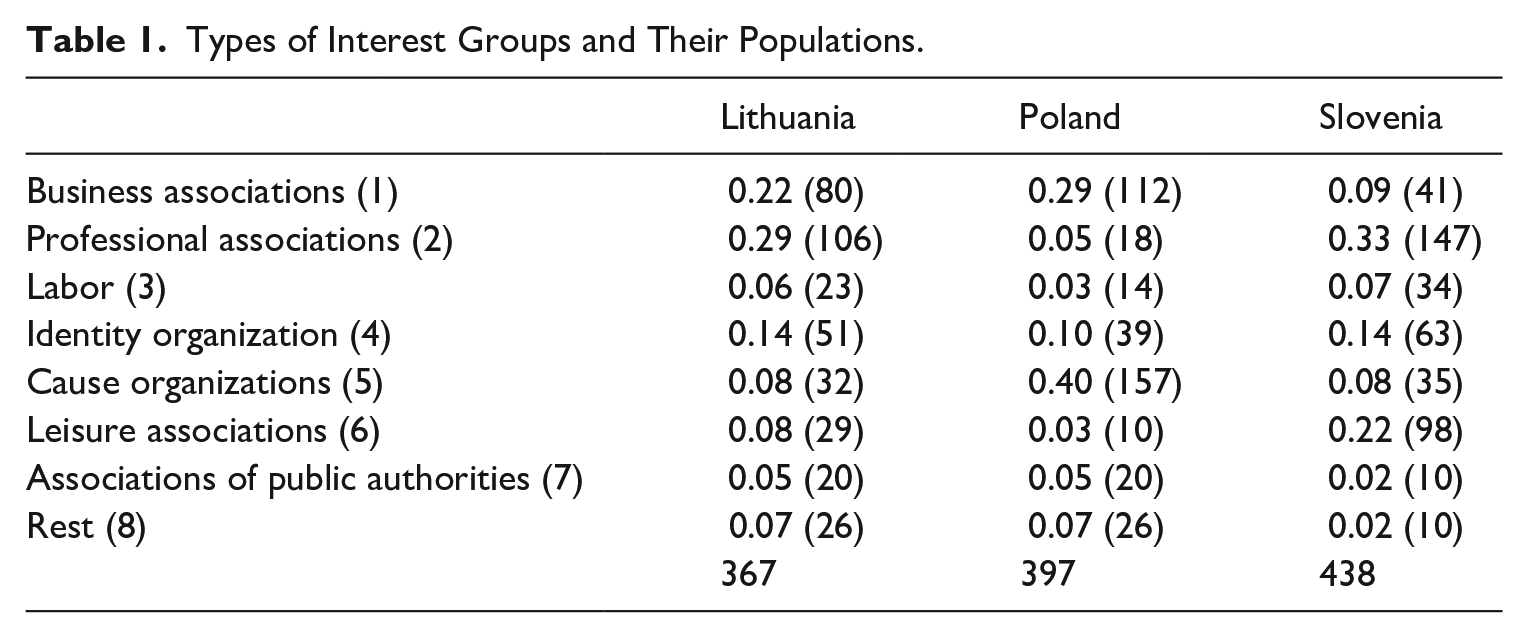
The Comparartive Interest Groups Survey project follows a broad definition of an interest group, where the group is an entity standing between the state and civil society. It aims to aggregate and represent the interests (e.g. companies, workers), a cause (e.g. the environment, health, consumers), or some constituency (e.g. refugees, unemployed, poor) (Beyers and Heylen, 2017). Therefore, it allowed us to catch a variety of groups: business associations, employers’ associations, citizens groups, trade unions, or third sector organizations. Exact numbers are presented in Table 1.
Types of Interest Groups and Their Populations.
Finally, among questions of the well-being of groups, their political strategies, organizational management, budget and its sources, and competition with other groups, questions were asked about their contacts with various political actors, including political parties.
Dependent, Independent Variables, and Methodology
Our dependent variable is contact with political parties, measured by the following question (QID32): During the last 12 months, how often has your group actively sought access to members, MPs, or officials affiliated with the following parties in the parliament?
The interviewees were presented with a list of major parties that have representatives in the European and national parliaments. The answer options were as follows: 0 = we did not seek access, 1 = at least once a year, 2 = at least once every 3 months, 3 = at least once a month, and 4 = at least once a week. The potential drawback is that this implies a very low threshold, namely, one contact a year is sufficient to be included in the category of the organization that established contacts with parties. The variable was dummy-coded to indicate “contact” and “no contact.” Groups that did not answer the question were discarded from the analysis.
To measure the groups’ budget, we asked (QID08): What was the annual operating budget of your organization in 2016 in Euros? The respondents were able to choose from eight categories; however, after recoding, it was scaled down to four categories—1: Small (<10,000 Euro); 2: Big (10,000–50,000 Euro), 3: Bigger (50,000–500,000 Euro); and 4: Wealthy (>500,000 Euro).
The membership size was measured by question (QID04): Listed below are different types of members. Please indicate for each type of member how many people/organizations support your organization. The respondents could choose the number of members from several categories (1–10, 11–100, etc.) and between different types of membership: individual, corporate, civil society organizations, and governments. The governmental membership was omitted as we are interested mainly in organizational types originating from society. We did not compute categories into one variable, as it is possible an interest organization offered membership to several groups, for example, individuals and corporate members.
The extent of subsidies and European funds was measured by question (QID09): Organizations get financial support from different sources. Please indicate the percentage of your organization’s 2016 budget that came from the various sources listed below. Respondents were asked to estimate the percentage influence (of 100% total) of each source: membership subscriptions, donations from individuals, contributions from corporate sponsors, funding from national governments, and funding from the EU programs. The variable is continuous (0–100) as they are estimations of percentages, for example, an organization might indicate 100% of their budget come from EU grant schemes. The sum of the two last categories was used in the analysis.
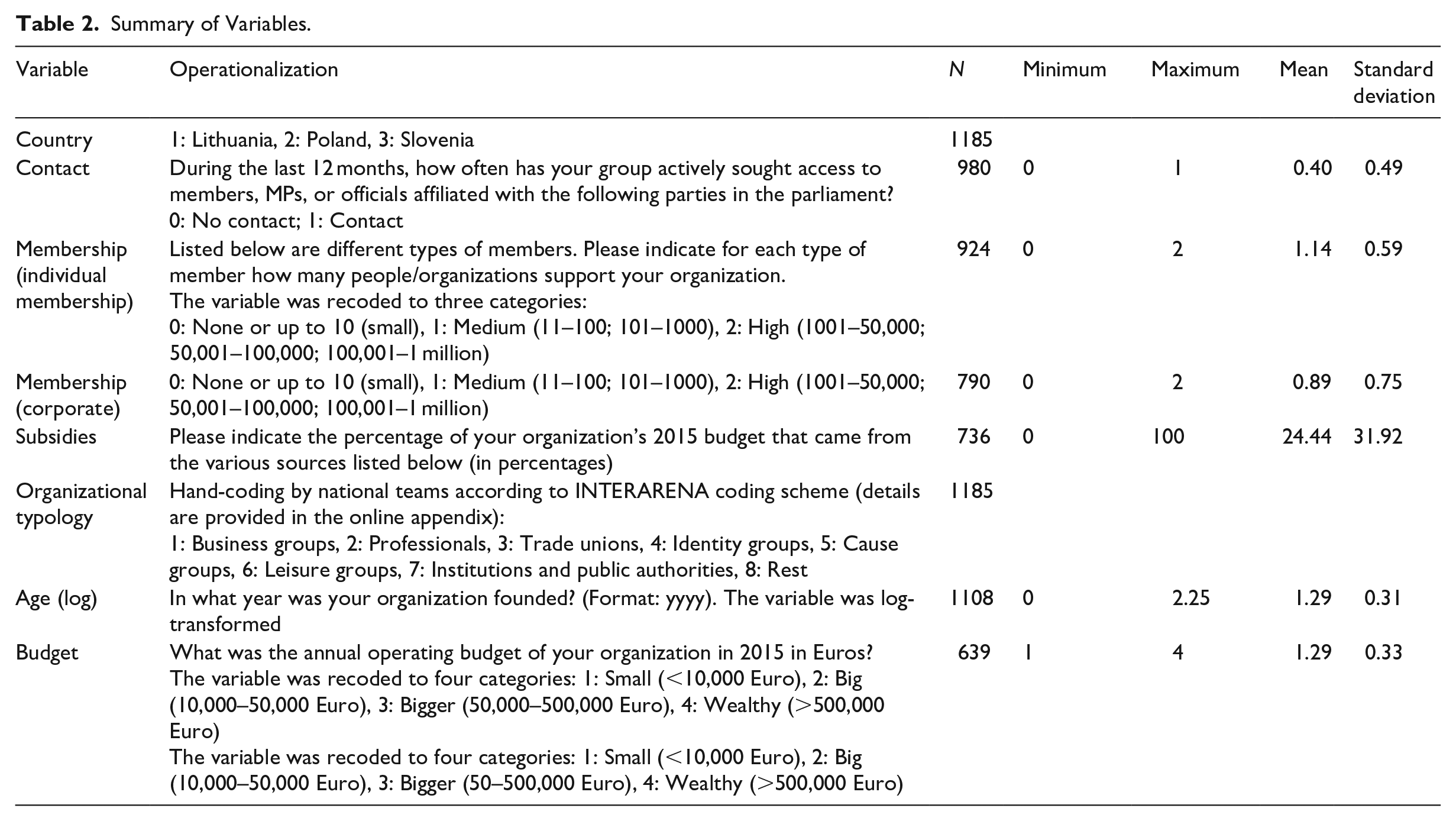
In addition, we use log-transformed age of the groups as a control variable. It was measured by asking the respondents about the year of the organizations’ establishment. Second, we controlled for group types, using INTERARENA typology scheme (Baroni et al., 2014) and that is: 1. Business groups, 2. Professionals, 3. Trade unions, 4. Identity groups, 5. Cause groups, 6. Leisure groups, 7. Institutions and political authorities, and 8. Other. To test our hypotheses, we use multiple logistic regression. Table 2 summarizes all the variables used in the article.
Summary of Variables.
What Explains Party–Group Interactions?
The descriptive statistics (Figure 1) show that indeed the frequency of contacts is much smaller in Slovenia than in two other countries. Only 30% of Slovenian interest groups report contacts with political parties. Interestingly, the electoral outcome does not always predict which one would be the groups’ favorite. It could have been argued that the most popular and the biggest parties should be contacted more often. However, for example, in case of Poland, Civil Platform (Platforma Obywatelska), which lost the last parliamentary elections, is almost as much contacted as the ruling Law and Justice (Prawo i Sprawiedliwość). It might show that there are other factors that groups see as valuable, possibly concerning the multi-level politics—either on a European or regional level. We briefly want to compare here the frequency of contacts with other institutions. 2 Interest groups contact ministries less frequently than political parties. No contacts reported 36% of organizations in Lithuania, 41% in Poland, and 33% in Slovenia. Contacts reported at least once a year were indicated by 20% in Lithuania, and 25% in Poland and Slovenia.
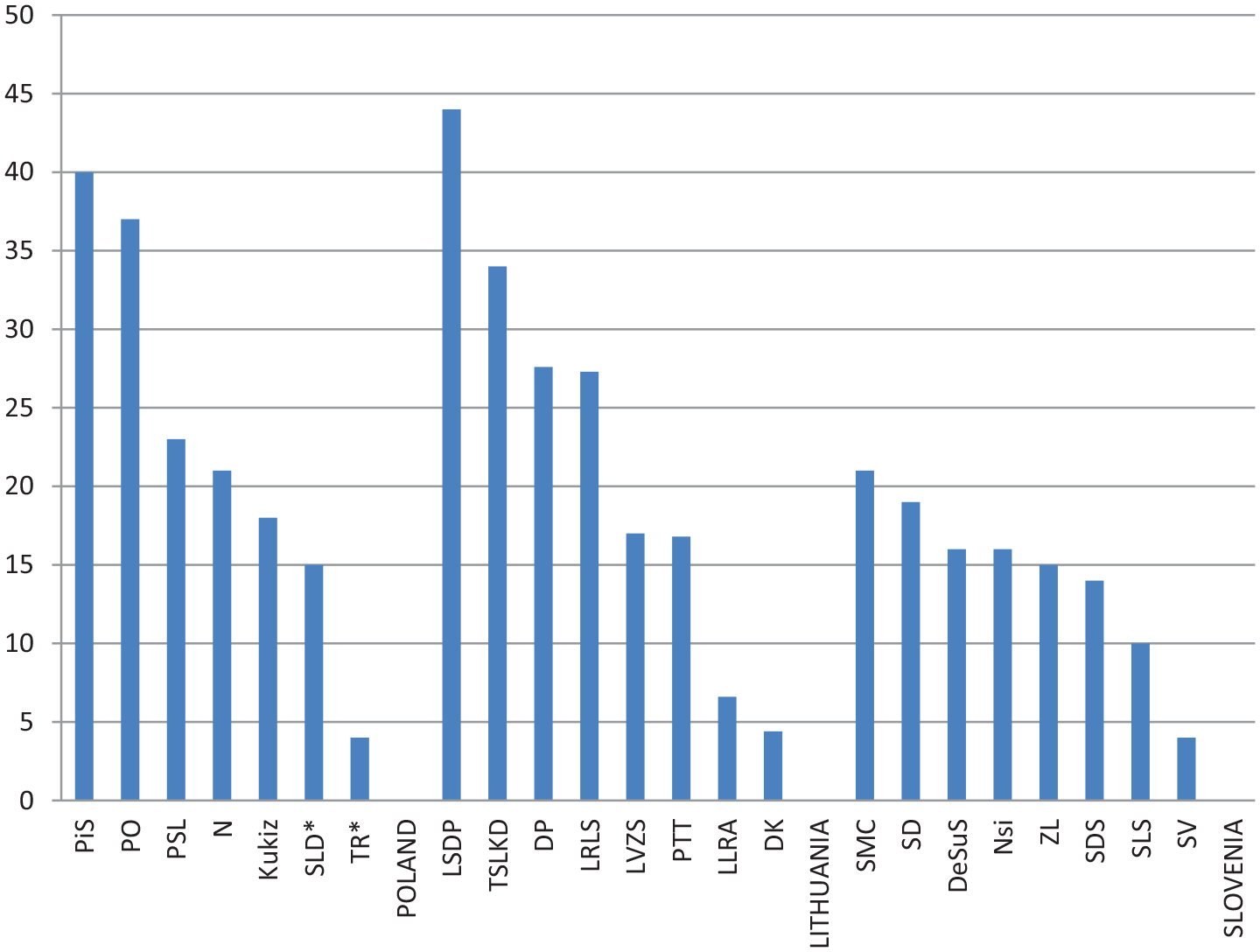
Percentage of Groups Declaring Contact with Political Parties.
Similarly, circa 50% of Polish and Lithuanian organizations show no contact with parties in government, while in Slovenia it is more than 60%. Circa 25% of groups in Poland and Lithuania report contacts at least once a year, while in Slovenia it is just under 15%. In the case of opposition parties, numbers are similar, with Poland being the only outlier as 30% of groups report contacts at least once a year, while in Lithuania it is about 20% and in Slovenia 15%. Interest groups are generally keener to contact civil servants in particular ministries. About a quarter of them in each of the three countries contact them at least once a year. The same goes for “once every 3 months”—about 20% in Lithuania and Poland, and 25% in Slovenia. Groups also rarely report contact with courts: 87% in Lithuania, 78% in Poland, and 74% in Slovenia have never had contact with the judicial system.
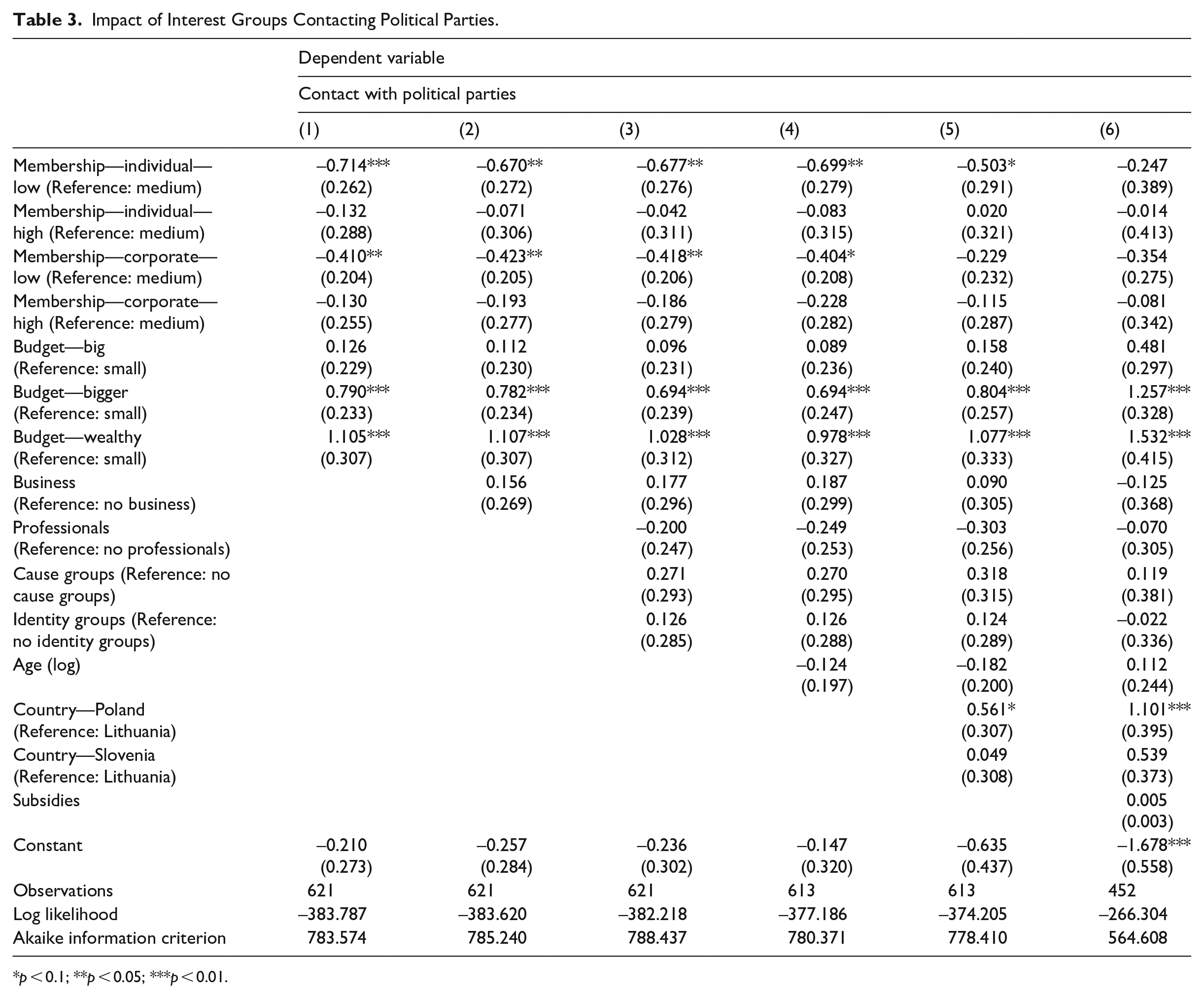
Table 1 shows the results of multiple logistic regression models. In Model 1, only membership and budget are involved. What seems to be clear is that interest groups’ financial resources do play an important role, being statistically significant. In Model 2, business groups were added; however, it has no effect throughout the analysis. In the next model (Model 3), we employed the group types dummies. In Model 4, we control for the age of organizations. In the fifth model, country dummies were added, while in the last model, we added the subsidies (the sum of funds received from EU and national grant schemes).
Table 3 presents the results of multinomial logistic regression, including coefficients and standard errors. In addition, Figure 2 shows average marginal effects (AMEs). The estimated AME allows us to accurately determine the influence of each variable on contacts with political parties as they are expressed as the change in the predicted probability that the outcome occurs that is associated with a one-unit change (Norton et al., 2019).
Impact of Interest Groups Contacting Political Parties.
p < 0.1; **p < 0.05; ***p < 0.01.
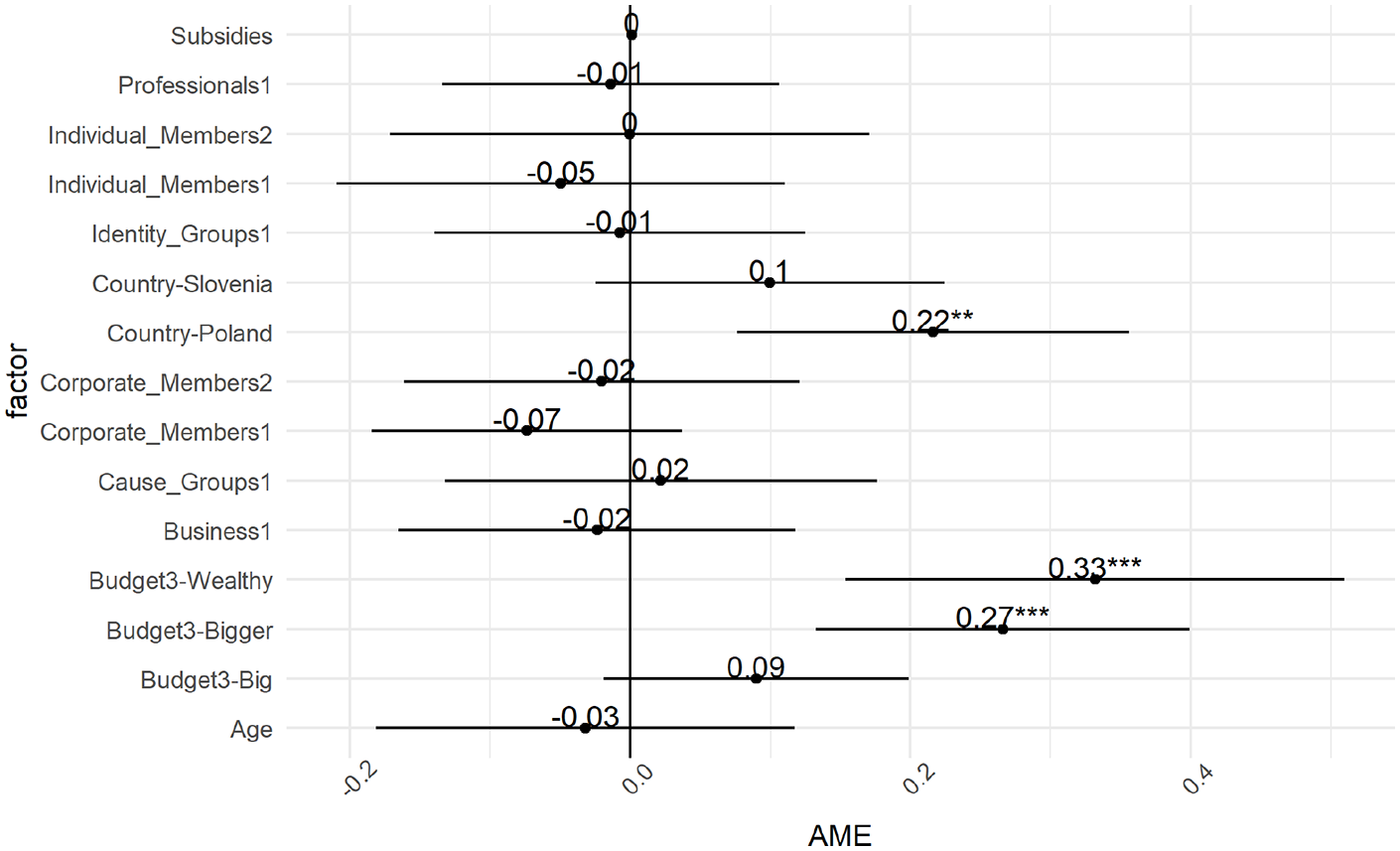
Average Marginal Effects for Contacting Political Parties.
We find strong evidence that financial resources aid the likelihood of contacting political parties. The marginal effect of a one-unit increase in budget between 50,000 and 500,000 Euro and above 500,000 Euro leads to a 0.27 and 0.33 change in probability in contacting political parties.
The variable is robust in every model employed. As it should be kept in mind that access does not necessarily mean influence, it is in line with current findings that financially privileged organizations might want to advocate more intensively. As the different models show, the overall levels of significance of the included variables were not affected as additional controls were added. Hence, we can confirm H1—financial resources is a useful predictor of groups–party contacts.
Second, we find no evidence that receiving subsidies might predict contacts with political parties. The size of significant effects is small if we look at the AMEs. More importantly, the pattern holds for every model employed in the analysis. Rasmussen and Lindeboom (2013), who did not find support for a similar hypothesis in Western Europe, argued that even though on one hand it might be incentivizing for groups to sustain a strong relationship with parties, on the other hand, state subventions may also make them less dependent. As it might be true for Western Europe, state aid in CEE countries is often perceived as make it or break it situation for many groups.
The puzzling element of the analysis is the fact that financial strength does not correlate with the influence of business organizations. Contrary to common wisdom, our analysis shows that business groups are not better positioned to have an access to policy makers, at least on the national level (see Bunea, 2013; Wonka et al., 2010). It should be mentioned here that controlling for other types of organizations—cause groups, identity groups, and professionals—did not weaken the model. Apparently, the financial inequality among interest groups is distributed across different organizational forms.
Finally, we find evidence that corporatist Slovenia demonstrates lower levels of the party–groups contacts than Poland. This finding is in line with what Rasmussen and Lindeboom (2013) observed in the case of the United Kingdom, the Netherlands, and Denmark. Interest organizations—especially trade unions and economic groups—participate in corporatist arrangements and enjoy privileged access to policy makers, but it appears to be happening on a governmental level.
Finally, we controlled for groups’ age as we could have assumed that older groups have over time developed more experience with political parties enabling them to initiate more networks. It could support the argument that interest groups and civil society as a whole are still young and not yet fully institutionalized. Moreover, it backs up the population ecology approach as groups come and go and there is not enough of survival of older organizations to play a significant role here. Finally, we controlled for the membership size of interest organization. Interestingly, however, the small number of supporters is associated negatively with the likelihood of contacting political parties, which would be in line with our expectations.
Conclusion
As a party–group research has gained recent scholarly attention, few scholars have been looking at contacts in new democracies, where the institutionalization of democracy is still an ongoing, and often bumpy, process. As researchers mostly agree that the times of close cooperation between interest groups and political parties in Western Europe are long gone, there has been little attention paid to validate this claim in young democracies from post-Communist Europe. Our findings add to a sparse cross-national, comparative literature of party–group collaboration and lay the ground for further analysis of democratic processes in Central-Eastern Europe.
Our study confirms that contacts between interest organizations and political parties in CEE persist; however, groups probably focus on lobbying other venues as much or more.
We can also confirm that financial power plays an important role in predicting contact with political parties. Wealthy groups contact politicians and possibly can influence policy-making processes in their favor. It also definitely weakens the hypothesis that interest groups are transmission belts between civil society and political parties as financial discrepancies are seen across different organizational types. As a result, many of the important societal interests might not be transmitted to politicians. This is particularly challenging as the concept of civil society is still fresh in CEE and, ideally, policy makers should be interested in building such channels of communication where more than one voice is heard. What is also interesting, the superiority of rich organizations does not translate into the advantage of business groups. Furthermore, according to our expectations, we found a higher level of interactions in pluralist Poland than in corporatist Slovenia. Overall, our analysis contributes to a growing body of literature devoted to understand the factors behind the party–groups contacts, taking also into account the context of new democracies.
Our findings are tempered by the limitations of the research design. One drawback was relying only on one side of the equation, namely, the data from interest groups. These groups provided us with the frequency of contacts with political parties, but we can only hypothesize whether some kind of organizational ties is here in play. Second, the data used came from three countries; therefore, we advise caution in attempting to make inferences about the whole post-Communist EU region.
Further research should focus on ideological positions of interest groups and how it is corresponding with political parties and issues salient for citizens, for example, whether it is possible that interest groups represent voters that do not see a proper representation within the party system (also see Kamiński and Riedel, 2021; Lefkofridi et al., 2014). Also, an interesting avenue for researchers would be to further expand the financial power angle and how it translates to political influence.
Supplemental Material
sj-docx-1-psw-10.1177_14789299221084167 – Supplemental material for It Is All About Money! What Drives Interest Groups’ Relations with Political Parties in Central and Eastern Europe?
Supplemental material, sj-docx-1-psw-10.1177_14789299221084167 for It Is All About Money! What Drives Interest Groups’ Relations with Political Parties in Central and Eastern Europe? by Pawel Kaminski in Political Studies Review
Footnotes
Declaration of conflicting interests
The author(s) declared no potential conflicts of interest with respect to the research, authorship, and/or publication of this article.
Funding
The author(s) disclosed receipt of the following financial support for the research, authorship, and/or publication of this article: The work presented in this article was made possible by research grant from National Science Centre (2021/41/B/HS5/01455).

Supplemental material
Additional supplementary information may be found with the online version of this article.
Contents
Table 1. Frequency of Contacts between Interest Groups and Ministers (Including Their Assistants/Cabinets/Political Appointees).
Table 2. Frequency of Contacts with Elected Members from the Majority or Governing Parties of Parliament.
Table 3. Frequency of Contacts with Elected Members from Minority or Opposition Parties of Parliament.
Table 4. Frequency of Contacts with National Civil Servants Working in the Prime Minister’s Office.
Table 5. Frequency of Contacts with National Civil Servants Working in Departmental Ministries such as Agriculture, Environment, Transport, Health, etc.
Table 6. Frequency of Contacts with National Civil Servants Working for the Coordination of EU Affairs.
Table 7. Frequency of Contacts with Courts.
Table 8. Multinomial Logistic Regression When “Once a Year” Is Coded as “No Contact.”
Table 9. Multinomial Logistic Regression When “Once a Year” Is Excluded from Analysis.
Table 10. Ordered Logistic Regression.
Figure 1. Predicted Probabilities of Budged (Model 6).
Notes
Author Biography
References
Supplementary Material
Please find the following supplemental material available below.
For Open Access articles published under a Creative Commons License, all supplemental material carries the same license as the article it is associated with.
For non-Open Access articles published, all supplemental material carries a non-exclusive license, and permission requests for re-use of supplemental material or any part of supplemental material shall be sent directly to the copyright owner as specified in the copyright notice associated with the article.
