







Abstract
How much can a celebrity’s involvement with a charity campaign change minds and shape political opinion? We explore this issue in the context of an appeal by Benedict Cumberbatch regarding the Syrian refugee crisis. We find that while the emotional, vivid images of the video did elicit a statistically significant increase in students’ positive feelings toward Syrian refugees and efforts to help them, surprisingly, Cumberbatch’s plea had no effect at all on these political views. Post-experiment focus groups allowed us to further probe these findings, and we suggest that viewer skepticism reduces celebrity influence, but that celebrity may be more effective as a “hook” in grabbing viewers’ attention, than in actually swaying their views. We also find that participation in a charity plea has the potential to benefit celebrities themselves by dramatically improving viewers’ perceptions of them.
Introduction
In the summer of 1985, the Irish musician Bob Geldof made celebrity politics history by organizing the stunningly large, multi-site Live Aid benefit concert event featuring iconic performers, such as Queen, the Four Tops, Madonna, and Paul McCartney. The event raised millions of pounds for famine relief in Ethiopia, successfully marshaling celebrity influence to raise awareness about, and funds for, a serious crisis. Scholars recognized the event’s political significance immediately, exploring how the “hype” inherent in popular music was “utilised to further advance the cause of famine relief” (Kenyon, 1985: 3). Though the event was controversial, particularly in hindsight, Geldof ultimately succeeded in applying the draw of popular music to the task of international aid (Westley, 1991) and illustrating the potential power of celebrity influence in driving politically related intentions and even behavior.
While Live Aid was a particularly dramatic example, celebrities have engaged in public political activity—in large and small ways—for decades. Celebrity endorsement of politicians, for example, has a century-long history in the United States. In more recent times, it has been normal to see a politician like Hillary Clinton flanked by Bruce Springsteen, Katie Perry, Lady Gaga, and the like. Yet, while we are generally willing to accept that celebrities are good at selling commercial products (Gunter, 2014), there is more skepticism regarding celebrity intervention in politics, whether as high-level fans of political candidates or as spokespeople for humanitarian or controversial issues. Do celebrities actually have the influence necessary to change attitudes or intentions about important social and political issues?
This article utilizes an experimental design in an effort to highlight the unique impact that celebrity influence can have on the success of an issue campaign. We seek to understand whether celebrities can influence someone’s views or intentions with regard to a highly politicized social problem. This experiment is unique in that it uses a real-life advocacy campaign—a video highlighting the Syrian refugee crisis from the charitable non-governmental organization (NGO) Save the Children, featuring the British actor Benedict Cumberbatch—to isolate the effects of celebrity endorsement. Our project builds on earlier experimental work that explored the role of celebrity in manufactured laboratory settings (Harvey, 2017; Nownes, 2011). Our hypothesis is that, among a young audience, the video featuring Benedict Cumberbatch advocating for Syrian refugees will be more persuasive than the same video sans Cumberbatch. We argue that while both videos increased concern for the Syrian refugee situation, Cumberbatch’s inclusion did not have an effect on attitudes or behavior intentions, while it did boost participants’ opinions of Cumberbatch himself. These results hold important implications for non-profit organizations as well as government agencies that choose to use celebrity appeals to spark citizen behavior in service of the goals of those organizations.
Literature Review
What Makes a Celebrity?
We live in an increasingly “media-drenched society” (Harvey, 2017) as the proliferation of communications technologies now allow us to literally engage with celebrities. In the United Kingdom, the advent of reality TV, social media, and a commercial news media have given rise to “an instant celebrity culture” (Wheeler, 2013). In the United States, scholars argue that celebrities are created by a “rationalized celebrity industry” (Meyer and Gamson, 1995) or an “image-making industry that tries to make people famous” (West and Orman 17). More outlets through which one can become a celebrity means that fame is becoming democratized (Meyer and Gamson, 1995). Marshall (1997: 13) suggests that this technological proliferation has created a “new public intimacy,” blurring the lines between the public and private spheres, and giving rise to a culture in which celebrities are seen as prominent actors (West and Orman, 2003), authentic (Meyer and Gamson, 1995), possessing unique kinds of capital (Gunter, 2014), legitimate (Wheeler, 2013), and in “institutional positions of power” (Tsaliki et al., 2011). Ultimately, our entire media ecosystem seems to be putting politicians and celebrities “on more level playing fields” (Harvey, 2017). Yet, while celebrities are becoming more prominent, are they truly relevant to the world of politics?
Street argued that celebrity politics can be examined in the context of two types of political actors. First, are the politicians who take advantage of forums within popular culture to advance their political careers or policy goals. Second, are the celebrities who wade into political controversies to advocate on behalf of an agenda about which they are passionate (Street, 2012). Our study focuses on the role of celebrities who wish to use their prominence to influence our attitudes and behaviors around a politically significant humanitarian issue.
How Do Celebrities Influence Politics?
Much of the scholarship on celebrity and politics explores the ways in which celebrities can shape politics. First, they are known for spotlighting important issues, bringing attention to a previously little-known problem through their ability to “command attention” and “outperform politicians” in the media (Harvey, 2017). For example, Driessens et al. (2012) examined the influence of celebrities in telethons—specifically, 2010 Flemish and Haiti relief shows. They argue that celebrity serves four distinct functions in political communication: they add “allusiveness” and “glamour” to a movement; they help to make an issue “relevant” to the public; they act as “principal motivators” who serve to set an example for the rest of the public to follow; they serve to help sell the charity and encourage the financial giving of the public. The authors caution that, while celebrity can be helpful, it often serves to portray complex issues as temporary problems that can be eradicated with individual donations. Consequently, framing of issues by celebrities can create misconceptions which undermine knowledge production and the sustained, multifaceted response necessary to address complex crises. Perhaps this is why Becker (2013) found that celebrity advocacy was more successful when the issue stakes were lower.
Celebrities have been successful at spotlighting issues related to international diplomacy, raising awareness about important topics through the UN initiatives (Wheeler, 2011). Atkinson and DeWitt (2018) find that celebrity witnesses in congressional testimony are three times as likely, relative to non-celebrities, to be the subject of reporting by the New York Times. However, they also suggest that “the average celebrity witness has no discernible effect on public issue attention.”
Second, celebrities can help shape political movements in a range of ways, for example, by bridging the gap between elite decision makers and political movements because those elite decision makers want to associate with key celebrities (Brockington, 2014) or by making political arguments—even unpopular ones—more appealing (Becker, 2010). In the context of climate change advocacy, celebrities have helped to motivate action and present a compelling “news hook” for the issue.
Yet, Anderson (2011) cautions that “media prominence is not necessarily a reliable indicator of influence. How issues are framed is of crucial importance and celebrity interventions can be a double-edged sword.” In an attempt to appeal to a larger audience, celebrities can water-down some of the more controversial elements of a political issue—leading to movements that can ignore some of the most important aspects of the issue (Meyer and Gamson, 1995). Celebrities may spotlight an issue and broaden participation in it, while overshadow local leadership, reframing movements “into more consensual, less controversial, and ultimately less disruptive affairs” (Meyer and Gamson, 1995).
Third, the literature suggests that there may be something about the personal characteristics of celebrities (and the populations they target) which serves to enhance or limit their ability to influence public opinion and/or political action. Indeed, some of the scholarship imagines celebrities as product pitchpersons and, consequently, the brand that they are endorsing is boosted by their own respective popularity (Mishra and Mishra, 2014). Beyond the literature specifically connected to celebrity influence, this work is also consistent with communication theories that posit that the characteristics of the messenger matter—things like charisma and attractiveness can add to the persuasive capability of an individual (Perloff, 2017).
Brown and De Matviuk discuss the dichotomy between identifying with a celebrity and having a “parasocial” relationship with a celebrity. Identification is finding a strong, personal connection with the celebrity—perhaps attempting to become more like the celebrity. Parasocial relationships are those relationships that we form with sports figures, movie stars, television stars and the like—these relationships are both intellectual and emotional. Identification, because it is about finding identity in the celebrity, is the more powerful type of relationship. The authors look at the case of Diego Maradona, an Argentinian soccer player, who struggled with drug use. They find that those who had an “identifying” relationship with Maradona were less likely to be influenced by drug prevention messages relative to those who merely had a parasocial relationship with the soccer star.
Click et al. (2017) examine the “Little Monsters”—the term used to describe the fans of Lady Gaga—and the way in which this group is powerfully influenced by the political values and activism of Lady Gaga. Ethnographic research into Angelina Jolie’s efforts in Burma provided a nuanced portrait of celebrity involvement in other countries. Specifically, Jolie created a sense of hope in the region, but the sentimental frame surrounding her work prevented a sincere discussion of political and economic obstacles to meaningful change (Mostafanezhad, 2017). Similarly, Farrell studies Bono and the Product (RED) campaign designed to address AIDS across sub-Saharan Africa. The author highlights the consumerism at the heart of this form of celebrity involvement which relies on people buying products. Commodification might negatively impact public perceptions of international crises and exacerbate the problematic dimensions of global capitalism (Kapoor, 2013).
Even more critically, Repo and Yrjölä (2011) posit that celebrities like Bono, Bob Geldof, and Angelina Jolie, through their work in African countries, “recreate Africa and its proper place in the neoliberal international system through a performative perpetuation of historically embedded subjectivities.” The result is a humanitarianism that assumes African countries should take a “childlike position in the western imaginary.” Chouliaraki (2013) argues that this form of activism serves to make us part of a kind of theater where we serve as “ironic spectators” to the atrocities of the world—and where our involvement in solving these problems only extends as far as we see benefits to ourselves. In his work, van Krieken (2015) makes the case that celebrity humanitarianism is just an instantiation of settler colonialism.
Jackson states that “young people are significantly more likely to agree with a position when it is endorsed by a celebrity.” However, the success of celebrity campaigns depends on the particular celebrity as well as whether or not there is “an appropriate match-up between idea and endorser.” The most common way for these young persons to receive celebrity messages is through social media platforms (Nisbett and DeWalt, 2016). The study of celebrity is particularly important for young people given that they are less connected to traditional politics and often receive political information from popular culture (Inthorn and Street, 2011).
What Methodological Techniques Have Been Used to Evaluate Celebrity Influence?
In this article, we use both an experimental design and follow-up focus groups with participants in the experiment. Previous research has made extensive use of survey research to examine celebrity influence (Brown and de Matviuk, 2010; Harvey, 2017). In addition, many scholars have opted to use experimental designs to approach this topic (Becker, 2013; Friedrich and Nitsch, 2019; Mishra and Mishra, 2014; Morin, 2012; Nownes, 2011). Experimental designs are uniquely helpful in that you can more carefully identify the direction of causality—do celebrities influence attitudes, intentions, or behavior? In survey research, you may be able to say that fans of a particular celebrity care about an issue but you cannot definitively say whether that support is due to the influence of the celebrity or unique attributes of the fans of said celebrity. In addition, there is a long history of qualitative work on the topic of celebrity, which have contributed nuance and foundational theoretical models to the conversation (Brockington, 2014; Click et al., 2017; Conley and Schulz, 2004; Drake and Higgins, 2012; Driessens et al., 2012; Farrell, 2012; Gunter, 2014; Meyer and Gamson, 1995; Mostafanezhad, 2017; Nisbett and DeWalt, 2016; Repo and Yrjölä, 2011; Street, 2004, 2012; Wheeler, 2011, 2012, 2013; Yrjölä, 2011).
One of the contributions of this article is to encourage more mixed method research designs. Nisbett and DeWalt (2016) used focus groups in their analysis, yet the combination of experimental research and focus groups has not been used in the study of celebrity influence. The student focus group conversations we include demonstrate that there is much to gain from seeking additional insight from participants in experimental research.
Materials and Methods
Our goal in this project was to determine the effects of celebrity on two key outcomes: individuals’ views on an important and pressing political problem and their behavior intentions, or their willingness to do anything about it. To achieve this, we developed an experiment and conducted follow-up focus groups. The Institutional Review Boards for each institution approved the research. 1 For the experimental portion of the study, we recruited current undergraduate students 2 by email and asked them to complete a pre-test which asked about their knowledge of, and views on, the Syrian refugee crisis, 3 any activism they may have engaged in regarding refugees, and asked them to complete feeling thermometers for Syrian refugees, White people, Muslims, and Donald Trump. We then randomly assigned respondents to watch one of two versions of a video created by the charity Save the Children. 4 Half of the respondents saw the original 5-minute 50-second video in its entirety, which featured actor Benedict Cumberbatch (for 1 minute 25 seconds of screen time) reflecting on the crisis and introducing footage of the Syrian refugee crisis, along with an accompanying request to send money to support Save the Children. The central goal of the video is to make people aware of the dire nature of the Syrian refugee crises and to urge them to support Save the Children’s efforts to care for refugees. The other half watched a 4-minute 25-second version of the video which included the emotional footage and call to send money to the charity, yet which we had edited to remove Cumberbatch’s comments and introduction. In this edited version of the video, Cumberbatch was neither seen or heard. 5 While Cumberbatch’s screen time is short, making up less than 20% of the original video, it is typical of similar campaigns that involve a celebrity spokesperson making a serious and sincere plea alongside a traditional charity advertisement.
All subjects watched the videos online via their personal devices, using a link we included in the survey instrument, and we included a basic content knowledge question in the post-test to ensure students watched until the end of the video. The response to the content knowledge question assured us that the participants generally paid close attention to the video; 83% of those who were randomly assigned the video with Cumberbatch’s introduction were able to accurately identify the video’s repeated “tagline” of “help is coming.” We chose a video featuring Cumberbatch in part because of his popularity, which the survey confirmed. 79% reported knowing who Benedict Cumberbatch is, and he was more recognizable than other recently-popular actors (Lupita Nyong’o was recognized by 53% of respondents), though he was not as universally known as long-established stars like Angelina Jolie (98%) and Leonardo DiCaprio (99%).
Data from our focus groups confirm that Cumberbatch was not only popular, but that students’ impressions of him were overall quite positive. The focus group participants had only positive—if occasionally vague—impressions of the actor. Each participant at least recognized him and ranged from a student who knew “that he was a pretty solid British actor” to another who said, “I’ve always really liked him. I think he is funny, and I liked him in ‘The Imitation Game.’” The sample also included some fans of the BBC series “Sherlock,” in which Cumberbatch starred. Yet none of the students knew anything about him beyond his acting, except for a generally positive sense that “he seems like a nice guy.”
After they had finished watching the Save the Children video, we asked respondents to complete a post-test survey which repeated some of the pre-test survey questions to see whether the video had shifted their views of the refugee crisis. This allowed us to compare the change in pre- and post-test responses between students who had watched the Benedict Cumberbatch version of the video and those who saw the edited version—measuring the overall impact of celebrity in this case.
We conducted the experiment and focus groups over 2 weeks in March 2018, at Universities 1 and 2, both liberal arts institutions in the Pacific Northwest with fewer than 3000 undergraduate students. 6 We received a total of 647 usable responses from the survey, and found that women responded at a higher rate than men. 65% of the respondents identified as women, 34% as men, and 2% self-reported a non-binary gender identity (N = 523). 7 We conducted three focus groups across two universities with students who had watched the Cumberbatch version of the video. Students were offered a US$10 incentive and given the option to volunteer for the focus group when they completed the post-test survey. We found no statistically significant differences between the treatment and control group on any of the metrics used in the pre-test survey tool. 8
Results
We find that the video, with its emotional, visually-compelling plea for support, does have a strong, positive, and significant impact on students’ attitudes about the Syrian refugee crisis, as well as their intentions to act in response to the crisis (e.g. by donating money). We also find that Benedict Cumberbatch’s role was not a key factor in driving these changes. However, the video does seem to produce positive attitudes toward Cumberbatch.
The Video Itself Has a Positive Impact on Attitudes toward the Syrian Refugee Crisis
We created pre- and post-test indices to measure the participants’ change in views of the Syrian refugee crisis. In the pre-test, we asked respondents to identify their preexisting attitudes and actions in relation to the Syrian refugee crisis. On a 7-point scale (from “Strongly Agree” to “Strongly Disagree”) participants were asked to respond to the following statements: I care a great deal about the Syrian refugee crisis. The US should allow more refugees into the US. Allowing more Syrian refugees into the US could have negative economic effects. Allowing more Syrian refugees into the US will increase the risk of terrorism in the US. The international community should do more to assist Syrian refugees. The US should do more to assist Syrian refugees by sending aid money and supplies to support refugee camps in the Middle Eastern countries where Syrian refugees have fled.
Likewise, we asked whether individuals had taken these steps already:
Talked to friends or family about the Syrian refugee crisis. Shared information/articles or posted about the Syrian refugee crisis on social media. Donated money to an organization working to help refugees. Contacted your congressperson or senator to express your concerns about the Syrian refugee crisis. Volunteered with an organization (if so, which). Voted in a political election for a candidate you believed would assist refugees. Other.
The questions were asked in both the pre- and post-test surveys. If their attitudes or propensity to engage in activism changed significantly, then it would be reasonable to argue that the change(s) were a result of exposure to the video.
In Table 1, we see that there was not a statistically significant difference between the control and the experimental group with respect to their attitudes and behavior intentions toward Syrian refugees as a result of the exposure to either the Cumberbatch or Cumberbatch-less video.
T-Test for Control/Experimental Groups Regarding Desired Syria Response. a .
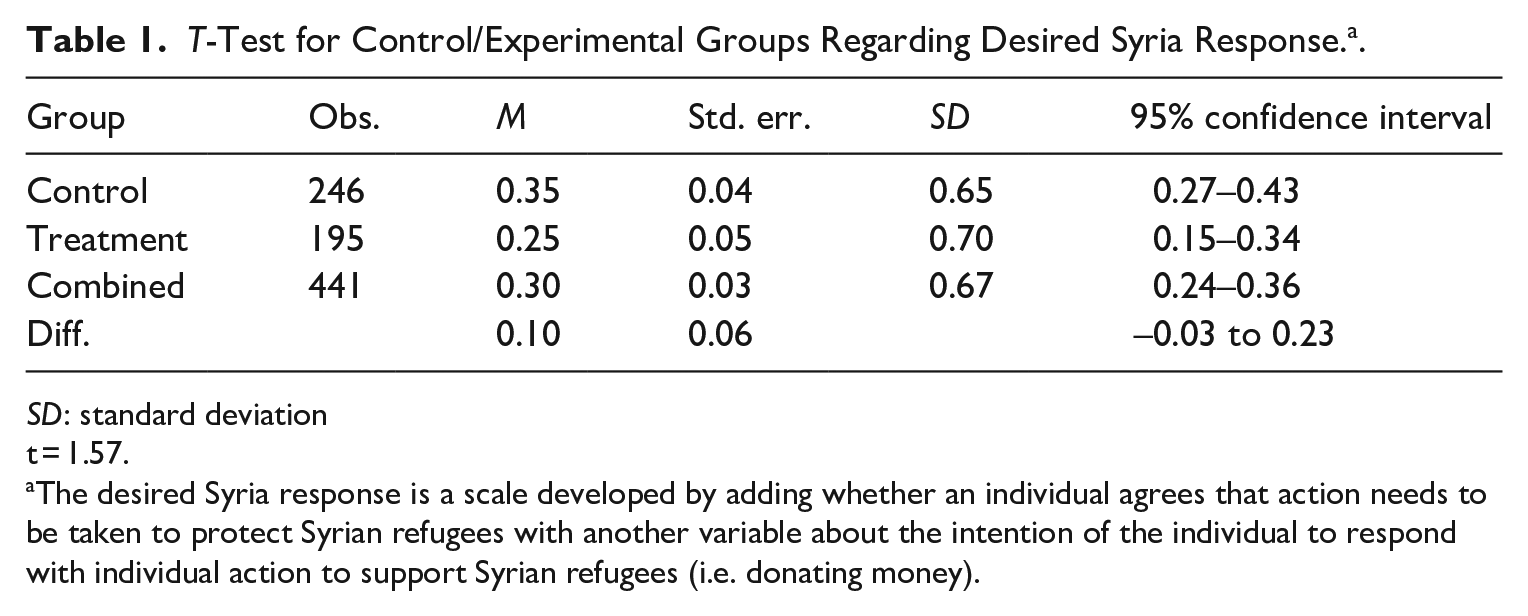
SD: standard deviation
t = 1.57.
The desired Syria response is a scale developed by adding whether an individual agrees that action needs to be taken to protect Syrian refugees with another variable about the intention of the individual to respond with individual action to support Syrian refugees (i.e. donating money).
We can further explore the relationship between the videos and the viewer’s response to the Syrian refugee crisis by looking at the control and experimental groups separately. In Table 2, the statistically significant results suggest that individuals in the post-test were dramatically more likely to experience an attitudinal or behavior intention change in their orientation to Syrian refugees (in the direction of becoming more supportive of said refugees) because of exposure to either the treatment or the control video. Looking at both groups separately, we see essentially the same result (Tables 3 and 4).
Pre–Post Test Results for All Respondents Regarding Desired Syria Response (Paired Sample T-Test).
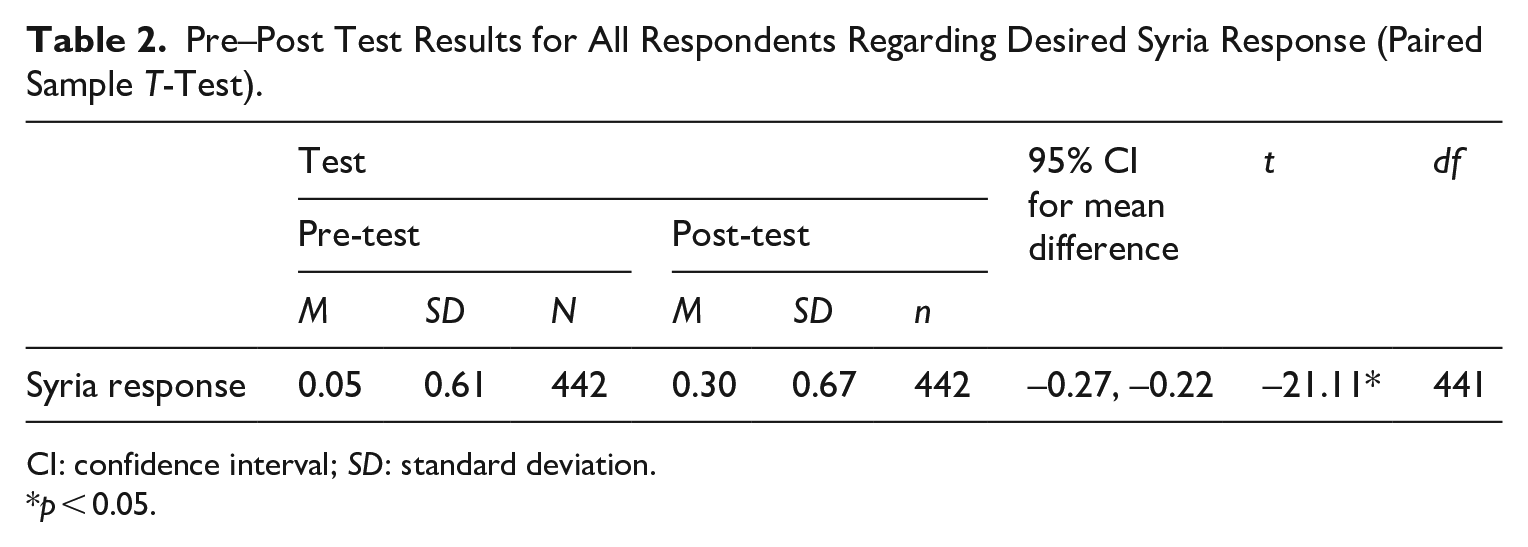
CI: confidence interval; SD: standard deviation.
p < 0.05.
Pre–Post Test Results for Control Group Regarding Desired Syria Response (Paired Sample T-Test).
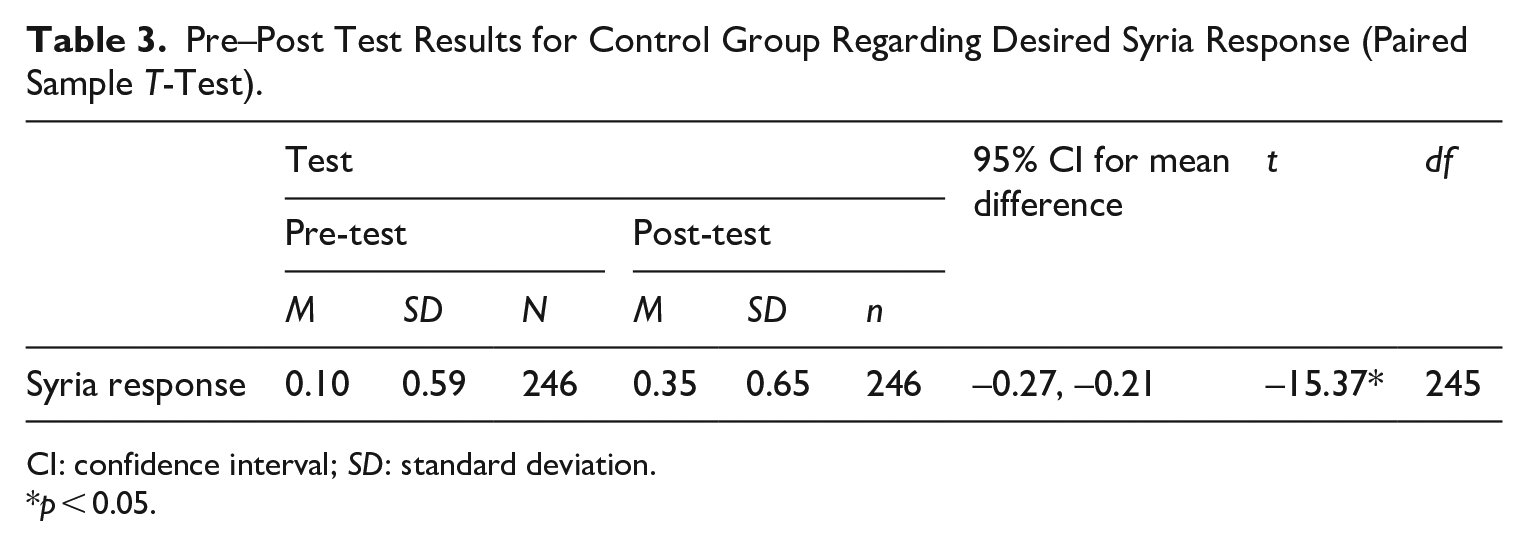
CI: confidence interval; SD: standard deviation.
p < 0.05.
Pre–Post Test Results for the Treatment Group Regarding Desired Syria Response (Paired Sample T-Test).
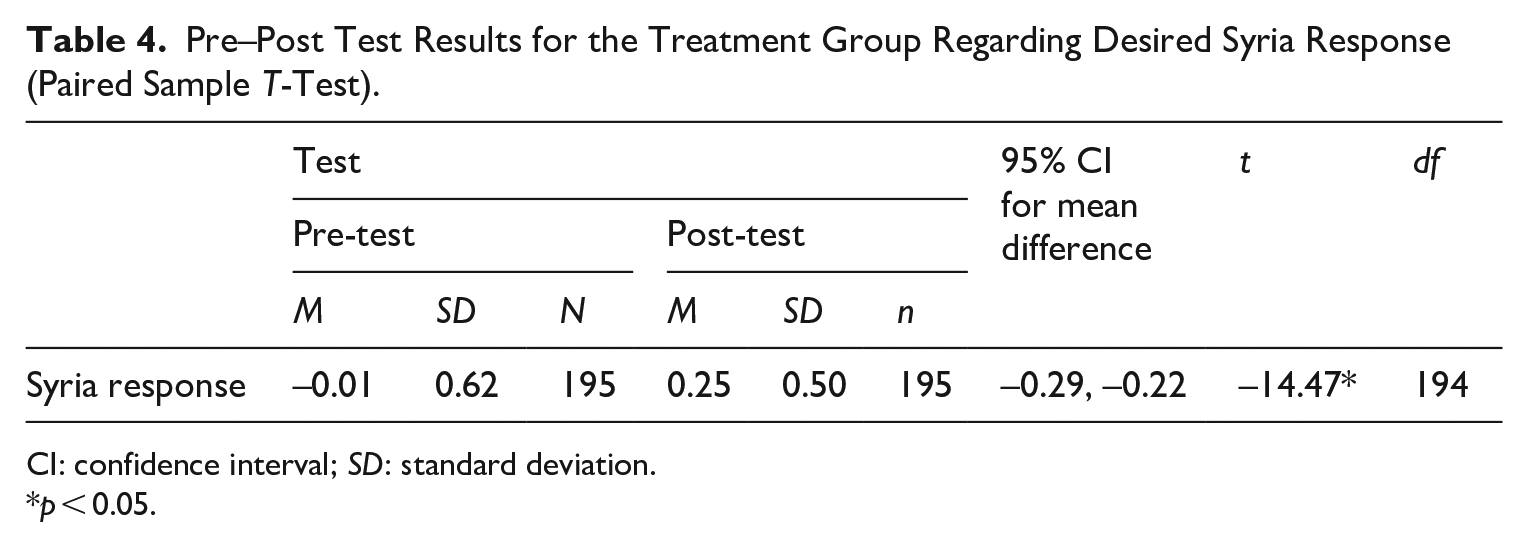
CI: confidence interval; SD: standard deviation.
p < 0.05.
Most focus group participants identified the poem that Benedict Cumberbatch reads (Warsan Shire’s “Home”) at the beginning as the most moving element of the video. While several identified the images of Syrians, especially young people, and the impact of learning 11 million people are displaced as the most compelling elements of the video, most focused on the poem. One student explained: the part where [Benedict Cumberbatch] said ‘people don’t leave their homes unless it is in the mouth of a shark,’ that’s true. I wouldn’t leave my home unless a boat was safer. That really touched me, because it reminded me of the little boy who washed up on shore. That was a huge thing for my mom and our family because I had a little brother that was that age at that time.
Another responded, “yeah, you’re right. Why would they totally flee their home, their neighborhood, their community, their jobs, things like that, if it wasn’t just extremely dangerous and they need to get out and go somewhere safer?” Students also referred to the video’s emotional nature, one referring to it as “pathos heavy,” and they found themselves drawn in by the real stories, and images, of refugees.
These results suggest that the emotional images were sufficient in and of themselves to shift opinions on this issue. Indeed, during our discussions students initially appeared most interested in discussing the general content of the video, rather than Cumberbatch’s role in it; though students commented on things he said, we had to prompt them with more questions before they gave their thoughts about his role as a celebrity spokesperson. Once we did, nearly all of the focus group students were adamant that they had not been influenced to do anything with regard to the Syrian refugee crisis as a result of Benedict Cumberbatch featuring in the video, nor did his involvement increase their interest in the story. A University 1 student said that she is not “heavily influenced by people with high statuses,” and another agreed, saying, “I don’t think that it changed my opinion at all . . . just the video itself, brought attention to the issue, but not because [of] his involvement, it didn’t make me care and want to get involved.” A number of others highlighted this idea as well, that the Syrian footage in the video, not the celebrity element, was what had an impact on them. One exchange in a University 2 focus group illustrates this:
I don’t think that Benedict’s role played a huge part in swaying me either for or against.
His involvement had a negligible impact on me, positively or negatively, in terms of my concern for the situation or my desire to do anything. It didn’t really affect it.
I do feel as though if you took out the clips of Benedict Cumberbatch I might have been more convicted than with those in there.
Yeah I think so too. Not a great deal, but I probably agree with that.
Me too.
Sorry, Benedict.
(Laughter)
Skeptical Students Are Suspicious of Celebrity Charity Pleas
We found that university students are generally skeptical of both celebrities and charity campaigns. A woman at University 1 put it this way: I am hesitant whenever celebrities get involved with these type of things . . . I don’t know a ton about Benedict Cumberbatch . . . [beyond his movies]. He’s a good actor, so that’s cool. But sometimes I wonder if they are getting paid for this, or their agent wants them to do it for good publicity and stuff like that . . . I’m just like, “is this guy actually legitimate?”
A fellow student replied, “I have to agree. I need to see if they are actually doing it themselves. If they have done more [to help] then just the video.” This theme returned throughout the focus groups, as students circled back to the issue of trust. “In general, with actors,” one student said, “it’s kind of hard to say, ‘oh is he being genuine or is he playing a character? How much does he mean this or is he just acting?’ It’s kind of hard for me to trust actors in general.”
Some students were quick to identify Cumberbatch’s inclusion in the video as a gimmick. One student reported that his “instant reaction” to Cumberbatch’s involvement was “skepticism because I feel like celebrities are often used to increase the exposure or the response to a certain call to meet a need.” Another student, while recognizing the potential allure of the celebrity placement, said that she thought, “this might be one of those videos, where it’s just, ‘oh my gosh there’s a celebrity so I’m going to donate money.’” In another group, a student pointed out that, again, “that is just a problem with actors. Put Benedict Cumberbatch, put Patrick Stewart up there,” he said: and they can probably just give a performance. And it’s like okay, nice job, you get a Grammy. If you want me to care about the issue, you need to tell me more about the issue, it doesn’t really matter who is saying it.
While our focus groups were small, we found that some people were more inclined toward skepticism than others. For example, of the four students who expressed the most skepticism in our discussions, three were men and only one was a woman. Not only did they express skepticism of both celebrities and charitable nonprofits, as discussed, they were also insistent that celebrity had little effect on them. Skepticism was clearly linked to a student’s assessment that they were not swayed by Cumberbatch’s inclusion in the video, suggesting that the frequent use of celebrities in charity campaigns may be making their role ineffective as viewers sense an attempt at manipulation.
Each Video Worked, But the Impact Varied Based on Attitudes toward Cumberbatch
We were curious about whether holding positive feelings toward Cumberbatch before viewing the video would make someone more inclined to experience attitudinal or behavioral shifts in the direction of supporting refugees (positive values are indicative of a more supportive attitude toward the plight of refugees and a desire to act personally in response to the crisis or for institutions to pursue a more proactive response with respect to the crisis).
The ordinary least squares (OLS) regression presented above suggests that attitudes toward Cumberbatch were not significantly related to the way that individuals processed the video (Table 5). We included a feeling thermometer for attitudes toward Cumberbatch as well as an interaction term for attitudes toward Cumberbatch and whether the respondent was or was not part of the treatment group. The results suggest that the feeling thermometer rating was not related to attitudes and actions in support of refugees regardless of whether the respondent was included in the treatment or the control group. Gender appears to be related to the response to the video—with those identifying as female significantly more likely to express support for Syrian refugees. Likewise, knowledge of the crisis, holding liberal political beliefs, and identifying as a democrat were all related to more positive attitudes and intentions to support Syrian refugees.
OLS Regression with Desired Syria Response as the Dependent Variable.
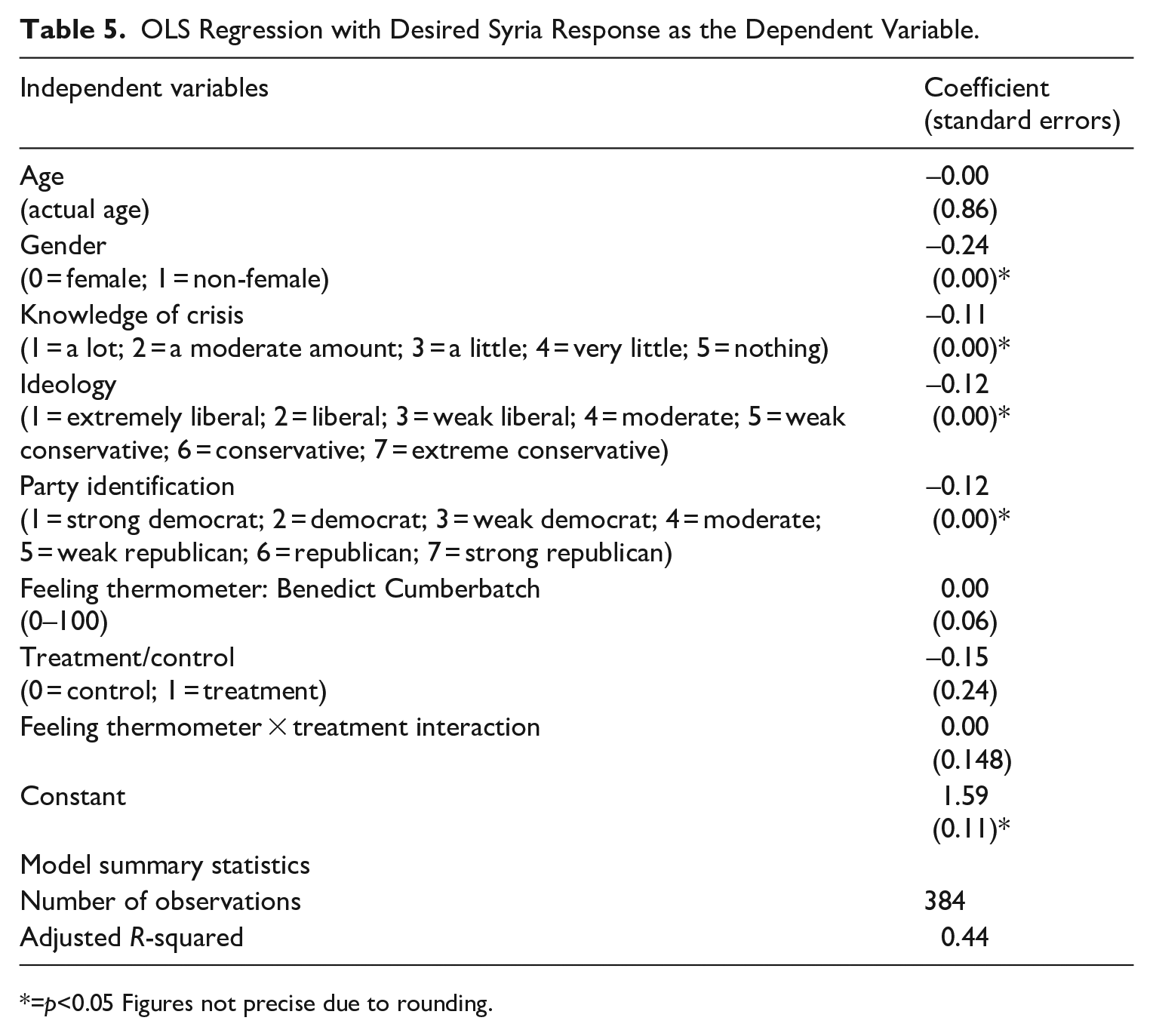
=p<0.05 Figures not precise due to rounding.
While attitudes toward Cumberbatch do not seem to change the response of respondents to the video, the regression does include interesting relationships between certain demographic characteristics and openness to attitudinal and behavioral support for Syrian refugees. For example, respondents who identified as female were significantly more likely to express support for Syrian refugees in the post-test relative to those with a different gender identity. In the focus groups we found that women respondents were more likely to express empathy for the refugees, whereas the few people who focused on the Syrian civil war itself, or brought up potential security concerns related to refugees, were men. As discussed above, men were also more likely to express skepticism toward Cumberbatch’s role in the video and charities in general. Likewise, whether the participant had preexisting knowledge of the Syrian refugee crisis was a significant factor—those who had an understanding of the issue were less supportive of any response to the Syrian refugee crisis. The focus groups confirmed that—with only a few exceptions—the students knew very little about the refugee crisis, “I honestly did not really know that much about it before watching the video,” admitted one woman. And those who knew something about the Syrian situation tended to have heard more about the conflict than the refugee crisis; students reported hearing that “Syria is a mess” or that “there was a lot of bombing.” One student remembered that he had learned some things in class, “about the whole issue in Syria with their dictator,” asking, “what was that guy’s name? I forgot his name . . . I was shocked [to learn that] there was 11 million [refugees] that were fleeing.” Only three students across all three focus groups reported that they knew some specific details about the refugee crisis.
As mentioned above, the closer someone was to identifying as Republican or conservative the less likely they were to support Syrian refugees. The focus group respondents avoided speaking in partisan terms, though one man did reference vetting and terrorism, both common conservative talking points, saying: I’m not opposed to accepting refugees from Syria into the country as long as the concerns about the ability to vet those individuals, concerning the types of activity that come out of that area as far as terrorist activities [are addressed] . . . [there is] evidence that we have from federal intelligence agencies that certain extremist terrorist organizations have announced . . . that they have the intention of basically taking advantage of the compassion of others by infiltrating the refugee population . . . And so as long as we are addressing that concern rationally and reasonably, and making sure that the techniques [used to] vet the individuals coming into the country [I have no objection to accepting refugees into the country].
While only one student mentioned these concerns, they do underlie partisan views that are likely linked to self-identified Republicans’ less positive views of Syrian refugees.
The campaign focused on the need to raise money in support of Syrian refugees. While the dependent variable above included the respondent’s intention to donate, we also isolated the intention to donate as a separate dependent variable in Table 6.
Logistic Regression Measuring Intent to Donate Money by Experimental Grouping.
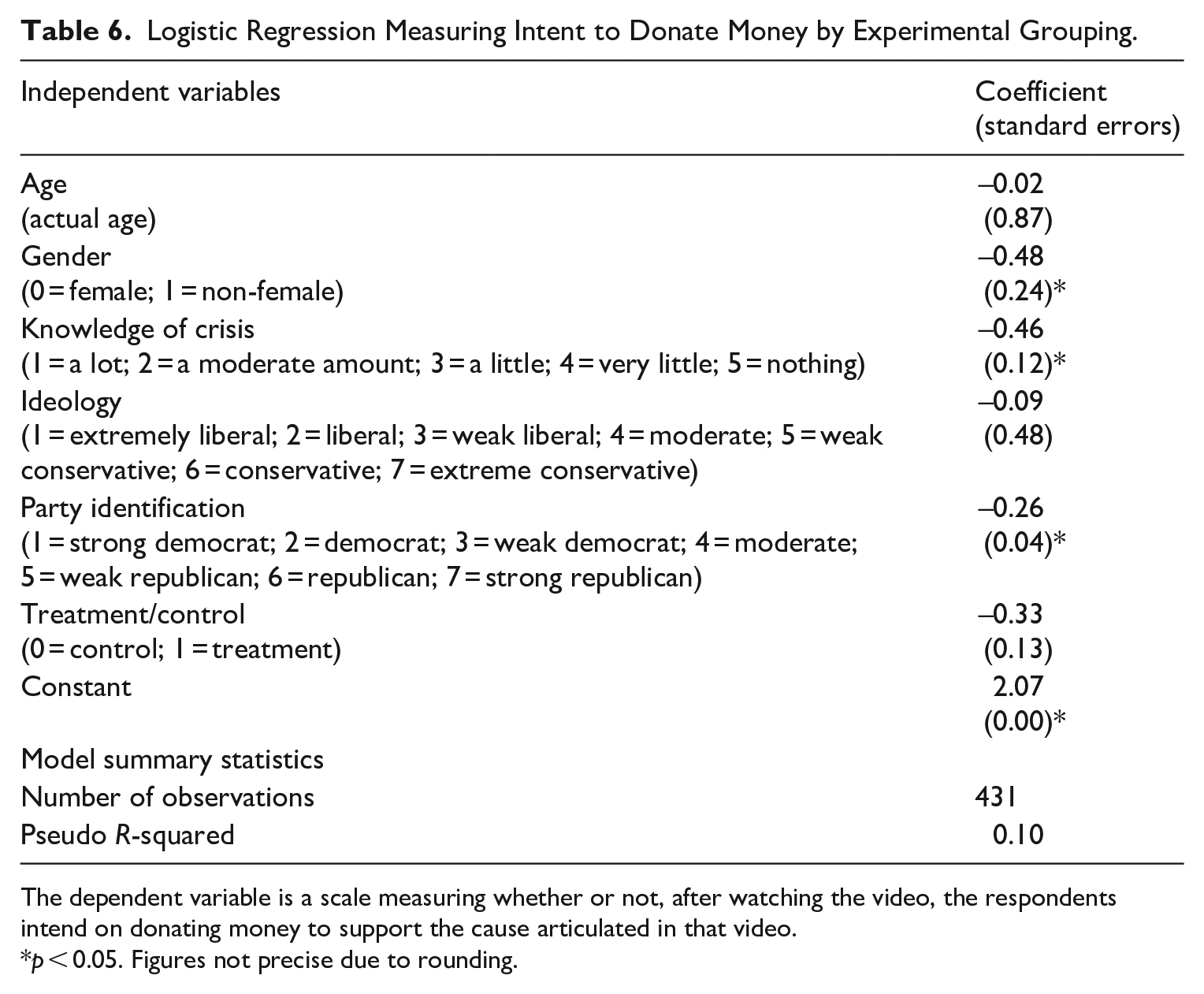
The dependent variable is a scale measuring whether or not, after watching the video, the respondents intend on donating money to support the cause articulated in that video.
p < 0.05. Figures not precise due to rounding.
Because the dependent variable is dichotomous, we used a logistic regression. The results suggest that the respondent’s placement in either the control or experimental group was not significantly connected to their intention to donate funds on behalf of Syrian refugees. The only statistically significant results were with respect to the respondent’s party identification. Specifically, for party identification, moving from “strong democrat” toward “strong republican” makes someone less inclined to donate.
We also measured whether or not the post-test responses significantly differed from the pre-test responses on the question of whether or not the participant was more or less likely to donate money after exposure to one of the videos.
Exploring the differences between the control and experimental groups in Table 7, we see that, contrary to expectations, the Cumberbatch-less video was actually significantly more likely to produce a desire among participants to donate money to support Syrian refugees.
Pre–Post Test Results for All Respondents Regarding Desire to Donate Money (Paired Sample T-Test).
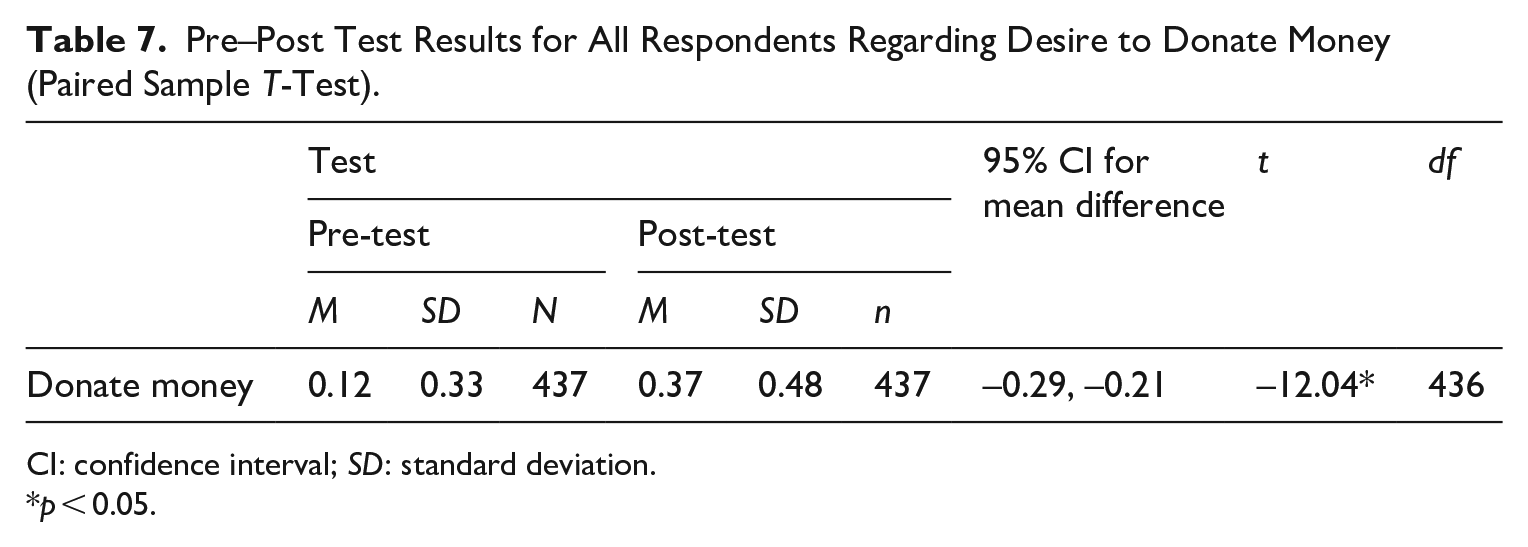
CI: confidence interval; SD: standard deviation.
p < 0.05.
These results provide evidence that both the videos produced their desired effect. However, it is important to note that this variable measures intention to donate and does not measure whether or not the participant followed through with respect to that donation. Both the control and treatment groups were more likely to indicate a desire to donate to the effort in the post-test as evidenced in Tables 8 and 9. Some students explained that they wanted to give, but felt unable to do so. “I was a little conflicted,” shared one woman, “because I wanted to help, but finances is not a good way for me to help.” Others expressed a strong sense of helplessness: “What’s there to do? It’s all going on across an ocean,” lamented a man studying biology. “I feel like things like this always make me feel really small. So, I always feel like I can’t really do much . . . we are just college students.” That the quantitative data show the video had an overall positive impact on viewers’ intention to donate is particularly compelling given the lean financial position in which many college students see themselves.
Pre–Post Test Results for Control Group Members Regarding Desire to Donate Money (Paired Sample T-Test).
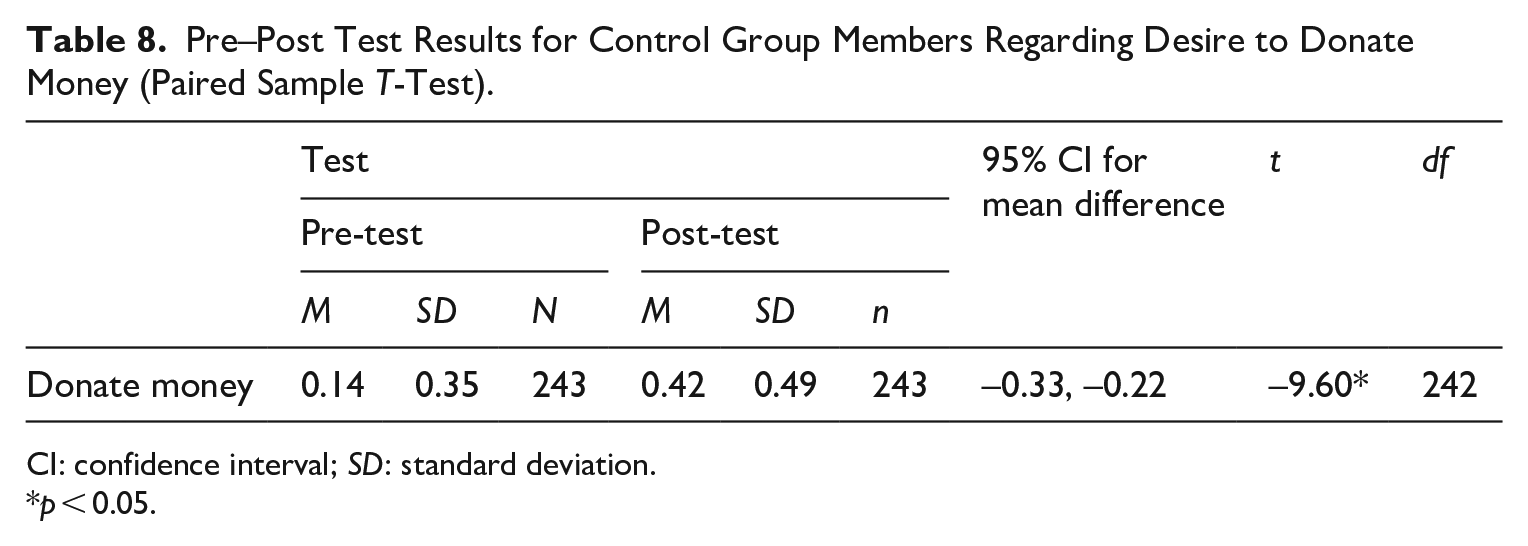
CI: confidence interval; SD: standard deviation.
p < 0.05.
Pre–Post Test Results for Treatment Group Members Regarding Desire to Donate Money (Paired Sample T-Test).
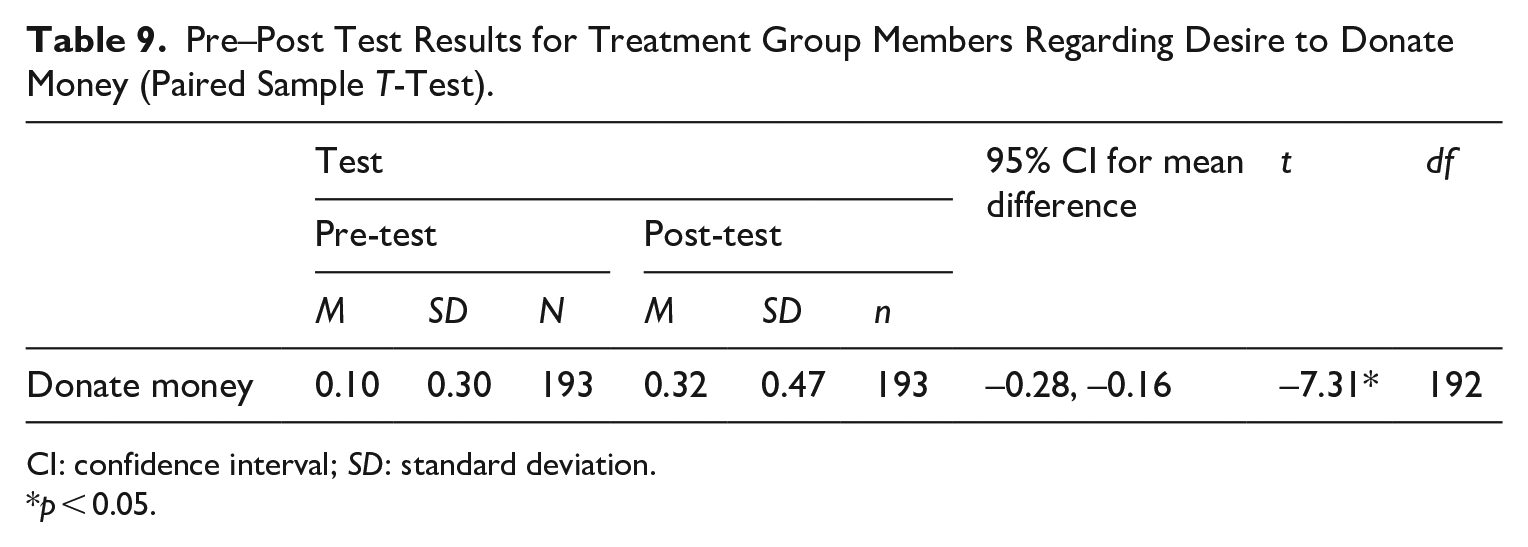
CI: confidence interval; SD: standard deviation.
p < 0.05.
In the end, we see that the videos made a difference. Specifically, both the treatment and control groups were more likely to express more positive attitudes toward refugees and a belief that personal and institutional responses are warranted with respect to the crisis (Tables 10–12).
OLS Regression Measuring Syria Response by Experimental Grouping.
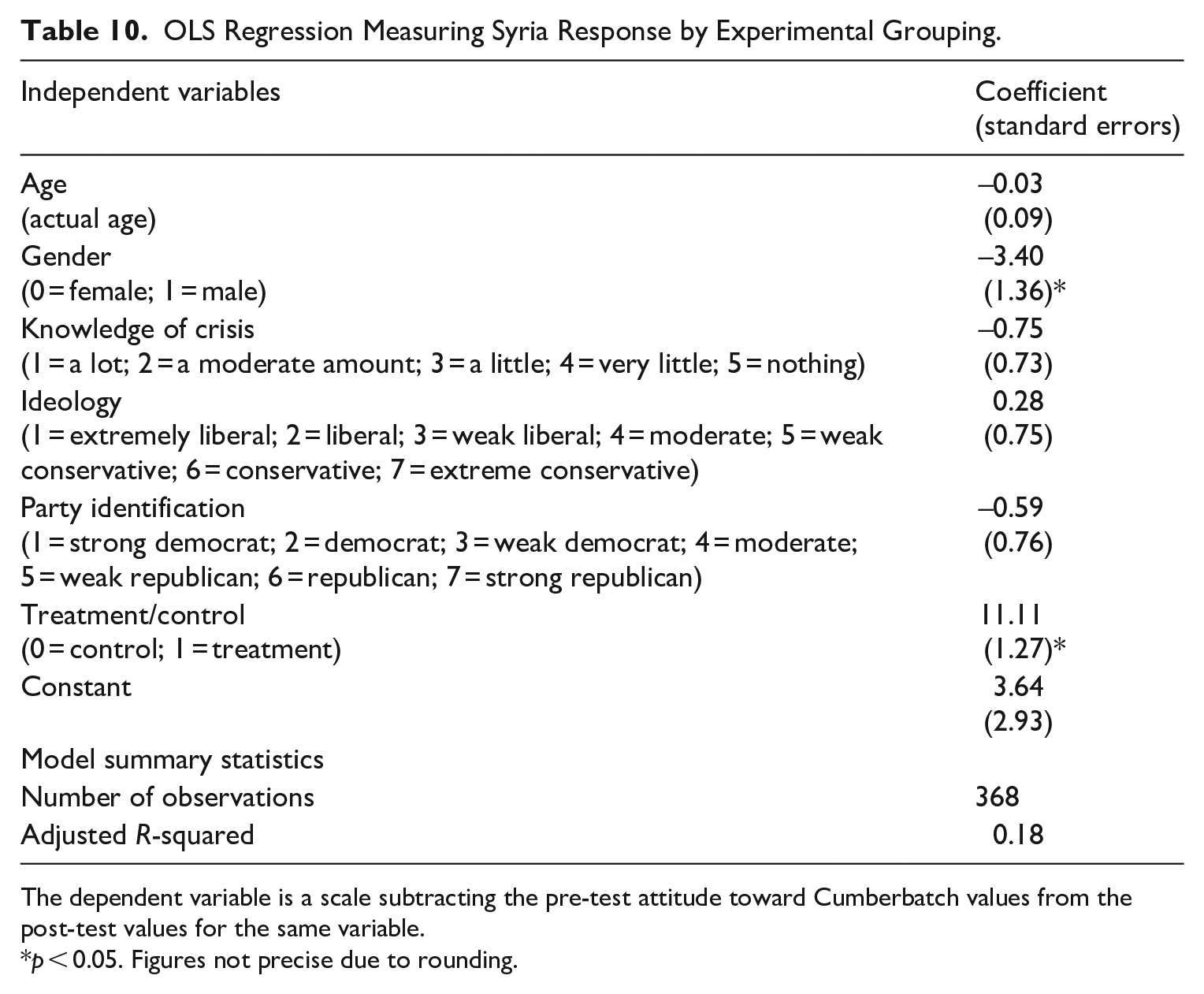
The dependent variable is a scale subtracting the pre-test attitude toward Cumberbatch values from the post-test values for the same variable.
p < 0.05. Figures not precise due to rounding.
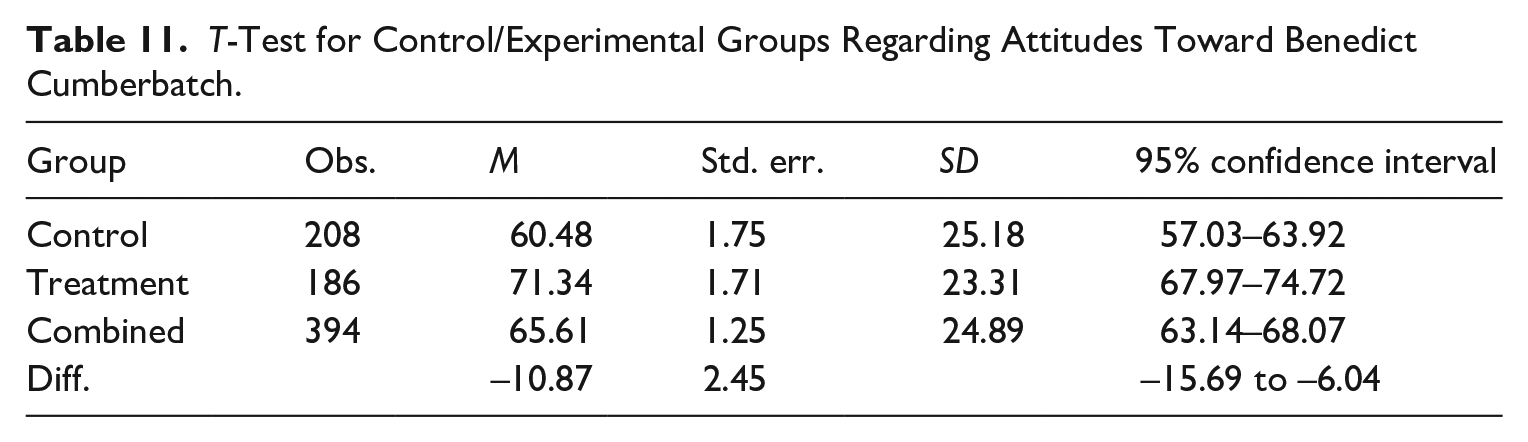
T-Test for Control/Experimental Groups Regarding Attitudes Toward Benedict Cumberbatch.
OLS Regression Measuring Syria Response by Experimental Grouping.
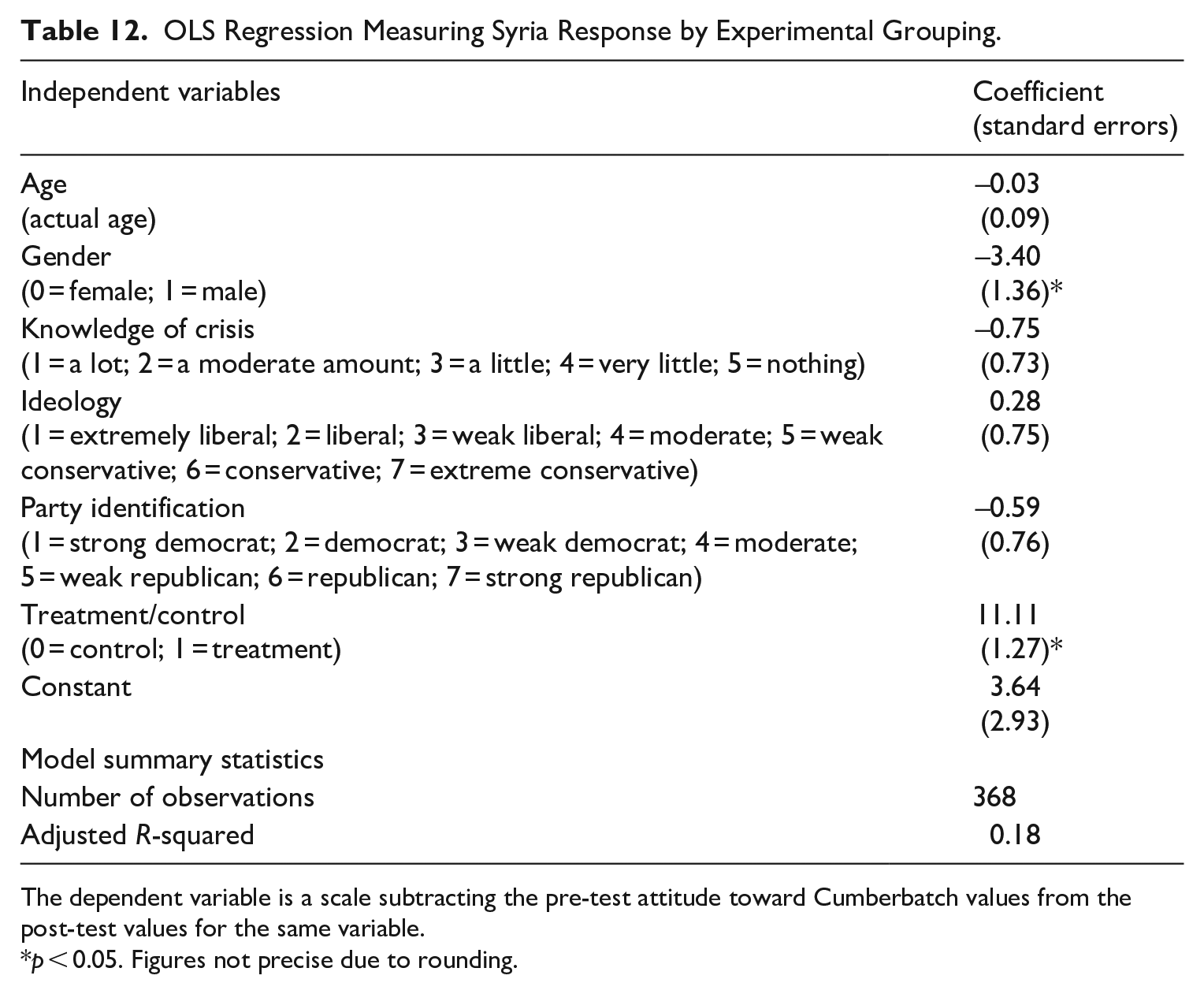
The dependent variable is a scale subtracting the pre-test attitude toward Cumberbatch values from the post-test values for the same variable.
p < 0.05. Figures not precise due to rounding.
Charity Involvement Can Boost Celebrity Image
We conducted the same analysis as above, this time substituting the dependent variable for one which measures the pre- and post-test changes in feelings toward Benedict Cumberbatch. More specifically, the post-test feeling thermometer for Cumberbatch was subtracted from the pre-test values for the Cumberbatch feeling thermometer. 9
This revealed one of our most interesting findings: those individuals exposed to the Cumberbatch video increased their feeling thermometer rating for him 11 points more than those exposed to the video without Cumberbatch. Students explained that they were impressed with Cumberbatch’s willingness to speak on behalf of refugees, saying, “I feel like it’s good that he is advocating for this,” and “I think it’s good that he is using his celebrity status for something good instead of just throwing money at a problem.” One woman felt as if her opinion “changed for the better,” sharing, “I do like him more now that I have seen him act like an activist . . . it actually personified him instead of him just being like this celebrity, like an idol,” as another student agreed, saying, “my view of him definitely increased.” A marketing/management major pointed out that the actor’s inclusion could have an outsized influence on some viewers explaining, “especially for people who are huge fans of Benedict, they are going to be like ‘well I will give 20 pounds if he is going to support it too.’” These findings suggest that charities wishing to recruit celebrities to publicly support their causes may find that they can use this outcome to convince celebrities to join them, as participation is likely to boost the celebrity’s public perception significantly.
Another way in which celebrity may contribute to charity efforts, specifically, is by serving as a hook: I think for the beginning, yes, if you didn’t show the video to me [as part of the study], but it popped up on my Facebook feed, I would have been more likely to click it because I knew Benedict Cumberbatch beforehand, than if it was just some random person that I didn’t know, explained one student.
“I was just really intrigued and curious as to why he’s doing this,” explained one woman, “he’s generally well-liked and a popular face in the media and so that draws people in.” “I feel like if it wasn’t someone that was known, that had a status,” said another woman, then “we wouldn’t pay attention to it . . . ‘oh you did put this known actor so I am going to look at it’, . . . I definitely think that his status helped the video.” In response, another student referred to that as the “click bait type of stuff,” and suggested that she might have been even more convinced to watch if it was “an American actor who I knew really well . . . someone like George Clooney.” Another student agreed: “[if it were another celebrity, I am passionate about] I probably would have been a little bit more gung-ho, but Benedict Cumberbatch is not my person.”
Limitations
There are some limitations to the generalizability of these findings. First, this study only looks at the role of Benedict Cumberbatch; and perhaps the inclusion of another celebrity would have produced different outcomes. Correspondingly, we only evaluated this particular campaign—an attempt to assist Syrian refugees. Finally, it is possible that our sample is not representative of young people more generally. Our use of convenience samples as opposed to random selection disrupts our ability to generalize our findings.
Discussion
Yet, even considering these limitations, this work provides several important takeaways as we think about the role of celebrity influence, lessons that may be of particular interest to charitable nonprofits. First, as we have demonstrated using a typical case of Benedict Cumberbatch and the Syrian refugee crisis, a celebrity plea is unlikely to have a strong influence on viewers. We found that celebrity involvement did not significantly change attitudes or behavior with respect to the refugee crisis within our sample. Also, while celebrity involvement might serve as a “hook” to draw in an audience—an important task when there are so many things competing for the attention of the public—a visually engaging multimedia campaign has the potential to be quite influential on its own. We found that the campaign studied was effective at shaping attitudes regardless, and not because, of Cumberbatch’s participation. Second, the inclusion of a celebrity generated positive attitudes toward Cumberbatch himself, suggesting that while a celebrity spokesperson may not influence viewers with regard to the campaign, celebrities may expect a boost in popularity as a result of their contributions to humanitarian endeavors. These findings are useful with respect to charitable organizations, and also for elected leaders and government agencies which have used celebrities to raise awareness about particular policy efforts. For example, the Obama administration recruited celebrities like Katy Perry and Mark Ruffalo to encourage people to sign up for the Affordable Care Act (Gittell, 2015). Finally, if a charitable group or politician wants to rely on a famous supporter or spokesperson, it is essential that they choose a celebrity with broad appeal. Finally, it is useful to understand the way that young people engage with politics and the appeals that may or may not work in encouraging political awareness and activism.
Future research should consider testing the effect of celebrity as part of a less emotional campaign—perhaps one that is even humorous—to see whether celebrity influence is useful in these cases. Another consideration is whether the length of celebrity participation in the event or online content is significant. The intersection of politics and celebrity has never been so ubiquitous and, as a result, it is essential that current and future scholars continue to explore this relationship.
Research Data
sj-dta-1-psw-10.1177_14789299221107270 – Supplemental material for The Reel Politics of International Crisis: Benedict Cumberbatch’s Appeal for Syrian Refugees
Supplemental material, sj-dta-1-psw-10.1177_14789299221107270 for The Reel Politics of International Crisis: Benedict Cumberbatch’s Appeal for Syrian Refugees by Michael Robert Artime and Megan Hershey in Political Studies Review
Footnotes
Declaration of conflicting interests
The author(s) declared no potential conflicts of interest with respect to the research, authorship, and/or publication of this article.
Funding
The author(s) received no financial support for the research, authorship, and/or publication of this article.

Notes
Author Biographies
References
Supplementary Material
Please find the following supplemental material available below.
For Open Access articles published under a Creative Commons License, all supplemental material carries the same license as the article it is associated with.
For non-Open Access articles published, all supplemental material carries a non-exclusive license, and permission requests for re-use of supplemental material or any part of supplemental material shall be sent directly to the copyright owner as specified in the copyright notice associated with the article.
