







Abstract
While democratic support remains robust, support for liberal-democratic institutions has markedly declined across established democracies. Affective polarisation features prominently in theoretical accounts of this erosion, yet empirical investigations yield contradictory findings. This study posits that such inconsistencies stem from conceptual and measurement limitations in conventional operationalisations of affective polarisation. Drawing on an original survey experiment in Belgium and the United Kingdom (N = 2000), I advance a multidimensional approach transcending political parties to examine polarisation across a salient societal cleavage (“wokeness”) while differentiating between dislike, social distance, and negative emotions. My analysis yields three contributions: first, conventional measures of affective polarisation demonstrate limited explanatory capacity regarding liberal-democratic support: if anything, they are weakly positively related to support for liberal democracy. Second, negative emotional responses towards a specified actor consistently relate to diminished liberal-democratic support across all experimental conditions and national contexts. Third, dislike and social distance directed specifically towards anti-democratic actors relate to more liberal-democratic support (and vice versa), revealing the crucial importance of taking into account the standpoint on democracy by those whom respondents polarise against. These findings invite theoretical reconsideration of affective polarisation’s relationship with democracy and empirical reoperationalisation of the measure of affective polarisation.
Introduction
Worldwide, support for core democratic principles has come under strain. Although support for democracy in general remains strong, support for liberal democracy including minority protections, civil rights, and the rule of law is waning while illiberal-democratic alternatives become increasingly popular (Claassen, 2020b; Foa and Mounk, 2016; Schedler and Sarsfield, 2007; Wuttke et al., 2022). Amid various contributing factors, scholars have focused on the role of rising ideological polarisation (Carothers and O’Donohue, 2019; McCoy et al., 2018; Torcal and Magalhães, 2022) and, more recently, affective polarisation—broadly seen as the affective distance between identity-based groups (Finkel et al., 2023; Gidengil et al., 2022; Iyengar et al., 2012; Janssen and Turkenburg, 2024; Kingzette et al., 2021; Wagner, 2021). The main worry in the former is that high levels of ideological polarisation undermine the legitimacy of the political system as a whole (Sartori, 1976), while under high levels of affective polarisation in the latter, citizens tend to choose the interests of their own political group over core democratic principles (Graham and Svolik, 2020; Mazepus and Toshkov, 2022; Svolik, 2019), especially when their political group is on the winning side of elections (Janssen, 2024).
The concept of polarisation thus has become a fundamental piece of the research puzzle (Levitsky and Ziblatt, 2018; Nugent, 2020; Schedler, 2023). Although the field of polarisation has predominantly focused on its most negative consequences for democracy, this pessimistic focus has recently been challenged by new empirical evidence questioning the link between affective polarisation and support for democracy (Berntzen et al., 2024; Broockman et al., 2023; Voelkel et al., 2022). Furthermore, polarisation studies have long underplayed some positive consequences such as increased political participation, voter turnout, and political choice dispersion (Harteveld and Wagner, 2023; McCoy et al., 2018; Wagner, 2024; Ward and Tavits, 2019). Even stronger, recent scholarship shows how, in the context of democratic backsliding, affective polarisation around democracy itself might strengthen democratic attitudes among the opposition (Gessler and Wunsch, 2025).
It thus has become increasingly difficult to sustain the idea that polarisation is always a problem for democracy. As a result, a more nuanced research agenda is developing, trying to understand the contrasting evidence on the challenges polarisation really poses for democracy. To understand when polarisation is a problem for democracy, two arguments can be made: polarisation is a problem to a certain degree, or when consisting of specific kinds (Rostbøll, 2024). Starting from the idea that, irrespective of its strength, polarisation is an integral part of democratic contest (Schedler, 2023), this article follows the latter argument. Its main contribution is that the ambiguous relation between affective polarisation and democratic support in the European context can partly be explained by applying a more nuanced measurement allowing for different types of polarisation.
To do so, this article joins the recent advances in affective polarisation research to critically reassess the dominant measurement of affective polarisation in the literature today as the spread of dislike scores towards political parties (Campos and Federico, 2025) and unpacks various other kinds or “Gestalts” of affective polarisation. More specifically, by seeing affective polarisation fundamentally as the increasing
Using novel data from a survey experiment in Belgium and the United Kingdom on different kinds of polarisation on the subject of wokeness (N = 2000), this article empirically looks at specific types of affective distance (dislike, social distance, and negative emotions) and specific types of out-groups (political parties vs actors in the conflict around wokeness). It shows that affective polarisation in these countries is uniformly linked with lower support for liberal democracy, irrespective of the target’s standpoint. Interestingly, it additionally shows that dislike and social distance against illiberal-democratic actors can be linked with higher support for democracy.
This article will proceed with a short theoretical overview of different kinds of affective polarisation and liberal-democratic support. The methodology sets out the operationalisation of the polarisation variables within the experimental set-up and support for liberal democracy. It concludes by reflecting on the implications for the broader field of polarisation studies and democracy in general.
Theoretical Framework
I start with a short distinction between various forms of democracy and citizen support thereof. I will then give a theoretical explanation of the different types of affective polarisation and explore the mechanisms that might link these different types with support for liberal democracy.
Liberal-Democratic Support
The vitality of a strong democracy depends largely on the extent to which its citizens believe in the legitimacy of the system (Claassen, 2020a). Tapping into the societal concern that this vitality is being challenged by increasing levels of polarisation, this article takes support for democracy as its core dependent variable. However, since the concept of democracy is understood in various ways by the broader public—and this conceptualisation tends to shift depending on whether respondents perceive themselves to be in the majority or minority within the democratic cycle (Bryan, 2023)—a careful operationalisation of support for democracy is necessary.
In line with concerns about democratic deconsolidation (Claassen, 2019, 2020b; Foa and Mounk, 2016; Schedler and Sarsfield, 2007; Wuttke et al., 2022), a growing number of people—especially among younger generations—seem to support democracy “in name only,” explicitly disregarding the importance of liberal principles (Wuttke et al., 2022). After all, since “democracy” is a very strong value, high levels of expressed support may be influenced by social desirability bias, thus obscuring the true level of commitment to liberal-democratic norms (Inglehart and Welzel, 2003).
To understand how polarisation might affect support for liberal democracy, it is thus not satisfactory to only ask respondents directly how strongly they value democracy as a form of government. For many citizens, the concept of “democracy” may refer only to procedural elements like elections, rather than encompassing the liberal principles of minority tolerance and adherence to the rule of law (Gibson, 1996; Schedler and Sarsfield, 2007). Moreover, the establishment of counter-majoritarian rights and institutions can sometimes decrease support for “democracy” among those who favour majoritarian rule (Claassen, 2020b; Gibson, 2008). Given that threats to liberal democracy today often emerge from actors who claim to protect democracy while undermining its liberal foundations (Krastev and Holmes, 2019), it is crucial to discern what citizens mean when they express support for “democracy” (Wuttke et al., 2022).
In this article, I address this challenge by developing a measure of liberal-democratic support including the protection of minority rights, and contrasting this with support for autocracy, including majority rule. This distinction provides a more nuanced measure of support for liberal democracy (Claassen, 2020b; Wuttke et al., 2022). By examining not only general expressions of democratic support but also preferences for autocracy, I aim at isolating liberal-democratic support from support for democracy in name only.
Affective Polarisation and Support for Liberal Democracy
Although research on support for liberal democracy has also focused on ideological polarisation (Carothers and O’Donohue, 2019; McCoy et al., 2018; Torcal and Magalhães, 2022), this article focuses on affective polarisation due to its persuasive theoretical mechanisms impacting the quality of democracy. A particular focus in recent years has been on the undermining of democratic norms (Berntzen et al., 2024; Druckman et al., 2024; Finkel et al., 2023; Halperin et al., 2009; Kingzette et al., 2021) and to a lesser extent on the support for democracy (Bryan, 2023; Graham and Svolik, 2020; Janssen and Turkenburg, 2024; Torcal and Magalhães, 2022).
The main theoretical arguments in these studies can be summarised in two key mechanisms, strongly rooted in social identity theory (Tajfel and Turner, 1979):
Still, while these theoretical arguments are persuasive, the empirical evidence has been contested by more recent evidence pointing to null findings on the proclaimed relationship between affective polarisation and lower support for democracy (Berntzen et al., 2024; Broockman et al., 2023; Voelkel et al., 2022). This empirical ambiguity has recently been addressed by re-examining the assumed linear relationship between ideological (Torcal and Magalhães, 2022) or affective polarisation (Janssen and Turkenburg, 2024). These studies find that the contrasting results reported above might be the result from the fact that the relationship between polarisation and democratic support depends on the intensity of polarisation: medium levels of polarisation drive democratic support, while low and high levels make it plummet. Assuming that the problem for democracy lies in the degree of polarisation, aiming at finding the “right” amount of polarisation democracies can cope with (Rostbøll, 2024), these authors show that this spread of dislike scores should be present to a “healthy” degree: not too low to miss the affective bonds voters make with their preferred parties which engages them to participate in the democratic system, but also not too high to make these bonds so strong that they overrule the support for core democratic norms in place to protect society against partisan domination, as outlined above.
While this reasoning might be useful for affective polarisation in its current form (spread of dislike between political parties), I aim to go a step further by dissecting the measurement of affective polarisation in itself. Following recent theoretical work reconciling empirical studies on polarisation with theoretical foundations within democratic theory (August and Westphal, 2024; Rostbøll, 2024; Schedler, 2023), and a recent study questioning the measurement of affective polarisation in itself (Campos and Federico, 2025), this article hypothesises that to properly understand the relationship between affective polarisation and support for liberal democracy in the European context, the classical measure of affective polarisation might not capture the dynamics of strong identity groups and the resulting biases resulting in the mechanisms explained above. More specifically, starting from a broader view on affective polarisation as the increasing emotional distance between identity-based groups, I argue that the current measure of affective polarisation as the spread of dislike between political parties is limited in two ways. First, because of its narrow focus on political parties, which might be too general and too detached from citizens in European multiparty systems, to generate the social identity dynamics linked with affective polarisation (Bantel, 2023; Hahm et al., 2023, 2024; Hobolt et al., 2021). Second, because of its sole focus on “dislike,” which might not be the right attitude to measure affective dynamics triggering in-group and out-group biases theorised above (Bakker and Lelkes, 2024; Röllicke, 2023). I therefore apply a more fine-grained distinction between the
For the former, I want to make two points of refinement. First, prior literature has focused on polarisation towards political parties, and this might overlook non-partisan polarisation dynamics regarding salient and divisive societal conflicts affecting support for democracy. Second, prior research predominantly looks at all political groups against which citizens polarise together without distinguishing between liberal-democratic or illiberal-democratic actors (except for Han, 2025; Rothers, 2025). Taking dislike scores towards liberal-democratic and illiberal-democratic actors together might mask underlying polarisation dynamics towards illiberal-democratic actors to defend democracy in the first place (see Gessler and Wunsch, 2025).
For the latter, I argue that while the main contribution of the study of affective polarisation is precisely looking at the affective bonds within this social identity theory framework and intergroup dynamics, this affectivity is underdeveloped in current measures of affective polarisation (Bakker and Lelkes, 2024). This focus on dislike has been problematised before (see Röllicke, 2023). Only a few studies have specifically focused on (negative) emotions (Berntzen et al., 2024; Lüders et al., 2023; McLaughlin et al., 2020; Nguyen et al., 2022; Renström et al., 2023).
The Importance of Distinguishing Between Actors and Conflicts
Current scholarship on affective polarisation has predominantly relied on measurements anchored in partisan dynamics, following decades of research on political parties as identity-based groups representing salient societal cleavages (Lipset and Rokkan, 1967). As the measure of affective polarisation originates in US-based research (Iyengar et al., 2012, 2019; Iyengar and Westwood, 2015), this partisan focus was the direct result of the primacy of partisan political identities in the American context (Abramowitz and McCoy, 2019; Abramowitz and Webster, 2016; Graham and Svolik, 2020; Lüders et al., 2023; Lupu, 2015). However, within non-American contexts, anchoring polarisation into partisanship might be less successful as identity-based cleavages and conflict in European countries might also be located elsewhere. In Belgium, recent qualitative evidence points out that partisan identities are only rarely mentioned by respondents when directly asked about polarisation in their experiences (Maes et al., 2024). In the United Kingdom, it was found that political identities around Brexit are also a good predictor of affective polarisation and even cut across party lines (Hobolt et al., 2021). A recent study of 25 European countries showed the importance of the cleavage of European integration as a driver of affective polarisation (Hahm et al., 2023). To better understand the contested evidence for the relationship between affective polarisation and democratic support, this article therefore further explores the role of non-partisan affective polarisation.
More specifically, I argue that current measures centred on dislike towards political parties in European countries may not capture threats powerful enough to diminish support for liberal democracy (Hahm et al., 2024). After all, as the main mechanism through which affective polarisation theoretically links to lower democratic support is primarily based on the idea that out-groups threaten the existence of the in-group, legitimising the violation of democratic norms and generally lowering support for a system sharing power with that out-group (Broockman et al., 2023; Finkel et al.,2020, 2023; Kingzette et al., 2021; Stephan and Stephan, 2000), the type of out-group captured in polarisation measures is of fundamental importance. As partisan measures of affective polarisation often disregard more concrete conflictual dynamics within societies underlying polarisation processes (Schedler, 2023), grounding polarisation measurement in specific societal conflicts rather than abstract competition between parties may better capture intergroup threats leading to lower democratic support.
Following the conceptualisation of opinion-based groups driving the main identities between which citizens can affectively polarise in a non-partisan perspective (Hobolt et al., 2021), I focus on the particularly salient non-partisan conflict concerning minority protection and inclusion efforts (derogatively labelled “wokeness”). This conflict has become increasingly pronounced in Western societies, with right-wing actors often employing anti-woke rhetoric to delegitimise struggles for inclusion and equity. Consequently, identity-based camps may have formed around this issue, transcending traditional partisan boundaries while still reflecting ideological differences (Bantel, 2023; Hobolt et al., 2021). This specific conflict offers a compelling context for examining polarisation’s relationship with democratic attitudes for several reasons. First, it directly implicates core liberal-democratic principles of minority protection and civil liberties. Second, it represents a concrete point of societal tension that may elicit stronger emotional reactions than abstract partisan affiliations. Third, by focusing on this specific conflict rather than partisan identity, we can better isolate the mechanisms connecting polarisation to democratic attitudes. For all these reasons, affective polarisation anchored in the conflict around “wokeness” may thus demonstrate stronger and more consistent relationships with liberal-democratic support than traditional partisan-based measures:
In addition, I also want to pursue the argument that, besides the type of actors regarding which conflict polarisation is anchored (partisan or societal), actor’s position regarding democracy itself is also very important in the context of polarisation’s presumed relation with lower support for liberal democracy (Schedler, 2023). Following recent arguments pointing to the importance of distinguishing between dislike towards pro- and anti-democratic parties (Han, 2025; Rothers, 2025), and given the focus of this article on liberal democracy (see section 2.1), it can be expected that polarisation against illiberal-democratic actors actively questioning the protection of minority rights might relate to higher support for liberal democracy. After all, citizens confronted with illiberal-democratic opponents might polarise against them to defend democracy in the first place:
The Importance of Distinguishing Between Types of Affect
Second, zooming into the type of distance within polarizing dynamics, I want to distinguish between dislike, social distance, and negative emotions when looking at affective polarisation in a non-partisan environment. After all, the key to the mechanisms outlined above (and to other mechanisms within this literature) is the affective attachment to the in-group and distance towards the out-group, which explains the exceptional political behaviour of polarised citizens (in comparison with, e.g. ideological polarisation which is also built on social identity dynamics). Surprisingly, though, this has been understudied and too easily seen as “(dis)like” instead of the more nuanced and fine-grained types of emotional distance (Armaly and Enders, 2022; Bakker and Lelkes, 2024). While most of the mechanisms and studies focus on the identity mechanisms which explain affective polarisation’s link with democratic support, the mixed evidence now might partly be explained by a weak operationalisation of the so-called “affective” attachment to this in-group and distance to the out-group, hence the affective part of affective polarisation. I want to contribute to that by focusing on both social distance and negative emotions as more specific types of affectivity to explain lower support for liberal democracy more robustly.
First, rather than merely disliking political adversaries, social distance describes a proactive aversion to forming or maintaining relationships and engaging with others (Bogardus, 1926; Iyengar et al., 2019; Park, 1924). As some scholars view social distance as an inherent component of broader affective polarisation (Iyengar et al., 2012), it is here conceptualised as a specific type of affective distance. Yet, it differs from dislike in the fact that it is a more behavioural extension of it (Campos and Federico, 2025). Studies have affirmed that social distance measures represent a more nuanced form of affective polarisation than general dislike (Druckman and Levendusky, 2019). Specifically, while affective polarisation broadly encompasses the negative perception of an out-group, social distance further specifies this aversion by predicting a desire for preferential treatment of one’s own political group and a deliberate avoidance of opposition members (Lelkes and Westwood, 2017).
This active and deliberate avoidance makes social distance a more potent force than dislike. Because citizens actively disengage from political out-groups, this phenomenon is expected to have a more pronounced relationship with lower support for liberal democracy (Campos and Federico, 2025). Social distance has already been linked to the dehumanisation of political opponents (Cassese, 2021; Martherus et al., 2021). Furthermore, its impact was illustrated during the COVID-19 pandemic, when the tendency to disengage with out-partisans significantly increased, thereby diminishing crucial opportunities for cross-partisan dialogue and compromise (Druckman et al., 2021). Consequently, it is expected that social distance will exhibit a stronger correlation with lower support for liberal democracy than dislike:
Regarding emotional distance, second, Intergroup Emotions Theory (IET) suggests that group-based emotions, shaped by appraisals of events’ implications for the in-group, may have more precise and potent effects on intergroup behaviour than general dislike (Mackie et al., 2008; Smith and Mackie, 2015). In this article, I focus on hate, anger, and frustration as negative emotions beyond dislike. Hate, first, has been identified as one of the key drivers of political intolerance (Halperin et al., 2009). Finkel et al. (2023) demonstrate that operationalising affective polarisation as hate yields strong anti-democratic tendencies, in contrast to the questioned link between dislike and anti-democratic attitudes (Broockman et al., 2023; Voelkel et al., 2022). Anger, second, has been associated with confrontational tendencies and support for aggressive policies (Mackie et al., 2000) and avoidance (Berntzen et al., 2024). Furthermore, prior research already showed that when threatened, respondents reacting in an angry way to an out-group are more polarised (Renström et al., 2023), and that angry citizens are increasingly intolerant towards each other (Halperin et al., 2009; Webster et al., 2022). Closely related to anger (Nguyen et al., 2022), frustration is associated with support for populist movements and anti-establishment sentiments, though not directly linked to polarisation or anti-democratic attitudes (Groenendyk, 2018).
Taken together, these findings suggest that emotions, unlike dislike, are associated with action and approach tendencies (Mackie et al., 2008; Valentino et al., 2011), potentially leading to more active democratic norm violations as they drive individuals to take action against their opponents. Emotions also involve distinct information processing patterns, which may influence interpretation of and response to political situations, possibly strengthening the mechanisms linking affective polarisation to lower liberal-democratic support outlined above (Bakker and Lelkes, 2024; Bakker et al., 2020). Although direct comparative evidence is limited, Berntzen et al. (2024) find that emotions generally predict anti-democratic attitudes better than classical forms of dislike and affective polarisation:
In summary, to link affective polarisation with support for liberal democracy, the classical measure can be refined by focusing on different types of actors (political parties vs actors in the societal conflict around “wokeness,” and the target’s specific standpoint on liberal-democratic principles) and by measuring different types of affect (dislike, social distance, and negative emotions). I argue that affective polarisation should be seen as a multidimensional concept in which those different dimensions are expected to be differently related to support for liberal democracy.
Methodology
Data and Sample
The research design employed parallel nationally representative samples (N = 1000 per country) drawn from Belgium and the United Kingdom during the period from 27 June 2023, to 18 July 2023. An external research bureau conducted fieldwork utilising stratified quota sampling across gender, age, and regional dimensions, with participation restricted to adult citizens (⩾18 years). More information and proportional tables regarding the population and sample characteristics can be found in the Supplemental Material Section A1.1. Engagement metrics suggested reasonable participant investment (median duration: 10.37 minutes; mean completion rate: 66.32%). While also including conventional political attitude measures, the instrument’s theoretical focus centred on “wokeness” as a widespread societal conflict—specifically selected to capture polarisation dynamics beyond traditional partisan affective dimensions which were directly linked to the protection of minorities (liberal element of democracy). The construct was operationalised as a bipolar attitudinal continuum between conceptualising wokeness as being aware of social inequalities (“pro-woke” orientation) versus being overly politically correct (“anti-woke” orientation). This emergent socio-cultural cleavage proved methodologically valuable due to its cross-national salience and demonstrated capacity to activate polarised cognitive frameworks among respondents in both sociopolitical contexts.
However, it is important to stress that the discourse on “wokeness” frequently functions as a strategic rhetorical device deployed by right-wing political actors to delegitimise certain equity-focused social movements (Allen, 2023; Cammaerts, 2022; Dhoest and Paulussen, 2024). Within the present research, this construct served primarily as a polarisation stimulus enabling respondents’ self-positioning within a contested ideological terrain, rather than as a semantic exploration of the concept’s multidimensional meanings. 1 Further information about the concept and how respondents answered to it and how these are related to their political views and preferences can be found in the Supplemental Material.
To empirically investigate interpersonal polarisation mechanisms while controlling the pro-woke and anti-woke character of the out-group, I used an experimental intervention using a vignette (see Supplemental Material Section A1.2). Participants encountered a fictional character profile (“Sam”) systematically varied across two dimensions: attitudinal valence (pro-wokeness vs anti-wokeness) and framing (idea-based vs identity-based). This 2×2 factorial design generated four equivalent experimental conditions (see Supplemental Material Section A1.2), each comprising 250 respondents per country (500 total per condition), enabling robust comparative analysis of polarisation processes across different framing mechanisms and national contexts.
In this article, I mostly focus on the first dimension: the difference between pro-woke and anti-woke versions of the vignette allowed for an experimental control over the standpoint against liberal democracy by the opponent respondents could polarise against. More specifically, the pro-woke condition could be seen as a proxy for the active protection of minority rights (“create a more just and equitable society”), while the anti-woke condition could be seen as a proxy for the reactionary disregard for those rights (“hinders free speech and open debate,” “the movement has gone too far”). Differentiating between these conditions might be crucial in looking at the relation between polarisation and support for liberal democracy, as explained in expectation 2. I collapsed the pro-woke and anti-woke conditions to increase the comparability and clarity of the interpretation of the results. Given the high conceptual similarity between the idea-based and identity-based conditions (see vignette wording in Supplemental Material Section A1.2), the groups can be merged. Analyses on the individual conditions can be found in the Supplemental Material (see Section A4.3) and show similar results.
The cross-national research design deliberately incorporated two distinct countries to examine polarisation dynamics across divergent institutional architectures and sociopolitical traditions. Belgium and the United Kingdom, while both established Western European democracies with multi-level governance structures, represent antipodes on Lijphart’s (2012) consensus-majoritarian continuum: Belgium epitomises the consensus democratic model, whereas the United Kingdom exemplifies majoritarian democracy. This institutional variance constitutes a theoretically robust basis for comparative analysis, as prior literature demonstrates that these systemic differences systematically influence polarisation trajectories (Bernaerts et al., 2023). Longitudinal V-Dem indices spanning two decades empirically validate this institutional divergence, documenting Belgium’s consistently lower manifestations of both idea-based and identity-based polarisation relative to the United Kingdom’s more pronounced polarisation metrics (Coppedge et al., 2026). Moreover, conventional affective polarisation measures also show Belgium demonstrating systematically lower polarisation compared to the United Kingdom’s more intensified partisan animosity (Areal and Harteveld, 2024; Orhan, 2022).
The deliberate inclusion of these contrasting cases—Belgium representing consensus structures versus the United Kingdom exhibiting majoritarian institutions—substantially enhances the theoretical robustness, external validity, and generalisability of our findings beyond idiosyncratic national particularities, thereby facilitating more nuanced theoretical inferences regarding polarisation mechanisms across divergent institutional environments.
Variables
Polarisation (Independent)
Following the theoretical expectations, affective polarisation is operationalised at two levels: towards political parties or general woke groups at the vertical level and towards a specific individual at the horizontal level (descriptive and statistical information per country can be consulted in the Supplemental Material). At the vertical level, polarisation was measured as the classical spread of dislike scores towards political parties following the spread formula by Wagner (2021). This formula is a measure of the dispersion or variability of an individual respondent i’s scores across a set of political objects (like parties). This index 2 ranges from 0 to 5. Essentially, it measures the degree to which respondents’ dislike differs between the various political parties. Higher scores do not necessarily mean more dislike, but a greater difference between the dislike scores towards the parties. Second, affective polarisation towards woke groups was measured as the spread of dislike scores between pro-woke groups and anti-woke groups in general. This was asked through the question “How do you feel towards people that see being woke as (1) being aware of social inequalities, (2) being overly politically correct,” of which the first was then categorised as pro-woke and the latter as anti-woke. Respondents had to indicate their affect by a scale of 0 (“Strongly negative”) to 10 (“Strongly positive”). This index also ranges from 0 to 5 and was created by applying the spread-measure of Wagner (2021) by taking the mean of the difference between the maximum score of like across both groups minus the like scores towards the pro-woke group, and the maximum score of like across both groups minus the like scores towards the anti-woke group.
At the horizontal level, affective polarisation was measured towards the vignette respondents were faced with in the survey. More specifically, three specific types of affective polarisation are measured: affective distance, social distance, and emotional distance. First,
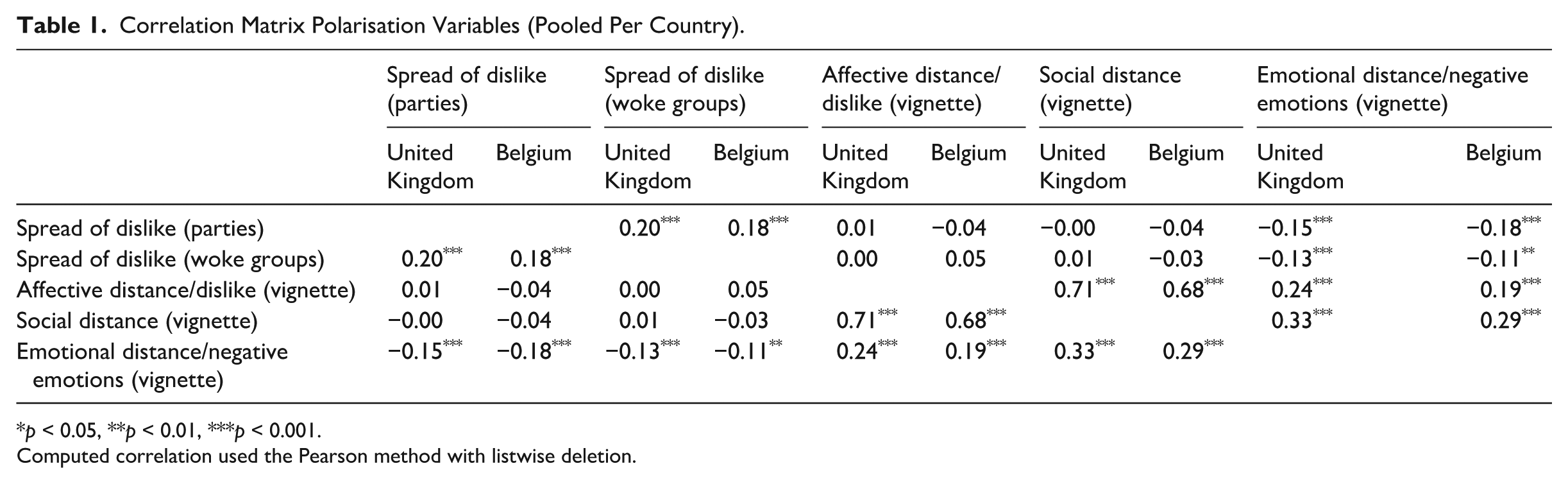
Pooled per country, the correlations between the polarisation variables can be found in Table 1. First, as expected from the theoretical framework, affective polarisation towards parties is not positively related to the interpersonal types of polarisation. Even stronger, while the correlation with
Correlation Matrix Polarisation Variables (Pooled Per Country).
p < 0.05, **p < 0.01, ***p < 0.001.
Computed correlation used the Pearson method with listwise deletion.
Figure 1 shows their mean values pooled per country (analysis of the experimental conditions shows minor differences in the strength of polarisation between the conditions, see Supplemental Material Section A3.2). Between measures, it seems that
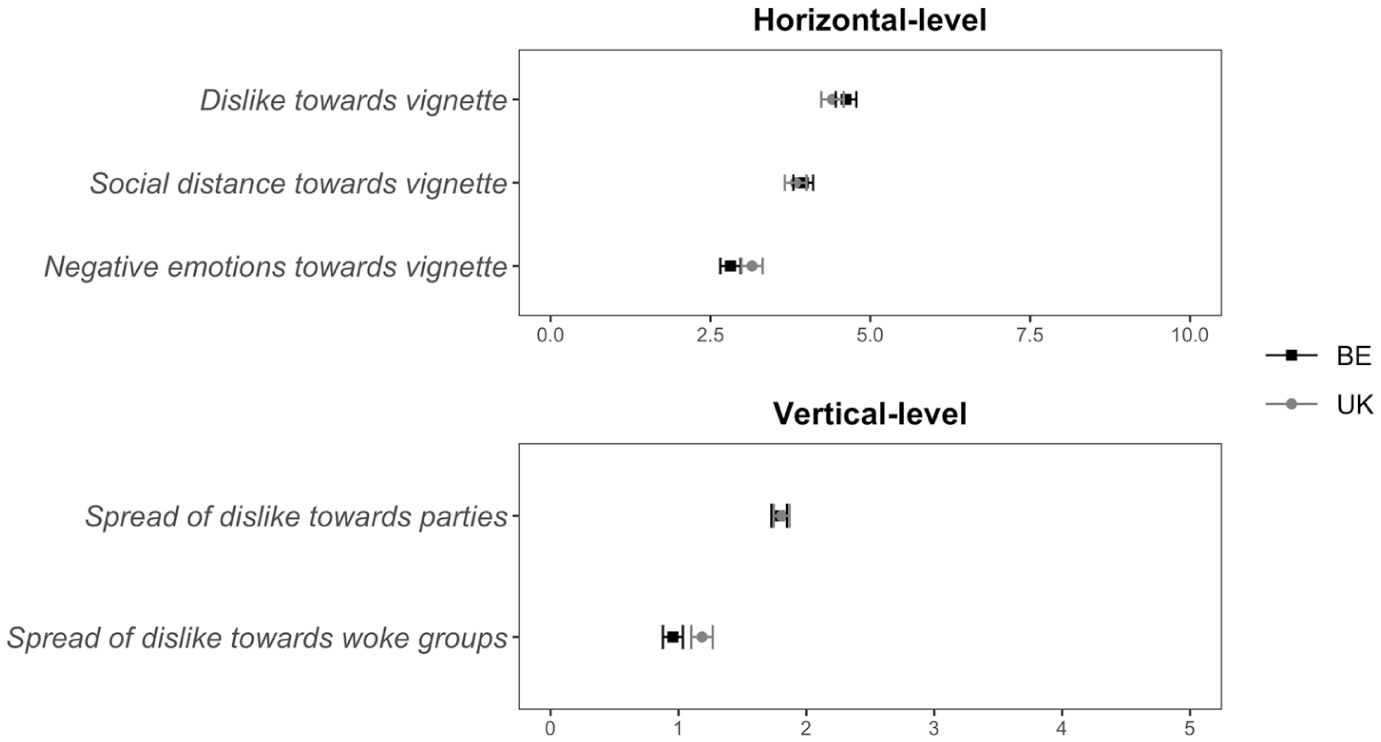
Pooled Mean Values Affective Forms of Polarisation Per Country.
Support for Liberal Democracy Versus Autocracy (Dependent)
As the main dependent variable in this study, I operationalise
Support for democracy: “It is important for me to live in a democracy with free elections, an independent judiciary, and individual freedoms.”
Support for autocracy: “This country needs a strong leader who is allowed to make decisions without parliament and without elections.”
Support for the protection of minorities: “The rights of minorities should always be respected.”
Support for majority rule: “The will of the majority should always be executed, even if it goes against the rights of certain minorities.”
As the main problem in measuring support for democracy using only the democratic scale lies in the fact that prior research has shown that respondents can simultaneously support democracy and autocracy, thereby conceptualising democracy in an illiberal way (Schedler and Sarsfield, 2007; Wuttke et al., 2022), I created an index for liberal-democratic support which takes into account both formal democratic and liberal-democratic elements. The specific formula was: ((preference_democracy + preference_minorities)—(preference_majority + preference_autocracy))/4. This index combines support for democracy and minority rights protection (core liberal-democratic principles) while subtracting from this support for majority rule without constraints and autocratic leadership (illiberal elements). While majority rule is not anti-democratic per se, I operationalise it here as an opposing principle to minority protections characterising liberal democracy. By incorporating these four distinct dimensions, the measure is innovative because it distinguishes between liberal democracy, which emphasises constitutional constraints and minority protections, and majoritarian and/or illiberal conceptions of democracy. The resulting scale ranges from −5 (complete support for autocracy and majority rule) to 5 (complete support for democracy and minorities protection).
Figure 2 shows that, in general, support for democracy is much higher than support for autocracy in both countries. In contrast, support for minority protection and majority rule are similar in strength. Interestingly, support for democracy, autocracy, and minority protection are higher in the United Kingdom. The t-tests between the two country samples (Belgium-United Kingdom) are, respectively, −2.79 (p = 0.005), −4.80 (p < 0.001) and −4.42 (p < 0.001). Considering the overall scale of support for liberal democracy, no significant differences between countries can be observed.
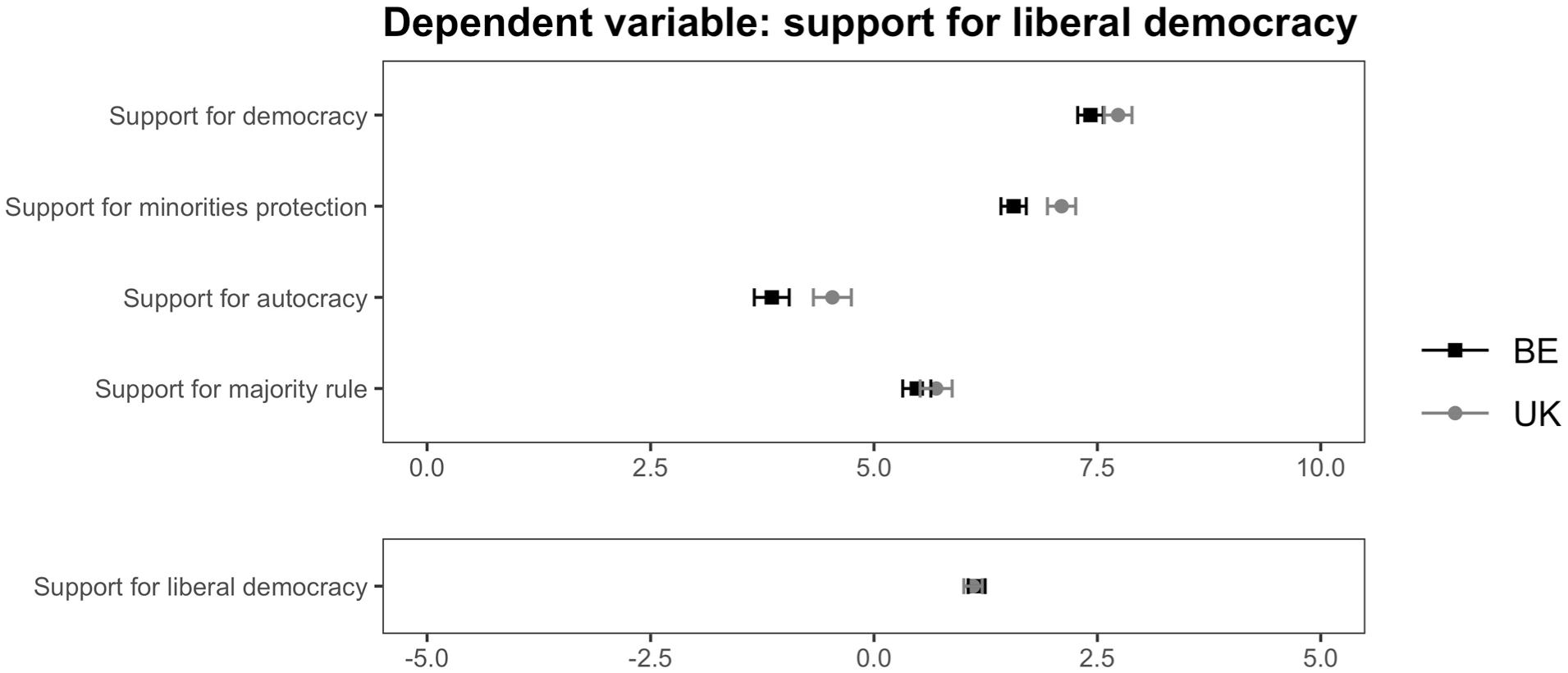
Mean Values Liberal-Democratic Support.
Control Variables
Finally, this article employs several control variables to minimise the influence of unobserved confounding variables. First, a manipulation check was inserted to control for respondents who failed to recall the stimulus of the experiment (see Supplemental Material Section A2.1 for more details). Although the description of the vignette stayed on top of the screen during the survey questions where it was relevant, 28% of respondents still failed the manipulation check (15% in Belgium, 13% in the United Kingdom). Second, the models control for respondent’s
Study Design
To explore to what extent support for liberal democracy is associated with various types of affective polarisation differently within the experimental and two-country design of the survey, following prior studies (Broockman et al., 2023; Dias and Lelkes, 2022), I model the relation between the vertical-level spread of dislike measures towards parties and woke groups and support for liberal democracy with linear and non-linear OLS regression models at the country-level while controlling for country-based differences with a country-fixed dummy. Following Janssen and Turkenburg (2024), I insert quadratic terms to check whether the polarisation measures portray a negative curvilinear relationship with democratic support. I model the relation between the horizontal types of distance towards the vignette and democratic support also at the country-level, but control for the differences between the experimental conditions by inserting interaction effects per polarisation term with the four conditions. As a result, I look for robust patterns across countries and between experimental conditions. All models and reported relationships in the text include control variables except when stated otherwise. Full model tables (with and without controls) can be found in the Supplemental Material (Section A4). Row-wise deletion was applied per country to maximise completion rates.
Analysis
Spread of Dislike Towards Parties Versus Woke Groups Explaining Liberal-Democratic Support
In the first set of models, I apply the classical measure of affective polarisation as the spread of dislike scores towards political parties and towards woke groups in general. Unexpectedly, both measures are significantly positively related to support for liberal democracy: in the combined model (see Supplemental Material Section A4.1), affective polarisation towards parties is weakly positively related to support for liberal democracy (standardised beta = 0.07, p = 0.008), while affective polarisation towards woke groups is moderately positively related to support (standardised beta = 0.20, p < 0.001). As the control variable for the UK sample is not significant (standardised beta = −0.04, p = 0.446), there is no statistical evidence that the outcome levels differ by country. These variables explain around 16% of the adjusted variance of support for liberal democracy.
It thus seems that affective polarisation in the form of spread of dislike—regardless of the type of actors—is only weakly related to liberal-democratic support. When including a quadratic term to check for non-linearity as proposed by Janssen and Turkenburg (2024), these terms are not significant for both measures (standardised beta’s are −1.07, p = n.s. for partisan polarisation and −0.95, p = n.s. for woke-based polarisation). This indicates that no evidence for non-linearity could be found, as can also be seen in Figure 3.
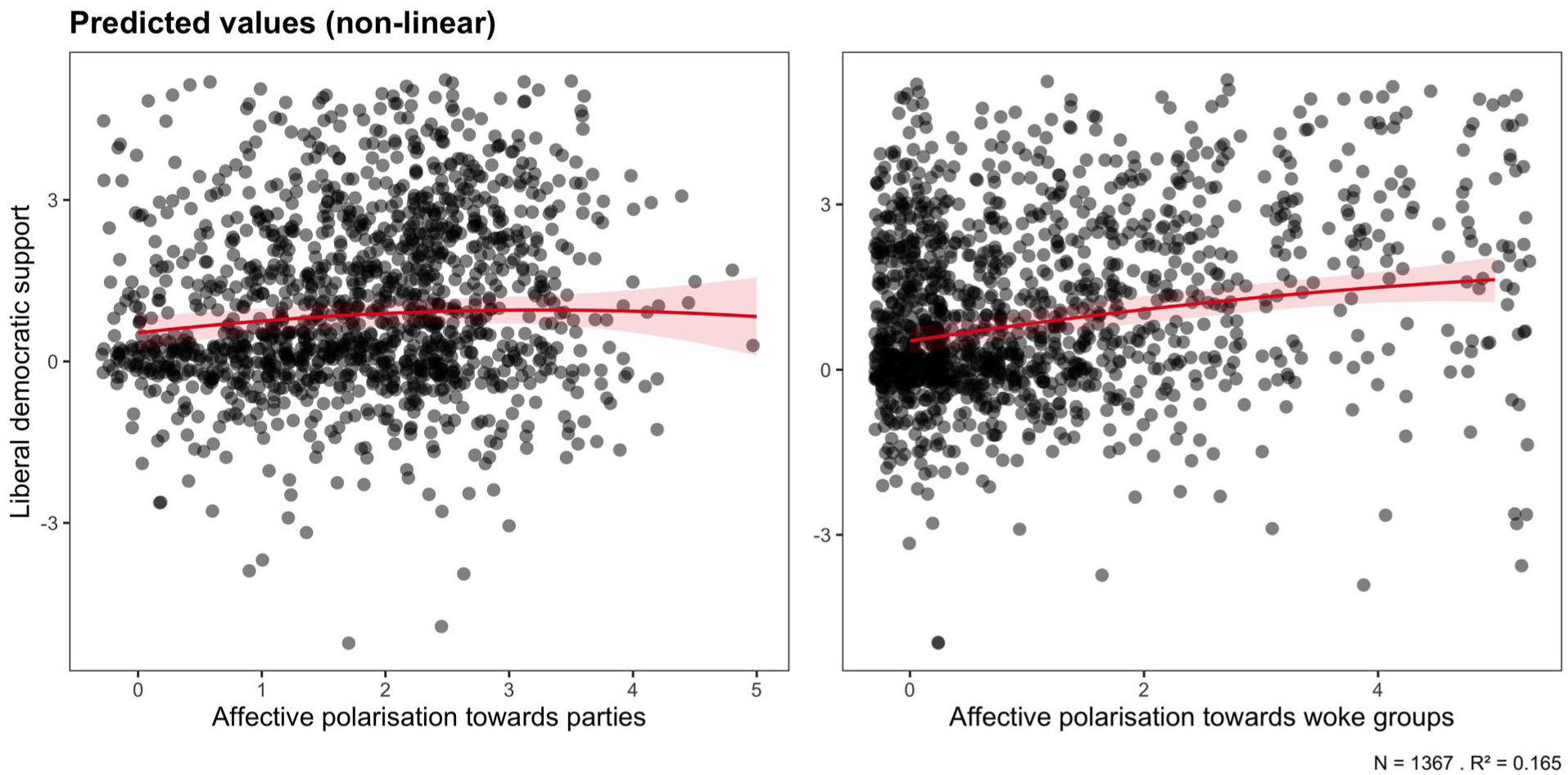
Predicted Values Plot Non-Linear Relationships.
These relationships are controlled for a range of variables. First, I included respondents’ individual standpoint on wokeness: anti-woke respondents in general were less supportive of liberal democracy (standardised beta = −0.17, p < 0.001). Second, unexpectedly, respondents with higher political trust were also slightly less supportive of democracy (standardised beta = −0.13, p = 0.001). Third, respondents with higher political interest (standardised beta = 0.17, p < 0.001) and who were more satisfied with democracy (standardised beta = 0.08, p = 0.015) were generally more supportive of democracy. Finally, older (standardised beta = 0.10, p < 0.001) and higher educated respondents (standardised beta = 0.23, p < 0.001) were also more supportive. These findings generally replicate across other studies on democratic support.
Different Types of Affective Distance Explaining Democratic Support
Delving into the different types of affective distance, second, I look at how dislike, social distance, and negative emotions towards the vignette are associated with support for liberal democracy, across the various experimental conditions. To do so, I pooled the data from both countries and accounted for the experimental differences by interacting the types of polarisation with those conditions. As explained in the methodology, I collapsed the pro- and anti-woke conditions (anti-woke is the reference category; see model tables in Supplemental Material Section A4.2).
A first and crucial finding is that the relationship between the various kinds of affective polarisation and support for liberal democracy depends largely on the specific conditions (and thus positioning regarding wokeness as a proxy for liberal-democratic principles by the treatment). For all kinds of polarisation, the interaction effects were significant (standardised beta dislike*pro-woke = −0.35, p < 0.001; standardised beta distance*pro-woke = −0.32, p < 0.001; standardised beta emotions*pro-woke = −0.14, p < 0.01), implying that the relationship between polarisation and support for liberal democracy is significantly more negative in the pro-woke conditions than in the anti-woke conditions.
Even stronger, for dislike and social distance, the overall direction of the relationship is opposed in both conditions (see Figure 4). In both cases, the relationship in the anti-woke condition (reference category) is slightly positive (standardised beta dislike = 0.16, p < 0.001; standardised beta distance = 0.09, p < 0.05). However, in the pro-woke conditions, the relation between dislike and democratic support becomes negative (standardised beta pro-woke*dislike = −0.35, p < 0.001; standardised beta pro-woke*distance = −0.32, p < 0.001). This means that respondents confronted with an anti-woke vignette, who disliked the vignette more or felt higher social distance towards it, had higher levels of democratic support. Vice versa, respondents confronted with a pro-woke vignette, who polarised against it in the form of dislike and social distance, had lower levels of democratic support. In other words, disliking or not wanting to engage with an anti-woke vignette is related to more support for liberal democracy. This was particularly true for the identity-based conditions (see Supplemental Material Section A4.3).
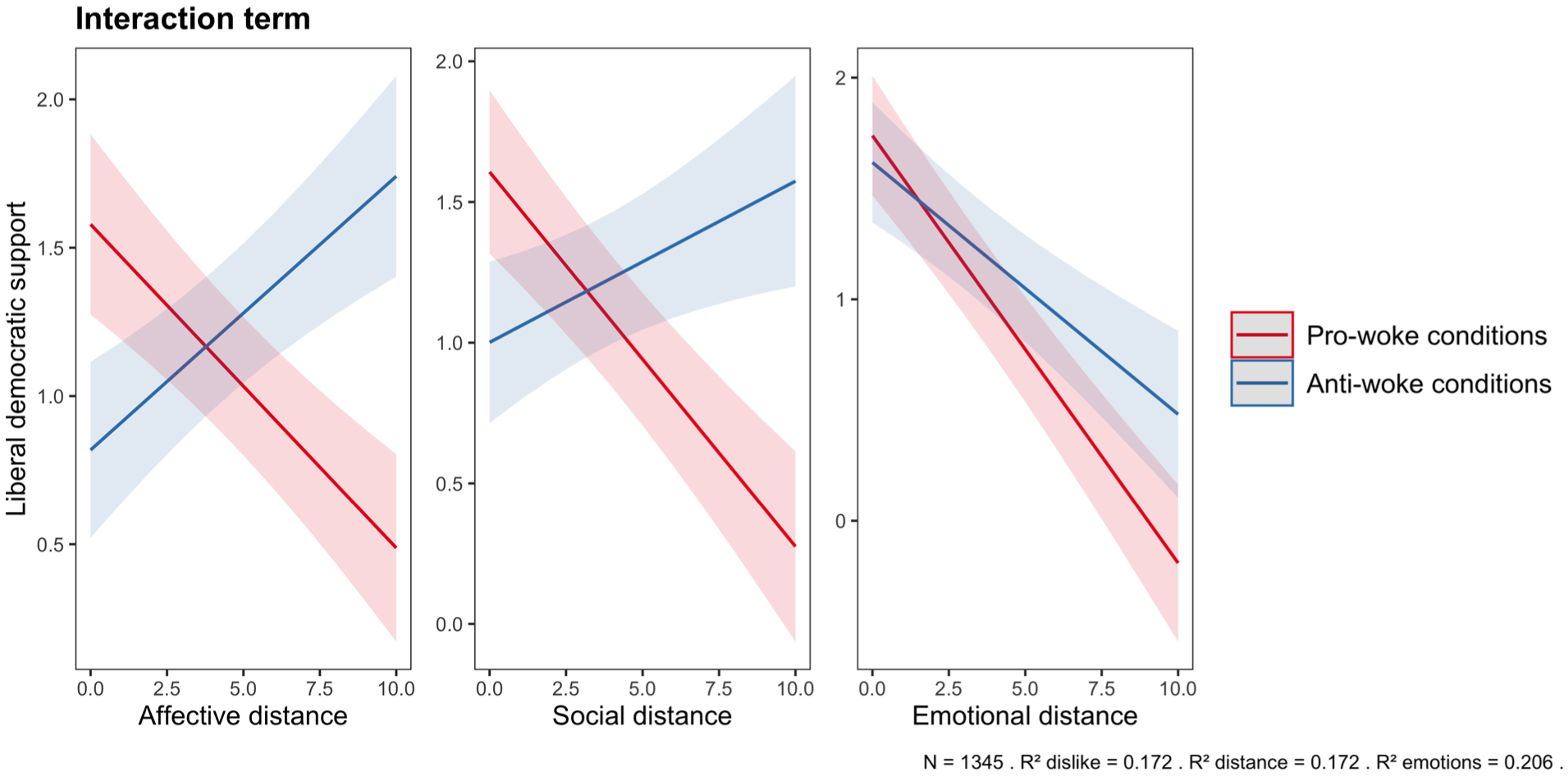
Interaction Experimental Conditions and Polarisation.
In contrast, negative emotions were related to less support for liberal democracy across all conditions. The direct relation between negative emotions and support for liberal democracy in the anti-woke condition was already negative (standardised beta emotions = −0.18, p < 0.001). The interaction between negative emotions and pro-woke conditions lowers this relation even more (standardised beta emotions*pro-woke = −0.14, p < 0.01). This can also be seen in Figure 4. While the type of actor might be important for disliking and not wanting to engage with the out-group, negative emotions are always problematic for liberal-democratic support.
Given the fact that the main difference between both conditions is the standpoint on wokeness, one could argue that the observed differences are driven by ideological congruence rather than polarisation. Under this view, the interaction is spurious: a respondent’s own stance on wokeness determines both their affective reaction to the target and their subsequent support for democracy. Consequently, the results would reflect simple ideological (dis)agreement rather than a distinct psychological mechanism of polarisation interacting with different standpoints on wokeness. Yet, while individual standpoints on wokeness are related to polarisation and liberal-democratic support (see Supplemental Material Section A3.3), in the models I explicitly control for this to rule this possibility out (both including and excluding other political attitudes such as support for democracy or political trust). By doing so, it is possible to compare respondents with the same ideological baseline who were exposed to different stimuli. After all, by holding wokeness constant, the experimental terms and their interactions with polarisation substantively represent the effect of the vignette’s ideological frame independent of ideological agreement or congruence. This allows us to isolate how the specific standpoint of the vignette treatment (pro or anti-woke), rather than just the respondent’s own political identity, shapes the relationship between different kinds of polarisation and support for liberal democracy.
While anti-wokeness in general is expectedly related to lower support for liberal democracy (standardised beta = −0.16, p < 0.001 for all three kinds of polarisation), the inclusion of this term into the interaction models only slightly lowers the strength of the coefficients, but this does not change their direction nor significance (reported coefficients in the text and in Figure 4 are controlled for individual standpoint on wokeness).
Overall, the findings reveal fascinating relationships between different affective measures of distance and liberal-democratic support. They show weak positive relationships between liberal-democratic support and the spread of dislike measure (applied to both political parties and woke groups). When examining direct affective reactions to vignettes, a striking pattern emerged: while negative emotions towards all vignette conditions were related to less liberal-democratic support, the direction of the relationships between liberal-democratic support and dislike and social distance depended on the target’s standpoint on wokeness. Dislike and social distance towards pro-woke (liberal-democratic) vignette conditions were related to less liberal-democratic support, but towards anti-woke (illiberal-democratic) vignette conditions with more support for liberal democracy.
These patterns suggest a more nuanced pattern than initially apparent. The measurement approach matters (spread of dislike vs direct affective reactions), but the targets of polarisation are also important. The finding that dislike and social distance towards anti-woke targets specifically are associated with higher democratic support challenges the view that affective polarisation uniformly relates to liberal-democratic support. Rather, both how we measure affective polarisation and against whom citizens polarise appear to shape the relationship with democratic attitudes.
Conclusion
How does polarisation relate to the current crisis of liberal-democratic support? This article empirically investigated this question on the one hand by replicating the classical affective polarisation measure, and on the other hand by describing patterns of novel operationalisations of affective polarisation (1) looking beyond the partisan focus and measuring polarisation towards a contentious societal conflict (“wokeness”), (2) looking beyond the narrow focus on dislike when assessing the affective distance between identity-based groups, and (3) taking into account the position on liberal-democratic principles of the target of polarisation.
It failed to replicate prior findings on the non-linear effect between affective polarisation as the spread of dislike scores towards political parties (Janssen and Turkenburg, 2024) and showed that the spread of dislike measure, irrespective of whether it was directed against political parties or woke groups, was weakly related to more democratic support. It particularly spoke to the literature by showing that only negative emotions are uniformly related to less support for liberal democracy, while dislike and social distance towards illiberal-democratic actors might actually be constructive for democracy.
The study’s primary contributions to the understanding of polarisation’s relationship with democracy are therefore three-fold. First, the explanatory power of the classical form of affective polarisation as the spread of dislike is limited: if it relates to democracy at all, it tends to have a positive rather than negative relationship with support. However, contrary to expectations, this was true for political parties and non-partisan idea-based camps. Although it is impossible to pinpoint the exact causes of these surprising findings, it might relate to the fact that a higher spread of dislike, irrespective of the “target,” is associated with more political engagement and thus more democratic support, as prior scholars have also pointed out (Harteveld and Wagner, 2023). Second, it matters to go beyond this measure and unpack other “Gestalts” of affective polarisation in a more refined way by including negative emotions and social distance as a more nuanced measure of affectivity towards idea-based camps. More specifically, it was very clear that the negative relation between affective polarisation and support for liberal democracy most strongly appears in the form of negative emotions. Only emotional distance was related to less support for liberal democracy in all conditions. Given the stronger intensity of negative emotions in comparison to dislike and social distance, this confirmed the expectation that negative emotions are more strongly related to lower liberal-democratic support. Third, there is a significant difference in the standpoint towards wokeness of the opponent against which respondents polarised: dislike and distance towards an anti-woke version of the vignette were related to more support for liberal democracy. This indicates that we should be looking more closely at which actors citizens polarise against. Polarisation against illiberal-democratic actors might relate positively to support for liberal democracy, as already shown by Han (2025) and Rothers (2025). In other words, the problematic character of polarisation in the form of dislike or social distance depends on the actors against whom polarisation emerges.
This article therefore joins the growing call for a more nuanced approach towards affective polarisation in future research (Campos and Federico, 2025; Röllicke, 2023; Rostbøll, 2024; Schedler, 2023). Although the measure of spread of dislike towards political parties is useful for mapping broader trends, it might have overlooked specific conflicts and actors in societies and the power of negative emotions instead of mere dislike.
However, although the convergence of findings in both countries—despite their institutional and socio-cultural differences—suggests some degree of generalisability, this study was limited in scope and statistical power due to its moderate sample size and should therefore be extended to other contexts and within larger and more extensive studies. Future research should also look at the emotional connection to the in-group (instead of only looking at the out-group) and apply this non-partisan focus to other societal or political cleavages. Furthermore, due to the correlational nature of the findings and the lack of a solid causal test due to the limitations of the experimental conditions, the findings should be primarily seen as descriptive and explorative as they mapped how different dimensions or “Gestalts” of affective polarisation and different polarisation targets are related to support for liberal democracy. Future research should approach this question within a causal framework to pinpoint the causal mechanisms at work and investigate to what extent the polarisation dimensions drive these findings.
In the current context of global democratic decline (Bermeo, 2016; Diamond, 2015), the findings provide a rare element of optimism as they demonstrate that support for liberal democracy is only structurally associated with strong negative emotions towards the out-group (which on average were still quite low in this sample). In addition, polarisation directed towards illiberal-democratic actors might relate to higher liberal-democratic support. While the question of declining support for liberal democracy remains more complex than an article like this can deal with, this study therefore hopes to have enriched the debate by demonstrating that understanding the relationship between polarisation and the erosion of democracy requires a more nuanced measurement and understanding of affective polarisation in the first place.
Supplemental Material
sj-pdf-1-psw-10.1177_14789299261438223 – Supplemental material for Affect or Emotions? Disaggregating Affective Polarisation to Explain Support for Liberal Democracy in Belgium and the United Kingdom
Supplemental material, sj-pdf-1-psw-10.1177_14789299261438223 for Affect or Emotions? Disaggregating Affective Polarisation to Explain Support for Liberal Democracy in Belgium and the United Kingdom by Kamil Bernaerts in Political Studies Review
Footnotes
Acknowledgements
The author thanks the DFUTURE research centre at VUB for commenting on earlier versions of this article, and especially Nino Junius for his valuable feedback. In addition, the author would like to thank the two anonymous reviewers who greatly helped improve the quality of the article.

Funding
The author disclosed receipt of the following financial support for the research, authorship, and/or publication of this article: This work was supported by EUTOPIA Institutional Partnership under Grant number EUTOPIA-PhD-2021-0000000058.
Declaration of conflicting interests
The author declared no potential conflicts of interest with respect to the research, authorship, and/or publication of this article.
Supplemental material
Additional supplementary information may be found with the online version of this article.
Contents
A1. Data collection A1.1. Generalisability and representation of key demographic groups A1.2. Explanation of experimental design Table A1.1: Vignettes of the experiment Table A1.2: Manipulation check (How does Sam look at the “woke” discussion?) A2 Univariate description A2.1. Independent: polarisation A2.1.1. Descriptive tables A2.1.1.1. United Kingdom A2.1.1.2. Belgium A2.1.2. Histograms A2.1.2.1. United Kingdom A2.1.2.2. Belgium A2.2. Dependent variable: support for democracy A2.2.1. Descriptive tables A2.2.1.1. United Kingdom A2.2.1.2. Belgium A2.2.2. Histograms A2.2.2.1. United Kingdom A2.2.2.2. Belgium A2.3. Control variables A2.3.1. Operationalisation A2.3.1.1. Wokeness A2.3.1.2. Political trust A2.3.1.3. Satisfaction democracy A2.3.1.4. Political interest A2.3.1.5. Political importance A2.3.1.6. Political efficacy A2.3.1.7. Age A2.3.1.8. Gender A2.3.1.9. Occupation A2.3.1.10. Income A2.3.1.11. Education level A2.3.2. Descriptives A2.3.2.1. Belgium A2.3.2.2. United Kingdom A3. Multivariate description A3.1. Correlation plots A3.1.1. United Kingdom A3.1.2. Belgium A3.2. Description variables by conditions A3.2.1. Independent: polarisation variables A3.2.1.1. United Kingdom A3.2.1.2. Belgium A3.2.2. Dependent: support liberal democracy A3.2.2.1. United Kingdom A3.2.2.2. Belgium A3.3. Bivariate correlations of individual wokeness score and polarisation and support for liberal democracy A3.3.1. Wokeness and dislike, distance, and negative emotions A4. Model information A4.1. Group-based polarisation models A4.2. Vignette-based polarisation models (collapsed) A4.3. Vignette-based models (per individual condition) A4.4. Condition-based interaction plots A5. Model diagnostics A5.1. Group-based models A5.2. Vignette-based models A5.2.1. Four conditions Table A5.1: VIF indices four-conditions model A5.2.2. Two conditions Table A5.1: VIF indices two-conditions model
Notes
Author Biography
References
Supplementary Material
Please find the following supplemental material available below.
For Open Access articles published under a Creative Commons License, all supplemental material carries the same license as the article it is associated with.
For non-Open Access articles published, all supplemental material carries a non-exclusive license, and permission requests for re-use of supplemental material or any part of supplemental material shall be sent directly to the copyright owner as specified in the copyright notice associated with the article.
