






Abstract
Political trust is low and declining across many parts of the world. In the United Kingdom, MPs are widely regarded as less trustworthy than people in all other occupations. What lies behind this judgement? This article presents original evidence on the way citizens evaluate trustworthiness and proposes a new model for decision-making in the low-trust context of one of England’s ‘left behind’ places. The study makes a unique contribution to a largely quantitative field by using a series of focus groups to gain deeper insights into what trustworthiness means for citizens of one of the United Kingdom’s ‘forgotten towns’, considering factors such as emotion, personal experience and dialogue, which may elude survey or experimental methods. The discussions reveal an almost universal starting point of distrust, from which participants take several different decision-making strategies. The findings suggest that rebuilding trust will require cross-party efforts to fundamentally change the way politics is conducted, to create space for collaboration and compromise. Different approaches may be needed to build trust with different groups: for some citizens, conveying competence is most important while for others, positive emotions and opportunities for face-to-face interaction with politicians may be more influential.
Introduction
Falling trust and rising political disillusionment are common trends across the United Kingdom and many other Western countries (Citrin and Stoker, 2018; Clarke et al., 2018). While confidence in implementing institutions (such as the police and legal system) has tended to increase in recent decades, trust in representative institutions (such as parliaments, governments and parties) has declined significantly, pointing to ‘a crisis of trust in elected representatives’ (Valgarðsson et al., 2024: 20). In the United Kingdom, only 14% of people regard politicians as trustworthy (Electoral Commission, 2025) and longitudinal data suggests that antipolitical sentiment has risen steadily over the past three decades (Clarke et al., 2018).
Trust is important for political elites: without it, politics may be viewed negatively, making it more difficult for politicians to operate (Flinders, 2012; Whiteley et al., 2016). Political trust has a significant positive relationship with a range of outcomes including policy compliance and voter turnout (Devine, 2024), while low trust is related to support for challenger parties and may feed the growth of populism (Berman, 2019; Bertsou, 2019). Governments that cannot count on the trust of citizens may be constrained in tackling long-term issues (Flinders, 2012; Stoker and Evans, 2019). In the face of threats such as climate change, international conflict and pandemics, trust matters.
While there has been much quantitative research into the factors that relate to variations in trust levels (see Citrin and Stoker, 2018), there has been little qualitative research about how individuals make decisions about the trustworthiness (or not) of their representatives – and what politicians might do to improve the situation. An exception is the work of Winsvold et al. (2024), who use open-ended survey questions to explore the bases of trust and distrust. The present study goes further, using a novel focus group exercise to examine citizens’ thought processes in greater depth. And in contrast to the relatively high-trust Norwegian sample used by Winsvold and colleagues, I speak to residents of one of the United Kingdom’s ‘left behind’ areas, providing an insight into judgements in a low-trust environment.
The article proceeds as follows: First, I situate the study in the existing literature on political trust and trustworthiness. Next, I outline the methods used to explore citizens’ decision-making and the advantages of using focus groups for this purpose. I then provide a detailed analysis of the focus group data, observing that almost all participants share a deep cynicism about politicians but take a number of different approaches to identifying those who are the ‘least bad’. Based on this analysis I propose a novel model for decision-making on political trust. Finally, I show how these findings contribute to previous research and conclude by considering the implications for politicians looking to rebuild trust.
Background
Within the psychology literature, trust is conceptualised as a relationship with two key elements: acceptance of risk (vulnerability) on the part of the trustor, and positive expectation of the behaviour of the trustee (Evans and Krueger, 2009; Mayer et al., 1995). Applying this to a political context, the citizen makes herself vulnerable by handing power to a politician or party to represent her – based on the expectation that the representative has the skills and motivation to act in line with her interests and values (Rose and Wessels, 2019). But on what is this expectation founded?
For those with strong party affiliation, partisanship may be a key factor (Warren, 2018). However, with declining party membership, more voters are following individual politicians rather than parties as a whole. Cwalina and Falkowski (2016: 221) suggest that personal traits of the ‘candidate’s image’ (which may or may not be true reflection of the candidate themselves) are therefore becoming increasingly important in forming judgements. For non-partisans, the behaviour of individual politicians – particularly leaders – may also provide a heuristic for judging the trustworthiness of government in general (Starke et al., 2020; Valgarðsson et al., 2020; Whiteley et al., 2016).
The idea that trust judgements are based on an evaluation of well-known, individual politicians and their behaviour, was therefore the starting point for this research. There seems to be a general consensus in the literature that such judgements consist of at least two attributes: integrity/honesty and competence/ability (Hay, 2007; Levi and Stoker, 2000; Whiteley et al., 2016). Other scholars propose either benevolence (Devine et al., 2024; Mayer et al., 1995) or authenticity – being ‘normal’ and ‘in touch’ with ordinary people – as third dimensions (Clarke et al., 2018; Valgarðsson et al., 2020, 2024). Recent literature also highlights that a lack of trust may take positive or negative forms: while mistrust, or political scepticism, may promote political accountability (Devine et al., 2020; Norris, 2017), active distrust, which is closer to cynicism, may pose a danger to democratic politics (Bertsou, 2019).
Devine et al. (2024) examine the causes of government trustworthiness through a conjoint experiment and find that benevolence (defined as ‘acting in citizens interests’, rather than for themselves) is the most important factor, above competence and integrity. However, the limitation of the findings is that the study relies on a narrow definition of the concepts, for example, integrity is operationalised as transparency, which may differ from how citizens understand the term. Furthermore, the experiment uses hypothetical governments, meaning factors such as partisan identity and emotion – which are likely to play a role in trust judgements (Erhardt et al., 2021; Warren, 2018) – cannot be accounted for.
Likewise, Valgarðsson et al. (2024) use a conjoint experiment to test the importance of the attributes of competence, integrity and authenticity across seven democracies. Traits associated with authenticity seem to matter more to people with low political trust, while those associated with competence seem to be important to those who are more trusting.
While these studies offer the benefit of scale, the disadvantage of survey or experimental methods is that citizens have to choose from a limited range of options which are predefined by the researcher. Winsvold et al. (2024) tackle this issue by using open-ended survey questions to ask about the bases of trustworthiness among citizens in Norway. However, they still use a deductive approach to coding the responses, rather than allowing patterns to emerge inductively. Focusing on local politicians, who are often regarded more favourably than those at the national level (Allen and Birch, 2015), Winsvold et al. find that predictability is the most important basis for trustworthiness. Intrinsic commitment, which includes perceived intentions, morals and collegiality, is most often mentioned in relation to distrust. However, Windsvold and colleagues acknowledge that most respondents gave short ‘off the cuff’ responses and suggest that to gain a more ‘nuanced’ understanding, alternative methods would be required (2024: 11).
The current study therefore extends this existing research in three respects. First, in a largely quantitative field, the study takes a novel approach by using focus groups to gain a deeper insight into the decision-making process. Second, rather than focusing on local or hypothetical politicians, it probes citizens’ views on the most high-profile political figures of the day. Finally, in contrast to the relatively high-trust Norwegian context of the study by Winsvold et al. (2024), the research is conducted in the lower trust setting of one of the United Kingdom’s ‘left-behind’ places. Such locations are associated with political discontent and have been the focus of increased policy interest in recent years (MacKinnon et al., 2024).
Political alienation seems to be more pronounced in peripheral regions experiencing low productivity, long-term economic and industrial decline and with fewer ties to the centre (Dijkstra et al., 2020; McKay et al., 2024; Rodríguez-Pose, 2018). Green et al. (2025) find evidence that direct experience of objective economic decline has the potential to cause political distrust but note that perceptions of local decline are heterogeneous and may be conditioned by partisanship and personal circumstances. However, Rodríguez-Pose (2018) argues that territorial inequality is more important that personal inequality in generating political grievances and that the revolt against the elite is driven by ‘the places that don’t matter’ rather than ‘the people who don’t matter’. This article will contribute to this growing literature on geographic discontent by speaking to the residents of once such place.
Research design
Methods
Qualitative methods are particularly suitable for unpacking concepts that are socially constructed, recognising that meanings can vary depending on the social or political context (Cyr, 2017). Focus groups offer an advantage over interviews, because they allow the participants to develop their ideas through discussion with one another while the researcher can take a more passive role, minimising any power relations or the risk of demand effects.
Allowing participants to lead the discussion may help to shed light on any ‘blind spots’ and draw out ‘complexities, nuances and contradictions’ within the subject matter (Kamberelis and Dimitriadis, 2020: 490–494). The focus group method also allows individuals to share the ‘cognitive burden’ (Cyr, 2017: 1039) of answering challenging questions by tackling them as a group, which may be easier on participants and result in a richer response than 1:1 interviews.
Crucially, the exchange of ideas between participants offers another form of data beyond the individual and group level. Focus groups allow the researcher to access a wider variety of forms of communication, such as jokes and arguments, which can capture knowledge in a way that may not be possible through direct questioning (Kitzinger, 1995).
Participants
The sessions took place in a seaside resort on the south coast of England which has suffered from many years of economic decline and in 2018 was ranked lowest in England for social mobility. To use Jennings and Stoker’s (2016: 372) terminology, the town might be described as a ‘provincial backwater’. Residents of such areas are more likely to be inward-looking, socially conservative and negative about immigration and the European Union (EU) than those in more affluent ‘cosmopolitan’ locations (Jennings and Stoker, 2016). Recruitment efforts targeted people of working age who lived in the same neighbourhood, with the aim of creating relatively homogeneous groups who could talk openly about shared experiences
The focus group sessions were advertised by word of mouth, social media and posters in the meeting venues. Participants were incentivised with free refreshments and a £20 shopping voucher. Some participants had met before but there were no groups in which all participants knew each other.
Four groups were recruited and the sessions were held in late 2023. The political context for the discussion was a Conservative (right wing) government in the United Kingdom, led by Rishi Sunak as Prime Minister. Political trust was particularly low following the ‘Partygate’ scandal (2021–2022) and Liz Truss’s short premiership (Sept–Oct 2022) and disastrous ‘mini budget’.
Before taking part, participants were asked to complete a consent form and short demographic questionnaire. Overall, 33 people took part, with an average age of 52. A broad range of parties were represented, from UKIP/Reform on the political right to the Socialist Workers Party on the left. More than a third of participants gave their party preference as ‘none’ or ‘don’t know’.
Participants in Groups 1 and 3 were generally of higher socioeconomic status than Groups 2 and 4. The former were predominantly composed of graduates with professional jobs who had voted Remain. Groups 2 and 4 had a more diverse range of participants, with fewer graduates. Around half of participants in these groups were Leave voters. For more details see Supplemental Appendix I.
It is acknowledged that the groups were not fully representative of the local area – a reflection of the difficulties in recruiting people to talk about politics, especially in a time of widespread political disengagement. Overall, participants were more affluent than average and may have been less affected by local economic decline. However, the literature on place-based resentment highlights the importance of geographic inequality over individual differences (Rodríguez-Pose, 2018). And while Green et al. (2025) find that perceptions of decline are heterogeneous and strongly conditioned by partisanship, they do not find an association with age, educational status or Brexit vote.
Materials and procedure
Each session lasted 1.5 hours and followed the same discussion guide (see Supplemental Appendix II) with ground rules adapted from Krueger (2014). Participants were given some freedom to shape the conversation, provided it stayed within the subject area. All sessions were facilitated by the author, supported by an assistant. The discussion was audio recorded.
After an initial icebreaker question, all groups started with a practical exercise which occupied about half the session. A set of 10 printed cards were handed to each participant, showing the photos, names and positions of the best-known British politicians (Table 1), based on YouGov ratings for the first-quarter of 2023. These politicians were chosen to give the greatest chance that participants would recognise them and be able to form a judgement. The cards displayed official portrait photos from the UK Parliament website where available, or a photo in a similar style. For more background information about the politicians see Supplemental Appendix III.
Politicians included in Exercise 1.
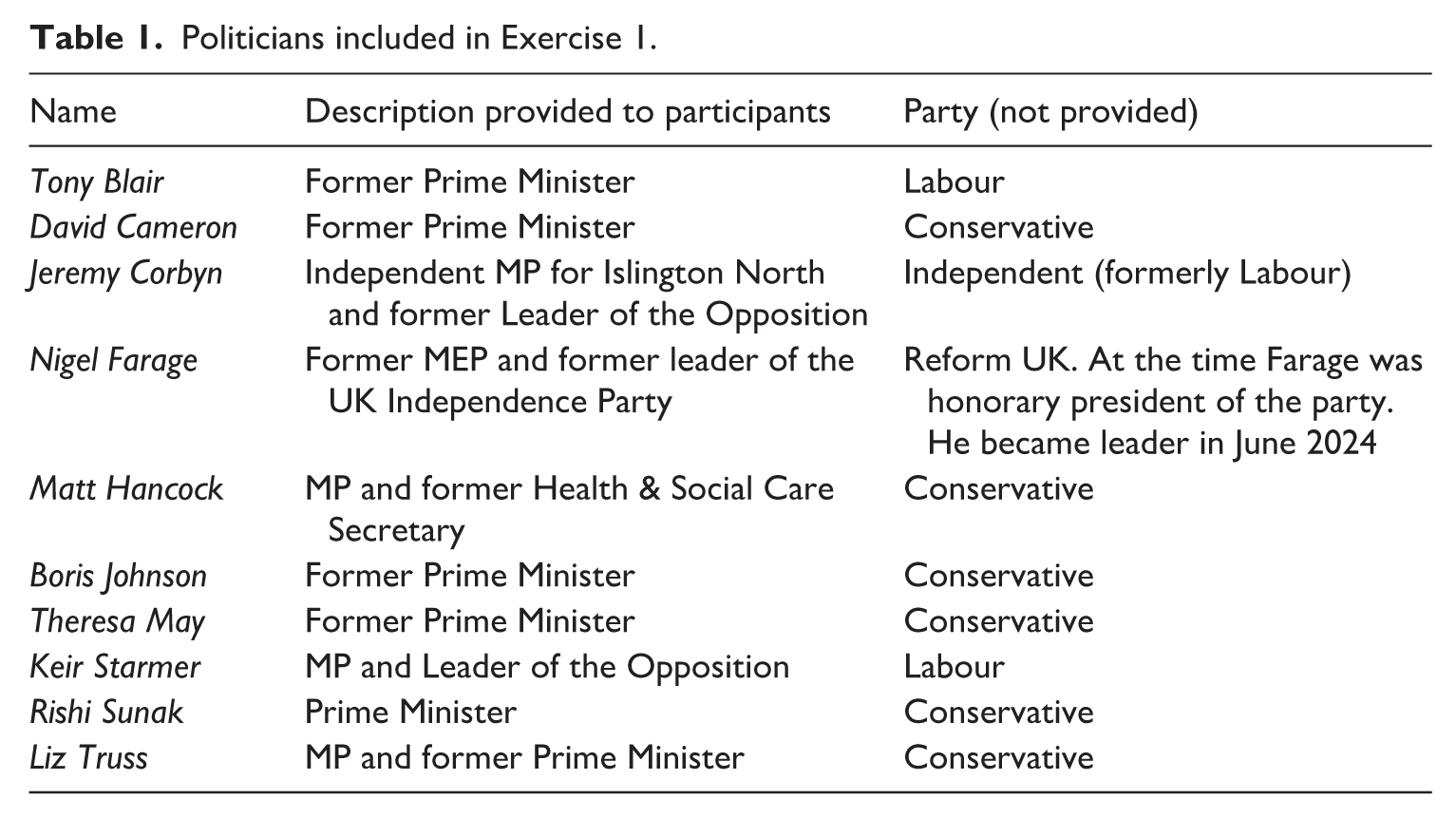
Participants were asked to work individually to place the cards in order from most to least trusted (putting any they did not recognise to one side) and then invited to discuss their choices as a group – making it possible to observe whether this changed their initial response. Following Clarke et al. (2018: 186) the aim was not to uncover information about particular politicians, but rather to expose the ‘marking criteria’ by which they were judged. All the politicians seemed to be recognised by all participants.
After the sessions, the recordings were transcribed and pseudonymised. The transcripts were coded in NVIVO. Coding was first carried out inductively to look for new themes, and then deductively against the attributes of integrity, competence and authenticity.
Findings
Stage 1: Fast thinking
Thinking about trust is a challenging cognitive task and the demands in terms of knowledge and processing ability are ‘high, perhaps unreasonably high’ (Theiss-Morse and Barton, 2017: 160). Participants immediately verbalised this at the start of the session: ‘This is very difficult actually’ (Ryan, 1 Group 2). It is likely therefore that participants’ initial comments were generated through a ‘fast thinking’, instinctive mode of decision-making (Kahneman, 2011; Stoker et al., 2016).
In line with the findings of Stoker et al. (2016), people’s initial off-the-cuff responses tended to be more negative and cynical. While many participants had difficulty in identifying any politicians they could trust, judgements of distrust came more fluently. This was the case in all four groups:
So, does anyone want to start with who they put as the most trustworthy?
Can we start with the least? (Focus Group 1).
Equally last? Can we do that?
That’s where mine are, all in a pile down the bottom (Focus Group 4).
In all groups, there was at least one participant (like Esther above) who applied the heuristic ‘all politicians are the same’: I think, rightly or wrongly, they’re all tarred with the same brush, aren’t they? As soon as you put MP in front of something, everyone sort of goes, ‘oh’. (Karen, Group 3)
While it should be recognised that there is variation in public levels of trust between different politicians (see Supplemental Appendix III for polling data), as Karen’s comment indicates there was deep cynicism and distrust of politicians in general. The most common evidence given for politicians’ untrustworthiness was their propensity to lie or give evasive answers: [They] hedge and dodge [. . .] And that just makes you feel like they’re totally stupid, or that they’re just totally untrustworthy because they won’t answer the question that is directly given. (Kate, Group 1) The ones more to the [top] tended to, to be more the ones that would admit they were wrong at times. And the ones more to the [bottom] you trust a whole lot less because whether they know they’re right or wrong, always make an excuse. (Paul, Group 3)
Several participants spoke of Tony Blair lying about the Middle East as a reason for distrusting him, one describing it as ‘unforgiveable’.
The second most common reason related to politicians’ motivations: those who were considered trustworthy were perceived to be in politics ‘for the right reasons’ while those who were less trustworthy were seen to be ‘out for [their] own gain’ or in it for ‘the glory’. For example, one participant explained why she had put Liz Truss at the bottom: I found it uncomfortable the way that the campaign that she led to become [. . .] Prime Minister seemed to be just to be all about her and not about representing the country. (Kathy, Group 3)
This chimes with Winsvold et al. (2024) who found that lack of intrinsic commitment was the most common basis for distrust. They noted that distrustworthiness was perceived as not just an absence of care for other, but an active motivation in a different direction, for example, being driven by personal gain.
Some participants also mentioned politicians’ financial or personal impropriety as reasons for distrust, although these aspects were mentioned less frequently than questions of motivation and basic honesty, and not all participants agreed on their importance: If their wives can’t trust them, then I don’t trust them either [laughs]. (Emily, Group 1) I don’t trust him because a big part of it with his wife and her tax. So we’re all being taxed so much in this country, but it’s okay for his wife to swindle it all offshore. (Ryan, Group 2) It doesn’t matter what they did in their private life. That’s, for me, irrelevant. Because everyone’s got a private life. (Steve, Group 4)
Somewhat surprisingly, the context of local decline was relatively little mentioned in relation to trust. In the warm-up exercise, several participants bemoaned the ‘lack of long-term, well-paid jobs’ and ‘lack of social mobility’, indicating they were aware of the struggling economy, but perhaps because the exercise focused on national figures they did not dwell on this topic. However, the poor geographical links with Westminster and difference in prosperity with the capital may have heightened the sense that politicians were out of touch: We’re just ruled by one, one after another, Eton you know, posh rich people who don’t know how ordinary people live. (Ben, Group 4)
In summary, general distrust seemed to be the starting point for decision-making for almost all participants – and perhaps would have been the end point in a situation where there was little time for reflection.
Stage 2: Decision-making strategies
When trying to decide which politicians were most or least trustworthy, not all participants followed the same process. Across the four groups, at least three main approaches could be observed, each of them across several groups. It is recognised that a larger sample may have produced even more types of strategies.
For some participants, the only trustworthy politicians were those who were different from ‘typical’ politicians (who were seen to be inherently dishonest). This may be related to the growing professionalisation of politics which means that representatives are drawn from an increasingly narrow group, appear to be detached from the ‘real world’ and seem incentivised to further their own interests (Allen and Cairney, 2017; Stiers et al., 2021). Other participants, particularly those of higher socioeconomic status, focused instead on which politicians were the most competent to run the country, and particularly the economy. Finally, a third group of participants, many (but not all) of whom were less interested in politics, consulted their emotions as a guide to trustworthiness and drew on feelings and personal experiences in making a judgement. For many participants – across all three decision-making routes – it seemed that some of the evidence used to support their choice was generated retrospectively.
Based on the observation of these discussions, a new model for decision-making in a low-trust political environment is proposed (Figure 1). The remainder of this article describes the elements within Stages 2 and 3 of the model in more detail, supported by evidence from the four focus group sessions.
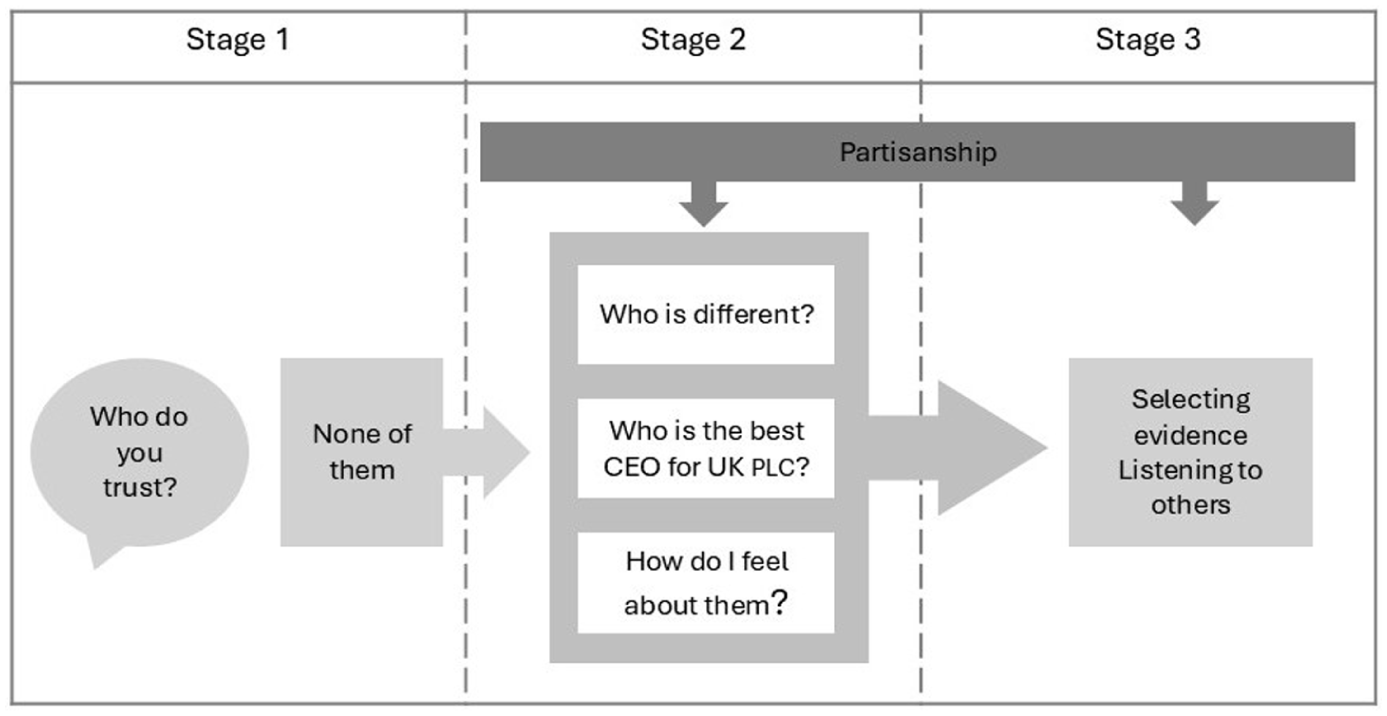
Proposed framework for decision-making on political trustworthiness.
Difference from ‘Typical’ politicians
For half the participants in Group 2, there was one politician who stood out. In contrast to most participants who had struggled to find positive examples, four people unhesitatingly named one politician as the most trustworthy:
So does anyone want to share who they’ve got at the top as the most trusted?
Nigel Farage. 2
Nigel Farage.
Nigel Farage.
Nigel Farage.
These participants were not copying each other – they were not all seated next to one another and had each made this judgement independently when putting the cards in order before the group discussion started.
For these participants, Farage was clearly different from other politicians because of his honest and straightforward communication style: ‘He calls a spade a spade’. He represented an alternative to the untrustworthy ‘establishment’ and, unlike other politicians who were responsible to their parties, he was free to ‘say it as it is’: I think he’s outside the establishment, isn’t he? He’s sort of an independent and the others are all tarnished by political leanings to their respective parties. (Mike, Group 2) It may not be everybody’s cup of tea, but there’s so much distrust of the main parties now that it’s nice to hear somebody else come around with maybe some alternative viewpoint. And I don’t think that there’s enough of that, really, from the other two mainstream parties. (Emma, Group 4)
Here Emma acknowledges that Farage is a divisive figure but this is interpreted as a positive signal because his ‘alternative’ views set him apart from other politicians. Farage’s anti-immigration stance chimed with local hostility towards a barge being used to house hundreds of young male immigrants in the nearby harbour.
Distrust of the establishment was also reflected in repeated mentions of conspiracy theories by some group members. More than one participant claimed that the World Health Organization was conspiring to reduce the population while several others suggested that climate change was a hoax. These participants believed the public were being kept in the dark about what was really happening while politicians were ‘playing the political game’ and failing to ‘commit to anything’. Farage, in contrast, was characterised as straight talking and consistent: He means what he says. And he doesn’t beat around the bush when he says it. (Karen, Group 2)
While to some extent this could reflect partisanship – many of the participants who picked out Farage had voted Leave and/or were Reform UK voters – people in other groups made similar arguments about ‘difference’ from other politicians as a sign of trustworthiness. Other examples included Rory Stewart, Jeremy Corbyn, Liz Truss (‘she went against the world’s authorities’) and Tony Blair: All of the people I’ve put on the left [i.e. ranked as least trustworthy], I think, are self serving, greedy [. . .] not there for the good of the country, but the good of themselves. And I think the only person that stands out above the crowd is Jeremy Corbyn, because he’s the only one with integrity. (Henry, Group 3) Tony Blair, I mean, when he came in it was an exciting change of government and, you know, everyone was excited and he wore jeans and he went to football matches . . . it was that change that brought about some trust. (Heather, Group 4)
This is not to suggest that Farage, Corbyn and others are similar in terms of style or policy, rather that they appear more trustworthy to some voters – particularly, though not exclusively, those of lower socioeconomic status – by stepping outside the mould of the ‘typical’ (i.e. dishonest) politician.
Focus on competence
As illustrated in the model above, a second common decision-making strategy was to focus on competence to ‘run the country’ as an indication of trustworthiness (still from the starting point that most politicians are untrustworthy). This argument was most often used by participants in professional/managerial occupations.
Competence was most often recognised in terms of personal qualities such as skills, knowledge and professional experience. Some said they judged politicians as trustworthy if they seemed to work hard and stick at the job: Theresa May was ranked highly by several people for this reason. Perspicacity and sound decision-making were also seen as signs of competence: It’s understanding. Having the intellect to understand some of the really complex nuances of what politics is. And being able then to make the right call. (Lisa, Group 1) I’ll start . . . I actually trust Keir Starmer more than almost all of the others on the basis he’s actually done a proper job [referring to the fact he worked as a barrister before becoming a politician] . . . And got reasonable results. (Charles, Group 3)
Experience that was related to the politician’s portfolio was seen as particularly valuable and several participants said they couldn’t trust politicians to do the job if they didn’t know enough about the subject matter. Across three groups, participants mentioned frequent Cabinet reshuffles as contributing to this problem: I don’t understand how someone who hasn’t worked in that sector understands it well enough . . . like education and stuff like that. I don’t understand how they can just jump around. (Laura, Group 1)
Policy successes and failures were less often discussed than personal traits – perhaps because the task focused mainly on individual politicians – but managing the economy was seen as critical by those who focused on competence. Several participants gave this as a reason for not trusting Jeremy Corbyn, as the following quote illustrates: When it comes to trust, I just wouldn’t trust him with the economy. I wouldn’t, I wouldn’t trust him running the country [. . . ] The country is like a business and you have to be able to, you know, make the books work, in some respects. (Dan, Group 1)
Some participants grappled with the question of what ‘trust’ meant in the context of politics and the emphasis on competence seemed to be a conscious strategy in some cases: There’s trusting him as a person and then there’s trusting him . . . as a statesman. (Matt, Group 1) I think not just integrity, it’s competence in running a government [. . .] Do you trust them in their belief in what they do? Or do you trust them to run the country? (Adam, Group 3)
These participants also tended to take a wider, international perspective on politics (compared with those who singled out Farage), for example, considering the United Kingdom’s position in the world and contrasting British politicians with those in other countries: I just don’t think he [Boris Johnson] was very good for the country really. I just don’t think he represented us very well. (Becky, Group 2) I’ve lived overseas and experienced other governments, and I would say even the current shower are relatively trustworthy. (Adam, Group 3)
Consulting emotions
The third common decision-making strategy was to draw on emotion. The role of emotion has been discussed relatively little in the literature on political trust and decision-making (Erhardt et al., 2021; Neuman et al., 2018), but it seemed that for some participants it was events they had experienced – and associated emotions – that informed their judgements about trustworthiness. This was particularly (but not only) the case for participants who were less interested in politics. Unlike information received passively, which may be hard to recall, memories of events are vivid and easy to access, especially if they have emotional content (Theiss-Morse and Barton, 2017).
For example, two participants spoke of close family members who had died during the Covid pandemic and whose funerals they were unable to attend due to lockdown measures. In this context, the Partygate revelations generated strong feelings of betrayal and anger towards political leaders such as Johnson and Hancock who had flaunted regulations while others suffered: And having actually been involved with somebody that nearly died during COVID, and seeing the impact on the family of [. . .] believing that they were never going to see that person again just was a step too far for me to be able to have trust in those people that were involved in that. (Linda, Group 4)
However, not all experiences had a negative effect. Previous literature has focused on the way fear and anger might increase or decrease trust (Erhardt et al., 2021), but positive emotions also seemed to play a role. In most cases, direct contact with MPs had had led to positive feelings and increased trust: Andy Burnham. I met him on a train, had a chat to him. He’s fantastic. Loads of great work with homelessness in Manchester. And I really like [him and Angela Rayner] and I trust them because of who they are, the connection, and feeling akin, I guess, and representing my beliefs as well. (Heather, Group 4) Well, he’s a genuine man [Jeremy Corbyn]. I’ve met him a few times. I’ve been, I’ve heard his speeches. He’s a man of the people . . . And you can actually, I’ve actually gone out and shook his hand. I’ve got a picture of my daughter going up and, you know, Ooh, can I have a selfie? (Brian, Group 1)
The sense of closeness and warmth in both these anecdotes relates to the concept of authenticity – politicians being more ‘in touch’ and ‘real’ – one of the key trust attributes identified in the literature: I felt he could relate more to my life. Like, it’s as simple as the fact that he rode a bicycle and he had an allotment and all those like, you know, little things compared to people who went to Eton. So, I just feel he was more connected to [. . .] my life, my lifestyle. (Emily, Group 1)
Positive emotion generated by humour also contributed to a sense of trustworthiness, particularly in the case of Boris Johnson: I was thinking, why have I put Boris in the middle? And I think it’s because of Have I Got News For You. Because he has hosted it, and I love that programme. And I have this baseline that if someone’s willing to laugh at themselves, I trust them more, rightly or wrongly . . . Because I’d seen him on that and seen how he conversed on that. I felt like I knew him, or I felt like I trusted him, whether I agreed with him or not. (Zoe, Group 3)
Johnson’s appearances on comedy panel shows might have created a sense of ‘parasocial interaction’ (Becker, 2020: 279) with viewers, that led them to develop an emotional connection or even start to feel they knew him as a friend. Combined with his knack for spotting photo opportunities that created a ‘lovable buffoon’ persona, this may have helped him to appear more relatable – and trustworthy – despite his privileged background: One of the things that makes me lean more towards him [Boris Johnson] than some of the others is that he is a bit more normal . . . he feels more like the kind of people that, you would see, walking down the street, have a chat to in the pub, that sort of thing. (Karen, Group 2)
Of course, this effect was not consistent across all participants – many others were distrusting of Johnson – but humour may have particularly influenced those like Zoe, who said they actively avoided the news and relied on other media for political information. A quarter of all participants said they had made a conscious decision not to watch the news at all – either for reasons of mental health or because they didn’t trust the content.
Stage 3: Justifying judgements
To recap: as illustrated in the model, in the first stage of thinking about trust, most participants quickly concluded that almost all mainstream politicians were untrustworthy. When pushed to generate some kind of ranking for trustworthiness, most people took one of three common strategies. Some participants picked out politicians who were outside the establishment, some focused on those which seemed most competent to run the country, and others consulted their emotions as a guide.
Having used these mental short-cuts to inform their decision-making, the third stage of the process revolved around justifying these judgements and it seemed that in some cases participants may have retrospectively generated additional evidence. This could be seen as an example of motivated reasoning (Taber and Lodge, 2006) or confirmation bias, where information is used selectively to avoid cognitive dissonance.
It is acknowledged that we cannot be certain of the order in which evidence was considered, but there are three reasons why I suggest that in some cases the evidence seemed to come after the judgement. First, some participants applied different standards to different politicians, depending on their existing view of them. An example of this was the discussion of the reality TV show, ‘I’m A Celebrity, Get Me Out Of Here’. Hancock was considered untrustworthy by almost all participants and all those who had watched him on the programme considered it a cynical attempt to win popularity. However, a participant who had agreed with this assessment, defended Nigel Farage (whom she had picked at the start as the most trustworthy) for going on the same show: I think he keeps a bit more integrity of going on this celebrity thing because he wasn’t a frontline politician at the time. (Karen, Group 2)
Similarly, while most people agreed that lying was a sign of untrustworthiness, another participant seemed to suggest it was acceptable for Johnson (whom she had identified as most trustworthy in the individual exercise) to do so: I’ve got him right at the top, because despite he’s lied, yeah, I do really trust the man. Bizarrely. I’m not saying I agree with him, of course, but I do really trust him. (Zoe, Group 3)
Second, it seemed that participants were able to use the same arguments both for, and against, the same politicians. One participant argued that Johnson was trustworthy because he was consistent, and another argued he was untrustworthy because he changed his mind in line with public opinion. This suggests that participants were choosing examples selectively to back up their argument.
Third, participants found ways to dismiss evidence that did not align with their position. For example, supporters of Johnson argued that other people were to blame for his failures: I feel bad for him. I think he was just royally chucked under the bus. (Karen, Group 2)
Similarly, a participant who had ranked Sunak highly at the start defended him on the basis that was ‘sold down the river by the Conservative Party’. Several other people suggested that negative stories about Jeremy Corbyn were simply misrepresentation by the media: They made that up, I’m sure. That awful Laura Kuenssberg, was it? She was always trying to stab him [Corbyn] in the back. There was a real campaign against him, poor man. (Nikki, Group 4)
In some cases, this could be seen as an example of partisan motivated reasoning (Bolsen et al., 2014), where evidence is interpreted selectively in line with existing partisan identities.
Group dynamics
Political decision-making rarely happens in isolation – indeed in a later part of the session which focused on sources of information, several participants spoke of how they found out about politics by talking to friends, family or workmates. It was therefore interesting to observe how the group discussion and dynamics modified the individual judgements made at the start of the session (‘Stage 3’ in Figure 1).
All groups included a range of viewpoints and some that strongly conflicted. However, people were open to listening to each other and there were several times when participants acknowledged that they had changed their opinions as a result of the discussion. The following is an example from Group 1 (comments from other participants are shown in square brackets):
Theresa May, I would also say in the same category, she is trying [‘Yeah, yeah’]
I moved her up, with our discussions.
Indeed during the discussions, I saw people listening and physically changing the order of their cards as they took on board other people’s views. This was particularly the case for participants who were politically in the centre, or without a strong position. Those who supported the slightly more extreme positions – both left and right – did not tend to change their views even when directly challenged by others. Participants in Group 4 explicitly acknowledged this point:
But if he holds political views that are diametrically opposed to your own, you’re hardly going to trust him, in a sense. I can kind of get that. I mean.
It’s about your ethos, isn’t it?
I think you would trust them, if they agree with what your thoughts are.
Role of partisanship
Not surprisingly, people seemed more inclined to trust politicians they agreed with; hence partisanship is shown as an input into both Stages 2 and 3 in the decision-making model. For example, as already discussed, Nigel Farage was seen as the most trustworthy by many Leave voters, while he was instinctively distrusted by participants on the other side of the political spectrum. This came out in a conversation between two participants in Group 4:
But I think it probably reflects my personal politics, which is left-wing. So I would consider Nigel Farage to be extremely right-wing.
And so does that mean he’s untrustworthy?
To me, yes.
However, in the centre ground, many participants rated politicians from opposition parties as relatively trustworthy. For example, Theresa May was ranked highly for trustworthiness among many non-Conservative Remain voters: [It’s] not necessarily whether you would vote for them. I trust some of them. I wouldn’t vote for them. (George, Group 3)
It is worth noting that in the pre-screening questionnaire, around two-thirds of participants either answered ‘none/don’t know’ to the question of party preference or named a party such as the Liberal Democrats, Reform UK, or another that was not represented by any of the politicians in the first exercise. Therefore, in most cases partisanship would not have provided an easy heuristic; perhaps different stimulus material would have changed this.
Discussion
In setting out to understand ‘how do citizens make decisions on political trustworthiness’, perhaps I was slightly misguided. Underlying this initial question is an assumption that there is a decision to be made at all. These focus group discussions suggest that for many people that is not the case: politicians are, by definition, untrustworthy. By choosing to become politicians, MPs mark themselves out as untrustworthy types. This is consistent with recent opinion polling in which MPs are rated the least trustworthy of all professions, with a net score of −64. Only journalists receive an almost similarly damning rating (−51), compared with family doctors at +68 and teachers at +54 (YouGov, 2024).
Fresh evidence of MPs’ inherent untrustworthiness is provided by the media every day, in what one participant described as a ‘constant feeding in of little wrongdoings’ from online news sources. It is therefore more a question of which ones are least untrustworthy, and participants found a number of ways to approach this. Clearly, if politicians are by their nature dishonest, then one strategy is to identify those who are least like ‘typical’ politicians. This led many participants towards Nigel Farage, who (at the time) also had the advantage that he had never been elected as an MP, and therefore had the freedom to ‘say it as it is’ without the real-life constraints that mean politicians must negotiate, compromise and sometimes change course.
This widespread disillusionment with the political class, coupled with economic discontent in ‘left behind places’, could help to explain the growing rise of populist leaders across many parts of the world. The findings are in keeping with the recent work of Valgarðsson et al. (2024), who found that the extent to which politicians ‘come across as different from other politicians’ and ‘mean what he/she says, even if people don’t want to hear it’ (almost the exact words that were used about Farage) were particularly important to less-trusting citizens.
A second strategy for judging trustworthiness, favoured more often by participants of higher socioeconomic status, was to focus on competence. Again, this is consistent with Valgarðsson et al. (2024) who found that ‘competence matters more to respondents with higher trust, higher income and university education’. Based on the discussions I observed, this may also be related to the way that citizens view the role of MPs – whether they focus on the way they operate at a national level, or whether they take into account the role of politicians in representing Britain on the world stage.
While Valgarðsson et al. (2024) found that politicians who had ‘a reputation for handling their duties poorly’ were the least trusted overall, they also noted that being ‘in touch with everyday life and ordinary people’ (authenticity) was almost as important. This relates more to the third decision-making group: those who called on their personal experience and emotions when judging trustworthiness. There seemed to be several ways in which a sense of ‘closeness’ with politicians came about – whether through face-to-face meeting, shared hobbies or ‘parasocial interaction’ through informal television appearances – but all of these contributed to a favourable judgement of trustworthiness. In several cases, this was enough to override more traditional reasons for distrust such as dishonesty or incompetence.
Based on my observations, I would suggest that the initial decision-making process is not necessarily rational and that some of the reasoning is generated after a fast judgement has been made. In an era of 24/7 media coverage and with social media algorithms providing a wide array of potential headlines and soundbites to choose from, citizens have ample scope to pick and choose evidence that fits any interpretation. It may also be related to the fact that the overriding tone of reporting about politicians is negative, so evidence of dishonesty is easy to obtain (feeding into the judgement that ‘all politicians are untrustworthy’), but positive indicators are harder to access.
While it should be acknowledged that the findings are based on a relatively small sample of people, all living in the same geographic area, the decision-making strategies described were all observed across more than one group. A wider and more diverse sample might have generated even more evaluative approaches. However, a strength of the research is that it provides an insight into attitudes within one of the United Kingdom’s ‘forgotten towns’, places that have been culturally and economically left behind (Pearce and Chrisp, 2021). Such areas have become a focus for policymakers and politicians, seen in initiatives such as the Conservatives’ flagship ‘Levelling Up’ policy and more recently the Labour Party’s ‘Plan for Neighbourhoods’’. 3
Conclusion
In this article I offer a new insight into the evaluative processes of citizens living in a ‘left behind place’. I show that politicians are widely viewed as inherently untrustworthy and although this does not seem to be a direct result of local economic decline, geographic inequality may heighten the perception that the political class is ‘out of touch’ with ordinary people. I document four focus group discussions which not only reveal participants’ thought processes but also the role of group dynamics in political evaluations, an aspect which is missing from existing literature. Based on these findings, I offer a new model for decision-making on trust. The article builds on existing literature about the drivers of trust (e.g. Valgarðsson et al., 2024) contributing fresh insights about the construction of trustworthiness in a UK context and the positive role of emotion.
What are the implications of this for parties looking to rebuild trust with the electorate? There are some positives to take away. First, that several participants were able to trust politicians they did not choose to vote for nor fully agree with, suggesting that (to some extent at least) it is possible to build trust across party lines. Second, it was evident from all the sessions that people listened to each other and were able to update their preferences in the light of new evidence, providing some hope that rebuilding trust is not a completely impossible endeavour.
However, the key finding must be that politicians in general seem to be widely considered untrustworthy by default. Everything that MPs say or do once elected is interpreted through this lens. This would suggest that increasing political trust cannot be achieved by one party working alone – a more fundamental change to the way politics itself is conducted is needed to bridge the gap between ‘typical’ (i.e. untrustworthy) politicians and ‘normal’ people (e.g. teachers and doctors), who are trusted by most people. What happens to people when they become an MP that suddenly makes them so untrustworthy? Perhaps the combative, antiquated style of discourse in the House of Commons does not help. Participants liked politicians who would ‘admit they were wrong at times’ and could find ‘sections of agreement with the opposition’. Neither the current format of political discussion, nor the way it is reported by the media, leave much space for making compromises or acting like ‘normal people’. The jeering from across the chamber, use of the third person and other archaic language employed in parliamentary debates make politicians seem more like private schoolboys than members of the public. And any action they take is interpreted through the lens of distrust: Starmer’s attendance at a Taylor Swift concert in June was reported fairly positively during the election campaign (Sky News, 2024), but ramped up into a ‘freebies scandal’ after he took office. This suggests it is perhaps not so much the politicians who are the problem, but the environment and political system in which they operate.
Clearly, being seen to do a ‘good job’ of running the country is also an important factor in rebuilding trust, and in the current polycrisis this is not easy to achieve. Citizens have high expectations for what government can deliver, alongside relatively little appreciation for the complexity of the task (Flinders, 2012). Appointing ministers with relevant prior experience and avoiding frequent cabinet reshuffles could be one step in the right direction.
For other participants, positive emotion was a more important indicator of trustworthiness. Again, not easy to implement but creating more opportunities for people to meet politicians face to face might help with this – although it is recognised that security concerns make this increasingly difficult. Further research could consider whether online interaction can have a similarly positive effect – the idea of MPs hosting Facebook Live sessions was discussed later in the focus group and was met with general enthusiasm. MP appearances on non-news media may help, but only if they are genuinely at ease with the format. ‘Feel good’ national events such as the Olympics and other large sporting events may also have a positive effect.
If changing the image of politicians is not achieved, the results for our democracy could be serious. Across the world, there we have seen growing support for parties such as the AfD and politicians such as Orban and Trump. If mainstream politicians cannot find ways to successfully bridge the gap with ordinary people, then populist politicians are ready and waiting to fill it.
Supplemental Material
sj-docx-1-psw-10.1177_14789299261451994 – Supplemental material for How Do Citizens Make Judgements on Political Trustworthiness? A New Model for Decision-Making in a Low-Trust Political Environment
Supplemental material, sj-docx-1-psw-10.1177_14789299261451994 for How Do Citizens Make Judgements on Political Trustworthiness? A New Model for Decision-Making in a Low-Trust Political Environment by Helen Bramah in Political Studies Review
Supplemental Material
sj-docx-2-psw-10.1177_14789299261451994 – Supplemental material for How Do Citizens Make Judgements on Political Trustworthiness? A New Model for Decision-Making in a Low-Trust Political Environment
Supplemental material, sj-docx-2-psw-10.1177_14789299261451994 for How Do Citizens Make Judgements on Political Trustworthiness? A New Model for Decision-Making in a Low-Trust Political Environment by Helen Bramah in Political Studies Review
Supplemental Material
sj-docx-3-psw-10.1177_14789299261451994 – Supplemental material for How Do Citizens Make Judgements on Political Trustworthiness? A New Model for Decision-Making in a Low-Trust Political Environment
Supplemental material, sj-docx-3-psw-10.1177_14789299261451994 for How Do Citizens Make Judgements on Political Trustworthiness? A New Model for Decision-Making in a Low-Trust Political Environment by Helen Bramah in Political Studies Review
Footnotes
Acknowledgements
The author thanks Peter Allen and Iulia Cioroianu for all their support and feedback, and Anna McDermott for her help with the focus groups.

Ethical Considerations
The project received ethical approval from the University of Bath Social Sciences Research Ethics Committee (Ref: 0454-978).
Consent to Participate
Informed consent was obtained in writing from all participants in the focus groups.
Funding
The author disclosed receipt of the following financial support for the research, authorship and/or publication of this article: The work was supported by the UK Economic and Social Research Council.
Declaration of Conflicting Interests
The author declared no potential conflicts of interest with respect to the research, authorship and/or publication of this article.
Data Availability Statement
Supplemental Material
Supplemental material for this article is available online.
Notes
Author biography
References
Supplementary Material
Please find the following supplemental material available below.
For Open Access articles published under a Creative Commons License, all supplemental material carries the same license as the article it is associated with.
For non-Open Access articles published, all supplemental material carries a non-exclusive license, and permission requests for re-use of supplemental material or any part of supplemental material shall be sent directly to the copyright owner as specified in the copyright notice associated with the article.
