







Abstract
This article theorizes the academic journal as a theatrical institution that stages the production, negotiation, and legitimization of knowledge. Through a conceptual analysis informed by Foucault, Butler, and performance theory, it argues that the processes of submission, review, and publication constitute a performative dynamic in which authority and intelligibility are continually rehearsed. Within this dramaturgy, the peer review process functions as a scene of epistemic contestation: reviewers act as opposing directors shaping the author’s performance of legitimacy, while the editor mediates between conflicting interpretations. The author, compelled to navigate these demands, becomes both actor and subject, performing compliance within an institution that both disciplines and displays intellectual labor. Drawing on critical theories of power, performativity, and subject formation, the article reimagines the journal not as a neutral repository of scholarship but as a stage upon which knowledge itself is enacted—where, as in theater, the struggle for publication mirrors the broader politics of recognition and intelligibility within the academy. By conceptualizing peer review as a theatrical and political performance, the article foregrounds how scholarly legitimacy is acquired through institutional rituals of interpretation, negotiation, and compliance, thereby offering a new conceptual framework through which readers in political studies may understand academic publishing as a site of power rather than merely an evaluative system.
Keywords
Introduction
The scene is emblematic of the academic publishing experience in humanities and social sciences journals: two reviewer reports arrive, each authoritative, each confident, and each pulling the submitted work in opposite directions. One insists that the argument must be expanded theoretically, while the other demands a sharper empirical focus. One urges a more assertive authorial voice, whereas the other calls for restraint and objectivity. 1 Between these incompatible directives, the author confronts a perplexity that is not only procedural but also ontological. The text becomes a site of negotiation between opposing epistemologies, and the writer’s identity, suspended between submission and resistance, begins to fracture and diminish. This moment of epistemic inconsistency reveals that the peer review process is not simply an evaluative mechanism but a scene of performance, where the author is compelled to inhabit multiple, and often conflicting, roles in order to remain intelligible within the institution that judges them. Comparatively, the author’s predicament recalls the existential and discursive entrapments of Harold Pinter’s characters—those who, caught between the opaque directives of anonymous powers, struggle to preserve coherence within an environment of shifting authority. Resembling Goldberg and McCann’s interrogation of Stanley in Harold Pinter’s (1957) The Birthday Party, the reviewers’ conflicting imperatives stage a contest of legitimacy whose violence lies precisely in its demand for compliance, presented under the guise of dialogue.
Rather than treating academic publishing as a neutral procedural process, this article conceptualizes the journal as a theatrical space that stages the production, negotiation, and legitimization of knowledge. It argues that the processes of submission, review, and publication form a performative dynamic in which authority and intelligibility are continually rehearsed. The central claim is that the peer review process enacts a dramaturgy of power: reviewers function as directors, the editor as mediator, and the author as actor, performing legitimacy under the institutional gaze. The significance of this argument lies in revealing how academic knowledge is not merely produced but performed—how epistemic authority is constituted through gestures of compliance, revision, and self-effacement. The author’s condition parallels that of Samuel Beckett’s (1953) protagonists, Vladimir and Estragon of Waiting for Godot, who are held in perpetual repetition and compelled to act though the meaning and outcome of the act remain uncertain. Like Beckett’s characters, the author performs the labor of revision in a cycle of submission and resubmission that both sustains and exposes the absurdity of institutional validation.
To avoid early misconceptions, it is important to untangle the scope of this argument at the outset. The analysis presented in this article does not presume a homogeneous politics of academic publishing across all disciplines, journals, or global contexts. Publication cultures vary significantly between the natural sciences, social sciences, and humanities, as well as within these disciplines themselves, depending on methodologies, epistemic norms, editorial traditions, and institutional contexts. Accordingly, when this article refers to “the journal,” it does so analytically, treating it as an ideal-typical institutional form rather than an empirically homogeneous entity. This approach is intended to foreground the performative dynamics through which legitimacy is enacted, while recognizing that these dynamics operate unevenly across different disciplines and publishing institutions.
The argument developed in this article is oriented primarily toward publication cultures in the humanities and interpretive social sciences, where issues of subject formation, authorial voice, and epistemic legitimacy are central to scholarly evaluation. In these fields, publication is not merely a mechanism for validating findings but also a site in which scholarly subjects (authors) are constituted through practices of interpretation, response, and revision. The convergence between journal publication politics and theatrical dynamics pursued in this article is thus intentional: both are concerned with how subjects are produced, disciplined, and rendered intelligible through performance. While publishing in the empirical and natural sciences operates according to different epistemic logics and evaluative criteria, the present analysis does not seek to generalize across those domains.
While there is extensive literature on the epistemic, ethical, and sociological dimensions of peer review, little attention has been paid to its performative and theatrical aspects. Studies of academic publishing have largely understood the journal as an instrument of validation, quality control, or gatekeeping (Fyfe et al., 2017; Hames, 2012), highlighting questions of fairness, transparency, bias, and editorial accountability. A significant body of work has examined the systematic challenges of peer review—its susceptibility to disciplinary conservatism, gendered and racialized citation politics, and the uneven distribution of editorial labor—emphasizing how the system often reproduces existing hierarchies within the academic field (Bornmann, 2011; Lee et al., 2013; Resnik and Elmore, 2016). Research in the sociology of knowledge has also scrutinized how peer review functions as a mechanism of reproducing disciplinary hierarchies, rewarding dominant paradigms and reinforcing the authority of established scholars, journals, and institutions (Bourdieu, 1988; Squazzoni et al., 2020).
Critical theory has further approached academic institutions as sites where norms are produced, circulated, and enforced. Michel Foucault (1977) situates the university within broader disciplinary apparatuses that regulate discourse and normalize intellectual conduct, while Pierre Bourdieu (1988) conceptualizes the academic field as a competitive arena in which actors compete for symbolic capital, legitimacy, and recognition. Scholarship in science and technology studies and critical publishing studies has extended these insights by examining how peer review firmly anchors disciplinary boundaries, regulates methods of argumentation, and shapes the forms of knowledge that become institutionally visible (Biagioli, 2002; Csiszar, 2018; Knorr-Cetina, 1999; Latour and Woolgar, 1986). However, despite these contributions, the form of submission itself—the act of writing under conditions of scrutiny—remains understudied. Most analyses treat peer review as a procedural or epistemic filter rather than as a site where authors negotiate visibility, legitimacy, and institutional belonging through rhetorical and discursive performance.
It is this gap—between the systemic accounts of academic publishing and the practical, performative dimension of submission—that the present article addresses. While existing scholarship has illuminated the structural and ideological functions of peer review, it has not sufficiently theorized how the author’s encounter with reviewer judgment becomes a scene of performance, where intelligibility is achieved not only through argument but also through the regulated enactment of compliance, revision, and self-presentation. This study therefore extends the literature by conceptualizing submission as a performative practice shaped by disciplinary expectations, evaluative norms, and the implicit dramaturgies of academic legitimacy.
While the performative dynamics analyzed here can be observed across academic fields, they manifest differently depending on disciplinary publication cultures. Research has shown that the peer review process in the natural sciences often prioritizes methodological accuracy, reproducibility, and cumulative research. In the humanities, legitimacy is more closely dependent on interpretive originality, style, and theoretical framing. Political theory in particular occupies an intermediate position, marked by diverse methodological approaches and persistent disagreement over evaluative standards and interpretation (Becher and Trowler, 2001; Biglan, 1973; Knorr-Cetina, 1999; Whitley, 2000). These features intensify the performative task of becoming intelligible, as authors must anticipate and negotiate heterogeneous expectations within a single review process. For this reason, political studies journals provide a particularly fertile site for analyzing how legitimacy is enacted, negotiated, and contested through submission, review, and revision.
Since the article adopts an interdisciplinary approach—combining studies in theater, political theory, and performance—the analysis is situated within the publication cultures of political studies and political theory. These fields are characterized by methodological pluralism, interpretive disagreement, and competing standards of scholarly legitimacy. In this hybrid publishing culture, reviewers rarely agree on a single evaluative framework and their judgments often reflect divergent theoretical orientations and evaluative criteria. Editors therefore play a central role in institutional performance, as they must reconcile heterogeneous assessments while maintaining the guise of procedural coherence. These specifics make journals specialized in political studies particularly appropriate for examining how legitimacy is performed, negotiated, and maintained through review and revision rather than discovered or empirically verified.
Political studies journals are partially interdisciplinary in orientation. While they are anchored in the discipline of politics, they also rely on others, including sociology, history, law, and philosophy. This status is reflected in their reviewer cultures, which often include scholars with diverse methodological and theoretical orientations, a condition that contributes to the heterogeneity of evaluative standards. Similarly, authors and readers operate within the specialized field of political studies as well as across broader interdisciplinary fields, creating a context in which submissions must remain intelligible across multiple interpretive frameworks (Abbott, 2001; Becher and Trowler, 2001).
In terms of publication practices, political studies journals tend to maintain a balance between theoretical innovation and methodological clarity. They often privilege original arguments, conceptual insights, and engagement with recent debates over purely cumulative knowledge production (Whitley, 2000). Their evaluation systems—shaped by journal rankings and impact metrics—are designed to ensure both the originality and disciplinary relevance of arguments. This combination of methodological heterogeneity, evaluative diversity, and institutional hierarchies intensifies the performative dimension of the submission process, since authors must anticipate and respond to multiple, and sometimes conflicting, criteria of legitimacy within a single review process.
A counterargument could propose that submitting this article to a political studies journal exposes it to a form of self-deconstructing reflexivity. If journals function as institutional spaces in which scholarly subjects are produced and disciplined, then the present submission is not external to that dynamic. The decision to submit a paper that critiques the peer review process as a performative act structured by power dynamics to a political studies journal does not therefore contradict or undermine its core argument but actually enacts it; it is a form of engagement rather than withdrawal. Disengagement would not constitute resistance but a retreat from the conditions under which critique becomes legible. Submission, revision, and response are thus treated here as the very practices through which critical participation takes place.
By conceptualizing the journal not as a neutral site of evaluation but as a stage where power, recognition, and legitimacy are enacted through performance, this article advances a set of theoretically oriented questions situated specifically within humanities and interpretive social science publication cultures. The guiding questions are therefore performative rather than empirical: What kind of scholarly subject is constituted through the process of peer review? How does the author’s performance of compliance sustain or unsettle the authority of the journal as an institutional form? What does the author’s perplexity before inconsistent judgments reveal about the performative foundations of legitimacy itself? These questions orient the analysis toward the intersection of power and performance, treating publication not as the endpoint of research but as a site of enactment through which research becomes intelligible.
The article’s theoretical framework draws on several critical traditions that together illuminate the journal’s dual nature as both institution and theater. From Foucault’s (1977) conception of disciplinary power comes the understanding of the journal as a disciplinary mechanism that regulates discourse and normalizes intellectual conduct. Bourdieu’s (1988) notion of academic field helps frame peer review as a struggle over symbolic capital and legitimate authority. Judith Butler’s (1997, 1993) work on performativity and subjection provides a lens for reading the author’s iterative acts of compliance as both submission to and formation by power. Jacques Derrida’s (2002) reflections on institutional undecidability in The University Without Condition expose the impossibility of reconciling conflicting interpretive demands. Finally, Erving Goffman’s (1959) and Richard Schechner’s (1988) theories of performance inform the conceptualization of the journal as a stage, with its own scripts, roles, and performance of legitimacy. Jean Genet’s (1947) theater of subjection completes this theoretical constellation with a final insight into performed identity: in The Maids, identity itself is a masquerade enacted under surveillance. The author likewise assumes the guise of legitimacy, performing intellectual discipline as both a mask and a means of intelligibility.
Methodologically, the article proceeds through conceptual analysis rather than empirical case study. It treats submission, peer review, and revision as performance-laden practices that can be theorized without presuming homogeneity across journals or disciplines. Rather than examining specific journals or reviewer reports, the argument draws on widely shared editorial norms and review practices characteristic of publication in political studies and related humanities fields—anonymized peer review, iterative revision, editorial synthesis of divergent reports, and the expectation that authors demonstrate responsiveness to critique even where reviewer demands are incompatible. These practices function as common institutional reference criteria, allowing the submission process itself to be approached not empirically but as an analytical framework through which the entanglement of power, identity, and knowledge in academic publishing becomes visible. The occasional use of theatrical analogies—drawn from dramatists such as Pinter, Beckett, Brecht, and Genet—is not merely illustrative but diagnostic: they provide a conceptual framework for approaching the journal’s operations as performative scenes of coercion and subjection, and the author’s role as both a ritual of compliance and a rehearsal of authority. In this sense, the analysis aligns with Butler’s (1997, 1993) account of the performative constitution of the subject (p. 34) and with Foucault’s claim that institutions produce subjects through the discursive mechanisms of their own visibility (p. 187).
The structure of the article is as follows. The first section examines the journal as an institution of power, situating peer review within the disciplinary logic described by Foucault and Bourdieu. The second conceptualizes the journal as a theatrical space, drawing on performance theory to explore how roles, scripts, and repetition shape the author’s relation to legitimacy. The third section turns to the moment of contradiction—the author’s perplexity before incompatible demands—as a site where the institution’s coherence collapses. The fourth develops the idea of intelligibility and performance, analyzing how authors negotiate recognition through compliance and revision. The conclusion reflects on the implications of viewing academic publication as a performative act, suggesting that awareness of its theatricality might open spaces for resistance and alternative modes of scholarly presence. The analytical structure of this four-stage progression is summarized in Figure 1, where the stages should be understood as conceptual moments in the publication process that intersect with, rather than directly map, the thematic organization of the article.
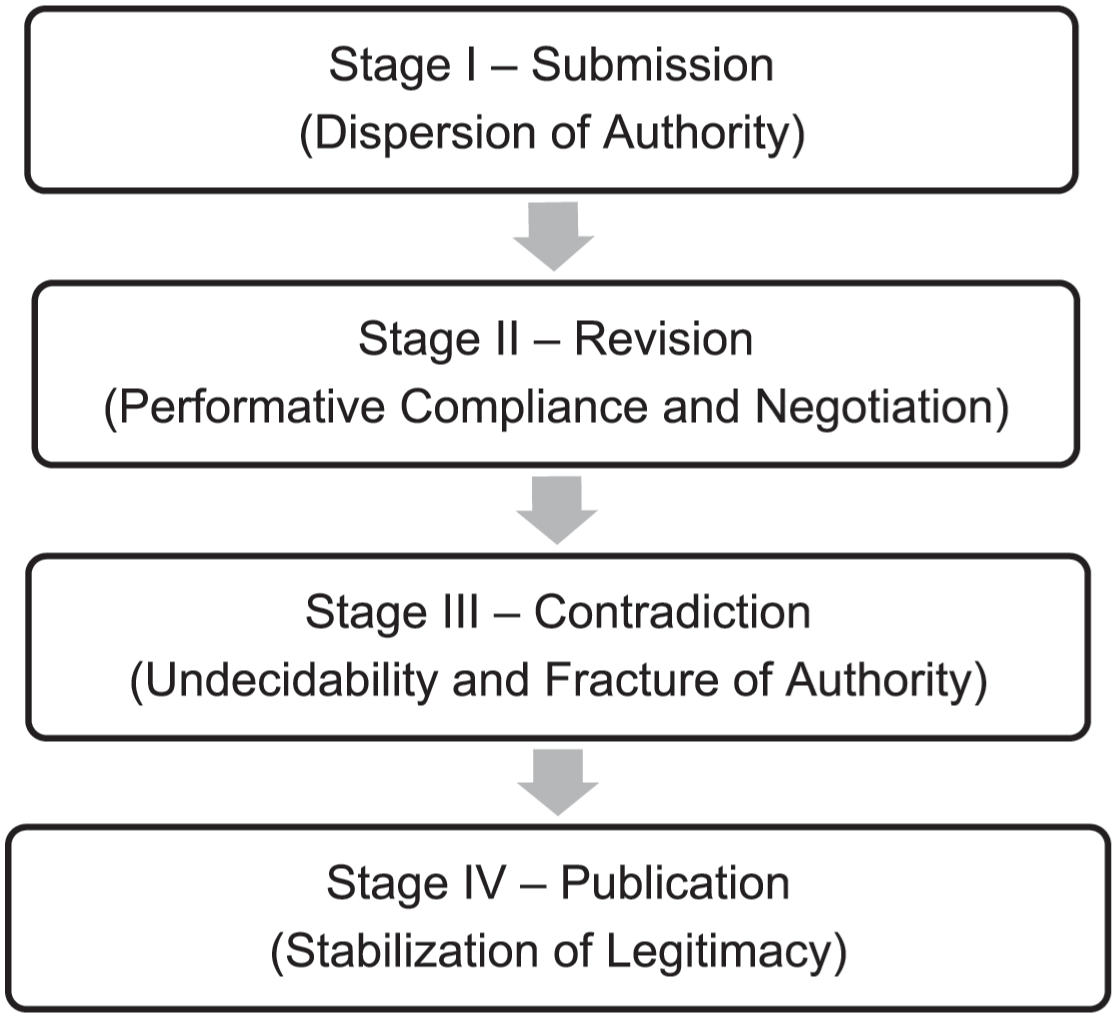
The four performative moments of journal publication. Each stage represents a distinct configuration of authority, subject formation, and legitimacy within the publication process.
By approaching the academic journal as a theater of power and legitimacy, this article seeks to make visible the performative dynamics of scholarly writing that are often mistaken for mere procedure. The scene of peer review—so often hidden behind claims of objectivity—emerges as a space of drama, subjection, and constrained agency. It is here, in the institutional theater of publication, that knowledge is not only evaluated but enacted, and where the struggle for intellectual intelligibility becomes indistinguishable from the performance of legitimacy itself.
The journal as institution of power
To understand the academic journal as an institution is to recognize its function not simply as a repository of knowledge but as a mechanism that organizes visibility, regulates discourse, and reproduces hierarchies of legitimacy. Like the modern disciplinary institutions Foucault analyzes in Discipline and Punish, the journal operates through a network of norms rather than explicit decrees, and through a continuous circulation of evaluative judgment rather than a single act of censorship. Its power lies not in formal exclusion but in the subtle operations of correction, review, and revision that transform knowledge into a field of compliance. Each submission is caught within a system of surveillance: the author absorbs and enacts the institutional gaze, anticipating the judgment that has not yet arrived, adjusting form, tone, and methodology to conform to imagined expectations. This anticipatory subjection—what Foucault (1977) calls “the prerequisite of the disciplined body” (p. 152)—renders the author a governable, compliant subject and fragments their presumed authority over the submitted text long before the editorial decision arrives. This corresponds to the first stage of the publication process outlined in Figure 1, where authority is presented not as a private activity but as dispersed across institutional norms, disciplinary expectations, and anticipated reviewer comments.
However, the journal’s disciplinary power diverges from institutions such as the prison or clinic: it regulates not bodies but meanings, exercising power through intellectual and symbolic forms. What is normalized here is not the body but the discursive norms of legitimacy that govern what counts as valid argument, citation, and evidence. Through its mechanisms of evaluation and normalization, the journal enforces the implicit norms that govern academic legitimacy—what Bourdieu (1988) calls “the rules of the game” (p. 156). Within this system, symbolic capital—the prestige of being published—gains its power precisely because it is exclusive and institutionally recognized. The peer review system thus functions as a ritualized structure in which authors compete for visibility, and reviewers, as representatives of institutional authority, act as gatekeepers of symbolic legitimacy. But this gatekeeping is never neutral, especially in humanities and social sciences journals: it reproduces the hierarchies and epistemic assumptions of the field itself, rewarding conformity while penalizing deviations that exceed accepted forms of intelligibility.
In this sense, the journal embodies both the productive and repressive dimensions of power. As Foucault insists, power does not merely constrain but produces: it generates the very subjects who operate within its regime (Foucault, 1977: 194; 1978: 94). The author who submits a manuscript is not simply evaluated but formed by the submission process. The act of writing under review transforms the writer into a subject who must continually justify, explain, and translate their own thought in terms acceptable to institutional authority. Even dissent must be articulated in sanctioned forms in order to remain intelligible within the accepted discourse of legitimacy. The institution thus produces the conditions of its own intelligibility: authors achieve intelligibility only by reproducing the categories through which the journal recognizes scholarly legitimacy.
This recursive structure of recognition corresponds to Bourdieu’s (1988) concept of misrecognition (méconnaissance)—the process by which the dominated participate in reproducing domination by accepting its principles as natural, legitimate, inevitable, or self-evident (p. 16). Within the journal, misrecognition takes the form of professionalism: the assumption that compliance with reviewer demands, however inconsistent, represents intellectual maturity rather than institutional submission. The more the author adjusts to these invisible norms, the more the institution’s authority is reaffirmed through the author’s performance of autonomous authorship. It is a paradoxical freedom: one is free to speak only within the discursive boundaries that render speech legitimate.
Michel Foucault’s (1977) theory of panopticism offers a suggestive analogy for understanding the peer review mechanism. The gaze of the reviewer—anonymous yet dominant—functions like that of the observing guard in Jeremy Bentham’s (1791) famous panopticon prison model: unseen, unverifiable, but internalized as a disciplining power. Foucault (1977) reinterprets the panopticon as a metaphor for the functioning of modern power, extending its logic beyond prisons to other disciplinary institutions—schools, hospitals, asylums, factories, workshops, barracks, public administrations, and private enterprises—and thus his theory of panopticism comes to denote “a new political anatomy” whose primary concern is discipline rather than sovereignty (p. 208). Here, power operates not through explicit coercion but through continuous observation and normalization, producing subjects who self-regulate in accordance with institutional expectations. Within this framework, visibility becomes a trap as individuals participate in their own subjection by performing compliance. While the metaphor of panopticism is suggestive in this context, it should not be understood as an exact structural equivalence. Unlike the classical panoptic model described by Foucault, the peer review process is typically characterized by mutual anonymity rather than one-sided visibility. Its relevance here lies instead in the internalization of evaluative norms, whereby authors anticipate judgment and regulate their writing accordingly, even in the absence of a clearly identifiable observer.
What distinguishes the academic panopticon is its affective dimension. It governs through anticipation, anxiety, and the desire for approval. The author does not fear punishment but rather rejection, invisibility, or exclusion from the symbolic capital of recognition. This fear disciplines imagination itself, creating a subject who regulates their own intellectual activity. Self-surveillance becomes indistinguishable from scholarly precision, and the performance of compliance merges with the performance of competence.
Conceiving the journal as an institution, then, highlights its dual nature, as both a Foucauldian space of normalization and a Bourdieusian arena of struggle. The two dynamics reinforce one another. Discipline ensures that the rules of visibility are fulfilled; the field converts those rules into distinctions of prestige and symbolic capital. Reviewers, editors, and readers participate in this performance of recognition, where each act of judgment reaffirms the institution’s power to define what counts as legitimate knowledge. What presents itself as a dialogue of equal peers is, in reality, a hierarchy of institutional positions: reviewers exercise symbolic power under the guise of academic evaluation, while authors engage in rhetorical self-regulation to maintain their intelligibility within the field.
If, as Foucault (1977) observes, institutions produce subjects through the discursive mechanisms of their own visibility (p. 187), then the journal is an emblematic site of such production. Its visibility operates in two directions: it makes scholarship visible while rendering the processes of its own authority invisible. The reviewer’s report appears as a reasoned critique, the editor’s decision as a procedural neutrality, and the published article as the visible performance of legitimacy. Still, beneath this transparency lies a system of symbolic coercion sustained by ritualized anonymity and delayed communication. The author’s time and labor spent over the rituals of submission, revision, and resubmission accumulate “symbolic capital” in the form of “academic worthiness” through institutionally recognized practices (Bourdieu, 1988: 96).
This disciplinary system constitutes a form of performative agency. It is, Butler argues, “the double-movement of being constituted in and by a signifier,” whereby the subject is compelled to repeat, cite, or reproduce the signifier through which identity becomes intelligible. Because the signifier sustains itself only through the continuation of a “citational chain,” agency emerges within the “hiatus in iterability”—the compulsion to establish identity through repetition (Butler, 1997: 220). The author’s revisions, footnotes, and discursive concessions are not mere formalities but gestures of intelligibility within an epistemic structure that demands perpetual self-regulation to achieve agency. In this sense, the journal functions as a theater before it becomes a theater: before the explicit performance of publication, there is already the backstage rehearsal of submission, a ritual of self-discipline performed for an unseen audience.
The institution is theatrical not because it stages spectacle but because it manages visibility, concealing power behind the guise of procedural neutrality. Its authority depends on the continuous performance of neutrality, much as in Bertolt Brecht’s theater where the mechanisms of production are purposefully made visible yet ideologically denied. The journal’s very structure—submission, blind review, revision, acceptance—constitutes a script of legitimacy whose actors must continually rehearse their own credibility. Within this institutional dramaturgy, the author becomes both subject and performer, compelled to reproduce the discourse that secures visibility yet constrains agency.
While journals exercise significant gatekeeping power, this power is neither absolute nor unidirectional. Rather, it operates through the iterative interactions among authors, reviewers, and editors, in which authority is negotiated, challenged, and re-stabilized over time. Journal power thus emerges not as a deterministic force imposed upon authors, but as a contingent effect of repeated evaluative performances in which authors themselves participate.
The journal as theatrical space
When the author uploads a manuscript and clicks “Submit,” the curtain rises on a scene already in progress. The audience—editors, reviewers, and institutional gatekeepers—awaits a performance whose script is only partially written. Every submission repeats the same ritual: self-presentation, tonal adjustment, and the anticipation of judgment. Still, the space of journals publishing humanities and social sciences research is not neutral; it is an apparatus that both frames and enforces performance. Its invisible structure—guidelines, reviewer expectations, disciplinary conventions—constitutes the stage upon which intellectual legitimacy must be enacted. The author’s labor, though largely textual, is also dramaturgical, with each paragraph functioning as a negotiation between visibility and concealment, assertion and restraint. This theatrical framing corresponds to the stage of revision outlined in Figure 1, where authors engage in performative negotiation with multiple, and often implicit, evaluative expectations.
The audience invoked here is not a single, homogeneous body. Immediately after submission, editors and reviewers act as institutional authorities who determine whether a manuscript satisfies prevailing standards of consistency and relevance. Nonetheless, the author also performs before an imagined disciplinary community whose standards extend beyond any individual report, as well as before future readers who will encounter the work once legitimized. These audiences do not demand identical forms of legibility. What persuades a reviewer in the present may not fully align with future disciplinary norms or values. The performance of legitimacy thus unfolds across overlapping but distinct audiences, each regulating what can be said, how it must be framed, and which claims can be sustained.
This kind of meta-performance reveals that publication is not merely the circulation of knowledge but a choreography of power. The journal functions as, in Foucault’s (1977) own terms, an “artificial and coercive theatre” (p. 251)—a space of visibility where the author becomes both the subject and the object of institutional surveillance and regulation. The peer review process, with its ritual of submission, judgment, and correction, rehearses the same system of surveillance that governs the panoptic institution: to write under review is to internalize the gaze of authority, performing compliance even in the act of self-articulation. Through this apparatus, discourse is regulated not by censorship but by the internalization of evaluative norms—the silent expectation of what counts as rigorous, original, or publishable.
Butler’s theory of performativity helps illuminate this dynamic as a paradox of subjection. The author becomes intelligible to the institution only by adopting its discursive conventions, but in doing so becomes bound by them. Authorship is thus both produced and constrained by the performative iteration of institutional norms. The author’s repeated gestures of self-editing, clarification, and justification are not merely strategic; they are constitutive acts through which academic subjectivity is formed. Each revision becomes a reenactment of authority—a speech act that both sustains and reaffirms the institution’s claim over what and how knowledge may be said.
From this perspective, the journal resembles the kind of performative space theorized by Goffman and Schechner: a liminal zone—a transitional threshold—between authenticity and performance, where self-articulation is sustained only through repetition and enactment. Goffman’s (1959) theory of the Front explains the author’s careful management of scholarly performance under the institutional gaze: “Front [is] that part of the individual’s performance which regularly functions in a general and fixed fashion to define the situation for those who observe the performance. Front, then, is the expressive equipment of a standard kind intentionally or unwittingly employed by the individual during his performance” (p. 22). Schechner’s (1988) conception of performance as a “twice-behaved behavior, behavior that can be repeated, that is, rehearsed” (p. 271) illuminates how academic writing re-enacts the gestures of legitimacy learned from prior performances. The peer review exchange becomes a rehearsal loop—each “revise and resubmit” request serving as a cue for further refinement, a new enactment of the same role under a shifting institutional gaze.
The metaphor of conceptualizing the journal as theater thus evolves from a mere illustrative analogy into a central analytical framework. The journal is not simply like a stage; it is one, sustained by its scripts, hierarchies, and rituals of repetition. Within this space, the author occupies the position of the actor whose agency depends on obedience to form. As in The Birthday Party (Pinter, 1957), the script of authority is obscure, and the directives of its representatives—Goldberg and McCann (reviewers and editors)—arrive in the form of commands and riddles that generate uncertainty. The resulting anxiety is not accidental but inherently constitutive of the institutional framework: it is through uncertainty that the institution maintains control. Beckett’s (1953) influence is also evident here: the author’s endless cycle of submission and return, of waiting and reperforming, recalls the absurd persistence of action in Waiting for Godot, despite the suspension of resolution. In Brecht’s (1995) Galileo, the drama of scientific truth is staged as a scene under constant scrutiny and judgment, where knowledge itself becomes a performative act subject to institutional authority and intervention. Similarly, in Genet’s (1947) The Maids, the self is theatricalized through Claire and Solange’s repeated role-playing of the murder of their mistress, enacting both compliance and resistance under the gaze of internalized power. This duality—the simultaneous enactment of constrained agency and internalized authority—mirrors the author’s experience: the manuscript, like Galileo’s discoveries or the two maids’ ritualized performances, is continuously revised, framed, and disciplined through a process that transforms knowledge and subjectivity into a staged negotiation of intelligibility, authority, and survival. The roles on this stage—author, reviewer, editor—are not fixed identities but institutional positions whose authority and expectations shift across disciplines and editorial cultures. What remains constant, however, is the institutional logic of performance through which legitimacy is enacted.
To read the journal through these dramaturgical figures is to recognize that knowledge itself enters the world through performance. The production of scholarly legitimacy depends not only on the circulation of ideas but on the successful enactment of institutional regulations. Citation, tone, structure, and methodology become the costumes of authority; rejection, revision, and acceptance form the rhythmic flow of its performance. The journal is thus not the antithesis of theater but its academic counterpart: a space where the expression of thought is bound by the constraints of form.
In this sense, the theatrical metaphor exposes the epistemic cost of intelligibility. To remain visible within the institution, the author must continually perform the kind of subjective identity that the journal recognizes as legitimate. What appears as communication is also containment; what seems like participation is also surveillance. However, as Butler (1993) suggests, “the paradox of subjectivation (assujetissement) is precisely that the subject who would resist such norms is itself enabled, if not produced, by such norms” (p. 15). Agency consists of a reiterative and rearticulatory practice operating within power rather than standing outside it in opposition. Performativity, therefore, both reproduces norms and contains the possibility of disruption. Each enactment carries the risk of deviation from the norm; each performance opens the possibility of failing to comply with reviewers’ directives, parodying their reports, or subverting their claims. It is within this fragile tension—between conformity and subversion—that the author’s subjectivity comes into being. The journal, then, should be understood not only as a space of power but also as a site of potential rupture. The following discussion turns to that moment of tension, when the author confronts incompatible reviewer demands. At this point, the institution’s coherence falters, exposing the instability of the norms it claims to uphold.
The moment of contradiction: Undecidability and the fracture of authority
The scene returns to the moment of submission, where two reviewer reports collide in the author’s inbox. Each voice is sovereign in its own domain, each bearing the mark of institutional authority, and yet they cannot be reconciled. One demands greater theoretical abstraction, whereas the other insists on empirical grounding; one calls for a stronger claim, but the other for modesty and self-restraint. The author, suspended between these incompatible imperatives, experiences not simply confusion but an ontological displacement. The text no longer belongs to a single interpretive voice—it becomes an unstable field in which authority itself fractures. This moment, often regarded as a procedural inconvenience, exposes the epistemic undecidability underlying academic legitimacy. At this instant, the authority of the journal collapses, revealing that its power depends not on the resolution of contradiction but on the endless suspension of it. This case relates directly to the third stage of contradiction outlined in Figure 1, where the review process produces not coherence but undecidability. Such contradiction, however, is neither universal nor absolute; rather, the article treats moments of disagreement, where they arise, as analytically significant instances in which the normative foundations of evaluation become especially visible.
Derrida’s notion of undecidability offers a critical lens for revealing how the journal’s authority rests on the perpetual postponement of a definitive judgment. As he argues in The University Without Condition (Derrida, 2002), institutions founded on reason and critique are nonetheless haunted by the impossibility of legitimizing themselves. Every act of judgment relies on an interpretation that is never absolute, because the standards it applies are themselves provisional and open to question. The peer review process, in this light, becomes a rehearsal of this inherent instability: reviewers make judgments that are neither wholly objective nor entirely subjective, but remain dependent on institutionally predefined standards. The author’s submission thus enters a discursive system in which every correction and judgment is performative, not merely evaluative—an act that claims its own authority in the very moment it is articulated. When authors confront incompatible evaluative demands, the criteria of judgment no longer form a coherent standard but instead expose the instability of authority within the institution. The contradiction between reviewers is therefore not a malfunction but a visible symptom of the institution’s intrinsic undecidability.
Following Butler’s theory of iterability, the author’s position can be understood as one in which subjection becomes the very condition of agency. Butler (1997) describes how subjects are formed through the very powers that constrain them, making recognition inseparable from submission: Performativity cannot be understood outside of a process of iterability, a regularized and constrained repetition of norms. And this repetition is not performed fa a subject; this repetition is what enables a subject and constitutes the temporal condition for the subject. This iterability implies that “performance” is not a singular “act” or event, but a ritualized production, a ritual reiterated under and through constraint, under and through the force of prohibition and taboo, with the threat of ostracism and even death controlling and compelling the shape of the production, but not, I will insist, determining it fully in advance. (p. 95)
The author who rewrites, accommodates, or edits in response to inconsistent reviews is not merely conforming to institutional norms but becoming intelligible within them. Each revision reiterates the conditions of legitimacy, transforming the author into a subject of discourse. Yet the paradox of performativity resides in the iterative enactment of norms that simultaneously enable and unsettle agency: the more the author strives to comply, the more they expose the constructed nature of the institutional script. What begins as an act of obedience becomes a performance of the institution’s instability.
Foucault’s analysis of visibility as a mechanism of discipline and power deepens this paradox. According to him: He who is subjected to a field of visibility, and who knows it, assumes responsibility for the constraints of power; he makes them play spontaneously upon himself; he inscribes in himself the power relation in which he simultaneously plays both roles; he becomes the principle of his own subjection. (Foucault, 1977: 202–203)
Power operates not through overt domination or punishment but through the internalization of surveillance—the subject’s anticipation of judgment. The peer review process operates in a comparable way: anonymity does not entail the absence of visibility but rather reorganizes it within the institutional gaze. The author becomes hyper-visible, as theorized by Muñoz (1999) in his description of constructed subjects, before unseen judges who remain invisible within the institutional apparatus. This asymmetry produces a theater of power in which the gaze is both omnipresent and unverifiable. Inconsistent reviews, in this sense, are less communicative failures than effects of a system operating through uncertainty and invisibility. The institution sustains its authority not by resolving contradiction but by organizing it—by compelling the author to perform reconciliation in a scene where resolution is structurally impossible.
The author’s predicament in this case mirrors the dramaturgy of modernist theater, where power and meaning are perpetually deferred. Resembling the protagonists in Pinter’s theater, who are confronted with opaque and arbitrary authority, the author of an article faces directives that cannot be fully interpreted; their inherent incoherence and occasional contradiction undermine the possibility of generating a stable meaning. In Beckett’s theater, repetition and incompletion expose the futility of reaching a resolution, while Brecht’s epic theater reveals that obedience is not merely an act of submission but a performance that can be used strategically. Even Genet’s The Maids anticipates this dialectic of submission and revolt: to survive, the performers must inhabit the masks that subjugate them. The peer review process thus becomes a ritual stage where legitimacy is never achieved but endlessly negotiated.
From this perspective, contradiction emerges not as a weakness but as the institution’s means of survival. The reviewers’ unreconciled demands sustain the illusion of impartiality by distributing authority across multiple, inconsistent voices. The editor’s mediation—often cast as the final, impartial voice of reason—functions primarily to anchor the illusion of coherence. However, what the institution ultimately anchors is undecidability itself—the performance of reason within a fractured interpretive field. Derrida (2002) reminds us that undecidability is not the suspension of decision but its founding condition; the decision is meaningful only because it emerges from a web of indeterminate, competing meanings that perpetually resist reaching a final resolution. The author, compelled to decide how to decide, becomes the site where this institutional paradox materializes.
This inherent tension illustrates the mechanism of performative power. Each revision, citation, or rephrasing is an act of intelligibility within a system that demands perpetual demonstration of legitimacy. The author’s compliance is not passive but strategic, recalling Butler’s (1997) observation that “subjection consists precisely in this fundamental dependency on a discourse we never chose but that, paradoxically, initiates and sustains our agency” (p. 2). That is to say, subjection is always ambivalent—it both constrains and enables agency. The disagreement between reviewers provides an opportunity for the author to perform the institution’s values, to demonstrate their capacity for adaptability, reflexivity, and intellectual restraint. This performance, however, also exposes the limits of those very values: the impossibility of presenting a stable meaning within a system that thrives on indeterminacy.
Overall, the moment of contradiction functions as the institution’s mirror. It reflects the journal’s dependence on performance, requiring constant rehearsal to maintain the façade of coherence. The author’s perplexity before conflicting demands is not an obstacle to publication but a necessary dramatization of the journal’s epistemic foundations. To write under such conditions is to participate in a play without resolution, to perform legitimacy before an audience that remains unseen. What is at stake extends beyond acceptance or rejection; it is the delicate negotiation of existence within the theater of knowledge.
Intelligibility and performance: Strategies of compliance and resistance
If contradiction exposes the fragility of authority, intelligibility becomes the means of navigating it. The author, confronted with the irreconcilable demands of reviewers and the silent expectations of the editorial system, must learn to persist in a space where coherence is neither guaranteed nor possible. This persistence does not come from resolving the contradiction, but from continuously performing it. Thus, to survive within the theatrical publishing culture is to navigate contradiction performatively—to transform the impossibility of agreement into a choreography of legitimacy. The author’s task is not to master or activate the institution’s norms but to improvise within them, to perform understanding without ever achieving it. The final stage of Figure 1 signals this strategy, whereby authors negotiate intelligibility by performing compliance, resistance, and adaptation within shifting evaluative frameworks.
Foucault’s account of disciplinary subjectivity clarifies this paradoxical mode of endurance. As he contends, “Discipline produces subjected and practiced bodies, ‘docile’ bodies,” by means of dissociating power from them, an effect instilled through two related ways: turning power into an “aptitude” or “capacity” that can be developed and enhanced, and reversing the course of that emergent capacity and converting it instead into a relationship of strict subordination and control (Foucault, 1977: 138). Discipline is not simply imposed on subjects; it invests, marks, and trains them through a subtle coercion that makes them simultaneously useful and compliant. The subject of power is not merely coerced but produced through the repetition of sanctioned moves that internalize surveillance. The academic writer, too, learns to anticipate evaluation—to avert critique, to revise in accordance with imagined authority, to discipline thought before it is disciplined by reviewers or editors. Such anticipatory performance is not mere submission but a form of intelligibility, a strategy that transforms subjection into competence. The compliant author does not simply obey; they demonstrate mastery of the institution’s gaze by reproducing its codes more skillfully than it can articulate itself.
Bourdieu’s conception of habitus offers another lens for understanding this dynamic. Habitus refers to: systems of durable, transposable dispositions, structured structures predisposed to function as structuring structures, that is, as principles of the generation and structuring of practices and representations which can be objectively “regulated” and “regular” without in any way being the product of obedience to rules. (Bourdieu, 1977: 87)
In other words, habitus consists of internalized dispositions and habitual ways of perceiving the world that are stable though flexible. They control how individuals think, act, and respond while allowing adaptation to new contexts and demands within the social field they inhabit. Within the academic field, an author’s habitus informs how they internalize and enact scholarly rhetorical and epistemic norms, anticipate peer review, and perform the practices that earn symbolic capital. Revisions in response to peer review thus become acts of self-formation through which authors build legitimacy. Every citation and methodological clarification functions as a performative gesture of belonging. Still, this sense of belonging is tentative; it depends on the continual reenactment of conformity. The author’s work, therefore, is both productive and unstable—a performance of competence maintained under the threat of exclusion.
Butler’s theory of performativity reframes this repetition as a form of ambivalent agency. She argues that the subject’s reiterative acts of compliance both reproduce and expose the structure of subjection. To perform the journal’s norms of legitimacy is to repeat them, with every repetition carrying the possibility of error, irony, or excess. The author’s revisions, no matter how precise, always risk disclosing the contingent nature of institutional authority. A misplaced emphasis, an overextended argument, or a tone that is too assertive or too cautious—all these reveal the instability of what counts as proper scholarly conduct. The author survives by performing legitimacy; each performance shows that legitimacy is something performed, not inherent.
The peer-reviewed journal, from this perspective, becomes a stage for what Goffman (1959) calls the presentation of self in everyday life. The author crafts an academic personality attuned to the expectations of an invisible audience. The reviewer’s gaze becomes the mirror through which the author negotiates visibility, and the manuscript is the set on which that visibility is negotiated. However, as Schechner (1988) reminds us, performance is not mere imitation—it is a “restored behavior” that has a life of its own (p. 271), a repetition that is always slightly altered, infused with the actor’s own agency. The author’s revisions thus inhabit an in-between space between obedience and improvisation, where each act of compliance retains a trace of the author’s subjectivity and creativity.
In this sense, intelligibility in the academic theater recalls the strategies of characters in modernist theater. In Beckett’s theater, endurance itself is a form of defiance: Vladimir and Estragon’s endless waiting performs the persistence of life in the face of indifference and hopelessness. Likewise, the author’s iterative revisions signify a refusal to vanish, a continual assertion of presence within an anonymous system. In Brecht’s dramaturgy, characters learn to perform their ideology in order to expose it; Galileo’s recantation—his public renouncement of his own scientific claims under pressure from the Roman Catholic Inquisition—thus becomes both an act of submission and a form of criticizing the underlying institutional power. Similarly, the academic author may outwardly comply with the reviewers’ demands, performing the norms of the journal, but this performance can carry irony, subtle critique, or a deliberate shaping of how their work is presented, negotiating authority while retaining autonomy. In Genet’s The Maids, the repetition of servitude produces brief moments of affective reversal, when imitation becomes revolt; likewise, the author’s mimicry of academic conventions may generate the very space in which critique or subversion becomes possible. Even in the absurd interrogations of Pinter’s characters, intelligibility depends on linguistic improvisation—the ability to answer without answering, to maintain coherence in a context where none truly exists.
These are not mere analogic metaphors but diagnostic frameworks that expose institutional mechanics. They reveal that the institutional apparatus always entails two contradictory demands: one must submit to the oppressive structures in order to remain recognized within them. Butler’s following argument explains the logic of this dynamic: No subject emerges without a passionate attachment to those on whom he or she is fundamentally dependent . . . . Primary dependency conditions the political formation and regulation of subjects and becomes the means of their subjection . . . . As the condition of becoming a subject, subordination implies being in a mandatory submission. (Butler, 1997: 7)
The author’s ability to articulate thought depends on the same disciplinary norms that restrict what can be expressed. This dependence, however, also enables resistance, since repetition creates a space for divergence from norms. To reproduce the institution’s language with excessive precision is to expose its artificiality through parody.
The strategies of intelligibility thus waver between precise reiteration and ironic performance, compliance with institutional norms, and critique of them. Each revision becomes a gesture of translation—transforming the author’s thought into the language of legitimacy without entirely erasing its intellectual dissonance. The choreography of publication depends on this delicate balance: too much conformity erases the authorial voice, too much deviation risks exclusion. The institution sustains itself through the author’s continual adaptation, their ability to perform self-suppression in order to remain visible and intelligible. This is why the peer review process, despite its claims of fostering improvement, often results in intellectual exhaustion instead of clarity. The author survives not by resolving contradictions but by managing them performatively.
However, it is within this performative management that limited forms of resistance emerge. Resistance in this setting does not take the form of overt refusal or institutional withdrawal. Rather, it becomes manifest through revisionary choices that remain formally compliant while quietly shifting emphasis, argument, or structure. An author may adopt the vocabulary suggested by a reviewer while preserving an underlying theoretical orientation, reframe a disputed claim without relinquishing it, or respond to incompatible demands by creating a text that satisfies formal expectations while maintaining its conceptual bases. Such gestures do not overturn institutional norms, but they demonstrate how repetition enables subtle changes within the ordinary labor of revision.
Foucault’s (2007) reflections on critique as “the art of not being governed quite so much” (p. 45) resonate here. A critical engagement within the institution does not entail standing outside it but complying with its procedures differently—to perform its script with deliberate hesitation. The author’s negotiation of reviewer feedback becomes a form of everyday resistance: a practice of rewriting that neither rejects authority nor fully assimilates to it. Each instance of strategic compliance is an enactment of what Butler (1997) describes as “active and productive conditions of subordination” (p. 16)—a form of agency that operates through, rather than against, power.
Intelligibility, then, is a performance of endurance within a space of uncertainty. It depends on the author’s competence to keep the play (the submitted article) going when the script (the publishing journal) collapses, to maintain the illusion of coherence through the strategic improvisation of legitimacy. In this performance, submission and resistance function as inseparable gestures of enduring persistence. The institution’s theater of knowledge depends on these performances—not because they resolve contradiction, but because they render it visible and manageable. As Beckett’s narrator in The Unnamable declares, “I can’t go on in any case. But I must go on. So I’ll go on” (Beckett, 2009: 397). The author proceeds with the submission process not out of conviction but necessity. The persistence of academic publishing, with its endless cycles of submission and revision, is thus the persistence of theater itself—a ritual that re-enacts power in order to survive it.
Conclusion
The academic journal, seen through the lens of theater, becomes less a transparent medium of knowledge than a stage on which authority, recognition, and intelligibility are continually performed. Peer review appears not as a neutral procedure but as a dramaturgy where judgment, subjection, and creativity converge, revealing a choreography of power in which authors, reviewers, and editors enact roles that sustain the institution’s legitimacy. 2 Knowledge here is not merely produced but staged; its authority arises from repeated enactment and public display rather than transparency. Publishing thus becomes a form of disciplinary exhibition in which legitimacy and visibility collapse into one another. However, every repetition leaves a space for variation, allowing agency to emerge in the subtle deviations that turn compliance into critique, much as the theatrical analogies drawn from Pinter, Beckett, Brecht, and Genet expose how performance wavers between obedience and resistance. The institution endures through ongoing rehearsal, but the dividing line between the institutional script and individual improvisation is never stable, making critique possible in the very deviations, hesitations, ambiguities, or inconsistencies that sustain the publishing system. To get published, then, is to perform a set of choices within a field of indeterminacy: every decision about revision, emphasis, or compliance is made amid conventions that are never fully explicit or stable. This resembles participating in a play whose rules shift, whose audience is unseen, and whose meaning is never settled. Resistance becomes possible because the author performs with awareness—exposing the machinery of legitimacy even while inhabiting it, turning repetition into reflection and obedience into subversive improvisation. In this regard, the production and accumulation of knowledge are not a neutral process, but the outcome of inherently political negotiations, structured by power, recognition, and the conditions of institutional intelligibility.
Footnotes

Author contributions
The author confirms sole responsibility for the conception and design of the study; data collection, analysis and interpretation of results; and manuscript preparation.
Funding
The author received no financial support for the research, authorship, and/or publication of this article.
Declaration of conflicting interests
The author declared no potential conflicts of interest with respect to the research, authorship, and/or publication of this article.