







Abstract
Underrepresented college students are more likely than majority students to underperform and drop out of college. Perceptions of status relative to other students may play a key role in this process. The current study uses subjective social status (SSS) to predict underrepresented students’ grade point average via their sense of academic competence at the end of their first year at an elite predominantly White institution. A total of 329 underrepresented college students (i.e., students from historically underrepresented racial or ethnic minority groups, first generation college students, or students from economically disadvantaged family backgrounds) participated in data collection during their first academic year attending a predominantly White institution. On average, students reported a drop in SSS from their home community to the university. After accounting for gender, race or ethnicity, family income, standardized test scores, and depressive symptoms, a larger drop in SSS was related to lower spring grade point average via reduced perceived academic competence.
In recent years, elite universities have successfully increased recruitment and enrollment of traditionally underrepresented college students, including students from historically underrepresented racial and ethnic minority groups, first-generation college students, and students from low-income backgrounds (Institute of Education Sciences, National Center for Education Statistics, 2013). However, such students tend to face additional challenges when they reach college including alienation, culture shock, stigmatization, discrimination, and other marginalizing experiences (Contreras, 2011; Wei et al., 2010). These experiences may lower students’ sense of status leading them to question their academic competence and consequently, underperform academically. Statistics indicate that students from underrepresented groups tend to struggle academically relative to their more affluent, continuing-generation, White counterparts (Chen & DesJardins, 2010; Hinz & Braxton, 2013). Despite increasing admission rates, underrepresented students are more likely than their majority counterparts to leave school before graduating. For example, nationally, only 41% of African Americans and about 50% of first-generation students who enroll in college obtain a bachelor’s degree after 6 years, compared with 64% of both continuing generation and White students (Franke, Hurtado, Pryor, & Tran, 2011). In addition, the college completion gap actually has been widening between Black and White students over the past 50 years (Snyder & Dillow, 2013; The William T. Grant Foundation, 2013). Although the disparities are smaller at more selective universities, majority students still outperform and graduate at higher rates than underrepresented students at elite institutions (Attewell, Heil, & Reisel, 2011; Bowen, Kurzweil, Tobin, & Pichler, 2006; Hinrichs, 2014). Although college is considered to be the great equalizer for racial or ethnic minority, first generation, and low-income students, many underperform and ultimately do not graduate or complete their chosen degrees, accumulating significant debt in the process.
Some universities have begun to expend large amounts of resources in attempts to close the achievement gap between underrepresented and majority students through intensive summer programs and tutoring for underrepresented students (e.g., Strayhorn, 2011). The assumption behind these types of approaches is that underrepresented students are less prepared for the rigors of college and need extra academic support in order to catch up to majority students. However, even with equivalent academic preparation, underrepresented students still fall behind and drop out at greater rates than their White, middle-class peers (Carnevale & Strohl, 2010), suggesting that academic preparedness alone cannot explain the academic achievement gap between underrepresented and majority college students. Thus, a better understanding of malleable factors beyond academic preparation that contribute to the achievement gap for underrepresented students may inform alternate or additional intervention approaches that hold promise for remedying this gap between underrepresented and majority college students.
Findings from previous research suggest that students’ sense of status relative to their peers may be an additional factor contributing to the educational attainment gap (Johnson, Richeson & Finkel, 2011; Ostrove & Long, 2007). Several markers of students’ sense of status, such as a low sense of school belonging, decreased academic self-efficacy, and increased experiences of stereotype threat (the salience of a given characteristic, such as race, impacting actual performance in stereotype-congruent ways) have all been linked to poorer academic performance (Hackett, Betz, Casas, & Rocha-Singh, 1992; Walton & Cohen, 2007; Woodcock, Hernandez, Estrada, & Schultz, 2012). The common thread between all of these predictors appears to be students’ sense of place and adequacy in their current school. Stereotype threat specifically has been shown to harm underrepresented students’ academic performance when marginalized backgrounds are made salient. Relative deprivation theory, a broad approach to social change and equity, suggests that judging oneself as worse off than others in the surrounding environment is associated with poorer physical and mental health (Scott et al., 2014; Smith, Pettigrew, Pippin, & Bialosiewicz, 2012). The idea is that relative status, or how people “stack up” compared with their neighbors, coworkers, or fellow students, matters for how well they will fare in a variety of domains, even above absolute measures of status (such as income or education level). According to this theory, a working-class individual in a working-class neighborhood may be better off than a middle-class person in an upper-class neighborhood, in terms of outcomes like individual achievement, intergroup attitudes, and health (Smith et al., 2012).
College students coming from minority racial or ethnic groups, low-income families, and who are first-generation college students may find several points of comparison between themselves and other students, such as race, perceived family income, family connections, and access to opportunities based on systemic issues. Underrepresented students may find themselves surrounded, many for the first time, by others their age who are from more privileged backgrounds, and this contrast may have a deleterious effect on underrepresented students’ perceptions of their status relative to their peers (Massey, Charles, Lundy, & Fisher, 2003). For example, a White student from a working class background may initially seem to fit in at a selective predominantly White institution (PWI); however, she may quickly notice that other students own more expensive personal belongings (e.g., laptops, clothes, phones), which may lower her sense of status. Similarly, a Black student who attended a predominantly Black, under-resourced public high school may find that despite earning admission to a selective PWI, he did not have access to the same types of academic resources as his peers who attended better-funded public or private high schools. This could substantially lower his sense of status from home to school. Moreover, racial and ethnic minority students may experience culture shock when shifting from a majority–minority high school to a PWI, and they also may be more likely to experience discrimination and exclusion in and out of the classroom at a PWI (Massey et al., 2003) all of which may result in a drop in their perceived social status.
One way to capture an overall subjective sense of how one stands relative to others is through measures of subjective social status (SSS; Adler, Epel, Castellazzo, & Ickovics, 2000). SSS refers to perceived social standing relative to a given social group. Measures of SSS typically ask participants to rank themselves on a ladder with rungs labeled 1 to 10 compared with others in their community or group. SSS does not provide criteria for participants to use when ranking themselves and so is thought to better capture an overall subjective sense of status rather than status in particular domains. Subjective standing has been show to influence the ways individuals behave and feel, beyond absolute standing (Singh-Manoux, Marmot, & Adler, 2005; Wolff, Subramanian, Acevedo-Garcia, Weber, & Kawachi, 2010).
Perceived competency in academics is likely to be a highly salient area of functioning for the majority of college students at selective universities; therefore, lower perceived social status may be associated with a decreased sense of academic competence and poorer academic outcomes (Walton & Cohen, 2011). Marginalizing experiences often communicate messages of inferior status to members of marginalized groups. Underrepresented students who are increasingly facing marginalizing experiences during their transition to a PWI may take this as an indication of a drop in their social standing. A perceived drop in one’s social status may detract from underrepresented students’ academic performance by undermining students’ perceptions of their academic competence resulting in greater psychological distress and fewer cognitive resources to commit to studies (Chemers, Hu, & Garcia, 2001). Given that underrepresented students are more likely to underperform and drop out than majority students, a link between lower SSS, self-perceived academic abilities, and academic outcomes may indicate that changes in underrepresented students’ perceptions of social standing play a key role in their academic adjustment as they transition to PWIs.
There is evidence that a perceived drop in relative status, such as when a person maintains the same income and wealth but relocates from a lower income area to a higher income area, may have additional negative consequences apart from current status alone (Leu et al., 2008). People from lower income backgrounds who move to more affluent neighborhoods, for example, may perceive themselves as financially worse off relative to their standing in their original community. The transition to an elite PWI among underrepresented students may similarly lead to a drop in perceived status. To gain acceptance at a selective university, underrepresented students likely were successful and prominent in their high schools and home communities. Thus, underrepresented students likely perceived themselves as being of at least equal standing to others in their home community. In addition, students from racial or ethnic minority groups or low-income backgrounds may also have shared many demographic similarities with members of their home community. After transitioning to college, however, students from underrepresented groups may find themselves outnumbered by peers with more resources and privilege, which may have a negative effect on their general self-perception relative to other students at the university. Moreover, majority students may directly and indirectly communicate messages of inferiority to underrepresented students (Massey et al., 2003) which may further undermine underrepresented students’ sense of social standing. In light of these types of experiences, underrepresented students would be expected to self-report a lower ranking on a ladder of SSS in their new school community relative to their previous home community. A drop in perceived status from students’ home communities to the university may predict poorer outcomes for these students as they, perhaps for the first time, find themselves surrounded by the privileged and resourced. This drop may detract from students’ perceived academic competence leading them to experience emotional distress, question their identities as high-achieving students, and engage with their coursework in less effective ways. Ultimately, questioning their academic competence may serve as an additional cognitive demand that diminishes their ability to achieve in their courses (Chemers et al., 2001).
The current study aimed to investigate the role of SSS in academic outcomes among underrepresented students attending an elite PWI. Students from historically underrepresented racial or ethnic minority groups, first-generation college students, and students from low-income backgrounds were eligible to participate in the study. Using a change in SSS from home to school as a predictor of academic outcomes, the current study examined self-rankings on an SSS ladder and how changes in perceived social status may affect students’ sense of academic competence (measured using the combined Scholastic Competence and Intellectual Ability subscales from the Self-Perception Profile for College Students; Harter, 1988) and consequently, their academic performance in terms of grade point average (GPA) at the end of their second semester (Marsh & Yeung, 1997). The current study examined two primary hypotheses: (a) Underrepresented students will report a drop in SSS when comparing their previous home to new school communities. (b) A drop in SSS from the previous home to new school setting will predict poorer academic performance (i.e., GPA), with perceived academic competence mediating this association.
Notably, the current study addressed potential confounds in several ways. First, our measure of a drop in SSS asked students to rate their perceived status prior to attending the university and currently. The drop is calculated by subtracting the current rating from the prior rating. This measure reduces the likelihood that the measure is just capturing negative affect as more global negative affect would likely yield similarly low ratings across both items. In addition, we had participants complete a measure of depressive symptoms and included that measure in our statistical model to account for the potential influence of depressive symptoms on students’ current ratings of SSS. Next, we included measures of gender, racial/ethnic minority status, and family income to help clarify whether a demographic characteristic might be driving any association between SSS and academic outcomes. Finally, to ensure that we were capturing potential effects of a drop in SSS above and beyond academic preparedness, we also included participants’ standardized test scores (taken from their applications for admission to the university) in our statistical model.
Method
Participants and Procedure
Participants in the current study included 329 first-year undergraduate students surveyed during the first and second semesters of their first year of college at a large, selective public university in the southeastern United States. Students were eligible to participate if their application information indicated that they identified with one or more historically underrepresented racial or ethnic groups (Black/African American, Hispanic, American Indian/Alaskan Native, or Native Hawaiian/Other Pacific Islander), or if they identified as first-generation college students, or if their families were considered low-income (defined here as full eligibility for the Pell Grant). Participants could have been members of multiple groups (e.g., a first generation Hispanic student). Based on these criteria, 775 students were identified as eligible to participate in the study. Eligible students were contacted by email and invited to come into the lab and complete surveys on an iPad about their social, emotional, and academic functioning. Participants over age 18 provided informed consent and those under 18 provided assent and consent was obtained from their parents or guardians. Overall, 340 students completed surveys (43.9% response rate) in the first semester, and 329 of these students (97% retention rate) completed surveys in the second semester. Only students who had data for both semesters were included in the current sample. The sessions each lasted about an hour, and students were compensated with a $20 Visa gift card for their time.
The sample was 68.5% female. The sample identified with the following racial or ethnic groups: Black/African American (29.1%), White (23.5%), Hispanic/Latino (10%), multiracial (20%), Asian (16.2%), or American Indian/Alaskan Native (.3%). Slightly less than half (44.7%) of the sample is identified as first-generation college students. The mean age of the sample in the fall semester of their first year was 18.11 years (SD = .37 years). Annual family income of participants ranged from below $4,999 to $105,000 and above. Analyses revealed that there were no significant differences between those students who did not participate in the second semester versus those who did on gender, family income, race, SAT scores, or first semester levels of any of the variables of interest.
Measures
Subjective social status
SSS was measured during students’ second semester. Using a measure created by Adler et al. (2000), we presented participants with a drawing of a ladder with numbered rungs from 1 to 10. We gave participants the following prompt: People define community in different ways; please define it in whatever way is most meaningful to you. At the TOP of the ladder are the people who have the highest standing in their community. At the BOTTOM are the people who have the lowest standing in their community. Where would you have placed yourself on this ladder before coming to [University]?
Perceived academic competence
Perceived academic competence was measured during students’ second semester. Using the combined Scholastic Competence and Intellectual Ability subscales from the Self-Perception Profile for College Students, participants completed an 8-item measure of perceived academic competence (Self-Perception Profile; Harter, 1988). Students picked the statement that best described them from two contrasting statements (e.g., “Some students feel confident they are mastering their coursework BUT Other students do not feel so confident”). Students then selected whether that statement was “really true” for them or “sort of true” for them. Some items were reverse scored. Scores ranged from 1 to 4, where a 1 represents the least competent self-view and 4 represents the most competent self-view. Scores for the two scales were averaged to create a composite variable. The combined Scholastic Competence and Intellectual Ability scales had good reliability (α = .88).
Grade point average
With participants’ written consent, academic records were accessed at the conclusion of the first and second semesters to obtain students’ GPAs (4-point scale) for the term.
SAT/ACT scores
Students’ incoming standardized test scores were obtained from their applications for admission to the university. ACT scores were converted to a 2400 scale to be consistent with SAT scores.
Depressive symptoms
The Beck Depression Inventory II (Beck, Steer, & Brown, 1996) was used to assess depressive symptoms in students’ second semester. This is a widely used measure of depression with good psychometric properties. For the purposes of the current study, the suicidality item was omitted, resulting in a 20-item measure with response options ranging from 0 to 3. Students rated the severity of depressive symptoms experienced in the past 2 weeks (e.g., “I am so sad or unhappy that I can’t stand it,” rated a 3), and all items were summed to create a composite score for each participant. This measure had excellent reliability in the current sample (α = .92).
Demographic variables
Demographic data collected from participants during their first semester included their gender, race or ethnicity, and total family income over the past year. We created a dichotomous variable to represent gender, with 0 referring to “female and other” and 1 referring to “male.” Only two participants selected “other” for gender; because male gender typically is associated with more privilege than female gender or nontraditional gender identity, we chose to include the participants who selected “other” with female participants for the purpose of our analyses. Similarly, we transformed data on race and ethnicity into a dichotomous variable where racial and ethnic minorities were coded as 0 and Whites were coded as 1. This allowed us to assess any benefits associated with being White at a PWI. Total household income was assessed through the question, “What is your best estimate of the total income from all persons and sources in the household in 2012?” Response choices ranged from 1 (Below $4,999) to 12 ($105,000 and above), with intermediate responses of monetary ranges of $9,999. The mean family income for the sample fell in the $65,000 to 74,999 range, and average family size was six people.
Results
Hypothesis 1: Underrepresented students will report a drop from their home to school communities in SSS.
Means, Standard Deviations, and Intercorrelations of Substantive Variables.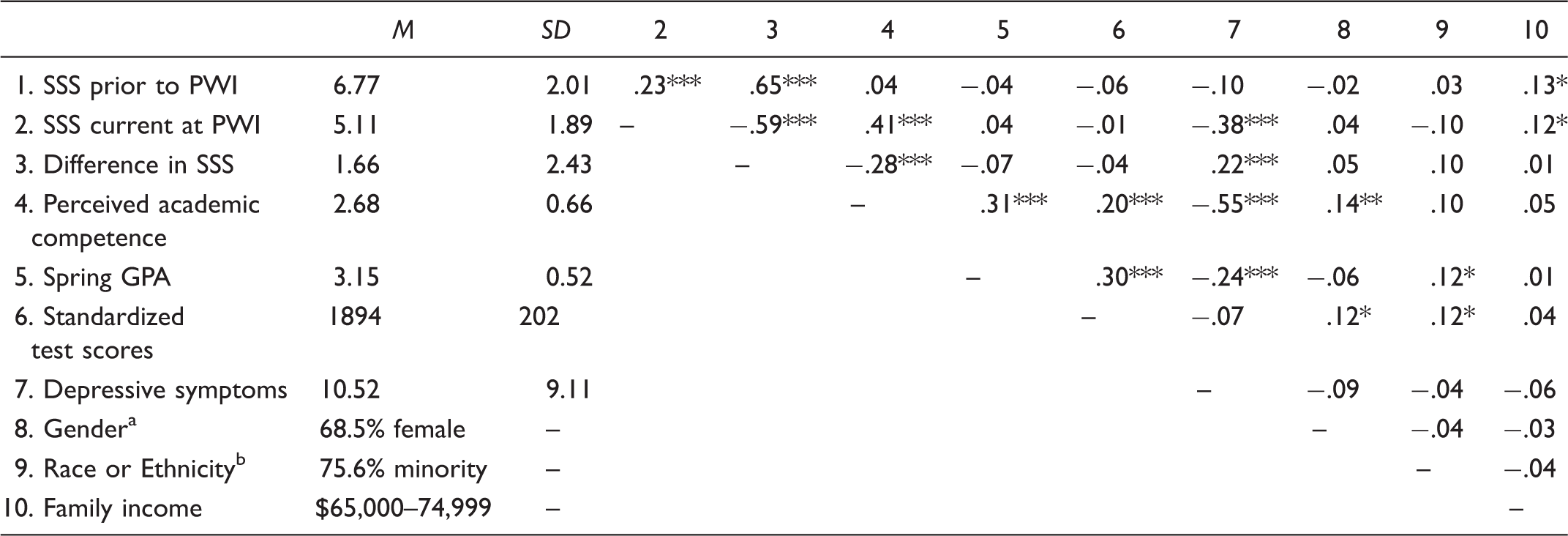
Note. SSS = subjective social status; PWI = predominantly White institution. Difference in SSS was calculated by subtracting current SSS from prior SSS.
0 = Female and other; 1 = Male.
0 = Racial or Ethnic minority; 1 = White.
p < .05. **p < .01. ***p < .001.
Calculating the average difference between home ladder ranking and school ladder ranking, results indicated that participants reported an average drop in SSS after the transition from home to college (M = 1.66 ladder rungs, SD = 2.43). This drop was significantly different from 0 (t = 12.33, p = .001). Hypothesis 2: A drop in SSS from home to school will predict poorer academic performance (i.e., grades) via perceived academic competence.
A path model predicting academic grades from a drop in SSS via perceived academic competence was tested. Initially, the model was fully saturated and included standardized test scores, race or ethnicity (recoded as 0 for racial or ethnic minority and 1 for White), gender (recoded as 0 for male and 1 for female or other), depressive symptoms, and family income as control variables predicting perceived academic competence and spring GPA. Nonsignificant paths were pruned from the model to allow for model identification. The indirect path from a drop in SSS to spring GPA via perceived academic competence was tested using bootstrapped confidence intervals. The resulting path model displayed in Figure 1 achieved good model fit, confirmatory factor analysis (CFI) = .97; Tucker-Lewis index (TLI) = .95; root mean square error of approximation (RMSEA) = .04, 90% confidence interval (CI) = [.00, .63]; χ2(11) = 17.01, p = .11). Results indicated that after accounting for the potential effects of depressive symptoms, standardized test scores, and holding a White racial identity, a greater drop in SSS was associated with lower perceived academic competence (B = −.17, p = .001). After accounting for standardized test scores and gender, lower perceived academic competence, in turn, was associated with lower spring GPA (B = .28, p = .001). There was a significant negative indirect effect from a drop in SSS to spring GPA via perceived academic competence [standardized indirect effect = −.05, 95% CI = (−.08, −.02)]. In sum, a greater drop in SSS was associated with lower perceived academic competence, which, in turn, was associated with lower GPA.
Direct and indirect paths from a drop in SSS to spring GPA via perceived academic competence, accounting for SAT/ACT scores, race or ethnicity, depressive symptoms, and gender. Note. SSS = subjective social status; drop in SSS was calculated by subtracting current SSS from prior SSS. Gender: 0 = Female and Other, 1 = Male; Race: 0 = Racial or Ethnic Minority; 1 = White; indirect effect: B = −.05, p < . 01; 95% CI [−.08, −.02]. Model fit: CFI = .97; TLI = .95; RMSEA = .04 (90% CI = .00, .63); χ2(11) = 17.01, p = .11. *p < .05. **p < .01. ***p < .001.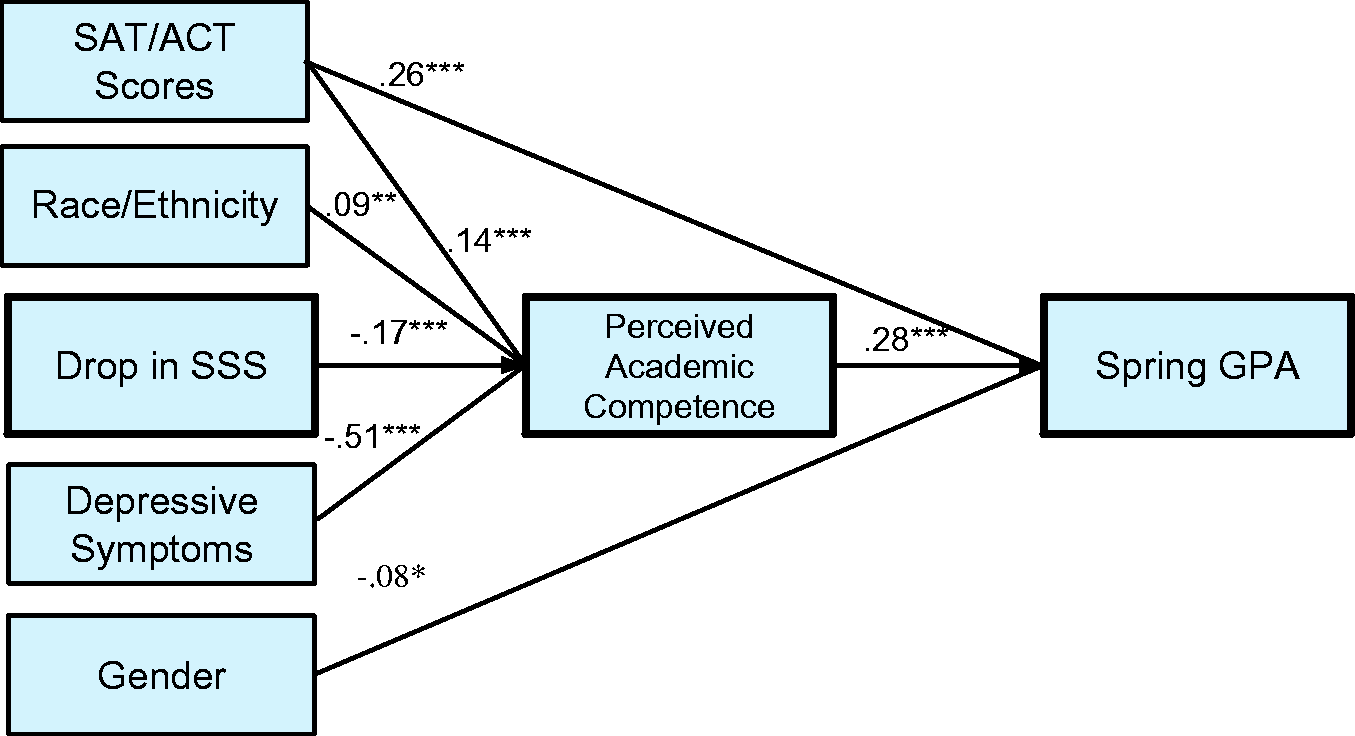
Discussion
Achievement gaps and disparate dropout rates between underrepresented and mainstream college students are major problems in the United States today. While education is considered an essential tool in eliminating inequality, even those underrepresented students who earn acceptance to elite postsecondary institutions struggle to graduate at the same rates as more privileged peers (Attewell et al., 2011; Bowen et al., 2006; Hinrichs, 2014). Underrepresented students who are accepted to elite universities yet leave without a degree likely find themselves in a worse predicament than if they had never enrolled in the institution as they are frequently encumbered with debt and are not well-positioned to repay their loans (Huelsman, 2015).
The results found in the current study likely reflect an unfortunate reality for many underrepresented students transitioning to an elite PWI. Such students are likely to experience daily reminders that they hold less relative social status in this environment than they previously held in their home communities. These reminders could come in the form of experiences of prejudice (e.g., overt discrimination, microaggressions), exposure to other students’ expensive possessions, or an awareness of one’s restricted opportunity structures relative to more privileged students. Although this study cannot speak to the exact reasons underrepresented students experience a drop in status from home to school, our results indicate that the underrepresented students in our study experienced a drop. Moreover, our results suggest that the extent of this drop was indirectly linked to poorer academic performance via perceptions of academic competence. A drop in SSS may lead students to feel less confident in their academic abilities, and this self-doubt may yield a cognitive toll that undermines students’ academic performance. Thus, we have reason to believe that there may be real academic consequences associated with a perceived drop in SSS.
SSS as measured in the current study captured students’ sense of a difference in their social status between their home and school communities. This is important to note because the difference score suggests that the findings are not attributable to more general negative affect or low self-esteem which would lead students to consider themselves relatively low-status across situations. In addition, by accounting for symptoms of depression in our statistical model, we further eliminate the possibility that the findings can be attributed to participants’ negative perceptual biases. To account for the possibility that the effects found were merely reflecting academic under-preparedness among underrepresented students, we also included students’ standardized test scores in our statistical model. Because the effects held after accounting for students’ standardized test scores, we can be more confident that it was not simply a group of less prepared students correctly perceiving their relatively low-academic competence and performing less well academically. Furthermore, participants’ mean GPA in the spring semester was quite high (3.15 on a 4-point scale) suggesting that this was a relatively high-achieving group of students. Thus, on the basis of the results of the current study, we have reason to believe that a drop in SSS may be a psychological consequence of being an underrepresented student at an elite PWI, and this drop in SSS may detract from underrepresented students’ ability to succeed academically in their new academic setting.
Perhaps, the clearest solution to the problem of a drop in SSS among underrepresented students is to truly rectify issues of underrepresentation among marginalized groups at elite PWIs. Relative deprivation theory suggests that being surrounded by others who possess more resources may adversely affect psychosocial outcomes (Scott et al., 2014), and this may be compounded by the fact that underrepresented students are isolated and encounter few similar others in their new academic context. An elite university with a representative mix of students from diverse racial or ethnic and economic backgrounds may reduce or eliminate perceptions of reduced social status among students from marginalized groups and provide the type of academic environment where all students can thrive.
Many elite universities claim that diversifying student populations is a high priority, yet enrollment of students from historically underrepresented racial and ethnic groups at elite universities has actually declined over the past 20 years (Institute of Education Sciences, National Center for Education Statistics, 2013). Clearly, there is more work to be done to diversify elite universities and make them a welcoming place for students from all racial or ethnic and socioeconomic backgrounds. Interestingly, recent events indicate that student-led efforts such as diversity-related protests at the University of Missouri (Izadi, 2015) may be highly effective in influencing institutional practice and policy as it pertains to issues of diversity at PWIs. Moreover, to the extent that students’ lowered SSS can be attributed to subtle and overt experiences of discrimination, exclusion, and marginalization, the next obvious target for intervention is campus climate. Programs that focus on leveraging campus diversity to foster meaningful and substantive dialogues across difference can enhance cross-group understanding and collaboration (Sorensen, Nagda, Gurin, & Maxwell, 2009), which ultimately, may diminish or eliminate drops in SSS among students from marginalized backgrounds. Beyond dialogues, universities should consider putting more resources into creating a positive and empowering environment for underrepresented students, such as through support for diversity offices and programs, and should adopt a clear and definitive stance against bigotry and discrimination.
There are several limitations to the current study. Data collected for the current study were largely self-reported by participants. Yet, it is worth noting that we collected students’ grades and standardized test scores from their academic records. In addition, SSS is necessarily a self-reported construct and other constructs such as perceived academic competence and depressive symptoms are traditionally measured by self-report due to their internal nature. Another study limitation is that perceived drop in SSS and perceived academic competence were measured at the same time point which limits our ability to make inferences about directionality. Reports of drops in SSS may have been partially influenced by concurrent perceptions of academic competence rather than the other way around. However, given that our measure of SSS focused on perceived changes in SSS as opposed to just students’ current SSS, we feel more confident that we were capturing changes in SSS that likely preceded students’ perceptions of academic competence. In addition, students completed these measures during the middle of the spring semester and students’ GPAs were collected at the end of the semester. Although students’ academic performance during the semester may have influenced their SSS and perceived academic competence, these measures were completed prior to final exams and the release of final course grades leading us to feel more confident that we captured temporal sequencing in associations among our variables of interest. Because the current study took place within students’ first year (before most students select a major), we also had a limited number of academic outcomes to assess. Future studies should also include other academic outcome variables that may be associated with SSS, such as the decision to change majors.
The current study took place at a large, selective public university in the southeastern United States. We do not know the generalizability of these findings to other types of colleges or universities or different geographic locations. Finally, without a comparative sample of majority students, it is not possible to determine whether these results are unique to underrepresented students rather than a normative pattern among incoming college students. Future studies that include students from majority and underrepresented groups will be better positioned to determine whether this phenomenon is unique to (or at minimum, more pronounced among) students from underrepresented groups.
The results of this study suggest that, for racial or ethnic and socioeconomic minority students at a large, selective public university, perceived social status may play an important role in their academic success. Although the current study did not address the possible issues that may contribute to a drop in perceived social status among underrepresented students, it is reasonable to speculate that the types of marginalizing experiences documented in other studies of underrepresented students at PWIs (Massey et al., 2003) are contributors to our documented drop. The results of this study suggest that a drop in SSS may predict lower academic performance by leading students to feel less confident in their academic abilities. Underrepresented students’ sense of status may be bolstered by changes in institutional practices and policies that increase representation of students from underrepresented groups and intentionally leverage institutional diversity to foster meaningful connections among students from diverse racial or ethnic and socioeconomic backgrounds.
Footnotes
Declaration of Conflicting Interests
The author(s) declared no potential conflicts of interest with respect to the research, authorship, and/or publication of this article.
Funding
The author(s) disclosed receipt of the following financial support for the research, authorship, and/or publication of this article: This study was funded through start-up funds awarded to the second author from the University of Virginia. The writing of this article was supported in part by a post-doctoral fellowship through the National Academy of Education and Spencer Foundation as well as a William T Grant Foundation Scholar Award to the second author.