







Abstract
Data from the Healthy Mind Study were analyzed using hierarchical multiple regression analyses to determine the role of discriminatory experience in students’ confidence in their ability to persist through graduation, controlling for age, extracurricular activity participation, housing, years in their degree program, and their sense of belonging. The final sample consists of 4,708 college students—57.1% women, 70.8% Whites, 7.4% Blacks, 10.4% Asians, and 10.4% Latinx. A final hierarchical multiple regression with discrimination and covariates revealed an overall model that explained 15.5% of the total variance of confidence to persist (F [12, 4574] = 76.762, p < .001). The frequency of discriminatory experiences explains a statistically significant percentage of the variance in students’ confidence in their ability to persist. Thus, efforts to minimize students’ discriminatory experiences need to be increased. This study offers an initial step that institutions can implement to serve and retain their students better.
Student persistence in college is one of the central issues in higher education. Researchers, practitioners, and administrators have devoted a substantial amount of time to examining student persistence and improving degree completion in postsecondary education (Aljohani, 2016; Braxton et al., 2014; Habley et al., 2012). Research to understand persistence and efforts to improve retention is becoming increasingly important as students enrolling in higher education become more diverse (Hussar & Bailey, 2017; Reason, 2009). However, many students of color enrolled in higher education do not graduate (de Brey et al., 2019). The national graduation rates for Black undergraduate students are 40%, and Latinx 54% compared to white students’ (64%) graduation rates. Several factors, such as academic preparation, demographics, interactions with peers and faculty, institutional fit, socioeconomic status, student involvement, and student integration influence students’ decision to persist (Astin, 1984; Bean & Eaton, 2000; Tinto, 1993). Sense of belonging and discrimination have been identified as significant predictors of student persistence (see Hartley, 2011; Hausmann et al., 2009; Meeuwisse et al., 2010; Morrow & Ackermann, 2012; Roberts & Styron, 2010; Vaccaro & Newman, 2016).
Students’ Sense of Belonging and Persistence
The majority of literature investigating persistence among college students focuses on students’ sense of belonging (O'Keeffe, 2013). Sense of belonging refers to how students perceive available social supports on campus and whether they feel connected (Strayhorn, 2012). Sense of belonging is shaped by the broader campus climate and the perceptions of belonging that students derive from their daily interactions with other students, faculty, staff, and administrators on campus, as well as the verbal and nonverbal messages conveyed during those interactions (Hurtado & Ponjuan, 2005; Stebleton et al., 2014; Tinto, 2017). Students’ perception of their belonging affects their academic progress, academic achievement, and social acceptance (Freeman et al., 2007; Meeuwisse et al., 2010; Walton & Cohen, 2007). Students who feel that they belong are more likely to persist due to an increased willingness to engage in help-seeking behaviors, such as going to professor office hours, meeting with an academic advisor, and utilizing academic support services (Hausmann et al., 2007; Walton et al., 2012). Hence, developing a ‘sense of belonging’ for the retention of students, especially for those who are considered to be at risk of non-completion (e.g., students of color, students of low socioeconomic status, or first-generation college students) is essential (O'Keeffe, 2013).
The most frequently utilized solution for increasing students’ sense of belonging is creating “culture enclaves” (Braxton, 2000, p. 205). These enclaves acknowledge and affirm the importance of subcultures. Culture enclaves create space for expression and support among underrepresented students, improve their self-efficacy toward graduation, and help students negotiate the psychological distance between their home cultures and a potentially hostile academic environment (Braxton et al., 2011). Though higher education institutions have built these spaces through extracurriculars, organizations, and programs, these cultural enclaves do not diminish the intensity or frequency of discriminatory experiences.
Discrimination and Persistence
Though not explicitly mentioned in retention models or theories, researchers have examined common forms of discrimination (i.e., racial discrimination and gender discrimination) and found that they have a deleterious effect on students. Race-based discrimination adds psychological stress that adversely affects academic success and intent to persist (Museus et al., 2008; Stevens et al., 2018; Wei et al., 2011). College women who experience gender discrimination or sexism within their field of study tend to underperform academically (Lewis et al., 2017; S. M. Lord et al., 2009 ). Discriminatory experiences negatively impact the sense of belonging and the persistence of even high performing students (Hurtado & Ruiz Alvarado, 2015). These studies provide the rationale for including undergraduate students when examining the effects of discrimination.
The adverse consequences of discrimination are not limited to the individuals who are targeted based on their identity. Previously conducted research has found that students who experience discrimination secondhand (i.e., observe or witness discrimination) are similarly affected as the students who experienced it themselves (Smith et al., 2016). Whether first- or secondhand, discrimination increases students’ academic stress and diminishes their positive feelings about the campus environment, which can ultimately impact their intention to persist (Johnson et al., 2014). Given discrimination’s potential effect on students of any identity, discrimination should be examined along with students’ sense of belonging to better understand persistence in higher education.
Rationale for the Current Study
According to two widely accepted models of retention (i.e., Bean and Eaton’s (2000) Psychological Model of College Student Retention and Tinto’s (1993) Student Integration Model, academic and social integration are paramount to students’ persistence and retention. Students’ attitudes about their institution, formed based on their integration, influence their intent to persist, and ultimately, their actual persistence (Bean, 1983; Bean & Eaton, 2000; Rodgers & Summers, 2008). Hence, it is important to consider both the students’ discriminatory experiences and their sense of belonging in persistence. The present study aimed to establish the extent to which discrimination influences students’ confidence in their ability to graduate, beyond their sense of belonging and other known factors that influence student persistence.
Methods
Instrument and Procedures
The Healthy Minds Study (HMS) is an annual, cross-sectional, web-based survey examining mental health, service utilization, and related health issues among undergraduate and graduate students (Eisenberg & Lipson, 2019). The survey gathers information to allow schools to identify needs and priorities, evaluate programs and policies, plan for services, and programs and advocate for resources. To date, the HMS has sampled approximately 300 colleges and universities, with over 300,000 survey respondents since 2007. It includes three standard modules—“Demographics,” “Mental Health Status,” and “Mental Health Service Utilization/Help-Seeking”— and twelve elective modules (e.g., substance use, eating and body image, and mental health climate) that institutions can opt into completing. On campuses with less than 4,000 students, all students are recruited to participate. Colleges with more than 4,000 students have at least that number sampled. Students must be at least 18 years of age to participate. No other inclusion or exclusion criteria were applied. This study is a secondary analysis of deidentified data from the HMS and was exempted from oversight by an institutional review board.
Sample
The 2018 – 2019 HMS consisted of 78,082 student respondents from 78 colleges and universities within the United States. However, the present study only examined the data from the twenty-two colleges and universities that opted to participate in the elective “Campus Climate and Culture” module of the HMS. This sample used in this investigation included students who attended one of the institutions mentioned above and who completed the corresponding questions to the variables listed below.
Measures
Demographics
Participants were asked to report a variety of personal characteristics including age, gender, race/ethnicity, number of years in degree program, extracurricular involvement (e.g., athletics, fraternity or sorority, cultural organization, and religious organization), average number of hours worked per week, and housing.
Sense of Belonging
Students’ sense of belonging was assessed by asking them to indicate how much they agree with the following statements: “I feel valued as an individual at this school;” “I feel I belong at this school;” “I have considered leaving this school because I felt isolated or unwelcomed;” “This university is a place where I am able to perform up to my full potential;” and “I have found one or more communities or groups where I feel I belong at the school.” Responses for each item were on a six-point Likert scale that included “Strongly disagree” (1), “Disagree” (2), “Neither agree nor disagree” (3), “Agree” (4), and “Strongly agree” (5). The single negative item – “I have considered leaving this school because I felt isolated or unwelcomed”- was reverse-coded (e.g., a response of 5 was recoded as 1). After recoding, the five items were combined to create a composite variable ranging from 5 to 25, where higher scores indicated a higher sense of belonging. The Cronbach alpha reliability for this scale within this sample was .823.
Experiences of Discrimination
Discriminatory experiences within the past year at school were assessed by asking respondents to indicate whether and how much they had experienced each of the following events: “Being treated rudely or disrespectfully,” “Being accused of something or treated suspiciously,” “Others reacting to you as if they were afraid or intimidated,” “Your ideas or opinions minimized, ignored or devalued,” “Overhearing or being told an offensive joke or comment,” “Being treated as if you were ‘stupid’; being ‘talked down to,” “Not being taken seriously,” “Being treated in an ‘overly’ friendly or superficial way.”
Possible response options for these questions were “Never” (1), “Couple times per year” (2), “Couple times a month” (3), “Couple times a week” (4), “Every day” (5). Responses to each of the 8 items were combined to create a composite variable ranging from 8 to 40, with higher scores indicating a higher frequency of discriminatory experiences. The Cronbach alpha for this scale within this sample was .867.
Confidence in Finishing Degree
Student persistence was assessed with one item that asked respondents to indicate how much they agree with the statement “I am confident that I will be able to finish my degree no matter what challenges I may face.” Possible response options for each item included “Strongly disagree” (1), “Disagree” (2), “Somewhat disagree” (3), “Somewhat agree” (4), “Agree” (5), and “Strongly agree” (6).
Analytic Strategy
Data were analyzed using Statistical Package for Social Sciences (SPSS; PASW, Version 25, SPSS, Inc., Chicago, IL). Descriptive statistics examined participants’ demographic characteristics. A hierarchal (sequential) multiple regression assessed the relationship between sense of belonging, frequency of discriminatory experiences, and students’ confidence in their ability to graduate. Persistence to obtain secondary degrees may differ by gender, race, and age (de Brey et al., 2019; V. B. Lord et al., 2013); therefore, all models adjusted for these factors. Additionally, persistence may be impacted by students’ year in program (Seidman, 2012), whether they live on campus (Schudde, 2011), participate in extracurriculars (Hu, 2011), and work (Perna, 2010; Robotham, 2012), and may also contribute to students' sense of belonging. Thus, models also adjusted for these variables.
Results
This sample comprised of 4,708 college students from 22 universities that completed the elective module, “Campus Climate and Culture.” Characteristics of the sample are provided in Table 1. Approximately 57.1% of students identified as female and students primarily identified as white (70.8%). The remainder were 7.4% Black, 10.4% Asian, and 10.4% Latinx. The majority of students indicated that they currently worked (61.1%), while 74.2% participated in extracurricular activities, and 57.5% indicated that they lived on-campus.
Demographic Characteristics by Race (n = 4708).
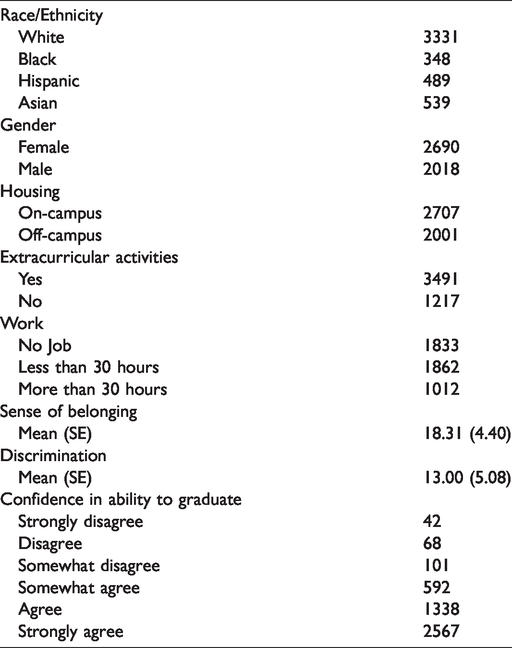
Table 2 presents the zero-order correlation matrix for the analysis of variables. A higher confidence in one’s ability to graduate was significantly associated with identifying as Black (r = .081, p < .01) or Asian (r = .047, p < .01), being older (r = .049, p < .01), being further along in their degree program (r = .071, p < .01), participating in extracurricular activities (r = .096, p <.01), and working part-time (r = .048, p < .01). Conversely, being white (r = −.073, p = < .01), experiencing discrimination (r = −.156, p < .01), staying off-campus (r = −.052, p <.01), and not having a job (r = −.063, p < .01) were negatively correlated with students’ persistence. No other correlations were determined.
Zero-Order Correlation Matrix for Study Variables (n = 4587).
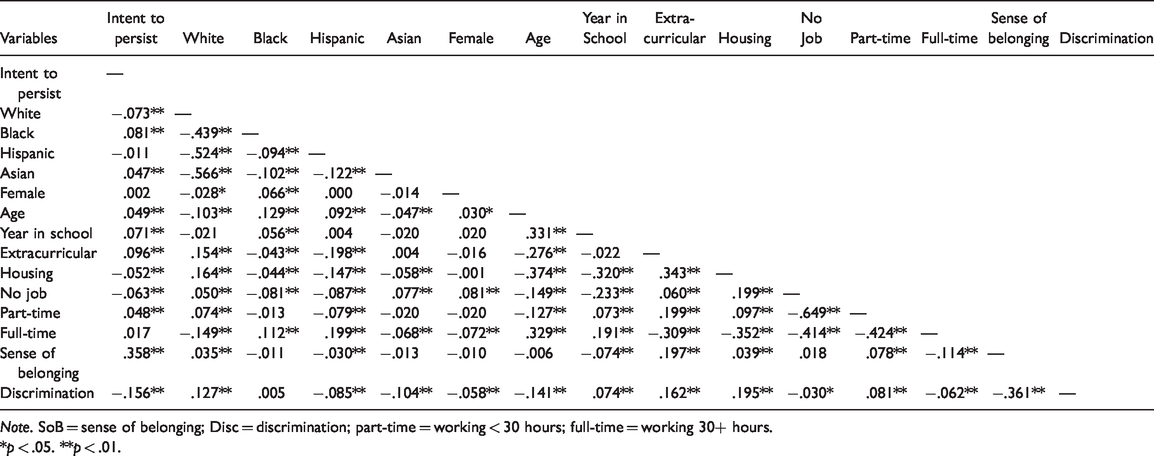
Note. SoB = sense of belonging; Disc = discrimination; part-time = working < 30 hours; full-time = working 30+ hours.
*p < .05. **p < .01.
Hierarchical multiple regression assessed the association between discrimination and students’ sense of belonging with confidence in their ability to persist through graduation (Table 3). Gender, race, age, extracurricular activity participation, housing, and number of years in their degree program were entered at step 1, explaining 3.2% of the variance in persistence. After entry of students’ sense of belonging at step 2, the total variance explained by the model was 17.9%, F (10, 4576) = 15.23, p < .001. The sense of belonging measure explained an additional 12.2% of the variance in intention to persist (ΔR2 = .123, F change (1, 4575) = 15.4, p < .001). After entering discriminatory experiences at step 3, the total variance explained by the model was 15.5%, F (12, 4574) = 76.762, p < .001. In the final model, several variables were statistically significant: identifying as a Black student (β = .083, p < .01) or an Asian student (β = .063, p < .01), the number of years in school (β = .072, p < .01), participating in extracurricular activities (β = .062, p < .01), having no job (β = −.036, p < .01), students’ sense of belonging (β = .347, p < .01), and the frequency of discriminatory experiences (β = −.032, p < .05).
Summary of Regression Analysis for Variables Predicting Intention to Persist (n = 4587).
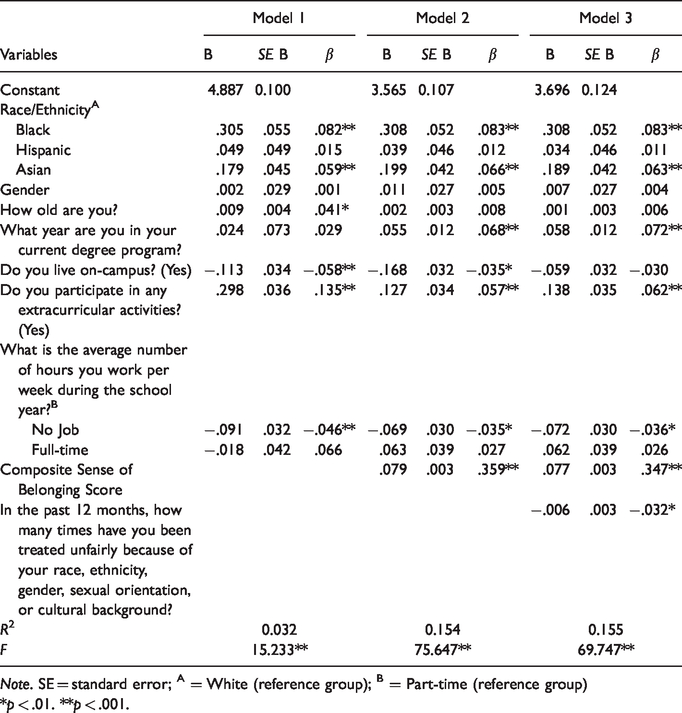
Note. SE = standard error; A = White (reference group); B = Part-time (reference group)
*p < .01. **p < .001.
Discussion
This study aimed to assess the impact of discrimination on students’ confidence in their ability to graduate, after controlling for known factors, most notably students’ sense of belonging. The results indicate that the frequency of discriminatory experiences is a significant predictor of students’ belief that they will graduate no matter the obstacles they face. The results hold regardless of students’ gender or racial identity. Students who face more frequent discrimination in higher education are more likely to have lower confidence in their ability to graduate, which is a significant predictor of actual persistence (Rodgers & Summers, 2008). Thus, this study’s findings broadly support the works suggesting college student perceptions of prejudice and discrimination on campus and within the classroom impact their persistence—and in this case, the confidence in their ability to graduate (Museus et al., 2008; Witkow et al., 2015).
The results are impactful as they highlight the impact of discriminatory environments and further underscore the need to create a more inclusive campus climate for all students. This need for making campuses more inclusive should be of utmost importance, especially in the wake of the recent protests against systemic racism, and colleges and universities are being called out for their contribution. These results also add to the growing body of persistence and retention research and to the lengthy list of college student outcomes affected by discrimination: trauma-related symptoms (Pieterse et al., 2010), risky health behaviors (Hatzenbuehler et al., 2011; Roberts & Styron, 2010), and self-efficacy (Nadal et al., 2014).
Though this study did not aim to identify race or gender differences in students’ confidence in their ability to graduate, notable findings were uncovered. Students who identified as being Black or Asian had significantly higher confidence in their ability to persist to graduation than their White counterparts. If all four racial groups experience the same frequency of discriminatory experiences, Asian and Black students would be more confident in their ability to graduate. Thus, this study supports the notion and need for equity in education. This finding is particularly significant for Black students who frequently report more discrimination than their peers (Forrest-Bank & Jenson, 2015; Greer & Chwalisz, 2007). The high frequency of discriminatory experiences faced by Black students affects their confidence in their ability to graduate. Based on this study’s findings, discrimination may partially explain Black students having the lowest six-year graduation rates from four-year colleges and universities (41 percent; Musu-Gillette et al., 2016; Snyder et al., 2016).
The numerous factors influencing students’ confidence in their ability to graduate are not unidimensional; therefore, the solution cannot be either (Reason, 2009). This study’s results reveal that “cultural enclaves” are not enough. While these enclaves do foster communities of belonging, garner academic and social support and enhance student leadership involvement (Brooms, 2018; Brooms & Davis, 2017; Garvey et al., 2017; Harper & Kuykendall, 2012), their impact is limited once the student step outside of those spaces. Therefore, new approaches need to be enacted to improve campus climate and further decrease the students' adverse experiences on campus.
Addressing discrimination should be implemented into the extensive structure of the university setting. Perhaps treating discrimination as similar to title IX and sexual harassment would be an actionable step towards creating an inclusive and welcoming campus. Universities broadly require sexual harassment training as part of the onboarding process and as a yearly requirement for all employees. While sexual harassment training alone is unlikely to reduce harassment, coupled with other efforts, it can play an essential role in contributing to the prevention or reduction of sexual harassment (Roehling & Huang, 2018). This could be the case for discrimination as well. At a minimum, anti-discrimination training should be a yearly requirement for both current and incoming students as well as faculty and staff. This act can help faculty, staff, and students address and unlearn bias in their everyday lives and aid institutions in making the necessary structural changes to improve the experience for all. Future work should develop and test these interventions for effectiveness to determine the applicability of this particular mandate.
Limitations
While the present study has many strengths, including randomly selected undergraduates from multiple campuses, there are limitations to consider when interpreting the results. First, this investigation analyzed secondary cross-sectional data, precluding any causal inferences. Second, this investigation inherits the limitations of the HMS. For example, this investigation used a single item to capture students’ confidence in their ability to graduate. Using validated scales— the Academic Resilience Scale (ARS-30; Cassidy, 2016)—may provide a more realistic measure for assessing students’ confidence in their ability to graduate compared to the construct used here.
Conclusion
Unlike previous studies on persistence, this investigation sought to determine whether discrimination was significant above known variables, including students’ sense of belonging, a well-studied persistence research factor. Overall, the more frequent the discriminatory experiences, the lower the students’ confidence in their ability to graduate, no matter their gender, race or ethnicity. In fact, in the adjusted model that controls for discriminatory experiences, Black and Asian students’ confidence in their ability to graduate is higher. These findings justify the need to continue to expand our understanding of the impacts of discrimination and provides an impetus to include interventions that reduce discrimination and bias on college campuses. This study offers a conceivable initial step that institutions can implement as an anti-racist approach. This can help create an inclusive climate campus that is beneficial to all and decreases the frequency of discriminatory experiences, which can improve persistence especially among Black students.
Footnotes
Declaration of Conflicting Interests
The author(s) declared no potential conflicts of interest with respect to the research, authorship, and/or publication of this article.
Funding
The author(s) received no financial support for the research, authorship, and/or publication of this article.
