







Abstract
Difficulty in retaining college students in STEM majors is one of the key contributors to the scarcity of STEM graduates and a short supply of STEM workers in the United States. Two factors that are closely related to retention and achievement are transition to college and sense of belonging and involvement. We conducted a case study to explore the transitional experiences and sense of belonging of five low-income, academically talented college freshmen and sophomores in chemistry and physics. Although participants reported a high sense of belonging, this alone did not necessarily lead to retention. Involvement in academic organizations and activities such as clubs and research groups played a more important role in the scholars’ decisions to remain in their degree programs. The findings of our research also suggest that faculty in STEM areas may benefit from systematic professional development with a focus on curriculum design and pedagogy.
Difficulty in retaining college students in STEM majors is one of the key contributors to the scarcity of STEM graduates and a short supply of STEM workers in the United States (Apriceno et al., 2020). Attrition rates are particularly high among underrepresented groups including women, low-income, first-generation students, and racially minoritized students (Allen et al., 2021; Barth et al., 2021; Cwik & Singh, 2022; Gopalan & Brady, 2019; Kezar & Kitchen, 2020; Meehan & Howells, 2018; Trujillo & Tanner, 2014). Two interrelated factors, transition to college and sense of belonging, are found to be crucial for the retention of college students in STEM areas.
Transition to college is often considered a critical life phase in which students must negotiate various social and academic stressors and make difficult adjustments (Apriceno et al., 2020; Guloy et al., 2017). Challenges associated with transition to college identified in the literature often highlight the mismatch in learning expectations between high school and college, for example, (a) the surface learning often encountered at high school as a response to standardized testing versus the deeper processing required of college learning, (b) less personal teaching and fewer opportunities to develop relationships with peers and faculty members at the college level, and (c) the higher level of autonomy and independence expected of college learning (Barth et al., 2021; Santangelo et al., 2021). College freshmen are likely to face a new reality where close parental and teacher supervision and external incentives (e.g., food, prizes, and field trips) are no longer available. Meanwhile, a lack of study skills appropriate for higher education means some of them must develop metacognitive skills such as planning, self-monitoring, and self-evaluating while building content knowledge. These various challenges may lead to low academic self-efficacy, underachievement, and dropout (Cameron & Rideout, 2022; Guloy et al., 2017; Postareff et al., 2017).
Sense of belonging is a feeling of connectedness and mattering to the others in a community and a feeling of being cared about, respected, valued, included, and supported by others in that community, and it is a major predictor of retention (Goodenow & Grady, 1993; Knekta et al., 2020). Sense of belonging is found to be associated with motivation, enjoyment, self-efficacy, effort, participation, and persistence in learning, in other words, factors that are positively correlated with achievement and retention (Astin, 1984; Cwik & Singh, 2022; Gopalan & Brady, 2019; Hoffman et al., 2002; Knekta et al., 2020; Pedler et al., 2022). Sense of belonging, linked to health and wellbeing, is a basic human need that must be satisfied before any higher-order needs such as innovation, desire for knowledge, and self-actualization can be met (Knekta et al., 2020; Maslow, 1962; Strayhorn, 2019). Transition to college and sense of belonging are connected in that various adjustment challenges facing first- and sometimes second-year students in STEM often result in a low sense of belonging or a feeling of misfit (Apriceno et al., 2020).
While adjustment to higher education is an ongoing process beyond students’ first-year experience, there are also differences between the developmental needs of freshmen and those of sophomores (Pedler et al., 2022; Provencher & Kassel, 2019). First, as students gain maturity from their freshman year to their sophomore year, they need more and more focused academic and career goals (Schaller, 2005). Students leaving college after their sophomore year often cite reasons such as a lack of academic and professional direction, issues related to identity development, and failure to build a professional network (Provencher & Kassel, 2019). Therefore, opportunities for sophomores to engage in critical self-reflection and to form a strong professional identity are particularly important. Second, academic courses in the second year tend to be more challenging than those in the first year. This means sophomores need to make a greater investment in their learning. Therefore, sophomores compared to freshmen tend to expect more returns from their academic experiences. Factors in their academic environment such as opportunities for intellectual growth, valuable course content, quality of classroom instruction, and fair and knowledgeable professors become more important for sophomores (Gahagan & Hunter, 2006). Third, sophomores tend to feel that they are given less attention as compared to freshmen, as most of the retention efforts and resources are often spent on first-year retention, and this may leave sophomores to feel confused, uncertain, and dissatisfied (Gahagan & Hunter, 2006). Therefore, faculty interactions and mentoring are important for sophomores for not only academic and professional guidance but also emotional support (Gahagan & Hunter, 2006). Overall, although retention rates tend to drop by half each year enrolled in college, sophomores are still vulnerable to attrition due to not only those similar reasons that may hinder freshmen such as financial concerns and adjustments of study and life skills but also the unique challenges of developmental needs as described above.
Several interventions with a focus on helping students cope with the demands of transition have proven to be effective in improving retention of STEM majors. First, learning communities are important for students to feel accepted and welcomed in a new academic environment. One way to build learning communities is by encouraging students to take courses together. First- and second-year college experience courses or academic seminars are such courses that not only help students build study skills but also create opportunities for students to work with faculty and peers (Hallett et al., 2020; Hoffman et al., 2002; Kezar & Kitchen, 2020). Second, enriched academic activities such as undergraduate research experience not only intensify student academic involvement but also strengthen learning communities (Barth et al., 2021). Third, working closely with a mentor and role model in STEM fields is associated with higher achievement and lower dropout rates (Barth et al., 2021).
The aim of this qualitative case study was to explore the transitional experiences and sense of belonging and involvement of low-income, academically talented college freshmen and sophomores (including historically marginalized groups) who were participants in a scholarship program. The program aimed to increase retention of college students in chemistry and physics through financial support and evidence-based strategies in the literature such as undergraduate research, learning community, and intensive mentoring. Tracking students’ sense of belonging and their experience in transitioning to college will provide the necessary feedback for evaluating the effectiveness of retention interventions, identify key factors that influence student decisions, and inform more-targeted future policies and practices (Hoffman et al., 2002).
Theoretical Frameworks
Knekta et al.’s (2020) two-part definition of sense of belonging to a department serves as the theoretical lens of this study. In addition, Tinto's (2012) model of institutional action not only inspired Knekta et al.'s work but also guided our research.
Tinto's Model of Institutional Action
Tinto's (2012) model of institutional action is a departure from the earliest efforts to address concerns over student attrition, which often focused on student characteristics such as ability and motivation. Tinto (2006) observes that even in the 1970s, when the efforts to increase retention began to consider the role of the environment, especially patterns of interactions between students and other actors in the institution, student affairs staff often assumed most of the responsibilities without active involvement of faculty. Therefore, changes in programming for students often were limited to generic freshman seminars and social bonding activities. Tinto (2006) believes that actions of faculty, especially in the classroom, are key to institutional efforts to improve student retention. Whether instructors communicate caring about students’ learning, termed “pedagogical caring” by Freeman et al. (2007, p. 207), has an important influence on not only students’ academic participation but also their sense of belonging. Faculty may demonstrate pedagogical caring by (a) openly encouraging hard work, (b) debunking the myth of “genius” or “brilliance,” (c) incorporating inclusive and equitable practices, (d) creating opportunities for students to cooperate and interact with their classmates, (e) cultivating a positive, nonthreatening classroom environment, and (f) being available for answering questions and tutoring (Cwik & Singh, 2022). Astin (1984) also argues that simply exposing students to worthwhile courses and professors with the greatest knowledge (i.e., content theory) or providing students with top-notch training faculties such as laboratories, libraries, and technologies (i.e., resource theory) is often not sufficient to improve retention. Increasing retention must be an institutional-level action with coordinated efforts from faculty, staff, and students (Tinto, 2012).
Learning communities are an important aspect of Tinto’s (2006, 2012) theory. He encourages institutions to allow students to coregister courses, which are organized around a theme to foster interdisciplinary or cross-subject learning. This requires coordinated effort to change academic organizations to provide students with opportunities to construct shared knowledge through shared knowing experiences. Tinto also argues that faculty, like students, should also be encouraged to collaborate across fields of study and participate in faculty development to improve instruction.
Knekta et al. (2020) built their concepts of sense of belonging and involvement on Tinto's (2012) model of institutional action. Using Tinto's work as their theoretical lens, Knekta et al.'s department-level sense of belonging and involvement directly places faculty actions, student academic involvement, and students’ interactions with faculty, staff, and peers at the center of their investigation.
Why Sense of Belonging to a Department?
Sense of belonging is found to vary more within a given institution between different departments (e.g., Physics and English departments in the same university) than within the same department between institutions (e.g., the Physics departments at two different universities, Kuh et al., 2008). Although sense of belonging has been widely studied at the classroom and institutional levels, sense of belonging to a department has only gained attention in the recent literature on retention (Knekta et al., 2020; Knekta & McCartney, 2018; Strayhorn, 2019). There are many reasons to believe that studying sense of belonging to a department will provide relevant, rich, and valuable information for retention of students in STEM fields.
First, departments are the most likely places for students to (a) interact with a wide range of faculty, staff, and peers; (b) take courses; (c) seek guidance and advice; and (d) become involved in research activities. Second, departments have some autonomy to enact changes. For example, academic departments may organize first- and second-year seminars to help students navigate their program, disseminate information on research opportunities, build study skills specific to the discipline, and foster learning communities through social learning activities such as peer-led learning and journal clubs. Third, the sense of belonging to different departments may have some unique and distinct meanings. For example, girls in a physics or chemistry program may be negatively affected by the societal stereotype that only boys belong to, or can excel at, these subjects. Negative stereotypes may alienate girls from these fields and make them question their abilities to succeed academically (Cwik & Singh, 2022). This means faculty in physics and chemistry programs may need to focus on implementing equitable and inclusive practices with deliberate effort. Due to the variations in beliefs and practices across departments, generic interventions to facilitate transition to college and academic involvement such as academic reading, essay writing, or problem solving in decontextualized courses may not be as effective as similar interventions that take into consideration academic discourses of different disciplines and disciplinary conventions for knowledge construction (Knekta et al., 2020).
Two-Part Definition of Sense of Belonging
Inspired by Strayhole (201) and Goodenow and Grady (1993), Knekta et al.’s (2020) first-part definition of sense of belonging focuses on subjective feelings, that is, “students’ perceived support at the department, a feeling or sensation of connectedness, and the experience of mattering or feeling cared about, accepted, valued by, and important to the department community or others in the community, such as faculty, staff, and peers” (p. 3). These researchers also identified two distinct constructs under sense of belonging: social acceptance and valued competence. The sources of social acceptance in their model are from peers or other people in the department. Social acceptance constitutes familiar ideas such as respect and support for each other, good relationships, helping each other succeed, and pride in each other. Valued competence, however, refers to students’ feelings about whether their opinions are valued and acknowledged by faculty and staff in the department. Valued competence is a type of academic validation (Hallett et al., 2020), in other words, how institutional agents such as faculty and staff make students trust in their own innate abilities to achieve academic success.
Whether sense of belonging and involvement should be considered a single construct or separate constructs is still under debate (Knekta et al., 2020). Astin’s (1984) definition of involvement is most widely used, that is, the “amount of physical and psychological energy that the students devote to the academic experience” (p. 5). Astin's definition of involvement emphasizes “what people do” such as devoting time to studying, spending more time on campus, and initiating communications with faculty and peers, instead of “how people feel.” Involvement and sense of belonging form a positive feedback loop and mutually enhance each other (Strayhorn, 2019). Knekta et al. (2020) expanded further on Astin's definition to also include what students may contribute to the department. These researchers found that college students in their studies did not consider they were an essential part of their department simply because they were being accepted, respected, or supported by others. A true sense of belonging for these students must include not only taking from the department but also giving back to the department, for example, working at a research lab, participating in voluntary programs, and serving as teaching assistants. Although involvement and sense of belonging are highly correlated and intimately connected with each other, they remain two distinct constructs. Strayhorn's (2019) model makes involvement a central component of sense of belonging. Based on their preliminary factor analysis, Knekta et al. (2020) also identified involvement as a distinct component than the two feeling-related constructs mentioned earlier. Consistent with Strayhorn (2019), Knekta et al. conceptualized sense of belonging and involvement as a composite construct that has both a feeling dimension and a behavioral dimension.
Methods
Although sometimes criticized for its lack of generalization and scientific rigor, the case study design is appropriate for our study because we are interested in the discovery of insight into student experiences instead of hypothesis testing (Noor, 2008; Patton, 2014). We collected data using multiple techniques, which gave us a holistic view of complex real-life phenomena such as sense of belonging and retention. Multiple sources of data can be triangulated to gain more confidence in research findings (Yin, 2017). Although case studies have limited generalizability, multiple case studies that we employed in our research allow some form of replication, which often leads to more convincing theories and more robust findings (Yin, 2017). In addition, the funds we received only allowed us to support two cohorts of first- or second-year college students, with each cohort limited to no more than eight students. Although the generalization of our findings may be limited, we have important insights we feel obligated to share. This study was conducted in accordance with an approved Institutional Review Board (IRB) protocol.
Participants
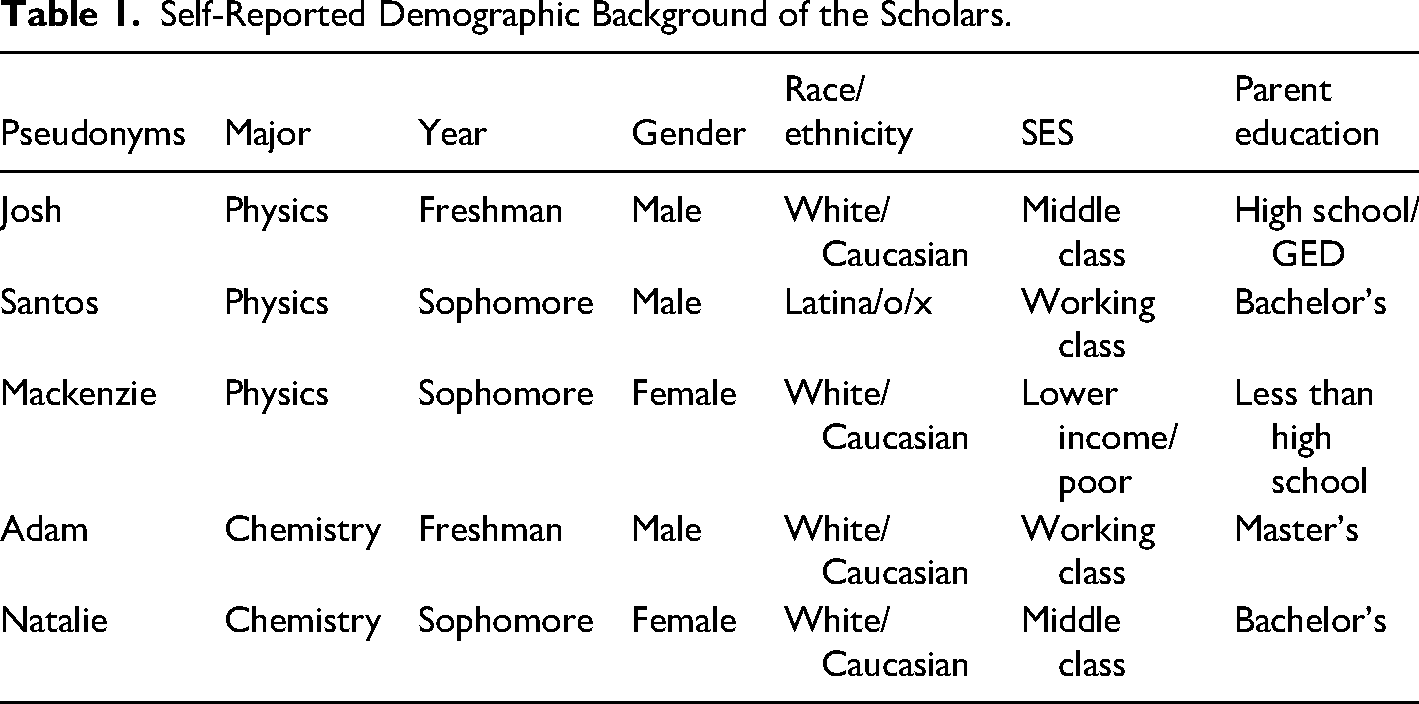
Five physics or chemistry freshmen and sophomores attending a rural liberal arts university in the southeastern United States participated in this study. The five students received financial support from a scholarship program targeting low-income, academically talented STEM students who were eligible for the Pell Grant. The five scholars (all pseudonyms below) were from diverse backgrounds. Their self-reported demographic information is presented in Table 1. Among the five scholars, two self-identified as low-income, first-generation college students (Josh and Mackenzie); one was from a racially minoritized group (Santos). Although the five scholars majored in physics or chemistry, they all belonged to the same department, which consisted of chemistry, physics, and astronomy majors.
Self-Reported Demographic Background of the Scholars.
Contexts
The National Science Foundation (NSF) S-STEM scholarship program at our university integrated competitive financial support and academic and career readiness support aimed at increasing STEM educational access and retention. The support was composed of evidence-based strategies such as undergraduate research, learning community, and intensive mentoring.
All five scholars were enrolled in a first- or second- year academic seminar for either a physics major or a chemistry major. They also participated in a 1-day community building program. In addition, all five scholars were paired with a mentor and toured the research labs in the department. Mentors met with the five scholars monthly as required by “intrusive advising,” a proactive intervention aimed at early identification of problems. Furthermore, scholars were strongly encouraged to engage in undergraduate research experiences as early as possible in their program. The three sophomores were already working at their mentors’ research labs when they received the scholarship. One of the two first-year scholars (Adam) immediately started to work at his mentor's research lab after receiving the scholarship. Finally, as part of the scholarship program, the university also offers tutoring and supplemental support, team advising, service–learning opportunities, summer internship opportunities, and a STEM careers and graduate studies preparation program. Since our research focuses on experiences and sense of belonging during the scholars’ first year in our scholarship program, these other services were not our focus, and the scholars might or might not be using these other services.
Data Collection
The five scholars completed Pampaka et al.’s (2012) Transition into University questionnaire and Knekta et al.’s (2020) Departmental Sense of Belonging and Involvement Survey twice, at the beginning and the end of the fall semester of the first year they were in the scholarship program. Administering these instruments twice allowed us to observe the changes in the scholars’ perceptions of their transitional experience and their sense of belonging. In addition, the students attending the first- or second- year academic seminars together with the scholars also completed the same instruments at the end of the same semester. The scholars’ scores were compared with the average scores of their peers. Pampaka et al.'s questionnaire includes 13 factors that are widely acknowledged in the literature as the most influential for transitional experiences: (a) amount of private study, (b) amount of responsibility for own learning, (c) level to which they are treated as adults, (d) difficulty of work, (e) quality of resources the student has access to, (f) pace of the course, (g) depth of learning, (h) teachers’ control over student work, (i) opportunity to ask questions, (j) opportunity to discuss ideas and problems, (k) formality of language used, (l) how personal teaching is, and (m) social life (pp. 1051–1052). A sample item from this questionnaire is presented below:
The pace of the course is faster/slower/about the same at university.
Negative Mixed Positive DON'T KNOW
As shown in the sample above, each item contains two components. The first offers three possible options for students to indicate the direction of change. The second asks students to choose the appropriate emotion to show their feelings about the change.
Knekta et al.’s (2020) Departmental Sense of Belonging and Involvement Survey measures three constructs: valued competence, social acceptance, and academic involvement, which are discussed in more detail earlier. All the survey items are written on the following six-point scale: strongly disagree, disagree, slightly disagree, slightly agree, agree, and strongly agree. Three sample items corresponding to the three constructs are shown below: Faculty and staff in the Department of Chemistry, Physics, and Astronomy value my opinions (Valued Competence).
There is at least one instructor or other faculty or staff in the department I can talk to if I have a problem (Social Acceptance).
During this academic year, it is likely that I will participate in undergraduate research (paid or unpaid) in the Department of Chemistry, Physics, and Astronomy (Academic Involvement)
The entire survey is published in Knekta et al.’s (2020, p. 11, Table 5). The quantitative, descriptive data served as a basis for us to develop interview questions that elicit students’ open-ended responses, which allowed students to elaborate further on why they rated a statement low or high (see Appendix for the interview questions). Tinto (2017) pointed out that retention was more studied from the institution's perspective, that is, what institutions could do to retain students. However, much less has been written through the eyes of students, that is, from a perspective of student persistence. The semistructured individual interviews allowed students to share their voices and provide in-depth information regarding their transitional experiences and sense of belonging and involvement. Other data sources included application materials, admission interviews, and academic records.
Data Analysis
First, the bulk of data, including transcribed interviews and other sources of data, were consolidated, reduced, and linked together in a narrative to generate a descriptive portrait for each case (Merriam, 1998). Second, several rounds of coding inspired by the grounded theory approach (Corbin & Strauss, 2014) were used to discover crosscutting themes. During the first round of coding, we created in vivo, process, and open codes to identify and label incidences, events, and items of interest (Saldaña, 2016). During the second round of coding, we refined the initial codes, as guided by our research question, and removed codes that we considered trivial or less relevant to the study. As analysis continued, we grouped codes into categories. Although we held rough hypotheses entering this study based on our review of the relevant literature, the coding categories were induced from the data. Finally, we conducted a fourth round of coding to generate analytic themes (Thomas & Harden, 2008) while making sure that the coding categories had stabilized.
Results
In this section, we first provide a descriptive portrait of each of the five scholars based on our within-case analysis. The information in Table 2 aids our description of each scholar. Next, we present salient themes crosscutting all the cases.
Self-Reported Sense of Belonging and Involvement of the Five Scholars and Retention Status.
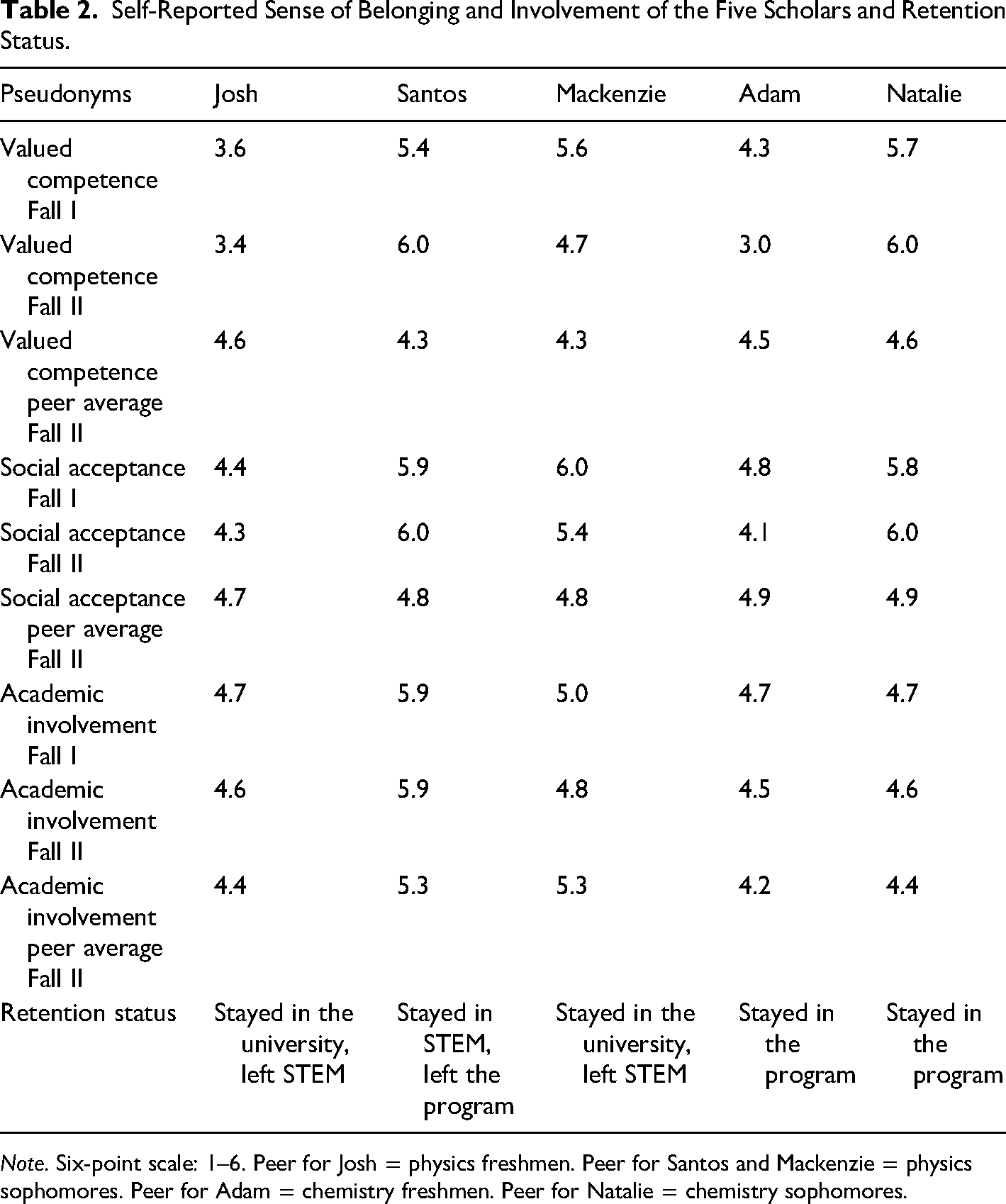
Note. Six-point scale: 1–6. Peer for Josh = physics freshmen. Peer for Santos and Mackenzie = physics sophomores. Peer for Adam = chemistry freshmen. Peer for Natalie = chemistry sophomores.
Adam: Academic Star
Adam described himself as “detailed, goal-oriented, and organized” and shared that his mother, who was a high school biology and chemistry teacher, had a great influence on him.
He had set a clear career goal for himself from the beginning and believed that pursuing a degree in chemistry was personally meaningful to him: The rise in medical conditions that occur within the body has provoked many research projects around immunology. I plan to advance that research by exploring the relationship of immunology and chemistry to increase the knowledge about these rising conditions … But with that optimism I carry a desire to extend research related to my field of chemistry … the mix of my passion for science and my personal motivations is the recipe for my future career. The chemistry department in particular feels really tight. It feels all the teachers and professors feel very open. Like I could go up to any of them and ask them a question if I had to. They’re all very open and they let you know that you can always come to them and ask them any questions that you have, whether they be from research, life in general, chemistry, or anything that they could answer … All the students are very accepting as well, they’re nice. And it's a good community with them as well.
Adam particularly emphasized that the chemistry faculty could be approached for any kind of question, stating: I’ve gone to multiple professors and asked them questions that I’m curious about. Like, if I’m questioning a decision that I’ve made in the long term, like my major concentration, I can be able to talk to them about that.
When asked about his participation in groups and organizations, Adam immediately emphasized his experience as a member of a research group. He described one of the benefits of being part of a research group as follows: You’re always going to be working in groups. Any time you have to go into any career, you’re going to have to work with other people and you’ll build all kinds of skills, communication, any practical skills in the field.
In addition, Adam found the small nature of the research group particularly attractive to him: “I have a group I can talk to and go ask my questions and they’ll teach me, and basically will teach me any equipment, things like that.”
Adam also shared that his social life had stayed “exactly the same” since high school, and he did not care for social situations, declaring, “I like simple life.” He was very self-aware, admitting “I am not very social, and shy, and working on that.” However, he had not experienced any difficulties in social adjustments, describing his social transition to college with a light heart: “Trying to get accustomed to everything and building my way into the community which only takes time and its' natural.”
Adam found his academic fit in the chemistry program and had quite a positive transitional experience. His self-reported level of academic involvement decreased slightly from the beginning to the end of his first semester in the program, but his average score was higher than the average of the first-year chemistry students (Table 2). Consistent with his application essay, Adam had been actively involved in undergraduate research and had presented at research conferences. He was also a member of the physics/chemistry club. Despite admitting that the research topics he pursued tend to be “pretty complex” and “takes a long time to learn it,” he was comfortable with seeking advice and guidance from his professors. Adam did not seem to be deterred by academic challenges easily; he believed that with the resources (e.g., research publications) available online as well as “professors to talk to,” mastering the research process and tackling advanced research topics “are really just time.” Unlike the other scholars in the program, Adam believed that the pace of the courses was about what he had expected, but a college student's schedule was more flexible, which gave him plenty of time to study outside of class. He also expressed no trouble adapting to the depth of learning and preferred deeper topics that were related to real-life applications. Furthermore, Adam described himself as an independent learner: “I would like independence to a certain degree of course, to have control of my grades, which I do in college, it's all up to me.”
It should be noted that despite finishing his first year with flying colors, Adam did not feel academically validated initially. His self-reported valued competence not only decreased from the beginning to the end of the first semester but also was lower than the average score of the first-year chemistry students (Table 2). Although feeling socially accepted in the department, Adam did not feel that people in his department had necessarily noticed he was good at something or that faculty and staff valued his opinions. He also disagreed that faculty gave him complements for doing something well or took an interest in him. However, Adam did not share the same feelings during the end-of-year interview. He was able to prove his ability with his perfect academic records and received due recognition.
Natalie: Well-Rounded High Achiever
Natalie developed a love for chemistry since her high school years: I knew I wanted to pursue a degree in chemistry. There's something so fascinating about how reactions proceed and the math behind all of it. I love figuring out why different reactions happen and what's happening with the reaction. When I was considering where I wanted my path to go through college and beyond, I knew I needed to choose something that would make me happy. It did not take long for me to decide on chemistry. The driving force behind my decision was, and will always be, the simple fact that I love chemistry. It excites me, it fascinates me, it challenges me, it pushes me to be independent, it helps me grow in confidence …
Besides obvious enthusiasm about the subject, she was also very specific about what a chemistry degree would lead to, declaring that she would like to pursue a master's and eventually a PhD degree in chemistry. She envisioned herself to be a material scientist and gain experience in the industry before starting an academic career as a college professor.
Natalie self-reported a very high sense of social acceptance and valued competence, as well as a high level of academic involvement. All her self-reported scores were higher than the average scores of the second-year chemistry students. Although she was highly active both academically and socially, Natalie did not participate in groups and organizations indiscriminately but instead emphasized the importance of prioritizing groups to benefit her major and minor, “more so than something that I just wanted to do for the sake of doing it.” She chose groups and organizations with purpose and intention. For example, she was the president of the chemistry club and was the only scholar in the program who took on a leadership role in a group or organization on campus. She explained that through this role, she built good relationships with juniors and seniors, which was valuable because of their advice on registering for upcoming semesters and “tips and tricks for studying.” She also joined the dance fraternity, which provided her with fun, stress relief, and a “break from classes.” Natalie also mentioned personal learning and leadership skills as benefits of participating in groups and organizations. She was involved in facilitating a family fun night for National Chemistry Week, participating in game nights with other academic-based clubs, and participating in community activities with the Science Education Center.
Serving in a leadership role of an academic club provided Natalie with “immediate validation,” making her believe “this is a good place to be, and they want you involved, they’re going to help you out.” Like Adam, Natalie emphasized how instrumental undergraduate research and her research advisor were in terms of helping her get connected with different opportunities and stay involved in academic activities. According to Natalie, the fact that faculty members start conversations and take initiative to know students beyond the classroom has positively affected their sense of belonging. She recalled: The amount of opportunities I’ve had in this past year, in these past two years has been just staggering. It's incredible, and I know that I can pretty much just walk into the hall, walk over to one of the professor's offices if I’ve had to and just immediately start a chat.
Like Adam, Natalie has also found her academic fit in the chemistry program. Natalie found that the pace of the courses has been what she had expected, explaining: It is definitely a pace that I was accustomed to and already used to with taking those advanced high school courses. So, it's been good, it's been exactly what I expected, and it's been fast enough to challenge me a little bit. But not so fast that I feel like I can't keep up and it's not so slow that I am bored in class. It's been a good pace.
Josh: Disengaged Bystander
Like Adam and Natalie, Josh was also motivated to pursue a degree in chemistry or physics. However, his goal was more general and ambiguous. For example, he stated in his application essay that he was interested in “creating something that's never been seen before, something new and beautiful.” He was excited to learn how to “fix things and know how things work.” He thought that critical thinking and decision-making are very important in life and that pursuing a physics or chemistry degree would “sharpen those skills and develop my thinking to not only think outside of the box, but to be able to think of the impossible and make it possible.”
Josh's self-reported social acceptance stayed about the same from the beginning to the end of the first semester of his freshman year and was slightly lower as compared to the average score of the first-year physics students. Throughout his freshman year, Josh did not participate in any on-campus groups and organizations, but he also did not perceive any barriers to participating, in his own words, “I have my group of guys that I talk to. I’ve always had my group of guys.” He stated that working with other people in a group setting is “always beneficial because you have multiple ways of thinking and multiple ideas” and that “it's very beneficial to have other people by your side.” He was also able to make new friends in the physics program. But he admitted that he still did not know what he wanted to do in the future, and that is the reason for not being involved in groups or organizations related to his major.
As far as department climate, Josh felt that people in the department conveyed high expectations to everyone, stating: They make you feel like you can achieve anything, and they really make you feel comfortable and that you can talk to them about anything, and they just welcome you with open arms, really.
Josh did not seem to find his academic fit in the physics program. He was the only scholar who did not participate in any undergraduate research activities after being accepted into the program. He thought the pace of the courses “is a little fast.” Although he expected the faster pace, as compared to the pace at the high school level, he still struggled to “keep up with it and just constantly going over notes and asking questions.” He did find that the library, working with the tutors at the learning center, and reviewing notes were helpful. He did not expect college professors to “baby” him as high school teachers might do. However, meanwhile, he would like more teacher control over his learning, for example, “making sure everyone gets it individually, the teacher approaching you and making sure you understand it.” When asked about the learning process, he sounded rather passive and disenchanted, recalling “a bunch of lectures and taking notes, and you just sit and just write it down and come back to it later.” However, Josh was grateful that the professors were always checking for student understanding, asking questions such as “Does that make sense?” He felt that his professors were patient and would “elaborate more and answer your questions further.” Overall, Josh was still exploring his academic identity, and participating in the scholarship program for him was like testing the water. He made little investment in his academic work and eventually left the physics program and transferred to the business school after his freshman year.
Mackenzie and Santos: Earnest Pathfinders
Mackenzie described herself as “a student with great academic standing and a low-income status,” emphasizing that “coming into college with an EFC of 0 is very difficult as you have no help other than taking out loans and trying to find scholarships, so any chance you find you have to take.” Like Adam and Natalie, Mackenzie had also set a clear career goal before being accepted into the program. She observed a high demand for physics teachers and a shortage or gap in recruiting physics teachers with strong content knowledge, which made her want to become a high school physics teacher. She felt that “a physics major or engineer can potentially lead to a good income and involve research that can help benefit the world”; however, physics “is a very overlooked subject and is definitely sparse in college enrollment.”
Santos was born in Costa Rica but has been living in the United States since 3 years old. Even at a young age, he wanted to be “a person of science.” After examining a long list of possible occupations, he decided that he wanted to be an electrical engineer.
Both Mackenzie and Santos reported extremely high levels of social acceptance, valued competence, and academic involvement at the beginning of the first semester of their sophomore year. Santos’ self-reported scores for the three areas remained very high until the end of the semester, whereas Mackenzie's scores decreased, especially in terms of valued competence and academic involvement. Her academic involvement was below the average level of second-year physics students, the highest of the four peer groups. Her social acceptance and valued competence scores remained higher than the average scores of her peers. Despite some differences in their self-reported scores at the end of the first semester of their sophomore year, the experiences and opinions that Mackenzie and Santos shared during the end-of-year interview were quite similar.
Both Mackenzie and Santos participated in multiple groups and organizations, both academic and nonacademic. The numbers of groups and organizations each participated in were above the average number of groups and organizations participated in by the second-year physics students. Santos described his freshman year's social life as “gone through the roof,” and since he started his second year in college, he made sure that his social life was “stabilized.” Both students cited hearing other peoples’ perspectives and opinions as their main reason for participating in groups and organizations. Mackenzie, for example, stated, “It's really nice to see what other people take on things … also, if you get lost on something, somebody else may not be lost on something.” She also reflected that she used to be shy, but “college helped me grow with that … I need to grow up. I want to be a teacher. You have to learn to be around people a lot.”
Both students felt they were socially accepted, which contributed to their high sense of belonging. For example, Santos noted that he and his peers: Practically share every class together … So, we help each other when we didn't really understand it in class, don't understand it with homework or with projects. We are just going out to eat and just having fun … So, I feel more belonging because it kind of kept me on my toes, but also, I didn't feel too burned out from it because I had most of my friends there. The faculty are very nice, the physics numbers are very small, so you always get very personal time with them, they always know your names right around the first day, stuff like that. I’m always downstairs doing research and stopping by people's offices. It's very like a home. I guess. Its' very wholesome.
Like the other three scholars, both Mackenzie and Santos felt that their professors provided a positive classroom environment for them to ask questions, discuss ideas, and voice problems. Mackenzie gave an example of how one of her professors always “wanted to make sure you said it. He didn't want it just to be silent, do your work … He really makes sure there was an open floor.” Mackenzie felt that students’ questions were respected and everyone in the physics program was going to “help you out and have an answer for you.” Although both students participated in research activities, they did not particularly single out their undergraduate research experience or groups as significant, nor did they mention presentations at research conferences.
Both students preferred a cooperative, group-oriented style, which did not seem to fit the expectations and demands of their program. Mackenzie complained that “it's honestly crazy how much you need alone time, because I found myself never being able to have time to do almost anything.” However, she also said that she did not mind studying more. Santos shared how he and his friends used the library as a site to work on their homework assignments together, trying to “get a lot more work done on campus … instead of always trying to do the homework in my room.” Both students mentioned how much they wanted to improve their study habits.
Both students struggled to fit academically and felt that the fast pace of the courses was too much for them. Santos lamented that “sometimes it's hard to try to keep up with the pace” and sometimes a course “was moving at breakneck speed.” Mackenzie also stated that sometimes she felt she got “rushed or overlooked” or “you’re just shocked.” Santos also emphasized that the fast pace might sacrifice the depth of learning, explaining that “I really liked explaining the topic instead of going through the PowerPoints too quickly.” He recalled that sometimes the professors had to keep moving on and left students’ questions not adequately addressed: Sometimes even just having the work written on the board doesn't really equate to knowing the exact extent of it. It’d be like if I really knew how you got to that point instead of just writing the end products of everything, but not really showing why they think that or why they should be that.
Both students seemed to prefer more teacher control over their learning. When asked about teaching style, Mackenzie shared that “I still think I want it personal, just because I want to know if I’m doing something right.” Similarly, Santos wanted professors to provide structure in the classroom, “instead of letting us loose all the time and we waste time.” He elaborated that he preferred professors to have “a bit more control over knowing where we are and where we need to instead of just keeping to deadlines and keeping to the schedule of things.” Toward the end of the interview, Santos also compared his college experience with his high school learning experience, expressing difficulties in his academic transition to college: It's a lot less personal compared to high school. But I know the real world isn't going to sit down and explain things to you just because you don't know what's going on. To me there's no true one or two ways to do it … I just wish it was more looking out for the individual, especially when we’re dropping like flies …
Crosscutting Themes
Theme 1
Interactions with faculty and participation in peer groups/organizations were important considerations regarding social acceptance for the five scholars. Faculty interactions with students, both inside and outside of the classroom, were perceived as important. Inside the classroom, the scholars appreciated faculty who (a) were open to student questions, (b) showed respect for students, and (c) conveyed high expectations to them and believed that all students were capable of doing well. Outside the classroom, students found the faculty members in their department approachable and accessible when students needed their advice. The five scholars especially appreciated faculty members who were willing to provide advice in areas beyond academic learning such as career choices and general life experiences. Regarding peer interactions, all five scholars emphasized their participation in groups and organizations. The two scholars who showed a moderate level of participation, Natalie and Adam, seemed to be the most successful in terms of balancing academic and social needs. These two students made serious decisions about which groups to join. Both had very specific purposes or intentions before they made their choices. Natalie emphasized the benefits of taking on a leadership role and building relationships with juniors and seniors who could provide valuable advice for course registration. She also emphasized the importance of prioritizing and not participating in groups indiscriminately. Adam emphasized the academic benefits of participating in small, tight-knit groups, for example, his research group. Josh did not participate in any groups or organizations during his first year. Santos and Mackenzie participated in more groups or organizations as compared to an average second-year physics student. Josh, Santos, and Mackenzie all cited gaining multiple perspectives and opinions as their major motive to participate in groups. Santos also mentioned study groups but emphasized the benefits of social time with group members. Unlike Natalie and Adam, the intentions or purposes for these students were more ambiguous and were also less academically related.
Theme 2
Participation in undergraduate research and attitudes toward research were tied to retention decisions. Adam and Natalie both singled out their research experience as particularly valuable to them. Adam felt that the small, tight-knit nature of his research group was one of the major reasons for his sense of belonging to the chemistry program. Although Santos and Mackenzie also participated in undergraduate research, neither singled out their research experience as an important reason for their sense of belonging to their program. Neither presented at research conferences. Josh did not participate in research activities because he was uncertain about what he wanted to do in the future. Scholars who remained in their field of study were more committed to research and valued research more as compared to their peers.
Theme 3
The pace of courses and depth of learning were significant factors that influenced the scholars’ perceptions of their transitional experience. Both Adam and Natalie believed that the pace of the courses was like what had been expected, whereas the rest of the three scholars were obviously stressed out over the fast pace of college-level courses in their field of study. In addition, Adam and Natalie both desired depth of learning and related depth of learning to the applicability of course material to the real world and to their future career. Santos also desired for more depth of learning but felt that the fast pace of some of the courses he took sacrificed depth of learning and left questions not adequately addressed nor thoroughly explained.
Theme 4
Academic success in physics and chemistry seemed to favor scholars who were independent learners and were willing to spend a lot of private time on study. Both Adam and Natalie described themselves as independent learners. They enjoyed the freedom their college professors granted them. Natalie also shared that she increased individual study time after attending college and believed this was necessary because group learning sometimes could be distracting for her. On the other hand, Santos and Mackenzie were more group-oriented, cooperative learners. Both preferred to study with their friends. Both also expressed their need for more personalized teaching and attention from their professors as well as more instructor control over the curriculum. However, this cooperative, group-oriented style did not seem to be a good fit with their field of study.
Theme 5
Faculty members’ pedagogical style was an important factor when the five scholars evaluated their transitional experience and sense of belonging. Natalie and Adam were satisfied with the way physics and chemistry were taught in their department. They both gave examples of professors who made clear connections between course content and real-life applications and gave them more freedom to dig deeper into the course material. On the other hand, Santos, Mackenzie, and Josh complained about having to sit through lectures and taking notes passively. Regardless of learning styles, all five scholars seemed to prefer more discussions and hands-on activities in the classroom.
Theme 6
Valued competence, social acceptance, and academic involvement were distinct factors under sense of belonging. Although all five scholars felt that they were socially accepted, the two freshmen perceived a lack of academic validation initially. The five scholars’ academic involvement also showed more variety than social acceptance. Overall, academic involvement played a more important role than social acceptance. Valued competence also seemed to be important but could change along with perceived academic challenges and academic records.
Discussion
Previous research has shown that sense of belonging, including a feeling of being cared about, respected, valued, included, and supported by others in a community, is positively related to the retention of college students in STEM areas (Apriceno et al., 2020; Astin, 1984; Cwik & Singh, 2022; Gopalan & Brady, 2019; Guloy et al., 2017; Hoffman et al., 2002; Knekta et al., 2020; Pedler et al., 2022). In addition, transition to college can be challenging when freshmen and sophomores develop new study habits and skills to meet the higher expectations of academic learning at the college level (Barth et al., 2021; Santangelo et al., 2021). The aim of this study was to gain insight into the transitional experiences and sense of belonging and involvement of low-income, academically talented freshmen and sophomores in physics or chemistry. We hope that a better understanding of students’ experiences and feelings will help inform policies and practices for future retention interventions designed for college students in STEM areas. Although we cannot make definitive claims about causal mechanisms for retention given the qualitative nature of the study, multiple case studies like ours, according to Yin (2017), do allow some form of replication and theory development.
The quality of faculty interactions with students, both inside and outside class, has been found to be an important factor for students’ sense of belonging to a department (Barth et al., 2021; Tinto, 2006, 2012; Tovar, 2015). The five scholars in our study found the faculty in their department friendly and accommodating. The faculty exhibited behaviors or attitudes that aligned with “pedagogical caring” (Freeman et al., 2007), which included (a) never acting condescending to students, (b) being open to all student questions, and (c) believing that all students are capable of high achievement. The five scholars also shared with us that the faculty in their department were approachable and accessible outside class if students needed to discuss course content with them. Besides academic topics, the five scholars also sought life and career guidance from their professors. Faculty, in the eyes of these students, are not only instructors but also advisors and mentors.
Our findings also indicate that students’ educational experiences in a classroom are tied to faculty's pedagogical decisions or styles (Tinto, 2006). Fast pace at the expense of depth of learning and overuse of lectures are likely to generate negative feelings about transitional experience. The five scholars in our study also associated depth of learning with whether instructors make explicit connections between a course and real-life applications.
Study skills and habits can enhance transitional experience or make it difficult (Cameron & Rideout, 2022; Lane et al., 2020). In our study, the two scholars who developed an independent learning style fared well in the department and decided to remain in their department. These scholars enjoyed more freedom in their learning at the college level and felt comfortable with studying alone. Their habits were more compatible with the learning expectations of their field of study. On the other hand, the scholars who relied on a group-oriented, cooperative learning style struggled academically. They responded poorly to having to (a) sit through lectures and take large amounts of notes and (b) increase their private study time outside class. They wished that there were more discussions in the classroom and more personalized teaching and attention from their professors.
Knifsend and Graham (2012) found that adolescents who were moderately involved in extracurricular activities felt a higher sense of belonging than either students who were not involved at all or students who were involved in too many. Our study with college freshmen and sophomores shows a similar pattern. The two scholars who decided to remain in the department prioritized their group or organization participation and made their decisions based on clear intentions or purposes (e.g., research and building relationships with the third- or fourth-year college students in the same department). Each of these two scholars was a member of two on-campus groups or organizations during their first year in our program, close to a typical chemistry freshman or sophomore. On the other hand, among the three scholars who left their department, two participated in more groups or organizations as compared to their peers; one did not participate in any group or organization.
Consistent with Barth et al. (2021), we found that levels of participation in undergraduate research were highly related to the scholars’ retention decisions. Being part of a research group or a professor's research lab contributed to the sense of belonging of all four scholars who participated in undergraduate research. However, there was a significant difference between the two scholars who decided to remain in the department and the two who left. The two scholars who stayed in the program showed a higher level of commitment and presented at research conferences. Not only did they value their research experiences more, but they also demonstrated a strong desire to conduct research in their application materials.
Overall, academic involvement and classroom experiences played a more important role than social acceptance in the scholars’ decision to stay with or leave their department. It should also be noted that all five scholars decided to stay with the university, but only two scholars decided to remain in their field of study or department. This suggests that department-level retention and college-level retention are likely to be influenced by different factors. Social acceptance may have a stronger impact on college-level retention but is not adequate for department-level retention.
Some may ask whether the content area had anything to do with the scholars’ decisions to stay with or leave their department because the three scholars who left the program were all physics majors. We believe this was probably a coincidence. The situation for another cohort of five students that were not included in this case study was just the opposite. Two chemistry students in the cohort left the program; three physics students decided to stay.
Implications for Practice
Based on our findings, physics and chemistry faculty can potentially play a central role in their students’ decision to remain in their field of study. One way to improve students’ sense of belonging is to create a nonthreatening, positive classroom environment. This may include public compliments of students who are doing well and more probing questions to show interest in students’ ideas or opinions. Faculty could also try to be available and prepared for frequent discussions outside class. In addition, faculty are often expected to serve as not only instructors but also mentors and advisors for their students.
Since faculty's pedagogical choices and styles have a large impact on students’ perceptions of their transitional experience, faculty could actively seek professional development opportunities to diversify instructional strategies. Physics and chemistry freshmen and sophomores are a diverse group of students with various needs. Some students might rely more on individually tailored, more-personalized teaching and need more personal attention. Others might enjoy more freedom. Faculty in these programs could adjust their instructional approaches to reach out to a wider range of students. On the other hand, classroom discussions and hands-on activities are popular strategies that might work for an entire class of students. Tinto (1998, 2006) has pointed out that successful retention efforts are likely to start with the classroom. Usually, retention efforts focus on improving the end results but overlook the potential of pedagogical innovations for generating higher levels of student engagement. Tinto (2006) recommends that faculty build learning communities just like what their students often do. Interdisciplinary learning communities that include faculty across several fields of study and/or disciplines are likely to discover innovative approaches. We also suggest that faculty in STEM fields, like their colleagues in education, participate in professional development that focuses on how to orchestrate classroom discourse, differentiate instruction, and promote scientific argumentation. Lesson study (Collet, 2019) and action research (Mertler, 2019), which are widely used and proven to be effective in the P-12 educational context, can be introduced to STEM fields through centers for teaching and learning on university campuses.
Meanwhile, students need discipline-specific study skill workshops, not generic ones. Students who have developed study skills and habits that are compatible with their field of study can be asked to provide concrete advice for students who lack these skills and habits. Although sometimes faculty's lecture-driven style may implicitly communicate that memorizing the materials is equivalent to learning, students also need to develop cognitive flexibility so that they can thrive in different types of classrooms, or they will need to know how to find professors whose teaching style meets their learning style and needs. When it comes to balancing academic and social lives, university faculty and staff may advise new students to prioritize extracurricular activities, join groups and organizations with clear purposes, and make sure at least one of the groups or organizations is related to their field of study such as research groups that encourage student presentations and publications. Recruiters for scholarship programs may also target potential students who demonstrate a strong desire to participate in undergraduate research and can articulate the values of scientific research.
Limitations and Future Research
This is an exploratory case study of five physics or chemistry students participating in a scholarship program. Although it can provide a more in-depth description of the students’ experiences and feelings, the results, however, are not generalizable to other physics and chemistry students. The findings of our study strongly suggest that different factors such as academic involvement or social acceptance may play very different roles in department-level versus college-level retention and therefore support more future studies that focus on department-level retention, which is a relatively new research area (Knekta et al., 2020; Knekta & McCartney, 2018; Strayhorn, 2019).
Our findings indicate that faculty's teaching styles and approaches may have a large impact on department-level retention. However, it is impossible for us to gauge the effects given the small number of students we worked with. In addition, our findings suggest that more investment needs to be made in faculty and staff professional development, especially opportunities to develop pedagogical skills. Future research may fill in these gaps by focusing on testing the effects of faculty pedagogy and faculty development on retention.
Conclusion
Despite our study's limitations, the current findings shed light on some of the most important factors that may influence the retention of low-income, academically talented college students in physics and chemistry. Although students reported a high sense of belonging, this alone did not lead to their decision to stay in their field of study. Levels of involvement in academic organizations and activities such as clubs and research groups played a more important role in the students’ decisions. When asked about their sense of belonging and involvement, students commented extensively on course pace, depth of learning, real-life application, lecture versus group discussion, and learning and teaching styles. Therefore, faculty in STEM areas may benefit from systematic professional development with a focus on curriculum design and pedagogy. Finally, although all five students in our study stayed with the university, only two stayed with their academic department. This suggests that retention efforts at the university level and the department level may need to focus on different areas and that more research studies on sense of belonging and retention are needed at the department level.
Footnotes
Appendix: Interview Questions
Acknowledgements
We send heartfelt thanks to Dr. Eva Knekta, Dr. Maria Pampaka, and the Higher Education Data Sharing Consortium (HEDS) for giving us permission to use their surveys.
Declaration of Conflicting Interests
The author(s) declared no potential conflicts of interest with respect to the research, authorship, and/or publication of this article.
Funding
The author(s) disclosed receipt of the following financial support for the research, authorship, and/or publication of this article. This work was supported by the National Science Foundation (grant number 2030804).
