






Abstract
Disparities remain in who enters and completes college, with lower income, ethnic minority and first-generation students being less likely to achieve four-year degrees. To address this disparity, numerous federally-funded college access (CA) programs are provided to underrepresented high school students nationwide. However, mixed evidence exists to demonstrate that CA programs are effective strategies to increase enrollment in postsecondary education. This study utilized secondary data collected by providers of one CA program, Upward Bound. Mixed-effects multinomial logistic regression analysis is used to investigate the predictors of postsecondary enrollment that are associated with student profiles including demographic and academic backgrounds. Results showed that male students were less likely to enroll in any postsecondary setting compared to female students. Academic predictors such as dual enrollment and enrollment in advanced placement courses had strong predictive power for whether participating students enrolled in postsecondary education.
College degrees remain a critical pathway to employment, lifetime earnings, and other social protective factors (Autor 2011; Kane & Rouse, 1995; Kolesnikova, 2010). Moreover, college completion is critical to the country's workforce; the need for degreed workers in key professions is outpacing the supply (Santiago, 2011)—and degrees are a key lever in ending cyclical poverty (Irwin et al., 2022). National trends highlight the persistent advantage of having a college degree in terms of employment and earning outcomes; the unemployment rate of individuals with a high school diploma only is nearly twice that of those with bachelor's degrees (U.S. Bureau of Labor Statistics, 2021). Additionally, the average annual income of individuals with associate degrees ($42,164) is roughly 20% more than the income of individuals who completed high school only ($35,213), while the average annual income of those with bachelor's degrees ($55,413) is 57% more than those who completed high school alone (National Center for Education Statistics, 2021a).
These implications for long-term earning potential demonstrate the importance of college access generally, yet the attainment of a postsecondary degree and its connection to lifetime earnings is especially salient among low-income and racial minority populations whose average earnings are persistently lower than non-minority populations. Despite the provision of federally funded programs aimed at increasing college access for underrepresented students for over half a century, youth who come from low-income and underrepresented racial backgrounds still face inequitable pathways to college education (Cowan Pitre & Pitre, 2009; Means et al., 2019). Additionally, students from first generation families in low-income and high-poverty communities are less likely to be considered college and career ready upon high school graduation (Guevara-Cruz, 2018). This fact can be deduced from the higher rates of remediation needs that are observed for Hispanic (who have higher rates of being first-generation college students) and low-income students in two- and four-year colleges (Complete College America, 2012; Von Secker, 2009). Similarly, Cabrera et al. (2001) reported that only 25% of low-income students had adequate high school grade point averages, which is known to be a key indicator of college readiness.
National statistics depict the dramatic levels of disparity in college enrollment based on students’ demographic background. Among high school graduates in 2016 1 , approximately 65% of low-income and middle-class students enrolled in college, whereas that figure was 82.5% for their high-income counterparts (National Center for Education Statistics, 2017). This large income-based gap in postsecondary enrollment can also be associated with the positive impact of attending a high school with more resources (Wolniak & Engberg, 2010). As of 2020, among high school completers, 65% of White and 82.7% of Asian students enrolled in college, while those numbers for Black and Hispanic students were 57.5% and 56.2% respectively (National Center for Education Statistics, 2021b). There continues to be a clear pattern of lower college enrollment among students of low-income and middle-class backgrounds, as well as for Black and Hispanic students.
Young men and especially young Hispanic men are less likely now than in previous decades to apply for or complete a postsecondary degree. National trends (National Center for Education Statistics, 2021b) show strong evidence of the decrease in enrollment rates both for female and male students from 2019 to 2020. Specifically, enrollments decreased 200,000 and 400,000 for females and males, respectively. The amount of decrease over this time frame was 50% more for males compared to females. In fact, the overall enrollment rate in undergraduate programs decreased by 2.5% in Fall 2020 due to COVID-19 disruptions (National Student Clearinghouse Research Center, 2020). Beyond the common impact of the COVID-19 pandemic, the disparity between female and male enrollment (especially, enrollment in four-year programs) persists. Among high school completers, the four-year college enrollment rates were 38.4% for males and 50.7% for females (National Center for Education Statistics, 2022). The lower enrollment trend for male students also persists across racial and ethnic categories with greater discrepancy among Hispanic students: the male-female enrollment percentage difference was 11.8% for Hispanics, whereas it was 8.4% and 8.9% for Black and White students, respectively (National Center for Education Statistics, 2021b).
Unfortunately, the disparity does not stop at college enrollment alone. Marked differences are also apparent in whether students obtain a degree after enrolling in college; college attainment and completion remain a major concern for the low-income and/or students of color after enrollment. As of 2020, 41.3% of White adults and 60.3% of Asian and Pacific Islanders hold a bachelor's degree or higher, while those numbers for Black and Hispanic adults were 27.9% and 20.8% respectively (National Center for Education Statistics, 2021b). Attainment rates are also lower for students of color compared to their peers. Among those who enrolled in a postsecondary institution in 2016, the attainment rates (six years after entry) were 82% for Whites and 88.4% for Asians. Those rates were 67.6% for Black and 75.4% for Hispanic students (National Center for Education Statistics, 2023). As reported by Complete College America (2012), upon entering college, nearly 53% of Black students, 40% of Hispanic students, and 48% of low-income students begin their freshman year in remediation courses, and it was reported that less than 90% of students who begin community college in remediation classes graduate within three years. It was further reported that among low-income students enrolled at 2- or 4-year postsecondary institutions, only 26% obtained a bachelor's degree within 6 years of first enrolling whereas 69% of their high-income counterparts obtained a bachelor's degree (Cahalan, 2021). The authors also report that nearly 40% of low-income students who initially enroll in a postsecondary institution drop out within 6 years. Therefore, the concern is whether students are getting “to and through” college, not just increasing college enrollment for underserved youth, but also ensuring that these students are adequately prepared for college and its completion.
Origins of Federally-Funded College Access Programming
These gaps in college preparedness, enrollment, and completion among low-income and racial minority students compared to more affluent, White peers are attributed to structural barriers such as financial constraints, lack of information about the college enrollment process, and lack of equitable educational opportunities (Page & Scott-Clayton, 2016). To address these origins, numerous college access programs have been developed for and provided to underrepresented high-school students nationwide through privately and federally funded programs aimed at increasing their access to postsecondary education (Bettinger & Evans, 2019). In 1965, the U.S. Department of Education began funding student outreach programs through Lyndon B. Johnson's War on Poverty (Groutt, 2014).
Of these original federal student outreach programs (known as TRIO), Upward Bound (UB) was the first to be conceived with the intent of preparing low-income students to pursue college education post high school graduation (Walsh, 2011). In fact, the acronym TRIO was used to refer to three key programs that are UB, Talent Search, and Student Support Services. Since 1968, five more programs have been included under the TRIO umbrella: Educational Opportunity Centers, Ronald E. McNair Postbaccalaureate Achievement, Training Program for Federal TRIO Programs Staff, Upward Bound Math-Science, and Veterans Upward Bound. All TRIO programs are considered as Federal outreach and student services to identify and support individuals from disadvantaged backgrounds including low-income and/or first-generation college students.
UB targets secondary students who are low-income, underrepresented minorities, and/or would be first-generation college students. The U.S. Department of Education states that UB's purpose is to “provide fundamental support to participants in their preparation for college entrance.” This includes supporting successful completion of high school, enrolling in postsecondary institutions, and graduating from these institutions (U.S. Department of Education, 2023). The UB program provides academic advising, tutoring, and counseling services to participating students at their high schools throughout the school year, and intensive summer programs at colleges. Some UB programs include a summer “bridge” program to support students in their immediate transition from high school to college (Grimard & Maddaus, 2004). Completion of the summer program along with staying longer in the UB program was associated with higher rates of postsecondary degree attainment (Partridge, 2016). Additionally, summer programs have been reported to promoting the “college going experience”, which is perceived as an important aspect of the UB program by the participants (Pringle-Hornsby, 2013). Since 1962, UB has served more than 2 million students with programs in all 50 states and even the U.S. territories (U.S. Department of Education, 2021).
In spite of these major efforts, and despite targeting programs like UB to youth who come from low-income and underrepresented racial backgrounds, these graduating students still face inequitable pathways to college education (Cowan Pitre & Pitre, 2009; Means et al., 2019). A widespread change in college enrollment and attainment rates has paralleled the timeline of these large federal efforts.
State of the Evidence: TRIO and Upward Bound Programs
As described by Brewer and Landers (Brewer & Landers, 2005), the effectiveness of TRIO programs is expected to be monitored and documented by program providers. Local program providers produce annual performance reports in which they disclose several a priori performance measures such as percent of eligible students enrolled in postsecondary education. Because of limited evaluation reporting requirements, the reports typically shed insufficient light on varying characteristics/profiles of students and how these variations are related with student outcomes, including enrollment and persistence in college.
Given the importance of college access for underrepresented youth, additional details about what works best for specific populations of students who benefit from these programs are warranted. One of the most frequently cited impact studies of UB, by the Mathematica Policy Research Inc. (Seftor et al., 2009) for the U.S. Department of Education, found that participation in UB had no significant effects on students’ grades at high school or high-school credits including enrollment in honors or advanced placement courses – both key enabling outcomes shown to support college enrollment (Myers et al., 2004). Myers and Schirm (1997, 1999) also reported that no statistical evidence was found in UB's role in closing the gaps in postsecondary achievement and attainment. Reports pointing out to “ineffectiveness” of the UB program raised concerns. At one point, former President George W. Bush publicly asserted that the program itself was ineffective (see, for example, Walsh (2011)). The Bush administration proposed dissolving UB several times due to such evaluations that yielded no positive effects from program participation and the costly monetary investment for each participant (Field, 2007). Even though it was not suspended, funding for UB programs decreased in the 2006 and 2007 fiscal years. In the same years, however, Olsen et al. (2007) reported significant effects of UB Math-Science program in terms of improved high school grades (both overall and in Math and Science) and increased likelihood of enrollment and completion of four-year degree programs.
In a later report by Cahalan and Goodwin (2014), UB's impact on college enrollment and attainment were found to be statistically significant after the re-analysis of the same data used by the Mathematica team. The former findings by Seftor et al. (2009) were reversed by this report and several fatal issues in their methodology were mentioned. To some degree, these reversed findings might have helped the program to stay active in the following years. Readers are referred to Partridge (2016) for a more detailed discussion of the UB's chronological history and its perceived value at the Federal level in terms of closing the gaps in postsecondary enrollment and degree attainment.
Purpose of the Current Study
The gap in the literature around the college access programs and their desired outcomes still exist with most of the major impact studies being conducted between 2000–2015. Further studies are needed that can explore the characteristics/profiles (both demographic and academic) of the students served by these programs in relation with desired outcomes. Even though UB programs target a well-defined group of underrepresented students, recruitment and program enrollment may vary considerably and there may still be several factors that distinguish distinct groups of students in this population. Exploration of such differences and their relationship with desired program outcomes, particularly, enrollment in postsecondary education 1) contribute to a deeper level of understanding of the potential mechanisms of influence and 2) may point to significant opportunities for program re-design, innovation, and customization for the populations served to increase enrollment rates in postsecondary institutions.
The purpose of the current study is to investigate student profiles that are related with enrollment in postsecondary education. Specifically, we focus on UB programs, which are funded by the U.S. Department of Education's TRIO programs. The current study asks and answers the following research questions (RQs).
RQ1: Does postsecondary enrollment vary by demographic characteristics of UB students (gender, race/ethnicity, and being a first-generation college student)? Which groups of UB students are more likely to enroll in postsecondary education?
RQ2: Does postsecondary enrollment vary by UB students’ academic experiences/status at high school? Specifically, are risk for school failure, completion of an advanced placement course, and dual-enrollment in fifth-year programs significantly relate with postsecondary enrollment?
RQ3: Does more exposure to UB programs (including an earlier start and total number of days enrolled in UB programming) significantly related with enrollment? Are UB students who start the program at earlier grades/had more exposure to the program over time more likely to enroll in postsecondary education?
Method
Sample and Variables
We used data that were collected as part of college access programs administered by a nationally-ranked university located in a southern state of the U.S. These programs have been assisting low-income and/or first-generation students since 1966 in several high schools in and around a large urban city. Five UB programs (UB Classic I, II, III, UB SOAR and UB STEM) administered share common support activities including mentoring, advising, Saturday academies, and summer programs. SOAR and STEM differ slightly in their targeted recruitment: these programs tend to recruit students who have stronger academic performance in math and/or science courses or who have interest in STEM (science, technology, engineering, and math) related careers. All UB programs included in the study were provided in one of three large urban school districts, all generally located in the same geographic area. Students that enrolled in these programs as early as 2006 are included in analyses. Student rosters were extracted from annual progress report datasets that were captured for the academic years of 17–18, 18–19, and 19–20. For each academic year, rosters included active as well as former students served in the programs.
During the initial data preparation phase, we excluded students who left the program and those who were continuing high-school students in the mentioned academic years. First, student observations with missingness in demographic and/or postsecondary enrollment variables were excluded from the final dataset. 93.5% of the students were either Black or Hispanic and the remaining 6.5% percent of the sample was recorded as one of the other racial or ethnic categories (i.e., American Indian or Alaskan Native, Asian, Native Hawaiian or other Pacific Islander, or White). We excluded this small group of students with other race categories as we intended to focus on two major groups of race/ethnicity in our sample. We also excluded data from high schools with less than 5 students to prevent convergence issues in the multilevel analyses, which are explained in the following paragraphs. The final sample was comprised of N = 635 students that graduated from 19 high schools. The minimum and maximum number of students per school were 5 and 130, respectively. In the final analysis sample, the distribution of student race/ethnicity was 54.5% Hispanic and 45.5% Black. The student sample was mostly comprised of females (62.5%) and the majority of students (91%) would be first-generation college students. A more detailed breakdown of the demographic variables can be observed in Table 1.
Descriptive statistics of the student profile variables as predictors of postsecondary enrollment.
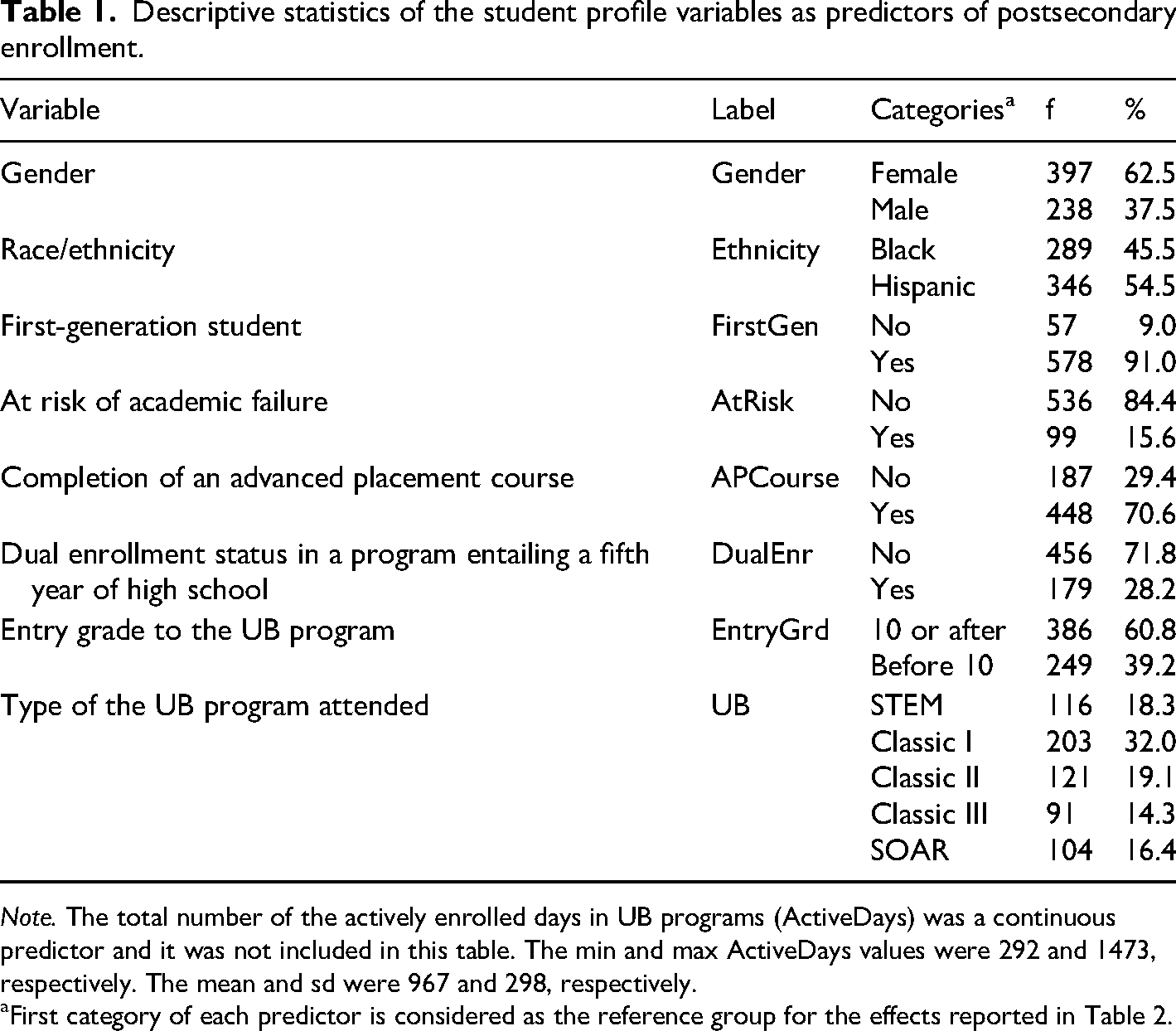
Note. The total number of the actively enrolled days in UB programs (ActiveDays) was a continuous predictor and it was not included in this table. The min and max ActiveDays values were 292 and 1473, respectively. The mean and sd were 967 and 298, respectively.
First category of each predictor is considered as the reference group for the effects reported in Table 2.
The outcome variable of interest was students’ enrollment status in a postsecondary institution. Enrollment status identified three groups of students in the sample: those not enrolled in any postsecondary institution (12%), those enrolled in 2-year programs (29.8%), and those enrolled in 4-year programs that grant a bachelor's degree (58.3%). Note that these enrollment indicators refer to the status of the students in the fall term following their graduation in high school. UB program providers check postsecondary enrollment status through National Student Clearinghouse. In case of non-existent student records, providers contact students to inquire about their postsecondary enrollment status.
In parallel to our research questions, we used several demographic and program-sourced variables as potential predictors of postsecondary enrollment status. Specifically, we used gender (female/male), race/ethnicity (Black/Hispanic), and first-generation college student status 2 (no/yes) as the demographic predictors. Predictors related to students’ school experiences/academic status included whether a student was flagged as being at-risk of academic failure (no/yes), completion of an advanced placement course (no/yes), and dual-enrollment in fifth-year high-school program (no/yes). The at-risk variable is a multi-component variable developed by the state education agency that combines a number of factors related to socioeconomic challenges and academic performance to create a binary risk of academic failure.
As predictors related to UB exposure, we used 1) the grade entered to the program to help determine an earlier start in UB programming and 2) the total number of days a student was actively enrolled in the UB programs (continuous). These two variables were considered proxies of program dosage, measures of exposure to UB programs during high school. We did not have, however, a “pure” dosage metric in terms of actual accrued program activities, minutes or days. Students could have entered the program as early as 8th graders or in their last year of high school as 12th graders. We dichotomized this multi-category variable into enrollment before 10th grade (1) or enrollment during/after (0). The decision to split into two groups (starting in 9th or 10th, or starting in 11th or 12th) is reflective of the differences in content provided to 11th and 12th grade participants; starting in 11th grade, college preparation activities increase meaningfully. This gave us general categories for understanding whether students started UB programming at the beginning of high school (or before as 8th graders) or in the latter part of high school. Also, the new 0/1 indicator resulted in more balanced student frequencies as opposed using actual entry grades. We also used the specific UB program a student enrolled in (Classic I, II or III, STEM or SOAR) as a control variable while we sought the prediction power of the other variables. More detailed explanation and descriptive statistics for these variables can be found in Table 1.
Data Analysis
We conducted mixed-effects (i.e., multilevel) multinomial logistic regression analysis with the postsecondary enrollment indicator (not enrolled, enrolled in a 2-year program, and enrolled in a 4-year program) as the outcome variable. In multinomial models, the outcome is categorical (can be ordered or unordered) with more than two levels as opposed to traditional logistic regression models, which are fit to data with a dichotomous outcome. We treated the enrollment indicator categories as unordered and assigned the 2-year enrollment as the reference category to be compared to the remaining status of enrollment: no enrollment in any postsecondary program and enrollment in 4-year programs. Thus, the two contrasts tested by the model were (1) the likelihood of not enrolling in any postsecondary program compared to enrolling in a 2-year program (2) the likelihood of enrolling in a 4-year program compared to enrolling in a 2-year program. Selection of the 2-year enrollment as the reference category instead of the non-enrollment was intentional, aiming to provide more meaningful interpretation of likelihoods.
In addition to testing for likelihood of enrollment with two contrasts, we accounted for school-level nesting, while modeling the likelihood of enrollment for UB program participants. Namely, we used mixed-effects modeling rather than a traditional multinomial regression approach to account for dependency between the observations of students nested within the same school. This decision aimed to control for potential correlations among enrollment status of students who participated in UB programs at the same high school, while we investigated the effects of the predictor variables on postsecondary enrollment.
The mathematical equations of the models are presented below, where subscripts i and j indicate student and school levels, respectively.
Results
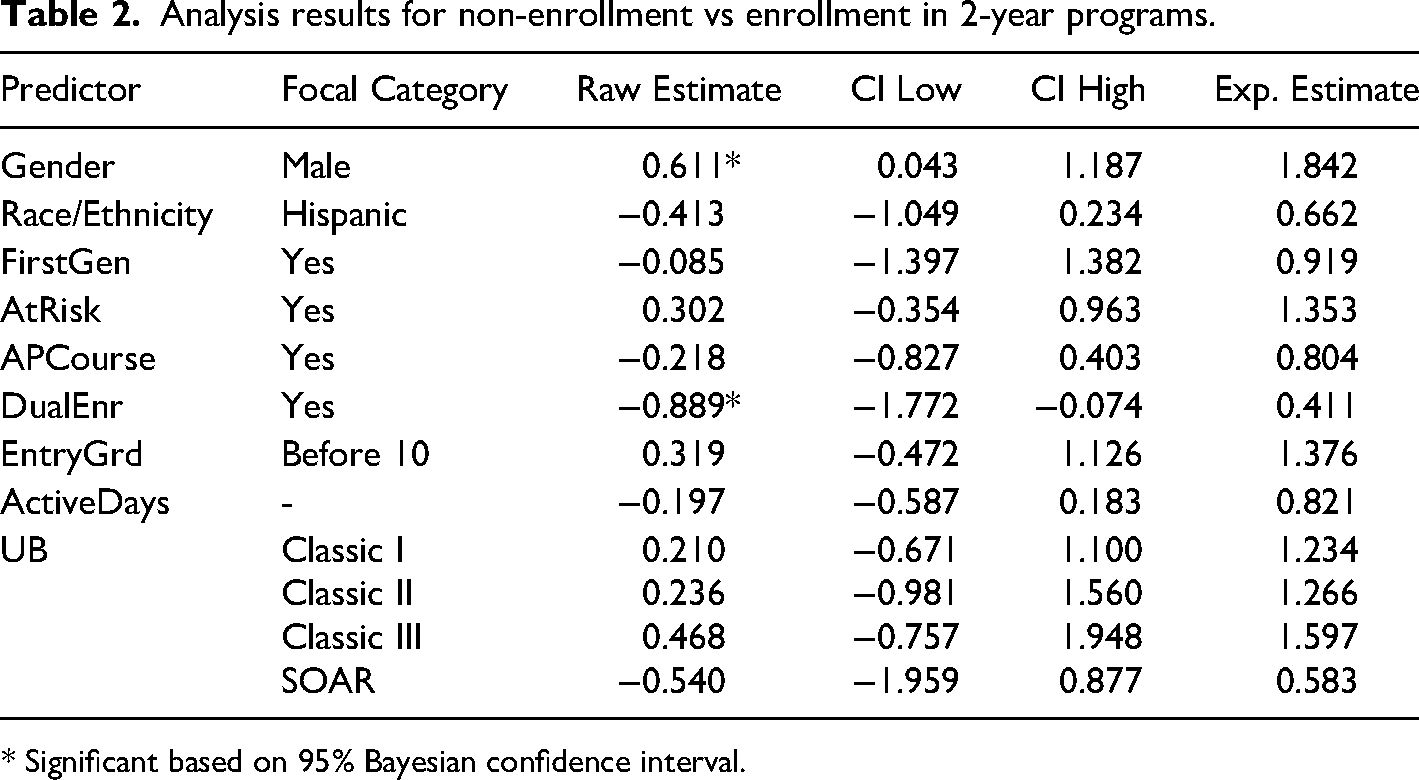
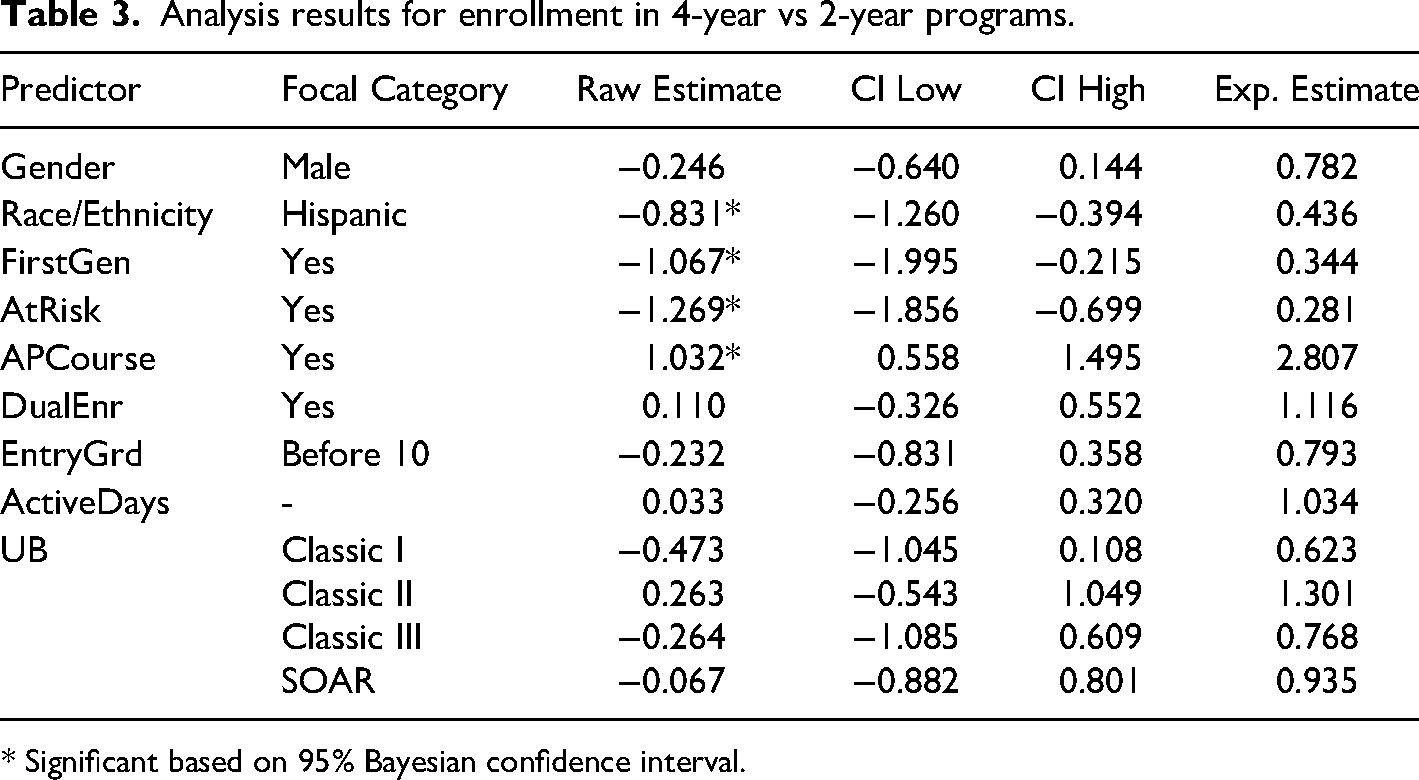
Results are summarized in Table 2 for the non-enrollment vs 2-year enrollment contrast and in Table 3 for the 4-year enrollment vs 2-year enrollment contrast. Note that only the fixed effect estimates were reported as the focus of the paper was exploring the predictive power of the variables of interest.
Analysis results for non-enrollment vs enrollment in 2-year programs.
* Significant based on 95% Bayesian confidence interval.
Analysis results for enrollment in 4-year vs 2-year programs.
* Significant based on 95% Bayesian confidence interval.
The first two columns in the tables list the predictors and the focal categories of those predictors except for ActiveDays, which is a standardized continuous measure of days of UB enrollment. Coefficient estimates per predictor (raw estimate) are followed by the upper and lower limits of the 95% CI. The last column provides the exponentiated value of the raw regression coefficients, which help to interpret the effect of predictors in the multiplicative scale, the odds of being in the target category of the enrollment outcome compared to the reference (e.g., the odds of non-enrollment compared to enrollment in a 2-year program).
Results for RQ1
Gender emerged as a significant predictor of non-enrollment. As reported in Table 2, male students’ log-odds of non-enrollment in contrast with enrollment in a 2-year program was larger than females. This translates to 1.842 times higher odds of non-enrollment vs enrollment in a 2-year program for males compared to females. No low likelihood of enrollment in 4-year programs was observed for males, in contrast with enrollment in 2-year programs (see Table 3). This finding implies that both males and females enrolled in UB programs were statistically equally likely to enroll in a 4-year program compared to their likelihood of enrollment in a 2-year program.
Race/ethnicity was a significant predictor of enrollment in a 4-year program, as can be seen in Table 3. Specifically, the log-odds of enrollment in a 4-year program in contrast with enrollment in a 2-year program was lower for Hispanic students compared to their Black peers. This translates to 0.436 times lower odds of 4-year enrollment for Hispanic students. Race/ethnicity was not a significant predictor when examining the likelihood of non-enrollment in contrast with 2-year enrollment. Thus, we did not observe a significantly higher odds of non-enrollment in contrast with 2-year enrollment for Hispanic students.
Whether or not a student would be the first to attend college in their family was also a significant predictor of enrollment in a 4-year program in contrast with enrollment in a 2-year program. As reported in Table 3, first-generation students’ log-odds of enrollment in 4-year programs in contrast with 2-year programs was significantly lower than their non-first-generation peers. This difference is equal to 0.344 times lower odds of enrollment in 4-year programs vs in 2-year programs for first-generation students. The likelihood of non-enrollment compared to 2-year, however, was not significantly different based on first-generation status of the students.
Results for RQ2
Participating in a dual enrollment program during high school was a significant predictor for the contrast of non-enrollment vs enrollment in 2-year programs. As can be observed in Table 2, the odds of non-enrollment vs enrollment in a 2-year program was 0.411 times lower for a student with a dual-enrollment status, compared to a student who did not enroll in such fifth-year programs. In other words, dual enrollment students were more likely to enroll in 2-year postsecondary program in contrast with not enrolling in any postsecondary institution at all. This finding is in line with several original research and review/meta-analysis studies (e.g., Berger et al., 2013; Giani et al., 2014; Schaller et al., 2023; Struhl & Vargas, 2012) that reported evidence on the positive effects of dual enrollment on the increased likelihood of postsecondary enrollment. When comparing the likelihood of enrolling in 4-year vs 2-year programs, however, dual enrollment was not a significant predictor.
At-risk status emerged as a significant predictor when examining the likelihood of enrollment in a 4-year program compared to a 2-year program. The effect was in the expected direction, with students “flagged” as at-risk of academic failure being less likely to enroll in a 4-year setting compared to a 2-year setting. As can be seen in Table 3, the odds of 4-year vs 2-year program enrollment for an at-risk student was 0.281 times lower compared to a non-at-risk student. On the other hand, at-risk status was not a significant predictor for the model that compared the likelihood of enrollment in a 2-year program versus no enrollment.
Similarly, completion of an AP course was a significant predictor of enrollment in a 4-year program in contrast with enrollment in a 2-year program (see Table 3). The log-odds of 4-year vs 2-year program enrollment were significantly higher for those who completed an AP course compared to students who did not. The exponentiated magnitude of this effect was 2.807, which indicated that odds of 4-year vs 2-year enrollment for AP course completers were almost three times larger than those who did not take or complete such a course during high school. When examining the likelihood of enrollment in a 2-year program compared to no enrollment, AP course completion did not emerge as a significant predictor.
Results for RQ3
Related to RQ3, neither grade-level upon entry to the UB program nor the total amount of exposure to the programs (approximated by the total number of the days of active enrollment) were found to be significant predictors of non-enrollment vs 2-year enrollment and 4-year enrollment vs 2-year enrollment contrasts. Also, despite being considered control variables in the model, the type of UB program was not found to be a significant predictor of the enrollment for either contrast.
Results for Interaction Effects
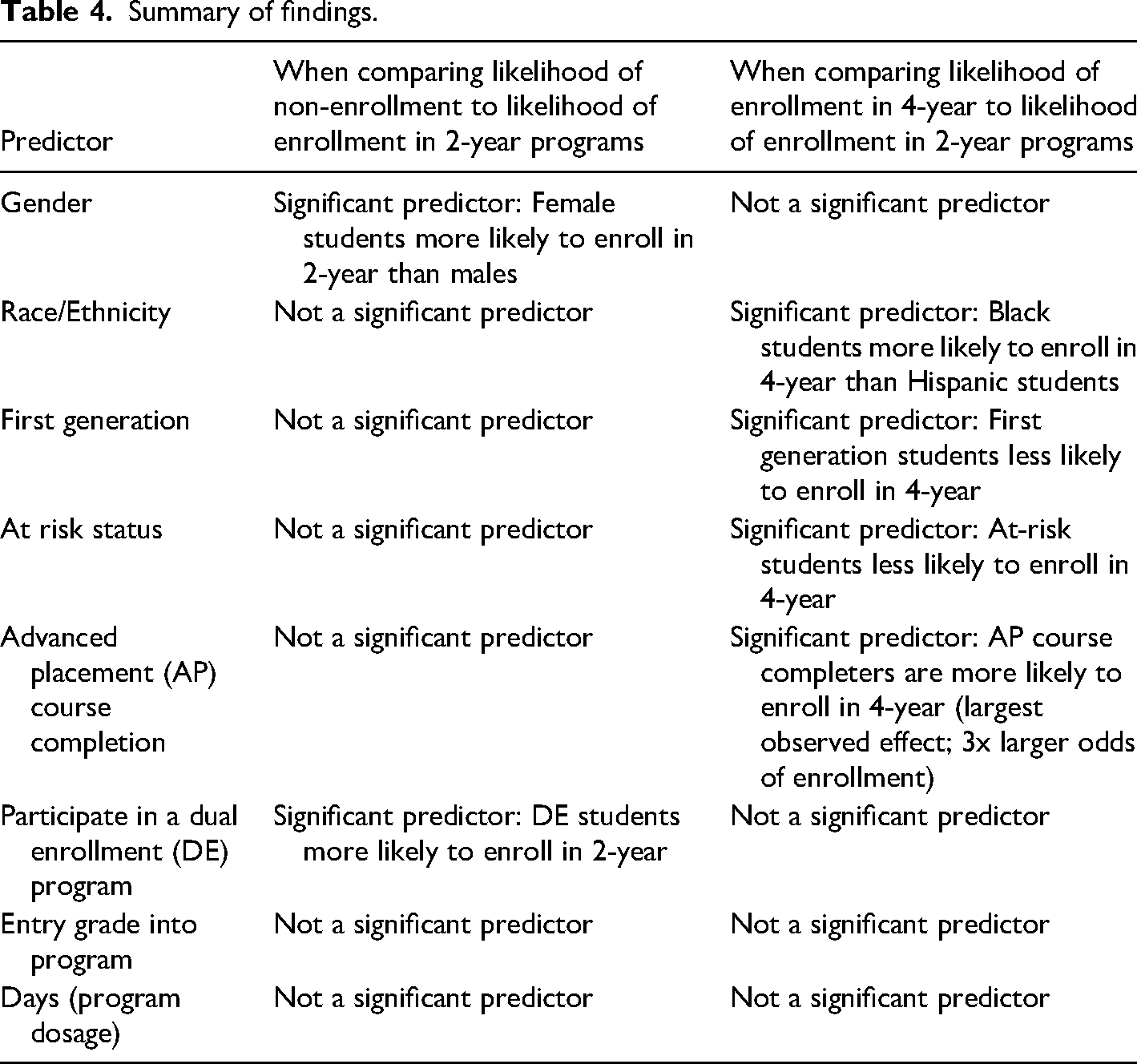
Although not reported in the tables, we also fitted additional models to examine the potential effects of gender & race/ethnicity interaction on the status of postsecondary enrollment. This interaction effect was not significant for both non-enrollment vs 2-year enrollment (b = -0.507, 95% CI = [-1.635, 0.635]) and 4-year enrollment vs 2-year enrollment (b = -0.567, 95% CI = [-1.414, 0.224]) contrasts. These results suggest that the significant gender-based differences observed for the contrast of non-enrollment vs 2-year enrollment did not differ between Black and Hispanic students. Similarly, significant race/ethnicity-based differences observed for 4-year enrollment vs 2-year enrollment did not differ between male and female students. See Table 4 for a summary of all results.
Summary of findings.
Discussion and Conclusions
Federally-funded college access programs are aimed at providing support and guidance to low-income and/or first-generation students all around the country. As per federal funding requirements, annual project reports provide descriptive statistics such as the percent of students who enrolled in postsecondary institutions. Although this level of evaluation reporting is typically sufficient for accountability and some improvement purposes, it is insufficient for establishing more high-confidence evidence about program effects, and for aims to replicate or to tailor programs to specific student populations. This study sought to contribute to that literature by using multi-year UB program data to investigate how UB program participants differ in their likelihood of 1) not enrolling in any postsecondary institution vs enrollment in 2-year programs and 2) enrollment in 4-year programs vs in 2-year programs. A unique and large dataset representing a body of the underrepresented students in a large urban school district in the South was used for the analyses.
Analysis results showed that compared to females, males were more likely not to enroll in any postsecondary institution (compared to enrollment in a 2-year program). This finding is in line with recent trends: college access is particularly challenging for male students; while female students have made strides in enrollment, overall, rates of enrollment for male students is declining (Mangan, 2022; National Student Clearinghouse, 2023). Moreover, this finding was valid for both Black and Hispanic students (i.e., no interaction of gender with race was observed). Thus, a low likelihood of enrollment in 2-year programs for males was common both for Black and Hispanic samples of underrepresented students. We additionally found that males and females enrolled in UB programs were statistically equally likely to enroll in a 4-year program compared to their likelihood of enrollment in a 2-year program. As a result, gender-based differences in postsecondary enrollment of UB students only emerged for 2-year programs.
Based on gender-related conclusions we draw above, the larger likelihood of non-enrollment for males can be considered a precaution rather than a statistical result that is in line with current national trends. In this regard, college access programs can take additional steps to mitigate male students’ low likelihood of enrollment in postsecondary institutions. We also believe that there is a need for additional research to shed more light on the potential reasons for low male enrollment in 2-year postsecondary education programs compared to females among UB program participants. In other words, more explicit research is needed to shed more light on gender-based disparities in UB students’ college enrollment rather than relying on figures reported in national trends. For example, focus group studies with male students may reveal underlying reasons for the low likelihood of male enrollment even though they voluntarily benefit from these programs.
Our results also showed that Hispanic students were less likely to enroll in four-year bachelor's degree programs (compared to enrollment in a 2-year program) than their Black peers. This finding is also in line with the current low concentration of Hispanic/Latino students within the population of underrepresented college students. There have been several studies (e.g., Becerra, 2010; Núñez et al., 2011; Pino et al., 2012; Zarate & Burciaga, 2010) that reported potential causes of low Latino enrollment in higher education such as higher high-school dropout rates and lower utilization of financial aid among others. However, it is important to note that such conclusions were drawn in comparison to White students. We believe that more detailed research is needed to investigate the potential reasons for Hispanic students’ low enrollment rates in four-year college degree programs compared to their Black peers, who benefit from UB and, more broadly, from college access programs. We want to also emphasize that no race/ethnicity-based difference was observed for the likelihood of non-enrollment in contrast with 2-year enrollment. This implies that Hispanic students’ low likelihood of postsecondary enrollment compared to their Black peers was only present for enrollment in bachelor's degree granting programs.
College access programs including UB mainly serve students who are low-income and would be first-generation college students in their family. First-generation status along with parents’ education levels have been reported to influence college enrollment and graduation. For example, Núñez and Cuccaro-Alamin (1998) indicated that students raised in such families would be less likely to acquire the value of postsecondary education. Less support from family, lack of knowledge about college education, and low sense of self-efficacy are other reasons reported as barriers for first-generation college students (Hellman, 1996; Terenzini et al., 1996). We would like to also note that the negative impact of low-income can be associated with broader structural inequalities such as the quality of the high school, which is shown to have a positive effect on college enrollment (Wolniak & Engberg, 2010). In our sample, more than 80% of the served students were identified to be low-income and first-generation students. Our results showed that compared to non-first-generation students, likelihood of enrollment in 4-year programs (compared to enrollment in a 2-year program) was significantly lower for first-generation students. This can be considered continued evidence for the barrier to 4-year programs presented by being the first college applicant in a family and points to important foci for programming decisions.
Related to the students’ school experiences/academic status, results confirmed the critical predictive power of at-risk status on postsecondary enrollment. Based on our results, if students were identified to be at-risk of academic failure during their high-school years, their likelihood of enrollment in 4-year postsecondary education programs was significantly lower than their likelihood of enrollment in 2-year programs. “At-risk” is a multi-component variable utilizing on time grad promotion, attendance, and other predictive factors to create a composite. The effect of at-risk status, however, was not a critical predictor of non-enrollment in contrast with enrollment in 2-year programs. It is well-established that the current academic status of students are generally strong predictors of students’ future performance. This particular finding can be related to the strong negative effect of not having the minimum academic qualifications to apply to four-year degree programs (Carneiro & Heckman, 2002; Greene & Forster, 2003). On the other hand, availability of the at-risk status to program staff recalls the importance of early intervention on the success of TRIO programs, discussed by (Balz & Esten, 1998) for example. Thus, program providers may consider students with at-risk status a priority target population for UB programs, and considerations for earlier interventions should be made as an “at risk for academic failure” status in high school starts in far earlier grades.
Similar to the finding regarding at-risk status, students’ completion of at least one AP course was a significant predictor of enrollment in 4-year programs when compared to 2-year programs, yet no effect was observed on the likelihood of non-enrollment in contrast with 2-year program enrollment. The magnitude of the effect when examining 4-year enrollment was the strongest of all examined relationships, with AP course completion translating into an almost three-fold greater likelihood of enrolling in a 4-year program compared to a 2-year program. This strong effect can also be interpreted as the importance of students’ early plans and their actions as the initial signs of postsecondary enrollment prior to their graduation from high school. Thus, program providers can use this status as an early yet promising indicator regarding students’ future success in terms of enrollment. This finding can also be discussed from the policy perspective such that resources can be directed to increase the support for AP programs, beyond the UB programs. Or at least increasing the awareness to these programs among the first-generation and/or low-income students can be a promising action considering the strong predictive power of the AP course completion compared to others, including the more exposure to UB services. We also note that at-risk students will not probably meet the criteria to take an AP course. Thus, the significant predictive power of the at-risk indicator (in negative direction) and the AP course completion complement each other.
Students who participated in dual-enrollment programs were more likely to enroll in a 2-year program than they were to not enroll at all, and dual enrollment programs had no significant bearing on the likelihood of attending a 4-year vs a 2-year program. This finding is complicated by the uncertainty about whether participation in a 2-year program yielded the conferment of an associate's degree at the time of high school graduation. Available data do not show us whether 2-year degrees were awarded, or perhaps whether students were accruing college credits during these dual enrollment programs with intentions of enrolling in 2 or 4-year settings. Students participate in dual enrollment programs for a wide range of reasons, including the cost-savings of being able to transfer credits into 2-year or 4-year settings. Nevertheless, AP course completion and dual enrollment's varying significance tied to type of the postsecondary enrollment can also be regarded as an important nuance. Namely, these two readily-available indicators to program providers strongly differentiate the groups of students who target 2- vs 4-year programs.
Lastly, we did not find any statistical evidence on the effect of starting the UB programs at early grades of high school. Similarly, more exposure to the program approximated by measuring the total days of active UB enrollment was not significant either. Thus, our hypothesis on the potential benefits of starting the UB programs earlier and getting more exposure to such services was not supported. Our findings related to the impacts of longer participation in UB programs were not in line with Seftor et al. (2009), who reported higher rates of postsecondary enrollment and completion for those who stay more in these programs. Importantly, while total days enrolled is a relatively rudimentary measure of students’ experiences with UB; however, the failure of a program dosage proxy variable like this one to explain variability in a key outcome of interest (in this case, postsecondary enrollment) points to important questions about program effectiveness. The relative “weight” of individual student-level characteristics (race, gender, first-generation) and characteristics of students’ educational experiences (at-risk, dual enrollment, AP course completion) over basic program dosage for explaining college enrollment in various 2 and 4-year settings is a salient finding. Moreover, these findings raise the question whether it is meaningful to spend more resources (in terms of time and funding) so that students can benefit from UB services for several years/days on their high school grades. Instead, UB programs can strategically focus more on encouraging students for dual enrollment and AP courses and decrease the allocation of other services/activities to save more resources.
Limitations and Future Research
There are several limitations of the current study. A conceptual limitation must be named first; that is, much literature addresses the structural barriers to students getting “to and through” college. These include generational and geographic poverty, cultural barriers, systemic racism and barriers in accessing adequate financial support including reluctance to carry debt after graduation. UB, as an intervention, is a program designed to support individual students, not a systems nor structural change initiative. If structural barriers remain in place, it begs the question of how much impact a program focused on equipping individuals may plausibly have. This issue is not unique to UB but may also apply to a wide range of college access and college readiness initiatives that are held accountable to a binary outcome – enrolled or not. Conversely, if UB and similar programs do show impacts in the context of structural barriers, the programs are well worth studying further and replicating as they may have a particularly potent effect in terms of assisting individuals in navigating persistent barriers.
A handful of methodological and data-related limitations are also notable. First, we focused on five UB programs administered as part of the college access programs administered by a single higher education institution, in a limited geographical area. Thus, our findings may be limited for making generalizations to other college access programs and populations of students they serve. Nevertheless, considering that the majority of such programs serve underrepresented students (both in terms of race/ethnicity and socioeconomic status), our findings may still provide some implications for other types of similar college access (TRIO) programs and the body of students they serve. This limitation may be balanced out by the ability to focus on Black and Hispanic students exclusively in this sample.
Second, information about UB program implementation was limited. We were not able to access archival data about program-specific characteristics including variation in services or activities provided to students. Total days enrolled in UB programming was the strongest implementation data we were able to include in the models. While dosage of programs can be used to predict outcomes, it is clear that additional investigation into how variability in implementation of UB program activities is or is not associated with postsecondary outcomes is warranted.
A third limitation is related to our confidence about the accuracy and definition of the students’ postsecondary enrollment status. The enrollment status of UB students were recorded by program staff primarily sourced from National Student Clearinghouse. In case of no record, enrollment status is directly acquired from students via personal communication. Thus, we assume that enrollment status was correctly reflected in the database system when no records were found in the clearinghouse. In addition, enrollment status for a student was checked in the fall semester following the graduation of that student from high school per grant reporting requirements. Hence, enrollment data did not capture students that might have enrolled in a postsecondary institution in later semesters. As a result, we conceptualized the postsecondary enrollment as enrollment in a postsecondary institution in the semester following graduation from high school.
Fourth, we focused only on enrollment in postsecondary institutions as the key student outcome. There is no doubt that this is the critical outcome of UB programs specifically and college access programs more generally and is the key outcome of interest for TRIO grants overall. However, additional measures, such as persistence through 2-year and 4-year programs or progression from 2-year into 4-year programs should be considered. Importantly, if an UB student does not enroll in college in the fall semester following high school graduation, they are recorded as “not enrolled” and are not re-approached in later semesters to determine whether they took time off before enrolling. This is an artifact of reporting requirements: because grantees are only required to follow up with students who do enroll in college, important information about delayed enrollment is not being systematically captured.
Last, it is equally important to consider the unmeasured potential outcomes for students who do not enroll in any postsecondary settings as well. Another direction for future research—research that focuses more broadly on college and career readiness and not just college readiness—includes whether participation in college access programs like UB may contribute to success in non-college career settings, and how that participation may interact with student-level characteristics as well as characteristics of students’ educational experiences.
Footnotes
Declaration of Conflicting Interests
The authors declared no potential conflicts of interest with respect to the research, authorship, and/or publication of this article.
Funding
The authors received no financial support for the research, authorship, and/or publication of this article.
