







Abstract
Colleges and universities increasingly devote institutional resources to student veteran support, yet military spouses remain largely invisible in higher education research, policy, and practice. This exclusion may have material consequences, given that military spouses have high rates of higher education participation but relatively low mental health and employment outcomes. Drawing on 20 interviews with military spouse students (MSSs) who matriculated through and beyond their bachelor's degrees, this foundational qualitative study examines how military life shapes MSS educational needs, trajectories, and persistence strategies. We find that the competing demands of the military, family, and higher education create continual academic barriers that threaten MSS retention, requiring significant sacrifice, luck, and strong personal networks to make degree attainment possible. Findings challenge the assumption that steady enrollment reflects the absence of educational disruptions and underscore a need for MSS recognition and support.
Introduction
Over the past two decades, scholars and practitioners have paid increasing attention to the challenges student veterans face navigating higher education (Cate, 2014; DiRamio et al., 2008; Lim et al., 2018). As a result, a suite of student services, such as veteran's centers, college bootcamps, and green zone training, has been developed to support “military student” success (Sikes et al., 2020; Spencer, 2026; Yeager & Rennie, 2021). Research on the outcomes of these services indicates they meet student veteran needs quite well (Cate, 2014; Gumber & Vespa, 2020), but little attention has been paid to the needs and experiences of other military-affiliated students, such as those actively navigating military service. In particular, few studies have examined how military life shapes paths to and through higher education for those supporting service members from the homefront: military spouse students (hereafter, MSS).
Research on military spouse health and career outcomes may indicate a need for targeted higher education research and support. In 2024, 83% of military spouses reportedly participated in higher education, an environment teeming with career development and mental health resources (Department of Defense, 2024). Yet in 2025, one in five military spouses was unemployed, many more were underemployed, and depression and anxiety were common (Cole et al., 2021; Department of Defense, 2024; Verdeli et al., 2011; Yambo et al., 2016). These findings raise questions about whether higher education enhances MSS well-being or contributes to their employment precarity, financial strain, and emotional distress (Cole et al., 2024; Corry et al., 2021, 2022). Recent work offers mixed perspectives. Woodall et al. (2026) found that MSSs had higher average rates of financial stress and mental functioning than non-student spouses, along with lower perceptions of military and social support. Blue Star Families (2026), on the other hand, found that participating in higher education was a significant predictor of continual full-time employment among military spouses , which has been shown to improve spouse mental health and alleviate military family financial stress.
The limited literature on MSSs consistently suggests that active military life can present unique barriers to degree attainment. However, given the lack of comprehensive U.S. national data on MSS enrollment and retention, it is unclear exactly how these military life transitions influence MSS educational trajectories and well-being. This foundational qualitative study asks: (a) How does military life shape MSS enrollment continuity and pathways to degree attainment, and (b) What strengths and challenges influence MSS persistence? Through in-depth analysis of 20 MSSs’ journeys to, through, and beyond the bachelor's degree, we examine how pivotal military life disruptions can influence MSS retention, as well as what MSS do to overcome them across multiple stages of higher education.
We find that frequent relocation, solo parenting, and financial precarity catalyze and disrupt MSS educational trajectories in ways often overlooked by military student services. These patterns suggest that MSS not only experience barriers to access but also structural constraints imposed by the “greedy” institutional demands of the military, the family, and higher education, dynamics that have been historically underexamined in military-affiliated student research. MSS educational journeys are often circuitous and serendipitous, requiring both significant sacrifice and “luck” to reach degree completion. Findings underscore the importance of examining the social and emotional costs of persistence, particularly for students who may not maintain continual enrollment. By describing the diversity of ways active military life influences MSS educational experiences, we extend military student scholarship beyond the traditional student veteran community and advocate that the confluence of structural barriers to degree attainment needs greater attention in retention scholarship.
Military Spouses in Higher Education
Nearly all of the existing research on military-affiliated students examines the experiences of veterans who enroll in college after their military service (DiRamio et al., 2008; Lopez et al., 2020). These students commonly face stereotyping, isolation, service-connected disabilities, and culture shock transitioning from the military to academia (Barry et al., 2021; Motl et al., 2022; Osborne, 2014; Southwell et al., 2016; Yeager, 2022). Military spouses, on the other hand, exist somewhere between these two institutions. Although most do not wear a uniform or experience military indoctrination, their lives as students are actively shaped by the structural demands of military life. Below, we explore how demographic and structural differences between military spouses and veterans may influence MSS educational journeys in unique ways, drawing on population data and insights from retention scholarship.
The demographic makeup of the U.S. veteran and military spouse communities is quite distinct. Among the over half a million active-duty military spouses in the United States, 90% are female, most are between 20 and 40 years of age, and one in three have children (Department of Defense, 2024) 1 . The U.S. veteran population, conversely, is about 90% male, and only about one in four are under 50 years old (Schaeffer, 2023). Although half of the U.S. veteran population is parents, their children are likely to be older than MSS children, given veterans’ greater average age. These differences in age and caregiving needs may influence MSS educational experiences in unique ways. Research on student parents, especially young student parents, finds they are more likely to face academic challenges and resource precarity compared to older student parents (Zeanah et al., 2025). Gender may also play a unique role in MSS experiences. A wealth of social science research documents that women take on the majority of labor in the home (Yavorsky et al., 2015). This is especially the case for military spouses, given the ongoing salience of traditional gender roles in the military context (Ziff & Garland-Jackson, 2020). Solo-parenting during deployments and field training may increase these caregiving demands, experiences which may no longer be a challenge for student veterans (Bommarito et al., 2017; Borah & Fina, 2017). Little is known about how these unique dimensions of gender and caregiving might influence MSS experiences and support needs.
Compared to veterans, active-duty spouses may experience more educational disruptions due to their transient lifestyle. One third of currently serving military families move each year, restricting their ability to choose academic institutions based on fit and often forcing them to relocate midway through their studies (Tong et al., 2018). In these cases, unclear transfer credit and out-of-state tuition policies have been shown to complicate reenrollment (Huffman et al. 2019). Unemployment associated with frequent relocation may also contribute to stop- and drop-out, particularly for military spouses seeking advanced degrees (Borah & Fina, 2017; Castaneda & Harrell, 2008; DaLomba et al., 2021, Dunham, 2020). Further, military spouses are chronically unemployed, with one in five consistently reporting wanting to work but not being employed since 2015 (Department of Defense, 2024). Lacking access to the same breadth of veteran education and disability benefits, college may simply be financially infeasible for unemployed MSSs. Although recent scholarship has increasingly documented the economic and emotional strain often experienced by military spouses (Bommarito et al., 2017; Corry et al., 2021; Friedman et al., 2015; Meadows et al., 2016), possible educational causes or consequences of these challenges remain comparatively underexamined within higher education research (Gleiman & Swearengen, 2012; Ott et al., 2018).
Research on student veterans highlights how institutional barriers, fragmented services, and limited faculty awareness contribute to attrition risk, underscoring the importance of coordinated and proactive support structures (Alschuler & Yarab, 2018). While this work has advanced understanding of veteran persistence, MSS remain less visible within retention scholarship, raising questions about whether similar institutional gaps shape their educational pathways, as well as what impact they may have on military spouse well-being. Like veterans, military spouses commonly report mental health strains, depression, and suicidal ideation associated with their service connection (Cole et al., 2021; Verdeli et al., 2011; Yambo et al., 2016). Some scholars argue that education can be a protective factor for insulating spouses from these service-connected mental health challenges, given the availability of counseling and career development resources (Meadows et al., 2016; Samuels et al., 2011). However, if institutional resources require availability, financial capacity, or physical proximity to campus-based services, the very tools designed to support MSS may contribute to their challenges (Borah & Fina, 2017; Rea et al., 2015). As scholarship on MSSs in higher education continues to emerge, additional research is needed to better understand how institutional structures shape both persistence and well-being for this population.
Military Spouse Persistence
Student retention scholarship has long examined the factors that influence whether students persist toward degree completion (Ackerman & Schibrowsky, 2007; Crede & Borrego, 2014; Elliott & Healy, 2001; Haverila et al., 2020). Early models of persistence emphasized the importance of academic and social integration within the institutional environment (Tinto, 1994), while other frameworks expanded these perspectives to better account for the experiences of nontraditional and adult learners who often balance competing responsibilities outside of college (Bean & Metzner, 1985). These models suggest that persistence is shaped not only by students’ academic preparation and motivation, but also by institutional contexts, support systems, and life circumstances that influence students’ ability to remain enrolled.
Many of the structural and institutional conditions identified in retention research are particularly relevant for MSSs. Similar to other adult learners, MSSs often balance higher education with employment, caregiving responsibilities, and complex family obligations (Bean & Metzner, 1985; Donaldson & Graham, 1999; Kasworm, 2003). However, military life introduces additional structural disruptions that may complicate persistence, including frequent relocation, deployment cycles, and shifting family roles (Borah & Fina, 2017; Tong et al., 2018). These conditions may interrupt enrollment, delay degree progress, or require students to change institutions or program modalities during their educational journeys (DaLomba et al., 2021; Ott et al., 2018). As a result, persistence for MSS may involve navigating repeated institutional transitions rather than following the continuous enrollment patterns assumed in traditional retention models.
Historically, retention scholarship has largely assumed stable institutional attendance and continuous enrollment, assumptions that may not fully capture the realities of military spouse educational pathways (Bean & Metzner, 1985; Tinto, 1994). Given the transience of military life and regularly shifting family, community, and work roles, persistence for this population may involve nonlinear educational pathways. Such pathways may involve pauses in enrollment, institutional transfer, or shifts between in-person and online learning environments, patterns that have been documented among adult and nontraditional learners balancing competing life responsibilities (Donaldson & Graham, 1999; Kasworm, 2003; Wyatt, 2011). As research on MSS persistence continues to develop, these nonlinear forms of educational persistence warrant greater attention.
Taken together, research suggests that MSSs may have distinct educational needs compared to student veterans. Caregiving, mobility, financial precarity, and mental health challenges often associated with active-duty life may interrupt enrollment and reshape educational timelines in emotionally and financially costly ways. These patterns highlight the importance of examining MSS through retention frameworks, which seek to understand how institutional contexts and life circumstances shape students’ ability to persist toward degree completion. By framing MSS as a culturally and structurally unique student population, this study seeks to examine how military life may influence enrollment patterns and degree progress. Such inquiry also expands retention scholarship by highlighting forms of persistence that occur outside traditional models of uninterrupted enrollment.
Theoretical Framework
This study draws on Bean and Metzner's (1985) model of nontraditional student retention and Donaldson and Graham's (1999) model of adult college outcomes to examine how environmental pressures and competing life roles shape MSS experiences. Bean and Metzner (1985) highlight how persistence for adult and commuter students is strongly influenced by environmental variables outside the institution, including employment, family responsibilities, and financial pressures. Unlike traditional students whose persistence is often linked to campus integration, nontraditional students must navigate competing external commitments that shape their academic experiences (Bergman et al., 2014; Graham et al., 2025; Kim, 2025). Donaldson and Graham's (1999) model of adult college outcomes further emphasizes how adult learners bring established life roles, experiences, and motivations into their educational journeys. Scholars employing these frameworks repeatedly find that family responsibilities, work obligations, and financial pressures shape persistence outcomes for adult and nontraditional students (Samuels et al., 2011; Wyatt, 2011). As such, these frameworks are particularly useful for examining the competing responsibilities MSSs may face while enrolled (Borah & Fina, 2017; Ott et al., 2018).
While theories of adult and nontraditional student success shed light on the complexity of adult learners’ competing roles, they do not fully capture the unique institutional entanglements that structure MSS educational trajectories. First, these models largely assume that students operate within relatively stable geographic and institutional contexts. Military spouses, however, relocate on average every 2–3 years. This frequent relocation demanded by military life may add an additional layer of disruption and instability, complicating long-term academic planning and access to institutional support. Second, while research on adult learner persistence has highlighted how caregiving responsibilities can disrupt enrollment continuity and extend time to degree, these limitations may be heightened for military spouses for two reasons (Samuels et al., 2011). As a highly transient population, military spouses may not have local access to the mentorship and respite care grandparents have been found to provide (Fruiht, 2015; The Hope Center, 2025). Military spouses also frequently experience extended periods of solo-parenting, potentially increasing the intensity of caregiving responsibilities relative to other student parents.
We employ Coser's (1974) classic theory of greedy institutions to help contextualize the unrelenting nature of these role obligations facing MSSs. According to Coser, greedy institutions demand loyalty, time, and identity commitment from their members. Greedy institutions require individuals to prioritize organizational expectations, often leaving limited space for competing obligations. Within military families, the military functions as a classic greedy institution, shaping the lives of service members and “spilling over” to family members through relocation, deployment cycles, and unpredictable schedules (Schnittker, 2019; Strader & Smith, 2022). The family is another greedy institution, particularly for mothers in patriarchal societies but especially for military spouses who assume the primary burden for caregiving. While work and family obligations may be more or less flexible for other adult students, the demands of the military and the family (especially during periods of solo-parenting) are non-negotiable for MSSs. Colleges and universities may also operate as greedy institutions through rigid expectations related to course sequencing, residency requirements, and academic timelines. MSSs exist at the center of these institutions that make frequent, unreasonable, and tireless asks of their time, energy, and resources.
Integrating Bean and Metzner (1985), Donaldson and Graham (1999), and Coser (1974), this study conceptualizes persistence as shaped by both life roles and institutional commitments. Military spouses simultaneously navigate the “greedy” expectations of the military, the family and academia (Coser, 1974; Strader & Smith, 2022), creating frequent disruption and role conflict that extends beyond traditional persistence frameworks. The intersection of military obligations, caregiving responsibilities, and institutional expectations produces persistent disruption in MSS educational pathways. Despite these constraints, MSSs demonstrate adaptive persistence by mobilizing forms of community cultural wealth, including navigational, social, and aspirational capital, to sustain enrollment and pursue long-term educational goals (Yosso, 2005). Community cultural wealth highlights how marginalized students draw on existing strengths and resources to navigate institutional barriers. For MSSs, this often includes peer support networks, informal mentoring relationships, and shared knowledge within military spouse communities. These networks help spouses locate educational opportunities across geographic locations and sustain long-term aspirations despite structural barriers. Together, these frameworks suggest that MSS persistence emerges at the intersection of life roles, institutional expectations, and relational supports rather than solely from individual determination.
Guided by this integrated framework, this study seeks to better understand how MSS educational journeys are shaped by institutional demands and relational support. Specifically, we ask: (1) How does military life shape MSS enrollment continuity and pathways to degree attainment, and (2) What strengths and challenges influence MSS persistence?
Methods
Research Design
This study employed a narrative case-study approach, ideal for exploring meaning in context and capturing comprehensive personal experiences. Narrative inquiry allowed participants to share detailed accounts of their educational experiences over time, highlighting how military mobility, caregiving responsibilities, and institutional expectations shaped their engagement with higher education. This qualitative design provided nuanced insight into the challenges, aspirations, and adaptability of military spouse students (Creswell & Poth, 2018; Mertens, 2020).
Recruitment and Participants
In line with Institutional Review Board approval, snowball sampling was used to identify prospective and current MSSs, beginning with recruitment flyers shared in online military spouse communities. Informed consent was obtained from all participants, and confidentiality was protected through secure data storage and de-identification procedures. Each participant received a $20 Amazon gift card for their time, funded by a small research grant from a professional association. Twenty participants were recruited to represent diversity within the military spouse community, spanning four service branches and varied demographic and institutional characteristics, such as parental status, education level, and program modality.
Table 1 summarizes participant demographics. Like the vast majority of military spouses, all but one participant identified as a woman. Thirty percent of participants identified as white, 25% as Black, 15% as Latinx, 10% as Biracial, and 10% indicated “Other.” Most participants were affiliated with the U.S. Army, followed by the Navy and Marine Corps. This service branch diversity is important given differences in installation locations that might affect access to higher education and continued enrollment through relocation. Three participants had multiple connections to service as veterans themselves or reservists, and six were no longer experiencing active duty life while enrolled, dimensions of service diversity that we explore in the findings. Nearly all of the participants in this study were actively enrolled in graduate degree programs, allowing us to examine both undergraduate and graduate degree-seeking experiences. However, it is important to note that this proportion is much higher than the 18% of military spouse students reported to hold advanced post-baccalaureate degrees (Department of Defense, 2024). As such, this sample represents a highly educated group of MSSs relative to the larger population.
Participant Demographics.
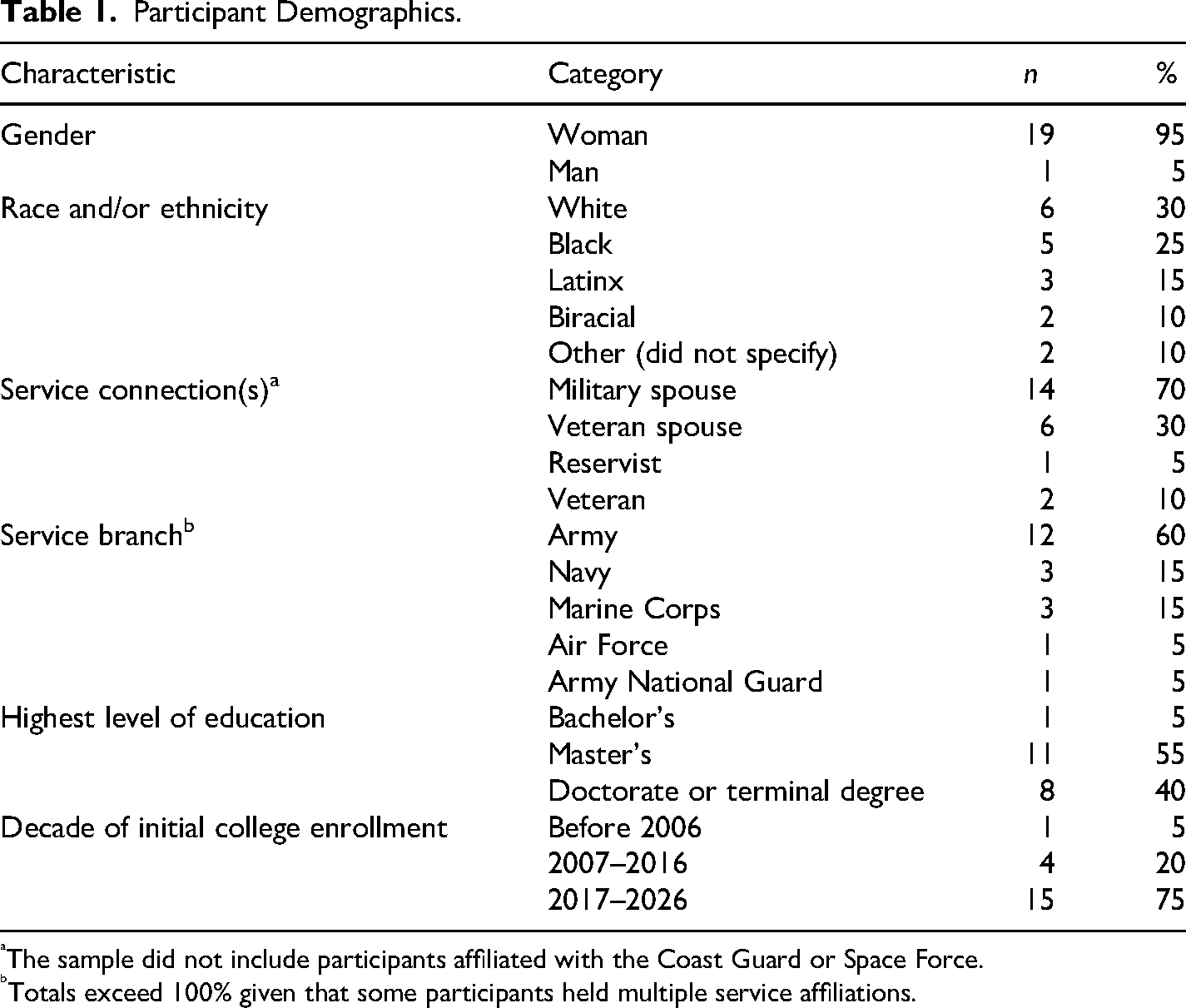
The sample did not include participants affiliated with the Coast Guard or Space Force.
Totals exceed 100% given that some participants held multiple service affiliations.
Data Collection
Interviews were conducted by both researchers, one who identifies as a Black woman educational leader, and the other who identifies as a white woman sociology doctoral student and military spouse. Each interview lasted 60–90 min over Zoom, ensuring qualitative depth and participant comfort. We used an in-depth, semi-structured interview protocol focused on participants’ high school experiences, initial undergraduate college aspirations, undergraduate and graduate college experiences, military life stressors, and experiences with university support services.
The interview protocol followed a life course approach as is common for studies of examinations of military experiences and outcomes (Blue Star Families, 2026; Segal et al., 2015). Interviews began with a discussion about how high school academic experiences and extracurricular activities shaped participants’ plans for postsecondary education. Recognizing that motivation and persistence for adult and nontraditional students are often influenced by multiple responsibilities (Bean & Metzner, 1985; Donaldson & Graham, 1999), we also ask how roles outside of school, such as parental status, relationship(s) to the military, and work obligations, shaped their motivations to enroll. We then asked about experiences transitioning into college, specifically what support and financial benefits participants received from the military, their community, and their institution. We asked detailed questions about participants’ undergraduate and graduate experiences, such as their residential status, modalities, degree levels, majors, and student activities. We also inquired about their trajectories moving to and through their degree programs, emphasizing strategies for persistence and participant strengths. Drawing on Coser (1974), we specifically asked participants how their connection to the military shaped their educational journeys and what administrators need to know about the MSS experience.
Researcher Positionality and Reflexivity
Both authors bring lived experience as MSSs to this study. One author currently navigates higher education as a military spouse, while the other reflects on prior experiences as an MSS and adult student parent. These shared experiences informed rapport-building with participants and contributed to a nuanced understanding of mobility, caregiving, and educational decision-making. At the same time, the research team engaged in reflexive dialogue throughout the study to examine assumptions and ensure that participants’ narratives remained central to interpretation.
Data Analysis
Data analysis followed an iterative and inductive process informed by narrative and thematic analysis. First, transcripts were read holistically to understand participants’ experiences in context before engaging in open coding focused on disruption, support, decision making, and institutional interaction. We each analyzed transcripts independently and then met to share our takeaways. This initially deductive and collaborative process allowed us to refine our codes into broader categories reflecting shared patterns of educational disruption and relational support across participant narratives (Richards and Hemphill, 2018). These categories were then synthesized into themes capturing how MSS understood educational persistence within the context of military life.
Given the nature of our interdisciplinary partnership, we sought out literature individually to help contextualize our participants’ often circuitous pathways to academic success. After reconvening, we reached consensus that an integrated theoretical framework drawing on Bean and Metzner's (1985) model of nontraditional student retention, Donaldson and Graham's (1999) model of adult student outcomes, and Coser's (1974) concept of greedy institutions would best support our findings. We returned to the data to inductively analyze how military spouses’ educational pathways were influenced by the demands of military, academic, and family life. Analytic memoing and ongoing dialogue between researchers and participants supported reflexivity and enhanced credibility.
Findings
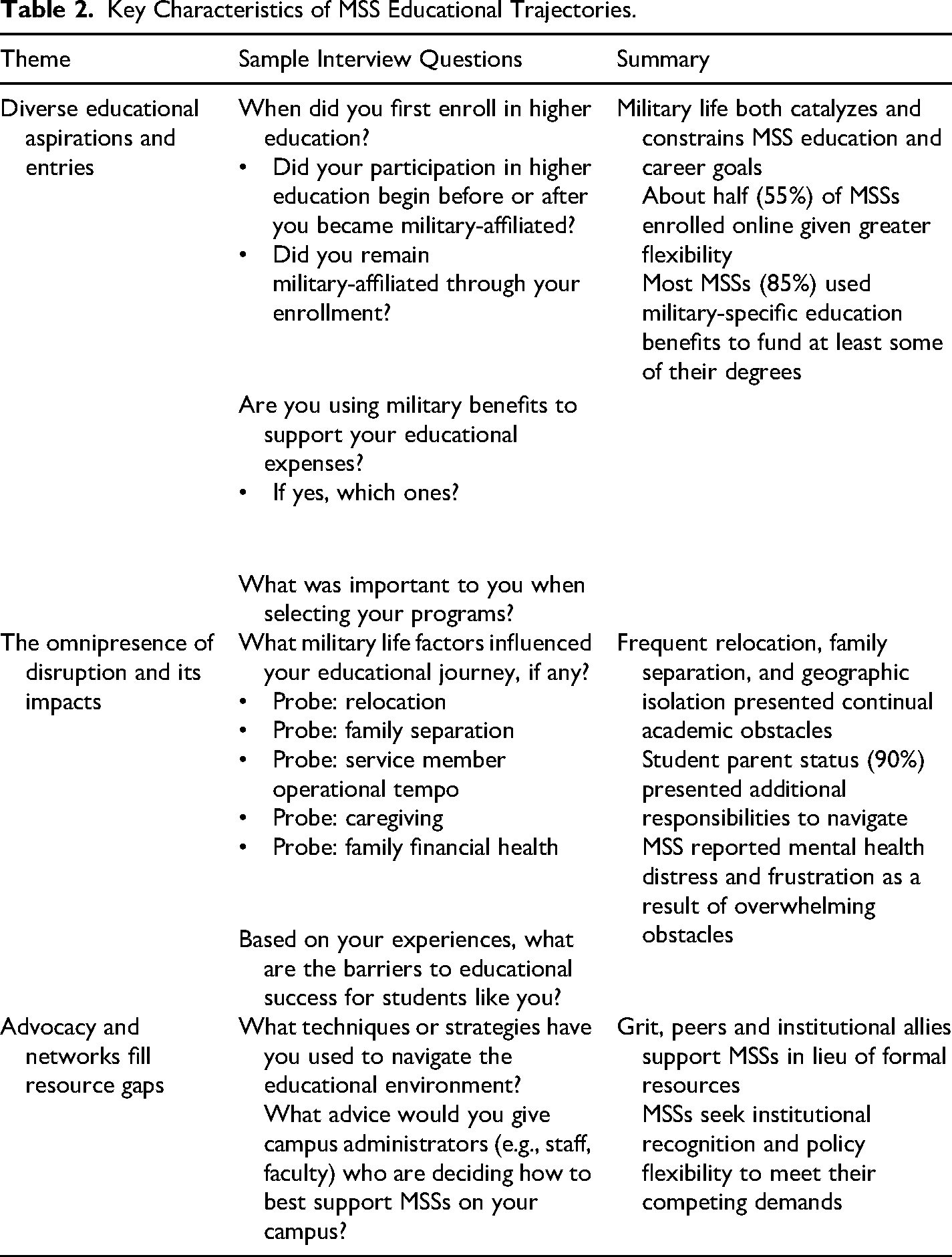
Three themes emerged in our analysis of MSS educational trajectories and persistence strategies. Table 2 outlines these themes, our sample interview questions, and summaries of our findings. First, participants’ connections to military service and higher education are much more complex than previous studies have documented. We identify five distinct pathways to higher education, each of which is differently catalyzed and constrained by military life. Second, the greedy demands of the military, the family and higher education create frequent academic disruptions that required military spouses to go to extreme lengths to maintain enrollment, circumstances they often navigated alone due to their self-determination and lack of institutional attention to their unique needs. Finally, informal support structures aid military spouses in navigating the uncertainty of active-duty military life when support structures overlook them or fall short.
Key Characteristics of MSS Educational Trajectories.
Diverse Educational Aspirations and Entries
Military spouse participants described a wide range of strategic reasons for pursuing higher education that varied based on when in their studies they married and where their service member was in their career timeline. As previous studies have found, students who first married to the military and then began their postsecondary education described higher education as something they always had a “genuine interest” in pursuing. For Sylvia, military life and work obligations delayed her degree attainment due to the combination of work and military relocation. She explained: I always wanted to pursue my education, but you know, life happens. You start working. I was in and out of school for a long time and got my associates in 2011 taking a class here and there, but I was tired. I didn’t want to go anymore in the middle of moving from state to state.
In other cases, military spouses’ undergraduate pursuits were expedited by their partner's service. Although Nina described having “passive” college motivations and only a general sense of what she wanted to study, her husband's service ultimately encouraged her. “I was inspired for the means to get there. I knew that he was getting to go to college through the military.” She in turn enrolled.
For military spouses who participated in higher education before marrying into the military, the decision to return to school was most often in response to challenges finding employment in their current field. Sharon described, “When I went back to school to get my PhD and my second master's, that decision was largely influenced by our military lifestyle, because the career field that I was in previously, I just couldn't make it work with the military.” These MSSs pursued graduate studies in fields like education, research, and health care, which they believed to be more universally in-demand and flexible for military life. Mark, for example, explained that he always intended to pursue a teaching license after completing his undergraduate English degree, but military life accelerated his timeline. I had dragged my feet on it, honestly, but when we met, the fact that she was in the military, I recognized that I needed to find something that I could do anywhere that we might find ourselves. It just solidified the idea. So I went back to school the year that we started dating so that I could get a teacher's license. Whenever we had to move, I at least had credentials for something that I could do just about anywhere in the world [..] even if we found ourselves overseas, there are Department of Defense schools. My license would have at least given me that. That was the catalyst to really go ahead and just buckle down and do it.
Online programs were key to making it possible for MSSs to achieve their educational aspirations, despite the threat of relocation. Monique explained: I happened to open up an email that my [California undergraduate alma mater] was starting a pilot program, and it was going to be 100% online for alumni. […] So I applied and was accepted in the first cohort, and that's how I ended up doing my master's degree. I started in Texas and then, my first semester we moved to Georgia. So when I graduated, we were living in Georgia, and that's the only way I was able to obtain a master's degree while my husband was on active duty.
Local job markets were a common precipitating factor for military spouse students returning to higher education. Nina, for example, already held a bachelor's degree in psychology, but decided to go back to school while stationed overseas, given her struggle to find meaningful employment there. Similarly, Mindy initially pursued licensure as a clinical social worker, but constant moves made it challenging to gain clinical hours. She explained, “For full licensure in most states, you must complete 3,000–3,500 hr. We’ve never lived anywhere longer than 2.5 years, so it just hasn’t aligned. I would accrue hours, then we’d move, and I’d lose those hours toward licensure.” Mindy shifted her focus to research—an alternate path that allowed her to stay connected to social work while adapting to military life, and returned to school to earn her doctorate in support of her new career.
For spouses whose connection to the military was coming to an end, pursuing higher education was yet another strategic career choice to support their financial sustainability after service. Anita recalled, “My husband was up for promotion or retirement. We didn't know which way he was going, so that made me say, okay! Now's the right time.” For Lisa, whose connection to service would end due to divorce, her educational aspirations were driven by a desire to prioritize her career. She explained, “By the time my husband was getting closer to retirement, I think he was in for 15 years whenever I enrolled. I was kind of thinking I would get a degree and then it would sort of be my turn.” These military spouses directly underscored the toll that the greedy institutional demands of the military had taken on their careers and saw higher education as a way to reclaim it.
Military life also offered financial and intellectual motivation for MSSs to pursue college and graduate school. While the vast majority of participants paid out-of-pocket for some portion of their education, 85% of MSSs used GI Bill education benefits or state military spouse scholarships to fund their education. For these spouses, military service reduced financial barriers to higher education. Anita explained, “My education would have cost me over $100,000. I spent maybe $10,000 out of pocket. It saved me over $100,000 in student loans or I wouldn't have been able to achieve my degree.” This was especially the case for MSSs who were also veterans, given access to their own GI Bill benefits, their spouses’ GI Bill benefits, and veteran education scholarships. Thec location of duty assignments also inspired MSS continuing education. Kimberley, for example, discussed how being a MSS stationed in Washington, D.C. gave her unique opportunities to explore national monuments and archives with her homeschooled children, making her studies “… something that was kind of fun for the kids that they could be involved with, too.”
The Omnipresence of Disruption and Its Impacts
Despite strong educational aspirations and opportunities precipitated by service connections, the competing demands of military, family, and academic life made accessing and maintaining enrollment challenging for MSSs. Although the nature and intensity of barriers varied across participants, all MSSs in this study faced educational interruptions, constraints, and persistence challenges connected to military life. Participants described how relocation, family separation and geographic isolation, compounded by caregiving needs, often made continuous enrollment feel uncertain or unsustainable, requiring them to go to great lengths to avoid dropping out or delaying progress. Educational disruption, therefore, was not an isolated experience but rather a pervasive condition of the MSS experience that required regular adaptation.
First, participants shared that frequent mandatory relocation often slowed their academic progress and led to fragmented or extended degree paths. Mark's hesitation to pursue graduate school reflected the uncertainty tied to relocations. The ever-present possibility of receiving a mandate to move made long-term planning feel risky. He explained: I always knew we’d get new orders every two years. But when you’re looking at a two- or three-year program, you start to wonder—am I even going to be able to finish?… it's really what kept me from going back to grad school for so long.
Monique similarly struggled with finding a program she could complete through impending moves. “I was trying to see how I could further my education, but every opportunity that I’d find didn't seem realistic unless my husband and I lived separately in different states … and that's not something I wanted to do.”
Extended family separations complicated MSS educational trajectories. Like previous studies have found, deployment and training exercises were common periods of disruption, particularly for MSS who were also working while enrolled. For those participants, balancing school, work and family was particularly trying when partners were away. Mark recalled: She was in Iraq, which was an eight or nine hour time difference. I lived about 30 min away from school. So getting out of class, driving home, starting homework and basically waiting for her to wake up that morning so that we could talk, it's like 11:00 p.m. or almost midnight. I was balancing the fact that I am working as a teacher all day. Class in the evening and then waiting, you know, that extra hour or two after doing homework so that we could just communicate. That was really kind of the stressor.
Time zone differences were also a challenge for Nina, who struggled to find online meeting times with her U.S.-based peers when she was enrolled in an online program overseas.
Lack of access to employment and higher education opportunities in military communities contributed to disruptive family separation, yet military spouses persisted. Participants described commuting multiple hours per day and even maintaining two residences to make being a MSS, parent, and employee possible. Sharon described: My husband was still stationed at his current duty station, and I was traveling to Texas to be able to work. We did that for two years. I would live down in Texas with our one year old and come back during the summers. […] that was the only way I was able to have a job.
MSSs went to great lengths to avoid pausing their educational pursuits or repeating courses, a challenge exacerbated by institutions’ inflexible residency requirements and course progressions. Although institutions accepted credits, they often didn’t apply them meaningfully toward degree requirements. Recalling her myriad institutional enrollments as an undergraduate, Elizabeth explained, “I had transcripts from everywhere… So, I ended up graduating with 140 or 145 credits—taking all these extra classes that didn’t really count for anything.” MSSs often made significant family sacrifices to avoid these costs of “starting over” in their programs.
Participants recalled the intensity of these competing commitments and the strain it placed on their well-being. Lisa remembered, “I was concerned about whether I would be able to take care of my kids and work and maintain my household and keep up with all of the schoolwork. I'm not going to lie. That's a lot of work.” The strain of these competing demands on top of other mental health challenges sometimes delayed and disrupted MSS's academic aspirations. Joanne, an MSS who intended to pursue school after retiring from 20 years of active-duty service, found the strain associated with “doing it all” untenable given other mental health challenges she was facing through her military transition. She recalled: I got out in October 2021. I didn't start working on my career growth until the beginning of 2023, and it was due to that mental health gap and needing support in that aspect before I decided, okay, now I'm at a good place where I can move forward and focus on education.
Anger emanated from many participants’ reflections on the hard and sometimes impossible tradeoffs they were forced to make due to the demands of military, family and academia. Anita explained, “You work hard to get into these schools and then because of marriage and duty and service and relocation, you end up having to put your life on hold.” Notably, participants identified the unpaid yet expected labor of military spouses to manage the homefront as a key source of frustration and educational disruption. Kimberly described, “There's a lot of expectation that the supporting spouse will drop everything. Sometimes we have to. And that makes me mad, you know, because we have lives, too.” These experiences highlight the social and emotional toll that sustaining higher education participation despite structural barriers can have on MSSs.
Advocacy and Networks Fill Resource Gaps
Participants’ reliance on advocacy and informal networks functioned as mechanisms that mitigated retention risk and supported continued enrollment. While MSSs appreciated military-affiliated campus resources for addressing their basic administrative needs, such as benefits processing, MSS reported that they often failed to meet the complex realities of being spouses, employees, students, and caregivers. Instead, they leaned on their help-seeking ability, advocacy, and informal networks to fill institutional gaps and foster a sense of belonging. Anita remembered: I didn't receive a whole lot of assistance in directing me through school. I had to lean on the internet. I had to lean on calling the VA, asking other people. The school I selected had a military service department, maybe? They kind of sort of helped, but I would say that their help was maybe at 50%. Most of it I had to do research.
Participants explained that it wasn’t that resources didn’t exist, but they just didn’t proactively reach out to MSS to offer support. Mark lamented, “The military is definitely set up that, hey, we have information, but you're going to come get it, right? So no, I just didn't seek it out.”
The types of resources MSS reported truly needing often extended beyond traditional student support services or military benefits processing. MSS attributed this resource gap to a lack of awareness about the responsibilities that fall on spouses in military families. Sharon explained: People will have a lot of understanding for an active duty member that's deploying and TDY (temporary duty assignment) and blah, blah, blah, but they don't really think about the military spouse that's kind of beholden to that lifestyle too. We're not actually leaving. It's just that everything falls to us. But they don't think about that.
Childcare, both daily and respite care, was a consistent unmet need. Sylvia explained: His job was the priority, so even when they would have to go out of the country for war, life is still happening for us. That would mean that I'm still home with the kids. I'm still going to work. And now I have scaled back with school, you know, because I need to be able to be there for the kids. There should be more resources available for those who want help with the kids.
Where resources failed to meet MSS needs, many participants took support into their own hands. Veteran spouse students in particular described strengths in self-advocacy, a capacity they saw as developing throughout thier military lives. Compared to earlier educational experiences, Syliva explained: I have a great relationship with the Veterans Affairs Office at the college where I am
Monique, a veteran spouse student, expressed a similar competency for agency through advocacy, “I just decide: when policies don't fit what I need, let's change them.” MSSs consistently identified service gaps and took the initiative to fill them. Joyce recalled, “I don’t think I had any help from anyone at that time. I remember thinking, ‘You all need help in this office, let me come help you.’ And that's how I ended up working there.”
As previous studies have found, MSSs frequently described the “collective resilience” of their community to band together in support of their own. Sharon expressed, “I have the most amazing tribe of friends. One friend that would come overand watch my kids so that I could go and study. That's what we did. Basically, community and grit.” Similarly, Lisa described military spouses as “scrappy” given their ability to adapt when “things don’t always go as planned.”
These relational supports served as critical persistence resources, particularly when institutional services were limited or inaccessible. MSS often relied on informal networks, such as online communities and peer mentorship, to navigate institutions, locate scholarships, and stay motivated. Sylvia emphasized how staying connected supported her well-being: “I have some military spouses I’ve met over the years who’ve been supportive. They check in on me, ask how I’m doing, and I send them updates.” In this way, military communities offered a protective factor in support of military spouse students’ educational goals.
For online students located outside of military communities, accessing this social support network was more challenging. Monique, a veteran spouse student and caregiver to her disabled veteran spouse, reported driving an hour one way to connect with a community of other caregivers. “There's really no camaraderie. I have it, but I have to drive for it. I'm sure they're out there in my city, but I would really enjoy a support network of other spouses in my area.”
Like student veterans, supportive faculty, advisors and employers were often the key agents in MSS success, acknowledging their unique challenges and offering flexibility when possible to help them manage it all. Sharon described, ″I was really fortunate to have some faculty that said okay, we're going to make accommodations for you so that you don't have to commute every week. Those were other moms. They were not military spouses; those faculty were moms.″ These leaders used their knowledge of students’ role conflicts and institutional power to break down greedy institutional policies and practices. Kimberly summarized the transformative effect this intentional care and top cover had for MSSs. It's not rocket science. Let them take one or two classes at a time or let them take an incomplete. If I was taking classes while my husband was deployed, like, no, I would have needed a pause, right? Just understanding that there's different needs and support levels for military connected students, be it the traditional high school student or the spouse, I think is just really important. And I think it should apply to any student, not just the military community.”
Discussion
Despite myriad educational aspirations and pathways, all MSS participants experienced barriers to persistence due to the confluence of military obligations, geographic locations, and family needs (DaLomba et al., 2021; Ott et al., 2018). These disruptions were pervasive rather than episodic. Regardless of educational pathway, parental status, and degree level, all participants described navigating frequent, significant educational roadblocks tied to relocation, family responsibilities, financial precarity, and institutional inflexibility. MSSs approached their education strategically in response, selecting programs, pacing coursework, and pausing enrollment in ways that accommodated their competing institutional demands. Participants leveraged nonlinear enrollment patterns, reenrollment, advocacy, and reliance on relational support systems to reach their educational goals. Persistence among MSS, therefore, reflected adaptive engagement rather than uninterrupted enrollment.
In addition to intentional decision-making, MSS emphasized the importance of serendipitous opportunities and relational support to achieve their educational goals. Participants described stumbling upon online programs, flexible faculty, or geographically portable career fields by luck. These unexpected openings enabled MSS to sustain educational and career development where structural barriers would have otherwise prevented it. Social support further strengthened MSS engagement in higher education (Cole et al., 2024). Informal networks, peer mentorship, and supportive institutional actors provided both emotional encouragement and practical guidance that helped participants navigate barriers, maintain motivation, and remain enrolled (Vacchi, 2012).
Importantly, every participant in this study described some form of educational disruption, persistence challenge, or institutional barrier associated with military life, though the nature and severity of these experiences varied across participants. Despite these challenges, participants continued pursuing higher education through adaptation, advocacy, and grit (Waldrop et al. 2024). These findings suggest that persistence among MSS often occurs not in the absence of disruption, but through ongoing negotiation of structural instability and competing institutional demands.
The study contributes to military student scholarship by underscoring the unique trajectories and needs of the MSS population. First, findings complicate the dominant assumption in MSS literature that military marriage precedes higher education enrollment. Participants’ narratives instead reflect five distinct pathways to and through higher education that influence MSS motivations and the types of educational disruptions they face. Beyond identifying structural attainment barriers, this study also demonstrates how military service can catalyze MSS educational pursuits through education benefits and vital social networks, strengths that previous scholarship has largely overlooked. By emphasizing both structural challenges and dispositional assets, this study illuminates how MSSs overcome educational disruptions, while also acknowledging the toll it can have in the absence of institutional recognition and support.
Findings from this study extend retention scholarship by demonstrating that persistence often occurs amid competing institutional demands, challenging assumptions that steady enrollment reflects a lack of disruptions. Participants described disruption as an expected condition shaping MSS educational pathways, suggesting that retention frameworks must recognize mobility and caregiving as structural factors rather than episodic barriers. Despite these constraints, MSS persistence was sustained through relational forms of capital that functioned as adaptive retention mechanisms when institutional supports were misaligned (Cole et al., 2024; Gleiman & Swearengen, 2012). These patterns point to the need for more inclusive, flexible, and military spouse-conscious institutional approaches, positioning recognition, relational support, and structural flexibility as central to MSS degree progress.
Implications for Higher Education Practice
Intentional support of MSSs is a team effort that extends beyond military student resources offices to include instructors, advisors, and peers. Faculty play an especially important role through flexibility related to attendance, assignment deadlines, participation expectations, and reenrollment following relocation or family disruption. Because many MSSs navigate unpredictable caregiving and military obligations, rigid classroom policies may unintentionally intensify educational disruption. Increased faculty awareness regarding military family life may help normalize nonlinear enrollment patterns and reduce stigma associated with stop-out, transfer, or temporary leaves of absence.
At the staff and institutional level, advisors, financial aid professionals, veteran resource center personnel, and enrollment management staff may be uniquely positioned to reduce structural barriers for MSSs. Participants frequently described educational disruption tied to relocation, transfer credit challenges, financial precarity, and limited awareness of available institutional resources. Student affairs stakeholders should consider proactive outreach strategies, military spouse-specific orientation materials, transfer and re-enrollment pathways, and advising models that account for temporary stop-out and geographic mobility. Veteran and military-affiliated resource centers may also broaden their outreach and programming to explicitly include spouses rather than assuming military-affiliated support services primarily serve veterans. Such efforts may be particularly important at the undergraduate level, where MSS may be balancing young children, financial instability, and early-career identity development simultaneously with college enrollment.
Academic affairs practitioners should be aware of how degree level may condition MSS support needs. For example, undergraduate MSSs may require more intensive navigational support related to enrollment continuity, transfer processes, childcare access, and financial aid navigation, particularly for new military spouses entering or returning to college while simultaneously adapting to military family life. Graduate and professional students, by contrast, may experience greater challenges related to career portability, licensure transfer, research continuity, and balancing advanced academic expectations with solo-parenting and relocation demands. Graduate faculty mentors and program directors may therefore play a particularly important role in supporting degree persistence by offering flexibility in residency expectations, internship placements, and remote participation opportunities. Across degree levels, findings suggest MSS success is strengthened when institutions recognize disruption not as individual failure, but as a structural condition produced through the competing demands of military life, caregiving, and higher education itself.
Limitations
Several limitations should be considered when interpreting these findings. First, as graduate and professional education students, study participants were not actively navigating their undergraduate education. As such, their memories and experiences are hindsight reflections rather than current experiences. However, all participants were asked to discuss their educational journeys from high school preparation through bachelor's degree attainment and into their graduate studies. These retrospective accounts provided important insight into undergraduate educational disruptions and the strategies participants used to navigate them over time. In fact, participants’ ability to persist into graduate and professional education despite continual educational disruptions makes their narratives particularly fruitful for persistence scholarship.
Although participant backgrounds represent many aspects of diversity in the military spouse community, examining differences in MSS experiences by race, service branch, institutional type, and geographic region was beyond the scope of this foundational study. Like all qualitative research, findings are not intended to be broadly generalizable across all MSSs or institutional contexts, but rather to offer insight into the social processes and competing institutional demands that characterize the understudied MSS experience. Further, our sample does not capture the experiences of MSSs who permanently discontinued their education or were unable to reenroll following disruptions, and therefore may understate the threat greedy institutions poses to MSS retention.
Future Research
Building on these findings, future research should continue examining how institutional structures shape MSS persistence and educational well-being across different educational contexts and degree levels. Additional inquiry could examine MSS stop-out patterns, time to degree, transfer experiences, and institutional practices that mitigate attrition risk across military-affiliated populations. Given the nonlinear and delayed pathways described by participants, operationalizing MSS persistence beyond traditional measures of continuous enrollment and semester-to-semester retention would be beneficial.
More research is needed on the prevalence and long-term consequences of educational disruption among MSS, including how frequently military spouses experience stop-out, delayed degree progress, transfer-related credit loss, or permanent withdrawal from higher education. Quantitative and longitudinal approaches may be particularly useful for examining the pervasiveness of these persistence challenges across the broader MSS population. Given the insights that participants gained from experiencing educational disruptions early in their academic careers, scholars should pay particular attention to how persistence strategies and resilience capacity might evolve over time.
Scholars should continue to expand military student scholarship beyond the experiences of student veterans, such as by including children of service members and veterans. These military dependents also experience repeated school transitions, disruptions in peer relationships, inconsistent access to college counseling resources, and curricular instability associated with military relocation. These experiences may shape academic preparation, college aspirations, social belonging, and college-going knowledge long before students enter higher education. Additional research is needed to better understand how educational mobility, loss of institutional continuity, and repeated adaptation to new school environments influence college access, persistence, and educational identity development among military-affiliated dependents.
Further research is also needed to better understand how intersecting identities and varied pathways into military affiliation shape educational engagement across the military student category. Because the experiences of undergraduate, graduate, and professional MSSs may differ substantially, future work should examine how support needs vary across degree level, caregiving stage, career trajectory, and family structure. Continued attention is also needed to explore how institutional claims of military friendliness are experienced by MSSs and other non-veteran members of military communities.
Finally, as scholarship on MSSs continues to emerge, future studies should examine how faculty practices, institutional policies, and military-affiliated student services either facilitate or constrain educational continuity for military spouses. Greater attention is needed to identify institutional practices that support educational continuity across the military family lifecycle, including transitions experienced by spouses, dependents, caregivers, and other family members connected to military service.
Conclusion
This study contributes to retention scholarship by drawing attention to MSSs as a population whose persistence is shaped by mobility, caregiving, and shifting institutional expectations. Participants’ experiences demonstrate that persistence occurs through adaptive engagement, relational support, and responsiveness to opportunity rather than continuous enrollment. Recognizing these patterns encourages a broader understanding of retention as an outcome of dynamic and relational social processes, especially for students whose educational progress unfolds amidst complex structural constraints often outside of their control.
These insights point to several implications for practice. Institutions may better support MSS by increasing flexibility in enrollment policies, strengthening transfer credit processes, and expanding proactive advising that anticipates relocation and caregiving demands (Alschuler & Yarab, 2018). In addition, recognizing the role of informal networks and supportive faculty relationships highlights the importance of relational engagement as part of retention efforts. These considerations suggest that institutional awareness and responsiveness are central to supporting MSS degree progress.
Footnotes

Funding
The authors disclosed receipt of the following financial support for the research, authorship, and/or publication of this article: This work was supported through an academic research grant awarded by the Southern Association for College Student Affairs.
Declaration of Conflicting Interests
The authors declared no potential conflicts of interest with respect to the research, authorship, and/or publication of this article.