







Abstract
Bentley Glass, an American geneticist during America’s Cold War with the Soviet Union, originated the legend that cockroaches would take over the world in the event of a nuclear apocalypse. As a scientific researcher, writer, editor, and administrator, Glass advocated higher-quality science writing and better communication between scientists and the public. Serving on the editorial board of the journal Science, he wrote a number of political opinion pieces and sought to improve the editorial process while interrogating the journal’s relationship to the mainstream media. Meanwhile, he wrote a science column for general readers, was a frequently tapped source for reporters, and was an expert guest on radio and television programs. As a leader of many scientific organizations throughout his career, his views were widely disseminated by press coverage of his public speeches. His often-frustrated efforts to bridge the gap between the two cultures of scientific and journalistic practice hint at the spectacular difficulty of this task. The polarization of scientific and literary/humanist worldviews provides a broad historical context for the nagging problems of communicating science.
The popular presentation of science must enlist writers trained in science and imbued with its spirit. They should be able to present new, strange developments clearly and interestingly and to discuss plainly the great public issues that grow out of science.
Bentley Glass, an American geneticist whose career spanned most of the twentieth century, used news media to shape popular conceptions of nuclear war and biology. Most significantly, he originated the legend that cockroaches would outlast humans in the event of nuclear war. As a writer and editor for science publications, his messages about the dire biological consequences of nuclear radiation accompanied liberal political topics such as civil rights and academic freedom. As a science columnist for a major newspaper, he discovered that controversial topics gained him readers, but uninvited controversy often arose when reporters tapped him as a scientific source. Glass’s public statements were widely amplified by the mainstream media, as when, for example, he predicted that black and white people would become indistinguishable, that embryos would be screened mandatorily for genetic defects and grown in artificial wombs, and that humans would routinely live one hundred years. 2 He was a provocative and conscientiously public scientist who worked for more effective science communication, which he argued was vital to democracy.
Glass (1906–2005) spent his scientific career studying genetic change. He was the first graduate student to work with H. J. Muller, who won a Nobel Prize for explaining how radiation caused genetic mutation in Drosophila (fruit flies). Glass continued to experiment with Drosophila through the first phase of his academic life, soon landing at Johns Hopkins University, where he oversaw a large laboratory operation and dozens of graduate students. With prominent statistician C. C. Li, he introduced a model for “gene flow” between racial populations, theorizing that Baltimore’s self-described black population had acquired 30% “white” genes over ten generations. The concept of gene flow became an important component in analyzing the evolutionary history of populations. Glass also helped establish the concept of “genetic drift” in isolated human groups through his study of a Pennsylvania religious sect, the Dunkers, whose members seldom married outside their relatively small numbers. From about 1950, he began trading time in the laboratory for time at his typewriter, accepting leadership posts and spending increasing amounts of time on science writing, editing, and administration. Glass was a polymath upon whom other scientists often relied for his extraordinary ability to digest dense, complex sets of material. One colleague wrote, “His capacity for acquiring new information of all kinds and being able to integrate and communicate it seemed unlimited.” 3
Glass was a prominent public figure in Cold War science. He “led a ubiquitous career as writer, scientific policy maker and theorizer, with provocative and often prescient predictions about still-burning issues like genetics and nuclear war,” wrote Douglas Martin in the New York Times. The Washington Post described him as a peripatetic figure in the 1950s and 1960s, advising the federal government, serving in ranking positions on professional boards and bodies, traveling the world on scientific exchanges, helping edit scientific texts and writing hundreds of articles for scientific and popular audiences.
4
He also wrote several books, 5 edited science journals, and held top posts in scientific and academic organizations. He expounded the dangers of nuclear fallout to government panels and the news media, chastised universities for requiring loyalty oaths from professors during the McCarthy era, and advocated civil rights based on his view that genetics proved the inherent equality of human races.
In addition, he showed himself adept at public relations by appearing regularly as a source or commentator in the national press throughout his career. “Glass, as it turns out, was involved in nearly every controversy surrounding the relationship of science and society in the postwar era,” writes Audra J. Wolfe. 6 Public comprehension of science was the defining aspect of Glass’s career and philosophy, to which he devoted an enormous amount of time and energy—so much that he once admitted to not knowing as much as he should about his genetic research, “but rather more, I hope, about life.” 7 Ronald Ladouceur writes that Glass attempted to apply his genetically informed view of human evolution to social issues, casting himself as “science’s minister” and taking up the challenge of establishing the proper role of biology in society. “As its minister, he would steer and counsel science away from the devils of prejudice and social injustice while aggressively seeking converts to the cause of setting the conditions necessary to progressively improve the genetic basis of his species.” 8
This public activity coincided with the Cold War, with its chilling effect on the political activities of scientists through the postwar period. Jessica Wang writes that after the United States ended the war by dropping atomic bombs on Hiroshima and Nagasaki, the physicists who worked on the bomb mobilized to an unprecedented extent, seeking to inform the public about the dangers of nuclear power and to influence policy. The atomic scientists transformed their professional societies, which had formerly served primarily as interest groups, into instruments of public outreach. However, this effort was cut short. It was discovered that as the Cold War hardened, antiwar or politically progressive scientists (such as the so-called “father of the atomic bomb” Robert Oppenheimer and nuclear physicist Edward Condon) were targeted by anticommunists of the “internal security state” with loyalty tests, surveillance, and House Un-American Activities Committee (HUAC) hearings. “In many respects, the Cold War order came to resemble the totalitarianism that it claimed to oppose,” Wang concludes. 9 Glass was a key figure in this drama as he wrote a number of editorials for the Bulletin of the Atomic Scientists and spoke out about the genetic hazards of radiation. As a biologist, Glass managed to voice his antiwar views in ways that were closed to physicists employed by the federal government, who feared losing their jobs. He might have enjoyed relatively free speech among scientists of his time, because his work did not involve security clearances and there were no higher-ranking biologists to remove him. However, the Federal Bureau of Investigation (FBI) did label Glass a “possible security risk” in 1951 and monitored his activities through the 1960s. 10
Although scholars often emphasize the climate of fear and repression following World War II, scientists also emerged from the 1950s with both unprecedented funding and a seemingly limitless ability to impress their views upon the public. During the 1960s, American scientists participated openly in politics, advised government officials, and spoke publicly about the implications of their own research (and the work of others). When they failed to reach consensus on such crucial fronts as nuclear power and human racial differences, scientists quarreled among themselves and angled for political power and media attention. Through his work both behind his desk and in front of audiences, Glass was deeply engaged in an ongoing struggle over the role of science in public affairs. “[S]cience is ineluctably involved in questions of value, is inescapably committed to standards of right and wrong, and unavoidably moves in the large toward social aims,” he wrote. 11 For Glass, there were certain things that scientists should do, such as to communicate relevant research to the public. A well-informed public would in turn hold government accountable for policies that reflected their best interests. This belief is why he so doggedly pursued solutions to the puzzle of making scientific information available to average Americans. However, his best efforts often left him frustrated.
Scientists, Journalists, and the Two Cultures
Frequently, the professions of science and journalism are described as two different cultures to explain or frame communication problems between them. This idea is rooted in “The Two Cultures,” a widely cited 1959 lecture by British scientist and novelist C. P. Snow. He argued that people in the sciences and those in the humanities (literary intellectuals) maintained vastly different worldviews and that poor communication between them threatened their ability to solve problems and realize a better future. Snow detected a “dangerous” mutual suspicion between the two types of academics.
Wilbur Schramm, a pioneer of mass communications research, cited this part of “The Two Cultures” in a 1962 memorandum to the American Association for the Advancement of Science’s (AAAS’s) Director of Studies of the Public Understanding of Science: “[I]ntellectual life tends to bipolarize between those who understand science and those who understand the traditional culture, and between them the majority of the public who really understand neither.”
12
In a 1960 article in Science, Glass too referred to Snow’s lecture: Is it in fact true that scientists and “literary intellectuals” now represent two poles of culture so remote that they have lost all real communication with each other and live in different worlds? Are the misunderstandings that separate us irreconcilable? . . . we must not forget that [science] is simultaneously social study and creative art, a history of ideas, a philosophy, and a supreme product of esthetic ingenuity.
13
In the postwar period, journalists would have been included in the category of literary intellectuals (if a bit rougher around the edges than novelists or essayists). Glass frequently complained he was misquoted and misunderstood by these workaday writers. He also sought to control messages from his scientific standpoint rather than to develop cooperative relationships with writers, who often displayed vastly more talent for communicating with popular audiences.
Some quantitative evidence that communication is poor between scientists and journalists exists. The First Amendment Center at Vanderbilt University, which advocates freedom of the press, published a survey in 1997 of 762 journalists and 670 scientists 14 and concluded that a dangerous communication gap exists between the two professions. Scientists complained about reporters’ lack of knowledge on basic research methods and statistics and their tendency to oversimplify whereas journalists blamed scientists for inadequately explaining their research, using too much jargon, and failing to make the news relevant to readers. The results showed that scientists are far more wary of journalists than vice versa. 15 The authors of the study focused on differences between the two professional cultures. It was found that scientists communicated mostly esoteric information to a narrow group of people, were usually isolated “in the lab,” and considered how their primary research was obtained as much more important than writing results. Meanwhile, journalists eschew the details and qualifications that make up much of scientific writing in their quest for sufficiently entertaining stories that can be understood by average readers. 16
In 2002, a pair of Australian researchers determined that conflicts between scientists and journalists had persisted through the latter third of the century. They formed focus groups of scientists and journalists. They write, We framed these discussions in terms of each group belonging to a particular occupational community or subculture that went back a long way and embodied sets of principles and values that were integrally bound up with their sense of professional identity.
Scientists and journalists both valued “research,” but the word retained different meanings in each subculture. Although scientists valued reason and slowly accumulated knowledge as a cultural framework, journalists operated under the guidance of democratic principles such as free speech and the public’s right to know. 17
Scientists and Journalists: Reporting Science as News examines scientists’ role in the mass communications process and finds an emerging but rocky “shared culture” similar to that between journalists and politicians or journalists and police officials. In “The Scientist as Source,” Sharon Dunwoody provides an analysis of the risks and benefits to scientists of serving as a source for journalists. She finds that scientists qualified as credible sources in reporters’ eyes if they met certain criteria: mainstream status, administrative credentials, and previous contact with the media. 18 Glass, in the postwar era, passed all three Dunwoody tests.
“The Journalist’s World” explores how time and space constraints affect science reporting, the roles of editors, and the scientific and educational backgrounds of reporters.
19
Christine Russell writes of a “tension” between scientists and journalists: The scientist may wish to tell his or her story in all its complexity, while the journalist must necessarily reduce it to a manageable and more simplistic form for his or her audience. But the tension can be exacerbated when there is a lack of awareness of the journalistic process by scientists involved, a confusion of roles, or a struggle for control of information.
20
The struggle for control was pinpointed in a 1979 survey. One of the first to assess attitudes among both scientists and journalists on how science should be reported, this study found agreement between the two groups on many statements but a sharp rift over two items: whether journalists’ stories should be read by quoted scientists before publication and whether scientific results should be released to the press only after publication in a journal. 21
In the United States, the control of science news has historically been in the hands of only a few journalists. From a study she conducted in the late 1970s, Dunwoody concluded that the science writing community was dominated by an “inner club” of about thirty high-status writers who tended to cooperate with one another rather than compete. This relationship had positive and negative effects on the quality of science journalism that enhanced story accuracy through the pooled resources of the writers but reduced the variety of science news coverage. 22
According to one scholar, science news was also controlled by a small number of scientists. Rae Goodell in her 1975 book The Visible Scientists reported that a handful of media-savvy and highly communicative scientists dominated the news about, and thus public perceptions of, science. She studied forty “visible scientists,” including Louis Leakey, Paul Ehrlich, Carl Sagan, Margaret Mead, Linus Pauling, and James Watson. The scientists had all focused on politically controversial, or “hot” topics (e.g., Ehrlich’s population control and Pauling’s peace activism), and most maintained colorful public images. Many wrote books for the popular press. They were good at translating scientific jargon into understandable English—in other words, they were highly quotable—and they all had earned significant respect from the scientific community. Perhaps it was that status that allowed them to “go public” with their research and, inevitably, their causes: Goodell found that the publicity did not aid their research careers or improve their standing among peers. 23 Although Bentley Glass did not make Goodell’s list of visible scientists, this monograph will show that he shared many of their characteristics, including quotability, high standing in the scientific community, and politically controversial topics.
In a 2001 collection titled It Ain’t Necessarily So: How the Media Make and Unmake the Scientific Picture of Reality, the authors use several cases to show that the media missed or chose not to cover important articles. For example, when the Centers for Disease Control announced that AIDS deaths increased in 1994, the New York Times made it front-page news; but when diagnoses of the disease decreased the following year, that announcement was ignored. The authors also found several cases of “unimportant” or flawed research blown out of proportion by the press, including a 1995 story on what turned out to be a wild rumor of a nuclear waste site exploding (also covered on the Times’ front page). There were many cases, too, of the misleading use of statistical data by journalists. The authors attribute much of their “rogue’s gallery of ills for which journalists are often to blame” to professional/cultural practices, such as the pervasive use of particular narrative frameworks and the tendency to give bad news more weight than good. 24
A Role for Professional Organizations
Founded in 1848, the AAAS terms itself “the world’s largest scientific society,” serving about ten million affiliates and members. Its peer-reviewed journal, Science, claims the largest paid circulation (about one million) of any general science publication in the world. Its mission to “advance science and serve society” is elaborated to include several communication goals: “Enhance communication among scientists, engineers, and the public; Provide a voice for scientists on societal issues; Increase public engagement with science and technology.” 25 Glass was a leader of the association during his career as a geneticist and was particularly keen on this part of the AAAS mission: improving public awareness of science-related issues. The AAAS also has a record of success as it inspires media coverage of its events and of the work of its members with annual meetings that frequently result in a flurry of national press coverage. 26
The AAAS provides a number of resources to its members for improved interactions with the press that include workshops and numerous paper and electronic guides. One online guide, for example, discourages the use of “unwieldy technical jargon” and suggests preparing three to five main points before speaking with a reporter. Scientists going public are also advised to think about the audience, be wary of the sound bite, and avoid rambling. 27
Other scientific organizations also offer guidance for talking with the press. The American Geophysical Union, American Institute of Biological Sciences, American Physical Society, American Chemical Society, American Psychological Association, and American Society of Human Genetics all maintain advice and information services for members who wish to publicize their work or avoid poor coverage.
All of these groups maintain public and media relations offices that issue press releases and fact sheets to the media. Their personnel serve as liaisons between their scientist members and reporters in search of scientific sources. Carol L. Rogers writes that any understanding of science communication must include these “practitioners in the middle” or “science information professionals.” 28 They set up news conferences, advise the leaders of their organizations on media matters, serve as spokespeople, write speeches, and produce magazines, newspapers, and booklets. Universities that wish to publish the research of their faculty also employ these types of communication specialists.
Many scientific organizations devote much energy and funding to the improvement (as they see it) of media coverage. Ostensibly, the goal is for ordinary people to develop a better understanding of science to make informed decisions about their health and public policy. Nevertheless, there are many less-pure motives. For example, scientists have long made a connection between media coverage of their research and public support, which translates into public funding. Some scientists have said that all things being equal, a clipping from the New York Times attached to a research grant proposal can be the deciding factor. In search of such lucrative media coverage, some researchers have fabricated results and perpetrated outright public fraud. 29 There have also been cases of scientists working to keep negative information from the news or to downplay risks associated with a particular scientific development to maintain undeserved public enthusiasm. 30 Since the end of the Cold War, corporate funding has steadily replaced government funding for research. Vacillating public favor can now translate into climbing or dropping stock prices, posing a not-so-new dilemma for scientists who speak with the press directly. 31
Perhaps as a result of awareness and efforts toward bridging the two cultures, the rift has seemed to diminish over time. A 2008 survey of scientists in the United States, the United Kingdom, Japan, France, and Germany shows that the media contacts of scientists are more frequent and trouble-free than previously thought. The authors of the study write, “Negative experiences with the media still dominate peer communication about science-media relations,” but “We now challenge several of the negative impressions of science-media interactions that are all too common.” The survey of 1,354 scientists found that about half were pleased with their media interactions and perceived a mostly positive impact on their careers as a result. The second-largest segment of respondents felt that coverage was balanced or neutral, with no impact on their careers, while small numbers of respondents were dissatisfied or perceived a negative impact on their careers. The scientists also largely agreed with six positive statements about their experiences with the media (such as “got message out to the public,” “my research was well explained,” and “journalist really listened to me”) and disagreed with six negative statements (such as “was treated with little respect,” “my statements were distorted,” and “information was inaccurately used”). 32
The quality and diversity of recent science writing has been acknowledged in other ways. A number of science writing and reporting awards are given to journalists by scientific organizations. Collections such as Best American Science Writing, The Oxford Book of Modern Science Writing, and Headline News, Science Views place on library shelves the best science writing by both scientists and journalists. Popular science writing has also become a topic for literary academics, who study its narrative patterns and rhetoric, as well as its myths, ideologies, and history. 33
Given that there are long-running problems of communication between scientists and journalists, and given that the role of the scientist in relation to the public has changed significantly with the political and cultural landscape over time, a historical investigation into the communication-related activities of one Cold War–era scientist can provide insight into how scientific information was disseminated in the nuclear age, at the height of scientists’ influence and public interest. Coverage of scientific topics was variously enlightened and irresponsible, while scientists ran the gamut from transparent to opaque. Bentley Glass is a prime candidate for a monograph because of the time he devoted to the puzzle of science communication and because of his attempts to communicate through multiple channels and in his multiple capacities.
The Atomic Cockroach: A Serendipitous Meeting of the Two Cultures
In December 1961, biology teachers from across the United States gathered in Denver for their annual luncheon, settling in for a keynote speech by one of their contemporary heroes. They knew Johns Hopkins University genetics professor Bentley Glass as head of the Biological Sciences Curriculum Study (BSCS), which had injected evolutionary theory back into biology textbooks during the 1950s after the launch of Sputnik ensured both federal funding and noninterference from fundamentalist groups. 34 Eschewing the traditional emphasis on lecture and memorization in favor of student experimentation and scientific discovery, the BSCS had produced three new sophomore-level books that eventually were used by more than half of American high school students. 35 When Glass took the podium, the assembled teachers expected a speech on one of his favorite topics: evolution, education, or the state of American science. Instead, he scared the hell out of them.
His talk, “The Biology of Nuclear War,” conjured the specter of 130 million dead Americans, with half of the estimated 50 million survivors quickly perishing from radiation exposure. The “biological effects” of an all-out nuclear attack included a miles-wide radius for each bomb within which everyone would be incinerated. Outside of these metropolitan (“primary target”) areas, radioactive isotopes would soon wreak misery. Iodine-131 would attack thyroid cells. Strontium-90 would imitate calcium, concentrate in the skeleton, and cause bone cancer. Cesium-137 would be a hazard to the entire body with its “highly penetrating” gamma and beta rays. Carbon-14 would insinuate itself into DNA and cause hereditary defects in later generations. Glass described how fallout would drift across the globe to expose noncombatant populations to troubling but survivable levels of radiation—actually no more than most Americans absorbed while receiving medical care. “In fact, it seems reasonable to say that the surest way to turn the world over to Communism would be for the great nuclear powers of today to destroy each other, and thus leave the future to Red China,” he said. 36
Because of their proximity to the detonation sites, surviving Americans would suffer and die from radiation sickness, symptoms of which Glass described in ghastly detail. Delayed effects of radiation would cause everything from cataracts to leukemia. Broken and otherwise damaged chromosomes would turn as much as 20% of the population “genetically defective,” resulting in such a number of “handicapped, deformed, and weakly individuals” as to severely tax the society of survivors, who would revert to the “ethics of the ape man.” Furthermore, domesticated plants and animals would be wiped out unless bomb shelters were prepared to accommodate them. The loss of wild birds would be particularly troubling. “Without the birds, the insects will take over,” Glass said.
Since adult insects are in general very resistant to high-energy radiation, they will remain in large numbers. . . . A cockroach, for example, can tolerate 400,000 r [rads or roentgens, 400 times the lethal dose for humans] and many insects will tolerate 40,000 r or more. . . . The insects, unchecked in their ravages, may quickly destroy every green thing left in their path.
37
Coverage of the Cockroach Speech
Glass’s macabre vision of a postnuclear world soon disseminated like so much radioactive dust. Several weeks later, when he delivered the same speech at Smith College, the Nation published a half-page article titled “The Insects Shall Inherit the Earth.” Its unbylined author supplied the rationale for heeding Glass by asserting, “Novelists, journalists and unaffiliated thinkers may be dismissed as mere alarmists when they talk about a nuclear war destroying civilization, but not Dr. Glass,” after a list of his scientific credentials. Then the writer supplied this succinct version of the most memorable part of Glass’s biological forecast: In the absence of fallout shelters for animals, Dr. Glass points out, all wild and domestic animals in the combatant countries would be exposed to lethal doses of radiation. Not only would the meat and milk supply go with the cattle, but an even greater disaster would be the destruction of the birds. Without birds to feed on them, the insects would multiply catastrophically. The insects, not man or other proud species, are really the ones fitted for survival in the nuclear age. They—and bacteria—are enormously radiation-resistant. Let a man absorb 600 roentgens and he perishes soon and miserably, but a hundred thousand roentgens may not discomfort an insect in the least. The cockroach, a venerable and hardy species, will take over the habitations of the foolish humans, and compete only with other insects and bacteria.
38
A few days later, a suburban Los Angeles woman quoted extensively from the Nation article when she wrote a letter to the editor of her local newspaper. She expressed frustration at haphazard federal civil defense efforts that had resulted in little more than widespread uncertainty about the efficacy of fallout shelters and the average American’s chances of surviving a nuclear war.
How will our representatives in Washington react if we ask them: Will there now be a plan to cover the forests from fallout? Will we soon have a new booklet of instructions? Will we be urged to hurry down to pick up our cans of insect sprays and sprayers?
39
Meanwhile antiwar activists noticed Glass’s grim account of the biological effects of nuclear weapons. The Committee for Peace in Port Angeles, Washington, took out a space advertisement in the local newspaper that consisted of the entire Nation article and two questions: “1. Just what do proponents of ‘total victory over communism’ mean by the word ‘victory’?” and “2. Where do people who advocate policies that will result in the United States being reduced to at best a ‘tenth rate power, incapable of industrial rehabilitation,’ get the unmitigated gall to call themselves patriots?” 40 It was not the last time the cockroach would be summoned on behalf of the peace movement.
In the summer of 1962, three months after publication of the Nation article, Glass appeared at the Congress of Scientists on Survival, where he once again delivered his talk on the biology of nuclear war. First given in 1961, his ten-thousand-word lecture was published in The American Biology Teacher in 1962 and reprinted in two essay collections in 1963: Problems of World Disarmament and The Fallen Sky: Medical Consequences of Thermonuclear War. At five hundred words, the text of the Nation article was a punchier and far briefer version of this talk. Passages from the Nation text, not Glass’s speech, appeared in the New York Times coverage of Glass at the Congress in 1962. The Times article turned several paragraphs of the Nation text into direct quotation by Glass, though he never uttered the words. The article by Milton Bracker so closely mirrored the Nation article that it must have somehow derived from it. A United Press International (UPI) wire story was published the same day as the bylined Times article, June 17, and appeared in newspapers across the country. 41 It contained the same with a bit more text from the Nation piece.
Glass was a finicky editor and scrupulous communicator. The reprints of “The Biology of Nuclear War” in two books the year after he spoke to the Congress of Scientists on Survival reflected a few revisions to statistics, but there is no evidence that Glass changed any of the words in his speech to match that of the Nation’s summary. The UPI issued a wire story written from the Nation article, perhaps by way of a press release created by the Congress of Scientists on Survival. Bracker, the Times reporter, almost certainly did not attend Glass’s speech. A potent combination of scientific authority and journalistic practice thus released into the zeitgeist a vivid and persistent Cold War legend: the nuclear cockroach.
The image of a barren postnuclear landscape overrun by cockroaches invaded the public consciousness, one already saturated with doomsday scenarios and general anxiety about the bomb. Beginning in 1946 with horrifying nonfiction accounts of postbomb Hiroshima by John Hersey and others, Americans had for fifteen years consumed a steady diet of “a distinctive subgenre of speculative literature, what might be called the nuclear apocalyptic.” 42 Science fiction novels, films, and comics depicted out-of-control clashes with Soviet diplomats, dismal scenes inside crowded fallout shelters, and strange and hideous effects from nuclear radiation. Mainstream magazines and newspapers published a slew of articles, some by distinguished journalists, on the probable results of a nuclear war, including artists’ conceptions of burning cities. The RAND Corporation’s Herman Kahn applied the relatively new methods of systems analysis to the nuclear nightmare in his controversial 1960 book On Thermonuclear War, a forecast teeming with cold-blooded statistics on death, survival, mutation, and the projected rebound of civilized society. 43
Considering that it was part of a larger literature, Glass’s predictions of casualties and genetic damage could have blended into the noise. But the cockroach proved intractable. In July 1962, a few weeks after the UPI article appeared, the Asheville Citizen published an editorial titled “Age of the Cockroach.” It read, . . . H. Bentley Glass advances the best argument for nuclear disarmament we’ve read in recent weeks. It goes something like this: Suppose nuclear war broke out on a global scale. And suppose that, through foresight, this country could provide, for its entire population, shelters that were effective against blast, heat, and radiation. The nation, says Dr. Glass, would still perish or at least be reduced to a tenth-rate power, incapable of industrial rehabilitation. His reasoning? Insects. Even if humans were saved, the blast and fallout would destroy all wild and domestic animals, plants and vegetation. More importantly, it would kill all the birds. Yet most of the insects, which can withstand ten times as much radiation as man, would survive—and would multiply “catastrophically.” “The cockroach, a venerable and hardy species, will take over the habitations of the foolish humans,” Glass says.
44
This quotation from the Nation would mistakenly be attributed to Glass many more times. There is no evidence that he ever objected, but he generally took care that his own speeches were “informative rather than sensational.” He also felt simply that in view of “possible dangers, the public should be educated in advance as to the types of dangers that may arise and the precautions and defenses that may be utilized.” 45 Without the crisp and hyperbolic phrasing later added by journalists, there is no way to tell whether the cockroach image would have scurried farther. However, it is certainly a metaphor of mythic proportions that owes its existence both to Glass’s credibility as a scientist and the snappy prose of a magazine writer.
Glass’s Background in Radiation Research
Early in his career, Glass had studied the effects of radiation on DNA as a graduate student of H. J. Muller who won a Nobel Prize for discovering that X-rays caused mutations in Drosophila melanogaster, or fruit flies. Glass went on to conduct his own research on Drosophila and radiation. In 1950, he used radiation to induce mutations that caused tumors to grow on the flies’ eyes. Six years later, he compared male and female flies’ susceptibility to radiation. 46
In 1956, along with his former mentor, Muller, Glass helped draft the Biological Effects of Atomic Radiation (BEAR) study for the National Academy of Sciences. The report was commissioned to be a “dispassionate and objective” evaluation of atomic radiation, free of the influence of the cultish, pronuclear-development U.S. Atomic Energy Commission (AEC). The BEAR study was conceived after radioactive materials from an American atomic bomb test in 1954 killed one crew member on a Japanese fishing boat, gave the others radiation sickness, and contaminated seafood over a large expanse of ocean. “The word ‘fallout’ entered the public consciousness, as did the possibility that the AEC was hiding the truth about the dangers of atomic radiation,” historian Jacob Hamblin writes.
And for the first time, laypersons witnessed a serious divergence in the scientific community that fell along disciplinary lines—geneticists were breaking ranks from other “atomic” scientists by claiming that all levels of radiation exposure increased the number of mutations in human genes, and that these mutations should be considered harmful.
47
Glass demonstrated his talent for the colorful example after he suggested that since radiation harmed genetic materials in the gonads, jobs with high amounts of radiation exposure should be performed by eunuchs. 48
Glass contributed more than light-hearted humor and a deep knowledge of genetics to the report. His expertise in communications soon became apparent. The BEAR study was divided among panels, but the genetics and pathology panels were considered the most important because they studied the impact of radiation on humans whereas the other four panels were devoted to various other environmental effects. The pathology panel was populated and controlled by former and current members of the AEC, whose official line was that studies on radiation were inconclusive and that additional radiation from testing bombs and building nuclear power plants would not endanger the public. The genetics panel, however, was populated by several scientists who had clashed with the AEC’s director, Lewis Strauss, the scientist-turned-bureaucrat who revoked Robert Oppenheimer’s security clearance in 1954, arousing resentment in the scientific community and hardening political differences among them. The AEC disparaged the genetics panel’s finding that any amount of radiation was harmful, whereas the members of the genetics panel considered the pathology panel’s report a whitewash. 49
Glass devised a solution when he wrote an article on the BEAR reports for the Bulletin of the Atomic Scientists. A British panel had convened simultaneously and timed the release of its own reports to coincide with the release of the BEAR study.
50
The British pathology report was far more dire—and more accurate, as far as the American genetics panel was concerned. Glass set up his summary article as a comparison of the British and American reports. He emphasized the more-extensive British findings in pathology, then pointed out the unanimity of findings by both countries in genetics. The result was an article that included British findings on, for example, increased rates of leukemia among irradiated populations, which had been absent from the American report. “Few more fateful documents have been submitted to the consideration of the modern world,” Glass concluded. He called for a wider appreciation of the foreseeable hazards, not alone of nuclear war, but equally the expansion of peaceful uses of atomic energy. . . . The cost of negligence would be genetic bankruptcy, and from that bankruptcy there might be no recovery, for nation or for mankind.
51
In August 1957, Glass wrote an updated article that summarized the work of “hundreds of investigators” on radiation-induced mutation in a Science article, “The Genetic Hazards of Radiation.” It reiterated the BEAR study’s results that any amount of radiation increased the rate of genetic mutations—there was no safe threshold. He pointed out that in light of recent findings, the committee’s initial recommendation that radiation exposure be limited to ten rads per individual (a concession for which the AEC had pushed hard) was far too high. Glass concluded that “a complete reevaluation of the recommendation is called for.” While he found that, for the general population, radiation exposure from nuclear weapons testing was minimal compared with that received from X-rays, he predicted that safe disposal of nuclear waste in power plants would soon become a problem “of major proportions.” 52
As is clear from the Science article, Glass read avidly in the field of radiation research. He had also contributed significantly to the literature. Glass’s work was cited in at least twenty-six articles in the journal Radiation Research between 1954 and 1967, including an article in which the authors reported on the study of irradiated cockroaches. In 1959, researchers D. R. A. Wharton and Martha Wharton published their finding that cockroaches could withstand far more radiation than humans. In 1961, they produced a second article on the chemical effects of radiation on cockroach metabolism. 53 Glass was cited in the second article. These two articles were almost certainly the source of the cockroach example in his speech to biology teachers at the end of 1961.
Fallout Shelters and the Peace Movement
Glass had been talking about the genetic hazards of nuclear war for many years, but his cockroach message attracted attention from journalists covering the national debate over fallout shelters. Civil defense had taken a long and bumpy ride through the Eisenhower administration, which had balked at the high cost of a national shelter system. The proposal of a national system drew both vigorous support and stubborn opposition in Congress. The American media fueled the public imagination with its coverage of the issue, producing stories about home shelters both lavish and spartan, proposed community shelters, and the likelihood of having to shoot one’s neighbors to protect space and stockpiled supplies in the event of a holocaust. Still, no national shelter program emerged in the 1950s, and eventually the federal government urged states and individuals to make their own plans for preserving themselves and their families from nuclear blast and fallout. 54 President Kennedy called for a national shelter system in July 1961 in his speech on the Berlin crisis, prompting new interest and support, but by the summer of 1962, it was clear Congress would dramatically cut funding for the expensive program. Science noted that “the prevailing sentiment” on Kennedy’s program in the House of Representatives “appears to be fairly divided between indifference and hostility.” 55
The question of whether fallout shelters should be built at all, much less at great cost to the American taxpayer, had been stewing for months. Theoretical physicist Freeman Dyson suggested in March 1962 that building fallout shelters actually increased the likelihood of death from nuclear war by assuring that combatant populations would live to launch yet more weapons at one another. Dyson wrote, [I]f shelters are built and are effective, then I do not know how the war can end before one side or the other finally runs out of weapons. . . . Our present policy of peace through deterrence, so long as we have no bomb shelters, is a policy of finite risk. . . . Only if we plunge into the vicious circle of building more and more massive bomb shelters, do we risk the whole future of humanity itself.
56
Dyson’s message caught Glass’s attention, and he suggested reprinting it in Science, in opposition to informal editorial policy spurning material that had already been given wide coverage in the popular press. 57
In such speeches, scientists including Dyson and Glass called for policy answers to the unavoidable questions of survival and morality posed by the continuing development of nuclear arms. New York Times columnist Russell Baker amplified the political subtext in Glass’s musings on the cockroach when he wrote, in June 1962, Is there no way short of peace to prevent the cockroach’s takeover? With what may be mocking irony, Dr. Glass suggests that there is. Nature now uses the bird to regulate the insect population. Save the birds from the bomb and hold the cockroach in check; let the birds die and the insects will multiply “catastrophically.” In short, the Government, although its shelter program for people is already stalled in Congress, has to persuade the Capitol that fall-out protection for the robin is not as fiscally irresponsible as it sounds. How to persuade the birds to go underground and live with the battery radio tuned to Conelrad until Bomb Day will obviously be a problem for a special Presidential commission. So will the question of how to regulate the insect population while the birds are down there in protective custody. A whole task force, of course, will be needed to find a bureaucrat reckless enough to present the necessary request for funds to Senator Harry F. Byrd.
58
This interpretation of the cockroach message points out the illogical nature of preparation for nuclear warfare and highlights the farcical whirlwind of rhetoric on fallout shelters.
The peace movement soon co-opted the image of the nuclear cockroach. Formed in 1957, the Committee for a Sane Nuclear Policy (SANE) met with unanticipated public response in the spring of 1962 when it ran a full-page advertisement in the New York Times featuring Benjamin Spock, author of a well-known book on child care. It garnered national press and thousands of new members, so SANE followed up with more advertisements about the dangers of radioactive fallout to children. President Kennedy eased America’s anxiety about the bomb somewhat with the Partial Test Ban Treaty of October 1963, but SANE continued to work against nuclear arms proliferation.
59
In July 1965, it linked the United States’s involvement in Vietnam with the cockroach legend. SANE purchased another full page featuring a life-size cockroach on a sea of white space with the headline, “The Winner of World War III.” Glass’s now-familiar misquotation was included in the copy (Figure 1): “Let a man absorb 600 roentgens [of radiation] and he perishes soon and miserably,” says Dr. H. Bentley Glass, a leading biologist, “but 100,000 may not discomfort an insect in the least. “The cockroach, a venerable and hardy species, will take over the habitations of the foolish humans, and compete only with other insects or bacteria.” If the cockroaches knew what was going on in Vietnam, if they realized how close to nuclear war the foolish humans have got themselves, they would be descending on the better neighborhoods to choose from the homes that may soon become available. In the United States. In the Soviet Union. In China. In Europe . . . . . . [I]f you can’t stand the thought of the cockroach taking over the world, send a contribution to SANE so that we can afford to run this advertisement in other cities.
60
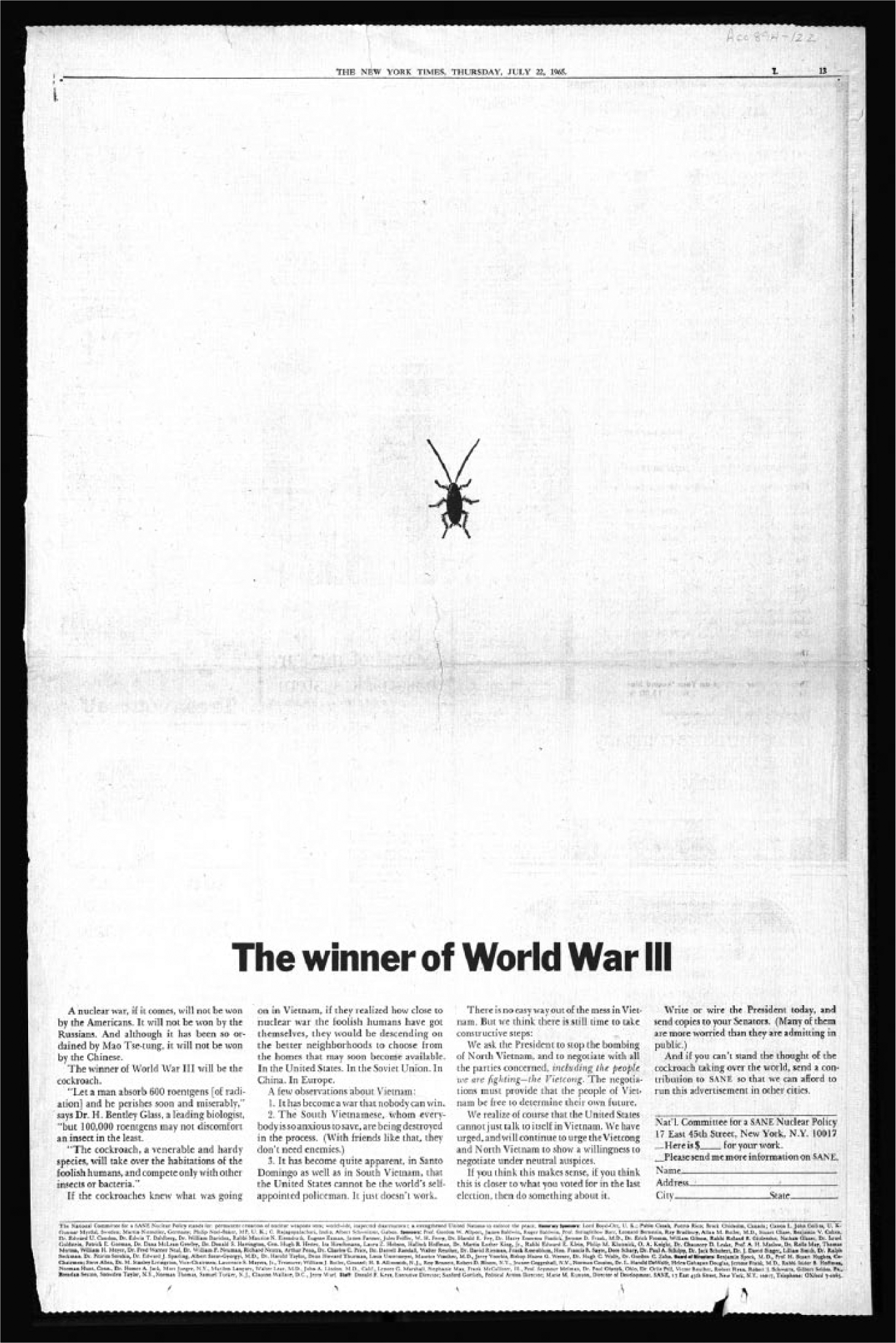
The peace movement co-opted Bentley Glass’s image of the nuclear cockroach in this full-page New York Times advertisement from July 1965. The copy it contained misquoted him.
SANE was known through its advertisements, which appealed to middle-class fears of nuclear war and the genetic and medical consequences of fallout. Along with birth defects and razed cities, the nuclear cockroach symbolized the American public’s nuclear nightmares.
Although Glass was more and more convinced over time of the dire biological effects of radioactive fallout, he did not advocate SANE’s program for disarmament. Actually, he turned down a lengthy and impassioned appeal from Todd Gitlin, then a Harvard student peace activist, to support a student demonstration in Washington, D.C., which had already signed on a number of student organizations, SANE, several labor unions, and an impressive list of public intellectuals. Glass both declined to offer money and refused to allow his name to be used on a sponsor list. He explained his position to SANE’s national program director, Donald Keys, a few months later when he also refused to sign a letter to President Kennedy from eminent scientists opposed to resumption of nuclear weapons testing. He wrote that although he sympathized with the desire to end weapons testing, the political decision to do so was complicated. Ending weapons testing without guarantees from the Soviet Union that they would do the same would only embolden them and make long-term disarmament more difficult.
Just as in the case of the Berlin crisis, so in this one there is a point at which we must stand our ground and refuse to be intimidated; or we lose everything, including the hope of future agreements to enter into disarmament.
61
Peace activist and Saturday Review editor Norman Cousins had earlier appealed to Glass to publicly support disarmament through SANE. In a 1957 telegram, he wrote, We are launching a national committee for a sane nuclear policy. Sending you copy for advertisement appearing in New York Times, Herald Tribune, Washington Post and Chicago Tribune on November 11 with key business, labor, church, science sponsors. Need your help to make national impact for a new approach to nuclear policy. Will you sign statement.
Glass revealingly replied, “Although I am in general agreement with statement, my official position on Advisory Committee for Biology and Medicine of Atomic Energy Commission makes it inadvisable for me to sponsor or sign such statements.” 62 Even while Glass retained his government-insider status, his nuclear cockroach became a boon to the peace movement.
A Metaphor with Legs
Journalists continued to find the nuclear cockroach irresistible. In July 1975, the New York Times ran an op-ed by David Lilienthal outlining his concerns about the number of nuclear power plants under construction or for sale overseas and the security of the plants’ spent nuclear fuel. Although the article mentioned nothing about a cockroach or even about radioactive fallout, it was headlined, “If This Continues, the Cockroach Will Inherit the Earth,” and featured a line drawing of a cockroach centered above the headline. The cockroach had become a stand-alone symbol of the nuclear age, with no need to explain what one meant about the bugs “inheriting the earth.” 63 In a 1983 column for Outside magazine, nature writer David Quammen contemplated a postapocalyptic world overrun with cockroaches. He had been alerted to the possibility, he wrote, by Jonathan Schell’s 1982 book The Fate of the Earth, which “describes in relentless scientific detail the likelihood of total human extinction following a full-scale nuclear war.” Quammen reiterates Schell’s theme of insect radiation-hardiness and mentions the cockroach studies by Wharton and Wharton, concluding that “if the worst happened, cockroaches in great and growing number would be around to dance on the grave of the human species.” 64
Academia continued to lend credence to the cockroach legend. In 1988, the Health Physics Society, a not-for-profit organization devoted to radiation safety founded in 1956, published “Would the Insects Inherit the Earth?” and Other Subjects of Concern to Those Who Worry about Nuclear War. The book is a question-and-answer guide to the heavy concerns of the nuclear age, with its title question answered by ecologist D. A. Crossley Jr. He explains why insects are so much more resistant to radiation than mammals (basically their cells and body systems are simpler) and pointed out that predation by birds makes little difference when populations of insects increase sharply. He recommended against the stockpiling of insecticide, because there were “more important things” to collect. And he concluded, “Ultimately, the ‘sage’ may be correct. Cockroaches may be the final beneficiaries of all of our labor. They are able to feed on dead, decaying organic matter which we might produce in great supply.” 65
The cockroach metaphor gained traction partly because of human experience with the pests. “A primitive suspicion that the cockroach represents the real wave of the future has nagged housewives since long before the atom bomb, or even gunpowder, for that matter,” Russell Baker wrote in his column.
66
Journalist Richard Schweid elaborated in his 1999 book about cockroaches: It is hard to say just what it is about cockroaches that gives so many people that little frisson, that extra bit of aversion and repulsion that makes roaches even less tolerable than spiders, flies, mosquitoes, slugs, and all the other slimy, nasty, filthy inhabitants of the insect world, but there is undeniably something. . . . one of the deterrents to the human race’s perpetrating a nuclear holocaust has been the notion that if we finally wiped ourselves out, or mutated the race beyond recognition with radioactive fallout, the cockroach would survive us, would inherit what remained, and would, somehow, manage to thrive on it, finally and fully appropriating the world that we consider rightfully ours.
67
Beginning with the light sarcasm of Baker’s column, humor has played no small role in perpetuating the cockroach metaphor (Figure 2). The nuclear cockroach appeared from time to time in the comic strip “Bloom County.” For example, when the character Opus is scared of a giant roach, Milo replies, “It’s just this sort of mindless fear within some people that many feel has made this country lose nerve and pursue nuclear-arms control.” In 1998, the Los Angeles Times printed a political cartoon by Michael Ramirez showing two human-size cockroaches emerging after a nuclear blast, one saying, “Bill?” and the other saying, “Monica?” In a 2004 episode of “That Seventies Show,” the writers pay homage to the show’s Cold War setting by having its characters Fez and Hyde play a game of “cockroach, foot, nuclear bomb” instead of “rock, paper, scissors.” 68
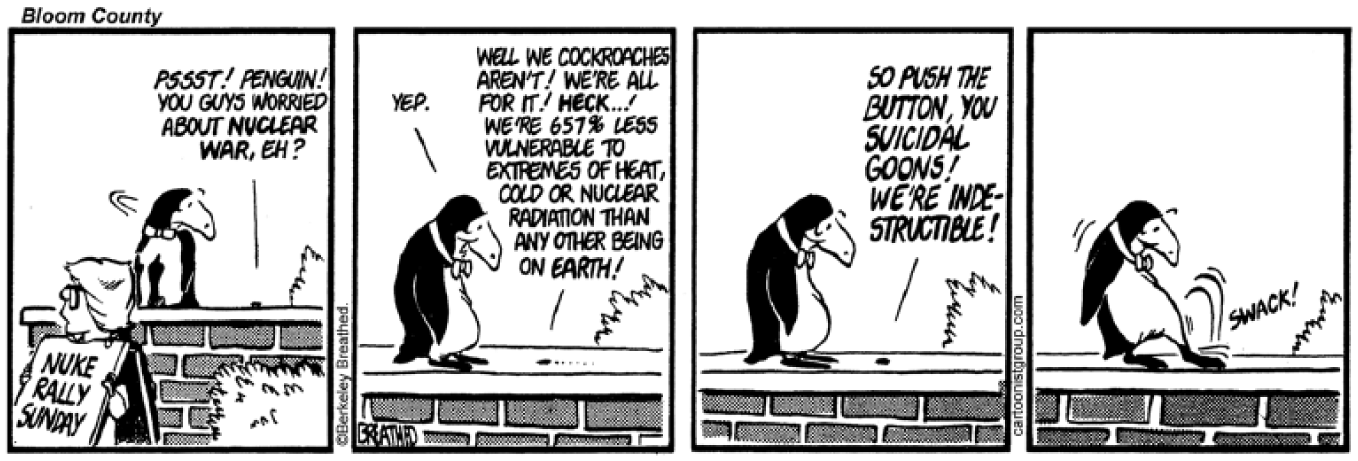
The Cold War was still raging in 1982 when this Bloom County cartoon poked fun at the supposedly indestructible nuclear cockroach.
In a 2009 essay, May Berenbaum, a University of Illinois scientist who writes popular articles and essays about insects, recounted many other cultural references to the “redoubtable entomological truism” of the nuclear cockroach. “It’s not easy to figure out where this idea of cockroach resilience originated,” she wrote, although she accurately pinpoints its basis in Wharton and Wharton’s laboratory studies. Like many other writers on this subject, Berenbaum focused on the superior survival skills of other species, such as certain bacteria, fruit flies, and the lesser grain borer. “Cockroaches will likely remain in the public conscience [sic] as the most radiation resistant of all creatures, all data to the contrary,” she writes, because those other bugs “don’t fit the image of the ultimate survivor.” Glass does not appear in this assessment, but the Nation’s paraphrase “the venerable cockroach” does. 69
The magazine National Defense in March 2010 reported on research involving cockroaches at Texas A&M University’s Nuclear Security Science and Policy Institute with this lead-in: “The creature that’s expected to inherit the Earth following a nuclear holocaust might also be well suited to help prevent man’s atomic self-destruction.” The cockroaches are outfitted with tiny radiation-sensing “backpacks” and controlled remotely with devices that apply pressure to their leg muscles and antennae. Researchers hope the roaches could be sent on missions to detect radiation, reports of which would be returned wirelessly to the bugs’ operators. “This would help officials determine if potentially contaminated areas—such as buildings where they suspect terrorists have planted a dirty bomb—are safe for humans.” 70
Glass was the unnamed “sage” who conceived the idea of the fallout-hardy cockroach. His was the creative scientific mind that conjured the only scenario worse than a postnuclear-apocalyptic world: that same world, ruled by roaches. A tribute in the Bulletin of the Atomic Scientists, published shortly after his death in 2005, pointed out, “Of all his pronouncements, none permeated the cultural lexicon more than his 1962 prediction that cockroaches would be the sole survivor of nuclear war.” 71 And Glass’s former graduate student Frank C. Erk wrote, “As Bentley’s work on the effects of radiation on fruit fly development prospered, the implications of the misuse of atomic energy for the future of mankind became ever clearer to him.” 72 Nevertheless, the metaphor was plucked from a long public speech in which the cockroach made only a brief appearance at the end. The news media amplified the idea, starting with the Nation article that first drew particular attention to this aspect of Glass’s message. Through letters to the editor, bylined and wire service articles (possibly via press releases), advertisements by the peace movement, and editorial commentary, the Nation’s version of Glass’s message was disseminated by the popular press.
Putting Politics in Science Writing
Although some scientists eschew public scrutiny and fear that press coverage will only harm their professional status, others welcome the opportunity to influence public opinion on issues they consider vital to human progress or survival. 73 The latter sometimes cultivate larger-than-life public personae, becoming household names and what Rae Goodell termed “visible scientists.” 74 Glass was a visible scientist by a slightly different definition, not famous in a general sense but certainly ubiquitous in the world of science journalism. He relied on a communications chain that originated within the scientific community and resulted from his talents as a writer and editor. He edited the Quarterly Review of Biology for more than forty years, served on the editorial board of Science for two decades and filled in as editor for a year, and contributed editorials regularly to these publications as well as the Bulletin of the Atomic Scientists and a handful of other journals.
Glass devoted increasingly more of his writing to big-picture issues and less to his genetic studies. Regardless, he sufficiently cultivated the respect of the scientific community to remain a trusted editor and frequent contributor to scientific publications. The result was a powerful loop of coverage for disseminating his views to the public. For example, when Glass delivered a speech as outgoing president of the AAAS, it was covered by large-circulation newspapers, where it spawned letters to the editor and staff editorials. Two weeks later, the speech was reprinted as an article in Science. Letters to the editor followed, to which Glass responded in print. A letter about the speech then also appeared in the Bulletin of the Atomic Scientists. This coverage in scientific journals kept Glass’s name in newspapers for more than a month after his speech was delivered. Thus, the media mileage generated from a single speech turned out to be self-perpetuating and, overall, wider than one might think. 75
A Brief Biography
Possibly Glass’s background explains his political bent. Born to Baptist missionaries, he grew up in China. He attended a school for Americans but was fluent in Chinese. In a 1957 profile of him in the Saturday Review of Literature, Glass cited his parents’ devotion “to the welfare of people who were not white,” saying it was only natural to continue their example in his own life. 76 During the 1950s, Glass publicly agitated for racial equality on the authority of his own genetic studies that showed racial groups have no distinctive genetic makeup. 77 As a child, he nurtured a fascination with insects, studying the local species closely and painting intricate pictures of moths and butterflies, precursors to the illustrations he later produced for his genetic work with Drosophila. At age seventeen, he taught natural history classes in Chinese to local junior college students. Soon after that, he returned to the United States for his own college education. He earned a bachelor’s degree from Baylor, the world’s largest Southern Baptist university, then took a job teaching and coaching at a Texas high school. 78 He returned to Baylor for his master’s degree and earned a Ph.D. from the University of Texas under H. J. Muller, who would later win the Nobel Prize for his discovery that X-rays can cause genetic mutations. Muller had friendly connections with Soviet scientists including N. I. Vavilov, a geneticist who was later imprisoned and killed for criticizing Josef Stalin’s pet biologist Trofim Lysenko. As Muller’s student, Glass spent time with Vavilov and two other prominent Soviet geneticists, both of whom also disappeared during Stalin’s purges. 79
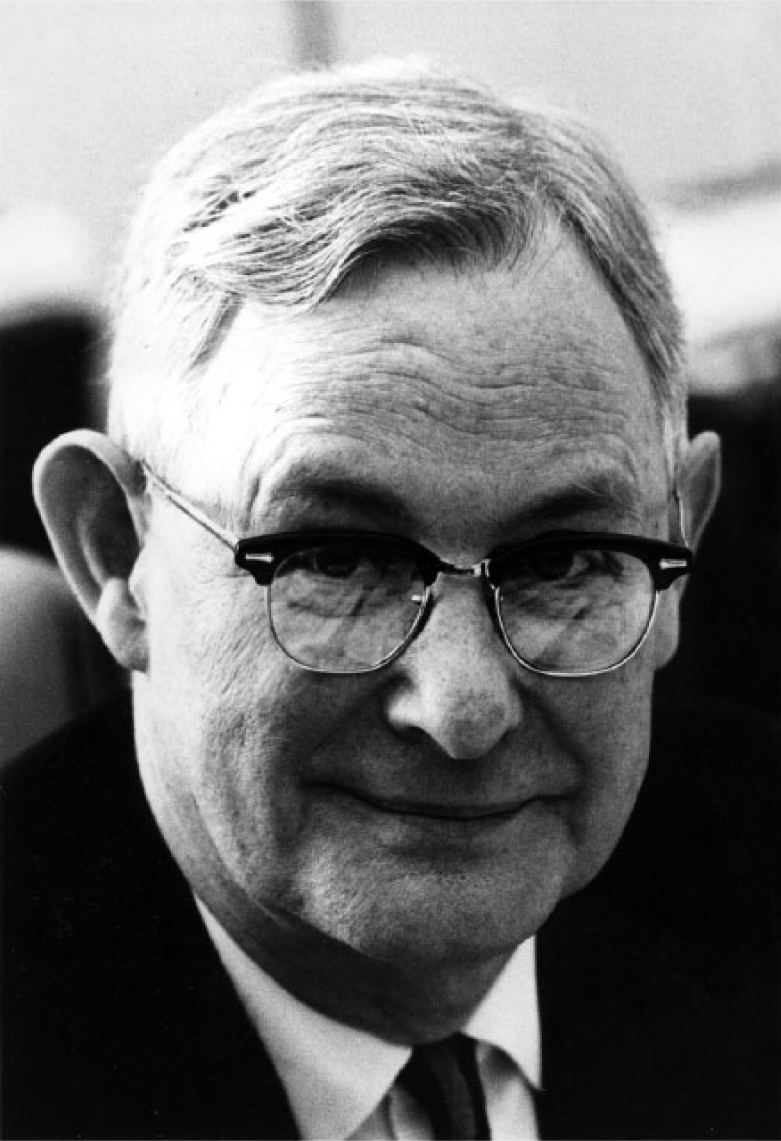
Bentley Glass was an extraordinarily prolific writer and editor who, while deeply concerned about accuracy in science communication, never shied away from presenting his political views in scientific forums. This portrait was taken around the time he was president of the American Association for the Advancement of Science (AAAS), a role he used not only to urge better science writing but also to warn of the dangers of environmental exploitation and capitalistic greed.
Glass tried to secure a postdoctoral position in London with renowned population geneticist J. B. S. Haldane for the school year 1932–1933, but the scheduling fell through. The administrator of the National Research Council grant that was to pay for the appointment suggested that Glass stay in the United States. “I am convinced your departure for Europe in September would result in a disappointing three or four months and would not attain the purposes for which the fellowships are granted,” he wrote. 80 Glass was not willing to accept a post stateside, however, and he stubbornly rejoined Muller in Germany. The two worked closely with another ill-fated Russian geneticist, N. W. Timoféeff-Ressovsky, in Berlin at the Kaiser-Wilhelm Institute.
Glass wrote about his studies in Berlin in a foreword to a set of essays called “The Grim Heritage of Lysenkoism,” published in 1990 in the Quarterly Review of Biology. As Adolph Hitler was coming to power, Glass witnessed a Nazi inquisition at the institute where he and Muller worked.
Not only all Jewish personnel, except the highest ranks, but every former socialist or communist was taken away for questioning. Some returned in a few days, bearing signs of beating during their questioning. Others never returned . . . it was a very strange period in which to attempt to keep one’s mind on scientific problems.
An intense music lover, Glass recalls emerging euphorically onto the streets of Berlin from a Wagner opera, only to confront a chilling sight: a “great throng” of people had gathered around a fifteen-foot pile of books. Glass made out the words of a German officer, who declared that the “Jewish” books would no longer corrupt the purity of the country’s Nordic youth. “Gallons of oil were poured over the great pile, and set afire. I believe I saw with my own eyes the very first ‘burning of the books’ in Germany, of which there were many in the succeeding months.” 81
The experience lingered in his mind three decades later. In his 1962 Bulletin of the Atomic Scientists article, “Scientists in Politics,” Glass would write about the Soviet and Nazi regimes as examples of “science under political pressure.” The twenty-year-long Lysenko controversy, during which many esteemed Soviet classical geneticists were ousted from their positions, resulted in stunted growth for genetics research in the U.S.S.R. even beyond Stalin’s death, Glass wrote.
In another land, political domination over science reached the ultimate extremity. In the Nazi state it has ranged from subservience in the design of weapons . . . to notoriously warped and twisted racist doctrines that claimed support from genetics and were used as a justification for the persecution and extermination of some millions of helpless Jewish citizens and captives.
82
Glass was not yet thirty years old when he returned from Germany to the United States to begin his career as a college professor and geneticist. While working stints at lesser-known institutions, he met and married his wife Suzanne and published his first book, Genes and the Man, before landing at Johns Hopkins University in Baltimore in 1948. The nature of the book indicated that perhaps Glass was disinclined to confine himself to purely scientific studies. Intended for science educators and general audiences, Genes and the Man attempted to fuse knowledge from various disciplines (cytology, embryology, genetics, and anatomy) into an explanation of human existence at various stages of life, from conception to old age. His thesis is that to understand a human, one must consider the genetic and biological aspects of his or her development along with environmental factors that affect those processes. “In short, this is a streamlined discussion of the recurrent theme of nature versus nurture, but strictly in the modern sense, and certainly with much more enlightenment than has been thrown on the subject many times in the past,” reviewer John W. Price wrote. 83
Politics in Science
Glass regularly reviewed books for the AAAS publications Scientific Monthly and Science beginning in 1944. He was a member of the original editorial board of Science, first appearing on the masthead in 1948, about the time he was hired at Johns Hopkins. He was chairman of the editorial board in 1953 when he was asked by the AAAS to temporarily assume editorial duties for both publications. Historian John L. Rudolph wrote that Glass had served as editor of Science and Scientific Monthly during the Red Scare in 1953, “where key debates over scientific freedom and government oppression took place,” and he was “convinced of the destructive power political and social pressure held for science.” 84 For at least five years, Science had been in a state of flux over its changing leadership, economics, and mission. Glass commuted from Baltimore to Washington, D.C. for most of the year to edit the journal, while his Johns Hopkins colleague William L. Strauss filled in during the summer so that Glass could keep prior commitments abroad. Glass took a no-nonsense approach to the work. “During the Glass-Strauss regime an attack was made on the backlog of accepted papers and Glass made an effort to expand Science coverage of important research developments with short articles written by members of the Editorial Board,” John Walsh writes. 85
Science was, and remains, the most influential general science publication in the United States. In 1960, after merging with Scientific Monthly, the circulation of Science was 64,819—mostly academic scientists, with the largest bloc from the life sciences. By 1970, circulation reached 150,000. 86 In 1976, it was the third most-read periodical (behind the New York Times and Time) among faculty members at major universities. 87 Research covered in Science frequently found its way into the general press. In a twelve-month period during 1978 and 1979, stories originating in its pages appeared in more than four hundred U.S. newspapers and magazines. 88
From 1951 to 1971, Glass wrote the journal’s opening-page editorial eleven times. According to a colleague, during his stint as editor Glass instituted the weekly editorial in Science over the objections of many contributors who thought that opinion pieces had no place in scientific journals.
89
In the roughly five-hundred-word space allotted, he rarely failed to make a connection between science and politics, often writing about what he called the social responsibilities of scientists, which included fostering scientific literacy among the public. In 1956, he wrote in “The Scientist’s Perspective” that the future welfare, if not the very existence, of human society will depend increasingly on the public understanding of science. . . . Nevertheless, few scientists care to undertake the labor of explaining the real nature of science; in fact, but few of them take time to think the matter out for themselves.
Scientists did society a grave wrong in neglecting the history and philosophy of science, Glass wrote, resulting in college textbooks that delivered an authoritarian science—series of established facts and generalizations with no hint of the uncertainty and constant revision that characterizes scientific enterprise.
In a 1957 editorial titled “Science and Freedom,” Glass sided with Nelson Mandela in arguing against the Separate University Education Bill before the British Parliament, which would have established separate universities for black students in South Africa and barred them from the five open universities which at that time admitted them. Citing Galileo’s trial by the Inquisition, state-sponsored scientific doctrine in the Soviet Union, and ongoing resistance to Darwin’s theory of natural selection, Glass wrote that academic and scientific freedom were “inextricably interwoven. . . . No scientist can really afford to be unconcerned with threats to the academic freedom of any university, whether in his own land or abroad.” Apartheid, he wrote, was an extension of Nazi doctrines of racial superiority, which tended to resurface whenever a dominant ethnic group felt threatened by the “numbers and growing enlightenment” of another.
Apartheid preaches very plausibly the theory of the equal but separate development of white and nonwhite people in residence, in labor, in education. Yet it is plain to see that it is a bare-faced effort of the whites to keep the black and colored people of South Africa in servitude and educational inequality.
In suggesting scientists had a stake in an area of the world that must have seemed remote to most of them, he brought a significant civil rights issue to a wide, and perhaps unlikely, audience of academics. That suggestion was overt: “Can there be any question that in the long run the freedom of mankind—and the freedom of science along with it—is more imperiled by the defeats of Little Rock and Pretoria than by the success of sputnik?” 90
When Glass wrote about environmental issues, they almost always were related to nuclear fallout. But in a 1969 editorial, he wrote about damage to ecological systems caused by major industrial projects in other countries. One was a Slovakian military aluminum processing plant that had been placed in an unwise location despite the protests of local scientists. Trapped sulfur dioxide from the only available fuel—local, low-grade coal—had killed all the plants and wildlife for miles around and endangered the workers’ health. The other example Glass gave was the Aswan High Dam on the Nile River, construction of which unexpectedly ravaged sardine populations in the Mediterranean and spread parasitic blood flukes through human populations in Egypt. That such examples of environmental disaster were becoming so severe and numerous explained the increasing public agitation of environmental scientists, Glass wrote. 91
Glass wrote a number of Science editorials about education, which preoccupied him, as he was leading a major effort to overhaul U.S. high school biology textbooks during the 1960s through the BSCS. 92 In a 1971 article, he wrote that even the newest and best curricula failed to “deal sufficiently with the role of science in the making of human culture.” The philosophical aspects of scientific inquiry must be developed alongside technical, empirical knowledge that gave man frightening new power over his environment, he wrote. He worried about the “submergence of the individual” and their human rights, but anticipated that salvation would come from the insight of scientists and from better education. “There may yet be hope for mankind, since from the perspective of a geneticist the present conflicts of human racial groups appear evanescent, and from the perspective of a psychologist the motivation of nations to war seems conquerable,” he wrote. 93
In addition to these editorials, several longer articles by Glass appeared in Science. Some of them were about his research, but others addressed sociopolitical topics. The latter were often reprints of speeches Glass had given, such as the 1960 article “The Academic Scientist, 1940–1960,” the text of a speech he had delivered as president of the American Association of University Professors at the group’s annual meeting.
94
A succinct accounting of the military–industrial complex in biology, it outlined the steep and rapid increase in federal support of university science in terms of available lab equipment and assistance, professor salaries, and grant money: In 1940, an assistant professor of biology, a fairly typical scientist, had no special funds for his research. An amount not exceeding $100 [about $1,600 today] annually came from the departmental budget and was used for consumable supplies. He had for his use one moderately good compound microscope and one good binocular dissecting microscope. He made all his own media, did his own sterilizing in a Sears Roebuck pressure cooker, kept his own stocks without assistance, and was grateful for some help in washing up the glassware. . . . In 1960, the professor has charge of two research laboratories, both supported by funds from the federal government. A senior research associate operates one of these laboratories semi-independently, with a research assistant to aid him. Two research assistants work in the other laboratory. In addition, there are two part-time laboratory assistants to wash bottles, keep animals, and prepare media. The annual research budget of the group is close to $50,000 [almost $400,000 today], not including the scientist’s university salary . . .
95
Glass wrote that the “modest empires” of these scientists had their origins in World War II, as a result of science’s place in aiding a U.S. victory, their growth accelerating with the advent of Sputnik and the Cold War. 96
Glass estimated that a quarter of the entire budget for higher education at that time came from the federal government in the form of funds for scientific research and science scholarships. With such a sea change came an “inevitable” increase in scientists’ involvement in politics, beginning at the time of the Manhattan Project. Activism among scientists took the form of organizations, conferences, and publications, “symptoms of the awakened political conscience of men appalled at what they had let loose in the world.” The effect was by no means confined to the nuclear physicists: “The secret preparations for chemical and biological warfare embroiled chemists and biologists in the same schizophrenia that the conscience-stricken physicists were in.” 97
Glass’s take on how world affairs led to the lionization of some scientists, and in turn to scientists’ sharply increasing political activities, was precisely the trend that became a large part of Rae Goodell’s thesis some fifteen years later in The Visible Scientists. Like Glass, she discussed massive government funding of scientific research and an “insider” advisory system within the federal government that grew unsatisfactory to many scientists. Some scientists in turn attempted to influence policy from outside of these normal government channels, typically by taking their messages directly to the public. 98 Glass recognized that scientists needed government funding and approval to do their work, but by 1960, he seemed to be growing weary of the insider system. “There is today a sort of scientific Washington Merry-Go-Round where the scientists who form these boards, committees, and panels meet their friends and, from time to time, exchange places,” he wrote. 99 Yet he was clearly one of them.
Editorial Activities and Concerns
Glass’s work on the editorial board for the AAAS included heavy involvement in refereeing papers, in establishing editorial policy, and in merging Science and The Scientific Monthly in 1958. Glass seemed to function as a mentor and editorial expert, with AAAS members and hired editors soliciting his input on a number of occasions. Aside from an endless onslaught of workflow and management issues, board members seemed to struggle with an increasing interest in science news on the part of the popular press.
Glass corresponded frequently with Howard Meyerhoff, editor from 1949 to 1953, about editorial policy and procedures. Glass was frustrated when papers he had reviewed and explicitly rejected ended up in print while those he felt were urgent languished and lost their news value. A backlog of submissions plagued the publication during this time, and scientists mystified by why their papers were being held up complained to Glass. In one example, the outspokenly political H. J. Muller, a geneticist embroiled in the Lysenko debate, submitted a transcript of his speech at the Congress for Cultural Freedom in Berlin as well as a translation made by his wife of a lecture by Hans Nachtsheim, a German geneticist who had put himself in peril by openly dissenting from Soviet policy while still residing in Berlin. According to Muller, Nachtsheim’s speech had resulted in a number of immediate resignations from the Prussian Academy of Sciences. In spite of the political urgency and newsworthiness of these items, Muller never received a response from a Science editor and later wrote Glass that the delay “looks to me like plain sabotage.” Although it probably was not sabotage but disorganization, Glass arranged to have the pieces published in the next issue. 100
Glass also criticized Meyerhoff for printing a controversial paper by Clarence Mills elaborating a theory that humans living in higher temperature areas become duller, slower, and less productive than their counterparts in cooler climates. The piece had provocative, possibly offensive, implications in terms of racial differences, but offered little empirical evidence. Meyerhoff defended the move by arguing that the article, “Temperature Dominance over Human Life,” had been the only one of the year to be included in Science Digest, a William Randolph Hearst popular-science magazine. “The reception of this article may be just a bit disturbing, but to me it offers an interesting lesson—namely, that reasonably sound controversial items can be published in greater number with considerable profit,” Meyerhoff wrote. “Not only do they attract outside attention but they arouse great interest among Association members. Isn’t that what we want?” Seeing a copy of this letter, L. J. Mullins wrote Glass, “I must say that if we measure the scientific quality of Science by whether or not our articles are digested by Sci. Dig. we shall not have a scientific journal any longer.” 101
However, Philip Levine wrote to Meyerhoff after his article about his discovery of a new blood factor was rejected on grounds that it had received too much mainstream news coverage. “I take vigorous exception to your remarks that my paper constitutes a restatement of my findings since the newspaper versions were as usual most confusing even to my colleagues,” wrote Levine, adding he had discovered two new factors and had planned to submit these findings to Science. “Incidentally, these papers will certainly satisfy your requirements of news value, which, however, is of no particular interest to me.”
102
Glass was called upon to arbitrate. Karl Lark-Horowitz, a physicist and fellow editorial board member, wrote to Glass, Nobody can help it if [Levine] makes a discovery which takes the fancy of the daily press, but his material is written up sometimes as he said, in the most confusing way. I must also take exception, that we should be guided by the fact whether material has been mentioned or not in the public press, whether it has been written up in LIFE or NEWSWEEK or TIME magazine.
103
Still, a draft of editorial policies for Science composed a few months later read,
It is surprising that in the midst of a backlog crisis in which papers were languishing for months, this policy emerged stipulating that coverage in the regular press would detract from a paper’s publishability in the scientific journal. Therefore, scientists faced a real dilemma: they could choose between accurate reporting and a lengthy delay or immediate but “confusing” publication of their discoveries. The policy was still in force several years later when in 1957, Glass suggested to editor Graham DuShane that an article published in Harper’s should be reprinted in Science. DuShane replied, “The general policy I would follow here is that we do not, in general, reprint from journals with a wide circulation in the United States, except under extraordinary circumstances.” 104 Science clearly saw itself as part or complement of the mainstream news media, in competition with other news outlets to be the first to break science news. Its editorial board members also seemed to enjoy its authors’ preference for the carefully considered peer editing promised by the journal, as opposed to translation by a reporter.
In spite of his own overt politics as a writer for Science, as editor Glass applied the brakes when he suspected articles were politically motivated. In one instance, a medical doctor, Benjamin Sieve, claimed to have developed an effective birth-control pill. Glass thought the clinical trial unsound, and though he had recommended that Science reject the paper, Meyerhoff published it while Glass was out of town. “The trouble is that the Planned Parenthood Federation (Paul Henshaw) needs funds, they are seizing this opportunity to arouse interest in and support for their work, and are playing it for all it is worth,” he wrote.
According to what I have heard, the two-page article in a recent issue of LOOK called “Birth Control by Pill” is a deliberate plant by the Planned Parenthood Federation. . . . It looks to me as though we were being used by the PPF to put scientific repute behind their campaign, which after all is, however worthy, a type of propaganda.
105
In another instance, Glass expressed distaste for an article titled “Dangers Confronting Science in the United States,” submitted by the American Association of Scientific Workers (AASW), an organization openly sympathetic to the Soviet Union. “What I don’t like about the paper is that . . . it tends to follow the party-line rather obviously. . . . why hold up Fascism and Nazism as dangers to scientific standards and not mention Communism too?” Glass suggested that a member of the U.S. federal bodies concerned, the AEC and the Office of Naval Research, be given an opportunity to provide a rebuttal. 106
Glass founded the Conference (later Council) of Biology Editors in 1957, getting funds from the Division of Science Information of the National Science Foundation for a first meeting of about twenty editors in Washington, D.C. It met again the following year and became a permanent institution. Glass wrote to Stanley Garn, a biologist who had also written about problems in science communication: I hope that by getting them together for a discussion of what ought to be done in regard to uniformity in the requirements made of contributors in the preparation of manuscripts, of what can be done to make the mechanics of editing and running a journal more efficient, and of what can be done to provide a better coverage by our abstracting journals, something may be achieved.
107
An interview with Glass appeared in the conference newsletter. Stephanie Passman and Barbara Osborne wrote, In the triangle of author-editor-reader, Glass noted the editor must guard against changing style, which is the essence of the person, while at the same time do all that he can to improve form and presentation for the benefit of the reader. The role scientific publishing plays in [the contemporary history of science] is of vital interest to Glass, as it is often in the review process and the give-and-take of referees and authors that the scientific opinion of our time is molded.
108
In 1963, Glass delivered a talk on scientific writing at a symposium for creative writing in the sciences, held at the Rockefeller Center in New York. He said that creativity was a vital part of scientific endeavor and the expression of scientific ideas at least as important as their factuality. He concluded that scientists have over-emphasized in their professional work the importance of laboratory or field technique and experiment and have under-emphasized the importance of the communication of ideas. In science, as elsewhere, discovery rewards the search, but the searcher must be inspired to look. The clarity and skill with which the seer sets forth his vision open the eyes of those who follow.
109
Trouble with Popular Science: The Two Cultures Clash
Glass attempted to communicate directly with the public through newspaper and magazine articles, radio addresses, and television appearances. He believed science should be applied to human problems and comprehended by the public. Scientists should not labor in obscurity, he thought, but should both educate and advocate according to the results of their research. As he wrote in his science column in the Baltimore Evening Sun, it was “an age when sensible judgments about scientific matters must be made by every citizen as a matter of life or death.” 110 In introducing Glass as the new president of the AAAS in 1968, Theodosius Dobzhansky wrote that Glass was “not the ivory tower kind at all. He is interested in about everything . . . a man of thought and a man of action coexist in him without conflict.” 111 Maura Flannery later wrote, “Glass’ accomplishments argue for scientists needing to move outside their laboratories from time to time—to teach, to consult, to exhort.” 112 Editors wanted to provide their general readers with scientific content, and Glass was willing to write. But their formats and standard practices differed from the science journals for which Glass was accustomed to writing and editing.
The AAAS published a simple visual analogy for the difference between a scientific report and a journalistic article. The scientist’s material looks like an upside-down triangle, with a bulk of background material and qualifications making up the “wide end” of the triangle at the top, leading to the supporting details and, finally, the scientist’s specific finding, which is likely to be quite narrow in scope: the tip of the triangle. The journalist’s triangle is right-side-up. It places the results of the research, the “bottom line,” at the top of the story, then an explanation of why the result is important to the reader, followed by a wide base of supporting details—space permitting, of course. 113 Many of Glass’s manuscripts for popular outlets, and even his published articles, resembled the upside-down triangle (scientific) more than the right-side-up one (journalistic). Such articles were probably less effective than had Glass followed the modern AAAS model.
Accustomed to openly voicing his political views and goals to scientific audiences, Glass also encountered problems with the journalistic norm of objectivity. His forays into direct mass communication required a different approach than speaking from the podium, and he clashed with general editors who wanted his writing to be impartial.
Glass as Science Columnist
Glass wrote at least five installments of a column titled “Science Commentary” for the Baltimore Evening Sun in 1957, in the middle of his tenure as a genetics professor at Johns Hopkins University. He received $35 (about $300 today) per column and could choose his own topic.
In one edition, Glass opened by citing recent news on a successful kidney transplant between identical twins. He emphasized that the difference between fraternal (“two-egg”) and identical (“one-egg”) twins was that one-egg twins were hereditarily identical, while there was “only one chance in 70,358,744,177,684” that two-egg twins would receive the same hereditary information from the parents. The tendency to produce a two-egg twin was hereditary and a one-egg twin “almost accidental.” As transplantation of the kidney was a new technique, Glass described the difficulties of transplanting tissues between people who were not genetically identical (the recipient’s body rejected the foreign matter). The successful kidney transplant had been between identical twins. The overall thrust of the article, appearing late in the text, was that genetics research was essential to progress in medical procedures. 114 Glass seemed to count on readers’ curiosity about twins to compel them through the lengthy instructional passages on genetics and organ transplantation.
Glass chose a similarly pedestrian topic, the pituitary gland, for another column. Just as the column on twins had been inspired by news of a successful transplant, this column was inspired by the news that researchers had synthesized a hormone secreted by the pituitary gland. Glass opened with several column inches devoted to a basic anatomy lesson on the gland, describing hormones, for example, as “the potent chemical substances . . . which glands secrete into the blood to be carried elsewhere and to produce their specific effects on the organs or tissues sensitive to them.” The point of the column seemed to be the importance of such research to development of medical treatments. Glass loved to speak glowingly about the future of science. He concluded, It is well within the realm of possibility that before long our biochemists may put together pieces different from any which are combined in natural hormones, and then make artificial hormones with new and interesting combinations of effects. By such studies we will rapidly advance in understanding the chemical basis of health and disease.
115
Unsurprisingly, these two columns failed to inspire a response in the Sun’s readers. But when he tackled the controversial topic of teaching evolution in school, Glass expected this column to attract more attention. “I shall be interested in the reaction to this one. . . . I suspect I shall call forth some brickbats,” he wrote the editor.
116
Glass wrote that he had served on a committee of biologists investigating the presence of evolutionary theory in school curricula thirteen years earlier, and they had found about half of high schools did not teach evolution in biology class. “In spirit, throughout a vast stretch of our nation, the same attitude prevails as in the days of William Jennings Bryan and his Fundamentalist followers,” he wrote. “Many teachers do not dare to teach openly about human evolution, for fear of local criticism and even of losing their jobs.” He stridently continued, This reluctance contrasts strikingly with the rapid acceptance by the American people, within little more than a decade, of such scientific fruits of discovery as antibiotics and nuclear energy. Yet the evolution theory, no less than penicillin or the atomic bomb, is a product of scientific investigation and evidence. No one has a right to accept the one and reject the other . . . For those who, being nonscientific, would accept the results of science on the authority of the scientist, there can be no choice. One doesn’t make the world flat by wishing it so; one can’t obliterate the bomb by hiding one’s head; and one can’t prevent radiation from making mutations and altering evolution by balloting against the teaching of evolution.
Glass played on the anxieties of the nuclear age and made an outright appeal to the “authority of the scientist” in his argument against fundamentalist resistance to evolution. In conclusion, he warned that failure of humans to understand their own origins was pointedly hazardous in a democracy pitted against undemocratic regimes. Citizens needed to know “what dangers lie in the nature we have inherited from our animal ancestors, a nature once well suited to the demands of an anthropoid existence but now translated into a struggle between embattled and suicidal titans.” The great nuclear powers, he said, were devolving into reliance on their animal instincts. 117
Readers swiftly responded. George S. Crites wrote in to say he agreed with Glass on teaching evolution, but disagreed with his citation of the Neanderthal Man as an evolutionary link. Crites found the “geological calendar” showing man was a recent addition to the earth convincing, but not the fossil record. He also extended the nuclear metaphor into a rebuttal. “[B]efore Dr. Glass was born, scientists honestly trotted out the theory that the atom was the smallest indivisible particle of matter only to have that theory break down,” he wrote. Scientists should spend their time “running down cold scientific facts and leave the Neanderthal man for bigots to mull over.” 118
In another letter, Irvin Winer called the evolution column “superficial and contrived” for its reliance on the statement that in 1944, Glass’s committee had found half of high schools failing to teach evolution. (This was a problem that the editor had attempted to correct by asking Glass to name some of the states in which evolution was forbidden in high school texts.
119
Glass either declined to do so or missed the deadline.) Winer found the evidence flimsy and Glass’s approach to the subject hyperbolic. Winer wrote, The apparent purpose of the author was to arouse attention to a particular facet of biology whose significance he feels is being suppressed and forgotten; but the apocalyptic seriousness of his tone serves only to produce the general vision of science as the great human misadventure into the supernatural.
120
In this complaint, we find a conundrum faced not only by Glass but by any scientist or journalist wishing to popularize scientific knowledge. They could best capture readers’ fickle attention with topics that were apocalyptic, futuristic, controversial, or bizarre. News value was also measured by its timeliness: the breaking announcement, the most salient point. Yet, theoretically, scientists operated on a continuum of shifting and accumulating knowledge. Expanding on this problem, Glass complained about press treatment of the American and British reports on radiation (GEAR and BEAR), discussed earlier, in an installment of “Science Commentary.” He suggested three titles for the piece, none of which was ultimately used: “Science Is Not News,” “Science and News,” and “Science in the News.”
121
Although the hazards of nuclear radiation were a source of “mounting dread” among the public, alarming a number of scientists and public leaders including the pope, and although a better understanding of fallout was “urgent beyond measure,” the news media had failed to do justice to the reports which were “written with great care so as to be intelligible to everyone who cared to read them.” Written with great care, in part, by Glass, who wrote, That was a month ago, and it is now time to see how the press has treated its responsibility to disseminate the views which were expressed in the reports. On the whole, not badly, in so far as immediate attention was concerned. This was
However, this coverage was distorted by a red herring. The geneticists had written about the radiation people absorbed from glow-in-the-dark clock and watch dials, to provide perspective on the amounts of radiation absorbed through other sources, including nuclear bomb fallout and X-rays. “To judge from the newspaper items and mail received, nobody got the point. Instead, there was a great hue and cry about the dangers of luminous watches and dials,” he wrote. Worse, nobody was even covering the issue anymore.
This type of scientific report is not, in fact, to be fundamentally treated as “news.” . . . What is so urgently needed is what so often our press overlooks in thinking of scientific developments solely in the light of news. We need repeated discussion, explanation, clarification, until Tom Jones and Sue Brown, already out of school and establishing their families, can enter the atomic era understanding and unafraid.
This attack on the press notwithstanding, Glass’s career as a popular columnist might have been cut short by his failure to conform to standard journalistic practice. The standard of objectivity in reporting does not necessarily apply to columnists, who are expected to state their views, but the editor of the Evening Sun, Newton Aiken, was displeased with Glass’s behavior regarding his next-to-last column. Glass was chairman of a committee to build a science museum in Baltimore. In his column, Glass advocated a new museum for the purpose, among other things, that communist nations were providing their students with better scientific training. “How extraordinary,” he wrote, that in our own city we can support two art museums, a historical museum, a great municipal library with numerous branches, a symphony orchestra, a municipal stadium, and a prospective “civic center,” while we have only a vestige of a science museum . . .
123
According to a letter from Aiken, the editor had learned by chance that Glass had circulated the column before its publication. A dinner was held at the Johns Hopkins faculty club to generate interest in the possibility of a new museum for Baltimore, and those invited had received copies of the column. Aiken wrote that this created a serious question in my mind as to whether the article was a straight out comment of a scientist on a current scientific development or a piece of propaganda designed to further a particular movement toward a certain scientific goal.
To Aiken, Glass had crossed a line by using his column to agitate for a publicly funded museum. Perhaps, in addition, Glass’s views did not jibe with the Evening Sun’s stance on the proposed building.
Aiken reprimanded Glass, writing, The Evening Sun is very jealous . . . of the impartiality and objectivity of both its news and editorial columns, and I am particularly concerned over the possibility that an article was submitted for use on the editorial page without a full disclosure of all of the facts and circumstances in connection with the article’s publication.
124
The clear message was that it was not acceptable to use the scientific column as a forum for local politics. Even while Glass was succeeding at injecting politics on a national scale into scientific journals, he learned that the popular press played by a different set of rules. “Science Commentary” soon met an abrupt end.
Misquoted and Misunderstood
“Science Commentary” helped Glass gain notice in the national media. In November 1957, the Saturday Review published a one-page “personality portrait” which suggested most Baltimore residents knew Glass through his column. Titled “Biologist in Society’s Laboratory,” the magazine article focused on Glass’s membership on the Baltimore City School Board. Glass was serving on the board when Baltimore became the first large city after Washington, D.C., to integrate its school systems in compliance with the Supreme Court ruling in Brown v. Board of Education. Author Edwin Diamond posited that Glass’s combination of scientific objectivity and social consciousness led to Baltimore schools’ speedy and peaceful integration. Diamond correctly pegged Glass as deeply involved in societal issues, citing his support of civil rights, academic freedom, and the arts. 125
Unfortunately, a major snafu with the article hinged on just one word. Diamond quoted Glass as saying to the Baltimore school board, “Differences in intelligence between races do exist, but differences in opportunity also exist, and until opportunity is equalized no one can say what is inherent by natural law.” Glass insisted he had said differences “may” exist, and was extremely sore that he had been so disastrously misquoted in a national magazine. Bypassing science editor John Lear, he wrote to Saturday Review editor Norman Cousins, who responded sympathetically. “I was deeply distressed to learn of your displeasure with the interview published about you,” Cousins wrote. “I think I have some idea how disquieting it can be to read remarks attributed to yourself that not only were not spoken but are completely alien to your own ideas.” 126
Glass responded with a letter to the editor explaining to readers his distress at being misquoted on the racial inheritance of intelligence, a topic which it is no exaggeration to call a raging controversy at the time. Glass suggested that the incident makes me conclude more than ever that if we are ultimately to improve the level of science writing for the general public, the journalist will have to submit his story in written form for a check by the scientist whose ideas are being translated into everyday language.
And he provided the following explanation of his position on race and intelligence: Let me then repeat: my true position is that until opportunities for the optimum development of intelligence are afforded to everyone, one cannot reach a scientific decision about racial differences in intelligence, if that is important. In any case, it is very clear that differences between individuals, whether of the same or different race, are far more significant than the problematical differences between races. The effects of environmental advantages and disadvantages on intellectual development are so great that genetic differences are often masked. Thus the scientific as well as the ethical solution demands equality of opportunity for all people.
A section of the letter that Glass asked to have excised before publication questions the reporter’s techniques even more pointedly.
I am further distressed about the practice of putting into the form of a direct quotation what I may have said to your interviewer, but doubt very much I ever said to the Baltimore School Board. Is this not a perversion of the properly understood meaning of quotation marks?
127
Glass already had a history of frustrating experiences serving as a source for stories on scientific topics. In 1951, Baltimore Sun reporter Frank Henry interviewed him for an article on biological techniques and the future of mankind. Henry sent Glass a draft of his article to “pass on,” or approve, the quotations. Glass began to mark up the draft, then crossed out a section and provided a typed replacement. Glass asked Henry to replace this long quotation on techniques for selective breeding: Among humans it would work this way: the ovum or egg would be taken from a woman of fine character and health and put into a test tube. It would be fertilized by sperm from a man of equally fine characteristics. Then it would be inserted into a foster mother, a woman especially fitted for childbearing. In that way we could breed a fine race of humans. We could have many children from the women of fine character and health and not wear them down with childbearing. Again let me say I realize the feeling against this way of breeding humans. Many people fear and resent it. But perhaps it will be commonplace in the future world we hear so much about.
And here is the replacement passage Glass supplied, which, in utter opposition to the reporter’s account, emphasizes the dangers and drawbacks of eugenics: Right now it is possible to secure numbers of mature eggs from a selected female rabbit, fertilize them with sperms from a chosen male rabbit, and then implant the eggs into the reproductive tracts of female rabbits that can serve as foster mothers. It is conceivable that such a technique might be worked out for humans. Thus many children could be produced from a very few true parents. But this would involve terrible dangers. No matter how fine the characteristics of a person appear to be, however strong, resistant to disease, intelligent, upright, and attractive in personality, we know that the genes of nearly everybody include some “bad” genes that do not show up because they are recessive and affect the characteristics only when they have been inherited from both parents. Using a few persons to sire a multitude is dangerous because it makes these bad genes more common in the population, and sooner or later children will be produced who have inherited such genes from both their parents. Some will be killed by the genes, some horribly deformed, blind, or feebleminded. Geneticists have no way of finding out which persons, if there are any, are quite free from such harmful recessive genes. In breeding animals, you can destroy the deformed and undesirable ones, and keep selecting until you have purged a breed of all its bad genes. That is what the ancient Spartans tried to do for their people in Greece. But I doubt if anyone, after the example of race purification set by the Nazis so recently, would want to go back to such a policy.
These passages exemplify the difference between scientific writing, with all its qualifications, detail, and careful language, and journalistic writing, in which the reporter attempts a succinct representation of the most important points. This incident seems to be a particularly egregious case of misquotation, which was certainly how Glass took it. He wrote to Henry, I fear that you so totally misunderstood my views that, although the facts you have cited are substantially correct, the conclusions are diametrically opposite to what I believe. I could not possibly authorize them as quotations from me. I do hope that, even though the enclosed draft may not be as spectacular copy as what you wrote, it will still serve the purpose of your article. If not, I would prefer not to be quoted at all. I realize fully how difficult it is to arrive at a just comprehension of a man’s views in a single brief conversation with him. I would not want you to think that I am offended. I am afraid, however, that publication of any such views as those attributed to me in your write-up would arouse a storm that would injure me, my institution, and the cause of science itself.
128
It was the cause of science itself that journalists’ skepticism sometimes worked against, whether they did it well or not. No such clashes occurred when Glass supervised an article called “Should Your Child Be a Biologist?” on behalf of the New York Life Insurance Company. The installment was part of a series exploring careers and urging early planning for college (preferably in the form of New York Life’s Educational Endowments). They were printed in high-circulation popular magazines; Glass’s appeared in Life, Look, the Saturday Evening Post, and Scholastic Magazine. The Biology News Bureau at the American Institute of Biological Sciences, which had lobbied the advertising firm producing the piece to include “biologist” as a possible career choice, arranged for Glass to byline the article and approve the manuscript, for which he was paid $1,000 (about $7,500 today). The writer, Donald Robinson, was “charmed” by Glass when they met to discuss the script, and when he sent the script to Glass, he noted, The more I worked on it, the more fascinated I became with the field of biology. I only wish we would have had more space. . . . My prose is far from sacrosanct, so please do make any changes you wish.
129
Finally, there was a cordial working relationship.
Glass suggested major changes only in a section of the article musing about possible future accomplishments of biological study, such as curing cancer, producing food by mimicking photosynthesis, or “influencing heredity for the better.” He wrote Robinson, “The discoveries predicted are safe enough, but the consequences likely to flow from them are wrapped around with so many economic and political aspects that I couldn’t say what might eventuate.” 130
Cold War Science on the Airwaves
Mid-century mass media adopted a certain hopeful and trusting attitude toward scientific progress. For example, in the early 1940s, Glass appeared on a radio show at Baltimore’s WBAL, which opened effusively: Science! Speeding the wheels of industry—creating better jobs and better living for everyone! Curing the ills of mankind! Bringing happiness and entertainment through the magic that is radio! Contributing mightily to the cause of national defense! Modern living is an intricate pattern of machines—the findings of the world of science are the guiding threads that make order out of chaos! We live better—we think better—because scientists are working with microscope, telescope and test tube to push back the frontiers of knowledge.
During the scripted “Quiz the Scientist” segment, Glass was called upon to explain the genetic basis of hair color. The genes for black hair dominated those for blond, but combinations of brown- and blonde-haired parents fetched unpredictable results. Meanwhile the gene causing red hair was recessive, he explained, meaning that two redheaded parents always bore redheaded children, while redheads could also be born to blonde- and brown-haired couples. 131
In 1951, Glass appeared on “The Johns Hopkins Science Review,” a television program produced by WAAM in Baltimore. According to the script, Glass was a genetics expert who provided much of the half-hour segment’s content however he saw fit. The producers asked him to explain blood groups for three minutes and Rh factors for two minutes. A volunteer family donated blood on-screen which was then tested and filmed through a microscope. Then for seven minutes, Glass discussed the results of the blood tests. He must have mentioned the potential problems of Rh-negative women becoming pregnant with Rh-positive babies (the trait can be inherited from the father), because he received letters asking for advice from two such pregnant women concerned about the genetic discrepancy that could result in a form of anemia and endanger their babies. Mrs. Lawrence Kindler, pregnant into her fifth month after three miscarriages, wrote that she had been advised by her doctor not to attempt to nurse her baby. Glass replied that although she should listen to her doctor, he had personally completed a study finding that miscarriages were not more common among Rh-negative women, and that additional tests could indicate the advisability of breastfeeding. He noted her location near New York City and suggested an appointment with an eminent blood specialist at the Jewish Hospital. 132
In the early 1960s, Glass delivered a long and technically detailed lecture over Voice of America radio about hereditary traits. It focused on how particular genes caused single steps in multistep metabolic processes. He explained that when any one step went awry, a number of dysfunctions could occur. Caused by a single gene’s absence, presence, or malfunction, hereditary diseases that could be traced to their biochemical roots stood a better chance of cure or remediation. In length and format, the lecture seemed like one Glass might have given to a class or at a scientific meeting. The piece was later printed in a collection titled The Frontiers of Modern Biology. It went over the specific causes and chemical bases for a number of hereditary diseases, including phenylketonuria (an inability to use the amino acid known as phenylalanine), galactosemia (an inability of the body to metabolize the sugar galactose), and pernicious anemia (a decrease in red blood cells die to an inability to absorb the vitamin B12). Each could be explained as a result of an “inborn error of metabolism,” though at times, environmental factors affected how an error manifested. The errors occurred only rarely, as the genes causing them were recessive. For example, a certain percentage of children born to parents with the gene causing sickle cell disease would have the disease, and others would only carry it.
Glass explained how such recessive “bad” genes sometimes were advantageous. Studies had shown people in equatorial Africa carrying the gene were protected from certain types of malaria. “Geneticists everywhere are excited over the demonstration that a gene which produces a severe defect may nonetheless under certain prevalent conditions confer a great advantage in the struggle for existence,” he wrote. “The advances of human biochemical genetics . . . are throwing light on the nature of racial differences, and qualifying our tendency to regard genes and their effects as ‘good’ or ‘bad,’ ‘better’ or ‘worse.’” 133
An attempt to take this message to a popular radio audience ended fruitlessly, indicating the difficulty of communicating with the public about the biological concept of race, as well as the lack of scientific consensus on how to talk about it. The corporation Broadcast Music, Inc. (BMI) asked Glass to provide a manuscript of 1,500 words for a new nationally syndicated program called “World of the Mind.” Contributors were asked to not “write ‘up’ or ‘down,’” but to write their papers in “the most stimulating manner possible, making its subject as interesting to the listener as it is to you.” 134 Glass’s submission was an evolutionary explanation of racial features titled “How Man Came to Differ.”
To ensure tribal survival and defend territory, Glass wrote, early hunter-gatherer societies maintained geographic isolation from one another, so there was little or no mixing between populations and physical differences between groups slowly appeared. After explaining how genes are responsible for physical features and how more-complex features such as intelligence are due to combinations of many different genes, he noted the problem of defining a species because some putatively separate species (such as a brown bear and polar bear) could interbreed and even produce fertile offspring. He wrote, [B]ut anyway, there is no trace of infertility or incompatibility in the intermating of human beings of different racial types, and so no ground for thinking of our human races as showing more than the very beginnings of a process which, had it continued for millions of years, might have made of us distinct species of men.
“The mobility of modern man and his vast migrations during historical times have reversed the effect of geographical isolation, and human races are being inevitably fused in the melting pot of common humanity.” Glass explained that new physical traits arise in a population initially through genetic mutation, which must then have some unforeseen reproductive value to be widely introduced. Reproductive value could be based on sexual selection (for example, a gene for red hair spreading rapidly among tribes with black hair because it is attractive to mates) or on survival value. The environment determined survival value in Glass’s example of sickle cell anemia among African Americans. In some equatorial areas, the gene’s sickle-shaped cells prevented malaria. 135
Along with some other examples, Glass discussed his own findings from a 1953 project (with geneticist and statistician C. C. Li) that tracked the rate of intermixture or “gene flow” from Anglo to African Americans by analyzing the rates of occurrence of seven different genes. Glass and Li concluded that about 30% of the genes in African Americans were derived from whites and that within forty to seventy generations (or 1,000 to 2,000 years), racial differences would disappear through complete mixture.
136
In the radio script, he wrote, To reach their present level of mixture in less than 300 years (about 10 generations) the U.S. Negroes must have received a fresh influx of genes from the white population amounting in every generation, on the average, to about 3%—in other words, about 6% of persons socially regarded as Negroes would have had a white parent.
Eventually, races would become indistinguishable.
What then? There would remain just as much hereditary diversity in the population as ever; probably be just as many different kinds of genes in people. But the clustering of particular characteristics in such a way as to mark a person as belonging to one human race rather than another will have vanished. We will then indeed have become “The Family of Man.”
137
The prediction that black and white people would merge until indistinguishable was a favorite for Glass, one that he made publicly in a number of speeches throughout the 1950s and 1960s, at the height of the civil rights movement. His genetic explanation was essentially that isolation had given rise to visible racial differences and that therefore a lack of isolation would eventually wipe them out. This theory coincided with the synthesis of evolutionary theory with Mendelian genetics that energized biological science in the 1940s. A lively debate was under way about the origin of races. Some anthropologists believed they had evolved into Homo sapiens at different times, and that black people were therefore thousands of years “behind” white people evolutionarily. Other scientific findings aimed to prove the intellectual inferiority of black people, whereas Glass and other evolutionists emphasized the importance of environment to development, and the primacy of nurture over nature. A fundamental contention of segregationists, in fact, was that school integration would lead to intermarriage, which would “contaminate” the white gene pool. At this time, for Glass to suggest both the inevitability of genetic mixture and the white parentage of many black people was a bold political use of scientific authority.
BMI sent Glass’s “How Man Came to Differ” script to Dael Wolfle, then executive director of AAAS, to review. The company’s representative Russell Sanjek sent Glass a letter that excerpted Wolfle’s criticisms and politely asked him to change his script. Wolfle thought the title misleading because “much of the paper is about the disappearance of the differences.” Glass had devoted too much space to the differences between black and white people as opposed to other racial groups and had not been objective enough in his discussion of the “Negro-white gene admixture problem.” Glass defended the script in a detailed reply and said that Wolfle had not understood his point. He wrote to Sanjek, I agree with him that the presentation should be unemotional and factual, rather than phrased in terms of values—good or bad. However, quite unemotionally considered, one must take one’s examples from the best scientific cases; and it so happens that more serious and detailed analysis has been given to Negro differences from Whites than to any others.
138
Furthermore, he wrote, the comparison of black and white people was the most apt example available for listeners, since they had personally observed these differences. He wrote, I could pick a good example of the graded difference in blood group frequencies between Orientals and Europeans, but it is more complex to discuss and less dynamic in character than the example used in the last paragraph, which also has the advantage (or disadvantage?) of being something I am known, in scientific circles, to have worked on myself.
Glass declined to make the substantive changes, though he said the terms melting pot and family of man could be removed. Although Glass was paid $75 (about $600 today), the script was never read on the air. 139
Humanity Strikes Back: Science Confronts a Cynical Era
The professor’s wife was fed up with the plaid-shirted heckler. She abandoned the sock she was knitting for her husband and stabbed Frank Rosenthal in the arm with her knitting needle, drawing blood. Rosenthal was a graduate student of physics from Columbia University. The woman was the wife of Dr. Garrett Hardin, a microbiologist with controversially harsh views on overpopulation who did not happen to be speaking at the session on “Crime, Violence and Social Control” at which the stabbing took place. Mrs. Hardin later said she was tired of meetings that were interrupted by “radical types who refused to let people speak.” 140
The incident happened in 1970, not on the steps of the Pentagon or outside a gray-walled corporate headquarters, but in the ballroom of a hotel. It was the largest gathering of scientists in the world, the yearly meeting of the AAAS. The conference organizers had sought to grant unprecedented attention to the “large human values” of science. They encouraged public participation in the many sessions at Chicago’s downtown Hilton and Sheraton hotels and vowed to focus on looming social questions such as pollution, overpopulation, atomic fallout, and reproductive ethics. 141
Under the presidency of geneticist Bentley Glass, the AAAS spurned the “ivory tower” image of the lone scientist laboring in his lab, indifferent to the world outside. Glass had many times repeated his desire, through his life’s work, to “remind science of its social responsibility.” This credo was shared by others in the AAAS, and in 1970 the scientists’ group planned an affair during which 1,500 speakers took part in talks on such subjects as “Science and Human Needs,” “Science and the Federal Government,” “Science and Democracy,” “How People React to Technology,” “Automobile Pollution,” “World Cities of the Future,” and “Hiroshima—25 Years Later.” 142
Reporters from news outlets across the country converged on the Windy City for the AAAS conference the day after Christmas, perhaps expecting their dispatches for the next five days to contain the usual science-page fodder. What they found, instead, was hubbub. Members of the radical group Science for the People (250 of them, by their own count) disrupted many of the sessions by shouting at speakers and audience members, a tactic the radicals variously called “heckling” and “educating.” They were mostly science students, along with some professors, who were involved in the anti–Vietnam War movement. Radical scientists’ groups like Science for the People were a new phenomenon at the time, having formed in the late 1960s. Their members questioned the ties of science to the military and insisted scientific progress should benefit the poor and disenfranchised rather than the established power structure. 143
Operating from a guest room in the Hilton, which conference organizers had provided in an effort to accommodate the activists, Science for the People members planned to interrupt particular sessions, including the one at which the knitting-needle incident occurred. The New York Times reported that during the session, activists shouted phrases such as, “The real causes of violence are the war in Vietnam,” and “You can’t separate the violence of the criminals from the violence of society.” During the confrontation between the knitter and the heckler, another woman had taken off her shoes and was threatening to hit the activist with them. In an interview with a Chicago Tribune reporter, the conference chairman admitted the professor’s wife had “lost her cool,” and said the whole thing had been an interesting lesson in how violence occurs. No charges were filed against her. 144
The incident was scarcely unique at the 1970 conference. AAAS president-elect Glenn T. Seaborg left his own inaugural speech on December 30 when some forty radicals crowded into the room and announced they would interrupt him with charges “for the crime of science against the people.” As the discoverer of plutonium, Seaborg had been instrumental in developing the atomic bombs dropped on Japan in 1945. He later served on the AEC for a decade. He was also the 1951 co-winner of the Nobel Prize in Chemistry and the only living person to have an element of the periodic table, seaborgium, named after him. Edward Teller, known as the father of the hydrogen bomb, had to be accompanied by two Chicago policemen after reported threats on his life. At a session on December 30, while explaining his position on the use of atomic weapons, the radicals presented him with their farcical “Dr. Strangelove Award” and held up signs calling him a war criminal. Visibly shaken, he nevertheless delivered a personal and emotional talk on how the U.S. government had reached its decision to bomb Japan. 145
A number of other disputes that unfolded during the conference, not all of which involved the radicals, were covered in the national press. Walter Sullivan, longtime New York Times science writer, noted that “confrontations were the order of the day,” with scientists exchanging harsh words on overpopulation and environmental damage. A Washington Post editorial listed controversies over women’s issues and Vietnam. The editors opened on a snide note: “In some ways, the current clambake or jamboree of the AAAS seems to be a good deal more fun . . . than any of the past annual meetings of this scholarly body that lie within easy recollection.” 146
In the midst of the fracas, on December 28, Glass delivered his address as retiring president of the AAAS. The talk, titled “Science: Endless Horizons or Golden Age?” included a statement that could have been made by any of the more-eloquent activists. He said that as history, the 1960s would become known as the time when man, with an unbridled lust for power over nature and for a so-called high standard of living measured by the consumption of products of an industrial civilization, set in motion the final speedy, inexorable rush toward the end of progress.
147
No record exists of Glass’s speech being interrupted, possibly because he was one of the more politically liberal and socially oriented scientists assembled. But his speech and its subsequent coverage inspired controversy and misunderstanding on two fronts. The first was mostly limited to professional debate and illustrates how scientists, reporters, readers, and editors cohabited a strange land, all trying to grasp the true implications of scientific progress. The second engaged the American public, and provided slow-burning fuel for a still-unresolved, emotionally fraught debate on abortion and genetic engineering.
The End of Scientific Discovery?
Viewed as a message for a popular audience, Glass’s AAAS speech suffered many of the shortcomings of some of his earlier “Science Commentaries.” It opened with a lengthy, thoughtful introduction comparing the views of two scientists on the past progress and future potential of their respective fields at different points in time: Vannevar Bush, an engineer who had been instrumental in mobilizing the United States during World War II and who wrote about the “endless horizons” offered by new nuclear technologies and molecular biologist Gunther Stent, who perceived in 1969 a “golden age” of science in which most major discoveries had already been made and scientific work mainly involved filling in the details. A close reading of the speech shows that Glass wished to place his own position somewhere between these two extremes, but listeners, readers, and reporters alike took Stent’s position as Glass’s own.
Sullivan of the Times, for example, in an article titled “Growth to Slow Down, Association Head Says,” quoted Glass as saying, “The great conceptions, the fundamental mechanisms and the basic laws are now known. . . . For all time to come, these have been discovered, here and now, in our own lifetime.” These sentiments represented one position in a debate Glass wished to outline. Scientists immediately pushed back against the mistakenly attributed pronouncements, one writing to Science: Bentley Glass’ mixture of pessimism and hubris is not representative of the feelings of all scientists about the future of science in human affairs. According to him the recent successes of biochemistry herald the end of the age of discovery. This is about as reasonable as claiming that complete knowledge of the universe is in sight now that pulsars and quasars have been discovered.
Another reader pointed out the falsity of an 1894 comment by pre-eminent British physicist Lord Kelvin that most of the major advances in physics had, at that time, been made—just a few years before the discoveries of radium and the X-ray. 148
Glass later said his own position was best exemplified by this excerpt: We are like the explorers of a great continent who have penetrated to its margins in most points of the compass and have mapped the major mountain chains and rivers. There are still innumerable details to fill in, but the endless horizons no longer exist.
The discussion of whether key scientific discoveries had mostly already been made, or whether, on the contrary, the horizons of discovery were truly endless, was actually only introductory material to a more subtle and outward-looking argument. The quite different coverage of the speech by the Chicago Tribune in “Science Leader Urges Greater Response to Needs of Mankind” accurately represented this, emphasizing Glass’s statement on the “unbridled lust for power over nature and a so-called high standard of living.” The Tribune’s copy read: Man faces hard times unless a new social and economic system far more responsive to human needs and more foresighted than in the past can be invented, said H. Bentley Glass last night. . . . Glass called for the creation of agencies to curb irrational exploitation and to carry out studies on the long-range and side-effects of technology, before it is unleashed.
149
His claim was actually that the rate of proliferation of scientific research and personnel mirrored the much-discussed world population increase and, similarly, would be forced to slow or adapt in response to reaching actual physical limits. Urgent problems, he said, included environmental exploitation and the unchecked greed of capitalism. It seems the obscured purpose of his speech was to ask scientists to recognize limits to growth in their underlying philosophy, to begin to approach environmental and social problems, including overpopulation, with open eyes. He even called for the expansion of an emerging discipline of “sociology of science.” Given the milieu of the conference and its socially oriented, environmental, and antiwar themes, it is somewhat surprising that these deeper concerns went unnoticed by almost all commentators.
Science readers might have made their minds up about what comprised the main idea in Glass’s argument after reading only the Times report rather than the whole speech. Glass certainly thought so, writing to Science that “Thanks to the widely quoted article by Walter Sullivan in the New York Times on December 28, 1970, I am probably the most widely misquoted man of the year.”
150
(This complaint that opened his reply was excised from what was printed in the journal.) Subsequently, Glass wrote to Sullivan: I am truly flattered at the wide attention my address to the A.A.A.S. received owing to your article on it in the Times, but I am also deeply distressed at the consequences of the error made in attributing to me the views of Gunther Stent which I was trying to summarize. It is never possible to correct such an impression when it receives such wide circulation. I am afraid I am irrevocably tagged, along with Lord Kelvin, as the man who said we had already discovered all the laws of science and all the science worth knowing.
151
He was right: Harvey Brooks made exactly the same mistake in a Science article published five months later.
152
A February 15 article in Time magazine also included the Glass misquotation, prompting another frustrated letter from Glass, who wrote to Time: I fear [the author] did not read my address, but instead depended on the analysis of it written by Walter Sullivan in the New York Times, for Walter Sullivan made the same mistake of attributing to me views of Gunther Stent expressed in his book . . . which I was summarizing as representative of the opposite end of the spectrum of opinion from the perspective of “endless horizons” adopted by other scientists.
153
Glass’s “explorers of a great continent” remark is still often cited to exemplify one line of reasoning on philosophical questions of progress and probability.
154
It was quoted in his 2005 New York Times obituary, along with another, even more inflammatory remark from his AAAS speech: In 1970, [Glass] suggested that not only would it become possible to prevent genetic defects, it would also become mandatory to do so. “No parents in that future time will have a right to burden society with a malformed or mentally incompetent child,” Dr. Glass said in a remark that is still regularly deplored by opponents of abortion.
155
Reproductive Issues
Glass was sixty-four when he addressed the AAAS in Chicago in 1970. He had enjoyed a long and distinguished tenure in the genetics department at Johns Hopkins University from 1947 to 1965, when he accepted the position of academic vice president at the State University of New York at Stony Brook. His AAAS presidency was one of many prestigious posts. He was president of the American Institute of Biological Sciences from 1954 to 1956, American Association of University Professors from 1954 to 1956, the American Society of Naturalists in 1965, the American Society of Human Genetics in 1967, and Phi Beta Kappa from 1967 to 1970. He was highly sought-after as a speaker on such diverse topics as academic freedom, genetics and race, atomic energy and nuclear fallout, sex education, and evolution. “He is interested in just about everything,” read a 1968 Science profile of Glass. “His energy, drive, and working capacity are prodigious.” 156
He was not only respected but ubiquitous in the world of science, part of the reason why his 1970 comments on reproduction inspired swift and sure response. Science printed the last part of his talk under the subheading “The Man of the Future.” It began with a biological argument about the outcome of uncontrolled population growth, which must inevitably result in death of some or all of a population, discovery of new resources, or other accommodations resulting in a leveling-off of growth. He predicted a future society with far more reproductive regulation: The once sacred rights of man must alter in many ways. Thus, in an overpopulated world it can no longer be affirmed that the right of the man and woman to reproduce as they see fit is inviolate . . . the right that must become paramount is not the right to procreate, but rather the right of every child to be born with a sound physical and mental constitution, based on a sound genotype . . . Just as every child must have the right to full educational opportunity and a sound nutrition [sic], so every child has the inalienable right to a sound heritage.
It was in this context that his remark on “malformed or mentally incompetent” offspring was couched. Glass went on to suggest that newly available genetic screenings for hereditary diseases such as Down syndrome could be combined with access to safe abortions to decrease the percentage of people born with such disabilities. This has, in fact, happened, not least of all due to the Supreme Court ruling in Roe v. Wade three years after Glass’s speech. Although the ethical propriety of genetic screening is still disputed—for example, Washington Post columnist George Will called it “eugenics by abortion” in 2005—a wide-ranging 1999 study showed that more than 90% of pregnancies with a prenatal diagnosis of Down syndrome between 1980 and 1998 ended in voluntary termination. 157
One major misinterpretation of Glass’s remarks came out in The Advocate, a California-based lesbian, gay, bisexual, and transgender (LGBT) rights newspaper. Its commentator wrote, One of the most evil prejudices of our age came out in the conference. Dr. H.B. Glass, retiring president of this prestigious association and one of the world’s leading geneticists, stated in a speech that in the interest of future social planning and to improve the quality of human heritage, there will have to be forced abortions by the state to rid the world of “uncontrollable defects such as mongolism and sex deviation.” That is one way of saying, “Kill the queers.”
158
Glass referred to a specific “sex deviation” in his speech, “XYY syndrome,” in which males receive an extra Y chromosome resulting in abnormal growth patterns that affected about 1 in 1,000 human males. Unfortunately, and ironically perhaps in response to the burgeoning gay-rights movement, medical practitioners had just replaced the term perversion with deviation for homosexuality (with more progressive doctors hoping this was a step on the road to the term variation). 159 Given the emergence of this politically correct terminology, a gay reporter might be forgiven for reading out of context, but should have investigated the comment by looking at the speech’s full text which makes it clear that Glass referred to a particular genetic defect of XY chromosomes.
In his speech, Glass called attention to the “startling progress” of British researcher R. G. Edwards, who he felt had achieved preliminary success in the process that would eventually be called in vitro fertilization. This characteristic excitement about the implications of scientific development was frequently exploited by the press. Sullivan himself had written an article on Edwards’s research in October 1970. “It has been forecast by Dr. Bentley Glass that by the end of this century some human beings will be gestated in the laboratory rather than in the womb,” he wrote. After Glass’s speech, the Washington Post reported his suggestion that couples could freeze their healthy reproductive cells for later implantation in the mother’s womb. “Glass said the process is one of various ‘science-fiction’ possibilities for the future” growing out of Edwards’s research, the article reported. 160
In Glass’s 1970 speech he said that Dr. Edwards “cautiously limits the application of his developing techniques to the provision of a healthy embryo for a woman whose oviducts are blocked.” (Sure enough, in 1978, the first “test tube baby” was born to one of Dr. Edwards’s patients whose fallopian tubes were blocked.) But, Glass told his audience in 1970, “It should be obvious that the technique can be quickly and widely extended” to surrogate mothering, prenatal selection of a baby’s sex, and saving the reproductive cells of young donors for their own later use (as the incidence of genetic birth defects increases steeply with age). He also talked of screening egg and sperm donors to avoid matching up carriers of genetic mutations and of discarding “defective” embryos. 161
Another Science reader derided these notions in a letter to the editor: So in this best of all possible worlds our children’s embryos will be carefully selected for us. Our wives may or may not bear our children, depending on their qualifications. Presumably the whole procedure will be administered by a hierarchy of eminently learned, wise, and incorruptible scientists.
Glass replied that while he might have predicted reproductive “constraints upon human rights and individual freedoms,” this did not mean that he liked or endorsed them, just as George Orwell’s writing 1984 did not mean Orwell relished the dystopian future he depicted. 162
The exchange prompted another letter to the editor, printed a few months later, from Leon Kass, a Harvard-educated biochemist who had attended Glass’s AAAS session the day before his own session, “Problems in the Meaning of Death.” At thirty-one, Kass had begun to develop a deep interest (and a career) in the ethics of biology, particularly “at the borders of life and death.” He thought the extension of the human life span through medical technology raised unprecedented ethical concerns for physicians who served dying patients, and he argued against any manipulation of embryos. “Those of us who have heard Glass present [his] views in public . . . can testify that his tone as a prophet has been enthusiastic, not to say jubilant,” he wrote in the letter. The “horrible future event” Glass predicted would mean assembly-line manufacture of human offspring: To achieve the requisite quality control over new human life, human conception will have to be brought into the bright light of the laboratory, beneath which it can be fertilized, nourished, pruned, weeded, watched, inspected, prodded, pinched, cajoled, injected, tested, rated, graded, approved, stamped, wrapped, sealed and delivered . . . there is no other way to achieve the flawless baby.
Following a prolific career in academics, Kass was appointed by President George W. Bush to head the President’s Council on Bioethics, which he did from 2002 to 2005. Kass helped convince Bush to strictly limit federal funding for stem cell research. The passage quoted above shows up, almost verbatim, in Kass’s 2001 testimony before Congress on human cloning, which he abhorred. It follows and refutes a direct quotation from Glass’s 1970 talk. Although Kass eventually dropped his opposition to in vitro fertilization, he quoted the Glass speech over and over again as an example of science run amuck. 163
Perhaps because of Kass’s use, passages from the speech have achieved notoriety and are frequently quoted by other writers. A 2005 editorial in Christianity Today quoted Glass in its denunciation of couples choosing the gender of their babies as part of the screening process for in vitro fertilization. Writing a history of eugenics in 2000, Rebecca Messall interpreted the speech as meaning Glass “believed there should be an end to the right to marry and have a family.” The speech also appears in several recent books on genetics, frequently as an example of eugenic thought in America. 164
Characterizations such as these have led to an ambiguous legacy for Glass and exposed problems with promoting controversial topics. Glass’s propensity for making wild predictions was a double-edged sword. On one hand, it ensured coverage of his speeches by major media outlets in the politically turbulent 1950s and 1960s. On the other hand, it got him into fruitless conflicts with scientists who might otherwise have been political allies while it exposed his words, as carefully researched and written as they were, to misinterpretation. As a respected leader of scientific organizations at the height of his scientific career, Glass used various pedestals to promote his ideal of scientists’ involvement in society, with mixed results. In many ways, his influence is obvious in the turbulence and concern with social issues evidenced at the 1970 AAAS meeting. Its avid coverage by national newspapers also testifies to the success of Glass’s science communication program.
Conclusion
Many scholars agree that Glass was an important figure in postwar science. 165 Some have dealt separately with his leadership of the BSCS, the Cold War institution that overhauled biology education and insisted upon an evolutionary framework that had been omitted for decades. However, what of the rest of Glass’s work, the four hundred articles and books he wrote, the voluminous correspondence he stashed away, the hundreds of talks given, and dozens of scientific posts held? One way to approach these documents is to consider his successes and failures in communicating with audiences both scientific and nonscientific, frequently on political issues that included racial equality, academic freedom, nuclear weapons, and reproductive ethics. Glass used a number of channels to communicate political messages grounded in scientific research.
Glass helped establish a place for addressing the politics of science in scientific journals. His insistence that editorial writing belonged in scientific publications was an important contribution to science communication and helped establish a new role for science-journal editors as social commentators. In the editorials he wrote for Science in the 1950s and 1960s, he urged scientists to descend from the ivory tower into the messy world of political advocacy where, he said, their expertise was indispensable. Members of the atomic scientists’ movement agreed. Their flagship publication, the Bulletin of the Atomic Scientists, addressed the ethical and social concerns of a newly promising yet perilous nuclear world. A biologist among a mass of concerned physicists who had worked on the first nukes, Glass contributed to the Bulletin in a specific and unique way by addressing the genetic and biological effects of atomic radiation. The Bulletin also became an outlet for his views on the importance of scientific communication to the public at large as it improved science education in the United States and fostered the concept of academic freedom.
Glass’s attempts to communicate directly with mass audiences were less successful. During a short stint as a science columnist for the Baltimore Evening Sun, he failed to modify his detail-laden, academic writing style into a journalistic voice. He might have learned, however, an important lesson about the desirability of controversial topics when his column on teaching evolution in schools inspired a great deal of reader response. Glass also presented scientific messages to general audiences by appearing as a guest on television and radio programs. Both in print and on air, Glass had problems with editors who felt his work was not in line with the sometimes delicate journalistic norm of objectivity.
Glass’s cockroach metaphor achieved long-term notoriety with the intended effect of making nuclear war seem more ghastly. Originating in his own research and disseminated through his antinuclear advocacy before scientific audiences, the cockroach proliferated far and wide through general-audience magazines and newspapers. For all his efforts to communicate with the public about socially relevant scientific research, it was the creepy and controversial cockroach that captured the attention of the press and its readers, persisting in popular discourse even through the present day. Therefore coverage of Glass’s most colorful turns of phrase—rather than his insider status as a science editor or his willingness to produce content for the mass media—resulted in the most effective dissemination of his ideas. Perhaps this is why Glass is remembered for his outrageous predictions and pronouncements, such as the many he made in public speeches as president of the AAAS and other academic organizations. Never fearing politics, Glass advocated for the importance of public science and for a generally liberal worldview throughout his career.
Glass thought that scientists’ work should directly benefit the public and that scientists should communicate clearly. He also saw it as a professional duty to be involved in policy making and to take responsibility for educating the public. His liberal political attitudes mingled with the tendency to seek effective means of communicating with the public about science. This combination made for a colorful science-communication legacy that illustrates the past efficacy of joining the two cultures—scientific credentials and well-crafted imagery.
The history of communicating scientific ideas reveals scientists’ frustration with a common public perception that facts, once established, are unchangeable. On the contrary, the spirit of the scientific method emphasizes the mutability and tentativeness of knowledge. Glass once responded to an inquiry from a Baltimore resident who had seen a film stating that humans had forty-six rather than forty-eight chromosomes, as scientists had previously believed. Glass told the man that the earlier number was based on imperfect scientific techniques. “Books are always getting out of date in science and the ‘facts’ we learn today may by tomorrow be shown to be wrong,” he said. “Always keep an open mind and expect to find your scientific information changing.” 166
Not only did scientific information change, it also proved difficult to condense into readable prose for a journalist’s wider audience. Glass’s attempts to become an effective science communicator illustrated this problem from a variety of angles. Talking to the public about a scientific concept was a balancing act. Concepts too esoteric and detailed, with the many qualifications often called for, lost their punch and consequently their audience. Nevertheless, journalists’ omission of details could dramatically alter the “truth” of a scientific message. For Glass, this could be particularly distressing when journalists translated his scientific explanations of socially delicate problems.
Glass was only one of many scientists who enjoyed significant public attention and trust during the Cold War. However, he was a leader among scientists who advocated improved communication with the public and a greater role for scientists to influence policy. The problems and successes he encountered in the use of this outsized public forum can thus be considered the results of self-aware experimentation with the scientist–journalist relationship. Many of the cultural differences that plagued this relationship through the twentieth century caused problems for Glass. The scientific message in this monograph with the most successful outcome, in terms of reaching general audiences, was that the biological effects of nuclear fallout are quite dire. The lasting impact of the atomic cockroach legend was the result of a scientist–journalist partnership that neither party truly controlled and would be difficult to replicate.
The Bentley Glass story shows that while the puzzle of effective science communication has no simple solution, the experimental, pragmatic approach typical of mid-century liberalism sometimes produced exceptional partnerships between science and journalism and achieved remarkable results.
Footnotes
Acknowledgements
The author wishes to thank Stephen Siff, Joseph Bernt, Marilyn Greenwald, Patrick Washburn, Audra J. Wolfe, Ken and Karen Brady, Valerie-Ann Lutz, Roy Goodman, and Megan Miller.
Declaration of Conflicting Interests
The author(s) declared no potential conflicts of interest with respect to the research, authorship, and/or publication of this article.
Funding
The author(s) disclosed receipt of the following financial support for the research, authorship, and/or publication of this article: The American Philosophical Society in Philadelphia and the Contemporary History Institute at Ohio University provided funding to make this research possible. The Ohio State University history department provided funds for image reproduction rights.