







Abstract
William Randolph Hearst became editor and proprietor of the San Francisco Examiner in 1887, and by 1935, he had assembled a media empire consisting of nearly 30 major newspapers, 13 magazines, 8 radio stations, 3 news wires, and 2 motion picture companies. Most scholarship about Hearst has focused on his newspapers; less studied have been the magazines he acquired early in the 20th century. This monograph examines immigrant representations in Hearst magazines published between 1905 and 1945, focusing on how magazine fiction, nonfiction, and “fact-fiction” articles presented immigrants and immigration as social and political issues. Like Hearst himself, the publications favored immigrants from Germany and the Scandinavian countries of northern Europe and tended to disfavor those from China and Japan and, to a lesser extent, Mexico. According to the magazines, immigrants from the Far East and Mexico were “undesirables” who threatened society by, allegedly, importing, selling, and using hazardous drugs. Newspaper advertisements, news articles, and editorials extended these portrayals to wider audiences. Hearst also applied cross-media promotion to motion pictures, with writers converting fiction from his magazines into screenplays for Cosmopolitan Productions and MGM. The monograph contains examples of how magazine content and iconic covers have informed contemporary films and television series. In recent years, stylized representations have glamorized lifestyles but have also perpetuated cultural stereotypes that may contribute to anti-immigrant attitudes.
As many as 12,000 Chinese laborers helped to construct the Central Pacific Railroad, which, when connected to the Union Pacific in May 1869, formed the first transcontinental railroad in the United States (Voss, 2018). Upon its completion, Chinese railroad laborers sought work in mining and agriculture, but the workers they encountered in both industries “deeply resented the competition” (McClellan, 1971, p. 59). Chinese laborers worked for lower wages, and their largely White counterparts feared a loss of employment. In San Francisco, home to the largest concentration of Chinese on the West Coast (Wright, 1940), city officials attempted to turn public opinion against Chinese workers—and the Chinese in general—by associating them with disease, opium use, and substandard living conditions in Chinatown (Sandmeyer, 1939; Shah, 2001; Trauner, 1978). In 1875, the city passed an ordinance banning opium dens (Morgan, 1978), which, city officials alleged, caused upstanding citizens to engage in drug use and prostitution (Ahmad, 2000). Less than 2 years later, White citizens attacked Chinese immigrants in a 3-day riot, killing four people and destroying more than US$100,000 in Chinese-owned property (Perlman, 1921). At the national level, the Chinese Exclusion Act became law in 1882 (Soennichsen, 2011), imposing a 10-year moratorium on Chinese labor immigration and barring Chinese immigrants from naturalized citizenship (Lee, 2003). The Geary Act of 1892 extended the law for 10 years, and the U.S. government banned Chinese labor immigration permanently in 1902 (McClellan, 1971). 1 Workers from the Far East had built the railroads, but their inexpensive labor met with resistance and hostility following construction.
In the 21st century, Sinophobia has again become salient due in part to the politicization of COVID-19 and attacks against individuals from the Far East. Although hate crimes in major U.S. cities showed a slight decline in the year 2020, racially motivated attacks against Asian Americans increased by approximately 150% (Center for the Study of Hate and Extremism, 2021). Tessler et al. (2020) characterized Asian Americans as “perpetually foreign,” and COVID-related assaults evince long-standing patterns of fear and medical scapegoating (Eichelberger, 2007; Jones, 2020). In the 1870s and 1880s, health officials in San Francisco incorrectly blamed “vapors” and the crowded conditions in Chinatown for outbreaks of malaria, smallpox, and leprosy (Trauner, 1978). In 1900, an alleged case of bubonic plague resulted in 14,000 people in Chinatown being cordoned off from the White population. Social concerns accompanied fears of disease: Whites warned that opium dens would result in “young white girls being ravished by sinister Orientals in these squalid places of sexual depravity and degenerate racial mixing” (Dikotter et al., 2004 p. 94). The 1875 law banning opium dens in San Francisco had sought to quell such concerns (Windle, 2013), but anxieties persisted.
Born there in 1863, publishing magnate William Randolph Hearst (WRH) became editor of the San Francisco Examiner in 1887. WRH considered himself a progressive (Procter, 2007), and the newspapers and magazines he would come to own did champion progressive causes; they opposed child labor, supported the direct election of U.S. senators, and exposed corruption associated with “the trusts,” the term of “disapproval used to describe the corporate monopolies that were growing stronger by the day” (Nasaw, 2000, p. 119). But, like the San Francisco Chronicle (Kil, 2012), the Examiner contained decidedly anti-Asian content (Hamm, 1999; Procter, 1998). Both newspapers reflected and contributed to yellow peril, “a popular term used to warn that Japanese and Chinese hordes were on the way to take over white America and destroy white civilization” (Shim, 1998, pp. 387-388; see also, Jaret, 1999; Lyman, 2000). On a personal level, according to Mugridge (1995), WRH did not see the “yellow races” as inferior nor did he consider them as especially vicious or threatening. Rather, he was concerned about the number of people who had been so long oppressed and backward, isolated and disunited. Hearst could not believe that, once these disadvantages were overcome . . . the “yellow race” would not quickly become assertive, adventurous, and, ultimately, dominant in the world. This state of affairs he anticipated with horror. (p. 47)
Content in Hearst newspapers amplified his concerns about the “yellow races.” In fact, as journalism historian Edwin Emery (1951) pointed out, Hearst newspapers amplified WRH’s concerns about most matters. The outlets published news columns on behalf of “their publisher’s private beliefs, attaching labels to the ideas which he oppose(d), creating stories in behalf of their causes, and distorting the news picture in many ways” (p. 435). One could observe WRH’s editorial control in a 1929 memo of reprimand sent to C.S. Stanton, editor of the Chicago Herald-Examiner: “I have always been in direct charge of the editorial departments of my papers. . . . You will please conduct the paper in all its editorial departments to the instructions which you receive from me” (quoted in Nasaw, 2000, p. 385). Life magazine added: Hearst was “The Chief,” in the parlance of his city rooms, and everyone else was a hired hand. He practiced the acme of “personal journalism”—the kind in which an uninhibited owner-editor pours out his own opinions, tastes, talents and prejudices—in more than a dozen cities at once, from Boston to San Francisco. (“Hearst Journalism,” 1951, p. 22)
2
Garza (2017) compared representations of Mexican immigrants in a Hearst newspaper, the San Antonio Light, with the independent and locally owned San Antonio Express and the Spanish-language publication La Prensa. In addition to portraying Mexican immigrants as a criminal menace, the Hearst newspaper represented them with “disease-tinged verbiage that described illegal immigrants as rodent-like” (p. 39). In contrast, the San Antonio Express “extolled the virtues of Mexican labor” (p. 46) and La Prensa provided a more complex portrayal. Lagos’s (2012) study of anti-immigrant narratives about Greek theater owner Alexander Pantages in another Hearst newspaper, the Los Angeles Examiner, also turned up negative characterizations: “As a powerful storyteller, the Los Angeles Examiner created an image of Pantages that not only disparaged him through his ethnic background, but also vilified him and reduced his ability to be regarded as a fully-developed human. . . . [S]uch portrayals over time can have a long-lasting, damaging effect on ethnic group portrayal in America” (p. 67).
This monograph examines representations of immigrants in Hearst magazines published between 1905 and 1945. It explores how magazine fiction, nonfiction, and “fact-fiction” articles presented immigrants and immigration as social and political issues of the period, representing “undesirables” as threatening society by, allegedly, importing, selling, and using hazardous drugs. Robertson (1997) notes that the “fact-fiction” storytelling technique gained popularity in newspaper journalism in the 1890s. Following Lennard Davis (1983), Robertson traces the fact-fiction genre to “news/novels discourse” in 16th-century England. At that time and thereafter, readers had little interest in separating fact from fiction, although they were fully capable of doing so. “Readers acceptance of textual ambiguity provided a hospitable discursive ground for some writers of genius in the eighteenth century—among them Daniel Defoe, Samuel Richardson, and Henry Fielding—who produced a new genre of text, the novel, that proved vastly entertaining while also insisting on its truthfulness” (Robertson, 1997, p. 5). Early in the 20th century, Upton Sinclair used this approach in The Jungle, a 1906 novel addressing abuses in the Chicago meat-packing industry. Sinclair based his narrative on abuses he had witnessed at a meat-packing plant, including the exploitation of immigrants. In magazines, authors of fact-fiction articles addressed topical issues and social problems through narratives featuring composite characters and fictional dialogue.
In connecting drugs and the vice surrounding them to specific groups, Hearst magazines helped to identify which immigrant groups allegedly posed a threat and which did not. Like WRH himself, the publications favored White immigrants from Germany and the Scandinavian countries of northern Europe and disfavored those from China and Japan and, to a lesser extent, Mexico. 3 In addition, just prior to the Immigration Act of 1924, which dramatically reduced the number of Italian and Jewish individuals permitted to enter the United States, a Hearst’s International exposé identified Italians and Jews as major operators in the drug trade. While one cannot assume a causal relationship between magazine content and the formation of public policy, the two appeared consistent. Hearst magazines did not stand alone in these representations of immigrants, but the publications were comparably unique in their prominence, circulations, and promotion in other Hearst outlets.
I examine the content in Cosmopolitan, which WRH acquired as The Cosmopolitan in 1905, as well as Good Housekeeping and the World To-Day, both of which he acquired in 1911 (Landers, 2010, 2013). 4 Although WRH published 10 additional magazines by 1935 (Emery & Emery, 1984), only Cosmopolitan, Good Housekeeping, and the World To-Day contained content relevant to this study. The three magazines published articles from top writers and promoted politicians and policies that WRH, himself, supported. Likewise, the publications criticized the politicians and policies WRH disliked and did not support. Recognizing WRH as a pioneer of horizontal integration (Craft & Davis, 2021), I provide examples of how the San Francisco Examiner supported magazine content through news articles, editorials, and advertisements, and how select stories published in Hearst magazines were converted to screenplays for Cosmopolitan Productions, one of WRH’s film companies. Regarding magazines, in particular, I assume that nonfiction, fiction, and fact-fiction articles taken in combination influenced readers’ perceptions of social reality, which, in turn, affected attitudes and behaviors directed at immigrants. As Abrahamson (2007) suggested, magazines function as “singularly useful markers of sociocultural reality” (p. 667) and that can be especially true of cover images (Cerulo, 1984). Select Hearst magazine covers appear online as supplementary materials for this monograph.
In the following section, I address key events in the life of WRH, especially those informing his political attitudes and business practices. I then develop a conceptual framework based on the hierarchy of influences model advanced by Shoemaker and Reese (2014). After explaining how I gathered and examined relevant magazine articles, I discuss representations in Hearst magazines. A subsequent section focuses on how those representations inform contemporary portrayals of immigrants, recent attacks on members of racial and ethnic minorities, drug policy and enforcement, and popular culture.
I conclude that WRH used his magazines, like his newspapers, to advance his financial and political interests. He opposed immigrant groups he feared would not assimilate, and magazine content reflected his opposition. To a limited extent, articles attributed drug-related crime among immigrants WRH favored to societal factors (e.g., insufficient employment opportunities) and behaviors among those he disfavored to internal predispositions or a propensity for deviance. The monograph mentions examples of how magazine content and iconic covers have informed contemporary films and television series and how representations stand to perpetuate cultural stereotypes.
A Publisher in Search of Prominence
William Randolph Hearst was born in San Francisco in 1863 to George and Phoebe Apperson Hearst. George Hearst, who lacked the sophistication of his spouse (Nickliss, 2018), made a fortune in gold mining, 5 and he used his wealth to send his wife and WRH, their only child, on expensive tours of Europe (Bernstein, 2021; Nasaw, 2000). International travels led WRH to develop a lifelong fascination with Europe, but they also resulted in a lasting distaste for monarchies and class systems. From an early age, WRH favored Germany among the nations of Western Europe (Procter, 2007; Whyte, 2009), and he also came to support Ireland in its efforts to escape British rule (Mugridge, 1995). WRH learned to read and write in both French and German, and his travels to Europe instilled in him an enduring appreciation for the arts.
WRH entered Harvard University in 1882, but poor academic performance led to his expulsion before the end of his junior year (Nasaw, 2000). While still at Harvard, he served as business manager for the Harvard Lampoon and became familiar with the procedures and costs of running a publication (Creelman, 1906). He also took an interest in daily newspapers, visiting the Boston Globe on more than one occasion and studying the layout and content of the New York World, published by Joseph Pulitzer (Lundberg, 1937). WRH would eventually compete with Pulitzer in New York, although his first foray into the newspaper business was at the San Francisco Examiner.
George Hearst had acquired the San Francisco Examiner in 1880, possibly as payment for a gambling debt or as repayment for money he had previously loaned to the “moribund, Democratic” newspaper (Swanberg, 1961/1996, p. 22). He took advantage of the exposure the Examiner provided and became U.S. Senator from California, first through an appointment and then in 1886 by election in the state legislature (Emery & Emery, 1984). After 1886, he no longer needed what was then a financially strapped newspaper; nevertheless, he hoped “the boy” would take an interest in running it (Nasaw, 2000, p. 40). In 1887, at age 24, WRH became proprietor and editor (Bernhardt, 2011). Despite his distaste for class systems and royalty, WRH added the phrase “Monarch of the Dailies” to the newspaper banner. More to the point, he offered generous salaries to lure reporters and editors away from other San Francisco news outlets (Swanberg, 1961/1996).
Although WRH had been born into wealth, he considered himself a champion of the common man, “intent on alleviating (if not eliminating) the economic, political, and social abuses of capitalism in the United States” (Procter, 2007, pp. 6–7). Like George Hearst, a hardscrabble Missourian who had trekked west to California and taught himself the fundamentals of mining, WRH had what Nasaw (2000) described as “unswerving loyalty to the Democratic party, and undying hostility to the unholy alliance of the Republicans and the railroad magnates” (p. 41). The San Francisco Examiner provided WRH with a platform to attack the Southern Pacific Railroad and its attempts to convince the federal government to forgive its “massive debts” (Nasaw, 2000, p. 116). WRH would also engage in crusades on the East Coast after acquiring the New York Morning Journal in 1895. Shortening its name to the New York Journal, WRH began to compete directly with Pulitzer and the publishers of seven other morning New York City newspapers (Nasaw, 2000). Like the San Francisco Examiner, the New York Journal championed the common man, serving as “a voice against injustice, the protector of the poor and downtrodden, the defenders of the average citizen against corruption and corporate greed” (Procter, 1998, p. 97). As he had done in San Francisco, WRH used handsome salaries to lure talent away from other news organizations, including Pulitzer’s. Notably, WRH hired away Richard F. Outcault, whose “Yellow Kid” cartoons had become popular with readers of the New York World. The Yellow Kid came to symbolize sensationalism in the New York Journal and the New York World, and the term “yellow journalism” followed (Emery & Emery, 1984).
In the final decade of the 19th century, allegations of Spanish misrule in Cuba led to the Cuban War of Independence (Procter, 1998). In 1898, the USS Maine, sent to Cuba to protect U.S. interests there, sank in Havana Harbor following an explosion, killing more than 260 men (Emery & Emery, 1984). Although its exact cause could not be determined, the New York Journal quickly began advocating for war with Spain (Nasaw, 2000; Schudson, 2003), which WRH blamed for the explosion. WRH later took credit for initiating the Spanish-American War (Mugridge, 1995) and driving Spain out of the region; however, Campbell (2001) found little evidence to support such claims.
In 1900, at the request of (unsuccessful) Democratic Presidential candidate William Jennings Bryan, WRH introduced an afternoon newspaper, the Chicago American, and became president of the National Association of Democratic Clubs (NADC; Nasaw, 2000). He began publishing a morning newspaper, the Chicago Examiner, in 1902, and a short time later, formed the International News Service, a news wire that enabled his newspapers in San Francisco, New York and Chicago to share content (Nasaw, 2000). The wire service would prove important and beneficial for Hearst’s empire by distributing the newspapers’ short news stories about magazine articles and thus promoting both the features and the magazines themselves.
In November 1902, WRH was elected U.S. congressman from New York; he was re-elected in 1904. He also ran unsuccessfully for president in 1904, but during that election year, as president of the NADC, he outlined his issue stances in a letter to A.D. Hendry, president of the Kansas chapter. Theodore Roosevelt had offended WRH by calling Democrats “hypocrites and time-servers” (Hearst, 1904) and accusing them of improvising their convictions based on circumstance. In his correspondence, WRH promoted the ideals of Jeffersonian democracy, “unlike the type of Republican represented by the trust owners and apologists” (Hearst, 1904). Democrats believed in freedom of the press, he wrote, and stood firmly against Republican judges who silenced communication on behalf of corporations. The party also supported national expansion efforts, although it opposed imperialism. WRH wrote that Democrats had an obligation to restore “the government of this country to the hands of the people for whom and by whom the Government was created.” That lengthy missive emphasized issue positions and convictions WRH hoped would lead to higher office.
But as Sarasohn (1976) explained, while WRH helped to liberalize the Democratic party, his “vitriolic style” undercut his political ambitions. Although he craved power and spent considerable sums of money pursuing it, the sensationalism in his newspapers prevented him from earning enough respect to attain it. People enjoyed the newspaper content, but, as indicated, they did not support him in 1904 as a presidential candidate, in 1906 as a gubernatorial candidate in New York, or in 1905 and 1909 as a candidate for mayor of New York City. WRH may have recognized this lack of popular support when he purchased Cosmopolitan, then a general-interest magazine, in 1905.
Hearst intended Cosmopolitan to be an orator for him. A national publication, Cosmopolitan could shout his ideals and ideology, his invective and spite to a readership generally unaware of its connection to Hearst. The publisher whose newspapers were known for sensationalism and vitriol had astutely decided to separate Cosmopolitan from the Hearst brand, aware that not everyone admired or liked his journalism and politics, especially the American middle class. (Landers, 2010 p. 125)
6
Along with his 1905 purchase of Cosmopolitan, WRH established the International Magazine Company, Inc., under which Cosmopolitan and future Hearst magazines would operate. WRH bought Cosmopolitan, then in a “downward spiral” (Landers, 2010, p. 124), from John Brisben Walker for US$400,000. Walker had acquired Cosmopolitan in 1889 from Joseph N. Hallock and had developed the publication into a popular general-interest magazine with a circulation of 400,000 in the 1890s (Peterson, 1964). Walker also became interested in automobiles, and as the first president of the American Manufacturers Association, he had little time for Cosmopolitan (Sumner, 2010). WRH bought the magazine and moved quickly to increase its circulation. The 1906 series “The Treason of the Senate,” by David Graham Phillips, excoriated both Republican and Democratic senators who had profited from their positions in government. WRH actually removed some of the most acerbic content from the first installment, which focused on Republican Senator Chauncey M. Depew of New York.
7
After Hearst executive George d’Utassy wired the initial article to WRH, d’Utassy received a 2:00 a.m. telegram containing the following message from WRH: Violence is not force. Windy vituperation is not convincing. I had intended an exposé. We have merely an attack. The facts, the proof, the documentary evidence are an important thing, and the article is deficient in them. For instance, there is one thing mentioned in the article which should be elaborated. The Albany capital is a great scandal. It is now falling to pieces. . . . We should have a picture and some quotations from reports, etc. showing the immense rottenness of the building and of the building board. We want more definite facts throughout. Supply them where you can. Then run the article if you want, and we will try to get the others later. (Quoted in Older, 1936, pp. 257-258)
WRH then phoned d’Utassy and instructed him to stop the presses. About 300 issues of the magazine had been printed and had to be scrapped. WRH rewrote parts of the article and sent edits to d’Utassy by telegram, the last arriving 3 hr after the phone call. The editorial control WRH assumed in that situation supported an assertion from Landers (2010): “Although he was not editor of the magazine, Hearst approved for publication every article in Cosmopolitan and closely edited each month’s issue, sending his critiques to an editor” (p. 128).
In 1911, after taking over as their publisher, WRH also kept a close watch on the World To-Day and Good Housekeeping. He bought the former, a somewhat unknown current-events publication with a circulation of 80,000, for US$25,000 (Older, 1936). Investigative series and added photography advanced the circulation to 175,000 in 1912; 250,000 by the end of 1913; and 317,000 at the beginning of 1917 (Landers, 2013). WRH bought Good Housekeeping from the Phelps Publishing Company of Springfield, Massachusetts, for US$300,000 in bonds, with 10% to be redeemed each year (Older, 1936). Phelps had acquired the magazine in 1898 following the death of Clark Bryan, who had founded it in 1885 as a “family journal conducted in the interests of the higher life of the household” (Tebbel & Zuckerman, 1991, p. 102). When WRH purchased it, Good Housekeeping was more established than the World To-Day, but like the less-popular magazine, which WRH sought to transform into a more personal (i.e., overtly Hearst) version of Cosmopolitan (Mott, 1957), it sought to influence public opinion “whenever possible to support issues of importance to its publisher” (Pizzitola, 2002, p. 350). This proved especially true in the 1920s and 1930s when Good Housekeeping published articles about immigration (Coolidge, 1921) as well as legislation aimed at curbing the use and sale of dangerous drugs (Bigelow, 1927; Connolly, 1935).
Few issues appeared more important to WRH than avoiding military entanglements overseas. When the United States entered World War I in 1917, his opposition led to allegations of sedition (Emery & Emery, 1984). “He fought for American neutrality at a time when that was considered little short of treason. He defended the Germans. He assailed the British. He was called pro-German and anti-English” (Swanberg,1961/1996, p. 294). WRH (1919) lamented in an editorial, The war is attributable to the survival in Europe of mediaeval institutions long outgrown by modern society. . . . This is a war of kings, brought on by the assassination of a king’s nephew, who is of no more importance to modern society than the nephew of any other individual, citizen or subject in all Europe. (p. 8)
WRH defended his views in a letter published in the New York Times on December 13, 1918. He wrote the letter to editor and confidante Arthur Brisbane at the New York Evening Journal 8 who sent it to other news outlets. In the letter, WRH intimated that a U.S. Senate committee had distorted his views of war by publishing a limited number of his telegrams about Germany and Great Britain: “I have no objection to my telegrams of instruction to editors being printed—in fact, I am glad to have them printed. There is never a telegram of instruction to any of my newspapers or to any editor that cannot be given the fullest publicity” (Hearst, 1918, p. 16). WRH reiterated his policy of “America first” and railed against the Espionage Act of 1917, “which I consider now, just as I considered it when it was first presented, to be unwise, unnecessary, undemocratic, and unconstitutional” (p. 16).
Following the Russian Revolution of 1917, WRH came to regard the communist state in Russia as a red peril, adding to the yellow peril about which his publications continued to warn (Carlisle, 1974; Procter, 2007). His media outlets contained articles supporting the Immigration Act of 1924, which placed rigid restrictions on individuals from Southern and Eastern Europe and banned Japanese immigrants entirely.
In 1924, with US$40 million in total assets and US$6.5 million in yearly earnings, WRH incorporated 22 newspapers and 4 magazines into Hearst Publications, Inc. (Procter, 2007). The August 15, 1927 cover of Time, shown in Figure 1, showed a drawing of the media baron and a quote, “Let us not be too hard on fools.” The quote came from a profile of WRH by Arthur Brisbane. Shortly after taking over the San Francisco Examiner, WRH had lamented to his father that many men were fools. His father responded: “That’s true, Willie. But let us not be too hard on fools. If there were not so many of them life would be less easy for you, for me and for some others” (quoted in “Progress of Hearst,” 1927, p. 20). As Time noted, WRH heeded that advice, earning great sums of money, but at the cost of being taken seriously as a potential leader.
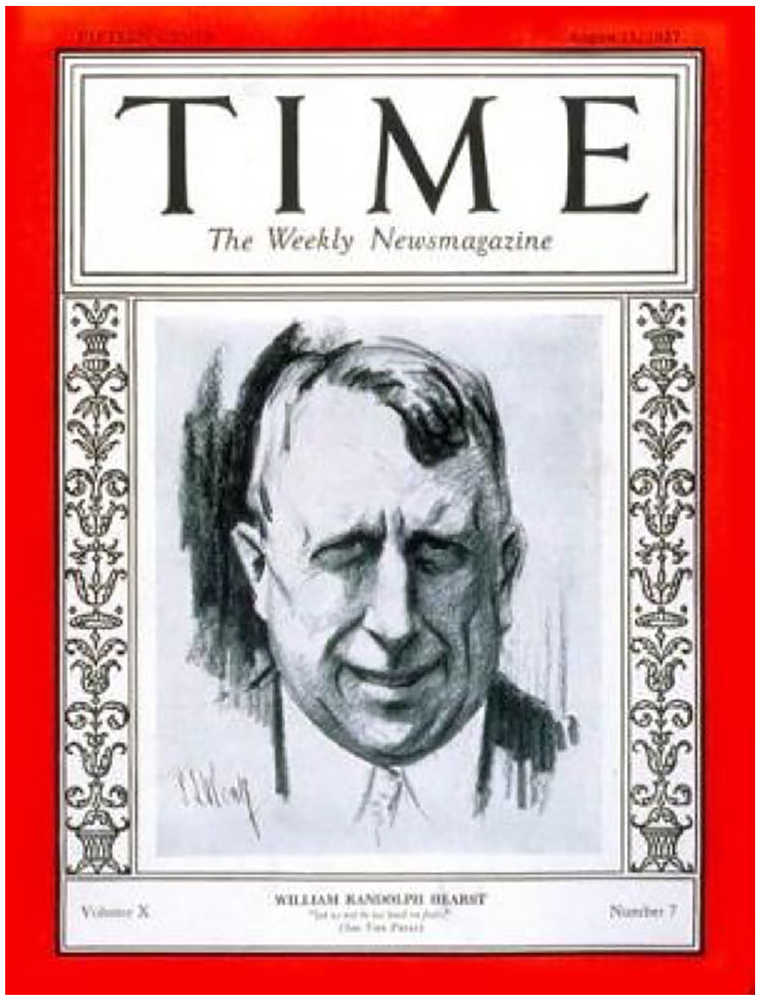
William Randolph Hearst on the cover of Time in 1927.
In the early 1930s, WRH supported Franklin Delano Roosevelt (FDR) for president. A few years later, when WRH’s newspapers began to lose large sums of money, however, his support for FDR waned. WRH thought FDR favored internationalism and viewed a taxation plan Roosevelt proposed as akin to communism (Procter, 2007). WRH came to believe that “communists were indoctrinating students with Marxist philosophy through the public school system and higher education. Hearst therefore worked assiduously to blunt such un-American activities” (Procter, 2007, p. 195). The United States needed to fend off communism and Marxist philosophy, WRH argued, and in keeping with Jeffersonian democracy, it needed to avoid military involvement overseas.
Also in the 1930s, the increasingly conservative WRH supported the efforts of Harry Anslinger, the first U.S. “drug czar,” to rid society of hazardous substances. When Anslinger targeted marijuana, Hearst newspapers perpetuated hysteria surrounding “reefer madness.” The Marijuana Tax Act of 1937 allowed the federal government to tax (and essentially regulate) marijuana. WRH welcomed the law, as he feared hemp would threaten his lumber interests. Scholars have written at length about the alleged threat of Mexican workers who smoked marijuana (Armstrong & Parascandola, 1972; Ferraiolo, 2007; Gerber, 2004; Luginbuhl, 2001; Morgan, 1981; Musto, 1972, 1991; Provine, 2007; Rasmusson, 2014), and Hearst newspapers heightened fears surrounding the substance and the Mexican laborers who allegedly introduced the drug to unassuming White adolescents.
As the 1940s approached, WRH continued to oppose U.S. military involvement in other parts of the world. But patriotism took precedence over isolationism following the Japanese attack on Pearl Harbor in December 1941 (Carlisle, 1974). WRH subsequently wrote in favor of the involvement of the United States in World War II, showing he did not hold categorically isolationist views. In fact, Carlisle noted that many of the foreign-policy positions WRH advanced became “internationalist” stances of both Democratic and Republican presidents in the 1950s and 1960s. During the Cold War, the United States and the Union of Soviet Socialist Republics (USSR) engaged in a nuclear arms race amid an atmosphere of mutual distrust. The military intervention in Vietnam sought to keep another domino from toppling in the direction of communism. WRH used his newspapers and magazines to endorse political candidates who aimed to keep the United States out of wars, but he also knew when military involvement became a necessity, and his publications supported U.S. troops once committed.
WRH lost much of his wealth in the Great Depression, although not entirely because of it. His increasingly conservative politics, denouncement of the New Deal, and vehement anti-communism alienated working-class audiences (Nasaw, 2000; Swanberg, 1961/1996). In 1937, following company restructuring, WRH lost control of his holdings and began to recede from public life. WRH did contribute articles to his media outlets, but his columns often lacked cohesion and incisiveness. At age 88, he died in Beverly Hills, California, in 1951, 10 years after Charles Foster Kane, a character based loosely on William Randolph Hearst, expired in Citizen Kane.
Conceptual Framework
I draw conceptually on the hierarchy of influences model proposed by Shoemaker and Reese (2014). Before I discuss their model, it is important to note that research has shown media portrayals to influence audience perceptions about immigrants (Eberl et al., 2018; Haynes et al., 2016; Schemer, 2012), in some instances through heightened emotional response (Lecheler et al., 2015; Oliver et al., 2012; Seate & Mastro, 2017; Wirz et al., 2018). Depending on the strength and duration of cognitive and emotional reactions, reports that disparage or dehumanize immigrants (Esses et al., 2018) may contribute to hostile or confrontational attitudes and behavior. This may be especially problematic when reports lead individuals to draw “cognitive comparisons to other physical or social ills” (Cisneros, 2008, p. 573). For example, Heber (2020) studied media allegations that immigrants in Sweden polluted that nation with sex-trafficking operations, and Aguirre (2012) observed portrayals of Mexicans as narco-terrorists. Indeed, immigrants from Mexico, like those from nations in Central and South America, have been stereotyped as criminals and violent drug traffickers. Such stereotypes may contribute to perceptions that by their very nature, individuals from those regions pose a threat (Mastro et al., 2007; Valentino et al., 2013). Media portrayals may even lead to physical aggression. Muller and Schwarz (2021) recently found an association between anti-refugee sentiment on Facebook and crimes against refugees.
In their hierarchy of influences model, Shoemaker and Reese (2014) explained media content as a function of the characteristics of individual journalists, media routines, organizational imperatives, extra-media influences, and cultural considerations. If one positions WRH at the individual level, media content would stem, in part, from his upbringing, his travels to Europe, and the time he spent at Harvard. Like many young people, WRH sought approval from his father, and he likely resented the way in which political elites joked about George Hearst and his lack of sophistication. Based on his early travels to Europe, WRH came to favor Germany and show disdain for Great Britain and what he considered its pretentious, outdated monarchy. He spent his time at Harvard somewhat removed from coursework, opting to become involved with the Harvard Lampoon and to study the Boston Globe and the New York World informally. WRH considered himself an advocate for the common man, and he favored certain immigrant groups (e.g., Germans and the Irish) over others (e.g., Chinese and Japanese). Given his influence on the content of his publications, one might expect favoritism (and disdain) toward certain groups to appear in the pages of his magazines.
When WRH became proprietor and editor of the San Francisco Examiner, and subsequently the New York Journal, he communicated with editors and reporters in person, in the respective newsrooms. As he acquired additional outlets across the nation, he communicated his editorial preferences to newspaper and magazine editors by both telephone and telegram. Veteran Hearst journalist Adela Rogers St. Johns, who began her career at the San Francisco Examiner, mentioned that when she visited the Hearst “ranch” at San Simeon, the telephone rarely stopped ringing during the 7:00 p.m. cocktail hour (Nasaw, 2000; St. Johns, 1969). In the eastern part of the country, newspapers were “going to bed” at that hour, and their editors sought content guidance from WRH before final editions went to press.
Lundberg (1937) noted that as WRH acquired more media outlets and began to wield greater societal influence, he “would be busy for the rest of his life endlessly dictating and reading telegrams” (p. 211). A frequent telegram recipient was Ray Long, who WRH hired in 1918 to edit Cosmopolitan and serve as president and editor-in-chief of the International Magazine Company, Inc. In this role, Long supervised all Hearst magazines and became one of the Hearst company’s most valuable assets. As indicated in online supplementary materials for this monograph, Long also assisted WRH in newspaper acquisitions. Still, WRH did not hesitate to voice content objections. Nasaw (2000) discussed a 1929 telegram in which WRH asked Long to remove an article for fear of costing Cosmopolitan “readers of better class” (p. 392). In referring to the prospective article, “Has an Unmarried Woman Right to a Child?” WRH wrote, “This article gives me [a] cold chill” (p. 392). Nasaw provided additional examples of WRH communicating his objections through telegrams, and Hearst’s International editor Norman Hapgood (1930) also discussed telegram exchanges with WRH.
Pizzitola (2002) noted that after WRH entered the film industry—WRH formed Cosmopolitan Productions in 1918—the publisher sent lengthy telegrams to production executives, detailing his expectations for content. WRH had instructed magazine editors to purchase fiction that could be converted into screenplays and had asked Ray Long to oversee the process (Lafontaine, 2021; Tebbel, 1969). 9 Some writers objected to signing over the movie rights to their work (“Authors Criticise Hearst Magazines,” 1921); but as an established magazine publisher, WRH had the leverage to require it. He had seen profit potential in magazine stories after Louis B. Mayer and MGM paid US$15,000 for the rights to a 1917–1918 Cosmopolitan series on which the 1918 film Virtuous Wives was based (Lafontaine, 2021). 10 Throughout 1918, Cosmopolitan had featured the 10-month series, based on Owen Johnson’s novel Virtuous Wives, advertising it in newspapers, magazines, billboards, and window displays. Motion Picture News reported that the magazine exposure, in addition to multiple forms of advertising, led MGM Chairman Louis B. Mayer to state, “The combined advertising and publicity given to the story by the magazine and book publishers constitutes one of the greatest campaigns in the merchandising of popular fiction” (“Film Story Credited with Wide Circulation,” 1918, p. 2956). 11
Indeed, magazine content—and magazine editors—contributed significantly to the business pursuits of WRH. In 1912, a former editor named Edward McManus suggested tying movie serials to print media. WRH recognized the potential for cross-promotion and, in 1914, he produced the 20-part adventure series The Perils of Pauline. Hearst print media promoted actress Pearl White through interviews and features, such that readers would become intrigued and attend movies to see her act as Pauline (Pizzitola, 2002). Lafontaine (2021) commented on cross-promotional strategies: Perhaps Hearst’s greatest achievement concerned his transmedial cross-promotion of film interests throughout his publication empire. Hearst not only devoted ample space to film reviews, but he also occasionally used his newsreel to promote films, financed various promotions and stunts aimed at bolstering Hollywood, and hired the first and most widely read film columnist, Louella Parsons. In addition, he promoted fictionalizations and peppered his papers with stories on subjects discussed in films, thereby raising the public’s interests in both the subjects and the films. (p. 55)
From a hierarchy-of-influences perspective, WRH exercised significant control over the content in his magazines, and that content often reflected his personal views about social and political issues. WRH hired editors and writers who would advance his views, and he paid them well to do so. But he also had profit motives. At the organizational level, his magazines supported ventures in the motion picture industry, supplying content and promoting movies. Cosmopolitan Productions did not focus on immigration per se, but the company and its business partner, MGM, did draw on magazine fiction in producing motion pictures. Thus, “Although they have evoked surprisingly little interest among Hearst biographers, Hearst’s magazines were as important in their own way as his newspapers, and Hearst used them too to promote Hollywood and help him prevail as a film industry leader” (Pizzitola, 2002, p. 350). I now examine immigrant portrayals in Hearst magazines.
Immigrant Representations in Hearst Magazines
This monograph examines content in three Hearst magazines published between 1905, the year WRH acquired Cosmopolitan, and 1945, when World War II concluded. Using 13 search terms, 12 I gathered 82 articles about immigrants and their alleged propensity to import, sell, and use hazardous drugs that were published in Cosmopolitan, Good Housekeeping, and the World To-Day. Drug-related content facilitated the research by shedding light on how certain immigrant groups ostensibly threatened society not only through their presence but also through their habits and customs. I also gathered information from letters written by WRH, government documents, and biographies about WRH, including materials from the Roy W. Howard Archive at Indiana University, the internet Archive, and the Library of Congress.
Initial Portrayals in Cosmopolitan
William Randolph Hearst acquired Cosmopolitan 23 years after the Chinese Exclusion Act of 1882 became law, 13 years after Congress extended the Act, and 3 years after the United States banned Chinese labor immigration permanently. In 1905, China had not emerged as an industrial power, and because Chinese labor immigration had been banned, the nation posed little threat. This reduction in perceived danger facilitated favorable articles about China and its potential to one day emerge on the international stage. For example, Broughton Brandenburg, whose book Imported Americans (1904) documented how Brandenburg and his wife lived among Italians on the east side of New York and traveled by ship to and from Italy to study immigration, wrote for Cosmopolitan’s June 1905 issue. Brandenburg (1905) praised the work ethic of workers in China and noted China’s abundance of natural resources. But he bemoaned the influence of opium: The missionaries, the consuls, the mandarins of the more enlightened class, and all employers of Chinese labor are doing their best to stay the spread of the habit, but without avail. Before the first breath of a great new life is inhaled by this slumbering people, the fumes of the juice of the poppy-pod may have so numbed the senses of the masses, and so vitiated their strong, active bodies, that decay will set in and not growth. (p. 150)
In fact, China banned opium shortly thereafter, in 1906. China had fought two wars with Great Britain to try to halt the flow of opium given its debilitating effects (Hanes & Sanello, 2002). The effort failed: Its military was not as advanced as that of Great Britain. Nevertheless, Brandenburg (1905) wrote optimistically about China and its potential as a nation. Isaac Taylor Headland, a professor at Peking University, also wrote favorably in 1909 about the Empress Dowager, who had died the previous year. In a preface to the article, Cosmopolitan characterized her as “the most impressive woman of the last century—if not the whole world’s history” (Headland, 1909, p. 483). Among the adversities she had faced, Headland mentioned that Great Britain had forced opium on China during her lifetime and that France and Great Britain had driven her from Peking to Jehol (now Chengde). Similarly, Saint Nihal Singh (1912), a journalist who wrote for U.S., British, and Indian publications, profiled Count Shigenobu Okuma of Japan. Asia had awakened from an “ages-long opium slumber” (p. 799), Singh noted, and Okuma had helped it become a “mighty world power whose naval and military successes have wrung unstinted praise from all nations, and whose industrial and economic growth is nothing short of marvelous” (p. 799).
Cosmopolitan also both praised and criticized the European nations about which WRH had written and spoken prior to purchasing the magazine. Charles Edward Russell (1906a), a muckraking journalist and social activist who had exposed abuses in the beef trusts (Miraldi, 2003), lamented that while Germans had once constituted the majority of U.S. immigrants, numbers had dropped precipitously: Not many years ago we used to draw the greater part of our immigration from Germany. Very few Germans emigrate now. They have too much to do at home. You can hardly find a considerable German town that cannot show a new factory or an old one enlarged. The prosperity of the country seems boundless and has a novel kind of patriotic inspiration; it is not alone to make money but to spread Germanism that the merchants strive and dare. (pp. 277–278)
Meanwhile, Cosmopolitan criticized nations “cursed” by caste systems. Russell (1906b) began a series by describing how India’s “hideous social system still retards progress, discourages education, and destroys ambition, while her British rulers remain indifferent” (p. 124). Russell (1907a) then contrasted “England’s System of Snobbery” to democracy, which Russell characterized as “free and absolutely equal opportunity to all men without the slightest respect to the accident of birth” (p. 285). Russell discussed the caste system worldwide, and the growth of caste in some sectors of the United States (Russell, 1907b, 1907c). Russell (1907c) attributed the deaths of more than 60 men aboard the U.S.S. Bennington, a gunship whose boilers had exploded, to an “insidious” caste system that had developed in the U.S. Navy. At one point, Russell noted, the Navy had considered line and staff officers equivalent; line officers stood on the bridge and gave orders, and staff officers worked below as engineers. But the Navy had grown increasingly concerned about its perception in England, where “no gentleman is an engineer” (p. 526). After Annapolis curtailed its engineering instruction, people with insufficient training began to work below deck, and tragedy followed.
Soon after WRH acquired Cosmopolitan, then, some writers advanced several of his world views to national audiences. The magazine also sounded an alarm when nations appeared threatening. For example, Goldwin Smith (1907) characterized Japan as a “world menace” tending toward “aggrandizement and expansion” (p. 604). In 1908, Richmond Pearson Hobson, a veteran of the Spanish-American War who became a longtime contributor to Hearst newspapers and magazines, wrote a series of three Cosmopolitan articles titled “If War Should Come!” (Hobson, 1908a, 1908b, 1908c). As a Rear Admiral in the U.S. Navy, Hobson intentionally sank the Merrimac, a ship in his command, near Santiago in an attempt to obstruct the enemy fleet (Rosenfeld, 2001). He became a prisoner of war and a hero for his bravery in scuttling the Merrimac.
In September 1909, Cosmopolitan published an article about Chinese individuals that bore little resemblance to coverage of the Empress Dowager 6 months before (Headland, 1909). In “The Yellow Pariahs,” journalist Charles Somerville (1909) described the June 1909 killing of a young woman named Elsie Sigal by a Chinese immigrant in New York City’s Chinatown. An editor’s note introduced the article: Attention has been riveted upon the Chinese quarters of our great cities by the atrocious murder of a young white woman, supposedly by a “Christianized” Chinaman. It is a shock to the law-abiding people of this country to learn that in nearly all our great cities there are settlements of Orientals who are with us but not of us, who administer their own affairs according to their own conception of what is right and wrong, who never subscribe to or heed either our laws or our customs and even arrogate to themselves the power of life and death over their own people in the community. . . . In Boston ten Chinamen were tried for acting as executioners of death-sentences decreed by themselves. Five have been found guilty and sentenced to death. The Chinese are a great problem. (Somerville, 1909, p. 467)
Somerville’s (1909) content and tone differed markedly from Brandenburg (1905) and Headland (1909), whose articles originated in China, where no particular threat existed. In the United States, the Chinese apparently had become a “great problem,” capable of committing vicious crimes and introducing their own brand of justice. Some of the crimes involved White women, long symbols of purity and virtue (Fischer, 2006; Junn, 2017). According to Somerville (1909), the Chinese had established their own culture in the United States and did not care to assimilate (i.e., “with us but not of us”). White women also put themselves at risk when they visited Chinese districts in urban centers: “The dangerous futility of it all is not written alone in the blood of Elsie Sigel. It can be traced to the tears of thousands like her who, wide eyed expectant, and religiously enthusiastic, approached the morass of Chinese duplicity, and remained to be fascinated into degraded exile from their kind” (p. 468). Somerville reported that Chinese men who belonged to tongs, or violent secret societies, engaged in slashings and stabbings, meting out their own brand of justice with hatchets as well as firearms. “They croon over the smoking opium pill, watch with furtive eyes the shift of cards in the game of fan-tan, or bow with solemn dignity before their gods” (p. 468).
In the month prior to the Cosmopolitan article, the San Francisco Examiner had published more than 20 news reports and an editorial about the homicide. Front-page headlines, published on successive days beginning June 19, 1909, included “Woman Strangled, Hidden in Trunk” (1909); “Elsie Sigel Warned Against Chinese” (1909); “Chinese Rival Cause of Miss Sigel’s Death” (1909); “Two Chinese Loved Elsie, Father Knew” (1909); and “Eye to Keyhole, Chinese Saw Elsie Sigel Murdered” (1909). An editorial stated on June 26 that although the homicide occurred in New York City’s Chinatown, it bore some resemblance to “Oriental contamination” in California: These Asiatic settlements are hotbeds of vice beyond the comprehension of decent white people. With enigmatical stolidity the yellow degenerates practice vice as a pastime, lying as an accomplishment. . . . They are utterly devoid of conscience and shame. Many who seem gentle are monsters of depravity, according to our ethics. They seem to regard vice as natural. . . . Given the opportunity they defile mere children. With leprous bodies and rotten hearts, they hide it all behind a mask of cunning impossible to tear from them. (“The Sigel Murder a Lesson to the East,” 1909, p. 20)
In August 1909, the San Francisco Examiner published advertisements for the Cosmopolitan article. “The Fate of Elsie Sigel” appeared on August 22, and “Remain Fascinated in a Life of Degradation,” a quote from Somerville, appeared on August 26. The text in the latter ad stated, “The Chinese in this country are impregnable to American civilization. They acknowledge no laws save those of their own ‘tongs’” (p. 7).
Yellow peril did not stop U.S. trade with China. In February 1909, the United States organized a meeting of the International Opium Commission in Shanghai (Wright, 1909). As a show of support for China’s efforts to eliminate opium, also in February, the United States passed the Smoking Opium Exclusion Act of 1909, which banned the importation of opium for smoking purposes. China had earlier imposed a voluntary trade embargo on the United States based on the latter’s treatment of Chinese laborers (Musto, 1991); the Smoking Opium Exclusion Act constituted an attempt at diplomacy. That is, the United States was (allegedly) willing to do its part to reduce the number of opium dens and discourage opium use among Chinese people living within its borders. A reduction in opium dens, in turn, would mean fewer White women being lured into “degraded exile” (Somerville, 1909, p. 468) by duplicitous Chinese men.
Notably, while the U.S. government banned opium for smoking, the 1909 law did not restrict opium in other forms; it remained available for the nostrums and elixirs sold as “patent medicines” (Courtwright, 2001), advertising for which contributed significantly to the media empire being constructed by WRH. Between 1903 and 1912, prominent magazines criticized the patent-medicine industry (Denham, 2020), which had become known for scams and lack of medical legitimacy; Cosmopolitan, however, remained conspicuously silent on the topic. This silence was not lost on Samuel Hopkins Adams, the author of the 1906–1907 Collier’s investigative series “The Great American Fraud.” Adams (1906) pointed out that Hearst newspapers received more than half a million dollars each year from patent-medicine advertising.
13
A June 1912 issue of Collier’s pictured WRH on the cover as one of “Two Patent Medicine Statesmen.” The cover story noted that while Hearst newspapers had announced they would rid their pages of “objectionable medical advertising,” patent-medicine ads continued to appear: The plain and painful fact is that Mr. Hearst doesn’t want to clean up. He only wants to get the credit for cleaning up. When it comes to the issue, it isn’t the principle that sways Mr. Hearst. It is the profits. So long as medical fraud pays, it will hardly be found objectionable . . . (“Two Patent Medicine Statesmen,” 1912, p. 26)
Cosmopolitan writers had criticized the Chinese for smoking opium and operating hazardous dens, but criticizing its presence in patent medicines appeared verboten. Manufacturers could threaten to stop advertising in newspapers at any point, and outlets opting to criticize patent medicines stood to lose an important source of revenue. Thus, as drug historian David Courtwright (2001) observed, “What we think about addiction very much depends on who is addicted” (p. 4) – an observation that could be extended to media portrayals, regulation, and substances themselves. For example, although morphine and heroin were both derived from opium, heroin use would become less acceptable, in part, because it was associated with immigrants: In the 1910s and early 1920s heroin use became widespread in the immigrant slums, where young men took to snorting small packets of the white powder. . . . Disdain for users, tinged by ethnic and class prejudice, was an impetus for restrictive legislation. (Courtwright, 1992, pp. 5–6)
One law aimed at regulating drug use, the Harrison Narcotics Tax Act of 1914, required sellers of opiates and cocaine to register with the Bureau of Internal Revenue and pay a small tax (Musto, 1999). Where the Smoking Opium Exclusion Act of 1909 had served diplomatic efforts in Shanghai, the Harrison Narcotics Tax Act of 1914 showed that the United States was willing to impose stricter laws on narcotics and thus contribute to international control efforts (Cantor, 1961; King, 1957). 14 While the 1909 law had focused on opium smoking among the Chinese, the Harrison Act followed increased attention to cocaine use among Black men (Cohen, 2006; Musto, 1999).
Hearst Expands His Magazine Footprint
In 1911, 6 years after acquiring Cosmopolitan, WRH purchased Good Housekeeping, a consumer magazine with a circulation of about 300,000. Shortly after acquiring it, WRH hired Dr. Harvey Wiley, “father” of the Pure Food and Drug Act of 1906, as food editor and contributing writer. But most Good Housekeeping content relevant to this monograph appeared at a later point, first in the article “Whose Country Is This?” by future president Calvin Coolidge (1921) and then in multiple articles published in the 1930s after Good Housekeeping’s circulation increased to more than 1.5 million (Nasaw, 2000). At that point, WRH had begun to support the efforts of Harry Anslinger, the first U.S. “drug czar,” to stamp out marijuana. I discuss related content later in the monograph.
Along with his purchase of Good Housekeeping in 1911, WRH also acquired the World To-Day. Like Cosmopolitan, the World To-Day (and its subsequent titles) “shouted” political sentiments to national audiences. When it became Hearst’s Magazine in 1912, a short article reminded readers that Great Britain had stymied progress in China—twice: Opium is about the worst known habit-forming drug, the most destructive poison imaginable to the race, because of its will-destroying function. . . . When the late imperial government in China and also the new republic took measures again to save the Chinese from this pest, the English merchants threatened. They had two hundred and fifty million pounds worth of opium in their stores; and to hell with the Chinese. (“Trend of the Times,” 1913, p. 292)
Cosmopolitan had portrayed the Chinese as a threat inside the United States (Somerville, 1909), but consistent with Brandenburg (1905) and Headland (1909), who contributed articles to Cosmopolitan from inside China, the World To-Day characterized the nation as one Great Britain had dominated militarily, advancing Britain’s financial interests in the process. 15
In 1915, Arthur Brisbane wrote a series of articles for Hearst’s about immigrants’ struggles in the United States. Unlike Somerville’s (1909) Cosmopolitan article, which suggested an internal predisposition for deviance among Chinese immigrants, the Brisbane series in Hearst’s, titled “Making a Criminal,” attributed problems to society and an unsympathetic government. Individuals portrayed in Figure 2 (Brisbane, 1915a) are notable because of their European features and the fact that Brisbane did not attribute their struggles to inherent shortcomings of character. In fact, the following phrase appeared below his name: “Betend dass Gott dich erhalte so rein und schon und hold,” or “Praying that God may preserve thee, so pure and beautiful and good” (p. 270).
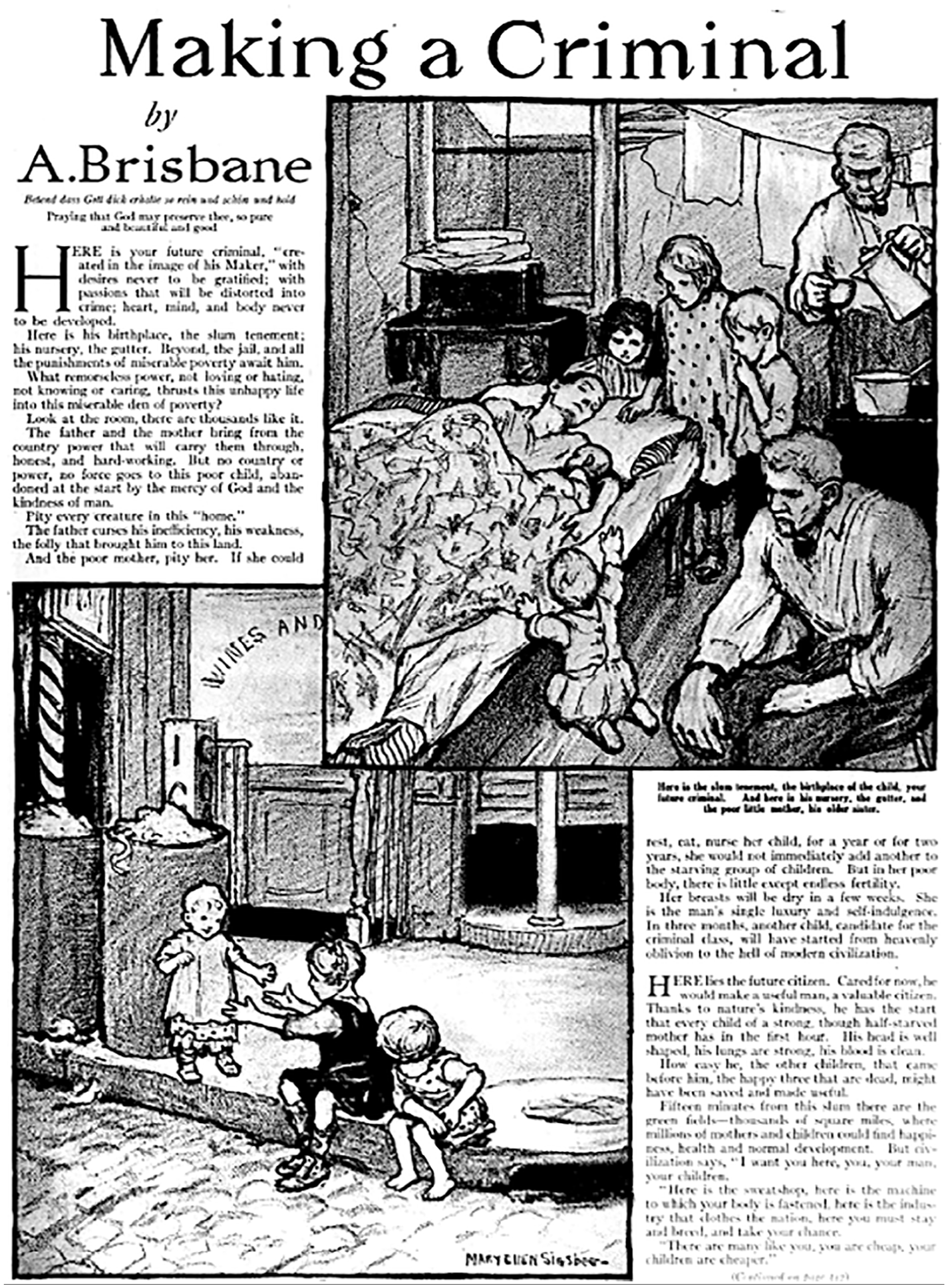
1915 Hearst’s article showing immigrants struggling in new nation.
Brisbane (1915a) wrote, The family, the children coming each year, stay in the slums, live and die there, and there from good, hard-working men and women are bred the criminals, the gun men, the cocaine fiends; all the various victims of poverty, dirt, darkness, and starvation. (p. 317)
As Brisbane saw it, society turned these otherwise productive individuals into criminals, as opposed to individuals with criminal proclivities arriving and burdening society. Subsequent articles in the series showed how children of immigrants grew up playing games in the streets, learning how to gamble (Brisbane, 1915b), and becoming seasoned criminals. Discussing paradoxes in the “land of opportunity,” Brisbane (1915c) asserted a young immigrant whose demise appeared imminent “could be saved, if it were any part of our republican government to feel responsibility for the human being, willing to work” (pp. 429, 460). To a small degree, Brisbane appeared to channel WRH’s contempt for Republican politicians, alleging the government had failed young men who possessed great potential.
In a fourth article, Brisbane explained how an otherwise productive citizen turns to crime and, after being apprehended, “stands, a weak, white-faced, trembling creature, before the judge” (Brisbane, 1915d, p. 528). The Making a Criminal series concluded with the immigrant incarcerated at “crime university, the penitentiary” (Brisbane, 1915e, p. 49). Following their time in prison, Brisbane wrote, individuals might lose hope and succumb to despair. Each of the five articles in Hearst’s contained two drawings of individuals with European appearances, as the author argued that society and the federal government had failed immigrants. Brisbane pointedly referred to the drawings in text, encouraging readers to examine them.
Magazines also backed WRH’s opposition to U.S. involvement in World War I. In 1917, WRH screened a 15-part adventure serial, Patria, in an attempt to shift attention away from Europe. In this heavily propagandistic serial, the heroine Patria defends a munitions factory against Japanese spies and their Mexican allies. Nasaw (2000) characterized Patria as “virulently racist,” (p. 262). While Patria ostensibly addressed “war preparedness,” Pizzitola (2002) called it “a fast-moving tirade against Japan and Mexico” (p. 155). U.S. President Woodrow Wilson appealed to Hearst representatives to remove some of the most blatantly racist content, as Japan, in particular, would serve as a U.S. ally in World War I. Some edits were made, but the content remained largely the same as did the ongoing dislike between Wilson and WRH. Their views on Great Britain and Germany moved in opposite directions. As shown in the supplementary materials for this monograph, Hearst newspapers and magazines promoted Patria in advertisements, pictorials, and reviews (e.g., Bigelow, 1917; Vance, 1917).
Fiction and fact-fiction in Hearst’s and Cosmopolitan
In addition to nonfiction, Hearst’s and Cosmopolitan published both fiction and “fact-fiction” articles. Fact-fiction, in particular, allowed magazines to dramatize news events and shape them for mass consumption. As Nasaw (2000) noted, “The cult of objectivity which would define journalistic standards—if not always journalistic practices—later in the twentieth century was not yet in place. What readers expected of their newspapers was not literal, but figurative truth” (p. 79). Because fiction can contribute to perceptions of social reality (Appel & Richter, 2007; Mutz & Nir, 2010), considering the messages readers got from fiction and fact-fiction accounts is important.
Corrupting youth
A May 1914 Campbell MacCulloch piece of fact-fiction, “Black Ruin,” focused on adolescent boys employed as night messengers, making the point that messenger jobs eroded the national social fabric by exposing young men to sordid environments and turning some into addicts. The story focused on a 13-year-old, George, who worked at the Eastern Consolidated Telegraph Company from 6:00 p.m. to 3:00 a.m. His “sporting district” callers request the likes of opium and cocaine. MacCulloch described one customer as a “half-crazed woman, an inmate of a vile den, who was mad for morphine” (p. 664). A stranger asks George about the dope to which he has access: “Cocaine, opium, an’ morphine. Some of them are using a new stuff now. They call it heroin” (p. 665).
George experiments with all of the substances he delivers and is eventually hospitalized as an addict. His mother pawns her wedding ring and purchases a revolver, which she uses to attempt to kill the manager of the telegraph company. During her trial, at which she is presented as a sympathetic witness, her attorney receives a note that George has died in the hospital. The story concludes with this final paragraph: Fathers and mothers of America, there is not a particle of exaggeration in this story. Every fact herewith set forth is a fact, in a general indictment drawn against most of the telegraph companies of the United States. Each statement is based upon painstaking, careful investigation by men trained in such work. The whole is founded upon a series of reports to which have been attached affidavits. Names, dates and places are given (but the names, dates and places in this story are fictitious). The things there revealed constitute a record so horrible in specific detail that it could by no possibility be printed for public reading, nor could it be read in open court without clearing the room. This record covers nine states and twenty-eight cities, the greatest in the country, and the conditions there described exist to-day, now. Think, think what this means! (pp. 669)
For magazine readers, it likely meant an increased awareness of messenger companies functioning as drug-delivery services, relying on 13- and 14-year-old boys to transport narcotics in seedy districts. The telegraph company appears to have transformed naive White boys into drug runners who sometimes experimented with narcotics and became addicts themselves. As a part of their routines, young messengers witnessed the trappings of “vile” opium dens and the madness of addicts in search of a fix. “Black Ruin” explained the problem of heroin, which was increasingly popular as a mind-altering substance in the sporting districts. Photos of adolescents smoking cigarettes and preparing for work appeared throughout the article, blurring the lines between fiction and nonfiction.
Investigating crime and its victims
Mystery writer Arthur B. Reeve incorporated drugs of abuse, as well as the ill intentions of those who peddled them, into a Cosmopolitan series about a fictional detective named Craig Kennedy who applied the latest in scientific advancements to crime scenes and victims of foul play. Cosmopolitan described the stories, launched in 1910, as “twentieth-century, up-to-the-minute tales of criminals and their undoing by scientific methods that are always one jump ahead of the most ingenious lawbreaker’s cunning” (Reeve, 1912a, p. 128). As MacCulloch (1914) did in “Black Ruin,” Reeve identified popular drugs then being abused as well as those who used such drugs to manipulate, even kill, unsuspecting victims. Stories sometimes relied on stereotypes of cruel, cunning individuals, with Kennedy ultimately outsmarting perpetrators and helping to bring criminals to justice.
One story (Reeve, 1911), for example, explained how mescal had been weaponized against an individual whom Kennedy had managed to resuscitate. A second story contained the type of hyperbole that would accompany “reefer madness” in the 1930s: “The White Slave” told of a young woman who had disappeared. Her remains eventually located: “Drawn and contorted were the features of the poor girl, as if she had died in great physical agony or after a terrific struggle. Indeed, marks of violence on her delicate throat and neck showed only too plainly that she had been choked” (Reeve, 1912a, p. 131). Kennedy visits several clairvoyants before concluding, based on comparisons of human hair, that the young woman had been lured to the den of a cult where she had consumed marijuana. The detective had not been satisfied with strangulation as the sole cause of death and explained the different ways cannabis could be consumed before discussing its effects: Slight vexation becomes deadly revenge; courage becomes rashness; fear, abject terror; and gentle affection or even a passing liking is transformed into passionate love. It is the drug derived from the Indian hemp, scientifically named Cannabis Indica, better known as hashish, or bhang, or a dozen other names in the East. . . . Under its influence, natives of the East become greatly exhilarated, then debased, and finally violent, rushing forth on the streets with the cry, “Amok, amok,”—“Kill, kill”—as we say, “running amuck.” An overdose of this drug often causes insanity, while in small quantities our doctors use it as a medicine. (Reeve, 1912a, p. 139)
Exaggerating the effects of marijuana, Kennedy identified its origins in Asia and its use by individuals of Asian descent to commit violent crimes in the United States, in this case, a swami. Meanwhile, Kennedy made a point of mentioning its medical use in responsible dosages, thus avoiding the implication that it should have been made illegal.
In “The Opium Joint” (Reeve, 1913a), Kennedy receives a call indicating that a woman from a prominent White family in Manhattan has been killed. The deceased woman had intended to marry a wealthy Chinese man, a tea importer, who will ultimately be held responsible for her murder. As Kennedy and law-enforcement officials investigated the case, much of which took place in Chinatown, the narrator described the scene at an opium den following a raid: It was low, common, disgusting. The odor everywhere was offensive; everywhere was filth that should naturally breed disease. It was an inferno reeking with unwholesome sweat and still obscured with dense fumes of smoke. . . . There was no glamour here; all was sordid. (p. 120)
Later, the officials came across “a Chinaman, stoical, secretive, indifferent, with all the Oriental cunning and cruelty hallmarked on his face” (p. 121). An illustration showed boxed shipments from China and the “cunning” criminal who prepared opium for sale in Chinatown.
Reeve (1912b) also used the purity of White women as a standard against which to measure women of other races and ethnicities. He told the story of a Hispanic woman who had been found dead—“a beautiful woman she had been, too, though not with the freshness which makes American women so attractive” (p. 384). The woman may have fallen victim to an endormeur, an individual Kennedy described as highly intelligent and adept at putting others to sleep—not death—to facilitate criminal acts. Kennedy also investigated a case involving narcophin, a derivative of opium, and the drug scopolamine hydrobromide—a substance used to induce “twilight sleep,” a kind of trance in which a victim teeters on the brink of consciousness, able to perceive but unable to remember (Reeve, 1915a). One of his cases involves absinthe, which Kennedy described as a “narcotic poison” nearly “as fatal as cocaine in its blasting effects on mind and body” (Reeve, 1913b, p. 628). Another involved horse-racing and a fatigue-inducing kenotoxin (Reeve, 1915b).
Reeve included heroin in two stories published in 1914. Kennedy mentioned that heroin had a more profound effect than morphine and was 10 times stronger than codeine. He said it was “rotting the heart out of” (1914a, 382) the seedy districts known as “tenderloins” where the drug had become known as “happy dust” (Reeve, 1914b, p. 760). Kennedy explained heroin’s pharmacology to his confidante, Walter Jameson, who accompanied the detective to crime scenes: Its scientific name is diacetyl-morphine. It is New York’s newest peril, one of the most dangerous drugs yet. Thousands are slaves to it, although its sale is supposedly restricted. . . . It can be taken hypodermically, or in a tablet, or by powdering the tablet to a white crystalline powder and snuffing up the nose. (Reeve, 1914a, p. 382)
Kennedy also investigated cases involving cocaine. “The habit is spreading like wildfire . . . . Cocaine is one of the most harmful of all habit-forming drugs. It used to be a habit of the underworld, but now it is creeping up, and gradually and surely reaching the higher strata of society” (Reeve, 1913c, p. 780). In fact, Reeve (1917) told the story of a supposed cocaine-smuggling operation in Peru, whose smuggling techniques would actually be used later in the century to move drugs from South America to the U.S. Legal shipments required the payment of taxes; smuggling not only “exempted” shipments from taxes but also enabled drugs to be sold illegally for higher profits.
Becoming an addict
After World War I, Hearst’s began to publish more articles about drugs of abuse. In 1920, a three-part series offered a first-person fictitious account of a young woman who experiences addiction. After her husband, Joe, departs for France to fight alongside General Pershing in World War I, the young woman has difficulty sleeping. She explains this difficulty to “Mrs. K,” who administers a drug that relieves the anxiety. The young woman begins to request more and more of the substance. Eventually, she convinces Mrs. K to take her directly to a source in Chinatown. As the first article closes, the young woman writes, “I had often heard that heroin was the most terrible drug on the market. But it was bringing me such joy that even though it would kill me I still could not do without it” (“The Sting of the Needle,” 1920, p. 75).
In the second installment, Joe is killed in action and his widow has become a full-fledged addict. She routinely visits Chinatown, where the operator of an opium den, Li Hund, takes all of her money and commands her to bring him her jewels and additional valuables. She experiences visions and hallucinations, having discovered “how delicious the effects of morphine or cocaine could be in conjunction with the smoking of opium” (p. “Down the Dark Lane,” 1920, p. 40). Her departure from reality reaches a crescendo when she kills Li Hund, whom she calls her “Chinese tormenter,” in the final segment of the story (“Like a Bad Nightmare,” 1920). Hearst’s published a drawing depicting a vision experienced by the character in the story. In the illustration, shown in Figure 3, Li Hund, the proprietor of an opium den, prepares to sink his claws into the young woman. 16
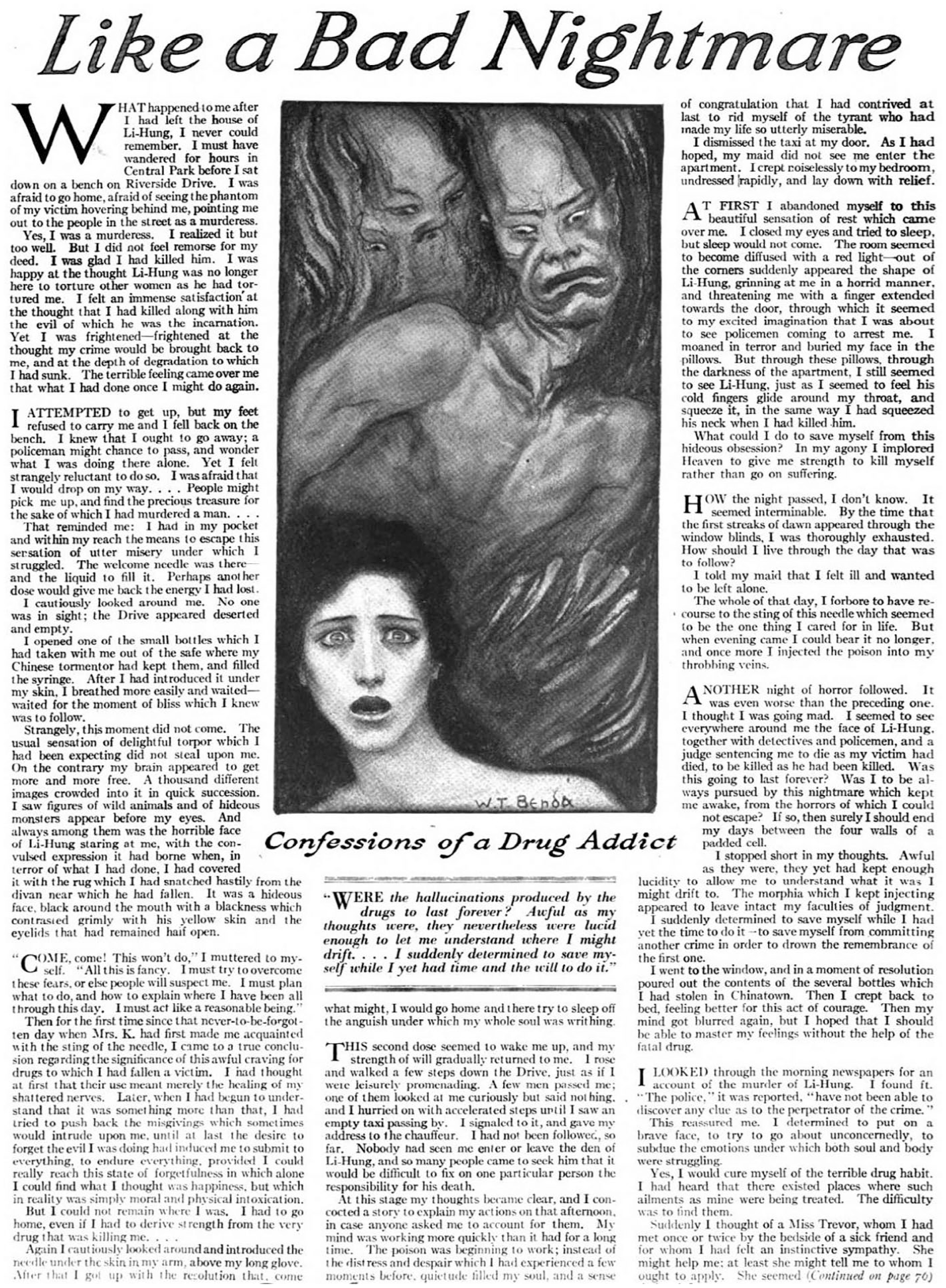
1920 Hearst’s story about a woman experiencing drug addiction.
The “Chinese tormenter” in the preceding piece of fiction resembled a character described earlier in “The Opium Joint” (Reeve, 1913a) as well as the Chinese man who killed Elsie Sigal, discussed in the nonfiction Cosmopolitan article (Somerville, 1909). Taken together, fiction and nonfiction may coalesce to create exaggerated perceptions of crime and social reality among readers; that is, dramatizations of Chinese men with evil intentions may have interacted with one or more news exemplars to show what happened to White women in “degraded exile.” 17
Post-War Reporting
Returning to nonfiction, Kenneth Roberts (1919), a journalist who would become known for his work in the Saturday Evening Post and as a historical novelist, wrote in the Cosmopolitan article “Oriental Irritants” that “a clever bit of treaty-breaking” (p. 63) had allowed Japan to take control in Korea. Roberts differentiated between political leaders in Japan who appeared friendly toward the United States, and the military there, much of which favored the United States being “sunk without a trace” (p. 112). Two years later, Danish historian Georg Brandes (1921) wrote in “Bright Prospects for New Wars” that Japan had acquired the Chinese province of Shantung, and its domination there had become a menace to the United States: America cannot stand by peacefully and watch Japan increase her domination until she becomes the leading power in the Far East, and the mistress of the Pacific Ocean. Such domination threatens the Philippines . . . . On the other hand, Japan opinion is stirred up bitterly against the United States because Japanese subjects are not allowed to settle in California and elsewhere. Japan needs an outlet for her growing population and feels that the United States is trying to keep her hemmed in. (p. 75)
As indicated in the section below, Japanese perception about being “hemmed in” would prove accurate. But already in 1922, the Russian novelist and political activist Maxim Gorky (1922), in an essay titled “The menace of Asia,” contrasted Eastern and Western philosophies. He noted, “Opium and other beloved narcotics, the purpose of which is to stimulate or benumb, came from the Orient” (p. 5). The Orient privileged moods and feelings, Gorky wrote, relying on metaphysical dogma and making nature a God. “The task of European science is to investigate the forces of Nature and to place them at the service of men, so that the individuals may be freed from dogma, superstition, prejudice, enforced labor: so that his bodily energies, thus freed, may be changed into spiritual power” (p. 5). 18
Crusading in Hearst’s International
The Hapgood approach
In 1906, Samuel Hopkins Adams helped to expose the patent-medicine industry in a series of articles for Collier’s magazine. His editor at Collier’s, Norman Hapgood, advertised the series, “The Great American Fraud,” in other periodicals and commissioned an illustration showing a skull with patent medicines and bags of money suggestive of graft. The illustration, “Death’s Laboratory,” has been reproduced in multiple texts about investigative reporting and the history of drug use. In 1915, Hapgood again commissioned a series of articles about patent medicines, this time as editor of Harper’s Weekly. He advertised the George Creel series in other magazines and promoted the series in Harper’s Weekly itself. In 1923, as editor of Hearst’s International, a magazine with a circulation of 443,000 (Siff, 2015), Hapgood commissioned writer and dramatist Sidney Howard to investigate drug use in the United States and write a series of cover stories. Silent film star Wally Reid had died in January 1923 as a consequence of morphine addiction (Siff, 2015), 19 providing the series a timely news event to generate audience interest. Beginning with its February 1923 issue, the magazine featured the series “The Inside Story of Dope” in six successive issues. 20 As Hapgood had done with The Great American Fraud series, he commissioned an artist, Rodney Thomson, to create a dramatic image that would capture attention and promote the work. The illustration shows a woman clenched in the teeth of a drug beast, another life lost to a predator.
Although Hapgood served as editor during the Hearst’s International drug series, he attributed the series idea to WRH: (I)t brings out a dominating trait in him, since he has kept his newspapers on that scent for a quarter of a century; not because he thinks such iteration pays, but because he feels intensely the human danger done by drugs. (Hapgood, 1930, p. 287)
The San Francisco Examiner helped to draw attention to the magazine series when, on January 21, 1923, it published a letter from Bertha Westbrook Reid, mother of deceased actor Wally Reid, as a short news article (“Wally Reid’s Mother Begs Mr. Hearst to War on Drug Menace,” 1923).
Full-page advertisements about the series appeared in multiple newspapers as did smaller ads. An examination of newspapers from 1923 [at newspapers.com] showed advertisements for the series in these newspapers (not all Hearst): Baltimore Sun, Boston Globe, Buffalo Enquirer, Buffalo Times, Chicago Tribune, Fort Worth Record-Telegram, Hamilton Evening Journal (Ohio), Indianapolis News, Indianapolis Star, Kansas City Star, Minneapolis Star Tribune, Pittsburgh Gazette Times, Pittsburgh Press, San Francisco Examiner, and St. Louis Post-Dispatch. 21 Advertisements likely increased awareness of the series.
Identifying the undesirables
In its preface to the February 1923 article by Howard, his first, the magazine noted that every senator and congressman in Washington, D.C., would get a copy of Hearst’s International for the duration of the series: “The rulers of our country shall know the ravages of this vice. They will be compelled to act” (Howard, 1923a, p. 14). This statement is noteworthy because the magazine series identified the groups allegedly responsible for trafficking cocaine, heroin, and morphine in the United States. Howard explained that cocaine, from coca leaves grown in South America, was “the high-stepping murderous stimulant of the disreputable. . . . The ‘dope-fiend’ of newsprint and criminology is properly the cocain [sic] sniffer. . . . He is completely and unutterably vicious” (p. 16). Howard noted that while the cocaine user was a “wild man” when using the drug, morphine and heroin users also became wild men without their drugs. The initial article’s hyperbolic claims included: “Drug addiction is responsible for some of the most atrocious crimes on record” (p. 16) and “Dope is a known menace of unknown proportions” (p. 17). To the extent such assertions alarmed policymakers, it may have increased their concern for groups the series held responsible.
Howard’s (1923b) second report focused more intently on those groups. While the “yellow race” had trafficked in smokable opium, he noted: “Dope is brought to the American Underworld through many channels, but it is sold thence chiefly by Italians, and the dealers who direct the selling are almost without exception Jews. Dope is virtually a Jewish-Italian monopoly” (p. 28). 22 Although Italians and Jews may have participated in the drug trade, attributing nearly all sales to the groups exaggerated their involvement. But situated in the context of immigration policy, blaming the two groups for selling illicit drugs appeared consistent with legislation characterizing Italians and Jews as “undesirable” immigrants.
To reduce admissions of groups considered “undesirable,” the U.S. government passed the Emergency Quota Act of 1921 and then the Immigration Act of 1924 (Wong, 2017). The latter policy became what journalist Daniel Okrent (2019) called “the most comprehensive barrier to immigration in the nation’s history, both then and ever since” (p. 336). The 1921 and 1924 Acts reflected both a new fear of mass migration (Marinari, 2020) and a belief in the emerging “science” of eugenics, which held that to strengthen the species, individuals possessing desirable human traits should be encouraged to mate. Research on eugenics purportedly showed a need to welcome individuals from the northern and western regions of Europe and turn away those from the southern and eastern regions. The Immigration Act of 1924 codified that belief, reflecting race-based nativism (Ngai, 1999) and a preference for immigrants from the United Kingdom, France, Germany, Belgium, and Scandinavia. Fewer immigrants from the Mediterranean region of southern Europe and the Alpine region to the east would be permitted to enter the United States.
The Immigration Act of 1924 eventually permitted the admission of no more than 165,000 immigrants in total per year—about 20% of pre-World War I numbers—and ensured curtailment of Italians and Jews by basing quotas on the U.S. census from 1890; more recent determinations had been based on data from 1913. While 222,260 Italians entered the United States in 1921, that number fell to 2,662 in 1925 (Okrent, 2019). As journalist David Turner (2013) pointed out, although Jews constituted at least 2% of the U.S. population in 1913, they constituted less than 1% in 1890; so using the earlier census numbers meant a significant drop in the number of Jews allowed in. In addition to curtailing immigration from southern and eastern Europe, the 1924 law totally banned Japanese immigrants. 23
As it happened, the second magazine installment by Howard (1923b), which attributed illicit drug sales to Italians and Jews, appeared in the March 1923 issue of Hearst’s International, available to readers in mid-February. At this time, members of the House Immigration Committee were drafting what would become the Immigration Act of 1924. The San Francisco Examiner provided readers with near-daily updates (“Immigration Board Favors Rigid Barrier,” 1923; “Sweeping Ban Proposed on Immigration,” 1923; Universal Service, 1923a, 1923b, 1923c), also including editorials (“Half Wrong, Half Right,” 1923) and op-eds from columnists including longtime Hearst writer Winifred Black, who wrote under the pen name Annie Laurie. Three of Laurie’s February 1923 columns, published on successive days, began with lengthy passages from the Hearst’s International series on dope. On February 23, Laurie (1923a) herself considered whether marijuana, “the new Mexican drug” (p. 16) had led to a homicide in Los Angeles. Her next column (Laurie, 1923b) characterized marijuana as a “Mexican plant” whose habitual users were “habitually haunted by dreams of murder” and turned into “blind, deaf, murdering beast[s]” (p. 18). A third column, headlined “Far East Finds Ready Dope Market in U.S.” (Laurie, 1923c, p. 7), discussed how opium typically traveled from the Far East to the United States. Again, each of the three columns began with a passage from the Hearst’s International series, thus promoting the work of Sidney Howard to readers of all newspapers belonging to the Hearst newspaper syndicate, Cosmopolitan News Service.
Laurie had drawn attention to Japan as an opium source in 1922, maintaining, “Japan keeps opium out of Japan, but the Japanese buy it and sell it and send it in and out of China and in and out of the United States . . .” (Laurie, 1922a, p. 5). “The Japanese are the greatest peddlers of narcotic drugs on the Pacific coast” (Laurie, 1922b, p. 7). In an April 15, 1924, editorial, WRH wrote that “I am strongly in favor of Japanese exclusion, to prevent these Orientals swarming into the country and absolutely overrunning it . . . . We want our country not merely for the white races, but for Occidental standards of wages, standards of living and conditions of labor . . . . This is not race prejudice. It is race preservation” (quoted in Tompkins, 1948, p. 256).
Hearst magazine content resembled newspaper opinion articles in that few appeared favorable to the Japanese. Hearst outlets were not unique in this regard: Publications from other companies also criticized or dismissed undesirable immigrant groups. Discussing the centrality of magazine journalism to the bigotry experienced by Jews and Italians in the 1920s, Okrent (2019) explained how George Horace Lorimer, editor of the Saturday Evening Post and a political moderate prior to World War I, had turned the magazine into “a hothouse for the most virulent anti-immigration rhetoric” (p. 268). In addition, the Hearst publication Good Housekeeping provided recently elected Vice President Calvin Coolidge editorial space for the article “Whose Country Is This?” Coolidge (1921) posited here that “racial tradition” stood to facilitate assimilation among immigrants, and that immigration restrictions were necessary to exclude those who either objected to American ideals or lacked the capacity to make meaningful contributions: There are racial considerations too grave to be brushed aside for any sentimental reasons. Biological laws tell us that certain divergent people will not mix or blend. The Nordics propagate themselves successfully. With other races, the outcome shows deterioration on both sides. Quality of mind and body suggests that observance of ethnic law is as great a necessity to a nation as immigration law. (p. 14)
For its part, Hearst’s International sent mixed signals. Some authors expressed sympathy for people who had traveled to the United States only to be refused admission (Bierstadt, 1923; Shepherd, 1922; Williams, 1921). Others appeared less concerned. Simon (1985) observed “ambivalence” in reports about immigrants, having analyzed the content in North American Review, Literary Digest, Harper’s, Scribner’s, the Atlantic Monthly, The Nation, and the Saturday Evening Post from 1880 to 1980. 24 Consistent with Okrent (2019), Simon concluded that the Saturday Evening Post showed the strongest support for restriction; she found a similar sentiment in the Atlantic Monthly and Scribner’s. These sentiments became especially strong following World War I, amid concern that immigrants apart from Germans and Nordic populations would be arriving in the United States.
The March 1923 cover of Hearst’s International drew attention to both “The Inside Story of Dope” and “The Jew in Our Colleges.” The latter article, the first of three in a series by Arthur Gleason (1923a), considered the case for reducing the number of Jewish students at Harvard, given what the author suggested was a growing sense of anti-Semitism on campus. Gleason reported that the percentage of Jewish students had increased from 6% or 7% to between 15% and 20% (exact numbers could not be obtained). In a letter to Alfred A. Benesch, a Harvard graduate and a Jew, Harvard President A. Lawrence Lowell wrote that anti-Semitism appeared to be on the increase nationwide and that anti-Semitism on campus appeared to increase when the number of Jewish students increased. The university observed less race antagonism, Lowell wrote, when Jewish numbers were smaller. Yet, the other two articles (Gleason, 1923b, 1923c) focused on the accomplishments of Jews and argued for both inclusion and recognition at universities. Hearst’s International editor Norman Hapgood had previously written a six-part series, “The Inside Story of Henry Ford’s Jew-Mania” (e.g., Hapgood, 1922), which had drawn attention to Ford’s obsession with Jewish Americans. 25
Continued smuggling
Howard (1923c) discussed additional trafficking patterns in America, commenting on drug shipments arriving from overseas: “Some of these smuggling ships seem as persistent as our dope peddler friends of the Underworld. The Nanking of the China Mail, in the San Francisco-Orient service, has seven times been found guilty of narcotic smuggling and the sum of her sins reduced to cash is set down at exactly $139,639.10” (p. 150). Howard noted that crews on foreign ships made money selling dope and that smugglers brought goods in from Mexico, crossing in San Diego and El Paso. In fact, in Hearst magazines examined for this monograph, references to Mexico often involved smuggling operations and trafficking routes, as opposed to actual drug use. References to “Mexican cigarettes” did appear, but much of the coverage pertained to drug entry points. “Dope comes in with . . . Chinese labor, booze, rejected immigrants and all the smuggler’s paraphernalia” (p. 151). Howard (1923c) also pointed to the arrest of an Italian Vice Consul at Niagara Falls, Canada, whose smuggling operation was illegal.
Howard (1923d) recognized the futility of treating drug abuse as a criminal problem. He noted that one hospital had treated 1,100 individuals for narcotic drug addiction; of these, 96 were members of the “underworld” and 400 were doctors themselves. “The remainder is pretty evenly distributed between butcher, baker, and candle-stick-maker” (p. 17). He continued to characterize cocaine as “pure depravity” (p. 19); relative to morphine users, he said, those turning to heroin appeared more willing to commit crimes and less likely to express remorse. Treatment facilities sometimes helped the addicted (Howard, 1923e), but legitimate clinics, such as one in Shreveport, Louisiana, were rare.
Summing up
In his summative article, Howard (1923f) attributed U.S. drug problems to international irresponsibility and called for an international conference to establish limits on production. He wrote that Turkey possessed the highest quality opium, followed by Persia, China, and India. Congressman Stephen G. Porter of Pennsylvania, chairman of the House Committee on Foreign Affairs, sought to limit opium production in those regions, and Howard noted that Bolivia, Peru, and Holland needed to do the same with cocaine. Howard (1923f) reiterated, “The two opium wars conducted by the British in the nineteenth century against the Chinese Empire’s attempt to stamp out opium within its borders are the darkest stains upon the record of our mother country” (p. 138). But he also credited Great Britain for passing its Dangerous Drugs Act and respecting U.S. policies on drug importation. In addition, he recognized drug addiction as a medical problem, not a criminal one.
From a policy standpoint, Howard’s suggestion that Jews and Italians were responsible for selling dope in the streets justified preventing them from entering the United States. If, in fact, the Hearst company followed through with plans to send every policymaker a copy of each Hearst’s International containing a dope article, then its depiction of certain groups may have helped to solidify exclusion decisions for some lawmakers. Notably, the Howard series helped to define heroin as a major scourge. 26 The Anti-Heroin Act of 1924, which prohibited the importation of crude opium for the manufacture or possession of heroin (Courtwright, 1992; Roffman, 1973), became law following the series. Porter represented the United States at a 1925 international conference on opium in Geneva. 27
Running Chinese Nationals
In 1923, following Howard’s dope series, newspaper journalist and magazine contributor Charles MacArthur (1923a, 1923b) investigated the illegal smuggling of Chinese nationals into the United States by way of Cuba.
28
His two-part series, “The Chink Runners,” published in the August and September 1923 issues of Hearst’s International, began: Enough Chinamen are stored in Cuba, today, to keep [runners] going for five years” (MacArthur, 1923a, p. 22). He estimated that 30,000 Chinese had arrived in Cuba, awaiting their chance to be smuggled across the Gulf stream: “A handful of immigration officers struggles manfully to keep them out. The Chink runners succeed in bringing them in. (pp. 22–23)
MacArthur (1923a) elaborated: Threaten the smuggler’s liberty, his Chinks or his boat and he will commit any of the crimes that disappeared with the old piracy. He has marooned his Chinese passengers on desert islands to die of starvation. He has buried them alive and sweating in the cargoes of his hold. He has fed them to the sharks. He looks upon a Chinaman as he might look upon a case of booze—a thing to be delivered when delivery is possible, to be disposed of quickly and completely at the first hint of danger. (p. 23)
As with the Howard series, newspapers promoted the MacArthur articles, with advertisements in at least five newspapers. In the Fort Worth Record-Telegram and the Pittsburgh Press, advertisements asked readers “Do You Want to Buy a Chinaman?” An advertisement, “Bootlegging in Chinks,” appeared in the Miami Herald, San Francisco Examiner, and Tampa Tribune. “Progeny of Captain Kidd” apparently had smuggled Chinese men into the United States and readers needed to be made aware. 29
But like select articles published earlier in Cosmopolitan (Brandenburg, 1905; Headland, 1909), a limited number of authors appeared sympathetic to China. In “Wandering in Northern China,” travel writer Harry A. Franck (1924) discussed the difficulties associated with opium reform. Anthropologist George A. Dorsey (1927), in an essay titled “If I were a Chinaman,” wrote that he would not forget the United States having “singled me out as the only person in the world not fit to be admitted into the United States on equal terms with other civilized nations” (p. 162). He was perhaps referring to the Chinese Exclusion Act of 1882, its extension in 1892, and the (then) permanent exclusion of Chinese workers in 1902.
Warnings of an Apocalypse
In the mid-1920s, officials and anti-drug advocates described narcotic use in what Speaker (2002) termed “apocalyptic” terms. She posited that increases in working-class drug use and decreases in White middle-class therapeutic use, along with prohibition of alcohol and increasingly xenophobic attitudes, likely influenced such representations (see also, Speaker, 2001). 30 When it came to “overheated antidrug rhetoric” (Siff, 2015, p. 22), few substances surpassed heroin. The president of the American Medical Association had described heroin addicts as possessing “an inferior personality” relative to morphine users (Aurin, 2000). A 1919 government report had made similar observations (“Traffic in Narcotic Drugs,” 1919). Opium and morphine users allegedly did not commit brutal crimes; when addicts did commit violent acts, “It is reported that they were users of cocaine or heroin. These are also the drugs which are most frequently used by prostitutes and those engaged in the ‘white-slave traffic.’ These drugs appear, therefore, to be the most obnoxious” (p. 26). In the 1920s, they also appeared to be drugs used by racial minorities, immigrants, and the poor in downtrodden neighborhoods.
William Frederick Bigelow (1927), editor of Good Housekeeping, commented on heroin use: Whether the facts justify it or not, the desperate character of many recent criminal episodes lends plausibility to the statement that the participants in these crimes, before they go forth to rob and slay or slay and rob, craze themselves with drugs—chiefly heroin. Brutality can go no further than it has already gone, and society must take some step to curb the criminal element or no man’s life will be safe. . . . Heroin must go. No home is safe—either from within or without—until it does. Pedlers (sic) are offering samples of the drug to boys and girls in dancehalls and in schools. Its lure is enticing; its kiss is hell. (p. 4)
31
At the beginning of his comment, Bigelow (1927) seemed to imply that regardless of whether individuals had actually used heroin, crimes that had been committed sounded like the actions that “crazed” people using the drug would take. Bigelow also appealed to the protection of youth. To the extent his editorial warned of an apocalypse (Speaker, 2002), its hyperbole and appeal to fear may have caused little attitude change among Good Housekeeping readers (Janis & Feshback, 1953).
In Cosmopolitan, 32 a recovering addict named Daphne Lucas (1926) described her 2 years as a “Slave to Dope”: “To begin with, you lose all sense of moral values. You are incapable of distinguishing between truth and untruth. You lie glibly, freely, with an increasing appetite for falsehood” (p. 44). Lucas wrote that addicts, in general, lose their humanity and sense of love. In her experience, “(Y)our nerves go. You see things which are not there; you hear whisperings; if you touch a book, a chair, the contact suggests something foul. The most familiar object has a dank clamminess. . . ” (p. 44).
In 1928, with the assistance of WRH, Annie Laurie, published Dope: The story of the living dead. Black referred to addicts as disease carriers, worse than those suffering from smallpox or leprosy. She asked why addicts could not be isolated as lepers would be.
“Why not, indeed?” asked David Courtwright (2001): It was an effective and revealing rhetorical question. A generation previous, when the majority of addicts were docile, isolated, and disproportionately female, Black’s leper metaphor would have been incomprehensible. But the changing characteristics of the addict population gave such sensational tropes a superficial plausibility and made it easier to frighten the public into supporting further restrictive measures. (p. 140)
Anslinger and the Feds
In 1930, Harry T. Anslinger was appointed to direct the new Federal Bureau of Narcotics and crack down on heroin use. Anslinger held the position for 32 years, retiring in 1962. He portrayed the Bureau as the “last line of defense against the perceived foreign drug menace” (Kinder & Walker, 1986, p. 909), inserting himself into policy matters beyond the scope of his position. Like WRH, Anslinger held strong beliefs on how the nation ought to be governed and how drugs of abuse should be eradicated. Anslinger played to a “latent xenophobia” (Kinder & Walker, 1986, p. 926) in the United States, reinforcing “anxiety about subversion from abroad. From international councils he brought his message of fear to the halls of Congress” (p. 926). Hearst newspapers and magazines supported Anslinger, and Anslinger considered this support “crucial” for success (Musto, 1999, p. 209).
As an example of how Hearst newspapers supported Anslinger and the 1930s anti-drug campaign, Figure 4 contains an image of “The Three Horsemen,” published on the editorial page of the July 23, 1934, edition of the San Francisco Examiner. The newspaper editorial stated,
With China infested by “dope” rings driven out of Europe by international control, and with Manchukuo and Jehol fostering the trade, California for months has been subjected to a smugglers’ invasion . . . . [T]here is a new menace from Central America, whence, it is officially reported, literally tons of “dope” have been smuggled into this country . . . . The fight against “dope” is an unceasing fight. Governments—Federal and State—must not relax their vigilance. (p. 10)
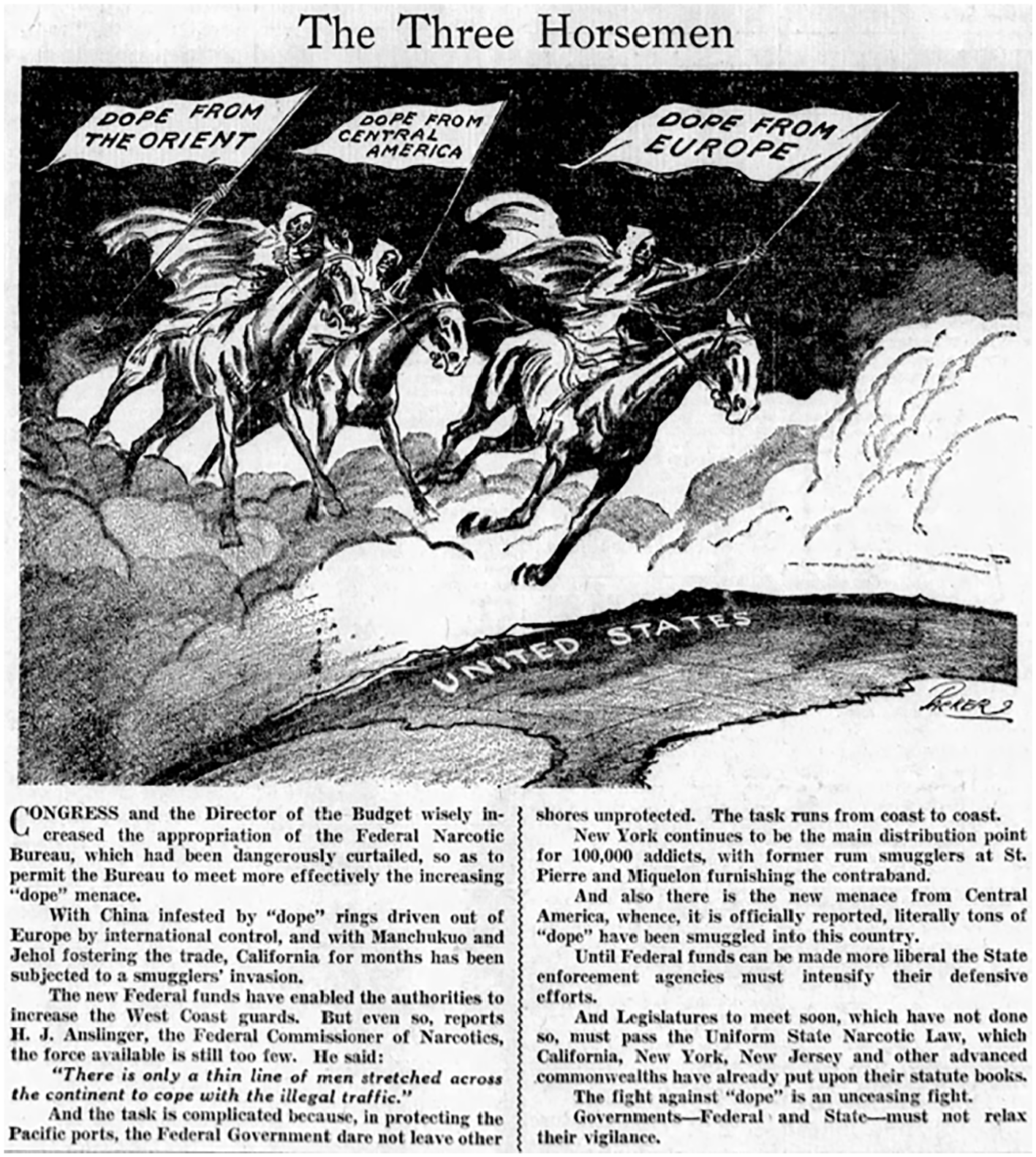
“The Three Horsemen” in the San Francisco Examiner, July 23, 1934.
Vera Connolly (1935), who in 1937 became one of the founding editors of Woman’s Day magazine, warned upward of two million Good Housekeeping readers about the “grave” addiction problem in the United States. She noted that Anslinger had asked 38 state legislatures to adopt the Uniform State Narcotic Drug Act, “the most powerful piece of state legislation aimed at the local drug peddler and the spread of addiction ever framed” (p. 90). As its name implied, the Act sought to create consistency between state and federal law and among individual states. Nine states had signed on by February 1935, when the Good Housekeeping article appeared, and California had already adopted comparatively stringent state laws. Connolly encouraged readers to get involved in the fight against drugs, advising them to demand that their respective state legislatures adopt the Uniform State Narcotic Drug Act. The first page of her article, “The Dope Menace,” featured an image of the federal government metaphorically cracking a whip against illegal drugs. One passage read: “The Uniform State Narcotic Drug Act, a whip that lies ready to the strong hand of the law, will scourge the purveyors of living death from the land—if you do your part” (p. 90).
Forrest Wilson (1935), a journalist who later won a Pulitzer Prize for his biography of Harriet Beecher Stowe, also drew attention to federal law enforcement in “How the Federals Get Their Men,” published in Cosmopolitan. According to Wilson, of the 14 federal bureaus pursuing criminal actors, the Federal Bureau of Narcotics was one of the busiest. Moreover, law enforcement vigilance had helped reduce the number of dope fiends nationwide, making heroin a scarce commodity and leading dealers to adulterate it by as much as 80%. Three years later, Leon G. Turrou, who worked as a special agent and translator for the Federal Bureau of Investigation (FBI), teamed with journalist James Street (1938) to celebrate the exploits of a G-Man, “a new type of hero . . . on the contemporary scene, one we are proud to include in our distinguished autobiography series” (p. 42). The article featured photographs of J. Edgar Hoover, FBI head, and of agents performing calisthenics and one agent firing a machine gun.
Reefer madness
In the mid-1930s, the federal government began to focus greater attention on marijuana use (Armstrong & Parascandola, 1972; Musto, 1972). It instituted the Marijuana Tax Act in 1937, requiring those who sold, dispensed, acquired, or possessed the drug to register with the Internal Revenue Service and pay a small tax. The law did not criminalize marijuana, but as Ferraiolo (2007) noted, “its language and implementation effectively brought about prohibition” (p. 154). Customs agents collected marijuana that had been imported and did not release it until all taxes had been paid and the necessary paperwork filed. Anslinger considered the legislation necessary not because of scientific evidence, but because of patriotism. “He saw the only solutions to pot as dogged enforcement, legislation, condemnatory rhetoric, and suppression of the new foreign music known as jazz” (Gerber, 2004, p. 4).
Anslinger won strong support for his antipot campaign in some fifty Hearst papers and magazines that regularly gave headline attention to marijuana-related incidents under such labels as “marijuana-crazed madmen.” William Randolph Hearst may have had his own motives as well. If he could eliminate hemp production, his extensive forest holdings would be the prime source of pulp needed for West Coast paper production. (Gerber, 2004, pp. 6–7)
The Marijuana Tax Act of 1937 appeared shortly after the 1936 film Reefer Madness premiered and Harry Anslinger began to exaggerate the effects of marijuana in print. His article “Marihuana: Assassin of Youth,” written with Courtney Ryley Cooper for the July 1937 issue of American Magazine, is perhaps the most reproduced marijuana article of the era. Reflective of content in Reefer Madness, it contained stories of young women jumping out of windows and young men unable to stop themselves from committing crime. A condensed version of the article appeared in the February 1938 issue of Reader’s Digest, reaching thousands of new readers. Connolly (1935) had helped to generate hysteria over marijuana (i.e., “Mexican cigarettes”) in Good Housekeeping: “Marijuana first exhilarates and releases the addict from all dictates of conscience or emotional restraint; it also excites sexually. Next follows a stage of dullness, melancholia, and stupor. Continued use of it leads to insanity” (p. 98).
Fact-fiction returns
Journalist and screenwriter Adela Rogers St. Johns’s novelette “Walking on AIR,” a story about a young man who experiments with hasheesh and begins to experience nightmares and personality changes, appeared in the May 1938 issue of Cosmopolitan. He drifts to a seedy underworld and becomes involved with people who photograph young women in compromising positions and then extort their wealthy families. Editors introduced the story by warning readers that while the story was fictitious, it would “astound America” (p. 36).
This is one reason for publishing it. We hope that it will shock this country out of the unthinking passivity that evades responsibility for the growing drug menace by saying, “This can’t happen to my son.” If you doubt that it could after reading this magnificent but heartbreaking story . . . read the actual facts, amply documented from government sources. (p. 36)
The story implied that one character had gained extreme levels of physical strength from marijuana and had killed a blackmailer with his bare hands. What might that mean for law-abiding citizens? In the San Francisco Examiner, Walter Winchell (1938) assured readers, “Walking on AIR” would “macerate” them. The May 1938 cover of Cosmopolitan calls the story by Adela Rogers St. Johns “the fiction sensation of the year.”
In addition to “Walking on AIR,” the May 1938 issue ran the nonfiction article “Public Enemy No. 1: Dope” by Frank C. Waldrop. He placed much of the blame for international dope trafficking on Japan: Its “war machine” had rolled into China and forced increases in morphine production, in turn smoothing the way for the production of “madness, murder, and misery for American homes” (p. 35). Waldrop noted that the Chief of Police in San Francisco estimated that peddlers sold US$1.5 million worth of dope each day in the United States and that Japanese-controlled areas provided much of the supply.
Newspapers nationwide covered the Waldrop article, with some treating it as news and others locating it on their editorial pages. The headline “Increase in Dope Output Follows Jap War Machine” (1938) accompanied an article in the Cedar Rapids Gazette, with the report noting that an increased Japanese presence in China had resulted in a “forced increase in opium-poppy production” (p. 3). The Gazette explained that morphine factories had opened in conquered provinces, with heroin output in a single factory accounting for more than 15 times the amount needed internationally. In the United States, narcotics agents had seized 386 tons of marijuana plants and dried bulk marijuana in 1936, doubling amounts seized in 1935. The “tons of madness,” Anslinger told Waldrop, “were grown for our school children, our boys and girls; for youngsters with a nickel to spend on a ‘reefer.’” (p. 3). 33
In 1941, Donald E. Keyhoe, a Marine Corps aviator, melded the law-and-order approach to crime with alleged communist infiltration, asking “Why Don’t We Deport Criminal Aliens?” Keyhoe’s writing appears consistent with something WRH might have written regarding communism: For years, thousands of alien Communists and criminals have mocked American laws. Four out of five escape deportation proceedings entirely. Of those ordered banished, three-fourths remain here—free. According to Attorney General Robert Jackson, less than one-fourth of the 8,091 aliens now under orders will be deported. Among these are hundreds of Communist Russians working viciously to wreck this country, and felons guilty of murder, robbery, criminal assault—almost every known crime. Yet only 330 of the entire group are in custody! (pp. 20–21)
Keyhoe (1941) contended that Mexico had served as the main entry point for “subversive agents” to infiltrate the United States, and urged “Mr. and Mrs. America” to recognize the potential dangers. Peck (1945) wrote about the damage opium stashed in wartime cargo could do, asking whether hard-won victories in the Pacific might generate a postwar narcotic problem. Peck suggested that World War II had exacerbated problems with drug trafficking, as ships delivering supplies and then returning for additional cargo allowed smugglers to stash narcotics. He focused on India as a primary source of opium. Peck noted that opium production there had once been limited to use in India: Now, in Bombay, Karachi and Calcutta, World War II has placed our troops in close association with the habits of the East. Westward go United States ships to the great new port of Basra to unload war materials, soldiers and civilian technicians in Iran, where both raw and prepared opium can be bought as readily as cigarettes in the United States. (p. 58)
Beyond Hearst: Commies, Countercultures, and Cocaine Cowboys
In the years following World War II, Hearst magazines published few articles addressing drug threats among immigrant groups. In 1947, Cosmopolitan did publish a three-part series about drug addiction as told by an individual who had spent time in a rehabilitation facility in Lexington, Kentucky (Davis & Slatoff, 1947a, 1947b, 1947c). Like the 1923 series by Sidney Howard, the articles defined addiction as a medical problem and portrayed punishment as a futile approach to the problem. In 1951, WRH died, and, by that point, Cosmopolitan had become “decidedly nondescript” (Landers, 2010, p. 217); during the 1950s, its absence of focus coupled with the advent of television resulted in fewer readers and lower advertising rates. As Landers (2010) noted, magazine publishers discovered that “specialization was salvation” (p. 218). By the end of the 1950s, Cosmopolitan had become a women’s magazine.
During the 1950s, as the Cold War ensued, a non-Hearst publication, the Saturday Evening Post, which had endorsed strict immigration policies in the 1920s, denounced communism and praised the U.S. federal government for its efforts in controlling the borders. In fact, similar to Cosmopolitan and Good Housekeeping in the 1930s, the Saturday Evening Post content appeared close to propaganda. For example, in a 1952 article titled “They’re Death on Dope Runners,” Neil M. Clark described “fifty hard-boiled” customs agents stationed along the Mexican border. Their lives in constant danger, the agents had succeeded in “nabbing some of the dirtiest criminals on earth” (p. 36). Clark characterized narcotic control as “one of the toughest jobs in the intensifying war on drug addiction” (p. 37). He also described traffickers: Generally speaking, the agents say, [drug smugglers] are the lowest of human scum . . . . Ages were mostly in the twenties and thirties, and they were predominantly male, but there were also quite a few women. Racially, Mexicans predominated, followed by Negroes, white American citizens, Chinese. Many were addicts themselves, but not the big shots. (p. 110)
Harsh depictions of drug smugglers appeared consistent with antidrug legislation in the 1950s. In November 1951, the Boggs Act introduced mandatory minimum sentences for drug offenses, and in 1956, the Narcotic Control Act extended the length of sentences and allowed a jury to invoke the death penalty for anyone older than age 18 caught selling heroin to anyone younger than 18. As drug historian David F. Musto (1999) noted, the statutes “represent the high point of federal punitive action against narcotics” (p. 231). One of the most popular magazines in the United States, Life, had earlier provided text and photography in tacit support of drug enforcement and punitive action. A June 11, 1951, article, “Children in Peril” (Brean, 1951), suggested that pushers were selling narcotics to thousands of adolescents. The issue contained images of drugs sales in the streets, known drug traffickers, confiscated substances, and incarcerated men. Two weeks later, the June 25 issue of Life contained photos of handwritten notes from students who had responded to a school assignment called “Narcotics” (“New York’s Children Accuse,” 1951). Grade school and junior high school students had written short essays on what they knew about drugs. The responses, which indicated a great deal, were submitted as evidence at a New York state narcotics hearing.
Regarding communism, editorials published in the Saturday Evening Post included “Mr. [Clement] Attlee’s Friends, the Chinese Commies, are the World’s Leading Dope Smugglers” (1954), and “Red China Exports Opium to Make Dope Addicts of Our Boys in Asia” (1955). The magazine criticized Attlee, a leader of the British Labor Party who had visited China, for believing what leaders in the Far East had told him about opium control. In its 1955 editorial, the Saturday Evening Post posited: Addiction is growing in this country, notably among teenagers . . . and the commodity involved is usually heroin, the deadliest of opium derivatives and one that has no place in American medical practice and is not, therefore, diverted from the legal manufacture and distribution of narcotics. It comes from abroad. . . . Red China is the major source of supply. (p. 12)
Adding to that editorial, Darrell Berrigan (1956), a newspaper editor who lived in Bangkok, addressed smuggling operations in Asia: “One of communism’s most vicious attacks on the free world strikes through corruption-riddled Thailand, where Red China unloads vast quantities of opium every year” (p. 42). Opium traffic in Thailand had reached 300 to 400 tons per year, an amount constituting cause for concern.
In the 1960s, communism and external narcotic threats pivoted to rebellion and internal threats. The Saturday Evening Post, Life, Look, Newsweek, and Time published stories on amphetamines, LSD, and marijuana use on college campuses and in the broader society. 34 A December 1965 Saturday Evening Post (Davidson, 1965) discussion of “the thrill-pill menace” focused on the dangers of amphetamines and barbiturates. Davidson noted that while the American Medical Association considered compulsive use of amphetamines and barbiturates a relatively small problem, Connecticut Senator Thomas J. Dodd argued: “Contrary to our experience with heroin and other narcotics, these dangerous drugs, used in various combinations, tend to induce a hostile state of mind. They have figured prominently in some of the most violent crimes on record” (p. 24). If one examines drug-related magazine content, it seems nearly all substances have been responsible for some of the most violent crimes on record.
When WRH became interested in moviemaking, he instructed his magazine editors to purchase articles that could be converted to screenplays (Pizzitola, 2002). In 1965, Life magazine published a photo essay of two heroin addicts who shared a Manhattan apartment near “Needle Park.” Black-and-white photos taken by Life photographer Bill Eppridge showed the couple using heroin. James Mills, the associate editor at Life, wrote an accompanying article and followed with a 1966 novel, The Panic in Needle Park. The photos and texts led to the 1971 movie The Panic in Needle Park, starring Al Pacino and Kitty Winn. Dog Day Afternoon (1975), also starring Pacino, was also based on a magazine article.
Panic in Needle Park (1971) premiered in theaters at a point when drug addiction among U.S. soldiers serving in Vietnam had worsened. John Steinbeck IV had written a cover story for The Washingtonian’s January 1968 issue in which he described widespread marijuana use among the troops. In 1971, the New York Times ran a front-page article headlined “G.I. Heroin Addiction Epidemic in Vietnam” (Shuster, 1971). One month later, U.S. President Richard Nixon declared “war’ on drugs, characterizing drug abuse as “public enemy number one.” 35 In waging “a new all-out offensive,” the government would address international sources of supply in Southeast Asia and Europe. Time magazine featured “The Global War on Heroin” on its September 4, 1972, cover.
In what seems an unrelated magazine article, but showing the legacy of Hearst’s innovation, Mark Jacobson later wrote about Harlem heroin kingpin Frank Lucas for the August 14, 2000, issue of New York. During the 1970s, Lucas ran a Harlem drug-trafficking group called the Country Boys, which allegedly imported heroin from Southeast Asia in the coffins of soldiers killed in Vietnam. The Jacobson article, “The Return of Superfly,” inspired the 2007 Universal Pictures movie American Gangster, starring Denzel Washington (Dargis, 2007). Relatedly, in June 1977, Harlem drug lord Leroy “Nicky” Barnes, looking suave in coat and tie, appeared on the cover of the New York Times Magazine. As New York Times writer Sam Roberts (2019) later recalled, U.S. President Jimmy Carter found the characterization of “Mister Untouchable” highly offensive and demanded the U.S. Justice Department focus more intently on its pending case against the drug trafficker. By the end of 1977, Barnes had been sentenced to life in prison. Director Mark Levin drew on the New York Times Magazine article (Ferretti, 1977) in developing the 2009 documentary “Mr. Untouchable.” 36 Additional vice-related films Boogie Nights (1997) and Wonderland (2003) were based on a 1989 Rolling Stone article, “The Devil and John Holmes,” by Mike Sager.
Indeed, allowing that the aforementioned magazine articles and feature films did not necessarily originate “in-house” (i.e., were not limited to a single company), cross-media practices pioneered by WRH have endured. On the topic of immigration, a 1981 U.S. News & World Report cover termed it a “nightmare” (Orr Kelly, 1981). Similarly, on its November 23, 1981 cover, Time characterized South Florida as a “Paradise Lost” to immigrant-related violence. The accompanying article by James Kelly (1981) discussed actions eventually featured in Cocaine Cowboys (2006), a documentary about drug traffickers from South America and Cuban refugees from the Mariel Boatlift wreaking havoc on a picturesque region of the United States. Kelly did not exaggerate statistics and occurrences in his report, but it nevertheless painted a bleak portrait: An epidemic of violent crime, a plague of illicit drugs and a tidal wave of refugees have slammed into South Florida with the destructive power of a hurricane. . . . [B]oatloads of half-starved Haitians are washing up on the area’s beaches every week. The wave of illegal immigrants has pushed up unemployment, taxed social services, irritated racial tensions and helped send the crime rate to staggering heights.
37
The 1981 Time cover continues to function as a reference point. Forty years after it appeared, the New York Times referenced the cover in an article about the collapse of Champlain Towers in Surfside (LaForgia, Playford, & Gamio, 2021). Kenneth Dickerman and Nathan Benn (2018) referred to the cover in a Washington Post article about 1980s Miami, and in the Daily Beast, Roben Farzad (2017) mentioned the article in a story about the Mutiny hotel, “where all the narcos came to play.” In the Los Angeles Times, Susan King (2006) described the early 1980s: “Drug-related crime was rampant, and Miami’s homicide rate tripled, prompting Time magazine to label the city ‘Paradise Lost’ in a cover article. Authorities cracked down.” Francisco Alvarado (2011) also referenced the cover story in a Miami New Times article about 1981, “Miami’s deadliest summer.” Apart from newspapers, the Time article nearly interrupted filming of the movie Scarface in 1983. As author Ken Tucker (2008) noted, the Time magazine piece did not sit well with [Miami’s] civic leaders. So, when they got wind of a Universal Pictures production company invading their town to make a bloody movie about a Miami drug lord—a Cuban-refugee one at that—squawking commenced immediately. (p. 53)
Eventually, producers succeeded in making the movie.
The 1980s actually came to resemble an earlier period addressed in this monograph. In the late-19th and early-20th centuries, women used opium and its psychoactive alkaloid morphine in higher numbers than men did (Courtwright, 2001). Both men and women who used these substances tended to be White, middle-class, and native-born. Reflective of largely White users, the legislation did not ban potentially addictive drugs nor did it define the issue as criminal. As more immigrants and members of racial minorities began using mind-altering substances, however, legislation began to appear. The Smoking Opium Exclusion Act of 1909 and the Harrison Narcotics Tax Act of 1914 allowed the United States to demonstrate a supposed commitment to fighting the international drug trade while also allowing it to institute quasi-measures of social control. Additional regulations, specifically the Narcotic Import and Export Act of 1922 and the Anti-Heroin Act of 1924, appeared following World War I when immigration concerns resulted in significant policy changes. By that time, heroin use had allegedly expanded in immigrant communities, and Hearst media had launched antidrug crusades.
In the early 1980s, cocaine in powder form became a drug of choice in White America, symbolizing success in high society (Siegel, 1984). In fact, the July 6, 1981, cover of Time showed the substance in a martini glass, complete with olive and drink stirrer. But in the mid-1980s, when crack cocaine became popular in urban centers, the drug came to symbolize violence in Black America (Hart, 2014; Jacobs, 1999). Following the high-profile death of basketball star Len Bias from a cocaine overdose, the U.S. government passed the Anti-Drug Abuse Act of 1986, followed by the Anti-Drug Abuse Act of 1988 (Belenko, 1993). The initial law called for mandatory prison sentences and appeared unusually harsh, if not draconian (Alexander, 2012). In 1986, Time and Newsweek devoted multiple cover stories to the crack-cocaine crisis in the United States (Reinarman & Levine, 1989). Magazines showed dangerous Latin drug lords and violent members of inner-city gangs, portraying drug traffickers as ruthless killers making their way to suburban America (Lassiter, 2015; Netherland & Hansen, 2016). 38 Violent crimes certainly occurred, but press coverage appeared to focus on supply and nearly ignored demand. 39
Just as magazines have helped to define drug-trafficking criminals, they have also identified drug-consuming victims. 40 Studies have recently examined the role of White women in affecting a “gentler war on drugs” amid the opioid epidemic (Daniels et al., 2018); however, when White people in lower income brackets or rural locations become involved with drugs, as with methamphetamine, they may be dismissed as “White trash” (Peterson et al., 2019) and used in campaigns about “meth mouth,” or rotted teeth (Linnemann & Wall, 2013). In other words, journalists have followed historical patterns in defining which groups constitute societal threats and which groups constitute unknowing victims.
Conclusion
This monograph examined how Hearst magazine fiction, “fact-fiction,” and nonfiction articles published between 1905 and 1945 presented immigrants and immigration as social and political issues of the period. In connecting drugs and vice to specific immigrant groups, Hearst magazines identified immigrants who allegedly posed a threat and those who did not. Like Hearst himself, the magazines favored immigrants from Germany and the Scandinavian countries of northern Europe and disfavored individuals from China and Japan, and to a lesser degree, Mexico. WRH also supported the Irish in their fight to escape British rule, and his magazines were consistently critical of Great Britain. He came to distrust Russia and crusaded against communism, which he believed had penetrated public education in the United States.
Nasaw (2000) characterized readers in the late 19th and early 20th centuries as seeking figurative, not literal truth in the news. WRH built an empire precisely accommodating those readers. Despite his success as a media baron and the exposure his news outlets provided, WRH did not succeed as a candidate for public office. He did serve as a congressional representative, but his mayoral and gubernatorial campaigns as well as his candidacies for the presidency ended in disappointment. The content in his publications helped to explain why: At the New York Journal (and elsewhere), WRH opted for sensationalism and advocacy. Reports of gruesome crimes and affairs in high society kept audiences entertained, but sensationalistic content also detracted from WRH’s perceived fitness for public office.
As drug historians (Courtwright, 2001; Musto, 1999; Provine, 2007) would have predicted, Hearst magazines associated the Chinese with opium and Mexican laborers with marijuana. Race, nationality, and social class appeared to influence portrayals of opiates, in particular. The Chinese smoked opium in unsanitary dens, and the underclass used heroin in downtrodden urban neighborhoods. In contrast, members of “respectable” society relied on morphine or perhaps codeine. Ironically, a German pharmaceutical company, Bayer, began marketing Heroin (sic) in 1898 as a cough suppressant, and it proved effective; however, it also proved addictive. Use among immigrants and those in lower socioeconomic classes led to state and national regulations. In the 21st century, heroin has retained its status as a “dirty” street drug (McElrath & McEvoy, 2001), while morphine and codeine tend to be associated with pain relief in medical settings. Pharmacological distinctions among opiates seem less consequential than sociological constructions, with media portrayals contributing to the latter.
To a limited extent, Hearst magazines attributed drug-related problems among European immigrants to social conditions and problems among Asians and Latinos to internal predispositions. In his 1915 series, Arthur Brisbane blamed society when “hard-working” European-looking individuals turned to drugs, but Hearst magazines tended to attribute deviant behavior among Asians and Latinos to propensities for wrongdoing. Following Haynes et al. (2016), researchers should continue to examine the role of mass media in defining group differences, focusing, at least in part, on the political agendas of news organizations. In the 21st century, conservative news outlets have exacerbated racial tensions surrounding contagious diseases (Li & Nicholson, 2021). Anti-Asian sentiment surrounding COVID-19 has resembled the anger directed at Chinese immigrants in the 19th century, when officials in San Francisco blamed “vapors” in Chinatown for outbreaks of malaria, smallpox, and leprosy (Trauner, 1978). After the U.S. President referred to COVID-19 as the “China virus” and the “Wuhan virus,” individuals lashed out against people of Asian descent. As in the 19th century, the aggression occurred at a time of financial uncertainty and unemployment concerns.
From a policy standpoint, this research shows that just prior to passage of the Immigration Act of 1924, which banned Japanese immigrants and sharply reduced the number of Italian and Jewish individuals permitted to enter the United States (Marinari, 2020; Okrent, 2019), a Hearst’s International exposé identified Italians and Jews as major operators in the drug trade. Although one cannot assume a causal relationship between Hearst magazine content and U.S. immigration policy, the two nevertheless coincided. Indeed, WRH had definite ideas of what the United States ought to be—and who ought to be in it (Mugridge, 1995). Still, magazines showed some variation in sentiment. For example, American authors based in or writing from Asia portrayed China as a nation of great potential but thwarted by opium forced upon it by Japan and Great Britain. In addition, although Hearst’s International suggested that Jews and Italians played significant roles in the U.S. drug trade, and WRH himself did not object to an anti-Semitic Henry Ford seeking the presidency, Hearst newspapers also reported on the atrocities of World War II in greater depth than other U.S. news outlets. Moreover, WRH appeared more outspoken than other publishers in advocating for a Jewish homeland (Nasaw, 2000; Wyman, 1984).
On the promotion side, WRH pioneered techniques still in use. For example, he understood the value of publicizing magazine investigations in his newspapers. Wire reports frequently contained synopses of magazine articles, and in some instances, newspapers published their own articles in response to the content of magazine features. This approach allowed WRH to expand the influence of Cosmopolitan, Good Housekeeping, and Hearst’s International. By the mid-1930s, as many as 20 million people—about 17% of the U.S. population—received information from a Hearst outlet (Nasaw, 2000). During the period, Cosmopolitan reached a circulation of 1,700,000. In 1943, Good Housekeeping reached a circulation of 2,500,000 en route to more than five million in the 1960s.
Cross-media promotion also applied to motion pictures. WRH instructed magazine editors to buy articles that could be converted to screenplays for Cosmopolitan Productions, in partnership with MGM. WRH also instituted serials, with film actors giving interviews to newspapers such that readers began to identify with the actors. Audience members developed parasocial relationships with the people they watched in the movies, and to some extent, such patterns continue to exist. Social media have allowed users to interact with celebrities, commenting on posts made by famous actors and high-profile athletes. Although its focus has changed, Cosmopolitan remains a leading magazine at Hearst Communications, as does Good Housekeeping. The former maintains a circulation of 2.2 million and the latter 3.3 million. 41 The publications have necessarily adapted to digital communication, maintaining websites as well as a presence on social media.
In her autobiography, Adela Rogers St. Johns (1969) wrote that among his differing media enterprises—newspapers, magazines, radio stations, film studios—WRH was most passionate about his newspapers. But Hearst magazines also reached millions of readers. With this monograph showing how Hearst magazines characterized immigrants from 1905 to 1945, meaningful opportunities exist for additional research on both the publications and the individuals who edited and wrote for them.
Supplemental Material
sj-ppt-1-jmo-10.1177_15226379211070038 – Supplemental material for Oriental Irritants and Occidental Aspirants: Immigrant Portrayals in Hearst Magazines, 1905–1945
Supplemental material, sj-ppt-1-jmo-10.1177_15226379211070038 for Oriental Irritants and Occidental Aspirants: Immigrant Portrayals in Hearst Magazines, 1905–1945 by Bryan Denham in Journalism & Mass Communication Monographs
Footnotes
Acknowledgements
The author thanks the reviewers for their comments and suggestions.
Declaration of Conflicting Interests
The author(s) declared no potential conflicts of interest with respect to the research, authorship, and/or publication of this article.
Funding
The author(s) received no financial support for the research, authorship, and/or publication of this article.
Supplemental Material
A Powerpoint lecture is available for this article online.
Notes
Author Biography
References
Supplementary Material
Please find the following supplemental material available below.
For Open Access articles published under a Creative Commons License, all supplemental material carries the same license as the article it is associated with.
For non-Open Access articles published, all supplemental material carries a non-exclusive license, and permission requests for re-use of supplemental material or any part of supplemental material shall be sent directly to the copyright owner as specified in the copyright notice associated with the article.
