







Abstract
Livelihoods are becoming increasingly defined by one’s (in)ability for and agency over movement, that is, mobility, especially on the transnational scale. Simultaneously, the relational turn of public relations scholarship has emphasized a network perspective, examining how a set of relations among social actors comprise, maintain, and/or disrupt society. Yet the development of the network perspective in public relations has not been without its limitations, notably the absence of public perspectives, actions, and realities—all of which impact the communicative interactions that produce the public’s social networks. Through a qualitative approach to social network analysis (SNA) that integrates ethnographic observations and visual network mapping alongside interviews with recent Afghan refugees and representatives from migrant-serving/advocacy organizations, this research incorporates public and organizational perspectives to highlight mobility as an increasingly important dimension to public formation and relationship dynamics. This monograph proposes the mobile social network ecology, a concept that integrates social network analysis and experiences of public mobility, to better consider mobility’s impacts on key public relationships, inclusive of distinct migrant publics, the civil society organizations (CSOs) that seek to serve them, and their linkages to civil societies on a transnational scale.
One crucial reality of the 21st century society is that livelihoods are increasingly defined by one’s (in)ability for and agency over movement, that is, mobility (cf. Dutta & Shome, 2018; Samek, 2017), especially on the transnational scale. In a modern era with tandem growth in globalization, communication technologies, and the proliferation of digital devices and platforms, the impacts of mobility on communication are boundless and borderless. People are moving, sometimes for voluntary reasons, but sometimes for involuntary reasons, such as being forced to flee their homes, persecuted for who they are—situations in which mobility is inflicted upon them. In particular, significant numbers of Afghan individuals and families have migrated to the United States since the early 1980s—an era of Afghan history characterized by political instability (Batalova, 2021). In the past 40 years, more than 6 million Afghans have been driven out of their country due to conflict, violence, and/or poverty, marking it as one of the world’s largest and longest displacement situations (United Nations High Commissioner for Refugees [UNHCR], 2023). More recent events between/within the United States and Afghanistan that led to the Taliban takeover of Kabul have only further exacerbated the displacement and transnational mobility (UNHCR, 2023).
Transnational movement inherently leads to cross-border connections and subsequent questions about how these relationships are maintained, navigated, and generated following the enactment of mobility, especially in cases of involuntary, traumatic movement. The current global communication landscape demands inclusivity of multiple, rich, and mobile relationships in social networks that span national borders (Sison, 2017; Wang, 2006; Yang et al., 2012), including those of migrants who often represent salient, key publics for global public relations (Bravo, 2015; Choi et al., 2021).
In the two decades since U.S. forces toppled the Taliban regime in Afghanistan, both countries have been embroiled in the subsequent “forever wars” and entangled in an era defined by tumultuous relations of violence, peace negotiations, and changing policy (Council on Foreign Relations, 2023). On August 15, 2021, the Taliban overran Kabul, the nation’s capital, having already seized provincial capitals and border crossings, resulting in a return to Taliban power (Council of Foreign Relations, 2023). Chaos erupted in the nation as thousands tried to escape. In response, the United States deployed 6,000 troops to evacuate U.S. and allied personnel, secure the international airport, and help evacuate the thousands of Afghans who worked with the United States (Council of Foreign Relations, 2023). Since the Taliban’s capture of Kabul in August 2021, more than 74,000 Afghan migrants arrived in the United States as part of Operation Allies Welcome, the largest evacuation since the Vietnam War (International Rescue Committee, 2022). The end of Vietnam War notoriously prescribed the development of the modern, global refugee system (International Rescue Committee, 2008), and this historic moment of mass forced migration of Afghans similarly compels examination of the relational dynamics present in serving this population. It evokes questions about the societal connections these people maintain, build, and navigate in their movement between nation-states entrenched in each other’s histories. As such, I turn to networked public relations scholarship and social network analysis (SNA) as a means of exploring the entangled ties of Afghan refugees on a global scale, including important organizational actors.
A network perspective examines how a set of relations among social actors—be it people, groups, or organizations—create systems that comprise, maintain, and/or disrupt society (Yang & Saffer, 2019; Yang & Taylor, 2015). In advocating for a network perspective, scholars acknowledge and highlight the varied interactions among multiple social actors, including publics, and how the patterns of those relationships implicate each actor and the network in which they reside ( R. L.Heath, 2013; Sommerfeldt & Kent, 2015; Zhou, 2019). Yet, these network perspectives have emerged alongside a prominent “valorization of stasis, boundedness, and roots” (Cresswell, 2020, p. 3); although living in an increasingly globalized world, publics are treated as belonging to a nation. Movements through or beyond a set place are not considered as influential on a public’s formation, issue response, or communicative norms within a network. In the 21st century, mass migration—the representative case of transnational patterns of mobility—is a defining feature of the globalized world (Valentini et al., 2016). The exclusion of mass migration in network theories is a significant gap and limits scholars’ ability to contribute to modern communication conclusions.
Global movements, societal connections, and overall livelihoods are colored by the affordances and confines of national immigration and citizenship policies. The United States expanded the legal protections and refugee status for recent Afghan migrants, including those who had previously worked with and/or supported the United States, human rights defenders, and political activists (Council of Foreign Relations, 2023; International Rescue Committee, 2022). Special Immigration Visa (SIV) programs have existed since the Afghan Allies Protection Act of 2009 (Bureau of Consular Affairs, 2023a), which affords lawful permanent residence to a person having previously been employed in Afghanistan by, or on behalf of, the U.S. government (Bureau of Consular Affairs, 2023a, 2023b). About half of the Afghans who have resettled in the United States following the Taliban takeover are eligible for the SIV process (Barros, 2022). Other legal pathways include utilizing short-term/temporary stays pursuant to the Afghan Adjustment Act and its promise of a more permanent residency, filing for humanitarian parole, seeking asylum, applying for family reunification, or appealing as a refugee (Barros, 2022). Despite the distinct legal options, many refer to the situation (and population) as involving Afghan refugees. Overlooking mass migration and public mobility is a symptom of a larger problem within networked public relation scholarship. Namely, network perspectives have been limited by an absence of publics (Zhou, 2019) that not only excludes their voices and perspectives but also overlooks how their experiences impact the ability of organizations to purposefully foster and maintain relationships. This is an especially critical omission in the case of marginalized publics seeking societal assistance and belonging, such as those forced to migrate. Migration, whether voluntary or forced, almost inherently entails introduction to new institutions and organizations. For those whose path to the United States has been more vulnerable (i.e., resettlement or seeking asylum), this tends to immediately involve organizations, such as national resettlement agencies, their local non-profit partners, and the other organizations whose purposes are to support migrants.
The particular case of Afghan refugees has called on the work of many civil society organizations (CSOs), including resettlement agencies and various nonprofit organizations, the latter of which the Biden administration partnered with as a means of providing Afghans temporary assistance with housing, food, material goods, employment, health care, etc. (Barros, 2022). Resettlement agencies, on the other hand, are embedded in the United States Refugee Admissions Program (USRAP) and three federal entities 1 (Ambar, 2022). After registering with the UNHCR, individuals applying for refugee status are referred to USRAP and one of the nine voluntary agencies who are federally funded in leading the refugee resettlement process (Ambar, 2022). These overarching national organizations work with their domestic affiliate agencies across all 50 states and D.C. to confirm the location in which a refugee will be resettled (Ambar, 2022). Agencies at the national and local level are contingent to the resettlement admissions and funding decisions by the U.S. president and administration (Ambar, 2022).
Those legally entitled to refugee rights and protections, such as recent Afghan migrants, have access to various services and support provided by the domestic affiliate agencies, including an initial 90-day period of funds/rent, furnishing, food, etc. Longer-term cash, medical assistance, and social services are also available through the ORR to support the integration of refugees into local communities (Ambar, 2022). Many Afghans are now at that point of resettlement in which they are meant to integrate into American society, find jobs, and learn English, despite the ongoing challenges that have delayed access to many services and benefits (Barros, 2022). As such, Afghan refugees are an example of a distinct, mobile population whose migration incurs questions about their inclusion into (civil) society and the plight of their needs in the United States. Integrating their perspectives into networked public relations scholarship not only evokes the enactment and context of mobility as an important part of social connections but also presents significant insights in how to build relationships with and support this population.
By reflecting upon the realities of mobility, we can better understand our fundamental societal connections alongside the transnational, globalized dimensions of the modern world. To promote this understanding, I expand the conceptualization of social networks in public relations by introducing mobility and, in turn, examining its impact through the perspectives of people with distinct experiences of mobility, that is, recent Afghan refugees to the United States. Incorporating people who have been forced to migrate as social actors and communicators in various network ecologies is one step in shifting strategic communication and global public relations’ focus to excluded, marginalized, or overlooked communities; this allows for a deeper consideration of circumstances, identities, and needs in communication (Bravo, 2015; Gregory & Halff, 2013). Second, I examine how CSOs, including nonprofit organizations and resettlement agencies, navigate public mobility’s impact on organizational networks and relationships, including dynamics with often marginalized, mobile publics. Together, these two purposes advance considerations of mobility as a factor to significant relational and societal ties. Having developed an innovative approach to SNA that utilizes visual mapping, interviews, and ethnographic observances, I provide empirical data showing how the enactment and context of mobility impact Afghan migrant and CSO network dynamics. I highlight subsequent communication behaviors, relational expectations, and the role of mobility as an underlying context generating distinct actors, ties, and positioning. Using these findings, I propose the mobile social network ecology, which features the impacts of the enactment and context of mobility on key public relationships, inclusive of the distinct publics of the modern world, the CSOs that seek to serve them, and their linkages to civil societies on a transnational scale.
The next section offers the literature review, first to unpack the concepts of mobility and social network analysis and these concepts’ connections to publics and migration, then to lay the foundation for the first of four research questions which examines how Afghan migrants perceive their social networks. The literature review then further explores mobility and social networks in relation to civil society to examine how Afghan migrants perceive their involvement with the organizations integral to societal belonging. The remaining two research questions highlight the civil society organizations (CSO) that serve populations who migrate. As such, the literature review unpacks existing scholarship on CSO social networks to make the case for investigating how these organizations perceive not only their social networks, inclusive of mobile publics, but the impact of mobility on organizational relations and dynamics. From there, the paper turns to the method and findings.
Understanding Mobility
What does it mean to be mobile and/or experience mobility, especially on a transnational scale? In its most simplified conceptualization, mobility is defined by one’s (in)ability for and agency over movement through space and place, existing alongside its inverse, immobility, that is, stillness or stasis (Samek, 2017). Typically thought of in terms of individual, mundane movement from place to place, mobility can also represent larger societal patterns such as the entrenched ideologies, meanings, and practices of societal norms and cultures (Cram, 2019; Samek, 2017). Mobility is therefore not just physical movement (travel through/to/from) but also intertwined with the shared meaning of that movement and its embodied and experienced practice (Cresswell, 2010, 2020). Mobility has always been inherent to human life as a relational, intersectional feature that impacts social interactions (Dutta & Shome, 2018), making it a significant dimension to understandings of relationships and networks. In particular, mobility is an overlooked factor in the existence of publics even though it not only shapes modern identity formation but is also part of the fabric on which social relations are woven (Jensen, 2011). Certain sorts of people perform certain types of mobile practices, in turn both producing and a product of relationships between people and space.
In this project, I do not just explore mobility as individual, one-off acts of public movement but also acknowledge mobility as entrenched patterns of movement and stasis of distinct publics that exist in relation to and are socially produced by geopolitical, cultural, economic, and historic power (Dutta & Shome, 2018; Samek, 2017). Mobility is imbued with meaning, constituted by and constitutive of communication, as a relational, intersectional feature (Dutta & Shome, 2018; Jensen, 2011). As such, mobility may impact the formation, existence, and social interactions of publics, thereby making it a salient factor to consider in our understanding of relationships and social networks. Those who migrate represent relevant publics because the process of their transnational movement embeds them in social fields comprising states and civil society actors, all of whom impact and are impacted by the said process of migration and acts of mobility (Waldinger, 2015). Examining group’s ongoing experiences of mobility, like that of the recent mass migration of Afghans to the United States, and how this might manifest in social interactions in turn expresses the fluidity and transnationalism of peoples, practices, and issues in the modern world. Recognizing individuals and groups who migrate as belonging to distinct, transnational publics (re)produced by acts of mobility allows for better scholarly consideration of their identities, interests, and issues, including the impacts of mobility on their social networks and the encompassing communicative interactions.
Evoking Networked Public Relations
Networked public relations scholarship emphasizes the significance of ties, or relationships, as the foundational building blocks that determine the structure of a network (Sommerfeldt & Kent, 2015; Zhou, 2019). The subfield stems from SNA, which examines sets of actors (aka nodes or vertices), including individuals, organizations, nations, content and locations, and corresponding sets of ties (aka edges) that link said actors, including the relational interactions that establish a connection and their qualities (Borgatti & Halgin, 2011; Marin & Wellman, 2011; Wasserman & Faust, 1994; Yang & Saffer, 2019; Yang & Taylor, 2015). As a subfield, networked public relations evaluates the quality and patterns of relationships within a network as well as their impact on social actor influence, examining variables like frequency of exchange, relational stability, symmetry/reciprocity of communication, centrality, and tie homophily (Atouba & Shumate, 2015; Borgatti et al., 2013; Kent et al., 2016; Saffer, 2016; Sommerfeldt et al., 2022; Wasserman & Faust, 1994).
One significant measure is relational strength wherein network relationships are classified as either strong or weak ties, determined by the (a) amount of time, (b) emotional intensity, (c) intimacy and mutual confiding, and (d) reciprocal services (Granovetter, 1973, 1983; Sommerfeldt & Yang, 2017; Yang & Taylor, 2015). Strong ties are characterized by close and frequent interactions between social actors that often lead to network consolidation due to the efforts of sustaining fewer but stronger ties resulting in higher levels of trust and network embeddedness (Sommerfeldt & Kent, 2015; Sommerfeldt & Yang, 2017; Uzzi, 1996; Yang & Taylor, 2015). Weak ties, on the other hand, are characterized by distant and infrequent relationships that require less time, effort, and resources and are associated with broader social spectrums (Hite & Hesterly, 2001; Sommerfeldt & Yang, 2017). Investing in the development of weak ties allows actors like organizations to explore new opportunities and access new information (Burt, 1976; Gilpin, 2010; Rowley et al., 2000; Sommerfeldt & Yang, 2017; Yang & Taylor, 2015).
Relationship strength is closely connected to relationship diversity, or the variance of actors, attributes, and/or ties within a network (Monge et al., 2008; Sommerfeldt & Yang, 2017). Within networked public relations scholarship, the concept has been operationalized as examining whether and how organizations connect with others from different sectors as well as interorganizational relationships between actors of different levels of institutionalization (Sommerfeldt & Yang, 2017). Also called network heterogeneity, the concept is linked with the diversity and facilitation of key resources between social actors because transactions are found to happen between actors holding different or distinct resources (Reagans & Zuckerman, 2001; Rodan, 2010; Wu, 2016). Whereas relationship strength speaks to the quality, impact, and combination of specific ties, relationship diversity speaks to the potential of the network as a whole as a means of exchanging resources and information. Both are key measures for understanding the dynamics of and between Afghan migrants and the CSOs that serve them.
Another significant feature is network positioning, that is, the location of specific social actors among the various social ties within a network. Scholarship has been particularly interested in whether and how certain network positions benefit a focal actor, including more control over and access to resources (Madden et al., 2021). For example, degree centrality is one relevant concept in the study of network positions; it examines the number of connections one social actor holds with other actors, including a variety of types of ties, as one way to measure the influence the focal actor has within the network (Doerfel & Taylor, 2004; Sommerfeldt & Kent, 2015). Actors with multiple quality relationships are likely to be more visible, involved, and invested in a network (Doerfel & Taylor, 2004; Sommerfeldt & Kent, 2015; Wasserman & Faust, 1994). Examinations of network positioning also help to understand the benefits and complexities of establishing relationships with other actors, such as by unearthing structural holes, the communication gaps between nodes in a network, and brokerage, when an actor connects others who would not otherwise be linked. Structural holes represent a separation between individuals, organizations, and other social actors who would otherwise be capable of working together (Burt, 2001, 2002, 2009; Sommerfeldt, 2013b). Brokerage bridges the gap of the structural hole and creates a beneficial network position for the broker (Burt, 2001, 2009), including access to and control over further resources, information, opportunities, and autonomy (Kent et al., 2016; Madden et al., 2021; Sommerfeldt, 2013a; Sommerfeldt & Kent, 2015; Stohl & Stohl, 2005; Yang & Taylor, 2015).
Despite these measurable features, networked public relations scholarship simultaneously pushes that the conceptualization of social networks as an assortment of nodes and ties should not be seen as a reductionist “aggregation of isolated entities” (Yang & Saffer, 2019, p. 3). Rather, social networks must be understood, examined, and valued holistically (Yang & Saffer, 2019), such as by taking an ecological approach.
Social Network Ecologies
An ecological approach to social networks aligned with the recognition of the multiplicity and entanglement of public relationships. Not only do organizations form different types of relationships with different actors, but they are also impacted by the interactions among other social actors. By incorporating multiple relationships and decentering the organization, an ecological approach examines the evolution of and interactions of relationship structures within a network (Yang & Taylor, 2015). In emphasizing all social actors as possibly connected, it recognizes the spectrum of relationships that an organization may have, calling into question the impact of overlapping social connections (Zhou, 2019). An ecological approach conceptualizes networks as dynamic, complex, and transformative social structures in which the network itself and the relationships within evolve over time (Doerfel & Taylor, 2017; Monge & Contractor, 2003; Sommerfeldt & Yang, 2017).
Building from rhetorical traditions, ecologies also evoke an examination of wider contexts and how they impact network formation, structure, and dynamics (Edbauer, 2005; Rivers & Weber, 2011). Based on communication as inherently in flux and reified by and reifying rhetoric, social connections are not fixed; rather, they reflect networked flows representative of lived and historical forces (Edbauer, 2005). Human interaction is recontextualized beyond isolated incidents and interactions to be cognizant of wider, fluid frameworks of transformative and transforming interactions based on ever-changing contexts (Edbauer, 2005; Rivers & Weber, 2011). Social actors are never outside prior and ongoing structures, highlighting their existence beyond the immediate and direct (Edbauer, 2005). Examinations into social actors and social ties need to be cognizant of the dynamism and context that prescribes and refines the connection in that moment, as well as note its constant potential for change with impact to actors and the network as a whole. This monograph thus considers social network ecologies as unbounded, dynamic moments of social connection (Edbauer, 2005; Rivers & Weber, 2011), fraught with the potential of transformation at the hands of movement, fluidity, and mobility, for and between all social actors.
An ecological approach stresses the ability of actors to shape their own networks (Sommerfeldt & Yang, 2017). Social actors, especially organizations, are identified as agentic actors whose decision-making and consequential communication strategies can change their structural position and relationships, impacting the network as a whole (Sommerfeldt & Yang, 2017; Yang & Taylor, 2015). Networked public relations scholarship attests to the importance of actor agency to network dynamics and transformation; notably decision-making and communicative strategies can help actors to shape networks by impacting structural positioning and specific relationships (Madden et al., 2021; Sommerfeldt & Yang, 2017; Yang & Taylor, 2015). More specifically, research has highlighted that organizations strategize to build their networks to achieve certain objectives, ultimately altering their immediate ecology such as through the choice and quality of ties in the interest of benefits such as resources, information, or social capital (Sommerfeldt & Yang, 2017; Yang & Taylor, 2015).
For networked public relations, the emphasis on the agency of and connections among all actors within a network ecology should translate to the inclusion of both organizations and publics, whom are theoretically communication equals within the network (Sommerfeldt & Kent, 2015; Yang & Saffer, 2019; Yang & Taylor, 2015). However, publics have been relegated to a secondary role given their absence from research in favor of examining organizations as nodes, organizational activities as ties, and interorganizational relationships as a whole (Zhou, 2019). The field has largely overlooked the interactions and impacts of publics in social networks. Instead, the challenge of incorporating and empirically analyzing multi-mode networks quantitatively has led most to examine solely interorganizational networks (Zhou, 2019). The exclusion of publics, their interactions, and their relationships contrasts the values of the ecological approach. Instead, the absence of publics ensures not adequately measuring the impacts of organization-public relationships (OPRs) and not recognizing public-public relationships, overlooking their importance on the network as a whole (Iannacone, 2021b; Morehouse, 2024; Morehouse & Saffer, 2023; Zhou, 2019). Furthermore, in practice, the exclusion of publics omits their perspectives and voices for the prioritization of the organization; this ignores intergroup and micro levels of communication that are crucial to civil society (Taylor, 2010; Tsai et al., 2020).
With regards to this research, the absence of publics simultaneously excludes their perspectives, their lived realities, and their choices among the wider ecological context, which may explain why elements of public mobility are underexplored. Transnational movement, that is, migration, arguably impacts the development and existence of publics, underscoring the need to examine the role of public mobility on social networks. The mobility of social actors presents a context that complicates our understanding of many foundational network concepts, including the perception, maintenance, and navigation of social relationships. The first research question asks:
Understanding migrant social networks and the transition between different nations, such as Afghanistan and the United States, further evokes questions about societal belonging.
Social Networks and (Civil) Society
International migration often reflects the inequities of mobility (Hirschman et al., 1999; Jensen, 2011; Kaufmann et al., 2004) including its implications for civil society belonging. While not all migrants are marginalized, nor marginalized in the same way, certain bodies and pathways, including those who are undocumented (Andrews, 2018; Bishop, 2019) and refugees and asylum-seekers (FitzGerald, 2019), face distinct acts of exclusion and/or symbolic violence (e.g., Cisneros, 2012; Iannacone, 2021a). Certain migrants lack the protections associated with belonging to a society, instead facing ever-present uncertainty about issues that may potentially remain unaddressed within their extended social network (Bishop, 2019). Instead of co-existing as equal members of a civil society, migrant publics are often in a “perpetual state of liminality and limbo” (Bishop, 2019, p. 3), evoking questions about the implications of mobility on the enactment of civil society.
Social networks are the essential foundation of society given the inherent importance of social connections; their structures, dynamics, and patterns can have tangible and intangible consequences for actors, ties, networks, and thus society itself (Burt, 2009; Sommerfeldt & Yang, 2017; Taylor & Doerfel, 2005; Yang & Saffer, 2019; Yang & Taylor, 2015). More specifically, social networks comprise society. Society is, in turn, a reflection of those networks and the dynamic relationships they represent (Yang & Taylor, 2015). The dynamics, structure, and features of social networks thereby reflect society at large but also point to the potential of social networks as a process that enacts civil society, a significant focus in public relations scholarship. Civil society is “a mediating space between private and public spheres in pluralistic democracies” (Sommerfeldt, 2013a, p. 282) in which individuals and groups have the agency to form independent organizations and purport multiple public spheres that capture their varied and changing interests and concerns. It is a communication process among social actors, grounded in the belief that relationships among organizations, associations, groups, and individuals can create better lives for all members of society (Putnam, 2000; Taylor, 2010).
Importantly, civil society is characterized by “private and public associations and organizations, all forms of cooperative social relationships that create bonds of trust, public opinion, legal rights and institutions, and political parties that voice public opinions and call for action” (Alexander, 1998, p. 3). Civil society is “the soil” that nourishes public spheres unique to the common interests of particular civil society groups (Sommerfeldt, 2013a). It is enhanced by individual participation in civic organizations, including a broad range of civil society organizations (Putnam, 1993; Sommerfeldt, 2013a). CSOs represent important connections that may help foster a sense of trust and belonging in a new society for publics that can be marginalized from essential communication processes (Andrews, 2018; Bishop, 2019; Iannacone, 2021a). Civil society is a phenomenon internal to all societies, dependent on the networks of actors, independent from the nation-state, whose social interactions balance conflict, consensus, and collaboration (Sommerfeldt, 2013a; Taylor, 2010). Understanding interpersonal and interorganizational linkages as markers of not only a society but also a potential civil society is thus an important component to the conceptualization of social networks in public relations scholarship. As such, the second research question more specifically explores the presence and role of CSOs in migrants’ networks as a means of examining their inclusion or exclusion from civil society.
Importantly, in this monograph, I balance the perspectives of an example mobile public, recent Afghan refugees to the United States, alongside the organizations that seek to support populations who migrate.
SNA research has long sought to understand the role of networks in solving complex societal problems, including through the formation of CSOs and CSO networks of cooperation (Atouba & Shumate, 2010; Doerfel & Taylor, 2017; Sommerfeldt et al., 2022; Sommerfeldt & Yang, 2017; Yang, 2020). CSOs mediate in situations that are complex, uncertain, and pertaining to public welfare, be it social, economic, environmental, or political causes (Schwarz & Fritsch, 2014). Notably, CSOs include non-profit organizations (NPOs) and non-governmental organizations (NGOs) as important civic organizations whose existence reflects the potential of social connections to improve society (Sommerfeldt, 2013a; Taylor, 2009, 2010). With goals of fostering public good in reference to a wide set of issues, scholars have established that CSOs are significant actors whose relationships and communication greatly impact society, including contributions on a global scale (Duhé & Sriramesh, 2009; Sommerfeldt & Taylor, 2011; Taylor, 2005).
CSOs and their relationships are notable due to their distinctness and their potential impact on both issues and other social actors (Doerfel & Taylor, 2004; Sommerfeldt & Kent, 2015; Taylor & Doerfel, 2003, 2011). CSO relationships both require resources to be generated and maintained but, in turn, also represent a unique resource and means for accessing and benefiting from resources (Ihlen, 2005). Previous literature has emphasized the significance of networking in organizational efforts and of strategic network building as a relationship management responsibility (Sommerfeldt & Yang, 2017). This includes the maintenance and cultivation of significant relationships with a wide variety of publics, who may represent multiple, distinct, national, political, and/or cultural backgrounds (Iannacone, 2021b).
SNA research has explored the formation of CSO networks that link civil society actors in cooperation over shared issues. Together within these largely interorganizational collaboration networks, civil society actors can address issues through leveraging influence, supporting join issue interests, activities, and information to advance issue development and even civil society efficacy (Atouba, 2019; Doerfel & Taylor, 2017; Sommerfeldt & Yang, 2017). In asserting the importance of issues to a social network, Yang (2020) introduced the issue niche theory (INT). This states that “an issue niche is formed when a number of issue stakeholders with various identities and ideologies attach significance to a situation or perceived problem, interpret the nature of the issue, and further mobilize resources to provide issue solutions” (p. 48). This communicative space surrounding an issue thereby generates tie-building, including ties marked by cooperation, competition, and conflict, whose quality is multi-dimensional and may serve one or multiple organization needs, such as resource access, identity expression, and ideological advancement (Yang, 2020). INT thereby offers premises regarding the creation of ties both in relation to issue prominence (Yang, 2020) and issue homophily (Sommerfeldt et al., 2022).
In particular, homophily, or the tendency to have connection/contact with more similar social actors than with dissimilar actors (Monge & Contractor, 2003), has been significant in studies of CSO network cooperation. Homophilous ties have been linked with maximizing coordination among social actors, wherein the shared relationship between similar CSOs is a form of collective agency for the mobilization and promotion of public interests (Atouba & Shumate, 2010; Doerfel & Taylor, 2017; Shumate et al., 2017). These ties can refer to homophily at the institutional level (i.e., shared institutional characteristic), geographic level (i.e., shared physical location), or the attribute level (i.e., the features/type of an organization) among interorganizational relationships (Atouba & Shumate, 2015); Sommerfeldt and colleagues (2022) recently expanded this latter category by examining the significance of issue homophily, or “the propensity for organizations to build ties based on shared issue priorities” (p. 265). More specifically, CSOs may form ties with others based on shared issue priorities or focus as a means of coordinating activities, information, and resources in the name of advancing the issue as well as to express identity alignment and values (Sommerfeldt et al., 2022; Yang, 2020).
Given the importance of CSO networks in impacting societal processes through connection and collaboration, they are a salient area for examining relationship management with regards to public mobility, including the ties with mobile, often marginalized, publics (re)produced by acts of transnational migration. Mobile people, such as those who have migrated, are often socially and economically marginalized, facing political voicelessness, hostility, and fear (Andrews, 2018; Cresswell, 2020), especially for those who undergo forced or involuntary migration. Their issues remain unaddressed within social networks (Bishop, 2019). CSO networks represent important connections that may help foster a sense of trust in a new society, while juggling the nuances of public mobility. As such, this project examines the following research questions:
In exploring the organizational perspective, these questions get at the characteristics of communication practices (i.e., frequency, channel, duration, content, strategy) and the quality of relationships (i.e., strength/weakness) for migrant advocacy CSOs with particular attention on the impacts of mobility, including the presence and dynamics of unique actors and ties.
Method
This research utilized an innovative, qualitative approach to understanding social networks through ethnographic techniques (Atwell Seate et al., 2022; Desmond, 2014; Tracy, 2013), participant interviews (Hollstein, 2011), and participant diagramming, namely a visual network mapping exercise (Copeland & Agosto, 2012; de Freitas et al., 2022; Luxton & Sbicca, 2021; Wheeldon & Ahlberg, 2019). The latter was based on the traditional sociogram approach (cf. S.Heath et al., 2009) with quadrant dimensions (cf. Hersberger, 2003) and color-coding steps (Dobbie et al., 2018). This overarching protocol allowed for multiple perspectives about the impacts of transnational mobility on social networks, forming a complex crystal of experiences through the collection of rich visual, textual, and embodied data (Tracy, 2010). For a full breakdown of a qualitative approach to networked public relations scholarship, see the article by Iannacone (2024).
Overarching Research Principles
Prior to articulating this research process, I must reflect on my guiding principles, namely, paradigmatic alignment, researcher reflexivity, and ethics. Paradigmatically, I undertook an interpretivist approach, which understands the social world as (re)produced through interaction; it highlights the co-construction of reality in communication among people as not a single discoverable true reality but as constant dialogic tensions (Mumby, 1997; Tracy, 2013). Seeing knowledge is produced in social interactions and thereby emphasizes shared meaning-making, underlining the importance of understanding each other’s perspectives, attitudes, and beliefs through non-judgmental communication and empathy (Tracy, 2013). As the instrument of qualitative research (Miles et al., 2014; Tracy, 2013), researchers co-construct the data with participants in the social setting of qualitative data collection (Roulston, 2010). Data represent situational accounts through which participants, under the constraints and opportunities of the research setting, engage in making sense about the various actors, events, places, and actions of their lives (Roulston, 2010).
In noting the role of the researcher, it is important to include researcher reflexivity. The inclusion of vulnerable migrant populations in qualitative research calls for cultural sensitivity (Quintanilha et al., 2015) and self-reflexivity, which recognizes how our identities, actions, and biases impact not only our research but also the field and the participants (Tracy, 2010). I acknowledge that I am a White, educated, middle-class woman whose own experiences of transnational migration have been voluntary and positive. Both times that I migrated to a new country long term, I had adequate financial support; I had a stable and safe livelihood while also staying in contact with my family, friends, and support networks in the United States. In both instances, I was migrating to areas where the population is majority white; I therefore never had to grapple with my skin tone being a marker of visibility and difference, which can lead to acts of xenophobia and/or racism. In addition, even in the context of learning a new language, the quality of my previous education was never doubted or dismissed. These are all privileges of my transnational migration experiences, which shape my identity to this day. They may, however, sharply differ from what my participants encounter(ed).
Furthermore, I must address my own expectations and understandings of transnational migration to and resettlement within the United States in light of my previous professional experience. Between 2015 and 2017, I worked with migrant communities, particularly to create and manage educational opportunities for migrant K-12 students as well as engaging with various community partners. This work familiarized me with the resettlement system, and how it intertwines with educational and social issues. Notably, however, this was a distinct time period in which then President Trump had severe anti-migrant, anti-refugee rhetoric and policies. While the actions of the presidency during this time have had lingering effects, my experiences will differ from what I witness in my current research. Thus, while my professional time with migrant advocacy/support organizations was useful for rapport-building and entering the field, I cannot assume that other CSO representatives fully share my views.
My procedures emphasize participant agency, voice, and comfort, which further speaks to the overarching relational ethics (Iannacone & Anderson, 2022) guiding the research design. First, the inclusion of vulnerable populations, such as Afghan refugees, invokes conversations about research benefits, especially feelings of imbalance between researcher and participant benefits. The benefits to the researcher are easy to see, so considering how one gives back to a vulnerable community is important. Volunteering (of time, effort, and/or knowledge) may be one such way to give back to the community being studied, as is a monetary honorarium for participants (Quintanilha et al., 2015). Second, I needed to more thoroughly consider privacy throughout data collection. Communities with low education, living with poverty, or from developing or nondemocratic countries typically have higher concerns about the privacy of data (Quintanilha et al., 2015). Specifically, more recent migrants who fled due to crisis scenarios (war, prosecution, etc.) are deeply concerned with their privacy and anonymity because of their social connections remaining in a previous country of residency. They fear retaliation and harm to their social connections should their participation in the research or honest perceptions be discovered by those in power. For many individuals in this scenario, this fear especially manifests in discomfort with photography or visual representation of themselves. As such, I could not depend on audiovisual recording; I was flexible in how data collection was accomplished for the purpose of ensuring participant protection. At no point did I take photographs or videos of any field observations, including locations/sites, participants, etc. Further nuances of the relational ethics behind qualitative social network mapping are discussed in the article by Iannacone (2024).
Third, the inclusion of vulnerable populations complicates conversations about research risks. The process of forced migration can be fraught with turmoil and trauma, and recounting those experiences (even in discussions of its current impact) can be a harrowing, emotional experience for participants and the researcher. In addition, researchers themselves may be at risk of emotional burnout with such sensitive topics (Dickson-Swift et al., 2007, 2009). To navigate this, I told participants that they could take breaks to process their emotions and that a list of potential resources was available. I also took time to process my own emotions following harrowing experiences of data collection through memo writing and ensuring that I did not overschedule data-collection sessions.
Participant Recruitment and Sampling
I recruited two types of participants, Afghan refugees and CSO representatives, so I needed multiple approaches to recruitment in recognition of the difficulties of accessing these groups, particularly migrant populations who are viewed as vulnerable and/or hidden. Migrant-serving CSOs were the initial point of contact for connecting with further participants and network members. These organizations have transparent and accessible points of contact, and sometimes, procedures for requesting research participation. Individual migrants/migrant communities were hard to reach without the pre-existing connection to a known organization or network. CSOs served as significant gatekeepers to both peoples who have migrated and other relevant service providers.
First, I followed traditional recruitment and sampling processes by cold calling/emailing migrant advocacy/service organizations to take part in the research, including through my personal and professional networks. From there, I utilized snowball sampling to recruit relevant participants. Snowball sampling relies on referrals from participants who know others who fit the criteria of the research (Lindlof & Taylor, 2019). In addition, I recruited participants through ethnographic observation at multiple relevant migrant advocacy/service organizations where I was a volunteer; as such, I developed rapport and relationships with potential participants. That is, ethnographic observation through volunteering at CSOs not only provided useful research data but also helped me to form the connections necessary to recruit participants.
As part of recruitment, I offered compensation. Compensation amounts differ for two reasons. First, it was based on how much time people spent in participation. Second, I distinguished between the two types of participants, given that migrants are a hard-to-reach population. Scholarship recommends compensating underresearched, marginalized groups because they often lack the luxury of free/leisure time (Ojeda et al., 2011). Migrant participants were offered compensation on a sliding scale related to a mid-Atlantic state’s local real living wage, a strategy that aligns with ethics of care (Warnock et al., 2021). CSO representatives were also offered compensation that reflected the time spent partaking in research activities. All participants were offered compensation, but some chose to decline it.
I recruited 21 participants (including pilot interviews 2 ). The eight migrant participants were over the age of 18 years, had migrated to the United States from Afghanistan, had utilized and/or were associated with a migrant advocacy/service organization, and were proficient in English. Many participants qualified for migration to the US through the SIV programs (U.S. Department of State, 2022). Those who did not themselves hold an SIV were able to migrate because a family member (i.e., male relative such as a father or husband) held one. Table 1 captures the details of the migrant participants. For Afghan migrant participants, I collected 394 minutes of data from the combined interview and visual mapping protocol, totaling six distinct maps 3 and 82 pages of transcripts.
Migrant Participants.
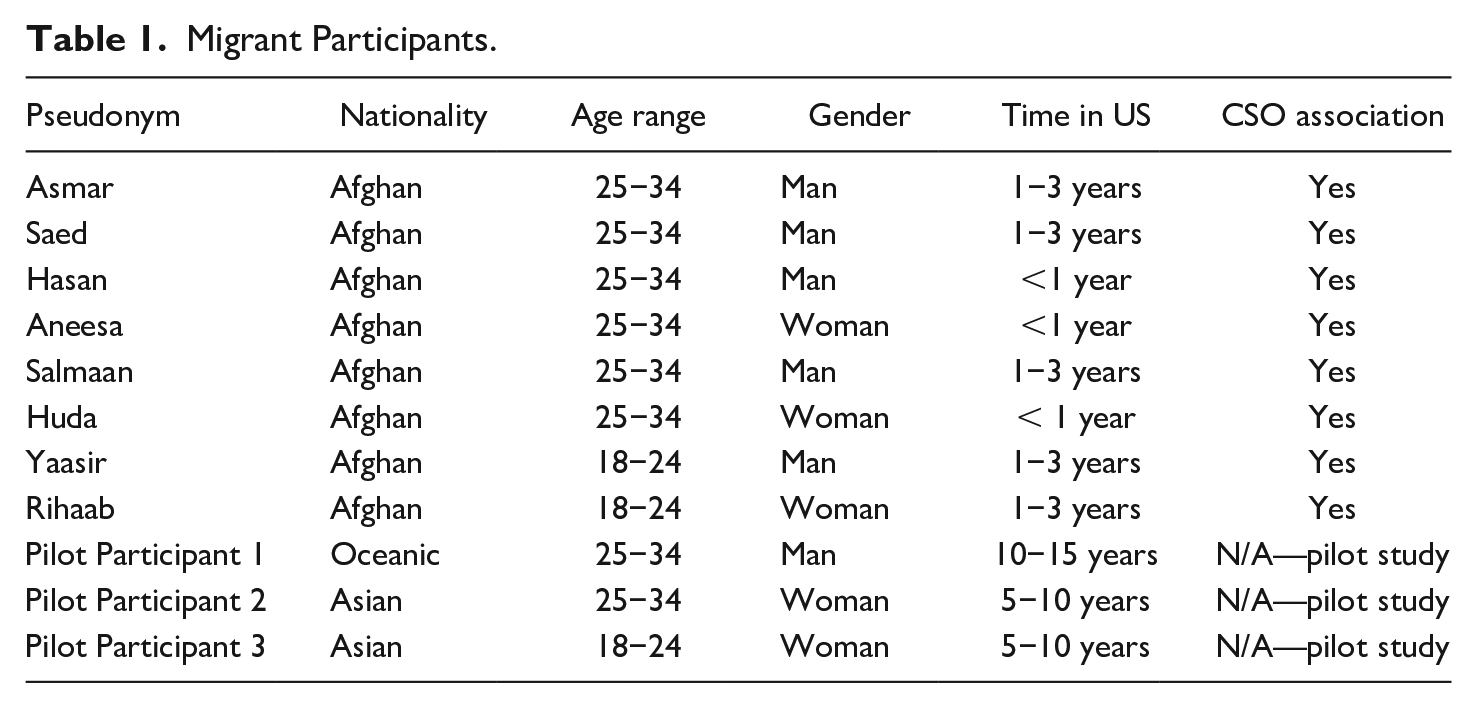
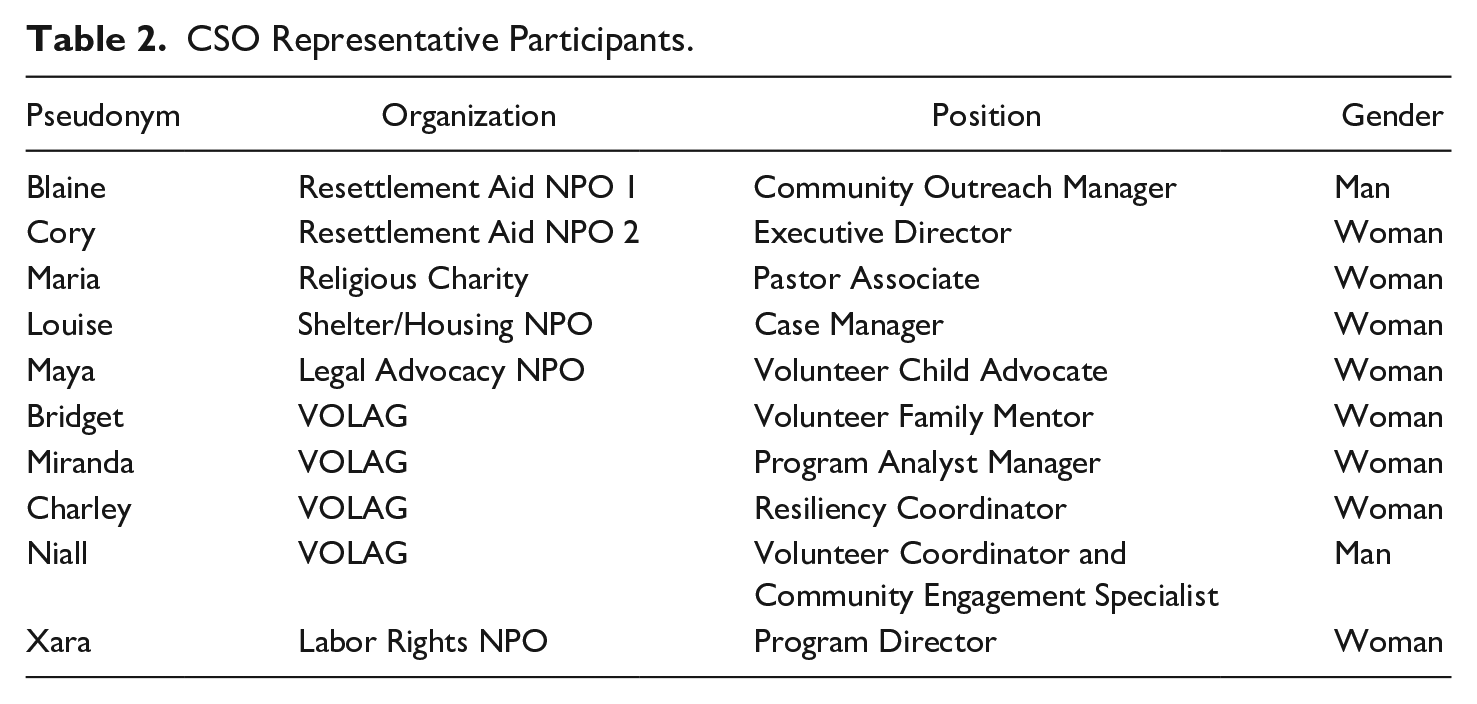
To address research questions exploring organizational perspectives, I recruited 10 members of a migrant advocacy/service organization, including employees and volunteers; all were over the age of 18 years. Volunteers represent individuals who are actively choosing to involve themselves with and identify themselves as part of the organization in a way that is arguably similar to employees who officially represent the organization (Iannacone, 2021b). Table 2 captures the details of the CSO participants, including their position within the organization. Table 3 establishes the purpose and operations of each represented organization. For CSO representatives, I collected 652 minutes of data from the combined interview and visual mapping protocol, totaling eight distinct maps 4 and 171 pages of transcripts.
CSO Representative Participants.
Purpose and Operations of Represented CSOs.
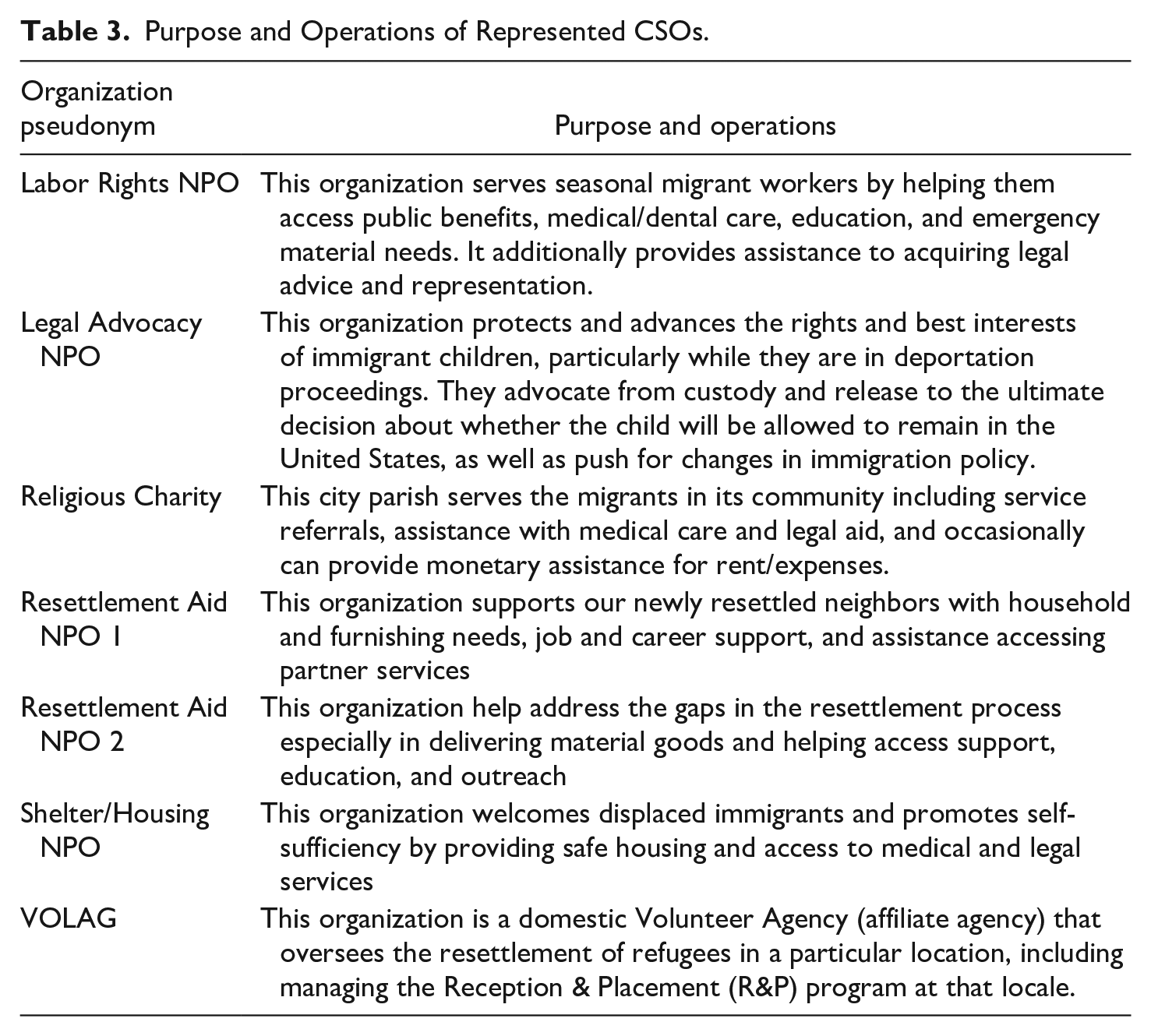
These categories of participants can overlap: Individuals may have migrated to the United States as well as be employees or volunteers of a migrant advocacy/service organization. Two individuals qualified as both categories of participants but responded to recruitment calls with a specific identity at the forefront. One noted they qualified as an Afghan migrant and as such went through the migrant protocol; the other noted they qualified as a CSO representative and thereby went through the CSO protocol. Both were able to and did note their distinct experiences as migrants and CSO representatives, as well as how they intertwined. These instances are clarified in the findings section, when relevant.
Data Collection
Visual Social Network Mapping and Qualitative Interviews
All data collection with both types of participants occurred between November 2022 and January 2023. The interviews and the accompanying mapping exercise occurred over the course of one sitting, sometimes face-to-face and sometimes virtually. Interviews began with general questions including demographic information. Next, participants were led through a visual mapping exercise that involved identifying, labeling, and connecting relevant actors (people and organizations) who are important in their life (see Iannacone, 2024). This was followed by another, more in-depth round of interview questions.
Visual network mapping is a graphic elicitation technique using participants’ drawing to understand complex concepts and experiences (Copeland & Agosto, 2012). I focused specifically on the traditional use of mapping as a means of eliciting visual participant-generated data on social networks in qualitative SNA research. Participants were given concentric sociograms with overlaid quadrants. For migrant participants, “self” was in the center circle, and the quadrants reflected transnationalism and the inclusion of both people and organizations in a social network. As such, quadrants were divided into sides representing country of birth and country of (current) residence, as well as representing people and organizations (see Figure 1). In doing so, this part of data collection spoke to RQ1 and RQ2 in allowing migrant participants to display their perceptions of their social network broadly but also with explicit consideration of CSOs. It is relevant to note that these boundaries may still overlook important actors in the social life of transnational migrants, namely those who are located in neither the country of birth or the country of residence; follow-up research questions aimed to address this limitation and asked who is not included. For CSO participants, the center circle was labeled “the organization” instead of “self.” In addition, quadrants were divided in terms of the level of operation of distinct actors, namely, local, regional, national, or global/international (see Figure 2).
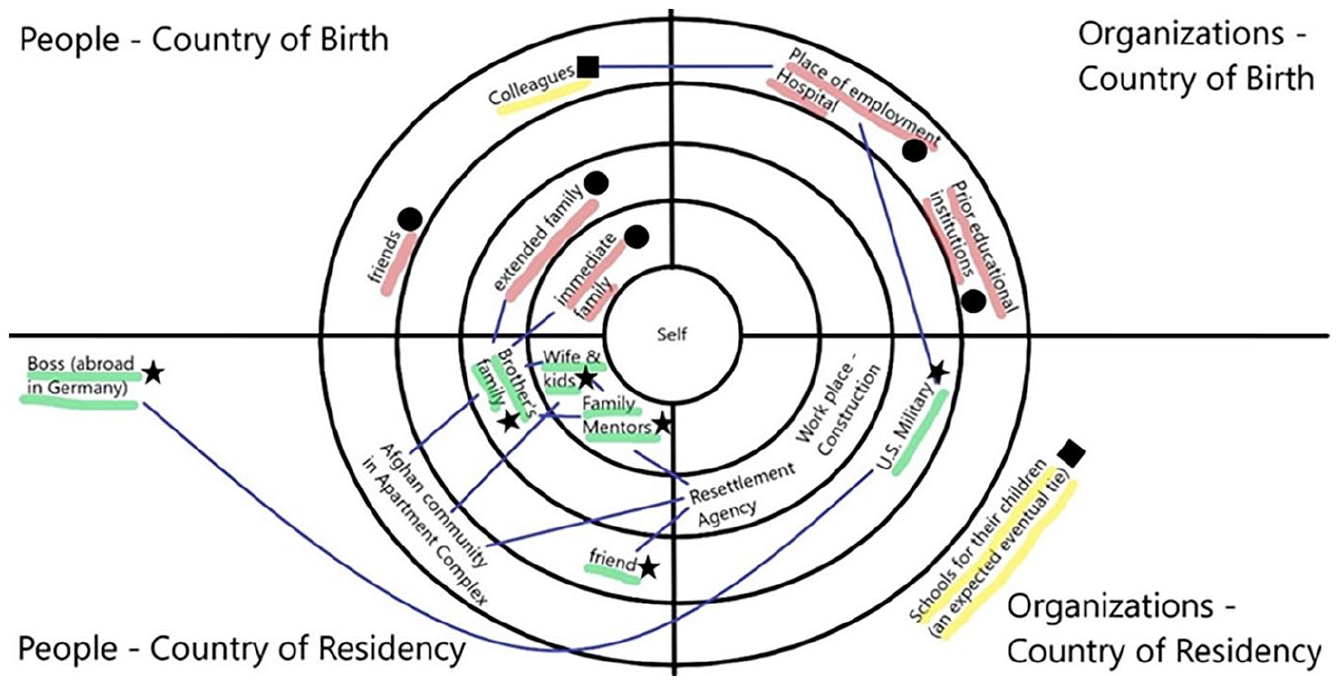
Example Anonymized Map From a Migrant Participant.
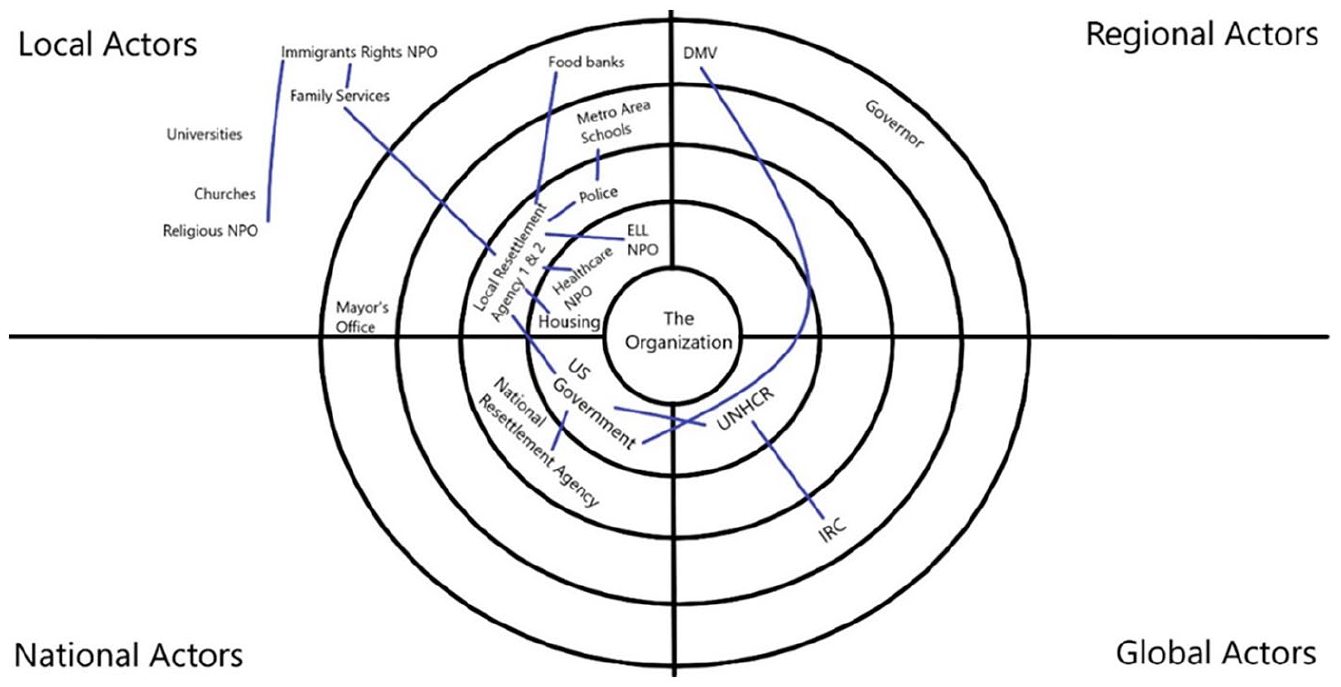
Example Anonymized Map From a CSO Representative Participant
Upon receiving a blank visual network map and following the suggestion of Dobbie et al. (2018, p. 210), Afghan migrant participants were asked to “please think about the important people and organizations in your life.” CSO participants were similarly asked to “please think about the important people and organizations for the migrant advocacy/assistance organization.” Both groups were then instructed to “place them on the map where you think they best fit” according to both the rings of the concentric circle and the quadrants. Participants are instructed to position the actors they felt were most important closer to the center circle; people they felt less close to or felt were less important were placed farther away from the center circle, thereby representing relational closeness (Dobbie et al., 2018). The quadrants further helped to categorize the relationship (Hersberger, 2003). Listing relevant social actors also illustrated the relationship diversity, or the heterogeneity/homogeneity, of participants’ social networks. Following the marking of the map with social connections, participants are also instructed to draw lines between the actors on the map who are connected to each other; this adds another layer of visualizing the connectivity as well as density of an individual network (Hersberger, 2003). It illustrated network positioning, including cases of structural holes and/or brokerage. Both migrant and CSO participants were instructed to connect the actors on their individual maps by drawing lines.
Distinctly, only migrant participants were instructed to color-code their visual social network maps as a means of representing different types of relationships (Dobbie et al., 2018). I used the following color/symbol scheme:
Red/Circle: These relationships have been impacted by your transnational movement.
Yellow/Square: These relationships wherein individuals are unaware of your transnational movement.
Green/Star: These relationships have helped or supported you through your transnational movement.
Color-coding helped to uncover relationship quality by specifically marking whether some (if any) relationships have been impacted by or have impacted the transnational mobility of the participant.
A visual map is itself a form of data for cross-comparison, but the mapping process is also a complementary form of data collection that crystallizes other types of often non-visual data like interviews (Copeland & Agosto, 2012; Hollstein, 2011; Wheeldon & Ahlberg, 2019; Wheeldon & Faubert, 2009). It is often integrated into the interview process as a means to invite deeper reflection and to provide content; maps may suffer from decontextuality if used in isolation (Copeland & Agosto, 2012; Dobbie et al., 2018). As such, after completing the visual mapping exercise, both types of participants were asked a further set of questions about the process of mapping their social network and the resulting visual. In particular, short, open-ended questions that emphasize describing the process and product of the visual network map helped to ensure a detailed account of their perceptions of their social network (Dobbie et al., 2018). Follow-up interview questions also afford space for any inconsistencies and/or limitations. For example, CSO participants were asked how the various relationships in the social network of the organization are impacted by the migrant publics they seek to serve, if at all, alongside other questions pertaining to RQ4.
Ethnographic Techniques
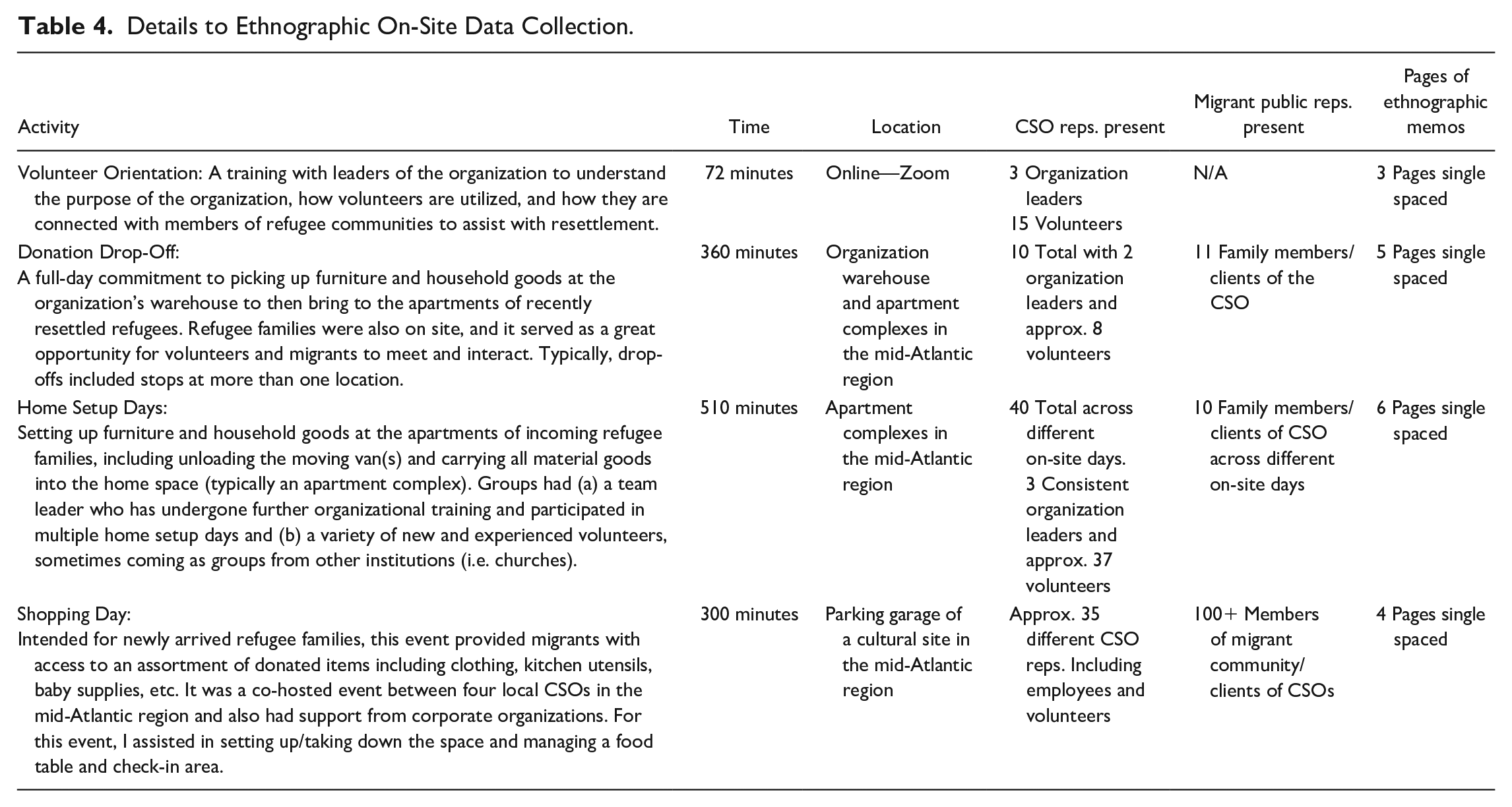
I used three ethnographic techniques (c.f., Atwell Seate et al., 2022; Madden & Levenshus, 2021): observation through witnessing, ethnographic interviews, and textual analysis. First, I conducted ethnographic witnessing at various organizational sites, including CSO warehouses, offices, and field sites. More specifically, I conducted approximately 21 hours (1,242 minutes) of ethnographic witnessing at two distinct organizations (Resettlement Aid NPO 1 and Resettlement Aid NPO 2) in the mid-Atlantic region from September 2022 to January 2023. This time frame and commitment allowed me the chance to partake in a variety of their main responsibilities and embed myself in the relational network I was examining, wherein I was able to generate distinct insights and themes. On site, I engaged in the daily tasks of the organization, acting as another set of hands—similar to a volunteer. I took field notes before, during, and after my times on site, using electronic devices. Occasionally, I recorded myself on my personal iPhone to speed up the note-taking and ensure that all important information was recorded, resulting in both audio recordings and speech-to-text notes; speech-to-text notes were later edited for clarity (i.e., spelling and grammar). In total, ethnographic witnessing resulted in the creation of 18 pages of notes (single spaced). Table 4 better depicts the breakdown of hours spent on site, as well as details to the other individuals on site and corresponding ethnographic memos.
Details to Ethnographic On-Site Data Collection.
Furthermore, I was approved to conduct brief informal on-site interviews, to clarify or verify observations as needed and to develop fuller explanations of what occurred (Atwell Seate et al., 2022). While on site, I would introduce myself as a researcher before talking with other members present in the field. I aimed to converse with as many of the other members as possible. I summarized these conversations in my notes but excluded identifying information. Frequently these conversations were shorter or more succinct due to the physical demands of being on-site—it can be hard to focus on conversation when you are carrying a couch upstairs.
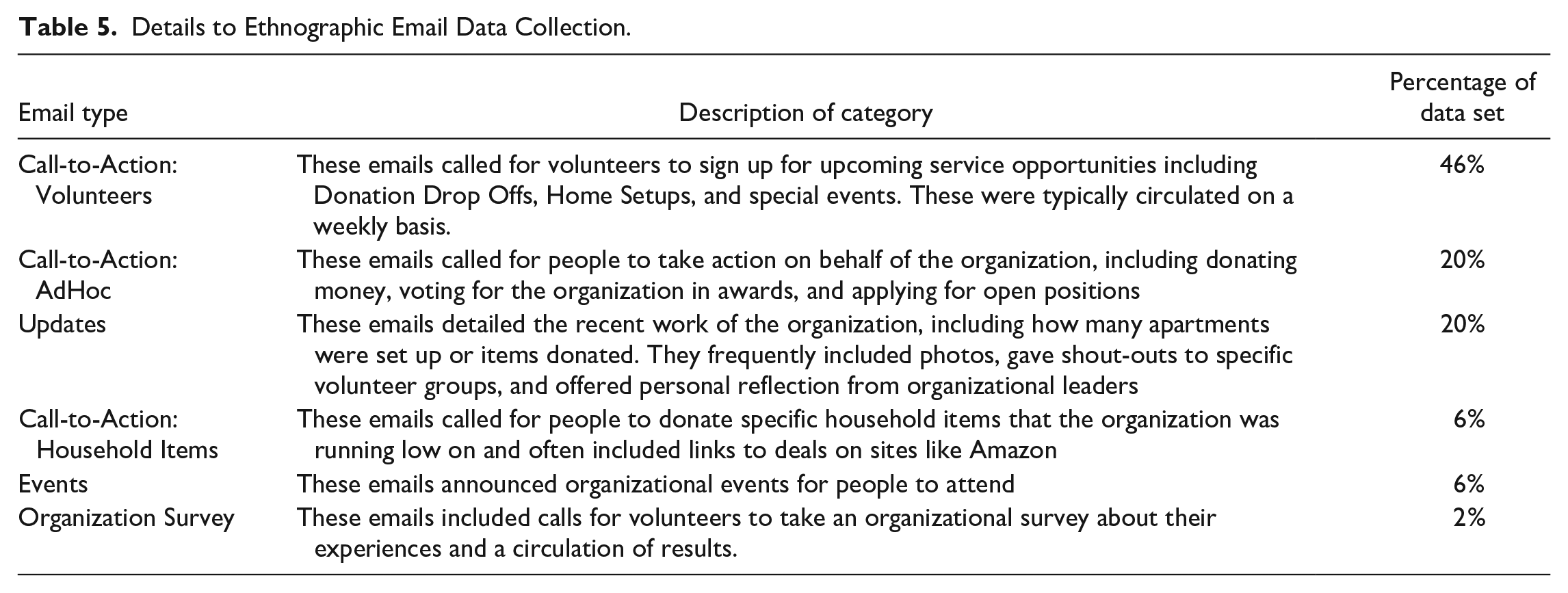
In addition, I collected texts in the form of emails sent through the Resettlement Aid NPO 1 organization listserv because emails served as the primary means of communicating with volunteer and donor publics. More specifically, I collected 100 emails from September 1, 2022 to December 31, 2023. Table 5 showcases the six categories of email types that appeared across the collected email data. For each type of email, I chose one representative email to include for further, more in-depth analysis.
Details to Ethnographic Email Data Collection.
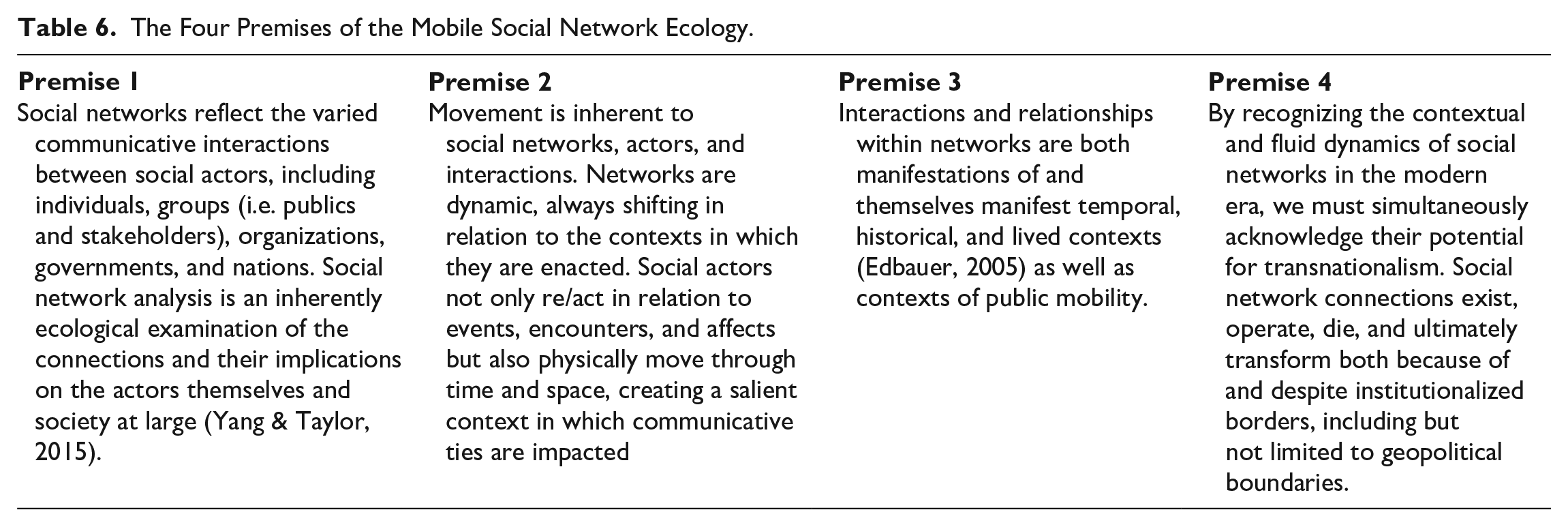
The Four Premises of the Mobile Social Network Ecology.
Data Analysis
Textual Data Analysis
I used a reflexive thematic analysis approach to the interview transcripts and ethnographic observation documents (memos and organizational emails). Reflexive thematic analysis (TA) is an approach to data analysis that highlights the process of identifying patterns in data, and then interpreting them in relation to theory (Braun & Clarke, 2020). It captures both semantic and latent meanings in a process of theme development that accounts for its theoretically flexible nature as an analytic process (Braun & Clarke, 2020). Reflexive TA relies on the interpretive work of the researcher and their reflexivity surrounding their own assumptions alongside any data and theories (Braun & Clarke, 2020, 2021). Researchers approach data through their own social, cultural, disciplinary, ideological, and political positionings (Braun & Clarke, 2021). The overall process thereby requires an immersion into one’s own identities as well as the close reading, re-reading, questioning, and reflecting of the data (Bowen, 2009; Braun & Clarke, 2021).
The unstructured, organic nature of open coding allows for evolution of codes to capture the researcher’s expanding understanding of the data (Braun & Clarke, 2020; Lindlof & Taylor, 2019). For this research, textual data including interview transcripts, ethnographic observations, and various organizational documents were all uploaded to NVivo, a computer software program that provides digital tools to assist with the organization and analysis of qualitative data. Inputting data into NVivo creates a study database, but, as a program, NVivo does not generate its own codes or outputs. The researcher still conducts and completes the coding and analysis. Each document was coded independently prior to the development of themes, which involved comparing codes across cases.
After each document of textual data was coded independently, themes were generated in relation to the distinct research questions and the theoretical lenses of SNA and mobility. Themes are the multi-faceted, more complex crystals reflecting multiple observations or dimensions to the data (Braun & Clarke, 2021). More specifically, codes from interview transcripts with migrant participants were compared to develop themes for RQ1 and RQ2, which explore the migrant perspective of social networks as an example of a mobile public. For example, codes like “safety,” “the Taliban,” and “digital channels” led to the theme of “Disruption to Cross-Border Interpersonal Ties.” Similarly, codes from interview transcripts with CSO representatives were compared to generate themes for RQ3 and RQ4, which examine the organizational perspective on having mobile publics within a social network. For example, codes like “localized,” “global actors,” and “collaboration” led to the theme of “Dichotomy of Glocal: Relationship Diversity among Hyper-Local Networks surrounding Global Issue.” Ethnographic memos and organizational documents were also coded independently and then compared with the relevant transcripts for all research questions.
Visual Data Analysis
The visual network maps created by participants were their own form of data and required a unique form of analysis, as outlined in the article by Iannacone (2024). The visual characteristics and topical dimensions of the network are thick, rich data within themselves (Decuypere, 2020). The visual maps produced by the participants of this project illustrated patterns for concepts like relationship strength (through the use of concentric circles representing “closeness”), relationship heterogeneity or homogeneity, and network positioning, including identification of structural holes and brokerage. As such, the visual maps produced by migrant participants helped uncover important details for RQ1 and RQ2, whereas the visual maps produced by CSO participants expressed salient information for RQ3. Two approaches were taken to analyze visual social network maps.
First, in analyzing maps-as-process, I referred to maps while coding distinct individual interview transcripts to understand their mutual corroboration (Iannacone, 2024). For example, many CSO representatives verbally highlighted the prominence of local connections (codes like “local actors” and “localized”) that were simultaneously visible on the distinct maps. Second, in analyzing maps-as-product, I analyzed maps independent of textual data according to the dimensions Decuypere (2020) suggests: regions, centers, density, interfaces, and infrastructure. All these help to highlight unique visual patterns (Iannacone, 2024). For example, analyzing and comparing each CSO representative map for density (i.e., the interconnectedness of nodes, Decuypere, 2020), further confirmed the existence of structural holes at the non-local levels, reaffirming the significance of localization. On the other hand, the analysis of the network infrastructure (i.e., the different types of nodes, Decuypere, 2020) of migrant participants’ maps highlighted the lack of relationship heterogeneity and subsequently the prominence of CSO representatives as network centers. CSO representatives frequently had the most ties and were color-coded as helpful actors. This particular scenario helped with themes for RQ1 and RQ2 in depicting the characteristics of migrant networks and the role of CSOs. The social network maps ultimately served as another salient form of data to assist in the generation of themes and were equally subject to the principles of reflexive TA, including the development of shared meaning according to my interpretation, analysis, and subjectivity.
Findings
This section details the findings of the four research questions surrounding the transnational social networks of mobile publics. RQ1 sought to explore the social networks of migrants, as a distinct public defined by mobility, to find network transformations that are incurred due to the enactment and context of mobility, including in the maintenance and navigation of cross-border ties. RQ2 aimed to ensure that the exploration of migrant social networks is inclusive of relationships with societal institutions, wherein participants emphasized perception of and involvement with resettlement agencies and some other migrant-serving nonprofit organizations in the United States as a means of integrating into the nation’s civil society. In examining the implications of publics mobility for the organizations that seek to serve those groups, RQ3 highlighted dichotomies in how CSOs perceive and maintain their social networks, which speak to the actors, relationships, interactions, and positioning within the networks. RQ4 showcases the role of mobility more in-depth by emphasizing it as the context underlying the social network ecology.
Findings for RQ1
The first research question sought to understand how Afghan migrants perceive and maintain their social networks. The findings largely speak to the network transformations that are incurred due to the enactment and context of mobility, particularly their communicative capacity to generate new connections and sustain cross-border ties.
Isolation in the Generation of New Ties in the Country of Residency
Migrants perceived their social networks as stagnating in the new country of residency: They feel a sense of isolation given their inability to foster ties in the United States. Visually, the social network maps from migrant participants had fewer actors and ties; even the process was more stunted. Participants were often prompted about certain categories of actors (e.g., neighbors) before that actor was included and/or discussed, as opposed to being recalled naturally as important. This generally resulted in more actors in the “country-of-birth” half of the map rather than the “country-of-residency” half of the map, suggesting it was a case of remembering past times rather than reflecting on current dynamics. Asmar captured this sentiment:
One thing in Afghanistan, the majority of people are very social. They are used to gatherings, used to having parties, going to one another’s house, and all those things. Here in the U.S., life is very different. People are not very social. . . . I see people have less interaction and they are very isolated.
Mobility, especially between nations, can lead to comparisons regarding the quality of people’s social networks, and this case emphasized a stagnation in which a perceived lack of actors highlights a lack of interactions. Participants stated that they did not have many if any connections across their network in the United States both interpersonally and with potentially significant organizations.
Many participants asserted being equally isolated from organizations, especially those that may provide employment. Hasan explained: “Actually I don’t know anyone right now. . . . I don’t know any other organizations. . . . Back in Afghanistan, we had a busy life . . . [but] we’re just stuck here in our house.” The issue is compounded regarding their opportunities for employment, one of the largest challenges for this community. While I conducted observations on site at a CSO volunteer orientation, a training facilitator explained the scale of the employment issue: “there has ended up with 70,000 people vying for a few jobs in this area, and people will instead need to shift to other fields” (1.4 Ethnographic Memo). Whether staying in their original work or shifting careers, participants do not feel that they have professional connections within their network. Although still young, in speaking of his future, Yassir expressed: “I wish . . . there was an organization or someone that’s really helped me with my career because I know it’s hard for me to start now.” Migrant participants perceived themselves as isolated from the employers who would hire them, the connections who would help them get a foot in the door, or even those who would help them once they were employed.
Disruption to Existing Ties in the Country of Birth
Many of the migrant participants witnessed disruptions—drastic changes or interruptions—to their social networks, especially in terms of maintaining their transnational ties. In particular, their connections to people and organizations in their country of origin were largely disrupted because of both mobility as an action (i.e., movement) and mobility as a context (i.e., the reason for and dynamics of mobility).
Disruption to Cross-Border Interpersonal Ties
First, the enactment of mobility in the form of transnational migration led to participants being physically distanced from many important actors within their social networks, thereby impacting their capacity to sustain existing, transnational ties. Primarily, this was noted with regards to their family members who remained in Afghanistan. The significance of family members still in their country of origin was visually illustrated—many listed their family within the inner ring of the “people—country of birth” quadrant and noted the disruption to their family ties (i.e., red color coding) as a fundamental change to their social network. Evidence of this disruption is best seen in the story of Aneesa, who was 8 months pregnant with her first child at the time she and her husband fled Afghanistan for Qatar, where she gave birth before migrating to the United States. Her mother and mother-in-law are the most important actors in Afghanistan for Aneesa, yet her transnational mobility means she has not been able to turn to them as frequently as she wishes or needs:
[My husband and I] didn’t have any experience about having a kid, and how to handle the kid, so that was a little hard for us. Back in Afghanistan, we had a big family from both sides. Our mother, and brothers, sisters, families—they supported us a lot. Since they weren’t here with us, that was a little scary and also a little hard for us.
The distance from their family and their support marks a disruption to their social network connections, which had a real, affective impact on their lives.
Many of the participants attempted to alleviate this disruption by relying on digital technology, including social media like WhatsApp, to maintain their connections with those who were physically far away. Salmaan, for example, explained that he was still interacted with his family in Afghanistan frequently: “We have a WhatsApp system. We have video chat. We do talk. I talk to them every single day [for] like three, four, five minutes.” While he wishes they could connect for lengthier periods, he expressed his gratitude that they can still communicate on a regular basis. While some participants noted the use of other digital apps, like Facebook Messenger, many primarily used WhatsApp and saw it as key for maintaining transnational ties, especially to share personal and/or private information, pointing to the way that the disruption of ties is also reflective of mobility as a context (i.e., the reason for and dynamics of mobility).
Second, the context of mobility is a salient factor in the migrant participants’ perception of disruption to their existing, transnational ties. Participants who migrated to the United States under the SIV program perceive themselves and their social network connections still in Afghanistan as unsafe following the evacuation of the United States and the fall of Kabul to Taliban rule. Because of their previous and current connection to the United States, participants expressed great fear for their connections, again often significant family members, who remain in Afghanistan, leading to distinct behaviors intended to maintain these ties. Hasan explained his intense concern about his two sisters, brother, father, and mother:
They are living in Afghanistan, so I’m worried about them. We are not refugees. We are SIV. That shows that we work with American people and we helped them when they were in Afghanistan, so I’m worried about them.
Participants actively fled from threats of persecution; threats they perceive as still existing within their network. As such, the disruption is not solely a reflection of transnational mobility but also the context and dynamics that surround that mobility.
The context of transnational mobility resulted, for many migrant participants, in a social network whereby ties are disrupted in the name of safety. This entanglement of safety and disruption is especially emphasized by Asmar, who fled Afghanistan. He later learned that the following day, the Taliban entered his family’s home, stole their money, and threatened to kill them. The Taliban accused the family of hiding weapons and working with the U.S. Army. Unsurprisingly, this knowledge and the perceived ongoing threat impacted how Asmar maintained the ties in his social network:
After the Taliban took over, it’s very hard to communicate with them. First of all, I don’t think that the way we communicate with them is safe, especially in south Afghanistan. I am always conservative when I talk with them.
He actively altered his communication behavior with these significant ties, emphasizing a disruption in a strong, interpersonal relationship. Similarly, people in his network chose to alter their ties and communication with Asmar:
Many of my friends that I was friends with [on] Facebook and social media, after the takeover of Taliban, they have unfriended me. Many of them have blocked me because they were concerned that if their cellphones are checked, they could find out that they have friends living in the U.S. . . . They have sent me messages saying, “I have unfriended you, don’t mind because we are not living in a good place now.” I understand them.
Again, his story emphasizes the disruption to existing, transnational interpersonal ties, which can no longer be maintained as they once were due to the context of mobility that resulted in a lack of safety between Asmar’s connections.
Disruption to Cross-Border Organizational Ties
While the enactment of mobility can also place physical distance between migrants and some organizations, the context of mobility was noted as much more significant to perceptions of organizational relations following migration. Many participants intentionally chose not to retain relationships with organizations in their home country following the Taliban takeover, sometimes because of what these organizations have come to represent under Taliban rule. They focus instead on the hope of creating new ties in the U.S. Aneesa, for example, was studying dentistry prior to the fall of the Afghan government. She was “busy practicing in a clinic and . . . was seeing about 20 patients every day.” However, she says that now she “doesn’t have any interest to have connections with any organizations . . . [instead] just focusing to start a new life here with the new culture.” She especially “wants to join a center just to start again in the medical field.” As a woman, she would no longer be allowed to study or practice dentistry under the new regime in Afghanistan, and so the organizations she was once connected to no longer reflect her values or identities. Rather, she emphasizes a desire to align with organizations that respect her beliefs and experiences.
The choice to not maintain an organizational connection also reflected perceptions that the organizations in their country of origin could no longer serve them. When on-site conducting observations, I learned that many foreign credentials, especially academic, were invalid if not nullified in the United States (1.4 Ethnographic Memo). Many migrants could not turn to their previous organizations for help within the United States, professionally or academically. For example, following the delivery of furniture to a newly resettled Afghan family of five, volunteers were treated to a home-cooked lunch, during which a fellow volunteer, an Afghan refugee himself, told a poignant story.
Upon hearing that I’m a researcher at the university, Kalan shared that he too had been an academic in Afghanistan—a professor of Persian literature whose own poetry was just starting to receive national attention. He had spent years researching, publishing, and just trying to survive graduate school to finally land a professor position. Then it was gone in the blink of an eye. With the fall of Kabul, he fled Afghanistan, ended up in a large metropolitan area on the east coast, and focused on getting his wife evacuated as well. Life as he knew it disappeared. Kalan wants to reestablish himself as a professor in the U.S., but it feels impossible at times. His old university, his degree—they do not offer the connections, channels, or credentials to join the academic community in the U.S. He has to instead focus on reinventing himself. (12.13 Ethnographic Memo)
Overall, this finding illustrates that not only are social networks transformed by migration but also the enactment of mobility and the context of mobility have implications for migrants’ social networks, including by disrupting significant ties.
Findings for RQ2
The second research question explored how migrant participants perceive their relationship with CSOs specifically. In particular, participants highlighted the evolution of their involvement with resettlement agencies and some other migrant-serving nonprofits in the United States, rather than a broader range of CSOs.
Interpersonal Ties as a Marker for Organizational Relationships
When discussing their connections with CSOs, migrant participants largely referred to specific interpersonal relationships with representatives of these organizations, especially those organizational members deemed closest to them, such as family mentors. Many migrant-serving CSOs utilize a mentor-partner program in which a U.S. citizen volunteer is paired with a migrant family; the volunteer assists the family members with life in the United States, including by helping them to obtain resources, sharing information, and being a point-of-contact for questions and concerns. These relationships were extremely significant, visually situated in the 1st or 2nd innermost ring of the “people—country of residence” quadrant with green color coding. Participants frequently expressed this when I asked specifically whether they felt close to any of the organizations in the United States and whether any had been helpful. Yassir mentioned his family mentor, Elena, and her friends:
These five guys, they really help us. When we first came, we were in a hotel. The organization that was connected with them, they were supposed to help us, but it took a long time to find us a home or house. [Elena] really helped us with that and they find us at home and whenever we want to go somewhere, they really help us.
Although Yassir noted that Elena and her friends are connected to a resettlement agency, he emphasized the significance of Elena herself and her ties with the family. To him, it was not about the relationship with the organization, but the CSO member who represented it. In this sentiment, he was not alone. Hasan similarly voiced the significance of family mentors:
My two family mentors—they’re very important to me. For me, they’re part of my family . . . They help me a lot. Believe me, they helped me a lot. Since I was in Qatar, they collected everything for us . . . everything [that] we need at the moment, like dishes, beds, clothes for my wife, clothes for my baby, for me. They’re helping us a lot. I love them too much.
Many of the Afghan migrants interviewed saw family mentors as providers of material goods, companionship, and problem-solving, ultimately serving as an important actor to help with a variety of concerns. In fact, when it came to problem-solving, new residents in the U.S. thought of family mentors as more significant than other more familiar community members. These interpersonal ties represented positive interactions with the organization because of their ability to leverage its network of resources. Overall, when prompted about connections to important organizations, migrant participants highlighted the role of specific CSO representatives and how these interpersonal ties were significant, particularly in whether/how they connected them to various aspects of U.S. society (i.e., resources, information, places, and employment opportunities).
Perceived Expectations Over the Course of CSO Involvement
Given the excess of CSO service roles and responsibilities, migrants perceive these organization as having boundless connections that can and should be optimized to assist the migrants with joining American life. They are expected to vouch for migrants in housing situations as co-signers to leases, to oversee the process of getting public benefits to migrants, and to connect migrants with monetary and material resources that ease their financial situation. As Saed expressed:
What the resettlement agencies do, they have their own relationship with the rental communities for their refugees and they rent the house for the refugees. . . . They have connections with different donations. . . . This impact means I was, at least for a year, not paying out-of-pocket to buy some stuff. It impacted me a lot financially.
Saed had experienced firsthand the help offered by migrant-serving CSOs and spoke of those initial services with praise, underlining how these organizations have important connections for migrants. These high expectations also applied to the employment sector, an especially challenging area for new migrants to the United States; many expect CSOs to have ties that can be pulled on to help them find jobs. As Asmar noted, “I’m not sure how they do [it], but they are connected to different job markets. . . . They are widely connected . . . and they refer employees to them.” The emphasis is, again, on the organizations having beneficial relationships within their own network that migrants can turn to. While migrants praised CSOs for optimizing these ties, they also were disappointed once they realized the CSO networking limitations and the (short) time that new migrants have access to these connections.
The high expectations for CSO services can generate equally high disappointment when those expectations go unmet. Many key resettlement agency services (e.g., one-time payment per refugee to assist with early expenses and other time-limited cash and medical assistance services) end after an initial 3-month period of resettlement in the United States (Bureau of Population, Refugees, and Migration, n.d.; Office of Refugee Resettlement [ORR], 2023). After that, many migrants instead must turn to other nonprofit organizations, which are often limited in what they can provide due to a lack of funding. This shift in what is provided and by whom is often surprising to migrants. Having worked in a couple of roles with a resettlement agency, Asmar mentioned this service gap:
They’re not serving the clients as they were expected—that is always a complaint from the clients. . . . It is very challenging after three months because the other [organizations] that we refer clients to, they are not simply giving rent. They do their best to find [clients] a job, and they have to be able to get to work and make some money. . . . For most clients, it’s against their expectations.
Having only 3 months of access to some of the resources and connections that resettlement agencies as a CSO can provide is a point of contention for many in the migrant community. Further services also end after 1 year (Bureau of Population, Refugees, and Migration, n.d.; ORR, 2023). The expectation of support services and connections is perceived as unmet due to what comes across as random time limitations, creating a needs gap that impacts the relationship between organization and migrant. This disappointment is only furthered by other perceived slights of CSOs as they attempt to manage remaining needs across the process of resettlement in the U.S. Migrant participants who had been in the United States at least a year described resettlement agencies as “going through the motions.” Working with nonprofits did not close this gap as they too were perceived as slow and inefficient. Overall, the perception of a welcoming into U.S. society by CSOs fades after that initial 3-month period for integral services: migrants find themselves relying on less-efficient connections, with access to fewer resources, and pushed to be self-sufficient. The expectations of boundless connections from CSOs goes unmet. As such, migrants express disappointment in their involvement with CSOs.
Findings for RQ3
The findings for RQ3 revealed clear similarities in how the different CSOs of this study perceive and maintain their social networks, specifically how they face three dichotomies: the dichotomy of service, the dichotomy of glocal, and the dichotomy of importance. Each of these dichotomies will be unpacked herein.
Dichotomy of Service: Organized for Yet Reliant on Others
By examining the social networks of CSOs aimed at supporting migrant publics, this project uncovered a dichotomy of service. Participants perceived networks as operating for some while relying others, and the presence of and interactions with these actors largely defined the network. Significantly, these findings show that publics play a complicated role as actors in CSO networks, both in their reception of services and their links to others through inter-public relationships. Yet, this does not discredit the importance of other organizational actors. As such, these networks seemingly depict a dichotomy in which CSOs are organized for migrant publics and are simultaneously reliant on others (interorganizational relationships).
Although the CSO representatives used distinct terminologies (i.e., migrant families, residents, farmworkers, or children), the meaning is the same: the primary actors of importance in the organizational network are the distinct migrant publics. This significance was visually represented across the mapping exercise; the majority of the social network maps have the migrant publics placed within the first or second ring of importance. Interestingly, participants representing resettlement agencies (VOLAG) did not map migrants on the organization’s social network despite referencing them throughout interviews. This visual absence suggests that migrants are inherently a part of this social network, as the reason for and receiver of the organizations’ operations, but are also marginalized members who cannot and/or should not be relied on as contributing members of the network due to their limited resources and capital. Regardless, migrants—in their varied contexts—were described and/or visually depicted as important to these CSO networks.
Significantly, migrant publics are not solely recipients of services but also creators of key connections for the CSOs, especially to other migrant families and individuals. In noting the significant actors in the Resettlement Aid NPO 1 social network, Blaine stated, “The families are also involved because they often end up being the ones who advocate for the newly arrived folks. . . . There are a bunch who will get involved with these organizations.” Migrants are a public that connects the organization with other migrants who need help, particularly their own family members or friends who have just arrived in the United States. These inter-public relationships also help build trust between CSOs and new publics. Louise noted that many of Shelter/Housing NPO’s current residents, migrants who would otherwise be homeless, followed in the footsteps of family members who were former Shelter/Housing NPO residents. She visually depicted both these actors on the social network map in the first and second rings with a strong tie (i.e., inter-public relationship) between them, noting: “I think there was trust, a lot of trust between residents and former residents, and more so than there was between residents and employees.” Her statement captures how the inter-public relationships often contain a level of trust that can help the organization when former migrant clients guide current migrant clients through the process.
The second part of the dichotomy of service is the reliance on other actors, especially key interorganizational relationships. On the organizational network maps, most list more organizations than people, groups, or distinct publics, illustrating the importance of interorganizational relationships, particularly with other migrant-serving CSOs. For example, although he represented Resettlement Aid NPO 1, Blaine noted a particular interorganizational relation with Resettlement Aid NPO 2, whom he placed in the innermost ring of the local actors quadrant: “A lot of the families that we set up apartments for get funneled to Resettlement Aid NPO 2 through either word of mouth or just directly through us. . . . I think it’s 80% or 90% overlap in families.” As the quote shows, the operations of the two CSOs are entwined with one another in that their interorganizational relationship helps each organization in its purpose of assisting migrant families to access material resources during their resettlement, with Resettlement Aid NPO 1 overseeing the furnishing of apartments and Resettlement Aid NPO 2 providing additional material goods. Although distinct, their purposes reveal a shared value to serve migrant publics in a way that is only possible through interorganizational relationships with other CSOs. Overall, the interactions between interorganizational actors ranged in quality, especially in terms of frequency of message exchange where more recurrent communication indicated greater importance.
Dichotomy of Glocal: Hyper-Local Networks of a Global Issue
The concept of glocalization, and the correlated adjective of glocal, underscores how the global is localized (Valentini, 2007). In this study, CSO representatives perceived their networks as united by a global issue yet highly localized. One participant, Cory, even said that she wished “more people could think of it as think globally and act locally.” The networks are glocal: glocalization characterizes their relationship diversity as well as the quality and norms of their interactions.
Generally, CSO participants articulated the transnational dimension of their work and network by highlighting how forced migration is a global issue. The global scale suggests an increase in relationship diversity because networks would be less bounded and would include a plethora of diverse actors/ties. For example, Maya from Legal Advocacy NPO noted a plethora of global and national actors, such as governments, immigrant rights organizations, foreign press, etc. She insisted that “other immigration organizations like United We Dream, UNICEF, and others are also helping fight this global issue really.” To her, having a network impacted by transnational mobility allowed for global connections and opportunities, especially in being united by a shared cause.
However, Maya’s perception was notably rare. Overall, the majority of CSO representatives acknowledged the global dimensions of their work but perceived their networks as very localized and subsequently not relationally diverse. Visually, most of the CSO maps showed an abundance of ties in the local quadrant. As Cory from Resettlement Aid NPO 2 succinctly put it, “The majority of the actors fall within the local quadrant just because we are very grassroots.” The emphasis is on action at the local level with the focus on particular individuals, groups, and communities who need assistance. As such, the networks as a transnational whole have minimal relationship diversity in terms of actors across quadrants and were furthermore perceived as having minimal relationship diversity across sectors within that local quadrant.
The glocalization and subsequent network homogeneity resulted in collaboration, wherein it was widely acknowledged that their organizations cannot be isolated in their efforts. The shared focus on how global migration becomes embedded at the local level joins these organizations together in the attempt to alleviate the issues that befall the mobile, marginalized publics. As Louise noted when discussing the relationships between Shelter/Housing NPO and other shelters, “It’s a comradery thing and I think usually it’s not competitive because we all understand the struggle.” Niall similarly mentioned the collaborative environment between VOLAG and the other resettlement agencies in the area: “We have really tight relationships with them. We have quarterly meetings to run through everything . . . so that we’re sharing the load and we’re sharing information.” The glocalization of these networks, in which a global issue is enacted at a local level, seemingly fosters collaboration, but not without its nuances. It is important to note that these instances of collaboration were most commonly between CSOs of the same organizational type and purpose. Pockets of collaboration between similar organizations seem to emerge because the scale of the issue is much larger than the scope of any one organization.
Dichotomy of Importance: Interactions and Impact Underlying Network Structure
Finally, findings for RQ3 present a unique complication to the assumption that only ties of interaction undergird network structures, instead emphasizing a dichotomy of importance that also highlights the significance of impact. The previous dichotomies show that interactions are still a significant component to understanding social networks. Some actors, however, were perceived as a part of the network regardless of the traditional interactional markers of ties such as frequency of exchange, collaboration, or time spent together.
Rather, certain actors were perceived as present in the organization network because of their impact, construed more specifically as their decision-making power, such as the global impact of the UNHCR. Speaking of its role in the Resettlement Aid NPO 1 network, Blaine explained:
It’s basically how families are matched to host countries or resettlement countries. . . . They, in a good year, do about 250,000. . . . We know of them and that’s about it. . . . We don’t interact with their world headquarters or whatever.
The work of the UNHCR in overseeing the resettlement of refugees across the world directly impacts the operations of Resettlement Aid NPO 1, and so the global actor is pertinent to their social network despite the absence of communicative interactions. This impact was further described by Niall, who noted that: “The UNHCR makes decisions that then affects us. . . . The UNHCR, actually, has . . . power to decide where refugees go. Whether they get refugee status, they’re more of the decision-makers.” The global actor’s presence on the social network map, despite the lack of interactions, emphasized the importance of impact to a social network structure.
The presence of and connections to an actor due to their impact was also relevant at the national level, especially including the U.S. government. The U.S. government, and in particular the president, has the right to set the number of refugees being resettled in a given year, and also oversees immigration policies (Ambar, 2022). These decisions have a prominent impact on the CSOs, according to participants, whether it was a resettlement agency or an NGO. As Niall explained:
I think all of the national decisions pending how many refugees are going to be admitted to the U.S. How many each year? What’s the ceiling going to be? That’s set by whatever administration’s in power. That greatly affects what our capacity is. What our funding is. They decide on funding. They decide on how much help we’re going to get really.
For VOLAG, decisions by the U.S. government have an immediate impact regarding their operations, especially because refugees are entitled to services and support from domestic agency affiliates (Ambar, 2022). In deciding how many and who, the U.S. government directly defines the expectations of VOLAG’s services. Other CSOs, like NPOs, were equally impacted. Many referenced the long-lasting damages inflicted by various Trump administration decisions. In seeking to restrain mobility, the decisions of the Trump administration greatly impacted the internal functioning of CSOs, threatening their survival and ability to serve migrant publics through funding cuts, etc. As such, organizational networks and the organizations within it are particularly vulnerable to the decisions of large actors at a national level.
Findings for RQ4
The findings for RQ4, the examination of how mobility impacts network perceptions and maintenance, reaffirm the importance of considering networks as ecologies in which context can be critical. CSO participants perceived mobility as an underlying reason generating the network, or more specifically, the formation and maintenance of their organizational network related to the issue and enactment of forced, transnational migration to the United States. Notably, the production of mobility by some actors (i.e., migrants) generates a social network ecology, which evokes and/or complicates the existence and purpose of other social actors (i.e., migrant-serving CSOs), generates necessary niche relationships, and prioritizes certain communicative behaviors. Ultimately, all of this reflects the conditions and context of the transnational mobility.
Mobility as Transformative in Generating and Challenging Social Actors
Just as the existence and transformation of ecosystems depend on the presence and regulation of energy, so too are participants’ social network ecologies defined and altered by an undercurrent of mobility, a property that manifests in our exchanges and environments. The production of mobility by migrant publics is a transformative property that calls for other actors, resettlement agencies and certain NPOs, to exist while also challenging the structure of pre-existing institutions. As Miranda explained, VOLAG is a domestic branch of an international resettlement agency that exists to handle the resettlement of refugees in local contexts in relation to (a) the national refugee cap set by the U.S. president and (b) the decisions made by their national and international heads. VOLAG and other agencies exist in response to the mass forced migration that occurs globally, a type of transnational mobility that often incurs marginalization and requires special services from CSOs.
Similarly, NPO representatives noted how their organizations exist because of mass mobility and the subsequent marginalization of many mobile publics, including in response to limitations of agency capabilities. Cory explained how Resettlement Aid NPO 2 was founded to oversee assistance to refugee families beyond the basics of agency support, including the provision of material goods and educational opportunities. Blaine further described how mobility leads to the need for NGOs beyond agencies when describing Resettlement Aid NPO 1:
[We were] founded because when a family comes here, they each receive a resettlement stipend. Some of that goes to the agency to cover operating costs. Whatever doesn’t has to go to making sure the family is moved in according to federal standards . . . the federal requirements are the bare minimums . . . it doesn’t necessarily mean that’s enough for them to be okay or stable. [We] started because we were like, well, we can offset arguably probably the most expensive part of resettlement, which is just getting furniture and beds.
To summarize, Resettlement Aid NPO 1 and 2 exist because the transnational mobility of forced migration to the United States results in certain needs and realities that are not met by agency intervention alone, necessitating the involvement of other organizations. The production of mobility by some actors calls for the existence of other actors.
The existence of these CSOs, which inherently consider transnational mobility to serve those who enact it, stands in contrast to other societal institutions in the social network ecology, whose services may impact but do not necessarily center migrant publics. Rather, mobility may actively challenge the structures of these organizations, speaking to its overall transformative capability within a network. Significantly, this transformation is complex as the fluidity of mobility, and how it is enacted can make establishing long-term changes difficult. For example, Xara and the Labor Rights NPO focus on the experiences and rights of migrant agricultural workers, who often move cyclically depending on the harvest season and are a distinct mobile public with needs that challenge the structure of other societal institutions:
From a systems perspective, we do have more Latino families, more Spanish-speaking people who are settling in an area over time, but because a lot of them are temporary, there isn’t a big shift in what is actually made available. . . . I was speaking with someone from the local hospital and they’re like, “We know that there’s a need to have interpreters here, but because we don’t really have the numbers to capture that that’s actually a patient population that comes, we don’t know how to justify that cost.”
Necessary transformation, in terms of hiring more interpreters to improve service, is hindered by the mobility of the migrant public, whose presence requires better language services but whose transience leads to their perspective being uncounted. Xara noticed a similar issue with schools, which are often unprepared for the influx of bilingual/English language learner (ELL) migrant students in the fall as if they “don’t know how to plan for those students until they’re already there, and then by the time they try to think what could be something that we would do to help them, they’ve moved on again.” Labor Rights NPO works, in part, to push for transformations that align with patterns of mobility, especially among those not inherently attuned to migrant publics. The example showcases how mobility generates new social actors like Labor Rights NPO and challenges the structures and procedures of other social actors in the network like hospitals and schools. Overall, the production of mobility by migrant publics is akin to the production of energy by producers in the natural world—it is a transformative property that generates the existence of other actors and challenges other structures in the environment, such as the procedures of existing social actors.
Complicated, Necessary Ties: Niche Relationships in Network Ecologies
The production of mobility by some actors (i.e., migrant publics) also delineated the need for certain ties between social actors. These relationships are not inherently voluntary and/or positive. Rather, organizations perceived these complicated relationships with nuance, even describing the ties as tense amid frequent exchanges of communication. In the context of this project, three complicated relational niches emerge due to the presence of transnational mobility: Agency-Nonprofit, CSO-Housing Organizations, and CSO-Law Enforcement.
Agency-Nonprofit Niche
One type of complicated relationship involves the tie between resettlement agencies and nonprofits, especially those who serve migrants at the same local level. Agencies are supposed to provide the services and support that refugees are legally entitled to (Ambar, 2022). NPOs also serve migrant publics but are not inherently affiliated with government legislation or funding and may thereby cover a wider breadth of services and populations (including but not limited to refugees). The two are conjoined in their efforts, often calling on each other for assistance, but do not have inherently positive relationships. As Cory from Resettlement Aid NPO 2 explained:
The resettlement agencies, we have a unique relationship with in that we want to have a good working relationship with them because we do have to go to them when we have a particular issue with the family that we want to raise assistance with. We also know that they’re not always the greatest and they sometimes say things and don’t do them or don’t deliver. That’s another delicate balance that we have to maintain there.
To use her exact words, the relationship is delicate—a fragile tie of necessity that can easily be damaged when it appears like either is not living up to the expectations of the connection.
More specifically, regardless of any frequency of interaction out of necessity, these types of ties represent a complex entanglement of expectations over the commitment to serving marginalized, migrant publics. Despite placing various agency affiliates in the inner rings of his social network map, Blaine expressed the unmet expectation of agency contributions: “The agencies themselves are notoriously bad at communicating outside of their own spheres. . . . A lot of agencies will have one specific program that could benefit everyone, but they don’t necessarily share or send that to clients from other agencies.” His quote illustrates a frustration at the quality of these interactions, regardless of their frequency of exchanges or the perceived importance of the actor. As Cory frankly described, “Look, there’s some agencies that are great and some case workers that are great and there’s others that are terrible and you don’t know what you’re going to get.” Her quote captures her perception of the relationship: the nonprofit/agency connection is not inherently positive. Both agencies and nonprofits emerge in relation to the production of mobility and are put into connection with one another due to the shared mobile publics. Yet, the necessity and frequency of their interactions does not denote other characteristics of quality, and instead may reflect more complicated or even tense ties.
CSO-Housing Organizations Niche
Second, the relationships between CSOs that serve migrant publics and housing actors are also fraught with tensions that are undermined by the necessity of these ties. For agencies in particular, housing is one of their expected tasks for incoming refugees who qualify for agency aid, and other CSOs equally noted the importance of providing adequate housing for all migrants, even those unqualified for agency aid. Yet, in seeking to provide this basic human right, the CSOs represented in this study often perceived complicated ties with housing organizations. For example, for migrant publics in an urban area, CSOs typically rely on relationships with “massive apartment complexes” (a phrase reiterated in interviews and on-site) that oftentimes are managed and owned by the same company. Speaking of this, Blaine, who visually marked housing in the second innermost ring of the social network map for Resettlement Aid NPO 1, noted:
It’s a catch-22 because we rely on these apartment complexes where they live that are not great apartment complexes. . . . I would call them slum lords that run them that are taking advantage of the fact that folks can’t go anywhere else.
Again, the emphasis is on the tension between necessity and negativity regarding the relationship with housing actors. During fieldwork, I saw for myself the conditions of the apartment complexes and found them disappointing. For example, while on site at an apartment setup for an incoming family of six at Resettlement Aid NPO 1, here is what I wrote about the overall state of the apartment:
At first, you’re distracted by the wide windows and charming views, by the volume of the freshly vacuumed carpet, but it soon becomes clear that these are surface level amenities. One of the bathrooms reeks—a scent of sewage strong enough to be more than anything stained into the caulking of the tile floor, more than anything our mop and cleaning detergent could handle. We closed the door to the bathroom as we worked. Even the cleanliness of the carpets is soon forgotten when cockroaches scamper through it. No one has brought any bug sprays or traps. It’s hard to feel like you’re setting up someone’s new home when the state of the space screams for exterminators and plumbers, not volunteers. (9.26 Ethnographic Memo)
The apartment was a necessity, but its conditions, although deemed fit by the apartment complex, left much more to be desired.
The need for housing can overlap with the need for employment, leading to unfit living situations and even experiences of exploitation for vulnerable migrants. As Xara from Labor Rights NPO bluntly put, “The orchards that we work with all provide housing. I would not call it great, but it’s there.” She described the organization as compelled to maintain a relationship with the orchards that hire the cyclical migrant workers but simultaneously acknowledged the inadequacies of the conditions it provides to their shared migrant publics. Louise also asserted the problematic ties that emerge due to the rarity and necessity of housing:
Some of these employers . . . would offer accommodation. They would offer that the person could stay there, and we never felt comfortable sending someone, but sometimes people would tell us they were going, and that was that. A couple of times this happened, I don’t want to say [former residents] got stuck out there, but something happened, they didn’t get paid properly. Those were the types of things that came up.
The organization may connect to employers that provide housing, but this potential of exploitation also shapes its operations. In follow-up, Louise noted how Shelter NPO would pay rent for individuals on an extended basis to help them avoid either living on the street or situations where employers exploit migrant labor. The undercurrent of transnational mobility within the network thereby creates tense relationships that CSOs must engage in as a means of serving their migrant publics.
CSO-Law Enforcement Niche
The third tense relationship within the transnational, mobile networks of the CSOs are the ties to law enforcement organizations, including local police, Border Patrol, and U.S. Immigration and Customs Enforcement (ICE). These complicated relationships represent distinct stances to migrants and migration policy that interact within a social network ecology, often resulting in ties strong in frequency but weak in affinity.
In acknowledging these tense relationships, Maya noted how the proximity of Legal Advocacy NPO to the southern border meant the network included “obviously law enforcement and Border Patrol and ICE.” These law enforcement organizations, in many senses, represent the opposite of the work of the Legal Advocacy NPO, oftentimes engaging in the cruel, inhumane responses to migrants that the organization seeks to circumvent and prohibit. Yet, despite these oppositional approaches, the two actors exist within the same network in response to the same global phenomenon. The organization thereby must maintain relationships experienced as downright negative connections, exemplified in Maya’s case of needing to interact, frequently and over time, with the detention centers that hold the migrant children she advocates for:
These detention centers, they won’t give us a heads up when something happens. . . . I had a child who I was talking with. We did everything, and then suddenly, I just got an email saying, hey, they got deported back to their home country last night. . . . Without telling us or anything. That’s the bad relationship. . . . It’s a rocky relationship with specifically the detention centers around here.
Again, the law enforcement organizations can and often do act in ways that counter the efforts and service of the CSO. Yet, they co-exist and interact within a network due to the production of mobility that results in specific niches of complicated and tense ties.
Furthermore, these relationships can be described as traditionally strong ties based on the frequency of exchanges. Louise noted that not only did the network of Shelter/Housing NPO include law enforcement actors but also that she frequently communicated with them, often because shelter residents had ankle monitors and needed to check in with ICE multiple times a week. Yet, while the frequency of interactions would suggest a strong relationship between the two organizational actors, it held a tension that would become embedded in the lived experiences of those interactions. As Louise explained:
Sometimes we would have to call ICE to get people out of detention centers and it was so weird. Everything seemed very subjective. . . . It was strange that we knew the horrible things happening, but I had to try to schmooze an ICE officer on the phone into giving me information.
Focusing solely on the frequency of those interactions overlooks the nuances that mark the relationship as tense and complicated.
Relying on Digital Channels Due to Transnational Mobility
The mobility underlying a network ecology, including the presence and connections of certain actors, also impacts the specific behaviors of actors, particularly how they can respond to the fluidity of mobility. Here, CSO actors identified and prioritized significant communication behaviors, notably the reliance on digital channels, that reflect the mobility of publics. In the following sections, I detail how mobility as an undercurrent to a social network also impacts the strategies and behaviors that facilitate ties.
First, the mobility that underlies the network requires the use of communication modalities that align with its transnationalism; it relies on communications that can circumvent geopolitical borders. In particular, the transnational mobility at the heart of the network emphasizes the significance of digital communication channels. Blaine from Resettlement Aid NPO 1 explained:
In the modern age of resettlement, there are . . . people who run these massive networks, who are refugees themselves, who run these massive communication networks. About like, when the smugglers are coming, what the tide is on those islands, and how to get out. There are WhatsApp groups that show paths to get through to Europe.
The use of digital communication technologies is an ingrained part of modern mobility, especially in this context of forced transnational migration. In asserting its importance, Blaine continued: “I think we can’t ignore that that’s going to be a major thing moving forward in communication. Whether it’s for the families here, the families coming here, or the people stuck in between.” The transnationalism in a mobile network means prioritizing the use of digital technologies and channels from one actor (migrant publics) that in turn influences the network’s other actors (CSOs).
Second, CSO actors highlighted their own use of digital communication for maintaining their network because of the network’s inherent mobility. Cory from Resettlement Aid NPO 2 said: “The families we communicate with fairly regularly . . . are reaching out to us always asking for help with X, Y, or Z. It’s almost all over email, text messages, WhatsApp.” Blaine also shared how “when Kabul fell, one of the links we used to send out was like a Google Doc that was just, here are scams that the Taliban are running.” In fact, many of the basic programs these CSOs operate to serve their migrant publics rely on digital channels to a degree. For example, both Bridget from VOLAG and Cory from Resettlement Aid NPO 1 noted the significance of digital WhatsApp groups between volunteers to access and share both information and material goods. Xara similarly noted how Labor Rights NPO, as well as the orchards in their network, uses WhatsApp to stay in contact with more cyclical populations of migrant publics:
We do get messages from the people who we work with whenever they’ve gotten back to Mexico and mostly on WhatsApp . . . especially when they’re maybe preparing to come back to the area and giving us an update about what the plans are.
These migrants are more frequently mobile than some of their resettled counterparts, and the network actors rely on digital channels when they are out of the area.
Digital channels have even extended the outreach and service of CSOs in some cases. For example, Blaine noted how the family service manager for Resettlement Aid NPO 1 is “a part of a couple of massive WhatsApp groups” for regular communication, but the organization has also used digital channels to go beyond its normal mission: “We have gotten emails from families that are hiding out in basements in Kabul. We have been able to connect to either sponsors or organizations.” The transnational, mobile publics rely on digital channels, including to connect with CSOs, who, in turn, also use digital communication to provide beyond their typical service capacity.
WhatsApp was noted as a significant digital communication channel, more than any other. As Louise from Shelter/Housing NPO captured “There’s not a universal WhatsApp number for Casa. If there was, it would be blowing up constantly.” Even as a case manager, she would “get some calls on my WhatsApp number . . . from families and Haiti and the DRC” who wanted to check in to see if family members had arrived at the shelter. In one case, she recalled, “family members from a Nigerian man who was in detention sent me his information and said, ‘Hey, can you check on him? Did he make it?’ He was there the next day.” WhatsApp stood out clearly as a prioritized means for migrants and organizations to communicate. It is an internationally available freeware with instant messaging and voice-over-IP service and is thereby perceived as more accessible and reliable when accounting for transnational mobility. As Blaine confirmed, Everyone has a smartphone, or like a SIM card. I can’t guarantee they’ll have a laptop, but they definitely have a WhatsApp.” WhatsApp is a strategic channel for CSO actors to maintain with both their volunteers and their publics because of the mobility inherent to their network. Blaine further captured its importance:
There are families who their journeys start and end with a WhatsApp group, which is like, here’s how you would get to a secondary country. Then there will be WhatsApp groups about how to apply for resettlement. Then when they arrive in that country, that will be added likely to WhatsApp groups of whatever is appropriate for them linguistically or culturally.
WhatsApp is a prime example of the entanglement between mobility and digitality and how this impacts network actors, including the CSO actors who maintain this digital behavior.
Ultimately, actors have modified their behavior due to the conditions of their network, notably the mobility and subsequent transnationalism underlying it. More specifically, migrant publics, and in turn CSOs, have relied on digital channels, especially WhatsApp, to maintain their network. This includes their interactions with each other, and notably the ability of the CSOs to serve these publics.
Proposing the Mobile Social Network Ecology
With more than 100 million people displaced across the globe (UNHCR, 2023), the enactment and context of mobility is more critical than ever, particularly wherein forced migration overlaps with communication as ramifications to our social connections. I have argued that the mobile realities of the 21st century are a salient factor and context in the enactment of social networks, and, thereby, the relational responsibilities of public relations. This includes the generation, maintenance, and improvement of significant societal ties and also speaks to public relations’ normative role in contributing to civil society (Sommerfeldt, 2013a). The current global communication landscape demands that public relations be inclusive of the depth of multiple, rich, and mobile relationships in social networks that span national borders, including migrant publics and their transnational ties (Bravo, 2015; Choi et al., 2021; Sison, 2017; Wang, 2006; Yang et al., 2012).
I propose a conceptualization of the mobile social network ecology, which integrates social network analysis and the experiences of public mobility in four distinct premises. It allows for scholars to better consider the impacts of the enactment and context of mobility on key public relationships, including the distinct publics of the modern world, the CSOs that seek to serve them, and their linkages to civil societies on a transnational scale. The social networks of a migrant public, specifically those of Afghan refugees in the United States, make apparent that the enactment and context of mobility is a component of network transformation. This was reified in the organizational networks of CSO representatives, whose communication strategies and behaviors reflect an underlying mobility to their network ecology. As such, this research showcases that mobility as a public experience is entangled with representations and histories of power (Cresswell, 2010; Dutta & Shome, 2018; Samek, 2017) and captures the importance of movement on public interactions and relationships. Namely, physical movement and the conditions surrounding it are an impactful context for the examination and facilitation of social networks. My findings help to illustrate four premises of a mobile social network ecology, referenced in the table below. This section subsequently details each premise with consideration of both public perspectives and organization perceptions of their social network ecology.
Premise 1: The Inclusion of All Network Actors, Ties, and Forces
First, social networks reflect the varied communicative interactions between social actors, including individuals, groups (i.e., publics and stakeholders), organizations, governments, and nations. Social network analysis is an inherently ecological examination of the connections and their implications on the actors themselves and society at large (Yang & Taylor, 2015). In this case, the analysis considers the social actors who enact or perform mobility, the forces that prompt mobility, and the plethora of actors, texts, and interactions that must make sense of that mobility. Importantly, this premise elucidates the role of publics as social actors, which has been absent in networked public relations scholarship (Zhou, 2019). In this case, Afghan refugees not only share similar experiences of transnational mobility but also emphasize self-agency in their network dynamics. In addition, CSO representatives equally highlighted the significance of publics and interpublic relationships as part of their social networks. Thus, a seemingly straightforward premise is actually predicated on the inclusion of all relevant actors, forces, and interactions. As such, this premise is first exemplified through the discussion of migrant publics as agentic actors whose (non)desire (Waymer, 2015, refers to “(non)desire” in critiquing public relations literature that blindly assumes all publics desire a relationship with an organization) is salient to the wider network ecology. Then, this significance is reified through a discussion of the role of publics and interpublic relationships to CSO network interactions.
Mobility, Migrant Publics, and Actor Agency
This research importantly rectifies the notable absence of publics from networked public relations scholarship (Zhou, 2019) through a unique case of people undergoing drastic life changes that alter their perceptions and expectations of themselves and their ties within a wider network. It is a critical counterbalance to the privileging of organizational voices and interorganizational relationships in SNA (Zhou, 2019) that highlights publics, too, frame their communication and thus meanings and relationships in relation to the actors and forces of a network ecology. For migrant participants, while articulating and mapping the varied actors of their social networks conveyed a perception of isolation, they also expressed the role of larger, societal forces at play. It aligns with Rivers and Webers (2011), who assert that communicators are never solitary agents but rather exist within a complicated system beyond just immediate contexts. Participants negotiated the meaning of their existence within a wider ecology as well as expressed their own agency in the shaping of this network.
As such, this research extends public relations ecological perspectives that stress agency within social networks (e.g., Madden et al., 2021; Sommerfeldt & Yang, 2017; Yang & Taylor, 2015) by finding that publics also actively strategize in the maintenance of their social networks, including because of/in light of experiences of transnational mobility. Networked public relations scholarship attests that actor agency is important to network dynamics and transformation and that decision-making and communicative strategies can help actors to shape their own networks and impact structural positioning and specific relationships (Sommerfeldt & Yang, 2017; Yang & Taylor, 2015). Highlighting the impact of mobility on the conditions of social networks makes evident that migrant publics do not inherently acquiesce to resulting dynamics; they, like organizations, are strategic about and shape their networks intentionally. In particular, publics can and do strategize to alter their social networks in relation to the opportunities and constraints of the wider network mobile ecology. Therefore, I urge networked public relations scholars to take into account publics’ (non)desire for a relationship (Waymer, 2015).
In this case, the action and context of mobility impacted participants’ perception of and strategizing about certain relational ties, including whether they would seek to maintain these connections regardless of previous affinity. It was not merely that transnational migration put physical distance between actors (although that plays into the details of whether or how a tie is maintained) but also the perception of a connection in relation to distinct objectives and values. Publics actively chose to disrupt, end, and/or abandon transnational organizational ties following experiences of mobility because they either no longer served the aims or represented the identities, experiences, or livelihoods of said publics. For example, many participants were either women who had received higher education in Afghanistan or men who had supported women in their family who were pursuing education. However, following the takeover of the Taliban, societal organizations (including the prior educational institutions of participants) were no longer able to support the education of girls and women. In turn, participants elected to abandon maintaining these previously significant ties because of a misalignment of values. Organizations are not the only social actors to be strategic and intentional with whom they form and maintain communicative relationships; publics also alter and shape their networks both despite and because of lived experiences. Thus, the contextual negotiation of identities, meanings, and relationships by publics is significant to network transformation.
Furthermore, in strategizing on how to shape their social networks, publics consider the wider mobile social network ecology and what constraints/opportunities it affords. In this way they, like organizations, aim to be strategic in their relationship building in conjunction with their current and aspired curation of social ties (Yang & Saffer, 2019). For example, despite their previous significance to people’s identities and livelihoods, some employment institutions in Afghanistan were abandoned. Not only was the physical distance a constraint to maintaining ties with these organizations, but migrants also perceived those organizations as being unable to assist with current and aspired objectives, such as finding employment in the United States. Instead, participants wanted to direct their resources, time, and effort into fostering new ties in the United States. These ties would not be constrained by transnationalism and could afford opportunities for employment. This showcases how publics, too, are intentional in assessing their needs and the wider mobile social network ecology to prioritize communication with certain nodes to foster relational ties. This aligns with Sommerfeldt and Yang’s (2017) description of organizational network strategy in that, as a social actor, a public may seek to build networks strategically by altering the immediate ecology in pursuit of perceived benefits. Publics, too, articulate agency in the shaping of their social networks in relation to the impacts of mobility.
This research extends scholarship about the relevance of actor agency by highlighting public choice in the dissolution of network dynamics such as the abandonment of ties. In this case, just as participants noted they aspired and strategized to be more embedded within American ties, their articulations of strategically shaping their network also manifested in the dissolution of ties. Participants made active decisions to forgo pre-existing organizational relationships after migrating with clear rationales for dissolving certain network dynamics. Importantly, this integrates public choice into the relational ties of social networks, merging work from the relationship management paradigm that asserts the significance of publics’ (non)desire for relationships (Waymer, 2015) and its implication within the context of transnational mobile social network ecologies.
Waymer (2015) argued against the assumption that only organizations could set the parameters of a dyadic relationship with a public, critiquing not just the absence of the perspectives of publics but also the expectation that they always wanted a relationship. This commentary is even more applicable at the network level of analysis wherein additional factors, ties, or opportunities may impact publics to feel dissatisfied with another social actor and wish to remain communicatively separate from them. Waymer (2015) noted that this communicative distance could be expected between publics and organizations that have harmed them, persons they know, or persons like them—a phenomenon that is captured in these research findings. Participants communicatively distanced themselves from Afghan social institutions that continue to harm persons like them under Taliban rule, whether organizations that deny women and girls opportunities for education or the institutional enactment of Taliban violence and norms against the Afghan citizens. In proposing the mobile social network ecology, I not only assert the importance of recognizing publics as relevant social actors but also emphasize the significance of their agency and (non)desires to the transformation of network dynamics.
The Importance of Publics for CSO Network Dynamics
The importance of publics as social actors in the wider network ecology is also salient from the perspective of CSOs and how they approach issues at the core of their connections. Previous network scholarship has privileged interorganizational relations (Yang, 2020; Zhou, 2019), ultimately neglecting the nuances of publics as network actors and/or within network dynamics, particularly the role and impact of publics who experience the issue firsthand. In contrast, this research identified that migrant publics were perceived as essential within the network of migrant-serving CSOs, including in their current and subsequent interactions.
CSO participants viewed their mobile publics, those who have firsthand experience of forced transnational migration, as a significant actor within their organizational networks. CSO representatives perceived their organizational operations and communication as being in service to their migrant publics, illustrating how communication social networks offer opportunities for interaction among organizations and their key publics (Yang & Taylor, 2015). In this case, the inclusion of the strong ties with publics who have experienced transnational migration firsthand and the CSOs’ motivation of serving this distinct public captured not only for whom operations are done for but also nuances to the “multidimensional explanations of why and how NGOs form ties” (Yang, 2020, p. 48), such as their reliance on interorganizational relationships. The varied communication interactions reflect the entirety of the network, including, prominently, the publics whom these CSOs serve. While previous studies have focused on the impact of public attention (Sommerfeldt et al., 2022; Sommerfeldt & Yang, 2017; Yang, 2020), I situate public experience as being equally important in holistic understandings of network ecology because it asserts the inclusion of key publics who have experienced an issue as fundamental to networks and their dynamics.
In addition, key mobile publics with whom CSOs held strong ties (i.e., the migrant publics they served) were significant in providing new connections to the organizations, as well as bolstering those resulting weaker ties via interpublic relations. As Yang and Taylor (2015) noted in describing a network perspective, “the identification of publics is insufficient. . . . [I]t is also important for an organization to understand how its publics interact with each other” (p. 100). In this vein, CSO representatives articulated how migrant publics created important connections for the organization to other individuals, groups, and members of the migrant community. Their strong ties with their target mobile public (i.e., current migrants) thereby generate weak ties with secondary mobile publics (i.e., incoming migrants). This interpublic connection becomes a means for organizations to efficiently build new relationships, although this is not always possible (Yang & Taylor, 2015); it also seems to align with Doerfel and Taylor (2017) in that this interpublic linkage reifies a lifeline of support for the CSOs in that it insures a steady stream of migrants linked to their operations. In addition, these interpublic ties between current and incoming migrants were perceived as having more trust, something from which the organization could benefit. Weak ties are not always or inherently conducive to higher trust levels (Yang & Taylor, 2015), but the interpublic trust may have cross-network implications. Namely, the quality of the interpublic relationship may bolster what would otherwise be a new, weak organization-public tie, especially in the greater context of a mobile social network ecology. This research thus aligns with public relations scholars calling for further examination of interpublic and intrapublic relations (Atwell Seate et al., 2022; Iannacone, 2021b; Morehouse, 2024; Morehouse & Saffer, 2023; Zhou, 2019).
Ultimately, the first premise speaks to the inclusivity of the plethora of interactions, actors, and forces within a wider mobile social network ecology, such as those who enact or perform mobility, the forces that prompt patterns of mobility, and those ties that must make sense of that mobility. As such, it ensures that networked public relations scholarship grapples with the impact of publics as a social actor within a network ecology. In highlighting publics’ agency and (non)desires as salient to network dynamics, their presence and interpublic connections are additionally significant to CSO network perceptions and interactions. It reifies that including all social actors, interactions, and forces within network dynamics is essential for organizations to understand the quality of current and future ties, particularly in the strategizing around a core issue. Rather than having a limited conceptualization of the role and impact of publics, their experience with the issue (i.e., transnational migration as an example of enacting mobility) and their subsequent communication behaviors are noted as essential in the dynamics of the mobile social network ecology.
Premise 2: Movement Within Social Networks
In its second premise, the mobile social network ecology indicates that movement is inherent to social networks, actors, and interactions. Networks are dynamic, always shifting in relation to the contexts in which they are en/acted. Social actors not only re/act in relation to events, encounters, and affects but also physically move through time and space, creating a salient context in which communicative ties are impacted. Edbauer (2005) critiqued the underlying situs in conceptualizing rhetoric as it stipulated a fixed-ness as a characteristic of both social fields and texts. I extend that argument to social actors themselves in that the assumed situs to their role and relations within a network overlooks important contexts of movement, notably mobility. For Edbauer (2005), the acknowledgment of the flux and circulation of social fields and texts also recognized that rhetoric was an accumulative amalgamation of messages, contexts, and constraints existing in relation to one another. Similarly, this research shows that mobility adds another dimension to understanding social networks by realizing the accumulation and transformation of texts, ties, and expectations. This premise is first exemplified through the discussion of migrant publics and how the context of their mobility can incur exclusion from civil society. Then, it is illustrated in the perception of involuntary ties in CSO networks.
Mobility and the Exclusion of Migrant Publics From Civil Society Networks
The Afghan migrant publics studied here notably manifested mobility, highlighting how social actors cannot be assumed to be static and incorporating the context of movement into the structure and dynamics of the network ecology. For the migrant participants of this research, their mobility came about in relation to the Taliban rise to power in Afghanistan, and their physical movement incurred changes to their social network, such as the presence of new actors and ties (notably CSOs that oversee the resettlement of refugees to the United States). As suggested by scholars of the new mobility paradigm (e.g., Cresswell, 2010, 2020; Dutta & Shome, 2018), their mobility also reflected an entanglement of political power (such as the disruption of organizations in Afghanistan) and overarching international relations (specifically U.S.-Afghanistan relations) that altered participants’ expectations and communicative behaviors in the maintenance of their social networks (such as their assumptions about CSO involvement). The enactment and context of mobility are salient factors to a network. Most importantly, this research highlights how the context of mobility can incur social network changes that exclude a mobile public from civil society.
Mobility is an important and transformative element in the ecologies of social networks. It can also showcase how distinct public experiences of transnational migration have ramifications for the inclusion into and fostering of civil society for these mobile publics. This research found that the experience of mobility left Afghan refugees feeling isolated from key institutions and opportunities in the United States and facing disruption (intentional and involuntary) to connections in Afghanistan. These migrant social networks depicted minimal overlap with those forming civil society. This aligns with scholarship in migration studies and communication that discuss how certain groups, such as migrants, can be marginalized from the connections and exchanges that represent an opportunity to publicize their needs and prompt action (Cresswell, 2020; Dutta-Bergman, 2005; Sommerfeldt, 2013a). More specifically, this research shows how migrant participants can be excluded from civil society in having both (a) minimal connections to organizations and groups that represent civil society (Putnam, 1993; Taylor, 2009) and (b) limited means to publicize their needs and interests as a means of prompting action and mediating the role of the state (Sommerfeldt, 2013a).
Afghan refugees who studied here expressed challenges in connecting to civil society such as their struggles to generate ties with U.S. citizens and CSOs, showcasing limited opportunities to belong. Simultaneously, participants face the risk that their rights as refugees may be revoked, such as losing their work permits and deportation protections (Montoya-Galvez, 2023). It evokes a sense of what Bishop (2019) called a perpetual limbo or uncertainty. Operating with uncertainties but without connections illustrates a limited means of bringing critical publicity to their issues, highlighting an exclusion from a civil society (Sommerfeldt, 2013a). As such, this project underscores how the enactment and context of mobility can be not only a transformative property of social networks but also a precursor to inclusion or exclusion from civil society networks.
Public Mobility and the Impact of Involuntary Ties in CSO Networks
The actors who enact mobility are not the only ones to be impacted by its enactment and context, as evidenced by the inclusion of and narratives from migrant-serving CSOs. For migrant-serving CSOs, the public mobility inherent to their networks is perceived as enacting an issue network surrounding the context of forced transnational migration to the United States (c.f., R. L.Heath & Palenchar, 2008; Heclo, 1978; Sommerfeldt et al., 2022; Yang, 2020). CSO participants perceived mobility as an underlying reason generating the network, or more specifically, the formation and maintenance of their organizational network related to the issue of forced, transnational migration to the United States. Namely, the patterns of mobility and how they connect to distinct historic, cultural and sociopolitical power structures enact certain affordances and regulations that can be socially constructed as an issue (Hirschman et al., 1999; Yang, 2020). CSO representatives I talked to described their networks as centered around the issue of forced, transnational migration to the United States.
Understandings of issue networks have largely revolved around assumptions of organizational agency and voluntary ties within a network, from which other actors may make meaning of dyadic alliances (Yang, 2020). However, this research underscores the presence of complicated ties within CSO networks that overall were perceived as involuntary or forced relationships. These involuntary ties illustrate the unique ways that mobility connects certain actors, potentially unwillingly, across the larger social network ecology. This research establishes that studies of network ecologies and social networks are limited when scholars only focus on voluntary ties. Significant scholarship about voluntary ties and organization agency is available within network building, but network ecologies are not matters of “either/or.” Rather, the presence of voluntary and involuntary ties should be considered in tandem.
More specifically, the presence of public mobility in the organizational networks made for tense ties between, among others, nonprofits and resettlement agencies, CSOs and housing organizations, and with the various levels of law enforcement, notably because of the U.S.-specific regulations surrounding mass forced migration. While scholars can treat these social actors as issue stakeholders within an issue network (Yang, 2020), the CSO representatives of this study, importantly, perceived them as required relationships and undesired ties. The CSO issue network thereby experiences salient involuntary connections when mobility is recognized as a factor in the social network ecology. Important to this discussion, CSO representatives emphasized involuntary ties as required not only for organizational operations but also as significant and strong connections, culminating in tense, complicated ties within an organizational network. CSO participants said they needed to work closely and frequently with organizations whose ideologies or values conflicted with their own, representing relationships they would rather not have but need to engage with to serve their mobile publics. For this project, CSO representatives emphasized that their networks included involuntary ties with actors worsening the problem (i.e., Border Patrol, ICE, detention centers). The CSO participants interacted with these actors in the interest of serving their publics, and representatives saw these ties as both undesired and less trusted.
This juxtaposition highlights some important dimensions. One is that although strong ties involve close and frequent interactions between social actors (Uzzi, 1996; Yang & Taylor, 2015), this is only one part of measuring the tie’s quality, alongside intimacy, mutual confiding, and reciprocity (Granovetter, 1973, 1983; Sommerfeldt & Yang, 2017; Yang & Taylor, 2015). Frequency of interactions alone does not result in the affinity of intense and close relationships, which can lead to higher levels of trust (Sommerfeldt & Kent, 2015; Uzzi, 1996; Yang & Taylor, 2015). As such, two, the presence of strong ties does not necessarily equate to the presence of positive ties; research needs to consider whether the relationship is perceived as voluntary.
Ultimately, this second premise expresses that movement is inherent to social networks, including the ways and contexts in which social actors physically move through space and time. Just as a social network ecology is not fixed in its understanding of interactions and texts (Edbauer, 2005), neither are social actors always foregrounded by situs as a fixed space-location, implicating the overarching dynamics of a network. The Afghan refugees, as an example of migrant publics, expressed how their experiences of mobility incurred a sense of exclusion from civil society. This inclusion of movement is additionally relevant for the whole social network ecology, not just the actors who enact mobility; involuntary ties were seen as a necessary component to CSO networks that need to be further considered in conjunction with voluntary ties and the overarching network dynamics manifested by public mobility. Mobility is thereby a salient dimension to understanding social networks and its amalgamation of texts, ties, and relational expectations.
Premise 3: Relationships as the Manifestation of (Mobile) Contexts
The third premise notes that interactions and relationships within networks are manifestations of and themselves manifest temporal, historical, lived contexts (Edbauer, 2005), as well as mobile contexts. As Edbauer (2005) noted, the social is not fixed but a networked space of flows, connections, and contexts such as situational exigencies, external conditions, and constraints; it is always in a state of flux rather than a grounded reality, representing an amalgamation of processes. Relationships are formed, maintained, and exist in a constant fluidity with “varying intensities of encounters and interactions” (Edbauer, 2005, p. 12). This premise builds on this by noting that the contexts in which interactions and relationships are manifested include mobility, which premise 2 stipulated as an inherent component comprising the social network ecology. The interconnected and fluid nature of relationships is reflected in how participants refer to the current state of their network, as well as their hopes for its evolution. Afghan refugees identified behaviors and expectations that account for their mobile, transnational, and temporal context, especially with being included in American civil society. In addition, CSO representatives noted their communicative strategies as entwined with the lived context of the publics they serve, including their mobility and digitality.
Publics Interactions, Tertius Iungens, and Expectations for Inclusion
Publics’ understanding of their connections to organizational and interpersonal actors in their networks reflects the “effects and concatenations” of their ecologies (Edbauer, 2005, p. 22), including the past and current connections as well as any potential future ties. This included not only the lived, historic, and temporal dimensions identified by Edbauer (2005) but also the enactment and context of mobility, as stipulated by this research. For example, while the action of mobility led participants to prioritize digital channels to communicate with their significant family ties, the context surrounding that mobility (i.e., the rise of the Taliban) also meant that participants feared for the safety of their family members still in Afghanistan and what may be trackable through digital channels. Participants’ previous support of and current residency in the United States further bolstered concerns and the potential of violence. Their current communication behavior illustrated these multiple, overlapping dimensions—although they relied on digital channels, participants ultimately had interpersonal conversations that were shorter, more conservative, and vastly different from how these relations were previously characterized. These narratives captured interactions as manifesting a plethora of connections and forces, such as between them, their family, and the Taliban. Notably, the interconnected nature of relationships was exemplified in the United States, particularly regarding how participants interacted in the hope of inclusion in American civil society.
While the context of mobility incurs exclusion from civil society, some subsequent expectations and hopes for inclusion impact network relational strategies. While participants perceived their social networks as currently outside of civil society, they did not depict it as inherently external to it, highlighting that with network transformation comes new expectations of its dynamics and the hope of/potential for inclusion. This research showcased how migrants’ strategies for generating new ties were entangled with their lived experience of being disconnected from previous relationships and expectations of being embedded in American civil society networks through the tertius iungens (Kent et al., 2016) of organizational representatives. A Latin phrase for the “third who joins others” (Kent et al., 2016, p. 91), tertius iungens is an orientation that emphasizes ethically uniting unconnected actors to develop relationships between multiple parties to address community issues. This research extends and examines this concept in the context of a migrant, marginalized public whose strategizing is not a removed process but interwoven with various mobile, historic, and temporal contexts that color the public’s expectations of other social actors and network positioning.
Because of disruption to significant civil society ties across their transnational networks, migrant participants strategized toward or actualized strong ties with the few CSOs with whom they had contact. These relationships fit the literature’s depiction of strong ties: migrants had (or wished for) frequent communication, emotional intensity, and intimacy with the migrant-serving CSOs (Sommerfeldt & Kent, 2015; Uzzi, 1996; Yang & Taylor, 2015). Equally important, the expectation and behavior of strong ties with organizations represented the manifestation of various contexts, enacting a dual strategy of accessing distinct resources and benefits as well as becoming embedded into a shared network—that of American civil society. By developing strong ties marked by intense and close relationships, actors ensure a deep embeddedness due to a more likely shared and/or overlapping social network (Sommerfeldt & Yang, 2017). Strong ties between the migrant public and the migrant-serving organizations were perceived as the “in” to civil society, both as the connections to other important institutions and its normative potential of representation and publicity (Sommerfeldt, 2013a; Taylor, 2009).
In particular, the expectations and behaviors of strong ties culminated around the organizational representatives that migrant participants perceived as being able to bridge the communicative gaps of their social network, that is, tertius iungens (Kent et al., 2016). Migrant participants emphasized case managers and volunteer mentors as the social actors most ingrained in both civil society and in the unique case/experience of the migrant. These organizational representatives showcased a potential for enacting tertius iungens, especially in their significance in welcoming migrant participants to the United States. Participants emphasized the importance of interpersonal ties to these organizational representatives, particularly in whether/how they connected them to various aspects of the U.S. society (i.e., resources, information, places, employment, etc.). Migrant participants voiced that their relationships with organizational representatives were opportunities to generate additional ties, center their needs, and result in greater autonomy. Participants perceived representatives in line with what Kent and colleagues (2016) described as the means of establishing cross-cultural connections to unite members of a community and members’ plurality of interests.
However, the connections to certain organizational members and their resources are asserted and constrained by the U.S. policies, which regulate if and how migrants can access key resources, particularly temporally. For example, those legally entitled to refugee rights and protections have access to various services and support provided by the domestic affiliate agencies, but most essential funding does not extend beyond an initial 90-day period. Many recent migrants expect to benefit from the connections and resources of organizational representatives indefinitely. Many migrants may not know the regulations surrounding those resources and commit ample time, efforts, and intimacy in the cultivation and maintenance of ties with organizational representatives. Yet, this relationship and the interactions that sustain it will inevitably reflect the limitations of both practitioner ability and organizational capacity (e.g., funding that only extends for 3 months). If/when the tertius iungens is not enacted or the hoped-for results and benefits do not manifest, it is not just a matter of a failed strategy. Rather, this is entangled in lived experiences and emotions, often exacerbating the disappointment from expectations going unmet. At the heart of the matter, unmet connections not only leave certain needs unfulfilled but also represent a continued exclusion from civil society and the possibility of affecting the conditions of their existence (Sommerfeldt, 2013a). Overall, interactions, especially those in the form of interpersonal CSO relationships, thereby reflected their mobility (i.e., wishing to be embedded in a new society), the historic context of their networks (i.e., the disruption to other significant ties in their former society), and the temporal boundaries of national policy (i.e., regulations that limit access to key resources and connections).
Context and CSOs’ Strategic Digital Interactions
The third premise of the mobile social network ecology is also evident from the perspectives of CSOs. This research demonstrates that CSO communication strategies reflect a myriad of temporal, historical, lived and mobile contexts. CSO representatives acknowledged publics, interpublic relationships, and reflected on how the context of public experiences with transnational mobility stipulated conditions for maintaining key relationships. In recognizing the social as interconnected situational exigencies, this research highlighted key conditions and constraints influential on how CSOs foster important ties through significant behaviors (i.e., privileging digital communication) and channels (i.e., WhatsApp). CSO participants’ recognition of target and secondary publics (i.e., current and incoming migrants) in their social networks provides nuance to how the organizations, in turn, maintain their network and operations of service, especially through digital channels.
CSO actors relied on digital channels, notably WhatsApp. This prioritization reflects the transnational mobility of their publics and illustrating the contemporary entanglement between human mobility and digital technology (Chouliaraki & Georgiou, 2022). CSO representatives explained how organizations modified their behavior to privilege digital channels in the formation of weak ties (particularly with incoming migrants) due to the mobility and subsequent transnationalism underlying their social networks. This aligns with Yang and Taylor’s (2015) assertion that new media technologies are useful for the facilitation of weak ties, such as with people who lack regular access to or contact with the organization. The strategic use of digital channels afforded the organizations further opportunities to serve impacted publics. As such, this case further captures that instant messaging and mobile instant messaging, such as WhatsApp, is an increasingly common form of digital communication across industries to facilitate dialogue between practitioners and key stakeholders (Mashiah, 2021).
Ultimately, the third premise of a mobile social network ecology recognizes that the interactions and relationships within such networks are both manifestations of and themselves manifest temporal, historical, lived and mobile contexts. The social is not grounded in one reality but reflects a variety of fluctuating factors (Edbauer, 2005). This flux implicates not only the network dynamics but also how the social actors within them interact with and strategize in relation to one another. For the Afghan refugee participants, that was evident in their (unmet) expectations surrounding CSOs and their interactions with organizational representatives as a means of inclusion. These relationships were shaped by a myriad of contexts and perceived as entangled with the past, present, and future identities and livelihoods of the migrant participants. For the CSO representatives, their strategic prioritization of digital channels reflected the transnational and mobile contexts salient to their networks. The presence of multiple publics that had experienced transnational migration signified which channels to use for important tie-building; relationships were formed and maintained in interconnected encounters, conditions, and expectations all characterized by ongoing fluidity.
Premise 4: The Potential for Transnationalism
By recognizing the contextual and fluid dynamics of social networks in the modern era we must simultaneously acknowledge their potential for transnationalism. Social network connections exist, operate, end, and ultimately transform both despite and because of institutionalized borders, including but not limited to geopolitical boundaries. The research participants illustrated the variation in transnational ties and their significance, capturing how geopolitical boundaries and policies implicate their network dynamics (such as U.S. policies that limit funding for resettlement, creating a tension with migrant-serving CSOs). Social networks are discursive transnational spaces and may thereby align with Fraser’s (2014) call to “locate normative standards and emancipatory political possibilities precisely within the historically unfolding constellation” (p. 10). How, as K.Nash (2014) asked, can social spaces reflect and respond to ordinary people given the burgeoning transnationalism of network ecologies? This premise is best exemplified by the recognition of issue impact actors, defined as social actors with outsized power over an issue that stretches beyond geopolitical boundaries and implicates other actors within a shared network.
Within this research, the role of issue impact actors reflects the shared issue priorities and transnationalism of the mobile social network ecology. A distinct actor emerges through the convergence of different levels and types of homophily, that is, the tendency for people to form connections with people similar to themselves (Atouba, 2019; Atouba & Shumate, 2010, 2015; Sommerfeldt et al., 2022). In asserting that CSO participants perceived their network as an issue-network surrounding forced migration to the United States, the characteristic of ties as either homophilous or heterophilous become a relevant and significant marker of network dynamics. The presence of issue homophily (Sommerfeldt et al., 2022) not only depicted the formation and quality of CSO ties, but when countered with geographic heterophily (Atouba & Shumate, 2015) captured a distinct type of network actor, namely what I propose to call an issue impact actor. The context of transnational public mobility resulted in migrant-serving CSOs sharing the issue of forced migration (issue homophily), but simultaneously captured distinct scales of operation (geographic heterophily); in these network contexts, the issue impact actor emerged. This distinct type of network actor evokes subsequent network dynamics that complicate scholarly understanding of relational quality.
Significantly, issue homophily emphasizes the potential presence of issue impact actors, which complicated traditional ideas of strong network ties. More specifically, CSO participants noted the significance of national and global actors with whom they did not always (if ever) interact but who were nonetheless perceived as an important part of their organization’s social network because of shared issue focus. These actors were perceived as present in the network because they shared issue priorities with the CSOs represented by participants, regardless of the level of interaction (which can be minimal or even nonexistent). These are weak ties in that they are characterized by distant and infrequent relationships that require less time, resources, and effort (Sommerfeldt & Yang, 2017), yet still perceived as significant.
More importantly, these global and national social actors were perceived as present and significant because they had an impact on these issues through their decision-making power and effects. Smaller and/or more localized CSOs react to the presence and decisions of these larger, more powerful social actors (such as the UNHCR or the U.S. government) without necessarily interacting with them communicatively. This goes beyond the understanding of weak ties as a strategic means to explore new opportunities and/or access new information (Burt, 1976; Sommerfeldt et al., 2022; Sommerfeldt & Yang, 2017; Yang & Taylor, 2015); CSOs are almost required to (re)act in relations to the decisions of these social actors. Yet, this does not reflect cooperation and/or strong ties, but rather identifies an obligatory symbiosis between issue impact actors and other social actors in a shared network. In this case, issue impact actors were nodes whose issue focus situates them within issue networks, and subsequently, having power over the issue and thereby other social actors within the network.
Furthermore, the overlap in how homophily and heterophily define a tie point to nuances in network structure, including the presence of issue impact actors. The majority of ties within CSO networks shared an issue and organizational type; when CSO participants discussed collaboration, they most frequently noted organizations of shared type and purpose (i.e., shelter-shelter, NPO-NPO, and agency-agency). This is consistent with previous literature that established the significance of attribute and institutional homophily among CSO relationships and the strength of their ties in terms of cooperation (Atouba & Shumate, 2015; Doerfel & Taylor, 2017). However, nodes with issue homophily but geographic heterophily within a social network may suggest the presence of an issue impact actor, whose power over a certain issue has implications across geographic boundaries. An issue impact actor can be important without sharing a physical location with the organization(s) under study, representing a nuance in network dynamics (i.e., the role of a removed, distant social actor within an issue network ecology).
The geographic heterophily of the issue impact actor is notable when compared with the overarching perceived localization of ties among actors that share a global issue. The latter suggests a relevance to geographic homophily among tie formation and quality (Atouba & Shumate, 2015). Many participants noted the glocal dimension of their organizations’ social networks and its implications for relational diversity, namely that as much as it presented opportunities beyond boundaries, it was largely enacted in a local context. The significance of geographic homophily to significant ties even in the context of shared global issue homophily blended the micro and the macro in the formation and maintenance of network dynamics. As much as the global is significant, it is reacted to locally. This aligns with other public relations scholarship that “embraces a fluid continuum of hybridity, recognizing that the glocal and local are always blended in ways that reflect the power structures or the ontologic, the lived realities of the territory, and the material processes of the milieu” (Curtin et al., 2015, p. 49). This research highlights the network structures and dynamic that affords some actors global reach and power, while the existence and operations of others only permeates a local dimension. It speaks to the potential of transnationalism within the mobile social network ecology and the ways in which it implicates overarching network dynamics.
Ultimately, the fourth premise of the mobile social network ecology recognizes that in considering the contextual and fluid dynamics of social networks in the modern era, we must simultaneously acknowledge their potential for transnationalism. The existence of issue impact actors highlighted how social network connections exist, operate, end, and ultimately transform both because of and despite institutionalized borders, including but not limited to geopolitical boundaries.
Practical Applications of the Mobile Social Network Ecology
Additional practical applications need to be considered in this mobile social network ecology, particularly for migrant-serving CSOs or those otherwise embroiled in a mobile social network ecology (e.g., those organizations whose purpose is not inherently migrant-centric but whose operations may overlap with these populations). First, this section discusses how the presence and salience of involuntary ties and issue impact actors may complicate CSO network strategies. Second, this section discusses how the mobile social network ecology (a) prescribes a public relations responsibility to foster ties with migrant publics and (b) presents insights for navigating such relationships.
Challenges to CSO Network Strategies
This research establishes considerable takeaways and questions for practice in CSO issue-networks surrounding migration and mobility. This qualitative approach to SNA for migrant-serving CSOs not only reaffirmed the significance of perspective to organizational networks (Sommerfeldt et al., 2022) but also highlighted how the perception of certain connections within the mobile social network ecology complicates communicative strategies. More specifically, involuntary ties and issue impact actors may limit an organization’s overarching capacity to strategically build relationships across their network.
First, the presence of involuntary ties may impact network strategies in that needing to spend time and effort on involuntary ties may limit an organization’s capacity for fostering voluntary ties. If strong ties often inhibit a broader spectrum of connections and global network cohesion, this is likely to impact strong, involuntary ties because the level of commitment is similar in that interactions are frequent, require more time and effort, and thus result in fewer ties within a network (Uzzi, 1996; Yang & Taylor, 2015). For example, nonprofits who regard resettlement agencies as a necessary yet tense relationship for their organization’s operations additionally noted needing to be in frequent communication with them regardless of their opinion of the agency’s work, values, or priorities. In needing to spend time on involuntary ties, CSOs have less availability to facilitate other important ties, whether this means strengthening new or existing ties or building additional weak ties across the network. Including involuntary ties as a component of SNA for issue networks challenges key propositions of networked public relations scholarship (cf. Sommerfeldt & Yang, 2017; Yang & Taylor, 2015), such as whether the size of an organization’s operating scope impacts the quantity and/or quality of involuntary ties and how that implicates their subsequent tie-building strategy. This is an avenue for future research on CSOs, their networks, and the advancement of issues. Moreover, practitioners may benefit from considering which relationships are (in)voluntary and how resources are exchanged in the maintenance of these ties.
Similarly, the presence of issue impact actors may be significant to CSO network structures and strategies. In needing to act and to react to the decisions of powerful, national, and/or global actors relevant to an issue, CSO operations can be limited even on the local level in how they serve certain publics, as well as in their communicative capacities. Regardless of the minimal existence of interactions with them, issue impact actors seemingly have a centrality that increases others’ reliance on them (Kent et al., 2016). Practitioners may need to question how this reliance on and reaction to the communication/decisions from issue impact actors shape and/or alter their network strategies, including whether/how it results in collaborative relationships within a network (Doerfel & Taylor, 2004) or even the means to explore new opportunities and/or access new information (Burt, 1976; Sommerfeldt & Yang, 2017; Yang & Taylor, 2015). The network dynamics of issue impact actors need to be further examined in terms of organizational strategies and implications for practice.
Relationship Building With Migrant Publics
Incorporating the perspectives of a migrant public, especially surrounding their experiences of mobility, illustrated important practical insights for networks including said mobile, migrant publics. Participants were able to describe what their network had been in Afghanistan, what it now was as resettled refugees in the United States, and what they hoped it would become, especially in terms of joining American society. This next section discusses how the mobile social network ecology (a) prescribes a public relations responsibility to foster ties with migrant publics and (b) presents insights for navigating such relationships. It poses means by which the needs and interests of marginalized migrant publics, such as Afghan refugees, may be incorporated into dominant discursive arenas and thereby enact a civil society inclusive beyond the immediate political citizenry.
This research presents a clear public responsibility for public relations and strategic communication practice to facilitate the inclusion of publics whose migration has resulted in a marginalization from civil society. Previous scholarship has noted that relationships are crucial for empowering publics to establish a critical publicity of their needs as a means of affecting the conditions of their livelihoods as a collective advancement for society (Sommerfeldt, 2013a). Relationships are thereby integral to and representative of civil society (Sommerfeldt, 2013b; Taylor, 2009). Civil society manifests when groups are connected in networks characterized by affinity and cooperation (Sommerfeldt, 2013a); a mobile social network ecology needs to reflect this potential.
The four premises of a social mobile network ecology bring to light nuances in navigating network dynamics and facilitating a civil society that includes mobile social actors. The (re)turn to rhetorical network ecology scholarship reifies that singular moments of communication are never a contained, neutral affair between the sender and receiver but exist in relation to—if not inherently infected by—the pulsating, accumulating flux of texts, actors, and forces within a network (Edbauer, 2005; Rivers & Weber, 2011). Relationships between social actors within a network do not speak to a singular moment or message but must consist of multiple distinct, even mundane texts to facilitate public attention and deliberation (Edbauer, 2005; Rivers & Weber, 2011). Public relations efforts at relationship building, the key to fostering inclusive civil society (Sommerfeldt, 2013a, 2013b; Taylor, 2009; Taylor & Doerfel, 2005, 2011), must be mindful of the wider mobile social network ecology, including the temporality of all previous communication and any potential future co-optations and counterpoints. Through this research, I add that this “trans-situationality” (Edbauer, 2005, p. 20) incurs a transnational dimension with regards to efforts for migrant publics to be included in civil society. The action and context of the public’s mobility across state borders define their expectations and behaviors of relationship building. As such, facilitating relationships with migrant publics should follow Rivers and Weber’s (2011) recommendation of multiple, coordinated texts for multiple audiences within an ecology as an avenue for building connections between social actors. This process should also reflect the patterns and lived experiences of mobility as a fluctuating force in the development of network ties.
For example, an institution wishing to build a relationship with a migrant public should utilize a communication strategy that (a) targets not only members of the migrant public but also their closest ties within civil society like a resettlement agency or nonprofit; (b) designs messaging with regards to the historic, temporal, lived, and mobile contexts in which said public communicate about a topic; and (c) acknowledges the communication channels and behaviors of said public. A program designed to offer aid to Afghan refugees cannot be communicated just as a solitary notice from organization to this migrant population but should consider how organizational benefits and opportunities have been framed in Afghanistan by Afghan and American peers alike, during the bureaucracies of the resettlement process by various international and domestic agency officials, on U.S. military bases by army personnel, and in the final resettlement locale by case managers and CSO representatives. It will take into account the entanglement of human mobility and digitality (Chouliaraki & Georgiou, 2022). It should not be a singular messaging opportunity, but multiple communication efforts with said public, migrant-serving CSOs, and other relevant social actors, utilizing the channels identified as salient by said public.
Conclusion
The project has some limitations. First, as a qualitative approach to SNA that highlighted network orientation, assessment, and evolution (Hollstein, 2011), this study prioritized perception as evidence of the existence and significance of ties over more grounded and/or observable measures. As such, actors’ perceptions of their relationships and the networks of which they are a part may be misinformed or inaccurate compared to quantifiable data. Second, power dynamics may have been at work, perhaps in impactful ways, in the data collection, particularly those between me as the researcher and the migrant participants. In the consent process and opening of the interview, I explained that participation in the research would have no impact on their relationship with a service organization or the services they can/will receive from them. Regardless, the combination of the lack of American connections, the ties and power I held as a researcher, and perceptions to how my role and research may help or harm their wider network may have affected how participants’ answers. Third, I acknowledge that Afghan refugees are not representative of all migrants in the United States. Migration is not homogeneous (Bravo, 2015; Green & Waldinger, 2016). Rather, Afghan refugees in the United States, particularly their stories of transnational mobility, were studied here because of their distinctiveness as a mobile marginalized public.
Yet these limitations and broader findings simultaneously offer direction for future research. First, the proposal of a mobile social network ecology requires further exploration, particularly by invoking studies with other migrant publics and other forms of mobility, such as groups whose transnational mobility manifests in voluntary forms of migration or more temporary and/or cyclical mobility (i.e., tourists, international students, migrant worker populations). Mobility also speaks to the inability or lack of agency to move, that is, immobility ( C. J.Nash & Gorman-Murray, 2014; Urry, 2003). Scholars need to examine how the immobility of populations impacts important social connections, such as the inability of people who migrated without documents to return to their countries of origin on their own terms. Second, the overlaps between issue and organization-type homophily alongside geographic heterophily within CSO networks affirm calls to view homophily as a layered concept in which multiple markers may indicate certain network dynamics (Sommerfeldt et al., 2022). This suggests the potential of research on how the contrasts and blends of homophilous and heterophilous characteristics in network ties dictate relationship formation, maintenance, and quality.
By integrating mobility and SNA, the mobile social network ecology helps to capture distinct characteristics and relationships of the modern world. In doing so, this research stipulates the importance of the perspectives and experiences of publics, notably in the theorizing of networked public relations scholarship. Highlighting public mobility has evoked salient actors (i.e., publics, issue impact actors) and ties (i.e., involuntary ties, inter-public connections) beyond traditional interorganizational linkages, reminding us of the importance of the inclusivity and multiplicity of public relationships in the 21st century (Sison, 2017; Wang, 2006; Yang et al., 2012) and the breadth of possibilities for their maintenance. Furthermore, this research integrates migrant publics and their transnational ties by highlighting the perceptions and experiences of recent Afghan refugees to the United States. This not only featured the salience of migrants for global public relations (Bravo, 2015; Choi et al., 2021) but also identified the needs, interests, and challenges of a population with distinct experiences of mobility.
With many around the world facing forced displacement and at risk of further marginalization upon resettling elsewhere, it is more important than ever for organizations and societies to foster inclusive, collaborative ties with distinct migrant populations. Taking seriously the realities and complexities of mobility, communication, and relationships among migrants, migrant-serving CSOs, and broader societal networks can help to generate positive social changes. Ultimately, these contributions advance scholarship in reckoning with the transnational, globalized dimensions of the modern world, showcasing how public mobility shapes and complicates our fundamental societal connections.
Footnotes
Acknowledgements
The author would like to acknowledge Dr. Erich Sommerfeldt for his efforts in advising me through this research project as well as recognize the work of my wider dissertation committee.
Declaration of Conflicting Interests
The author(s) declared no potential conflicts of interest with respect to the research, authorship, and/or publication of this article.
Funding
The author(s) disclosed receipt of the following financial support for the research, authorship, and/or publication of this article: Data collection for this project was supported by a dissertation research stipend from the Department of Communication at the University of Maryland.
