







Abstract
The chief executive officer (CEO) holds one of the most important and influential roles in an organization, yet research on the role remains ambiguous, conflicted, and outdated. The purpose of this study was to address the gap between what is reported in the literature and what is known in current practice on the role of CEO. A major goal of this research was to use the insights provided by CEOs to improve our general understanding of the major roles played by CEOs and how they generally allocate their time in various critical functions. This research was also intended to serve those responsible for identifying CEO candidates, recruiting CEOs, coaching CEOs, sustaining an organization’s leadership system, and developing performance matrices for boards of directors who are ultimately responsible for making sure the CEO is effective and efficient.
Introduction
One of the most important and influential roles in any organization is that of chief executive officer (CEO), yet research on this role remains ambiguous, conflicted, and outdated. It is ambiguous to the extent the role is still uncertain and remains unsubstantiated by empirical research (Edersheim, 2007; Hales, 1986; Lafley, 2009). It is conflicted by contradicting research and by authors of popular literature claiming to know what the role is (Ireland & Hitt, 1999) but with no empirical evidence supporting the claims (Edersheim, 2007; Hales, 1986; Lafley, 2009). Finally, it is outdated in the sense we continue to rely on models and theories from the late 1960s and early 1970s to guide scholarly research on the role of CEO, seemingly ignoring the complexities of business today and how these complexities have changed the world of work (Breene, Nunes, & Shill, 2007; Hales, 1986).
During a 2003 interview, Peter Drucker commented that “the role of CEO needed to be the next focus of management research” and former CEO of Proctor and Gamble, A. G. Lafley, referred to the CEO role as “Drucker’s unfinished chapter” (Edersheim, 2007, p. 40). Much of the focus on CEOs during the past 10 years has been negative due to the widely publicized failures of WorldCom, Enron, Arthur Andersen, and Tyco (Matsumura & Shin, 2005; Zhang & Wiersema, 2009). These scandals were associated in the press with CEO compensation, bringing executive compensation into the limelight. Critics of CEO compensation packages suggest that the pay is too high, that it has no link to organizational performance, and that the relative increases in compensation are immoral and unethical (Matsumura & Shin, 2005). The bailout of banking and automotive manufacturers during 2009 and 2010 continued to place CEOs and their compensation packages in the news. In the turmoil of today’s economy and in light of the tainted reputation of CEOs, understanding the role of CEOs and how they spend their time seems a worthy research topic.
CEOs may lead companies with extremely significant economies (Edersheim, 2007). Not only can these CEOs influence the course of their companies, employees, and markets but also can they, in some cases, influence the course of entire countries and regions of the world (Boatright, 2009; Edersheim, 2007; Cunningham, Lynham, & Weatherly, 2006). During 2006, it was estimated that “of the hundred largest economic entities in the world, 46 were countries, and 54 were companies” (Edersheim, 2007, p. 40). As manufacturing and service centers have shifted offshore, the CEO role has also shifted to that of a global leader. Although there is much negative focus on CEO compensation, companies spend hundreds of thousands of dollars in recruitment fees to hire these individuals, creating a tension between public perception and corporate boards (Case, 2009; Matsumura & Shin, 2005).
Stakeholders and the Need for This Study
Organizations and the CEOs who lead them have numerous stakeholders. These stakeholders may be affected significantly by decisions made by CEOs and boards of directors. The list of stakeholders includes, but is not limited to, consumers, suppliers, investors, employees, including human resource (HR) directors and other C-level executives, and boards of directors. The need for this study is rooted in the need for CEOs to understand what their roles are and how they should spend their time. Existing research is outdated and does not provide CEOs with updated roles or time allocations. The resulting data from this study may serve HR directors who create job descriptions, performance appraisals, and succession plans for CEOs. It may serve boards of directors, responsible for hiring and evaluating CEOs. It may also serve the CEOs by helping them to understand their existing roles and how time might best be allocated to major categories of roles. A CEO’s understanding of their own role may serve them well in meeting the needs of remaining stakeholders, including their employees, consumers, suppliers, investors, and boards of directors.
Problem Description and Statement
Popular literature offers an abundance of how-to-be a CEO advice, yet the advice tends not to be based on empirical research (Hales, 1986). Little is known about the impact popular literature has on the ability of CEOs to lead their organizations. However, failure to perform in the role results in the frequent churn (turnover) we see in CEO positions (Jacovitz, 2006). One third of all CEOs in charge of U.S. organizations are terminated from their jobs, voluntarily or involuntarily, within 3 years of being hired (Coyne & Rao, 2005). In 2006, the number of CEOs changing jobs was 2,088 in the United States, an increase of more than 47% from 2005 (Jacovitz, 2006). According to a 2006 study by Booz Allen Hamilton Inc., turnover rates for CEOs in 2006 were 16.2% (Mooney, Dalton, Dalton, & Certo, 2007). CEOs may be forced out of their jobs by their board of directors for a variety of reasons including poor performance and poor fit with the organization, yet these are seldom reasons made public (Charan, 2005). Accounting irregularities, insider trading, and other unethical or illegal acts are more apt to get the attention of the customer and may erode a company’s reputation quickly (Ertugrul & Krishnan, 2011). In addition, ignoring customers, tolerating low performers, denying the reality of bad news, and failing to execute programs critical to organizational success are reasons CEOs lose their jobs (Murphy, 2005).
The external business environment has been described as volatile, uncertain, complex, and ambiguous (Johansen, 2007; IBM Institute for Business Value, 2010). With unemployment in the United States being above 9% during July 2010 (U.S. Bureau of Labor Statistics, n.d.), the country is struggling for economic recovery. CEOs play an especially vital role as they are expected to provide leadership that produces jobs, quality products and services, and return on investment to shareholders (Boatright, 2009; Case, 2009). CEOs are therefore expected to be efficient and effective leaders with significant impact on the performance of the organizations they lead (Boatright, 2009).
The context of the world in which we do business has changed dramatically, thus we are left with a substantial gap in our theory about the role of CEO and how CEOs spend their time. Managing has been referred to as a “theory in search of evidence” (Hales, 1999, p. 339). Although Mintzberg’s research provided a framework for studying and understanding the role of CEO in the 1970s and 1980s, the theory and much of the informing research is now 30 to 40 years old. Research conducted to support Mintzberg’s theory has been described as “richly descriptive and insightful, but largely self-contained, studies” (Hales, 1999, p. 337). It has also been criticized for numerous limitations and omissions, failure to find similarities while focusing only on differences, data that are only descriptive, identification of variations that still require explanation, and rarely going beyond demonstrating correlation with other variables to advance possible substantive causal connections (Hales, 1999; Martinko & Gardner, 1985). These deficiencies help further illuminate definition of research questions that are the foundation of this study.
Research Questions
To gain an understanding of how working CEOs perceive their roles, the overarching research question was as follows:
Research Question 1: What is the role of CEO in the United States?
To gain an understanding about how CEOs allocate their time, the following question was asked:
Research Question 2: How much time do CEOs estimate they spend in six categories of roles?
On the survey, participants were asked to add roles that were missing to explore the following question:
Research Question 3: What roles are identified by CEOs that were not identified in the literature on the role of CEO?
In addition to the three research questions, the following hypotheses were tested:
Hypothesis 1: There is no difference between gender, agreement with the 31 role descriptions, and time allocated to the six role categories. (a) Female CEOs will report they spend more time in interpersonal roles than their male counterparts. (b) Female CEOs will report they spend less time in operational roles than their male counterparts.
Hypothesis 2: CEOs from public companies will report they spend less than 10% of their time in strategic role categories.
Hypothesis 3: A CEO’s degree major or industry background will be related to the amount of time spent in the role categories.
Hypothesis 4: There will be no difference in the way CEOs spend their time between CEOs with other C-level executives working for them and those without C-level executives.
Hypothesis 5: There will be an association between age, years in current job, years as a CEO, last degree earned, company size, and agreement with each role category.
Hypothesis 6: There will be no difference in the responses on role agreement and time spent in the role categories between CEOs from privately held versus publicly held companies.
Hypothesis 7: There will be no difference in the responses on role agreement and time allocations to role categories between a convenience sample of CEOs and a random sample of CEOs.
Hypothesis 8: There will be no difference in the responses on role agreement and time allocations between CEOs from small companies and CEOs from large companies.
Study Purpose and Significance
Given the informing problems and guiding research questions and hypotheses, the purpose of this study was to address the gap between what is reported in the literature and what is known in current practice on the role of CEO. It was hoped insights provided by CEOs would improve understanding of their role. In addition, it was hoped Mintzberg’s (1973) theory of the role of CEO would be informed by this research project; theories generally require a constant process of refinement and development to inform them (Lynham, 2002). There is a gap in research and literature on the role of CEO and the intent of this research project was to inform the gap with current research.
Review of Literature—Theories Supporting the Role of CEO
Theories of Leadership
The leadership role is believed to be one of the most important roles of a CEO with a reach that spans all other roles. This belief makes a brief description of leadership theories necessary for informing research on CEOs (Goleman, Boyatzis, & McKee, 2002; Mintzberg, 1973; Steiner, Kunin, & Kunin, 1981). CEOs perform in the upper echelon of the organizations they lead. Upper echelon theory helps to explain the influence of top leaders on organizational development, suggesting CEOs and other top leaders are able to reflect their thoughts and values into an organization. This ability is based on how much discretion these leaders have to act independently, that is, CEOs who act independently are more able to influence the organization (Boal & Hooijberg, 2001; Hambrick & Mason, 1984; Hiller, Resick, Weingarden, & Whitman, 2009). Upper echelon theory evolved into strategic leadership theory, which suggests organizations are truly reflections of their top leaders. Taking these theories one step further, positive agency theory purports leaders act in their own best interests, as opposed to the best interests of the organization (Boal & Hooijberg, 2001). To increase alignment between the goals of leaders and those of stakeholders, boards of directors use incentive systems tied to organizational performance to influence top leadership (Boal & Hooijberg, 2001). Leadership theory in general describes leaders at all levels of an organization (not necessarily CEOs); however, strategic leadership theory refers only to top organizational leaders (Vera & Crossan, 2004).
Strategic Leadership Theory
Unique to strategic leadership theory are the concepts of adaptive capacity, or the ability to change (Cummings & Worley, 2009), and absorptive capacity, or the ability to learn. Absorptive capacity requires that the individual constantly experiment, tolerate small failures, and engage in double-loop learning (Argyris & Schon, 1978; Boal & Hooijberg, 2001). Handling the rapid change and complexity of today’s business environment suggests that leaders need to become ambidextrous or to develop “the capacity to simultaneously implement diverse courses of action: incremental and discontinuous innovation, exploration and exploitation, flexibility and control, and feed-forward and feedback learning” (Vera & Crossan, 2004, p. 227). Bodwell and Chermack (2010) suggested, “Ambidexterity eliminates the need for organizations [or CEOs] to choose between opposites or to focus on ‘trade-offs’” (p. 197). From strategic leadership theory transformational leadership evolved, including the concepts of complexity and the ability to handle juxtaposing positions (Bass, 1985, 1998). The transformational leadership style is described in the following section.
Transformational Leadership
The transformational leader stands in stark contrast to the transactional leader who focuses on internal processes and managing others to get the job done (Bass, 1990; Vera & Crossan, 2004). Instead, the transformational leader “asks followers to transcend their own self-interests for the good of the group, organization, or society; to consider their longer-term needs to develop themselves, rather than their needs of the moment; and to become more aware of what is really important” (Bass, 1990, p. 53). Transformational leaders are identified as being “charismatic, inspirational, intellectually stimulating, and individually considerate” (Vera & Crossan, 2004, p. 224). Described as selfless or servant leadership, transformational leadership focuses on the development of all members of an organization into leaders (Bass, 1990). Emerging theories resulting from transformational leadership include the complexity theories of behavioral and cognitive complexity introduced by Hart and Quinn (1993) and explored in more detail by Zaccaro (2001). Transformational leadership has a focus on integrity; however, integrity alone will not insure strong organizational performance. Leaders often struggle with the desire to do the right thing while at the same time making sure the organization performs financially. Lynham’s (1998, 2000) theory of responsible leadership for performance addresses this tension.
Theories of Responsible Leadership for Performance
Ambiguity in theories of leadership calls for both firm performance and selflessness (Lynham, 1998). The selfishness of human nature conflicts with the ability to be a servant leader, especially when complicated by the demand for corporate performance from shareholders and boards of directors. It is not difficult to imagine how executives become tempted to force earnings when their personal wealth can be substantially influenced by a strong stock price (Boatright, 2009; Jensen & Murphy, 1990). To resolve the conflict between selfish needs and the needs for performance, Lynham (1998) has suggested a new model of “Responsible Leadership for Performance” (p. 208). The need for a new model stems from the leadership dilemma that remains in many organizations, lack of evidence that leadership development programs sustain real results, increased complexity in business, and increased rate of change in which leaders must act (Antonioni, 2003; Block, 1993; Lynham, 1998; Zaccaro, 2001).
Gone are the days of prescriptive recipes of leadership. Organizations will need leadership that is able to think and act fundamentally differently, able to integrate critical thinking with critical practice. Organizations will need to shift away from the pursuit of control, discrete boundaries and recognizable problems towards greater complexity, global competition, continuous quantum change and collaborative team orientations. These shifts herald an increasing gap between current leadership practices and future leadership needs. The competencies needed of and for leadership will be different. They will need to integrate the apparent paradox of performance demands and the realities of humanity—in other words, of people and performance. (Lynham, 1998, p. 209)
Lynham (1998) also suggested that leadership systems should be developed to answer the problem of succession planning. It is not uncommon for organizations to undergo substantial changes due to the change of one individual at the top. This is disruptive and often very unproductive for the organization (Case, 2009). A recent article about the replacement of HP CEO Mark Hurd suggested that the CEO position should be a “team job” arguing that
a rotational CEO position would put boards in control of the CEO spot, rather than the other way around. Instead of paying huge sums to—and relying exclusively on—a single individual, boards would groom multiple individuals of diverse skills useful for finite durations, with paychecks to match. Investors would benefit knowing the company had several qualified and/or tested CEOs from which to choose. Perhaps, by failing to engage in adequate succession planning and to rein in pay, boards have, inadvertently, pointed us to a better, more cost-effective model at the top. (Bloxham, 2010, p. 3)
The Contribution of Leadership Theories in Informing Research on the Role of CEO
The theories of leadership described in the literature suggest that the leadership role of CEOs is an evolving role. The newer models suggest CEOs are leaders not only within their organizations but also globally, and, as global citizens, the role is even more important (Antonioni, 2003; Matsumura & Shin, 2005). It seems the need for these evolved models of leadership could not have been imagined by Mintzberg during the 1960s or 1970s. Furthermore, he could not have anticipated the magnitude of changes that would occur in the 40 years following his research on five CEOs, yet his study continues to provide a conceptual framework for contemporary research on the role of CEO. His work was an attempt to create a theory about the role of CEO by observing what CEOs did at work. A description of his research and the resulting theory on the role of CEO is presented in the following section.
The Seminal Research of Mintzberg: A Theory of the Role of CEO
Mintzberg’s work began as a result of his interest as a child in what his father did at the office. The purpose of his research was to determine what CEOs really do at work, not to theorize about what they should do to be effective. Mintzberg recognized a gap in the literature where generalities about the CEO’s or manager’s job were made, yet no empirical data informed the general theories about what the job was. A structured observational study of five CEOs resulted in Mintzberg’s dissertation in 1968: The Manager at Work—Determining His Activities, Roles, and Programs by Structured Observation. In 1973, after putting some time between himself and the research, Mintzberg released a book titled Nature of Managerial Work. This book is considered a landmark study on the role of CEOs with impacts extending into the role of managers at all hierarchical levels. The following discussion details Mintzberg’s methodology and research purpose and describes in detail the six characteristics of the work of CEOs.
Mintzberg’s Methodology: Structured Observation
Mintzberg’s intention in applying the structured observation method was the inductive development of a theory about the role of managers (Mintzberg, 1973). Specifically, he observed five male CEOs: (a) a chairman and chief executive from a major consulting firm, (b) a president of a research and development firm engaged in high-technology solutions for industry and the military, (c) a director of a large urban hospital, (d) a president of a manufacturing company producing consumer goods, and (e) a superintendent of a large suburban school district (Mintzberg, 1973).
Each subject was observed for 1 week while at work. The observations resulted in a chronology record, a mail record, and a contact record. The chronology record summarized the amount of time each participant spent on desk work, telephone calls, scheduled meetings, unscheduled meetings, and tours. The mail record summarized the type and amount of mail each subject received and read at work during the week of observation. The contact record summarized the type of contacts: (a) verbal, (b) telephone, (c) scheduled meeting, (d) unscheduled meeting, and (e) who the contact was: subordinates, directors, clients, suppliers, peer/trade organizations, independents, and other. The purpose of the contact was categorized as organizational, scheduling, ceremony, board work, status requests and solicitations, action requests, manager requests, observational tours, receiving information, giving information, review, strategy, and negotiation. The activities from each record were categorized and, from the process of categorization, Mintzberg’s 10 roles were delineated.
The review of literature contributed to this study in two significant ways. The research revealed 31 roles that are the basis for the survey instrument developed for this research study with the purpose of answering Research Question 1. Furthermore, the review of literature and the process of constant comparative analysis resulted in the identification of six major role categories comprising the role of CEO. These six role categories provide a systematic way of synthesizing the research on the 31 roles and create a simplistic system for understanding and thinking about the role of CEO. These role categories are used in the survey instrument to answer Research Question 2.
The six role categories consist of informational, interpersonal, decisional, operational, strategic, and diplomacy roles. They are presented in detail in the following section and were developed using constant comparative analysis. Constant comparative analysis “is an inductive (from specific to broad) data analysis procedure in grounded theory research of generating and connecting categories by comparing incidents in the data to other incidents, incidents to categories, and categories to other categories” (Creswell, 2002, p. 451). This analysis was made by reviewing the detailed descriptions of each role presented in the literature and then grouping the similar descriptions together, forming the categories of roles. The discussion of the six role categories begins with the informational roles.
The Informational Roles
A significant amount of a CEO’s time is spent communicating with others, either receiving or providing information from individuals inside and external to the organization (Carlson, 1951; Mintzberg, 1968, 1973; Tengblad, 2006; Whitely, 1978). It is estimated that CEOs spend between 22% and 91% of their time either receiving or providing information (Mintzberg, 1973; Rastetter, 1985; Tengblad, 2006; Whitely, 1978). This wide range in values may be attributed to any number of factors. Three researchers (Mintzberg, Tengblad, and Whitely) used structured observation, so differences in methodology are unlikely. The differences may be more related to individual personality, small sample sizes, or organizational characteristics that affect the role.
The informational role category includes the following four roles:
Monitor: The CEO receives and collects information enabling the development of a thorough understanding of the organization (Mintzberg, 1973).
Disseminator: The CEO transmits special information into the organization (Mintzberg, 1973).
Spokesperson: The CEO disseminates the organization’s information into the business world (Mintzberg, 1973).
Commander: The CEO gives orders to employees (Gulick, 1937 as cited in Mintzberg, 1973).
The role of monitor was first used by Sayles (1964) but this role was also identified by Mintzberg (1973) and Rastetter (1985). In some cases, up to 39% of a CEO’s time was spent in the monitor role (Rastetter, 1985). In the monitor role, five different kinds of information were processed (Mintzberg, 1973). Information either pertained to internal operations, external events, analyses, ideas and trends or pressures. Internal operations and external events are self-explanatory terms. Analyses included information from financial reports and trade organizations that required further explanation. Ideas and trends resulted from attendance at conferences and contact with other executives in similar industries. Pressures come from within the organization as well as from external sources and can include a subordinate’s request for additional power or requests from outside individuals or organizations for time and/or financial support.
In the disseminator role, the CEO provides information from external sources into the organization or coordinates the communication of information within the organization. Research on the spokesperson role has resulted in conflicting results. In some cases, it has been considered the least important role (Beggs & Doolittle, 1988) and others have found it to be the primary focus of the CEO (Greenfeld, Winder, & Williams, 1988). As spokesperson for the organization, the CEO is communicating information to individuals outside the organization. This can include the board of directors or what Mintzberg (1973) referred to as “the organization’s public” (p. 76). The organization’s public may be described today as the organization’s stakeholders. Stakeholder is defined as “a person or group having a vested interest in the organization’s functioning and objectives” (Cummings & Worley, 2009, p. 754). This could be a vendor, customer, employee, investor, or others directly or indirectly affected by the organization’s business. Three classes of stakeholder can be identified by one or more of the following characteristics: “(1) the stakeholder’s power to influence the firm, (2) the legitimacy of the stakeholder’s relationship with the firm, and (3) the urgency of the stakeholder’s claim on the firm” (Mitchell, Agle, & Wood, 1997, p. 854).
The final role in the informational category is the commander role derived from Fayol and described as the role in which the CEO gives orders to employees (Fayol, 1916, as cited in Mintzberg, 1973). Fayol recognized five roles—commander, controller, planner, organizer, and controller—in his research and these roles became the foundation for ongoing research by Gulick (1937) and Mintzberg (1968, 1973).
The Interpersonal Roles
The interpersonal roles are linked closely with the informational roles because much of the contact a CEO has with others is during the process of either receiving or providing information (Carlson, 1951; Mintzberg, 1973; Tengblad, 2006). Study participants have indicated they spend between 65% and 90% of their time in contact with others (Carlson, 1951; Mintzberg, 1973; Whitely, 1978) and in some cases, up to 55% of a CEO’s time is spent in the leader role (Quarterman, Allen, & Becker, 2005). The interpersonal role category includes the following three roles:
Leader: The CEO leads and motivates subordinates (Mintzberg, 1973).
Motivator: The CEO creates and sets a sense of excitement and vitality in the organization, challenging people to gain new competencies and achieve higher levels of performance (Hart & Quinn, 1993).
Director: The CEO makes sure the right people are in the right place at the right time doing the right things (Gulick, 1937, as cited in Mintzberg, 1973).
The leader role requires little explanation and may be the most important role of the CEO (Edersheim, 2007; Lafley, 2009; Mintzberg, 1973; Quarterman et al., 2005). The motivator role, described by Hart and Quinn (1993), has an internal, flexible focus and is described as the role in which the CEO is “managing meaning” (p. 552). In a study of 916 CEOs, the motivator role was most strongly associated with organizational effectiveness and had a positive association with business and financial performance, yet it was one of the roles CEOs spent the least amount of time in (Hart & Quinn, 1993). The director role emerged from Gulick’s (1937) work and could also be described as a resource allocator role where human, rather than financial, resources are being directed. Managing both financial and human resources is also part of the decisional roles, which are considered next.
The Decisional Roles
Given the complexity of today’s competitive environment and the speed at which technology changes, one of the most important characteristics a leader must have is the ability to be ambidextrous. That is, CEOs need to be able to consider multiple conflicting ideas at the same time, make quick decisions, and be entrepreneurial and innovative at all times (Bodwell & Chermack, 2010). The decisional and entrepreneurial roles have been suggested to be the most important roles of a CEO (Beggs & Doolittle, 1988; Mintzberg, 1973). An entrepreneurial approach suggests innovation as a major component of the CEO role with an emphasis on maximizing profit (Galambos, 1995). This emphasis is consistent with the unprogrammed nature of managerial work where the most significant impacts on the organization are those made in the decision theory framework (Mintzberg, 1973). The complexity of the decision-making process implies individual characteristics of the person in the role of CEO may be more important than the roles expected of the individual (Hart & Quinn, 1993; Mintzberg, 1973; Zaccaro, 2001).
Decision making is influenced by existing mental models of individuals in decision-making roles (Chermack, 2003). Mental models are defined as the biases, beliefs, experiences, and values of the individual (Ford & Sterman, 1998; Senge, 1990/2006). Furthermore, “mental models embody how individuals see the world, how individuals know and think about the world, and how individuals act in the world” (Chermack, 2003, p. 410). Thus, the decisional roles may be informed more by studying the unique aspects of the individual and not necessarily the role itself. This suggests the importance of cognitive and personality aspects of the individual who serves as CEO (Hart & Quinn, 1993).
The decisional role category contains the following eight roles:
Entrepreneur: The CEO initiates change within the organization (Mintzberg, 1973).
Disturbance handler: The CEO takes charge of the organization when it is threatened (Mintzberg, 1973).
Conflict handler: The CEO handles conflicts that arise between individuals and outside organizations (Castaldi, 1986).
Resource allocator: The CEO decides where the organization will expend efforts and resources (Mintzberg, 1973).
Taskmaster: The CEO has a strong focus on results or getting the job done (Hart & Quinn, 1993).
Staffer: The CEO makes sure the right people are hired for the right positions (Gulick, 1937).
Negotiator: The CEO is compelled to enter negotiations on behalf of the organization (Mintzberg, 1973).
Problem solver: The CEO serves to solve the organization’s problems (Lau, Pavett, & Newman, 1980).
Decision making can comprise between 18% and 85% of a CEO’s time and between 9% and 89% of the reasons for interpersonal exchanges (Mintzberg, 1973; Whitely, 1978). Mintzberg estimated that approximately 21% of the time he observed was spent in decision-making roles. Research to “replicate, supplement and extend Mintzberg’s findings” focused on seven managers, two were CEOs (Whitely, 1978, p. 195). The construct of stress was researched as a factor affecting the 10 roles based on Mintzberg’s assertion about the fast pace and fragmentation of the CEOs’ work (Mintzberg, 1973; Whitely, 1978). The researcher concluded stress did not contribute negatively to the work of the CEO due to the fact that managers, especially CEOs, enjoy a great deal of autonomy in their positions. This autonomy provides flexibility that offsets the negative impact of stress, and is consistent with research findings where empowerment was discovered to offset negative impacts of role conflict, and job autonomy contributed to a higher level of job performance (Marginson & Bui, 2009; Morgeson, Delaney-Klinger, & Hemingway, 2005).
Hart and Quinn (1993) identified the taskmaster role, with an external, predictable focus, “concerned about firm performance and results” (p. 553). Their findings indicated taskmaster was the role most frequently engaged in but had the least impact on the three performance indicators they studied (business, organizational, and financial).
The problem solver, conflict handler, and disturbance handler roles seem to conflict with Senge’s emphasis on altering mental models to make better decisions (Senge, 1994). This suggests that an orientation toward problem solver may be very limiting to a CEO’s ability to make effective decisions.
Problem solvers are fundamentally reactive—they wait until a problem is defined, then seek a solution. A problem-solving orientation tends to limit creativity in certain ways. When executives are trying to solve a problem, they focus their efforts on defining the problem, on understanding its extent. By thinking about solving problems, rather than dissolving them, executives often reinforce a problem’s existence. (Senge, 1994, p. 17)
The Operational Roles
The role of operator was added to Mintzberg’s list while testing the assertion that all managers spend time in the 10 roles identified by Mintzberg (Howe, 1988). Using a combination of structured observation and a questionnaire with CEOs from small- and medium-sized insurance companies, the researcher concluded all managers do not perform all roles; however, CEOs in small companies play an operator role which Mintzberg did not recognize. It has been recommended the 10 roles described by Mintzberg be reconstructed in more parsimonious terms (Howe, 1988). Hart and Quinn (1993) used only four roles, including the analyzer role in their study of the effectiveness of CEOs. Analyzer, with an internal, predictable focus, “sets the context and shapes the decisions made by the operating system” (Hart & Quinn, 1993, p. 553). The analyzer role was a strong predictor of business performance but was found to be only weakly related to organizational performance and not related to financial performance.
Executives in both the private and public sectors were researched by Lau et al. (1980) in “The Nature of Managerial Work: A Comparison of Public and Private Sector Jobs.” Using a questionnaire to gather data on the job content described by Mintzberg’s 10 roles, an additional role was added, “technical expert” (Lau et al., 1980, p. 340). The technical expert role emerged from an earlier study of Navy civilian executives. The researchers concluded Mintzberg’s roles were very similar in terms of job content and the characteristics described by Mintzberg (i.e., fragmented, high pressure, propensity to react quickly) were seen in both the public and private sector CEOs. The suggestion by Mintzberg (1973) that roles might be different for executives working in public versus private sector organizations appears unsupported by this research (Lau et al., 1980). An important finding was the roles the CEOs did not have time for, including “reflective, systematic planning” and self-development and learning (Lau et al., 1980, p. 343).
In summary, the operational category consists of six roles:
Organizer: The CEO makes sure deadlines are met (Fayol, 1916).
Analyzer: The CEO focuses on efficient management of the internal operating system in the interest of serving existing products/markets (Hart & Quinn, 1993).
Controller: The CEO makes sure projects are completed on time (Fayol, 1916).
Operator: The CEO makes sure day-to-day operations are being completed in a satisfactory manner (Howe, 1988).
Technical expert: The CEO is the expert on product and market (Lau et al., 1980).
Consultant: The CEO provides advice on issues that arise within the organization (Lafley, 2009).
Whereas the operating role category focuses on the business today, the strategic roles focus more on the future. Two of the strategic roles were identified by Fayol (1916) and Gulick (1937)—coordinator and planner—but further definition of the strategic roles began to emerge from research beginning in the late 1970s and early 1980s. A description of the strategic role categories follows.
The Strategic Roles
Early research on CEOs suggested they did not have time for long-term strategic planning (Carlson, 1951; Mintzberg, 1973). The lack of time for long-range planning was a result of frequent interruptions during the CEO’s day, leading to a lack of undisturbed time in which to plan (Carlson, 1951; Mintzberg, 1973). This conflicts with the suggestion that strategy is the role of the CEO, documented in much of the literature about the role of CEO, but with little supporting data (Breene et al., 2007; Ireland & Hitt, 1999; Stata, 1988). The vision setter role with an external, flexible focus on “creating a sense of identity and mission—the definition and articulation of the firm’s basic purpose and future direction”—was included in research focused on CEO performance, effectiveness, and financial performance; however, the findings were mixed (Hart & Quinn, 1993, p. 551). The vision setter role was associated with business performance and organizational effectiveness, but not with financial performance, and was discovered to be one of the roles CEOs worked in the least (Hart & Quinn, 1993). The suggestion that strategic planning has no impact on financial performance is counterintuitive and further research to verify or deny this finding is needed.
A focus on strategy as the role of the CEO was suggested by Ireland and Hitt (1999) in their description of six components of effective strategic leadership. These components include crafting a purpose or vision for the firm, exploiting and maintaining core competencies, developing human capital, sustaining an effective organizational culture, emphasizing ethical practices, and establishing balanced organizational controls. The strategic role category is composed of the following seven roles:
Coordinator: The CEO makes sure all efforts are coordinated toward the goals and strategic plan of the organization (Fayol, 1916; Gulick, 1937).
Innovator: The CEO guides the organization into new cycles of innovation in U.S. markets and in overseas markets (Galambos, 1995).
Planner: The CEO does both short-term and long-term planning for the organization (Fayol, 1916; Gulick, 1937).
Vision setter: The CEO creates the sense of identity and mission for the organization (Hart & Quinn, 1993).
Strategist: The CEO crafts the organization’s strategy (Stata, 1988).
Transformer: The CEO transforms the organization as markets and the external environment change (Galambos, 1995).
Creator and maintainer of culture: The CEO establishes and ensures the organization’s culture is consistent with its strategic focus and plan (Sashkin & Fulmer, 1988).
The strategic roles developed as the business environment became more complex in the late 1970s and early 1980s. The complexity and pressure exerted on CEOs by the external environment along with the size and complexity of multinational organizations seems to have changed the role of the CEO (Boatright, 2009; Steiner et al., 1981). The diplomacy roles are a result of the responsibility to multiple stakeholders, further delineated as a global citizenship role. Although two of the diplomacy roles were conceived by Mintzberg in 1973 as informational roles, the descriptions of these roles align more closely with the link or statesman role identified by Lafley (2009). The diplomacy roles are the topic of the next section.
The Diplomacy Roles
The diplomacy roles emerged from studying impacts of the external environment and the shift in the role of CEO to one of global citizenship. External complexities have led to changes in the way CEOs must interact with the world (Lafley, 2009). Globalization of businesses, increased complexity, expansion of the corporate stakeholder group, and company economies exceeding those of small countries have resulted in the need for the CEO to be a diplomat or statesperson, linking the outside world to the world inside the organization (Edersheim, 2007; Lafley, 2009). The diplomacy role category includes the following three roles, two of which were originally identified by Mintzberg (1973):
Link/Statesperson: The CEO links the external world to the world inside the organization (Lafley, 2009).
Figurehead: The CEO represents the organization in all formal matters (Mintzberg, 1973).
Liaison: The CEO interacts with peers and others outside the organization to gain favors and information (Mintzberg, 1973).
Research Design
The research design used in this study was nonexperimental, descriptive, inferential, and used quantitative methods. The methodology was a self-reporting survey to collect data for testing comparative and associational questions and hypotheses about the role of CEO. E-mail was selected as the primary method for contacting participants due to the ease of sending large numbers of e-mails at a minimum cost. When compared with the cost of printing and mailing paper surveys along with the resulting manual data entry, e-mail was the most economical and efficient method for conducting the survey. Paper surveys were offered as an alternative to the online survey, with 11 participants choosing the paper survey method. Of the paper surveys mailed, four surveys were returned and included in the sample.
Sampling Procedures
The sampling procedures for this study were conducted in phases aimed at maximizing the number of study participants. The first phase was composed of a convenience sample of 127 CEOs. The advantage of using a convenience sample is that it is believed CEOs are more likely to respond to surveys when they are conducted by someone they know or trust (Bartholomew & Smith, 2006). The second phase of sampling was based on an accessible population of CEOs from a purchased database. The entire accessible population was contacted. A large sample was necessary due to the expected low response rate.
External Validity
The goal of sampling is to select a sample that is representative of the total population so that inferences can be made from the sample to the population (Gall, Gall, & Borg, 2005; Gliner, Morgan, & Leech, 2009). Having a sample that is representative is more important than overall sample size and is an important aspect in evaluating external validity, specifically population external validity (Gliner et al., 2009). Ecological external validity, a second aspect of external validity, is considered adequate when the study is conducted in a natural setting for the participants (Gliner et al., 2009). Due to the nature of a mailed or e-mailed survey, it is assumed CEOs who choose to participate will do so from their homes or their offices—a natural setting for them as opposed to a laboratory or classroom. For purposes of this study, internal validity will not be evaluated because the research is not designed to infer a causal relationship (Gliner et al., 2009).
Measurement Validity and Reliability
Measurement validity establishes evidence for using a particular instrument in a “particular setting with a particular population for a specific purpose” (Gliner et al., 2009, p. 165). Validity is based on the scores obtained from the instrument. There are three types of evidence supporting measurement validity of an instrument: content validity, criterion-related validity, and construct validity (Gall et al., 2005; Gliner et al., 2009). Measurement validity is more difficult to obtain than measurement reliability. Both reliability and consistency are necessary for measurement validity (Gliner et al., 2009).
Content evidence can be provided by using an instrument that has already been used or by having experts review an instrument to verify its content represents what the instrument is trying to measure. This instrument has not been used previously; however, these roles emerged from research over the past 40 years and, therefore, it is believed there is some level of content evidence for the roles on the survey. The use of expert CEOs to review the instrument also provides content validity. The process of content analysis was used to induce the six categories of roles by analyzing the descriptions of the roles and grouping the descriptions that were most similar into the categories described in the literature.
Construct validity evidence can be provided by response processes in which participants do not answer with responses they believe to be socially desirable. It can also be provided with evidence based on internal structure, which is tested via factor analysis. For purposes of this study, Cronbach’s alpha was used to assess internal consistency reliability of the roles within the major categories: informational, interpersonal, decisional, operational, strategic, and diplomacy. Specifically, factor analysis and Cronbach’s coefficient alpha is used for testing internal consistency reliability by measuring consistency in a multiple-item scale when enough responses are received (Leech, Barrett, & Morgan, 2005). Cronbach’s alpha is usually used “when the researcher has several Likert-type items (ratings from strongly disagree to strongly agree) that are summed or averaged to make a composite score or summated scale” (Gliner et al., 2009).
This instrument was tested using factor analysis. Factor analysis helps determine which items result in consistent responses from survey participants. Consistency in responses suggests certain items are measuring the same construct and fit the categories (Gall et al., 2005). The alpha is then based on the average correlation of each item with every other item and is used because it provides a measure of reliability based on one administration of a questionnaire or survey (Gliner et al., 2009). In this respect, the use of alpha could significantly reduce the number of items on the survey for future use.
Data Collection
Data were downloaded from Qualtrics directly into SPSS for statistical analysis, eliminating the potential for human error from data input. All surveys with responses to the 31 roles were considered complete. Ideally, respondents allocated their time to each role category on a weekly basis. If this portion of the survey was skipped but the 31 role questions and demographic data were complete, the survey was still used. The 5-point Likert-type scale items of strongly agree (1) to strongly disagree (5) were assigned numerical values of one to five. The number of hours spent in each role category was recorded as the actual number of hours indicated on the survey by the CEOs. A blank response was not recorded with any numerical value. Demographic information was coded using numerical values between one and five, depending on the number of levels the variables contain. Qualitative data in the form of text were also gathered; however, these data were not analyzed for this study due to institutional review board (IRB) restrictions. These restrictions included obtaining written permission from each CEO to use e-mails and other nonsolicited comments. On completion of data collection, exploratory data analysis was conducted to review the responses for completeness and skewness, to look for outliers, to understand the descriptive nature of the data, and to clean the data (Gliner et al., 2009; Leong & Austin, 2006).
Description of Sample
The sample for this study was obtained through professional relationships and two databases of U.S. companies containing CEO e-mail addresses. The accessible population comprised 28,018 possible study participants; however, two e-mails were returned due to invalid e-mail addresses. After receiving IRB approval, CEOs were e-mailed a link to the survey along with the appropriate IRB consent information. A total of 1,768 surveys were started, 1,237 were completed, and 1,202 were considered usable, for a total response rate of 4.29%.
Nonrespondents
Nonrespondents totaled 26,784. This is a substantial, but not unexpected, number of nonresponders. According to Dillman (2007), nonresponse error is one source of error that results from survey research. Other errors include sampling error, coverage error, and measurement error. An increase in any one of these types of error may cause the results of a study to “become increasingly suspect and decreasingly valuable as evidence of the characteristics in other audiences” (Dooley & Lindner, 2003, p. 100). There are several recommended solutions for controlling for nonresponse error after follow-up procedures have been used. These include “ignore nonrespondents; compare respondents to population on characteristics known before the study; compare respondents to nonrespondents on characteristics known before the study; compare early to late respondents; and ‘double-dip,’ or sample, nonrespondents” (Dooley & Lindner, 2003, p. 102).
Lindner, Murphy, and Briers (2001) suggested comparing the last wave of 30 respondents to early respondents as one defensible and “generally accepted procedure(s) for handling nonresponse error as a threat to external validity of research findings” (Dooley & Lindner, 2003, p. 103). In an independent sample t test of the first 30 and last 30 responses received, there were no statistically significant differences on agreement with role categories or time spent in the role categories between the two groups sampled.
Demographics
The sample is composed of 1,048 males (87.5%) and 150 females (12.5% total, and 15 from public companies). The S&P Fortune 500 (Lipman, 2011) contains approximately 13 female CEOs, making this sample seem fairly representative in terms of gender. The majority of respondents range in age from 45 to 64, with 21.3% between 50 and 54, 20.9% between 55 and 59, and 18.7% between 60 and 64. The age distribution was also similar to the age distribution of CEOs in S&P Fortune 500 companies. Average tenure in current job is 12.4 years and the average tenure as a CEO is 11.6 years. Average company size was 962 employees and US$253 million in sales revenues.
Exploratory Factor Analysis (EFA)
The primary research focus was not instrument development; however, as the survey instrument used was designed specifically for this study, it is appropriate to run EFA to examine the reliability and validity of the instrument (Yang, 2005). The purpose of EFA is “to discover the common factors that drive interrelationships among the observable variables” (Yang, 2005, p. 184). EFA is preferable over confirmatory factor analysis (CFA) “in early stages of scale development . . . to explore the underlying factor structure and to determine how measurement items load on factors that have not been clearly revealed” (Yang, 2005, p. 185). Principal components analysis (PCA) was run with Varimax (orthogonal) rotation. Rotation can be described as “mathematical alignment” of variables in which “variables that cluster closely together on some axis are presumably related to each other” (Leong & Austin, 2006, p. 251). Rotation is used “to improve the psychometric properties (i.e. reliability and validity) and substantive meanings of extracted factors” (Yang, 2005, p. 192). Principal axis factor analysis (PAA) was also run with Promax (oblique) rotation and the results were not substantially different. PCA was used for this study as PCA is the most commonly used form of factor analysis (Leong & Austin, 2006). The sample size was adequate for factor analysis. Leong and Austin (2006) recommended giving a survey to at least five times as many people as there are questions on the survey.
PCA revealed seven components comprising 52.4% of the total variance explained. Using a loading of .40, appropriate for a new survey (Yang, 2005), the 31 items sorted into seven components with 27 items retained. Three of the roles, entrepreneur, conflict handler, and consultant, did not load. The fourth excluded role, commander, did not fit logically with the diplomacy roles and the decision was made to exclude the role.
Discussion
This section discusses the three research questions and eight research hypotheses in detail, interpreting what the data indicated for a generalized conclusion and analyzing possible explanations for the responses based on the contextual nature of survey research.
Research Question 1
Research Question 1 asked, “What is the role of CEO in the United States?” Almost 99% of participants strongly agreed or agreed that leader (Mintzberg, 1973) is a role of the CEO. Also considered the most important role of a CEO (Edersheim, 2007; Lafley, 2009; Mintzberg, 1973; Quarterman et al., 2005), this role was described on the survey as “I lead and motivate my subordinates.” The leader role was part of the interpersonal role categories, which included motivator (96% of respondents strongly agreed or agreed with this description—“I create and set a sense of excitement and vitality in the organization, challenging people to gain new competencies and achieve higher levels of performance”; Hart & Quinn, 1993) and director (90.3% strongly agreed or agreed with this description—“I make sure the right people are in the right place at the right time doing the right things”; Gulick, 1937). The leadership roles resonated with participants because leader may be the image most commonly associated with CEO. In the literature, leader was designated as one of the most important roles of a CEO, touching all other roles within an organization (Goleman et al., 2002; Mintzberg, 1973; Steiner et al., 1981). The data obtained in this study support this conclusion. Some participants criticized the survey for the use of “I” in describing the CEO roles, indicating that the role was less focused on the CEO as an individual and more focused on the CEO’s ability to lead and motivate the teams making up their organizations.
The decisional roles also received a large percentage of strongly agreed or agreed responses from the participants. These roles include disturbance handler (96.7% strongly agreed or agreed with this role description—“I take charge when my organization is threatened”; Mintzberg, 1973), taskmaster (96.6% strongly agreed or agreed—“I have a strong focus on results or getting the job done”; Hart & Quinn, 1993), resource allocator (91.5% strongly agreed or agreed—“I decide where my organization will expend efforts and resources”; Mintzberg, 1973), and staffer (87.7% strongly agreed or agreed—“I make sure the right people are hired for the right positions”; Gulick, 1937). Participant alignment with the decisional roles seems natural based on the CEO’s unique authority to guide the direction of the organization either through independent decision making or through the process of influencing consensual decision making. CEOs are perceived as having the final say in guiding the organization (Breene et al., 2007).
The strategic roles also received strong ratings as CEO roles. Vision setter (Hart & Quinn, 1993) received the most strongly agreed/agreed responses (93.5% of participants) to the description, “I create a sense of identity and mission for my organization.” Also included are creator/maintainer of culture (91.6% strongly agreed/agreed—“I establish and ensure the organization’s culture is consistent with its strategic focus and plan”; Sashkin & Fulmer, 1988), coordinator (90.8% strongly agreed/agreed—“I make sure all efforts are coordinated toward the goals and strategic plan of the organization”; Fayol, 1916; Gulick, 1937), innovator (87.9% strongly agreed/agreed—“I guide the organization into new cycles of innovation”; Galambos, 1995), transformer (83.4% strongly agreed/agreed—“I transform the organization as markets and the external environment change”; Galambos, 1995), strategist (83.1% strongly agreed/agreed—“I craft the organization’s strategy”; Stata, 1988), and planner (80% strongly agreed/agreed—“I do both short-term and long-term planning”; Fayol, 1916; Gulick, 1937).
Strong participant responses to the strategic roles were surprising in light of the suggestions that CEOs do not have time for strategic planning (Carlson, 1951; Mintzberg, 1973) but may suggest a shift in the CEO role based on the challenges of difficult economic times. Many of the study participants referred to predepression and postdepression sales revenue numbers and employee numbers, suggesting that many of the organizations were deeply affected by the economic challenges of the past few years. Although the addition of chief strategy officers to top management teams has been recommended (Breene et al., 2007), economic realities may be forcing CEOs to fill this role themselves to insure survival of the organizations they lead. Timing of the survey may have also influenced responses to the strategic roles. The survey was sent in late October 2010, a time when many companies are finalizing projections for the current year and creating financial and operating strategies for the coming year. A strong focus on strategy at the time of taking the survey may have influenced responses to these roles.
The diplomacy role categories were more controversial in terms of agreement by the participants. Figurehead received the majority of strongly agreed/agreed responses in this category with 87.5% (“I represent the organization in formal matters”; Mintzberg, 1973). Liaison received 74.2% strongly agreed/agreed responses (“I interact with peers and others outside the organization to gain favors and information”; Mintzberg, 1973), and link received 66.9% strongly agreed/agreed responses (“I link the external world to the world inside the organization”; Lafley, 2009). The link role was described by Lafley, former CEO of Proctor and Gamble, in 2009 as the one role that only the CEO can perform. This new role may resonate more strongly with CEOs from large, global organizations like Proctor and Gamble but may have been less recognized by study participants because the majority of them (86.1%) were from privately held companies.
The operational roles were fairly controversial, yet organizer (“I make sure deadlines are met”; Fayol, 1916) and analyzer (“I focus on efficient management of the internal operating system in the interest of serving existing products/markets”; Hart & Quinn, 1993) received 65.6% and 60.8% strongly agreed/agreed responses, respectively. Controller (“I make sure projects are completed on time”; Fayol, 1916) received 55.1% strongly agreed/agreed responses while almost 30% of participants neither agreed nor disagreed that this is a CEO role. Operator (“I make sure that day-to-day operations are being completed in a satisfactory manner”; Howe, 1988) was even more controversial. Of the responses, 47.2% strongly agreed/agreed, 25.1% neither agreed nor disagreed, and 27.7% disagreed or strongly disagreed that operator is a CEO role. The controversy in these roles may be the result of organizations that employ chief operating officers (COOs) or other C-level executives responsible for operational activities. It is also possible that many CEOs do not feel it is their role to direct the day-to-day activities of their organizations and in many cases, they may not have time to do this. It may be more accurate to view the CEO role as one that guides the general direction of the organization from a 50,000 foot view, with much less involvement in day-to-day details.
The informational role category, which was changed substantially by factor analysis, was the most controversial. While negotiator (“I am compelled to enter negotiations on behalf of my organization”; Mintzberg, 1973) received 65.4% strongly agreed/agreed responses, the remaining roles received less than 50% strongly agreed/agreed responses. Of responses to the spokesperson role (“I disseminate the organization’s information into the business world”; Mintzberg, 1973), 46.8% strongly agreed/agreed, 23.3% neither agreed nor disagreed, and 29.9% disagreed or strongly disagreed that this was a CEO role. Technical expert (“I am the expert on product and market”; Lau et al., 1980) was split as follows: 38.4% strongly agreed/agreed, 32.4% neither agreed nor disagreed, and 29.2% disagreed/strongly disagreed with this role. Finally, problem solver (“I am the person who solves the organization’s problems”; Lau et al., 1980) was split as follows: 36.1% strongly agreed/agreed, 39.1% neither agreed/disagreed, and 24.8% of participants disagreed/strongly disagreed that this is a CEO role.
In today’s business environment, the negotiator role may be delegated to corporate attorneys more qualified to navigate the complexities of legal negotiations. This may be the result of a much more litigious and complicated business environment today than during the 1970s when Mintzberg identified this as a CEO role. The spokesperson role is frequently the responsibility of the investor or public relations department and this may partially explain disagreement with this role. The roles of technical expert and problem solver are likely delegated to individuals more familiar with the day-to-day operations of an organization, making these roles more controversial among participants. In high-technology and biotechnology firms, engineers and scientists are frequently the experts in the technical aspects of the business, whereas CEOs are viewed as the experts in business management and leadership.
Factor analysis results indicated that four roles did not load in this category and two that loaded together were not used in the final analysis of data. Four of these roles, monitor (“I receive and collect information enabling me to develop a thorough understanding of my organization”; Mintzberg, 1973), disseminator (“I transmit special information into the organization”; Mintzberg, 1973), entrepreneur (“I initiate changes within the organization”; Mintzberg, 1973), and consultant (“I provide advice on issues that arise within the organization”; Lafley, 2009) received strongly agreed/agreed responses in excess of 90%. Conflict handler (“I handle conflicts that arise between individuals and outside organizations”; Castaldi, 1986), and commander (“I give orders to employees”; Gulick, 1937), received strongly agreed/agreed responses from 76.6% and 62.0% of participants, respectively.
In summary, all 31 roles included on the survey received some strongly agreed/agreed responses and all 31 roles also received neither agreed nor disagreed, disagreed, and strongly disagreed responses. The leader role was the most agreed-on role and problem solver was the least agreed on by the study participants. The interpersonal role categories were most agreed-on by all participants, whereas the informational role categories were least agreed on. Many of the CEO roles identified in the 20th century still reflect the role of the CEO in the 21st century, even though the business environment has changed significantly. In addition, new roles have been identified, confirming the complex and evolving nature of the role of CEO (Lafley, 2009).
Research Question 2
Research Question 2 asked, “How much time do CEOs approximate they spend in six categories of roles? In direct conflict with Mintzberg’s theory, the participants indicated they spend 21.0% of their time in the strategic roles. Mintzberg (1973) argued that CEOs do not have time for strategy. There are many possible reasons for the substantial amount of time study participants allocated to the strategic roles. It is possible, but hopefully unlikely, that the responses were based on how CEOs think they should allocate their time. It is also possible that the responses had something to do with the timing of this survey. The survey was sent late October 2010 through late November 2010, which is the time when many companies are finalizing current year projections and creating budgets and strategic plans for the following fiscal year. The participants may have been spending more time focused on strategy when they received this particular survey, influencing their responses. It is also possible that in light of the current economic conditions, CEOs need to be and indeed are spending more focused time on strategy. It is possible that the complexity and uncertainty of the business environment today has forced CEOs to finally focus their time on strategy while leaving less urgent roles, like operations, to COOs, chief financial officers (CFOs), and chief information officers (CIOs).
Interpersonal, decisional, and operational roles received almost equal allocations of time, 17.5%, 18.1%, and 18.0%, respectively. One might expect to find more time spent in the interpersonal roles (leader, motivator, and director) based on the strong agreement with this role category. Conversely, the controversy within the operational roles would suggest less time might be spent in this category; however, this is not the case. Further exploration of this inconsistency might be best studied using interviews or other qualitative methods to understand why CEOs spend time in roles they may not necessarily believe to be their roles.
Participants spent 14.6% of their time in the informational roles. This may be due to the use of investor relations and public relations departments today that might not have been used 40 years ago. Participants spent the least amount of time in diplomacy roles (10.8%), which included link, liaison, and figurehead. The link role did not resonate strongly with participants, perhaps, because there were more privately held company CEOs than publicly traded company CEOs in this sample.
Research Question 3
Research Question 3 asked, “What roles are identified by CEOs that were not identified in the literature on the role of CEO?” Other roles suggested by participants that are different from the roles included on the survey include coach, mentor, cheerleader, succession planner, consensus builder, liaison with board of directors, community involvement and outreach, driver of sustainability, investor relations, financial oversight, fund raising, enabler, chief storyteller, recruiter, thought leader, and industry positioner. The chief storyteller role was also suggested in the pilot study of the survey and included the description “telling stories to reinforce the culture.” The board of directors liaison role was mentioned by several participants as a key role of the CEO, yet participants did not feel the survey reflected this important role.
It is not surprising that the CEO’s role as liaison with the board of directors was mentioned. In light of scandals like Enron, boards are now held to higher levels of accountability than ever before and may be more involved with the CEO than they were prior to Sarbannes Oxley (2002). The current focus on corporate social responsibility and increased regulatory pressure created by the Dodd-Frank Wall Street Reform and Consumer Protection Act (the Dodd-Frank Act), intended to enhance corporate governance, market structure, and corporate disclosure (BDO Knows: SEC, 2011; Wood, 2011), may increase the difficultly in accessing CEOs from publicly traded companies. The extensive rule making and regulation forced on public companies certainly may influence the complexity of the CEO role, in addition to putting the CEO in a defensive posture.
The new roles identified by participants are important for future development of the survey instrument and for theory building or theory refinement related to the role of CEO. Descriptions of these roles are necessary for refining the survey instrument and may be best obtained through a focus group of CEOs.
Hypothesis 1
Hypothesis 1 was partially supported by the findings. There were no statistically significant differences between male and female CEOs in terms of time spent in the six role categories. Males and females showed statistically significant differences in agreement with the operational, strategic, and diplomacy role categories; however, effect sizes were small to medium, d = .23, .29, and .39, respectively, leading to the conclusion that there is very little practical significance in the response differences between male and female CEOs. In all cases, the female participants agreed more strongly with the roles than their male counterparts, and female participants agreed more strongly with all of the roles than male participants.
Most empirical research on female CEOs focuses on the glass ceiling or on differences in compensation structure between males and females. The focus of this study, CEO roles and time allocations to roles does not appear in current research on CEOs. The findings of this research suggest that male and female CEOs may not be substantially different in terms of how they execute the role of CEO. It seems logical that female CEOs would need to know the role as well as their male counterparts. This is further supported by Hypotheses 1(a) and 1(b).
Hypotheses 1(a) and 1(b)
Female CEOs will spend more time in interpersonal roles than their male counterparts and female CEOs will spend less time in operational roles than their male counterparts were supported by the evidence, but the differences were minimal. It seems there are only minor differences in role agreement and time allocated to roles between male and female CEOs and this is not surprising. Female CEOs may hold the CEO position because they understand the expectations of the role just as well as their male counterparts.
Hypothesis 2
Hypothesis 2 was not supported by the data. CEOs from public companies were not substantially different than CEOs from private companies in their time allocations. This conflicts with the belief that the ownership status of a company affects the role of the CEO (Mintzberg, 1973). It seems that the impact of publicly traded ownership may not be as significant today as it was in the past. More likely, today private company CEOs experience similar pressures as their public company counterparts, a result of the complex business environment and strong competition.
Hypothesis 3
Hypothesis 3 was not supported. There were small differences in agreement with the informational roles between finance majors and technical/engineering majors, with the latter agreeing more strongly that these are CEO roles. There were also small differences in agreement with the decisional role category between operations majors and technical/engineering majors, with the latter agreeing more strongly that these are CEO roles. Overall, there was stronger agreement on the interpersonal and decisional role categories, with means ranging from 1.48 to 1.66 (1 = strongly agree) than the other categories. Time allocations were also different. Operations and technical/engineering majors had higher mean ranks in the operational role category than finance majors. In terms of practical significance, all of the effect sizes were small.
Hypothesis 4
Hypothesis 4 was not supported. There were statistically significant differences with small effect sizes in the interpersonal, operational, strategic, and diplomacy categories. In all categories, the CEOs with other C-level executives had higher mean ranks than those without other C-level executives, with the exception of the operational roles. This may indicate that CEOs who use other C-level executives need to spend less time in operational roles than those who do not.
Hypothesis 5
Hypothesis 5 was not supported by the data. These variables explained a very insignificant amount of the variance in role agreement and time allocations across the participants. This leads to a very important question: What factors do influence role agreement and time spent in roles by CEOs? This question remains unanswered by this research study. One could speculate that the contextual nature of business may influence this role including the economy, the business cycle, and the uniqueness of specific industries. Some have indicated that the CEO’s personality influences the role and the way time is allocated (Hart & Quinn, 1993; Zaccaro, 2001). It is also possible that multiple regression was not the appropriate model for understanding these relationships.
Hypothesis 6
Hypothesis 6 was not supported. There were small differences in role agreement in the informational, interpersonal, and diplomacy role categories. Public company CEOs agreed more strongly with the informational and diplomacy roles and private company CEOs agreed more strongly with the interpersonal roles. Although the differences were small, they seem logical. A CEO in a publicly traded company is more likely to be known by name than a CEO in a privately held company; therefore, the public company CEO may identify more strongly with the leader role due to his or her notoriety. Private company CEOs are less likely to have investor relations or public relations departments handling information requests; this may make the informational roles resonate more with private company CEOs. There were small differences in time allocations between the CEOs in the interpersonal role category.
Hypothesis 7
Hypothesis 7 was supported by the data. At the beginning of this research project, the researcher believed the most productive way to access CEOs would be through personal contacts (Martinko & Gardner, 1985; Thomas, 1995). The problem with this approach was the limited sample size. Thus, a database of companies that included CEO e-mail addresses was purchased. This random sample was much more fruitful than anticipated and led to a stronger study, yet there were no significant differences between the two groups of respondents.
Hypothesis 8
Hypothesis 8 was not supported by the data. In fact, there were statistically significant differences on agreement in all role categories across three levels of company size based on employee numbers, small, medium, and large. Company sizes were defined by the World Bank standards of small (less than 100 employees), medium (between 100 and 500 employees), and large (more than 500 employees; www.worldbank.com).
There were differences in time allocations between small- and medium-size companies in the informational (medium effect size), operational, decisional, strategic, and diplomacy role categories (small effect size). Small- and large-size companies differed in the interpersonal (medium effect size), informational, operational, and strategic categories (small effect sizes). Medium- and large-size companies differed in the interpersonal and decisional categories (small effect sizes). These differences lend support to research on CEO failure rates and the thesis that “something changes when a company reaches a certain size that makes it somehow different to manage” (Tuck & Earle, 1996, p. 19).
Summary of the Findings
This section summarizes the findings from the research questions and hypotheses by discussing potential factors influencing participant agreement with the roles and time allocated to the role categories. It also identifies questions that remain unanswered and discusses the limitations of this study.
Agreement with Roles
Mintzberg’s (1973) theory about the role of CEOs was a foundational theory for the conduct of this research. All ten of the roles identified by Mintzberg received support by the study participants as roles of the CEO. Factor analysis indicated that three of the roles, monitor, disseminator, and entrepreneur, may not be measuring what they were intended to measure. Two roles, spokesperson and negotiator, were controversial roles from the CEO’s perspectives, perhaps, because these roles can be delegated to investor relations and legal departments. The data revealed that the informational role category may not be as relevant today as it was during the 1970s.
Although Mintzberg (1973) disagreed with Gulick (1937) and Fayol (1916) about the practice of management as science, their seven roles, commander, director, staffer, organizer, controller, coordinator, and planner, still received substantial support from CEOs as roles that are reflective of the CEO. Four roles suggested by Hart and Quinn in 1993 received support as being roles of a CEO: motivator, taskmaster, analyzer, and vision setter. The strategic roles of innovator and transformer (Galambos, 1995), strategist (Stata, 1988), and creator/maintainer of culture (Sashkin & Fulmer, 1988) also received support as CEO roles. Link and consultant (Lafley, 2009) were supported as CEO roles, along with conflict handler (Zaccaro, 2001). Roles receiving less support included technical expert (Lau et al., 1980), problem solver (Zaccaro, 2001), and operator (Howe, 1988). Of the 31 roles suggested by the literature review and used in the survey instrument, 26 roles received strong support as being CEO roles from the study participants.
Though not the primary purpose of this research, it now seems possible to begin the process of updating and refining theory that informs the role of CEO. Roles that no longer resonate with CEOs, like technical expert, problem solver, and operator, may now be considered the roles of other C-level executives within an organization. New roles including board of director liaison and chief embodiment of the values of the organization can be added as roles reflective of the changed nature of the CEO role.
Time Allocated to the Role Categories
This study is believed to be one of the first to ask CEOs to allocate their time across role categories. Some researchers have attempted to understand how CEOs spend their time while observing them at work, whereas others have asked CEOs about the importance of the ten roles identified by Mintzberg (Beggs & Doolittle, 1988; Mintzberg, 1973; Tengblad, 2006). It was surprising to find 21% of participant’s time was spent in strategic roles and 18% of their time was spent in operational roles. The operational roles were not strongly agreed on as the role of CEO. Table 1 provides a summary of the time allocations from this research compared with other studies on CEOs that provided time-related data.
Comparison Data: Time Allocations to Role Categories
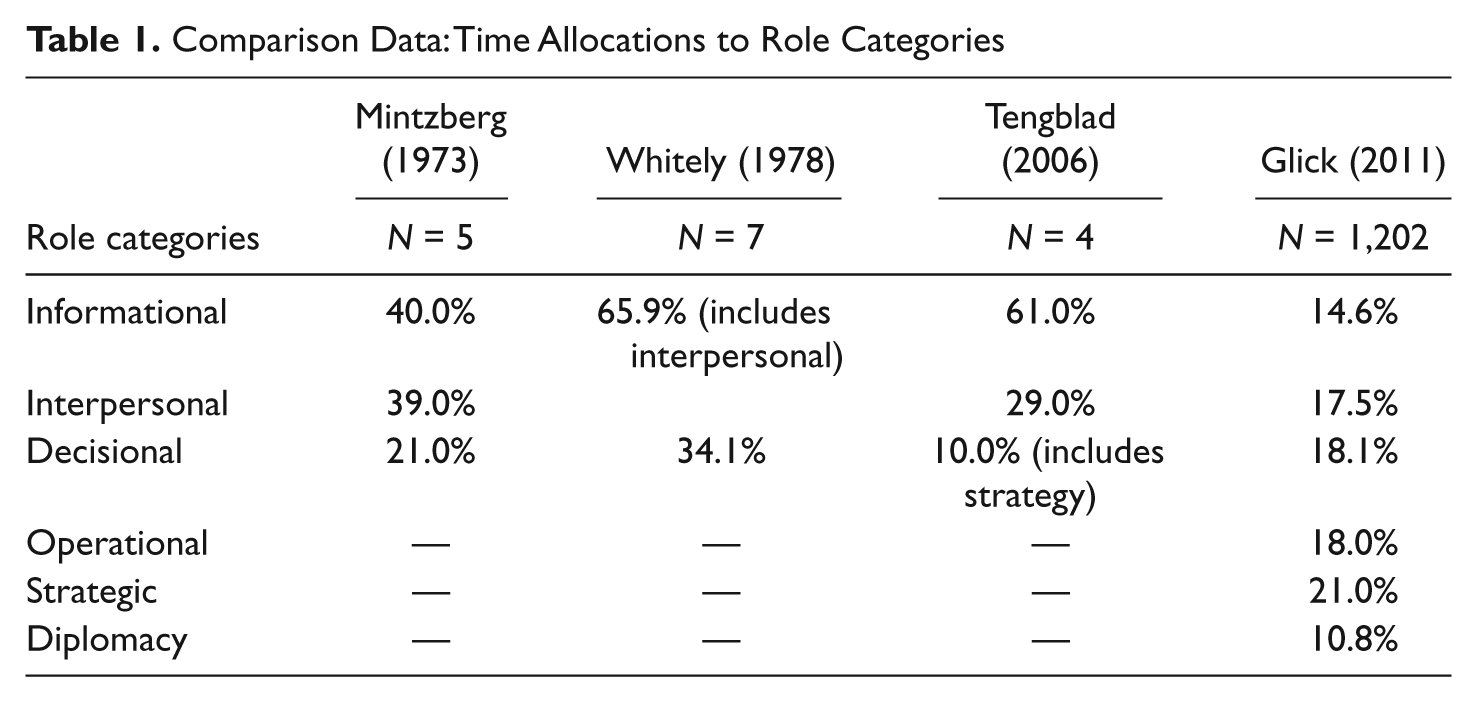
Factors Influencing Role Agreement and Time Spent in Role Categories
Gender, major of last degree or industry focus, having other C-level executives working for them, and company ownership status, that is, publicly versus privately held, had only small influences on agreement with CEO roles and time allocations. When combined, neither age, years in current job, years as a CEO, last degree earned, and company size in sales revenue were predictive in determining agreement with the CEO roles nor was there much association between these variables and role agreement. Company size in terms of employee numbers was a factor affecting the most significant differences in the way CEOs responded to role agreement and how they allocated their time.
It is likely other factors may have more influence on the role of CEO than were considered by this study. These factors include current economic conditions, availability of capital, whether a company has just been sold or is in acquisition mode, and company stability (existing companies versus start-ups). Several CEOs in this study indicated that they were spending more time on financial issues, a direct result of the difficult economic conditions they face. Some CEOs indicated that managing the board of directors took a substantial amount of their time yet did not see this role reflected in the categories presented in the survey.
Limitations of the Study
There were many factors that limited this study on CEOs. The database purchased was done so based on the availability of CEO e-mail addresses; however, many companies are still able to keep this information confidential. In some cases, the e-mail addresses included info as the name, so these went to a general e-mail address that most likely never reached the CEO. Many CEOs have their e-mail screened by assistants and it is possible many CEOs never saw the survey. Although there were a wide variety of company sizes and industries, private companies outnumbered public companies six to one. As expected, male CEOs outnumbered female CEOs seven to one.
There are many control variables that may have provided additional depth to this study. Industry-specific variables not controlled for in this study include geographic region(s) of the organization, industry sector, products imported or exported by the organization, whether the organization is service oriented, organizational financial health, business life-cycle placement and age of organization, and organizational culture, that is, whether it is a hierarchical or team-based organization. Individual CEO characteristic variables that were not controlled for in this study include schools attended, roles previously held, and number of job or industry changes. Additional research that controls for these organizational or individual-specific variables may provide additional new insight into the role of CEO and the way CEOs choose to spend their time.
Many of the comments received by CEOs indicated that the roles on the survey were too limiting and did not cover the breadth of roles that CEOs are expected to engage in. One CEO indicated that if they were doing an optimal job, they would be doing all of the roles included on the survey. It is impossible to know whether the participants answered the questions honestly or provided the answers that they believed were most favorable. There is also no way to know how accurate the time allocations were. The study was conducted only from the CEO’s perspective. The ability of participants to “self-select” can lead to errors including undermining “the extent to which the composition of the panel mirrors the composition of the general public and likely leads to biased results” (Dillman, Smyth, & Christian, 2009, p. 338). The expectations of boards of directors and other C-level executives were not considered for this study. This study was limited to CEOs in the United States, so the results may not be indicative of CEOs from other countries. Use of the survey instrument was a pilot study—it was designed specifically for this research, limiting its validity and reliability (Dillman et al., 2009). Other than the data obtained through EFA, there are no other measures available to support the instrument’s validity and reliability (Gliner et al., 2009).
Implications and Recommendations for Future Inquiry and Practice
This final section discusses the implications for theory, research, and practice while making recommendations for future research to enhance the body of knowledge about the role of CEO.
Implications for Theory
One goal for this study was further refinement of Mintzberg’s theory of the role of CEO. According to Lynham (2002), theory requires an ongoing process of refinement and development which “ensures that the relevance and rigor of the theory are continuously attended to and improved on by theorists through further inquiry and application in the real world” (p. 234). Mintzberg’s theory was built deductively using a “research-to-theory” strategy (Lynham, 2002, p. 225). During the 1970s and early 1980s, many individuals contributed to the theory by using “theory-to-research” strategies, yet many of these theories were not proven to be useful in practice, thus leaving a gap that was the focus of this study (Lynham, 2002, p. 225).
Using the general method of theory building described by Lynham (2002), the ongoing process of theory development requires five phases, including conceptual development (the theory was originally conceived by Mintzberg in 1973), operationalization, confirmation or disconfirmation, and application. The operationalization phase requires testing in real-world situations. Many doctoral students attempted this phase leading to conflicting results, perhaps the result of small sample sizes. Confirmation or disconfirmation is the intentional design of research for this purpose, that is, to confirm or disconfirm a theory. This particular study has provided data that both confirm and disconfirm Mintzberg’s original theory. It has also provided confirmation and disconfirmation by roles proposed by other researchers, hopefully expanding and updating Mintzberg’s original theory about the role of CEO. A next phase for this research is the application phase in which a real-world CEO would test the effectiveness of the time allocations and the role categories within their organization. Finally, all theories require ongoing refinement and development to ensure their applicability to real-world situations (Lynham, 2002).
Stakeholders: Human Resource Development (HRD) Professionals and HR Directors
Further refinement and development of a theory of the role of CEO may be beneficial to HRD professionals and HRD directors who are responsible for change interventions and for creating CEO succession plans. A clear understanding of the CEO’s role and time spent in roles may be useful in interventions designed at enforcing organizational culture while at the same time making changes necessary for the continuing advancement of the organization. To enable the identification and development of future CEOs, a theory that explains the role of CEO under a variety of individual and organizational variables may be extremely practical. Theory building may also be improved with new research that controls for organizational and individual characteristics not addressed by this study but discussed in the limitations section.
Implications for Research
Data collected during the survey can be used to further this study in several ways. One of the unanswered questions resulting from this study is “what factors do influence role agreement and time spent in roles by CEOs?” While company size based on employee numbers resulted in statistically significant differences in responses to role agreement and time allocations, is there additional influence based on industry? Is there a relationship between industry, company size, and agreement with roles and time allocations to role categories? Although not part of my original research, these findings could be important for CEOs in specific industry categories. This information could be particularly important for a CEO switching jobs in a new industry where roles and time allocations may be significantly different than those in their current job. Perhaps, this information could help CEOs transition more efficiently, helping to reduce excessive turnover.
The unsolicited qualitative data collected were not analyzed for this study. The unsolicited insights, remarks, criticisms, and words of encouragement were some of the most interesting data obtained, yet they were not consistent with the quantitative/postpositivist methodological strategy of this study. To deeply understand the factors influencing role and time allocations, in-depth discussions with CEOs are necessary. Although the hard, quantitative data are difficult to argue with, it is impossible to delve deeper for more meaning and understanding. For example, although the data showed little differences between male and female CEOs, intuitively it seems there must be interesting and insightful differences in the experiences and expectations of both male and female CEOs. These experiences can only be learned through qualitative methods. Research on the role of CEO has been criticized for its failure to find similarities while only looking for differences (Hales, 1999). The focus on differences may be due to the nature of hypothesis testing. Perhaps, qualitative methods would be more appropriate for identifying similarities in the role of CEO.
Impacts of Further Research on Stakeholders
Further research controlling for different individual and organizational variables may be extremely useful for CEOs, boards of directors, HRD professionals, and HR directors. Research focused on the perspective of other C-level executives may be useful not only for COOs, CIOs, and CFOs but also for the CEOs they work for, boards of directors, HRD professionals, and HR directors. Especially for CEOs understanding the gaps between their perception of their role and the way employees and boards perceive their role could be critical for closing the gap between role expectations and actual performance of the role.
Implications for Practice
The results of this study could have practical implications for a variety of stakeholders including HR directors, boards of directors, CEOs, employees, investors, and consumers. A description of how implications for practice could affect these stakeholders is provided in the following section.
Stakeholders: HR Directors and Boards of Directors
HR directors could use the CEO role information in creating job descriptions or evaluation plans for CEOs within their organizations. The role information could also be used for succession planning purposes. A refined theory of the role of CEO may help to identify roles that are necessary when certain organizational conditions exist. Boards of directors could use the roles and the time allocations as benchmarks for the CEOs whose performance they evaluate. They may use the time information to compare the role of the CEO with other C-level executives within the organization, making sure that efforts are not duplicated.
Stakeholders: CEOs
A working CEO could use the results of this research in three different ways. First, the roles identified and agreed on could be used as a benchmark for the CEO’s own job description. There may be roles identified in this study that the CEO had not considered part of his/her job. Furthermore, a CEO interested in expanding research on the role of CEO might identify new roles, providing clarity to the role of CEO while contributing knowledge that informs continual refinement of the theory. A third practical use of the study findings is the time allocations. A CEO could use the time allocations as a benchmark for how they spend their time at work, potentially identifying areas that are important to the position but that need more concentrated focus. This may prevent a CEO from spending time in roles they are most comfortable in, where they may duplicate efforts of other C-level executives.
Stakeholders: Employees, Investors, Consumers
Employees, investors, and consumers who depend on organizations for basic needs as well as creature comforts are also affected by this research. For example, CEOs who know what the role is and how to allocate their time may be more efficient and effective in leading their organizations. Hopefully, this leads to higher quality products and financial returns that benefit investors with direct interests in the organizations as well as the economy in general.
Conclusions
The purpose of this study was to address the gap between what is reported in the literature and what is known in current practice on the role of CEO. This article has presented the theoretical framework and review of literature related to the role of CEO. In addition, it has described the research methods and design, conclusions from participant responses to the survey, responses to the three research questions, and the results of testing the research hypotheses. The study findings were summarized and the implications for theory, research, and practice were presented. Although this study has not revealed significant changes to the role of the CEO, it has added new roles, has confirmed and disconfirmed CEO roles that are more than 40 years old, and has supported the thesis of a complex and evolving nature of the role of CEO. This study has provided data that further refine Mintzberg’s theory on the role of CEO. Data on how CEOs allocate their time has been added to the body of knowledge on the role of CEO and have confirmed the impact of company size on the role of CEO. Hopefully, this study has created opportunity and interest in future research on CEOs and has provided insight on what they perceive today as the role of CEO.
Footnotes
The author(s) declared no potential conflicts of interest with respect to the research, authorship, and/or publication of this article.
The author(s) received no financial support for the research, authorship, and/or publication of this article.