







Abstract
Despite significant gains in the number of women leaders in higher education, there are still challenges for developing women leaders in higher education.
Effective collaboration between women’s centers and other campus organizations that support women’s leadership can provide opportunities to overcome these barriers. This article presents leadership development programs offered by the Women’s Center at the University of Minnesota, focusing on those facilitated in partnership with the university’s Office of Human Resources. Several lessons emerged from the review: the value of collaborative relationships, the importance of emphasis on individual and system-level leadership, and the need for ongoing assessment and evaluation of the climate for women leaders within postsecondary institutions.
These lessons, and the principles used in implementing them, reveal practices that may be useful for other Women’s Centers, HR departments, and internal and external entities who seek to develop more women leaders in higher education.
Women currently make up more than half of the college and university student population in the United States (Martínez Alemán & Renn, 2002), and the number of women receiving doctorates has been steadily increasing. However, the representation of women in higher education leadership has not kept pace. A study by the American Council on Education (ACE) found that 23% of college presidents were women but noted that “women’s progress has slowed in recent years” (ACE, 2010, p. 1). Only 14% of those women presidents have been appointed at doctoral institutions, and just 4% of college and university presidents are women of color. The majority of female administrators remain situated in low- and midlevel positions that often lack institutional authority and professional and monetary advancement tracks (Edghill, 2006). In addition, a current trend is the highlighting of a female administrator as proof that gender inequity is no longer a relevant issue on campus. This practice can be particularly detrimental to change as it supports an unwillingness to recognize, and thus address, sexism on campus.
These challenges present opportunities for collaborative work among organizations that support women and women’s leadership in higher education. Connections between campus women’s centers and other offices (e.g., human resources [HR], human resource development [HRD], leadership development) provide especially fertile ground for partnerships. Women’s centers in higher education are focused on improving the climate for and success of women staff, faculty, and/or students (Davie, 2002). HRD is an interdisciplinary field focused on helping individuals and organizations develop themselves to “enhance the learning and performance of individuals, organizations, communities, and society” (Academy of Human Resource Development, 1999, p. ii). Thus, the two entities have a common goal of developing climates that promote individual development and organizational growth. By partnering with women’s centers, HR and HRD offices can expand their scope of influence and gain insights from fresh perspectives. Examining successful efforts can help HRD and leadership development scholars and practitioners develop new strategies. This article describes one such successful collaborative effort at the University of Minnesota.
The Women’s Center at the University of Minnesota, the oldest campus-based women’s center in the United States, celebrated its 50th anniversary in 2010. After providing a historical context for the Women’s Center, this article examines its current leadership programs and opportunities for women, focusing on those that are offered collaboratively with HRD professionals housed in the university’s Office of Human Resources (OHR). Four guiding principles are identified, representing overarching themes that influence the Center’s work. Next, we offer reflections on lessons learned and how these lessons might inform similar efforts. The guiding principles and lessons represent the viewpoints of the authors (Director and Assistant Director of the Women’s Center, and the OHR organizational effectiveness consultant who partners most closely with the Center). Finally, we suggest three questions for future research.
Historical Overview of the Women’s Center
There were few organized resources for women in higher education during the 1960s. Betty Friedan’s The Feminine Mystique (1963) mentioned only two universities actively advancing women’s equity, specifically naming the Women’s Center at the University of Minnesota (then named the Minnesota Plan for the Continuing Education of Women) for its work in addressing the changing needs of women in a time when cultural support for women’s continuing education was weak. The Carnegie Corporation–funded Minnesota Plan was started in response to the needs of married educated women of the 1950s. It became known as the Rusty Ladies program, both because of the demographics of its participants—women between the ages of 28 and 42 years—and its mission of “rust-removal” and “rust-proofing” the minds of its members (Opitz, 1999, p. 7). The program created a space in which women could explore their goals, including those related to leadership. In addition to playing a role in the advancement of women within colleges and universities, the University of Minnesota’s program responded to two of the major research questions about women’s leadership: (a) Can women be leaders? and (b) Who is the woman leader? (Indvik, 2004). Lehmberg and Pflaum (2001) highlighted the University of Minnesota’s contribution to both leadership theory and feminist activism, noting “other manifestations of feminism included Minnesota’s pioneering role in 1969 in establishing the Council for University Women’s Progress, one of the first university-based women’s action groups in the United States” (p. 126).
As other universities throughout the United States followed in the footsteps of the Minnesota Plan for the Continuing Education of Women, the program continued to evolve and respond to issues of concern to women. Between 1969 and 1980, Women’s Center programming corresponded with the burgeoning national women’s liberation movement, addressing issues such as Title IX and salary equity. A major galvanizing event at the University of Minnesota was a salary equity lawsuit which became known as the Rajender case (filed in 1973, decree in 1980, salary settlement began in 1989). The Rajender consent decree (Kohlstedt & Fischer, 2009) resulting from the grievance, litigation, and a class action lawsuit, mandated that the University institute affirmative action goals, correct salary inequities between male and female faculty, set a timetable for hiring more women faculty, and modify its hiring practices. The effects of the Rajender case went well beyond Minnesota, providing an impetus for other universities to review their pay equity discrepancies, examine other inequities, and launch new programs to address those issues.
From 1980 on, the Women’s Center dedicated resources and effort to not only continuing to serve the Rusty Ladies and other students but also the broader goal of affecting the campus climate for women staff, faculty, and alumnae. The Women’s Center began examining institutional policies, expressing the “commitments to affirmative action and diversity, with particular emphasis on those addressing academic women” (Spector, 1993, p. v) as well as compiling strategies and resources for improving the campus environment for women. By that time, women’s leadership was being examined in many sectors. Rosener’s (1990) seminal article observed, the first female executives, because they were breaking new ground, adhered to many of the rules of conduct that spelled success for men. Now a second wave of women is making its way into top management, not by adopting the style and habits that have proved successful for men but by drawing on the skills and attitudes they developed from their shared experience as women. (p. 119)
Within higher education, researchers were using feminist theory to help understand the challenges for women seeking leadership roles. For example, in a 1988 book on women in the academy subtitled Outsiders in the Sacred Grove, Aisenberg and Harrington argued that traditional male and female roles, combined with established norms, made it difficult for women to gain a voice of authority and leadership in higher education.
In 2000, the Center sponsored the national teleconference, Women’s Lives, Women’s Voices, Women’s Solutions: Shaping a National Agenda for Women in Higher Education. Designed in part to address the dearth of women in higher education leadership, it was conceptualized as a forum that would allow
. . . women and men to take stock collective of our progress; address the critical issues that affect us; examine our roles as leaders and colleagues; and formulate an action plan for women in higher education that embraces the diversity among women and offers a vision to transform institutions of higher learning for the betterment of everyone. (Rios & Longnion, 2000, p. 1)
More than 5,000 participants from four regional sites and 200 satellite sites contributed to a national multicultural women-led agenda for higher education, with recommendations that ranged from leadership development to work–life balance and policy development (Rios & Longnion, 2000).
Over time, the Center began to focus more intentionally on issues of diversity and access. This mandate was represented by its organizational location within the Office for Equity and Diversity. There was recognition that Women’s Centers, predominantly staffed by White women, had been negligent in teaching and acting with any depth about equity and diversity. Perhaps their understanding was not fully formed, or perhaps they thought the best strategy was to gain a foothold with some societal acceptance of white women as leaders. Early women’s centers also reflected the women’s movement’s fear of advocacy for lesbians. Betty Friedan used the term lavender menace in the late 1960s (Evans, 2003, p. 249) to express her concern that an association with lesbianism would reduce the ability of the women’s movement to achieve serious political change.
This focus responded to a recognition that it is impossible to separate multiple identities. As Patricia Hills Collins (1991) asserted, we must reconceptualize people with multiple identities and see all facets as interlocking and interactive. For example, for women of color, the three constructions of gender, race, and class form an umbrella of dominance (hooks, 1989; Smith, 1987). Women with disabilities, from diverse religious backgrounds, and with other subordinated identities have expressed the importance of honoring the whole woman as a way to assist all women on their leadership journeys. Environmental activist and Nobel Peace Prize awardee Wangari Maathai’s legacy was to help us all see that the problems and solutions for gender justice are also interwoven with movements for environmental, economic, and political justice. Astyk (2011) beautifully encapsulated Maathai’s philosophy, “It is not possible to repair just one piece of the world at a time” (p. 1). Therefore, in the Center’s leadership training, though gender justice work is critical, the direction for the future is to combine it with a thoughtful exploration of multiple identities, power and privilege, and implicit biases, as challenging and uncomfortable as that may be.
The Women’s Center Today
In spite of the gains made since the 1960s, the Women’s Center continues to count women’s leadership development as one of the significant elements of its mission and work. Its scope has expanded to include staff and faculty and also has a focus on women of color and women in STEM (science, technology, engineering, and math) fields. The Women’s Center, throughout its many iterations and generations, has remained relevant, despite ever-shifting expectations.
Davie (2002) identified three key features of campus-based women’s centers: mission, services, and stakeholders. Although many centers have similar missions, they may deviate from one another in terms of services, stakeholders, and reporting structures. She drew a distinction between resource centers and research centers:
In brief, while resource centers and research centers are both devoted to bringing about change to benefit women within the institution and society, resource centers attempt such change through services to empower women; research centers approach change through scholarship to produce and promote knowledge for women. (pp. 48-49)
The University of Minnesota Women’s Center falls more cleanly in the first category, providing services for a broad range of faculty, staff, and students. As a resource center, the Women’s Center provides assistance and “serves an advocacy role for women on campus to promote educational equity” (Davie, 2002, p. 49). In addition, the Center engages in activities that are typical of research centers such as “sponsoring feminist research, educational programming, and activist organizing” (Davie, 2002, p. 49). However, due to the small Center staff and large constituent base, 51,000 students and approximately 13,000 staff and faculty at its flagship Twin Cities campus, the Women’s Center strategizes by allocating resources and energy on the initiatives that have the greatest impact on its mission.
Currently, the Women’s Center focuses primarily on institutional change and women’s leadership development. Though these are similar to the foci of the Women’s Center foremothers, the current Center, with a deeper understanding of the need to serve women of multiple identities, offers programs to change the climate, and provide women with skills and knowledge they need in today’s context. At the core of its mission, to “advance equity for women staff, faculty and students across identities,” is the assumption that leadership requires “showing up, as you are” and incorporating all of one’s identities (K. N. Lockhart, personal communication, December 15, 2010). The Women’s Center believes leadership development entails more than practical skill development but is also about creating socially responsible change agents who can affect their spheres of power.
Over the past 20 years, the Women’s Center has developed and strengthened a collaborative relationship with the University’s OHR. In fact, this was solidified when OHR created a unit focused on HRD, including leadership development programs. Both units recognized an overlapping interest in helping women at all levels of the organization to become more effective leaders.
Guiding Principles for Leadership Programs
During the analysis of current and historical Women’s Center activities, including those jointly sponsored with OHR, four guiding principles were identified that have served to inform its leadership programs and opportunities throughout the decades. These guiding principles have emerged through the years from research on women’s issues, best practices described in literature, as well as a combination of experience and internal judgments by the Center staff, HRD partners, and stakeholders:
overcoming bias against women in leadership;
honoring women’s leadership styles;
building collaborations and broad networks; and
leading for equity and systems change.
Overcoming bias against women in leadership
Northouse (2004) observed that “although many executives and managers prefer to believe that organizations are objective about merit and are gender neutral,” repeated research findings indicate that this is not the case (p. 267). Discrimination against women in this era tends to be less overt, resulting from historical structures, patterns of behavior, and stereotypes (Bielby, 2000; Reskin, 2000). These patterns may include negative stereotypes of a group’s ability, the lack of influential mentors, and exclusion from social networks that facilitate career or leadership advancement (Lach, 1999; Steele, 1997).
In addition to overcoming the externally manifested implicit bias against women as leaders, this work also includes overcoming the internal biases that either participants bring with them or that prevent them from even considering themselves as potential leaders. Many women in the United States have tendencies toward modesty and lack of self-promotion that perpetuate their lack of involvement in management positions (Budworth & Mann, 2010). Therefore, although leadership training is beneficial for all, women report that they appreciate women-only safe spaces in which to conceptualize these traits differently and increase their belief in their leadership capacity. The identification of safe spaces aligns with the University’s initiatives to create communities for women to explore and enact leadership, as well as benefit from what Allen (1970) calls the “Free Space,” a small group structure “where women can come to understand not only the ways this society works to keep women oppressed but also ways to overcome that oppression psychologically and socially” (p. 8).
Honoring women’s leadership styles
A second principle guiding the Center’s programs for women leaders is a belief that the characteristics identified in female leadership perspectives are especially needed in today’s society. As Northouse (2004) observed, “although quite similar to men in behavior and effectiveness, women leaders tend to be more participative and less autocratic, a pattern well suited to 21st-century global organizations” (p. 273). Earlier models of leadership tended to reflect the views and experiences of those traditionally in positions of power, that is, a predominantly White, male, upper-middle-class, heterosexual orientation to leadership (Amey & Tombley, 1992; Bensimon & Neumann, 1993). Such traditionally male models of leadership were exemplified by, among other characteristics, individuality, hierarchical power, depersonalization, persuasion, and control (Kerr & Gade, 1986). In more recent literature, a different image of leadership has been painted—a more participatory, relational, and interpersonal style in which leaders tend to emphasize responsibility toward others, empower others to act, and deemphasize hierarchical relationships (Astin & Leland, 1991; Helgesen, 1990; Rosener, 1990; Shakeshaft, 1987). This collaborative model of leadership, once labeled as a women’s leadership style, is becoming more common among leaders of all genders. “In today’s world, the executive’s job is no longer to command and control but to cultivate and coordinate the actions of others at all levels of the organization” (Ancona, Malone, Orlikowski, & Senge, 2007, pp. 92-93).
In addition, culture complicates a gendered analysis of leadership. Earlier studies did not examine multiple aspects of identity, such as race, social class, or role within an organization, to determine how these identities interact and affect a leader’s effectiveness. Nickles and Ashcraft (1981) pointed out that masculine and feminine typecasts of leadership styles are cultural. Traits that are stereotypically feminine in the United States are valued among Japanese men, for example; conversely, from an American viewpoint, male Japanese managers and political leaders exhibit a more typically feminine leadership style. Hofstede (1980) also identified a masculine and feminine dimension of cultural difference. He proposed that the masculinity trait can be measured to express “the extent to which the dominant values in society are ‘masculine’—that is, assertiveness, the acquisition of money and things, and not caring for others, the quality of life, or people” (p. 46).
Rigid conceptualizations of gender differences have also informed some of the stereotypes assigned to women leaders; archetypes are often presented the research literature about women in leadership roles. For example, Hammer (1978) wrote,
The earth mother brings home-baked cookies to meetings and keeps the communal bottle of aspirin in her desk. The manipulator relies on feminine wiles to get her way. The workaholic cannot delegate responsibilities. The egalitarian leader denies the power of her leadership and claims to relate to subordinates as a colleague. (p. 49)
Generalizations like the aforementioned stereotypes are just one of many barriers with which women—and truly, people of all genders—contend in the workplace (Cottledge, 2007). The result of these generalizations is that organizations are less effective, because “whenever any one system dominates . . . the whole picture is not represented” (Hagberg, 1984, p. 194).
In our leadership programs, the Women’s Center and OHR encourage participants to seek full-range leadership (Smith, Matkin, & Fritz, 2004) choosing transformation or transactional leadership behaviors when appropriate and at a desired frequency to optimize organizational effectiveness (Bass & Avolio, 1990). In addition, the Women’s Center’s alignment with broader equity and diversity issues means that it increasingly brings in non-Western views of leadership that may resonate more strongly with some participants and provide rich leadership concepts for everyone.
Building collaborations and broad networks
A third guiding principle is the need to work collaboratively and build broad networks within and outside of the university. In addition to their mutual activities, both Human Resources and the Women’s Center have strong ties to many other groups on campus. Staff from the Women’s Center serve on a range of university and community committees, and the center convenes meetings of the University Women’s Consortium, representing units that provide a range of services for women. Relationships like these enable the center to take a more active role in decisions and initiatives that affect women students, faculty, staff, and alumnae. Likewise, staff from OHR have worked with a range of formal and informal groups promoting professional development and a supportive campus climate. Being involved with and learning from these groups enables OHR to shape development programs that respond to the university’s needs.
This guiding principle is evident in the women’s leadership programming. For example, the 2010 Women Reading for Equity and Diversity (R.E.A.D.) program responded to a need identified by human resources to help women learn financial management skills. In addition to selecting an appropriate book, that initiative resulted in an annual event featuring a noted financial management expert. The 2011 Women R.E.A.D. program selected a book to complement a spring semester conference on White privilege, which was cosponsored by several campus departments and community organizations.
Leading for equity and systems change
Reflecting current national trends, the bulk of our leadership training focuses on empowering the individual leader. Although this is an important place to start, leading toward equity means going beyond individual empowerment to affect long-term, systems-level, or organizational changes. Therefore, the Women’s Center’s leadership programs increasingly stress that leaders need to learn to lead with equity in mind and to strive to create long-term institutional change that improves the climate for everyone. However, working at the institutional level against imbedded, systemic oppressions such as racism, sexism, and homophobia is complex (Kirkham, 2005), and learning how to educate around this topic is a work in progress. The belief is that greater focus on systems change will accelerate the path toward a time when all individuals and university structures actively encourage all citizens to develop all of their talents.
Current Women’s Leadership Programs and Partnerships
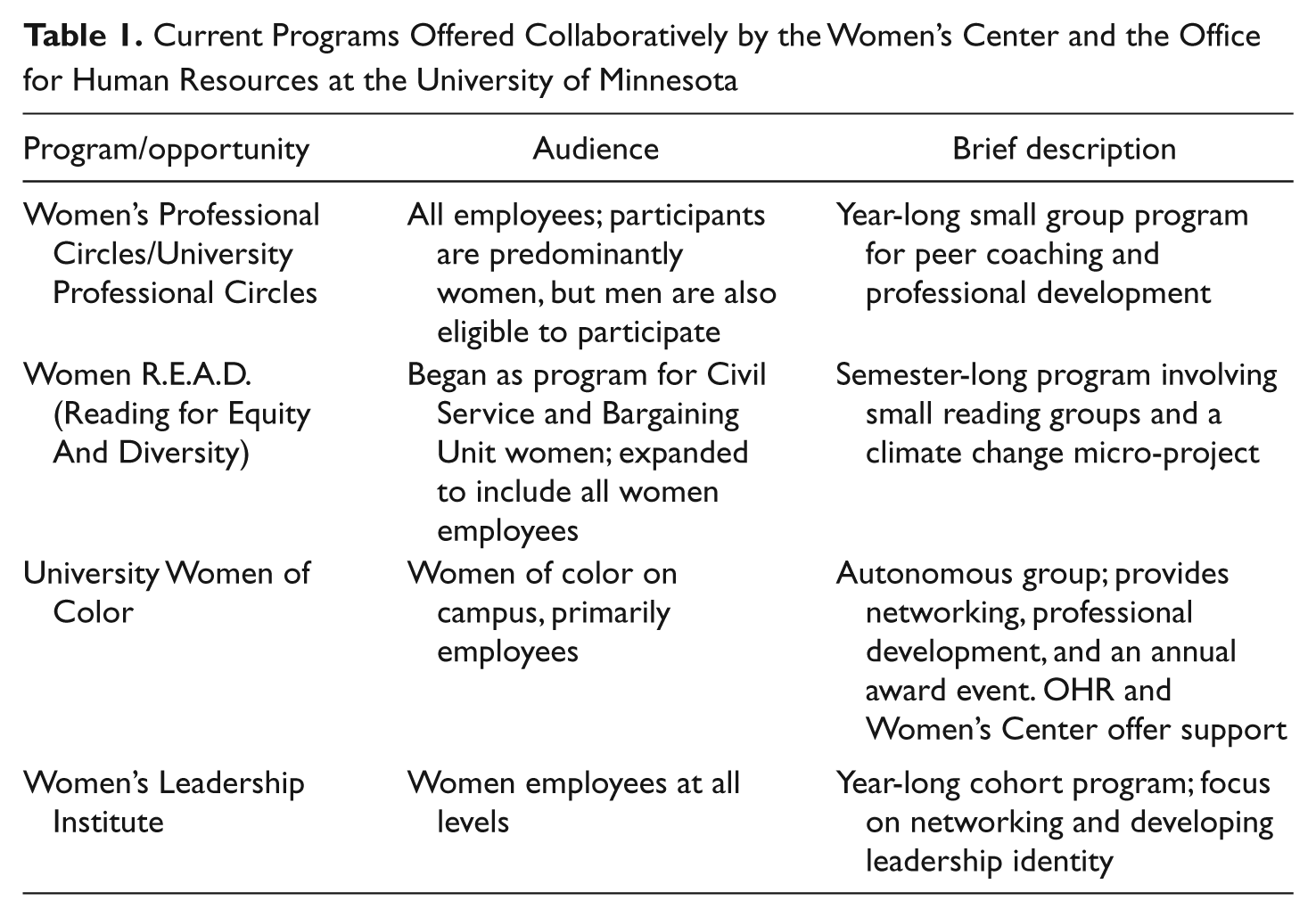
Guided by the aforementioned principles, the Women’s Center and OHR offer a number of jointly sponsored programs. In addition, the Women’s Center currently offers several initiatives to advance women’s leadership including ones that particularly support women faculty, women students of color, and women’s groups involved in the university’s governance structure. An overview of programs offered collaboratively by the Women’s Center and the OHR are now described and also summarized in Table 1. A more detailed description is provided for the Women’s Leadership Institute, which is the longest running program and for which the most evaluation data are available.
Women’s Professional Circles/University Professional Circles: This program allows participants to focus on a personal or professional goal and receive formal peer coaching. Approximately 80 participants are divided into circles of 4 to 6 members who hold each other accountable and provide support. Formerly limited to women employees, in 2011 this program was expanded to include women-only, men-only, and mixed-gender groups. In addition, participants requested more cross-group networking, and thus a monthly large group meeting was added that includes professional development and small group-discussion sessions.
Women Reading for Equity and Diversity (R.E.A.D.): The Women R.E.A.D. program, now in its 4th year, is an opportunity for women employees to meet in small groups and discuss a selected book. It includes a kick-off educational session, a wrap-up workshop and celebration, as well as training sessions for volunteer facilitators. Beginning in 2010, each reading group was also asked to select and carry out a microproject to improve the culture of the university. Cosponsored by the Women’s Center and the Office for Human Resources, about 100 women participate each year.
University Women of Color: Founded by the Women’s Center 10 years ago, University Women of Color is now an independent group. It sponsors an annual professional development breakfast as well as an award for individuals that help create a thriving campus community where diversity in the widest sense is welcomed and supported. The center’s assistant director serves ex officio on the board, and OHR staff have been active on the board over the years.
Current Programs Offered Collaboratively by the Women’s Center and the Office for Human Resources at the University of Minnesota
Women’s Leadership Institute
The Women’s Leadership Institute (WLI) is the longest running leadership development program for women at the University of Minnesota. This was the first sustained collaborative effort between the Women’s Center and OHR, and it has become a cornerstone program for both units. As it illustrates a collaborative program for developing women’s leadership in higher education, it will be described in greater detail. This description serves as an example of a collaborative effort to develop women leaders on campus.
The WLI is a cohort-based opportunity for approximately 25 women each year. It is unique in that it is not limited to one group, such as faculty or administrative support staff. Rather, a deliberate effort is made to build a cohort across a broad range of perspectives employee categories. The WLI differentiates itself from other leadership development programs at the university by focusing on self-reflection and learning from others’ stories. The curriculum is not centered on developing specific leadership skills but rather on promoting a more conscious and intentional approach to leadership. Participants are able to hear about the leadership journeys of successful women leaders and explore topics such as managing competing demands from home and family, leading from the middle of an organization, and building collaborative partnerships.
First offered in 1998 as a pilot program sponsored by a grassroots Network of Women Administrators, the WLI sought
to provide a unique set of training opportunities emphasizing the creation of a community of mutual learning and support through the development of a cohort of women at a high level of accomplishment and at similar points in their careers at the University of Minnesota. (Gmeinder, Grimes, Marten, Towle, & Quanbeck, 1999, p. 2)
The program’s original focus was on women who were likely to move into senior leadership positions; this has been expanded over time. Since the participant pool includes administrative and academic staff, the focus is not on developing academic leaders, such as deans, vice presidents, and chancellors. Rather, the focus is on developing one’s leadership potential from various parts of the organization.
Like many practitioner-based programs, there has not been a strong research focus on WLI outcomes. More recently, however, evaluation data on the WLI has been collected for both program improvement and educational research. Merriam (2009) noted that “the difference between evaluation and research, which are both forms of systematic inquiry, lies in the questions asked, not in the methods used” (p. 4). Evaluation data are used to make decisions about a program, process, or technique. Evaluation research, however, uses systematic data collection and thoughtful analysis to assess accomplishments and effectiveness (Gall, Gall, & Borg, 2007). For the WLI, both approaches are used. Evaluation data used to examine and improve the program also allows for in-depth analysis using a mixed-method research approach. Most recently, a graduate student conducted a study based on individual interviews of 25 participants from past 12 years (Chuang, 2010). Her findings identified three positive program outcomes: developing increased self-confidence as a leader, building professional networks, and learning from others’ experiences.
According to participants, self-confidence was created by providing space for women to develop their identities as leaders and discuss common concerns with peers. Chuang (2010) found that the program “created a comfortable and safe environment for them to share their stories and feelings, and the group factors helped them with generalizing and normalizing some concerns of working at the university” (p. 3). This self-confidence is indicated by data showing increased participation in university governance and other development programs. For example, about 25% of participants in a campus program for high-potential leaders have previously participated in WLI (Bonebright, 2008, p. 2).
Professional networking, a second strength of the program, is modeled by speakers and promoted through group activities (Chuang, 2010). Two all-WLI community events are offered each year for current and past participants. Networking was also identified as the largest challenge for the program, with several participants mentioning that they would like to see expanded opportunities, such as a formal mentoring component and follow-up programs.
Learning from others’ experiences was the third positive outcome for the WLI (Chuang, 2010). Participants connect with peers about professional activities and common interests, such as raising young children or seeking advanced degrees while working full-time. In addition, guest speakers are asked to talk about their leadership journeys and the lessons they learned along the way.
Critiques of the program relate to the heavy focus on self-reflection and limited skill-building content. Some observers indicated a desire to increase content on equity and diversity awareness and incorporate systems thinking/institutional change. A few participants have requested group or individual projects where participants would implement some of the skills and knowledge they are gaining. In addition, some participants expressed a desire for a formal mentoring component. These findings provide value insights into potential changes, most of which have been addressed. Skill-building and equity and diversity speakers have been added to this year’s program. A discussion regarding adding projects is underway. However, as projects are a component of two other campus leadership programs (University Professional Circles and the President’s Emerging Leadership Program), we are exploring alternative ways to meet this goal. The mentoring program has not been possible due to limited staff resources, but we continue to look for other partners who could assist us with the implementation.
Implications for Practice
The Women’s Center has remained relevant for the past 50 years because of its ability to evolve and consistently focus on the needs of its stakeholders. By partnering effectively with the OHR and their HRD practitioners, both units have been able to work more effectively to support and develop women leaders on campus. In the process, we have learned lessons that may guide others who seek to develop women leaders in higher education. Our key lessons include the following: leveraging the power of collaborative relationships, balancing emphases on individual and system-level leadership, and integrating ongoing assessment and evaluation of the climate for women leaders within postsecondary institutions.
First, the success of the partnership between the University of Minnesota Women’s Center and its OHR illustrates the importance of collaboration across stakeholder groups. Long-term partnerships with academic leadership, human resources, and other identity groups allows the center to create a broad focus that provides service to a wide range of constituents. Where possible, it builds activities that support other organizational initiatives. This strategy enables the center to be a voice in policy making. Many leadership programs in higher education focus on narrowly defined stakeholder groups, such as new faculty. Programs such as the WLI demonstrate mutual benefit in bringing together individuals with diverse viewpoints and perspectives both within and outside of the organization.
Second, we have learned that it is no longer enough to focus solely on developing the individual strengths of women students, staff, and faculty. Although both women’ centers and HRD programs are often focused at the individual level, successful efforts in the future need to also focus on system-level change and eliminating institutional barriers. Institutional change is slow and can be overwhelming, but through improved leadership development programs, future leaders will be more prepared to create organization-level solutions.
Finally, there is an ongoing need to monitor trends and improve the environment for women in higher education. A quick read of current popular literature (Rosin, 2010) or a conversation with a 1st-year college student might imply that the work is no longer necessary. However, statistics reveal that there is still a dearth of women in leadership in higher education across the United States and on the University of Minnesota campus. Martínez Alemán and Renn (2002) found that
women not only are less likely to have access to tenure-track positions but may fall behind because of extra demands, such as committee assignments, heavier teaching loads, and student advising. They also have less access to powerful mentors and networks in their field, creating a cumulative disadvantage at the time of promotion and tenure. (p. 373)
These difficulties, the authors noted, are even greater for women of color, older women, lesbian, and disabled women, who face “double discrimination” (p. 410). In sum, there is still a need to monitor implicit and overt bias against women leaders in higher education and deliberately bring women’s voices to the leadership table.
Directions for Future Research
Organizations interested in women’s leadership face a number of challenges if they are to be vital contributors for the future academy. The role of women’s centers needs to be addressed to cultivate leaders of all genders. Although there are a host of important areas for future research, three key questions are highlighted below:
What is the state of women leaders in the academy? Ongoing research needs to examine the role of women leaders in the academy. It is important to pay continued attention to organizational structures and parity. Research also needs to look at how women leaders in higher education are integrating their leadership styles into their roles.
What is the appropriate role(s) for women’s centers and HR programs designed for women? Additional research needs to be done to learn whether and how leadership programs for women make a difference individually and collectively. The role of women’s centers in dealing with issues such as work/life status of women leaders needs to be examined, particularly as little research seems to exist about the work and impact of women’s centers. Furthermore, as younger women leaders enter the academy, many with outside interests, women’s centers and other higher education offices, need to learn new ways to answer questions and provide resources (e.g., how to conduct and write publishable research while managing other activities and succeeding in other areas of one’s life).
What models describe women’s leadership? Finally, more work needs to be done to develop models of leadership for women in higher education and other industries. There is a need for complex models that address leadership at many different levels within an organization and adopt what Berger and Guidroz (2009) deem “the intersectional approach” (p. 1). This approach has the potential to speak to and include women with marginalized identities, who have not been traditionally seen as leaders and whose experiences have not been reflected in research literature.
Conclusion
From the time of the Rusty Ladies, the University of Minnesota Women’s Center has leveraged the power of women’s networks and small groups as a tool for both personal leadership development and institutional transformation. By building strong partnerships across campus among key players, by bringing together the knowledge, expertise, and viewpoints of many stakeholders, and by being responsive to future needs and directions, the University of Minnesota can continue to be a force for developing women leaders for years to come.
As the Women’s Center and OHR at the University of Minnesota continue efforts to improve the campus climate and develop women leaders, we see an increased need to work together. The partnership has strengthened the ability of both units to effectively meet their individual and collective goals, and it benefits leaders of all genders and positions in the organization. Such partnerships can be implemented by other organizations interested in developing women leaders and who share the belief that “to maintain leadership amid increasing economic and educational globalization, the United States must aggressively pursue the innovative capacity of all of its people” (Committee on Maximizing the Potential of Women in Academic Science and Engineering, National Academy of Sciences National Academy of Engineering, & Institute of Medicine, 2007, p. 1).
Footnotes
The author(s) declared no potential conflicts of interest with respect to the research, authorship, and/or publication of this article.
The author(s) received no financial support for the research, authorship, and/or publication of this article.