







Abstract
The Problem.
Human Resource Development (HRD) scholars and practitioners need to address the problem of conceptualizing HRD in various community settings.
The Solution.
To address this need, the authors conducted a case study research to explore the role of HRD in developing the Ismaili community in Minnesota. Data analysis revealed four themes: (a) conceptualization of HRD in the Ismaili community of Minnesota, (b) history and examples of HRD efforts in this community, (c) the role of women in the community’s HRD efforts, and (d) the future of HRD in the Ismaili community of Minnesota. The use of HRD within this community was heavily focused on societal development of the community.
The Stakeholders.
Recommendations for HRD practice (practitioners) and research (researchers) suggest that HRD, especially within religious communities (members and leaders of such communities), be explored with an open mind for the purpose of creating a pluralistic and civil society (all citizens).
Although scholars and practitioners have made significant contributions to the field of HRD by sharing their knowledge and expertise, we have been unable to identify much literature on HRD as seen and practiced in communities. The August 2004 issue of Advances in Developing Human Resources highlighted the role of community in national human resource development (NHRD) from a global perspective (Bartlett & Rodgers, 2004; Cho & McLean, 2004; Lynham & Cunningham, 2004; McLean, 2004; Osman-Gani, 2004; Rao, 2004; Szalkowski & Jankowicz, 2004; Yang, Zhang, & Zhang, 2004). Although there is no one right approach to NHRD (Cho & McLean, 2004), Yang et al. suggested that NHRD needs to be sustainable, holistic, and create an equilibrium among people in a society or community.
Budhwani and McLean (2005), among others, have highlighted the concept of community development within a religious community. They have underscored the importance of exploring and understanding the phenomenon of community development within a global context. This case study addresses how HRD in a religious community contributes to societal development.
Problem Statement and Significance
This article presents findings and recommendations of a case study research conducted for the purpose of exploring, understanding, documenting, and presenting HRD philosophy and activities within the Ismaili community within Islam in Minnesota. The general research question explored the role of HRD in developing the Ismaili community in Minnesota.
Community-based HRD efforts ultimately contribute to societal development. Studying HRD in the Ismaili community is significant because not much research in HRD has been identified within the arena of community development. This inquiry also opens a new avenue for HRD professionals to explore HRD in a religious, societal, philanthropic, and cultural community. In addition, as suggested by Budhwani and McLean (2005), the inquiry is a contribution to the literature of HRD that currently sheds little light on community and societal development within a religious context.
Ismaili Community: A Background
Ismailis belong to the Shia branch of Islam, one of the two major branches of Islam, the Sunni being the other. They form a well-organized community, living in more than 25 countries, mainly in Central and South Asia, Afghanistan, Western China, Africa, and the Middle East, as well as in Europe, North America, the Far East, and Australia (Saleh, 2002). Currently, there are more than 20 million Ismailis throughout the world (Calderini, 1996; Syed, 1995).
The current spiritual leader (Imam) of the Ismailis is His Highness, Prince Karim Aga Khan. He is one of the most influential voices in the Muslim world (Woodruff, 2002). The community has its own constitution and institutional framework aimed at community development within the community for its members. The framework has projects in areas that include education, economic planning, youth and sports, health, social welfare, legal and risk management, and communications and publications. Their advanced organization lends itself to an interesting study of HRD within this particular community.
Research Questions
The general research question guiding the case study, intended to facilitate conceptualization of the study, is as follows:
Research Question 1: What has been the role of HRD in developing the Ismaili community in Minnesota, USA?
Other questions include the following:
What has been the role of HRD in developing the Ismaili community in Minneosta?
What are some of the HRD efforts in the Ismaili community in Minnesota? Give some examples.
Why has HRD been important in the Ismaili community in Minnesota?
What has been the role of technology in Minnesota’s Ismaili community’s HRD?
What are some favorable outcomes in Minnesota’s Ismaili community’s HRD efforts?
Why were the outcomes favorable?
What are some unfavorable outcomes in Minnesota’s Ismaili community’s HRD efforts?
Why were the outcomes unfavorable?
What have been some of the challenges related to HRD in the Ismaili community of Minnesota?
How can HRD in Minnesota’s Ismaili community be improved?
What are some of the challenges related to HRD in the Ismaili community of Minnesota after September 2001?
What has been the role of women in Minnesota’s Ismaili community’s HRD efforts?
Method
A single–case study methodology was used to address the phenomenon of HRD in the Ismaili community of Minnesota. A case study is a form of study that is defined by an interest in a specific case and not by the methods of inquiry used (Stake, 1995).
The study included purposive sampling because only a few individuals in the community had adequate information regarding various projects and could provide integrated perspectives. Demographics were obtained, interviews were conducted, and observations were made. Also, a review of the community’s constitution, institutional framework, and data was conducted. Participants’ consent for the study was obtained, and strict anonymity was maintained at all times. Besides, participants were provided a written agreement ensuring that they understood how the study would benefit them, the Ismaili community, and the researchers. Written approval from the University of Minnesota’s Institutional Review Board was obtained.
The population for the case study included community members within the Ismaili community of Minnesota. Nine interviews were conducted; interviewees comprised four male and five female participants. Follow-up was done with interviewees for the purpose of filling in gaps.
Trustworthiness (construct validity in positivism) was addressed by using multiple sources of data collection and having key informants review the draft of the case study report. Dependability (reliability in positivism) was maintained by using a case study protocol.
Theoretical Framework
Various scholars have addressed the phenomenon of community development from different perspectives. The context has mainly been rural or urban disadvantaged or underrepresented communities (Botes & Rensburg, 2000; Brent, 2004; Flora, 1997; Gilchrist, 2000; Shaw & Martin, 2000; van der Veen, 2003).
Farnell explicitly addressed the role of faith-based communities in his approach to community development. He asserted that there is a growing but partial recognition of faith-based communities in policy making. Faith often enables people to bring moral codes to their involvement in public life and encourages them to give higher priority to issues related to injustice and inequality. Faith-based groups often create partnerships with other groups and local authorities. A wide range of activities initiated by faith-based groups and the value of such work has highlighted the need for more research (Farnell, 2001). Whereas the diversity of faiths and a variety of interpretations add to the social capital of a society, the challenge is to identify the extent to which faith-based communities work exclusively for the benefits of their own members (Farnell, 2001). Farnell suggested identifying and understanding factors that encourage communities to work collaboratively or in isolation for the purpose of gaining a better understanding of diversity.
Within the context of HRD, a holistic approach to development has been used to address community development (na Chiangmai, 2004). The holistic approach to development referred to a change occurring in basic economic and social assumptions within the context of HRD, from economic independence to interdependence of people, communities, and nations (na Chiangmai, 2004). Such a change requires that HRD be pluralistic in nature.
In Thailand, na Chiangmai recommended that HRD at the community level should be based on sufficiency economy, a philosophy with intellectual origins in Buddhism and Asian values of life. Sufficiency economy emphasizes moderation and is applicable to individuals, communities, societies, and nations (na Chiangmai, 2004).
The action research model (McLean, 2006; Rothwell, Sullivan, & McLean, 1995) as used in various developmental projects of the Ismaili community in the northern areas of Pakistan has also been used to address community development in HRD (Budhwani & McLean, 2005). This approach to community development emphasized the need to understand HRD from a much broader than normal perspective by addressing factors such as cultural variables, beliefs, traditions, and gender roles. Given that community development plays a role in national HRD (McLean, Osman-Gani, & Cho, 2004), Budhwani and McLean suggested that HRD be examined from cultural, regional, ethnic, and religious perspectives. They also challenged cultural and religious stereotypes that may exist within the HRD community.
Budhwani and McLean (2005) supported the concept of development as advancement and better quality of life. To them, community settings offer unique and often challenging conditions for planning and implementing HRD. Also, HRD in community settings is often implemented by nongovernmental organizations (NGOs), with training as the main tool. In community settings, the action research model is often used for the purpose of bringing about changes, thereby linking HRD, organization development, and community development.
Budhwani and McLean (2005) addressed challenges associated with community development, which include continuous funding and creating awareness of community development issues, especially in the Western world. They highlighted the role volunteers play in community development. This role is especially significant when seen within a religious community. They also proposed a framework as a first step toward understanding organization development and change management efforts from a community development perspective. According to them, there is no one right approach to HRD in community development, a claim that also holds true for national HRD (Cho & McLean, 2004).
Community development projects are also found within the Ismaili community worldwide. The Aga Khan Development Network (AKDN) is one of the world’s biggest international, nongovernmental, and nondenominational organizations with community development projects in many parts of the world (Aga Khan Development Network, 2004). Many dissertations and theses have been published in North America addressing different aspects of the Ismaili community in various parts of the world. Only one thesis, by Allibhai (1996), seems to have addressed community development within the Ismaili community in the United States. However, the focus of her study was more on Ismaili community members’ utilization of various agencies’ services within the greater Dallas area than on community development explicitly. Thus, there is a need to understand the role of HRD in developing the Ismaili community.
Case Study Research Findings
A thematic analysis was conducted to understand and present findings of the study. The data yielded four themes that are discussed in this article: (a) conceptualization of HRD in the Ismaili community of Minnesota, (b) history and examples of HRD efforts in this community, (c) the role of women in the community’s HRD efforts, and (d) the future of HRD in the Ismaili community of Minnesota.
Theme 1: Conceptualization of HRD
Interviews and observations revealed that HRD in the Ismaili community of Minnesota is conceptualized as a phenomenon that is more about community than about individual development. HRD in this community setting is also about volunteer work and community development. Volunteer work involves committing time and resources. As one participant said,
I am looking at volunteer development, people in the community who work as volunteers. How can you improve understanding of community objectives, what the community wants to achieve, what are their constraints, what are their issues, and work with those volunteers or develop those volunteers to help the community achieve those objectives.
A review of secondary documents suggested that Ismailis in the United States, in general, and those in Minnesota, in particular, focused on voluntary service. According to the July 2005 issue of The Ismaili, a publication for Ismailis in the United States, the U.S. Ismaili council structure consisted of nine areas at national and regional levels, all of which are aimed at developing this community by building on the community’s tradition of voluntary service. Each area has certain portfolios, and HRD is one of the portfolios. The objectives of the HRD portfolio are “performance improvement and organizational assessment/restructuring of all institutions through their respective volunteers” (The Ismaili, 2005, p. 8). A fundamental component of this portfolio is a series of training modules on various topics, including exemplary service and effective communication. The training modules are aimed at increasing professionalism among Ismaili volunteers.
The analysis revealed that volunteer work was the core aspect of HRD in the Ismaili community of Minnesota. The driving force for HRD efforts is the guidance of the spiritual leader—Imam. Imam in this case study refers to the leader of Ismailis who provides temporal and spiritual guidance to his followers.
And the objective was to serve not only their Imam and community, but also humanity, including Muslim Ummah (the global Muslim community). Thus, within the context of this study, HRD can be conceptualized as a process of developing male and female, young and adult Ismaili community members for volunteer work with the ultimate goal of voluntarily serving the Ismaili Imamat and community, the Muslim Ummah, and all of humanity by following the guidance of their Imam. The intent was not to propose a definition of HRD from the community’s perspective but to build on McLean and McLean’s (2001) definition of HRD that included community as one of the beneficiaries of HRD efforts. Figure 1 summarizes the conceptualization of HRD within the Ismaili community of Minnesota.
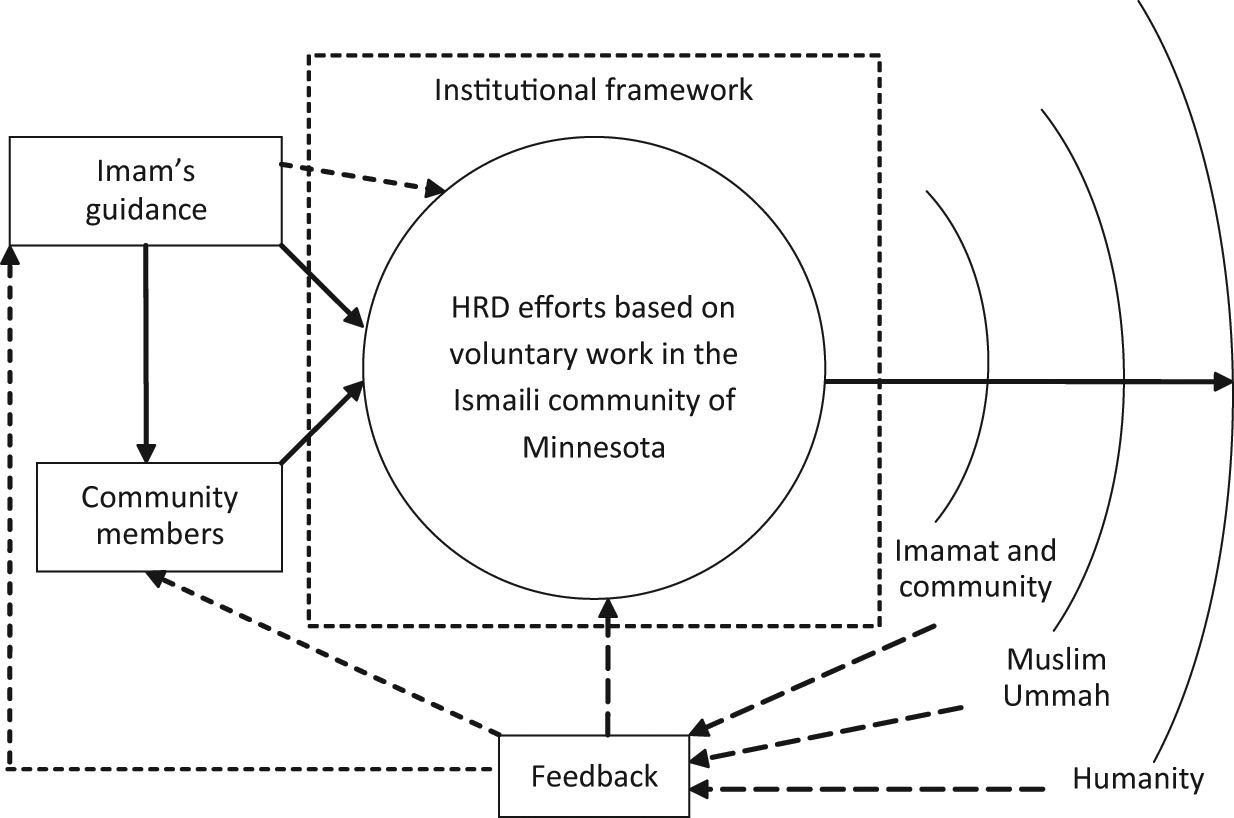
Conceptualization of HRD in the Ismaili community in Minnesota
Theme 2: History and Examples of HRD
In Minnesota, a Jamat Khana (community center) for the Ismaili community started in 1968 in an informal manner. It was not until October 1998 that the Ismaili community acquired a permanent place for a Jamat Khana. At the time of data collection for this study, the community consisted of 200 to 225 members.
Interview findings revealed that both before, and immediately after moving to the permanent Jamat Khana, volunteers were responsible for managing all activities in the Ismaili community of Minnesota, which is still the case. However, decision making was handled almost entirely by the community leadership, comprising both a male and a female leader.
Examples of HRD efforts
At the time of this study, the two formally structured institutions that focused on HRD in the Ismaili community of Minnesota were volunteer corps and the religious education center (REC).
The volunteer corps is comprised of children, youth, and adults, including both men and women. The organization of the volunteer corps included a facilitator and team leaders for male and female volunteer corps. Training is provided to all volunteers.
In REC, specific HRD activities included training, coaching, and mentoring of teachers. Training and mentoring were considered to be a part of HRD because they help individuals develop certain teaching skills that are necessary for their role as teachers. Thus, one of the outcomes of HRD efforts in the Ismaili community of Minnesota was the development of individuals and the institution, which, according to Swanson’s (2001) and McLean and McLean’s (2001) definitions of HRD, is more a process and an outcome than a one-time activity. As one participant said, “You know you are developing people, that you are in a constant effort of developing people in the community, where the faces of the people change but the efforts don’t.”
Theme 3: Role of Women in HRD Efforts
HRD efforts in the Ismaili community of Minnesota involved both men and women. According to the study participants and personal observations, the handling of issues related to gender roles in Muslim societies by the Western media contributes to creating many stereotypes of both Islam and Muslims. The theme, role of women in the Ismaili community’s HRD efforts, serves dual purposes. In addition to presenting research findings, it serves the purpose of minimizing negative stereotypes associated with Muslim women in a diplomatic manner.
Women’s roles in this community are addressed jointly by two of the nine areas of the U.S. Ismaili council structure. The areas are Economic Development Vertical (EDV) and Family Development Vertical (FDV). Both EDV and FDV address women development with the objective of providing leadership and other skills necessary for women to be able to contribute to their families and community by becoming economically and socially empowered (The Ismaili, July, 2005). Examples of programs offered for women, based on the review of documents, included English language classes, driving classes, job skills training, career workshops, and social adaptation skills training.
Observations suggested that the role of women in Minnesota’s Ismaili community was reflective of the status of women in Islam, as suggested by the Qur’an. Women participated in, as well as assumed, various leadership positions in both social and religious activities of the community. For example, at the time of this study, portfolios of legal and risk management, health, religious education, national council, regional council, and social welfare were headed by women.
Women in the Ismaili community in Minnesota enjoyed equal rights with men. However, it is also important to understand this theme from gender and cross-cultural perspectives. Different, and perhaps contrasting, views of male and female participants regarding the role of women in this community underscored the need to understand Hofstede’s (1997) cultural determinant of masculinity and femininity.
Observations suggested that many members of the Ismaili community in Minnesota represent East African and South Asian cultural values. In this regard, women’s assumed roles in the Ismaili community of Minnesota were evident as a result of their respective cultural values. Women in this community, regardless of their cultural background, were always active participants at all levels. One participant said, “I have always believed that, if you educate a girl, you are educating a family.” With more women in this community acquiring higher education, their role in developing this community might be even more critical in the future.
Overall, active participation of women in community activities, to some extent, might challenge stereotypes pertaining to the assumed roles of women in various cultures. This, in turn, underscores the need to address not only intercultural but also intracultural differences. Also, it is important to note the influence of cultural values on how a religion, Islam in this case, is interpreted and practiced in different parts of the world (Ernst, 2003). Thus, interpretation and practice of Islam are as diverse as its followers. The same diversity can be seen in the way various issues related to men and women are addressed.
Therefore, it would be inappropriate and myopic to think of a universal interpretation of Islam for approximately 1.5 billion Muslims spread across the globe (Ernst, 2003). Also, active participation of women in community development activities could be one of the reasons why the institutional framework of the Ismaili community, in general, addresses development of both men and women.
Theme 4: Future of HRD in the Ismaili Community
The fourth theme of the study focuses on the future of HRD in the Ismaili community of Minnesota. From a time-line perspective, this theme attempts to link Minnesota’s Ismaili community’s past and current HRD efforts to challenges and future opportunities. From a systems perspective, it highlights some key factors that determine the future of HRD in this community. At the time of this study, the challenges related to HRD efforts in the Ismaili community of Minnesota included time commitment, small community size, and cultural diversity.
Time commitment
One of the challenges was the time commitment of individuals who initiated and participated in HRD related activities. As one participant said, “I think the biggest challenge is the time commitment of these volunteers. They are professionals or businesspeople, and they have limited time to do these voluntary activities.”
According to participants, more time commitment would allow organizers to do thorough research before designing and implementing HRD efforts. Although time commitment posed a challenge, it also encouraged other members of the community to take a leading role, at least on an ad hoc basis.
Community size
The challenge of time commitment is further complicated by the small size of the Ismaili community in Minnesota. As one participant said, “Well, I think the size matters, and we know that in bigger communities there’s just a lot of human resources to tap into.” The challenge of small size has been a characteristic of the Ismaili community in Minnesota since 1968 when members of the community started getting together on an informal basis.
On the other hand, according to some participants, the small community size helped when it came to logistics and organizing activities. As one participant said, “You want to get something done quickly, a smaller place is where to go, so Minnesota would be the place to go.” Participants of the study also suggested that the small community size provided a family environment and made one-on-one interaction among members relatively easier. According to one participant, “I think you get more of a family environment here, and you get more one-on-one [interaction]. It builds friendship and communication between people.”
Cultural diversity
According to participants, cultural diversity, mainly in terms of Eastern and Western value systems, posed an important challenge. Organizers of HRD-related activities had to be sensitive to the needs of community members with different and, at times, conflicting cultural values.
According Hofstede (1997), power distance is defined as the extent to which members of a group—the Ismaili community of Minnesota in this case—are comfortable with an unequal distribution of power, which is of specific importance. Based on personal observations, power distance played a significant role in how people of various cultures reacted while participating in or leading HRD activities. As one participant said, “Again, the cross-cultural issue is important as different persons from different cultures participate in different institutions.”
Related to cultural diversity was multilingualism. It was observed that, on average, Ismaili community members communicated with one another in two to three languages. Activities were organized in such a way that Gujrati-, Hindi-, Urdu-, and English-speaking individuals could participate in them. English was used because it is the language of the host culture. Gujrati, one of the official and important regional languages in India, is used because it is spoken by many Ismailis who have South Asian and East African origins.
In addition, the review of documents suggested that there has been a significant push in the community from the Ismaili Imam and councils toward understanding the value of diversity at both local and global levels. Figure 2, a relationship diagram, summarizes the role of the aforementioned challenges and their influence on HRD efforts within the Ismaili community of Minnesota.
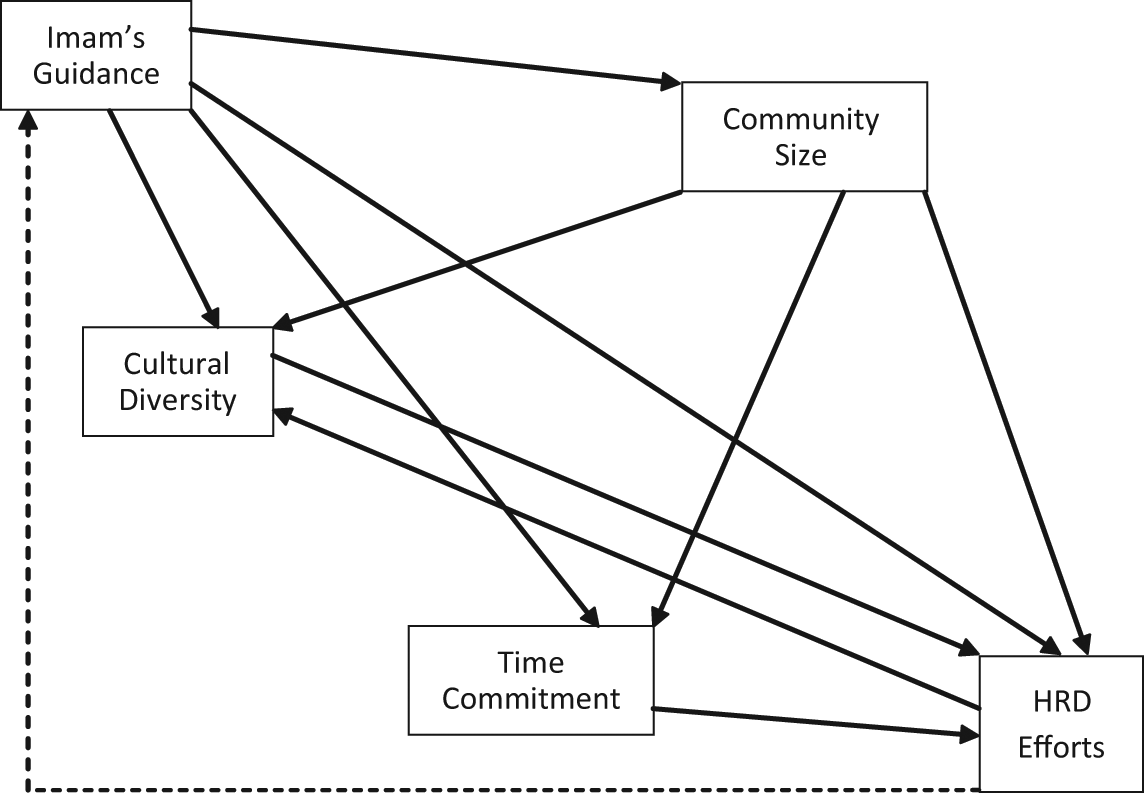
HRD relationship diagram
Opportunities for improvement
The data also revealed that there were several determinants guiding the future role of HRD in the Ismaili community of Minnesota. The determinants include better use of technology, evaluation of HRD efforts, formalization of the HRD portfolio, and collaboration with other communities.
These determinants are applicable only within the context of this study. Also, the determinants and their influence on the Ismaili community of Minnesota may change over time.
Recommendations for Practice
Based on the study findings, the following recommendations are made. These recommendations may also guide HRD practitioners and scholars in exploring community and societal development in various communities.
First, it is recommended that appropriate community-specific instruments be created and used for evaluating HRD efforts in community settings. HRD practitioners should seek input from and collaborate with civil society organizations that are engaged in community and societal development efforts.
Second, the process of evaluating HRD efforts should include both participants and leaders as it might help in bringing about changes from a holistic perspective. Also, results of evaluation should be communicated in a neutral and constructive manner. The objective of evaluating HRD efforts, especially in a religious community, should be more about making continuous improvements than challenging religious beliefs. The same holds true for societal development efforts because societies comprise communities representing rich traditions and strongly held values and beliefs.
Third, diversity efforts should be designed and implemented by incorporating cultural, lingual, ethnical, and religious diversity. Efforts should also be made to understand how gender-related issues influence, and in turn are influenced by, various aspects of societal development. In Muslim communities, diversity efforts should be related to and built on Islamic teachings pertaining to creating a modern, dynamic, and civil society. This might provide opportunities to HRD practitioners in the form of challenges associated with material and spiritual aspects of development.
Fourth, by engaging in the act of self-reflection, HRD practitioners should make genuine efforts to learn from the mistakes of various communities’ HRD efforts. The focus should be more on learning the contextual nature of societal development efforts than on criticizing individuals and communities.
Finally, from a societal development perspective, it is recommended that more HRD efforts focusing not only on intra- but also on inter-community collaboration be designed and implemented. Such efforts might help various faith-based communities promote pluralism. As Aga Khan, the present Imam of Ismailis, in one of his speeches, said,
There is clearly a need to mitigate not what is a “clash of civilizations” but a ‘clash of ignorance” where peoples of different faiths or cultural traditions, are so ignorant of each other that they are unable to find a common language with which to communicate. (Aga Khan Development Network, 2003)
Recommendations for Future Research
Several recommendations for future research are suggested. First, more research should be conducted to examine how HRD is conceptualized and practiced in community settings, including faith-based communities. Modood (cited in Farnell, 2001) argued that theorists often fail to pay attention to developmental efforts of faith-based groups.
Second, more research is needed to understand the role of HRD in developing Muslim communities. Doing so will help address and remove misconceptions about the role of Islam in individual and societal development (van der Veen, 2003).
Third, it is recommended that HRD scholars share findings of community and faith-based HRD efforts using nonethnocentric and nondenominational perspectives, unlike Alagaraja and Dooley (2003), who in their attempt to explain the contributions of various belief systems to HRD gave treatment that appears to be differential to the contributions of various organized religions, including Islam, to HRD.
Fourth, it is recommended that both qualitative and quantitative studies be conducted to understand various aspects of community and societal development processes, especially in faith-based communities. Such studies should focus not only on economic and noneconomic outcomes but also on understanding the role of size, gender, power distance, and intra- and inter-diversity on a community’s HRD efforts.
Finally, it is recommended that more case studies be conducted to explore the phenomenon of HRD, especially in community settings. This is mainly because case study methodology has the greatest potential to address the holistic and complex nature of a phenomenon (Torraco, 1994). Also, case studies help develop theories and enrich research areas for which existing theory is inadequate (Eisenhardt, 1989). Community development, if studied within the context of HRD, has a lot to offer to both theory and practice of HRD.
Conclusion
This case study was an attempt to understand HRD within a specific community setting. The themes of the case study research revealed that HRD played a role in developing members of the Ismaili community in Minnesota.
In conclusion, although the themes of this case study research may not be applicable to other communities, including Ismaili communities outside of Minnesota, they do add a realistic and positive perspective to the role of HRD efforts in community settings. Also, the process of community development requires dialogue, creativity, and research (Aga Khan Development Network, 2004). It is hoped that the study would enrich this dialogue. Besides, in light of the current global and political environment it is essential that community development efforts, particularly within Muslim communities and among all faith-based communities in general, be explored and understood with an open mind for the purpose of creating a pluralistic and civil society. One way to promote a pluralistic civil society is to ensure that community-level HRD be explicitly linked to and reflective of societal development efforts.
Footnotes
Declaration of Conflicting Interests
The author(s) declared no potential conflicts of interest with respect to the research, authorship, and/or publication of this article.
Funding
The author(s) received no financial support for the research, authorship, and/or publication of this article.