







Abstract
The Problem
Significant advances in technology and the increasing ways in which employees use it in their work and personal lives have led to an environment in which employees can work nearly anytime and anywhere. Although virtual human resource development (VHRD) brings with it useful efficiencies and increased opportunities for learning, the prospect of 24/7 learning can have a deleterious impact on work–life balance for employees.
The Solution
The aim of this article is to first explain how work–life balance and workplace technology interact to affect the lives of employees. The article models boundaries between these areas and recommends that attention to work–life balance become part of practice when human resource development (HRD) professionals design virtual learning or help develop workplace technologies and policies.
The Stakeholders
Stakeholders include HRD professionals, scholars who study work–life balance, and organizational leaders who implement workplace technology policies and practices.
How does the organization know managers are doing their jobs and that they are making the best possible decisions? Because they are spending every moment at it and thus working to the limits of human possibility. When has a manager finished the job? Never. Or at least, hardly ever. There is always something more that could be done.
Introduction
The words above from Kanter (1977) ring exceptionally true 37 years later. Remarkably, this observation was made in a time when work was primarily confined to a specific time and place, well prior to the advent of mobile technologies that allow us to work anytime and anywhere. Today, the workplace is no longer a discrete physical location and technologies that are increasingly affordable and sophisticated allow for employees to stay connected to work at all times (Kreiner, Hollensbe, & Sheep, 2009). This continual connectivity has led to an increased amount of time during which employees work outside of traditional work hours (Boswell & Olson-Buchanan, 2007; Waller & Ragsdell, 2012). Given these issues, learning and development are likely occurring at times and locations outside of the traditional work arrangement and thus represent a potential dilemma for virtual human resource development (VHRD) initiatives. The desire to provide accessible and convenient learning opportunities is frequently in direct opposition to an individual employee’s effort to create and maintain a degree of work–life balance.
While there is debate about the actual number of hours that people work each day and the degree to which it is a problem, workers are inarguably complaining of increased workloads and longer working hours (MacDermid & Wittenborn, 2007). Kelly and Moen (2007) found that 44% of employees reported feeling overworked, overwhelmed, and that they did not have ample time to reflect on their work in the past month. In addition, employees who spend many hours outside of the regular business environment, such as teleworkers, may be passed over for promotion because they lack visibility and the opportunity to lead key assignments (Bennett & Bierema, 2010). As Kossek, Lautsch, and Eaton (2006) noted, employees “cannot move work into the home without changing their social relationships” (p. 364). Although technology does allow for greater connectivity to work, greater flexibility, and a resultant increase in productivity and efficiency, this integration of work and home life leads to a blurring of boundaries between these two aspects of each employee’s life and, ultimately, comes at a price (Boswell & Olson-Buchanan, 2007; Orlikowski & Scott, 2008; Park & Jex, 2011).
The implications of mobile forms of technology need to be addressed in VHRD when speaking of workplace technologies. For the purposes of this article, workplace technology is defined as those electronic tools, both portable and stationary, that are used in conjunction with one’s job to communicate and/or to perform work either at a traditional work setting or away from such a setting. Schlosser (2002) noted presciently more than a decade ago that on a very basic level, “we need to find out more about how people use technology, so that we can begin to determine both positive and negative outcomes of its use” (p. 408). The role of human resource development (HRD) in technology development has come to the forefront (Bennett, 2010, 2014a; Bennett & McWhorter, in press; McWhorter, 2014;) because of these very issues. Studying the pros and cons of workplace technology alone does not provide for us a holistic picture of the impact of technology on work and life. I argue that because the ubiquity of technology has made it the singular game-changing factor that has turned any notion of balance in the work–life balance equation on its head, we need to specifically consider the impact of technology on work–life balance. Furthermore, within the context of VHRD, we need to understand how HRD professionals can consult with organizations to manage the balance, both technically and culturally. The culture of an organization sets the expectations and policies regarding virtual work; this cultural aspect is central to VHRD (Bennett, 2009). For more discussion about organizational culture and intranet technology, see Bennett (2014b.
Workplace technology, unlike any factor prior, has blurred the lines between work and home and created an environment in which people are forced to choose work over family—or vice versa. Yet, in their analysis of four leading management journals over a 10-year period, Orlikowski and Scott (2008) found 95% of the articles published in top management research journals failed to account for the role of technology in organizational life. Accordingly, Kreiner et al. (2009) called for a deeper understanding of the complex nature of the technology/work/home interaction. Such an understanding will provide insights into how organizational leaders and employees alike can best manage and maximize technology in the workplace. The aim of this article is to explain how work–life balance and workplace technology interact to affect the lives of employees. The article next discusses the implications of this interaction on VHRD efforts within organizations. Finally, suggestions are made as to how HRD professionals can maximize VHRD efforts without neglecting the work–life balance needs of employees.
Work–Life Balance
In his book on meaningful workplaces, Chalofsky (2010) noted that employees desire work–life balance because such balance provides a sense of completeness; no one area of our lives should dominate at the expense of other areas. Consequently, organizations in recent years have begun to pay increasing attention to work–life balance issues. Those organizational initiatives concerned with work–life balance “are deliberate organizational changes—in policies, practices, or the target culture—to reduce work–family conflict and/or support employees’ lives outside of work” (Kelly et al., 2008, p. 310). Because they are responsible for the development of employees across an entire organization, HRD professionals are in a position to work directly with both managers and employees to engender and maintain a sense of work–life balance throughout their given organization.
Key Concepts Defined
There is no singular and agreed on definition for the term work–life balance. Several authors offered their own definition (Arthur, 2003; Berg, Kalleberg, & Appelbaum, 2003; Clark, 2001; Grzywacz & Carlson, 2007; Kossek, Colquitt, & Noe, 2001), whereas others referred to definitions from prior writings on the topic (Frone, 2003; Reiter, 2007). The term work–family balance is often used interchangeably with work–life balance. Because the demands of work affect the lives of those employees without children or families in ways that are as important and meaningful as the impact on those that do have families, I will use the term work–life balance for the purposes of this article.
Most definitions of work–life balance give the impression that the sole responsibility for and obligation to create and maintain balance lie solely with an employee (Clark, 2001; Frone, 2003). That said, I will focus on the more inclusive definition from Grzywacz and Carlson (2007) that defined work–life balance “as accomplishment of role-related expectations that are negotiated and shared between an individual and his or her role-related partners in the work and family domains” (p. 455). This definition brings up the important views that work–life balance (or lack thereof) is about the congruence of expectations surrounding the work and life domains and that each employee is not alone in his or her struggle to gain and maintain balance. Achieving balance is a dynamic and fluid process that requires work and negotiation by all parties involved.
A key concept in the work–life balance literature is work–family conflict, which Greenhaus and Allen (2011) defined as conflict that “occurs when role pressures from work and family are mutually incompatible such that participation in one role is made more difficult by participation in the other role” (p. 166). Work–life balance, we can deduce from this definition, is achieved when work–family conflict is minimized.
Another key concept—balance—is not well defined nor has a common and standard definition of the concept been agreed on (Frone, 2003; Greenhaus & Allen, 2011; Greenhaus, Collins, & Shaw, 2003). Frone (2003) noted that people think that a universal definition for work–life balance is fairly self-evident, yet many scholars fail to define balance (Reiter, 2007). Balance is not a zero-sum game or an either/or proposition; it should not be defined simply as the absence of conflict (Chalofsky, 2010; Hill et al., 2007). Furthermore, balance is a subjective construct, as each person’s idea of what constitutes balance differs. Reiter (2007) rejected the idea that balance is about making sure your attention and resources are spread equally across the various facets of your life. Accordingly, Hill et al. (2007) advocated framing the notion of work and home balance with the music metaphor of harmony as a way to conceptualize the coming together of various elements to make a functioning whole. Importantly, Clarke, Koch, and Hill (2004) offered that balance is not something that happens without effort; it is proactively achieved by employees.
Greenhaus et al. (2003) argued that achieving balance is critical to having satisfied, productive employees because (a) balance buffers individuals from the negative effects that might be experienced in the work and family roles and (b) it does indeed reduce work–family conflict. As people develop their careers, they also begin to develop routines and further facilitation skills that enable them to meet the demands of the various roles in their lives. These skills used to achieve work–life balance are called boundary work.
Nippert-Eng (1996) explained that boundary work is the process by which one organizes his or her life according to the various home and work roles played as he or she determines which items to integrate and which to segregate between the work and home domains. Employees tend to accomplish this role transition either through “segmentation (making clear distinctions between the roles) or integration (being flexible and transitioning easily between the work and family roles)” (Ashforth, Kreiner, & Fugate, 2000, p. 474). In an effort to segregate, employees purposefully create two distinct categories for home and work. In turn, employees do whatever they have to in order to maintain this distinction; this is done through the creation of boundaries.
Segmentation tends to make transition between roles difficult because it requires a complete separation of tasks and attention; the concept assumes that one cannot focus on his or her job at all while also focusing on family, for example (Desrochers & Sargent, 2004). Integration, however, generally makes transition easier because focus on both roles is constant to one degree or another (Rothbard, Phillips, & Dumas, 2005). However, the integration of roles makes it more difficult to determine which role should be prioritized as role contexts change—attention and focus is fractured, which is often exacerbated by changing demands. Because of the easy and continuous access to work and learning that it affords, technology has made the employment of boundary work increasingly more complicated.
Technology’s Impact on Work
The first way in which technology has affected the lives of employees is that it has changed the very nature of work itself (Parkinson, 1998). Technology is no longer a set of tools that we might leverage to accomplish certain tasks; the use of technology is the definitive way in which we communicate and accomplish our work. Subsequently, technology is integrated into everything that we do throughout our workdays and within a given organization. We now use technology to communicate and work all day, every day (McWhorter, 2010). Because workers desire flexible work hours as opposed to working for fixed periods of time, work is now symbolically constructed as an activity; because workers desire flexibility with regard to work location, work is no longer viewed as a place (Cowan & Hoffman, 2007).
Along with the increasing work flexibility afforded by workplace technology, however, comes increased working hours and an increasing obligation to feel that one should be working at all times. What is not fully understood is whether the source of the phenomenon is an organization setting expectations for use of workplace technology, thus potentially adopting new cultural expectations of employees, or whether employees are setting these expectations for themselves. Recent estimates show that working parents spend an average of 64 hr paid and unpaid hours per week engaged in activities related to work (Schneider, 2011). The number of hours worked increases for parents in professional jobs and, particularly, for those in managerial positions.
Fenner and Renn (2004) referred to this additional work enabled by technology as supplemental work, defined as “a form of distributed or remote work where employees engage in job-related activities at home and away from the traditional workplace” (p. 179). This is work that, only a few short years ago, would have been impossible to complete without being physically located in one’s workplace. Today, the ability to work anywhere and anytime means that we indeed do work anywhere and anytime. The technological developments that have led to remote work have led to the erosion of work and life boundaries and often invade what was once personal or private time (Land & Taylor, 2010). As a result, employees have created ways with which to deal with the increased hours during which they work in an effort to establish or maintain a sense of work–life balance.
Parkinson (1998) explained that employees most often learn of new technologies in the work setting and then go about figuring out how they can use those technologies to better manage their personal commitments. For example, when an employee gets a smart phone for work purposes, the email and calendaring functions of that phone can be, and generally are, soon used for personal emails and appointments in addition to those items exclusive to work. In a study concerning how people integrate home and leisure-related activities into their work lives, D’Abate (2005) argued that people engage in personal business (emails and phone calls) on the job because work too frequently cuts into their personal lives, thus limiting their ability to maintain balance. Similarly, Waller and Ragsdell (2012) noted that although email allows for more deliberate communication and decision making across time and geographies, it also makes interpersonal communication harder to interpret, relationships more difficult to start and maintain, and, at a very basic level, it is frequently difficult for people to simply keep up with the volume of email they receive. Furthermore, workers who rely on electronic communications have difficulty forging trusting relationships with co-workers (Germain & McGuire, 2014). Workplace technology, then, affects people in a number of ways that warrant further examination.
Technology’s Impact on People
The second way in which technology has affected employees is that it has changed their behaviors in and around work in a number of significant ways. Employees who are consistent users of workplace technology will frequently change their role identities in ways that more closely align with work, as employees with such work-centric identity tend to have three constructs of identification in common: affective commitment, ambition, and job involvement (Boswell & Olson-Buchanan, 2007; Fenner & Renn, 2004). That is, employees who identify closely with the organizations for which they work, are ambitious and desire to get ahead in their careers, and are highly engaged in their jobs will most frequently place work and the need to work anytime and anywhere above all else in their lives (Schlosser, 2002).
When work intersects with all aspects of life, employees find it difficult to separate their identity as employee from that of father or husband or friend. Furthermore, given the demands of the workplace and the intrusive nature of technology, employees find it exceedingly difficult to create functional boundaries that separate work and family (Park & Jex, 2011). Time and again, if given the choice between work and family, those employees with access to workplace technology most frequently choose work as they struggle to negotiate among their work and family role expectations (Greenhaus & Allen, 2011; Grzywacz & Carlson, 2007).
In some cases, employees engage with technology after hours because they want to stay on top of their work and/or prevent major issues from developing (Boswell & Olson-Buchanan, 2007). In other cases, peer pressure and the demands of the organization compel them to stay connected (Fenner & Renn, 2004; Waller & Ragsdell, 2012; Wilson et al., 2004). Waller and Ragsdell (2012) noted that the more senior an employee is within an organization, the more compelled that person feels to check his or her email and to stay connected outside of work. In this regard, there is in effect a disincentive to become successful. The reward for advancing in your career is a feeling of being further owned by the organization for which you work and an obligation to stay connected and be responsive at all times of the day and night. Paradoxically, although the ability to work remotely is intended to increase flexibility for employees, working for long periods of time from home using email, Skype, or instant messaging “remains largely perceived by companies as being uncommitted and shirking office responsibilities” (Schneider, 2011, p. 118). Thus, in many situations, an employee must both physically appear in the office on a regular basis and stay connected outside of the office to appear engaged and productive in the eyes of his or her co-workers and management.
Irrespective of the reason(s) why an employee allows work to intrude on his or her personal life, such intrusions frequently create conflict with spouses, significant others, and family members (Boswell & Olson-Buchanan, 2007). In their study on the usage of email by professionals, Waller and Ragsdell (2012) explained that “employees described feelings of anticipation, anxiousness, or urges which resulted in a conscious decision to check e-mails despite the negative implications associated with doing so out of office hours” (p. 169). Once this intrusion begins, employees begin to find ways to cope with the omnipresent technologies in their lives.
Figure 1 illustrates a tempered interaction between workplace technology and an employee’s work and home spheres that leads to healthy work–life balance. In it, the permeable boundaries of the spheres (Clark, 2000) of home and work are both interrupted by workplace technology, which directly affects both work life and home life. Employees utilize boundary making techniques to reduce work–family conflict, which ultimately leads to improved work–life balance. The driving factor behind the encouragement for and implementation of these techniques should be HRD-led work–life balance initiatives and an organizational culture that is supportive of such initiatives. These initiatives provide employees with the tools to manage and maximize workplace technology while preserving a sense of balance in their lives.
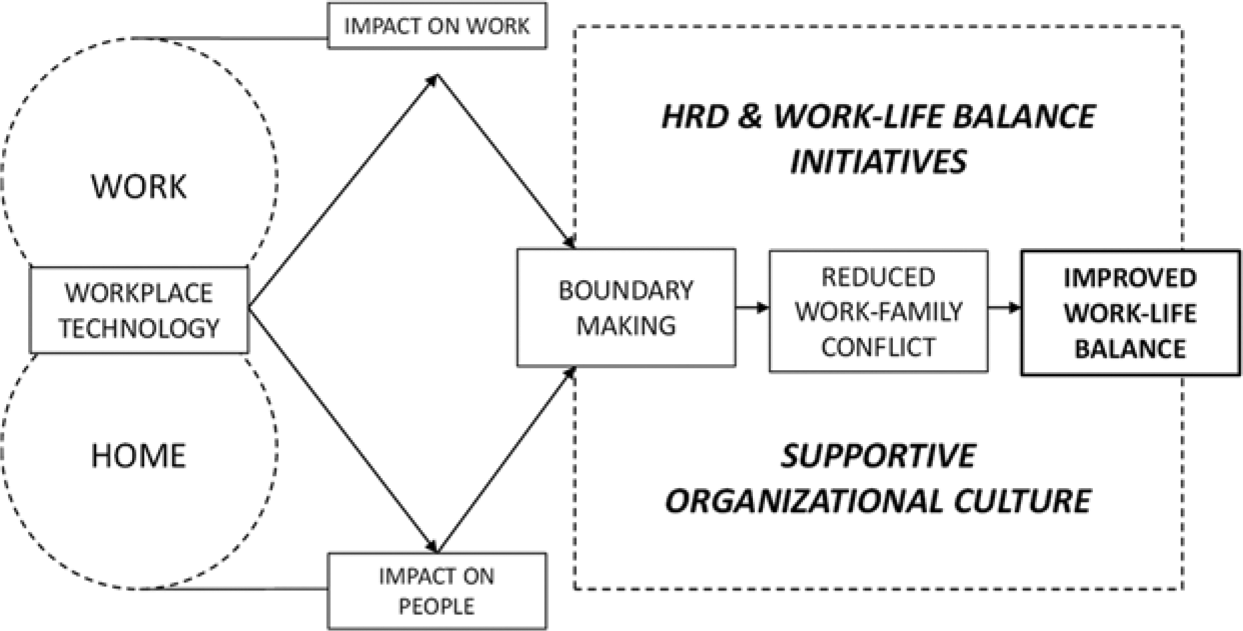
A healthy approach to workplace technology and its impact on the home/work domains, work, and people.
Kossek et al. (2006) explained that employees can experience positive psychological benefits of the increased flexibility afforded by technology, but the “most robust predictors of individual well-being were (a) higher job control over where, when and how one worked and (b) a boundary management strategy favoring the separation of work and family boundaries” (p. 361). Thus, an employee must create boundaries and decide to what degree he or she should be permeable to control technology for maintaining a sense of balance. Organizations should make efforts to create work–life balance initiatives and should encourage employees to take advantage of such initiatives. In addition to creating and maintaining a sense of balance in the lives of employees, the creation of boundaries by employees benefits organizations as well.
Caligiuri and Givelekian (2008) cited three reasons why organizations should think strategically when it comes to the implementation of work–life balance initiatives: (a) to attract and retain key talent, (b) to increase the time capacity of key talent, and (c) to maximize the performance of key talent. By helping enable all three of these reasons, HRD practitioners can help contribute to employee retention and to maximizing the overall performance of the organization. However, organizations tend to be more responsive to employees’ need for flexible work schedules when their managers believe that not being responsive could have detrimental effects on the employees’ and, ultimately, the organization’s performance (Milliken, Martins, & Morgan, 1998).
Thus, proactive implementation of work–life balance efforts can and should occur prior to any individual or organizational degradation in performance. Employees whose organizations provide work–family benefits report greater commitment, less intention to leave the organization, and less work-to-family conflict (Thompson, Beauvais, & Lyness, 1999). Given the benefits to enabling work–life balance for employees, HRD practitioners need to consider the implications of not providing such benefits when creating and implementing any HRD initiatives. Because technology frequently leads to a disruption in work–life balance, particular attention needs to be paid when VHRD initiatives are designed and implemented.
Implications for VHRD
Virtual HRD is a culturally relevant webbed environment that emphasizes learning, particularly informal learning that strategically improves various work and development outcomes (Bennett, 2009), and it provides virtual place in which organizational members can interact (Bennett, 2009; McWhorter, 2010). Mobile technologies extend the access and interaction members have within a webbed environment. The discussion to this point demonstrated the role of organizational culture when discussing boundaries and workplace technologies. In addition, workplace technology, including mobile technology, allows employees to access VHRD from many locations 24/7 (McWhorter, 2010). Mobile technology, thus, becomes part of the ecology of VHRD (Bennett & Bierema, 2010). While some access is valuable, too much access is problematic when it significantly affects family and home life. Given that HRD emphasizes improving oneself through learning, one must have work–life balance for capacity to be freed up for such learning to occur (Herzberg, Mausner, & Synderman, 1959; McClusky, 1963).
Strategic improvement is also a central idea in VHRD (Bennett, 2009; Bennett & McWhorter, in press), and so aligning development and work–life balance can be strategic with organizational mission. If an employee is overwhelmed with work or obligations outside of work, he or she will not have the time or energy to focus on learning. That said, HRD practitioners implementing VHRD learning initiatives must consider the work–life balance implications of any such initiative(s) to ensure that that the work–life balance of employees is considered and respected. It is one thing to conclude that what is best for an organization is a virtual learning experience that allows employees to learn anytime and from anywhere; it is another thing altogether to think that such easily accessed learning will not in some way impinge on the work–life balance of those same employees. HRD practitioners who have influence over implementation or development of technology should ensure that work–life balance is addressed early.
Speaking of the primary challenges facing HRD professionals who are implementing VHRD initiatives, Nafukho, Graham, and Muyia (2010) offered as one concern the overloading of learners with too much information because technology so significantly eases the production and distribution of training. This is a critical concern for technology development that provides the means through which VHRD is created and learning capacity is increased (Bennett, 2010; Bennett & McWhorter, in press). The concern for cognitive overload is also echoed in Ausburn and Ausburn (2014 [this issue]).Virtual solutions need to be thoughtfully conceived, designed, and delivered without losing sight of the primary goals of improving the effectiveness of the learning, performance, and development of employees (Bennett, 2014a; Yoon & Lim, 2010). VHRD solutions must be carefully considered as one approach to fulfilling the training and learning needs of an organization, not as the singular and relied on alternative.
At times, a low-tech intervention may still provide the best HRD support in a given situation (Bennett & Bierema, 2010). Thus, HRD professionals must not rush to jump on the technology bandwagon for its own sake. Brandenburg and Ellinger (2003) cautioned HRD professionals against focusing too much on technological tools and infrastructure. Instead, we must not lose sight of the human aspects and the more social components of learning and must choose and implement technology wisely. This is also consistent with the conceptualization of VHRD, which stated technology should be strategic and aligned with organizational mission (Bennett, 2009).
Because employees need to be freed from stressors and distractions to be at their most productive, work–life balance is an issue central to HRD (Grzywacz& Carlson, 2007) and, thus, to VHRD efforts. However, all training and development efforts and work–life balance initiatives share the same fundamental concern: ensuring that workers and organizations function as effectively as possible (MacDermid & Wittenborn, 2007; Rothbard et al., 2005). Yet, the disciplines pursue these goals differently. VHRD places greater emphasis on workers’ learning and development (Mancuso, Chlup & McWhorter, 2010; Short, 2010). Work–life balance initiatives focus on reducing impediments to worker performance inside and outside the workplace, such as problems with dependent care arrangements. However, it is not enough for HRD practitioners to simply produce work–life balance initiatives; the initiatives must be the right solution to the problem(s) particular to a given organization and must address the needs of employees. In the case of VHRD initiatives, HRD practitioners need to be mindful of all of the work with which a given employee or group of employees is tasked so that additional virtual training does not prove to be supplemental work that is too taxing.
To help ensure the success of VHRD initiatives while still considering work–life balance, HRD practitioners can conduct work–life impact assessments to deduce the needs of the organization and to determine the importance of the nature of the training and to what degree it can be done elsewhere or at another time (Barnett, 1999). From there, employee-focused cultures that help restore and maintain work–life balance can be created, and carefully planned VHRD interventions that are minimally impactful to work–life balance can be initiated. In light of cultural relevance described in VHRD (Bennett, 2009), a culture should adopt values and practices that support work–life balance within workplace technologies. The payoff for such consideration of work–life balance is significant. Indicators of achieving such balance have been associated with greater employee commitment, job satisfaction, and organizational citizenship behavior (Grzywacz & Carlson, 2007), all of which are factors that contribute to furthering VHRD’s mission of developing employees.
Figure 2 illustrates the potential hazard of VHRD interventions that have been implemented without careful consideration to the impact of such interventions on the work–life balance of employees. Recall that in Figure 1, employees used boundary work to reduce work–family conflict, which in turn led to improved work–life balance. Below, a VHRD intervention has been introduced just as an employee is trying to create boundaries between work and home. Efforts at boundary making have been disrupted, as supplemental VHRD work has added to the employee’s workload. If boundaries are correctly made, work–family conflict may be reduced and work–life balance may be achieved. However, if the additional VHRD work proves to be stressful, the employee’s workload could become overwhelming and work–life balance may be reduced.
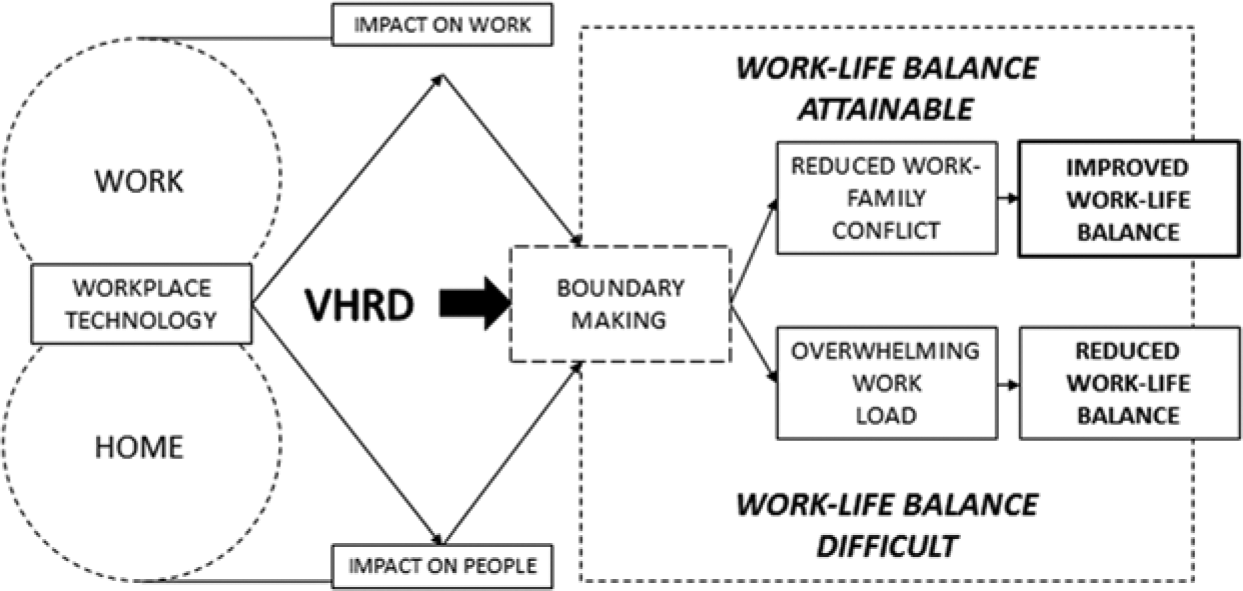
The potential impacts of VHRD on the home/work domains, work, and people.
One of the key ways in which HRD professionals and managers alike can assist employees to achieve balance is by helping employees to establish thoughtful and realistic boundaries when it comes to VHRD efforts, to set realistic expectations for themselves and their co-workers, and to exercise a large degree of control over their time (Fenner & Renn, 2004; Park & Jex, 2011; Parkinson, 1998). Because managers and supervisors set the tone for the way(s) in which a group conducts its work, Schlosser (2002) urged supervisors to be up front about the use of technology:
If an employee is expected to be on call 24/7, then this must become a formal part of the job, acknowledged by the employee upon entering the role . . . it should not be an expectation introduced later, as an unintended by-product of wireless technology capabilities. (p. 421)
Employers must, thus, carefully spell out expectations around when and how frequently employees are expected to engage in VHRD efforts outside of work. When employees are armed with knowledge about these expectations, have both a supportive work culture and a supportive supervisor, and are taught how to effectively manage technology to control their work and their own time, then they are best positioned to keep workplace technology in perspective and to achieve a satisfactory degree of work–life balance.
Supervisors are particularly critical to the effectiveness of work–family initiatives because they can either encourage or discourage employees to take advantage of such benefits. Of all the elements that go into creating a work environment that is focused on reducing work–family conflict, Kelly et al. (2008) found the most important and effective way to foster support for such initiatives was through supportive supervisors. As a result, supervisors set the tone for the employees’ acceptance and use of these policies by either reinforcing the work–family norms or the traditional cultural norms that would discourage usage (Sturges & Guest, 2004; Thompson et al., 1999; Voydanoff, 2004). Because supervisors are on the frontline with employees, they are the face of the organization and can truly accommodate and support those with family responsibilities (Clark, 2001) to achieve a sense of balance in the workplace.
Conclusion
Although some might argue, I offer that it is safe to assume that not every employee wants to work 24 hours each day. Yet, advancements in workplace technology have allowed for us to be able to work anywhere and anytime. Given Bennett’s (2010) call to study “how technology is changing organizational design and the meaning of work” (p. 738), this article has aimed to look further into the workplace technology phenomena while providing practical suggestions as to why and how HRD practitioners can create and deliver VHRD interventions that are impactful while still being conducive to work–life balance.
Specifically, this article initially explained how work–life balance and workplace technology interact and affect the lives of employees. Discussed next were the implications of this interaction on VHRD initiatives within organizations. Finally, suggestions were made as to how HRD professionals can maximize VHRD efforts while keeping in mind the work–life balance needs of employees. Although the benefits of VHRD initiatives are clearly recognized and supported, HRD practitioners are encouraged to not summarily eschew traditional methods of delivery and also to strongly consider the work–life balance implications of VHRD initiatives prior to their implementation.
Footnotes
Declaration of Conflicting Interests
The author(s) declared no potential conflicts of interest with respect to the research, authorship, and/or publication of this article.
Funding
The author(s) received no financial support for the research, authorship, and/or publication of this article.