







Abstract
The Problem
A number of new perspectives of virtual human resource development (VHRD) have been provided in this issue of Advances in Developing Human Resources (ADHR) that warrant further discussion. As VHRD is still a nascent area of inquiry in HRD, professionals need more explanatory examples and solutions to consider for determining their own role in working with people and technology.
The Solution
This article offers a synthesis of key constructs of VHRD from the articles in this special issue. Also, it provides a discussion around two different modes of technology development (TD) needed by HRD professionals in the contemporary technology-enabled environment afforded by VHRD. And, the integration of TD in addition to career development, training and development, and organization development is essential to the future of HRD and is discussed herein.
The Stakeholders
This article targets primarily practitioners interested in VHRD interventions and processes. It encourages the reader to examine the commonalities across the articles in this issue of ADHR and also to consider the new skills required for HRD professionals when seeking to align organizational mission with all levels of the organization.
This issue of Advances in Developing Human Resources highlights the evolving nature of virtual human resource development (VHRD). Over the past 4 years since VHRD was first explored as an emerging construct in the field of HRD (McWhorter & Bennett, 2010), it has grown in complexity to capture both formal and informal learning processes in a virtual environment that may be strategically aligned with organizational objectives at both the individual and collectives levels of an organization (Bennett, 2014a). As such, the focus of VHRD has turned toward the larger goal of alignment of all levels of the organization with the organizational mission (Bennett, 2014a; Germain & McGuire, 2014; Thomas, 2014) thereby providing further depth, breadth, and value for HRD.
The purpose of this article is twofold: (a) to synthesize the contributing authors’ treatment of defining characteristics of the constructs of VHRD (Bennett, 2009) in this new area of inquiry (McWhorter, 2010) and (b) to present further discussion on technology development (TD), which Bennett (2010, 2014a) advocated for adoption into HRD practice and research.
VHRD: Synthesis of Key Constructs
In this issue, the authors utilized a single definition for VHRD, which is a “media rich and culturally relevant webbed environment that strategically improves expertise, performance, innovation, and community-building through formal and informal learning” (Bennett, 2009, p. 364). The articles in the issue were analyzed in light of this definition to develop a synthesis of key constructs. As a result of the analysis, connections were found that lend support for the most prominent themes found in the articles in this issue and included webbed environment, community building, informal learning as a process, and media richness, and each will be presented next.
Webbed Environment
Discussions of the webbed environment necessary for VHRD are found in each of the articles in this issue. For example, Bennett (2014a) noted that a webbed environment is created when “applications, people, and digital objects are incorporated into a system . . . [such that each] new digital item added becomes part of the virtual environment of the organization” (p. 268). Also, virtual teams function through digital communications that are typically highly sophisticated and integrated technologies incorporating audio, video, text, social media, and the opportunity to record the sessions for archiving to review later on demand; and artifacts of the meeting are further available through company email or the repository system in the organization (see Germain & McGuire, 2014).
In addition, virtual scenario planning (VSP) is offered as another example of artifacts that are webbed into the organization’s repository to collect scenario stories, interviews with remarkable people, and data from internal and external sources that gather insights about the future (McWhorter & Lynham, 2014). Likewise, Thomas (2014) saw mobile technology as key for VHRD and recognized as a way for an employee outside the physical boundary of the organization to remain connected to virtual learning opportunities and collaboration with colleagues and customers.
It is noted that in our modern world, people are connected to each other and also wirelessly connected to their vehicles, gadgets, and digital devices. Such device connectivity generates massive amounts of traffic on the Internet, and was termed in the literature as the Internet of Things (IoT) (Cisco, 2011; Minoli, 2013) linking digital and physical worlds into a complex environment (Gershenfeld & Vasseur, 2014). Further, Cisco (2013) recently added the human, process and data components to the IoT and named this new integrative environment the Internet of Everything (see also McWhorter, 2011; 2014). Also, sociomateriality was introduced by Fagan (2014) who described the sociomaterial perspective to be a view of the social and the material elements of digital systems as mutually intertwined, and she posited it as a way to study VHRD. In addition, Monteiro, Almklov, and Hepsø (2012) gave an example of how they used sociomateriality to study mediated information in a complex environment (i.e., the exploration of petroleum resources located far below the seabed and impossible to directly measure) where networked sensors used for visualization of scientific data were utilized.
As organizations incorporate networked devices, sophisticated software, and learning tools that are integrated or “webbed in” (Bennett, 2014a) to the system, the environment becomes very complex. Bennett (2014a) remarked that “there is far greater complexity with conceptualizations of VHRD as a virtual environment, rather than just focusing on discrete pieces within a system” (p. 265) thus giving support for VHRD as a complex and webbed system.
Informal Learning
Each of the articles in this issue mentioned informal learning as a key component of VHRD. Informal learning (i.e., experiential learning, workplace learning, and social learning) is seen as the most prevalent type of learning as compared with formal learning (i.e., course work and structured activities) in the workplace (Bennett, 2014a). Both types of learning are important and vital for the success of the organization (Bennett, 2014a; A. D. Ellinger, 2005). Formal learning (such as training done online) is part of VHRD but informal learning has been theorized to be more influential because of the volume of informal learning in today’s virtual environments. In his discussion on workplace boundaries, Thomas (2014) discussed that mobile devices such as digital tablets and smartphones are not only extending our workday but also increasing our opportunity to access informal learning experiences. Such experiences may include virtual team meetings (Germain & McGuire, 2014), Internet searches for information (Carliner, 2012), and connections within social media (Ausburn & Ausburn, 2014; Bennett, 2014a; Delello & McWhorter, 2014; Fagan, 2014; Germain & McGuire, 2014; Thomas, 2014; Thomas & Akdere, 2011).
According to Bozarth (2010), the greatest learning of workplace content is informal learning experiences happening in the spaces in time between formal learning events, noting that social media such as Twitter (twitter.com) is useful for continuing dialogue between formal training sessions by “tweeting” salient points or thoughts for attendees to consider. Bozarth (2010) remarked that social media “is one way for the training department and the training practitioners to get into those spaces and reach employees between events” (p. 15).
Organizational Culture (OC)
OC was also found throughout the articles in this issue. For example, OC was defined by Bennett (2014b) as “the shared beliefs, values, and assumptions that determine how members interpret events and act in an organizational environment” (p. 298). In a similar vein, Thomas (2014) added that OC should include “practices [and policies] that support work-life balance within workplace technologies” (p. 290) thus creating a boundary between technology and the workplace.
Within OC, we can also locate community building in practice. Bennett (2014a) remarked that “even some of the most mundane aspects of technology carry meaning about a culture and possess the ability to foster community development consistent with the definition of VHRD” (p. 314). And, in their article on virtual teams, Germain and McGuire (2014) saw collaboration and community building essential for establishing trust in virtual environments. It is not surprising to learn that email has been declining in recent years with social networking channels taking center stage for collaboration in the workplace “enabling employees to form virtual workgroups and exchange ideas . . . making relevant content accessible and searchable for the entire company” (Holmes, 2012, para. 6).
Media Richness
Bennett (2014b) commented that “technology should be . . . media rich to have the best chance of improving human resource development outcomes” (p. 297). This media richness in VHRD ecosystems is examined by McWhorter and Lynham (2014) as they noted that visuals and media have been shown to have a positive effect on VSP; and similarly, Ausburn and Ausburn (2014) reported that Screen-based virtual reality environments (SVREs) are highly visual environments that can have the same look and feel as the spaces they represent. And, media richness in Bennett’s (2014b) study was found in an intranet, which housed news announcements, images, and video of organizational events, among others.
In recent years, there has been a move from social media to visual social media (Delello & McWhorter, 2014; Fazarro & McWhorter, 2011) that engages the senses. Take, for example, the graphic richness of three-dimensional (3D) virtual worlds (Kapp & O’Driscoll, 2010; Mancuso, Chlup, & McWhorter, 2010; McWhorter & Lindhjem, 2013; McWhorter, Mancuso, & Hurt, 2008); augmented reality that overlays virtual images onto real images (McWhorter, 2012a), videos, and graphics in intranet postings (Bennett, 2014a) and company branding; visual social media sites such as Pinterest (McWhorter, 2012b); the timeline and addition of graphics onto Facebook; short videos onto Twitter; and graphics embedded into web-based ePortfolios and LinkedIn profiles (McWhorter, Delello, Roberts, Raisor, & Fowler, 2013). Truly, a picture speaks a thousand words and the richness of the environment that is created by VHRD is replete with many instances of the richness of the digital environment that we can work within (McWhorter, 2010).
Technology Development
In the contemporary workplace, sophisticated technology can be of tremendous benefit to the organization because technology extends human capabilities (McWhorter & Bennet, 2014b). Unfortunately, it is estimated that on average, two out of every three information technology (IT) projects are considered to be a failure (i.e., cost or time overruns, rollout with less functions than promised, or total project discontinuation; Nelson, 2007). It only takes a perusal through failed and less-than-stellar technology IT projects to consider that perhaps some of the technology failures were preventable through necessary forethought, and appropriate design and implementation expertise (Bennett & McWhorter, in press; Dirksen, 2012; Koch, 2002; McWhorter & Bennett, 2014a, 2014b; Payne, Smith, & Cohen, 2013; Wailgum, 2009).
Given that technology projects are crucial to the success of an organization, HRD must be involved in the design and implementation of technology “to support learning, workflow, and organizational structure” (Bennett & McWhorter, in press). In 2010, Bennett introduced TD to the field of HRD and it has since been defined as “the integration of technology with HRD objectives and processes to improve learning capacity and performance” (Bennett & McWhorter, in press).
Each of the articles in this issue touched on the theme of TD. For example, Bennett (2014a) described that technology has two modes in practice: (a) “one that adapts technology to support HRD interventions and processes in practice” (p. 271), and (b) application of the “HRD processes, techniques, and models of HRD to ensure organizational needs are met strategically during and after design and implementation of new technology” (p. 273).
Mode 1 and Mode 2 are simply ways for HRD professionals to consider how their expertise can lend value in organizations around technology; typically, these modes are integrated within the same project or activity. Articles in this issue are heavily loaded to Mode 1, but it is useful to consider how HRD professionals can lend their expertise needed for Mode 2 of TD to bring new software and conference systems into organizations. See Table 1 for various examples of TD activities within Mode 1 and Mode 2.
Examples of Mode 1 and Mode 2 Technology Development Activities.
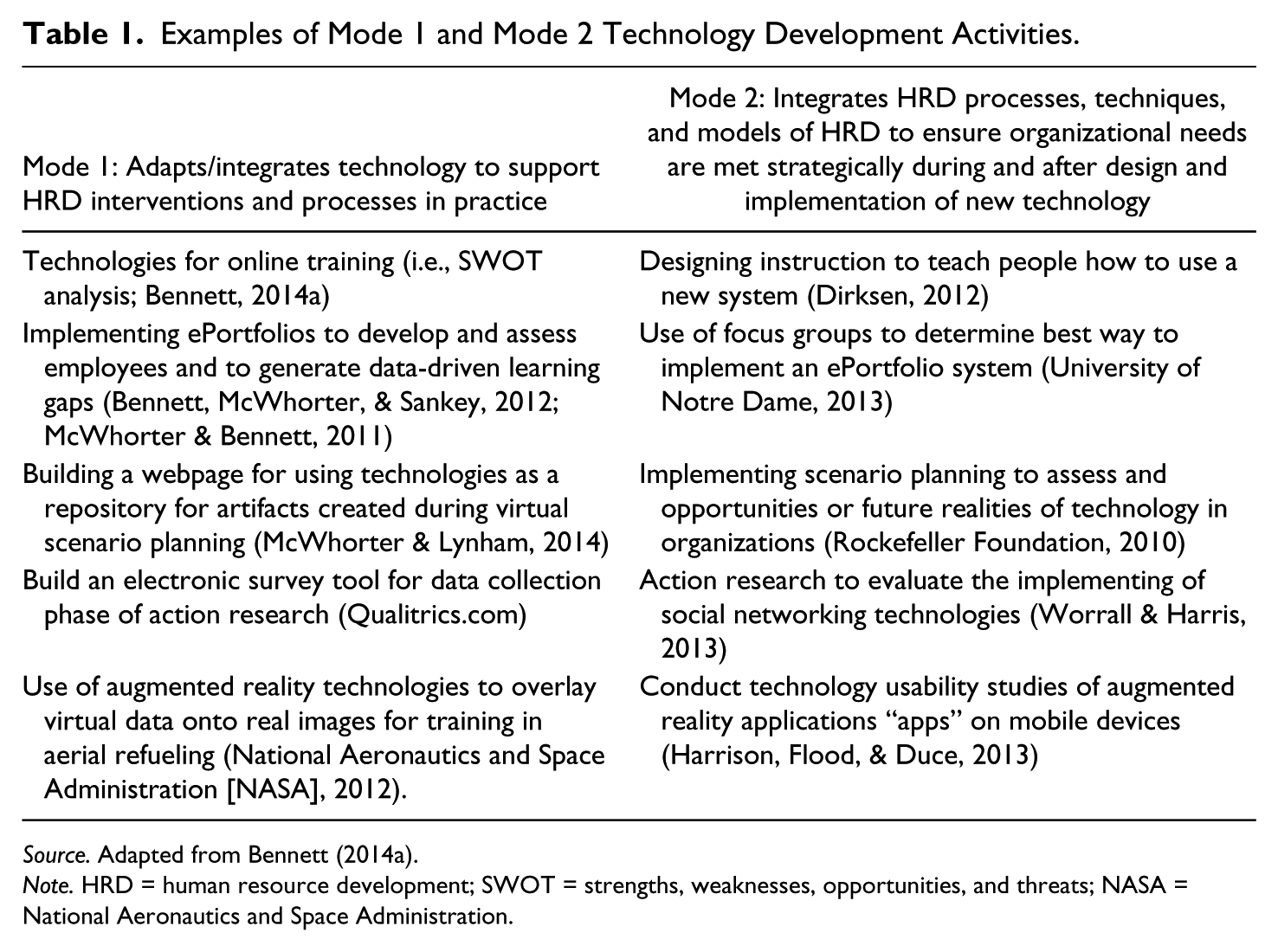
Source. Adapted from Bennett (2014a).
Note. HRD = human resource development; SWOT = strengths, weaknesses, opportunities, and threats; NASA = National Aeronautics and Space Administration.
Implications of TD for Research, Theory, and Practice
Because the implementation of technology can be very expensive, both in terms of resources and the morale of organizational members tasked with change and implementation (Bennett & McWhorter, in press; McWhorter & Bennett, 2014a), HRD professionals should be skilled in TD. The following list is not meant to be exhaustive but to direct HRD professionals to examine their individual skills and consider the benefits to their career management and value to an organization for acquiring additional skills that facilitate TD.
Skills Benefiting TD
Multi-tasking in hybrid training and hybrid events (Fazarro & McWhorter, 2011; Huggett, 2010)
Envisioning the end-product to aid in designing-in the needed features (Bennett, 2014a)
Envisioning “webbing in” (Bennett, 2014a) of technologies that can be integrated into the existing technology ecosystem of VHRD
Social media skills for professional branding (Deckers & Lacy, 2013; McWhorter, 2014)
Gamification skills for designing learning (Kapp, 2012)
Project management and project leadership skills (A. E. Ellinger & Ellinger, 2014; Gallagher, Kaiser, Simon, Beath, & Goles, 2010)
Visualizing the use of mediated information within technologically integrative environments for increasing learning capacity and optimizing work processes and organizational system performance (McWhorter, 2011; Monteiro et al., 2012)
Performing a usability study of technology (Boudreaux, 2012; Instructional Assessment Resources, 2007; National Center for Technology Innovation, 2011)
Use of change processes in the implementation of an enterprise resource planning (Martin & Huq, 2007) or electronic health records (HealthIT.gov, 2013, 2014)
Conducting a task analysis for technology tools (Bennett, 2013)
Database design/management (Gallagher et al., 2010)
Computer programming (Gallagher et al., 2010; Hein, 2013)
Instructional design (Bennett, 2014a)
System testing and operating systems (Gallagher et al., 2010)
Voice/data communications (Gallagher et al., 2010).
Final Thoughts
There are a number of ways to build TD skills in academic programs including course work, pairing of HRD students with IT or information systems (IS) students, and technology-related projects (see Bennett, 2014a). Other ways to develop TD skills include community-based projects such as the initiative enacted at a number of institutions called Service Learning. Typically in these cases, students give service hours in for-profit or nonprofit organizations in a number of areas, but the strategic pairing of them for technology-related projects to gain experiential learning while giving back to the community is helpful (Farazmand, Green, & Miller, 2010). Service Learning can also be useful for HRD professionals when partnering with nonprofits to share and develop their skill set for TD while lending a helping hand in needed areas.
This article has presented a synthesis of contributing authors’ treatment of a number of defining characteristics concerning VHRD. In addition, further discussion was provided to support the call by Bennett (2010, 2014a) to integrate TD into the work of HRD and has also provided a number of implications to consider.
Footnotes
Declaration of Conflicting Interests
The author(s) declared no potential conflicts of interest with respect to the research, authorship, and/or publication of this article.
Funding
The author(s) received no financial support for the research, authorship, and/or publication of this article.