







Abstract
The Problem
The connection between human resource development (HRD) and the practice of being an ally of social justice in the workplace seems worthy of meaningful dialogue, yet few publications have addressed this vital workplace need.
The Solution
The purpose of this article is to explore the importance of social justice allies’ critical perspectives regarding climates of inclusion in the workplace, and HRD’s role in facilitating the development of social justice allies. We envision the ally development process as cyclical, and we offer suggestions for HRD practitioners and organizations on how to foster environments of inclusion by allowing allies to grow and openly vocalize their convictions.
The Stakeholders
Viewing HRD as a mechanism for advancing and understanding the development of social justice allies in the workplace has the potential to impact both research and practice, for those deemed to possess privilege and for those deemed to be oppressed, and across many levels of hierarchy in organizations—from investors, to executives, to managers, to employees, and even to consumers/customers.
Where does change begin? What can we do to begin to create a more just society? The problems of oppression and social injustice run wide and deep, so wide and deep that they permeate most every context in which groups and individuals interact, including work. As a result, there are socially conscious people who work actively to do something about the injustices that they see around them. Recognizing that changes on the personal level are not enough, these groups work to make systemic changes. These people are known in the social justice arena as allies. Allies are friends of and advocates for minority and/or disempowered social groups that experience oppression based on markers such as race, ethnicity, sexual orientation, gender, religious affiliation, disabilities, age, and so forth. Typically, allies work to demonstrate “the tensions between dominant and subordinate identities (those privileged or disadvantaged on the basis of social group memberships)” (Adams et al., 2013, p. 2). Allies do so in an effort to support and encourage a change in the attitudes toward and treatment of marginalized groups (Brooks & Edwards, 2009; Hall, 2009). However, while social justice allies can embody criticality to question injustice and advance alternative viewpoints in organizations, marginalized groups may also ally for themselves and others, changing environments “from inside out” (Raeburn, 2004).
Our understanding of criticality is rooted in critical reflexivity (Cunliffe, 2004) in that we aim to dismantle the status quo by challenging individuals to consider their “cultural orientation, personal style, ethical framework, and prior experiences” (Brownell & Jameson, 2004, p. 559) alongside both informal and formal, widely accepted standards. Our approach to criticality involves, [examining] the assumption that decisions are justified solely on the basis of efficiency and profit, that there is one rational way of managing, that current managerial practice is paramount, and that as professionals we know what is best for others. (Cunliffe, 2004, p. 408)
This is arguably an especially important imperative, and even a historically missed opportunity, for the field of human resource development (HRD), which often aims to create work environments and implement strategies most conducive to individual productivity and engagement.
The basic position of the human resource function is between organizations and employees. Because of this, HRD professionals often aim not to favor the organization or the employee too heavily. Instead, human resource functions are generally balanced between the two. This makes HRD professionals especially viable candidates for promoting social justice at work and for encouraging others to do so as well, through employee-related policies, people-related strategies, and training and education. However, as a field, HRD has historically been less concerned with critical social justice perspectives than with organizational outcomes, though critical perspectives have been articulated and advanced by scholars. As Collins (2012) noted of some past dialogue in HRD, “Critical perspectives that are theorized but never acted upon ultimately may not create meaningful change” (p. 352). As individuals come to a critical level of recognition, realizing the nature of oppression, they can then understand their role in promoting liberation from social injustices.
Given that workplaces exist for organizational objectives, such as creating shareholder value and maximizing profits, we recognize that for HRD practitioners there may be a disconnect between supporting and implementing such objectives while also maintaining a social justice perspective. To assume that there is an intuitive connection between social justice and the workplace is misguided. There are some employment laws and regulations to which organizations are bound, but these do not protect everyone, and even if they did, social justice is not their mandate but rather compliance. As a field that frequently is concerned with developing individuals and organizations, HRD might be more appropriately focused on being less compliance-based and more oriented toward social justice and inclusion. Therefore, we emphasize an approach to social justice at work that promotes “power with” HRD professionals, as opposed to “power over” (Kreisberg, 1992, as cited in Adams, Bell, & Griffin, 2007). To frame this perspective, we adopt the following definition for social justice: The goal of social justice is full and equal participation of all groups in a society that is mutually shaped to meet their needs. Social justice includes a vision of society in which the distribution of resources is equitable and all members are physically and psychologically secure . . . Social justice involves social actors who have a sense of their own agency as well as a sense of social responsibility toward and with others, their society, and the broader world in which we live . . . The process for attaining the goal of social justice, we believe, should also be democratic and participatory, inclusive and affirming of human agency and capacities for working collaboratively to create change. (Adams et al., 2007, pp. 1-2)
The work of social justice allies is critically important in the workplace, where individuals from many different walks of life and backgrounds spend time together communicating and interacting. As proponents of “critical transformation” (Freire, 1970), social justice allies understand the importance of being comfortable around many different types of people and in a large variety of social settings, including work. Allies deal critically and creatively with the reality of their work situations advocating for safe, responsible, and socially conscious workplaces. Thus, the connection between HRD and the practice of being an ally may seem worthy of meaningful dialogue, and yet few publications have discussed this vital workplace need (i.e., Brooks & Edwards, 2009; Chrobot-Mason & Thomas, 2002; Collins, 2012; Githens, 2012; Schmidt, Githens, Rocco, & Kormanik, 2012). The purpose of this article is to explore the importance of social justice allies’ critical perspectives regarding climates of inclusion in the workplace and HRD’s role in facilitating the development of social justice allies. As HRD aims to promote responsibility as a part of career and individual development (Burke & Saks, 2009), the practice of being an ally seems a natural fit with the field.
Our Stories
Although social justice allies may find work to be one outlet for effective advocacy, often the reasons they have for becoming allies come from outside of work, with some moment, event, or person inspiring thoughtful and intentional transformation. The following are two stories that illustrate the authors’ inspiration and explanation for how and why they became social justice allies. These true stories illustrate the complexities and challenges of becoming an ally and set the tone for the remainder of this article.
Joshua’s Story
When I was 17 years old—a senior at a small, private, majority-White, Christian high school in Texas—something happened outside a grocery store that would change the course of my life. As I exited the store and walked back to my car, I heard a voice. “Hey! Hey you, hold on!” “Sir, please wait!” “Let me ask you a question!” I say I heard a voice—it’s more like I recognized a sound . . . I heard nothing. The voice’s attempts to get my attention continued for my entire walk across the parking lot, but I unknowingly chose to ignore the voice. As I got back to my car and opened my door, I turned back to notice that the voice was now directed at someone else, someone who was more responsive than I was. I also noticed to whom the voice belonged. She was an older Black woman with a small child, and all she wanted to know was where she could find a pay phone. Her car had broken down. Why did I ignore her, I thought to myself. She was trying to get my attention this whole time. I did not see her. I had noticed her on my way into the store, but I only saw what my unrecognized and unchecked White middle-class privilege allowed me to see: the worn state of her clothes and the color of her skin. I had been conditioned to do so because everything I ever knew was a product of White, middle-class people—people who were not and are not inherently racist or classist but also were not aware of their own daily microaggressions toward the working class or people of color.
Of course, at the time, I did not know the word “microaggression,” and I certainly did not know what it meant or that I had just committed one. I knew words like “privilege,” “oppression,” and “marginalization,” but I had assumed that people in America could not experience them. Those were words for other places. Regardless of my (in)ability to articulate at the time how I felt, I did know that what had happened in that parking lot was not okay. Not yet able to be “out” as gay myself because of the conservative, Christian background of my family and close social circles at the time, I knew that I understood, at least in some small way, what it felt like to be dismissed for who I was. And I decided at that moment, in that parking lot, that I could do better.
Dominique’s Story
The correctional officer (CO) is standing too close to my table. It’s making me more nervous than usual, and the women have noticed as my voice cracks. After he moves away, a student-inmate volunteers, “He’s watching us. Looking to make trouble.” I notice the subtle wording, not looking for trouble but looking to make it. My student explains, “We are the ones they don’t know what to do with.” I don’t say anything, but my facial expression poses a question. She continues, “The education classes are scheduled during the visiting hours. This is their way to watch those of us who aren’t in with the visitors.” I glance in the direction of the CO and realize this isn’t about educational opportunities: It’s about surveillance and controlling these women’s time.
I was barely 22 years old the first time I taught in a women’s correctional facility. It was through this experience that I was granted the opportunity to dissect and understand my own privileges, such as my freedom to come and go, my racial and class privilege (White Jamaican citizen, upper-middle class, legally residing in the United States), and my levels of educational attainment (at the time, I was a graduate student working on my first master’s degree). Teaching on the “inside” allowed me to think creatively, critically, and reflectively about what it meant to collude with oppressive systems. It spurned me to use my power to actively fight against systems of oppression.
Intellectually, I had begun this work as an undergraduate participating in ally workshops, diversity trainings, and witnessing active protests on my own University campus (students took over the administration building during my first semester at Columbia University to protest the demolition of the Audubon Ballroom, the site where Malcolm X was assassinated in 1965). Yet it was when I worked within the complex world of prison education that I began the hard work to understand the jarring, harsh, compelling, and oppressive issues surrounding social injustices. It was within the walls of a women’s jail that I heard a clarion call saying, “Do something for others.”
Criticality and the Importance of Social Justice Allies at Work
Criticality as an HRD practice might involve thinking judiciously, perceptively, and creatively about work structures, activities, and outcomes that may influence learning (Harrison, 2006), including the learning that takes place in allies’ lives. Callahan (2013) asked some important questions regarding this kind of thinking in HRD: How are we being creative with the ways we think about our practice, our teaching, and our research? Is our discourse reinventing the dominant power structures, or are we challenging those structures and questioning who we are serving as we train individuals to become more creative? (p. 388)
Because dominant power structures can be challenging to overcome, being an ally is a difficult and complex role that is dependent on era and context (Evans & Washington, 2010). The importance and purpose of social justice allies at work may be summarized in the articulation of three primary objectives: (a) to create and sustain acceptance and growth among colleagues, (b) to increase understanding of the issues facing those who experience oppression and to encourage everyday activism among allies, and (c) to help create new perspectives. Each of these objectives will be discussed in the sections that follow.
Creating and Sustaining Acceptance and Growth
In the workplace, social justice allies often serve as the vital link between dominant groups and “others,” advocating for the causes of the disenfranchised, disempowered, targeted, and/or oppressed groups to build socially just workplace communities. One of the primary objectives of any good ally would be to construct spaces and opportunities for supportive, educative dialogues designed to educate individuals about differences regarding power and privilege, build coalitions around common causes, and create empathy (Collins, 2013). Most often, these opportunities manifest in honest conversations about personal beliefs or convictions and by actively engaging individuals when they speak or act in a way that is intolerant or simply uninformed (Agosto, 2010). For example, a mindful ally might question, in an unthreatening way, a person’s use of privileged language—such as giving impolite commands or making demands of colleagues and subordinates. The recipient may interpret such commands and demands as microaggressions, and such comments can foster an environment of contempt. As a function of HRD, opportunities for creating and sustaining acceptance and growth can and will also happen within allies themselves, as even the most vocal or supportive ally may discover previously unknown or unrecognized prejudices. This is a natural part of the development and learning process. Social justice allies should ideally be acutely aware of their own biases when they surface and be equally as open and honest in discussing injustices in their own way of thinking as they are discussing others’ biases.
Increasing Understanding of Social Justice Issues by Encouraging Everyday Activism
At work, allies can make it their imperative to increase understanding about all social justice issues and not only those they may feel a personal connection toward. Any of us could find that we are not a part of the dominant group at a point in time, in one way or another. Increasing understanding of social justice issues by encouraging everyday activism might be one way to continue to expand one’s depth of understanding regarding privilege and oppression of many kinds, perhaps even through carefully planned and executed HRD training and development or other related interventions. Everyday activism (Vivienne, 2011) can be something as small as updating one’s Facebook status with information regarding an injustice or an important law affecting a group of people. Everyday activism can be grander in its scope, too—something as big as encouraging others to wear purple to work on Transgender Remembrance Day. Such acts can go a long way in helping to increase not only one’s own understanding of the issues, but others’ as well. The idea that even disempowered groups can find power in being active allies is a potent one because it creates connections that strengthen targeted people and allies, weaken oppression, and increase the shared experience of justice (hooks, 2000).
Helping to Create New Perspectives
As social justice allies at work look to help create new perspectives regarding the issues they discover, an emphasis is likely to be placed on learning. As a complementary field to HRD, adult education has a much longer history of stressing opportunities for critical learning related to social justice. Still, HRD and adult education share important similarities like “believing that learning is a vital component of almost everything we do, and desiring to provide quality adult learning experiences” (Reio, 2013, p. 4). Adult education scholars Merriam, Caffarella, and Baumgartner (2007) asserted that we should seek to “broaden our understanding of learning and knowing” (p. 173), which includes expanding and building upon our worldviews in an effort to create new perspectives. They argued, “questioning and critiquing taken-for-granted worldviews, structures, and institutions of society are the first steps in changing oppressive and nonemancipatory practices” (Merriam et al., 2007, p. 241). In an HRD context, nonemancipatory practices might include saying that sexism does not exist in the workforce or a particular organization, not granting workers paid leave for religious holidays, or remaining hesitant to draft inclusive sexual orientation and/or gender identity policies because it is assumed or perceived no lesbian, gay, bisexual, or transgender (LGBT) people work within the organization. It seems reasonable to assert that one of the first and most important steps social justice allies can take is to encourage new perspectives in word, action, and thought.
Understanding Ally Development
As noted by Collins (2012), Bishop (2002) presented six steps for ally development that seem particularly relevant to the field of HRD, because “human resource developers are in a different position than management in most organizations—they often have more immediate formal commitment to worker well-being and their interests are not directly tied to preserving control or current hierarchical relations” (Fenwick, 2005, p. 230). This positions HRD professionals who are aware of oppressive and power-granting structures as potentially great agents of change. Thus, the first step (recognize that oppression exists and seek to understand it) involves allies intentionally breaking down their own assumptions and learning about why those assumptions exist in the first place (Bishop, 2002). In this step, an ally might begin to think of a concept they once thought they understood more critically. For example, when parents of an LGBT youth kick their child out of the home for being LGBT, might that technically qualify as domestic violence or abuse? How does homophobia and heterosexism affect families, children, individual development, and by transference how individuals live and work?
The second step (recognize that oppressions intersect) involves learning to see people as more than just one thing (Bishop, 2002). For example, while all women may have some shared experiences with marginalization and oppression that stems from patriarchy and chauvinism, Black women often encounter additional oppressions that stem from racism and ethnocentrism. Women with disabilities also have additional, but different struggles, as do women who are lesbians or aging or do not practice the dominant religion of their social/work context. An individual who operates with a critical ally lens does not assume that any one of these women has it “worse” or “better” than any other, nor would a critical ally assume that two women with similar ability, racial, religious, or sexual identities will have the same experience. As a way to think about building a workplace community that supports the mission of HR, all the while seeing people as more than just one thing, allies may ask themselves, “What conditions make me most able to work well in partnership with other people? What makes me feel connected rather than alienated?” (Pharr, 2013, p. 598).
The third step (deal with guilt associated with privileged identity) involves becoming comfortable enough with one’s own identity as a social justice ally that it is possible to move beyond feeling responsible for the fact that others have been and continue to be disempowered and targeted, and instead work to end such marginalization from a place of genuine understanding (Bishop, 2002). As an ally, it is sometimes easy to feel guilt because one has experienced privilege and realizes how she or he has acted as the oppressor or specifically colluded with an oppressive workplace system that has devalued equal pay and promotion practices for everyone without going to HR to report what he or she has witnessed. Moving beyond this sensation of guilt and channeling those feelings into productive and active change is a vital step in the ally development process. As Lorde (1984) reminds us, guilt when it leads to change is no longer guilt; instead, it is the beginning of knowledge.
The fourth step (understand personal areas of marginalization and work for change) involves allies’ awareness of times when they have been targeted for a part of who they are (Bishop, 2002). This is an important step for many allies because it centralizes the experience of oppression from being solely about “others” to also being about one’s self. For example, a single mother may realize her employer’s nonflexible work arrangement policies that privilege heteronormative couples make it impossible for her to attend her children’s school activities or take time off without using her own vacation days or sick leave time to take her ill child to the doctor. In this step, allies may also be likely to realize that different forms of oppression draw strength from one another and that the elimination of oppression would benefit everyone (hooks, 2000). As Johnson (2013) has noted, “Although disadvantaged groups take the brunt of the trouble, privileged groups are also affected by it, partly because misery visited on others come back to haunt those who benefit from it, especially in the form of defensives and fear” (p. 612). The lives of privileged groups are limited and narrowed in this way, so by eliminating oppression all groups stand to benefit.
The fifth step (be an ally) involves actively, creatively, and critically looking for ways to advocate for change, to reach out to those who need encouragement, and to change the hearts and minds of others through word and action. For instance, two or three allies may decide to go to their employer and HR to advocate for training and development designed to promote awareness and training around becoming an ally. In times when social justice allies can see the fruits of their labor, the process of being an ally can be an uplifting and rewarding experience. At other times, such as when allies’ viewpoints are openly demeaned or mocked, being an ally can be a challenge, which is why all of the steps outlined previously are inseparable from the sixth step (stay positive).
The sixth step in Bishop’s (2002) model for ally development involves looking past the difficult experiences sometimes associated with being an ally and focusing on the positive. Bishop’s model maintains the view that being positive about the future of allies’ roles/impact is vital to promoting change. Sometimes, it can be dangerous or difficult to be “out” as a social justice ally. In these times, it is important for those who can be outspoken and proud in their role to raise their voices for others. As West (2013) articulated, “It takes courage to cut against the grain and become nonconformist. It takes courage to wake up and stay awake instead of engaging in complacent slumber. It takes courage to shatter conformity and cowardice” (p. 625).
Ally Development as a Cyclical Process: Implications for HRD
One critique of Bishop’s (2002) model for ally development is that many allies do not progress through the “steps” in sequence. Taking Bishop’s steps into account, we envision ally development in HRD as a cyclical process (Figure 1). Our conceptualization of ally development as a cyclical process is consistent with prior HRD research by Kormanik (2002), in which it was proposed that diversity initiatives in organizations may result in distributed results (i.e., individuals at different stages of awareness) en route to organizational change. In the cyclical process we describe, we argue individuals are often spurred to become allies by some initial motivation and/or awareness and are strengthened by criticality. After the initial motivation, allies move through a continual process of acknowledging privilege and oppression, acknowledging “-ism” thinking (i.e., racism, sexism, ableism, heterosexism), deciphering personal commitment to advocacy, being an ally and telling others, recognizing areas of (dis)comfort with the ally role, assessing environments and facing discomfort(s), and advocating for change and seeking additional education. In the sections that follow, we will explore each of these processes, their impact on both allies and those for whom they advocate, and the implications for HRD.
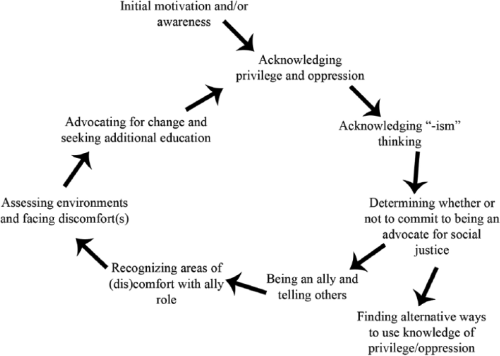
Criticality in practice: The cyclical process of ally development.
Initial Motivation and/or Awareness
Social justice allies are often motivated into action and awareness by specific events such as witnessing an injustice or learning of a close friend or relative who identifies with one or more minority, disempowered groups (hooks, 2000). This initial motivation or awareness is what puts many allies on a path toward ally development and directs them to start (or continue) paying attention to the words, feelings, and experiences of others. Harro (2013) described this stage as the “waking up” phase in her cycle of liberation model, a model that combines theory, analysis, and practical experience in an effort to describe the cyclical process that occurs in social change efforts that lead to some degree of liberation from oppression (p. 619). Such motivating events can make the experience intensely personal, to the point where some allies feel that when targeted groups experience discrimination or injustice, they too as an ally experience it. Becoming aware in this way often works to build and encourage empathy, as well as break the silence. Thus, when growing as a social justice ally and an HRD professional, an important aspect of development is the continual acknowledgment of privilege and oppression, both within the self and in others, to better individuals’ lived experiences and the climate of organizations.
Acknowledging Privilege and Oppression
At work, acknowledging privilege and oppression may affect many outcomes and constructs of interest to HRD, including employee engagement, leadership, talent management, and others (Shuck, Collins, Diaz, & Rocco, 2014). An acknowledgment of privilege and oppression at work could influence change in how individuals are permitted to approach their work, who is hired and promoted, and ultimately how business is conducted. A major component of becoming the “authentic self” (Merriam et al., 2007, p. 201), as an ally, is to share openly with the world stories and experiences of both privilege and oppression. As an ally, it is not only okay but also encouraged to be vocal about one’s positionality and to acknowledge the positionalities of others, effectively communicating across differences.
Acknowledging “-ism” Thinking
Along with acknowledging privilege and oppression as an ally is acknowledging “-ism” thinking—or stereotypes and discriminatory beliefs that lead individuals to thoughts, words, and actions rooted in racism, heterosexism, sexism, ethnocentrism, and so forth. For many allies, this can be difficult because it means opening one’s self up to realities surrounding personal prejudices and taking responsibility for social change. Joshua (first author of this article) recalls an experience with acknowledging such thinking when he attended a work-related training seminar on immigration, in which he learned about some of the experiences of children of immigrants (both documented and undocumented) and was forced to confront many of his own assumptions about immigrants’ reasons for moving, work ethic, and loyalties. This experience set him on a path toward broadening his social justice advocacy to include immigration reform, with particular focus on the rights of children of immigrants. It also called into question many of his ethnocentric beliefs he had not previously known even existed within him. Allies “at work,” both in a metaphorical and literal sense, must take responsibility for their own prejudiced and uninformed assumptions.
Determining Whether or Not to Commit to Being an Advocate for Social Justice
Organizations provide a compelling context for allies to foster and encourage change because organizations often bring together a wide diversity of people (Qin, Muenjohn, & Chhetri, 2013), direct them toward a (or many) common goal(s) (Williams, 2002), and maintain internal structures of hierarchy and power that may or may not mirror external, societal structures (Montesino, 2002). Each of these aspects of organizational behavior should be an important part of socially just HRD practice and scholarship. As social justice allies develop, they must constantly assess whether or not being an ally and an advocate for change is something they can truly commit to, given these factors are prevalent in many organizations. Being an ally can be tough, especially when allies are targeted simply for being aligned or associated with a specific group of people. Being a critical and outspoken ally is not a role that every person will be ready to fulfill because it involves rejecting the standards of others and setting one’s own. However, we advocate that even those who perceive they cannot fully commit to their role as an ally, being aware of privilege, oppression, and “-ism” thinking, are still responsible for finding alternative ways to use their knowledge.
Being an Ally and Telling Others
According to Usher, Bryant, and Johnston (1997), being open and engaging in public confessions of previously held private information is an important part of the learning process. For social justice allies at work, a part of this process involves actively seeking opportunities not only to be an ally and advocate for change but also to tell others about the roles, convictions, and attitudes one holds as an ally. Allies continually think critically about their situations, refusing to conform. Allies have participated in such efforts as the “It Gets Better Project” by creating videos telling young LGBT people that there are compassionate and understanding adults in the world who will support and fight for their rights (It Gets Better Project, n.d.). The process of telling others might also help in identifying areas of (dis)comfort around being an ally, as talking openly about being an ally can be challenging.
Recognizing Areas of (Dis)Comfort With Ally Role
HRD can help build change by creating systems and policies that make it possible for allies and others to speak and think freely about organizational practices and structures. For example, Pharr (1988) argued that to understand the connection among the oppressions, we must be able to examine common elements. She wrote, Once economic control is in the hands of the few, all others can be controlled through limiting access to resources, limiting mobility, limiting employment options. People are pitted against one another through the perpetuation of the myth of scarcity which suggests that our resources are limited and blames the poor for using up too much of what little there is to go around . . .. (p. 54)
Imagine HRD working to create change so that allies could openly speak about the injustices when economic control is in the hands of a few.
Assessing Environments and Facing Discomfort(s)
The use of “I” terminology can help allies to iterate their own experiences and to question new or uncomfortable aspects of advocacy. For example, “I feel that being too outspoken an ally in the workplace is dangerous for me and it makes me uncomfortable sometimes.” Being able to express how you are feeling as an ally without fear that your views will be assumed to be the views of all other allies can be comforting. For instance, Erikson (1970), the psychoanalytic theorist who coined the term identity crisis, acknowledged the complexity of identity development, one shaped by individual characteristics, sociohistorical factors, political contexts, family dynamics, and social identities. Recognizing (dis)comfort in the ally role allows allies to speak more freely, ask better questions, and find out what targeted group members need and want. Facing discomforts does not necessarily mean that allies need to get over their fears of public speaking or participating in other acts as an ally. Facing discomfort merely means that allies recognize aspects of being an ally that make them uncomfortable and think about them critically and in dialogue with other allies if possible. There may be instances when allies who do not like speaking in public are the only allies around and must do so to stand with the minority group(s) they seek to help. Being aware of discomfort and facing it will make standing up in these instances easier.
Advocating for Change and Seeking Additional Education
A crucial aspect of advocating for change is courageously and consciously seeking out additional education and looking to make employee-initiated changes (Githens, 2012). This is perhaps the best way for HRD practitioners to encourage productive change in organizations while also considering more traditional objectives such as productivity or profits. Employee-initiated changes can help to direct organizations to listen to the diverse and varied voices of those in the organization and to reassess policies and practices in relation to their needs. This step is also the place to help develop others; after all, is that not one of the main purposes of HRD—developing employees? Likewise, the model proposed in this article can certainly be applied at the individual level, but it could also be used to involve others in the process of ally development.
Additional education would preferably be sought through a variety of means, as to inform change at multiple complementary levels. In this process, a social justice ally would be aware of and knowledgeable about many approaches to how to discuss with others the issues disempowered groups face. This might be especially useful in the process of developing, shaping, and implementing more wholly inclusive policies, such as nondiscrimination clauses or recruiting initiatives. HRD professionals, seeking specific examples and activities, can draw from the formal educational work done with HRD graduate programs, which highlights recommendations for teaching about race (Alfred & Chlup, 2010). Education can also be “nonformal,” bridging previous knowledge with the idea of what it means to be an ally (Merriam et al., 2007, p. 30). It can also be supplementary, focusing on topics that typically do not get discussed frequently within organizations, and issues such as the barriers faced by transgender individuals in the workplace or individuals who do not possess documented immigration status.
Implications for Practice: What Can Organizations Do?
We began this article by asking, “Where does change begin? What can we do to begin to create a more just society?” In this section, we detail some of the implications for practice both within the scope of societal change and the specific practice of HRD within organizations to provide some possible solutions to address the important question, “What can organizations do?” We will discuss these solutions in relation to two goals HRD professionals might set and encourage among others: (a) foster positive social justice attitudes and (b) decipher appropriate action steps.
Foster Positive Social Justice Attitudes
Viewing HRD as a mechanism for fostering the development of social justice allies in the workplace has the potential to affect both research and practice, for those deemed to possess privilege and for those deemed to be oppressed, and different stakeholders in organizations—from investors, to executives, to managers, to employees, and even to consumers/customers. Drawing from Johnson (2013), we present scenarios of what each HRD stakeholder can do in practice. For example, in the process of fostering a more socially just environment, investors can choose not to support businesses that engage in unfair labor practices, including union busting. Executives can pledge a portion of the organization’s proceeds to benefit lower-, working-, and lower-middle-class employees as a way to oppose the increasing concentration of wealth and power in the United States. Managers can become aware of how class divisions within social systems can result in the oppression of staff members (e.g., Are all employees paid a living wage or just some of the employees?). Employees can ask for organizational development, training and development, and career development that promotes awareness around issues of privilege and oppression. Consumers/customers can choose which businesses to support (e.g., not supporting businesses that practice inhumane treatment of their workers or use slave labor or not supporting businesses that are inaccessible to people with disabilities and sharing with the businesses the reasons for not buying from them). By openly choosing and modeling different paths (Johnson, 2013), HRD stakeholders can take responsibility free from guilt and blame and begin to constructively, creatively, and critically make change happen.
It is possible to carry out the practices of being an ally at work while supporting the organization’s needs and objectives. For instance, allies at work may ask, “How do privilege and oppression operate in one’s life and in the lives of others? How does privilege and oppression affect one’s experiences working at this organization?” For example, White heterosexual allies can acknowledge the privilege associated with their identities as a way of demonstrating consideration of the experiences of people who are not White or are not heterosexual. Carbado (2013) argued that one way “to contest gender and sexual orientation hierarchy is for heterosexual men to detail their social experiences on the privileged side of gender and sexual orientation” (p. 397). Similarly, Black heterosexual allies can acknowledge the privileges associated with their heterosexual identity while still being vocal about oppression based on race. As an ally, being open about who you are and what you have experienced is a vital part of establishing a reliable and trustworthy perspective to foster growth in others, setting the stage for even more tangible action steps.
Decipher Appropriate Action Steps
In the process of identifying and implementing action steps for social justice, workplace allies should first aim to be vocal about their beliefs in whatever ways are possible for them. As allies and as HRD professionals, individuals must also think about how their voices may affect their employment or how others treat them, and they must be constantly aware of how far they are willing to go in speaking out against injustices. However, a critical aspect of being an ally is doing the right thing quite simply because it is the right thing to do, regardless of other factors, which can cause discomfort for many HRD professionals who must also consider organizational objectives and mandates. “Doing the right thing” can be advanced every day as the most important of all action steps, simply by choosing not to be associated with people who actively and purposefully target others and by putting forth a disposition that makes others feel comfortable and accepted despite differences in identity or beliefs.
However, in practice, it is equally important for allies to recognize areas of comfort and discomfort in the ally role. Areas of comfort may be leveraged as strengths, things that allies know they can do and say with confidence while advocating for targeted groups. For example, some allies may be exceptionally good at and comfortable with public speaking, whereas others may not be. Knowing as an ally what you are comfortable with can go a long way in helping you establish your perspective and practice the act of being vocal in your organizational setting. Similarly, it is important for allies to know what aspects of being an ally make them uncomfortable or even angry. Can you speak up in HR meetings, question an unjust policy, call attention to privilege or oppression, or ask your employer the hard questions all the while balancing the organizational objectives of the company? There is no one right way to be an ally. Discomfort in the ally role provides opportunity for learning and development, and anger can often be transformed into powerful and respectful change.
Thus, it is important for HRD professionals to engage in the “hard conversations” to develop action steps that work for both individuals and the organization. Ash Beckham, in her 2013 TEDXBoulder talk, stated that we all have closets and not just in the traditional sense of the closet for LGBT people. According to Beckham (2013), All the closet is, is a hard conversation. And although our topics may vary tremendously, the experience of being in and coming out of the closet is universal. It is scary, and we hate it, and it needs to be done. (Online transcript, http://www.youtube.com/watch?v=kSR4xuU07sc)
Allies learn to break the silence despite obstacles like “closets.” For “closets” exist within our organizations, and as HRD professionals, we need to risk opening the closet doors.
Conclusion
In the end, allies help to create socially conscious workplaces to the benefit of everyone. Ally development allows us to have the opportunity to learn from our colleagues and to increase the capacity we have to work and operate in safe and just work environments. By transforming our organizations into supportive, educative, socially just workspaces, we are actively promoting change in how our systems are organized around privilege. It takes courage to take a risk, speak out, and call attention to privilege and oppression, yet allies choose to take on this responsibility. Taking responsibility does not have to involve guilt, shame, or blame. Rather it means simply acknowledging our social obligations and advocating, as good friends do, constructive ways to act on our obligation to one another. This mentality undoubtedly has the potential to move the field of HRD forward in many important ways, creating and sustaining a culture of criticality, social justice, and equality among students, practitioners, and scholars.
Footnotes
Declaration of Conflicting Interests
The authors declared no potential conflicts of interest with respect to the research, authorship, and/or publication of this article.
Funding
The authors received no financial support for the research, authorship, and/or publication of this article.