







Abstract
The Problem
Very little research has examined the current state of human resource development (HRD) education in the United Kingdom, or the factors influencing its genesis and development.
The Solution
We analyze historical and contemporary factors influencing HRD education in the United Kingdom, identify different levels and providers of HRD qualifications, and outline curriculum content of HRD programs. Our aim is to clarify the current situation, by proposing a tripartite model of stakeholders in HRD education based on the United Kingdom but which might assist in the analysis of HRD education in other geographic areas.
The Stakeholders
HRD education in the United Kingdom is largely influenced by three key stakeholders: the U.K. government, the Chartered Institute of Personnel and Development (the professional body for human resources), and the academy. Our analysis reveals complex and dynamic interactions between these stakeholders, which have implications for them as well as learners, practitioners, and researchers.
This article addresses the question, “How and why have HRD programs around the world come into being?” (Zachmeier & Cho, 2014) from a U.K. perspective. Education of human resource development (HRD) professionals in the United Kingdom has seen many changes over the last century or so, yet there has been limited analysis of this. HRD education has been reviewed across Europe (Walton, 1997) and globally (Zachmeier & Cho, 2014) and compared between the United Kingdom and the United States (Kuchinke, 2003), but there has been little focus on factors influencing changes in the United Kingdom. The genesis and changes in HRD education have been initiated by central government policies, by professional bodies, and by the research and curriculum development work of academic staff in universities (Stewart & Sambrook, 2012). Based on Stewart and Sambrook’s (2012) research, it is reasonable to conclude that these three “players” of government, professional bodies, and academics have shaped the curriculum development and approaches to learning adopted in education programs for HRD professionals. So, we can say that the current programs have emerged through a complex and dynamic process of interactions between a tripartite model of players. One player or set of players, not included in this model, is that of employers and/or their representative bodies. This is a deliberate although arguable exclusion. It is also possible to argue that an additional player is that of trades unions. However, while acknowledging a role in education policy for these two stakeholders and recognizing, for example, that professional bodies, including the Chartered Institute of Personnel and Development (CIPD), commonly and actively consult employers, our view is that employers and trade unions exert a less direct influence than the three players examined here. The purpose of this article therefore is threefold: (a) to outline the historic and ongoing influence of the three players; (b) to describe the current structure of HRD programs, quantifying their number, level, and form; and (c) to consider the future of HRD education in the United Kingdom. Together, this provides a comprehensive review and explanation of the state of HRD education in the United Kingdom. We also propose that the tripartite model can potentially be used to analyze HRD education in other geographic areas. We begin with a brief outline of the role of the key players.
HRD Education in the United Kingdom: Three Key Players
We contend three key “supply” stakeholders, individually and through a process of interactions, shape HRD education in the United Kingdom (see Figure 1). First, we outline the role of the three players: the government, professional bodies, and HRD academics. Then we discuss how the complex and dynamic interactions include the political and philosophical orientation of the prevailing government, which in turn shapes both the presence and influence of professional bodies and the prominence of HRD teaching and research within the U.K. academy, both of which influence each other and lobby governments for perceived required changes and direction in HRD policy. Finally, we suggest this tripartite model of players might have a similar structure and influence on the development of HRD education in other countries, although the precise nature will depend on the political persuasions and historical legacies of successive governments, the existence or not of (potentially competing) professional practitioner bodies, and the status of HRD in universities. We now outline the role of the three players, beginning with the U.K. government.
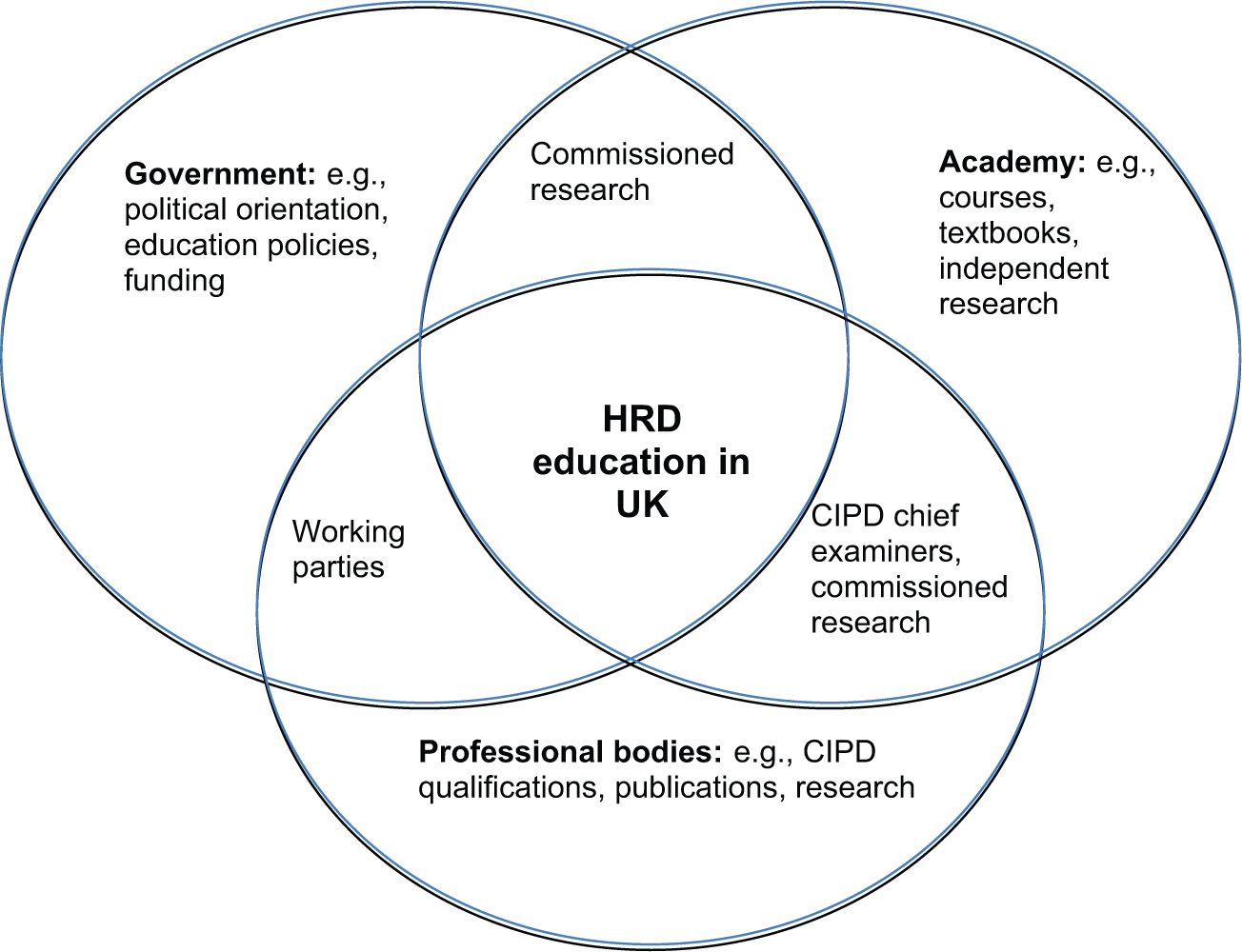
Tripartite model of three key “supply” stakeholders in HRD education in the United Kingdom.
Government
As well as having an influence on national economic conditions shaping demand and supply in the labor market, governments also implement policies of more direct relevance to education depending on their political and philosophical orientation, for example, whether interventionist or not (see Lee, 2004 for a review). Such policies are variously referred to as National HRD (NHRD) and Vocational Education and Training (VET; Stewart & Rigg, 2011), although NHRD (McLean, 2004; McLean & McLean, 2001) as a concept is less conspicuous in the United Kingdom (Lee, 2004) than, for example, Asia or New Zealand (McLean, Bartlett, & Cho, 2003). Government policies affect HRD education in three ways. First, government directly influences specific qualifications for HRD professionals and funds academics to explore the relationships between different types of HRD provision (Walton, McGoldrick, Moon, & Sambrook, 1995). Second, policies influence all qualifications and thus include those for HRD professionals, for example, the introduction in the United Kingdom of the current Qualifications and Credit Framework (QCF) and the Framework for Higher Education Qualifications (FHEQ). The QCF standardizes all qualifications into eight levels with Level 1 being basic school leaving qualifications and Level 8 being doctorate level. The FHEQ is concerned with Level 4 and above in the QCF. Level 4 is the defining point of higher education (HE) awards. All qualifications offered in the United Kingdom can be approved as fitting into one of the eight levels of and are also regulated by the QCF. There is some variation in Scotland, Wales, and Northern Ireland as constituent countries of the United Kingdom because of devolution of some legislative and government powers to those countries, but the principles are similar (see Ofqual, 2014). Third, curriculum content of qualifications for HRD professionals includes consideration of government policies. As well as understanding the historical role and impact of national HRD/VET policies, awareness of the current content of these policies is an important component of the knowledge base of HRD professionals. Comparative analyses of NHRD/VET policies in Europe (Walton, 1997) and around the world (Kuchinke, 2003; Zachmeier & Cho, 2014) are an additional important component of the curriculum in educating HRD professionals in the United Kingdom. Having briefly considered the historical and current effect of government, we now turn to professional bodies.
Professional Bodies
Employers and learners in the United Kingdom and elsewhere value qualifications, especially those at higher levels, which often include those awarded or accredited by professional bodies (Dearden, McIntosh, Myck, & Vignoles, 2000; Ridoutt, Selby Smith, Hummel, & Cheang, 2005). There are, of course, professions where such qualifications are an essential license to practice, for example and traditionally, in medicine, law, and accountancy. However, and perhaps partly because of this tradition, the value placed on professional accreditation extends to “quasi-professions” such as human resources (HR). In the United Kingdom, the relevant professional body is the CIPD. This body is the result of a merger of former bodies known as the Institute of Training and Development (ITD) and the Institute of Personnel Management (IPD). The award of a Royal Charter to the merged body of CIPD enhanced the standing of both professions (see Stewart & Sambrook, 2012 for a fuller discussion). This arguably affords the profession a stronger position from which to lobby government on issues relevant to HRD education. Both previous bodies had a history of awarding their own qualifications through programs delivered by education providers and accrediting alternative qualifications meeting their requirements and standards. This dual approach continues with the CIPD. Therefore, the CIPD directly influences HRD education in the United Kingdom in, at least, three ways. First, it provides specific HRD qualifications. Second, it offers accreditation of other qualifications, delivered in universities, further education colleges, and private providers, as long as they comply with the body’s professional standards. These standards do change over time and thus require program re-design. Third, its research, policies, and publications influence and are often main components of HRD curriculum. In addition, the CIPD comments on and attempts to influence government policy and, similarly, the government invites the CIPD to represent the profession on working parties, thus demonstrating some of the complex interactions between these stakeholders (see CIPD, 2014 for recent and current examples). The CIPD also has a complex and dynamic relationship with academics and academic institutions, which we discuss next.
Academics and Academic Institutions
Academics working in U.K. universities influence curriculum content and approaches to learning for HRD professionals in three main ways. First, they design and provide a significant number of associated programs. In the United Kingdom, the majority of HRD education in universities is encompassed in programs with titles and content focused on Human Resource Management (HRM) provided within business schools (Sambrook, 2014; Sambrook & Stewart, 2010). This is in contrast to most of mainland Europe and the United States where HRD education tends to be in schools of education, or similar (Kuchinke, 2004, 2007). The location of programs in business schools is probably one reason for the incorporation of HRD within HRM. An additional reason is the merger of the professional bodies to create the CIPD. The former Institute of Training and Development (ITD) is commonly seen as the junior partner to the former Institute of Personnel Management (IPM) in that merger (Stewart & Sambrook, 2012). The ITD was certainly junior in numbers of members at the time of the merger, and this might reflect the apparent dominance of HRM in the curriculum (Sambrook & Stewart, 2010).
A second way academics influence HRD education is in roles performed by them for the CIPD, revealing another complex player interaction. For example, one of the present authors is the CIPD appointed Chief Examiner for Learning and Development. In that role, he authored much of the detailed curriculum content and assessment vehicles of many HRD-related modules making up current CIPD qualifications. Other academics contributed to the qualifications in their roles of CIPD chief or associate examiners by authoring other modules in both HRD- and HRM-related subjects. So, the CIPD relies on academics to provide research informed consultancy on qualification design. The third influence of academics is more indirect. Academics conduct research into HRD. This wider academic research is also used by those academics authoring CIPD modules. It is therefore reasonable to argue that academics have more influence on HRD education in the United Kingdom than any other constituency. However, this influence is shaped by complex interaction with the other two stakeholders. For example, there are tensions between academics not wishing to reinforce what many critical scholars perceive to be an overly managerialist orientation within the CIPD curriculum, policies, and publications (Lawless, Sambrook, Garavan, & Valentin, 2011; Lawless, Sambrook, & Stewart, 2012). In addition, government commissioned research tends to perpetuate this managerialist agenda (see, for example, Engage for Success, 2014; U.K. Government, 2011). Having reviewed the influence of the three key stakeholders, we now analyze the current structure of HRD qualifications in the United Kingdom.
HRD Qualifications in the United Kingdom: The Current Situation
In this section, we explain the categories of qualifications, consider the levels of qualifications, and describe the current content of HRD programs. This analysis reveals the important influence of both government policies and the CIPD, and provides a comprehensive insight into the current structure of HRD qualifications in the United Kingdom.
Categories of Qualifications
There are a number of ways of categorizing HRD qualifications in the United Kingdom. One way is to define them as associated with the CIPD or to be independent of the professional body. Given the high status and influence of the CIPD in the United Kingdom, this is a significant categorization, and we examine the associated qualifications first.
There are two ways of categorizing qualifications associated with the CIPD. The first are named by the CIPD as “CIPD-awarded” qualifications. This means that individuals successfully completing a program are awarded the CIPD’s own qualification, which has national and European recognition through the QCF and the European Qualifications Framework (EQF). Providing institutions will have been approved by the CIPD to deliver programs leading to CIPD qualifications. These institutions can be education providers in the U.K. national system or private companies. The second category is named by the CIPD as “CIPD-approved” qualifications. This means that individuals successfully completing a program are awarded the qualification of the institution where they studied. CIPD-approved qualification status is therefore only available to institutions that can award their own qualifications. To understand this requires a little explanation of the U.K. further education (FE) and HE system. There are three levels of institution in the system: first, FE colleges, then colleges of HE, and third universities (the latter two known collectively as higher education institutions or HEIs). FE colleges focus on post-compulsory but sub-degree vocational qualifications and generally do not have their own qualification awarding powers at or above the QCF Level 4. Some do have partnerships with HEIs, and so some FE colleges can and do award qualifications of an HEI. The HEIs provide first degree and above education and qualifications. CIPD considers submissions from institutions for approval of their programs and their qualification as meeting the CIPD requirements to support learners and the standards and content of the CIPD qualification. If approved, an institution then offers and provides its program leading to its own qualification but with the stamp of approval of the CIPD and recognition for individuals completing the program that they have met the requirements specified in the CIPD’s own qualifications. It is important to note that CIPD-awarded and CIPD-approved qualifications have exactly the same status in meeting all or part of the requirements for membership of CIPD, depending on the level of membership sought by an individual qualification holder.
The second category specified above, that is, CIPD independent, is a qualification that is neither CIPD awarded nor CIPD approved, and can be of two main types. The first is a National Vocational Qualification (NVQ) in HRD or related subject. This type of qualification has had a checkered history in U.K. NHRD/VET and is less commonly provided now than in the past (see Stewart & Sambrook, 2012). The main CIPD independent qualification provided now is a degree awarded by a HEI (mostly universities) or a partner FE college. The number of providers of CIPD independent qualifications appears to be much higher than those with CIPD-associated qualifications (see Tables 3 and 4 later). However, the data in Table 3 refers to HRM-related qualifications, and so the position in relation to HRD may be different (see later section). In addition, many programs in the United Kingdom, especially at postgraduate level, are aimed at overseas markets such as China and India where the CIPD “stamp” has little or no meaning or value. Thus, providers of these programs have no material interest in gaining CIPD-approved status.
Levels of Qualifications
An additional way of categorizing HRD qualifications in the United Kingdom is by educational level. This utilizes the QCF and FHEQ. As with the previous section, we will begin with CIPD-associated qualifications.
CIPD offers qualifications at three levels, which it names as foundation, intermediate, and advanced, as detailed in Table 1. Foundation level equates to Level 3 on the QCF, which is the same level as what is known as “A Level” in the United Kingdom. “A Levels” are advanced qualifications for school leavers, which require 2 additional years of schooling post the compulsory earliest leaving age (currently 16 years) and are the main entry requirement for university study. Intermediate level equates to the second year of a first/bachelor’s degree. Bachelor’s degrees in the United Kingdom are commonly 3 years in length, and study in the first year equates to Level 4 on the QCF and FHEQ, the second year to Level 5, and the final year to Level 6. So, the CIPD intermediate qualifications are comparable to the level studied by second-year undergraduates. CIPD advanced qualifications are placed at Level 7 on the QCF/FHEQ. This equates to postgraduate level. In U.K. universities, this implies a first degree as an entry requirement and a final award of a master’s degree. However, there are exceptions in most cases, because many universities accept alternatives to a first degree for entry, including work experience. This is an important factor for professionally orientated awards. Master’s degrees are also commonly organized into three phases in the United Kingdom, which allow exit with either a postgraduate certificate or postgraduate diploma, depending on the number of credits achieved. Many professionally associated programs are organized for CIPD professional recognition to be achieved at postgraduate diploma rather than full master’s degree award.
Aligning CIPD Qualification Levels Within the U.K. National Educational Framework.
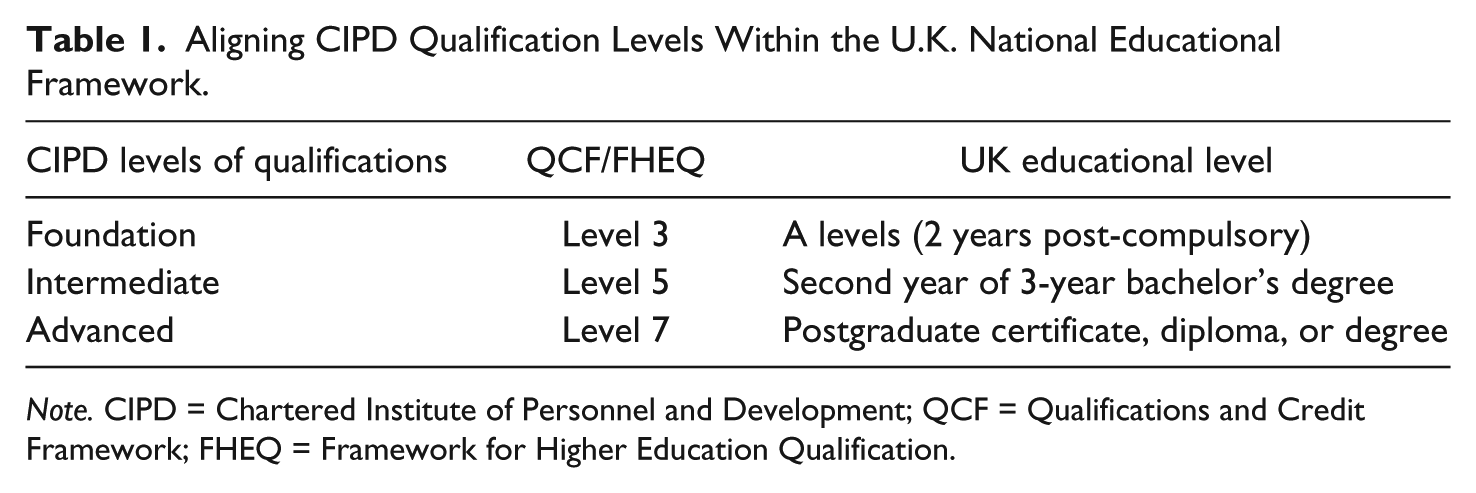
Note. CIPD = Chartered Institute of Personnel and Development; QCF = Qualifications and Credit Framework; FHEQ = Framework for Higher Education Qualification.
Three qualifications are available at each level for CIPD qualifications: an Award for achievement of a single module/unit, a Certificate for a specified minimum number of module/units making up a specified number of credits, and a Diploma, which is the highest qualification, awarded for the highest number of modules/units and associated credits in the CIPD qualification system. This arrangement reflects national policy as defined by the QCF and so, is an example of a direct influence of one player on another. CIPD-awarded qualifications are named as either HRM or HRD depending on which modules/units are achieved. We are concerned from this point with only intermediate- and advanced-level qualifications. In CIPD-awarded qualifications, each of those levels have a number of core modules/units that must be studied and a number of optional modules/units from which a combination is selected to make up the required number of credits. Each of those levels also has a Rules of Combination (ROC) specification that determines whether the qualification will be named HRM or HRD. As mentioned before, CIPD-approved qualifications are those awarded by institutions with awarding powers, where the institutions themselves name the award. For CIPD approval, they cannot name a CIPD-approved qualification with HRD in the title unless it meets the requirements of the CIPD ROC. CIPD-approved qualifications are commonly a postgraduate diploma or a master’s degree. CIPD independent qualifications are almost exclusively master’s degrees, usually with a name including HRM rather than HRD (see Sambrook & Stewart, 2010). Although rather complex, we believe it is essential to provide this context information to understand the current situation in relation to HRD programs in the United Kingdom.
Curriculum Content
We now examine the current situation in the United Kingdom regarding curriculum content, the quantity of HRD education provision, and prominent teaching and learning methods. We begin our review of the main curriculum content of U.K. HRD programs by detailing the CIPD specifications for their awarded qualifications. Given the influence of U.K. academics on those specifications and the fact that institutions providing CIPD-approved qualifications have to demonstrate that their own programs and qualifications match these specifications, we argue that the CIPD specifications represent the main content studied by HRD professionals in the United Kingdom. Therefore, Table 2 details the specifications for CIPD intermediate and advanced levels in HRD. In U.K. HEIs, the intermediate level forms part of a bachelor’s degree, and the advanced level forms part or the whole of postgraduate diplomas or full master’s degrees. It can be usefully noted that the ROC applied by the CIPD mean that qualifications named HRM must contain some modules/units based on HRD subjects, such as “Contemporary Developments in Human Resource Development” at Level 5 and “Leadership and Management Development” at Level 7. This means that HR professionals in the United Kingdom graduating with HRM qualifications have to study elements of HRD theory and practice. Thus, the number of qualifications named as HRD is not the sole or exclusive indicator of HRD education provision. The converse is also worth noting; individuals graduating with named awards in HRD have also studied elements of HRM. Although qualifications at CIPD certificate level are available, we have excluded those specifications for two reasons. First, they are comprised of the same modules/units, and the difference between certificate and diploma is a simple one of quantity of credits achieved. Second, although both certificate and diploma qualifications at both intermediate and advanced levels achieve Associate membership of the CIPD, it is only diploma level at advanced level that provides evidence of the required knowledge that forms part of the criteria for full Chartered membership of the CIPD.
CIPD Intermediate and Advanced Diplomas in HRD.
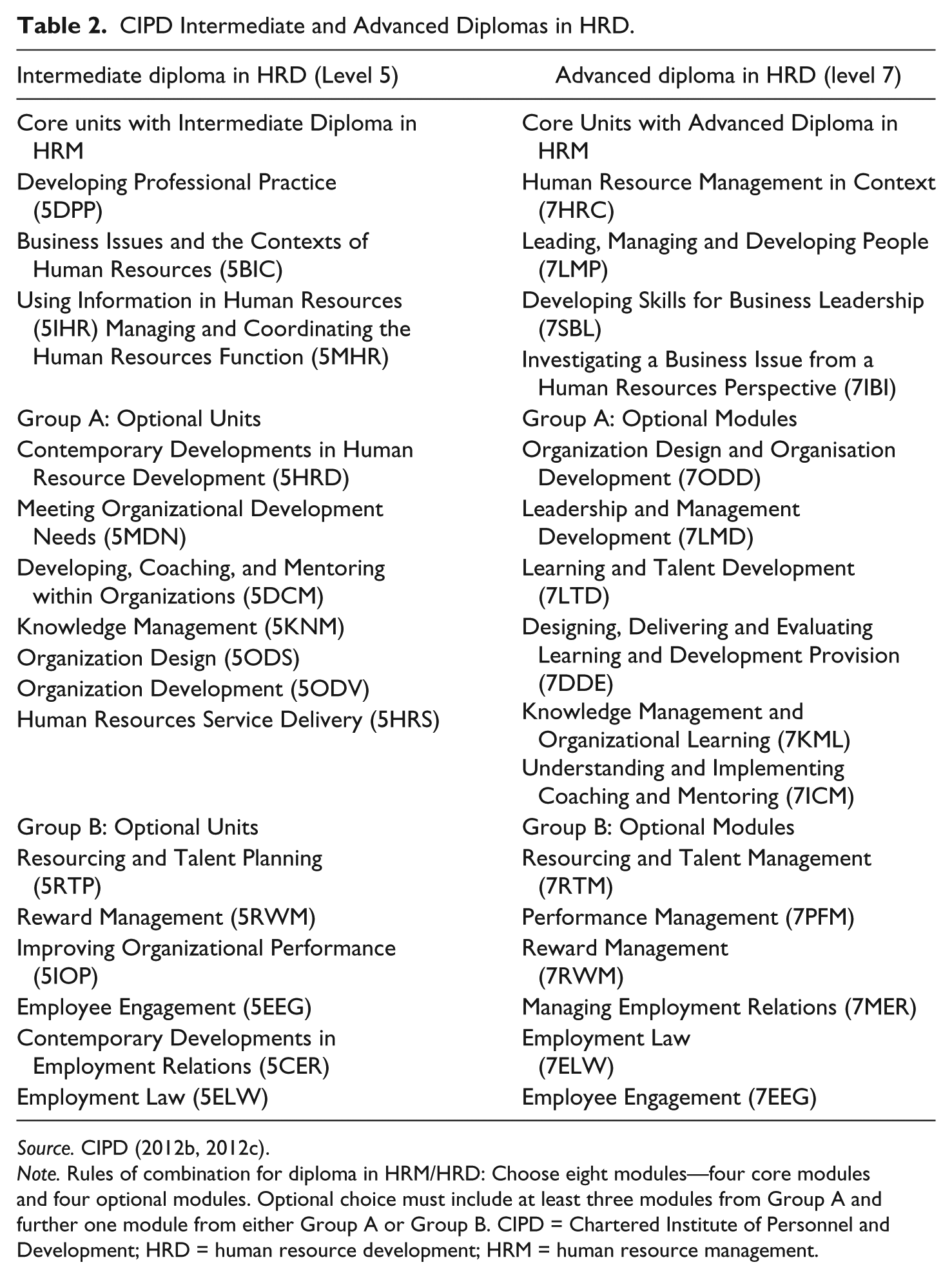
Source. CIPD (2012b, 2012c).
Note. Rules of combination for diploma in HRM/HRD: Choose eight modules—four core modules and four optional modules. Optional choice must include at least three modules from Group A and further one module from either Group A or Group B. CIPD = Chartered Institute of Personnel and Development; HRD = human resource development; HRM = human resource management.
As well as clearly defining the content of CIPD-linked qualifications, representing a substantial proportion of HRD education in the United Kingdom, a number of additional points of interest emerge from Table 2. First, there is a common core of modules irrespective of the qualification being named HRM or HRD. Second, Organization Development (OD) is included at both levels, as a separate module/unit at intermediate level and in combination with organization design at advanced level. Third, both coaching and mentoring feature as content at both levels and, as with OD, will form part of many HRD-named qualifications. Finally, employee engagement is a further common topic of interest. This in part is probably the result of the recent and growing academic interest in the concept and an indication of the influence of both academics and government. The U.K. government has commissioned research into the topic and invested resources in promoting engagement strategies among employers (see, for example, Engage for Success, 2014; U.K. Government, 2011), illustrating again one of the complex interactions between the key players in HRD education. Having reviewed the curriculum content, we next examine the quantity of current provision.
Quantity of Current Provision
Anecdotal evidence available to the authors through personal experience, professional networks, and work for CIPD indicates both decline and growth in demand for HRD qualifications. Decline is and has been experienced at advanced/postgraduate level in the part-time mode of study market. This market serves professionals in work in HR departments of employers who wish to gain professional qualifications and are commonly supported in doing so by their employers. Part-time study financed by employers is a long-established tradition in the United Kingdom, especially in relation to professions and quasi-professions. The continuing effects of the 2008 global economic crisis and the current austerity measures of the U.K. government have seen a significant decline in the number of employers willing and able to fund their employees’ professional education (CIPD, 2012a, 2013). This is particularly the case in U.K. public sector organizations, which have experienced significant cuts in their budgets (CIPD, 2010, 2011, 2012a, 2013). So, many HEIs in the United Kingdom are experiencing lower demand for part-time programs in HRM and HRD. The majority of these are CIPD-approved programs. Growth though is evident at CIPD intermediate level in first-degree programs. This is as a result of the CIPD producing in 2010 intermediate qualifications that can be approved as part of bachelor’s degrees, although most are in HRM with only elements of HRD included. The second growth area for U.K. HEIs is in full-time programs at master’s degree level. The market for these qualifications is primarily overseas students from emerging/growing economies such as China, India, and Nigeria. Vos (2013), for example, found that this market had grown by more than 300% between 2000 and 2012, and that 80% of this increase came from overseas students. As noted above, many, but not all, of these programs are CIPD independent, and so the curriculum is less constrained by meeting those specifications. However, anecdotal evidence again suggests that the curriculum is not very different in many of these programs (see also Sambrook & Stewart, 2010).
More detail on current provision is provided in Tables 3 and 4. Table 3 shows that the majority of HEIs in the United Kingdom provide programs at either or both of undergraduate and postgraduate levels. There are variations in the total number of HEIs claimed to exist in the United Kingdom, but it is around 140. Table 3 shows a slight increase in institutions offering postgraduate programs and a slight decrease in the number offering undergraduate programs between 2011/2012 and 2012/2013 academic years. However, if we remove those programs primarily focused on either health and safety (H&S) or industrial relations (IR), the number of institutions providing undergraduate programs increases very slightly in that period. It is also interesting that the number of programs linked with the CIPD is greater for undergraduate (around a half) than postgraduate programs (around a third), confirming the point made earlier on growth areas in bachelor’s degrees. This also reflects figures at postgraduate level, showing both a growth and many more CIPD independent than CIPD-linked programs. This is likely to be related to the number of institutions entering the full-time and overseas students market. The relative growth of this market suggests a possible decline in the influence of the CIPD on HRD education.
HEIs Providing HRM/HRD Programs.
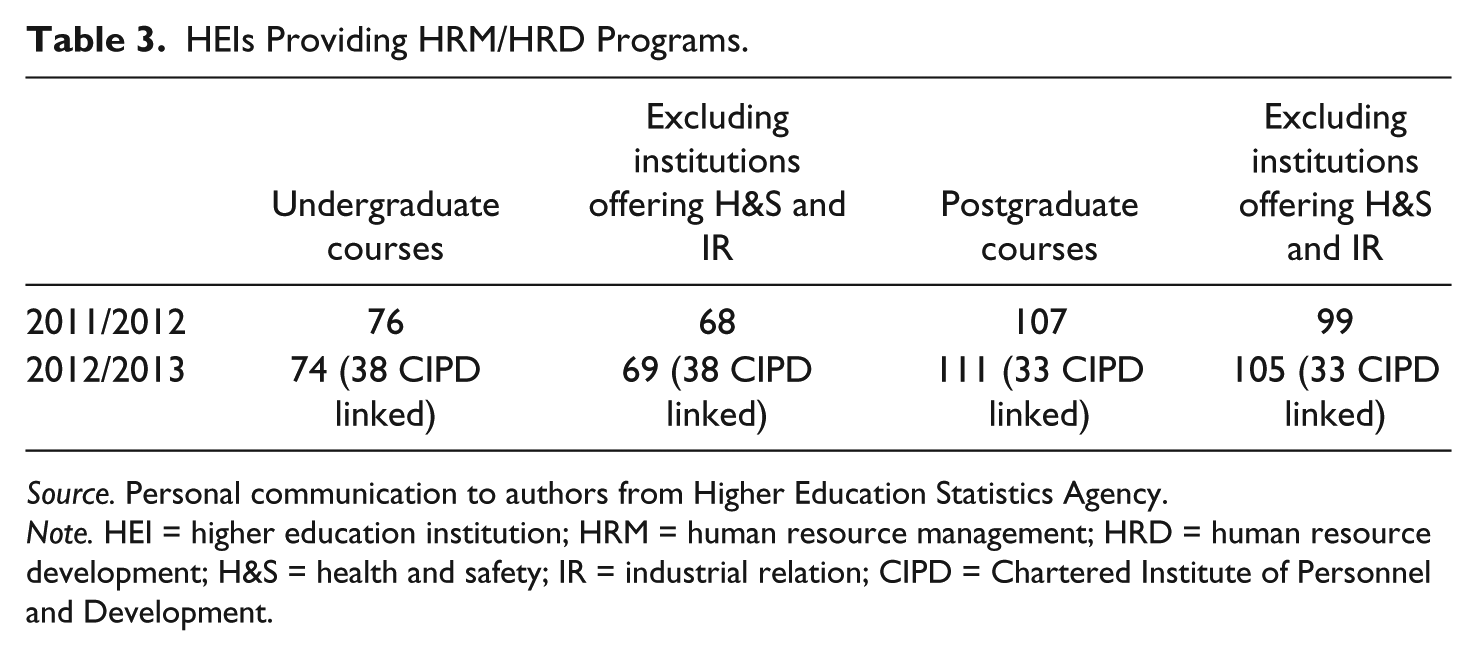
Source. Personal communication to authors from Higher Education Statistics Agency.
Note. HEI = higher education institution; HRM = human resource management; HRD = human resource development; H&S = health and safety; IR = industrial relation; CIPD = Chartered Institute of Personnel and Development.
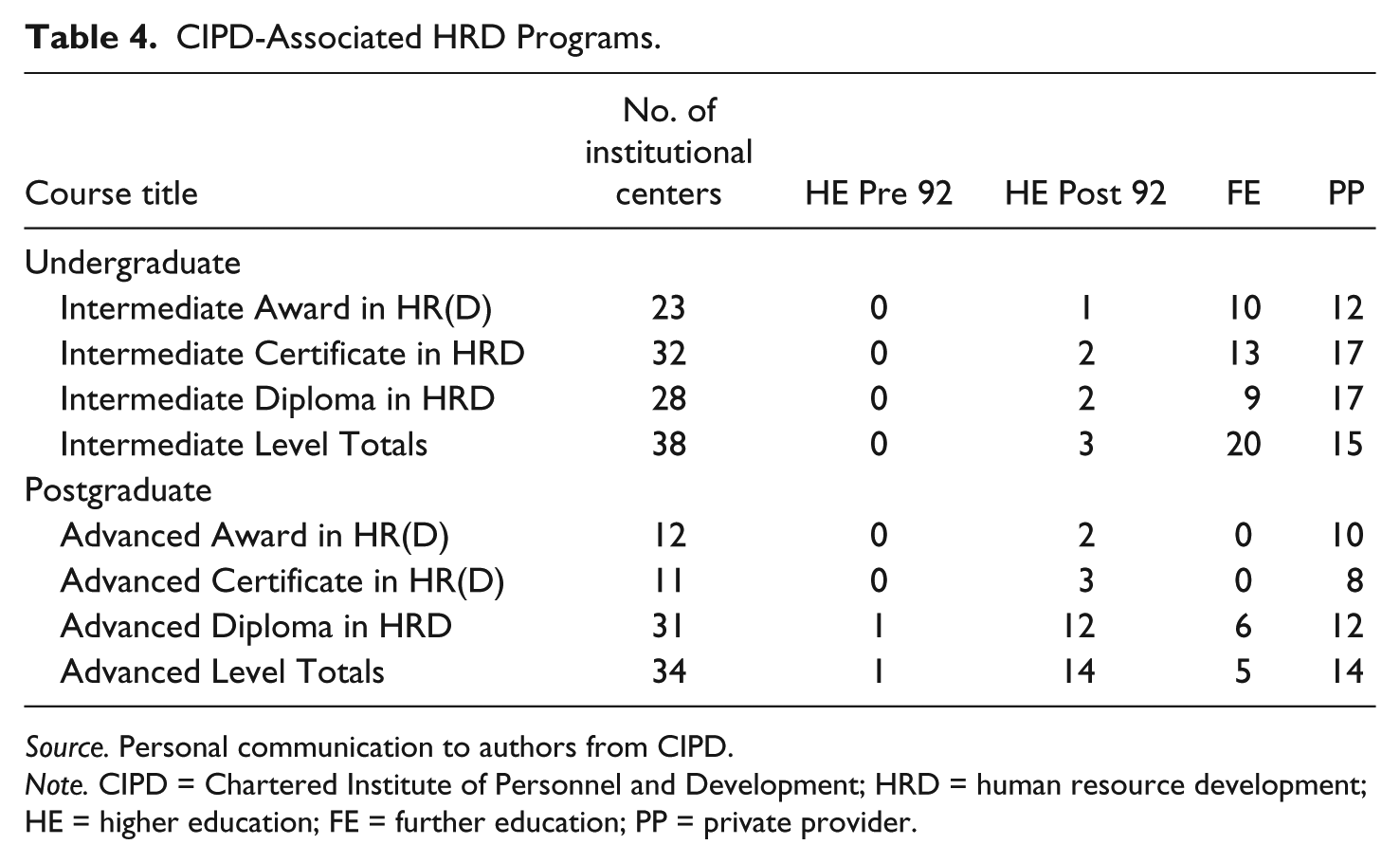
CIPD-Associated HRD Programs.
Source. Personal communication to authors from CIPD.
Note. CIPD = Chartered Institute of Personnel and Development; HRD = human resource development; HE = higher education; FE = further education; PP = private provider.
As already explained, HEIs are only one type of provider, and they are also the main one involved in CIPD independent provision. Other types of providers, such as FE colleges and private training organizations, are more commonly providing CIPD-associated programs. A limitation of this analysis is that we can only access information on HRD-specific programs from the CIPD as U.K. HE data groups HRD qualifications within HRM awards. So, Table 4 below provides data from the CIPD showing the number of programs with HRD-named qualifications by type of provider. It needs to be noted that the total of the columns in Table 4 is not equal to the sum of the figures in those columns, because some institutions provide more than one qualification.
Table 4 reveals a number of additional interesting insights. First, it confirms anecdotal evidence that the majority of postgraduate programs lead to a CIPD diploma level qualification rather than certificate or individual module/unit award. Second and when compared with Table 3, it shows considerably fewer HRD- than HRM-named qualifications. Third, the same figures suggest less growth at undergraduate level for HRD than for HRM. Fourth, an interesting finding is that “post-92” HEIs are more active in HRD education than “pre-92” institutions. The pre-92 institutions were originally established as universities, whereas the post-92 were originally polytechnics, created from a government NHRD/VET policy dating back to the 1960s as providers of vocational and economically relevant HE. In 1992, polytechnics were given university status. The continuing distinct vocational orientation of those institutions compared with pre-92 universities is evident in the figures in Table 4. A final point is that at both advanced and intermediate levels, non-HEIs, that is FE colleges and independent private providers (PP), outnumber HEIs in HRD education provision. So, education of HRD professionals at both undergraduate and postgraduate level equivalents is not the exclusive or even majority preserve of universities in the United Kingdom. This means that non-university staff have more direct influence on the education of HRD professionals through the means of direct provision of and teaching on programs than do university academics. However, university academics retain greater indirect influence because of their influence on the curriculum through their research and roles for CIPD. Having examined the detailed provision of HRD programs in the United Kingdom, next, we consider teaching and learning methods.
Teaching and Learning HRD in the United Kingdom
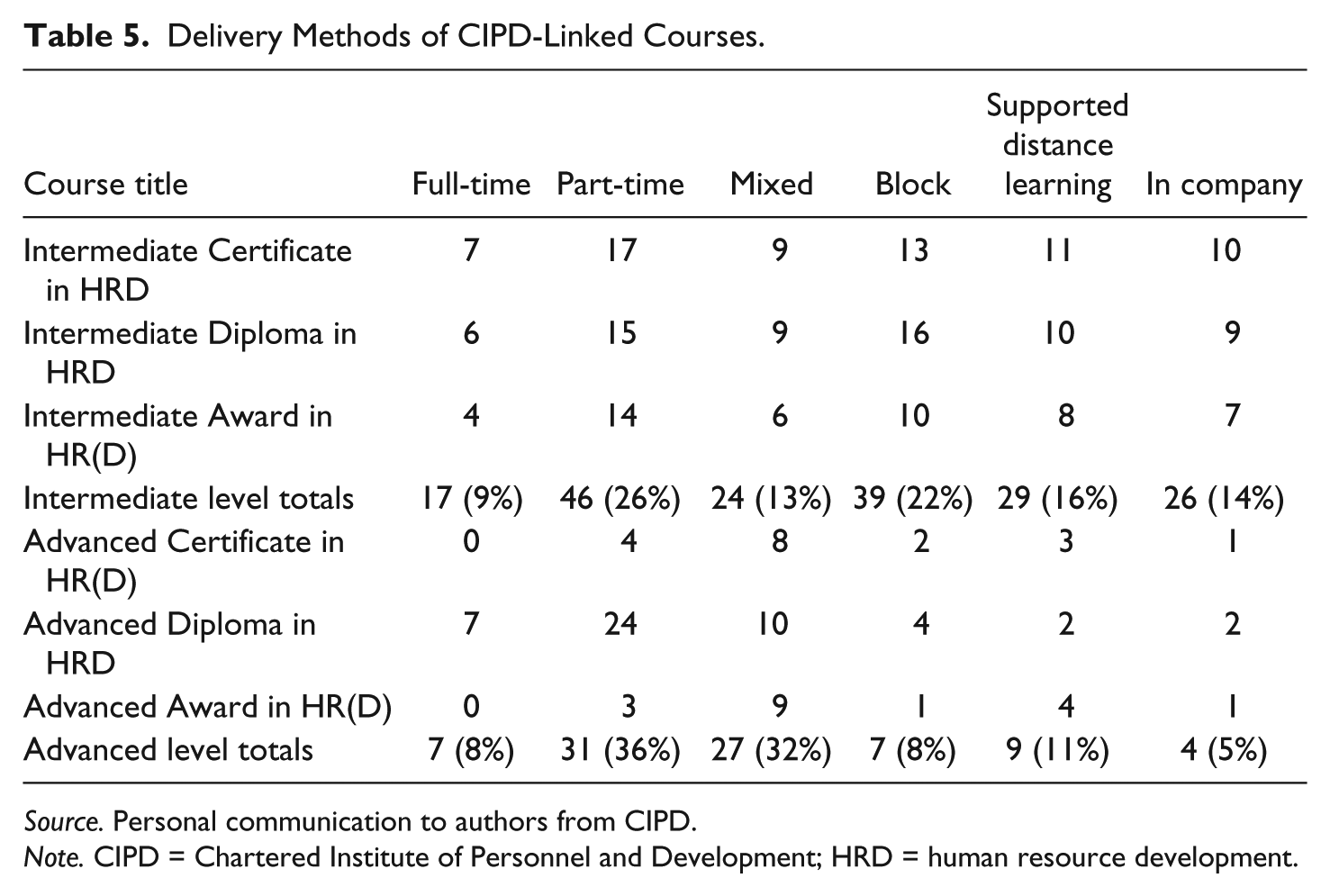
We now turn our attention to approaches to teaching and learning HRD in the United Kingdom. Very little research has been conducted, but Sambrook and Stewart’s (2010) albeit small survey identifies the most common forms of teaching, learning, and assessing HRD in the United Kingdom. As a broad generalization, those will vary according to the mode of delivery. Table 5 provides details of delivery methods for CIPD-awarded and -approved programs. As can be seen, the majority of programs are part-time delivery. This mode commonly involves attendance at the provider premises for an afternoon and an evening once each week; for teaching sessions lasting approximately 6 hr with a 3-hr slot devoted to a module/unit, and so 2 are studied concurrently. Program length is typically 2 academic years for advanced level and 1 academic year for intermediate level. In common with both mixed mode and block delivery, part-time means that all, or at least a large majority, of learners are employed and so have immediate opportunities for application of theory in their professional roles. Full-time study is usually for 1 academic year at advanced level leading to a master’s degree. Use of case studies, role-plays, industrial visits, visiting speakers from the profession, and short (typically around 6 weeks) internships are the main vehicles to explore application in professional practice. This is seen to be beneficial; for example, Morse (2006) noted the value of work placements for postgraduate HRD students, and Shaw and Ogilvie (2010) concluded that work-based learning improved undergraduates’ understanding of HRD content. Action learning and reflection are also common (Francis & Cowan, 2008). Supported distance learning is again mainly used by individuals in employment, and so although this lacks the immediate interaction with academics and other learners achieved in part-time, full-time, and block delivery modes, individuals also have the possibility of immediate application in their work roles. In-company programs are those where a provider, commonly but not exclusively a HEI, designs and delivers a program for a single employer who has sufficient number of HR employees to provide an educationally and economically viable cohort size. In most cases, block delivery is used. This will normally involve periods of 2, 3, or 4 days spent studying with around 4-, 5-, or 6-week-long gaps between blocks. As Table 5 shows, this is a minority mode of delivery. This is perhaps a pity as such programs provide the best opportunities for linking theory and practice through innovative forms of work-based teaching and learning (Sambrook & Stewart, 2010).
Delivery Methods of CIPD-Linked Courses.
Source. Personal communication to authors from CIPD.
Note. CIPD = Chartered Institute of Personnel and Development; HRD = human resource development.
Sambrook and Stewart (2010) found that active and participative methods of teaching and learning are commonly adopted on HRD programs. These include action learning in various forms, learner-led seminars, individual and group consultancy assignments, individual and group presentations, workshops, and self- and peer assessment by and of learners. That research also found indications of growing interest in and adoption of Critical HRD (CHRD) through use of, for example, critical reflection (Lawless et al., 2012). This is a form of critical process in education rather than critical content. A special issue of Human Resource Development International (HRDI; Stewart, Callahan, Rigg, Sambrook, & Trehan, 2014) provided additional evidence of this trend applying to both process and content.
Future of HRD Education in the United Kingdom
In this final section, we summarize our review of the current state of HRD education in the United Kingdom and consider its future. This article has demonstrated that HRD education in the United Kingdom results from complex, dynamic interaction between three key players: U.K. central government, the professional body (CIPD), and academics. Given the scope of the article, we have not been able to consider the voices of other important stakeholders, particularly learners and employers who may be conceived of as consumers of HRD education, although it could be argued that these are, in part, met through (HEI/CIPD) program evaluations and industry partnerships. The key “supply” stakeholders interact in a tripartite model, which we propose provides a useful framework for analyzing influences on HRD education in other countries. We have revealed the connections between these three players in the United Kingdom, explaining their direct and indirect influences on each other and on HRD education. Each pursues a different agenda (Stewart & Sambrook, 2012) but with a common purpose, we believe, of stimulating and satisfying demand so that professional capacity and capability are ensured. Within current government policies and qualification frameworks, provision of HRD programs is largely left to market forces producing equilibrium in the demand of employers and individuals and the supply of HEIs and other organizations. This influencing factor may vary in other countries with more interventionist-oriented governments, for example, Germany (see Stewart & Rigg, 2011). HEIs focus on both CIPD independent and CIPD-approved programs, whereas non-HEI providers are more likely to provide CIPD-associated programs. It is clear that HRD education is not the exclusive preserve of universities, even in the context of qualifications and most programs being at undergraduate and postgraduate levels. It is also clear that although not legislatively compulsory, the curriculum content of HRD programs is largely determined by the professional body. This highlights the powerful influence of the CIPD professional body, with limited challenge from other U.K. “quasi-professional” bodies such as the Institute of Training and Organizational Learning, although this may not be the case in other countries. It might therefore be a useful and reassuring factor that the standards prescribed by the professional body are generally produced by academics using HRD research as their starting point. However, there is also healthy critique of some of the CIPD’s perceived managerialist orientation, with some U.K. academics increasingly incorporating more critical perspectives in the curriculum (Lawless et al., 2011; Lawless et al., 2012; Sambrook, 2010; Trehan, 2004). Finally, it is also clear that in the United Kingdom, HRD education is in some ways subservient to HRM in that much and probably most HRD teaching and learning occurs within HRM named and oriented programs. However, because of both the professional body and the interests of academics, and the interaction of these players, HRD is almost always a constituent part of HRM programs.
Our closing statement is an observation on the “health” of HRD programs in the United Kingdom. Using a quantitative indicator of this is problematic, as the evidence base is not perfect for making such judgments, and what evidence is available is mixed. Overall, we conclude that there is a decline in provision of full professional programs. However, there are logical economic explanations for this decline, which also supports optimism for a reverse of the decline and renewed growth as the U.K. economy recovers. In qualitative terms, the picture is more encouraging. HRD programs are subject to two separate and independent assessments of quality. These are undertaken by the professional body (CIPD) and by the U.K. national organization responsible for quality assurance in HEIs. Both assure sound levels of quality in approved HRD programs.
Looking to the future, it is unlikely that named programs in HRD will resume their status enjoyed back in the 1990s (Walton et al., 1995), with the then burgeoning provision of NVQ and postgraduate courses. However, it is also unlikely that HRD will be dropped from mainstream HRM education, given its current prevalence within the CIPD’s professional standards and qualifications. In fact, one of the current authors is presently working with others on a CIPD project to review CIPD qualifications in HRD. This project will give greater distinctiveness and separation of HRD from HRM in future CIPD qualifications. This gives us measured hope for a healthy future for HRD education in the United Kingdom, particularly as the economy recovers from the recent recession (arguably stimulated by the government’s various economic policies), and growth and development begin to re-assert themselves on the business agenda. However, this also illuminates the fragile position of HRD, with training “costs” scrutinized and demand for training and development programs often slashed in lean business budgets, a trend that might be reversed with signs of economic recovery.
We conclude that the strength and presence of HRD education in the United Kingdom will continue to be shaped by the complex interactions of the three key players identified in this article. If we can consider what might change for the better, we would argue for a much more critical view to be reflected in and adopted by the HRD curriculum. We believe this would require a shift in the relative power of the three key players with academic voices being heard by the government and the professional body much more than currently. However, with the dominant narrative in Western democracies being that of neoliberal meritocracy, critical voices are likely to be ignored in the foreseeable future (see Vernhaeghe, 2014 for more on this argument). However, and as Vernhaeghe (2014) argued, education and educationalists can help to shape new narratives. And, similarly, HRD professionals through their work are also able to influence narratives in work organizations. So, it seems to us that HRD education has the potential to contribute much more to the world than the narrow vision and current exclusively quantifiable measurement of performance enhancement. Perhaps that is the real challenge facing HRD education.
Footnotes
Declaration of Conflicting Interests
The authors declared no potential conflicts of interest with respect to the research, authorship, and/or publication of this article.
Funding
The authors received no financial support for the research, authorship, and/or publication of this article.