







Abstract
The Problem
Adaptive leadership calls for leaders to open up conflicts and differences and to help others engage with them. However, this sets up some tension with organizational priorities such as order and productivityWorking with difference and conflict is built on assumptions other than those that privilege efficiencies and smooth functioning. Taken-for-granted habits and assumptions about what is “good” and productive are at issue. Engaging with differences and conflict is not just a matter of learning new skills, it involves engaging with questions of mind-set and assumptions. The prospect of making space for differences may be threatening or seem to be out of bounds, particularly in traditional organizations.
The Solution
In this article, we argue that new practices privileging conflict and difference call for methods that disrupt habitual ways of working and that support people as they learn to respond to familiar situations in new ways. We offer montage, a technique adopted from the movie industry that sets disparate images side-by-side, as promising in this regard, providing temporary “new rules” that enable people to experience new ways of working.
The Stakeholders
This article will be of interest to human resource (HR) professionals who select and sponsor leadership development interventions It will be particularly relevant for those in the area of learning and development who support new learning beyond workshops, in the context of day-to-day organizational life. It will also be of interest to researchers who seek to understand felt experiences in organizations and managers who are interested in reshaping their practice.
Introduction
A constellation of leadership practices associated with recognizing and seeking out differences, getting beyond “dehydrated talk” (Gratton & Ghoshal, 2002, p. 2), and engaging in genuine struggles over meaning are emerging. However, there is a paucity of such accounts and they do not necessarily engage with questions of power (e.g., Cunliffe & Eriksen, 2011; Gagnon, Vough, & Nickerson, 2012). This article addresses the development of leadership practices related to working with difference and conflict, while taking account of the power of mind-sets, and the challenge of disrupting established relationship dynamics and ways of working.
We draw on preliminary empirical material from two senior health care leaders, an administrator and clinician, who were leading a significant, visible, and controversial change process in a key department of a large public hospital. This slice of empirical material was connected to a much larger project focused on the development of clinical leadership involving two of the authors and the hospital. We use data from these two leaders to illustrate how established interactions push back against the possibility of new practices, and to consider the potential for working with montage as a way of mitigating these effects.
The first section of this article addresses the shifting context for leadership, and the necessity for developing leaders who are able to bring conflict and diverse perspectives into the conversation. We discuss the development potential of arts-based methods and introduce the theory and method of montage. We then describe the leadership development initiative that contributed to our preliminary work with montage. Finally we consider the broader potential that montage offers for helping leaders to expand their repertoire of responses to include recognizing diverse perspectives, and making space for conflicting views.
The Case for Engaging With Differences and Conflicts
The theory of adaptive leadership argues that rather than being viewed as negative and requiring containment, conflict can be viewed positively—as an engine for change, and as a source of energy for productive engagement (Heifetz, Grashow, & Linsky, 2009). Working with conflict is one of several essential practices that are juxtaposed with “technical” orientations that are focused on containing and settling things, resolving differences and finding solutions. Grint (2005) claimed that our ways of knowing and constructing problems determine our ideas of leadership and how it is carried out. Thus, a “wicked” problem calls for a different idea of leadership than a “tame” one. Grint pointed to the importance of continually engaging with the tensions, contradictions, and conflicts surrounding wicked problems, paying particular attention to the questions they provoke. Heifetz and his colleagues (Heifetz & Laurie, 1997; Heifetz & Linsky, 2002) argued that working with conflict in relationship to adaptive problems involves opening up differences and making their tensions visible. Heifetz et al. (2009) suggested that shifting interpretations of problems from benign to conflictual is necessary for people to engage with the issues that affect them rather than believing that intractable situations can be turned over for experts to fix. Leadership, they argued, involves surfacing inherent differences and “raising the temperature” (Heifetz & Linsky, 2002, p. 109) of the social situation. These developments in how leadership is understood entail a shift in emphasis toward questions rather than answers, toward exposing conflicts rather than resolving them (as quickly as possible), and understanding changes in terms of dynamic, unfolding, emergent qualities (Tsoukas & Chia, 2002).
However, engaging with differences and conflict is problematic. Definitions of conflict are replete with the language of breakdown, carried in words and phrases such as “antagonistic struggle . . . hindering; injuring; retaliation; breaches; opposition; threat” (adapted from Andrade, Plowman, & Duchon, 2008, pp. 23-28). Conflict is also charged with hindering productivity in organizations (Gerzon, 2006). Framed this way it stands to reason that the absence of conflict would be associated with “good” leadership. Indeed, Gerzon (2006) observed that the work of leadership is frequently overshadowed by a managerial style that blindly focuses on task accomplishment. He suggested that managers are inclined to ignore cold conflicts, perceiving their role as to simply “make things work” (p. 34). Thus, in Rittel and Webber’s (1973) typology of tame and wicked problems adapted by Grint (2005), responses to conflicts in work settings are interpreted in ways that are suitable to tame problems, hence “the manager’s role is to provide the appropriate processes to solve the problem” (p. 1473, emphasis in the original).
To take new theories of leadership seriously, leadership development must therefore contend with unsettling traditional ideas about conflict and differences in the context of organizations. Historic meanings of conflict in work settings, as well as the meanings that differences and conflict have come to hold through an individual’s experiences outside work, suggest that such leadership development would support participants to act in ways that significantly extend practice, and that may feel uncomfortable or even at odds with prior learning. The phrase “going against the grain” is helpful here because it refers to moving against the direction of the fibers in a piece of wood. The analogy is that managers and others who are involved in leadership development may experience engaging with conflict as quite “wrong,” automatically responding in ways that avoid conflict, minimize differences, and cool things down. To respond otherwise may be experienced as “going against the grain.” For, as Heifetz and Laurie (1997) observed, “Managers and leaders rarely receive promotions for providing the leadership required to do adaptive work” (p. 65). Although working with conflict is essential for adaptive problems, such practices require some very strong “handrails” (Gehry cited in Liedtka & Mintzberg, 2006, p. 16). Therefore, next we consider what arts-based methods in general, and montage in particular, might offer to this situation.
Arts-Based Methods and Montage
The theory and method of montage can be situated within arts-based methods in leadership development (Adler, 2006; Ladkin & Taylor, 2010; Sutherland, 2013). These methods are based on the belief that there are ways of approaching the world that fundamentally differ from those of traditional logic, and that these might better suit a world that is increasingly complex, contradictory, and unpredictable (Ladkin & Taylor, 2010; Weick, 2007). Arts-based methods are associated with loosening the language of organizations (Taylor, 2002) through engaging distinct processes that are not activated by conventional approaches to development (Taylor & Ladkin, 2009). This is important in developing practices that may “go against the grain” because deeply held assumptions are often tacit and relatively inaccessible. Indeed organizations have been described as suffering from “aesthetic muteness” (Taylor, 2002, p. 821) because they lack the language to speak aboutfelt experience. Conflicts and differences are likely to hamper leadership work in subtle ways, because they are out of direct lines of sight.
Arts-based methods involve ways of knowing that are presentational rather than propositional. While propositional knowing is “about” something, presentational knowing “provides the first form of expressing meaning and significance through drawing on expressive forms of imagery [such as] through music, drawing, painting, [and] sculpture” (Heron & Reason in Taylor & Ladkin, 2009, p. 56). Presentational knowing enables access to experiences that are felt in emotional and embodied ways, but that can be very hard to express in the language of rationality and propositional knowing that has shaped organizations. Montage derives its power from conflict and difference, having the potential to open up aspects of a situation that are potent, that matter a great deal to people, and that are unavailable to the conversation.
The original concept of montage was theorized by Russian cinematographer Sergei Eisenstein (1898-1948). He saw that “meaning in the cinema was not inherent in any filmed object but was created by the collision of two signifying elements, one coming after the other and, through the juxtaposition, defining the sense to be given to the whole” (Eisenstein, 1991, p. xv). Following Eisenstein, montage can be defined as an “assembly of fragments constructed out of complete and autonomous parts” (Aumont, 1987, p. 150), which nonetheless cohere in an overarching narrative. Eisenstein saw that an entirely new and unrelated whole could be produced by showing a quick succession of fragments that were, on the surface, unrelated. He argued that the patchwork effect of apparently unlinked fragments engrossed audiences who would reach out, to create connections. He was interested in using “separate fragments that function not as depiction but as stimuli that provoke associations” (Eisenstein, 1991, p. 134, emphasis in the original). In the process of grasping for meaning, the audience would become fully, imaginatively, and emotionally involved. Eisenstein (1925) relished setting contradictory fragments alongside each other to startle the audience. For example, in one of his major films Strike (1925), images of striking factory workers were juxtaposed with images of cattle being slaughtered, with the intention of stimulating the audience to imaginative leaps between capitalism and people being treated like animals; an idea that was not available in either of the shots. In montage, the relationship between fragments of the story is held open and this compels viewers into the narrative. This method presents fragments as wholes while drawing people to make connections, potentially leapfrogging the prospect of a checkmate, or fixed, opposing views. The invitation to montage works on the assumption that reality is many things, where markedly different pieces or fragments are at play. Holding each fragment as contained and whole creates a context where differences are preserved, but also where something new that is quite beyond any one fragment might be stimulated.
We see the potential of montage to help leaders express felt experience. In particular, we suggest that montage can create the handrails for leaders to experience and acknowledge the felt senses that occur when differences are opened up, thus enabling working with differences and conflicts to be experienced as more accessible and less “against the grain.” Montage also presents possibilities as a projective technique—giving expression to “unconscious stuff” or “tacit embodied knowing” (Taylor & Ladkin, 2009, p. 58) that shapes the situation. However, this potential has emerged from our work in leadership development rather than through the tradition of movie making, and therefore, we discuss this in more detail later, in the context of empirical material.
The Research Context
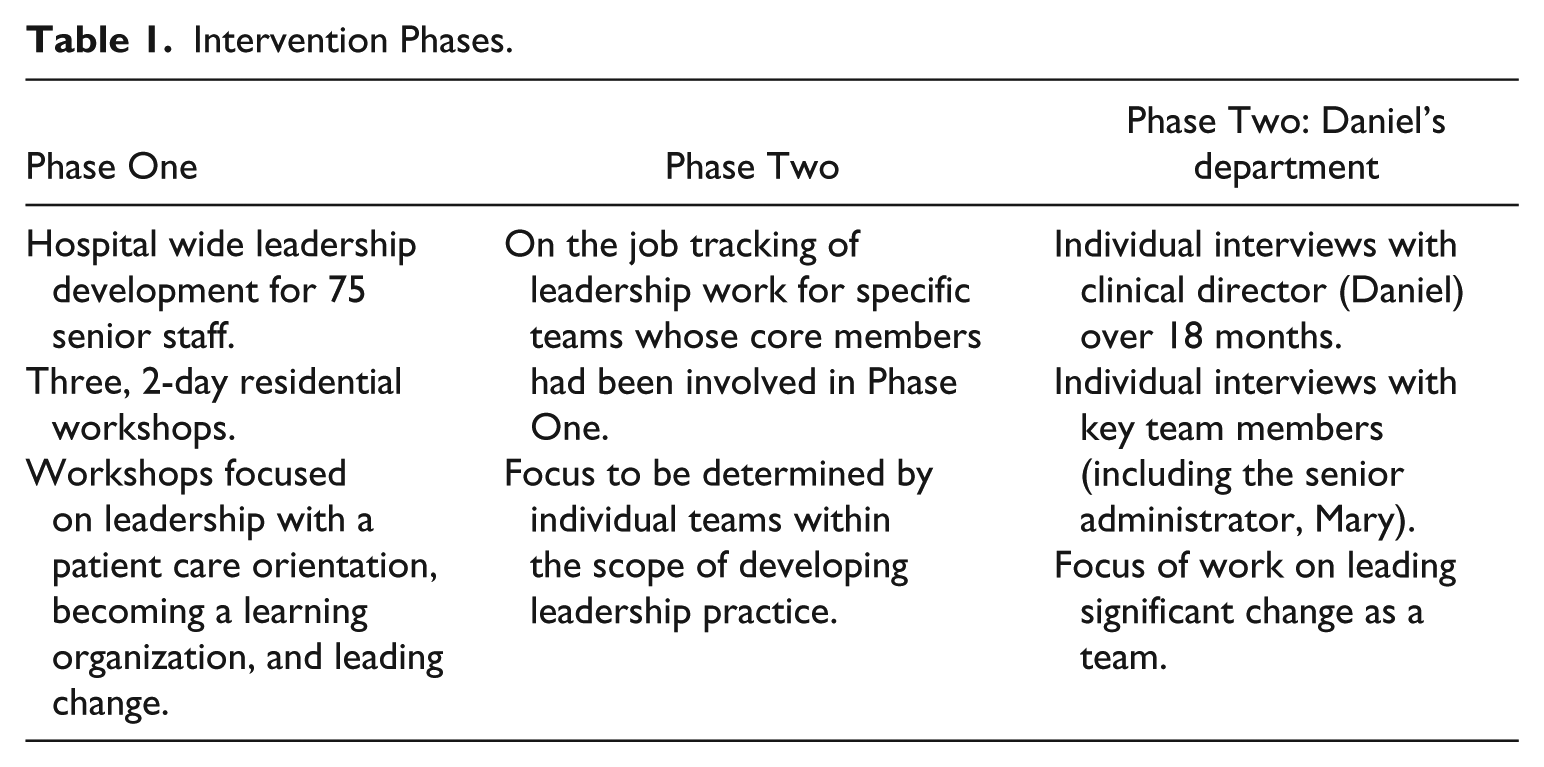
The foundations for the empirical material in this article were laid during an in-house leadership development program for a large public hospital in Australasia. Three cohorts, each comprised of approximately 25 senior managers and clinical leaders including doctors, senior nurses, and senior allied health professionals, participated in three, 2-day residential workshops spaced over several months between 2011 and 2013. The program was one of several interventions undertaken by the hospital aimed at revitalizing the culture and boosting performance. It was tailored to the hospital’s clear intention to develop itself as a learning organization (Bohmer, 2009). For the purposes of this article, we refer to this work as the Development Program, Phase One. The empirical material for this article was drawn from a second phase of work where clinical teams who had been involved in Phase One, had the option to be followed by individual researchers. Although people had been selected for the leadership development program with strong input from human resources (HR), participation in Phase Two was largely in the hands of the teams themselves. The relationship between Phase One and Phase Two, and key elements of each are outlined in Table 1.
Intervention Phases.
Phase One—The Development Program
The development program asked participants to consider the proposition that health care professionals could enact leadership in the course of their day-to-day interactions with patients. In this respect, the program could be seen as an “identity workspace” (Petriglieri, 2012, p. 295). Participants grappled with the proposition that leadership was their work—as opposed to somebody else’s—and what this might mean for their perceived identity. The program was explicitly based on insights associated with social constructionist epistemology: Worlds are made and not found (Cunliffe, 2008; Grint, 2005). This perspective suggests that although we experience the social world as something that seems fixed and objective, it is nonetheless socially produced and reproduced in the present, within local relationships. Consequently, conditions that enabled or undermined the work of leadership were addressed as they came to life in interactions during workshops.
The program explicitly addressed the role of leadership in exposing and working with conflicts and differences (Heifetz & Laurie, 1997). Conflict was framed as an essential site for the work of leadership, and participants practiced conversations where they experimented with “warming things up” by noticing and engaging with differences between them, while addressing key leadership questions. This work was challenging for many groups, and required strong modeling by facilitators. For many, opening up differences felt risky, baffling, or intrusive. For some, conflict work was felt to be at odds with the opportunities for affiliation (Tuckman & Jensen, 2010) that were afforded by the opportunity to build relationships with colleagues. Many practice conversations that sought to work with difference and conflict seemed to raise essential identity dilemmas: playing out tensions between management and leadership identities (Carroll & Levy, 2008), and between human needs to both fit in and belong, and to be unique or different (Ernst & Chrobot-Mason, 2011).
Phase Two
While Phase One brought senior hospital personnel together from across the hospital, Phase Two focused on particular clinical teams in local sites. This phase was available to teams whose key members had participated in the leadership program, and who therefore had a shared language and understanding, and who were also ready to develop their leadership on the job. It was anticipated that this phase would enable different forms of learning and evaluation based on the movement of the work itself. While Phase One had been anchored by topics introduced by facilitators, the second phase followed the leadership work identified by the particular teams.
The empirical material in this article is drawn from a small team that engaged in Phase Two. We focus on Daniel, a relatively young clinical director, and Mary a senior administrator on Daniel’s team. Daniel had been hired into his role because he was seen as having the potential to lead change in an area of the hospital that had been under-resourced and was experiencing serious morale and performance problems. He and his team—including Mary—were followed by the first author who brings reflexive assumptions (Cunliffe, 2003) to the research process, assuming that she is part of unfolding dynamics, rather than an outsider.
Data gathering took place over 18 months, and included the researcher attending several leadership team meetings, interviews with Daniel and key members of his team, and email conversations with Daniel. Interviews, phone conversations and meetings were recorded and transcribed. The team was small and two key positions were not filled for much of this period. Team meetings were rarely held as they waited for new members to arrive. This research was shaped in large part by the pragmatics of a busy public hospital, and a service that was undergoing significant upheaval. Consequently our most consistent contact was by phone with Daniel. While the first author primarily took the role of asking questions and offering reflections that were relevant to the research, consistent with a reflexive position, she also shared some of her responses in the course of these conversations.
Phase Two: Daniel and Mary
Daniel’s initial purpose for being involved in Phase Two related to learning and enquiry. He had been a keen participant in Phase One. He described himself as “craving self-development” and as constitutionally impatient, saying, “I have an inbuilt impatience chip.” Questions such as “How do we (the team) help each other . . . how do we support each other and tolerate mistakes?” and concerns about “high variability in care” were fundamental to Daniel’s purpose for involvement in Phase Two. Soon after Phase Two began, a more specific goal was identified. Daniel realized that it was important for members of his team to contribute fully to conversations rather than being swept along by his impatience and enthusiasm. Daniel described his tendency to be captivated by an idea and to take over the conversation in terms of leadership rhetoric (what he calls “rah-rah”) saying, “I head far too close to the ‘rah-rah,’ rather than the question mark.” Indeed, with the best will in the world, Daniel realized that his “rah-rah” inhibited other voices so that perspectives that ran contrary to his own were held back, or were revealed much too late. While Daniel captured his own style with the language of “rah-rah,” Mary, who had responsibility for the majority of departmental staff, captured this energy in terms of “storming ahead [with changes]” in ways that made it difficult to voice doubts or differences. An excerpt from an interview with Mary, as she reflected on the fallout of the change process, shed some light on this dynamic.
I think some of the tension for me is that it was one person’s idea and we stormed ahead and there’s been a lot of pain. There’s been tears, there’s been falling out, there’s been a whole raft of stuff . . . I think some of the issues that we’ve hit late in the piece I saw coming a long time ago, but if I could rewrite it in a different way, then we would have been having conversations six months ago with people.
Were you able to say, just in your conversations, “I’m a bit uncomfortable with this, I’m not sure?”
Yeah but I probably didn’t say it as well as that. I did challenge. I did say that might be a difficult way for nurses to work. But I don’t think it was taken on board. I have since learnt a few other things . . . But yes in some ways I wish I could have just have had a stronger voice.
At the time of the above interview, despite Mary’s sense that some of the pain caused by the change process might have been avoided if she had a “stronger voice,” she had yet to establish a conversation that addressed the tensions in the leadership team. Looking back she said, “I have to have this conversation [with Daniel] and I haven’t.” Consequently, she had persevered with major changes without voicing her reservations. Indeed, when she said “if I could rewrite it . . . ,” she seemed to imagine a context 6 months prior, where different perspectives would have been sought out and treated as whole, and important in their own right.
Mary suggested that a better process would be one where people might have shared their different views “six months ago,” before the changes started. However, in reality, the work of leadership requires improvisational responses, wading into and interrupting pre-interpreted worlds that are already in flow (Weick, 2004). Reticence such as Mary’s is not at all unusual in our experience, particularly when power differences are involved. Mary’s reluctance to speak illustrates the challenges of going against the grain and the limits of conceptual understanding when mind-sets and deeply held assumptions are at issue. Both Mary and Daniel knew that a different interaction was required, even while perpetuating a dynamic where “one person [Daniel] just steamed ahead” and others, particularly Mary, would look back and say “I saw it [the difficulties] coming a long time ago.” One of the consequences of not making or claiming space for different perspectives in this case, is that the change process was precariously held as “one person’s idea” rather than shared leadership work.
Working With Montage
We worked with Daniel alone, inviting him to construct a montage assembled from different images of the department during the change process. This one-on-one work was due primarily to the pragmatics of access outlined earlier. However, as Mary’s comments suggested, Daniel not only had more formal power than others on the team but also had a thoroughly convincing voice. We suspected that helping him to pause and see differences was a necessary precursor to work that included the team. Giving Daniel the opportunity to fully acknowledge competing realities in his own mind and asking him to scaffold the boundaries between these alternative perspectives, rather than being captured by his current point of view was seen as a first step. We hoped that this would enable him to eventually take this experience into conversations with his team. Therefore, we asked Daniel to apprehend the contradictory and somewhat disjointed fragments that he experienced, without allowing his current perspective to alter prior points of view in any way. We followed the principles of montage asking Daniel to describe different images of the work environment during the change process. We used the metaphor of movie making, inviting Daniel to construct scenes, position actors, and to consider the ambience of each scene, including what an audience might see and hear. Daniel described three scenes, depicting the department at three different moments that were then assembled into a montage arrangement. One scene evoked an utterly mundane world, the second depicted a vibrant and optimistic place, while the third was constructed as the scene of a horror movie (Table 2).
Daniel’s Montage Scenes.
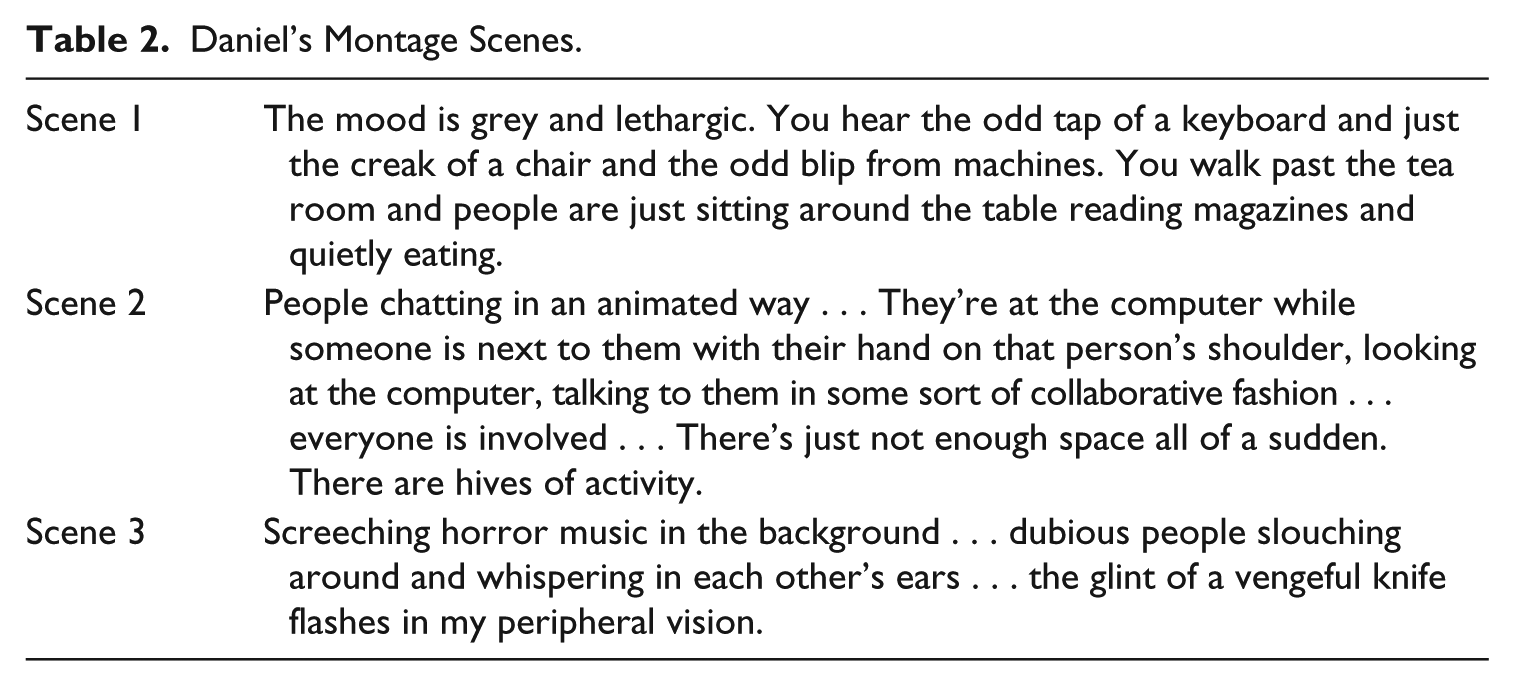
Thus Daniel produced three scenes that were whole, with each suggesting an internally consistent world that could be imagined beyond the initial descriptions. These scenes were preserved and laid out back-to-back so that Daniel could consider their patchwork effect. Seeing each image as a whole encouraged him to hold rather than collapse distinctions, and he became interested in their differences. For example, he pondered the implications for his identity, suggesting that in the first scene he had experienced himself as a “slave driver” who is “pushing and pushing,” whereas in the second he described himself as a “cheer leader” who is “going around marveling and cheering,” and in the third, as the first glimpse of a personal pronoun suggests when he refers to “my peripheral vision,” it was his own back that was the target of the knife. Indeed, in constructing the third scene he realized that he was fearful, and that he required the active support of his manager and the hospital’s executive. He also became conscious of his sense-making (Weick, 2009), noticing “scenes” he had considered worthy of attention. For example, he observed that he had spent many months living in the mundane scene with the identity of “slave driver.” He noticed that he had rushed through describing this scene while setting up others with more enjoyment and interest. Daniel used the metaphor of movie making to consider how the mundane scene related to the two other scenes when he observed, “If we were making a leadership movie, Scene I would have been a minute or two . . . when in actual chronological order it’s like been 99%! But we compress the boring bit and get to the exciting bit.”
Implications
One of the tasks of leadership development is to create an environment where participants are able to take safe risks—where they are encouraged to grow and even undo existing selves (Nicholson & Carroll, 2013). For most participants this includes learning to bring themselves more strongly into the conversation, claiming individual space and creating opportunities for others to bring themselves fully into the work. We have argued that this may “go against the grain” particularly in the context of organizations where the necessity of robust conversations contends with the realities of power dynamics and habitual responses shaped by pressures for performance, order, and efficiency. This is an important insight for HR professionals who support those who have participated in leadership development to translate their learning in the work context. Indeed, it might be useful for those who sponsor leadership development to assume that the creation of new practices will be challenging, that leadership development workshops are just the beginning, and that workshop material requires significant reworking, support, and close attention on the ground.
We see the potential for montage to contribute to the work of learning and development professionals, by providing temporary new rules that set up a different grain. These rules ask that fragments be constructed and apprehended as wholes, that they be buffered so that they hold their integrity even when placed alongside clashing perspectives, and that the various fragments be arranged in a potentially conflictual relationship with one another. These rules help interrupt over-determined interactions such as those driven by needs for affiliation, or that are caught in familiar patterns such as where those with more formal power have voice, whereas those with less do not. As such, montage may be a useful resource for HR professionals who are called on to coach managers who are struggling with dysfunctional dynamics in their teams. Such a method would be particularly useful in organizations where top-down leadership initiatives have attempted to create a unifying whole but have instead resulted in disaffection among staff. Working with montage in troubled teams or organizations presents the opportunity for fostering openness to difference and diversity.
As we noted earlier, people tend to privilege “benign” over “conflictual” interpretations of their situations (Heifetz et al., 2009, p. 114), perhaps because these interpretations are less threatening to prevailing views of the world. While needs for affiliation can be threatened by conflicting interpretations, contradictory and diverse perspectives interrupt prevailing views by raising the prospect that things could be otherwise. For example, seeing his three scenes laid out together temporarily broke Daniel’s tendency to be captivated by his immediate perspective. Montage worked as a circuit breaker, enabling Daniel to consider a more nuanced and complex picture of the change dynamics, and to ask questions about his own identities, and what this meant for himself and others.
Our work with montage has focused on developing Daniel’s capacity to invite and hold diverse perspectives, starting with apprehending his own competing realities. This has raised the potential for working with montage as a projective technique. When Daniel constructed his identity as that of a “slave driver,” a conversation about what this might mean for his team or others in the department (one could ask “are they then slaves?”) then became possible. The principles of montage could potentially also be used to quite different effect. For example, Mary was inclined to rationalize away the possibility of backing her views and bringing them forward. She delayed this prospect with the hope that she would do it differently next time. Montage might offer something to Mary and others like her who retreat in the face of power dynamics, saying somewhat fatalistically, that they need a stronger voice. For example, leadership development participants could be asked to produce visual images of a particular issue or point in time, and to construct those as whole vivid scenes with actors, sound, and set. The visual images could then be laid out either in sequence, or in a more traditional montage arrangement to promote a clash of views, and to maximize tensions or contradictions. This would not only slow down enthusiasts such as Daniel by forcing the issue that other perspectives exist, but would also require those with less power and voice to shore up their story, to practice reinforcing fragments, and thus contribute a clear, differentiated piece to the montage arrangement.
Research into arts-based methods has focused on drama studies in group settings and visual arts for individuals to “discover” their creative selves. Montage has the potential to enlarge this repertoire of tools for researchers interested in exploring the intersection of the group and individual identities, particularly in relation to learning the process of leadership. Montage may also be an important vehicle for researchers to explore organizational members’ felt sense of things. For although interviewers might ask questions about felt experience, people in organizations are often “aesthetically mute,” finding felt experiences exceptionally hard to talk about because, by and large, in many organizations, no one does! (Taylor, 2002). Researchers who want to explore questions related to areas such as culture or politics that are known in ways that are partially tacit and unconscious may also find montage helpful.
We have begun to explore the potential of montage as an “object in the world” by considering Daniel’s three scenes. The montage arrangement enabled Daniel to reflect on these scenes in ways that were more contemplative and curious than would be possible without an object as the focus for conversation (Taylor & Ladkin, 2009). We see the potential to extend montage beyond helping individual leaders to reveal and consider conflicts in their thinking, or helping those with less voice to stake a claim. For example, montage could be used in leadership development with different identity groups. Each group could be asked to construct their fragment and to then discuss how the “pieces” of the organization might be arranged to create productive friction and to stimulate conversations.
We have emphasized that montage can temporarily create new rules that interrupt habitual dynamics such as the pull to maintain affiliative relationships, or to play it safe with regard to existing power relationships. An artwork, no matter how novice, creates the expectation that people will relate to it in their own particular ways (Taylor & Ladkin, 2009). Divergent views sit at the very heart of montage and idiosyncratic responses are taken for granted in the world of art more generally. We have suggested that a cognitive appreciation of the importance of working with conflict and difference is unlikely to be sufficient for people to engage in new practices in the face of power differences and strong organizational norms. Montage has the potential to be a circuit breaker in this problematic terrain. We hope this inquiry encourages conversation and more in-depth empirical work with montage, as well as attention to the challenges of bringing critical leadership practices out of the workshop setting and into the daily work of organizations.
Footnotes
Acknowledgements
We would like to thank our colleague Josh Firth for editing our writing and the three anonymous reviewers who gave invaluable feedback, helping us refine this article.
Declaration of Conflicting Interests
The authors declared no potential conflicts of interest with respect to the research, authorship, and/or publication of this article.
Funding
The authors received no financial support for the research, authorship, and/or publication of this article.