







Abstract
The Problem
Leadership development is one of the most pressing issues for human resource practitioners within organizations. Recently, coaching to enhance emotional intelligence (EQ) has become a major focal area for human resource and leadership development. The concept of EQ has received overwhelming research and practical support, suggesting that it, more so than technical skills or cognitive ability, is the key determinant of success in leaders. However, EQ alone may not help leaders in creating an inclusive work environment and proactively recruiting and developing diverse employees.
The Solution
Diversity intelligence (DQ), recently introduced by Hughes, is another important skill that has significant impact on the interpersonal relationships at work. The current article seeks to integrate the concepts of EQ and DQ with a practical and strategic approach for human resource development professionals. A theoretical review, qualitative examination, and practical application of the main models of EQ with a focus on how specific components of these models can be utilized in coaching for increased DQ is presented. Using concepts of executive coaching and general principles of leadership development, the current study examines which facets, or dimensions, of EQ should be highlighted and developed to increase DQ.
The Stakeholders
In addition to identifying which facets of each EQ model are essential for DQ, practical applications for human resource development practitioners and leaders are presented.
Our emotions play a significant role in our thought processes, our decision-making, as well as our relationships and interactions with others, both at work and in our personal lives. For the past several decades, there has been increased interest in the subject of emotional intelligence (EQ), with both popular press publications as well as empirical studies examining this topic. EQ is the ability to understand our emotions and how to effectively use our emotions to enhance our feelings, thoughts, and behaviors. EQ can be formally defined as the capacity to reason about emotions, and of emotions, to enhance thinking. It includes the abilities to accurately perceive emotions, to access and generate emotions so as to assist thought, to understand emotions and emotional knowledge, and to reflectively regulate emotions so as to promote emotional and intellectual growth (Mayer, Salovey, & Caruso, 2004, p. 197).
A foundation of EQ is the proposition that the ability to perceive, understand, use, and manage emotions varies among individuals. In turn, these differences also affect how people respond to various situations.
A growing body of research indicates that EQ is a significant contributor to positive organizational outcomes. For example, direct relationships between EQ and job performance have been reported across multiple industries and various roles within those industries (e.g., Boyatzis, 1999; Cote & Miners, 2006; Farh, Myeong-Gu, & Tesluk, 2012; Hopkins & Bilimoria, 2008; Petrides & Furnham, 2006; Wilderom, Hur, Wiersma, Berg, & Lee, 2015). In fact, given the large number of studies, researchers have been able to establish the relationship between EQ and job performance outcomes through meta-analyses (e.g., Joseph, Jin, Newman, & O’Boyle, 2015; Joseph & Newman, 2010). Some of these studies examine the role of leadership whereas others consider the contributions of individual staff members. EQ has been found to have a predictive relationship with transformational leadership, a style of leading that inspires people to achieve desired goals (e.g., Mandell & Pherwani, 2003). The Center for Creative Leadership cites that deficits in emotional competencies are the primary causes of leadership derailment (Cherniss, 2003). Cherniss (2003) compiles a substantial body of applied research, providing nearly 20 business cases for the importance of EQ.
Although there is no shortage of information on business outcomes and individual performance outcomes related to EQ, there are surprisingly few research studies (empirical or applied) that examine applications of EQ on diversity outcomes. Diversity is a topic that has also received a tremendous amount of attention in both empirical and applied research as well as in the popular press. With a few notable exceptions (e.g., Gardenswartz, Cherbosque, & Rowe, 2010), very few have attempted to utilize EQ to address diversity-related topics. Given today’s business environments and increasingly diverse workforce (Wittmer & Rudolph, 2014), individuals and work teams are both challenged and provided an opportunity to work with people who have differences in values, languages, behaviors, preferences, and norms. The emotional reactions to these differences depend on how effectively an individual can deal with these differences.
A new concept has recently addressed the issue of multiple intelligences in the area of diversity, called diversity intelligence (DQ; Hughes, 2016). According to Hughes, DQ is the capability of individuals to recognize the value of workplace diversity and to use this information to guide thinking and behavior. In her recent book about DQ, Hughes recognized that there are several types of intelligence constructs that are mainstreams in the current leadership literature: intellectual (IQ), emotional (EQ), and cultural (CQ). Hughes argues that leader effectiveness is often discussed and measured in IQ, EQ, and CQ terms. All of the constructs may contain some element of diversity; however, none of them address the workplace experiences of individuals belonging to protected classes. Hughes (2016) argues that as there is diversity in many workplaces, DQ needs to be integrated alongside intellectual, emotional, and cultural intelligences to be effective.
Given the relative scarcity of research on EQ related to diversity and given the keen opportunity to explore the new construct of DQ, the purpose of the current study is to examine how EQ and DQ can be aligned. In addition, we seek to integrate these concepts with a practical and strategic approach for human resource development professionals, as well as leaders seeking to develop their skills in engaging a diverse workforce. To do so, the current study takes a qualitative approach to determine which factors of EQ (which components of different EQ models) are most important to the development of DQ in leaders. Finally, the current study provides recommendations for how focused development on these specific EQ components, through coaching, can help leaders achieve realized increases and practical behavioral changes related to DQ.
Literature Review
Introduction to Models of EQ
Researchers have been studying the concept of emotional expression and topics directly related to EQ for over 100 years. Thorndike (1920) describes social intelligence as the ability to get along with people by being able to understand the internal states and behaviors of oneself and others, a definition closely associated with the present-day concept of EQ. Gardner (1983) broadens the notion of intelligence to include mental abilities such as social and personal intelligence. The initial definition of EQ was introduced by psychologists Salovey and Mayer (1990) as an ability to perceive emotion in self and others, to understand emotion, and to manage emotion. EQ came to the forefront of public attention after the publication of Goleman’s (1995) book on the subject.
There are numerous models of EQ, which represent different perspectives on the composition of EQ. Some models focus on abilities, whereas others emphasize traits and other personal qualities. Another general stream of research in the EQ area centers on emotional and social intelligence competencies, which are “any characteristic of the person that leads to or causes effective or superior performance” (Boyatzis, 1982, p. 21). The field of EQ is presently dominated by four models representing these diverse viewpoints of what comprises EQ. Each of these models have been developed and empirically tested over a period of years.
Ability Model of EQ
The ability model of EQ is based on the work of Mayer et al. (2004). Mental abilities and information processing are at the center of this model. “We view EQ as a member of a class of intelligences including the social, practical, and personal intelligences . . . operating on cognitions dealing with matters of personal, emotional importance to the individual” (Mayer et al., 2004, p. 197). These authors propose that EQ operates on emotional information, and that emotions direct and often suggest motivated responses to situations.
The ability model divides the abilities and skills into four areas or branches of EQ: the ability to perceive emotions, to use emotions to facilitate thought, to understand emotions, and to manage emotions. The four branches are in order from the perception to the management of emotions, based on the extent to which the ability is integrated within an individual’s overall personality. For example, the management of emotions is the most developmentally integrated of the four branches. The ability model is measured by the Mayer–Salovey–Caruso EQ test, the MSCEIT, an ability test which measures EQ by evaluating performance on a range of tasks. The MSCEIT is used in research, educational, and therapeutic settings.
Mixed Model of EQ
A second model of EQ is based on the work of Bar-On (1988b), who was interested in identifying the traits and skills that help people adapt to their social and emotional demands. According to the Bar-On model, “emotional-social intelligence is an array of interrelated emotional and social competencies, skills and behaviors that determine how well we understand and express ourselves, understand others and relate with them, and cope with daily demands, challenges and pressures” (Bar-On, 1988a). Emotional and social intelligence is defined by the effective management of personal, social, and environmental change through coping with the immediate situation, solving problems, and making decisions.
The main components of the Bar-On model include five scales and 15 subscales: Self-Perception (Self-Regard, Self-Actualization, Emotional Self-Awareness), Self-Expression (Emotional Expression, Assertiveness, Independence), Interpersonal Skills (Interpersonal Relationships, Empathy, Social Responsibility), Decision-Making (Problem Solving, Reality Testing, Impulse Control), and Stress Management (Flexibility, Stress Tolerance, Optimism). Bar-On’s model is measured by the Emotional Quotient Inventory (EQi; Bar-On, 1997), which has been used by both researchers and practitioners.
Competency Model of EQ
A third predominant model of EQ, based on the work of Boyatzis and Goleman (Boyatzis, 1982; Goleman, 1995), is designed to represent social and emotional competencies that are associated with outstanding performance in the workplace. Boyatzis and Goleman (2014) define emotional and social intelligence as “the capacity for recognizing our own feelings and those of others, for motivating ourselves, and for managing emotions effectively in ourselves and in others” (p. 1). Their model identifies competencies that differentiate outstanding from average performers.
Their EQ competency model is centered on four clusters of competencies: the Self-Awareness cluster, the Self-Management cluster, the Social Awareness cluster, and the Relationship Management cluster. The four clusters include 12 individual competencies. The Self-Awareness cluster contains the Emotional Self-Awareness competency. The Self-Management cluster includes Emotional Self-Control, Achievement Orientation, Positive Outlook, and Adaptability. The competencies of Empathy and Organizational Awareness are in the Social Awareness cluster. Within the Relationship Management cluster are the competencies of Influence, Coach and Mentor, Conflict Management, Inspirational Leadership, and Teamwork. The measure of the Boyatzis and Goleman (2014) model is the Emotional and Social Competency Inventory (ESCI). This measure has been used in academic research as well as applied settings, such as leadership development programs.
Trait Model of EQ
A fourth model is based on a trait approach to EQ. The trait model is intended to include “all personality facets that are specifically related to affect” (Petrides, Pita, & Kokkinaki, 2007, p. 274). Petrides (2010) defines trait EQ as “a constellation of emotional self-perceptions located at the lower levels of personality hierarchies” (p. 137).
The trait EQ model is based on a content analysis of earlier EQ measures (Cherniss, 2010). The trait EQ model is comprised of 15 facets within four primary sections which center on personality traits, as opposed to abilities or competencies. The four primary elements are the following: Well-Being, Sociability, Self-Control, and Emotionality (Petrides et al., 2007). The 15 facets within the trait EQ model include the following: Adaptability, Assertiveness, Emotion Expression, Emotion Management of others, Emotional Perception, Emotion Regulation, Impulsiveness—low, Relationships, Self-Esteem, Self-Motivation, Social Awareness, Stress Management, Trait Empathy, Trait Happiness, and Trait Optimism. The measurement instrument for the trait model of EQ is the Trait Emotional Intelligence Questionnaire (TEIQue; Petrides, 2009). This instrument is primarily used for academic and clinical research.
In the following sections, we discuss the two constructs of EQ and DQ. First, we examine the distinctions between these two constructs. Next, we consider how these two constructs are related to each other. Finally, we apply the different models of EQ to DQ, and identify specific components of these models that directly relate to enhanced DQ.
Relationships Between EQ and DQ
People who are high in EQ are typically described as having high interpersonal savvy. Following the Bar-On (1997) model, for example, a leader can have high self-perception, self-expression, interpersonal skills, decision making, and stress management. However, this same leader may not be aware of his/her unconscious bias against those individuals who are dissimilar or he/she may not have the knowledge to properly leverage individuals from protected classes within teams. DQ leaders are not only interpersonally savvy with people similar to themselves; they are able to value and utilize the differences found in the diverse workforce. Hughes (2016) describes that DQ leaders are able to not only recognize differences between themselves and others, but also appreciate these differences, seeing them as strengths. DQ leaders demonstrate in their behaviors acceptance and appreciation of differences and are able to motivate a diverse group of individuals. Thus, one could argue that EQ is a necessary component of DQ, but is not, in and of itself, enough to create a leader with high DQ. For a full description of the implications for DQ from leaders with high EQ characteristics see Hughes (2016).
Application of the Components of EQ Models to DQ
EQ holds great promise for leaders wanting to lead inclusive organizations. Emotions are fundamental to the formation of our reactions to differences that we see and experience in people and situations. The more capacity that we have to recognize, understand, and manage our emotional responses, the more effective we will be in our interactions and relationships with others. As discussed previously, each of the four models of EQ provides some distinct perspectives on the concept of EQ. One model focuses on abilities, another on traits and skills, third on competencies, and fourth on traits.
Although there are particular distinctions among these models of EQ, there are also certain primary aspects contained within all four models, which are central to DQ. The two fundamental components of EQ that the current study argues are important in the relationship between EQ and DQ are emotional self-awareness and empathy. Emotional self-awareness is the capability to recognize and understand our emotions. Emotional self-awareness is the most basic property of EQ. When we have an emotional read and sound awareness of our emotions, the more appropriately we can respond. In addition, the simple act of recognizing and acknowledging our emotions helps to bring the emotional experience back into the neocortex, the logic center of the brain, which allows us to decide how to behave, preventing emotional reactions also known as emotional hijacks (Lieberman, Inagaki, Tabibnia, & Crockett, 2011). This phenomenon applies particularly well to diversity when attempting to prevent unconscious bias against those individuals who are different from ourselves.
The second foundational component of EQ that is essential for DQ is empathy. Empathy is the recognition, understanding, and appreciation for how other people feel, that is, their emotions. An individual who consistently demonstrates empathy senses others’ feelings and perspectives and takes an active interest in their concerns. Clearly, when dealing with individuals with dissimilar values, language, behaviors, preferences, and norms, it is essential to think and act with empathy, putting ourselves in their shoes. In sum, emotional self-awareness is being in touch with our emotions, and empathy is being in touch with the emotions of others. These two aspects of EQ directly related to DQ may provide the underlying support for DQ, as they reflect our emotional state and guide our reactions and behavior. The more frequently we demonstrate these two EQ components, the more facility we will have to demonstrate DQ.
Although emotional self-awareness and empathy are the foundational aspects of EQ that result in DQ, the models of EQ provide a number of additional abilities, traits, competencies, and skills which also directly contribute to DQ. We could argue that all facets of EQ contained in these four models are important contributors to DQ. For example, the four branches of the ability model of EQ (Perceiving Emotions, Using Emotions to Facilitate Thought, Understanding Emotions, and Managing Emotions) involve identifying emotions in oneself and others, evaluating how certain emotions facilitate thinking, recognizing the complexities of emotional meanings, and using emotions in interpersonal relationships (Mayer et al., 2004). Each of these branches has an important relationship with recognizing the value of diversity and using that information to guide thoughts and behaviors, the essence of DQ.
Human Resource Development of EQ and DQ Through Executive Coaching
The human resource development practice of executive coaching has increased markedly in recent years with positive results. Coaching has been found to increase self-awareness, increase understanding, and improve sustained behavioral change (Wasylyshyn, 2003). Additional indicators of successful coaching include the development of positive leadership behaviors, team building, and staff development (Parker-Wilkins, 2006). As such, executive coaching has been recognized as one of the five top leadership development best practices (WanVeer & Ruthman, 2008). Executive coaching has become a common practice in the development of EQ, as coaching assists an individual in two of the fundamental elements of EQ—awareness of self and awareness of others. Whitmore (2017) describes EQ and coaching as inseparable. Given that the essence of coaching is to build awareness and take responsibility, executive coaching is likely to be effective in developing leaders’ DQ so that they may lead inclusive organizations. The application of executive coaching to developing EQ and DQ is discussed further in the “Discussion” section of this article.
Method
Within the four models of EQ presented earlier, there are certain properties of EQ, which are more essential to DQ than others. To arrive at the final list of EQ components that most directly relate to DQ, the authors used the qualitative method of deductive data analysis (Gilgun, 2014). The authors consulted with 10 individuals in executive leadership positions in a variety of industries, such as health care, finance, higher education, law, manufacturing, information technology, and retail, as well as disperse geographic locations across the nation. Considering the range restriction in executive leadership positions, the authors surveyed both men (4) and women (6) and gave consideration to collecting information from a wide age range (38-63 years with an average of 44 years). Participants’ organizational tenure ranged from 10 years to 29 years with an average of 15 years. The authors explained the purpose of the study and provided the leaders with a standard form that listed the definitions of EQ (Mayer et al., 2004) and DQ (Hughes, 2016) as well as the components from all four models of EQ. Leaders were to indicate which EQ components they believed were most important for the development of DQ. There was also room for comments, so that the leaders could elaborate on their thought process and opinions. In addition, the authors examined the EQ models and independently developed their component lists. The criterion that guided the selections was the following question: Which specific aspects of EQ are the most directly related to DQ?
Initially, each author classified the participant responses individually, with 97% agreement between authors. An objective researcher, not associative with the study, but familiar with the topic, was used to resolve any disagreement. Thus, the authors arrived at an agreed-upon final set of EQ components from the models. To validate this list, the authors followed Creswell and Miller (2000) and used peer debriefing and member checking. Specifically, an external researcher was asked to review and provide feedback both on the protocol and the results. This researcher provided valuable feedback on the protocol, as well as the data analysis and results. Finally, member checking was used with two of the participants, where participants of the study are provided with the results and asked to confirm results and narrative accounts. Both validity measures were supportive in confirming the final set of EQ components and narrative leader statements found in Table 1.
Components of Emotional Intelligence Important for Diversity Intelligence.
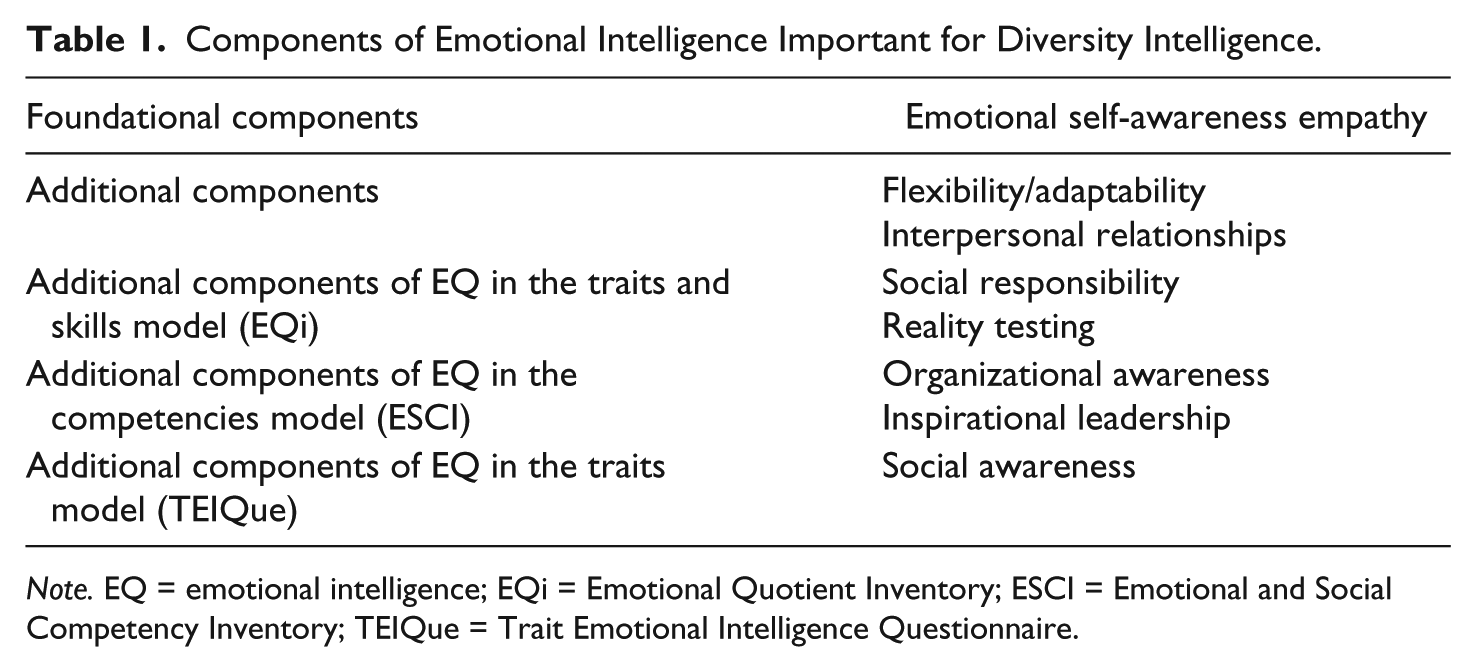
Note. EQ = emotional intelligence; EQi = Emotional Quotient Inventory; ESCI = Emotional and Social Competency Inventory; TEIQue = Trait Emotional Intelligence Questionnaire.
As Table 1 illustrates, in addition to the two fundamental aspects of EQ (emotional self-awareness and empathy), which are essential for DQ, adaptability, or flexibility, is an important contributor to DQ. Flexibility is the adaptation of emotions, thoughts, and behaviors to unfamiliar or changing circumstances, which are certainly relevant to DQ. A second element of EQ, which is also clearly valuable to enhanced DQ is interpersonal relationships, which is developing and maintaining mutually satisfying relationships (Hughes, 2014).
The EQi contains two additional EQ traits, which we believe have an important direct relationship with DQ: Social Responsibility and Reality Testing. Social responsibility is defined as a willingness to contribute to one’s society, groups, and the welfare of others (Bar-On, 1997). Reality testing is the capability to remain objective and view things as they objectively appear to be (Bar-On, 1997). Within the Emotional and Social Competency Inventory, we identified the two competencies of Organizational Awareness and Inspirational Leadership as also significant for DQ. Organizational Awareness is reading a group’s emotional currents, dynamics, and power relationships, whereas Inspirational Leadership is working to bring people together through inspiring and guiding (Boyatzis & Goleman, 2014). In the Trait Emotional Intelligence Questionnaire (Petrides, 2009), we included Social Awareness as a key contributor to DQ as it defines someone with excellent social skills. The leaders who participated provided several other insights into why they felt these different EQ dimensions are important for DQ, for example, It is interesting to think about this overlap considering the fact that we hear a lot about EI. Diversity intelligence gives us an opportunity to actually apply EI in a meaningful way. However, I don’t think it would be possible for me to recognize a diversity need or to be sensitive to others’ needs (emotional or tangible) if I didn’t have empathy. I think from EI, that’s the most important. I already think that emotional self-awareness is the most important aspect of EI to begin with because I need to understand myself in order to understand others. This MUST be important to diversity intelligence as well. Others such as social responsibility and social awareness are necessary as well. These concepts are definitely food for thought. (Leader 1) A leader (as well as any person) must have self-awareness—this is how you recognize your behaviors and needs, which allows you to recognize needs in others. To me, this is the key to diversity intelligence, recognizing needs of others and realizing other diverse strengths and styles. If I were to pick my top five, 1. Self-awareness, 2. Social Awareness, 3. Empathy, 4. Flexibility, and 5. Interpersonal Relationships. (Leader 2) I personally was not aware that there were so many models of emotional intelligence. This makes it hard to choose (because of the overlap). I am most familiar with Bar-On because I have taken the EQi a couple of times, so I would say empathy (when someone comes in my office, they just want me to understand where they are coming from; you have to have this for diversity intelligence), emotional self-awareness (I am constantly trying to dig deeper into my reactions about things and understand my decisions), Interpersonal Relationship (you must constantly try to build mutually satisfying relationships; and this may take more effort when people are more diverse), Flexibility (people have different strengths and different ways of doing things, so I have to allow people to play to their strengths. I cannot micromanage how someone completes a task. This incorporates many different aspects of diversity). (Leader 3)
In summary, there are two elements of EQ that are essential in the relationship with DQ: emotional self-awareness and empathy. Additional components of EQ that most directly relate to enhanced DQ include adaptability and effective relationships. These four parts of EQ (emotional self-awareness, empathy, adaptability, and effective relationships) are common among the different models of EQ. Social responsibility, reality testing, organizational awareness, social awareness, and inspirational leadership are further aspects of EQ spread across the different EQ models, which also deserve serious consideration when developing DQ.
Discussion
The topic of EQ has received a tremendous amount of attention from practitioners because of the great empirical and applied research support demonstrating its strong, positive relationship with key performance indicators, and also because of Goleman’s (1998) belief that EQ is a learnable skill, one that comes from experience and targeted development practices. When we examine the field of leadership development as a whole, a debate concerning whether leaders are born or made has surfaced countless times. Conger (2004) conclusively states that they are both born and made, implying the strong need for all leaders to develop skills in all areas of performance, whether in technical skill or knowledge, in EQ, or now in DQ. Conger (1992) outlines four different approaches to leadership development: personal development, conceptual understanding, feedback, and skill building. Although there is some evidence to suggest that EQ can be developed through traditional training (i.e., presentations, team-building, self-paced distance learning; for example, Sadri, 2012), the developmental tool of executive coaching has gained tremendous popularity in recent years (e.g., Passmore, 2007). Executive coaching can take many forms, as it is a customized development relationship between a leader and a coach utilizing all of Conger’s (1992) four development approaches to facilitate performance-enhancing behavioral changes.
Reinforcing DQ Through Coaching
The current authors argue that the use of executive coaching would be particularly helpful when targeting increases in EQ and DQ simultaneously. Passmore (2007) develops a model of executive coaching that incorporates six streams that flow together in a seamless manner: (a) developing the coaching partnership (establishes trust, credibility, empathy), (b) maintaining the coaching partnership (self-awareness, awareness of coach, adaptation of behavior), (c) behavioral change (based on self-awareness, problem-solving, and planning), (d) conscious cognition (based on cognitive–behavioral coaching interventions deepening the understanding between thoughts and behaviors), (e) unconscious cognition (focusing on cognitive processes that are outside of awareness), and (f) cultural context (which surrounds the model). Much of the potential to grow both EQ and DQ lies within self-awareness (both on the conscious and unconscious level). In Table 1, many of the leaders commented about the importance of emotional self-awareness. For example, “[T]his is how you recognize your behaviors and needs, which allows you to recognize needs in others. To me, this is the key to diversity intelligence.” Thus, developing individual self-awareness surrounding essential diversity-related thoughts, attitudes, and behaviors (i.e., bias, ethical blind spots) should increase both EQ and DQ. Coupling increased self-awareness with the great need to bring awareness to external ethical, legislative, and organizational issues within DQ, the above outlined process is likely to bring the realized behavioral changes that leaders are trying to develop in both intelligences.
An additional advantage of using executive coaching to build both EQ and DQ simultaneously would be that experienced coaches would have the ability to focus specifically on the EQ components most applicable to DQ (e.g., in Bar-On’s model: self-awareness and empathy, along with flexibility, interpersonal relationships, and social responsibility) while using specific diversity-related examples and applications. Thus, executive coaching offers the opportunity to increase EQ as it relates to DQ, as well as offers targeted development in DQ alone, uncovering unconscious bias and opportunities to gain knowledge of diversity concerns.
Implications
Hughes (2016) provides a detailed description of the consequences of poor DQ in the workplace beyond the obvious discrimination issues. These include no shared vision, disempowerment, low trust, and misalignment. These are described as chronic leadership problems that many have attributed to poor strategy, poor communication, or poor EQ. However, Hughes (2016) argues that each is related to low DQ. Thus, the ability of HRD practitioners, leaders, and executive coaches to target both EQ and DQ development together is promising for many leadership problems.
An additional implication is that much of the discussion has focused on how targeting development in EQ can also increase DQ; however, there are several areas in which DQ can inform or help increase EQ as well. One example is in the area of diversity literacy. When a leader has a greater depth of knowledge in diversity, proper terminology, and issues facing specific minority groups, he or she will be better able to build mutually satisfying relationships, provide appropriate empathy and support, as well as be emotionally expressive in an appropriately sensitive manner, increasing his or her EQ.
As Hughes (2016) suggests, there is little evidence to support the effectiveness of traditional diversity training. As discussed above, executive coaching provides an opportunity to leaders to develop both EQ and DQ simultaneously. Thus, it is recommended that coaches become familiar with the concept of DQ, become more informed on minority populations and inclusion issues, and implore leaders to explore their knowledge, feelings, and assumptions about protected classes. Although there are a number of different styles and approaches to executive coaching (Maltbia, Marsick, & Ghosh, 2014), discussing underlying issues related to stereotypes and biases may be a divergence from what is traditionally covered in executive coaching. However, this divergence is one that is necessary and will allow leaders to explore and develop their DQ in a safe environment.
Future Research and Conclusion
As the topic of DQ is relatively new, as is its relation to EQ, there are many empirical and applied research opportunities. It would be beneficial to examine the measurement of DQ, as well as the constructs of DQ and EQ together. From an applied perspective, it will be important to examine how coaches and leaders charged with developing others can gain knowledge and experience in DQ. For example, what type of additional education/knowledge/experience should a coach have before attempting to develop others in DQ?
Given the plethora of support for EQ in the both applied and empirical literature, the newer concept of DQ (Hughes, 2016) provides an important leadership development opportunity for human resource development researchers and practitioners. Proper self-awareness along with self-management is perhaps the most important key to leadership development. Thus, having a solid knowledge base in both EQ and DQ, coupled with a deep understanding of one’s owns thoughts, emotions, biases, and blind spots, will allow motivated leaders to achieve real behavioral changes as well as performance increases for themselves, their teams, and their organizations.
Footnotes
Declaration of Conflicting Interests
The author(s) declared no potential conflicts of interest with respect to the research, authorship, and/or publication of this article.
Funding
The author(s) received no financial support for the research, authorship, and/or publication of this article.