







Abstract
The Problem
As the discourse around employee engagement has continued to emerge as an interdisciplinary, intercultural, and interprofessional concept, the gap between research and practice of engagement still remains, making collaboration among HRD scholars and practitioners in developing an engaged workforce a huge challenge.
The Solution
To fill the gap between research and practice on engagement, ontological, epistemological, and focal views of various perspectives on engagement are reviewed. Conceptual commonalities and differences in the multiple definitions, theories, and frameworks of employee engagement are also discussed. By exploring the divergence and convergence in the engagement discourse, a common ground for collaborative HRD in developing an engaged workforce is identified. Finally, implications for HRD research and practice are provided.
The Stakeholders
The intended audience for this article is HRD scholars, practitioners, and employers interested in developing an engaged workforce and workplace.
Engagement is about putting our real selves into work, not simply working hard (Kahn, 2010). While credited originally to Kahn (1990) in his pioneering work of exploring psychological conditions of personal engagement in the workplace, interest in employee/work engagement has gained momentum in many fields, including vocational psychology (e.g., Schaufeli et al., 2002), nursing (e.g., Collini et al., 2015), human resource management (HRM) (e.g., Bailey et al., 2017), and human resource development (HRD) (e.g., Shuck et al., 2021). However, as the discourse around engagement has continued to emerge as an interdisciplinary, intercultural, and interprofessional concept, the gap between research and practice of engagement still remains, making collaboration among multiple stakeholders in developing an engaged workforce a huge challenge.
Over the past three decades, various, often inconsistent, definitions of engagement have flourished. For example, Shuck et al. (2017) defined engagement as an active, work-related positive psychological state operationalized by the intensity and direction of cognitive, emotional, and behavioral energy toward positive organizational outcomes. While the Gallup organization stated that “(engagement) is … the satisfaction, involvement, and enthusiasm of the employee at work” (Harter et al., 2002, p. 417). As Sambrook (2021) noted, defining engagement from different perspectives makes the conceptual convergence difficult. Moreover, the debate over the academic-practitioner divide on engagement continues and threatens collaboration between scholars and practitioners in developing effective engagement programs. Bailey (2022) argued that practitioners rarely draw on academic knowledge when designing or conducting engagement programs. Therefore, the divergence continues to make the collaboration difficult.
The issue is more critical when considering the identity of HRD in building impactful engagement interventions. There is also concern that what is the role of HRD in cultivating an engaged workforce, and how HRD can contribute to that (Y. Lee et al., 2017; Valentin, 2014). As an applied discipline, HRD differentiates itself by “pioneering approaches to practice-based research rather than mirroring the path of the established social science” (Kuchinke, 2020, p. 120), and creating systematic theories and practice that develop human resources (AHRD, n.d.). HRD professionals are proud of being transformative agents who help employees and organizations thrive through training, learning, and development (McLean & McLean, 2001; Shuck & Rocco, 2014; Swanson, 2001). Nevertheless, the evolution of HRD is not without criticism. Torraco and Lundgren (2020) called out the need to strengthen HRD research to address practical concerns and needs. Without a stronger impact on organizational strategy, reaching academic maturity in HRD is just “a hollow victory” (Kuchinke, 2020, p. 120). Thus, how can HRD leverage its professional knowledge and skills to create more impactful engagement interventions? This is still a challenging question for both HRD scholars and practitioners.
In sum, to address the gap between research and practice in developing an engaged workforce, creating meaningful and impactful engagement interventions, two questions should be further discussed: • What we talk about when we talk about employee engagement? • How can HRD scholars and professionals work together to foster employee engagement?
Purpose Statement
In response to these important issues, one promising way to open the door for constructive dialogue is to identify common ground between scholars and practitioners by exploring conceptual commonalities and differences in the multiple definitions, theories, and frameworks of engagement. The purpose of this article is to review multiple theories and perspectives on engagement in an effort to advance the academic-practitioner dialogue with the goal of developing impactful engagement interventions.
This article is organized as follows. First the theoretical background of a collaborative HRD approach is introduced, followed by a literature review on multiple perspectives of employee engagement, examining the underlying assumptions and focal points. Next, the identity and role of HRD in employee engagement is reviewed. Finally, discussions and implications for HRD research and practice are provided. While more comprehensive reviews of the engagement literature have been published (see Sambrook, 2021 and Shuck, 2011), this article primarily focuses on the gap between scholars and practitioners in promoting engagement in the workplace.
Theoretical Background
Evolutionary realism (Campbell, 1988; Van de Ven & Johnson, 2006), which acknowledges theory and practice are two distinct forms of knowledge, provides a forward-looking philosophy of science to reconcile the tension among the different perspectives of engagement. It assumes objectivist ontology and selectionist evolutionary epistemology, which lie between positivism and relativism (Van de Ven, 2007). Specifically, evolutionary realism recognizes that social reality or truth is out of our current knowledge, which is multi-faceted. Current theories and models proposed by scholars, therefore, only capture partial facets of knowledge (Bhaskar, 1998; Rescher, 1995). Evolutionary realism also acknowledges that we can approach the ideal truth by comparing logical arguments and empirical evidence among candidate theories. Hence, we can select theories and models with a better fit and solve a phenomenon and sift out less appropriate ones (Campbell, 1988). By assuming evolutionary realistic ontology and epistemology, evolutionary realism provides a robust theorical background for HRD scholars’ and practitioners’ work toward a collaborative approach in making engagement practices impactful, with both rigor and relevance.
To analyze the conceptual commonalities and differences among multiple theories and frameworks of engagement, adopted a semi-systematic review (Callahan, 2014; Snyder, 2019) is adopted as the method to compare the key assumptions and theoretical underpinnings of the perspectives. Rather than systematically analyzing and integrating different sources of knowledge on a certain topic like the integrative literature review method (Torraco, 2016), in a semi-systematic review, the researcher recognizes recent developments by focusing on selected literature (Snyder, 2019).
Engagement, work engagement, employee engagement, human resources, and human resource development were used as the keywords to identify relevant literature for this article. Multiple databases were searched including Google Scholar, Web of Science, and Academy of Human Resource Development (AHRD) conference proceedings and journals. In addition, practitioner publications were searched from the following sources: Society of Human Resource Management (SHRM), Association for Talent Development (ATD), Harvard Business Review, and human resource consulting firm reports. In sum, 64 journal articles, books, book chapters, and professional reports were identified for further review.
Literature Review
Drawing on the academic and practitioner literature, six theories/frameworks of engagement were identified that have been widely embraced by HRD scholars and professionals: (a) Kahn’s personal role engagement; (b) job demands-resources model; (c) social exchange theory; (d) critical engagement framework; (e) consultancy model; and (f) strategic alignment model. Each framework reflects a unique philosophy of engagement, and sheds light on the practical implications of developing an engaged workforce. Supplemental Table 1 compares the various perspectives, providing a snapshot of selected literature. The table includes information on the theories/frameworks, key features and focal points, basic assumptions, implications, and example articles.
Kahn’s Personal Role Engagement
Based on previous scholarly work on sociology and organization behavior, Kahn (1990) first developed the term personal engagement and personal disengagement to describe the phenomenon that people attach to or detach from their real selves in their work role performance. More specifically, engagement was conceptualized as the combination of self-employment (i.e., people prefer to have energy in their work role performance) and self-expression (i.e., people express their true selves in the role, including their identity, thoughts, and feelings). Kahn (1990) then defined engagement as “the simultaneous employment and expression of a person’s ‘preferred self’ in task behaviors that promote connections to work and to others, personal presence, and active full role performances” (p. 700).
To foster personal engagement, three essential psychological conditions are required: meaningfulness, safety, and availability (Kahn, 1990). Meaningfulness means the degree to which employees feel that it is meaningful to bring their real selves to their work role performance (e.g., sense of achievement, dignity, and value). Safety concerns whether is it safe for employees to express their real selves (e.g., voice and self-image) in the workplace, while availability asks if employees have the necessary tangible or intangible resources to help them complete their work role performance.
Kahn also acknowledges that engagement is not simply a psychological state. Instead, it should be understood as a socially embedded phenomenon that is context-contingent: “those work contexts, mediated by people’s perceptions, create the conditions in which they personally engage and disengage” (p. 695). Moreover, the differences in the dynamic workplace environment, job conditions, and employee experiences imply that engagement is not static but fluctuates over time, like momentary ebbs and flows (Bailey et al., 2017; Shuck et al., 2017). Ontologically, Kahn (1990) views engagement as a personal psychological state, which reflects employees’ experience of being engaged in the workplace and is affected by various work conditions. Epistemologically, his approach of engagement encourages researchers to look at this phenomenon from both positivism and interpretivism stances. Kahn’s conceptualization of personal engagement is a remarkable starting point of scholarly inquiry and created space for future studies to examine the complex conditions related to cultivating engagement in the workplace.
Job Demands-Resources Model
Grounded in the job burnout literature, the job demands-resources (JD-R) model was originally developed by Demerouti et al. (2001) to analyze various antecedents of job burnout. According to Bakker and Demerouti (2007), factors that influence job burnout and engagement can be classified as two general categories regardless of the occupational differences: job demands and job resources. Job demands refer to job-related features that require sustained physical, psychological, and/or social efforts from an employee that can result in physiological and/or psychological costs. Job resources refer to job-related features that help an employee achieve work goals, alleviate stress from job demands, and advance personal learning and development. As a result, a high level of job resources and limited demands promote employee engagement while a high level of job demands and limited resources lead to employee burnout.
The JD-R model has dominated the engagement research, particularly in the positivism psychological approach. Scholars have recently refined these concepts to expand the boundary of the model. For example, focused on the working experience of employees and integrated ideas from Kahn’s engagement theory and the JD-R model, Shuck et al. (2017) defined engagement as an active, work-related psychological state operationalized by the intensity and direction of cognitive, emotional, and behavioral energy toward positive organizational outcomes. J. Y. Lee et al. (2020) identified five categories of necessary resources to cultivate engagement, including organizational, social, job, home, and personal resources. Kwon and Kim (2020) also explained why organizational, interpersonal, task, and personal resources can promote employee engagement and innovative behaviors by incorporating social exchange theory (SET), conversation of resources (COR), self-determination theory (SDT), and broaden and build theory (B&B), into the JD-R framework.
Overall, the JD-R model assumes that engagement is a positive psychological work-related state that leads to positive outcomes, such as job attuites and performance. Two fundamental job characteristics—resources and demands—interact through several processes to influence engagement. When resources exceed demands, engagement occurs (Bakker & Demerouti, 2014; Schaufeli, 2014). Thus, it has practical implications in that engagement could be enhanced by identifying and developing these important drivers.
Social Exchange Theory
Social exchange theory (SET) (Emerson, 1976) assumes that workplace relationships evolve over time into trusting, loyal, and mutual commitments if all parties abide by certain principles of exchange. Therefore, individuals tend to return what they have received as an obligation resulting from numerous reciprocal interactions (Cropanzano & Mitchell, 2005). For example, when employees receive positive resources (e.g., rewards, benefits, organizational support) from their employer, they feel obligated to be engaged as a return to the organization. Conversely, employees disengage from their work performance if they do not obtain those resources (Schaufeli, 2014).
There has also been emerging evidence for the SET model in the Asian context where interpersonal and social relations are emphasized in the workplace. For instance, Xi et al. (2018) collected a sample of 876 employees from 109 Chinese companies to explore the association between the employee-organization relationship with job and organization engagement. They suggested that the interaction between an employee’s expected contribution and the investment provided by the organization is positively correlated with employee engagement. Using a sample of 812 executives of the major Indian power sector, Mohanty and P (2020) identified four resources in the organization that influence employee engagement: (a) organizational culture; (b) co-worker trust; (c) supervisor trust; and (d) organizational trust. They indicated that the three constructs related to trust (co-worker trust, supervisor trust, and organizational trust) partially mediate the relation between organizational culture and employee engagement. In Song et al.’s (2021) work of developing Korean Employee Engagement Scale (KEES), they argued organizational engagement as an important dimension of employee engagement because it captures the unique cultural background in Korean organizations.
Critical Engagement Framework
In contrast to traditional psychometric inquiry on engagement, the critical approach to examining engagement emerged with a focus on the social construct nature of engagement. Although researchers have employed various lenses to explore employees’ experiences of being engaged or disengaged, all lenses have followed an interpretive epistemology. The critical engagement framework primarily concentrates on two issues of engagement: (a) criticism of performance-oriented engagement practice, and (b) questions about conventional decontextualized approaches to understanding engagement.
The root of the criticism on performance orientation in engagement practices can be traced back to the debate of soft and hard management approaches (Sambrook, 2012). The hard approach prioritizes employee productivity, efficiency, and performance as the ultimate goal of developing engagement, whereas the soft approach emphasizes employee-centered practices that aim to promote positive workplace conditions and relationships (Bailey, 2022; Shuck & Rocco, 2014; Valentin, 2014). This paradox parallels Kahn’s (1990, 2010) concern that the emphasis on performance poses a serious threat to employees’ self-expression (voice), which, in turn, prevents stakeholders from having a constructive dialogue to solve workplace problems. Consequently, this emphasis on performance has failed to truly engage employees due to meaningless work, an unsafe workplace, and conflicts of interest. Instead of seeking to leverage performance through an engaging workforce, understanding the conditions to nurture performance is more important (Bailey et al., 2017; Shuck & Rose, 2013).
Critical scholars have cautioned against the dominant positivistic paradigm that assumes a stimulus-response schema of employee behaviors but fails to consider the influence of various contextual factors in shaping the meaning, purposes, and conditions of engagement (Fletcher et al., 2020; Guest, 2014; Truss et al., 2014). Through the lens of power and privilege, Shuck et al. (2016) asked who controls the work context, who defines the value of work, and who benefits from a constructed ideology of engagement. They suggested that the power and privilege in an organization profoundly influences the conditions of engagement. Linking engagement with business ethics and employee well-being, Francis and Keegan (2020) discussed how economic and industrial environments sharpen the tensions of an employment relationship in which ethical concerns about engagement strategies have emerged. Based on an intersectionality approach, Dillard and Osam (2021) explored how diversity and intersectional identities play a critical role in determining work meaningfulness, psychological safety, and socioemotional resources, all of which promote employee engagement.
Consultancy Model
Although scholarly inquiry has advanced our knowledge of engagement, the rise of business interest in engagement has also been promoted by consultancy firms that claim to have expertise in engagement (Macey & Schneider, 2008; Schaufeli, 2014). The Gallup organization first examined the relationship between employee engagement and business unit outcomes (e.g., customer satisfaction, employee productivity, and turnover intention). Based on their findings, they defined engagement as the “individual’s involvement and satisfaction with as well as enthusiasm for work” (Harter et al., 2002, p. 269). Another human resource consulting firm, Towers Perrin, portrayed engagement as “employees’ personal satisfaction and a sense of inspiration and affirmation they get from work and being a part of the organization” (Towers Perrin, 2003, p. 5). According to Aon Hewitt, 2015, engaged employees consistently demonstrate three behaviors: (a) say: they speak positively about the organization; (b) stay: they have an intense desire to be a member of the organization; and (c) strive: they go the extra mile to contribute to business success.
This approach has gained popularity among practitioners and treated engagement as a desired employee outcome (e.g., positive attitude or behavior in task performance and toward organizational values). Therefore, some companies often overlap engagement with satisfaction, commitment, and involvement and use them as a proxy for employee engagement (Shrotryia & Dhanda, 2020) or use engagement as a combination of multiple job-related attitudes (Nimon et al., 2016). Following this lead, engagement has been proposed as the bridge that promotes desired organizational results. In another words, if they keep employees happy, their customers are happy.
Strategic Alignment Model
Another popular approach in the practitioner community is the strategic alignment model. This model reflects an attempt to connect engagement with business strategy, and views it as an organizational-level concept. Some professionals have argued that engagement is a critical part of the organizational strategy. Thus, it is often included in human resource practices for talent management and employee retention (Bailey, 2022; Shrotryia & Dhanda, 2020). From an organizational perspective, engagement involves engaging employees so they can thrive, which leads to organizational success. It also enhances employees’ belief in collective values and promotes a sense of attachment to the organization. These thoughts echo HRM professionals’ view of engagement as a management practice to support organizational goals by aligning multiple organizational components (Albrecht, 2010; Bailey et al., 2017; Robertson & Cooper, 2010; Truss et al., 2013).
Some practitioners also refer to engagement as a strategic consequence of achieving organizational alignment at the individual, job, departmental, and organizational levels. For example, Armstrong et al. (2018) defined engagement using outcome terms such as “an organizational climate where people choose to give the very best of themselves at work” (p. 8). Gifford and Young (2021) suggested that the core of engagement relies on “mutual gains, leading to the good of the employer and the good of employees in tandem” (p. 18). Connected to this perspective is Alagaraja and Shuck’s (2015) proposition that “the state of engagement is realized and contingent on the ability of the organization to drive alignment at all levels” (p. 30). They suggested that engagement occurs only when employees align themselves with their job and organization, and when organizational practices are aligned with the embraced values and goals. In sum, the strategic alignment perspective explains the meaning and purpose of engagement in organizations from a management lens.
Situating Human Resource Development in Employee Engagement
As an interdisciplinary profession, HRD focuses on the nexus between human functioning (performance) and flourishing (development). HRD professionals are dedicated to advancing workforce learning and training, and advocating for organizational performance, change, and sustainability using a transdisciplinary approach (Jacobs, 2017; Kuchinke, 2020; McCracken & Wallace, 2000; McLean & McLean, 2001; Swanson, 2001; Wang, 2020). In addition, HRD exists in a dialectical position between serving the interests of the organization and those of employees (O’Donnell et al., 2006), along with supporting the organizational strategy and championing employees so they can thrive at work (Sambrook, 2021). From Kahn’s theory to contemporary business practice, the essence of the engagement discussion has inherently relied on employee performance and organization development, which resonates strongly with the target of HRD. Thus, it is not surprising that engagement is positioned at the center of HRD research and practice (Yoon & Chae, 2022), and vice versa.
Driven by the objective of stimulating organizational transformation through individual and collective learning and development, three types of HRD-based engagement practices have emerged: organization development (OD), talent development (TD), and career development (CD). Optimizing the organizational structure, process, and strategy, OD is about building a positive workplace, valuing employees’ opinions, advancing efficient communication, and teamwork (Shuck et al., 2014). OD also emphasizes using the appreciative inquiry technique to develop organizational leadership capacity (Kaye Hart et al., 2008). TD considers the opportunity of learning and growth to be an important driver of engagement. It focuses on mentoring, coaching, and other formal and informal training to provide technical and emotional resources, which, in turn, empowers employees to succeed (Sanyal & Rigby, 2017; Shuck & Rocco, 2014). Lastly, CD focuses on helping employees create clear career goals, matching their interests with the job, and using career mapping (Webb et al., 2017), job design, and crafting (Truss et al., 2014) to develop their career paths and climbing the corporate ladder.
In line with Knight et al.’s (2017) finding on engagement interventions, HRD-based engagement programs emphasize three aspects: (a) building organizational, job, and personal resources; (b) creating a positive workplace culture; and (c) linking physical and psychological well-being with employee engagement. HRD’s unique identity makes it both an organizational change agent and an advocate for employee development. Dancing between the hard and soft approach of engagement, HRD practitioners consistently focus on creating a common space to maximize job performance and enhance workplace learning.
However, studies have also found ambiguous results regarding the effectiveness of engagement practices. Researchers have reported that the direction and magnitude of intervention effects vary in different organizational, industrial, and cultural settings (Albrecht, 2010; Knight et al., 2017). These efforts are significantly affected by how organizations define engagement, measure it, and interpret the results (Fletcher et al., 2020; Y. Lee et al., 2017; Rothmann, 2014). Thus, HRD professionals must understand the impact of contextual contingencies on the effectiveness of interventions that promote engagement.
Toward the Common Ground in Developing Employee Engagement
Through the literature review, the theoretical foundations that framed the gap between engagement research and practice are examined. Understanding the divergence while focusing on the common ground moves the academic-practitioner collaboration forward in a productive way. In this section, the divergent ontologies of engagement that shape the intentions, epistemologies, and methods of engagement are discussed. Next, the convergence in the engagement discourse which leads to a starting point for filling the gap is explored.
Divergence in Meaning and Purpose of Engagement
The divergence within the engagement discourse involves different understandings of the meaning of engagement and the purpose of doing engagement and reflects the diverse ontological views of engagement (see Figure 1). Academics tend to believe that engagement involves (a) a psychological state of employees, including cognitive, emotional, and behavioral engagement toward self-expression and self-employment (Kahn, 1990; Schaufeli, 2014; Shuck et al., 2017), and (b) a socially contextualized process that reflects employees’ work experience, with numerous external and organizational influences that form the conditions of engagement (Fletcher et al., 2020; Sambrook, 2021; Valentin, 2014). From this perspective, employees’ engagement is influenced by how they identify themselves in the workplace, how they perceive the organizational resources and demands, and the interactions between themselves and other organizational members. However, practitioners conceive engagement as (a) employees’ positive outcomes toward work and the organization, which is focused on the observed facets of the engagement (Bradley & Olivier, 2019; Gifford & Young, 2021), and (b) a strategic part of organizational alignment (Armstrong et al., 2018; Bailey, 2022). Thus, engagement should be situated within a broad organizational strategy framework. In addition, the intention to better support organizational goals denotes the purpose of doing engagement for practitioners. Conceptual map of the essence of engagement.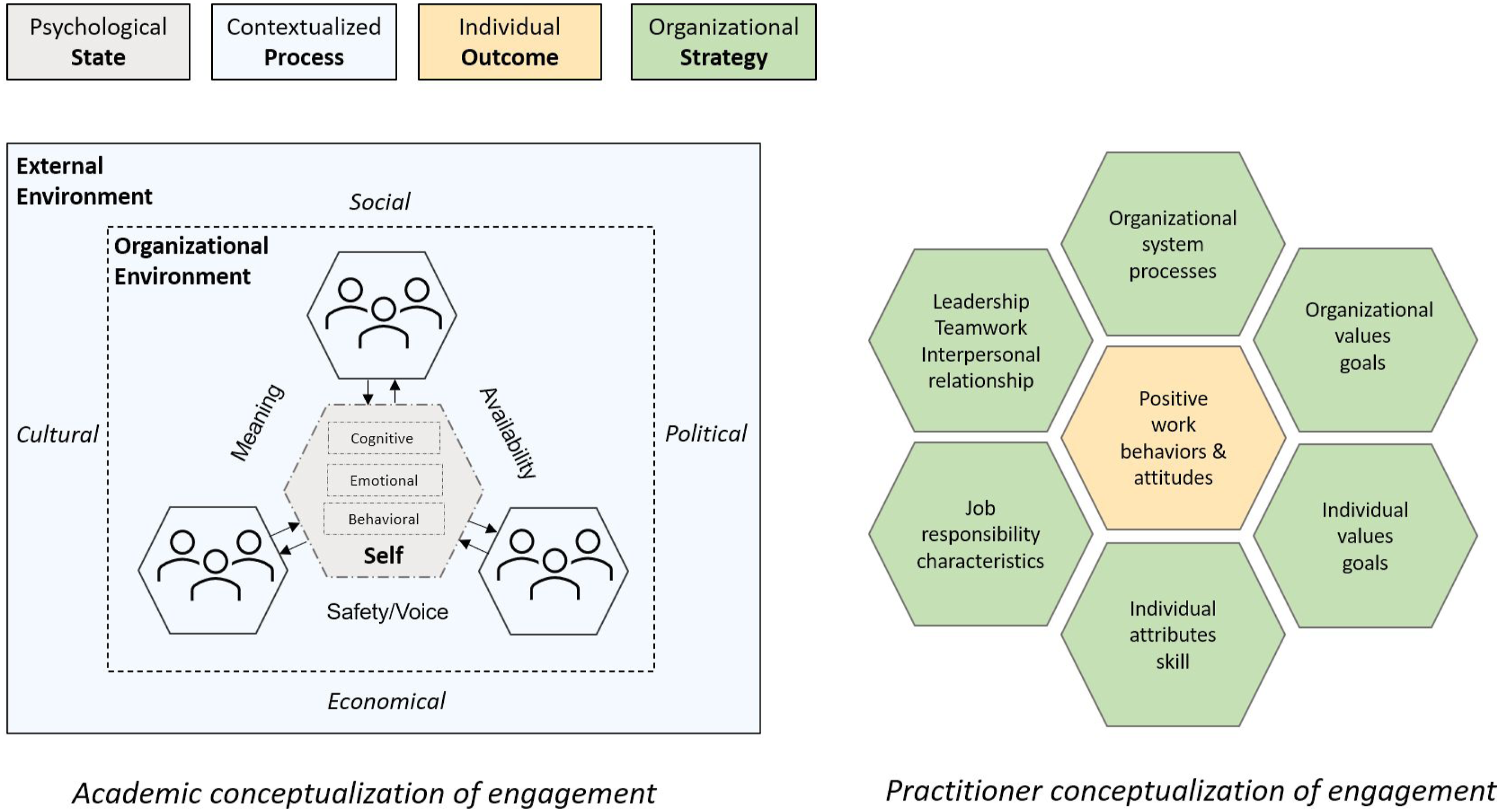
This finding, in partial accordance with previous discussions on the soft and hard approaches of engagement (Jenkins & Delbridge, 2013), suggests two foci of developing engagement: (a) improving employees’ sense of engagement to reach individual and organizational development goals, resulting in high work performance; and (b) developing engagement to align multiple organizational components to support business performance and strategy. The former highlights the temporal priority of analyzing employees’ interests and the context-sensitive conditions of personal attributes, and then taking action to adjust the organizational environment in response to employees’ needs. In contrast, the latter requires a systematic examination of alignment across organizational, team, job, and individual levels. Engaged/disengaged work behaviors, from this perspective, demonstrate how well alignment strategies are executed and sustained in the organization.
Convergence in Understanding and Developing Engagement
Although the disagreement that scholars and practitioners have in conceptualizing engagement is salient, there is emerging agreement about adopting a pluralistic understanding of engagement and developing engagement using a contingency approach. Both scholars and practitioners are beginning to realize the multidimensional nature of engagement. In contrast to a psychometric view of engagement, recent practitioner reports have suggested the significance of conceiving engagement as an umbrella term (e.g., Armstrong et al., 2018; Gifford & Young, 2021). This perspective highlights the cognitive, affective, and behavioral aspects of engagement (Shrotryia & Dhanda, 2020), and locates engagement at different levels (individual, team, and organizational). Academics and practitioners converge on the unique connotation of engagement, which should be differentiated from satisfaction, involvement, and commitment. This perspective shows that engaged employees are dedicated to both individual and organizational goals (Saks, 2006), they bring their real selves to work (Kahn, 2010), and their personal engaged/disengaged behaviors are embedded in the organizational dynamics and employment relations (Bradley & Olivier, 2019).
Discussions around the dark side and the gray space of engagement have also resurfaced in both the academic and practitioner literature. Scholars have cautioned against prettifying the consequence of engagement programs, and have asked whether engagement is always good for employees and the organization (Bailey et al., 2017; Fletcher et al., 2020). The relentless pursuit of engagement is problematic when it is assumed that higher engagement is the proxy of higher performance. If that is the case, engagement practices will intensify concerns about commodification of labor in today’s capitalistic economy (Ardichvili & Harmon, 2022; O’Donnell et al., 2006), and prevent professionals from developing a humanized, safe, and meaningful workplace.
Similarly, practitioners have noticed that reliance on performance may lead to pseudo-engagement, which implies that employees are engaged in personal tasks but not engaged in teamwork, or employees seem to be proactively engaged but they are “stretching the workload to fill time, working slowly so as not to be given more work” (Armstrong et al., 2018, p. 15). A similar concept, (dis)engagement with reservation, suggests that employees may be engaged and disengaged simultaneously for different reasons (Shuck et al., 2016). Rather than simply conceiving engagement as working hard, employers must realize that a temporary detachment from work is also necessary for employees to restore energy and better engage in the work role over a long time. The convergence of critical analysis and evidence from current literature reveals that engagement, as a multilevel concept, should be understood from a wider context where both the costs and benefits are noteworthy.
Both parties also agree that the conditions for fostering engagement are context-dependent. To develop engagement in organizations, two general approaches are needed: resource enrichment and culture building. That is to say, engagement could be cultivated through the conditions where the organization offers supportive resources as well as creates a positive workplace culture. However, employees decide whether to bring their real selves and full energy to their work roles. This decision is contingent on how employees perceive the organizational resources, demands, structures, power, culture, and values as well as how they internalize the whole process to support their unique identities and make work meaningful. The conditions of engagement based on multiple socio-structural factors affect engagement through interaction with the employees’ self-evaluation system. In this process, employees use multiple lenses to make sense of organizational components and job characteristics, along with their assessment of safe self-expression in the workplace. Such variation in perspectives implies that the context of engagement matters. Due to the variation in relevance and experience of engagement across various settings, researchers and practitioners need to take a contingency approach to promote engagement in different contexts.
To help academics and practitioners work through the tensions, the following arguments for considering engagement are made: • For individuals, engagement is about putting their real self into their work role performance, and bringing their full cognitive, emotional, and behavioral energy to meet organizational goals. • Employees observe and gauge how engagement is defined and executed in the organization to form their own understanding of engagement. • For organizations, developing engagement is not only about improving work performance, but also aligning the organizational goals with individual interests for mutual gains. • To develop a sustainable engaged workforce, the organization must recognize the costs and benefits of engagement, as well as the wider context in which they are embedded. • Engagement programs should be developed based on the aligned meaning and the purpose of engagement; it must be implemented and evaluated through a contingency approach that acknowledges the contextual influences.
This section outlined the findings from the literature and provided the basis for academics and practitioners to work together toward a collaborative approach for developing an engaged workforce. Based on the key issues identified in the review, implications for HRD scholars and practitioners are discussed next.
Implications for Human Resource Development Research
The extant literature highlights the perspectives of managers and HR leaders on the significance of fostering engagement in organizations (Knight et al., 2017; Kwon & Park, 2019; Truss et al., 2014). However, there has been limited research on how employees conceptualize engagement and how this affects engagement programs. This raises critical questions that need to be explored further. For example, how do employees perceive the meaning and the purpose of developing engagement in their organizations? And how does such perception shape employees’ experience of being engaged or disengaged? To develop a full picture of engagement, employees’ perspective should not be ignored (Y. Lee et al., 2017), and the impact of employment relationship on engagement should be emphasized (Francis & Keegan, 2020; Shuck & Rocco, 2014). Hence, HRD researchers must engage all relevant stakeholders in problem formulation, and develop relevant research to address practical concerns and needs.
Another question that deserves further exploration by HRD scholars is: How do engaged employees contribute to the long-term growth and profitability of the company? As noted by Valentin (2014), employee engagement is not a concern in some business models because organizations can still focus on the productivity to earn profits without engaged employees. Nonetheless, the performance-driven business model has been shown to be detrimental to organizational and employee development (Ardichvili & Harmon, 2022; Jenkins & Delbridge, 2013), and a threat to organizational diversity and justice (Byrd, 2018; Dillard & Osam, 2021). To understand how an engaged workforce can drive organizational growth and development, case studies and longitudinal research are needed to demonstrate the benefits of engagement for organizations.
Implications for Human Resource Development Theory
Although the discussion of engagement has expanded to non-Western contexts, theory is still lacking on the cultural impact on employee engagement and its core elements. Meaningful work, for example, is a popular topic among HRD scholars and is closely linked to engagement (Bailey et al., 2019). According to Chalofsky (2003), meaningful work involves living and working with values, purposes, integrity, and striving for overall well-being. Researchers have examined that work meaningfulness is an underpinning factor that positively connected to employee engagement in Western organizations (Fairlie, 2011; Rothmann, 2014). However, Fang and Kim (2019) claimed that work meaningfulness has unique ethical attributes that either positively or negatively affects engagement in different situations. Recent studies also suggested that meaningful work should include the sense of being a member of the organization when considering engagement in Asian organizations (Shrotryia & Dhanda, 2020; Song et al., 2021).
In short, to bring a more nuanced understanding of engagement in various cultural contexts, more research is needed to expand the theoretical boundaries of engagement and to assist HRD professionals in maintaining an engaged workforce through learning and training interventions. As McLean and McLean (2001) suggested, HRD-based interventions will be more effective in non-Western contexts when cultural differences are considered.
Implications for Human Resource Development Practice
HRD practitioners are positioned at the center of workforce training and organizational development. Understanding how engagement may be conceptualized by all stakeholders is important for HRD professionals to examine the context-dependency meaning and purpose of engagement in a given organization. Different individuals within an organization, with varying identities, power, and privilege, may have inconsistent or contradictory understandings of engagement (Dillard & Osam, 2021; Shuck et al., 2016). Even when organizations recognize the organizational need to develop engagement, employees may not find that participating in the intervention is meaningful (Fang & Kim, 2019). If that is the case, disregarding employees’ opinions will make engagement initiatives unproductive, which could lead to pseudo-engagement (Armstrong et al., 2018). Therefore, HRD professionals must understand the meaning of being engaged and disengaged for the employee, employer, and organization before conducting interventions. An aligned working definition of engagement should be developed to ensure that the engagement projects are embraced by all stakeholders.
In addition, HRD practitioners should be aware of the potential adverse outcomes of engagement programs and strive to achieve sustainable engagement within the organization. Multiple engagement scales have been applied to help organization identify engaged/disengaged employees (Shuck et al., 2017). However, some employers may interpret these engagement measures narrowly to focus on results rather than implications, particularly in performance-oriented organizations (Guest, 2014; Shrotryia & Dhanda, 2020). Then, disengaged employees or employees who have low engagement might be labeled as underperformers who are no longer valuable resources for the organization. In contrast, highly engaged workers will be rewarded and recognized. Consequently, such organizational marginalization of employees based on engagement levels will lead to workplace injustice and discrimination, resulting in disengagement and pseudo-engagement issues. As Byrd (2018) pointed out, HRD professionals have a moral duty to counter this challenge and create a justice and equitable workplace environment for employee development. HRD practitioners, therefore, need to work with researchers and stakeholders to answer the following questions: What are the positive and negative consequences of engagement programs? Can we develop a comprehensive framework to measure and cultivate long-term engagement while considering equity and sustainability? As we look into the future, HRD practitioners and scholars must engage in ongoing dialogue to ensure engagement projects are inclusive, adaptable, and valuable.
Conclusion
Grounded in the mission to bridge research and practice in HRD (AHRD, n.d.; Kuchinke, 2020), this article expanded the effort by comparing diverse perspectives of engagement, and identifying common goals in the development of an engaged workforce. Balancing employee-centered and performance-centered approaches of engagement can be challenging, yet creating positive and supportive conditions for engagement to flourish is achievable. As the concept of engagement continues to evolve in the coming years, it is a new chapter for HRD researchers and practitioners to reunite. HRD scholars and practitioners should collaborate toward a shared goal of developing impactful engagement interventions. A collaborative HRD, combining scholarly and industrial insights, has the potential to influence a variety of stakeholders to stimulate organizational change and appreciate contextual contingencies.
Supplemental Material
Supplemental Material - Bridging the Gap Between Research and Practice of Engagement: Toward a Collaborative Human Resource Development
Supplemental Material for Bridging the Gap Between Research and Practice of Engagement: Toward a Collaborative Human Resource Development by Bo Fang in Advances in Developing Human Resources
Footnotes
Declaration of Conflicting Interests
The author(s) declared no potential conflicts of interest with respect to the research, authorship, and/or publication of this article.
Funding
The author(s) received no financial support for the research, authorship, and/or publication of this article.

Supplemental Material
Supplemental material for this article is available online.
Author Biography
References
Supplementary Material
Please find the following supplemental material available below.
For Open Access articles published under a Creative Commons License, all supplemental material carries the same license as the article it is associated with.
For non-Open Access articles published, all supplemental material carries a non-exclusive license, and permission requests for re-use of supplemental material or any part of supplemental material shall be sent directly to the copyright owner as specified in the copyright notice associated with the article.
