







Abstract
The Problem
Virtual communities of practice (VCoPs) share many features of digital learning networks (DLNs). Their work is ecosystemically connected, and they operate on overlapping continuums. This makes understanding how they function and decisions about which term to use difficult.
The Solution
This article outlines points of convergence and divergence between VCoPs and DLNs. It explains how the term, complexly coevolving, clarifies their brackish connections, and the proposed term, glocal peer-learning practice networks (GPPNs), is needed to describe their intersecting existence.
The Stakeholders
Organizations and networks that seek to quickly and comprehensively describe the scale and scope of their work. Researchers who seek to unify terminology for better evaluation and advancement of the field across societal sectors. Practitioners and funders who aim to develop or strengthen work against issues of global concern using combined features of VCoPs and DLNs.
Keywords
Connectivism shares that to make sense of the challenges we face, we must learn and act with others through digital networks to solve them (Siemens, 2005, 2006; UGA Mary Frances Early College of Education, 2021a). By sharing unique ideas and knowledge gained from formal, informal, and incidental learning experiences (Watkins et al., 2018), digital networks develop collective intelligence (Hogan et al., 2023) with which to “poke at the corners of a problem” (UGA Mary Frances Early College of Education, 2021b, p. 32:23). Though not all information shared or actions taken through digital network collaboration will resolve a challenge, the collective intelligence generated can accelerate adaptive problem-solving processes (Heifetz et al., 2009; Hogan et al., 2023). Moreover, through “combinatorial creativity” (USC, 2014, p. 0:49), collective intelligence can lead to more effective and efficient responses (Hogan et al., 2023). Thus, knowledge flow in digital networks “can be likened to a river that meanders through the ecology of an organization” (Siemens, 2005, Connectivism section, para. 4). Therefore, to stay rich in actionable knowledge and scale impact amid complexity, we must stay connected to and engaged in digital networks (Siemens, 2005, 2006; UGA Mary Frances Early College of Education, 2021a).
Although if knowledge flow through digital networks is akin to rivers, it is like the ocean in communities of practice (CoPs). The ocean is the largest reservoir, but its waters are not stagnant; they are constantly in motion, and CoPs help members discover needed skills, both new and old, to ride out the tidal waves of change. Virtual communities of practice (VCoPs) that coevolve in complex ways exhibit elements of both (Eller, 2024). They are the brackish waters, where the freshwater of the river meets the salty water of the ocean, transforming the environment around it into an estuary of rich existence.
To explain this assertion, I begin by comparing organizations and networks. Then, I outline the dimensions of learning organizations (Watkins & Marsick, 1993) as compared to those of (digital) learning networks (Downes, 2009; Ehrlichman & Sawyer) and (virtual) communities of practice (Wenger-Trayner & Wenger-Trayner, 2015). Finally, I conclude with how VCoPs, which coevolve in complex ways (Eller, 2024), demonstrate elements of both and propose new terminology to reference the interdisciplinary gathering and collaboration of such VCoPs.
Organizations and Networks
Formal organizations are entities that traditionally have more hierarchical structures and defined boundaries (Harmon, 2019). Yet, in more adaptive organizations, structures can be decentralized, and boundaries made permeable through global digital platforms (Snow & Fjeldstad, 2023). Comparatively, “networks are not associated with entities. Networks are agile, they can reform in a moment. Networks are available to all regardless of place in society. Networks are not hierarchical. They belong to complex systems. They evolve” (TEDx Talks, 2012, p. 2:47). However, networks often require coordination (Ehrlichman & Sawyer, 2018). Furthermore, there are many organizations that operate on a scale larger than some networks. The lines between the two are blurred, and maybe that is the point; they should be considered along continuums of operation and interdependency (Siemens, 2006).
Learning Organizations, Learning Networks, and Communities of Practice (CoPs)
Learning organizations “create continuous learning opportunities, promote inquiry and dialogue, encourage collaboration and team learning, establish systems to capture and share learning, empower people toward a collective vision, connect the organization to its environment and capacity building for change” (Watkins & O’Neil, 2013, p. 135). They are different from organizational learning, which is more aligned with knowledge management or organizational memory (Watkins & Marsick, 1993; Watkins & O’Neil, 2013).
Similarly, it could be said that networked learning is simply passing information along digital channels while learning networks enable “participants to share information and learn from one another” (Ehrlichman & Sawyer, 2018, para. 1). According to Downes (2009), effective network learning is decentralized, distributed, disintermediated, disaggregated, dis-integrated, democratic, dynamic, and desegregated. However, learning networks are often facilitated by organizations with coordinators who are responsible for everything from communications and outreach efforts to design and operations (Ehrlichman & Sawyer, 2018).
Communities of practice (CoPs) build relationships and communal knowledge among a group of people with a shared interest in practice related to a particular domain. In a CoP, this resembles developing repositories of resources and a collective voice, brainstorming new ideas, collaborating on joint efforts, innovating and solving challenges, giving and receiving feedback, and working to create connections across geographical, professional, and other boundaries.
While not all communities fit this definition, CoPs exist across societal sectors, from (non)profit organizations and governmental agencies to businesses and civic groups. CoPs can be organized more informally or formally. They can emerge through self-organization or be more formally structured, and they can connect as part of or through (learning) organizations and (learning) networks (Wenger-Trayner & Wenger-Trayner, 2015). Therefore, the existence of learning organizations, learning networks, and CoPs is ecosystemically intertwined. Yet, CoPs occupy their own unique space (Wenger-Trayner & Wenger-Trayner, 2015). In literature, CoPs are often referred to as mechanisms used by learning organizations (Jagasia et al., 2015; Marsick et al., 2000; Smith, 2003). However, literature has shown interchangeable use of the terms CoPs and LNs, especially those utilizing primarily digital platforms to connect (Allee, 2000; Cummings & Van Zee, 2005; Murillo, 2011), as demonstrated by the following two passages: There are countless examples of learning networks around the globe, though many use different terms to describe themselves, including communities of practice or associations (Ehrlichman & Sawyer, 2018, How Learning Networks Work section, para. 1). Communities of practice are not called that in all organizations. They are known under various names, such as learning networks, thematic groups…While they all have the three elements of a domain, a community, and a practice, they come in a variety of forms. Some are quite small; some are very large, often with a core group and many peripheral members. Some are local and some cover the globe. Some meet mainly face-to-face, some mostly online. Some are within an organization and some include members from various organizations. Some are formally recognized, often supported with a budget; and some are completely informal and even invisible. Wenger-Trayner & Wenger-Trayner, 2015, What do Communities of Practice Look Like? section, para. 1).
Despite their interchangeability, there are differences between learning networks and virtual communities of practice. Virtual communities of practice (VCoPs) utilize digital platforms and networks to offer primarily asynchronous and synchronous informal and formal learning opportunities. Each VCoP functions and evolves differently (Eller, 2024) and may or may not lean as heavily on effective learning network principles (Downes, 2009) but has a focus on practice. Whereas “collaborative action is not the primary goal of a learning network, action is often a byproduct of the deeper connections and shared learning that result” (Ehrlichman & Sawyer, 2018, para. 1). VCoPs that coevolve in complex ways offer the most structured flexibility (Eller, 2024) and align best with the principles of effective network learning (Downes, 2009). These VCoPs coevolve their design with members to best meet their needs and interests, offer a variety of connection points, and encourage members to collaborate throughout the network.
While communities of practice (CoPs) are the “social fabric of a learning organization” (Wenger, 1996, p. 20), complexly coevolving VCoPs (Eller, 2024) that network both diverse individuals and communities of practice together could be said to be the social fabric of learning networks. In a learning network, the focus is on connection for information flow that leads to strategic intervention and innovation. Relationships form and are strengthened through interaction and may lead to collaboration (Ehrlichman & Sawyer, 2018; Wenger-Trayner & Wenger-Trayner, 2015). In a (V)CoP, the focus is on “the development of a shared identity around a topic that represents a collective intention—however tacit and distributed—to steward a domain of knowledge and to sustain learning about it” (Wenger-Trayner, n.d, para. 1). Diversity of members and thought through continued interaction leads to information flow, collaboration, and innovation (Wenger-Trayner & Wenger-Trayner, 2015). VCoPs that coevolve in complex ways hold onto a shared sense of identity and develop the knowledge base and practice of a given domain while expanding (network) connections to strengthen the flow of information, strategic intervention, and innovation (Eller, 2024; Wenger-Trayner & Wenger-Trayner, 2015). These VCoPs build global capacity to respond to wicked challenges (Rittel & Webber, 1973) by serving as a mechanism to connect the micro-narratives of members to meta-narratives of a shared vision (TEDx Talks, 2012). It can be said that complexly coevolving VCoPs (Eller, 2024) are: • • • • • •
An example of an organization, as depicted in Figure 1, is The Geneva Learning Foundation (TGLF) https://www.learning.foundation/, a Swiss non-profit with the mission to “research, develop, and scale up new ways to learn and lead against critical threats to our societies” (TGLF, 2024a, para. 1). Their members represent all tiers of the healthcare system from both the public and private spheres, and they partner with local governmental organizations, civil society organizations, and global health alliances, among others. For example, TGLF’s work in immunization is tied to the Movement for Immunization Agenda 2030, which “emerged in response to the Director-General’s call for a ‘groundswell of support’ for immunization and combines a network, platform, and community of action” (Sadki, 2022, What is the Movement for IA 2030? Section, para. 2). However, TGLF supports global health practitioners across multiple other domains as well, such as female genital schistosomiasis, psychological first aid, and climate change (TGLF, 2023, 2024a). Each of these domains could be said to be similar to a complexly coevolving VCoP although they are also more than that. Learning organizations to learning networks continuum.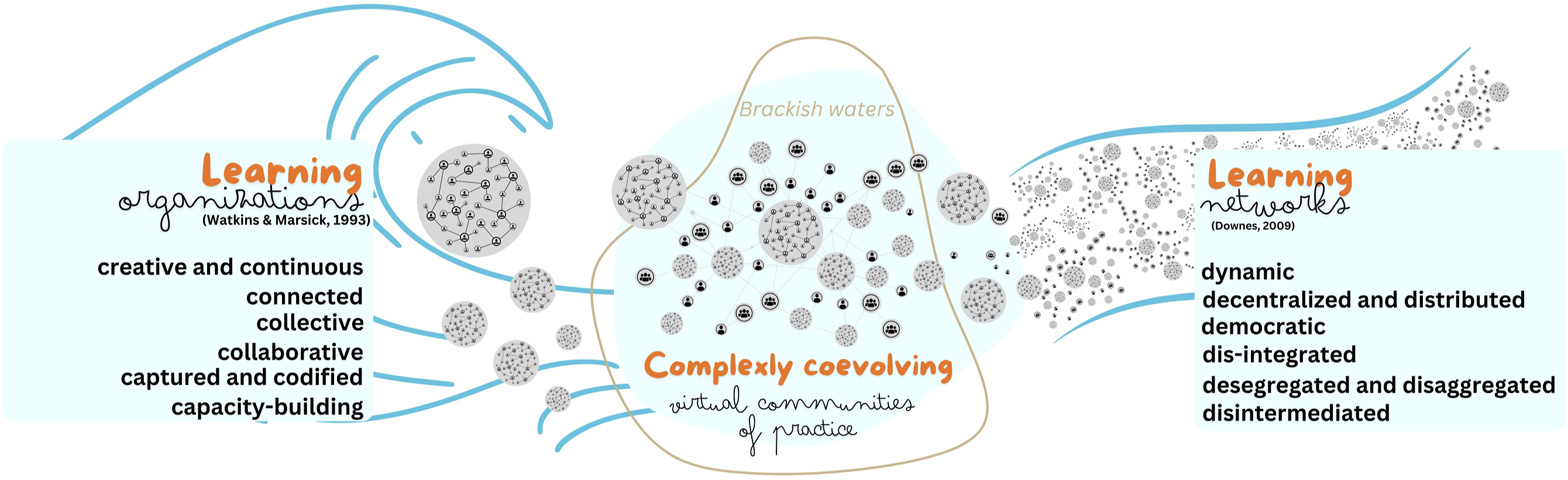
Referencing Complexly Coevolving and Interdisciplinary Practice
Members from a VCoP focused on one domain that coevolves in complex ways (Eller, 2024) often join and engage in others, serving as boundary spanners (Keszey, 2018; Williams, 2002). Additionally, members from these VCoPs may also join interdisciplinary events and collaborate across domains. Such events and collaboration “hold potential for unexpected learning. The meetings of perspectives can be rich in new insights, radical innovations, and great progress” (Wenger-Trayner et al., 2014, p. 17). This cross-pollinating potential can be evidenced in the gatherings and work like that of TGLF’s special interest groups, such as “women inspiring women,” (TGLF, 2024c), their country-based scholar groups/associations, and their signature Teach to Reach: Connect events (TGLF, 2024b).
However, to my knowledge, there is not a term that comprehensively captures the work of organizations like TGLF, which operate multiple communities that coevolve in complex ways (Eller, 2024) and encourage members to gather and collaborate across disciplinary borders for shared concerns both in formally and informally organized ways. To distinguish this work in practice and scholarship that is so much more than a VCOP, I propose the term Glocal Peer-learning Practice Network (GPPN). This term takes into consideration [1] the scale at which such organizations operate, [2] the primary method used to engage members, and [3] members’ embeddedness within and across co-evolving communities of practice networked together in a broader landscape of practice (Wenger et al., 2014). These elements are reflected in my working definition of GPPNs: organizations that facilitate and intersect multiple glocal (global + local), peer-learning-based, interdisciplinary, and complexly coevolving VCoPs across a shared, broader landscape of networks to drive innovation and scale outcomes, especially against critical threats. GPPNS connect primarily through virtual (synchronous) gatherings, either formally or informally, and collaborate online (asynchronously) using digital platforms.
New Insights for HRD Education
Original conceptions of a learning organization (Watkins & Marsick, 1993) and communities of practice (Wenger, 1996, 1998) were developed before the digital technologies we use today. Complexly coevolving VCoPs (Eller, 2024) and GPPNs, which utilize the latest technological advancements, challenge HRD to consider how education in our 21st century can be more expressive, evolving, expansive, equity-minded, engaging, embodied, embedded, and empowering. They offer HRD training developers insights into the use of newer informal and incidental learning variations (Watkins et al., 2018). Additionally, they provide examples of how more accessible program designs and interdisciplinary partnerships may better meet the needs of employees, organizations, and societies at large. For HRD researchers, the clarification of their terminology means being able to more easily identify and reference them in literature, an act that can also bring new insight through existing and future studies of their empirical impact.
Conclusion
The work of learning organizations is tied to that of learning networks, and the terms (digital) learning networks and (virtual) communities of practice have been used interchangeably (Cummings & Van Zee, 2005; Ehrlichman & Sawyer, 2018; Murillo, 2011; Wenger-Trayner & Wenger-Trayner, 2015). Although they operate along continuums (Cummings & Van Zee, 2005; Siemens, 2006), VCoPs that coevolve in complex ways (Eller, 2024) occupy their own space on the learning organizations to learning networks continuum (Figure 1). They maintain a collective identity and continue developing expertise in a domain while diversifying and strengthening connections to improve the exchange of information. GPPNs that facilitate such interdisciplinary community gatherings and collaboration within and across broader landscapes of practice further amplify our global capacity to respond to the wicked challenges (Rittel & Webber, 1973) of our 21st century. The brackish connections of complexly coevolving VCoPs (Eller, 2024) and the intersecting potential facilitated by GPPNs forge powerful learning-to-action pathways and critical spaces for future HRD study.
Footnotes
Acknowledgments
I would like to thank Dr Karen Watkins and Dr Henriette Lundgren for their generous motivation and expert feedback that guided the development of this work.
Declaration of Conflicting Interests
The author(s) declared the following potential conflicts of interest with respect to the research, authorship, and/or publication of this article: I disclose supporting qualitative research and other key deliverables in my doctoral assistantship with The Geneva Learning Foundation (TGLF), a non-profit organization, which is described in this manuscript.
Funding
The author(s) received no financial support for the research, authorship, and/or publication of this article.