







Abstract
Problem
Organisations increasingly expect supervisors to coach their direct reports, and employees increasingly expect high-quality coaching support. Yet Human Resource Development (HRD) professionals lack clear evidence about whether the frequency of coaching or the expertise with which supervisors coach matters more for employee outcomes, and how coaching relationships shape these effects. This uncertainty leaves HRD professionals without clear guidance on where to focus developmental efforts.
Solution
This study refines the Ellinger et al. (2003) Coaching Behaviours Measure (CBM) to more precisely distinguish coaching frequency from coaching expertise and examines how each relates to employee in-role behaviours (IRB) and turnover intentions. Using data from 63 employee-supervisor pairs in a New Zealand consulting organisation, the refined F-CBM and E-CBM demonstrated strong reliability and validity. Whilst coaching expertise emerged as the stronger predictor of employee outcomes, coaching frequency exerted a more meaningful effect than previously recognised. The pattern of associations is consistent with the possibility that coaching relationship quality may play an indirect role in these relationships.
Stakeholders
These findings offer actionable guidance for coaching supervisors, HRD professionals and organisational leaders by clarifying which aspects of supervisory coaching matter most for employee performance and retention. This evidence can inform the design of coaching development initiatives that meet both employee expectations and organisational talent retention goals.
Implication
HRD practitioners can enhance employee outcomes by prioritising supervisors’ coaching expertise, strengthening their relationship-building capability, and supporting regular high-quality coaching conversations.
Keywords
Introduction
Employee coaching is a widely used form of development support in organisations (Ellinger, 2013). When tailored to each employee and aimed at helping them reach their development and performance goals, it can be highly valuable (Jones et al., 2025; Zhao & Liu, 2020). Gregory and Levy (2010, p. 111) describe employee coaching as: A developmental activity in which an employee works one-on-one with his/her direct manager to improve current job performance and enhance his/her capabilities for future roles and/or challengers, the success of which is based on an effective relationship between the employee and manager, as well as the use of objective information such as feedback, performance data, or assessments.
For HRD professionals, employee coaching is appealing because it is associated with a wide range of positive outcomes including improved performance (Ellinger et al., 2003; Nguyen et al., 2025); stronger working relationships (Ellinger, 2013; Weer et al., 2016); enhanced job satisfaction (Batson & Yoder, 2012; Kim et al., 2013); increased organisational commitment (Pousa et al., 2020; Ribeiro et al., 2021); and reduced turnover intention (Batson & Yoder, 2012; Mowat et al., 2025).
However, employee coaching does not always lead to positive outcomes. Coaching can place additional demands on supervisors (Jones et al., 2025), some employees may prefer to be coached by someone other than their manager (Spaten & Flensborg, 2013), and not all coaching conversations are experienced as valuable (Echeverri, 2020). Empirical findings are also mixed. Contrary to expectations, Kim and Kuo (2015) found that supervisory coaching behaviours had no direct effect on employee in-role behaviours (IRBs), and when comparing two groups of employees where one had been formally coached whereas the other had not, Mowat et al. (2026) found no difference in turnover intentions or counterproductive work behaviours. These inconsistencies suggest coaching effectiveness depends on how coaching is enacted and how employees experience both the quality of coaching behaviours and the coaching relationship.
Despite the widespread use of coaching, HRD professionals still lack clear evidence about which aspects of supervisory coaching matter most and how they should be measured. A central challenge concerns the relative importance of coaching frequency versus expertise and the adequacy of existing measures of these constructs. Many organisations invest heavily in training supervisors to coach effectively and in allocating time for regular coaching interactions (Spaten & Flensborg, 2013). However, few empirical studies have examined whether coaching effectiveness is driven more by how often supervisors coach their direct reports or how well they enact coaching behaviours.
A key reason for this gap is measurement. Although coaching scholars consistently recommend coaching interactions occur regularly (London & Smither, 2002), existing research has relied on measurement approaches that do not adequately capture coaching frequency. Prior studies have focused primarily on assessing supervisors’ coaching skills and behaviours (see Hagen & Peterson, 2015) with far less attention paid to how frequently those behaviours are enacted. To date, no validated instrument has operationalised the frequency of enacted coaching behaviours as a distinct latent construct. Instead, researchers have typically treated coaching frequency as a global, single-item observed variable, asking participants to retrospectively estimate how often coaching occurs over a given period (e.g. Mowat et al., 2025), limiting the field’s ability to examine the relative contributions of coaching frequency in comparison with coaching expertise.
A second measurement gap concerns the assessment of coaching expertise. Prior studies have inferred coaching expertise indirectly through measures of coaching skills or coaching behaviours, which are sub-components of expertise, yet none have directly operationalised employees’ perceptions of their supervisor’s level of coaching ‘expertise’ as a distinct latent construct. This limits both theoretical development and practical guidance for HRD professional seeking to build employee coaching capability, particularly for those interested in capturing expertise specifically.
A third measurement gap concerns employees’ perceived quality of the coaching relationship (PQECR). Although the supervisor-employee relationship is broadly recognised as central to coaching effectiveness (e.g. Pousa et al., 2020), empirical research examining how and when PQECR links coaching practices with work outcomes remains limited (Mowat et al., 2025). This underscores the need for psychometrically robust relational measures in coaching research. Importantly, the four-dimension PQECR scale by Gregory and Levy (2010) provides such a foundation. Notably, its ‘Genuineness of the Relationship’ dimension includes three items that capture employees’ perceptions of their supervisor’s goodwill, benevolence, and authenticity, key elements of social exchange theory and conceptually distinct from coaching that is enacted simply to satisfy organisational expectations.
In response to these gaps, we adapted the Ellinger et al. (2003) Coaching Behaviours Measure (CBM), developing two refined scales to more precisely capture coaching frequency and expertise. We also used the 12-item PQECR scale developed by Gregory and Levy (2010) to assess employee perceptions of the coaching relationship. Using these measures, we examined the comparative importance of both coaching frequency and coaching expertise in predicting IRBs and turnover intentions, both directly and through PQECR as a potential mediating mechanism.
The findings will be of interest to both HRD professionals and researchers. For practitioners, the study offers nuanced insight into the coaching frequency verses expertise debate, providing evidence to inform decisions about where to prioritise investment in coaching capability. For researchers, the introduction of distinct and psychometrically sound measures of coaching frequency and expertise provide new opportunities to explore how coaching practices influence a wide range of work outcomes. Figure 1 presents our research model:
Research Model
Research model. Note.PQECR = Perceived Quality of the Employee Coaching Relationship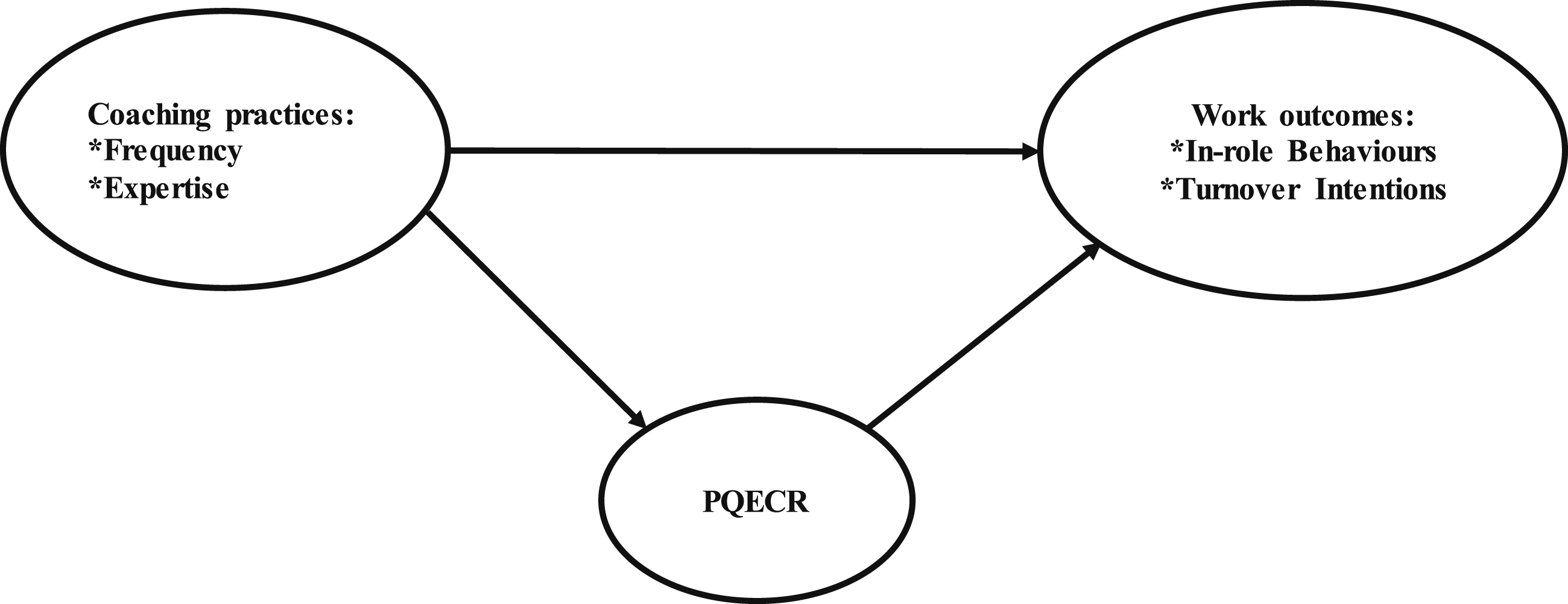
Theoretical Background and Hypotheses
Social Exchange Theory (SET)
The hypotheses for this study were shaped through the lens of Social Exchange Theory (SET) (Blau, 1964). Previous research examining employee coaching has also drawn on SET (e.g. Raza & Ahmed, 2020; Ribeiro et al., 2021). SET proposes that when offered a valuable courtesy from another, without an expectation of compensation, the generosity expressed by the giver elicits a strong affective response in the recipient. Paradoxically, it is the expression of goodwill and the absence of any obligation to repay that motivates voluntarily reciprocation. This contrasts with financial exchange where goods and services are provided with an expectation of contemporaneous compensation. Unlike social exchange, financial transactions are typically devoid of emotion, meaning they do not germinate a social connection between the supplier and the receiver (Emerson, 1976). Moreover, whereas financial transactions are legally enforceable, social exchange is voluntary, governed by implicit norms of reciprocity (Blau, 1964).
When considering theoretical frameworks that help explain the link between employee coaching practices and work outcomes, we were mindful that employees are more receptive to coaching and giving back voluntarily when their supervisor demonstrates altruistic intent, valuing people over task (McLean et al., 2005). This is because the ethos of employee coaching is to advance the employee’s development and performance goals for the sake of the employee and is less concerned with advancing the work goals of the supervisor and the organisation (McCarthy & Milner, 2020). The broader SET framework aligns well in this regard because it focuses on voluntary reciprocation arising from the genuine goodwill expressed by the giver rather than instrumental intent. As noted by Nguyen et al. (2025), employees may be less willing to engage in a coaching process when they perceive it has been offered for something other than the employee’s benefit. Taken together, SET suggests that when supervisors provide regular, high quality employee coaching in a manner perceived as genuine, and in the employee’s best interest, most employees value the relational-resource and reciprocate through enhanced coaching relationships, and work-related attitudes and behaviours.
Hypotheses
The hypotheses focus on one positive and one negative work outcome. For the positive outcome, we selected IRBs, defined as behaviours recognised by the formal reward system and forming the core responsibilities of an employee’s job (Williams & Anderson, 1991). IRBs are crucial in team contexts, where successful project completion depends on all team members fulfilling their assigned responsibilities (Hsu et al., 2017). They are also appropriate for employee coaching because one of its central aims is to help employees achieve their performance goals (Gregory & Levy, 2010). IRBs offer an additional methodological advantage: they can be accessed via multiple sources (e.g. supervisors, and organisation records), reducing the risk of common method variance (measurement error) that can arise when data is single sourced (Podsakoff et al., 2012). Theoretically, coaching practices should enhance employees’ ability to perform their core job tasks, and prior research supports this (Huang & Hsieh, 2015). Where our study extends the literature is by exploring whether stronger IRBs are an outcome of increased coaching frequency versus enhanced coaching quality, and whether the employees’ perception of the coaching relationship plays a role in shaping those relationships.
For the negative outcome, we selected turnover intentions, a well-established predictor of actual turnover (Böckerman & Ilmakunnas, 2009). Turnover imposes substantial costs on organisations through the loss of knowledge and having to recruit, induct, and train new employees (Haar et al., 2016). Employee coaching has been shown to reduce turnover intentions by strengthening the supervisor-employee interpersonal relationship and enhancing work engagement (Ali et al., 2018). Conceptually, both coaching frequency and expertise ought to reduce turnover intentions. However, Mowat et al. (2025) found that when mediated by PQECR, coaching expertise predicted lower turnover intentions whereas frequency did not. This pattern was unexpected and motivated us to extend the literature by operationalising coaching frequency as a multi-item latent construct, distinct from coaching expertise, and enabling us to capture a more precise test of its effects.
Coaching Frequency
We define coaching frequency as how often a supervisor enacts coaching behaviours during one-on-one work-related conversations with each of their direct reports. Importantly, our measure captures both formal and informal coaching episodes that span the employee coaching spectrum of events (Grant, 2017). SET generalises that people become motivated to reciprocate voluntarily when they receive an obligation-free social courtesy from another (Blau, 1964). Therefore, when an employee perceives the coaching they receive from their supervisor to be a useful relational-resource, and they receive it more often, conceptually, the employee ought to appreciate the extra help (Haar et al., 2016). Such response is likely to include being more open to being coached, developing a stronger affective bond with their supervisor (Gregory & Levy, 2012), and improved work-related attitudes and behaviours. This leads to our first hypothesis:
Coaching Frequency is positively related to (a) PQECR; and (b) IRBs; and negatively related to (c) turnover intentions.
Coaching Expertise
We conceptualise coaching expertise as the calibre of a supervisor’s enacted coaching behaviours toward fostering employee development and performance (Ellinger et al., 2003). Expert coaching behaviours have been found to enhance employee learning (Ellinger et al., 2003) and employee perceptions of the coaching relationship (Mowat et al., 2025). The proposed connection between coaching expertise, relational quality, and desirable work outcomes is grounded in the principles of SET. When employees view coaching to be a valuable relational-resource, offered by their supervisor for the employee’s benefit, the enhanced expertise is likely to be appreciated and met with a positive response. This leads to our second hypothesis:
Coaching Expertise is positively related to (a) PQECR; and (b) IRBs; and negatively related to (c) turnover intentions.
Coaching Frequency Versus Coaching Expertise
When predicting work outcomes like PQECR, IRBs and turnover intentions, the relative importance of coaching frequency versus expertise is debated. Some suggest it is the quality of the coaching that matters, not the frequency (Dahling et al., 2016; Pousa et al., 2018), and a recent meta-analysis found coaching frequency had no impact on work outcomes (de Haan & Nilsson, 2023). Others contend that coaching is more than a “one-time event” (Park et al., 2021, p. 816) and ought to take place regularly to keep supervisors and employees connected and on-track toward their goals (Al Nahyan et al., 2024; Ali et al., 2018).
Theoretically, more frequent coaching ought to create more opportunity for meaningful communication and feedback exchange, and build stronger coaching relationships (Hammack-Brown et al., 2024), and stronger coaching relationships ought to lead to enhanced work outcomes (Gregory & Levy, 2010). Additionally, a highly skilled and experienced supervisor-coach ought to build stronger coaching relationships and enable employees to achieve better work outcomes compared with a coaching novice (Ladyshewsky & Taplin, 2017). Therefore, rather than coaching expertise completely dominating frequency, there are compelling reasons to expect that both practices meaningfully influence PQECR, IRBs, and turnover intentions. This leads to our third hypothesis:
Both Coaching Frequency and Coaching Expertise will be substantive factors when predicting (a) PQECR, (b) IRBs; and (c) turnover intentions.
Coaching Relationship Quality (PQECR)
We position the supervisor-employee coaching relationship as a mediating mechanism, linking coaching frequency and expertise with IRBs and turnover intentions. Our positioning is partly influenced by evidence from Mowat et al. (2025) who demonstrated that when mediated by employees’ perception of the coaching relationship (PQECR), coaching expertise had a positive indirect effect on job satisfaction, and a negative indirect effect on turnover intentions. Although previous research strongly suggests that healthy supervisor-employee relationships enhance the effectiveness of coaching (Gregory & Levy, 2010), it remains unclear whether such benefits arise primarily from increased frequency of coaching or improved expertise, an issue directly addressed by this study.
SET provides the framework for why PQECR should operate as a mediation pathway that links coaching practices and work outcomes. When supervisors engage in authentic, employee-centred coaching, and employees perceive the coaching relationship as high-quality and a valuable relational-resource, employees appreciate the goodwill and are motivated to reciprocate with something of value to their supervisor and organisation. Moreover, a strong coaching relationship reflects an employee’s high level of trust and confidence in their supervisor (Gregory & Levy, 2010). We therefore expect such reciprocation to manifest as enhanced work-related attitudes and behaviours, and this reasoning leads to our fourth set of hypotheses:
PQECR is positively related to (a) IRBs; and negatively related to (b) turnover intentions.
PQECR mediates the influence of (a) coaching frequency; and (b) coaching expertise towards both IRBs and turnover intentions.
Method
Sampling and Participants
Our intent was to recruit a large New Zealand (NZ) organisation and obtain a sample of 200+ employees. However, the task proved more difficult than anticipated. In the 9 months between May 2024, and February 2025, we contacted the senior Human Resources Managers representing 16 large NZ-based enterprises (public and private), inviting them to participate. Despite significant engagement with a handful of organisations, ultimately, none agreed, citing operational commitments and inconvenient timing. In March 2025, we met with representatives of a comparatively smaller NZ-based organisation, employing between 150-250 people. The executive members agreed to partner in this research.
The organisation we recruited is a private enterprise that provides business consulting services. We invited the entire workforce to participate. All potential participants were provided information about the study and advised that participation was voluntary. Employee level participation involved completing two on-line surveys (both less than 5 minutes), separated by a month. Supervisor participation involved completing a single on-line survey (less than 5 minutes), rating IRBs for their direct reports. Only those employees who had agreed to participate in the research were rated by their supervisor.
To encourage employee participation, we offered two NZD $250 gift-cards as prizes. Despite this, just 73 employees completed the Time 1 survey (43% response rate), and 68 went on to complete the Time 2 survey (7% attrition). Supervisors completed 68 surveys relating to employee participants. The final dataset contained n = 63 complete supervisor-employee matched cases. Employee participants had an average age of 41.07 (SD = 10.90), were predominantly female (66%), had an average tenure of 5.60 (SD = 5.19), and 47% had a bachelor’s degree or higher. All had received coaching from their supervisor in the 6 months prior.
Time Lagged, Multisource Design
To reduce the potential for common method variance (CMV), we followed the advice of Podsakoff et al. (2003). Specifically, employee participants completed two surveys spaced 1 month apart, introducing temporal separation into our design. Coaching frequency, coaching expertise, and PQECR were measured at Time 1, while turnover intentions were captured at Time 2. To further diversify data sources and strengthen construct validity, IRBs were assessed using supervisor ratings, ensuring data for our dependent variables was multi-source.
Measures
A primary aim of this study was to strengthen the measurement quality of both coaching frequency and expertise. To do so, we adapted the eight-item Coaching Behavior Measure (CBM) originally developed by Ellinger et al. (2003) and created two refined versions of the original instrument. Hagen and Peterson (2015) note that the CBM is one of two employee coaching related instruments that dominate the literature. The CBM was originally designed to capture the prevalence of eight exemplary coaching behaviours. However, the item response anchors from the original scale, 1 = almost never to 7 = almost always, suggest it captures the frequency with which coaching behaviours are enacted, not how widespread they are. This is ambiguous and raises questions as to whether the CBM measures the prevalence of coaching behaviours or their frequency. To eliminate such ambiguity, we refined the CBM to clearly distinguish between how often coaching behaviours are enacted (coaching frequency) and the level of expertise demonstrated when they are (coaching expertise).
Based on the original CBM, we developed the F-CBM to specifically assesses the frequently with which supervisors engage in the eight coaching behaviours specified in the original instrument. Likewise, we developed the E-CBM to capture employees’ perception of their supervisor’s level of expertise in enacting those same behaviours. Although item wording for both the F-CBM and the E-CBM remained consistent with the original scale, we introduced refined construct definition statements and anchor points that clearly differentiate between coaching frequency and expertise, thereby improving the measurement reliability and validity of both constructs.
To improve participant recall of enacted coaching behaviours and capture coaching episodes that span the full formal to informal spectrum, we utilised the eight coaching behaviour items contained in the original CBM as structured memory cues. In contrast to a single, global measure, by anchoring participant recall to these specific, concrete coaching behaviours we provide a more reliable basis for measuring both coaching frequency and expertise (Schwarz, 1990). Also, our approach focuses participant attention to what amounts to exemplary coaching behaviours (see Ellinger et al., 2003), reducing the likelihood that such behaviours might go unrecognised as employee coaching (as highlighted by Dixey, 2015). Furthermore, by asking participants to rate their supervisor’s level of expertise for each of the behaviour items specified in the original instrument, we obtained a more nuanced and behaviourally grounded assessment of coaching expertise, distinct from frequency.
Except where noted, all items were coded 1 = strongly disagree to 5 = strongly agree. We report construct reliability (CR) as an indicator of internal reliability for first-order latent variables, and omega hierarchical (ωh) as an indicator of internal reliability for second-order latent variables (e.g. PQECR) because compared with Cronbach’s alpha, both CR and ωh are stronger indicators (Cheung et al., 2023).
Coaching Frequency was measured using the eight item F-CBM, adapted from the original CBM designed by Ellinger et al. (2003). The construct definition statement was “Over the past 6 months, how often has your direct supervisor demonstrated the following coaching behaviours during one-on-one job-related conversations with you?” A sample item is “Over the past 6 months, my supervisor helped me think through issues rather than providing solutions.” Coded 1 = never; 2 = once; 3 = roughly twice; 4 = roughly 3-4 times; 5 = roughly monthly; 6 = roughly fortnightly; 7 = roughly weekly or more. For the current study, item eight was removed because the standardised factor loading was small (.46) and significantly less than .70 (p < .05), reducing model fit (CR = .93).
Coaching Expertise was measured using the eight item E-CBM, adapted from the original CBM designed by Ellinger et al. (2003). The construct definition statement was “To what level of expertise does you direct supervisor demonstrate the following behaviours?” A sample item is “My supervisor solicits feedback from me to ensure our interactions are helpful.” Coded 1 = novice; 2 = beginner; 3 = intermediate; 4 = advanced; 5 = expert. (CR = .93).
Perceived Quality of the Employee Coaching Relationship (PQECR) was measured using 12 items from Gregory and Levy (2010). This construct comprises four dimensions, and each dimension contains three items. Sample items for the Genuineness of the Relationship dimension is “I believe my supervisor truly cares about me.” (CR = .90). A sample item from the Effective Communication dimension is “My supervisor is easy to talk to.” (CR = .93). A sample item from the Comfort with the Relationship dimension is “I am content to discuss my concerns or troubles with my supervisor.” (CR = .91). A sample item from the Facilitating Development dimension is “My supervisor enables me to develop as an employee of our organisation.” (CR = .96).
In-Role Behaviours was measured with six items from the six-item scale by Williams and Anderson (1991) coded 1 = never to 5 = almost always. A sample item is “This employee adequately performs assigned duties.” (CR = .96).
Turnover Intentions was measured with four items by Kelloway et al. (1999). A sample item is “I am planning to look for a new job.” (CR = .95).
Control Variables
We controlled for age, gender (male = 0, female = 1), tenure, and level of education (1 = High School, 2 = Technical/Polytechnic, 3 = bachelor’s degree, 4 = post-graduate). This was based on results of meta-analyses by de Haan and Nilsson (2023); Ng and Feldman (2008, 2009, 2010a, 2010b). All controls were modelled as ordinal variables.
Measurement Model
To evaluate the quality of our measurement model, we performed a confirmatory factor analysis. Model fit was assessed against the commonly accepted thresholds: comparative fit index (CFI) ≥.95; root mean squared error of approximation (RMSEA) ≤.08; and the standardised root mean square residual (SRMR) ≤.10 (Williams et al., 2009). Fit indices for our measurement model did not meet the recommended thresholds. Whilst the result was unsurprising given the small sample size: χ 2 (df) = 1433.61 (743) p < .01, CFI = .79, RMSEA = .11, and SRMR = .08, loose fit certainly constrains the strength of inferences that can be drawn from the model.
Construct Reliability
The internal reliability (CR) for our latent constructs ranged from .93 to .96, exceeding the recommended cut-off of CR ≥ .70 (Fornell & Larcker, 1981; Hair et al., 2014). These results enabled us to confirm our construct measures to be internally reliable.
Convergent Validity
To assess convergent validity, we inspected the standardised factor loadings and average variance extracted (AVE) for each construct. Item loadings of .70 or higher are preferred as they indicate that the latent factor accounts for at least 50% of the variance in the indicator item loaded to it (Cheung et al., 2023; Fornell & Larcker, 1981). Moreover, AVE values exceeding .50 indicate that the construct explains the majority of variance across all item indicators (Fornell & Larcker, 1981; Hair et al., 2014). For our measurement model, standardised factor loadings ranged from .65 to .98, p < .01. Except for two items, all loadings were greater than .70, and for those two items less than .70, the upper 90% bootstrap confidence intervals (1,000 samples) for each was greater than .70. This means that when sampling variance was accounted for, the standardised factor loadings for all items were acceptable (Cheung et al., 2023). AVE indices were all greater than .50, ranging from .64 to .84. These results enabled us to confirm our measures to be convergently valid.
Discriminant Validity
When assessing discriminant validity, we followed Cheung et al. (2023), specifying our model to prohibited cross-loading. We then applied the Fornell-Larker criterion, which requires the squared bivariate correlation for each construct pair to be less than each construct’s AVE (Fornell & Larcker, 1981). We achieved the criterion for all i-j pairs except for the correlation between coaching frequency and expertise. To account for sampling variance, we estimated 90% bootstrap confidence intervals for this correlation (1,000 samples). The lower 90% bootstrap confidence interval was less than each construct’s AVE meaning that when sampling variance was accounted for, the Fornell-Larker criterion was met for all i-j pairs. This enabled us to confirm our measures to be discriminately valid (Cheung et al., 2023).
Dominance Analysis
To determine the relative importance of coaching frequency versus expertise in predicting PQECR, IRBs and turnover intentions, we undertook a series of dominance analyses. Dominance analysis assesses the relative contribution of multiple predictors toward the variance (R2) that can be explained in a single dependent variable (see Budescu, 1993).
Analysis
To assess model fit, and test hypotheses, we used R statistical software (R Core Team, 2026) and Microsoft Excel. More specifically, to fit the measurement model, we used the R measureQ package developed by Cheung et al. (2023). To undertake dominance analyses we used the Dominance Analysis Excel worksheet developed by Professor James LeBreton (Tonidandel & LeBreton, 2011).
Common Method Variance
To statistically assess the risk of CMV, we conducted a Harman’s One Factor Test. None of the variables accounted for more than 50% of the total variance, signalling that CMV may not be a concern (Podsakoff et al., 2003).
Results
Descriptive Statistics
Descriptive Statistics
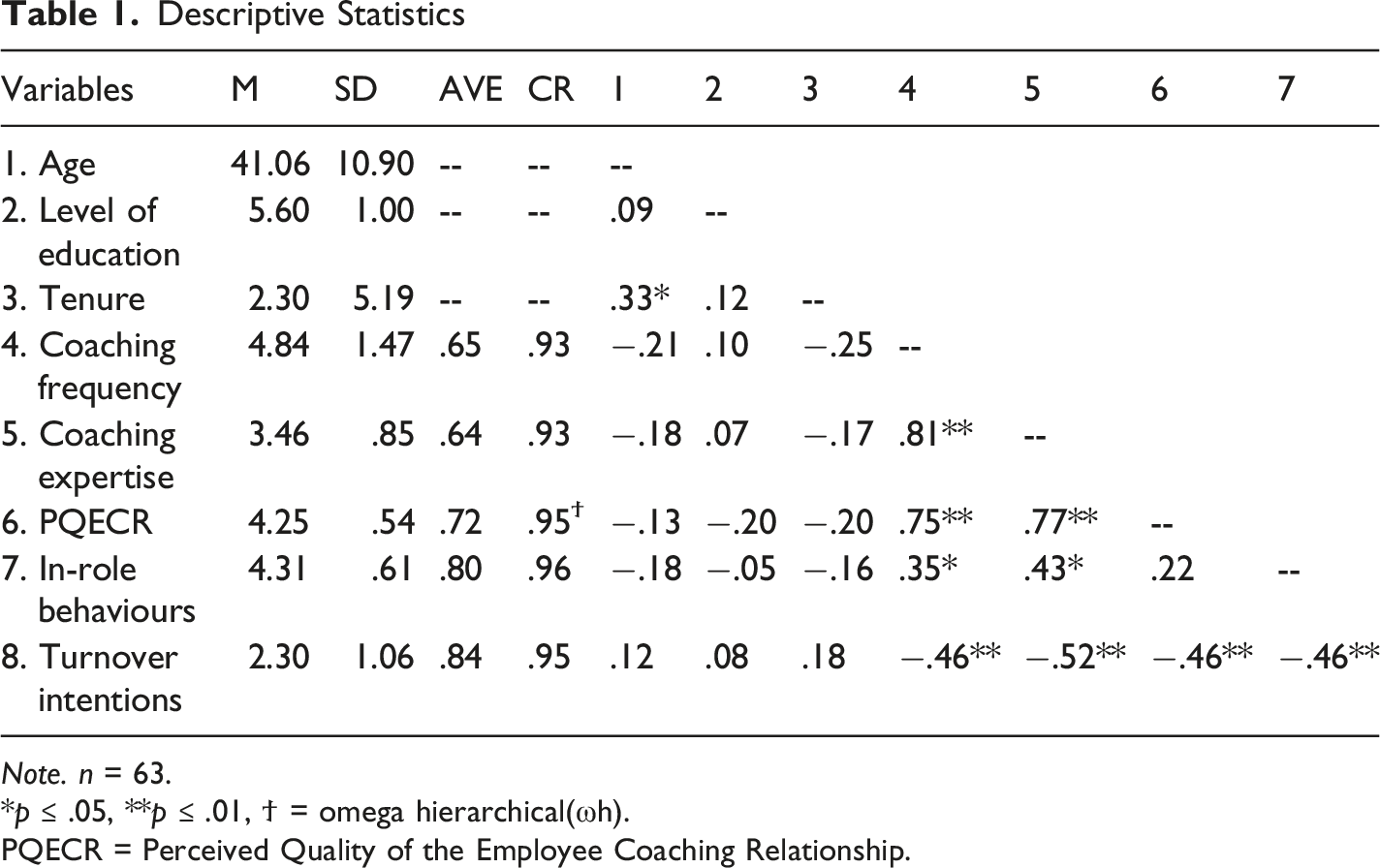
Note. n = 63.
*p ≤ .05, **p ≤ .01, ϯ = omega hierarchical(ωh).
PQECR = Perceived Quality of the Employee Coaching Relationship.
All bivariate correlations among the focal variables were significant and aligned with our expectations. The single exception to this was the correlation between PQECR and IRBs which was in the expected direction but did not quite reach statistical significance (p = .07). Overall, this pattern confirms the relationships between coaching practices, PQECR, and both IRBs and turnover intentions are robust.
Dominance Analysis
Dominance Analysis. Coaching Frequency versus Coaching Expertise
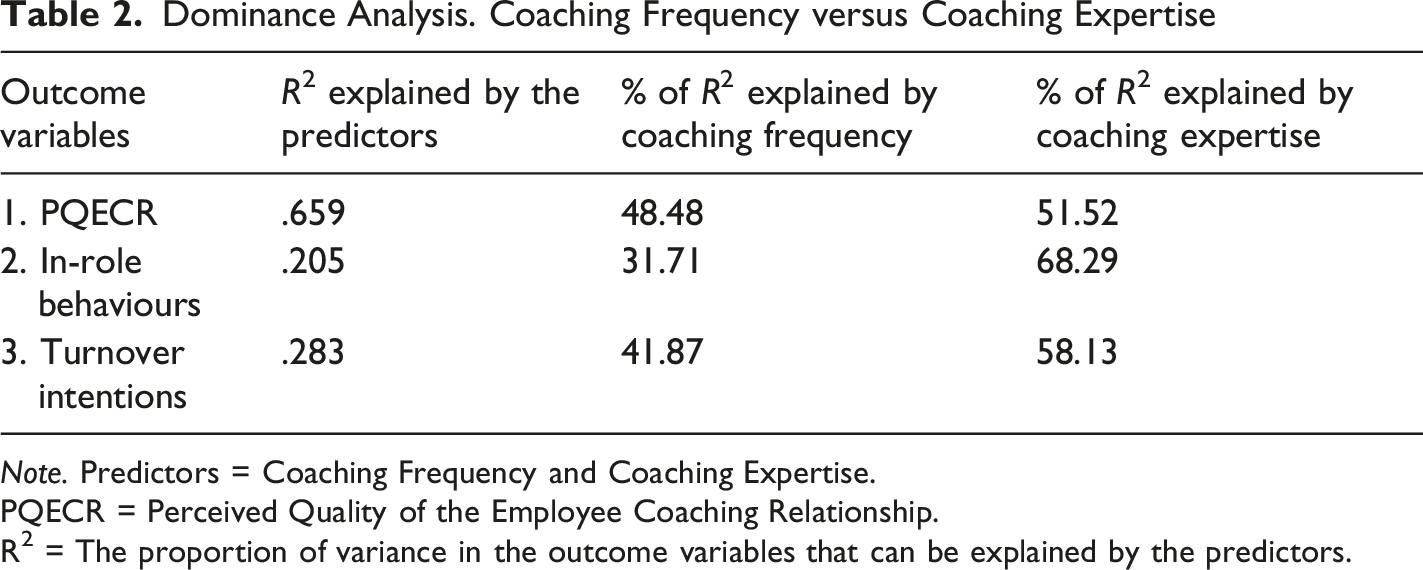
Note. Predictors = Coaching Frequency and Coaching Expertise.
PQECR = Perceived Quality of the Employee Coaching Relationship.
R2 = The proportion of variance in the outcome variables that can be explained by the predictors.
Hypotheses Testing
When examining variable relationships, we emphasise correlations rather than structural pathways. Given the modest sample size (n = 63), statistical power was insufficient to reliably detect regression coefficients at conventional thresholds (p ≤ .05). Therefore, correlations derived from the measurement model provide the most stable basis for interpreting pairwise associations, enabling us to assess both direction and magnitude of relationships among the focal variables.
Hypotheses 1 and 2 predicted that both coaching frequency and expertise would be positively related to PQECR and IRBs and negatively related to turnover intentions. The correlation results aligned with these expectations, providing support for Hypotheses 1(a) and (b), and 2(a) and (b). Hypothesis 3 proposed that both coaching frequency and expertise would jointly explain the variance in PQECR, IRBs, and turnover intentions. Considering PQECR, dominance analysis results showed a near even split: coaching frequency contributed approximately 48% of the explained variance, and expertise contributed approximately 52%. For IRBs, it showed that the relative contribution was approximately 30% for coaching frequency and 70% for expertise. For turnover intentions, the 40/60 split confirmed a more even distribution. These results provide clear support for Hypotheses 3(a), (b), and (c).
Hypothesis 4 proposed that PQECR would be positively associated with IRBs and negatively associated with turnover intentions. Whist results show a positive correlation between PQECR and IRBs (φ = .22, p = .07), this parameter did not quite reach statistical significance meaning Hypothesis 4(a) was not supported. However, we observed a strong, negative correlation between PQECR and turnover intentions (φ = −.46, p < .01), providing support for Hypothesis 4(b). Finally, the pattern of strong positive correlation between coaching frequency and PQECR (φ = .75, p < .01), and between coaching expertise and PQECR (φ = .77, p < .01), combined with PQECR’s positive association with IRBs and its strong negative association with turnover intentions is suggestive of a potential mediation role. Although formal mediation testing was not feasible due to the sample size constraints, this pattern offers preliminary support for Hypotheses 5(a) and (b).
Discussion
This study addressed three underexplored areas in employee coaching: how coaching frequency and expertise independently contribute to employee work outcomes, and whether the quality of the coaching relationship (PQECR) helps explain these effects. Our findings show that both coaching frequency and expertise matter. Although expertise emerged as the stronger predictor, coaching frequency also accounted for meaning variance in IRBs and turnover intentions, and both practices contributed almost equally to PQECR. In turn, PQECR showed the expected negative association with turnover intensions and a positive association with IRB’s (albeit non-significant, p = .07). While our sample size did not permit a formal test of mediation, the pattern of results demonstrate that the foundational conditions for mediation are present. Together, these finding suggest that coaching effectiveness depends not only on the calibre of coaching expertise, but also on how consistently coaching occurs and how employees experience the coaching relationship.
Theoretical and Practical Implications
Our findings align with SET, which suggests that when employees receive regular, obligation-free, expert coaching within a high-quality coaching relationship, they are motivated to reciprocate with attitudes and behaviours that are valued by the organisation (Blau, 1964). Consistent with this logic, recent research shows that PQECR can transmit the effects of coaching expertise to outcomes such as job satisfaction and turnover intentions (Mowat et al., 2025). Our results reinforce this view by demonstrating that both coaching frequency and expertise are strongly associated with PQECR, and PQECR is negatively associated with turnover intentions.
A key contribution of this study lies in clarifying why coaching frequency has sometimes appeared irrelevant in prior research. Coaching occurs along a continuum from formal, structured sessions to brief, informal, in-the-moment interactions (Grant, 2017). Informal coaching is more frequent, spontaneous, and less memorable, and employees may not always recognise it as coaching (Dixey, 2015). Prior studies have typically relied on retrospective recall or organisational records to quantify coaching frequency (Dahling et al., 2016; Mowat et al., 2025). Such approaches are likely to have privileged formal, memorable coaching episodes and underrepresented informal ones. If so, the apparent irrelevance of coaching frequency in earlier studies may reflect measurement limitations rather than a genuine lack of effect.
To address these limitations, we refined the Ellinger et al. (2003) CBM, producing two new scales: the F-CBM and the E-CBM. The original CBM was designed to assess the prevalence of exemplary coaching behaviours, but its anchors, 1 = almost never, to 7 = almost always, blur the distinction between the prevalence and frequency. Moreover, contemporary research has used the CBM to capture coaching style or as a generalised measure of coaching behaviour (e.g. Wang, 2013), illustrating conceptual drift. Our refined scales restore conceptual clarity, independently operationalising coaching frequency and coaching expertise. By anchoring participant recall to the eight behavioural items from the original CBM, the F-CBM and the E-CBM enhance recall accuracy (Schwarz, 1990) and capture coaching behaviours across both formal and informal contexts. Both scales demonstrated strong reliability and validity, offering more precise tools for future coaching research.
Our dominance analysis provides new insight into the coaching frequency versus expertise debate. When explaining the variance in PQECR, whereas Mowat et al. (2025) reported a 92% to 8% split in favour of coaching expertise, our results showed a more balanced 52% to 48% distribution. We attribute this difference to measurement. Whereas the global behavioural measure used by Mowat et al. (2025) likely captured formal coaching frequency, our multi-item F-CBM captured frequency across the full coaching spectrum. Whilst coaching expertise remains the more influential predictor, our findings show that coaching frequency is more relevant than previously recognised.
Finally, we modelled PQECR as a plausible mechanism linking coaching practices with employee work outcomes. Conceptually, it is difficult to imagine employees acting on coaching advice when the coaching relationship is characterised by mistrust and low confidence, regardless of the supervisor’s technical skill. Although our sample preluded a formal test of mediation, the observed correlations demonstrated that the necessary preconditions for mediation are present. Given the centrality of relational quality to effective coaching (Gregory & Levy, 2010), further research examining PQECR as a mediator is therefore warranted.
Limitations
The most apparent limitation of this study was the modest sample size (n = 63). Small samples can suffer from reduced statistical power, resulting in wider confidence intervals and an increased risk of Type II error, whereby true effects in the population may go undetected (Bell et al., 2019). For this reason, we focused our interpretation on the pattern of correlations rather than on structural path estimates, which are more sensitive to sample size. Additionally, because participants were drawn from a single organisation, caution is warranted when generalising findings beyond this context.
A second potential limitation concerns measurement bias arising from supervisor self-enhancement or relational halo effect. Because the supervisors in this study provided the coaching, they may have been inclined, consciously or unconsciously, to perceive their coaching as effective and therefore inflated employees’ IRBs more favourably. We mitigated this risk through a multi-source design, where employees provided all ratings of coaching frequency, coaching expertise, and coaching relationship quality, while supervisors provided IRB ratings only. Nonetheless, we acknowledge that some residual risk of halo inflation may remain.
Future Research
We intend to further validate the F-CMB and E-CBM instruments. Although both measures demonstrated strong psychometric properties, further validation with an independent sample would strengthen confidence in their reliability and construct validity. In alignment with SET and in support of Mowat et al. (2025), we view PQECR as a theoretically meaningful mechanism, linking coaching practices to employee work outcomes. However, our modest sample size precluded a formal test of mediation, a requirement for such a claim. We therefore recommend that future research examine PQECR as a mediating mechanism using a larger and more statistically robust sample.
Additionally, when sample sizes permit, examining whether coaching frequency acts as a boundary condition on the effect of coaching expertise would offer valuable insight. Conceptually, it is plausible that the benefits of coaching expertise may be amplified when high-quality coaching is delivered more frequently. Testing this interaction would help clarify how coaching frequency and expertise operate together to influence employee work outcomes.
Conclusion
This study addressed three underexplored aspects of employee coaching: the relative importance of coaching frequency and coaching expertise and the role of PQECR in shaping employee work outcomes. Our findings show that both coaching frequency and coaching expertise are substantial predictors of IRBs, turnover intentions, and relational quality, with expertise emerging as the stronger factor but frequency proving more influential than previously recognised. By introducing the F-CBM and the E-CBM, we provide HRD researchers and professionals with conceptually clear and psychometrically robust tools for assessing coaching practices across formal and informal contexts. For HRD professionals, the results highlight three evidence-based priorities for effective coaching: developing supervisors coaching expertise through formal training, fostering authentic and high-quality coaching relationships, and supporting regular coaching interactions. Together, these insights contribute to a more nuanced understanding of how coaching practices influence employee work outcomes and offer practical guidance for strengthening organisational employee coaching capability.
Footnotes

Funding
The authors received no financial support for the research, authorship, and/or publication of this article.
Declaration of Conflicting Interests
The authors declared no potential conflicts of interest with respect to the research, authorship, and/or publication of this article.