







Abstract
Grief comes for all of us, but faculty often keep it close. Many of us suffer in silence. This article uses autoethnography and literature review to explore the full experience of faculty grief on an academic career. Using an autoethnography of my mother’s death by suicide, I explore the impacts of grief and trauma on relationships with colleagues and students, limits of institutional support, and the isolation of grief. In response, the article discusses faculty bereavement support at the individual, team, and institutional levels. Individual actions include therapy and meaning making in one’s research, teaching, and service. Team support includes peer engagement and managerial support. Finally, I consider how to cultivate a praxis of care in neoliberal institutions of higher education that are themselves under increased societal pressures.
Introduction
Grief comes for us in the classroom in many ways. It could be the death of a loved one, the death of a student or colleague, a divorce, a loss of health, and more. For many of us, grief, especially traumatic grief (Jacobs, 2016), is kept close. Many of us suffer in silence. We may continue to show up for our students to teach and mentor. But grief, especially unattended grief, has a cost. Academia is a care profession (Motta & Bennett, 2018). Caring for our students is often a prerequisite for better connection, and even better learning in the classroom (O’Brien, 2010). Moreover, faculty have been thrust into the frontlines of student care institutionally, especially since the COVID-19 pandemic (Altan-Olcay & Bergeron, 2024). The elevation of student care and advocacy manifests in overtures by administration to faculty asking them to take a stronger frontline role in identifying and supporting students experiencing crises. While many faculty, particularly women faculty (França et al., 2023), have been doing this for a long time, COVID and the subsequent student mental health crisis have put institutions on higher alert. Care work is already complicated and difficult, but it is even more so for the bereaved (Holmes et al., 2021).
This article uses autoethnography to explore the full and extended experience of faculty grief on an academic career. Using the experience of my mother’s death by suicide, it explores the impacts of grief and trauma on faculty relationships with colleagues and students, the limited support within institutions for grieving faculty, and how isolating grief can be for faculty. My own story of experiencing traumatic grief while on the tenure track, touches on how the personal effects (severe anxiety, feelings of isolation) are exacerbated by a lack of institutional support for grieving faculty. Especially when one moves from an institution where colleagues are aware of the loss to another where no one knows. This includes the realities of only being able to take a week off in the middle of the semester to bury one’s parent while then spending subsequent weekends traveling to administer an estate. The tyranny of the academic calendar, not to mention the tenure clock, affords little time to attend to these tasks and one’s own grief. Alas, stifled grief has significant adverse consequences for both workers and the workplace (Eyetsemitan, 1998). The article will use the arc of the last 8 years in my professional journey to illustrate the extended impacts of traumatic grief on faculty. Long after others think we should have “moved on” from loss, the ghosts of the past continue to affect us.
That said, the article also explores how grief can help faculty better connect with students and with their own work (Mallinson, 2019). It begins with a brief review of the research on grief and care work and the long effects of trauma on work. The aim is to situate higher education teaching as a position of care work and to review what evidence has shown to be the best support for bereaved employees. After an autoethnographic analysis of my own grief and professional journey (Poulos, 2021), the article will discuss individual, team, and institutional actions for attending to grief. For individuals, these include therapy and meaning making in one’s research, teaching, and service. For teams, support includes peer engagement and managerial support. The article then wrestles with how to cultivate a praxis of care in neoliberal institutions of higher education that are themselves under increased societal pressure (Aberbach & Christensen, 2018). It wrestles with the ways in which the rhythm and pressures of academia, combined with the arrhythmic nature of death and grief, complicates the implementation of evidence-based grief support for faculty.
Grief and Care Work
College faculty, especially at research institutions, may not immediately think of themselves as being in a caring profession. Caring professions that likely come to mind are nursing, social work, childcare, and even K-12 teaching (O’Connor, 2008). But higher education, including faculty, is a care profession (Motta & Bennett, 2018). As universities and colleges grew over the twentieth century and sought to expand access to higher education to previously excluded communities, they also built student support infrastructures to meet the variety of needs that came with those students. In many respects, faculty are the frontline workers in connecting students with these services. Moreover, caring faculty-student relationships are beneficial for both parties personally and professionally (O’Brien, 2010).
Many faculty experienced a push from their institutions for hypervigilance over student needs during the COVID-19 pandemic to prevent attrition, when they themselves were also struggling with the implications of stay-at-home orders, sickness, and even death. In fact, professor support became a key proxy for organizational support during the pandemic (Chambers et al., 2023), a hallmark of faculty serving as street-level bureaucrats in higher education (Lovell, 2024). Increased pressure for greater faculty care work has continued during a post-COVID surge in the youth mental health crisis that is pushing upwards as students move from secondary to higher education (Ethier et al., 2025; McGorry et al., 2024). In sum, good teaching requires a caring approach, but increasingly faculty are being pushed by institutions to grow their caregiving as components of teaching and advising, even if that care work remains largely unrewarded (França et al., 2023).
At the same time there is countervailing and historically deep pressure in higher education for hierarchy and detachment in the faculty-student relationship. Such detachment extends to horizontal interactions among colleagues, as higher education institutions tend to foster competition and reward individualism. Within that system, caring is traditionally feminized and thus not viewed as prestigious or rewarded. For example, women, especially women of color, experience inequitable shares of advising, student support, and service loads, which are not rewarded in tenure and promotion decisions (Domingo et al., 2022). As Motta and Bennett (2018, p. 632) argue, issues of body and emotion are “often represented as feminized irrational and private,” whereas issues of mind and intellect are “assumed to be masculinized rational and public.” Alas, these collective pressures combined with stigmas that come along with grief and traumatic loss complicate how faculty experience and cope with grief.
Public affairs educators have also recognized the need to build emotional capacity and intelligence within their students (Awasthi & Mastracci, 2021). Public service delivery requires substantial emotional labor on the part of government and non-profit employees (Guy, 2020; Mastracci et al., 2010). Public affairs educators must not only be care workers themselves but also must teach their students how to likewise care for others. The necessity of teaching care work extends to doctoral education, where faculty can prepare future academics for navigating the tension between academic rigor and an ethic of care (Zavattaro et al., 2024). Teaching caring practice, however, requires emotional labor on the part of the faculty (Isenbarger & Zembylas, 2006). Emotional labor “is what teachers perform when they engage in caring relationships but they have to induce, neutralize or inhibit their emotions so as to render them appropriate to situations” (Isenbarger & Zembylas, 2006, p. 123). An example could be maintaining a neutral countenance when a student is sharing difficult personal news and seeking support or coping with societal stresses (e.g., violence, economic upheaval, threats to democracy). Grief complicates the care work of faculty by making such emotional regulation even more difficult.
Grieving in the Workplace
Grief in the workplace is far more common than many are likely aware of. In one study, 96% of working-age employees had experienced a past bereavement, with 78% reporting experiencing grief currently (Wilson et al., 2018). Such grief comes from many different sources. There is personal grief at the deaths of family and friends, but also losses of health, financial losses, broken relationships and divorce, and more. There is grief at the death of students and colleagues. Particularly for faculty in public affairs, there is grief over larger social phenomena, like police killings, assassinations and mass shootings, fears over declines in liberal democracy, to name but a few (Thompson et al., 2025). Public affairs faculty are also currently grieving with our undergraduate and graduate students over futures in public service or higher education that may look far different than they expected. Many of us also experience grief within our work from the heaviness of our research and teaching subjects. Grief comes in so many forms and being in a caring profession with structural forces that both elevate and disincentivize care makes grieving complicated.
There are well-known impacts of grief on our work. Grief tends to depress the immune system (Knowles et al., 2019), which leads to physical illness (Flux et al., 2020). Illness can result in absenteeism from work, but also sickness presenteeism where faculty are trying to work while physically ill (Johns, 2010). Grief can also lead to anxiety, fatigue, sleeping problems, and executive functioning impairment (Gibson et al., 2010). Each contributes to difficulty with memory and recall, which can lead to embarrassing moments in research, teaching, and service settings. From an organizational perspective, these physical and psychological effects of grief on workers, and related absenteeism, errors, turnover, and loss of productivity have considerable costs. While dated, a 2003 study estimated that grieving of all kinds has an annual economic impact of $75 billion in the United States alone (James & Friedman, 2003). This would be equivalent to $132 billion in 2025, just under 0.5% of GDP.
There are several prevailing theories of grief. Perhaps the most widely-known is the older Kübler-Ross (1969) theory that those experiencing grief moved through a series of five definable stages to eventual acceptance of a loss. However, newer dynamic theories of grieving have largely replaced this linear view (Ciupak & Smith, 2025). In the Dual Process Model, grief is essentially a dynamic oscillation between loss avoidance and loss confrontation (Stroebe & Schut, 1999). This is the model that will be used in this autoethnography. Privately dealing with a changed life due to loss can combine with work pressure to create substantial work-life conflict. Such conflict creates significant stress that leads to burnout (Demerouti et al., 2009). Some find solace in doing caring work while grieving (Gibson et al., 2010), as it takes them outside of themselves (i.e., loss avoidance). However, extreme loss avoidance through work that is simultaneously rewarded (e.g., awards, tenure, promotion) is also a recipe for burnout. Moreover, both voluntary and involuntary events of loss confrontation will punctuate periods of loss avoidance. Each aspect of the Dual Process Model will be evident in the autoethnography.
It is also notable that grief that remains unacknowledged by one’s peers can result in isolation, overwhelm, or even feelings of failing at one’s work (Bento, 1994; Quazi, 2013). One may even fear and avoid returning to work (Gibson et al., 2010), which increases isolation. In many respects modern technology in the academy can enable such isolation. Working from home has been greatly enhanced by the ability to hold video meetings. The videoconferencing boom that helped higher education navigate the COVID pandemic has not receded (Pal, 2025) and it is having an effect on faculty-student interactions (Fahey & Boddy, 2024). For the grieving, physical distance from work enables further physical isolation, while still appearing to be “present” for one’s work.
It is important to also recognize that these impacts of grief on faculty last long after the initial loss. Among the bereaved, 40% experience symptoms of major depression within a month, 15% at a year, and 7% at 2 years (Hensley, 2006). Recent systematic reviews show that the prevalence of persistent grief disorder (PGD) among adults with any type of loss is 10% (Lundorff et al., 2017). This rises to 49% if the loss was the result of a violent death (Djelantik et al., 2020). Granted, the prevalence rates vary across countries and cultural contexts (Hilberdink et al., 2023). For present purposes, it is important to understand that difficulty in engaging socially at work can linger for a long time after loss (Gibson et al., 2010). Cognitive and mental challenges can also linger, especially with more complicated and traumatic grief. In a study of parents who lost a child to suicide, Gibson et al. (2010, p. 514) note that “in relation to their more general outlook on life, some felt that their life had been shattered, that they had failed, that they no longer had any certainties or that future events would always be tinged with sadness.” Moreover, jumping right back into work results in stifled grief (Eyetsemitan, 1998), which can explode in self-destructive ways later.
Importantly, grief, including traumatic grief, does not have to be stifled. Including at the workplace. Workplaces, including higher education, are full of social relationships and grief is experienced in relationship (Reed, 2024). Faculty have relationships with peers and students that can be sources of healing. The academy can be a place of both useful grief avoidance and healing grief confrontation. Before discussing how faculty and institutions can better cope with grief, I will first examine the experience of traumatic grief as a faculty member and its long effects on my professional life.
Method: Autoethnography
Using an autoethnographic approach (Poulos, 2021), the following is a retrospective analysis of the experience of my mom’s death by suicide in 2017 and the nearly 9 years of effects that have followed. As (Zavattaro, 2021, p. 1056) writes, Autoethnography is both a process and an outcome. The process involves vulnerability and honesty, mixed with scholarly literature about the chosen concept. The outcome is a scholarly piece of writing that highlights the researchers’ lived experiences as crucial to understand the phenomenon under study.
Autoethnography is not simply storytelling but uses my position as researcher in the center of the research process. In autoethnography, vulnerability and honesty are essential and subjectivity and emotionality are not dismissed but embraced (Ellis et al., 2011). It is a phenomenological qualitative methodology that has been used to understand lived experiences in higher education (Diggs et al., 2023; Lee, 2022; Zavattaro, 2021; Zavattaro et al., 2024). Phenomenology is “the study of structures of experience” and autoethnographers use “systematic introspection and analysis to gain richer, fuller understandings and interpretations of the phenomena under study” (Poulos, 2021, pp. 14–15).
In this case, my position in this research allows me to examine how grief unfolded, how I experienced the complexities of grief as a tenure-track faculty member, and the many ways that it continues to impact my work. I can also speak to the structural forces of higher education that shaped my experience of grief as a faculty member. Such experience is the value of systematic introspection in autoethnography. It “requires conscious attention to and focus on the researcher’s experiences, memories, emotions, insights, epiphanies, and life practices as a way to gain a fuller understanding of the interaction between one’s inner world(s) and the outer world(s) encountered in human social life” (Poulos, 2021, p. 16) Thus, I can speak about the larger social phenomenon of how grief impacts a professor’s life and work in a way that is deep, though perhaps not generalizable. I cannot directly speak to the grief from the loss of a child, for example. But my story will illuminate points raised above in prior research, as well as new insights for further consideration in future research focused on grieving college faculty.
My Story
The Loss
The call came around 10pm on a Saturday in February 2017. Just a simple call from the Lancaster County Coroner’s Office that my mom had died by suicide at my dad’s grave. He had died of heart disease in 1998 when I was 13 and, in many ways, she had not moved forward from that. Mom also struggled throughout her life with clinical depression. She had it well-regulated with medication, but she had been sick with strep throat at the time. The antibiotics she was on suppressed her depression medication, which she was aware of. She said as much in her note. Also important to this story is that I grew up essentially as an only child. I have a half-brother through my dad, but he lived with his mom, not us, when I was growing up. And with mom dying second, I immediately became the sole executor. I am grateful that I was married by the time mom died and was thus not alone when the horrible call came. Apparently, protocol in these situations was for the police to come and inform me of the suicide, but that never happened. Instead, it came via one sterile phone call. To say I was in shock is an understatement. I stayed pretty much in shock and numbness for the next year.
The next day, Sunday, we went to church, packed up, and made the 3-hr drive from our apartment in coastal New Jersey to my half-brother’s house in Lancaster, Pennsylvania. It was mid-February, so classes were in full swing. I was a tenure-track Assistant Professor at Stockton University, a regional comprehensive in southern New Jersey. My wife was also adjunct teaching at the time. I had just recently returned from the American Political Science Association’s Teaching and Learning Conference in Long Beach, CA. As I will discuss shortly, just that week I had also applied for my current position at Penn State Harrisburg. We had not yet told my mom that I applied for a job that would have us living only 30 min away instead of 3 to 4 hr. But the academic semester was clearly in full swing.
I emailed my program chair to let them know what had happened and that I would be gone for a week. I then contacted my students to tell them that classes would be canceled for a week. No context, just canceled. We went back to Lancaster to bury my mom and begin the process of settling her estate and cleaning out and selling the house I grew up in. Returning to New Jersey after that week, it was right back into teaching. What would I tell my students? I told them the truth. And I tearfully told them to please let me know if they were ever struggling. I could see some of them getting emotional too. I wish I knew what was behind those emotions, but we never talked about it further.
No one ever reached out to tell me what the bereavement policy was at my institution. People who knew what had happened, mainly those in my program, were kind and shared their condolences. But that was it from my employer. Admittedly, I also did not approach Human Resources, likely out of not only a lack of awareness about available resources, but also trepidation and feelings of shame over the manner of my loss. The rest of the semester involved getting right back into teaching, research, and service on the tenure track. At the same time, I went through the interview and hiring process at Penn State Harrisburg. That meant that by April I was telling my colleagues that I was leaving. In many ways, staying busy with work was a form of grief avoidance. It allowed me to do something that felt within my control and thus avoid a personal situation that felt difficult to control. We also traveled back to Lancaster many weekends to work on cleaning out my mom’s house, as there is a lot of pressure (due to estate taxes) to sell the house quickly. Oh, we also had been trying to get pregnant with our second child and were successful, which meant we were due to have a baby in November. Life was still in full swing too. Though, pressing on in all aspects of life also helped me to avoid dealing with my grief.
The Move
By July, we were packed up and drove out of New Jersey to Pennsylvania. We had our 20-week pregnancy appointment the day I drove the U-Haul out of town. From a grief perspective, it was a terrible time to uproot from what semblance of a support structure that we had in New Jersey. No one at my new institution or in our new life knew about my mom, unless we told them. And most of the time we did not. How do you introduce yourself and your grief at the same time? Instead, I buried it in my new relationships.
Being at a new academic institution also had its challenges. While I was familiar with Penn State as a graduate student, I had not previously dealt with its large and complex bureaucracy as a faculty member. That said, being at Penn State Harrisburg had its benefits and drawbacks. Institutionally, being at a regional campus means a double layer of bureaucracy, which is difficult to navigate. If I was reticent to seek workplace support for my grieving at Stockton, I was even more so at Penn State. Though, the Harrisburg campus is smaller than Stockton’s, which has meant an easier time making connections with more faculty in different departments. Such connections were valuable once I engaged in more grief confrontation, but the new environment meant completely unacknowledged grief at first.
As discussed above, unacknowledged grief is isolating. We moved into a situation where the trauma we had experienced was completely unacknowledged, as people around us barely knew. With suicide, there are additional feelings of shame and searching for meaning (Bottomley et al., 2025). But the stigma around suicide means that others tend to avoid talking about their loved one with the survivor for fear of upsetting them. But survivors very much yearn to talk about their loved one. Unfortunately, there is little incentive – especially with one’s colleagues and students – to talk about a suicide loss.
Anxiety and Panic
The numbness lasted exactly 1 year. In that year, I plowed through completing all the estate paperwork and tax filings, as well as disposing of so many of my family’s things and my childhood home. I continued largely without any emotion, owing to my avoidance of dealing with the grief. My forging ahead also demonstrates what is referred to as instrumental grieving. It is not that there was no emotion there, but I certainly prefer to feel “mastery” and “control” over my emotions (Doka & Martin, 2010). But the 1-year anniversary of her death brought the onset of severe anxiety, which is a common symptom of neglected grief (Shear & Skritskaya, 2012) and a maladaptive dissonant pattern of grieving (Doka & Martin, 2010). Dissonant grieving involves an internal “war” over how to grieve. Moreover, shame and avoidance among suicide survivors will result in severe anxiety and post-traumatic stress disorder (Bottomley et al., 2025). In my case, I experienced persistent anxiety punctuated by significant panic attacks. It took years, several talk therapists, and treatment with eye movement desensitization and reprocessing (EMDR; Torres-Giménez et al., 2024) to reduce my anxiety and panic attacks. Each of these experiences reflected my preference for more instrumental grieving (Doka & Martin, 2010).
I firmly believe that my long journey of recovery was extended by tenure-track pressures. Granted, some of it was my own doing. I chose to change jobs at the height of my grief. That meant having to perform under increased expectations for both teaching and research at my new institution without having any understanding or support for my grief. I was building a research lab, maintaining high productivity, developing classes, taking on doctoral students, and more to meet the expectations that I had for myself and the higher research expectations of my new job. Thus, in many ways I pressed on and was rewarded for diving into my work in a way that helped me to avoid the grief. But you can only defy gravity for so long. Anxiety and panic brought me crashing back down in many ways. Not that there was a blip at work. But by the time I received tenure and promotion, I was deeply burned out. That burnout and my experience with severe anxiety and panic attacks forced me to be more intentional about confronting my grief rather than simply trying to avoid it.
The Work of Making Meaning
Over time, however, I have worked to make greater meaning out of my loss. Meaning making occurs across myriad stressful life experiences, including grief (Park, 2010). Loss, especially sudden traumatic loss, creates a crisis of meaning that shocks our sense of goals, values, and life significance (Hibberd, 2013). In the meaning making model, after a person experiences a stressful event, like the death of a loved one, there is an implicit assessment of that event in terms of why it happened, level of personal threat, feelings of loss, lack of control, implications for one’s life, and more. If that event is discrepant from a person’s global sense of meaning (beliefs, goals, and feelings), the resulting stress fosters efforts to make meaning of the event. In my case, a sudden death by suicide of a mother to whom I was very close and with whom I enjoyed a strong positive relationship was incredibly discrepant from my prior comprehension. While I was aware of her experiences with depression, I did not fully understand their apparent depth. Deliberate meaning making is then a coping strategy for bringing one’s global and situational meaning into alignment. It can also result in new purposes in one’s life that are shaped by the loss (Hibberd, 2013).
Deliberate meaning making has been a significant part of the healing process for me and the flexibility and freedom I feel in my academic position has helped make it a reality. I became involved in fundraising efforts for the American Foundation for Suicide Prevention and serve as a policy advocate on suicide prevention legislation. In my research, I conducted a funded project for the Center for Rural Pennsylvania on suicide prevention programming in schools and suicide trends in the Commonwealth (Mallinson et al., 2021). I even presented that research at the first Suicide Research Symposium. 1 That afforded me the opportunity to dedicate the research to my mom. I recently helped prepare a firearm suicide research proposal that is under review at a state agency. When seeking input for a Human Resources panel on mental health, I participated, sharing my loss and my struggles with anxiety. All of these things help me to share my loss and my experience in ways that build connections with others. Connection is very important to me, as evidenced by my highly collaborative work style. Building these connections that were deliberately related to my mom’s death helped to bring her loss in better alignment with my global sense of meaning. Given their situation within my professional work, they also represented the development of new goals and opportunities for professional growth. They also helped me to integrate “suicide survivor” into my identity (Park, 2010).
I also have been open, at appropriate times, with students and colleagues about the loss – be it in the classroom or in one-on-one meetings. My experiences with this loss, and several before it, have also made me more sensitive to students who are struggling with life. Part of that sensitivity is my personality, part of it is my mom’s influence, but part is also bringing my grief alongside them to meet them where they are at. All these things have helped me to make personal meaning from the loss, formulate a new identity as a survivor, and connect with others who have lost loved ones to suicide (Gillies & Neimeyer, 2006). I also pursued professional counseling, which will be discussed more in the next section. But counseling also connects to the process of meaning-making, as it helps with both cognitive and emotional processing of the loss (Park, 2010), putting me in a more beneficial instrumental grieving pattern rather than the dissonant grieving I experienced in the first year of the loss (Doka & Martin, 2010).
Meaning-making, connection, and counseling helped me to confront and express my grief and lessen my anxiety. But there is no “arrival” at some un-affected state of being. Grief and anxiety will haunt forever, and grief will come for all of us at some point. Reflecting on grieving, Stephen Colbert has said, “It is a need everyone has eventually to deal with in their lives, if they’re lucky, in a strange way, and means they’ve lived long enough to experience the loss of someone else and some they have loved or been loved by enough that it deeply affects them” (Cooper, 2022). My experience, considering the literature reviewed above, raises two important questions. First, what can be done to support grieving faculty – both through their personal action and that of higher education institutions? Second, how does the unique context of our role and the structure of academia push us to rethink the evidence-based advice of the broader workplace literature on bereavement support?
What Can Be Done? Recommendations for Supporting Bereaved Faculty
The following considers what can be done at the individual, team, and institutional levels to support bereaved faculty in the workplace. Figure 1 organizes these supports, with the individual as the foundation and moving upwards into increasingly structured and systemic supports. I begin my discussion of these, however, with the individual, as that is where we have the most direct control as faculty. I then consider what academic peers and immediate leaders (e.g., deans and department chairs) can do to support bereavement at the team level. Finally, I address the increasingly neoliberal nature of higher education, how that shapes faculty grief experiences, and recommendations for better supporting faculty.
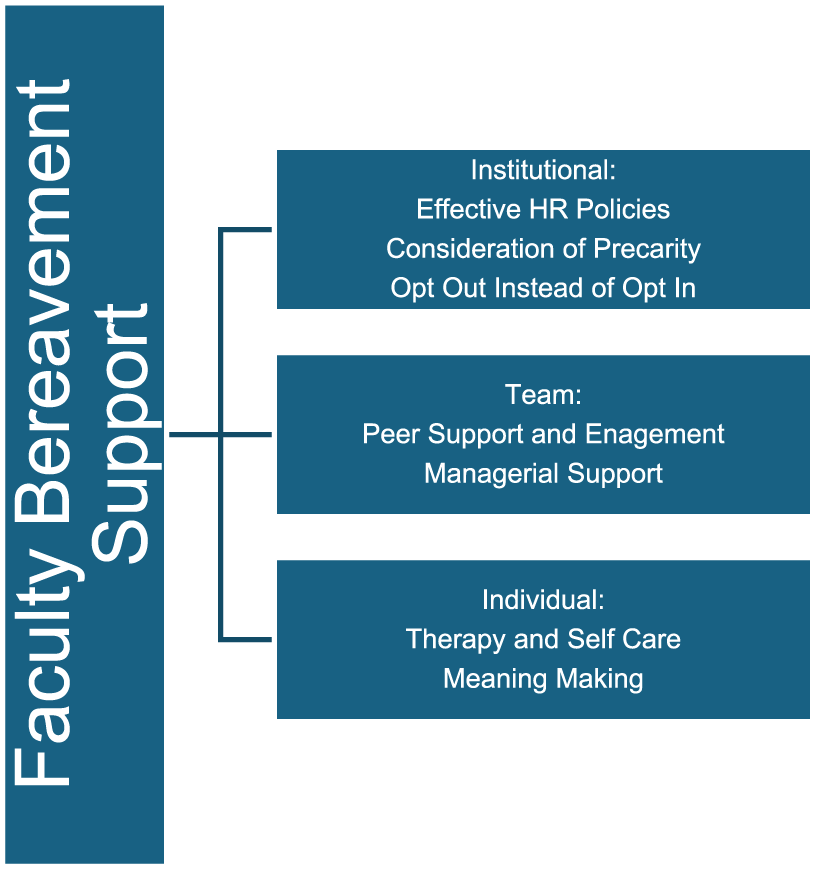
Faculty bereavement support at the institutional, team, and individual levels.
Individual
Therapy and Self Care
Especially when experiencing traumatic loss, it is vitally important to seek professional support in the process of coping and constructing new identities that come with the loss. Cognitive behavioral therapy (CBT) and EMDR have shown considerable effectiveness in dealing with post-traumatic stress that follows traumatic loss (Wild et al., 2023) and reducing the risk of prolonged grief disorder (Spicer, 2024). Talk therapy also helps the process of deriving meaning from one’s loss (Rim et al., 2025), which can make the difference between experiencing grief, and transitioning into chronic depression and pathological grieving (Scharer & Hibberd, 2020).
Personal self-care is having a profound cultural moment in the United States, but it is important for not only coping with grief, but also broader work-life balance. Fortunately, there are more resources available now for faculty and early career resources that address self-care in the modern university (Lemon, 2025; Lorentz et al., 2022; McDonald & Hatcher, 2023). Though, a common barrier to implementing effective health-promoting acts of self-care is personal efficacy (Rimal, 2000), which can be a considerable challenge when one is grieving. Faculty should take advantage of any offered paid bereavement leave and could also consider using unpaid leave under the Family and Medical Leave Act (FMLA). FMLA requires employers to provide up to 12 weeks of unpaid leave, with the promise that one’s job will be held for their return. Though, there is a considerable downside to the loss of income during such leave, especially if one is now the sole earner (i.e., in the loss of a spouse/partner) or already was. There is also a limitation for the newly hired, as this benefit is not available until at least 1 year of work is completed. Consideration for Practice #1 (Personal): Seek professional counseling and support for proper work-life balance after any traumatic loss.
Meaning Making
Meaning making is a key thread throughout my story and this article, as it has been central to my healing and has reshaped some of my academic work. Engaging in meaning making within our profession can help the process of meaning reconstruction after traumatic loss and offer new avenues for deriving significance from our lives (Hibberd, 2013).
The classroom can be a prime location for meaning making for faculty. Heather Cherie Moore (2016) offers a powerful autoethnography on what meaning making in the classroom looks like. For her, personal experiences with injustice (i.e., the death of a loved one in police custody) matched with her subject matter expertise (multicultural education) in powerful ways. It was powerfully difficult as she grieved and wrestled with how to connect her experience to the classroom. But her sharing was powerfully poignant for her students. While many faculty are grieving at any given time, many students are too. Studies have found roughly 30% to 40% of college students having experienced the death of a family member or friend one within the past year (Balk et al., 2010; Cupit et al., 2022). Grief can thus reshape how we view ourselves and our mission within higher education and how we connect with our students through lived experience. Vulnerability and transparency with students throughout the process can help us and them. We have a tendency, however, to remove “ourselves” from the classroom out of a sense of professionalism.
Because of the artificial hierarchies and masculine bias of higher education (Motta & Bennett, 2018), faculty can feel impostor syndrome if they are too vulnerable with students. Such feelings are especially the case for faculty of color and women in predominantly white male academia (Moore, 2016). But burying these experiences and remaining emotionally detached is inauthentic, and amounts to a coercive exercise of power over students if we are in turn asking them to engage with personal topics in the classroom (hooks, 1994). Granted, faculty must maintain necessary and appropriate professional boundaries with students in instructional settings. However, hooks (1994) emphasized that reciprocity between teacher and student is necessary for engaged pedagogy. Teaching practices that require emotional distance and control reinforce domination rather than a relational learning community (hooks, 1994, pp. 188–189). Thus, moving beyond the artificial hierarchies we often maintain in higher education involves shifting authority from performative distance toward credibility grounded in shared responsibility and mutual respect (hooks, 1994, pp. 21, 83–84).
Sharing our loss with students can help to build both a shared responsibility over the topics we are discussing and mutual respect with our students. This can be particularly the case in public affairs classrooms where we wrestle with difficult social topics, governance questions, and public policies. Moreover, for faculty from groups not traditionally present in academia, their lived experience is an important aspect of teaching students in a diversifying academy (Philips, 2025). In my case, I was forthright with my students about why I was absent for a week of class in February 2017. This bid for connection visibly landed with many of my students. In subsequent years, I have shared details of my loss and grief experience in policy classes when discussing topics like mental health, gun control, and more. My lived experience helped me to build mutual respect and credibility with students, especially those who also had experienced loss. Consideration for Practice #2 (Personal): Use your lived experience with loss to connect with them on both human and pedagogical levels.
Our research and service work can also be a refuge from grief, and not necessarily in a bad way (Pletneva, 2024). It is certainly possible to use work to avoid grief, which is not healthy. But as my example above demonstrates, work can be a method for making meaning of our loss, especially if it is traumatic. As faculty, we have latitude in what we teach, what we research, and what service we pursue. Academic freedom makes our position open to the kinds of job crafting that can help with grief (Pletneva, 2024). Job crafting involves modifying “task boundaries (i.e., altering the type or number of job tasks), relational boundaries (i.e., altering with whom one interacts at work, or the nature of interactions), cognitive boundaries (i.e., altering the view one has of their job and the meaning assigned to it), and skill boundaries (i.e., seeking opportunities to develop new skills or simplifying the job)” (Pletneva, 2024, p. 1058). While the research on job crafting tends to focus on either promotion seeking or negative outcome avoiding, Pletneva (2024) argues that the same modifications can be used to turn work into a refuge from grief. This could mean changing the focus of our research or the types of service we provide to the discipline (task boundaries). It could mean relating to peers and students differently, including reducing engagement with those who may stigmatize or shame the loss (relational boundaries). Faculty may increase or decrease the relative centrality of their academic career to their sense of personal meaning and fulfillment (cognitive boundaries). Or faculty could seek new skills (skill boundaries), like taking a Question, Persuade, Refer (QPR) training for suicide prevention. Any of these re-crafting approaches can help one restore meaning in their work after loss. Consideration for Practice #3 (Personal): Take time to evaluate how recrafting the task, relational, cognitive, and/or skill boundaries in your work can help restore meaning in your work/life.
Team
Peer Support and Engagement
As noted above, unacknowledged grief is harmful in many ways. Some losses, like suicide or the death of a child, also suffer from increased social taboos, which makes them more isolating for survivors (Reed, 2024). Turning back to Colbert, he says “I think people are afraid to talk about grief because they think it’s a trap of depression or something like that. When, in fact, grief is a doorway to another you” (Cooper, 2022). My mom’s is not the only death I have experienced. My dad died when I was 13, my aunt from suicide a few years later, my grandfather (who lived with us) in graduate school, and some friends along the way. Inevitably, people do not know what to say. In the vacuum, they tend to say meaningless things that hurt more than help (e.g., “well, she’s in a better place”). Grieving faculty will have to navigate such pain like anyone else. For colleagues of the grieving, it is important to be sensitive to their needs. The best thing that anyone said to me in the days after my mom’s death was “there are no words.” That is it. Not trying to make me feel better or offer some positive mental shift. Just recognition that the loss was painful.
Experiencing grief can also make one sympathetic to others who experience loss. There is the opportunity to be a support for grieving colleagues and students. Those displays of care can, in turn, help us in our own healing journey. In fact, faculty who have themselves experienced loss are more empathetic and supportive of students in their classes who experience significant loss (Hedman, 2012). Thus, engaging with colleagues and students, when there is enough felt safety to do so, can be both healing to oneself and caring to others. Consideration for Practice #4 (Team): Use your position as a grief survivor to better engage and support grieving students and peers.
Managerial Support
Structural support for the bereaved by management (deans, department chairs, etc.) is needed within the workplace. There cannot be a one-size-fits-all approach (Flux et al., 2020). Gilbert et al. (2021, p. 408) offer the CARE model of employee bereavement support: “(1) effective two-way communication about bereavement matters, (2) accommodation of the employees’ unique needs and job design, (3) recognition of the loss, and (4) emotional support for bereaved employees.” Workers feel supported when managers meet their specific needs (Bergeron, 2025). Early acknowledgment and space for expressing grief have long-term benefits for the bereaved (Bonanno, 2001; Choi et al., 2016). Time and space for mourning, and in my case the considerable collection of tasks required to manage an estate, is vitally important. Paid time off is also necessary, as there are considerable direct and indirect costs for funerals, travel, meals, lodging, and more when attending to the death of a loved one. In the case of the loss of a spouse or partner there could be the loss of an entire income. They also face a substantial cognitive load in learning to take on tasks that they had not previously done (Flux et al., 2020). Thus, new responsibilities at work may not be helpful or even feasible. Flexibility is therefore a repeated topic in the literature (Bakelants et al., 2024). Grief-related flexibility includes phased returns and changes to responsibilities that can linger long after formal paid time off ends. Consideration for Practice #5 (Team): Faculty managers should provide task flexibility for grieving faculty, including a phased return to full responsibilities.
Workplaces, including academia, vary considerably in the extent of their bereavement support (Flux et al., 2019). Many workplaces lack adequate support (Barclay & Kang, 2019). Policies also tend to be dictated by who died (Madhusoodanan, 2023), which often includes support only for the death of children, parents, or a spouse, but not unmarried partners. Moreover, a basic lack of awareness of these policies, as well as economic and social pressures, can prevent employees from using the available benefits (Reed, 2024). Clarity about work expectations and formal bereavement policies (Gibson et al., 2011; Noordik et al., 2011) are a must and anticipatory support needs to be initiated by the institution (Madhusoodanan, 2023), not the faculty member. This point is reminiscent of my experience with interpersonal support from family and friends. For the grieving there is a fundamental difference between asking “what can I do for you?” and saying, “I’m going to bring a meal by, do you have any allergies or aversions?” The former puts the cognitive effort on the bereaved to help the giver know what to do. Often, I would say “nothing” when asked if I needed anything. But the latter puts the effort on the giver and is a relief rather than another burden. Deans, department heads, and other managerial staff should be anticipatory and proactive in building a bridge between faculty and Human Resource departments rather than expecting faculty to simply figure things out on their own (Bakelants et al., 2024). Consideration for Practice #5 (Team): Faculty managers should not place the onus on faculty to know and implement university bereavement support but instead should be proactive in reaching out and connecting.
Institutions: The Neoliberal University
It is important to be sober minded about the state of modern universities. Neoliberalism has been seeping into the university for decades. It has led to an increasingly corporate culture, decline of liberal humanism (Giroux, 2009; Moore, 2016; Thorpe, 2009), where faculty governance is less robust and influential, and work is more precarious, even for tenured faculty (Das Acevedo, 2025). There has also been a shift in treating students like customers (Mintz, 2021). A customer service mentality puts even more pressure on faculty in many ways, including maintaining distance with students and ensuring they are “satisfied” with their experiences. Declining support from state and national governments has increased expectations on faculty through larger classes, greater pressure to seek external funding, and more pressure to publish research. The modern neoliberal university is also increasingly built upon precarious, lower paid, and lower benefited faculty labor: doctoral students, postdocs, non-tenure teaching faculty, and un-tenured faculty. These positions are not always eligible for bereavement support and other benefits, like an employee assistance plan (EAP). Moreover, graduate students and postdocs are often not treated as employees, meaning they may not even be thought of by management for connection to eligible services when experiencing loss.
For a truly humane bereavement policy, universities must wrestle with the systemic pressures on faculty that prevent them from even using such policies in the first place. That is a more fundamental, yet harder to solve, problem that warrants far greater attention and has implications beyond bereavement. Human resource management research documents an empathy-efficiency paradox, whereby grief support appears to conflict with the productivity goals of a firm (Bergeron, 2023). This perceived conflict implicitly pressures workers to hide their grief in ways that can paradoxically hinder productivity. Even with clear and well communicated bereavement policies, faculty must take them and department chairs, directors, and even tenure and promotion committees must follow them. It was not until writing this article that I realized no one ever explained the university bereavement policy to me when my mom died, if there even was one. I have no idea. I used my control of the classroom to cancel classes for the week, but do not know if I was entitled to more leave.
But I also question whether I would have taken leave in my position. I was on the tenure track. Tenure review committees are sadly not well adept at taking such clock extensions into consideration (Holland et al., 2024). The tenure clock would have kept ticking in my mind, even if it was paused. Like women who do not accept tenure clock extensions due to child bearing (Holland et al., 2024; Sullivan et al., 2004) or the many of us who did not take additional offered tenure clock time during the COVID pandemic (Hewko et al., 2024), I would not have felt comfortable taking any accommodation anyway. The research on women academics taking maternity leave is instructive to the current discussion of bereavement leave. Women academics are more likely to take maternity leave if the package is better (e.g., paid leave instead of unpaid and for a sufficient period) and if they are more secure in their position. Being early on the tenure track, I certainly did not feel secure in my position. Even less so when I transitioned to a new university.
Faculty teaching is also different in important respects than other jobs. These differences affect what accommodation might look like for a faculty member. The best approach to supporting bereaved faculty, based on past research, is paid time off, a phased return, and slow reintroduction of responsibilities (Gibson et al., 2011). My mom died in mid-February. I was in the middle of teaching three classes. If I took time off, who would teach those classes? We do not have substitute teachers in higher education. The need for a phased return and task flexibility butts up against the rigid academic calendar. The persistent “demands of teaching and research [can] demands of teaching and research overshadow the role of grief and mourning for some faculty members” (Fitzpatrick, 2007, p. 99). There is no easy answer. Colleagues may step up and help, but how should they be compensated? If classes are canceled, how are students impacted, including in their progress to graduation? Once again, these questions are not easy to answer but warrant additional consideration from researchers.
It is not just the pressures of an increasingly neoliberal higher education that drives the grieving back to work. Returning to work can be a useful distraction and refuge from grief (Gibson et al., 2011; Pletneva, 2024), including for university faculty (Fitzpatrick, 2007). As noted above, it can also be part of making meaning from one’s loss. However, work can also become an unhealthy distraction for faculty and result in unresolved grief, as it did for me. Especially when one faces traumatic grief. The formal support for bereaved faculty focuses on the time immediately following the loss. But grief does not conveniently go away in a month or two. And unresolved grief can create long-term problems that are more difficult to tackle. Managers need to pay attention to signs of burnout in faculty who experience significant loss but just continue to plow forward in their work (Sabagh et al., 2018). Additional support and intervention may be necessary if complicated or unresolved grief results in physical and/or mental illness (Buur et al., 2024; Buur et al., 2025)
Importantly, compassionate bereavement leave and grief support policies are available in many market-oriented organizations, including institutions of higher education. This means that they can be well implemented through good policy design and strong leadership. Moreover, better institutional bereavement care can help not only faculty and staff, but also students (Balk, 2001) who represent a considerable policy and research gap with respect to bereavement support (Valentine & Woodthorpe, 2020). Workplaces, including higher education, can leverage the Dual Process Model of grieving presented in this article to structure workplace bereavement policies (Bergeron, 2023). Processes and procedures need to be clearly and proactively communicated to faculty (Bakelants et al., 2024; Spiccia et al., 2023). Longer bereavement leave that can be delayed – that is, not required to be taken immediately after the loss – offers flexibility for workers to decide when they are ready for a phase of grief confrontation. Such flexibility is important to preventing or coping with stifled grief (Bakelants et al., 2024). EAPs can help employees cope with larger tasks like funeral arrangements, estate attorneys, real estate help, even support for needed relocation and moving expenses.
Additionally, making accommodation the norm, but allowing faculty to opt out if they wish, can reduce the stigma for using such support. For example, most colleges and universities offered tenure clock extensions due to the COVID-19 pandemic, but some made them automatic rather than opt-in (Gonzales & Griffin, 2020). Transparently setting a policy as the default, while also providing agency opt out if one decides they do not want to participate, is an effective means for increasing the use of a program (Paunov et al., 2019). Using an opt out rather than opt in fosters the perception that the default policy is the implicit recommendation of the organization (McKenzie et al., 2006), rather than leaving workers wondering whether they will be somehow penalized for using the accommodation. Effectively implementing bereavement policies will also require cultural change that empowers faculty, staff, and management to act compassionately, while balancing necessary institutional standards around teaching, research, and service (Charles-Edwards, 2009). Consideration for Practice #6 (Institutional): Institutions of higher education should follow a dual process model of support, offering faculty flexibility in using accommodations and making accommodation the default. Moreover, additional thought and attention needs to be given to those who are most precarious (graduate students post docs, adjuncts, non-tenure line faculty), not just tenure-line faculty.
Conclusion
Grief will come for all of us. Loss is a fundamental part of human existence. But grieving is too often a private affair for the bereaved and an uncomfortable one for those around them. The context within which university faculty work adds complexities to experiencing grief. The increasing precarity of neoliberal higher education results in substantial pressure to keep pressing forward. Lingering views of care as feminine and thus somehow lesser than intellectual prowess can force a cold stiffness in faculty-student, faculty-faculty, and faculty-staff relationships. Many difficult personal experiences, including grief from various types of loss, then become taboo and our grief goes unacknowledged. But we can do better – both for ourselves and within the structures of academia. How can we build necessary emotional capacity in our students as future public servants (Awasthi & Mastracci, 2021), if we cannot first do so in ourselves?
Using literature review and an autoethnography of my own experience of traumatic loss as a faculty member, this article has raised more questions than offers clear answers. The answers appear clear from the broader literature on grief in the workplace, but higher education has its own unique context that warrants additional research. As Mariskind (2014, p. 309), citing (Rossiter, 1999), puts it, “teachers will be more able to develop caring relationships with students and colleagues if they feel sufficiently cared for themselves and are valued and secure within their institution.” I hope this article, and the broader special issue on Pedagogies of the Emotionally Exhausted, sparks discussion of how to have a more humane, and ultimately more effective, academy.
Footnotes

Funding
The author received no financial support for the research, authorship, and/or publication of this article.
Declaration of Conflicting Interests
The author declared no potential conflicts of interest with respect to the research, authorship, and/or publication of this article.