






Abstract
As organizations formalize their corporate social responsibility (CSR) activities, many firms are voluntarily disclosing these activities in their annual report. Some advertising agencies, for example, are discovering the benefits of undertaking pro bono work and reporting them in their annual reports. This article uses a longitudinal approach to observe the pro bono activities presented in the annual reports of the largest advertising agency holding company in the world, WPP Group. The amount of “social investment” has been disclosed in the annual reports including details of the financial cost of pro bono activities and the types of organizations that are the recipients. This study provides an insight into the disclosed pro bono activities of a major organization across a 10-year period (2000–2009).
Introduction
Outcomes of major corporate ethical and financial disasters have resulted in many organizations taking steps to improve their corporate governance, ethical practice, and social responsibility (Agrawal & Chadha, 2005; Margolis & Walsh, 2001). In particular, attention is growing in the corporate social responsibility (CSR), which includes a “concern for the impact of all of the corporation’s activities on the total welfare of society” (Bowman & Haire, 1976, p. 13). This growing concern assumes that the corporate entity influences and, in turn, has influence upon the society in which the corporation operates (Deegan, 2002). All organizations need to behave in a socially responsible way, so that they will be perceived as a “good citizen” (Campbell, 2007). CSR and, more specifically, CSR reporting is an area of growing interest in both accounting and marketing academic research (Farook & Lanis, 2005; Gray, Owen, & Maunders, 1987; Luo & Bhattacharya, 2006; Waller, 2009, 2010; Waller & Lanis, 2009a).
Companies voluntarily disclose nonfinancial information, such as CSR policies, initiatives, and outcomes, to their various stakeholders, which helps to develop a particular brand image for the organization. This information may be disseminated through their website, annual reports, CSR reports, and press releases to a range of stakeholders, including shareholders, employees, customers, suppliers, media, and the government (Berkey, 1990; Hopwood, 1996; Judd & Timms, 1991; Maignan & Ralston, 2002; Neu, Warsame, & Pedwell, 1998; Stanton & Stanton, 2002). While marketing-related companies, including advertising agencies and media organizations, are often criticized for unethical practices, such as controversial advertising images, and the effects on the more vulnerable sections of society, it is important to examine how these communicators view their social responsibility to the community in general (Waller & Lanis, 2009a, 2009b). There is an increased interest in CSR and pro bono work by advertising agencies in the industry literature, including observing the benefits gained from having a pro bono client as well as awards won for this type of work (Lister, 2008; Rappoport, 2008; Waller, 2010).
This article observes the pro bono activities of the world’s largest advertising agency holding company, WPP Group. This will be achieved by presenting correspondence from an executive involved in CSR decision making, and analyzing the annual reports over a 10-year period (2000–2009). The research objectives will be (1) to determine the importance of pro bono work to the WPP Group; (2) to discover the amount of “pro bono activities” that are reported over a 10-year period; and (3) to identify the types of organizations that are the recipients. This article advances the knowledge in the area of CSR disclosure by focusing on pro bono reporting by one organization (WPP Group) in a longitudinal analysis across 10 years.
Background
Stakeholder Theory
Organizations are increasingly embracing CSR activities to show stakeholders that they are socially accountable for their actions (Esrock & Leichty, 1998; Gray, Kouhy, & Lavers, 1995; Waller, 2010). From a theoretical perspective, there are a number of reasons why an organization would behave responsibly (Campbell, 2007; Waller & Lanis, 2009a). One framework used to help understand CSR is the stakeholder theory (Campbell, 2007; Doh & Guay, 2006).
Stakeholder theory posits that it is important for an organization to relate favorably with the stakeholders into which it is located (Freeman, 1984). Stakeholders, according to Freeman (1984), are “any group or individual who can affect or is affected by the achievement of the organization’s objectives” (p. 46). The various stakeholder groups, including shareholders, government, general public, and media, are essential as they form an integral component of the business loop (Murphy et al., 2005). There are two stakeholder approaches to help understand CSR. First, the “shareholder approach” emphasizes that organizations are not only accountable to their shareholders but also balance the interests of other stakeholders (Freeman, 1984; Van Marrewijk, 2003). Second, the “societal approach” emphasizes that companies are responsible to society as a whole (Van Marrewijk, 2003; Walton, 1974; Wood, 1991). Therefore, as part of an organization’s CSR activities, it is important that it is socially and morally responsible in its business activities; this can include working for pro bono clients, and, in particular, building positive relations with stakeholders.
CSR and Pro Bono Disclosure
For companies undertaking CSR activities, there is also a desire to communicate these activities. CSR disclosure is “ . . . the process of providing information designed to discharge social accountability. Typically this act would . . . be undertaken by the accountable organization and thus might include information in the annual report, special publications, or even socially oriented advertising” (Gray, Owen, & Maunders, 1987, p. 4). This suggests that CSR disclosure is a way management can interact with the broader society to “influence external perceptions about their organization” (Deegan, 2002, p. 292). Jenkins (2006) categorizes the CSR activities of Small–Medium Enterprises in the United Kingdom as environmental, employees, supply chain or business to business, and community or society. Waller and Lanis (2009a) in analyzing the annual reports of advertising agency holding companies found CSR disclosed in the following general categories: work output, human resource activities, social or community commitment, and environmental initiatives. An example of social or community commitment is the undertaking of pro bono work for various charities or nonprofit organizations.
A number of advertising agencies are increasingly disclosing their pro bono activities in their annual reports or specialized CSR reports, listing the nonprofit organizations they have done work for and identifying the estimated cost of such work. A definition of pro bono work in relation to the advertising industry is “the provision of creative, production, and/or media placement services by agencies to community or nonprofit organizations at a reduced or no fee” (Waller, 2009, p. 2). Organizations such as WPP Group, Publicis Groupe, Dentsu, and Havas place a significant amount of effort into this kind of “social investment” (Waller & Lanis, 2009a). Publicis Groupe, for example, was involved in developing more than 300 pro bono campaigns representing a total of approximately $US50 million (Publicis Groupe, 2009).
Although it appears fairly popular among some agencies as an important part of their CSR activities, there has been limited research on this type of pro bono work (Lister, 2008; Pratt, 2003; Waller, 2010). Having a pro bono client helps an agency in a number of ways, including staff relations, creativity, and status (Lister, 2008; Pratt, 2003; Rappoport, 2008). Waller (2010) identifies six main advantages for the advertising agencies in doing pro bono work: to demonstrate civic responsibility, to provide creative opportunity, to motivate staff, to gain exposure, to increase profile and prestige, and to attract paying clients.
WPP Group
The context for this article is the advertising agency holding company, WPP Group. WPP describes itself as “the world leader in marketing communications services” (WPP, 2009). It comprises of more than 150 companies, including the Ogilvy Group, J Walter Thompson, Young & Rubicam, and Grey. Over 135,000 people (including associates) work for WPP companies, based in 2,400 offices located in 107 countries (WPP, 2009). According to the Advertising Age list of top agencies, in 2009 WPP ranked number 1 with a worldwide revenue of $13.6 billion, followed by Omnicom Group, Interpublic Group, and Publicis Groupe (Advertising Age, 2009). The London-based company was first listed on the US stock exchange NASDAQ in 1988, and so, as a publicly listed company, is required to produce an annual financial report for shareholders and regulatory bodies. As a major force in global communications, a recognized good corporate citizen, and an organization that provides information regularly to the public, WPP provides an example of what CSR activities are being undertaken by a large communication corporation.
Method
This article uses a descriptive, case study approach to observe the pro bono activities in the advertising industry, as it focuses on one major organization, WPP Group. Case-based research is a powerful way of examining and “understanding the dynamics present within single settings” (Eisenhardt, 1989, p. 534), and can combine data from a range of qualitative and quantitative sources (Eisenhardt, 1989; Stake, 1994; Travers, 2001; Yin, 1994). According to Yin (1994, pp. 2–4), the case approach “allows an investigation to retain holistic and meaningful characteristics of real-life events—such as…organizational and managerial processes.”
Two methodologies were used to obtain data for this study on pro bono activities at WPP Group: (1) personal correspondence with a senior executive involved in the CSR decision making and (2) a content analysis of annual reports over a 10-year period (2000–2009).
Correspondence was undertaken by e-mail with Vanessa Edwards, Head of Corporate Responsibility, who provided answers to several open-ended questions on CSR activities by WPP. After giving her permission, there was a three-step process to obtain an accurate response. She was initially sent four questions on CSR/pro bono activities at WPP. After receiving her answers, another e-mail was sent to her clarifying particular points, to which she responded. Finally, a summary was made and sent to her, which was finally approved.
As a business communication tool, annual reports are an effective way to obtain relevant data from WPP that directly related to its pro bono activities. The annual reports were accessed as a .pdf file from the website www.wpp.com. To discover the appropriate information or sections in the reports, a search was run using the terms pro bono, CSR, and corporate responsibility. The data included financial information and descriptions of activities taken directly from the text of the annual reports, therefore, no subjective judgments were made, and there was no need for third-party reliability checking.
Findings
Importance of Pro Bono Work
The first research objective, to determine the importance of pro bono work to the WPP Group, is answered by statements in the 2008 annual report and personal correspondence with the WPP Group Head of Corporate Responsibility ( Our companies have a long tradition of pro bono work—providing creative services to charities at little or no cost. This work can be invaluable—helping raise money and awareness for hundreds of good causes every year. It also benefits WPP by show casing our creative skills and ability to create compelling communications on a wide range of social and environmental issues. Our people gain a breadth of experience and the chance to contribute to their communities. (WPP, 2009, p. 125)
The following extract comments on the relationship between WPP and the pro bono clients:
Pro bono projects are agreed between WPP companies and the charities concerned. Many of our companies have long-standing relationships with their pro bono partners. WPP the parent company helps to coordinate pro bono projects involving multiple WPP companies or cross-Group collaboration. (WPP, 2009, p. 118) . . .our companies do an enormous amount of pro-bono work and have done for many years. I think it is tremendously important to our agencies. It allows people to work on causes very close to their hearts and they perhaps have a wider brief/can be more creative with these projects. As WPP’s operating companies are autonomous, it is up to them to choose the pro-bono work that they do.
As for the main benefits of pro bono work:
To the charity, this work can be invaluable by helping raise money and awareness. Internally as I said before, it is very empowering for staff to be able to work on a cause that they feel passionately about.
Finally, explaining why WPP publicly communicates its pro bono work:
We tend to detail this in the annual report and CR (corporate responsibility) report as we see it as a significant part of our CR commitment.
Clearly, from the annual report and correspondence with the WPP senior executive, pro bono work is perceived as being very important for WPP in general for “making a positive contribution in society,” but more specifically it helps the pro bono client in raising money and awareness, and assists WPP to encourage creative ideas and empower its staff.
Annual Reports 2000–2009
To answer the second and third research objectives regarding the amount of “pro bono activities” that are disclosed and the types of organizations that are the recipients, a content analysis was undertaken of the WPP Group annual reports over a 10-year period (2000–2009). While CSR information is communicated using press releases, advertising, annual reports, public relations activities, and websites (Esrock & Leichty, 1998), annual reports are the only documents produced regularly to comply with regulatory requirements and is central to the organization’s own image (Gray, Kouhy, & Lavers, 1995). A list of each report, the report date and a summary of the title of the relevant section, the page numbers, the headings, and the number of tables or graphs included is found in Table 1. Note that the reports are based on a calendar year, so the publication date is in the following year. Summaries of the relevant text and activities for each year are described below. It is presented in a year-by-year format to show the longitudinal development, changes, and growth of CSR disclosure by WPP.
WPP Group Annual Reports 2000–2009
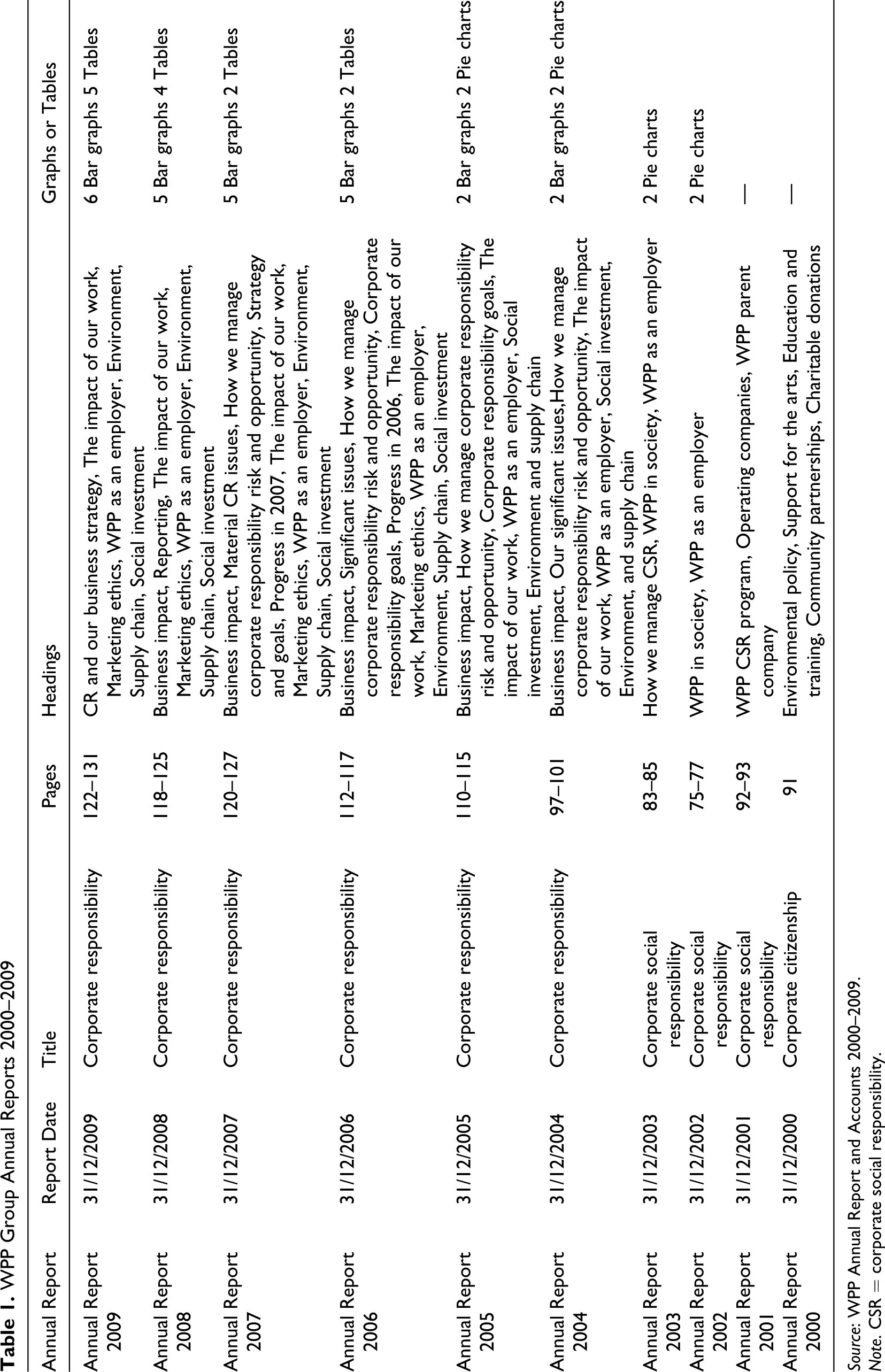
Source: WPP Annual Report and Accounts 2000–2009.
Note. CSR = corporate social responsibility.
Annual Report 2000
The “Corporate citizenship” section is a single page (WPP, 2001, p. 91) and begins by stating that “WPP is playing an active part in developing corporate and social responsibility policies and standards that are relevant to the communications services industry.” The subheadings are: Environmental policy; Support for the arts; Education and training; Community partnerships; and Charitable donations. In discussing support for the arts, the report says WPP “encourage and foster mutually beneficial partnerships between our operating companies and arts organizations. Many WPP employees are active in their own arts communities, giving time and marketing counsel to a variety of arts-based organizations and activities around the world” (WPP, 2001, p. 91). It gives examples of the National Portrait Gallery in London and the Creative Forum for Culture and the Economy, a “think and action tank” for business leaders dedicated to developing dynamic relationships between business and the arts.
Community partnerships and charitable donations are generally determined and contributed by the operating companies at local level, while WPP, the parent company, concentrates its charitable giving in “the areas of education and training of young people, with particular emphasis on those who are disadvantaged.” A list containing the social investment, charitable donation of the parent company, and pro bono activities identified in the various annual reports from 2000 to 2009 is found in Table 2. There is discussion of WPP’s involvement in various education programs and more examples of pro bono clients around the world, including WWF and Childline in South Africa; Médecins Sans Frontières and UNICEF in France; The Red Cross in Greece, Mexico, and Portugal; Partnership for a Drug Free America in Chicago; and the National Youth Theater in London.
CSR Activities Reported by WPP Group
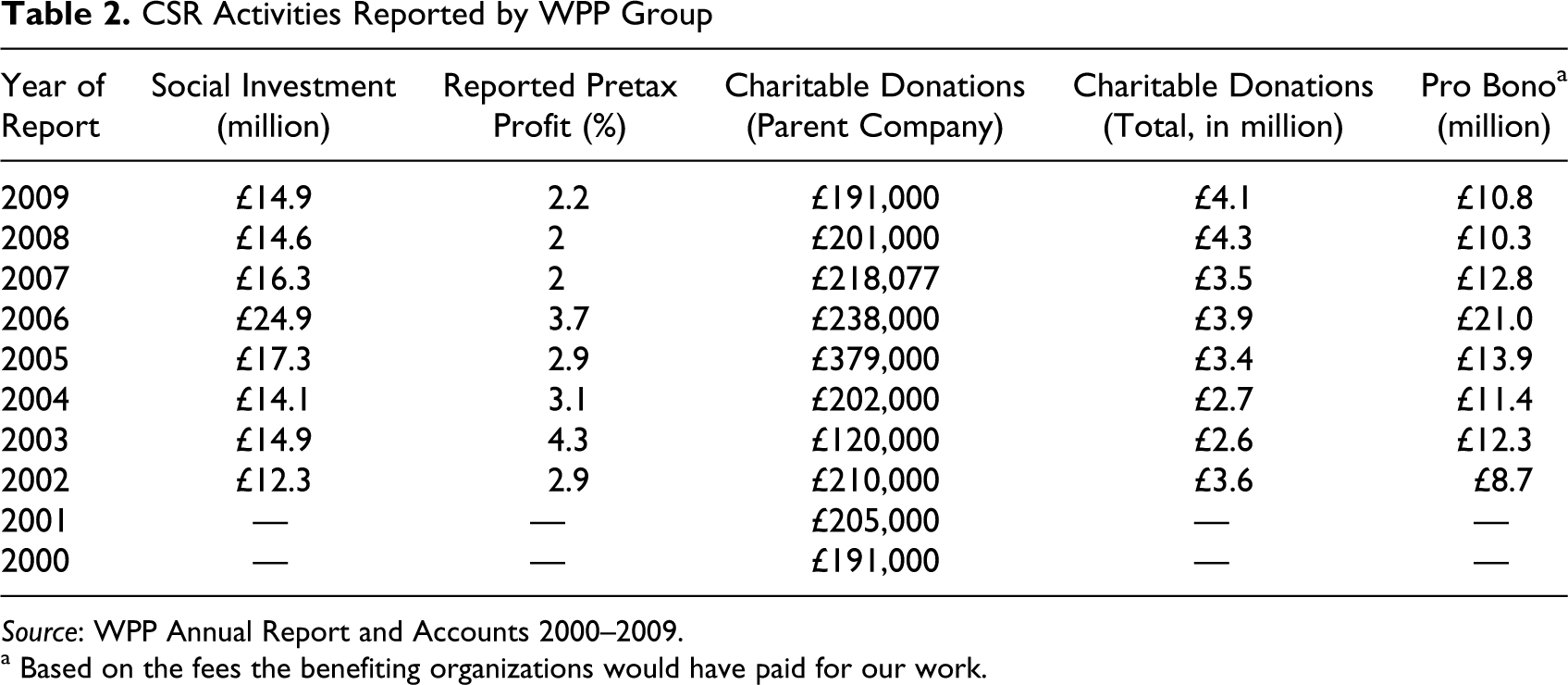
Source: WPP Annual Report and Accounts 2000–2009.
Based on the fees the benefiting organizations would have paid for our work.
Annual Report 2001
The relevant section in the 2001 report, renamed “corporate social responsibility,” runs for two pages (WPP 2002, pp. 92–93). The headings are different to the previous year’s as it focused on the “WPP CSR program,” the “Operating companies” (giving examples of CSR activity by the WPP companies), and “WPP parent company” (which discussed “Education and training” and “Support for the arts and community”). The discussion on CSR activities by the operating companies includes a number of examples and a statement on the importance of pro bono work: “Pro bono’ work, free marketing services that are provided to charities and community organizations, is one of the most significant ways in which our companies contribute to society.”
Annual Report 2002
The section on “corporate social responsibility” provides more detail across three pages (WPP, 2003a, pp. 75–77). There are two main parts: WPP in society and WPP as an employer. This report provided more financial detail of pro bono work and donations compared to the previous reports, as shown in Table 2, and will assist in answering research objective 2. Pro bono work is discussed under the “key issues” in WPP in society, and mentions “social investment,” “including donations and pro bono work (professional work at no, or minimal, cost).” A pie chart presents showing “WPP businesses pro bono work value” with figures based on the amount of work by the main agency brands. However, rather than pointing out the social benefit of CSR activities, the 2002 report identifies the financial benefit of such work, beginning the section with:
WPP believes that being socially responsible is not only morally right—it makes good business sense. Social responsibility is an important factor in the management of brands and corporate reputation, a core area of our business. Our values help us to recruit and retain the most thoughtful and talented people. A strong record in CSR attracts investment from the growing number of socially responsible investors. (WPP, 2003a, p. 75)
Note that this is the first year that WPP published a separate CSR report, “WPP Corporate Social Responsibility: A Review.” Importantly in this report, WPP identifies its stakeholders as: investors; employees; clients; consumers; business partners and suppliers; charities; and the environment (WPP, 2003b, p. 7). Discussing the various stakeholders in the first CSR report clearly shows a good understanding of CSR issues and supports a stakeholder approach to understanding CSR activities from WPP’s perspective. In addition, the CSR reports have more detail on examples of pro bono campaigns in different countries. This increased disclosure also coincides with changes in corporate governance rules, such as the Sarbanes-Oxley Act (2002) in the United States, due to numerous global accounting scandals (Agrawal & Chadha, 2005).
Annual Report 2003
The “corporate social responsibility” section in the 2003 Annual Report was three pages in length (WPP, 2004, pp. 83–85). The section has a number of parts: “How we manage CSR,” “WPP in society” (Key issues, Social investment, and WPP the parent company), “Marketing ethics,” and “WPP as an employer.” Like the previous year, pro bono work is discussed in “key issues” and “social investment,” and a pie chart shows “WPP businesses pro bono work value” but has figures based on the type of recipient organization. This information continues in future reports and assists in answering research objective 3.
Annual Report 2004
In 2004, the relevant section’s name was shortened to “Corporate responsibility,” and expanded to five pages in length (WPP, 2005, pp. 97–101). The section is divided into “Business impact,” “Our significant issues” (the impact of our work; employment; and social investment), “How we manage corporate responsibility risk and opportunity,” “The impact of our work” (marketing ethics, privacy, social marketing, and cause-related marketing), “WPP as an employer,” “Social investment” (WPP the parent company, and Employee volunteering), and “Environment and supply chain.” Again each of these target interests of specific stakeholders. A drop in social investment is seen in 2004 blamed on the fall in the amount of pro bono work carried out during this busy year:
WPP’s social investment reduced in 2004 primarily due to a smaller amount of pro bono work being undertaken. During this period of high commercial activity the time and resources that our people were able to donate to pro bono work reduced, meaning that the value donated did not keep pace with revenue. (WPP, 2005, p. 100)
It is also noted that “Many WPP companies gave money and undertook pro bono work to support communities affected by the Asian tsunami” (p. 101).
Annual Report 2005
The “corporate responsibility” section grows to six pages in 2005 (WPP, 2006, pp. 110–115), with headings similar to the previous year, a new part is added on “Corporate Responsibility Goals,” which set three ongoing goals: (1) Contribution to society—undertake pro bono work and make donations to charity to a value of 0.4% of revenue; (2) Marketing ethics—comply with all laws and industry codes governing marketing material (and to track our performance globally to establish how we are doing); and (3) Environment—calculate climate impact, purchase recycled paper, and install recycling facilities in 10 of our largest offices (p. 111). Therefore, pro bono work is not only seen as an important part of social investment, along with charitable donations, but it is also becoming a measure for the organization’s CR goals.
Annual Report 2006
The “corporate responsibility” for 2006 maintains a length of six pages (WPP, 2007, pp. 112–117) with similar headings as before, yet with an expanded discussion on “Significant issues,” identifying five corporate responsibility issues to be of significance to WPP: “(1) The social and environmental impact of our work for clients; (2) Marketing ethics, compliance with marketing standards, and protection of consumer privacy; (3) Employment, including diversity and equal opportunities, business ethics, employee development, remuneration, communication, and health and safety; (4) Social investment, including pro bono work, donations to charity and employee volunteering; and (5) Climate change, including the emissions from energy used in our offices and during business travel.” Each of these issues are clearly targeting different stakeholders, such as clients, the industry, employees, charities or pro bono recipients, and environmentalists.
In 2006, the social investment was worth £24.9 million, which is the highest amount over the years observed in this study, and equivalent to 0.42% of WPP’s total revenue and 3.7% of reported profit before tax. The reason given for the increase was “partly due to improvements in our data collection systems” (p. 125). The pro bono work mentioned in the report is for the Global Media AIDS Initiative in which pro bono TV advertising spots are created to raise awareness of HIV/AIDS, 25 years after it was first diagnosed, with the campaign being made available rights-free to media outlets around the world. It was also mentioned that WPP ranked fourth in the UK Guardiannewspaper’s Giving List 2006 (based on 2005 data), which ranks FTSE 100 companies by the value of their social investment.
Annual Report 2007
This year’s “corporate responsibility” section is eight pages long (WPP, 2008, pp. 120–127), again with similar headings. One extra part identifies the “Business benefits from our CR strategy” identifying four benefits: “(1) Generate new business opportunities; (2) Attract, retain and motivate the best people; (3) Enhance our reputation; (4) Meet investor expectations” (pp. 120–121). These benefits can relate to several stakeholders—including potential clients, staff, business partners and suppliers, and investors. The report stated that regarding their pro bono work, “The benefit to the charity is usually many times the value of our input” (p. 126). Pro bono work is mentioned as a way to enhance its reputation. The pro bono example of Grey Group’s support for the “Stand Up Speak Out Against Poverty” campaign, organized by the United Nations, is designed to remind governments of their commitment to eliminate poverty by 2015.
Annual Report 2008
The section on “corporate responsibility” in 2008 is eight pages long (WPP, 2009, pp. 118–125) and follows similar headings as previous years. Social investment for this year was £14.6 million, down from £16.3 million in the previous year. The reduction in pro bono work was claimed to be “due to the worsening economic conditions, which placed pressure on our companies to focus on fee-paying work” (p. 125). In discussing the pro bono work, the report clearly states the benefits to WPP: “It also benefits WPP by showcasing our creative skills and ability to create compelling communications on a wide range of social and environmental issues. Our people gain a breadth of experience and the chance to contribute to their communities” (p. 125). It then lists a number of charities, “with a particular focus on education, the arts and young people” that are supported by WPP.
Annual Report 2009
Finally, in 2009, the section on “Corporate responsibility” is 10 pages long (WPP, 2010, pp. 122–131). The social investment figure of £14.9 million is slightly higher than the previous year’s total of £14.6 million. In discussing the pro bono work, the report states:“In addition, WPP media agencies negotiated free media space worth £27.3 million on behalf of pro bono clients” (p. 130). The report also follows similar headings as previous years and lists organizations that WPP supports and is a member, such as Business in the Community, Employers Forum on Disability, and The Institute of Business Ethics.
Discussion
According to the annual reports and a WPP senior executive, pro bono work is perceived as being very important for WPP’s contribution to society, by helping the pro bono client in raising money and awareness, and assisting WPP to encourage creative ideas and empower its staff. This confirms Waller’s (2010) discussion of the benefits of having a pro bono client, and answers the first research objective.
From the descriptive discussion of the contents of the annual reports for the 10-year period 2000–2009, there was mention of WPP’s “corporate citizenship” and charitable donations from their reports from 2000 onward. However, since 2002 the amount of disclosure has increased with subsequent reports detailing pro bono work, including the financial value, the identity or type of recipients, and the publishing of a separate CSR report. This increased disclosure coincides with changes in corporate governance rules (Agrawal & Chadha, 2005).
Table 2 presents the financial amounts that help answer the second research objective. While in the body of the reports WPP has mentioned the arts and education as key beneficiaries of its social investment, according to the figures disclosed in the annual reports (presented in Table 3), the top beneficiaries were health, followed by local community, and then education, arts, and the environment (answering the third research objective).
Pro Bono Work by WPP
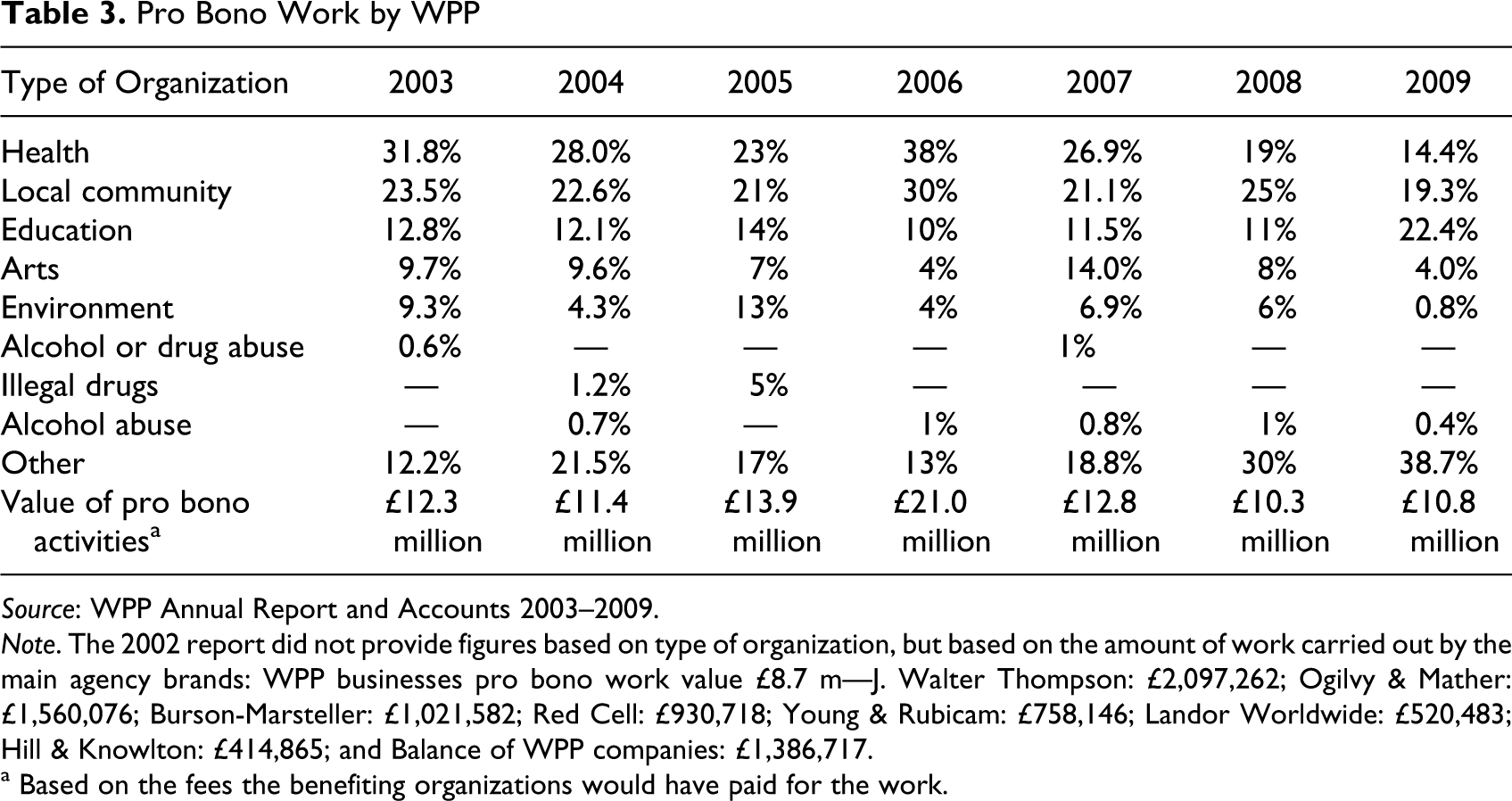
Source: WPP Annual Report and Accounts 2003–2009.
Note. The 2002 report did not provide figures based on type of organization, but based on the amount of work carried out by the main agency brands: WPP businesses pro bono work value £8.7 m—J. Walter Thompson: £2,097,262; Ogilvy & Mather: £1,560,076; Burson-Marsteller: £1,021,582; Red Cell: £930,718; Young & Rubicam: £758,146; Landor Worldwide: £520,483; Hill & Knowlton: £414,865; and Balance of WPP companies: £1,386,717.
Based on the fees the benefiting organizations would have paid for the work.
This analysis of WPP’s annual reports raises some important points in the area of CSR disclosure. First, this study confirms that the disclosure of CSR activities is not new (Doh, & Guay, 2006), and for over 10 years WPP annual reports discuss its behavior relating to its “corporate citizenship.” Further, detail disclosed increases since 2002 due to changes in corporate governance rules. Second, stakeholder theory is clearly a strong practical framework to help understand CSR activities by large organizations (Campbell, 2007). Discussion in the annual reports targets the interest of certain stakeholders, and the first CSR report in 2002 identifies the main stakeholders (investors; employees; clients; consumers; business partners and suppliers; charities; and the environment—WPP, 2003b, p. 7).
Third, WPP is an organization that strongly believes in the value of social investment, which includes pro bono work and charitable donations. WPP recognizes direct benefits to the staff as well as the charitable organization. Fourth, while WPP is a regular supporter of many charities, it is noted that the amount given in pro bono work is much larger that what is given in donations. Further, while donations are fairly constant in amount, the pro bono amount, while larger, is influenced by market conditions, such as busy workloads for regular clients and the global financial crisis. Finally, as a major player in social investment, WPP is a benchmark on how to disclose CSR activities; this includes setting goals, identifying benefits, detailing figures, and presenting examples of pro bono work. By observing the practice of one organization, this study will promote discourse in this area for future studies.
Conclusion
This article presents a case study of the largest advertising agency holding company in the world, WPP Group, focusing on its disclosure of CSR and in particular their pro bono activities. The data are collected from correspondence with a WPP executive and analyzing the annual reports 2000–2009. This research focused on one organization; however, it is important to recognize that other advertising organizations, for example, Publicis Groupe, and other industries, such as legal and accounting firms, also undertake a large amount of pro bono work. A comparison could be made across organizations or industries using similar analysis. Learning whether a link exists between pro bono activities and business performance or community attitudes to the organization would also be worthwhile to explore. The use of an organization’s annual reports and other formal documents by marketing researchers as a method to gain data on specific company activities is encouraging. Therefore, further research is necessary. As organizations recognize the win–win benefits of undertaking pro bono work and publicly communicate them, perhaps more organizations will be encouraged to do pro bono work for the community.
Footnotes
Declaration of Conflicting Interests
The author(s) declared no potential conflicts of interest with respect to the research, authorship, and/or publication of this article.
Funding
The author(s) received no financial support for the research, authorship, and/or publication of this article.