







Abstract
Background:
Competitive forces influence social marketing efforts. Indeed, social marketers often find themselves “shadow boxing” various forms of competition throughout their interventions. Despite the seminal role of competition as a threat to social marketing intervention efficacy, few empirical studies have undertaken competitive analysis or compared the usefulness of competitive typologies. Thus, this paper proposes an index approach to categorize competitive typologies relevant to a specific social marketing intervention in terms of their ease of use, intuitiveness and generalisability to the broader social cause domain. The proposed index approach is illustrated with empirical data, undertaking a competitive analysis of forces obstructing efforts to address educational inequality in Australia, then comparing the ease of use, intuitiveness and generalisability of 15 competitive typologies noted in the social marketing literature to produce a competitor analysis index.
Research Question:
Which competitive typologies most effectively frame forces that inhibit educational equality social marketing efforts in Australia?
Methods:
Via interviews and focus groups, qualitative data were collected from 46 students from low socioeconomic status (LSES) backgrounds at six universities and sought to understand the influence of their home residence’s geographical remoteness on their university participation. The analysis revealed eight participant-identified differential competitors experienced by students from regional, rural and remote settings (LSES-R, n = 25, 54.4%) that were not experienced by those from metropolitan areas (LSES-M, n = 21, 45.6%). Fifteen competitive typologies were identified in the social marketing literature, and their capacity to frame these eight differential forces in terms of their ease of use, intuitiveness and generalisability was critiqued.
Findings:
Unlike their metropolitan counterparts, LSES-R participants experienced situational (n = 3), dispositional (n = 3) and goal pursuit (n = 2) competitive forces. The most effective competition typologies comprised two classification options that were distinctly different and could classify both the unfriendly and friendly competition that exists in social marketing. Five competitor typologies were identified as easy to use, intuitive and generalizable to the broader educational inequality domain. Together, these five competitor typologies form a competitor analysis index for educational inequality researchers and practitioners to enhance their intervention efficacy.
Recommendations:
Despite widespread agreement as to the importance of competitor analysis in social marketing, the efficacy of various typologies has received little attention. Social marketers are encouraged to critique competitor typologies before selecting those which enable effective decision-making. Furthermore, it is recommended that social marketers use a competitor analysis index comprised of multiple typologies to better capture the nebulous nature of the many different types of competitors that exist in a specific social marketing context.
Limitations:
The educational inequalities cause and qualitative method may constrain generalisability, but they exemplify the importance of competition typology choice and model how competitor analysis indexes can be developed.
Effective social marketing requires a thorough understanding of the competitors that may inhibit an intervention’s efficacy (Schuster, 2015). Several competitor typologies are presented in social marketing literature; however, little has been written about their efficacy. This paper proposes an index approach to categorize competitive typologies relevant to a specific social marketing intervention in terms of their ease of use, intuitiveness and generalisability to the broader social cause domain. The index approach is illustrated with empirical data, comparing 15 competitor typologies with regard to the social cause of educational inequality in Australia to identify those competitor typologies that can collectively form an index to guide future researchers and practitioners in this area.
Education is a means of social mobility for Australians from disadvantaged backgrounds (Cunningham & Trinidad, 2017). Educational inequality is an important social cause with far-reaching implications. Increasing the participation of low socioeconomic status students from regional, rural and remote communities in higher education has been a policy priority of successive Australian governments for decades (e.g. Bradley et al., 2008; Department of Employment, Education & Training, 1990; Napthine et al., 2019).
Low socioeconomic status students from regional, rural and remote areas (LSES-R) experience a double disadvantage, with poverty reducing access to educational resources and the relatively greater geographic distance between home and university campuses obstructing participation. Those who are considering going to university must navigate a range of challenges different from their metropolitan counterparts (Zacharias et al., 2018). Attending to the national calls for fresh thinking to arrest the inverse relationship between university qualifications, socioeconomic status and remoteness, this empirical paper identifies three key competitor clusters experienced by LSES-R students but not their metropolitan (LSES-M) counterparts.
The research question that underpins this paper is: “Which competitive typologies most effectively frame forces that inhibit educational equality social marketing efforts in Australia?” Data from a large qualitative study of educational inequality in Australia were analyzed to determine competition experienced by LSES-R students but not their LSES-M counterparts. The eight differential competitors identified were categorized as situational, dispositional and goal pursuit clusters. Next, 15 competitive typologies found in the social marketing literature were evaluated in terms of their ease of use, intuitiveness and generalisability capabilities to frame these eight differential competitive forces.
Competition in Social Marketing
Despite the importance of competition in social marketing, it remains underexamined. Systematic reviews of the literature regarding social causes consistently reveal little reporting of competitors and competitor typology analysis (e.g. Almodarresi et al., 2020; Kim et al., 2019). The conspicuous absence of discussion about competition nor the use of competitor typology analysis is peculiar, and the prevalence of this trend over time suggests that this is not an accidental oversight.
The dearth of discussion about social marketing competitors is troubling, with only two studies—Clay-Wayman et al. (2007) and Weinberg and Ritchie (1999)—addressing what Schuster (2015) noted as our largely conceptual understanding of competition. Among the few studies that have undertaken competitor analysis, Deshpande and Rundle-Thiele (2011), Noble et al. (2007), Schuster (2015) and Wilson et al. (2019) have modeled how empirical investigations of the influence of competition in social marketing could be reported in the literature. Several competitor analysis typologies have been drawn from other literature (e.g. Porter, 1997), and a few developed in the social marketing literature (e.g. Hastings, 2007; Noble & Basil, 2011). This paper brings together both competitor identification and competitor typology analysis presenting an empirical investigation into the influence of competition in social marketing and modeling a competitor index development approach whereby 15 competitor typologies are assessed to determine those best suited to the social cause context.
The critical importance of mapping and addressing competition in social marketing is not contested. More than two decades ago, Andreasen (1995) first highlighted that competition in social marketing not be ignored, describing competition as a “battle of ideas” whereby social marketers must “do battle” to both attract the attention of target participants and then convince them to accept and sustain a positive behavior. In the 21st-century, the battle is beyond ideas to now also include a battle for participants time (UK National Social Marketing Centre, 2019).
Competing ideas are forces that can slow and inhibit the adoption of the social marketer’s intervention; hence, social marketing efficacy is contingent on the “battle” with competing ideas and time (Peattie & Peattie, 2003; Ritchie & Weinberg, 2000). The need for “doing battle” is rooted in three elements central to social marketing practice—the preference for voluntary behavior change, respect for participants freedom of choice and the view that competition is whatever the participants perceived it to be (Hastings, 2007; Noble & Basil, 2011; Schuster, 2015).
Typically, the process of competitor analysis commences with the identification of a broad range of participant-determined competitors that are then categorized into clusters and labeled according to a single competitor typology (e.g. Deshpande & Rundle-Thiele, 2011; Wilson et al., 2019). Schuster (2015) is the only social marketing competitor analysis to consider multiple competitor typologies. Extending Schuster’s (2015) approach, this paper comprehensively and systematically applied multiple competitor typologies. A total of 15 competitor typologies were identified in the literature and are summarized in Table 1.
Summary of Social Marketing Competition Typologies.
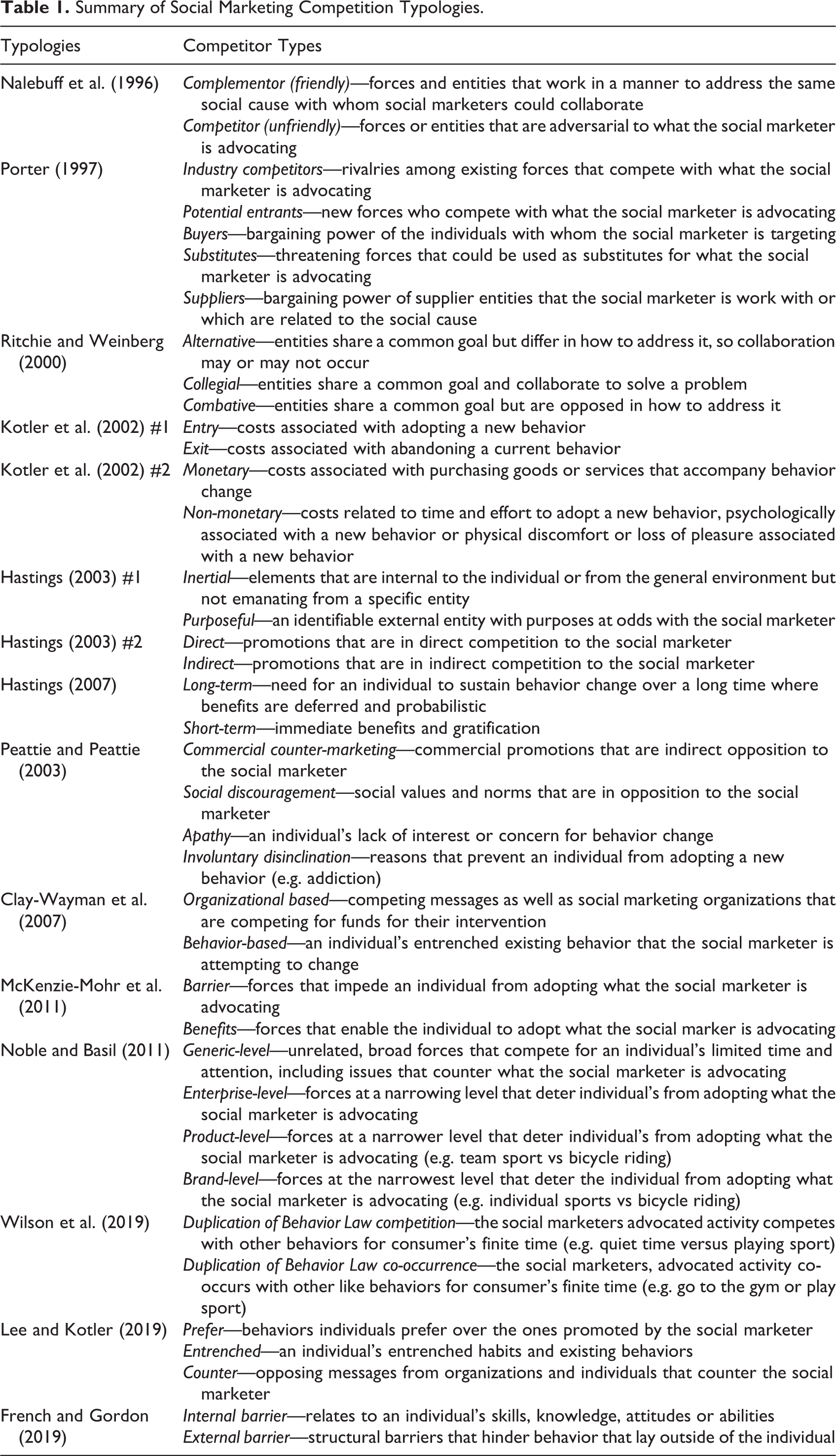
As presented in Table 1, 10 of the 15 competitor typologies consisted of two competitor types (e.g. French & Gordon, 2019), raising preliminary concerns about their ability to catalogue complex social marketing phenomena. Hastings (2007) competitor typology was distinct as it was the only time-based competitor typology. Likewise, the competitor typologies of Peattie and Peattie (2003) and Lee and Kotler (2019) stood out as they presumed that individuals were disinclined to change. Five of the competitor typologies were based on commercial marketing frameworks with competitor types such as direct competition (Hastings, 2003); entry costs (Kotler et al., 2002), monetary costs (Kotler et al., 2002), product-level forces (Noble & Basil, 2011) and industry competitors (Porter, 1997). As competition in social marketing contexts is different to that experienced in commercial marketing contexts (Peattie & Peattie, 2003), the transferability of these commercial typologies to the educational inequality domain was unknown.
Each typology was evaluated in terms of its efficacy in this study as well as its ability to be generalized to the broader educational inequality domain in which this study is located. As wicked problems, like educational inequality, are complex, tangled and sometimes obscure, developing a competitor typology index (thus, abandoning a single typology perspective) would deliver a more sophisticated competitor typology index that could advance others’ social marketing efforts to address educational inequality in a meaningful way. That is, the competitor typology index could become a tool for future educational inequality researchers and practitioners to frame competition in their interventions.
Educational Inequality
Educational inequality is a wicked problem the world over (OECD, 2017). Educational inequality exists at all levels of education, including university study (Cunningham & Trinidad, 2017). Researchers across a range of disciplines, including social marketing (e.g. Russell-Bennett et al., 2020), have contributed to efforts to reduce educational inequality.
In Australia, A Fair Chance for All (DEET, 1990) framed successive governments’ efforts to address the underrepresentation of key equity groups in Australian higher education. Students from low socioeconomic backgrounds and students from regional, rural and remote (RRR) areas were two of these identified equity groups. The Independent Review of Regional, Rural and Remote Education (Halsey, 2018) and The National Regional, Rural and Remote Tertiary Education Strategy (Napthine et al., 2019) highlighted that education inequality for LSES-R students requires urgent redressing as a student from a RRR area are half as likely to gain a bachelor and above qualification compared to those from metropolitan areas. Indeed, the Napthine et al. (2019, p. 5) national strategy is currently reshaping higher education policy to ensure that “every Australian, no matter where they live, should have the opportunity to access Australia’s world-class education system.”
In Australia, Widening Participation (WP) is the umbrella name used for university efforts to reduce educational inequality. All universities in Australia have engaged in WP efforts or “outreach,” and these efforts grew exponentially following the Bradley Review (Bradley et al., 2008) and the creation of the Higher Education Participation, Partnerships and Programs funding arrangements. From 2021, this fund will be renamed the Indigenous, Regional and Low-SES Attainment Fund, reflecting the focus on LSES and RRR students that are the focus of this paper.
University-led WP outreach seeks to mitigate four key structural barriers: poverty, geographic isolation, school factors and access to timely information about careers and university (Cupitt et al., 2016; Zacharias et al., 2018). These barriers overlap and compound for LSES-R students (Napthine et al., 2019). For example, the tyranny of distance amplifies the already high financial costs of going to university (Carrillo-Higueras & Walton, 2020). Consequently, LSES-R university students turn to paid employment during their studies which may have affected their academic performance (Napthine et al., 2019). Furthermore, in LSES-R areas universities engage schools, students and parents less frequently than in metropolitan environments resulting in students not always receiving timely information and along with the non-availability of some senior secondary school subjects in some LSES-R schools further constraining university options and degree choices (Zacharias et al., 2018).
Additionally, LSES-R parental expectations for students to go to university are lower than is the case in metropolitan areas (Koshy et al., 2019). LSES-R students are typically the first in their family to attend university (Dollinger et al., 2020). They can experience mixed messages from their family, friends and significant others, with messages of both encouragement and discouragement making more convoluted an already complex decision (Zacharias et al., 2018).
There is a large and fast-growing body of research regarding educational inequality and WP outreach in Australia. However, many of these studies are focused on LSES-R experiences exclusively and do not have the opportunity to make comparisons with LSES-M students (e.g. Dollinger et al., 2020). Unlike these other studies, this study compared the experiences of LSES-R to LSES-M student experiences to identify differential competitors faced by those from regional, rural and remote locates that were not faced by those for metropolitan locations.
Method
When “researching from the margins” it is important for the researcher to first position oneself as a person with a marginalized identity (Kirby & McKenna, 1989, p. 64). The author identifies as an Aboriginal woman heralding from an LSES background. The author has always lived in regional Queensland.
A case study methodology was utilized with qualitative data collected via semi-structured interviews and focus groups with 46 LSES students enrolled at six universities in Queensland, Australia. Queensland is the second-largest state in Australia, with the highest proportion of the population living in RRR areas of which most are classified as LSES (Australian Bureau of Statistics, 2018). When “researching at the margins” it is important that the methods selected promote empowerment and inclusion by foregrounding the voice of participants (Kirby & McKenna, 1989, p. 64; Sellar & Gale, 2011). The qualitative design selected enabled participant voice, whereby LSES students were given the opportunity to speak for themselves and narrate their own experiences (Sellar & Gale, 2011). Both interviews and focus groups were used to improve participation as not all students were comfortable sharing their personal experiences with poverty and disadvantage in front of their peers. The interview and focus group protocols comprised the same questions to ensure data comparability.
Participants were required to be alumnus at a high school involved in WP outreach initiatives targeted at LSES communities. Participants must have completed Year 12. The process to identify these eligible participants commenced with determining secondary schools in LSES areas, with a total of 408 LSES high schools identified. As universities were assigned to high schools to deliver the WP outreach initiatives, schools were grouped according to their partner university. Participants would have had the opportunity to experience a minimum of two WP initiatives during their time at secondary school as per the formal agreement between Queensland universities.
Student privacy meant that access to student contact details and secondary schooling records was not accessible to researchers outside of an institution. Thus, participant recruitment was possible via the generous assistance of WP outreach staff at each of the six universities. WP outreach staff identified eligible participants via their university records. There were no requirements regarding participants enrolment status (e.g. full time, part-time), their campus location, their program of study or year of study (e.g. first year, second year). As per ethics approval (Curtin University, HRE2016-0491), WP outreach staff were provided with an email script, research project information sheet and consent form. The outreach staff invited eligible students to participate in the research and provided them with these documents. In addition to managing the return of completed forms, WP outreach staff organized rooms for face-to-face groups and interviews at their campus. In recognition of their time, all student participants received a $20 gift card.
There were more female participants (n = 30, 65.2%) than male participants (n = 16, 34.8%), reflecting national enrolments (Australian Government Department of Education, Skills & Employment, 2019). Twenty participants (43.5%) were from major cities and were classified accordingly as LSES-M, with the remaining 26 participants (56.5%) classified as LSES-R heralding from inner regional (n = 21, 45.7%), outer regional (n = 3, 6.5%), remote (n = 1, 2.2%), and very remote (n = 1, 2.2%) locales, as defined by the Australian Statistical Geographic Standards Classification. There were 22 focus group participants (47.8%) and 24 interview participants (52.2%).
Both focus groups and interviews were digitally audio-recorded and accompanied by hand-written field notes and reflective memos of the data collectors. A commercial company was enlisted to transcribe the audio recordings verbatim. Data were analyzed in three stages to ensure that the findings truthfully reflected the data (validity) and that if replicated, the same findings would be obtained (reliability) (Krippendorff, 2018). Each stage involved more than one person, with critical discussions and review of findings culminating in consensus. Such triangulation approaches increase the validity of the findings (Bengtsson, 2016; Cho & Trent, 2020).
In stage one, the two data collectors (one being this paper’s author) independently engaged in the reflexive, manual, thematic analysis of all data subscribing to an inductive, manifest and coding reliability approaches to generate units of meaning and to code these and their sub-categories to themes as per Bengtsson (2016) and Braun et al. (2019). As per the inductive approach, the coders analyzed the text with an open mind and set about codifying meaningful units and themes as well as mitigating forces emerging from the data (Bengtsson, 2016). Furthermore, manifest analysis was engaged where the focus was on what the informant actually said; thus, staying close to the text and describing what was visible and obvious (Bengtsson, 2016). The prominence of a theme in the data was codified (high, moderate or low) as well as the most observed sentiment (positive, neutral or negative) expressed by the participants for each theme. The focus on how many with regard to prominence and sentiment helps to summarize rather than report details in the thematic analysis (Krippendorff, 2018). Next, both coders shared their findings and over a series of meetings met as “critical friends,” critiquing each other’s findings to reach an interpretive consensus (triangulation) of the stage one preliminary findings.
In stage two, an interactive workshop was held with a panel of esteemed WP academic and practitioner colleagues (n = 9) from across Australia. Opening the findings up to further discussion by knowledgeable others and engaging in reflexivity (Leavy, 2020; Yin, 2015) through this process established the credibility (internal validity), transferability (external validity), dependability (reliability) and confirmability (objectivity) of the findings (see Cho & Trent, 2020; Lincoln & Guba, 1985). Over the 1-day interactive workshop, stage one findings were presented for the panel’s interrogation and discussion with consensus achieved.
In stage three, the data were analyzed using NVivo12, first by a research assistant and then by the author of this paper from the previous two stages’ outcomes. This software package was primarily used for data management. Most of the data analysis was undertaken manually in stages one and two to ensure full immersion in the data. “Qualitative analysis is a continuous iterative enterprise” (Miles & Huberman, 1994, p. 12) with the three-stage approach to data analysis allaying concerns that manual approaches can sometimes make it difficult to see data all in one place as well as concerns that software packages potentially lead to a distance between researcher and their understanding of the data and alternatively (Jackson & Bazeley, 2019). Data display functions in NVivo12 helped the researcher arrange data in ways that enabled patterns and complex issues to be viewed in a simple format and enable within-case and cross-case checking and verification of relationships. Stage three was guided by processes recommended in the seminal work of Eisenhardt (1989), Miles and Huberman (1994) and Yin (2015).
Findings
To address the research question, competitors were identified among the codified units and themes with each examined to ascertain if they were experienced by LSES-R students but not LSES-M students. These competitors were organized into meaningful clusters. Next, 15 competitive typologies identified in the social marketing literature were overlayed on these differential competitors to determine their efficacy with regard to educational inequality in Australia.
Phase 1: Competitor Identification and Clustering
Qualitative data analysis identified eight competitors that were clustered into situational competitors (competitors #1 to #4), dispositional competitors (competitors #5 and #6) and goal pursuit competitors (competitors #7 and #8). In the situational cluster, competitors were prominent forces in the participants’ milieu, being the geographic distance between home and campus (#1), complicated relationships with strong-tie influencers (#2), visibility and promotion of non-university post-school options (#3), and financial and resource pressures (#4). The dispositional cluster comprised competitors associated with the participant’s resilience, being dealing with and taking risks (#5) and experience of social isolation in senior high school (#6). The goal pursuit cluster included competitors associated with critical forces to ease the transition into university, being knowledge of university life (#7) and secondary school academic achievement levels (#8). Findings for each follow.
Situational Competitors
Competitor #1 Geographic distance between home and campus
Unlike their LSES-M counterparts, proximity from their home residence to university was a prominent item of discussion among LSES-R students. The discussion tended to have a negative sentiment and center on time, effort and non-monetary psychological costs associated with relocation from home in order to participate in university. LSES-R participants were more likely to relocate for university, with finding student accommodation within a reasonable distance from campus was one of their greatest concerns. While participants shared challenges regarding their initial relocation, they also shared how they now enjoyed living independently. I live probably about an hour and a half, two hours away. So yeah, I had to move [to go to university]. So that was interesting, but it’s all pretty good now. (LSES-R participant)
Competitor #2 Complicated relationships with strong-tie influencers
LSES-R participants discussed positive role models and supportive influencers to a lesser extent (prominence) than LSES-M students. For LSES-R participants, parents, siblings and teachers influenced their decision to go to university, with participants expressing a neutral or mixed sentiment compared to the LSES-M peers who expressed positive sentiments. Parents’ opinions and encouragement was particularly important for LSES-R students to enrol as well as to persist with their university studies. Most LSES-R participants were the first in their family to go to university and experienced additional pressures from strong-tie influencers, such as having to explain to parents how university worked. The additional costs associated with relocation appeared to elevate the influence of LSES-R parents on the participants’ university decisions. LSES-R participants also recalled how their siblings had assisted with their degree choice. Teachers, who had a firsthand experience at university and understood the community where they worked, empathized with their hopes to go to university and selectively encouraged those they saw as most promising. But also, none of my family had been through university as well. So, I was also the first going through it. So, it was just like having your family understand what’s happening as well as trying to figure it out yourself at the same time. Just going through all of that. (LSES-R participant) My parents made some decisions on my behalf, which was, you know. It was good, but I didn’t really make a conscious decision that I was going to go to university. (LSES-R participant)
Competitor #3 Visibility and promotion of non-university post-school options
Competitor #3 was not as prominent in the data, but there was a considerable difference in the sentiment. LSES-R participants expressed negative sentiments for this competitor, unlike their LSES-M peers who expressed a positive sentiment. For many LSES-R participants, pursuing apprenticeships and paid employment post-school was the norm in their home communities. Some LSES-R participants interpreted this as the school had low expectations of students. Non-university job opportunities were highly visible at school, and in many cases, the school had a good reputation for securing employment and apprenticeship opportunities. The visibility and availability of non-university jobs in their hometown created an opportunity cost dilemma for LSES-R students. Going to university meant they would forgo local, paid employment immediately upon completing school. Being from an LSES background, securing work and earning an income as soon as possible was extremely appealing. Furthermore, as university-qualified jobs were not visible in their hometowns, some LSES-R participants struggled with this opportunity cost dilemma throughout their senior schooling studies. The person that recruits the students into the trades is quite resentful I think of university. She made some really resentful comments of kids these days just want to go to university. I’m like, okay. Yeah, so she’s not—like they’re not encouraging people to go to university. (LSES-R participant)
Competitor #4 Financial and resource pressures
While LSES-M and LSES-R participants experienced financial and resource pressures, relocating from home to university heightened these pressures on LSES-R participants. The prominence of competitor #4 was the same for both LSES-M and LSES-R; however, the former expressed a neutral sentiment, and the latter expressed a negative sentiment. One LSES-R student described how she accepted an early offer from her university, and she was able to organize accommodation, welfare benefits and research public transport while completing Year 12. For most other LSES-R participants, there was intense end-of-year anxiety and a scramble to find accommodation. Most LSES-R participants did not apply for bursaries and scholarships to ease financial and resource pressures. The documentation required for some scholarships, the time to prepare a scholarship application and a lack of knowledge about when to or how to apply were notable barriers. I didn’t really apply for any sorts of scholarships and things like that. My grades in high school weren’t, probably, up to scratch to meet those. I did look into things like Centrelink and that sort of thing but living at home I wasn’t eligible for anything. So, yeah, I’ve pretty much just relied on my parents being as generous and helpful as they have to get me through the last two and a half years at university. (LSES-R participant)
Dispositional Competitors
Competitor #5 Having to deal with and take risks
LSES-R participants described their determination to come to and stay at university in greater frequency (prominence) and with more emphasis, particularly how they regularly faced challenges and overcame them. LSES-R students could be described as risk-takers who persisted despite their fears and a lack of clarity of what the transition into university would hold. LSES-R participants expressed a negative sentiment, unlike their LSES-M peers who expressed a positive sentiment. It appears that LSES-R negative experience, however, inculcated higher self-efficacy levels and greater resilience as a result of facing an array of barriers. LSES-R participants possessed personal confidence and a sense of accomplishment that came from dealing with and taking risks that were less apparent among LSES-M participants. It was very stressful the first couple of months after, like, moving out. So, like, when I enrolled in my course, there was, like, a while before I didn’t know what I was going to do for, like, accommodation or how I was going to pay for it. (LSES-R participant)
Competitor #6 Social isolation in senior secondary school
The experience of social isolation in senior secondary school was not mentioned by LSES-M participants (not prominent). However, the LSES-R participants described in negative ways (sentiment) how they experienced social isolation and were regarded by some of their school peers pursuing non-university options as odd because they wanted to go to university. Participants who lived in remote locations described feeling like an outlier as there were few students on the university pathway. One participant described how she had to study a challenging mathematics subject, which was a pre-requisite for her chosen university degree, online because low demand meant it was not offered at her school. Some LSES-R participants articulated that the experience of social isolation and being an outlier steeled their resolve to go to university. While this experience enhanced their conviction to go to university, they shared how few of their Year 12 university pathway peers went on to university and how many of those that went to university dropped out. My family’s [an] anomaly just with—that we are academic and it’s not really expected…because we’re so isolated, the school sort of says “you know, since we’re so isolated, you’re not going to do well.” (LSES-R participant)
Goal Pursuit Competitors
Competitor #7 Knowledge of university life …I knew exactly how to do QTAC, and I knew my options. So, I think that, yeah, it definitely increased my knowledge and my confidence. (LSES-M participant) Yeah, I had no idea about, like, all the clubs on-campus and stuff until I got here. (LSES-R participant) I think if I had to try and pinpoint somewhere around fourth grade. Third or fourth. Because I think I originally wanted to be like a police officer. Then I was like, maybe not; I want to be a lawyer now. If you want to be a lawyer, you have to go to university. So that kind of stuck with me. (LSES-R participant)
Competitor #8 Secondary school academic achievement levels
LSES-R students shared how influential WP outreach experiences were. For some LSES-R students, these experiences inspired them to pursue university and motivated them to improve their grades (positive sentiment). LSES-M participants did not mention (no prominence) related experiences. In Year 10, it would have been; I wasn’t the best student; my grades were really low and I just kind of picked up the ball again. All my teachers were so impressed that, by Year 12, I was top of the class, and they said, I hope you’re furthering your education because you are a smart girl, and you can go far. So, I basically took that under my wing. (LSES-R participant)
Phase 2: Evaluation of Competitor Typologies
Following competitor identification, the eight competitor clusters were analyzed using 15 typologies identified in the social marketing literature. The findings are presented in Table 2.
Comparison of Competitor Typologies Applied to LSES-R Differential Competitors.
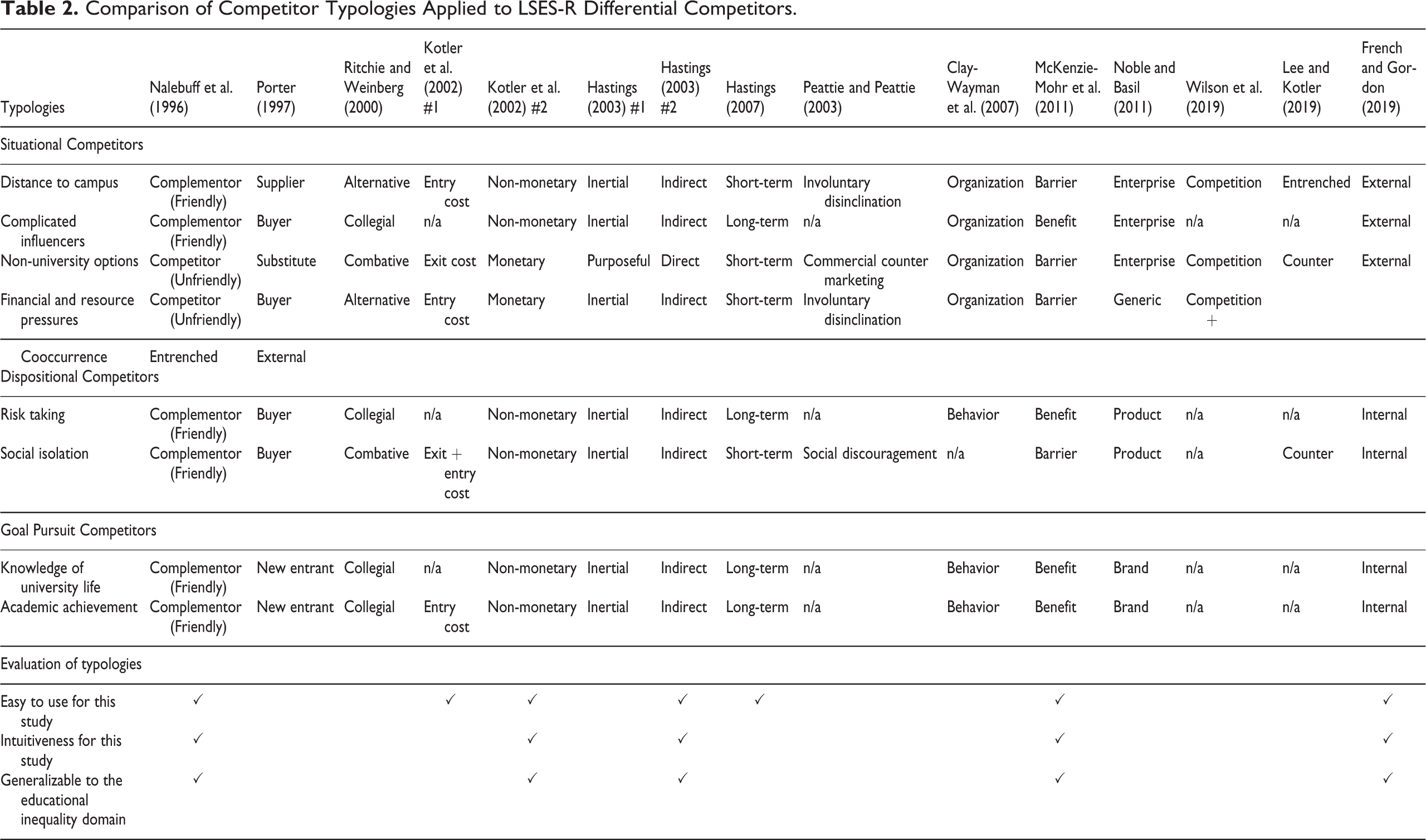
Each typology was evaluated in terms of its ease of use, intuitiveness and generalisability to the broader educational inequality domain. Ease of use assessed the simplicity, effort requirement and speed of application of the typology as per Dabholkar (1994); intuitiveness assessed clarity and ease of understanding as per Zhu and Meyers-Levy (2005), and generalisability assessed the ability of the typology to be broadly applied as per Gurhan-Canli (2003). Five of the 15 typologies met all three criteria, being:
Nalebuff et al.’s (1996) complementor (friendly) vs competitive (unfriendly) types;
Kotler et al.’s (2002) monetary vs non-monetary competitor types;
Hasting’s (2003) direct vs indirect competitor types; and
McKenzie-Mohr et al. (2011) barrier vs benefits competitor types.
French and Gordon’s (2019) internal vs external competitor types;
These five competitive typologies combined formed an educational inequality competitor typology index for use by educational inequality researchers and practitioners. Each of these five typologies comprised two classification options that were distinct from each other (i.e. opposites, mutually exclusive). The prima facie differences between the classification options made each easy to use and easy to understand, which benefits social marketers, practitioners and other key stakeholders, including intervention participants. Clarity, reduced cognitive load and enhanced communication among social marketing teams are likely benefits of this index that will ultimately enhance intervention design and efficacy.
The remaining 10 typologies were not suitable for various reasons. Porter’s (1997) five classification option typology works well at the organizational level in commercial contexts; however, it proved difficult to apply at an individual level. Similarly, Ritchie and Weinberg’s (2000) combative, alternative and collegial options may work in instances where a competitor is a person or organization in a zero-sum context; however, their typology was challenged when trying to classify competition originating from the person such as their disposition. Kotler et al.’s (2002) entry and exit costs, while useful due to its twofold classification option structure, were not well suited to a transition or change context as the individual is in effect exiting one scenario in order to enter a changed state. Hastings (2003) inertial and purposeful options were open to interpretation and subjectivity, making them less intuitive. Also, Hastings (2007) long- and short-term dual classification options, while useful, was difficult to interpret with high-involvement, complex decisions that are made with significant others (syncretic or group decisions) and that occurs over several years as in the context of this study and educational inequality more broadly.
A further attribute of the five effective typologies was their capability to classify both negative and positive competition. In the context of this research, unfriendly and friendly competition was present. It was found that the negatively valenced typologies of Peattie and Peattie (2003) and Lee and Kotler (2019), as well as Clay-Wayman et al.’s (2007) typology, were unable to classify friendly, positive competition as they assumed that the participant did not want to change their status quo. Noble and Basil’s (2011) competitor analysis typology organizes classification options into four hierarchical levels. Noble and Basil’s (2011) typology’s structure is process-oriented, implying rational and sequential decision-making, which is at odds with the nature of wicked problems and hinders its ease of use and generalisability. Furthermore, the commercial-type names of each level—enterprise, generic, product and brand—are difficult to grasp in the context of social causes as each level and this lack of intuitiveness could lead to misinterpretation that undermines the competitor analysis process.
Lastly, Wilson et al.’s (2019) Duplication of Behaviour Law typology comprised of two classification options making it easy to use. Using Wilson et al.’s (2019) typology to classify the human-based competition that originated from within the participant themselves (i.e. dispositional and goal pursuit competitors) or from those around them (e.g. strong-tie influencers) was difficult. Similar to Porter’s (1997) typology, Wilson et al.’s (2019) typology appears to work well in zero-sum or “either/or” contexts where there are two discrete options. As such, the multifarious nature of educational inequality was not compatible with Wilson et al.’s (2019) competition-cooccurrence binary.
Limitations and Areas of Future Research
The empirical study’s social marketing context—inequality in Australian higher education—and the cross-sectional and qualitative nature of the data drawn from university students (a consumer’s perspective) are acknowledged limitations that constrain generalisability. Testing the efficacy of a multi-typology competitor analysis index in different educational inequality settings and with quantitative and longitudinal data is encouraged. Also, testing the index approach in other social marketing settings is a valuable area for future research. This will enable assessment of the rigor of an index approach and add to the stock of knowledge and research conversation around what is good practice in the under-examined area of competitor analysis. It is possible that underpinning contextual characteristics may be revealed in various contexts that can further advance understanding and the practice of effective competitor analysis. Positioning is the step that follows competitor analysis in commercial marketing. Studies that bridge the competitor analysis index with effective positioning would also make meaningful contributions to social marketing.
Conclusion
Voluntary behavior change is central to downstream interventions and is underpinned by the notion of freedom of choice (Hastings, 2007). Yet, this freedom of choice introduces a wide variety of self-determined competitors vying for an individual’s attention and with which social marketers tussle (Schuster, 2015). The need and value of competitor identification are undisputed; however, progressing beyond this initial stage to effectively analyze competitors in social marketing is murky and relatively uncharted (Noble & Basil, 2011). The absence of recommendations to guide or, in the least, be a catalyst for further examination, critiques of competitor typologies and sharing of competitive analysis practices are much needed. This paper proposes an index approach to categorize competitive typologies in terms of their ease of use, intuitiveness and generalisability to the broader social cause domain. In doing so, this paper attends to the seeming silence surrounding competitor analysis conventions in social marketing and hopes to be an aperture through which good practice emerges.
This paper extends on Schuster’s (2015) work in that it advances understanding of competition in social marketing, from a consumer perspective, via a qualitative empirical study. Specifically, this paper covers a wider range of competitive analysis typologies, comprehensively using each typology to evaluate competitors and then comparing their relative merits in terms of ease of use, intuitiveness and generalisability to a wide range of social causes. The underpinning empirical study focuses on improving the participation of an underrepresented group in Australian higher education and, by doing so, enabling social mobility and intergenerational improvements in quality of life.
In phase one, qualitative data were analyzed to ascertain participant-defined competitors that play havoc in their pursuit of a university qualification after secondary school. Eight differential competitors were identified, and these were organized into three clusters: situational, dispositional and goal pursuit competitors. Following competitor identification, the subsequent phase two was to undertake competitor typology analysis. Fifteen competitor analysis typologies were identified in the social marketing literature, with many heralding from commercial marketing.
It was concluded that five of the 15 competitor analysis typologies were effective in that they were easy to use, intuitive and generalizable to the wider social cause domain of educational inequality. These five typologies comprised two classification options that were distinctly different. Furthermore, the five typologies could classify both the unfriendly and friendly social marketing competition.
As no one competitor analysis typology was decidedly better than the others and given the incompatibility of a single typology approach to wicked problem measurement, a competitive analysis index for educational inequality comprising these five typologies is recommended. A competitive analysis index enables the measurement of various aspects and provides a multi-dimensional constellation of competitors that can lead to intervention design insights and efficacy.
Footnotes
Acknowledgment
I wish to acknowledge the assistance of Mr Joshua Dale, the support of the larger project’s qualitative research team being Dr Nadine Zacharias, Mr Geoffrey Mitchell and Professor Sue Trinidad. I would also like to acknowledge the invaluable input from the larger project’s advisors Ms Mary Kelly and Ms Kate Flynn.
Declaration of Conflicting Interests
The author(s) declared no potential conflicts of interest with respect to the research, authorship, and/or publication of this article.
Funding
The author(s) disclosed receipt of the following financial support for the research, authorship, and/or publication of this article: Funding for this project was provided by the Australian Government through the Higher Education Participation and Partnerships Program (HEPPP) National Priority Pool.
