







Abstract

From the constantly changing rules on mask-wearing and social distancing to rapidly having to show results to secure quick roll-out of social marketing programs, the COVID-19 pandemic highlighted the need for speed and flexibility when developing social marketing programs. This commentary discusses two examples detailing how social marketing was used during the pandemic and reflects on the suitability of the social marketing planning process in the rapidly changing environments which arose from the pandemic.
Background
The novel coronavirus (COVID-19) outbreak presented a significant challenge for the entire world. As with other respiratory infections, such as the flu or the common cold, public health measures were critical in slowing the spread of the virus. Whilst some public health preventative actions were well-known already, such as covering your mouth when sneezing or coughing, the pandemic introduced people to new behaviours and unfamiliar terms, such as ‘social distancing’ and ‘self-isolation’.
The COVID-19 pandemic also highlighted the irrational nature of human beings, from battles for toilet paper, publicly supporting lockdown measures while privately doing otherwise, and large gatherings with seemingly little respect for social distancing. This irrational behaviour meant that in many countries, politicians and policymakers drew on the expertise of behavioural scientists and others working in the field of social behaviour change, including social marketing professionals, to help develop social behaviour change programs and interventions.
Using Social Marketing to Reduce the Spread of COVID-19
At the start of the pandemic, it was recognized that social marketing was well placed to develop effective interventions and campaign messages to support behaviour change in relation to the public health preventative measures (Lee, 2020). From the generation of behavioural insights, and the prioritization and segmentation of audiences, to understand the barriers and benefits (the exchange) and the development of strategies which considered the four P’s (product, price, place, and promotion), social marketing had a lot to offer public health teams.
Social marketing projects usually follow a systematic and staged planning process. Figure 1 showcases the National Social Marketing Centre’s six-staged Planning Process. The National Social Marketing Centre’s Planning Process.
Other books and articles often detail slightly different planning processes, but they all follow a similar staged approach. In each stage of the process, there are activities which need to be completed before moving to the next stage, and these activities are designed to help social marketing professionals draw upon the existing evidence-base, generate key behavioural insights, and engage and mobilize key stakeholders and local communities.
This planning process is one of the strengths of social marketing and helps manage the complexities involved in developing any behaviour change project, while keeping the overall drive of the work moving forward. The social marketing literature talks about the need to invest time and resources in each of the planning stages, not to rush to the development of interventions and messages and to have a clear follow-up stage at the end of the project allowing time for stakeholders to carefully review the evaluation findings (French et al., 2009).
Yet, the speed at which the COVID-19 virus spread meant that social marketing projects needed to evolve rapidly, changing as new evidence emerged, infection rates altered, and public health guidelines were updated. As one of the social marketing professionals who tried to follow the social marketing planning process in the constantly changing COVID-19 environment, the need for speed made me frequently question – is social marketing fit for purpose in such a rapidly changing environment? And if not, what can we do to make sure the discipline is prepared for the next pandemic?
Taking a Nimbler Approach During COVID-19
In March 2020, I started working on a social marketing program to improve hand hygiene practices in some of Tajikistan’s most rural communities. Working with a fantastic team from the UN’s World Food Programme, as much of the world started to close its borders, a small group of us were in Tajikistan trying to set up and run a social marketing project. We did not have the luxury of time; we needed to develop, test, and implement our social marketing project in the space of weeks, not the usual months taken to follow the social marketing planning process.
Instead of spending weeks conducting formative research, in 2 days, we identified some ‘quick and dirty’ behavioral insights. Through our rapidly collected research data, we found that: (1) Our target audience knew that they should wash their hands with soap and knew the critical times when they should do this. However, although stating they 'always' washed their hands with soap, our household observations showed that most adults and children only used water, simply holding their hands under a tap for a few seconds. (2) Soap was reserved for guests and as such was not kept by the sink area. (3) Due to multi-generational households being the social norm, all family members looked after the children (as opposed to just the mother or parents having the main responsibility), highlighting the need to take a whole family approach. (4) People were very fearful of negative gossip, and they wanted to be seen by others as a family who cared about hygiene and whose children were always clean and well looked after.
Based on these insights, we developed a social marketing intervention mix in a few days aimed at changing school-aged children’s behaviour and their family members behaviors also. The interventions developed aimed to move beyond simply telling people what to do, and instead create new habit cues and encourage social commitment. • For our tangible product, we used ultraviolet germ scanners to help families realize how easily germs are spread and show the difference that washing with soap for 20 seconds can make. This was our attempt to re-program the existing habit (to wash hands with water only) by making the invisible, visible. • Family pledges were made with the aim of encouraging social commitments with an emphasis on altruism as family members promised to protect each other. Every family that pledged received a certificate and families were encouraged to place these in their windows or outside their houses so that other neighbours could see what a ‘clean household’ they were (our price strategy). • Posters showing the benefit of washing hands with soap for all the family were displayed on the back of toilet doors and in cooking areas (our place and promotional strategy). • Simple nudges were also developed such as soap dishes placed by wash areas, and point-of-sale marketing materials were placed in the local village shops (the final part of our promotional strategy).
We were confident in the behavioral insights identified and the interventions we had subsequently developed, but we only had funds to implement the interventions in a small area. Therefore, to secure additional funding, we needed to determine the effectiveness of our interventions quickly. To do this, I used ‘Nimble Trials’.
What Are Nimble Trials?
Nimble Trials, also called ‘Nimble Evaluations’ or ‘Rapid Fire Evaluations’, seek to decrease the gap between research and action by testing short-term outcomes quickly and cheaply (The Behavioural Insights Team, 2019). American Economist Dean Karlan coined and popularized the term in 2017 (Peace, 2018). Nimble Trials have been used in recent years to gain rapid feedback on interventions, although they remain an underused technique and one which is seldom written about.
I first read about the concept in 2018 when the Strategic Impact Evaluation Fund, an arm of the World Bank, put out a call for proposals to incentivize Nimble Evaluations (The World Bank, 2018). Whilst I was excited by the concept and could see the merits in applying such methodology to my social marketing projects, I struggled to convince my colleagues to try this approach. They regarded it as too ‘quick and dirty’ and therefore lacking in rigour. However, when COVID-19 began to spread at an alarming speed, ‘quick and dirty’ started to look more appealing. I, therefore, seized my opportunity to apply these methods to the project in Tajikistan.
To rapidly assess the social marketing interventions, three villages were identified with similar characteristics and population demographics. In each village, 10 households were selected at random. The households in Villages 1 and 2 received a different mix of interventions, and Village 3 was used as a control group and therefore received no interventions. A household survey was conducted as well as household observations. The baseline survey was done before the interventions were implemented, and then the follow-up survey was conducted 3 weeks afterwards. The nimble trial showed positive results. Although the sample size was small and not statistically significant, we could show the potential positive impact of the interventions, which in turn helped us engage with donors and secure further funds to roll out the interventions immediately.
All in all, we took only 1 month to gather the insights, develop, pilot, evaluate the interventions, and secure further funding.
Determining Which Messages Motivate Change
After conducting the nimble trial in Tajikistan, I used the methodology in another way during the COVID-19 pandemic.
I was asked to develop a social marketing campaign by a local government department in London. Based on a very rapid review of the evidence and some formative research conducted online with the target audience, I developed a series of adcepts. The adcepts focused on encouraging young people to adhere to the rules on social distancing and self-isolation. The adcepts were then tested with 12 people, purposively selected. Data was collected at two time points through qualitative in-depth individual interviews. All interviews were conducted online due to the lockdown restrictions.
Questions Asked During the Interviews at Both Time Points.
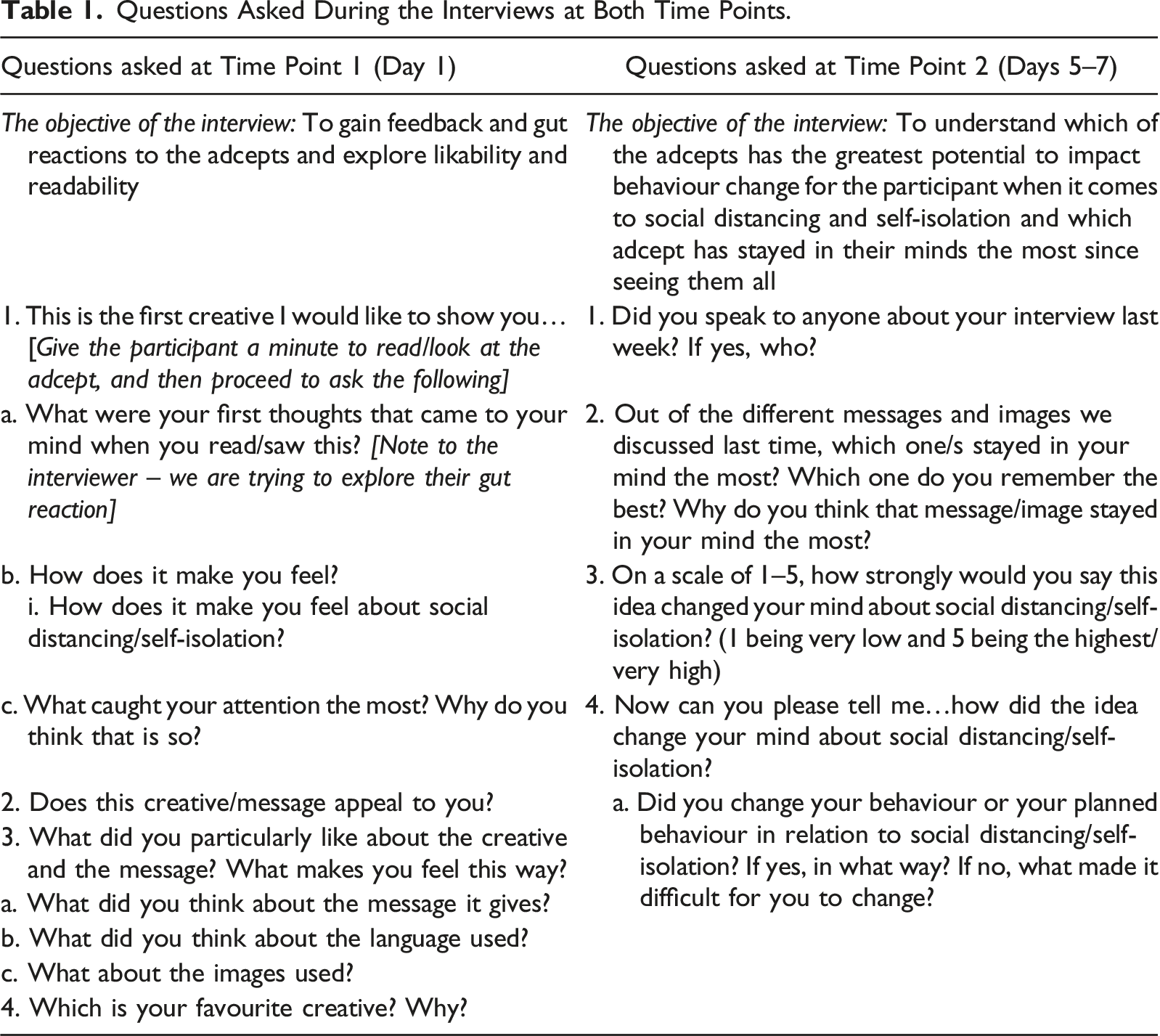
It quickly became apparent at the follow-up interviews which adcepts were remembered and discussed with others, and – most importantly – which were acted upon. Interestingly, it was often the adcepts which were liked the least during the first interviews which had stuck in people’s minds and motivated change. This data was then used to finalize the campaign plan, skipping the pre-testing and piloting phases, and instead moving on to implementation immediately.
Summary Thoughts
I appreciate that, in an ideal world, we would follow the social marketing planning process and conduct more robust evaluations of our social marketing projects. However, I feel there must be a place for the more robust and traditional approaches to evaluation, as well as the ‘quick and dirty’ Nimble Trial approach. If the recent pandemic has shown nothing else, it has highlighted how nimble a virus can be. If we are to match the virus in the future, then I argue that we need to start being nimbler in our approach.
Footnotes
Declaration of Conflicting Interests
The author(s) declared no potential conflicts of interest with respect to the research, authorship, and/or publication of this article.
Funding
The author(s) received no financial support for the research, authorship, and/or publication of this article.