







Abstract
Background
Teenagers are at high-risk of obesity and related co-morbidities, and yet, are notoriously challenging to engage for behavior change.
Focus
This work offers an innovative integrated theoretical model, the Enhanced Integrated Behavioral Model (EIBM), drawing from communication, persuasion, and behavior-change theories to inform social marketing.
Research Question
Can the EIBM prove effective to reach and engage teens in both behavior- and social norms-change?
Program Design/Approach
We used EIBM to pilot a social marketing campaign aimed at increasing water consumption among teens and their networks.
Importance to Field
Social marketing is an approach, not a theory. Behavior change models usually provide only limited instruction on messaging. Communication theories can lack practical application guidance. By combining both, we propose a theoretical framework to maximize social marketing campaigns.
Methods
We piloted a two-tiered social media driven social marketing campaign for high school students to promote increased water consumption and decreased sugar-sweetened beverage consumption in rural New Mexico to change their behaviors and engage them as change agents.
Results
Our campaign guided students through various stages of attitude, empowerment, and behavior change, for themselves and their families and friends, supporting our model’s utility for social marketing campaign design and implementation.
Recommendations for Research
Further testing of EIBM for social marketing.
Keywords
Introduction
Structural factors drive disproportionate disease burdens in marginalized and rural communities across the U.S. with today’s youth predicted to have shorter lifespans than their parents (Deal et al., 2020). Overweight/obesity can lead to emotional harms, reduced productivity, and increased risk of co-morbidities, particularly for teens (Rankin et al., 2016). Families and teens have a general understanding of the health risks associated with consuming unhealthy food and soda. However, many are unaware that their current sugar-sweetened beverage (SSB) consumption habits are unaligned with nutritional guidelines and putting them at risk for obesity and other co-morbidities, and even if teens are aware, such awareness alone rarely translates to behavior change.
Teens are busy forming their identities. Semiotic connections created by food and drink speak volumes about teens’ identities and aspirations; and large food and beverage conglomerates understand this, targeting them for unhealthful marketing (Deutsch & Theodorou, 2010). Commercial marketers spent $1 billion marketing beverages to teens in 2018, up 26% since 2013, specifically targeting youth of color (Harris et al., 2020). Commercial marketers also capitalize on knowing that youth often have significant impacts on family purchasing decisions, where they are trusted messengers and marketers in their own right (Calvert, 2008). Despite all of this, social marketers have not fully enacted youth obesity prevention campaigns (Aceves-Martins et al., 2016), or tapped into youth as marketers themselves.
Although educational approaches for teen nutrition indicate some success, information alone is rarely sufficient. Even when teens know they should make healthier food selections, price, taste, and availability, rather than health, drive choice (Block et al., 2013; Salvy et al., 2012). Research exists on youth-led obesity prevention efforts particularly for peer-to-peer advocacy, (Frerichs et al., 2012, 2015; Millstein & Sallis, 2011; Smith & Holloman, 2014). However, almost nothing exists on youth as family health messengers (Calvert, 2008; Williams et al., 2015). Interventionists must explore social marketing to encourage change both with youth as the primary audiences, and with youth as the marketers or changemakers to their peers and families. Making behaviors public is effective in motivating healthful actions through social comparison (Berger, 2013), and gamifying strategies seem effective in engaging and spurring behavior change (Johnson et al., 2016).
Social marketing is an approach rather than theory and employs behavior-change or persuasion theories with the marketing “Ps” to achieve desired outcomes. Choosing just one theoretical school can prove inadequate; behavior-change theories provide instruction to modify behavior but often offer minimal messaging guidance, while persuasion theories provide explanations with limited practical advice. Both primarily focus on individual loci of control.
This study presents an innovative composite theory: the Enhanced Integrated Behavioral Model (EIBM), used to pilot a social media driven social marketing campaign at a high school to encourage increased water consumption and decreased SSB consumption among teens, and to engage teens to become marketers to their families and friends to impact social norms.
We focused on increasing water consumption and decreasing SSB consumption to impact obesity levels and improve overall health because SSBs account for half of all added sugars in teen diets (Harris et al., 2020) and many youth are chronically underhydrated (Brooks et al., 2017; Kenney, Long, et al., 2015).
Methods
Project Development
This project was driven by a community advisory board concerned about youth sugar consumption and diabetes in a rural frontier community in northern New Mexico. This board had an ongoing community-academic partnership focused on community level physical activity, and we agreed to investigate strategies to address these added concerns. This project was approved by the University of New Mexico Institutional Review Board (#16816), and all participants were provided both verbal and written information and assented or consented to their various types of involvement.
We began with focus groups with students, parents, and teachers (Hess et al., 2019), identifying four key elements: (1) Most people felt municipal water supplies were unsafe or unpalatable due of high mineral content (although testing proved the water safe to drink); (2) most participants believed soda was harmful but were unaware of harms from other SSBs (e.g., sports drinks, teas); (3) advertising convinced parents and students sports drinks are necessary for student athletes; (4) parents listen to, and rely on, children to help navigate online information and purchases. Combined, these elements led us to conclude that a social marketing campaign where teens were not only being marketed to, but engaged as social marketers themselves, could be both efficient and effective for changing teen community behavior.
Theoretical Framework Construction
Considering context, social-norms changes, and environments influencing health, we grounded our model’s behavioral portion in Social Cognitive Theory (SCT) and the Integrated Behavioral Model (IBM).
Social Cognitive Theory
SCT is grounded in observational learning (Bandura et al., 1963), where individuals see someone do something, find personal salience, envision acting out the behavior, test the behavior, observe feedback, and if positive, attempt again (Bandura, 2001). SCT evolved to include Triadic Reciprocal Determinism, wherein Environmental factors (e.g., institutions, physical environments), Personal factors (e.g., knowledge, expectancies, motivations), and Behavioral factors (e.g., frequency, repetition) create- and are created by-lived experiences. This triad impacts a person’s sense of self-efficacy, which drives behavior.
Bandura (2001) further expanded SCT to describe social modeling from traditional media sources for norms change, occurring along a dual pathway, where viewers are influenced both directly by viewing the content; and indirectly as it is reinforced by influential people or “influencers” in their lives. We believed it would produce similar effects for social media.
Integrated Behavioral Model
Our EIBM holds that many factors drive intent to enact behaviors and subsequent behavior change, including beliefs and evaluations of behavioral outcomes, attitudes, normative beliefs and motivations to comply, and subjective norms. IBM expands the Theory of Reasoned Action (Glanz, et al., 2008), also drawing heavily on SCT modeling processes. IBM also includes control beliefs and perceived power, both affecting perceived control. Control, attitude, and subjective norms all influence intent to perform behaviors (Ajzen, 1991). IBM recognizes external variables’ influences, including demographic characteristics, personality traits, environmental factors, abilities, and self-efficacy, building in these elements from SCT (Glanz, et al., 2008). Outcome expectancies are key in IBM. The more strongly individuals believe in the ubiquity, or positive benefits, produced by behaviors they are being asked to enact, the more likely they will engage (Fishbein & Cappella, 2006).
The original authors of these theories acknowledge highest predictiveness when people control their circumstances but note that environmental barriers can be overcome and solutions developed to surmount structural impediments if solid elicitation strategies ensure fully understood motivations, constraints, and facilitators of those involved (Glanz et al., 2008).The original IBM lacks SCT’s reciprocal triad of determinism and behavioral sustainability once tested, both critical elements added to the EIBM.
Elaboration Likelihood Model
For elements of the campaign messaging and persuasion strategy, we drew on the Elaboration Likelihood Model (ELM) (Petty & Cacioppo, 1986) and on Attribution Theory. ELM elucidates pathways of attitude change occurring via central or peripheral routes, providing different mechanisms for message processing. In central route processing, individuals cognitively elaborate, assess validity of arguments presented, consider their stance on issues, determine message support, and are persuaded to act. Peripheral processing relies on peripheral cues connected to messages, such as an attractive messenger or credible expert to be persuaded.
Pathway activation is determined by personal interest and cognitive ability and impacted by message delivery characteristics (Petty et al., 1983, 2004). Central route processing leads to more sustained attitude and behavior change, likely due to cognitive acceptance of the reasoning (Wilson, 2006). Emotion was initially considered a peripheral route factor, but later was included as a means of heightening interest for the central route (DeSteno et al., 2004).
Attribution Theory
Attribution Theory was developed by Heider (1958), and expanded upon by Weiner (1993) and Gilbert et al. (1995). Its basic premise is that people understand the world by assigning attributions for causes and solutions based on their previous experiences, current knowledge, emotional factors, and for messages—informational framing. Attribution categories are defined as internal or external. Message designers must consider attributions’ effects on receivers’ perceptions of potential solutions, depending on their assignment of locus of control and their ascriptions of the message’s values.
Figure 1 Enhanced integrated behavioral model.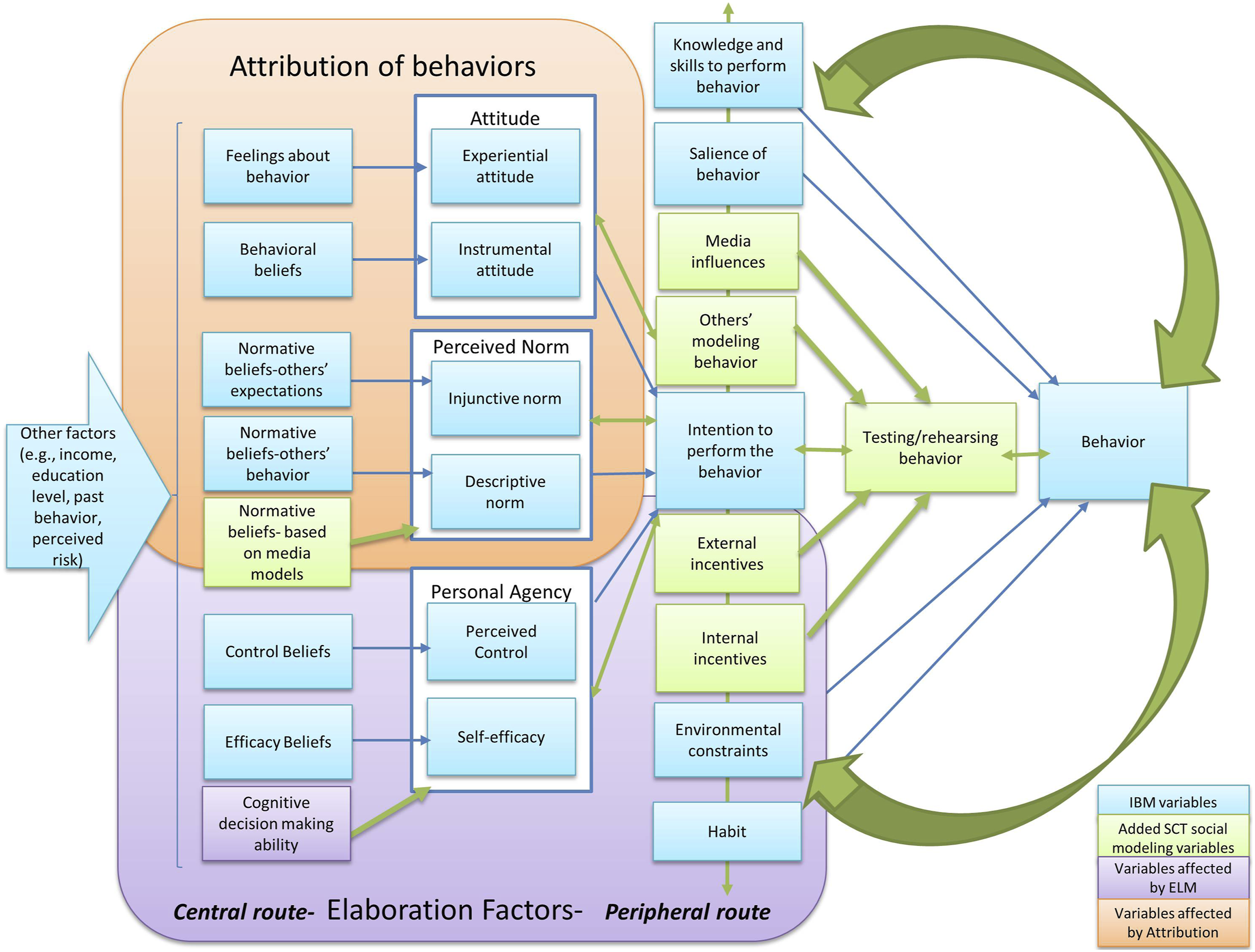
Social Marketing Campaign Design
Using focus group data, and social marketing fundamentals of a defined consumer orientation, audience segmentation, defined behavioral goals, and an integrated marketing strategy reliant on the 6P’s, we designed an 8-week campaign on Facebook and at a high school where almost all households were low-income and 96% of students identify either as Hispanic or American Indian. Prior to launch, the school received two water-bottle filling stations providing filtered, chilled water, replacing two standard fountains.
This campaign had tiers, first to reach students, and then to train students to reach their community. We aimed to (1) engage students; (2) educate them about health risks/benefits of water versus SSBs, and about media targeting; (3) change their beverage consumption habits; and (4) enable students to become health messengers among their families and friends to change broader community level behaviors.
Our primary audience was teens, and secondary audiences were their families, networks, and school staff. We addressed 5 of the 6 social marketing P’s. The Products were intrinsic—feeling like health experts, feeling better with improved hydration, and extrinsic—a water bottle and filling stations, making water appealing and visible. The Price was giving up or substituting SSBs for water. The Place was on social media, at home, and at school, both for performance of behavior and with point-of-decision prompts of filling stations. The Promotion was from campaign staff to students via social media, school announcements, school activities and from the students through word-of-mouth, social media, content creation, and by modeling behaviors to secondary audiences. The Partnerships were with the school, and with the students as we engaged them as marketers to their siblings, parents, extended families, and friends. As a pilot, we lacked Policy change, but believe school policy change would be critical for expansion.
Using ELM, we planned to encourage cognitive elaboration throughout campaign stages, while also leveraging social pressure from classmates, celebrities, media, school, and family for peripheral processing Appendix Table. Attribution theory informed decisions to focus on shifting SSB marketing perceptions from aspirational to predatory, and changing attributions of water as being unpleasant to being trendy and enjoyable by engaging students as producers of social media messages and of more in-depth project content to change community norms.
We consulted regularly during design with a student advisory group, selected by school staff, and with teachers. We devised the logo, hashtag (#icH2Oose), and Challenge tagline (“I Choose H2O”) to create an empowering tone and attribution of freedom of choice. Campaign collateral urged students to make their own decisions and framed the messaging positively, shown to be more effective in prevention work (Maibach & Parrott, 2005). The short campaign slogan was designed for students to augment, focusing on whatever actually motivated them. This was further supported by the “i” in the logo text, “I choose water” being reaffirmed every time they used the hashtag, saw the logo, or drank water, bolstering agency and self-efficacy. Asking students to choose water is a simple, clear, actionable behavioral goal (Fishbein & Cappella, 2006), and “Challenge” offered a contest, decreasing the price of engagement by gamifying.
The campaign’s two parts occurred simultaneously but one was a school-wide activity versus activities in limited classes.
Part I
The Challenge
An 8-week school-wide contest, we invited students to complete weekly “Splash Tasks” on Facebook (e.g., water infusions, sugar calculations) earning points and having chances win prizes. We encouraged students to engage with peer posts online and participate in supplementary home and school-based activities for bonus points. We reinforced campaign messages with posters, announcements, and logoed water bottles participating students received. For Challenge kickoff we hosted a school-wide assembly providing education and explaining rules. We concluded the Challenge with a “Final Splash” event. Social media elements made behaviors visible, tracked student progress, and were supplemented by school-based activities and tangible weekly incentives.
Part II
QuenchCast Projects
Project-based educational activities, where students worked in groups to create “QuenchCasts,” focused on campaign goals. The campaign team provided education on media literacy, nutrition, and social marketing, supplemented by lessons adapted from The Bigger Picture’s curricula for youth driven diabetes prevention (Rogers et al., 2014). Students selected highly segmented audiences (e.g., teen athletes, younger siblings), identified barriers and facilitators to behavior change for that audience, and developed promotional messages and strategies to supplement the campaign. They included “Choose H2O” with instructions to focus on reasons for choosing water they believed would resonate for their audience.
Campaign Evaluation
We employed a mixed-method evaluation approach: (1) semi-structured interviews conducted 2–4 months post-campaign; (2) structured observations counting water fountain/filling station use at three points, and (3) qualitative and quantitative analysis of social media engagement and QuenchCasts.
For interviews, we used purposive and snowball sampling techniques to recruit 27 students who had been high-participators (HP), low-participators (LP), or non-participators (NP); and nine staff (ST) to understand campaign reach and effectiveness among those actively involved, and those only peripherally exposed. Full interview findings, including more on student perceptions of health and motivations for behavior change, are described elsewhere (Lilo & West, 2021).
The water observations used a modified structured water-source tool (Kenney, Gortmaker, et al., 2015), measuring fountain/filling station use in 30-minute increments. Observations were conducted at 3 timepoints: before, and after, the filling stations were installed pre-campaign to understand the impact of the filling stations alone, and again 4 months post-campaign, for added campaign impact.
Results
Implementing the Model
The data indicate success implementing the EIBM in a social marketing campaign for teen obesity prevention
Mediators
Formative data (Hess et al., 2019) and input from the student advisory group had pinpointed the need to address feelings, normative and behavioral beliefs, and self-efficacy and control, impacting perceived community water safety and appeal of water fountains. Focus groups noted that when people bought bottled beverages, they often purchased “tastier” drinks, perceived as delivering more value per dollar. Students valued water consumption for hydration, but lacked the desire to drink it, calling it “boring”; and perceived water fountains as “nasty.” They described the need for sports drinks for student athletes. Our campaign needed to change community attributions, providing knowledge and control to make healthier choices and motivate a sense of rebellion toward beverage companies. Providing filling stations and bottles and engaging students to drink water in fun ways addressed environmental barriers with cold filtered water and changed attributions of water to “tasty” and “cool.”
ELM encouraged cognitive elaboration to guide students down central route, boosting their sense of efficacy and control by engaging with marketers’ targeting methods, gaining new information about their beverage choices, and learning to educate their families. As one student said, “I think it was very informative…actually how bad sugary drinks are…it made you think about how much water you really don’t drink…I was surprised [that] I don’t drink water normally.” (09HP). Those not directly engaged in the campaign moved down peripheral routes, seeing behaviors modeled by friends.
During the campaign, students’ knowledge of health and their feelings changed, along with abilities to enact target behaviors, supported by normative beliefs about others’ beverage choices. Common reasons students cited for participating included the Challenge’s novelty and interactivity. “I just want to be a part of it, and not just stand by and watch others do it, I want to be doing it as well,” said 06HP. Students liked participating, boosting agency. “Just the interactiveness…we actually got to do something. And it wasn’t just like…information intake. It was an actual challenge,” said 09HP.
Students described becoming influencers through their social media posts, since their family and friends worldwide could see activities, changing norms. They thought social media made the campaign and their school “cooler,” encouraging posting to impact those watching. “I was just kind of curious… interested and just wanted to try it… because I’d never heard of a program like this …and on social [media]…for us,” commented 16HP.
Gamifying, with added peer/self/family competitions to earn points by designing slogans, calculating intake, and drinking more water/fewer SSBs motivated student participation, facilitated engagement, and influenced experiential attitudes. “Why not? Just like, drink more water, you get benefits from it too, not only health-wise, but you get prizes.” (10LP).
Moderators
Moderators increased students’ knowledge and skills about targeted behaviors, emphasizing personal salience. The campaign offered peripheral routes for message absorption or reasons for choosing water over SSBs (external incentives; endorsement from friends). Peers became credible, appealing spokespersons for behavior change, and water bottles became “cool.” Some students promoted desired behaviors on Facebook and through QuenchCasts, but even students not actively promoting messages modeled behavior change by enacting target behaviors.
Campaign participation promoted questioning behaviors of celebrities or famous athletes who endorsed sugary drinks and business practices aimed at selling them: I’d say the advertising [is what I learned]. I know all about the lies, and the way they try to persuade you… Like…exposing the truth and false of advertisements…And after [we] got the water bottle, it made drinking water fun. (06HP).
Students’ decreased levels of belief in beverage marketing modeled to them, instead focusing on behaviors modeled by peers. “Yeah, people will be like, ‘do you want to get water?’ And then we’ll go to the water machine instead of…buying pop or something,” said 12NP. One student described beverage-choice behaviors spreading organically, similar to fads that no one teaches but suddenly become popular. Even NPs described learning new information and making changes for themselves and their families.
New knowledge and supports gave students increased efficacy over beverage choices. The campaign shifted attributions and attitudes about both water and SSBs, making water seem more appealing and SSBs less so: Just noticing…how much sugary beverages I actually drink. And it’s like wow, I really need to drink water (laugh). [I drank] one to two [SSBs] a day… I was really heavy on Gatorade and [now] I haven’t drank one in about a month, and sodas, I haven’t drank in about a week, just water instead…because of the Challenge. (09HP)
The campaign also increased peer support for making healthier beverage choices, changing perceived norms: [The Challenge] was pretty good… it shows a lot of kids that water is really important to us, in this environment…people, they bring a lot of chemical drinks here…I thought it was kind of fun and cool, but ever since this [Challenge] happened, and the water bottles and the [filling stations] everyone started constantly getting water. (17NP)
The teachers stressed the Challenge’s importance for behavior change, suggesting that filling stations alone were insufficient, “You brought the context and the machines, which was great…otherwise it would take forever...So, no, you need [the Challenge]. It’s what makes it work” (32ST).
Students built/modeled skills experientially through Splash Tasks, reinforcing reciprocal factors, “The water infusion with the fruit…was really fun. I liked the Final Splash, where we got to do all the different things… like the water taste test, and the sugar measurement thing” (18HP).
External incentives, environmental supports and peer modeling fostered new habits, engaging even NPs in peripheral-route processing: All the events you had for us [showed] that water…really means everything. Like, water is life for us… the water bottles… got really popular …I wanted to know where the water bottle and the fruits came from...[when] everybody started drinking water… I wish I could have had that… Those water bottles were pretty neat. (17NP)
Participating students enjoyed completing the QuenchCasts, expressing themselves creatively and as advocates. “The drawings and rap song and stuff. It was pretty neat how they were showing…their skills and ideas about how they feel about the water… and just thinking about who you think needs this information” (21HP). Other students enjoyed developing and critiquing marketing strategies, “It was fun … just putting thoughts into the ads and stuff…finding out information, and then actually making your own [ads]. It makes you think about it” (09HP).
Students took ownership of their health choices and engaged family and friends, hoping to influence others’ choices. Unanimously, students and staff felt “Choose H2O” or “I choose H2O” was effective and useful in framing. They felt the message was strong, motivational, not corny, easy to understand, and relatable. “I think it worked…Because it was more of a positive…outreach, rather than a negative, ‘Oh, don’t do this.’ You know teenagers; you tell them not to do something, and they’ll do it” (09HP).
Students marketed for change, promoting water consumption and avoiding sugar or decrying risks of SSBs: Friends, they drink a lot of Cokes every day and that worries me…I just told them like, “Oh you shouldn’t be drinking as much Cokes, you’d be so much better at sports if you’d just drink more water…And [I told] my nieces and my sister to stop drinking as much Coke. (10LP)
Students educated peers, parents, siblings, and extended family, further impacting perceived norms, as 29LP described, “I told [my mom] about the Challenge. She used to bring back soda [from the store]. Now she only brings back water”.
Most not advocating said they would do so in the future, but a few felt uncomfortable sharing or questioning people or said doing so was inappropriate. Others were vocal about convincing others, even NPs, “Especially for the little kids…Because it’s too much [sugar] for [them [my sister’s] kids don’t drink sodas now, because I told her about this [Challenge]” said 22NP.
As students became more aware of benefits and risks associated with beverage choice, their perceptions about marketers’ and media influences’ over their decisions changed. Increased awareness encouraged students to persuade others to change, since the students saw their responsibility to be carriers of the “water truths,” as one student put it. “Pepsi and Coca-Cola commercials… kind of ignore the fact that there’s a lot of sugar in them, and people don’t see that in the commercials,” said 10LP. Similarly, 20HP noted that “advertisers don’t really care about your health either, they just want you to buy, they want money.”
Combined, these factors reinforce the SCT triad (EIBM reciprocal green arrows). With increased water access, changes in environmental factors influenced behavioral factors. Simultaneously, campaign education and information influenced personal factors (knowledge, salience), reinforcing students’ decisions to use environmental supports, influencing behavioral factors as students’ habits changed. These shifts in knowledge, perceptions, and access led to changed social norms at school and home, making water now a more acceptable choice or the “in thing,” as 012NP commented.
As students made changes, they received internal incentives to continue; feeling better physically motivated them to maintain these changes: [Sugar] makes you tired, it could give you hyper blood sugar…drinking water doesn’t do anything [bad], it actually keeps you healthy and full…it keeps my energy up…I don’t get all tired and thirsty… I didn’t like water before until now [with fruit infusions] because I didn’t like just plain water. And then afterwards I was just starting to chug water and get used to it… and now I crave it. (15LP)
Behavior Change
Students Elaborated on Changing Their Habits
All students and staff interviewed described change, regardless of participation level, and most described family changes. NPs described some of the biggest changes, with some students describing extra activities. Even self-described uninterested students interviewed—those unengaged in the Challenge and seemingly unconcerned about health—reported making changes.
More Water
All but one student reported drinking more water, most increasing consumption by 1-2 bottles per day; many reported previously drinking almost none. Some students already drinking enough water said the Challenge reinforced water’s importance, making drinking water more socially acceptable. Reasons cited for increased water consumption included increased knowledge; having a “cool” water bottle; access to appealing filling station water; and friends also drinking more water, “I’m just drinking more water…knowing it’s better for me…and right now it’s Lent and I gave up Coke… I know some of my friends don’t like Cokes, and I want to be that friend that doesn’t like Cokes,” said 34LP.
Students repeatedly cited one selling point for motivating others: hydration for peak athletic performance, aligning with many QuenchCast tactics “I’m an athlete myself. So, all these sugar drinks and stuff…like…slow you down, make you tired and stuff… I drink water” said (05NP). Students also described water as “cleansing,” leaving them more energized: I was drinking sodas all the time. It wasn’t really good for my body. And then, having P.E. did not mix. I had to run and exercise and stuff. And I was always hurting…And now, it’s like… I felt that this was like a small goal for me … I actually [ran a mile]… drinking water is the best thing. (30NP)
Fewer SSBs and the Substitution Effect
Many students drinking SSBs before the campaign now reported significantly reducing or dropping them altogether because the campaign highlighted SSBs’ sugar content. Many students described completely cutting out sodas or sports drinks or going from drinking 2-3 SSBs per day to 1-2 a week. Many reported substituting water for SSBs due to increased information about health risks and new provisions for easy, clean, “cool” ways to drink water: Before, I was drinking soda constantly…Soda, I found, is not too healthy, I’ve drank it most of my life and I’m…the size of a whale (laugh). [Before], I would probably have 8 to 9 sodas [per day], like even those big 2-liter ones…If I was told to drink water, I would have a big fit, I was like, “I don’t like it!” Now, if I do drink a soda, I’m like, “ick!” just because all of the sugar I taste in them… It’s very rare that you see me drink a soda now… but now I’m constantly filling up my water bottle and just drinking water. (14LP)
Students who reported still drinking SSBs described substituting drinks with less sugar or drinking smaller-sized SSBs: I don’t drink [sodas] anymore… But before, three sometimes a day…and now, none…we get those G2s [lower calorie Gatorade] and water…That’s all… I’ve started losing weight, I’m more energetic. I’m not as tired all the time. And I feel more alert and focused to what I’m doing. (27NP)
Physical Effects
Students described physical differences with increased water consumption: reduced headaches, more energy, increased alertness, weight loss, full and satisfied sensations, reduced craving for sugary drinks, and generally feeling more hydrated and healthier, as this student said, “You need water to live (laugh)…it makes me feel better…healthier …More awake. More alert… like clearer… because [the SSBs] used to be a really bad habit… and… they’re kind of gross to me now” (09HP).
Conscious Choices
Many students described changed thinking and making conscious decisions to substitute, “I drink a lot more water… [I think] about all the sugar that’s in [SSBs]. I’ll stop and I’ll be like, “I shouldn’t drink these, it’s not good for me.” Sugar is not healthy. Not in that amount” said 13LP.
Changes at Home
Students reported significant changes in their households, including beverage substitution and diet changes. Students reported influencing siblings (particularly younger ones), parents, and other relatives to make behavioral changes. One teen mother modeled healthier behaviors for her child.
Many students influenced their mothers, while fathers seemed more resistant to change. Male students felt their fathers were less approachable or less willing to change. Female students reported greater success with influencing their dads, as one said, I’ve told my dad, because he likes sugary drinks, to drink less… I think he’s listened…Well, he eats anything that has sugar in it. Sometimes I see a soda, and I’ll ask, “How many have you had this week?” And he’ll say a big number. And I’ll tell him, “Cut back, you should cut back, you should maybe drink a water.” And I’ve seen him pick up less. Yeah, I have had an effect. I guilted him… I told him, “You want a big stomach forever?” (16HP)
Most students received positive reinforcement from siblings and parents. One NP student indicated: Yeah, I told my mom[about]the water bottles and everything. My mom said it was good that was happening. Because in our community, there’s a lot of people on disability… who go to dialysis and they have diabetes, they have to take insulin all the time. So, she said it’s about time that people are realizing that water is really important for our community. (17NP)
However, some families remained unengaged, although the students themselves adopted campaign behaviors, indicating strong self-agency. Many students made water infusions at home, asking parents to buy fruit. Others continued to make infusions for their families post-campaign. Some students influenced healthier family food choices as well, as 11LP said, “We eat more healthy food. Once me and my mom started drinking more of the infusion water, we just like started going on a diet and eating more healthy, more fruits and stuff.… We don’t really buy Coke anymore”.
Structured Observational Findings
Full campaign participation and results are reported elsewhere (Lilo, 2017), but almost half the student body participated. Interviewees’ reported behavior changes were supported by the structured water observations, with a 42.8% increase in water-bottle usage pre-campaign to 3-months post-campaign.
Over observational periods, a shift also appeared in types and sizes of SSBs seen at school. At baseline, most students carried SSBs (often 20+ oz. containers); almost none carried water. Post-campaign, more students were carrying water than SSBs, often in Challenge water bottles, and more reduced-calorie/calorie-free drinks. Students with sodas mostly had smaller sizes (8 or 12 oz.), and energy drinks were rarely seen. This evidence supports reports from staff and students.
Discussion
This pilot suggests EIBM works. All groups were influenced by the campaign in ways corresponding to mechanisms accounted for through model design. The pilot also showed promising results regarding using social media as the primary campaign channel, leading teens to cognitively elaborate on health topics, to engage in behavior change, and to socially model, becoming change agents themselves.
This study’s contribution to the literature is twofold; first, engaging teens in social marketing for their families and networks for obesity prevention, as recommended by Hatfield et al. (2017). Second, providing a theoretical framework for social marketing that offers concrete guidance on both the messaging and behavior change elements while maintaining a consumer orientation and structuring one’s integrated marketing strategy to achieve the desired behavior change.
Study Results Support the Model
Campaign strategies were driven by the EIBM to facilitate behavior change. Splash Tasks and QuenchCasts were both keyed to theoretical constructs of the EIBM appendix, and interviews revealed associations between beliefs and consumption behaviors linked to the EIBM belief/attitude/attribution variables. Similarly, campaign tactics impacted normative expectations through shifting attributions about consuming water, leading to increased water consumption and decreased SSB consumption. ELM constructs further guided students down the cognitive route to understand their beverage choices, gain greater understanding of the personal/family/community salience of such choices, and develop knowledge and skills necessary to effect behavior change.
As the campaign progressed, EIBM constructs guided students to increase their feelings of self-efficacy and behavioral control to embrace changing norms about enacting targeted behaviors. Shifts in social norms meant students were now actively seeking to emulate their peers and be “cool” by drinking water. While having “cool” things is not necessarily an emotion, the desire to fit in can be an emotional trigger. As DeSteno et al. (2004) explained, emotions may heighten arousal for people receiving campaign messages, triggering cognitive elaboration through the central route. Therefore, the desire to be seen as “cool” by drinking water might be achieving central route processing, for sustained behavior change. Emotions may also manifest as concern or worry about health outcomes for themselves, peers, and family members.
Students also demonstrated capacity to critically evaluate media influences, as predicted/influenced by normative beliefs based on media models (Bandura, 2001). As the students learned more about marketing and their ability to influence choices as leaders, they became more receptive to efforts to modify their own beverage consumption behaviors and to encourage others as well.
Behavioral Outcomes
Most important, every person interviewed described making beverage consumption changes, meaning they implicitly modeled these behaviors. Most students reported quite drastic changes, doubling or tripling their water consumption, and significantly curtailing their SSB consumption, sustained at least three months post-Challenge; and supported by water bottle filling station observations data.
Students also reported changing family beverage habits. Although previous research found parental rules and modeling to have the greatest impact on youth beverage consumption (Bogart et al., 2013; van der Horst et al., 2007), our project offers promise that teens can influence their parents’, siblings’, or other family members’ beverage consumption habits as well. Long term, these changes at home may lead to greater effects than we could capture, since Kassem et al. (2003, 2004) found the biggest predictor affecting behavioral control for soda consumption among teens was home beverage availability. Also, changing household beverage availability affects all family members’ options, not just students.
Health Messengers and Marketers
Many students felt empowered to advocate for changes with friends and family because they had the knowledge and resources to feel like experts: they had tested the new behaviors themselves and were now modeling them for others. Students used both emotional and informational tactics in their messaging and provided support and encouragement. Using positive peer pressure, they questioned friends’ poor choices, were influencers of healthier behaviors, and pushed for household purchasing changes. Household changes due to Challenge participation indicate that students had reached the full behavior change stage of the model, building new habits and being change agents, indicative of sustained change.
Students of all genders shared Challenge information with their mothers, finding them more receptive than their fathers, who were either less approachable or harder to persuade. Girls seemed more comfortable and effective than boys at influencing their fathers. These results may relate to existing gender norms where females are more concerned with health and more interested in weight (McPhail et al., 2012), making mothers more receptive, and female students more focused on health issues with their parents. Because of gender roles, fathers may also listen more readily to daughters than sons about health.
Limitations
This was a pilot project, with limited funding. Interviews may have been affected by selection bias. We reached a subset of students in interviews (11.6% of student-body), those who may have been most enthusiastic about the Challenge. We attempted to address this by recruiting LPs and NPs for interviews, many of whom described making significant changes or inventing their own spinoff challenges.
Interviewee response bias is always possible, where students were telling us what they thought we wanted to hear. However, some students scored the campaign success poorly, citing lack of policy changes at school or low participation by peers. These negative responses indicate limited appeasement.
In the interview analysis, we had difficulty teasing out whether changes were due to the campaign, the water-bottle filling stations, or some combination of the two. Patel’s et al. (2019); Schwartz’s (2016) studies found that increased water access at school is linked to increased water consumption and to body mass index changes. However, other studies have shown that additional education and training are necessary to maximize impacts (James et al., 2004; Patel et al., 2011). Most people interviewed felt that increased knowledge, awareness, and the “coolness” factor of the campaign were catalysts for behavior change, suggesting that access alone is insufficient, but without a comparison intervention we cannot confirm. We conducted fountain observations pre-and post-filling station installation pre-campaign, as well as post-campaign, trying to assess added campaign impact.
This rural campaign community differs from many others due to its remoteness, ethnic/cultural composition, and high poverty levels. Our campaign may have worked with this community’s mix of students but might not be as successful with whiter, more urban, or otherwise different students. However, good social marketing aims to know and reach specific audiences for behavior change (Grier & Bryant, 2005).
Finally, this Challenge’s success might be due to its novelty factor. The reverse may also be true. We might have seen even better responses had we more time to build stronger school/student relationships first. A staff member commented that, given the isolation and cultural factors in this community, students are often cynical and disengaged, requiring more rapport building and relationship cultivation to be successful. These concerns might be specific to this community or may apply when working with underserved or marginalized youth in any community. These points strengthen the argument for needing high levels of community engagement and student leadership when attempting projects of this nature.
Conclusion
Despite limitations, we believe our model will work to inform the design and implementation of social marketing for teen health. We showed that youth are interested in interactive activities, gamification, and strategies mimicking commercial marketers. Teens are eager to role-model for younger siblings and to act as experts with parents and extended family. To do so effectively, students need accurate, relevant health information, presented in sufficiently engaging ways to retain the information and act accordingly.
Policies, educational and social systems, and environmental changes must enhance campaign efforts. Our study, like others, showed the positive impact of increasing the number of touch-free water-bottle stations at schools to provide clean, appealing water, increasing water consumption. Combining this with “cool” water bottles, or at least encouraging schools to adopt policies promoting water bottles, appears to increase this effect.
Finally, nationwide, communities also need access to safe, clean, palatable tap water, equitable internet access, and much more regulation of teen-targeted unhealthy food and beverage marketing. Although some regulatory limits exist for television marketing, teens are targeted on all digital platforms, and policymakers have failed to keep pace across platforms or in mandating media-literacy education. Educating students and engaging them in social marketing campaigns online and in-person provides an effective multimedia marketing mix to reach teens and inspire them to act. We recognize that the model needs further testing and urge others to adopt it for social marketing campaigns and to build the literature concerning the efficacy, validity, and reliability of the EIBM model.
Supplemental Material
Supplemental Material - Development and Piloting of the Enhanced Integrated Behavioral Model to Frame a Social Marketing Campaigns for Teens
Supplemental Material for Development and Piloting of the Enhanced Integrated Behavioral Model to Frame a Social Marketing Campaigns for Teens by Emily A. Lilo, Judith McIntosh White, and Davis Weiss in Social Marketing Quarterly.
Footnotes
Authors’ Note
This article was developed from a dissertation submitted by Dr. Lilo in fulfillment of the requirements for the PhD in Communication at the University of New Mexico. Dr. White served as the chair of Dr Lilo’s dissertation committee and as a contributor to this paper.
Acknowledgments
We would like to thank the students, staff, and administration at the Cuba Independent School district for agreeing to participate in the Choose H2O Challenge project. We would like to thank Camelbak® for donating water bottles, Brita® for providing the water-bottle filling stations, and the New Mexico Army National Guard for their community outreach programs and providing activities for the Final Splash event, as well as the local businesses that provided additional donations for weekly prizes. We would also like to thank Dr. Sally Davis, Dr. Theresa Cruz, and the staff at the UNM Prevention Research Center for their facilitation of this project, Dr. Andrew West for assistance in data analysis, and Dr. Nicholas Levin for the procurement and installation of the water-bottle filling stations.
Declaration of Conflicting Interests
The author(s) declared no potential conflicts of interest with respect to the research, authorship, and/or publication of this article.
Funding
The author(s) disclosed receipt of the following financial support for the research, authorship, and/or publication of this article: This research was funded in part through the generous donations and contributions from CamelBak, and a whole range of local and national corporations and businesses who provided prizes for student participation and other elements to make the campaign a success. In particular, we would like to acknowledge the contributions made by GlowGolf, Premiere Cinemas, Fallout Trampoline Park, Enchanted Hills Dentistry, Saveway Variety Store of Cuba, Subway of Cuba, the Nacimiento Community Foundation, the UNM Lobos, and Screen Images. This research was also funded in part through a student research grant from the University of New Mexico Graduate and Professional Studies Association. Support for the water fountain observations was provided through the UNM Prevention Research Center as part of the larger VIVA-Step Into Cuba project.
Ethical Statement

Supplemental Material
Supplemental material for this article is available online.
Appendix A
School Wide Challenge Splash Tasks. Theoretical links between weekly Choose H2O Challenge activities and Enhanced Integrated Behavior Model (EIBM) • SCT: explanation of normative beliefs based on media models and marketers • ELM: cognitive elaboration on key campaign concepts presented up front • IBM: begins to engage behavioral beliefs, and requires initial “investment” in the campaign • ATT: begin to change thoughts about media influences and health risks and benefits • SCT: think about what students were currently socially modeling and what their media environments promote • ELM: cognitively process existing messages as to whether they liked them or not • IBM: analyze their feelings of control over their current behaviors • ATT: begin to change thoughts of water from bad to good, and SSB vice versa • ELM: (1) foster cognitive elaboration about the benefits and harms of beverage choices and (2) promote consideration of media choices (3) Begin becoming spokespeople for peers who may travel peripheral route • IBM: address experiential and injunctive norms by viewing other’s posts and evaluating their own and others’ perceptions regarding good beverage choices • ELM: foster deeper cognitive considerations (1) of how to persuade others to change behaviors and (2) about how SSB marketers target students and families • ATT: shifting attributions associated with water and SSBs • IBM: focus on (1) shifting norms to encourage better choices and (2) encouraged perceived control that students could change their beverage habits • SCT: (1) testing a new behavior and evaluating its effects prior to decision to adopt or not and (2) implicitly modeling behaviors for others (3) Changing environmental factors and behavioral factors • IBM: (1) draws on experiential attitudes; (2) promote norms of community participation in drinking water; participation could promote (3) sense of self-efficacy toward drinking water and (4) increased control belief about making healthful choices. • ATT: changing previously held notions of water not tasting good • SCT: increase intention to engage in behavior by providing necessary knowledge and skills to make jump to regular enactment of behavior • ELM: (1) furthering cognitive elaboration on the risks and benefits of current behavior (2) Becoming trusted spokespeople to family traveling peripheral route • IBM: (1) increase intention to engage in behavior by providing necessary knowledge and skills and (2) boost self-efficacy to address household/personal barriers to water consumption • ATT: sharing with family begins to shift perception of buy in from believing in the importance of water to encouraging others to also care, thus shifting family norms • SCT: (1) encourage enactment of the behavior for long enough to provide internal motivation to continue the behavior beyond end of the campaign (2) participants begin to feel the gains of consuming more water, shifting from external incentives to internal incentives for action (3) becoming a peer model for healthy behaviors • IBM: (1) increases efficacy beliefs (2) promote norms change where “everyone” drinking water would address normative beliefs/expectations about others’ behaviors (3) begins forming habits • ELM: becoming modelers of healthy choices, thus becoming trusted spokespeople • ATT: contest challenge makes drinking water seem “cool” • SCT: (1) reward successful participation as incentive for others to adopt healthy behaviors • ELM: Additional educational activities continue to move students down the central route • IBM: promote norms change by showing the achievements of participants who made changes to their beverage consumption choices and their water intake • ATT: fun event that students got to go to instead of class, was a coveted privilege, making participation “cool” Quench Cast Activities. Theoretical links between Choose H2O Challenge QuenchCast activities and Enhanced Integrated Behavior Model (EIBM). • ELM: cognitive processing of messages increases persuasive impacts, leading to sustained attitude and behavior change, both for the students creating the messages and for their target audiences • IBM: acquisition of increased knowledge and skills through researching information to create content for the campaign builds student self-efficacy and feelings of control • SCT: students using mediated forms to develop content intended to socially model desired behaviors • ATT: sharing student products publicly for prizes adds level of status and credibility • SCT: student participation in creating and implementing campaigns encourages family or peer changes and changes in community norms through modeling behaviors • ELM: (1) researching and developing messages for others creates fully cognitive elaboration for participants (2) makes those students credible spokespeople for family and peers • IBM: student-generated messaging encourages family or peer changes and changes in community norms through increasing a sense of community self-efficacy • ATT: (1) audience-appropriate messaging can shift attributions associated with water and SSBs (2) sharing student products publicly for prizes adds level of status and credibility • IBM: giving youth a sense of ownership over the campaign promotes self-efficacy and increases internal locus of control over making behavior changes, both at the individual and family levels • SCT: makes students feel like experts, changing their personal perceptions of self, and providing information to change personal behaviors and to influence family behaviors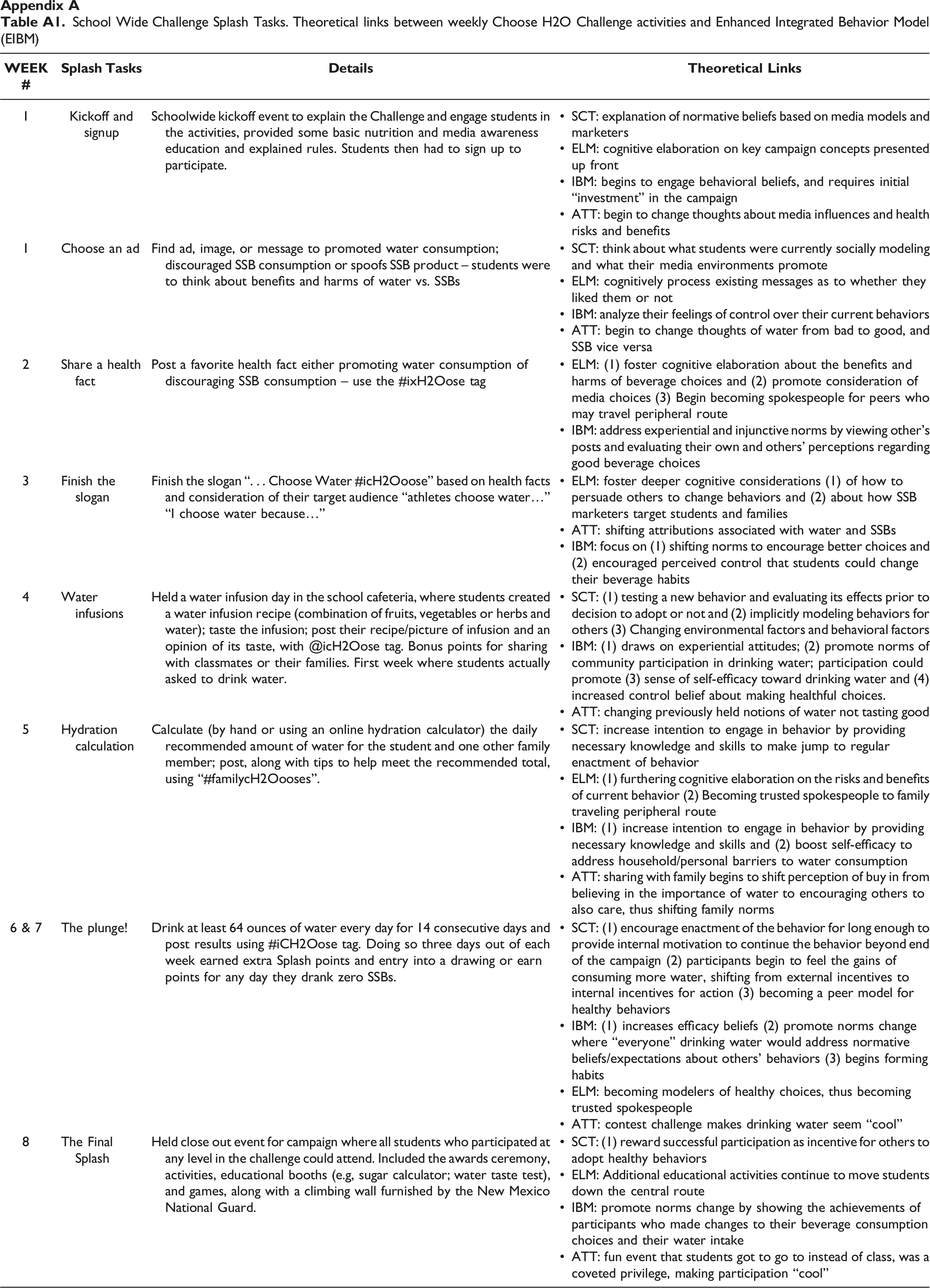
1
Kickoff and signup
Schoolwide kickoff event to explain the Challenge and engage students in the activities, provided some basic nutrition and media awareness education and explained rules. Students then had to sign up to participate.
1
Choose an ad
Find ad, image, or message to promoted water consumption; discouraged SSB consumption or spoofs SSB product – students were to think about benefits and harms of water vs. SSBs
2
Share a health fact
Post a favorite health fact either promoting water consumption of discouraging SSB consumption – use the #ixH2Oose tag
3
Finish the slogan
Finish the slogan “. . . Choose Water #icH2Ooose” based on health facts and consideration of their target audience “athletes choose water…” “I choose water because…”
4
Water infusions
Held a water infusion day in the school cafeteria, where students created a water infusion recipe (combination of fruits, vegetables or herbs and water); taste the infusion; post their recipe/picture of infusion and an opinion of its taste, with @icH2Oose tag. Bonus points for sharing with classmates or their families. First week where students actually asked to drink water.
5
Hydration calculation
Calculate (by hand or using an online hydration calculator) the daily recommended amount of water for the student and one other family member; post, along with tips to help meet the recommended total, using “#familycH2Oooses”.
6 & 7
The plunge!
Drink at least 64 ounces of water every day for 14 consecutive days and post results using #iCH2Oose tag. Doing so three days out of each week earned extra Splash points and entry into a drawing or earn points for any day they drank zero SSBs.
8
The Final Splash
Held close out event for campaign where all students who participated at any level in the challenge could attend. Included the awards ceremony, activities, educational booths (e.g, sugar calculator; water taste test), and games, along with a climbing wall furnished by the New Mexico National Guard.
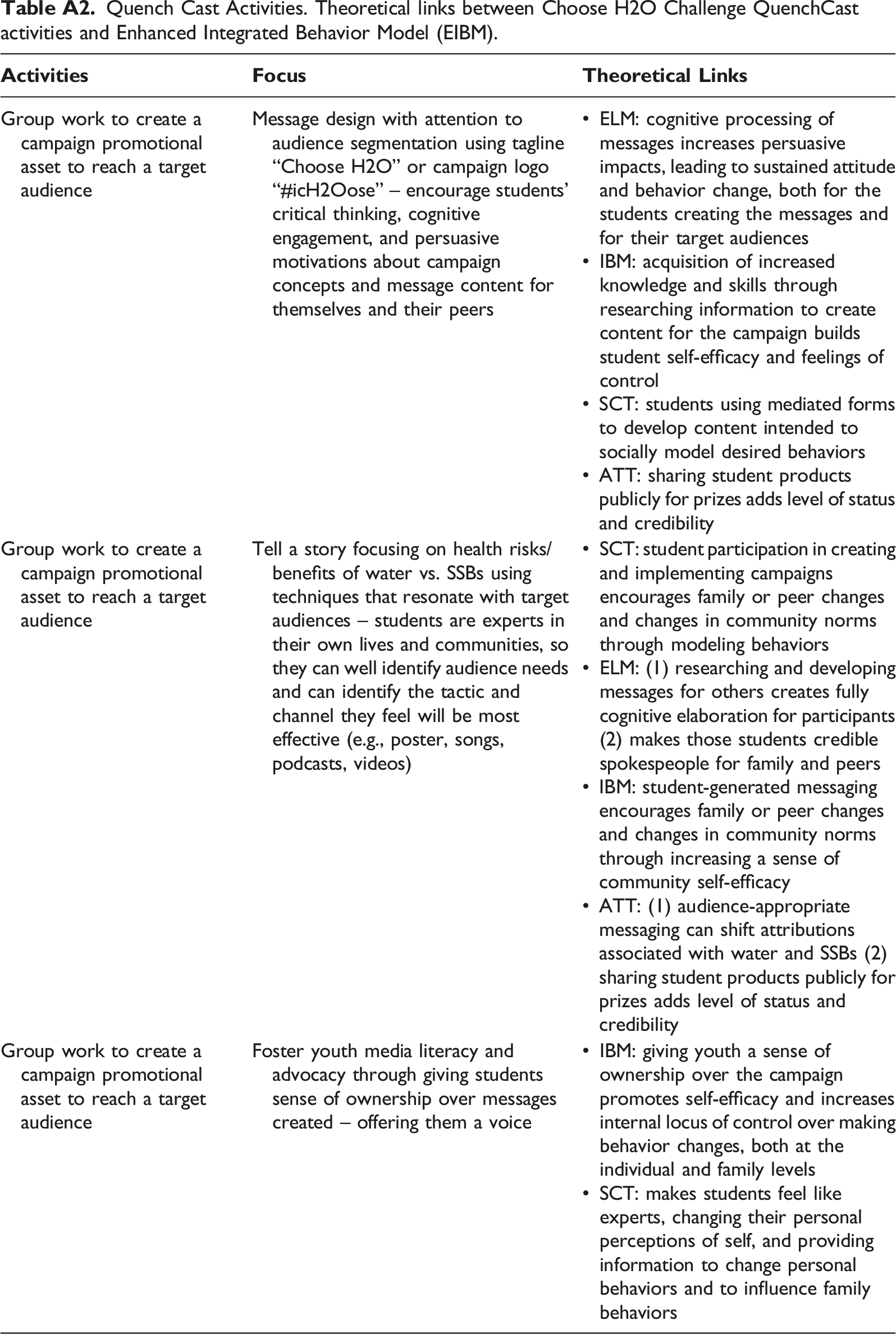
Group work to create a campaign promotional asset to reach a target audience
Message design with attention to audience segmentation using tagline “Choose H2O” or campaign logo “#icH2Oose” – encourage students’ critical thinking, cognitive engagement, and persuasive motivations about campaign concepts and message content for themselves and their peers
Group work to create a campaign promotional asset to reach a target audience
Tell a story focusing on health risks/benefits of water vs. SSBs using techniques that resonate with target audiences – students are experts in their own lives and communities, so they can well identify audience needs and can identify the tactic and channel they feel will be most effective (e.g., poster, songs, podcasts, videos)
Group work to create a campaign promotional asset to reach a target audience
Foster youth media literacy and advocacy through giving students sense of ownership over messages created – offering them a voice
Author Biographies
References
Supplementary Material
Please find the following supplemental material available below.
For Open Access articles published under a Creative Commons License, all supplemental material carries the same license as the article it is associated with.
For non-Open Access articles published, all supplemental material carries a non-exclusive license, and permission requests for re-use of supplemental material or any part of supplemental material shall be sent directly to the copyright owner as specified in the copyright notice associated with the article.
