







Abstract
The number of older victims of domestic violence is expected to increase drastically in Asia as many countries are experiencing rapid population aging. In 2012, 11% of the population in Asia were aged 60 years and over. This is expected to rise to 24% by 2050. This article discusses the unique features of Asian cultures that are relevant to the understanding of elder abuse and summarizes the existing literature looking at the prevalence and risk factors of such abuse in Asian populations.
Keywords
Elder Abuse in Asia—An Overview
Elder abuse refers to “intentional actions that cause harm or create a serious risk of harm, whether or not intended, to a vulnerable elder by a caregiver or other person who stands in a trust relationship to the elder, or failure by a caregiver to satisfy the elder’s basic needs or to protect the elder from harm” (National Research Council, 2003, p. 40). Abuse includes physical assault, psychological aggression, violation of personal rights, sexual abuse, financial exploitation, neglect, and self-neglect. The impact of elder abuse may be particularly detrimental as abusers are most frequently the victims’ own adult offspring. Aside from the bruises, fractures, and other bodily injuries resulting from physical assault (Anetzberger, 2004), elevated levels of depressive symptoms have been observed among mistreated elders in comparison with their intact counterparts (Mouton, Rodabough, Rovi, Brzyski, & Katerndahl, 2010). Prospective studies also suggest that older persons subjected to abuse and neglect have a greater mortality risk than those who are not victimized (Dong et al., 2009).
Elder abuse is prevalent worldwide. In the United States, 5–10% of people aged 65 or older have been abused by someone on whom they depend for care or protection (Fulmer, Paveza, & Guadagno, 2002; National Research Council, 2003). A survey in Canada reports prevalence rates of 7% for emotional, 1% for financial, and 1% for physical or sexual abuse (Canadian Centre for Justice Statistics, 2002). A study in the United Kingdom finds prevalence rates of 5.4% for verbal, 1.5% for physical, and 1.5% for financial abuse (Bennett & Kingston, 1993).
The number of abused elders is expected to increase, given that many countries are experiencing a rapid aging of the population. This is particularly acute in Asia whose population is aging at an unprecedented pace. In 2012, 11% of Asians were 60 years or older, a figure expected to rise to 24% by 2050 (HelpAge International, 2012b). The greatest increase in the aging population will occur in those over 75 years, from 15% in 2000 to 27% in 2050 (HelpAge International, 2012b). Over the past three decades, substantial research has been conducted on elder abuse in Asia, especially among Chinese, Indian, Singaporean, Japanese, and Korean populations. This article reviews the existing literature on prevalence and risk factors. Special attention will be paid to academic work that reflects on risk factors in Asia that are relevant to the understanding of elder abuse.
Methodology
It is our intention to include the most accurate data in order to provide a clear and comprehensive picture of elder abuse in Asia. Prior to conducting the literature search, we developed inclusion and exclusion criteria. The inclusion criteria for the present review are reports, book chapters, and journal articles published in English after 1990. The exclusion criteria are reviews and commentaries, dissertations, and other unpublished documents, and any publication in a language other than English. In spring 2013, we conducted a search of EBSCO, JSTOR, Proquest, Psychinfo, and Pubmed. The following key words were used: older persons/elderly/senior AND abuse/neglect/mistreatment/violence/aggression AND Asian (Asia)/Chinese (People’s Republic of China [PRC], Taiwan, Hong Kong)/Indian (India)/Singaporean (Singapore)/Japanese (Japan)/Korean (Korea/South Korea). We also identified studies that were not available in the database search from the reference lists of previously identified works.
The authors were responsible for carrying out the search. We reviewed abstracts and summaries of all articles located and decided which should be included in the review based on their relevance to the study topic. The final analysis includes 46 peer-reviewed articles and 3 research reports published by governmental and nongovernmental organizations. These include Chinese (PRC—8 articles, Taiwan—3 articles, Hong Kong—4 articles and 1 report, U.S. Chinese—1 article); Indian (India—5 articles and 2 reports); Singaporean (Singapore—2 articles); Japanese (Japan—9 articles); and Korean (Korea/South Korea—7 articles, U.S. Korean—5 articles).
In order to familiarize readers with the cultural values and social context relevant to the study of elder abuse in Asia, this review begins with a discussion of these cultural considerations. It is our wish that readers will be able to appreciate the findings reviewed here while taking into consideration the limitations of existing studies. We have thus included a discussion on the limitations identified in our analysis in the section that follows. A summary of the available findings on the prevalence of, and risk factors for, elder abuse is then presented. The review concludes with our suggestions for future research and good practice in relation to elder abuse in Asia.
Background to the Review
Cultural Considerations in Understanding Elder Abuse in Asia
Interpersonal relationships are culturally constructed and any attempt to understand elder abuse in Asia must take account of this cultural context. Inherited from Confucian teachings, the concept of filial piety emphasizes the virtues of benevolence and propriety (Lin, 1992). It prescribes that adult children should provide care, respect, and financial support for their parents and show them obedience (Cheng & Chan, 2006; Ng, Loong, He, Liu, & Weatherall, 2000; Ng, Philips, & Lee, 2002; Sung, 2001). Earlier findings show that older people continue to have high filial expectations of the younger generation and that young people still accept these obligations for their parents (Lee & Sung, 1997). However, a more recent study shows that young people are now likely to interpret filial duty differently from their parents. While most regard it as a way of following cultural traditions and reciprocating the parent’s love and care, many also suggest that practicing filial piety may depend on their future circumstances (Tsai, Chen, & Tsai, 2008). For example, in Hong Kong “love and care” is increasingly interpreted as paying for parents’ institutional care. Intergenerational conflicts are likely to result from such divergent generational expectations.
Based on the limited number of studies undertaken in some Asian countries, it is evident that Asians identify culturally specific forms of mistreatment that would not necessarily be deemed abusive from a western perspective. For instance, the concept of “disrespect” captures actions and attitudes that violate basic Asian cultural norms. In their qualitative study of home care workers, Tam and Neysmith (2006) report that disrespect is the main form of elder abuse in the Chinese community. Examples include “family members being excessively bossy or rude; or sharing the care of the elder between different family members so that parents feel like ‘a ball being kicked around among relatives.” Qualitative interviews with older Chinese confirmed that disrespect results in unsettled feelings. Examples provided by such Chinese elders included “being ignored by children” and “behaving as if [the elder person] is the enemy” (Dong, Chang, Wong, Wong, & Simon, 2011). Hong Kong Chinese elders considered “being treated as if transparent” to be a serious and common form of abuse (Hong Kong Christian Service, 2004).
Disrespect and lack of dignified living conditions are also considered a major form of elder abuse by older Indians (HelpAge India, 2012b; Nagpaul, 1998). “Being taken for granted,” “being used as additional domestic help,” and “not being appreciated for contributions made to household chores” are other examples of elder abuse in India (Shah, Veedon, & Vasi, 1995). In many situations, however, abuse is attributed to the younger generation leading a lifestyle that does not accord with their parents’ expectations (Nagpaul, 1998).
Similar observations have been made in other Asian cultures. Chang and Moon (1997) show that older Koreans consider lack of respect for elders, and inappropriate treatment of them by family members, to be a prominent form of abuse. Korean elders tend to see insufficient attention from their daughters-in-law as a form of abuse (Chang & Moon, 1997). Some such culturally specific examples include “failure to employ Korean language usage that denotes respect,” “direct expression of disagreement with the mothers-in-law,” and “failure to acknowledge the older person when arriving and leaving the residence.” In a survey of 587 community-dwelling older Koreans, 58.9% of respondents believed that older persons did not receive proper respect (Kim, 2002). Respondents in this study identified neglect as the most serious form of abuse of older persons, followed by verbal mistreatment. Studies of older Japanese provide another example of culturally specific types of elder abuse. When asked to generate examples of extreme abuse, respondents provided illustrations of “blaming”; that is, elderly parents being blamed for whatever problems the adult children were having (Arai, 2006).
While many Asian cultures consider disrespect to be a serious form of elder abuse, their elders may show a high tolerance for financial exploitation. In India for instance, many older Indians are schooled in the traditional belief that they will have to give up their worldly goods to prepare for their next reincarnation. Under such circumstances, many will give away all their wealth to younger family members, thereby falling victim to financial exploitation. Indeed, 50% of financial abuse in Delhi involves family members and inheritance problems (Shah et al., 1995). Moon, Williams, and Stein (1993) show that Korean American elders, compared to their African American and Caucasian counterparts, are more tolerant of hypothetically abusive case scenarios, especially in instances of financial abuse.
Perhaps predictably, Asian populations are reluctant to seek help for elder abuse, mainly because it is perceived as a private family matter (Dong, Simon, & Gorbien 2007; Yan & Tang, 2001). Acknowledging one’s own victimization also means admitting to others that family members, especially adult children, are not fulfilling their filial obligations of respecting and obeying their elders (Cheng & Chan, 2006; Sung, 2001). In many Asian cultures, this is a shameful acknowledgment and results in a significant loss of face (Chan, 2009). A quantitative study in India found that 55% of elders who had been abused had not reported it to anyone. Of these, 80% gave the reason that they wished to uphold family honor (HelpAge International, 2012a). About one third (36%, n = 45) of older Koreans reported no help-seeking intentions in the face of a hypothetical abusive situation. Their reasons included viewing abuse as a family problem, high tolerance of the abuse, shame, victim blaming, and mistrust toward third-party intervention (Lee & Eaton, 2009). Apparently, discussing family matters with a third party, especially if the problem involves a child’s abusive behavior, is considered shameful because such behavior may be attributed to poor parenting (Lee & Eaton, 2009). In a study comparing various groups of Asian immigrants to the United States, older Koreans showed the greatest tolerance of financial exploitation, a propensity to blame the victims of elder abuse, and more negative attitudes toward the involvement of nonfamily members and the reporting of abuse to the authorities (Moon, Tomita, & Jung-Kamei, 2001). A significantly higher percentage of older Korean immigrants (25%) than American-born Asians (0% of Chinese Americans and 13% of Japanese Americans) felt that neighbors should not report elder abuse to the police or outside agencies (Moon et al., 2001).
Older persons also tend to be ignorant of the community resources available for victims of elder abuse (Dong et al., 2011; Moon & Evans-Campbell, 2000). Korean American elders have been shown to be significantly less aware of the formal and informal resources available to them than their Caucasian American counterparts (Moon & Evans-Campbell, 2000). Korean American elders are also significantly more likely than other groups to blame the victim (Moon & Benton, 2000; Moon et al., 2001)—in this case, themselves—which may lead to reduced help-seeking behaviors (Lee & Eaton, 2009).
Limitations of Existing Studies
Huge variation is observed in the reported rates and risk factors of elder abuse. This can partly be attributed to the different methodologies used across studies. Several limitations observed in existing studies and their implications for future research are discussed subsequently.
Lack of consensus on definitions and types of abuse
While most researchers agree on the definition of elder abuse, the types of abuse examined and the operational definitions used in these studies vary. While physical and psychological abuse were included in most of the studies reviewed (14/20), financial abuse (10/20) and neglect (11/20) were less consistently mentioned. Self-neglect (3/20) and abandonment (2/20) were rarely examined in the literature. Possibly because sexual matters remain a taboo topic in Asian societies, only three studies addressed sexual abuse. Some studies also tackle different types of abuse including financial neglect, inappropriate use of medication, and violation of personal rights. Six of the studies reviewed did not specify the types of abuse under investigation but applied the general terms abuse and neglect. Given the variations between the types of abuse examined in different studies, the prevalence estimates they generate are not truly comparable. A more consistent definition and a clearer breakdown in reported prevalence is required for future research in this area.
Variations in recall period
Existing studies of elder abuse in Asia have used divergent recall periods, ranging from 1 month to 1 year, or none at all. It is therefore extremely difficult to draw meaningful conclusions from the prevalence estimates obtained.
Lack of representative samples
To date, the majority of studies of elder abuse have been based on samples of nonrepresentative groups such as clinical populations or members of community centers. Studies using representative samples generally report lower rates compared with those from nonrepresentative samples. There are several possible reasons for this trend. First, older persons experiencing physical or cognitive decline dominate clinical samples and are known to experience higher rates of abuse. Thus, it is to be expected that the rates drawn from such samples would be higher than those from community samples. Second, older people who have been abused may be more inclined to participate in research, resulting in higher rates in convenience rather than representative samples. Studies relying on convenience samples may not reflect the actual prevalence of abuse due to their small size and biased characteristics.
Problem with assessment instruments
It has often been argued that the screening and assessment instruments developed in western societies may not be able to capture culturally specific forms of elder abuse in Asian cultures. While developing local assessment tools may solve this problem, the drawback of relying on such measures is that they hamper efforts at cross-cultural comparison. It is recommended that existing measures developed in non-Asian countries should be adapted for use after careful translation and cultural adaptation. Particular attention should be paid to the need to allow for cross-cultural comparisons while leaving room for culturally specific measures of elder abuse. Several research teams in the PRC have attempted to translate and adapt established instruments for assessing the prevalence of elder abuse (Dong, Simon, Gorbein, Percak, & Golden, 2007; Dong, Simon, Odwazny, & Gorbien, 2008; Dong, Beck, & Simon, 2010; Wu et al., 2012). To aid cross-cultural comparisons, it would be desirable to report separately the prevalence estimates obtained from the original and the adapted versions.
Informant issues
Studies using clinicians as informants yield extremely low prevalence rates. While older persons subjected to physical violence and neglect may present with physical injuries or other observable characteristics such as malnutrition or dehydration, those who have suffered emotional or financial abuse may have no presenting symptoms at all. This may be the reason why physical violence is overrepresented in clinician-identified cases. Similarly, given the low reporting and detection rates of elder abuse in the community, official records are likely to underestimate actual rates and should be interpreted with caution. Contrary to the common perception that perpetrators are unwilling to admit to abusive behaviors, several studies using caregivers as informants have found prevalence rates comparable to those generated through victim reports. Further research should compare the prevalence rates of reports from different informants and acknowledge the gender difference in reporting abuse (Chan, 2011) in order to achieve a more comprehensive picture.
Cross-sectional nature
All of the studies reviewed here used a cross-sectional design. As a result, little is known about how abuse progresses over time. For instance, although there are potential overlaps, there are also considerable differences between spousal abuse that continues into old age and elder abuse occurring in spousal relationships. Cross-sectional designs inevitably confuse these two types of family violence and obscure the picture. Furthermore, the use of cross-sectional data does not allow the identification of causal effects or the risk and protective factors associated with elder abuse. Longitudinal studies on elder abuse are urgently needed to address these issues.
Risk and protective factors
There are disputes over the risk and protective factors for elder abuse. While some studies show that poor physical functioning is associated with abuse, others find that it is not. Such inconsistencies may be due to methodological differences, but it is also likely that there may be underlying subtypes of abuse. It would be a mistake to assume that different types of abuse are associated with the same risk factors. Furthermore, the search for an identical set of identifiers is based on the assumption that older persons who have been abused form a homogeneous group, which is not the case. An example illustrating this heterogeneity would be the case of cognitively impaired versus cognitively intact older persons. Compromised cognitive abilities, intensive interaction with a primary caregiver, and isolation from the social network and community support all characterize the social context of an older person with cognitive impairment. This is very different from the experience of a cognitively intact and mobile older person living in the community. It would be wrong to assume that older persons who are cognitively impaired share the same set of risk and protective factors as those who have intact cognitive function. Similarly, institutionalized and community-dwelling older adults are exposed to a host of different personal and environmental characteristics that make their situations very different. Further research on elder abuse should take into consideration the similarities and differences among the older population.
Prevalence of Elder Abuse in Asia
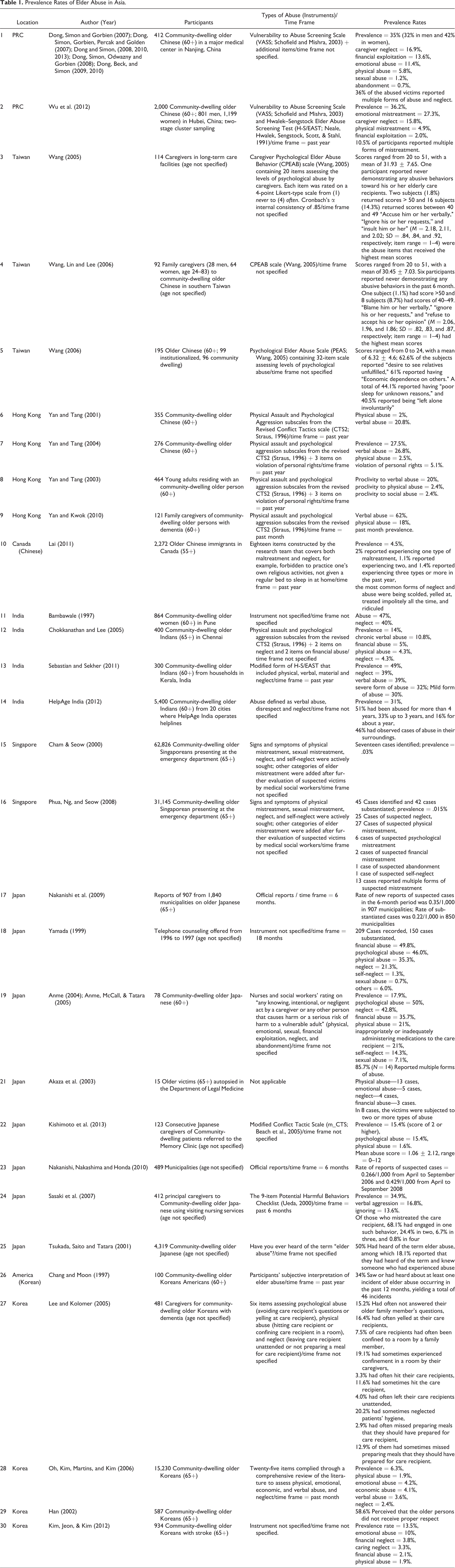
Considerable variation, with figures ranging from 0.22 per 1,000 to 62%, is observed in the prevalence estimates of elder abuse across Asia. Psychological abuse and neglect are frequently reported in studies using older persons or their caregivers as informants. Physical violence and financial abuse are more commonly observed in cases identified in clinical settings and reported to governmental or nongovernmental organizations (Table 1).
Prevalence Rates of Elder Abuse in Asia.
The PRC
Published work on elder abuse estimates in the PRC is drawn mainly from two studies. The first is based on a convenience sample of 412 older Chinese attending an urban medical center in Nanjing. Dong et al. (2007, 2008, 2010) report a prevalence of 35%, with caregiver neglect being the most common form of mistreatment (16.9%), followed by financial exploitation (13.6%), emotional abuse (11.4%), physical abuse (5.8%), sexual abuse (1.2%), and abandonment (0.7%). Thirty-six percent of the abused participants in this sample had experienced two or more types of abuse.
The second study involved 2,000 older Chinese in Hubei recruited through a two-stage cluster sampling. Wu et al. (2012) report similar prevalence rates of 36.2%. Psychological abuse was the most common form of mistreatment (27.3%), followed by caregiver neglect (15.8%), physical abuse (4.9%), and financial exploitation (2%). Ten percent of the participants in this study had suffered multiple forms of elder mistreatment.
Hong Kong
Drawing on a convenience sample of 355 community-dwelling Chinese aged 60 or above, one study reports prevalence rates of 2% for physical and 20.8% for verbal abuse (Yan & Tang, 2001). Another study of 276 older Chinese indicates that 27.5% of older respondents reported having experienced at least one abusive behavior by their family caregiver during the year of survey (Yan & Tang, 2004). The most common form of abuse in this sample was verbal abuse (26.8%). Violation of personal rights (5.1%) and physical abuse (2.5%) were comparatively rare.
In a sample of 122 family caregivers of older persons with dementia recruited from local community centers, 62% and 18% of respondents reported having verbally or physically abused their care recipients in the past month (Yan & Kwok, 2010). Another study of 464 younger adults indicates that they would verbally (20%), physically (2.4%), or socially (2.4%) abuse an older person if there were no social constraints or punishment for doing so (Yan & Tang, 2003).
Taiwan
In Taiwan, 195 subjects including both institutionalized and community-dwelling older Chinese completed the Psychological Elder Abuse Scale (PEAS; Wang, 2006). Participants had experienced an average of 6.32 psychologically abusive behaviors. The most commonly reported experiences were “desire to see relatives unfulfilled” (62.6%), “economic dependence on others” (61%), and “being left alone involuntarily” (44.1%).
Wang (2005) collected information from 114 formal caregivers in nursing homes using the Caregiver Psychological Elder Abuse Behavior (CPEAB) scale. Along a possible range of 20–80, the participants’ mean score was 31.93, indicating that most of them had engaged in some form of abusive behavior. Only one reported never having demonstrated any abusive behaviors toward a care recipient. “Accusing the patient verbally” (mean = 2.18), “ignoring the patient’s requests” (mean = 2.11), and “insulting the patient” (mean = 2.02) were the items with the highest mean scores. A similar study of 92 family caregivers (Wang, Lin, & Lee, 2006) reports mean scores of 30.45 for “blaming [the elder] verbally” (mean = 2.06), “ignoring requests” (mean = 1.96), and “refusing to accept [elders’] opinions” (mean = 1.86). These items showed the highest mean scores.
Chinese Immigrants in Canada
Lai (2011) reports a prevalence of 4.5% in a random sample of 2,272 community-dwelling Chinese aged 55 or above residing in seven major cities in Canada. Among this sample, 2.5% reported having experienced multiple types of mistreatment. The more common abusive acts included “being scolded” (2.5%), “being yelled at” (2.4%), “being treated impolitely all the time” (1.5%), and “being ridiculed” (1.2%).
India
In a survey of 864 community-dwelling women aged 60 or above in Pune, 47% reported that they were being abused and 40% felt they were being neglected by their family (Bambawale, 1997). Chokkanathan and Lee (2005) report a prevalence rate of 14.1% in a sample of 400 community-dwelling Indians aged 55 or above, with chronic verbal abuse being the most common (10.8%) followed by financial abuse (5%), physical abuse (4.3%), and neglect (4.3%). Almost half the older persons who reported abused said that they had experienced multiple forms (Chokkanathan & Lee, 2005). In a representative household survey of 300 older Indians, Sebastian and Sekher (2011) show that nearly half of the respondents (49%) reported having experienced abuse or neglect from their family members in the year of survey. Neglect and verbal abuse (39%) were the most common forms of mistreatment followed by physical abuse (13%).
In a large-scale representative study conducted by HelpAge India (2012a), 31% of the 5,400 community-dwelling respondents aged 60 or above sampled had experienced abuse and 24% faced abuse on a daily basis. More than half of those who reported abuse had endured this for over 4 years. Among those who reported abuse, 44% identified disrespect as the most common form, 30% neglect, and 26% verbal abuse. Forty-six percent of the respondents in this sample had observed examples of abuse in their surroundings.
Singapore
In Singapore, Cham and Seow (2000) review all cases of nonaccidental injuries in older persons presenting to the emergency department of a major hospital. Among the 62,826 older patients treated between 1994 and 1997, they identify 17 cases of elder abuse, giving a prevalence rate of 0.3%. Using similar research methods, Phua, Ng, and Seow (2008) identify 42 (0.13%) cases in 31,145 patients presenting to an emergency department over a 12-month period. The 42 cases identified include physical mistreatment (n = 27), neglect (n = 25), psychological mistreatment (n = 6), financial mistreatment (n = 2), abandonment (n = 1), and self-neglect (n = 1).
Japan
In a sample of 78 older Japanese living in an agricultural village on the main island, 17.9% reported abuse (Anme, McCall, & Tatara, 2005). Among those who did so, the most common type of abuse was psychological (50%) followed by neglect (42.8%), financial exploitation (35.7%), physical abuse (21%), inadequate administration of medicine (21%), self-neglect (14.3%), and sexual abuse (7.1%; Anme, 2004).
Attempts have also been made to investigate caregivers’ reports of their own abusive behaviors. In a survey of 412 principal family caregivers of older Japanese users of visiting nursing services, 34.9% reported having engaged in potentially harmful behavior against the older care recipient over the past year (Sasaki et al., 2007). The most frequently reported behaviors were verbal aggression (16.8%) and ignoring (13.6%). In another survey of 123 Japanese caregivers of older persons referred to a memory clinic, 15.4% reported abuse (Kishimoto et al., 2013). Psychological abuse was reported in all cases, and two cases also involved physical maltreatment. In a representative sample of 4,391 older Japanese, more than half had heard of the term “elder abuse,” among whom 18.1% personally knew someone who had been a victim (Tsukada, Saito, & Tatara, 2001)
Cases reported to social services agencies also allow a glimpse at the patterns of elder abuse in Japan. Reviewing the records of a total of 150 elder abuse victims receiving telephone counseling services from March 1996 to September 1997, Yamada (1999) concludes that financial abuse (49.8%) was the most common form of abuse in this sample followed by psychological abuse (46%), physical abuse (35.3%), neglect (21.3%), self-neglect (1.3%), and sexual abuse (0.7%).
Despite the relatively high rates of elder abuse reported in the community, official records of elder abuse in Japan indicate a relatively low prevalence. Reviewing cases identified by officials in 489 municipalities, Nakanishi, Nakashima, and Honda (2010) find a rate of 0.429 per 1,000 in 2008. Based on the responses from 917 municipalities, Nakanishi et al. (2009) also estimate that the rate of new reports of suspected case over a 6-month period was 0.35 per 1,000 and the rate of substantiated cases 0.22 per 1,000.
South Korea
Drawing from a representative sample of 15,230 older Koreans residing in Seoul, Oh, Kim, Martins, and Kim (2006) report an overall prevalence rate of 6.3% for elder abuse. The prevalence of individual subtypes was emotional abuse (4.2%), financial abuse (4.1%), verbal abuse (3.6%), neglect (2.4%), and physical abuse (1.9%). Lee and Kolomer (2005) interviewed 481 family caregivers providing care to older Koreans with dementia. They report that 16.4% had often “yelled at the care recipients,” 7.5% had often “confined the care recipients to a room,” 4% had often “left their care recipients unattended,” 2.9% had often “not prepared a meal for the care recipients,” and 14.9% had “hit the care recipients.” In a sample of 934 older Koreans recovering from stroke, the prevalence of elder abuse was 13.5% (Kim, Jeon, & Kim, 2012). Emotional abuse was the most frequently reported form (10%) followed by financial neglect (3.8%), caring neglect (3.3%), financial abuse (2.1%), and physical abuse (1.9%).
Korean Immigrants in the United States
In a sample of 100 older Korean immigrants residing in Los Angeles, 34% indicated seeing or hearing about at least one incident of elder abuse and neglect among their Korean relatives, friends, and neighbors, amounting to a total of 46 incidents (Chang & Moon, 1997). Financial exploitation was found to be the most frequent type (36%), followed by psychological abuse (24%), culturally specific form of abuse such as “grown up children refusing to live with their parents” or “lack of contact from grown up children” (17%), neglect (15%), and physical abuse (4%).
Risk Factors for Elder Abuse in Asia
Considering the high prevalence and impact of elder abuse in Asian societies, researchers have also studied the risk factors for such mistreatment (Table 2).
Risk and Protective Factors for Elder Abuse in Asia.

Note. ADL = activities of daily living; EM = elder mistreatment; OR = odds ratio; m-CTS = Modified Conflict Tactic Scale.
Victim Characteristics
A handful of studies have looked at how demographic, psychological, and social characteristics may affect the occurrence of abuse.
Age
Advanced age appears to be a protective factor against elder abuse in most Asian societies. Abuse is significantly more likely to be experienced by the young-old living in the PRC (Dong & Simon, 2010, 2013). One study estimates that older adults in the PRC have a 68% lower likelihood of suffering abuse or neglect (Dong, Simon, Gorbein, Percak, & Golden, 2007). Similar findings have been obtained in Korea, where participants over 80 were least likely to be abused in comparison with other age-groups (Oh, Kim, Martins, & Kim, 2006).
Gender
A greater susceptibility to abuse among older females has been observed in studies conducted in the PRC (Dong & Simon, 2010) and India (Chokkanathan & Lee, 2005; Sebastian & Sekher, 2011). In one study in India, 30% of the male but 60% of the female respondents had been mistreated by family members (Sebastian & Sekher, 2011). Another study shows that a significantly greater number of women have experienced verbal and physical abuse and neglect compared with men (Chokkanathan & Lee, 2005). Two studies report different findings. Wu et al. (2012) find that in the PRC, males experienced an increased risk of neglect relative to females. Another study, in Korea, reports significantly higher prevalence rates of abuse in older men than older women for overall, emotional, and verbal abuse (Oh et al., 2006).
Marital status
Research findings on the impact of marital status are mixed. Two studies in the PRC have found that older Chinese who had been abused were more likely to be currently unmarried (Dong & Simon, 2008; Wu et al., 2012). In both India and Korea, being a widow is associated with an increased risk of abuse (Kim et al., 2012; Sebastian & Sekher, 2011). In other studies conducted in the PRC, marital status is not associated with abuse (Dong, Simon, & Gorbien, 2007, Dong & Simon, 2008; Dong & Simon, 2013).
Living arrangements
It has been observed that living alone is associated with an increased risk of abuse in the PRC (Wu et al., 2012), India (Sebastian & Sekher, 2011), and Korea (Oh et al., 2006). Yan and Kwok (2010) show that the number of coresiding days between caregiver and care recipient is predictive of elder abuse. Another study, however, reports no association with the number of persons living in the household and abuse (Dong & Simon, 2013).
Education level
Lower education levels have consistently emerged as a risk factor for elder abuse and neglect in the PRC (Dong, Simon, & Gorbien, 2007; Dong & Simon, 2008, 2013; Wu et al., 2012), Chinese immigrants in Canada (Lai, 2011), India (Sebastian & Sekher, 2011), and Korea (Oh et al., 2006). After adjusting for age and sex, illiterate people are 3 times more likely to be abused (Dong et al., 2008), while 5 years or less of schooling is also associated with an increased risk (Wu et al., 2012). In India, the chance of an older respondent who had received at least a high school education of being abused was almost half that of older respondents who either were illiterate or had only received primary schooling (Sebastian & Sekher, 2011). In Korea, participants with no education were more likely to be abused than those with tertiary levels of education, with an odds ratio of 1.61 (Oh et al., 2006).
Income
Studies on the role of income have yielded mixed findings. Lower monthly income has been associated with elder abuse and neglect. In the PRC, those without any income are nearly 3 times as likely to suffer abuse as those earning US$125+ (Dong, Simon, & Gorbien, 2007). After adjusting for age and sex, lower income is positively associated with an increased risk of abuse and neglect. Those without any income are also more likely to report being the victims of abuse and neglect (Dong & Simon, 2013; Dong et al., 2008). In India, older persons who are economically dependent are more vulnerable to verbal abuse and neglect than those who are not (Sebastian & Sekher, 2011). Low family income is an identified risk factor for abuse in Korea (Oh et al., 2006).
Physical health
One study in the PRC indicates that physical disability and chronic illness are associated with increased risk of abuse (Wu et al., 2012). Self-reported poor visual ability has been linked with physical and verbal abuse in Hong Kong (Yan & Tang, 2004). Levels of psychological abuse increase with the number of chronic diseases suffered by, and functional dependence of, Taiwanese elders (Wang, 2006). Studies in India (Chokkanathan & Lee, 2005), Japan (Sasaki et al., 2007), and Korea (Oh et al., 2006) all show that poor health and functional impairment are risk factors for abuse.
Not all studies, however, identify a negative association between physical health and abuse. Dong and Simon (2010) find that impairment in physical function and indicators of activities of daily living and instrumental activities of daily living are not independently associated with increased risk of elder mistreatment, after considering potential confounding variables. Their 2013 study also shows that medical conditions, overall health status, quality of life, or recent change in health status are not associated with abuse.
Cognitive functioning
It has generally been observed that rates of abuse are higher among older persons with cognitive decline. A study in Taiwan shows that the experience of psychological abuse increases with cognitive impairment (Wang, 2006). In Japan, it has been estimated that the risk of abuse is higher for frail older persons who are cognitively impaired (4.76 times), who wander due to cognitive impairment (15.01 times), or who have sensory disorders (6.98 times; Anme, 2004; Anme et al., 2005). Abusive behaviors by caregivers are common for older persons with behavioral disturbances (Sasaki et al., 2007; Kishimoto et al., 2013). This is also true of older Koreans, where people with cognitive impairment are more likely to be abused by their family caregivers (Lee, 2009; Lee & Kolomer, 2005).
Studies suggest that older persons with or without cognitive impairment may experience different types of mistreatment. Work carried out in Singapore shows that older patients who have been abused or neglected have different characteristics (Phua, Ng, & Seow, 2008). Suspected victims of neglect are more likely to be bedbound and require maximal care. Their cognition may be significantly impaired and they are unable to make informed decisions. Suspected victims of physical mistreatment are comparatively mobile and cognitively intact, compared to suspected victims of neglect.
Psychological variables
Researchers have also identified depression in the abused person as a risk factor for abuse. Depression is a prominent predictor of different types of abuse and neglect. It is associated with a higher risk of self-reported physical mistreatment, psychological abuse, and neglect (Wu et al., 2012) and also with physical and psychological abuse (Dong & Simon, 2013; Wu at al., 2012). Older Chinese in the PRC who have been mistreated are more likely to report feelings of being dissatisfied with life, bored, helpless, and worthlessness (Dong & Simon, 2010). Those who self-report poor or very poor quality of life are 3 times as likely to report abuse and neglect (Dong et al., 2008).
Social variables
Studies suggest that the abused person’s lack of social support and feelings of loneliness are associated with increased risk of abuse. Dong and Simon (2008) find that a medium or high level of social support is associated with a 59% lower likelihood of a report of elder mistreatment. Specifically, “having someone to listen to and talk to,” “having someone to show them love and affection,” and “having someone to help with daily chores” are all associated with a decreased risk of elder mistreatment (Dong & Simon, 2008). Conversely, a sense of loneliness in abused persons is associated with an increased risk of mistreatment. Specifically, feelings of lacking companionship, being left out of life, and being isolated are associated with increased risk of mistreatment (Dong, Beck, & Simon, 2009; Dong, Simon, Gorbien, Percak, & Golden, 2007; Dong & Simon, 2008). This association remains significant even after controlling for age and gender (Dong, Simon, Gorbien, Percak, & Golden, 2007). It has been shown that perceived social support, but not instrumental social support, mitigates the effects of loneliness on elder mistreatment (Dong et al., 2009). Lack of social support has been identified as a risk factor for abuse in older Chinese immigrants in Canada (Lai, 2011).
The association between lack of social support and elder abuse has also been observed in India (Chokkanathan & Lee, 2005). In Japan, the odds of being abused increase by 11.7 times for those who do not receive much support from family members living elsewhere (Anme et al., 2005).
Abuser Characteristics
Kinship
Most studies report that adult sons and daughters-in-law are the primary abusers in most cases followed by daughters-in-law acting alone. This, presumably, is a function of coresidence. In Hong Kong, 88% of abusers are adult children (Yan & Tang, 2004). In India, estimates that the son is the abuser range from 56% to 62.5% (Chokkanathan & Lee, 2005; HelpAge India, 2012a; Sebastian & Sekher, 2011). In Japan, a review of helpline reports indicates that 36% of abuses are committed by an adult son and 25% by a daughter-in-law (Yamada, 1999). Another study in Japan reports that nearly two thirds of abusers are daughters-in-law (Anme et al., 2005).
Age
In Taiwan, being a younger caregiver is associated with psychological abuse of the older person (Wang, 2005).
Caregiver burden
Several studies examine the role of caregiver burden on abuse when providing care to older persons with cognitive or physical impairments. Compared with nonabusive caregivers, abusive caregivers in Japan report significantly more role conflict and care burden (Anme et al., 2005; Kishimoto et al., 2013; Sasaki et al., 2007). The association between care burden and abuse has also been implicated in studies conducted in Hong Kong (Yan & Kwok, 2010) and Korea (Lee, 2009; Lee & Kolomer, 2005).
Social support
Studies explore the effects of the social support experienced by the caregiver. In Taiwan, caregivers with fewer social resources are more likely to be psychologically abusive (Wang, Lin, Tseng, & Chang, 2009). In Korea, Lee and Kolomer (2005) examine a cohort of 481 caregivers and care recipients. Their findings suggest that formal social support (nursing services, paid home care, day care programs, and so on), but not informal social support (from family members, etc.), is associated with a lower risk of abuse.
Childhood experience of family violence
In a study of the likelihood of elder abuse, Yan and Tang (2003) show that high levels of childhood experiences of abuse consistently emerge as the single most salient predictor of participants’ endorsement of the proclivity to abuse older people.
Discussion
There is a considerable amount of literature on elder abuse. We now have some understanding of the extent of the problem, its antecedents, and its consequences. Research into elder abuse in Asia, however, remains underrepresented in this body of work. Part of the reason for this is that Asian scholarship is not well represented in English-language journals. When performing the literature search for this review, we became aware that a sizable amount of work on elder abuse in Asia has been published in the form of research reports in Korean and Japanese. Scholars conducting research on elder abuse in Asia should be encouraged to publish in English-language journals to disseminate their findings. Research reports produced in an Asian language should be accompanied by an English summary that allows international readers to access the main findings.
Cultural sensitivity is essential for research into elder abuse in Asia. This needs to go beyond using culturally sensitive instruments, which measure culturally specific types of abuse. Many older Asians may be reluctant to report their own abusive experiences to people outside their families. In conducting research in this area, special attention should be paid to building rapport with participants in the data collection process. Studies that employ indirect estimates by asking participants to report abuse they have heard of or witnessed may be an alternative to traditional research that focuses on personal experience.
Limitations
While the present review summarizes the major findings from the elder abuse literature in Asian societies, several limitations should be noted. First, the present review excluded research studies published in languages other than English, although a significant amount of research has been published in Asian languages. Given the exclusion criteria, research on intimate partner violence in older couples was also excluded. Research on the impact of elder abuse, which is extremely scarce in the Asian population, also falls outside the scope of this review. Much of the existing research on elder abuse in Asian populations is flawed in the key areas reported here, but the prevalence of the problem in Asia warrants further and more rigorous research.
Conclusion—Key Findings
Prevalence estimates of elder abuse across Asian populations vary. The variations can be attributed to differences in research methodologies including the types of abuse investigated, sampling methods and sample populations, recall periods, informants, and the instruments employed.
There is debate in the literature about the risk and protective factors for elder abuse. Part of the variation can be attributed to methodological differences, but it is also plausible that there may be underlying subgroups of victim.
Implications for Practice, Policy, and Research
Older Asians are reluctant to report abusive experiences to people outside their families, so prevention and intervention efforts should concentrate on building rapport with suspected victims.
Given victims’ reluctance to disclose their abuse experiences outside the family, mobilizing victims’ social networks, family, and friends will aid prevention and intervention efforts.
Routine screening for elder abuse in social and medical settings should go beyond physical examination. For instance, given that depression is a prominent risk factor for elder abuse, screening for abuse in older persons with depression should be part of routine examination.
Given that social isolation is a major risk factor for abuse, outreach programs that proactively seek out those at risk should facilitate early detection.
Culturally sensitive instruments are needed that will map culturally specific types of abuse while at the same time providing enough flexibility for comparison between multisite cross-cultural studies.
Larger studies that use representative samples are also needed to provide more concrete prevalence estimates.
Research must reflect the reality that older persons constitute a heterogeneous population and take into account differences in gender, class, cognitive and physical abilities, and so on.
Longitudinal studies that investigate the underlying mechanisms of how various factors impact on abuse and their mediating and moderating effects are needed.
Important research reports produced in Asian languages should also be disseminated in English to allow easy access for international audiences.
Footnotes
Declaration of Conflicting Interests
The author(s) declared no potential conflicts of interest with respect to the research, authorship, and/or publication of this article.
Funding
The author(s) disclosed receipt of the following financial support for the research, authorship, and/or publication of this article: Research Grant Council General Research Fund #751113.