







Abstract
Across the Global North, adolescent-to-parent abuse (APA) is becoming recognized as a significant social problem and is receiving attention from researchers, policymakers, and practitioners who work in the intersecting fields of juvenile justice, child protection, and domestic violence. One of the key questions shaping current debates concerns the extent to which APA maps onto the contours of domestic violence, in terms of research and theory, policy, and practice. In particular, to what extent can our established ways of working with domestic violence be applied when working with APA? This article begins by reviewing definitions and prevalence rates of APA. It then considers how the problem fits into the “family conflicts” and “gender-based violence” paradigms that are most frequently used to conceptualize domestic violence. The article then examines how APA represents a similar but distinct phenomenon to adult-instigated domestic violence and identifies how its departures represent particular challenges in working toward its elimination. The article concludes by reviewing intervention programs that work with APA and exploring some of the ways in which they adopt and reject elements of good practice from the domestic violence practice field.
Introduction
He’d just come in and he’d lost his temper with some kids outside…come in and just took it out on the house. Well, he actually picked me up and threw me across his bedroom as well. And he’s only 14.
So what then to make of this newly recognized social problem and how best should we conceptualize it? It is an important question to ask of any social problem, but particularly so during its emergence because our definition and measurement of the problem shape how individuals understand their experiences and respond to them. It also shapes our responses to the problem, whether as researchers, policymakers, and/or practitioners. A number of institutional frameworks have been suggested to help us make sense of APA and how we should respond: Is it a juvenile justice problem? A child protection issue? A question of domestic violence? Of course, APA concerns all three of these institutional arenas (see Holt, 2009; Hunter, Nixon, & Parr, 2010). However, the question of whether APA can and should be considered as a form of domestic violence is ripe for particular interrogation due to a number of recent developments. First, there have been recent developments in national policymaking, such as the inclusion of APA in the U.K. Government’s most recent Violence Against Women and Girls Action Plan (Her Majesty’s Government, 2014). Second, there have been recent developments in practice, such as the emergence of specialist APA programs being developed by domestic violence services, for example, the Yuva project in London, United Kingdom (see McGeeney, Barakat, Langeland, & Williams, 2015). Third, grass-roots campaigning by women’s services and domestic violence agencies is including the issue in its remit (see Paul, 2014). The aim of this article is to explore the extent to which APA can be conceptualized within a framework of “domestic violence” and to consider what the implications of this might be for practice.
Conceptualizing Adolescent-to-Parent Abuse: Family Conflict or Gender-Based Violence?
Generally speaking, domestic violence falls within two competing conceptualizations: the “family conflicts” paradigm and the “gender-based violence” paradigm. Howarth and Feder (2013) point out that constructing domestic violence as a response to “family conflict” means that any and all abusive responses to conflict, regardless of intent or impact, are defined as domestic violence. Such responses to conflict are often measured through behavioral checklists such as the Conflict Tactics Scale, and such measures produce higher prevalence rates and greater symmetry between the genders than other measures of domestic violence (Hamby, 2014). In relation to APA, this is certainly what has been found when conceptualized in this way: large-scale community surveys (e.g., Ullman & Straus, 2003), which tend to ask about solitary violent incidents without exploring their context (e.g., “how many times in the past year have you hit a parent?”), have generally found gender symmetry between male and female instigators and surprisingly high prevalence rates. This approach would fit well with Cottrell’s definition of APA, cited earlier, in terms of any act.
In contrast, constructing domestic violence within a feminist gender-based violence paradigm foregrounds the (unequal) power dynamics at the center of the violence. It also emphasizes the pattern of abuse which serves to undermine the liberty of those most vulnerable (i.e., women and children). A gender-based analysis of APA will therefore highlight the ways in which it serves to perpetuate broader gendered power relations and, as such, APA is identified as part of a wider pattern of violence against women and girls. As predicted by Howarth and Feder (2013), research which has taken this more contextual approach—that is, research which counts cases on the basis of parents reaching “breaking point” and seeking help, whether through the police or other agencies—has found lower overall prevalence rates and significantly more cases involving sons rather than daughters (e.g., Condry & Miles, 2014; Walsh & Krienert, 2007). As Johnson (2001) discusses in relation to intimate partner violence (IPV), 2 such cases are likely to involve a greater frequency and severity of violence and a general trend of escalation. 3 This approach would be more in line with Holt’s (2013) definition of a pattern of behavior, outlined at the beginning of this article.
There are strengths and limitations to whichever approach we take in conceptualizing APA. One advantage of taking a gendered and more contextual approach is that it implores us to bracket off those “one-off” acts of abuse and/or aggression that are claimed to be part of everyday teenage behavior. We can then focus our resources on cases where there is a continual pattern of abusive behavior which shapes all family interactions. These cases are likely to be particularly harmful for family members and are likely to require intervention before the behavior becomes entrenched within a young person’s dating relationships, where correlations have been identified (Laporte, Jiang, Pepler, & Chamberland, 2009; Mitchell, 2007). A gendered approach would also be useful to help understand an abused mother’s experience in terms of wider patterns of violence against women and would enable us to draw on resources that have been used successfully in combating other forms of violence against women. However, it is a difficult model to apply to those cases where fathers are victimized and where daughters are instigating the abuse, although there are still likely to be gendered dynamics at play in such cases. Furthermore, it may be problematic to respond to the young person within such a conceptual framework: that is, as a “perpetrator” who must take full responsibility for their crime. In such cases, working with young people within a family conflict framework may be more appropriate. Interventions that explore family dynamics and help young people to think about new nonabusive ways of responding to family conflict may be more productive than criminalizing children and labeling them as “perpetrators of abuse.” 4 Indeed, in most jurisdictions across the Global North, there are safeguards in place (to a greater or lesser extent) to ensure that children and young people are not subject to the long arm of the law in the same way that adults are. These safeguards are reflected in a considered age of criminal responsibility, a greater reluctance to prosecute and a leniency in sentencing. However, such safeguards present particular challenges when considering how best to respond to something that looks very much like the perpetration of domestic abuse and violence against women.
Adolescent-to-Parent Abuse and Domestic Violence: An Exploration of Common Themes
There are many similarities between domestic violence between adult partners and APA. Groundbreaking research on domestic violence from the 1970s revealed victims’ chilling descriptions of “walking on eggshells” and “living with Jekyll & Hyde” (e.g., Marsden & Owens, 1975; Pizzey, 1974): those same descriptions are now being re-told in research with parents experiencing abuse from their children (e.g., see Galvani, 2010; Holt, 2011; Murphy-Richards, 2015; Routt & Anderson, 2015; Tew & Nixon, 2010). As with adult-instigated domestic violence, APA is highly gendered and frequently involves experiences of polyvictimization (i.e., a combination of different forms of abuse, such as emotional, economic and physical abuse) that makes the experience particularly difficult to cope with. It also causes similar immediate and long-term harms to its victims—including the ability to parent effectively. Other similarities include the isolation and withdrawal that often accompanies (and facilitates) the abuse and the ways that other family members, particularly children, are also harmed by the violence. However, a number of “common themes” are worthy of particular examination here because they highlight both what we can learn from forty years of campaigning against domestic violence and the limitations of applying a domestic violence framework to the problem of APA. The common themes discussed below are (i) structural violence, (ii) contexts of blame, (iii) abusive tactics, and (iv) social resistance to “the problem.”
Structural Violence
Structural violence refers to a form of secondary violence enacted by the state against abused victims and their families. Examples of structural violence have been well-documented in cases of adult-instigated domestic violence (see Quigley, 2007; Radford and Hester, 2006) and, in response, policy guidance, protocols, and legislation have been implemented in countries across the Global North to reduce this. Examples include the use of pro-arrest policies and the development of specialist domestic violence courts. However, cases of APA are not subject to such measures and this has led to some rather worrying responses from state agencies. For example, most youth courts across the Global North now invoke the use of parental responsibility orders. These are court orders that are issued to the parents (usually the mother) of “young offenders” to ensure that they take responsibility for their child’s offending. Parental responsibility orders stipulate particular conditions of parental behavior (such as attendance at a parenting program) and a breach of these conditions can result in a criminal conviction for the parent. Their use in tackling youth violence outside the family home has been criticized for their inherent unfairness in targeting particular parents and for their ineffectiveness in reducing youth offending. 5 However, of more concern is evidence that they are often used as a state response to youth violence inside the family home. The use of parental responsibility orders in this context effectively serves to criminalize the victims of violence by problematizing their behavior and insisting that they must be the transformative agent (Condry & Miles, 2012; Holt, 2009). Furthermore, there have been several documented cases of parents—again, usually mothers—being held legally responsible for paying their child’s fines which were administered by the youth court in response to cases that were a product of APA (Holt & Retford, 2013; Nixon, 2012). Recent recognition of this problem has led to some innovative responses at the local level. For example, in Santa Clara County, CA, USA, a specialist youth family violence court has been in operation for a number of years to provide a specific judicial response to cases of APA (see Pacheco, 2013). However, notwithstanding the question of whether it is ever appropriate to import a judicial practice designed for adults to cases of children, such examples are rare exceptions. In general, juvenile justice systems across the Global North are configured in ways which enable the judicial response to re-victimize the victim. This is an injustice which campaigners against other forms of domestic violence have worked so hard to eliminate.
Contexts of Blame
The history of domestic violence is littered with highly gendered victim-blaming attitudes and responses to it, regardless of national context (see Gracia, 2014; Waltermaurer, 2012). Such victim-blaming enables particular myths about domestic violence to take hold. Examples include the myth that it is not a serious crime (a myth that is helped by the incidentalism implicit in family conflict definitions and measurements of domestic violence); the myth that victims are responsible for their victimization (evident in claims such as “she lets him abuse her” or “if you were a better wife/mother, it wouldn’t happen”) and myths that serve to exonerate or excuse the perpetrator (Valor-Segura, Expósito, & Moya, 2011). In cases of APA, such victim-blaming is compounded by the presence of a parent-blaming culture (or, more specifically, mother-blaming: see Caplan & Hall-McCorquodale, 1985a, 1985b) that is increasingly shaping the formation of public and private family life; one example is the judicial responsibilization of parents, discussed earlier. The addition of a parent-blaming culture makes these victim-blaming myths much harder to resist or challenge for a number of reasons. First, because adolescence is constructed as a time of young people “letting off steam” and “acting out,” adolescent acts of abuse or violence are more likely to be discounted as “one-offs” than adult behaviors. This serves to minimize their seriousness. Second, the safeguards that have been put in place to provide judicial leniency to children and young people may also serve to exonerate their abusive behavior more readily than an adult’s abusive behavior. Third, parent-blaming culture shapes how we treat parents of “difficult” children, both informally (through pointed-fingers in supermarkets) and formally (through our juvenile justice systems). This means that cases of APA are even more likely to be blamed on the victim whose child-rearing practices, both past and present, will be held up to scrutiny.
Such victim-blaming may be unsurprising when coming from the general public where few alternative discourses are available. It may also be expected from the juvenile justice systems that are increasingly configured in ways that responsibilize parents. However, it is surprising when it comes from family practitioners, who have been found to conceptualize APA as a failure of parenting (e.g., Holt & Retford, 2013; Hunter et al., 2010; Nixon, 2012). Indeed, the current dominance of parent-blaming discourses invites speculation that APA is a new problem specific to Westernized cultures and is related to a shift toward more “child-centered” child-rearing practices. However, it is important to recognize that, like domestic violence, the problem is neither new nor culturally specific: historians have documented assaults against parents from as far back as the 17th century (Miettinen, 2014) and its incidence has been reported in Taiwan (Hsu, Huang, & Tu, 2014), Hong Kong (Lisha & Johnson, 2012), South Korea (Kim, Bum, & Kyung, 2008), Egypt (Fawzi, Fawzi, & Fouad, 2013), and Colombia (Betancourt, 2012).
The Victim-Instigator Relationship: Legal Remedies and Abusive Tactics
The nature of the relationship between victim and instigator in cases of APA produces a very distinct context because the parent has a legal responsibility toward their child. One consequence of this is that, in such cases, the victim cannot “leave” the perpetrator in a way that might be possible in adult-instigated domestic violence contexts. 6 Because the parent cannot leave, the most extreme cases of APA require that the child or young person leaves the family home. However, while instances of this have been documented, in practice there is often nowhere else to house young people, particularly those who are over 16 years of age (Miles & Condry, 2014) and refuges are either not available or are inappropriate when the instigators are children (Baker, 2009). Furthermore, while court injunctions have been used in Australia (Purcell, Baksheev, & Mullen, 2014) and in some states in the United States (Strom, Warner, Tichavsky, & Zahn, 2014), questions remain about their use when applied within the United Nations’ Convention on the Rights of the Child (UNCRC) 7 framework which requires that the best interests of the child are of primary concern when making any decision which involves them. It is questionable whether this priority can be maintained when court injunctions are made against them (Hunter & Piper, 2012).
The unique legal and social nature of this parent–child relationship also shapes how abusive behavior manifests when instigated by a child toward his or her parent. Yet the abusive tactics themselves look very similar to those documented in adult-instigated domestic violence. For example, common abusive tactics used in adult domestic violence, such as attempts to undermine the victim’s parenting ability, threats (and acts) of physical violence, damage to property and threats to call social services and make a complaint against a parent have all been documented in cases of APA (Cottrell, 2004; Cottrell & Monk, 2004; Price, 1996). However, because the parent–child relationship is different to that of adult (ex)partners, these abusive tactics hold a particular meaning for the victim. For example, threats by the child to call social services have particular potency because of the caring responsibilities that parents have toward their children and the potential for legal sanction if these responsibilities are not met. Price (1996, p. 17) refers to this abusive tactic as “the hammer of the 90s” in reference to the emergence of the children’s rights discourse, which incorporates the prioritization of children’s voices, that gained currency during this decade and which children draw on in an attempt to control their parents. For a parent who has had previous experiences with social services, particularly if they have a family history of domestic violence, such threats can be terrifying (Stanley, Cleaver, & Hart, 2010). Similarly, children may make financial demands on their parent by emotionally manipulating a parent’s feelings of inadequacy or guilt. While also a common tactic used in adult domestic violence, it may have a particular meaning for the parent if there is a family history of child abuse and the child constructs the parent as having not sufficiently protected him or her. Thus, while many abusive tactics endure across different family and intimate relationships, the specific power of any tactic is shaped by the legal and social nature of that relationship. 8 This raises important conceptual questions regarding the extent to which it is useful to consider both forms of abusive relationship within the same theoretical framework and to wonder what nuances we might miss if we do.
Social Resistance to The Problem
It has taken a long time for domestic violence to be taken seriously by policymakers, state agencies (e.g., police and courts, social services, and schools), and media outlets. Domestic violence campaigners who apply a gendered lens to the problem have fought an important battle in shaping how domestic violence is reported in the media. Recommendations for reporting incidents effectively include detailing the history of the abuse, acknowledging its wider prevalence, and treating violence against women as distinct from other forms of violence. 9 This makes sense in the context of how domestic violence has traditionally been reported: as a (series of) incidental events; as a personal (not a social) issue; and as a gender-neutral crime. In contrast, those who campaign on behalf of children, including children who offend, are keen to foreground the vulnerability of children and young people outside and inside the criminal justice system. Thus, campaigners seek to avoid the (further) demonization of young people and combat any suggestion that there is any kind of youth crime “pandemic” underway. For those of us who work in the field of APA—where the fields of domestic violence and juvenile justice intersect—we face a unique challenge: how to navigate a world where domestic violence is treated too leniently and where youth crime is treated too punitively? Overcoming this challenge is essential if we are to develop a public engagement strategy which raises awareness about the seriousness of APA and the importance of developing a coordinated response. Yet at the same time, we must take care to ensure that our efforts do not unwittingly add to the increasingly shrill tone of parent-blame that might, in turn, reinforce some of the less enlightened attitudes toward domestic violence which the last 40 years of campaigning have done much to address.
Adolescent-to-Parent Abuse as a form of “Domestic Violence”: Implications for Practice
So far, this article has identified and examined a number of issues which require consideration when conceptualizing APA as a form of domestic violence. It is hoped that this analysis might suggest ways forward in how to address the emerging social problem of APA and to identify where future challenges may lie. A final issue that needs examination concerns practice. Are the conceptual similarities sufficient for us to apply our intervention work with adult domestic violence to work with APA? This final section discusses this issue in greater detail.
While it is certainly the case the adolescent violence and abuse toward parents has always been a problem for some families, practitioners and researchers are now talking about it, although not necessarily with the same terminology (Holt & Retford, 2013; Nixon, 2012). Over the past 10 years, practitioners working in the fields of mental health, parenting support, victim support, juvenile justice, youth services, or family support (or, very often, working within a multiagency context) have started to develop specific ways of working with the problem. Sometimes these new ways of working appear as “programs,” at other times they emerge as strategies, techniques, or “good practice.” There is now a small but significant literature base on this work (e.g., see Micucci, 1995; Newman, Fagan, & Webb, 2014; Sheehan, 1997) and many of the more formal programs are on their way to being manualized and independently evaluated. An analysis of outcome data is not yet feasible. What is of interest here is the ways in which such programs have drawn on some of the core principles of intervention work with adult domestic violence in their work with APA. For example, one of the first programs to emerge from the United States is Step-Up, a 21-week dual program for parents and young people. In its genesis, Step-Up drew on the groundbreaking Duluth Model in principle and in practice. The Duluth Model (Pence & Paymar, 1986) was developed in the early 1980s in Duluth, MN, USA, as a community response to eliminating adult male-perpetrated domestic violence. Its two principle aims were to make perpetrators accountable and to keep victims safe. A key component of the Duluth Model was the use of the gendered “Power and Control Wheel” which identified and defined a form of abuse in each of eight “portions,” such as intimidation (“making her afraid by using looks, actions, gestures”), emotional abuse (“putting her down”), and isolation (“controlling what she does”). During weekly sessions, male perpetrators would be asked to reflect on the Power and Control Wheel and to identify which abusive behaviors they had engaged in over the previous week. They would then be asked to consider alternative nonabusive behaviors from the complementary “Equality Wheel,” which included behaviors such as respect (“listening to her nonjudgementally”), trust and support (“supporting her goals in life”), and economic partnership (“making money decisions together”). Thus, the Step-Up program applied this wheel template to develop the “Abuse and Respect Wheels”. Weekly “check-ins” require young people to reflect on the previous week and identify from the “Abuse Wheel” where they have behaved abusively. The wheel includes behaviors such as physical abuse (“physically attacking parent and/or brothers or sisters”), emotional abuse (“putting family members down”), and threats and intimidation (“using looks, actions, gestures to intimidate parents”).Young people are then asked to identify from the “Respect Wheel” how they might behave respectfully, which includes behaviors such as being trustworthy (“developing/accepting guidelines”) and choosing to stay non-violent (“stopping yourself when you feel like hurting a family member”; Routt & Anderson, 2015).
While the centrality of the Duluth Model in the conceptualization of the Step-Up program is evident, there are some intriguing aspects to the Step-Up program which mark a clear departure from the original model. For example, unlike the original Duluth Model Wheels, the descriptions in each wheel portion of the “Abuse and Respect Wheels” used in Step-Up have been de-gendered, for both the instigator and the victim (i.e., parent). De-gendering also takes place within the intervention sessions themselves: unlike the Duluth Model, the Step-Up program works with both male and female perpetrators of abuse and mixes the genders in the sessions (as do most APA group programs 10 ). This raises an important question about the appropriateness of importing an intrinsically gender-based domestic violence program into an adolescent arena which, in the process of translation, loses much of its political potency. The de-gendering process may also have implications for reducing risk in future abusive relationships (for both victims and instigators). However, this is not to suggest that Step-Up is devoid of any gendered component, and gender is attended to in particular Step-Up practices such as having both a male and female practitioner present to demonstrate how male and female participants can communicate (and resolve conflict) healthily. Step-Up also facilitates discussions with both the young people and the parent participants about expectations of gender roles (Routt & Anderson, 2015). Nevertheless, this de-centering of gender raises intriguing questions about what should be at the center of such work with young people. Perhaps the loss of a specifically gendered focus is necessary to enable a specifically developmental focus that foregrounds the context of adolescence? Given that this work aims to nurture a transformative experience for young people who are at a particularly sensitive stage of development, it may be that change is more meaningful for young people when constructed at the level of the personal rather than the political.
A second departure from the Duluth Model involves the explicit positioning of Step-Up within a “restorative framework.” This is something that would be anathema to those who work with the Duluth Model (Paymar & Barnes, 2007) and indeed for most adult domestic violence programs because of concerns about the intervention process enabling further abuse and victimization (Daly & Stubbs, 2006). However, restorative approaches are increasingly common in work with juveniles as it is seen as an effective remedial and noncriminalizing method of reparation (Crawford & Newburn, 2013). Furthermore, an emphasis on “restoration” reflects the wishes of the parents in their goal of maintaining their relationship with their child. The emphasis on restorative practice also means that Step-Up has no requirement of arrest, although many referrals to the Step-Up program are made through the youth courts as either a diversion strategy or part of a court order (Routt & Anderson, 2015). In contrast, mandatory arrest was always a key principle (if not always in practice) underpinning the original Duluth Model because of its powerful message that domestic violence is a crime and should always be treated as such (Paymar & Barnes, 2007). All of these departures from the Duluth Model, and the key theoretical tensions that emerge, highlight the limitations of attempting to import a male/powerful => female/oppressed domestic violence model into a child/powerful => parent/oppressed context. They also raise pressing questions about whether aligning APA interventions too closely within a domestic violence remit might send out a problematic message that the needs of the victim may not always trump the needs of the instigator.
Using Groupwork With Adolescent-to-Parent Abuse
One aspect of the Step-Up program that does not depart from domestic violence intervention work with adults is its use of groupwork. Groupwork is often argued to be the only appropriate way of working with perpetrators of adult domestic violence perpetrators due to concerns about “one-to-one” work enabling further victimization and abuse. For example, by support workers sympathizing with perpetrators’ point of view and thus colluding with the violence. It is also suggested that groupwork in domestic violence interventions provides opportunities for pro-social modeling, peer support, and higher levels of engagement in the program. In particular, groupwork enables a robust and constant challenge to those practices of minimization, denial and victim-blaming that perpetrators engage in to justify their abuse (Blacklock, 2003). Of course, these are also good reasons why groupwork may be appropriate in work with young people who instigate APA. However, it could also be argued that working with APA requires a more nuanced framework for conceptualizing “the instigator” than that which is provided by the unambiguous model offered by adult domestic violence programs. Thus, the need to respond to the unique history of how the young person came to occupy multiple and overlapping positions—as both perpetrator and “victim”; as “powerful” and “oppressed”—may mean that one-to-one intervention work is more appropriate. One example of this approach is the work by Wish for a Brighter Future, an intervention project for APA that emerged out of a local domestic violence support organization in Bristol, England. Wish starts from the position that the abusive child or young person has a history of trauma, most likely through witnessing or experiencing domestic violence, of which there is some evidence. The one-to-one work offered by Wish (which works with young people and, if appropriate, with their families) focuses on developing attachment relationships and healing past traumas. It prioritizes the exploration of each family member’s unique history to explore how brain development and emotional regulation are shaped by earlier experiences of trauma (Evans, 2015). Such an approach to working with APA is very different in tone to many of the group programs available which advocate the parent’s use of “consequences” in an attempt to teach families how to communicate in non-abusive ways and to address the sense of “entitlement” that is seen as fundamental to the commission of both APA (see Gallagher, 2004) and adult domestic violence (see Paymar & Barnes, 2007). An attachment-based approach primarily positions the child or young person as a traumatized victim, rather than as an entitled perpetrator, and does not advocate the use of such parenting strategies that may risk “re-traumatizing” the child.
Intervention work with APA is at an early stage of development, and practitioners have been creative in taking what they need from domestic violence practice and discarding that which may be particularly damaging when applied to people at such an early stage in their life course. Different programs appear to draw on distinct aspects of domestic violence paradigms and intervention models: some take a more family conflicts approach while others explicitly attempt to address gender-based violence, some position the young person as an entitled perpetrator, others as a traumatized victim. Such differences are perhaps inevitable, and surely healthy, when attempting to work with a unique and complex problem where there is yet no consensus. Yet such differences—and the departures they take from established domestic violence [DV] models—highlight how our current ways of conceptualizing domestic violence are inadequate when applied to a small but significant population of young instigators. Perhaps this now raises the question of what domestic violence practice can learn from the emerging body of work in the field of APA?
Conclusions
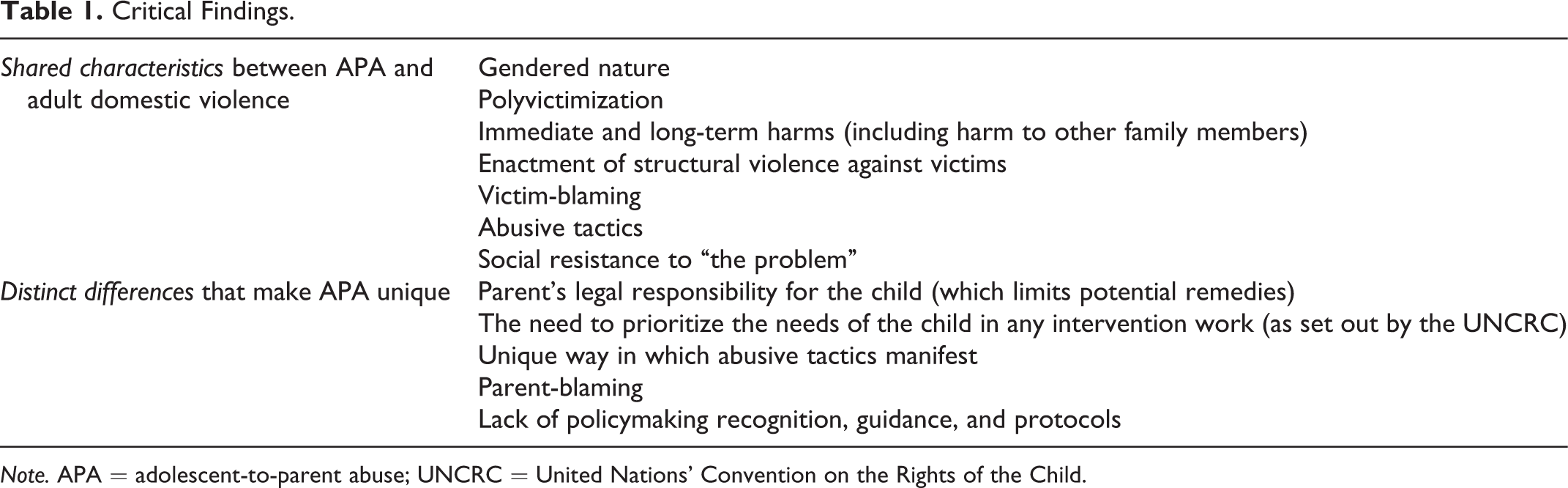
This article has highlighted the challenges involved in attempting to conceptualize the emerging social problem APA as another form of domestic violence. As Table 1 highlights (below), there are both shared characteristics and clear differences between adult-instigated domestic violence and APA. This suggests that we need to carefully consider whether a domestic violence framework is the most appropriate way of thinking about APA, and to what extent it should be applied in our intervention work.
Critical Findings.
Note. APA = adolescent-to-parent abuse; UNCRC = United Nations’ Convention on the Rights of the Child.
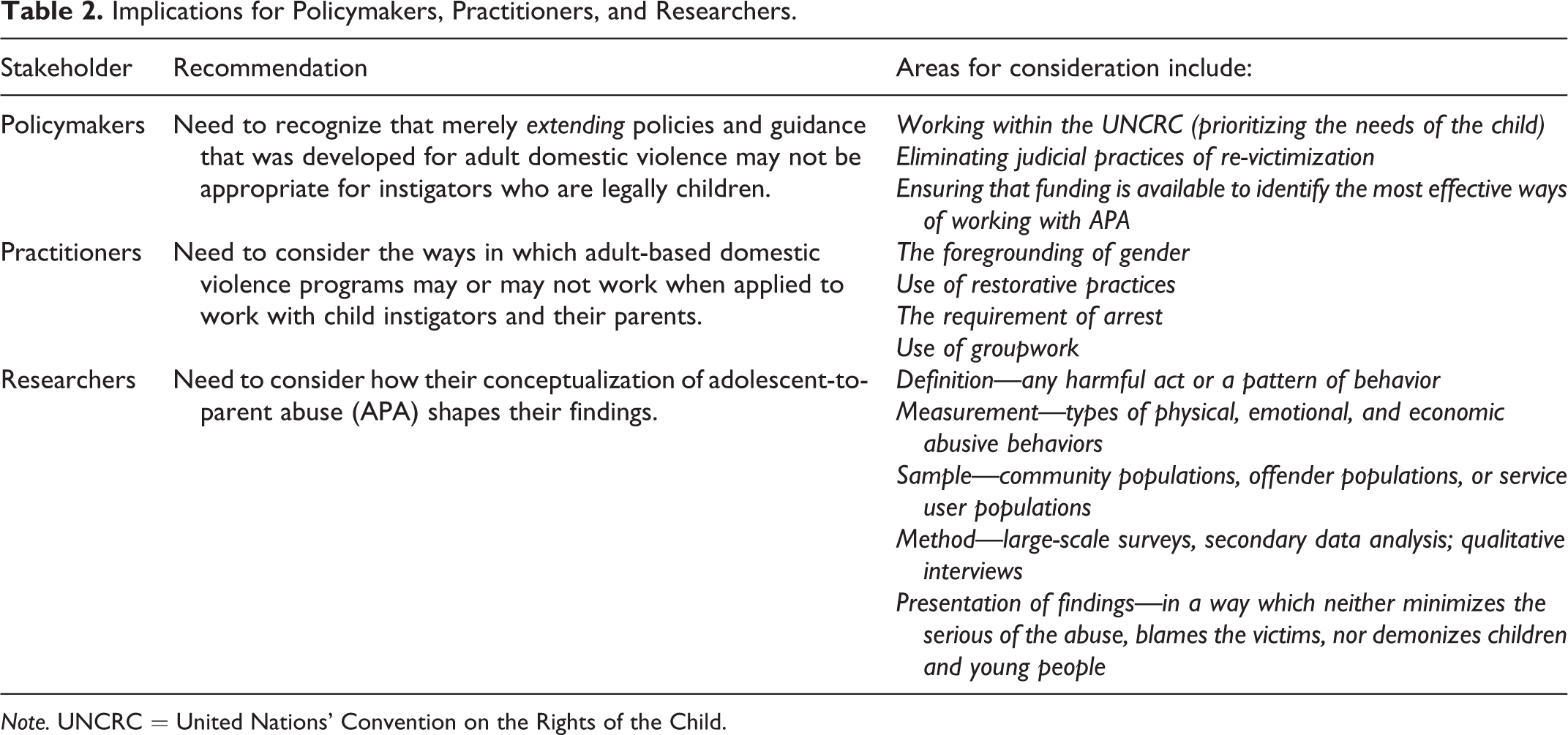
This conceptual review does not claim to have the final word on how we should or could conceptualize APA. Indeed, only the two most dominant “DV paradigms” have been discussed (family conflicts and gender-based violence), and other frameworks may be more appropriate for thinking about both adolescent-initiated and adult-initiated violence toward family members or intimate partners. Indeed, given early indicators of correlations between (i) observing parental domestic violence and instigating abuse toward parents and (ii) instigating abuse toward parents and instigating abuse toward dating partners, then a lifespan approach to domestic violence seems a potentially fruitful conceptual avenue. This review is also broadly limited to English-speaking sources and, as acknowledged in the article, APA is not a phenomenon limited to the English-speaking world. Indeed, an exploration of how other cultures conceptualize both adult domestic violence and APA, and how they work with these problems, would broaden our understanding and might, again, suggest potential avenues for further enquiry. Finally, while APA is a field in its infancy, it is a fast-moving one. Intervention programs and practices are continually emerging, research is being produced at an astounding rate, and policymakers are finally acknowledging the need for a response at national and local levels, and there are important issues that need careful consideration along the way (see Table 2). The pace of such change may mean that the article’s aim to offer a current “state-of-the-art” in the field of conceptualizing APA is an impossible one. But after decades of silence on this topic, that is an encouraging position to be in.
Implications for Policymakers, Practitioners, and Researchers.
Note. UNCRC = United Nations’ Convention on the Rights of the Child.
Footnotes
Acknowledgments
Many thanks to Aisha K. Gill and Jane Evans for reading earlier versions of this article and for providing valuable feedback. Thank you to the two anonymous reviewers who offered very useful comments that helped to strengthen this article.
Declaration of Conflicting Interests
The author(s) declared no potential conflicts of interest with respect to the research, authorship, and/or publication of this article.
Funding
The author(s) received no financial support for the research, authorship, and/or publication of this article.