







Abstract
Forms of cognitive and behavioral therapies (CBTs), including prolonged exposure and cognitive processing therapy, have been empirically validated as efficacious treatments for posttraumatic stress disorder (PTSD). However, the assumption that PTSD develops from dysregulated fear circuitry possesses limitations that detract from the potential efficacy of CBT approaches. An analysis of these limitations may provide insight into improvements to the CBT approach to PTSD, beginning with an examination of negative affect as an essential component to the conceptualization of PTSD and a barrier to the implementation of CBT for PTSD. As such, the literature regarding the impact of negative affect on aspects of cognition (i.e., attention, processing, memory, and emotion regulation) necessary for the successful application of CBT was systematically reviewed. Several literature databases were explored (e.g., PsychINFO and PubMed), resulting in 25 articles that met criteria for inclusion. Results of the review indicated that high negative affect generally disrupts cognitive processes, resulting in a narrowed focus on stimuli of a negative valence, increased rumination of negative autobiographical memories, inflexible preservation of initial information, difficulty considering counterfactuals, reliance on emotional reasoning, and misinterpretation of neutral or ambiguous events as negative, among others. With the aim to improve treatment efficacy of CBT for PTSD, suggestions to incorporate negative affect into research and clinical contexts are discussed.
Introduction
Recent changes to the Diagnostic and Statistical Manual of Mental Disorders, fifth edition (DSM-5), include the reclassification of posttraumatic stress disorder (PTSD) as a trauma and stress-related disorder (American Psychiatric Association, 2013). A fourth symptom cluster, defined as “negative alterations in cognitions and mood associated with the traumatic event(s), beginning or worsening after the traumatic event(s) occurred,” was also added to the diagnostic requirements for PTSD (American Psychiatric Association, 2013, p. 271). Symptoms within the cluster (i.e., exaggerated negative beliefs and expectations, distorted cognitions that manifest notions of self-blame, the persistent experience of a negative emotional state) are characteristic of increased negative affect (Watson, Clark, & Tellegen, 1988).
Empirically supported variants of cognitive and behavioral therapies (CBTs) for PTSD, which have generally yielded positive results for those who adhere to and complete treatment, do not specifically address negative affect as structured. Instead, the theoretical foundations of CBT treatment models for PTSD are based upon the correction of disruptions in fear circuitry. However, treatment mechanisms with an explicit focus on correcting fear circuitry may not fully address distress or symptoms associated with negative affect more broadly. The scope of this review examines negative affect as an essential component to the conceptualization of PTSD and a possible barrier to the implementation of CBT for PTSD in more complex cases. In particular, the review specifically focuses on the relationship between negative affect and aspects of cognition (e.g., attention, memory, and processing) that may act as preconditions for the successful application of CBT for PTSD. With the aim of improving the efficacy of CBT for PTSD, the incorporation of negative affect into research and clinical contexts is discussed.
CBTs for PTSD
Psychotherapy is considered to be the first-line treatment option for the symptoms of PTSD. Specifically, forms of CBT, including prolonged exposure (PE) and cognitive processing therapy (CPT), have been empirically validated as efficacious treatments for PTSD in adults (Cloitre, 2009; Powers, Halpern, Ferenschak, Gillihan, & Foa, 2010). Empirical data suggest that CBT for PTSD is demonstrably more effective than treatment as usual or unstructured therapy modalities in providing clinically significant outcomes (Cloitre, 2009; Gerger et al., 2014; Powers et al., 2010; Watts, Turnell, Kladnitski, Newby, & Andrews, 2015).
Competing cognitive and behavioral treatment approaches to PTSD highlight conceptual differences in the theory of treatment mechanisms. Behavioral approaches typically conceptualize PTSD as a maladaptive learning process (Lissek & Grillon, 2012). PTSD is viewed as a fear-based disorder that develops in response to exposure to threatening, traumatic stimuli. This exposure leads to a conditioned fear response thought to be responsible for PTSD symptoms. Behavioral approaches espouse that exposure to conditioned stimuli without negative consequences will extinguish this conditioned fear response (Foa, Keane, & Friedman, 2009).
In comparison, cognitive models contend that PTSD develops from the formation of mental representations following a traumatic experience comprised of feared stimuli, learned responses to the stimuli, and cognitive attributions about the event (Foa & Kozak, 1986). Further elaborations on cognitive theory for PTSD include emotional processing theory and cognitive processing theory (Resick & Schnicke, 1993). Nonetheless, all variants of cognitive theory for PTSD acknowledge that the meaning attached to a traumatic event is integral to the development and maintenance of the disorder.
Despite differences in theory regarding efficacious treatment mechanisms, cognitive and behavioral components are often used in a complementary fashion to treat PTSD. The marriage of these two approaches is evident in most manualized versions of CBT for PTSD, from the inclusion of processing cognitive reactions in PE to the incorporation of a written trauma narrative in CPT. Differences between these approaches are reconciled by a common basic assumption in theory—that PTSD is a disorder of dysregulated fear circuitry.
Fear Circuitry Model of PTSD
There is a substantial body of neuroscience literature that evinces the impact of dysregulated fear circuitry within the development of PTSD (Garfinkel & Liberzon, 2009; Johnson, McGuire, Lazarus, &Palmer, 2012; VanElzakker, Dahlgren, Davis, Dubois, & Shin, 2014). Neural connections between the amygdala, medial prefrontal cortex (mPFC), and the hippocampus in the human brain are thought to comprise a circuit responsible for the emotion of fear (Lanius, Bluhm, Lanius, & Pain, 2006; Shin & Handwerger, 2009). Evidence suggests that the amygdala contributes to this network in the detection of threatening stimuli, the generation of a fear response via conditioning, and the encoding of emotional memories (Davis & Whalen, 2001; Dejean et al., 2015; LaBar & Cabeza, 2006). The mPFC is thought to play a role in the extinction of behavioral responses (Milad & Quirk, 2002; Phelps, Delgado, Nearing, & LeDoux, 2004) and the top-down regulation of emotion in PTSD (Lanius et al., 2006; Rozeske, Valerio, Chaudun, & Herry, 2014; Shin & Handwerger, 2009). The hippocampus is believed to be important for encoding emotional memories (LaBar & Cabeza, 2006; Milad et al., 2009; Parsons & Ressler, 2013).
Fear circuitry theory is based upon Pavlovian conditioning principles (i.e., an organism associates neutral, environmental stimuli with a fear response). Put simply, the fear circuitry model suggests that the mPFC is inefficient in the inhibition of a hyperactive amygdala after the experience of a traumatic event, as the hippocampus fails to discriminate between safe and unsafe contexts. Reexperiencing and hyperarousal symptoms are proposed to be a direct consequence of the misfiring of the fear circuit (i.e., the fight, flight, or freeze response; Johnson et al., 2012). An individual then engages in avoidant behaviors in the presence of traumatic reminders, thus reinforcing the association between fear and the conditioned stimuli and maladaptive cognitive attributions about the event. As such, primary treatment mechanisms of CBT variants for PTSD include behavioral exposure to the traumatic memory and contextual reminders as well as the cognitive processing of maladaptive cognitions that subsequently diminishes cognitive avoidance; both strategies are thought to weaken the conditioned response that maintains PTSD symptoms.
Limitations of Fear Circuitry Model
PTSD is a phenotypically complex phenomenon that varies greatly among each individual (Waddington et al., 2003). As PTSD is comprised of four broad, separate symptom clusters, each individual case will likely possess a unique presentation. Given this symptom heterogeneity, the assumption that PTSD is a direct consequence of disrupted fear circuitry may be an oversimplification of a complex network of interactions between individual and contextual factors. It is unclear how sole reliance on this theory, embedded within CBT approaches for PTSD, influences treatment outcomes among individual clients. Despite positive results of CBT for those who adhere to and complete treatment, there is significant room for improvement with regard to treatment response and retention. An examination of the fear circuitry model’s limitations may provide insight into potential improvements to variants of CBT for PTSD.
The fear circuitry model is inherently locationist, specifically that a specific psychological phenomenon (e.g., fear) is generated by a specific brain structure (e.g., the amygdala; Lindquist, Wager, Kober, Bliss-Moreau, & Barrett, 2012). Primary examples of the locationist approach within the fear circuitry model of PTSD include the hypothesized relationships between the amygdala and fear, hippocampus and memory, and the mPFC and emotion regulation. Locationist theory would infer consistent activation of these regions during the provocation of the particular psychological function. However, neuroimaging findings regarding these brain regions as they relate to fear and PTSD are mixed and inconclusive (Feinstein et al., 2013; Garfinkel & Liberzon, 2009; Lanius et al., 2006).
Given the consistent difficulty with localizing psychological phenomena in the brain, it has been proposed that emotions may be a function of multiple diverse, more general brain patterns (Lindquist et al., 2012). As such, specific locations of the brain may contribute to the experience of a wide range of emotional experiences and vary as a function of context, a central thesis of psychological constructionism. Fear is likely one of many emotional experiences that manifest and maintain PTSD symptoms. For example, the experience of interpersonal trauma (i.e., traumatic event in which an individual is assaulted or violated by another person that may be known or unknown to the trauma survivor) can manifest a myriad of emotions other than fear including guilt, sadness, shame, disgust, and anger (Lilly & Valdez, 2012). Thus, a therapy protocol that attempts to address PTSD with a central emphasis on fear may not be amenable to other discrete and complex emotional presentations (e.g., complex PTSD; Lonergan, 2014). It should be noted that CPT briefly identifies some of these emotional presentations (e.g., guilt, shame, etc.) as “manufactured” or “secondary” emotions and encourages emotional expression (Resick & Schnicke, 1993). While CPT then assists in the identification of stuck points related to these emotions, the treatment does not explicitly address how to tolerate negative affect states.
The fear circuitry model also takes a predominantly biological focus. As such, important contextual factors and interactions remain unexplained. For example, the neuroanatomical regions that comprise the fear circuit are inherent to human neurobiology and should theoretically yield similar responses among individuals. However, multiple people can be exposed to the same traumatic event and have extremely varied reactions (i.e., multifinality; Shalev & Segman, 2007), including adverse posttraumatic outcomes both distinct from and comorbid with PTSD (e.g., depression, substance abuse, suicide, anxiety pathology, affective instability, and interpersonal difficulties) or an adaptive/resilient response (i.e., posttraumatic growth; Tedeschi & Calhoun, 2004). Similarly, the experience of very different traumatic events (e.g., witnessing the 9/11 terrorist attack on television from afar vs. witnessing 9/11 as a first responder) can both manifest PTSD (i.e., equifinality; Shalev & Segman, 2007). Additionally, individual risk and protective factors may mediate the development and maintenance of the disorder (i.e., multicausality; Shalev & Segman, 2007). The inference that the neurobiology of PTSD is universal and consistently related to fear conditioning diminishes the capacity of current CBT approaches for PTSD to address such contextual factors.
The Relationship Between Negative Affect and PTSD
We propose that negative affect is an important contextual factor to address in CBT approaches for PTSD. Negative affect represents a dispositional mood dimension of subjective distress and is believed to subsume a variety of aversive mood states including anger, contempt, disgust, guilt, and nervousness (Watson & Clark, 1984; Watson et al., 1988). Negative affect exists along a continuum, and individuals who experience high levels of negative affect tend to frequently experience distress and espouse a negative view of the self, engage in more introspection, and exhibit an attentional bias toward the negative aspects of a situation (Noguchi, Gohm, & Dalsky, 2006). In comparison, individuals who experience low levels of negative affect exhibit a sense of self-satisfaction and security (Watson & Clark, 1984).
Negative affect has been found to predict the onset (Frazier et al., 2011; Souza et al., 2008; Weems et al., 2007) and development of PTSD among multiple trauma populations (Christiansen & Elklit, 2008; Ferrier-Auerbach, Erbes, Polusny, Rath, & Sponheim, 2010; Rademaker, van Zuiden, Vermetten, & Geuze, 2011). Negative affect may also interact with stressful situations to exacerbate PTSD symptoms, suggesting that individuals with greater negative affect may experience more severe posttraumatic reactions (Souza et al., 2008). Indeed, negative affect has been consistently identified as a robust predictor of PTSD symptom severity (Brown et al., 2016; Post, Zoellner, Youngstrom, & Feeny, 2011). Moreover, negative affect is thought to be responsible for the comorbidity between PTSD and other mood and anxiety disorders (Clark & Watson, 1991; Mineka, Watson, & Clark, 1998; Watson, 2005).
Negative Affect and PTSD: Emotional Circuitry
There is also considerable support in neuroimaging studies for the relationship between negative affect and PTSD. In addition to its function of perceiving threatening stimuli, the amygdala serves to generate sustained emotional responses (Davis, 1992; Liberzon et al., 1999), which can theoretically be considered the “source” of negative affect. Additionally, interaction between the mPFC and the anterior cingulate cortex (ACC) is thought to influence broad emotion regulation (Garfinkel & Liberzon, 2009). The ACC is believed to be important for cognitive control of emotion and the interpretation of emotionally relevant stimuli (Bush, Luu, & Posner, 2000). The insula, a vast cortical area that maintains connections with the amygdala, also appears to contribute to negative affect within PTSD. Among the several proposed functions of the insula, it is hypothesized to be important in the processing and experience of affect (Wager & Barret, 2009).
Interestingly, many of the same brain areas implicated by the fear circuitry model of PTSD demonstrate dysregulation in response to affective stimuli unrelated to feared reminders of the traumatic event. These findings are also important because similar brain areas are thought responsible for the experience of negative affect independent of the experience of a traumatic event or diagnosis of PTSD. Affective inductions typically elicit the recruitment of the mPFC (Beauregard, Levesque, & Bourgouin, 2001; Kalisch et al., 2005; Levesque et al., 2003; Matsumoto, Ichikawa, Kanayama, Ohira, & Iidaka, 2006), the ACC (Anderson & Phelps, 2002; Banks, Eddy, Angstadt, Nathan, & Phan, 2007; Ochsner, Bunge, Gross, & Gabrieli, 2002; Pissiota et al., 2003; Schaefer et al., 2002; Whittle, Allen, Lubman, & Yucel, 2006), the amygdala (Barrett, Bliss-Moreau, Duncan, Rauch, & Wright, 2007; Cremers et al., 2009), and the insula (Wager & Barret, 2009). Negative affect is also thought to be responsible for pervasive difficulties with emotion regulation (Lightsey, Maxwell, Nash, Rarey, & McKinney, 2011). As such, neuroimaging findings regarding negative affect within PTSD suggest that fear circuitry may be too simplistic to capture the emotional complexity of the disorder (Diekhof, Geier, Falkai, & Gruber, 2011).
The Problem of Negative Affect and CBT Treatment Approaches for PTSD
Affect regulation is not a primary focus of current CBT approaches for PTSD, but the research reviewed thus far suggests that a greater focus on negative affect and affect regulation in PTSD may be helpful. In fact, the level of negative affect may present a barrier to maximally benefiting from CPT or PE in terms of treatment response and/or retention. Generally speaking, CBT requires basic cognitive processes to be intact to facilitate treatment gains. While mild-to-moderate negative affect elicits adaptive cognition functioning (Forgas, 2007), severe negative affect may actually disrupt these preconditions for attention, processing, and memory. Additionally, a considerable amount of cognitive insight is often an important indicator of treatment effectiveness (Beck, Baruch, Balter, Steer, & Warman, 2004). Thus, the impact of negative affect on aspects of cognition essential for the application of CBT for PTSD was explored in this review. Criteria for inclusion consisted of studies of cognitive science that directly assessed the impact of negative affect on primary components of cognition (e.g., attention, memory, cognition, cognitive regulation of emotion, etc.). An extensive search of literature databases (PsycINFO and PubMed) yielded 25 articles that met these criteria via searches of the term “negative affect” and the aforementioned terms referencing components of cognition. To be considered for this review, articles must have been published recently (i.e., 2006–2016) using an adult sample, examined negative affect as an independent variable with either self-report methodology or an affective induction paradigm, and utilized cognitive science methodology to assess an aspect of cognition as a dependent variable. These findings are summarized in Table 1.
Findings From Experimental Paradigms Examining the Relationship Between Negative Affect and Cognitive Processing.
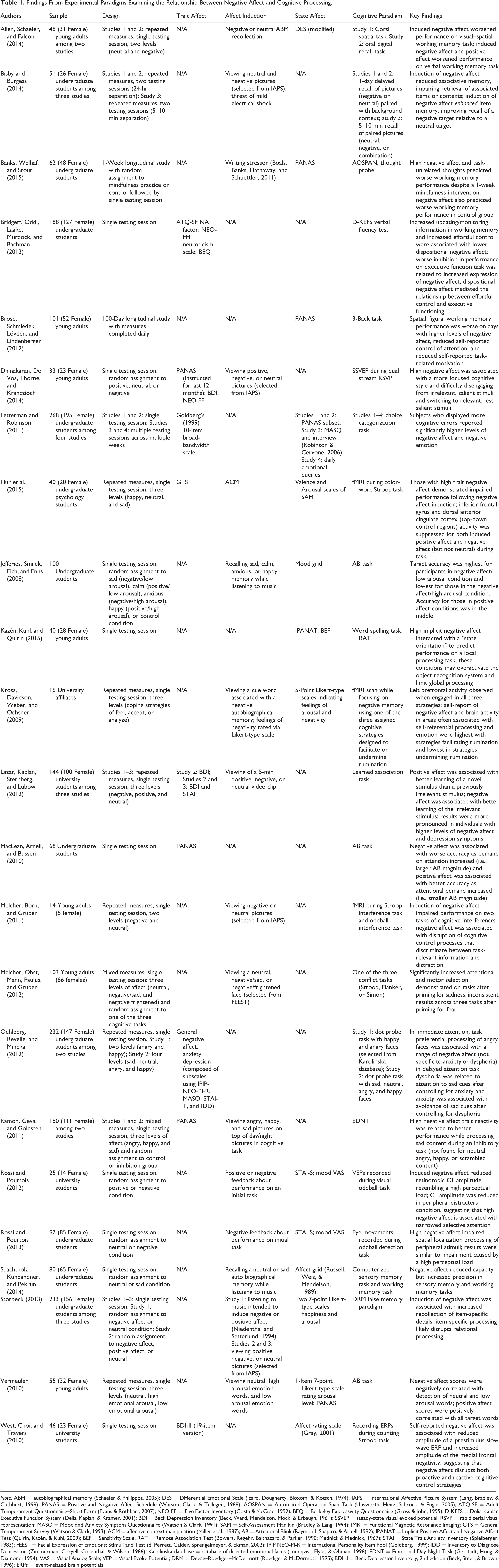
Note. ABM = autobiographical memory (Schaefer & Philippot, 2005); DES = Differential Emotional Scale (Izard, Dougherty, Bloxom, & Kotsch, 1974); IAPS = International Affective Picture System (Lang, Bradley, & Cuthbert, 1999); PANAS = Positive and Negative Affect Schedule (Watson, Clark, & Tellegen, 1988); AOSPAN = Automated Operation Span Task (Unsworth, Heitz, Schrock, & Engle, 2005); ATQ-SF = Adult Temperament Questionnaire–Short Form (Evans & Rothbart, 2007); NEO-FFI = Five Factor Inventory (Costa & McCrae, 1992); BEQ = Berkeley Expressivity Questionnaire (Gross & John, 1995); D-KEFS = Delis-Kaplan Executive Function System (Delis, Kaplan, & Kramer, 2001); BDI = Beck Depression Inventory (Beck, Ward, Mendelson, Mock, & Erbaugh, 1961); SSVEP = steady-state visual evoked potential; RSVP = rapid serial visual representation; MASQ = Mood and Anxiety Symptom Questionnaire (Watson & Clark, 1991); SAM = Self-Assessment Manikin (Bradley & Lang, 1994); fMRI = Functional Magnetic Resonance Imaging; GTS = General Temperament Survey (Watson & Clark, 1993); ACM = affective context manipulation (Miller et al., 1987); AB = Attenional Blink (Raymond, Shapiro, & Arnell, 1992); IPANAT = Implicit Positive Affect and Negative Affect Test (Quirin, Kazén, & Kuhl, 2009); BEF = Sensitivity Scale; RAT = Remote Association Test (Bowers, Regehr, Balthazard, & Parker, 1990; Mednick & Mednick, 1967); STAI = State Trait Anxiety Inventory (Spielberger, 1983); FEEST = Facial Expression of Emotions: Stimuli and Test (d, Perrett, Calder, Sprengelmeyer, & Ekman, 2002); IPIP NEO-PI-R = International Personality Item Pool (Goldberg, 1999); IDD = Inventory to Diagnose Depression (Zimmerman, Coryell, Corenthal, & Wilson, 1986); Karolinska database = database of directed emotional faces (Lundqvist, Flykt, & Öhman, 1998); EDNT = Emotional Day Night Task (Gerstadt, Hong, & Diamond, 1994); VAS = Visual Analog Scale; VEP = Visual Evoke Potential; DRM = Deese–Roediger–McDermott (Roediger & McDermott, 1995); BDI-II = Beck Depression Inventory, 2nd edition (Beck, Steer, & Brown, 1996); ERPs = event-related brain potentials.
Attention
Negative affect narrows the attentional field, induces distractibility, and reduces attentional control (Brose et al., 2012; Lazar, Kaplan, Sternberg, & Lubow, 2012; MacLean, Arnell, & Busseri, 2010). Negative affect also moderates selective attention, restricting focus to threatening stimuli (Oehlberg, Revelle, & Mineka, 2012) and magnifying the inhibitive effect of salient distracters (Vermeulen, 2010). Indeed, high negative affect has been found to impair the top-down control of attention, particularly under conditions of a negative valence (Hur et al., 2015). Individuals high in negative affect also demonstrate difficulty in disengaging their attention from irrelevant stimuli (Dhinakaran, De Vos, Thorne, & Kranczioch, 2014). Further, negative affect undermines the ability of these neural control processes to accurately determine task-relevant information from distracters in the presence of affective stimuli (Melcher, Born, & Gruber, 2011).
Consequences of restricted attention attributed to high negative affect extend to perception. Additional research has observed that high levels of negative affect have the same limiting effect on attentional resources and subsequent perceptual capacities as a large perceptual load (Rossi & Pourtois, 2012, 2013). The authors suggest that attentional resources may be restricted in individuals with high negative affect because of associated intrusive negative thoughts. A characterological focus on threatening stimuli can become reinforced by the introduction of a traumatic event, forming a resistant attentional pattern and manifesting avoidant behavioral strategies (Kunst, Bogaerts, & Winkel, 2011). A constricted focus on specific stimuli also interferes with initial information processing, likely manifesting several types of cognitive distortions (i.e., filtering, overgeneralization, and polarized thinking) and inhibiting consideration of beneficial cognitive alternatives.
However, there is evidence to suggest that specific negative affective states may influence attention in a variety of ways. These differences have been observed when negative affective states have been categorized by motivational intensity into either high (e.g., anger, disgust) or low (e.g., sadness, shame) domains. This research demonstrated that negative affective states high in motivational intensity narrow the attentional field, whereas states low in motivational intensity may broaden attention (Gable & Harmon-Jones, 2010). Similar findings have been observed for low arousal negative affect states (e.g., sadness) versus high arousal states (e.g., anxiety; Jefferies, Smilek, Eich, & Enns, 2008). As such, low motivational/arousal negative affective states may be more amenable to cognitive techniques in CBT for PTSD. On the contrary, high motivational/arousal states such as anger and disgust may be more resistant to techniques attempting to induce attentional and cognitive flexibility.
Memory
Negative affect has been found to disrupt several facets of memory. For example, Banks, Welhaf, and Srour (2015) observed that negative affect interferes with working memory and that mind wandering is associated with the highest levels of negative affect, even after a concerted mindfulness intervention. Likewise, temporal increases in negative affect have been associated with daily disruptions in working memory performance (Brose, Schmiedek, Lövdén, & Lindenberger, 2012). Additionally, the elicitation of negative affect with autobiographical memories disrupts both verbal and visuospatial working memories (Allen, Schaefer, & Falcon, 2014). Interestingly, high negative affect has been found to enhance general spatial working memory (Storbeck & Watson, 2014). However, the authors note that general spatial working memory is important for threat or error detection, and their results suggest that high negative affect relates to an attentional bias toward negative stimuli. While negative affect definitively interferes with working and sensory memory, this decrease in performance appears to be accompanied by an increase in the precision of memory (Spachtholz, Kuhbandner, & Pekrun, 2014; Storbeck, 2013). Although this trade-off surely enhances information processing in problematic situations, it may have unintended consequences for individuals with PTSD, including vivid reexperiencing of traumatic memories.
With regard to memory recall, negative affect has been found to impair associative memory but enhance recognition of a negative item or memory (Bisby & Burgess, 2014). These results suggest that negative affect strengthens the encoding of negative sensory/perceptual representations, thus increasing the resistance to new learning that may modify the existing structure. Indeed, cognitive schemas associated with a traumatic experience tend to be rather rigid and inflexible in individuals with PTSD. Considering counterfactuals about past situations may be consistently difficult for these clients, as the negative aspects of a situation are more easily recalled per the availability heuristic. Individuals reporting higher levels of negative affect also tend to report increased rumination regarding recalled autobiographical memories (Kross, Davidson, Weber, & Ochsner, 2009). Thus, individuals diagnosed with PTSD may tend to dwell extensively on their history of traumatic events, further exacerbating symptomatology and subjective distress. Giving an appropriate amount of consideration to the positive aspects of a situation may be particularly challenging for these clients during CBT.
Cognition
Individuals experiencing excessive negative affect also tend to adopt an analytical cognitive style when processing information (Kazén, Kuhl, & Quirin, 2015). Fiedler’s affect-cognition model (2001) delineates an association between negative affect and an accommodative processing style, a rigid approach that typically preserves the initial interpretation of novel information. Cognitive models of PTSD often recognize overaccommodated thoughts as problematic (Sobel, Resick, & Rabalais, 2009), which can lead to perseveration and circling thoughts. Combined with an attenuated focus, it is understandable how a systematic processing approach to overaccomodated cognitions might exacerbate rumination and increase the probability of cognitive distortions. The introduction of analytical cognitive skills to these clients may appear redundant and invalidate their emotional experience further, given their preexisting hyperfocus on their own thoughts. With the consideration of the numerous elements of cognition disrupted by negative affect, it is not surprising that negative affect is associated with a greater frequency of cognitive errors (Fetterman & Robinson, 2011). Evidence consistent with this notion demonstrates that individuals high in negative affect tend to be more introspective and dwell upon and magnify mistakes, frustrations, disappointments, and threats (Glaser, van Os, Portegijs, & Myin-Germeys, 2006). Cognitive impairments from negative affect could be complicated further in the presence of PTSD, as preexisting belief structures are often drastically altered by the experience of a traumatic event. Routine cognitive errors are likely to reinforce self-critical ruminations about control and self-efficacy that were previously intact prior to the traumatic event.
Cognitive Regulation of Emotion
The interaction between negative affect and the cognitive regulation of emotion may be a legitimate barrier to the application of CBT principles for PTSD in some individuals. Indeed, negative affect has exhibited an inhibitive influence over cognitive control in response to affective priming using threat-related stimuli (Melcher et al., 2011; Melcher, Obst, Mann, Paulus, & Gruber, 2012). Other research demonstrates that negative affect has definitively promoted cognitive inhibition, particularly in the presence of emotionally loaded conditions like sadness (Ramon, Geva, & Goldstein, 2011). Cognitive inhibition observed in individuals with high negative affect may be explained by evidence, suggesting that high levels of negative affect impair effortful control and also mediate the relationship between effortful control and executive functioning (Bridgett, Oddi, Laake, Murdock, & Bachmann, 2013).
The cognitive inhibition resulting from elevations in negative affect further limits the self-regulation of emotions. It had been previously thought that individual differences in affect influence different strategies of cognitive control, with the adoption of a reactive control strategy in the presence of chronic negative affect (Braver, Gray, & Burgess, 2007). However, an electroencephalogram (EEG) study of brain activity during a neurocognitive task that assessed proactive and reactive cognitive control revealed that negative affect weakens both types of strategies (West, Choi, & Travers, 2010). Inhibition of cognitive processes that typically regulate negative emotions as a result of high negative affect may increase the salience of emotional distress in client experiences. These clients ultimately may require practice in emotion regulation to subsequently engage in effective cognitive restructuring or exposure techniques.
Other Considerations
Worth brief mention are broad conclusions reached by other studies of negative affect and cognition that did not utilize a cognitive science paradigm to assess domains of cognition. Generally speaking, negative affect has been found to disrupt higher order cognitive processes (i.e., interpretation, judgment, executive decision-making, and reasoning; see Blanchette & Richards, 2010, for a review). Negative affect also interferes with the formulation of accurate judgments about ambiguous future events. Individuals with high negative affect tend to overestimate the likelihood of negative events in comparison to control subjects, likely contributing to behavioral avoidance (Constans, 2001; Vastfjall, Peters, & Slovic, 2008). This probability overestimation may be problematic after the occurrence of a traumatic event and may fuel resistance in CBT to discounting the possibility that such an event could ever happen again. Moreover, increases in the frequency of the personal experience of trauma certainly undermine examination of “realistic” probability. Individuals high in negative affect also exhibit the propensity to engage in emotional reasoning, which is often the basis of their judgments (Clore & Huntsinger, 2007). As noted by Blanchette and Richards (2010), persistent negative affect likely results in deviations from accurate, realistic judgments.
In addition to the cognitive prerequisites that facilitate CBT efficacy for PTSD, emotion regulation skills are assumed to be developed in adult clients to some degree. The inability of a client with PTSD to manage their own emotional experience can immediately become a barrier to the application of exposure or cognitive restructuring. Indeed, rates of treatment dropout from PE and CPT in real-world settings are alarming in comparison to results from tightly controlled randomized trials (see Najavits, 2015, for a review). Additionally, individuals with PTSD are most likely to drop out of CBT early (i.e., during the first three sessions; Kehle-Forbes, Meis, Spoont, & Polusny, 2016) or during the first portion of treatment (i.e., by midtreatment; Gutner, Gallagher, Baker, Sloan, & Resick, 2016), which includes the initial in vivo, imaginal, and written exposure phases of treatment (Schottenbauer, Glass, Arnkoff, Tendick, & Gray, 2008; Zayfert et al., 2005). Symptom exacerbation during these portions of treatment is well documented (Foa, Zoellner, Feeny, Hembree, & Alvarez-Conrad, 2002; Schottenbauer et al., 2008). A patient may become discouraged early in treatment, as negative affect is increased through initial exposure (i.e., imaginal, in vivo, or written) without any positive emotional contrast or instant relief from the intervention.
Although adults are assumed to have developed emotion regulation skills as they age and mature emotionally (Linehan, 1993), the intense emotions associated with a traumatic event can disrupt this development, especially if the trauma occurs at an early age. Affect regulation skills are often among the first skills taught to children who have experienced a traumatic event, and these skills are automatically introduced prior to the use of cognitive restructuring or exposure techniques. The rationale for focusing on affect regulation, as noted by Cohen, Mannarino, and Deblinger (2006), is that the experience of trauma often coincides with the experience of painful negative emotions. More often than not, these children fear that they will be overwhelmed by this emotional experience, which directly influences avoidance. Affective expression and modulation grants these children the ability to cope with these painful emotions without resorting to avoidant strategies. Thus, this treatment module recognizes that affect dysregulation represents a risk factor for the development of PTSD in the presence of a trauma and maintains PTSD symptoms. Over time, a portion of these children will likely develop healthy emotion regulation techniques that act as a protective factor or allow their symptoms to remit. Although those who never develop such skills may become adults who continue to struggle with complex PTSD or possibly, chronic personality disorders associated with trauma.
Granted, not all cases of PTSD begin during childhood and adolescence. However, negative affect still acts as a risk and maintenance factor for PTSD in adults. Thus, it may not be the case that all adults who have not experienced a traumatic event possess the capacity to efficiently cope with dysregulated affect if a trauma occurs. It is more likely that some adult clients will possess the same fear of painful emotions resulting from a traumatic experience, leading to avoidant strategies as well. This makes sense, as negative affect is negatively associated with an individual’s tendency to confront psychological stimuli and analyze their own thoughts, feelings, and behaviors (Tull, Jakupcak, McFadden, & Roemer, 2007). In individuals with PTSD, empirically supported forms of CBT (e.g., PE and CPT) are the obvious choice. Although with consideration of the interaction between negative affect and aspects of cognition, the implementation of affect regulation skills prior to the beginning of PE or CPT with individuals identified as having affect regulation difficulties may facilitate more favorable treatment outcomes with these interventions.
Discussion
Given the profound amount of evidence supporting negative affect as a dimensional construct underlying the pathology of PTSD, consideration of the construct by CBT approaches may yield increased treatment efficacy for some clients. A narrow focus on the fear aspect of PTSD phenomenology unintentionally limits the efficacy of CBT for the disorder. Given arguments that treatments for various disorders are too refined or too specific (Barlow, Allen, & Choate, 2004; Gros, 2014; Norton, 2008, 2012), research has sought to address this issue by treating the common element of distress among anxiety and mood disorders via transdiagnostic treatment protocols. Although some preliminary data suggest the utility of transdiagnostic approaches to treating PTSD, it is unknown the extent to which such approaches will affect the many facets associated with the disorder. Unlike any other disorder, PTSD requires the previous experience of a Criterion A traumatic event, a unique facet of the disorder that may complicate the treatment of nonspecific constructs. In addition to the affect dysregulation experienced by individuals with PTSD, fear is a predominant feature of the disorder. The application of a transdiagnostic protocol addressing negative affect to PTSD may fail to address what current CBT approaches assume to be the focus of treatment—dysregulated fear circuitry. So, how can CBT approaches for PTSD reconcile acknowledging both dysregulated fear circuitry and affect to improve treatment efficacy? The implications of this question span the entire treatment process, beginning with research methodology.
Changes in the conceptualization of psychopathology require modifications of research methodology. With regard to the greater weight given to the dimensional constructs like negative affect underlying mental illness, research strategies must reflect this changing agenda to inform theory and practice. Adherence to traditional methodology in the presence of such changes can inhibit the progression of our understanding. Thus, treatment trials of CBT should be designed in such a way that gives credence to these constructs. For example, a frequent criticism of randomized controlled CBT trials is that exclusionary criteria for the disorder of interest are too strict. This is often done to create a homogenous experimental group that theoretically isolates the target symptoms to maximize the internal validity of results. This has traditionally been enacted in efficacy trials of CBT for PTSD (e.g., Foa, Rothbaum, Riggs, & Murdock, 1991; Monson et al., 2006; Resick, Nishith, Weaver, Astin, & Feuer, 2002; Rothbaum, Astin, & Marsteller, 2005), as participants are often excluded for comorbid medical and psychological conditions, the use of concomitant medications, suicidal ideation, history of severe mental illness, and mild or severe levels of symptomatology.
Only a limited understanding of negative affect can be derived from this treatment context, as overt indicators of negative affect (e.g., comorbidity, symptom severity) have been excluded from the experimental group. Further, because the treatment group is too refined, effective treatment mechanisms for this particular population may not generalize to clinical settings, where comorbidity and severe symptomatology are the rule rather than the exception. Moreover, restrictive inclusion criteria limit the examination of the full spectrum of dimensional constructs. Future treatment outcome research should focus on effectiveness trials more broadly to further understand the limitations of CBT for PTSD. Additionally, given that prior efficacy trials of CBT for PTSD have generally not included a metric of negative affect, both future efficacy and effectiveness trials in populations with PTSD should seek to do so to further understand how negative affect influences treatment application. Trauma-related variables that may relate to different affective presentations like trauma type, number of traumas, frequency, and chronicity variables should also be accounted for in these trials. Taken together, fewer exclusion criteria in treatment trials of CBT would aid in broadening our understanding of negative affect in PTSD.
Another important modification that would advance knowledge of the role of affect in trials of CBT for PTSD is the inclusion of valid and accurate measurement of negative affect through multitrait multimethod approaches. Fortunately, robust construct-specific measures of negative affect are available (e.g., Positive and Negative Affect Schedule–Expanded Form; Watson & Clark, 1999). The incorporation of affect-specific measures into the assessment and treatment process can provide diagnostic clarification regarding symptom severity and the presence of comorbid conditions, as negative affect serves as an indicator of both. This assessment can also inform intervention strategies, since not all clients with PTSD will be experiencing chronic negative affect. For example, there is research supporting a computer-based assessment of anxiety and depressive symptomatology, including negative affect, to direct initial treatment considerations (Cukrowicz, Smith, Hohmeister, & Joiner, 2009). Thus, the consideration of negative affect within treatment can increase the compatibility between clients and selected treatments. In the absence of chronic negative affect, standard CBT protocols may be very effective for clients, as they may possess affect regulation skills that allow them to participate in exposure and cognitive restructuring.
When excessive negative affect is present, treatment providers should also consider the incorporation of affective modules at the initial stages of CBT for PTSD. Indeed, it could be argued that both CPT and PE implicitly encourage the identification and regulation of affect through current treatment components (i.e., noting the discrepancy between past and current emotions when rewriting the trauma narrative in CPT, processing emotional responses following imaginal exposure in PE). However, this focus on managing affect takes place in the context of confronting a traumatic event. Some individuals may require practice in affect regulation prior to approaching their trauma, as they may fear the extreme emotional reaction from doing so. Such modules have already been validated and included in trauma-focused CBT for children and adolescents with PTSD (Cohen & Mannarino, 1998; Cohen, Mannarino, & Rogal, 2001). The research on the utility of affective modules in adult populations is limited but promising. Cloitre, Koenen, Cohen, and Han (2002) examined the efficacy of the implementation of skills training in affect and interpersonal regulation (STAIR) prior to exposure treatment in a group of 58 women with PTSD related to childhood abuse. STAIR, a cognitive–behavioral treatment derived from dialectical behavioral therapy (DBT; Linehan, 1993), was provided to clients during the initial 8 weeks of treatment. Their results indicate that the STAIR module definitively strengthens the therapeutic alliance, decreases negative affect, and predicts the successful application of PE (Cloitre, Koenen, Cohen, & Han, 2002).
The capacity to regulate negative affect was also found to mediate the relationship between the gains in therapeutic alliance established by interpersonal skills training and the effectiveness of exposure in reducing PTSD symptoms (Cloitre, Miranda, Stovall-McClough, & Han, 2005). The influence that negative affect exerts over the therapeutic alliance is not surprising, as the consideration of negative affect is a valuable way to validate client distress (Markowitz & Milrod, 2011). Likewise, preliminary findings suggest that the initial application of DBT techniques in a group of women with PTSD (and without a diagnosis of personality disorder) related to childhood sexual abuse enhances the effectiveness of CPT (House, 2006). Wolfsdorf and Zlotnick (2001) found support for the treatment of women with PTSD related to childhood sexual abuse using affective modules in a group setting. Although this study did not use a DBT module like previously cited studies to stabilize affect, the researchers mention the effectiveness of other potentially useful affect regulation skills including mindfulness and crisis planning. Indeed, mindfulness has been a technique that has shown promise in reducing negative affect by increasing tolerance to distorted cognitions (Gilbert & Christopher, 2010; Shallcross, Troy, Boland, & Mauss, 2010). It is worth noting, however, that research on this topic has primarily been conducted on female survivors of childhood sexual abuse. This limitation can be addressed with future research in more diverse trauma populations.
The effectiveness of affective modules in addressing other disorders of emotion dysregulation, like borderline personality disorder (BPD), lends additional support for the incorporation of affective modules into CBT protocols for PTSD. PTSD and BPD are often comorbid and individuals with BPD frequently have extensive histories of trauma (Pagura et al., 2010). Moreover, it has been postulated that affect dysregulation is a key component in maintaining both disorders (Marshall-Berenz, Morrison, Schumacher, & Coffey, 2011). DBT (Linehan, 1993) is considered the first-line treatment approach for BPD and has been validated on multiple populations. Affective modules from the DBT protocol are likely to demonstrate a similar effectiveness on extreme manifestations of emotion dysregulation sometimes experienced by individuals with PTSD. Other affective techniques, including individual positive memory imagery and individual soothing imagery, have exhibited efficacy in stabilizing affect in individuals with BPD (Jacob et al., 2011). It may be worthwhile to examine these strategies in the treatment of PTSD as well.
Any decision to alter a manualized protocol that has demonstrated efficacy in treating a disorder must be ethically sound. The consideration of negative affect at each stage of the treatment process has the potential to enhance the ability of clinicians to provide ethical care. The inclusion of affective modules in CBT protocols for PTSD will potentially extend the length of treatment depending on the amount of time initially allocated to affect dysregulation. Although the extension of a CBT protocol is debatable, given the focus on providing brief, effective psychotherapy, Korner (1995) suggests that attending to positive and negative affect in session is likely to reduce destructive treatment outcomes. This approach is especially salient when treating PTSD, as current forms of CBT may exacerbate symptomatology in some clients, contributing to client dropout and nonresponse rates. Responding to negative affect during CBT for PTSD may be an avenue to curtail possible negative treatment outcomes.
Summary and Conclusions
Despite mounting evidence in both research and clinical settings supporting negative affect as integral to the conceptualization of PTSD, the consideration of negative affect within CBT for PTSD is qualified with a degree of uncertainty. PTSD is a complex phenomenon, and not all of the connections between the multiple domains of the disorder and negative affect are well understood. However, given the limitations of a fear-circuitry model of treatment, the role of negative affect as a risk and maintenance factor for PTSD, and the potential disruptions of psychotherapy due to the experience of negative affect, affect dysregulation is worth further consideration in treatment contexts. This consideration should not result in the denouncement of assumptions based on fear circuitry, as current forms of CBT for PTSD have proven their efficacy under multiple circumstances. Rather, fear assumptions should be examined in conjunction with affect dysregulation to expand upon established forms of treatment. Further consideration of negative affect in PTSD treatment contexts is likely to yield an improved treatment-client fit above and beyond that of extant manualized cognitive and behavioral treatments. The addition of affective modules exhibits the potential to enhance the efficacy of PTSD treatments for a portion of previous treatment nonresponders.
The reclassification of PTSD as a trauma- and stress-related disorder and the inclusion of negative affect within a distinct symptom cluster in the DSM-5 (i.e., negative alterations in mood and cognition) warrant the attention of researchers and clinicians alike. The current conceptualization requires the adaptation of treatment models to account for the incorporation of negative affect. Future directions for research on this topic include the construction of PTSD self-report and diagnostic measures that account for the affect symptom cluster, the examination of treatment techniques and strategies that address the symptoms associated with this cluster, and the evaluation of such measures and treatment modules on the variants of PTSD in multiple diverse populations.
Implications for Practitioners and Researchers
Practitioners
When possible, use evidence-based assessment tools to evaluate presence of excessive negative affect at baseline and throughout treatment When chronic negative affect is suspected, consider incorporating affective modules into beginning of treatment to increase self-regulation and improve therapeutic alliance
Researchers
Gain a better understanding of negative affect in treatment trials by: Including more heterogeneous samples, as those high in negative affect are likely to have comorbidities and severe symptoms, which are typically excluded in experimental trials Incorporating affective-specific measures into the assessment and treatment process
Footnotes
Declaration of Conflicting Interests
The author(s) declared no potential conflicts of interest with respect to the research, authorship, and/or publication of this article.
Funding
The author(s) received no financial support for the research, authorship, and/or publication of this article.