






Abstract
The aim of the systematic review described in this article was to determine the outcome of child maltreatment in long-term childcare and the scope of the evidence base in this area. Searches of 10 databases were conducted. Forty-nine documents describing 21 primary studies and 25 secondary studies were selected for review. Searches, study selection, data extraction, and study quality assessments were independently conducted by two researchers, with a high degree of interrater reliability. Participants in the 21 primary studies included 3,856 abuse survivors and 1,577 nonabused controls. In six primary studies, survivors were under 18 years, and participants in the remaining primary studies were adults with a mean age of 54 years. Reviewed studies were conducted in the United Kingdom, the United States, Finland, Romania, Tanzania, Canada, Ireland, Australia, the Netherlands, Germany, Austria, and Switzerland. Participants were abused in religious and nonreligious residential care centers and foster care. There were significant associations between the experience of child abuse in long-term care and adjustment across the life span in the domains of mental health, physical health, and psychosocial adjustment. Evidence-based trauma-focused treatment should be offered to child abuse survivors. Future research in this area should prioritize longitudinal studies.
This article is a review of studies of outcomes for survivors of child abuse which occurred in long-term care. It is the final paper in a series of three on outcomes of child maltreatment. The first paper in the series is a review of review papers on the outcome of child abuse in noninstitutional contexts (Carr, Duff, & Craddock, 2020a). The second paper is a review of review papers on the outcome of severe structural neglect in underresourced institutions (Carr, Duff, & Craddock, 2020b).
Reviews of international research and inquiries consistently indicate that child maltreatment occurs in a wide range of long-term childcare settings and that historically it has been denied or underreported (Biehal, 2014; Gallagher, 1999; Sen, Kendrick, Milligan, & Hawthorn, 2008; Sherr, Roberts, & Gandhi, 2017; Skold, 2013; Uliando & Mellor, 2012). There is considerable variability in estimates of the extent of this problem due to variations in rates of child maltreatment across settings and methodological differences in sampling and case identification strategies. In a systematic review up to 2009, involving 18 U.K., U.S., and Australian epidemiological studies, Biehal (2014) found that the incidence and prevalence of child maltreatment in foster care ranged from 0.27% to 2% and 3% to 19%, respectively. In a systematic review of the international literature on maltreatment in large institutional settings such as orphanages in developing and developed countries, Sherr, Roberts, and Gandhi (2017) found that rates of maltreatment including physical and sexual abuse ranged from 13% to 93%. From the foregoing, it is clear that internationally, maltreatment of children in care is a problem of significant proportions.
The causes of child maltreatment in long-term care are complex and involve a wide range of factors (Nunno, 1997; Smith & Freyd, 2014; Wolfe, Jaffe, Jetté, & Poisson, 2003). Multifactorial models of child maltreatment in long-term care propose that risk and protective factors in multiple domains contribute to child abuse and neglect. They include factors associated with the perpetrator; the young person in care; the type of care setting (size, power structure, and staff oversight); out-of-home carers; peers in care, community, and childcare center–based child protection systems; the young person’s birth family; the quality of relationships between the young person and members of their social network; and the wider social, economic, educational, and cultural environment systems within which the young person lives.
Survivors of noninstitutional child abuse and survivors of severe structural neglect which occurred in underresourced orphanages experience long-lasting detrimental outcomes on a wide range of variables in the domains of physical and mental health and psychosocial adjustment (Carr, Duff, & Craddock, 2020a, 2020b). Maltreatment of children in long-term care is also associated with negative outcomes (e.g., Carr et al., 2010), although the scope of the current evidence base for this population is currently unclear. The aim of the systematic review described in this article was to establish the scope of this evidence base and determine the outcomes of child maltreatment in long-term childcare.
Method
Guidelines for conducing systemic reviews were followed in developing a protocol for this review (Moher, Liberati, Tetzlaff, Altman, & The PRISMA Group, 2009). The protocol specified the aim, search terms, databases, and websites to be searched; study selection criteria; supplementary manual search strategies; data extraction system; study quality assessment procedures; and data synthesis methods. The review was registered with PROSPERO at the Centre for Reviews and Dissemination, University of York (https://www.crd.york.ac.uk/PROSPERO/registerReview.php#index.php). The registration number of the review is CRD42017065088.
Search Terms
Record titles, abstracts, and key words were searched in the electronic databases listed in the next section. The terms child maltreatment or child abuse or synonyms were combined with the term care or synonyms.
Databases and Websites
The following databases were searched: PsycINFO, Academic Search Complete, EMBASE, Sociological Abstracts, Medline, Cumulative Index to Nursing and Allied Health Literature, Web of Science, Applied Social Sciences Index and Abstracts, Education Resources Information Centre, and Cochrane Library. In addition, the following websites were searched for gray literature: http://www.greylit.org, http://www.opengrey.eu, http://www.scopus.com, http://www. http://scholar.google.com, http://www.google.com, and the University College Dublin library database.
Inclusion and Exclusion Criteria
Compared with research on child abuse perpetrated in the community (Carr, Duff, & Craddock, 2020a) or severe structural neglect of children in orphanages (Carr, Duff, & Craddock, 2020b), the scientific literature on the effects of child abuse perpetrated on children in long-term care is at an early stage of development. There are relatively few studies on the effects of child abuse perpetrated on children in care, and many have significant design limitations. Because of this, relatively liberal inclusion and exclusion criteria were used in this literature search. Quantitative and qualitative studies of the effects of child maltreatment on physical and mental health and social adjustment across the life span, for individuals who as children were in long-term care, were included. Journal articles, book chapters, books, conference proceedings, dissertations, and gray literature were included. Multiple publications of the same study where the same data were analyzed in different ways were also included. Discursive papers including nonsystematic narrative reviews, theoretical papers, editorials, and letters were excluded. The search was not confined to English-language publications.
Search Process
Records identified in electronic searches were downloaded to EndNote (http://endnote.com). Covidence (https://www.covidence.org/) was used for record screening, data extraction, and quality assessment. In addition to electronic searches, a supplementary manual search was conducted. Bibliographies of papers and tables of contents of relevant journals were searched. Established research teams in the field, who had published more than three recent papers, were also contacted.
Through electronic and manual searches, 3,077 separate records were identified after duplicates were removed. When the titles and abstracts of these were screened, 115 relevant papers were downloaded for full-text screening. A final set of 49 documents which met inclusion and exclusion criteria were selected for review. These 49 documents described 46 studies, of which 21 were primary studies and 25 were secondary studies. A flow diagram of the search is given in Figure 1.
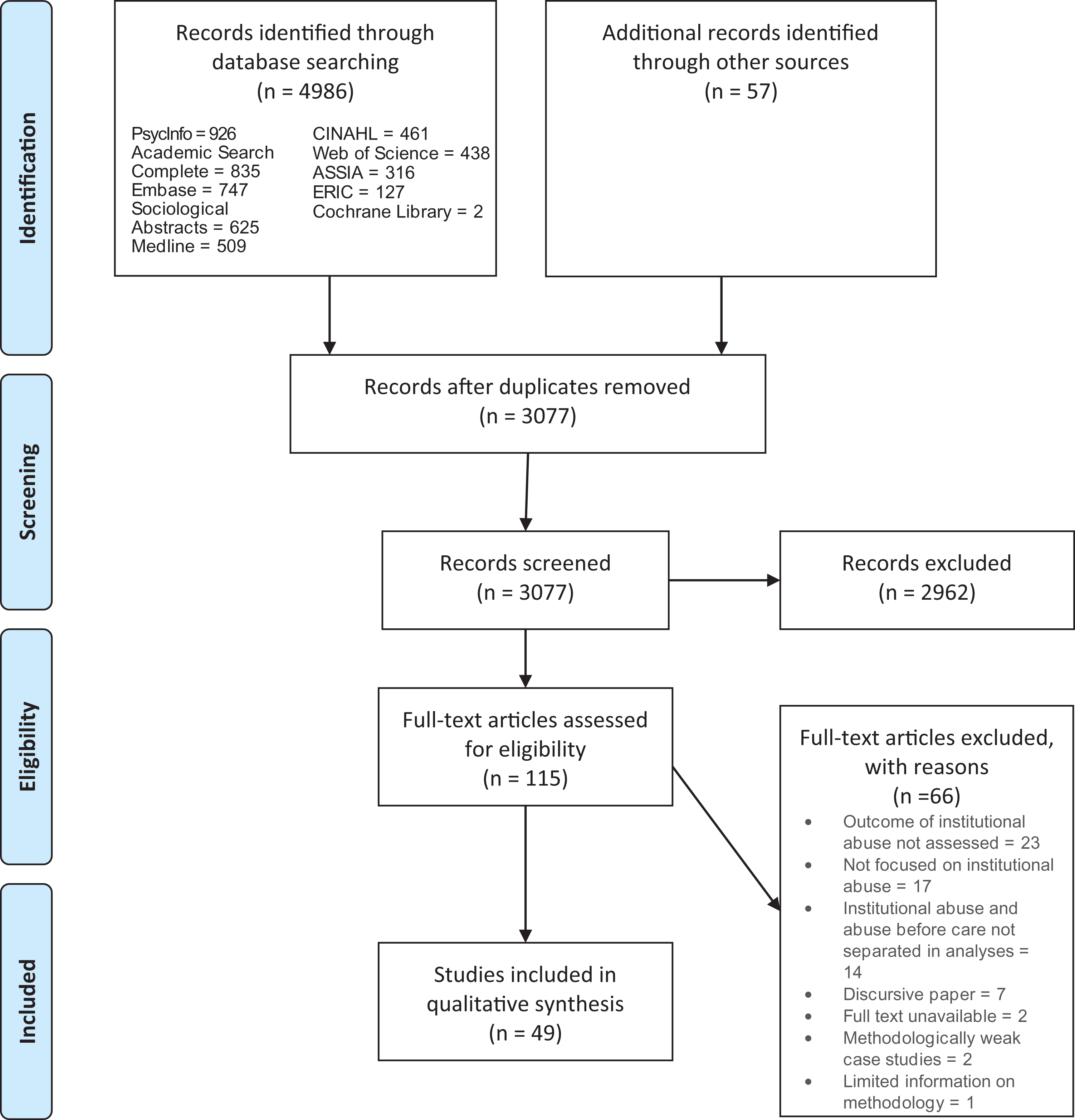
Preffered reporting items for systematic reviews and meta-analyses (PRISMA) flow diagram of literature search on outcomes of child abuse in long-term care.
There were six papers, published between 1996 and 2015, describing studies in which respondents were children or adolescents. One of these was from the United States (Benedict, 1996), one was from the United Kingdom (Hobbs, Hobbs, & Wynne, 1999), one was from Finland (Ellonen & Pösö, 2011), one was from Romania (Gavrilovici & Groza, 2007), and two were from Tanzania (Hermenau, Eggert, Landolt, & Hecker, 2015; Hermenau, Hecker, Elbert, & Ruf-Leuschner, 2014). The remaining 43 documents described studies of adult survivors of institutional abuse. Nine, published between 1999 and 2010, were from Canada. Eight of these were produced by the same research team (Boucher, Paré, Perry, Sigal, & Marie-Claude Ouimet, 2008; Paré, Sigal, Perry, Boucher, & Ouimet, 2010; Perry, Sigal, Boucher, Paré, & Ouimet, 2005; Perry, Sigal, Boucher, Paré, Ouimet, Normand, et al., 2005; Perry, Sigal, Boucher, & Paré, 2006; Sigal, Rossignol, Ouimet, Boucher, & Paré, 2002; Sigal, Perry, Rossignol, & Ouimet, 2003; Sigal, Rossignol, & Perry, 1999) and one by another research group (Wolfe, Francis, & Straatman, 2006). Six documents, published between 2009 and 2010, which included a major report (Carr, 2009) and a series of five related papers, were from Ireland (Carr et al., 2009, 2010; Fitzpatrick et al., 2010; Flanagan et al., 2009; Flanagan-Howard et al., 2009). There were three papers, published between 2011 and 2015, from the United States (Jackson, O’Brien, & Pecora, 2011; Morton, 2015; Salazar, Keller, & Courtney, 2011); two papers, published in 2012, from Australia (Bode, & Goldman, 2012; Goldman, & Bode, 2012); one report produced in 2013 from the Netherlands (Deetman et al., 2013); and one German study published in 2014 (Spröber et al., 2014). There was a series of 12 related papers by the same research group, published between 2014 and 2017, from Austria (Glück, Knefel, & Lueger-Schuster, 2017; Knefel, Garvert, Cloitre, & Lueger-Schuster, 2015; Kantor, Knefel, & Lueger-Schuster, 2017; Knefel & Lueger-Schuster, 2013; Knefel, Tran, & Lueger-Schuster, 2016; Lueger-Schuster et al., 2015, 2014, 2018; Lueger-Schuster, Weindl, et al., 2013, 2014; Weindl, 2017; Weindl & Lueger-Schuster, 2016). Finally, there was a series of nine related papers by a single research group, published between 2013 and 2016, from Switzerland (Burri, Maercker, Krammer, & Simmen-Janevska, 2013; Krammer, Kleim, Simmen-Janevska, & Maercker, 2016; Küffer, O’Donovan, Burri, & Maercker, 2016; Küffer, Thoma, & Maercker, 2016; Kuhlman, Maercker, Bachem, Simmen, & Burri, 2013; Maercker, Hilpert, & Burri, 2016; Rechsteiner, Burri, & Maercker, 2015; Simmen-Janevsk, Forstmeier, Krammer, & Maercker, 2015; Simmen-Janevsk, Horn, Krammer, & Maercker, 2014).
Series of Papers
Papers were grouped into series that analyzed the same or related data sets. There were series of papers from Canada, Ireland, Austria, and Switzerland. The findings from each of these series of related papers will be considered in the results section.
In the series of papers from Canada, two primary studies are described in Sigal, Rossignol, and Perry (1999) and Sigal, Rossignol, Ouimet, Boucher, and Paré (2002). The remaining papers describe analyses (Boucher et al., 2008; Perry, Sigal, Boucher, Paré, & Ouimet, 2005; Perry, Sigal, Boucher, Paré, Ouimet, Normand, et al., 2005, 2006; Sigal et al., 2003) or case studies (Paré et al., 2010; Perry et al., 2006) based on the data set in the primary study by Sigal et al. (2002). The paper by Boucher, Paré, Perry, Sigal, and Marie-Claude Ouimet (2008), which is in French, summarizes results presented in English papers by Perry, Sigal, Boucher, Paré, and Ouimet (2005), Perry, Sigal, Boucher, Paré, Ouimet, Normand, et al. (2005), and Sigal, Perry, Rossignol, and Ouimet (2003). The paper by Paré, Sigal, Perry, Boucher, and Ouimet (2010), which is in French, presents two of the seven case studies in the English paper by Perry, Sigal, Boucher, and Paré (2006).
The papers from Ireland (Carr et al., 2009, 2010; Fitzpatrick et al., 2010; Flanagan et al., 2009; Flanagan-Howard et al., 2009) describe analyses of the data set in a primary report (Carr, 2009).
The papers from Austria (Glück et al., 2017; Kantor et al., 2017; Knefel & Lueger-Schuster, 2013; Knefel et al., 2015, 2016; Lueger-Schuster, 2015; Lueger-Schuster et al., 2014, 2018; Lueger-Schuster, Weindl, et al., 2013, 2014; Weindl, 2017; Weindl & Lueger-Schuster, 2016) are all based on data from three primary studies (Lueger-Schuster et al., 2013, 2018; Lueger-Schuster, Kantor, et al., 2014).
The papers from Switzerland (Burri et al., 2013; Krammer et al., 2016; Küffer, O’Donovan, et al., 2016; Küffer, Thoma, et al., 2016; Maercker et al., 2016; Rechsteiner et al., 2015; Simmen-Janevsk et al., 2014, 2015) are based on data from a single primary study (Kuhlman et al., 2013).
Translations
Six papers were translated from German to English. These included five papers from Austria (Glück et al., 2017; Kantor et al., 2017; Lueger-Schuster et al., 2013; Weindl, 2017; Weindl & Lueger-Schuster, 2016) and one paper from Switzerland (Simmen-Janevska, Horn, Krammer, & Maercker, 2014). Two papers were translated from French to English (Boucher et al., 2008; Paré et al., 2010). The papers were translated from German or French to English by a translator for whom English was their first language and who was fluent in German and French.
Study Quality Assessment
The quality of selected quantitative studies was assessed with an adapted version of the Risk of Bias Tool for Prevalence Studies (RoB; Hoya et al., 2012). For qualitative papers, study quality was assessed with the National Institute for Clinical Excellence Quality Appraisal Checklist for qualitative studies (NICE-QAC; NICE, 2012). Data on the quality of quantitative and qualitative studies are given in Table 1 and 2, respectively.
Assessment of Study Quality and Risk of Bias in Quantitative Studies of the Physical and Mental Health and Psychosocial Outcomes for Survivors of Child Abuse in Long-Term Care.

Note. *This * indicates that items 1, 3, 4, 5, and 7 are from the risk of bias scale developed by Hoya et al. (2012). Items 2, 6, 8, 9, 10, and 11 were developed for this review.
a Participants were those described in Sigal et al. (2002). Sigal et al. (2002) and (2003) are entered as a single study because the report by Sigal et al. (2002) and journal article by Sigal et al. (2003) each present the principal findings of a single study. bParticipants were those described in Carr (2009). Carr (2009) and Carr et al. (2010) are entered as a single study because the report by Carr (2009) and journal article by Carr et al. (2010) each present the principal findings of a single study. cParticipants were subsamples of those in Lueger-Schuster, Kantor, et al. (2014). dParticipants were the same as the survivor group in Lueger-Schuster et al. (2018). eParticipants were those in Lueger-Schuster, Kantor et al. (2014) combined with those in Lueger-Schuster et al. (2013). fAbuse survivor participants were subsamples of those in Kuhlman et al. (2013).
Assessment of Study Quality and Risk of Bias in Qualitative Studies of the Physical and Mental Health and Psychosocial Outcomes for Survivors of Child Abuse in Long-Term Care.

Note. All items are from NICE (2012) Quality appraisal checklist.
a Paré et al. (2010) is omitted from this table because the two case studies in that paper, and a subset of the seven case studies in Perry et al. (2006).
Quantitative studies
The 40 quantitative studies had five main limitations. First, studies were predominantly based on self-selected convenience samples, which were not representative of the general population of survivors of child abuse in care. Participants in these studies were probably better adjusted than abuse survivors who did not volunteer to participate. Second, participants in 90% of samples had probably or definitely experienced child abuse or neglect before entering care. It was therefore not possible to accurately determine the extent to which their adjustment problems were due primarily to institutional abuse. Third, the cross-sectional design of almost all studies meant that associations which were found between indices of abuse and adjustment were correlational rather than causal. Abuse may have caused adjustment problems or may have predated them, or survivors with adjustment problems may have inadvertently selectively overreported recollections of abuse. Fourth, there was a control group in only 28% of studies. It was therefore not possible to say with accuracy, the extent to which the adjustment problems shown by participants were worse than those who were not abused in care. However, in some studies, psychometric assessment instruments, for which there were general population norms, circumvented this difficulty. Fifth, in 35% of studies, there were financial incentives for overreporting child abuse or adult adjustment problems because results of assessments of child abuse or adjustment problems were used for redress or compensation purposes. The group of quantitative studies had a number of design features that allow a degree of confidence to be placed in their results. They involved relatively large samples, with 65% having samples greater than 100. In over 90% of studies, data were collected directly from participants, the same mode of data collection was used for all participants, an acceptable case definition was used, reliable and valid assessment instruments were used, and data were analyzed using appropriate methods. The strengths and weaknesses of the group of quantitative studies allow considerable confidence to be placed in the associations found between indices of childhood institutional abuse and adjustment. However, they limit the certainty with which causal statements may be made about the effects of institutional abuse on adult adjustment. They also limit the confidence with which statements may be made about the generalizability of the findings to all survivors of abuse in long-term residential childcare.
Qualitative studies
The six qualitative studies had two main limitations, both concerning reliability. In all studies, only one method of data collection was used, so triangulation was not possible. In all studies, transcripts were coded or rated by a single person, so intercoder or interrater reliability was not determined. The group of qualitative studies had a number of features that allow considerable of confidence to be placed in their results. In all studies, a qualitative approach was appropriate. There was a clear research objective. Data collection was well conducted, and data were rich. Study design and data analysis were rigorous. The role of the researcher, the research context, and ethical issues were clearly described. Study findings were convincing and relevant to study objectives. Conclusions were supported by the results of data analysis.
Interrater Agreement
Two of members of the research team independently conducted searches, study selection, data extraction, and study quality assessments. Disagreements were resolved by discussion. Percentage agreement and Krippendorff’s α (Hayes & Krippendorff, 2007) were used to determine interrater agreement and reliability. There was a high level of interrater agreement. For both screening records and full texts, there was a 95% agreement rate. For data extraction, agreement rates ranged from 79% to 100% and Krippendorff’s α values ranged from 0.66 to 1.00. Quantitative research paper quality assessment agreement rates ranged from 98% to 100% for RoB items and the Krippendorff’s α value for the 11-item scale was 0.99. Qualitative research paper quality assessment agreement was 100% for NICE-QAC items and the Krippendorff’s α for the 14-item scale was 1.
Results
Study Design Features and Participants’ Demographic Characteristics
Study design features and participants’ demographic characteristics are given in Table 3. The 46 studies were published between 1996 and 2017. Data collection in these studies occurred between 1984 and 2016. There were 16 single cohort, cross-sectional studies; 10 studies of subgroups or process studies within a single cohort cross-sectional study; 12 controlled cross-sectional studies, 1 of which included a qualitative analysis of a subgroup of cases within the same paper; 5 other qualitative studies; and 2 longitudinal single cohort studies. There were 21 primary studies containing nonoverlapping data sets (Benedict, 1996; Bode & Goldman, 2012; Carr, 2009; Deetman et al., 2013; Ellonen & Pösö, 2011; Gavrilovici & Groza, 2007; Goldman & Bode, 2012; Hermenau et al., 2015, 2014; Hobbs et al., 1999; Jackson et al., 2011; Kuhlman et al., 2013; Lueger-Schuster et al., 2013, 2018, 2014; Morton, 2015; Salazar et al., 2011; Sigal et al., 1999, 2002; Spröber et al., 2014; Wolfe et al., 2006). Within these 21 primary studies, there were 3,856 survivors of abuse in care and 1,577 nonabused cases in control groups. There were six primary studies of young people under 18 years and 15 primary studies of adults over 18 years. In the six primary studies of young people, their mean age was 11, with a range from 1 to 18 years. The mean number of females in these studies was 52%, with a range of 46–61%. In the 15 primary studies of adults, their mean age was 54, with a range from 12 to 101 years. The mean number of females in these studies was 39%, with a range of 0–100%.
Study Design Features and Participants’ Demographic Characteristics in Studies of the Physical and Mental Health and Psychosocial Outcomes for Survivors of Child Abuse in Long-Term Care.

Note. The quality of quantitative studies and risk of bias was assessed with an adapted version of Hoya et al.’s (2012) scale. The items are listed in table 4.1. The quality of qualitative studies was assessed with the NICE (2012) Quality appraisal checklist. The items are listed in table 4.2. SC = single cohort cross-sectional study; GP = subgroups or process study within a single cohort cross-sectional study; CC = controlled cross-sectional study; LG = longitudinal single cohort study; QL = qualitative study; SR = self-report data were available for these cases; OS = these cases were offspring of parents from whom data were also collected; + = survivors were over 40 years; — = data were not available.
a Participants were those described in Sigal et al. (2002) or a subsample of them. Sigal et al. (2002, 2003) are entered as a single study because the report by Sigal et al. (2002) and journal article by Sigal et al. (2003) each present the principal findings of a single study. bParticipants were those described in Carr (2009). Carr (2009) and Carr et al. (2010) are entered as a single study because the report by Carr (2009) and journal article by Carr et al. (2010) each present the principal findings of a single study. cParticipants were subsamples of those in Lueger-Schuster, Kantor, et al. (2014). dParticipants were the same as the survivor group in Lueger-Schuster et al. (2018). eParticipants those in Lueger-Schuster, Kantor, et al. (2014) combined with those in Lueger-Schuster et al. (2013). fAbuse survivor participants were subsamples of those in Kuhlman et al. (2013).
Childcare Experiences
Survivors were abused within a range of different types of settings including foster care, childcare centers, orphanages, reformatories, borstals, young offender institutions, secure units, boarding schools, industrial or farming facilities, long stay health-care facilities, and group hostels or homes. Data on childcare experiences of participants in the 19 primary studies were available. To avoid duplication, data from secondary studies are omitted from the following summary of these childcare experiences. In nine studies, survivors were mainly abused within Catholic institutions, with a range from 51% to 100% (Bode & Goldman, 2012; Carr, 2009; Deetman et al., 2013; Goldman, & Bode, 2012; Lueger-Schuster et al., 2014; Sigal et al., 1999, 2002; Spröber et al., 2014; Wolfe et al., 2006). In one of these, 18% of cases were abused by Catholic clergy outside institutions in parishes or churches (Lueger-Schuster et al., 2014). Seven studies included survivors who were mainly abused within state foster care with a range from 10% to 100% (Benedict, 1996; Hobbs et al., 1999; Jackson et al., 2011; Kuhlman et al., 2013; Lueger-Schuster, et al., 2018; Morton, 2015; Salazar et al., 2011). In one of these studies, a small number of survivors (16%) were abused within nonreligious residential institutions (Hobbs et al., 1999). In two studies, survivors were mainly abused within nonreligious institutions (Gavrilovici & Groza, 2007; Lueger-Schuster et al., 2013). There was one comparative study in which survivors had been sexually abused in Catholic (38%), Protestant (12%), and nonreligious (49%) residential institutions (Spröber et al., 2014). Age-related data on residential care experiences were given in seven studies (Benedict, 1996; Carr, 2009; Gavrilovici & Groza, 2007; Hermenau et al., 2014; Kuhlman et al., 2013; Sigal et al., 1999, 2002). The average age when participants entered residential care was 5 years, with a range from less than 1 year to 16 years. The average duration of their time in care was 9 years, with a range from 0 to 26 years.
Child Abuse Experiences
Detailed data were available on child abuse experiences of participants in 19 of the 21 primary studies (Benedict, 1996; Bode, & Goldman, 2012; Carr, 2009; Deetman et al., 2013; Ellonen & Pösö, 2011; Gavrilovici & Groza, 2007; Goldman, & Bode, 2012; Hobbs et al., 1999; Jackson et al., 2011; Kuhlman et al., 2013; Lueger-Schuster et al., 2013, 2018, 2014; Morton, 2015; Salazar et al., 2011; Sigal et al., 1999, 2002; Spröber et al., 2014; Wolfe et al., 2006). To avoid duplication of results, data from secondary studies are not given in the following summary. Ten studies reported rates of intrafamilial maltreatment prior to entering residential care and these ranged from 0% to 80%, with a mean of 38%. In 13 studies, rates of unspecified child abuse in long-term residential care were given. These ranged from 39% to 100% with a mean of 88%. Fifteen studies reported rates of sexual abuse in residential care and these ranged from 15% to 100%, with a mean of 67%. Thirteen studies reported rates of physical abuse in residential care and these ranged from 14% to 100%, with a mean of 63%. Eight studies reported rates of emotional abuse in residential care and these ranged from 16% to 99%, with a mean of 71%.
Mental Health Outcomes
Detailed data were available on mental health outcomes in 16 primary studies (Benedict, 1996; Carr, 2009; Deetman et al., 2013; Ellonen & Pösö, 2011; Hermenau et al., 2015, 2014; Hobbs et al., 1999; Kuhlman et al., 2013; Lueger-Schuster et al., 2013, 2018, 2014; Sigal et al., 1999, 2002; Spröber et al., 2014; Wolfe et al., 2006) and three secondary studies (Burri et al., 2013; Knefel et al., 2013, 2016), which supplied additional information not contained in primary studies.
General mental health
Across 10 studies where rates of general mental health were assessed, between 26% and 88% of participants had significant current mental health problems or had experienced such problems at some point during their lifetime. The average rate of mental health problems across these 10 studies was 67%. In calculating this average, lifetime rates of diagnoses were used where these were reported. Otherwise, current rates of diagnoses were used. In this context, mental health problems indicate that participants met the diagnostic criteria for one or more psychiatric disorders, had significant psychological problems on a psychometric instrument that assessed some aspect of mental health, or were judged to have mental health difficulties by a health professional in a clinical or helpline interview. The rate of mental health problems at any point in the lifetime assessed with the Structured Clinical Interview for Axis I or II Disorders of Diagnostic and Statistical Manual of Mental Disorders (DSM-IV; SCID I and II; First, Spitzer, Gibbon, & Williams, 1996, 1997; Wittchen, Wunderlich, Gruschwitz, & Zaudig, 1997) was given in three studies and ranged from 82% to 88%, with a mean of 84% (Carr, 2009; Lueger Schuster et al., 2013; Wolfe et al., 2006). This is particularly important finding because the SCID assesses mental health problems using diagnostic criteria in the American Psychiatric Association’s (APA, 1994) DSM-IV, which is widely used internationally and has good reliability. Across three studies, between 10% and 43% of cases had more than two current or past comorbid psychiatric disorders (Carr, 2009; Spröber et al., 2014; Wolfe et al., 2006).
Anxiety disorders
Across five studies, rates of current and lifetime anxiety disorders (including posttraumatic stress disorder [PTSD]) ranged from 13% to 83%. This wide range of variability was due, in part, to the time frame for assessment (current or lifetime) and criteria used (DSM-IV or participants’ judgment). Across three studies, rates of current anxiety disorders ranged from 36% to 52%, with a mean of 41%. Across four studies, rates of lifetime anxiety disorders ranged from 13% to 83% with a mean of 58%.
PTSD
Across nine studies, rates of current and lifetime PTSD ranged from 7% to 74%. This wide range of variability was due, in part, to the time frame for assessment of PTSD (current or lifetime) and the diagnostic criteria used. A range of criteria were used including those given in DSM-IV (APA, 1994), the World Health Organization’s (WHO, 1992) International Classification of Diseases—tenth edition (ICD-10, 10th ed.) and eleventh edition (ICD-11, 11th ed., http://www.who.int/classifications/icd/revision/en/) and participants’ own judgment. Across seven studies using a variety of criteria, rates of current PTSD ranged from 17% to 54% with a mean of 33%. Across five studies using a variety of criteria, rates of lifetime PTSD ranged from 7% to 74% with a mean of 51%. Where both ICD-10 and ICD-11 diagnostic criteria for PTSD were used in the same study, the ICD-11 criteria yielded a lower rate (38% vs. 53%; Knefel et al., 2013). In two studies where complex PTSD was assessed, rates ranged from 17% to 21%, with a mean of 19%.
Depressive disorders
Across seven studies, rates of current and lifetime depressive disorders (including major depressive disorder and dysthymia) ranged from 13% to 63%. This wide range of variability was due, in part, to the time frame for assessment (current or lifetime) and criteria used (DSM-IV, participants’ judgment, or the Geriatric Depression Scale; Sheikh & Yesavage, 1986). Across six studies, rates of current depressive disorders ranged from 23% to 48%, with a mean of 29%. Across five studies, rates of lifetime depressive disorders ranged from 13% to 63% with a mean of 44%.
Personality disorders
Across three studies, rates of DSM-IV personality disorders ranged from 25% to 65%, with a mean of 41%.
Drug and alcohol disorders
Across four studies, rates of current and lifetime drug and alcohol disorders ranged from 0% to 66%. This wide range of variability was due, in part, to the time frame for assessment (current or lifetime). Across four studies, rates of current drug and alcohol disorders ranged from 0% to 21%, with a mean of 9%. Across four studies, rates of lifetime drug and alcohol disorders ranged from 0% to 66% with a mean of 37%.
Comparison of Rates of Mental Health Disorders in Studies of Survivors of Child Abuse in Long-Term Care and International Community Surveys
In Figure 2, lifetime and current prevalence rates of psychiatric disorders of survivors of child abuse in long-term care and participants in international community surveys are presented. In this context, community surveys refer to epidemiological studies in which rates of psychiatric disorders were determined by assessing probability samples with standardized diagnostic interviews such as the SCID (First et al., 1996). Prevalence rates for survivors of institutional abuse are means from rates in studies by Benedict (1996), Burri, Maercker, Krammer, and Simmen-Janevska (2013), Carr (2009), Knefel et al. (2013), Knefel, Tran, and Lueger-Schuster (2016), Kuhlman, Maercker, Bachem, Simmen, and Burri (2013) Lueger-Schuster et al. (2013, 2018) Lueger-Schuster, Kantor, et al. (2014), Spröber et al. (2014), and Wolfe, Francis, and Straatman (2006). Means were calculated by summing prevalence rates across studies and dividing by the number of studies for which prevalence rates were available. Lifetime and current mean prevalence rates were calculated for any psychiatric disorder, anxiety disorders, PTSD, depressive disorders, and alcohol and drug use disorders. For personality disorders, only mean current prevalence rates were calculated because a distinction between current and lifetime diagnoses of personality disorders is not normally made. Where available, community sample prevalence rates are from reviews or meta-analyses of multiple studies (Baumeister & Härter, 2007; Baxter, Scott, Vos, & Whiteford, 2013; Ferrari et al., 2013; Koenen et al., 2017; Tyrer et al., 2010). Otherwise, they are from the U.S. National Comorbidity Survey—Replication (Kessler & Wang, 2008). Current prevalence rates from community surveys are based on a 12-month period. With the exception of current alcohol and drug use disorders, the prevalence rates of psychiatric disorders in survivors of child abuse in long-term care were significantly (p < .05) higher than those in international community samples. The difference in prevalence rates for all disorders, except alcohol and drug use disorders, ranged from 22% to 47%. The rates of lifetime and current PTSD for institutional abuse survivors were at least 10 times higher than those in normal community samples. The rate of personality disorders of institutional abuse survivors was more than 5 times higher than that in normal community samples. The rates of lifetime and current anxiety and depressive disorders and lifetime alcohol and drug use disorders of institutional abuse survivors were at least twice as high as those in normal community samples. These vastly differing prevalence rates underline the strong association between institutional child abuse and adverse mental health outcomes.

Rates of adverse mental health outcomes in studies of survivors of child abuse in long-term care and international community surveys.
Physical Health and Psychosocial Outcomes
Detailed data were available on physical health and psychosocial outcomes in 16 primary studies (Benedict, 1996; Bode, & Goldman, 2012; Carr, 2009; Deetman et al., 2013; Ellonen & Pösö, 2011; Gavrilovici & Groza, 2007; Goldman, & Bode, 2012; Hobbs et al., 1999; Kuhlman et al., 2013; Lueger-Schuster et al., 2013, 2018, 2014; Sigal et al., 1999, 2002; Spröber et al., 2014; Wolfe et al., 2006).
In the domain of physical health, across six studies, 6–74% of survivors of child maltreatment in long-term care had frequent physical illness, with a mean 30%. In this context, physical health problems referred to frequent physical illness, being on long-term sick leave, and to chronic medical complaints particularly pain conditions (headaches, back pain, and joint pain), allergies, and asthma. In the single study where it was assessed, 28% had been frequently hospitalized for physical health problems.
In the domain of psychosocial adjustment, significant proportions of survivors of child maltreatment in long-term care had poor outcomes on 12 variables. In descending order of average frequency of occurrence, these were educational problems (school problems, not finishing high school, or learning difficulties; M = 59%, range = 18–100%, k = 7), poverty (unemployment, unskilled, or semiskilled job; M = 56%, range = 43–73%, k = 3), marital adjustment (never married, separated, or divorced; M = 39%, range = 29–55%, k = 9), nonviolent crime (M = 37%, range = 22–51%, k = 3), sexual problems (M = 31%, range = 23–46%, k = 3), violent crime (M = 30%, range = 10–39%, k = 4), suicidality and self-harm (M = 29%, range = 14–63%, k = 6), anger control problems in intimate relationships (M = 25%, range = 20–49%, k = 3), homelessness (21%, k = 1), anger control problems with children (13%, k = 1), imprisonment (M = 12%, range = 3–21%, k = 2), and children taken into care (4%, k = 1).
International Studies of Institutional Child Abuse
In the following subsections, studies have been grouped into those in which participants were under 18 years and those conducted with adults over 18 years in different international contexts including Canada, Ireland, the United States, Australia, Germany, Austria, and Switzerland. For each group of studies, a summary of key findings is given.
Studies of the outcomes of child abuse in long-term care, before the age of 18 years
Participants in six studies in our review were of young people under 18 years rather than of adults (Benedict, 1996; Ellonen & Pösö, 2011; Gavrilovici & Groza, 2007; Hermenau et al., 2015, 2014; Hobbs et al., 1999). Collectively, the results of the six studies of outcomes for participants under 18 show that there were significant associations between child abuse in long-term care and physical health, mental health, and psychosocial outcomes in children and adolescents under 18 years. Adverse mental health outcomes included anxiety and depression. Adverse psychosocial outcomes included antisocial behavior, self-harm or suicidality, and revictimization. The association between institutional child abuse and mental health outcomes occurred in some, but not all contexts, or using all mental health assessment instruments. For example, in two studies (Ellonen & Pösö, 2011; Hermenau et al., 2015), there was no significant association between institutional child abuse and mental health assessed with the strenghts and difficulties questionnaire (Goodman, Meltzer, & Bailey, 1998), while in another study, the significant association between institutional child abuse and mental health outcomes only occurred when children were placed in institutions before the age of 4 (Hermenau et al., 2014). Child sexual abuse had a particularly strong association with depression (Benedict, 1996) and perceived stigma increased the effect of institutional neglect on depression (Hermenau et al., 2015). The main implication of these results is that risk and protective factors may increase or decrease the vulnerability of children to the negative outcomes associated with child maltreatment in long-term care and that some assessment instruments may be more sensitive than others to adverse outcomes of child abuse.
Canadian study of Duplessis’ children, abused in crèches and orphanages
Sigal, Perry, and colleagues conducted two studies of a group of adult survivors of institutional abuse in Canada known as Duplessis’ children described in eight papers (Boucher et al., 2008; Paré et al., 2010; Perry, Sigal, Boucher, Paré, & Ouimet, 2005; Perry, Sigal, Boucher, Paré, Ouimet, Normand, et al., 2005, 2006; Sigal et al., 1999, 2002, 2003). This group of survivors were called after a former Premier of Quebec, Maurice Duplessis, whose policies led to the institutionalization and maltreatment of illegitimate children in crèches and orphanages run by Catholic nuns and brothers. These studies show that there were significant associations between prolonged institutional abuse in childhood and physical health, mental health, and psychosocial adjustment in later adulthood. The association between institutional child abuse and outcomes in later adulthood was influenced by the constellation of early adversities and protective factors experienced in childhood. Those who experienced greater maltreatment and adversity in childhood and who had fewer strengths and supportive relationships in residential care were more vulnerable to adverse outcomes in later adulthood.
Irish study of survivors of abuse in catholic institutions
Carr and colleagues at University College Dublin conducted a research program involving 247 adult survivors who had experienced multiple, severe episodes of physical, sexual, and/or emotional abuse during childhood in Irish Catholic institutions (Carr, 2009; Carr et al., 2009, 2010; Fitzpatrick et al., 2010; Flanagan et al., 2009; Flanagan-Howard et al., 2009). They found that survivors of institutional child abuse had poor outcomes in the mental and physical health and psychosocial domains in adulthood. Severe institutional child sexual abuse, extreme traumatization processes, the use of maladaptive coping strategies, and insecure adult attachment styles were all associated with poorer outcomes. In contrast, resilience was associated with the absence of sexual abuse, less intense psychological traumatization processes, the use of positive coping strategies, and a secure adult attachment style.
Three U.S. studies
Two large quantitative studies (Jackson et al., 2011; Salazar et al., 2011) and one qualitative study (Morton, 2015) conducted in the United States showed that there was a significant association between institutional child abuse and adult mental health, specifically PTSD, depression, and adult educational adjustment. The occurrence of PTSD in adulthood was also associated with intrafamilial abuse prior to entering residential care. The availability of social support reduced the effects of institutional child abuse on depression. Institutional abuse affected educational adjustment through multiple complex pathways.
Two Australian studies
Bode and Goldman at Griffith University, Queensland, Australia, conducted two retrospective qualitative studies on the effects of institutional child sexual abuse on educational development (Bode & Goldman 2012; Goldman & Bode, 2012). Institutional child abuse was associated with negative educational outcomes for both men and women. However, for women, there was also a transgenerational effect, in that their children’s educational development was also adversely affected.
German study of the outcomes of adult survivors of institutional child sexual abuse in Catholic, Protestant, and secular institutions. Spröber et al. (2014) at Ulm University, Germany, analyzed testimonials collected through a hotline where survivors could anonymously describe their experiences of institutional sexual abuse. Patterns of child sexual abuse and subsequent adjustment problems were quite similar across Catholic, Protestant, and secular institutions. This suggests that institutional child sexual abuse is probably not due to attitudes towards sexuality of a specific religion, but to institutional structures such as group cohesion, hierarchical power structures and dependence, and credibility bias in favor of authority figures, and to societal assumptions about the rights of children.
Austrian studies of the outcomes of adult survivors of child abuse in long-term care in Catholic institutions and federal foster care. The Austrian research program, conducted by Lueger-Schuster and colleagues, investigated the effects on adult adjustment of child abuse within Catholic institutions and federal foster care in a three stand research program (Glück et al., 2017; Kantor et al., 2017; Knefel & Lueger-Schuster, 2013; Knefel et al., 2015, 2016; Lueger-Schuster et al., 2015, 2014, 2018; Lueger-Schuster, Weindl, et al., 2013, 2014; Weindl, 2017; Weindl & Lueger-Schuster, 2016). About four fifths of survivors of child abuse in Catholic and federal institutions in Austria had significant mental health problems. About half had PTSD and a fifth had complex PTSD. About a fifth were resilient. Social support was associated with better adjustment. Additional stress or trauma in adulthood was associated with poorer adjustment.
Swiss studies of outcomes of former indentured child laborers
Maercker and colleagues conducted a research program on the adjustment in older adulthood of former Swiss indentured child laborers (Verdingkinder) who had suffered child abuse (Burri et al., 2013; Krammer et al., 2016; Küffer, O’Donovan, et al., 2016; Küffer, Thoma, et al., 2016; Kuhlman et al., 2013; Maercker et al., 2016; Rechsteiner et al., 2015; Simmen-Janevsk et al., 2014, 2015). Until the mid-1950s, it was common for Swiss children from disadvantaged or single-parent families to be removed from their homes by the state and sent to work on farms. They were effectively taken into state sanctioned foster care by farming families, coerced to engage in unpaid labor, and subjected to child abuse. Early severe, prolonged emotional child abuse was associated with depression in older adulthood. Survivors with PTSD showed significantly greater cognitive impairment in older adulthood. Child abuse in state foster care was associated with lower self-efficacy and conscientiousness, especially when abuse occurred in early adolescence, and greater impulsivity, especially when abuse occurred during preschool years. Compared with females, males were particularly vulnerable to developing sexual difficulties following child abuse in state foster care. Children of parents abused in state foster care were more likely to engage in nonoptimal parenting with their children and, in some instances, to abuse them. Resilient survivors of child abuse in state foster care showed higher levels of certain protective factors including physical health, income, perceived social support, the capacity to disclose trauma without experiencing undue distress, and self-efficacy. PTSD symptoms were less intense where survivors had the ability to disclose their abuse to others and were offered support and understanding by members of their social network in response to disclosure.
Conclusions
The aim of the systematic review described in this article was to establish the scope of the evidence base concerning the outcomes of child maltreatment in long-term childcare and determine whether there was an association between child maltreatment in long-term childcare and adverse outcomes. We found that the evidence base at present is limited. Forty-nine documents describing 21 primary studies and 25 secondary studies were identified and reviewed. Forty studies were quantitative and six were qualitative. There were significant associations between the experience of child abuse in long-term care and adjustment across the life span in the domains of mental health, physical health, and psychosocial adjustment. A summary of key findings is given below.
Reviewed studies had some limitations. Almost all were retrospective rather than prospective. Almost all studies used convenience rather than probability samples. In almost all studies, participants may have experienced intrafamilial child abuse prior to entering long-term care. In 72% of quantitative studies, there was no control group. In all qualitative studies, intercoder reliability was not reported, and data were collected from a single source rather than multiple sources to allow triangulation. Only a single study investigated the outcomes of abuse in non-Catholic religious institutions (Spröber et al., 2014). This limited the strength of our conclusions about the outcome of child abuse in non-Catholic childcare institutions and the comparative effects of outcomes associated with Catholic and non-Catholic institutions. On the positive side, the qualitative studies were methodologically exemplary (except for the two limitations mentioned above). The quantitative studies were large with samples greater than 100 in 65% of studies. In most studies, psychometrically robust instruments were used for data collection. Appropriate data analyses were conducted in all studies. The strengths and weaknesses of reviewed studies allow considerable confidence to be placed in the associations found between indices of child abuse in long-term care and adjustment across the life span. However, they limit the certainty with which causal statements may be made. We cannot say definitively that child abuse in long-term care led to all observed adverse outcomes in adulthood. The strengths and weaknesses of reviewed studies also limit the generalizability of findings. We cannot say that our findings of adverse outcomes generalize to all survivors of abuse in long-term care.
Summary of Key Findings
Mental health outcomes
There were significant associations between child abuse in long-term care and poorer mental health outcomes. In the mental health domain in descending order of average frequency of occurrence, the main outcomes were as follows. Eighty-four percent had lifetime mental health problems diagnosed with the Structured Clinical Interview for Axis I or II Disorders of DSM-IV, 67% had general mental health problems, 58% had lifetime anxiety disorders, 51% had lifetime PTSD, 44% had lifetime depressive disorders, 41% had personality disorders, 37% had lifetime drug and alcohol use disorders, and 19% had current complex PTSD. These rates were significantly higher than those found in surveys of the general population.
Physical health and psychosocial adjustment outcomes
There were significant associations between child abuse in long-term care and poorer physical health and psychosocial outcomes. In the domains of physical health and psychosocial adjustment in descending order of average frequency of occurrence, the main outcomes were as follows. Fifty-nine percent had educational problems, 56% lived in poverty, 39% had marital adjustment problems, 37% had committed nonviolent crime, 31% had sexual problems, 30% had committed violent crime, 30% had frequent physical illness, 29% reported suicidality and self-harm, 28% had been frequently hospitalized for physical health problems, 25% had anger control problems in intimate relationships, 21% were homeless, 13% had anger control problems with children, 12% had been imprisoned, and 4% had their children taken into care.
Risk and protective factors
The associations between child abuse in long-term care and physical health, mental health, and psychosocial outcomes were influenced by the constellation of risk and protective factors experienced across the life span. Risk factors included severe prolonged institutional maltreatment, especially sexual abuse, intrafamilial abuse prior to institutional care, additional trauma after leaving institutional care, experiencing severe traumatization as a result of institutional abuse, the use of maladaptive coping strategies, and an insecure adult attachment style. Protective factors included socially supportive relationships, personal strengths and competencies, adaptive coping strategies, and a secure adult attachment style. Survivors exposed to more risk factors and fewer protective factors had poorer outcomes. In contrast, better outcomes occurred for those with more protective factors and fewer risk factors.
Implications for Research, Policy, and Practice
The adverse outcomes associated with child abuse in long-term care documented in this review highlight the importance of implementing evidence-based child protection policies and practices to prevent maltreatment and treat child abuse survivors. For children in care, child abuse prevention programs should aim to eliminate or reduce risk factors. Evidence-based trauma-focused treatment should be offered to child abuse survivors. For frontline childcare staff and foster parents, selection, training, and supervision procedures should optimize their child protection skills. For religious and secular organizations that provide long-term residential or foster care, quality assurance and independent inspection and regulation programs that optimize child protection are essential. The lack of prospective studies, essential for establishing causal links between maltreatment and outcomes for abuse survivors, underlines the importance of conducting such longitudinal studies on the effects of child abuse in long-term care.
Supplemental Material
Supplemental Material, Supplementary_file - A Systematic Review of the Outcome of Child Abuse in Long-Term Care
Supplemental Material, Supplementary_file for A Systematic Review of the Outcome of Child Abuse in Long-Term Care by Alan Carr, Hollie Duff and Fiona Craddock in Trauma, Violence, & Abuse
Footnotes
Declaration of Conflicting Interests
The author(s) declared no potential conflicts of interest with respect to the research, authorship, and/or publication of this article.
Funding
The author(s) disclosed receipt of the following financial support for the research, authorship, and/or publication of this article: This article was supported by funding from the Scottish Child Abuse Inquiry.

Supplemental Material
Supplemental material for this article is available online.
References
Supplementary Material
Please find the following supplemental material available below.
For Open Access articles published under a Creative Commons License, all supplemental material carries the same license as the article it is associated with.
For non-Open Access articles published, all supplemental material carries a non-exclusive license, and permission requests for re-use of supplemental material or any part of supplemental material shall be sent directly to the copyright owner as specified in the copyright notice associated with the article.
