







Abstract
South Korea implemented specific legislation titled the Act on Punishment of Crimes of Stalking (APCS) on October 21, 2021, to address the issue of stalking. This study evaluated the risks associated with stalking incidents in South Korea by reviewing and analyzing legal cases with finalized judgments within the first year of the APCS. Data were collected through a systematic search of the Korean Supreme Court’s Written Judgment Management System database. We identified 193 stalking-related cases between October 21, 2021, and October 14, 2022. These cases were analyzed based on four risk profile criteria: profiles of stalkers and victims, the nature of stalker–victim relationships, motivations behind stalking, and patterns of stalking behavior. Further, we reviewed cases to which the APCS and the Criminal Act applied by analyzing stalker–victim relationships and the stalkers’ underlying motivations to assess the risks associated with stalking. Approximately 16.6% of stalkers were diagnosed with mental disorders, the most common disorder being psychosis. The average age of the victims was 42.84 years, with a higher prevalence of female victims compared to male ones. Predominantly, stalkers were former intimate partners of the victims, with most cases motivated by rejection. Direct contact methods, such as physical approaches, have been observed more frequently than indirect methods, such as repeated unwanted messages, or non-contact behaviors, including surveillance and loitering. The findings provide an up-to-date overview of the under-examined criminal stalking issue in South Korea.
Introduction
Stalking is defined as “a pattern of behavior directed at a specific person that would cause a reasonable person to fear for the person’s safety or the safety of others; or suffer substantial emotional distress” (Stalking Prevention, Awareness, & Resource Center [SPARC], 2024). The consequences of stalking can be devastating for victims and include psychological symptoms such as depression, anxiety, post-traumatic stress disorder (PTSD) (Davin et al., 2022), social restrictions, and physical assaults (Spitzberg, 2017). Moreover, the patterns of stalking behaviors are often subtle and unpredictable, leading to ambiguity and uncertainty for victims. This heightened state of confusion can render them helpless in managing such situations (Miller, 2012). Approximately 14% to 27% of reported stalking victimization experiences include unwanted following or harassment; however, this may be underestimated, given the tendency of victims to avoid reporting stalking or the police to deal with it callously (Matos et al., 2019; Spitzberg, 2017; Taylor-Dunn et al., 2021).
Stalking is often overlooked as a criminal offense. Garza et al. (2020) found no association between prior stalking and arrest decisions in 322 cases of intimate partner violence (IPV). This is because stalking behaviors, such as sending text messages or expressing love, may seem innocuous on their own. Moreover, as most stalkers know their victims, visiting the victims’ places or making personal contact may not be perceived as a criminal act but as justifiable behavior (Magyarics et al., 2015). Victims may also perceive stalking behaviors by acquaintances as a relationship problem and attempt to resolve the issue themselves (Kang, 2022). Furthermore, there are many different perspectives of and standards for defining stalking behaviors across different contexts. The legal definitions and operationalizations of stalking vary across different countries and regions, depending on the frequency of the repeated acts and the level of fear and distress that the victim must experience for the behavior to be classified as stalking (Hauch & Elklit, 2023).
However, stalking can be a warning sign of future violence and assault, as it is often associated with long-term—approximately 6 months to 1 year—and escalating behaviors (Morrison, 2008). Based on the stalking behavioral classification conducted by Kang and Kim (2021) by using latent class analysis, the behaviors are categorized into three types: proximity stalking, pursuit stalking, and intrusion stalking. The proximity type is characterized by loitering around the victims’ usual locations. The pursuit type involves the stalker waiting for the victims at locations they were likely to visit, chasing them, conducting surveillance, and attempting to approach them. The intrusion type, the most dangerous form with a potential to provoke a crime, involves more direct and intrusive actions of the stalker, such as visiting the victims’ abode, knocking on their doors, and attempting to invade their personal space. The authors reported that these categories often progress from proximity and pursuit to intrusion types over time, increasing the risk of violent crimes, including homicide. Weapons, including handguns, knives, or automobiles, are occasionally used in stalking incidents, and approximately, 30% to 60% of stalking victims are threatened with violence, 25% to 50% are physically assaulted, and 2% ultimately end up being murdered (Miller, 2012). Davin et al. (2022) also noted that 64.1% of female IPV victims reported co-occurring stalking, and victims who experienced stalking along with IPV reported more severe PTSD. Therefore, it is crucial to take stalking seriously and implement measures to prevent future violence and crime.
Professionals, practitioners, and policymakers must prioritize assessing the risk of stalking as a critical task to prevent further harm and protect victims. According to the literature, individuals with a history of violent crime, substance abuse, or mental illness are more likely to engage in stalking behavior (Kang, 2022). Regarding the relationship between stalker and victim, factors such as negative emotions toward the victim (e.g., anger or humiliation), prior history of battering, prior intimate relationships, and an obsessive preoccupation with the victim have been found to predict stalking behavior (Miller, 2012). While female stalkers have been reported, research indicates that most stalkers are males (Brooks et al., 2021), and most victims are young females (Kang, 2022; Miller, 2012).
Kropp et al. (2002) proposed the Stalking Risk Profile—a guide for assessing the risk of stalking based on five domains: (1) the relationship between a stalker and victim; (2) a stalker’s motivations; (3) a stalker’s psychological, psychopathological, and social status; (4) a victim’s psychological and social vulnerability; (5) the legal and mental health context. Nevertheless, the most pressing concern, from a victim’s perspective regarding risk assessment, is safety. Thus, Mullen et al. (2006) suggest three areas to be considered when assessing the risk to victims: (1) whether the stalking behavior will continue, stop, or recur; (2) whether the victim will suffer harm; (3) whether the stalking behavior will escalate to physical and sexual violence.
Anti-Stalking Law Newly Enacted in South Korea
The legal context plays a crucial role in preventing stalking violence (Mullen et al., 2006). California was the first state to enact anti-stalking legislation in 1990, followed by all other states in the United States by 2000. Western European countries, such as Australia, Canada, and the United Kingdom, have also enacted similar legislation (Miller, 2012).
Regarding South Korea, there was no specific legislation against stalking until 2021, despite proposals being made as early as 1999. During the period without specific laws, stalking was simply treated as continuous harassment, punishable by a fine not exceeding 80,000 KRW (75.73 USD) or a misdemeanor imprisonment or a minor fine under the Punishment of Minor Offenses Act (Punishment of Minor Offenses Act [Article 3]). However, in response to the rising number of stalking incidents annually, which have increasingly led to notable cases of femicide, the National Assembly enacted an anti-stalking law titled the Act on Punishment of Crime of Stalking (APCS) on April 20, 2021—20 years after its proposal. This act was implemented on October 21, 2021, aiming to address the serious problem of stalking violence in South Korean society and provide comprehensive protection for victims (Park, 2021).
APCS enactment is significant primarily because it aims to predict and prevent stalking risks by distancing the stalker from their victims rather than focusing solely on penalizing offenders. This approach aligns with the observed preference of victims, who often prioritize halting the stalker’s behavior and achieving separation over seeking punishment for the perpetrators. According to a recent survey in South Korea (Kang, 2022), only 15.3% of stalking victims reported their ordeal to the police, while 80.6% asked their stalkers directly to stop stalking them without reporting them. Additionally, the APCS differentiates between “stalking behavior” and “stalking crime.” It defines stalking behavior as any act of approaching, following, waiting, watching, sending objects or messages, or damaging dwellings or property against the victim’s will, without justifiable reasons, which causes them anxiety or fear. Stalking crime, however, is characterized by repeated and continuous acts of such behavior (APCS [Article 2], also see Park [2021]). It allows for intervention through mechanisms such as emergency measures before the behavior escalates into a criminal act.
In South Korea, stalking crimes can now be punished through imprisonment for up to three years or a fine of up to 30 million KRW (23,110.70 USD) under the APCS [Article 18(1)]. According to the first APCS enacted on October 21, 2021, stalking crimes cannot be prosecuted against the expressed will of the victim not to pursue punishment. If the victim chose not to pursue punishment, the stalker would not face these legal consequences. However, this provision [Article 18(3)] was removed when the law was amended on July 11, 2023. Further, if a stalking crime is committed while the perpetrator is carrying or using a dangerous object, such as a weapon, the stalker may be sentenced to up to 5 years in prison or given a fine of up to 50 million KRW (38,500.04 USD; APCS [Article 18(2)]). Moreover, if separation from the perpetrator is necessary for the safety and protection of the victim, the court can impose provisional measures on the stalker to prohibit access to the victim or detain them for a period. If the stalker violates these provisional measures, they could face up to 2 years in prison or a fine of up to 20 million KRW (14,989.13 USD; APCS [Article 20]).
Study Aims
In this study, we evaluated the risks associated with stalking incidents occurring in South Korea by reviewing court decisions on stalking cases in the first year following the enforcement of the newly enacted APCS. Specifically, we analyzed the reviewed cases based on four risk profile criteria, following the frameworks proposed by Kropp et al. (2002) and Mullen et al. (2006): (1) the profile of stalkers and victims, (2) the nature of stalker–victim relationships, (3) underlying motivations for stalking, and (4) the patterns of stalking behaviors. Additionally, we assessed the risk of stalking by analyzing the cases prosecuted under the APCS and the Criminal Act in accordance with the risk profiles, which included the stalker–victim relationships and underlying motivations for stalking.
Methods
Study Design and Data Searching
This is a descriptive study conducted to review and analyze legal cases prosecuted under the newly enacted APCS in South Korea, which came into effect on October 21, 2021. The cases were systematically searched in the database of the Judgment Management System of the Supreme Court of Korea, which is open and accessible to the public for adjudicated cases. In total, 207 cases were initially identified from October 21, 2021, to October 14, 2022. Three cases were excluded from the analysis because they were not publicly available, and 11 retrial cases were merged with the original cases. The final sample comprised 193 cases.
Data Extraction and Coding
The authors who performed the data extraction and coding were organized into two teams based on their specialty: one focused on law (SB and WL), the other on violence (HW and SP). The former extracted and coded data related to judicial characteristics (e.g., charges and court decisions and orders). The latter handled data associated with stalking, including profiles of stalkers (e.g., underlying mental disorders), victims’ information (e.g., age, gender, and number), nature of the stalker–victim relationship, underlying motivations for stalking, and stalking behaviors. SB and HW initially extracted and coded the data, which was then cross-checked by the first author and the corresponding author, respectively, to ensure accuracy. Any discrepancies were resolved through several discussions, which considered court decision reports and the context of the underlying crimes as interpreted from the written cases and available evidence.
Definitions and Classifications of the Risk Profile Criteria
The risk profiles for each case were established and categorized based on the extracted and coded data. This process involved the authors engaging in multiple in-depth discussions to define the four risk profile criteria, both theoretically and operationally. Subsequently, each case was classified based on these criteria.
The stalkers’ underlying mental disorders were classified into six categories: none (or unknown), psychosis (i.e., schizophrenia), addiction (i.e., substance use disorders), mood disorders (i.e., depression and bipolar disorder), mixed disorders (i.e., comorbid conditions), and unspecified. Individuals identified as having a mental disorder that was not specified were classified as “unspecified.”
The nature of stalker–victim relationships was divided into seven categories: stranger, acquaintance, family, ex-intimate partner, neighbor, celebrity fan, and unspecified. An acquaintance stalker is defined as someone who knows the victim, such as a friend or regular customer, whereas a stranger stalker is defined as someone with no prior connection to the victim. An ex-intimate partner stalker is someone who previously had an intimate relationship with the victim, regardless of whether they were married.
The underlying motivations of stalking were classified into six categories based on the stalking typology suggested by Mullen et al. (2006). The first category, “rejected,” was defined as stalking behaviors related to the breakdown of an important relationship, in which the stalker wishes for reconciliation or seeks revenge for rejection. The second category, “resentful,” was defined as stalking behaviors related to revenge. Resentful stalkers aim to induce fear and stress in their victims to gain a sense of power and control over them. The third category, “intimacy seeking,” was defined as stalking a victim with whom the stalker desires to build an intimate relationship. Stalkers in this category often mistakenly believe that the victims have reciprocated feelings or that they already have a special relationship with the victims. The fourth category, “incompetent,” refers to a stalking behavior in which a stalker wishes to establish a relationship with a victim but only to seek a dating or sexual encounter, which is different from intimacy seekers. The fifth category, “predatory,” involves stalking behavior that includes assault, particularly in a sexual context. Such behaviors may include gathering information about a victim, calling without speaking, and imagining and rehearsing an attack. Cases that could not be assigned to any of the above categories because of insufficient information were classified as “unspecified.”
Finally, the patterns of stalking behaviors were inductively analyzed and categorized into three types based on the descriptions in the case records. The first type, direct contact behavior, includes actions that stalkers use to approach or contact victims directly, such as physical approaches, obstruction, sudden appearances, intrusion, or knocking on the victim’s door. The second type, indirect contact behavior, encompasses a stalker’s communication with the victim through indirect means, such as repeated calls, messages, or delivering or leaving items. The third type, non-contact behavior, involves the stalker hovering around the victim without direct or indirect contact, such as waiting, tailing, surveilling, or loitering.
Data Analysis
Descriptive analysis was performed to examine the judicial characteristics of criminal stalking cases and the frequency and percentage of included cases across the risk profile criteria. Further, the frequency and percentage of prosecuted crimes under the APCS and the Criminal Act were analyzed based on the nature of stalker–victim relationships and underlying motivations. Microsoft Excel was used to analyze the data and illustrate the findings.
Results
Judicial Characteristics of Criminal Stalking Cases
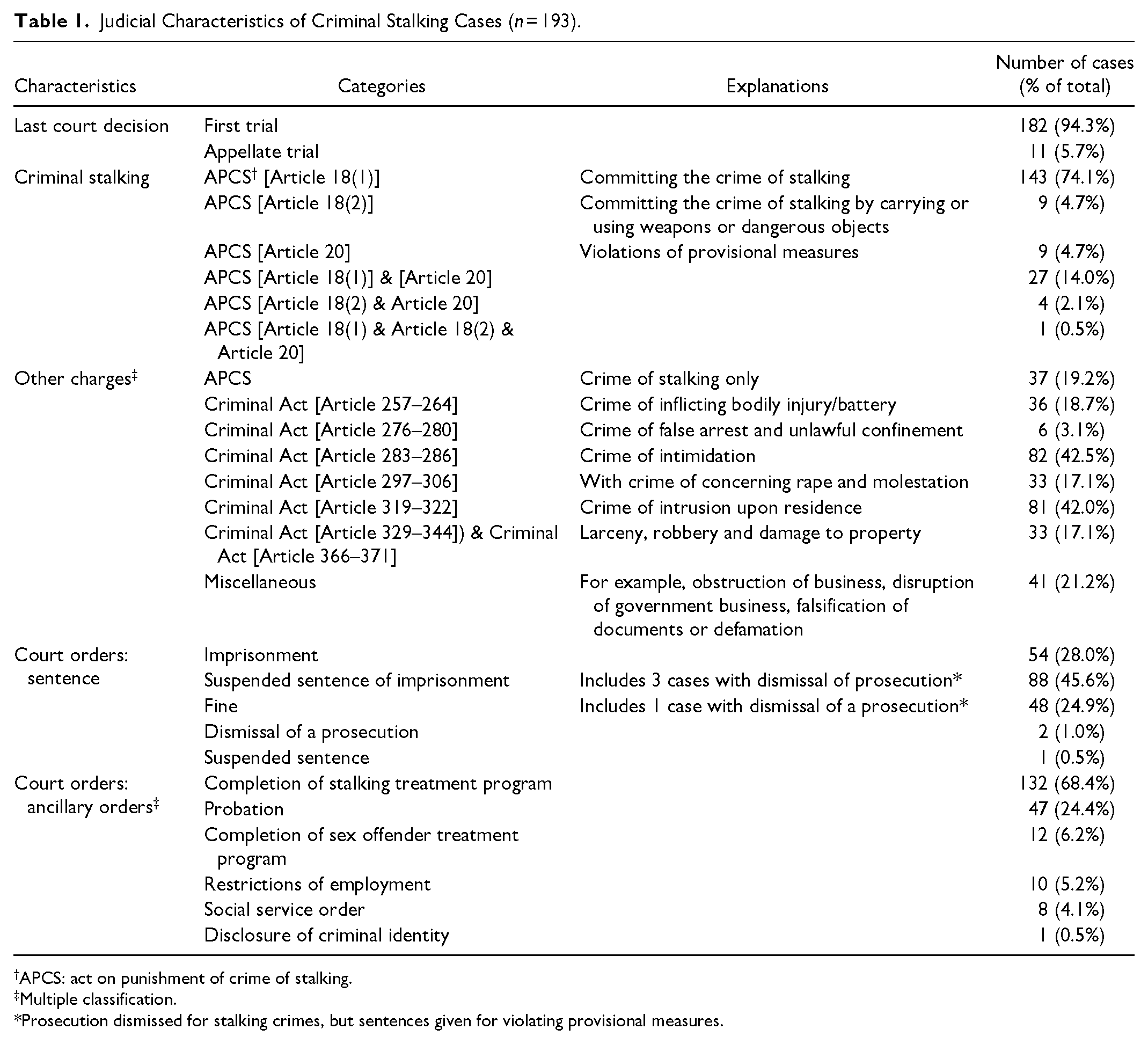
Table 1 presents the judicial characteristics of the included cases. Of the 193 cases, 94.3% (n = 182) were included in the first trial. After the classification of stalking crimes according to the types enumerated in the APCS, stalking crimes that fall under Article 18(1) were the most prevalent (74.1%), amounting to 143 cases. Cases corresponding to Articles 18(1) and 20 totaled 14.0% (n = 27), and violations of provisional measures against stalkers under Article 20 amounted to 4.7% (n = 9). Approximately 7.3% (n = 14) stalking crimes were committed while carrying or using weapons or dangerous objects. Dangerous objects include rocks, knives (including fruit, utility, and kitchen knives), lighter fluid, scissors, hammers, glass bottles (liquor bottles), golf clubs, and fishing rods. In some cases, criminals used dangerous objects to damage entrance door locks (1 case) or vehicles (2 cases) or inflict self-harm (1 case). Violations of provisional measures against stalkers totaled 21.2% (n = 41), including breaches of restraining orders banning stalkers from approaching victims (17 cases) and contacting victims through telecommunications (13 cases); in 11 cases, both prohibitions were violated.
Judicial Characteristics of Criminal Stalking Cases (n = 193).
APCS: act on punishment of crime of stalking.
Multiple classification.
Prosecution dismissed for stalking crimes, but sentences given for violating provisional measures.
Although some cases solely involved criminal stalking, most stalking cases included other charges prosecuted under the Criminal Act. The most frequently prosecuted crimes involving stalking were intimidation (42.5%, 82 cases) and intrusion upon residence (42.0%, 81 cases). Fewer cases involved the crime of inflicting bodily injury or battery (18.7%, 36 cases), rape or molestation (17.1%, 33 cases), larceny, robbery, or property damage (17.1%, 33 cases), and false arrest and unlawful confinement (3.1%, 6 cases). Additionally, 41 cases were indicted with other charges, including obstruction of business, disruption of government business, falsification of documents, and defamation.
We reviewed and categorized the court orders into sentences and ancillary orders. Regarding sentences, 28.0% (n = 54) resulted in imprisonment, and 45.6% (n = 88) resulted in suspended sentences of imprisonment. Approximately 24.9% (n = 48) resulted in fines, including three cases with suspended fines. In six of the total cases, the court found stalking behaviors but dismissed prosecution for stalking crimes because the victim chose not to punish the stalkers. Among these, four cases resulted in sentences for violating provisional measures; three cases received suspended sentences of imprisonment, and one case received a fine. Additionally, one case had the sentence suspended. Regarding ancillary orders, the completion of a stalking treatment program was the most common, accounting for 68.4% of cases (n = 132). This was followed by 24.4% of cases (n = 47) involving probation, 6.2% (n = 12) requiring completion of a sex offender treatment program, and 5.2% (n = 10) imposing employment restrictions.
Risk Profiles of Criminal Stalking Cases
Profile of Stalkers and Victims
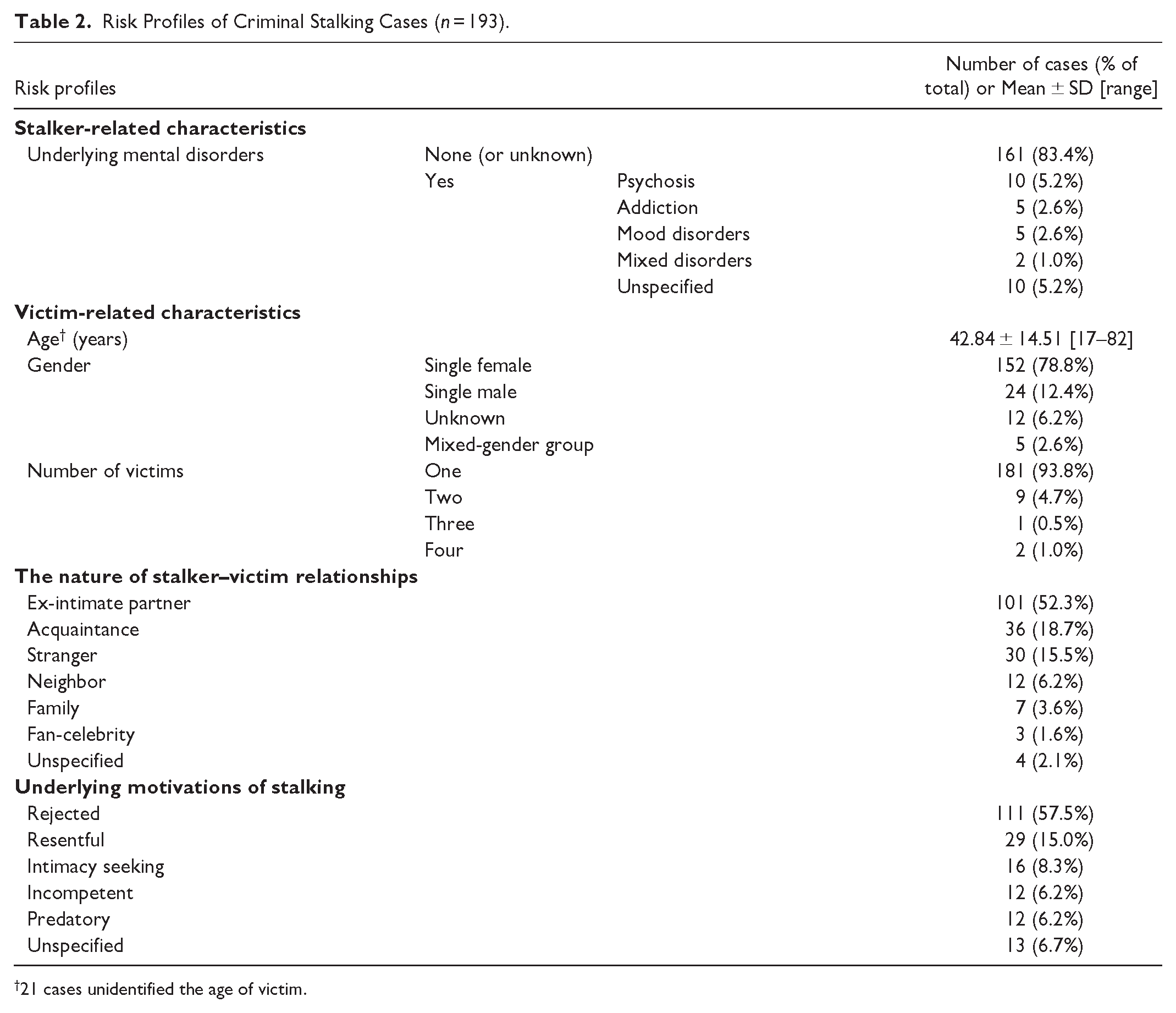
Table 2 presents the risk profiles of the analyzed criminal stalking cases. Among the 193 cases, stalkers in most cases did not have any mental health issues (83.4%, 161 cases), while 16.6% of cases (n = 32) involved stalkers with identified mental disorders. Of these, psychosis was the most prevalent (5.2%, 10 cases), followed by addiction problems and mood disorders, with five cases each, accounting for 2.6% of the cases. Other demographic characteristics of the stalkers, such as age and gender, were not publicly available, preventing access to this information.
Risk Profiles of Criminal Stalking Cases (n = 193).
21 cases unidentified the age of victim.
The mean age of victims was 42.84 years (standard deviation: 14.51), with ages ranging from 17 to 82 years. Female victims (78.8%, 152 cases) were more prevalent than male victims (12.4%, 24 cases), whereas a few cases involved a mixed-gender group of victims (2.6%, 5 cases). Single individuals were the most common targets of stalking (93.8%, 181 cases), while incidents involving group victims—multiple individuals targeted by a single stalker—were less frequent. In 10 cases, the group victims were families or couples, whereas in two cases, they involved unspecified victims with no personal relationships.
Nature of Stalker–Victim Relationships and Underlying Motivations
Most stalkers were ex-intimate partners of the victims (52.3%, 101 cases), followed by acquaintances (18.7%, 36 cases), strangers (15.5%, 30 cases), and neighbors (6.2%, 12 cases). A few cases involved family members (3.6%, 7 cases) or fans (1.6%, 3 cases) as stalkers. Rejection (57.5%, 111 cases) was the most common underlying motivation for stalking, followed by resentful (15.0%, 29 cases), intimacy seeking (8.3%, 16 cases), incompetent (6.2%, 12 cases), and predatory (6.2%, 12 cases) stalking types.
Patterns of Stalking Behaviors
Table 3 presents the stalking behavior patterns. The data revealed that direct contact behaviors were the most frequently observed, followed by indirect and non-contact behaviors. Among the direct contact behaviors, physically approaching victims (or attempts; 75.1%, 145 cases) was the most common, followed by sudden appearances (39.4%, 76 cases), knocking on victims’ doors (27.5%, 53 cases), intrusions (or attempts; 19.7%, 38 cases), and obstruction (6.2%, 12 cases). Among the indirect contact behaviors, repeated contact and transmission of messages (67.9%, 131 cases) were the most common, followed by leaving goods (14.0%, 27 cases) and delivering goods (6.7%, 13 cases). Finally, waiting (29.5%, 57 cases) was the most frequent non-contact behavior observed, followed by surveilling (13.0%, 25 cases), tailing (9.3%, 18 cases), and loitering (9.3%, 18 cases).
Patterns of Stalking Behaviors (n = 193).

Multiple classification.
Assessing the Risk of Criminal Stalking
Analyzing Criminal Stalking Cases Under the APCS
Figure 1 presents an analysis of criminal stalking cases under the APCS based on the nature of stalker–victim relationships and the underlying motivations for stalking. Simple stalking behavior, a violation of Article 18(1), was the most common offense, occurring across all stalker–victim relationships. Breaches of Article 18(2) involving carrying or using dangerous objects during stalking were observed for stalkers with familial (14.3%, 1 case), neighborhood (8.3%, 1 case), past intimate (8.9%, 9 cases), or acquaintance (8.3%, 3 cases) connections with victims. Contraventions of Article 20 pertaining to provisional measures were noted in most types of relationships, with exceptions in family-related cases and those involving fans and celebrities. Notably, severe forms of stalking, which involved violations of both Articles 18(2) and 20, were exhibited in ex-intimate partners (3.0 %, 3 cases), acquaintances (2.8%, 1 case), and neighborhood relationships (8.3%, 1 case).
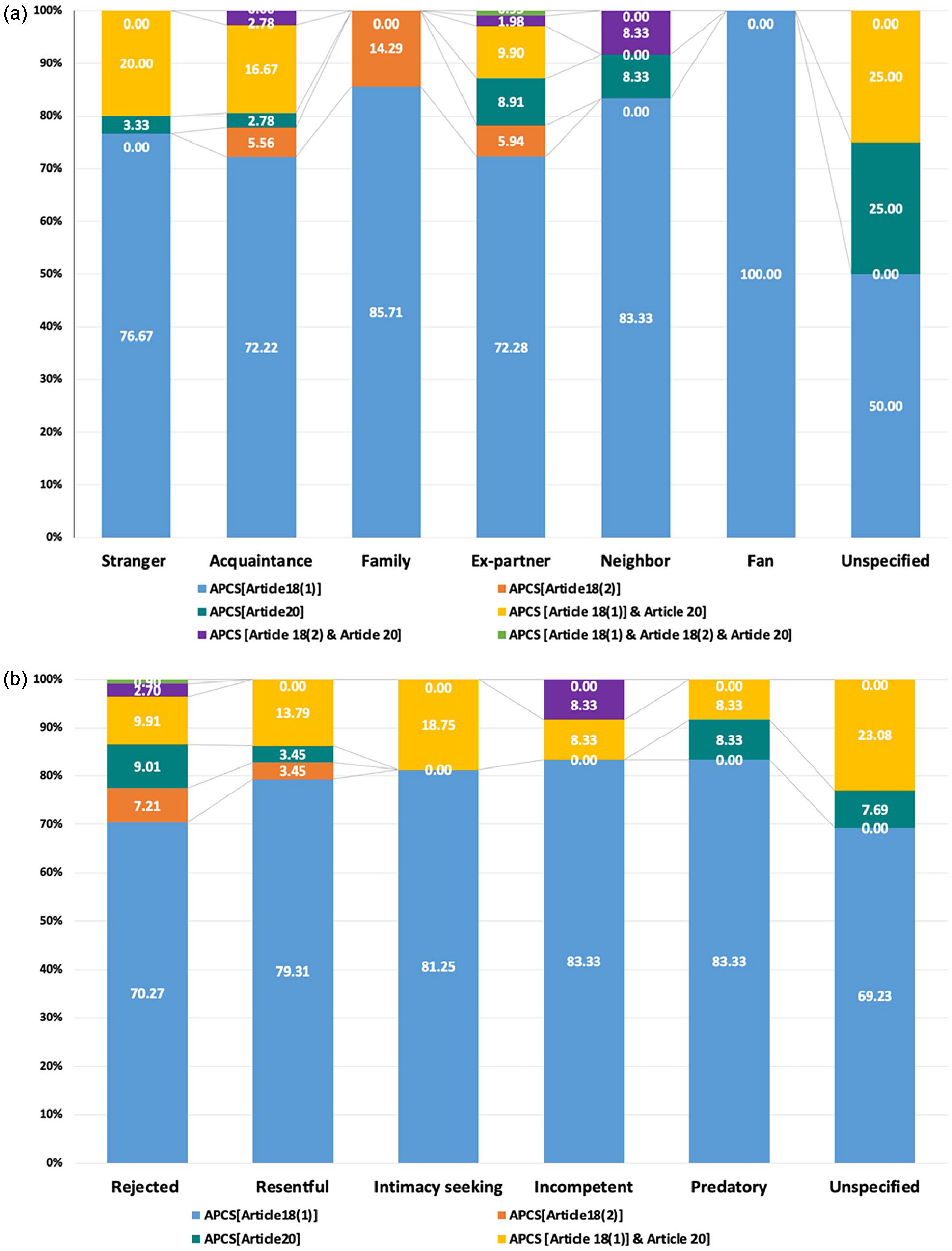
Analyzing criminal stalking cases under the Act on Punishment of Crimes of Stalking. (a) By the nature of stalker–victim relationships. (b) By the underlying motivations for stalking.
The violation of Article 18(1) was the most common regardless of underlying motivations. Violations of Article 18(2) were particularly prevalent in instances of rejected stalking (10.8%, 12 cases), and observed in those of incompetent (8.3%, 1 case) and resentful (3.4%, 1 case) stalking. Violations of Article 20 were found across all types of stalking motivation. Severe forms of stalking involving violations of both Articles 18(2) and 20 were predominantly observed in rejected (3.6%, 4 cases) and incompetent (8.3%, 1 case) stalking types.
Analyzing Criminal Stalking Cases Under the Criminal Act
Figure 2 presents an analysis of criminal stalking cases under the Criminal Act based on the nature of stalker–victim relationships and underlying motivations for stalking. The crime of inflicting bodily injury/battery was prevalent across various stalker–victim relationships, with a higher incidence rate observed among family members (14.3%, 2 cases), ex-intimate partners (14.0%, 23 cases), and neighbors (12.0%, 3 cases). False arrests and unlawful confinement were perpetrated solely by ex-intimate partners (3.7%, 6 cases). Intimidation was observed in all relationships except for fan-stalkers. Rape and molestation were prevalent among strangers (21.9%, 7 cases), acquaintances (13.7%, 10 cases), neighbors (12.0%, 3 cases), and ex-intimate partners (7.9%, 13 cases), whereas no cases were reported among family members or fans. Intrusion upon residence was observed in most relationships, with a higher incidence rate observed among neighbors (48.0%, 12 cases), family members (35.7%, 5 cases), and fan-stalkers (100.0%, 1 case). Larceny, robbery, and damage to property were commonly reported in all relationships, except for fan-stalkers.
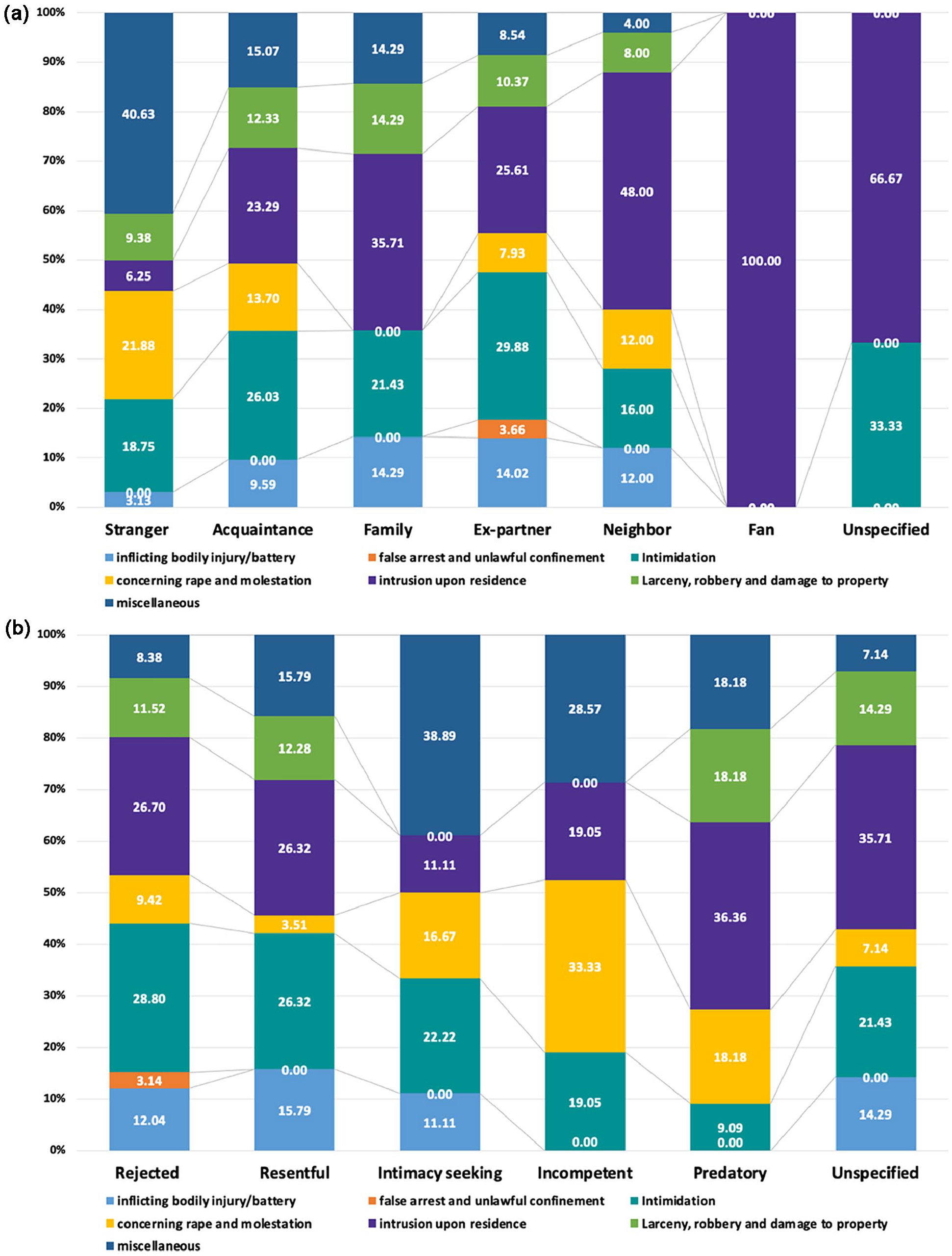
Analyzing criminal stalking cases under the criminal act. (a) By the nature of stalker–victim relationships. (b) By the underlying motivations for stalking.
Regarding the underlying motivations for stalking, inflicting bodily injury/battery was committed in incidents of resentful (15.8%, 9 cases), rejected (12.0%, 23 cases), and intimacy-seeking stalking (11.1%, 2 cases), whereas none was committed in incidents of incompetent or predatory stalking. Intimidation was observed across all types of stalking, whereas false arrests and unlawful confinement were solely perpetrated during incidents of rejected stalking (3.1%, 6 cases). Rape and molestation were observed across all stalking types, with a higher incidence rate observed among incompetent (33.3%, 7 cases), predatory (18.2%, 2 cases), and intimacy-seeking types (16.7%, 3 cases). Intrusion upon residence was observed across all stalking types, with a higher incidence rate reported among incidents of predatory (36.4%, 4 cases), rejected (26.7%, 51 cases), and resentful (26.3%, 15 cases) stalking. Finally, larceny and robbery, as well as property damage, were solely reported in incidents of predatory (18.2%, 2 cases), resentful (12.3%, 7 cases), and rejected (11.5%, 22 cases) stalking.
Discussion
This study reviewed and analyzed criminal stalking cases related to the APCS, which has been in effect in South Korea since October 21, 2021. In total, 193 cases were methodically searched, examined, coded, and analyzed according to four risk profile criteria: profiles of stalkers and victims, the nature of stalker–victim relationships, motivations for stalking, and patterns of stalking behaviors. Moreover, we categorized the cases under the APCS and Criminal Act based on the nature of the stalker–victim relationship and the motivation behind stalking to assess the associated risks.
In approximately 16.6% of cases, stalker behaviors were associated with mental disorders. The psychopathological state of the stalker is often specified as it influences court decisions. In South Korea, the law stipulates that individuals who are unable to make discriminations or control their will, due to mental disorder, shall not be punished (Criminal Act [Article 10(1)]), or their punishment may be mitigated if they have deficiencies in such abilities due to mental disorder (Criminal Act [Article 10(2)]). Therefore, determining whether an offender has mental health issues is crucial for assessing their culpability. In our findings, psychosis (specifically schizophrenia) was the most prevalent condition considered in court decisions, followed by mood disorders and substance use problems. This aligns with a previous study (Choi & Lee, 2018), which reviewed 1,597 legal cases under the Criminal Act in South Korea from 2014 to 2016 involving defendants with mental disorders. The study reported that schizophrenia, mood disorders, intellectual disabilities, and addictions were the most common diagnoses used to support insanity defenses. These cases often involved interpersonal violence, including murder and physical/sexual assaults. However, in general, other mental conditions, such as personality disorders, have been rarely considered. Nijdam-Jones et al. (2018) observed that 72% of offenders who exhibited stalking behaviors met the criteria for clinical diagnoses, with personality disorders (50%) and substance use disorders (46%) being more common than psychotic disorders (10%) and mood disorders (31%). Additionally, an online survey in Germany reported that most stalkers suffered from psychotic and personality disorders (Praus et al., 2018). Furthermore, many countries, including Canada, the United Kingdom, and Portugal, tend to focus on stalking cases involving individuals without psychosis in close relationships, such as ex-partners (Farnham et al., 2000; Matos et al., 2019; Morrison, 2008). In the first year of court decisions in South Korea on stalking crimes, the focus was predominantly on cases involving stalkers with schizophrenia, with no consideration given to personality disorders, the associated risks, or protective measures for victims. Future research is necessary to assess various mental health conditions in stalkers and the level of risk posed by their stalking behavior, which should be reflected in court decisions and victim protection measures.
Contrary to prior findings that most stalking victims were young females (Kang, 2022; Miller, 2012), the ages of the victims in this study were diverse, although the majority were female. Ex-intimate partner stalkers were the most prevalent in terms of the stalker’s relationship with the victim. While earlier studies noted that most stalkers were former intimate or sexual partners and that strangers were the least common (Farnham et al., 2000; Miller, 2012), stranger-stalkers were also prevalent in this study. This may be because stalking by strangers is more likely to be perceived as a crime than stalking by people they know. Scott et al. (2022) claimed that people might consider the behavior of someone they know to be less risky than that of strangers. Additionally, because of the social and cultural emphasis on family and close-knit groups in South Korea’s collective culture (Park & Chesla, 2007), South Koreans may find it easier to penalize strangers than people within their social circles.
Various stalking behavior patterns were identified. Direct contact stalking behavior was the most frequent type, including physical approaches and sudden appearances. However, indirect approaches were also common, typically via Internet-based platforms (e.g., email and social networking services) or electronic devices (e.g., smartphones and tablet PCs). These methods have recently become the primary means of stalking, facilitating repeated unwanted contact and one-sided communication (Stefanska et al., 2022). Although such behaviors are often considered less severe forms of stalking (Stefanska et al., 2022), they enable stalkers to reach victims regardless of their physical distance and time. Consequently, victims have no free place or time to be completely separated from stalkers, causing them to suffer from chronic fear and uncertainty.
Regarding the risk of stalking crimes based on severity, simple stalking cases (Violation of Article 18(1)) were more prevalent than those with harmful weapons or objects (Violation of Article 18(2)) or those violating provisional measures (Violation of Article 20). Nonetheless, stalking by ex-intimate partners was the most severe and diverse form, followed by stalking by acquaintances. This finding aligns with previous literature, which indicates that more diverse and longer-duration stalking behaviors occur in closer relationships (Matos et al., 2019), and stalking by ex-partners often involves more threatening and assaultive behaviors (Logan, 2020; White et al., 2022). Regarding stalking motivation, rejected stalkers showed more severe and diverse patterns than the other stalker types.
Regarding the risk of stalking crimes based on co-charged violent crimes, intimidation and intrusion upon residence were the most prevalent. In particular, intrusion upon residence was likely committed by stalkers who were within close residential distance and could come and go frequently, such as neighbors and family members, rather than strangers. Among the three fan-stalkers, one escalated beyond simple stalking to commit an intrusion upon the residence. Often called parasocial relationships, this relationship characterizes a one-sided interaction between viewers and celebrities (Hoffner & Bond, 2022). Despite fans being strangers to a celebrity, the relationship can be recognized as close from the fans’ perspectives.
Inflicting bodily injury/battery is likely to be committed in closer relationships, such as by ex-partners or family members, as reported in a previous study (Miller, 2012). Sexual violence, including rape, seemed not to be related to relational closeness but was prevalent in incompetent, predatory, and intimacy-seeking types of stalking that pursue intimate or sexual interaction. Larceny, robbery, and property damage were generally observed in all relationships but not in intimacy-seeking and incompetent types of stalking. Finally, false arrests and unlawful confinement were committed only by rejected ex-intimate partners. This may be in line with the perspective in which stalking behavior is considered dysfunctional bonding based on attachment theory (Bowlby, 1982). Those who develop insecure attachment by failing to have a positive image of themselves and others are likely to exhibit increased rejection sensitivity and fear of abandonment, leading to various mental, behavioral, and relational problems (Gillath et al., 2016; Tussey et al., 2021).
This study has several limitations. First, some judgment documents lacked comprehensive information about stalking cases, limiting the authors’ ability to understand the details beyond those presented in the judgments. Consequently, specific risk profiles were classified as “unspecified.” Second, the scope of this study was restricted to cases that had been finalized within 1 year. Moreover, owing to the limited number of legal cases examined and the focus solely on behaviors documented in legal reports, the categorization of stalking behaviors was relatively simplistic. Spitzberg and Cupach (2014) identified eight tactics, encompassing a broader range of stalking behaviors, such as hyper-intimacy, coercion, and threats. Therefore, caution should be exercised when generalizing the present study’s findings. Third, access was unavailable for three legal cases sealed from public view. Fourth, owing to data limitations, the comparisons made in this study were not grounded in statistical analysis. Finally, the data from this study are not sufficiently comprehensive to fully address the implications for diversity and equity; therefore, future research is crucial. Particularly, despite lacking detailed demographic characteristics of stalking offenders, it is essential to explore and consider vulnerabilities related to their gender, age, socioeconomic status, and mental health conditions to tailor support and prevention systems against the recurrence of stalking crimes. Moreover, further research and policy reviews are needed to ensure that the APCS is applied equitably, without disparities across various demographics. This includes ensuring fair treatment for minority populations in South Korea, including non-binary or transgender individuals, individuals with disabilities, or new settlers from North Korea, who may face challenges in seeking help and protection in South Korean society because of social prejudice.
Nevertheless, this study is significant, as it seeks to examine the profiles of stalking crimes in South Korea, which have long been overlooked due to the absence of specific legislation. We hope that these findings can contribute to further amendments to the APCS and enhance the protection of stalking victims (Table 4).
Critical Findings and the Implications of the Review.

Footnotes
Declaration of Conflicting Interests
The author(s) declared no potential conflicts of interest with respect to the research, authorship, and/or publication of this article.
Funding
The author(s) disclosed receipt of the following financial support for the research, authorship, and/or publication of this article: This work was supported by the National Research Foundation of Korea (NRF) grant funded by the Korea government (MSIT) under Grant number 2021R1F1A1048142.
