







Abstract
Exposure to violence in childhood and adolescence is linked to adverse educational outcomes. Research from South America is underrepresented in evidence syntheses on the topic, despite being among the most violent regions worldwide. Attending to this problem, this systematic review characterizes and maps available evidence on the relationship between violence exposure and educational outcomes in South America. Using a preregistered protocol, we searched original empirical peer-reviewed studies published in English, Spanish, or Portuguese between 2012 and 2024 across multiple databases, Google Scholar, reference scanning, and expert consultation. Eligible studies examined any form of violence exposure and a broad range of educational outcomes in pre-primary, primary, or secondary school populations in South America. Information regarding independent, outcome, and mediating variables, study design, and publication characteristics was extracted and presented in an interactive evidence atlas. Studies were assessed using the Quality Appraisal for Diverse Studies tool. Thirty-nine, out of 1,123 identified documents, met the inclusion criteria. Most research was from Brazil (35.9%) and Colombia (30.8%), addressing school (39.6%) and community violence (22.6%). Non-traditional educational outcomes (e.g., school climate, social-emotional skills) were frequently studied. Study quality varied greatly, and a quantitative cross-sectional design was employed predominantly in 69.2% of the studies. Research on violence and educational outcomes in South America presents methodological, geographic, and population gaps. Greater methodological diversity, improved research infrastructure, international collaborations, and inclusive multilingual publication practices could allow for better research quality, coverage and accessibility. Findings highlight the need for a context-sensitive conceptual framework to understand violence’s impact on children.
Introduction
A 2024 report by the United Nations (UN) Special Representative on Violence against Children highlights that violence against children continues to escalate, fueled by factors such as poverty, social inequality, armed conflicts, and climate change, resulting in an “unprecedented crisis in child rights” United Nations, 2024, p. 18). Children in the Global South are at a particularly high risk (United Nations International Children’s Emergency Fund [UNICEF], 2022). Among the long-lasting consequences of violence exposure, its negative impact on educational performance and learning in children and youth is well-documented. Evidence supports a consistent negative effect of different forms of violence (e.g., community violence, bullying, intrafamilial violence, child maltreatment, harsh discipline) on school attendance, grades and performance tests (Fry et al., 2018, 2021; Hardaway et al., 2014; Nakamoto & Schwartz, 2012; United Nations Educational, Scientific, and Cultural Organization [UNESCO], 2016, 2021; Zhang et al., 2025).
Given the global prevalence of violence against children, understanding the relationship between violence exposure and academic outcomes—comprising a broad range of competencies, including cognitive, social, and emotional abilities, resulting from teaching and learning—is essential to enhance adequate educational opportunities for all (UNESCO, 2017).
As evidence accumulates and reveals the complex processes involved in the relationship between violence and academic outcomes, systematically organizing the available evidence becomes paramount to generate a comprehensive overview of the available data to inform prevention efforts and further research.
Two central observations of the research field inspire this study. Firstly, research on child victimization of violence spans multiple disciplines (e.g., psychology, education, criminology, social work), theoretical frameworks, and types of violence. This diversity, while enriching, has also contributed to a highly diffuse body of literature. In this vast, fragmented, and multidisciplinary field, Evidence and Gap Mapping (EGM) allows researchers to systematically describe what has been studied, across domains, populations, methods, and contexts. It helps organize the landscape of evidence, creates transparency, and shows where gaps remain (White et al., 2020). While a relatively new approach in systematic evidence reviewing, its relevance in the field has been shown in earlier applications, mapping the evidence regarding interventions to reduce violence against children (Brants & Ariel, 2023; Pundir et al., 2020) and the effect of interpersonal violence exposure on behavior outcomes (Holmes et al., 2022). Regardless, to our knowledge, no evidence maps are available on the link between violence exposure and educational outcomes.
Secondly, despite being one of the regions with the highest international rates of child homicide, organized crime, gangs, and firearm injuries (Imbusch et al., 2011; United Nations Office on Drugs and Crime [UNDOC], 2023a), research produced in South America on the educational consequences of violence has been highly underrepresented in existing review studies. Children are more likely to die due to violence in South and Central America compared to any other region (UNICEF, 2022). A large proportion of children in the region experience not one but various forms of violence while growing up, and exposure rates are highest in socioeconomically vulnerable groups (Fry et al., 2021). Simultaneously, the region presents alarmingly low academic achievement with substantial socioeconomic disparities (Economic Commission for Latin America and the Caribbean [ECLAC], 2024), raising the question on how both phenomena are linked (Chioda, 2017).
Attending to this problem, this study aims to produce an evidence and gap map of studies on the educational outcomes of violence exposure in pre-primary, primary, and secondary school populations in South America, identifying where evidence is strong or weak, what populations and outcomes are under-studied, and which methods are commonly used or missing, guiding further research.
Theoretical Background
The Concept of Violence
The definition and categorization of violence vary widely across empirical studies, depending on theoretical, empirical, or contextual considerations. The multitude of taxonomies and definitions that have been proposed in violence research, along with inadequate descriptions of the theoretical underpinnings when reporting on these studies, have led to conceptual confusion and difficulties for evidence systematization (Antunes & Ahlin, 2017; Kennedy & Ceballo, 2014; Mels et al., 2022).
In an effort to create a comprehensive, universally applicable framework for understanding, measuring, and addressing violence globally, the World Health Organization (WHO) defined violence as “the intentional use of physical force or power, threatened or actual, against oneself, another person, or against a group or community, that either results in or has a high likelihood of resulting in injury, death, psychological harm, maldevelopment, or deprivation” (World Health Organization, 2002, p. 5). Based on this broad definition, the WHO proposes a taxonomy of violence along two dimensions: the modes in which violence may be inflicted (physical, sexual, psychological, and deprivation) and the victim–perpetrator relationship. As such, the taxonomy distinguishes self-directed violence (suicide or self-harm), interpersonal violence (either in the family/partner relationship or in the community; the latter distinguishing between community violence committed by strangers or by known, yet unrelated people, e.g., peers), and collective violence (aiming at larger groups, motivated by social, political or economic gain). Collective violence is manifested in war, discrimination, and hate crimes, among others.
Several authors have critically noted that this dominant definition of violence conceptualizes it primarily as a collection of individual-level acts committed by singular perpetrators, thereby inadequately accounting for the broader social determinants that shape violent phenomena (Befus et al., 2019; Imbusch et al., 2011). In response, they argue for the inclusion of structural and cultural violence as analytically relevant categories, emphasizing the deeply intertwined nature of different forms of violence and their close relationship with social, economic, and political inequalities. Along similar lines, Maternowska and Fry (2018) conceptualize structural and institutional violence as key drivers of interpersonal violence against children, highlighting how macro-level conditions and systemic arrangements create the contexts in which interpersonal violence is more likely to emerge. In this way, the notion of structural violence provides a useful analytical lens, according to Weigert (2008), structural violence (also called indirect violence and, sometimes, institutionalized violence) is differentiated from personal violence (also called direct or behavioral) and refers to preventable harm or damage to persons (and by extension to things) where there is no actor committing the violence or where it is not practical to search for the actor(s); such violence emerges from the unequal distribution of power and resources or, in other words, is said to be built into the structure(s). (p. 2005)
Finally, it is important to establish an analytical distinction between violence and violence exposure: while the former refers to the social phenomenon itself, the latter refers to an individual’s personal experience of violent acts. It includes victimization or direct witnessing of violence, yet a growing number of authors have made a case also to include indirect violence exposure, such as knowing about violent events taking place in the neighborhood (Kennedy & Ceballo, 2014; Mels et al., 2022), or living in places where violence occurs, even without having direct knowledge of it (Sharkey, 2018).
Polyvictimization is the term used to refer to experiences of a combination of types of violence victimization. While the polyvictimization prevalence in childhood is estimated at 10% in high-income countries, in non-war-affected low and lower-middle-income countries, its overall prevalence is estimated at 38% (Le et al., 2018).
Educational Outcomes and Their Relationship to Violence
The second construct central to this paper, educational outcomes, is equally complex. In general, the term refers to the results of teaching and learning. However, notions of the desired outcomes have evolved throughout history (Klieme et al., 2008). Since the 1990s, a consensus has arisen among leading educational organizations that the objective of education should be the development of 21st-century skills or competencies, allowing individuals and economies to respond to growing complexities of the job market and society, including technological innovations, globalization, and a need for sustainable development (González-Salamanca et al., 2020). In this scenario, the OECD (Organization for Economic Co-operation and Development) and UNESCO, among others, have assumed a functional approach to assessing educational outcomes involving a broad range of competencies, including psychological and social abilities. Expanding on this notion, UNICEF (2019) understands that the outcomes of teaching and learning entail foundational (numeracy, literacy), social, emotional, and digital skills, as well as an enabling school environment (e.g., positive school climate, teacher-student support, positive peer relationships, effective school practices). To complement the assessment of these educational outcomes, UNESCO (2021) uses enrolment and attendance as operational indicators, a salient marker for school success in Latin America due to its extremely high dropout rates (ECLAC, 2024).
Studies examining the relationship between violence and educational outcomes primarily draw from (a) neurobiological theory, understanding that chronic stress from violence exposure disrupts brain development, and consequently, executive functioning which is key to learning (Bajnath et al., 2020); (b) stress theory, considering that high stress resulting from violence exposure increases psychopathology, including post-traumatic stress, depression and anxiety, all of which affect classroom behavior and learning capacity (Hardaway et al., 2014; Mels et al., 2023); (c) social learning theory, positing that exposure to violence may teach children that aggression is an acceptable and effective way to resolve conflict, increasing aggression and externalizing behaviors (Mels et al., 2022). Multi-level theoretical frameworks, including social disorganization theory, link the concentration of social problems—such as violence—to relationship dynamics, focusing on how lower parental involvement (Patton et al., 2012), lower school engagement and connectedness (Borofsky et al., 2013) and increased involvement with academically disengaged peers (Schwartz et al., 2016), among other social factors, affect developmental and academic outcomes.
The variety of theoretical frameworks used to study the phenomenon has resulted in the consideration of a wide range of mediating variables and explanatory processes. While this breadth is informative, it simultaneously and inadvertently creates a lack of cohesion within the literature. Organizing the available evidence following Bronfenbrenner’s ecological model, the identified mediating and moderating variables operate across different levels, reflecting psychological, relational, and sociocultural mechanisms. At the ontosystem level, studies report emotional dysregulation, externalizing behaviors, cognitive difficulties, negative self-perceptions, loss of agency, and stress as central mechanisms that explain how exposure to violence affects school performance (Chávez & Aguilar, 2021; Nakamoto & Schwartz, 2012; Romano et al., 2015; Zhang et al., 2025). In addition, individual characteristics such as age, gender, race and ethnicity are consistently mentioned as relevant moderators (Nakamoto & Schwartz, 2012; Romano et al., 2015; Zhang et al., 2025).
At the microlevel, referring to the immediate environments and direct interactions where children experience violence, studies have identified mediating effects of household characteristics, the type of violence experienced, the level of aggressiveness, the periodicity of violent events, and the type of relationship with the perpetrator (Chávez & Aguilar, 2021; Kennedy & Ceballo, 2014).
At the mesosystem level, studies highlight perceived safety and school climate as factors that shape interactions and, consequently, the magnitude of the effect of violence exposure (Chávez & Aguilar, 2021; Romano et al., 2015). Romano et al. (2015) identify socioeconomic vulnerability as a moderating variable, while Zhang et al. (2025) report significant differences across geographic regions, implying that broader sociocultural contexts shape the relationship between exposure to violence and academic achievement.
While theory suggests macro-level influences, such as cultural beliefs that normalize violence and structural inequalities (Imbusch et al., 2011), systematic evidence on how they influence the impact of violence exposure on child development is scarce (Befus et al., 2019).
Study Context: Violence and the Educational Crisis in South America
While often considered as a sole cultural-linguistic region by international agencies, Latin America is a diverse conglomerate of countries in terms of history, manifestations of violence, and educational systems (Imbusch et al., 2011; UNDOC, 2023b; UNESCO, 2016). South America, the object of this paper, refers to the continent located in the southern part of the Americas. Culturally, it is characterized by a rich blend of European and Indigenous heritage, along with certain African influences, which have fostered a relational-oriented and collectivist culture (Rojas, 2020). Politically, South American countries share a history of colonialism, authoritarian regimes, and democratic transitions, and while most are now consolidated democracies, some countries continue to face challenges of institutional weakness and social unrest (Imbusch et al., 2011). Socioeconomically, despite including large and fairly diversified economies, the region is one of the most unequal in the world, with persisting poverty, precarious labor markets, and limited access to quality education, health, and social protection systems for the poorest (Chioda, 2017). These intersecting characteristics create a complex context in which children are disproportionately exposed to violence and its consequences, both within their families and broader social environments (UNICEF, 2022).
Prevalence of Violence and Trends in Child Protection Policies
Violence is a persistent feature of South American history. Homicide trends—a standard indicator of severe violence due to its consistent recording across countries and regions—have been fluctuating between countries in the region for the last decade. Venezuela, struck by a political and economic crisis, has reported a drop in homicide rates from 41.0 per 100,000 inhabitants in 2019 to 20.2 in 2021. However, the low quality of the data raises suspicion of underreporting (UNDOC, 2023b). Columbia, finding relative peace after decades of internal warfare, observed a rise in community violence, elevating homicide rates to 25.4 in 2022 after a previous decrease observed in 2019 (23.9). Brazil, known for its high rates of gang-related violence, shows relatively stable homicide rates (21.3 per 100,000 in 2021). Nonetheless, a handful of other South American countries have seen stark rises in homicide rates in the past years, primarily associated with conflicts between criminal gangs. Ecuador almost doubled its homicide rate between 2021 (14.0 per 100,000) and 2022 (27.0). In that same period, Chile experienced an increase in homicides of 45.1 % (to 6.7 per 100,000 in 2022), and Uruguay reported a 25.8% increase (11.2 per 100,00 in 2022) (UNDOC, 2023b). Most victims are young people between the ages of 15 and 24 (Chioda, 2017; Fry et al., 2021).
While generally less comprehensively and consistently documented (Imbusch et al., 2011), some data on other types of violence in the region are available. UNICEF (2022) reports high levels of violent discipline in South America, ranging between 53.0% (Paraguay) and 73.0% (Guyana), and indicates that 2.0% of young women in Colombia report having experienced sexual violence before the age of 18 years (data from other countries in South America were not available). A global report by UNESCO (2019) denotes that bullying prevalence is highly variable in the region, ranging from 15.1% in Chile to 47.4% in Perú. Lifetime intimate partner violence experienced by women reportedly ranges between 14.0% (Uruguay) and 58.5% (Bolivia) (Bott et al., 2019).
In this context, the initiation of the Sustainable Development Goals (SDGs) process at the Rio+20 Conference in Brazil in 2012 marked a turning point in public policy agendas, urging governments and donors to prioritize safe and violence-free environments for children (SDG 16) as well as access to quality education (SDG 4).
Similarly, the introduction of the INSPIRE guidelines in 2016 provided a comprehensive, evidence-based framework for preventing and reducing violence against children, promoted by a coalition of global organizations led by UN agencies, the World Bank, and international NGOs (Pan American Health Organization, 2025). The INSPIRE package outlines seven evidence-based strategies to prevent and respond to violence against children, including reducing violence in homes, schools, and communities, promoting quality education, fostering social-emotional learning, and providing education for violence prevention.
At a time when South America was transitioning from a decade of growth, optimism, and progressive policies to a period of economic stagnation, inflation, and growing inequality, both the SDGs and INSPIRE established a common framework to guide regional policies and the allocation of resources aimed at protecting children from violence and mitigating the negative effects of violence exposure from 2012 onward (Chávez & Aguilar, 2021).
Education in South America: Context and Challenges
South American students present alarmingly low academic achievement, as shown in standardized test results and extremely high school dropout rates (ECLAC, 2024). In the 2022 Programme for International Student Assessment (PISA), all seven 1 participating South American countries scored significantly below the OECD mean. On average, 88% of students from low-income families lack basic mathematical skills, exemplifying the continent’s substantial socioeconomic educational inequalities (OECD, 2023).
Data from 2022 for seven countries in South America 2 demonstrate that, on average, only 77.3% of youth complete secondary school before age 24 (Economic Commission for Latin America and the Caribbean [ECLAC], 2025). These data also show that disparities between countries are significant, ranging from a 92.0% completion rate in Chile to 50.3% in Uruguay. Despite between-country differences, socio-economic inequality in school dropout rates is generalized (ECLAC, 2024). For example, in Uruguay, only 25.5% of the poorest students complete secondary school before age 24, compared to 85.2% of their peers in the upper-income quintile (Instituto Nacional de Evaluación Educativa [INEEd], 2025). Socio-economic inequality also applies to social-emotional skill development. The Estudio Regional Comparativo y Explicativo (ERCE) by UNESCO of educational outcomes in Latin America found the lowest social-emotional skills scores in Brazil and Peru, compared to other participating countries from Central America. A similar pattern was found for disruptive classroom behavior. In PISA 2022 (OECD, 2023) several South American states rank low on self-efficacy.
Concern is growing that educational outcomes and violence exposure in South America are related, as is shown by accumulating evidence and recent initiatives from the UNICEF Latin America and Caribbean Regional Office (Fry et al., 2021). ERCE reveals that violence in the school neighborhood is negatively associated with standardized test scores in the sixth year of primary school (UNESCO, 2016), as is exposure to bullying and violent discipline at home (UNESCO, 2021).
Available Systematic Reviews of Violence Exposure and Educational Outcomes
Understanding the broad scope of educational consequences of different types of violence exposure in children, adolescents, and school staff is essential for informing educational policy. Several review studies have undergone efforts to synthesize available evidence.
The most comprehensive systematic review and meta-analysis aiming to understand the educational outcomes of violence exposure in childhood is authored by Fry et al. (2018) and includes a broad range of types of violence. While the geographic scope of the study’s search strategy is global, eligible languages were restricted to English. A total of 67 studies were included in the review, mainly reporting data collected in the Global North. Only three selected studies were conducted in South America (two in Peru, one in Chile). Most studies referred to bullying (36), physical violence (16), sexual violence (14), and child maltreatment (10). Other categories referred to neglect, witnessing domestic violence, emotional violence, community violence, and adolescent relationship violence. While the violence definitions included in the review study were based on consensual sources (e.g., UN agencies), no overarching rationale or taxonomy was provided for the types of violence included. Educational outcomes, on the other hand, were operationalized as school enrolment, attendance, school dropout, progression, and learning (including basic literacy and numeracy skills, critical thinking, problem-solving, and knowledge that promotes well-being). Despite this broad spectrum, no specific data are presented for types of outcomes.
Other review studies have focused on the educational outcomes of specific forms of violence. A meta-analytic review by Nakamoto and Schwartz (2012) on the association between peer victimization and academic achievement (grades, standardized achievement test scores, or teacher ratings of academic achievement) involves 33 studies performed in Europe, North America, and Asia. Only sources published in English were included. Romano et al. (2015), investigating the link between childhood maltreatment and academic achievement (educational outcomes/difficulties, academic achievement, school performance, emotional and behavioral outcomes/difficulties), identified 20 publications, 70.6% of which were conducted in the US, followed by Canada (23.5%) and Israel (5.9%). Non-English language articles or grey literature were not considered.
A recent meta-analysis by Zhang et al. (2025), also focusing on the association between child maltreatment and academic achievement (standardized achievement test scores, grades, or objective teacher/parent/self-ratings of school performance), recognizes the language bias in available review studies and therefore explicitly includes Chinese databases. The study identifies 59 published studies, including participants from five continents (Asia: 15.3 %; Europe: 3.4 %; North America: 67.8 %; Africa: 6.8 %; Australia: 6.8 %), but not South America. Ironically, while UNICEF intended to perform a systematic review on the impact of community violence on educational outcomes (dropout, attendance, enrolment, grades, or standardized test scores) centered on research from Latin America, the authors had to broaden their geographical scope, citing a lack of evidence (Chávez & Aguilar, 2021). Eventually, the review included 29 studies, three of which were produced in South America (one in Colombia, two in Brazil). While this study also included grey literature, only papers written in English were considered eligible.
Clearly, language bias is an important causal factor in the underrepresentation of evidence produced in countries from the Global South in systematic review studies (Stern & Kleijnen, 2020; Zhang et al., 2025). While most journals are written in English, and many non-native English scientists choose to publish in English, regional variations exist. According to Céspedes (2021), Spanish and Portuguese are the predominant languages in mainstream South American journals, especially in the Social Sciences and Humanities.
The Present Study
The lack of geographical diversity in available systematic review studies, and particularly the conspicuous absence of South American literature, stymies a holistic and nuanced understanding of the educational consequences of violence, as its impact and causal processes may differ by country and ethnicity (Cage et al., 2018). For example, the impact of specific forms of violence may vary depending on their naturalization and social acceptance resulting from country-specific history and culture (Imbusch et al., 2011).
In order to address this problem, this study seeks to map and analyze the core features of research on the educational outcomes of violence exposure performed in South America. Beyond categorizing studies geographically, we also aim to characterize the research population, the types of violence, educational outcomes, and the mediating variables included in these studies. Considering the known limitations affecting the research field, we intend to identify variations in the methodological quality of the studies according to the country, specific topic, and publication characteristics.
The following questions guide this paper:
- Which countries in South America have produced publications regarding the educational outcomes of violence, and which populations have been studied? (pre-primary, primary, secondary education; students, teachers, or other school actors; rural, urban, or general population; low-income or specific minorities)
- Which variables (type of violence, educational outcomes, mediating/moderating variables) were addressed in the identified studies?
- Which study designs are used in these studies, and what is their overall quality?
Method
An evidence map approach was chosen as the method for our review. Evidence maps collate research on a particular topic and enable access to the research evidence. They provide an overview by summarizing key characteristics of existing studies, allowing us to see where evidence gaps exist (White et al., 2020). While they focus on identifying instead of synthesizing research in a specific area, they use a search methodology similar to other types of systematic reviews. Therefore, this study was conducted in accordance with the guidelines of the Preferred Reporting Items for Systematic Reviews and Meta-Analysis (PRISMA) 2020 (Page et al., 2021) and was preregistered at
Eligibility Criteria
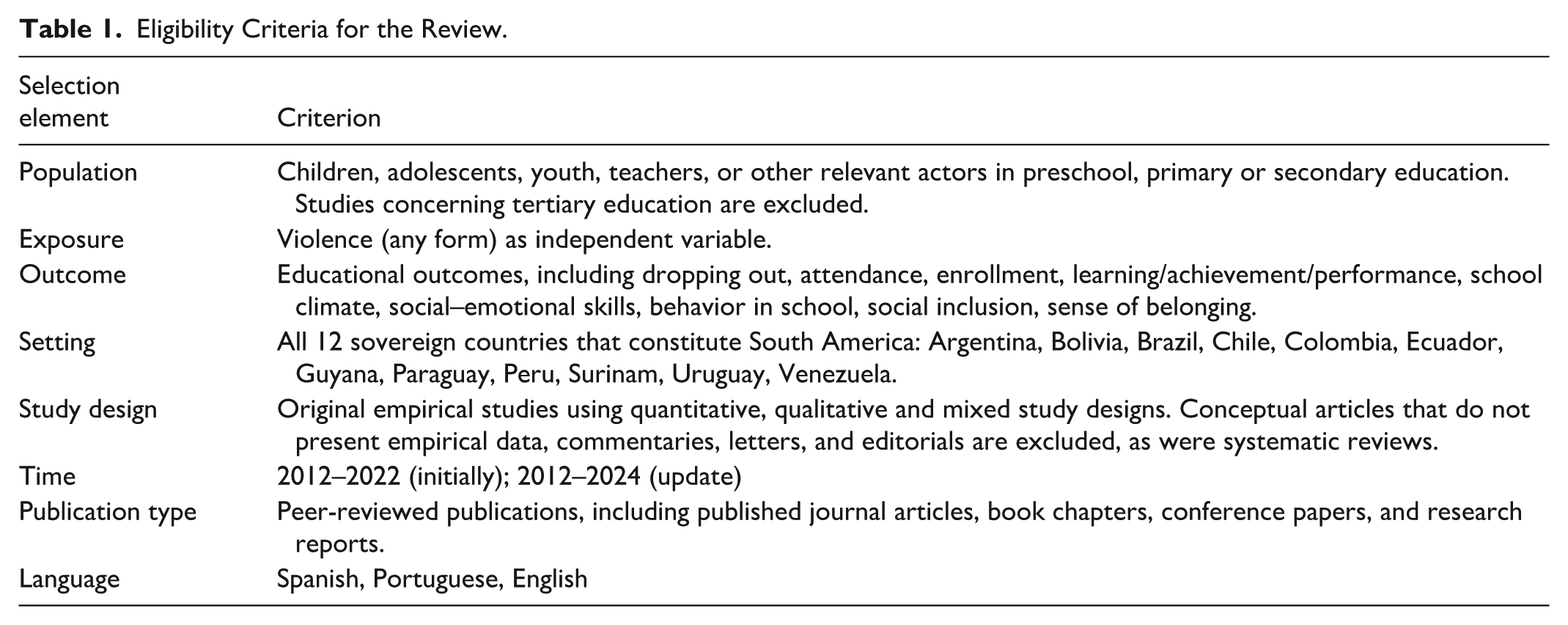
Inclusion and exclusion criteria for the review were defined using a framework that included population, exposure, outcome, time, setting, and study design elements (Glanville, 2019). Identified literature should be peer-reviewed and written in one of the three languages commonly used by South American researchers (Spanish, Portuguese, English). Eligibility criteria are depicted in Table 1. As regards the time criterion, the study, initiated in 2022, initially intended to review literature produced during the last decade to ensure the inclusion of studies reflecting current practices and policies, such as the development and implementation of the SDGs and INSPIRE framework (Glanville, 2019) as discussed above. However, a lack of resources slowed down the study selection process, forcing an expansion of the time scope to ensure the inclusion of up-to-date evidence.
Eligibility Criteria for the Review.
Selection and Data Extraction Procedure
Literature search results were processed in CADIMA Software (version 2.2.3, available at https://www.cadima.info/), allowing for the coordinated collaboration of reviewers. The first author trained and supervised reviewers in using the literature selection and data extraction protocol and CADIMA software. Identification of duplicates was performed automatically and then manually in CADIMA—based on title and author information—each time new data sources were added. In case publications were based on a singular study, all reports were considered if they addressed different variables.
Papers were selected in two stages, assuring double coding for all records. At stage 1, four reviewers independently screened the retrieved titles and abstracts against the first five inclusion criteria (Table 1). In the second stage of selection, full-text PDF files were imported. When not available (either through the Universidad Católica del Uruguay’s online subscription, research platforms such as Research Gate and Academia, or contact with authors), the paper was excluded from the review. Full-text manuscripts were scanned for all criteria. At both stages, inconsistencies between reviewers were discussed within the team and subsequently resolved under the lead of the study coordinator. Excluded references are provided at https://osf.io/6zduy/files/osfstorage.
Data were extracted from the selected papers in duplicate (first and final author) using a standardized form (extraction criteria and extracted data are provided as Supplemental Material) facilitated online in CADIMA. Discrepancies were resolved through team discussion. Finally, the Quality Appraisal for Diverse Studies (QuADS; Harrison et al., 2021) assessed the quality of the studies included in our review, regardless of their study design. The QuADS tool has demonstrated considerable inter-rater reliability and face and content validity for application in systematic reviews combining quantitative and qualitative study designs (Harrison et al., 2021). Thirteen items (referring to methodological, evidence, and reporting quality) are rated on a scale from 0 to 3 according to pre-established criteria. Both individual item scores and the sum scores for each study are included as variables.
Information Sources
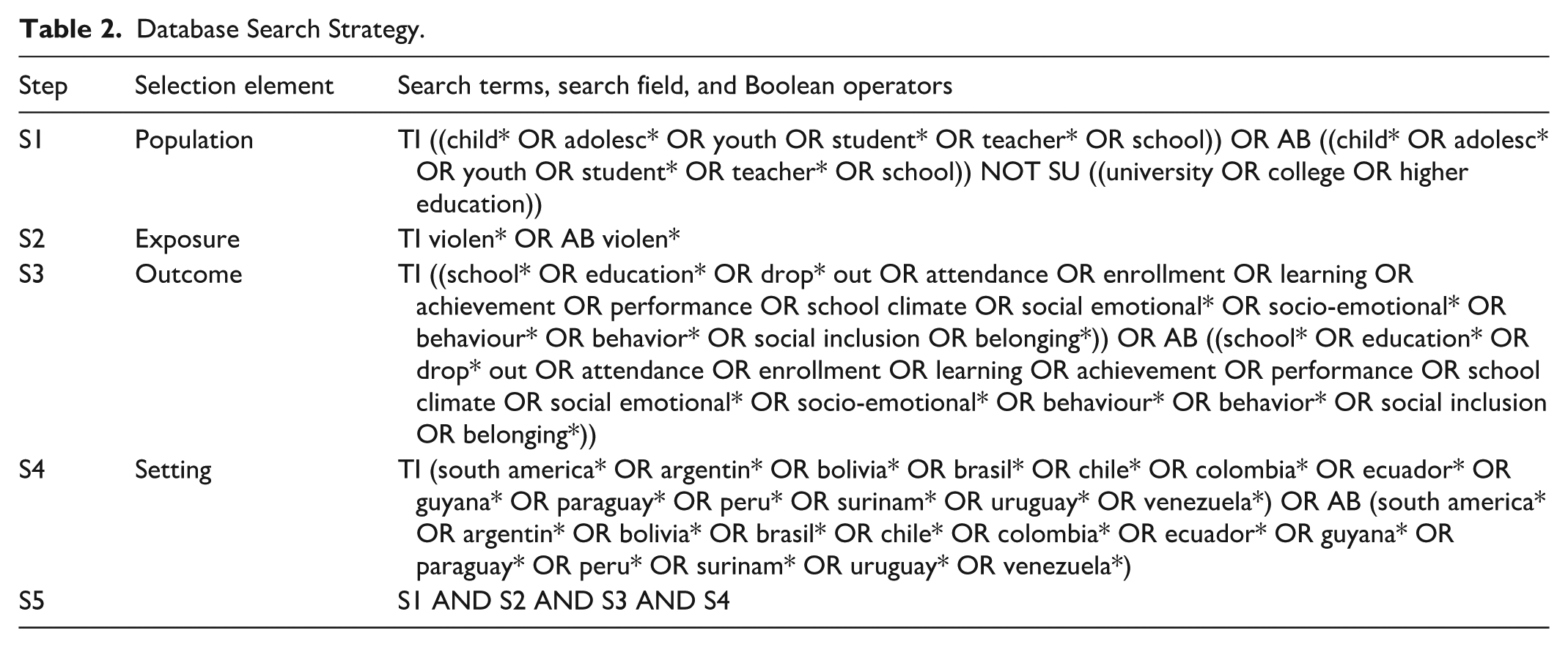
Literature was gathered using four information sources: database searches, reference list revisions, Google Scholar, and inquiries among researchers. First, the Ebscohost platform (hosted by the Universidad Católica del Uruguay’s) was used to access the following databases: PsycArticles, ERIC, SciELO, Academic Search Index, Academic Search Complete, MEDLINE, Fuente Academic Premier, and Directory of Open Access Journals. The search string included the four primary selection elements defined for our study (Table 1), using Boolean connectors and introducing truncation when relevant (Table 2) (Glanville, 2019). All search terms were introduced as free-text items and covered the title and abstract. The following filters were used: year of publication (2012–2022 in a first search performed in June 2022; 2022–2024 in a second search performed in March 2024), peer-reviewed. No language, design, subject, or geographic restrictions were applied as filters. The leading author implemented the search in four consecutive steps (Table 2).
Database Search Strategy.
Secondly, in April 2024, a Google Scholar search was performed to obtain relevant grey or non-indexed literature. The search included the words education and violence in Spanish and Portuguese. Following our two-step selection procedure, the first 200 results were evaluated for their compliance with the inclusion criteria.
Thirdly, the reference list of all articles complying with the inclusion criteria was scanned. Finally, members of the Red Latinoamerica de Convivencia Escolar, a regional research network devoted to studying violence and schools, were sent a list of included articles and asked to identify missing materials (May 2024). The flowchart summarizing the selection process is visualized in Figure 1.
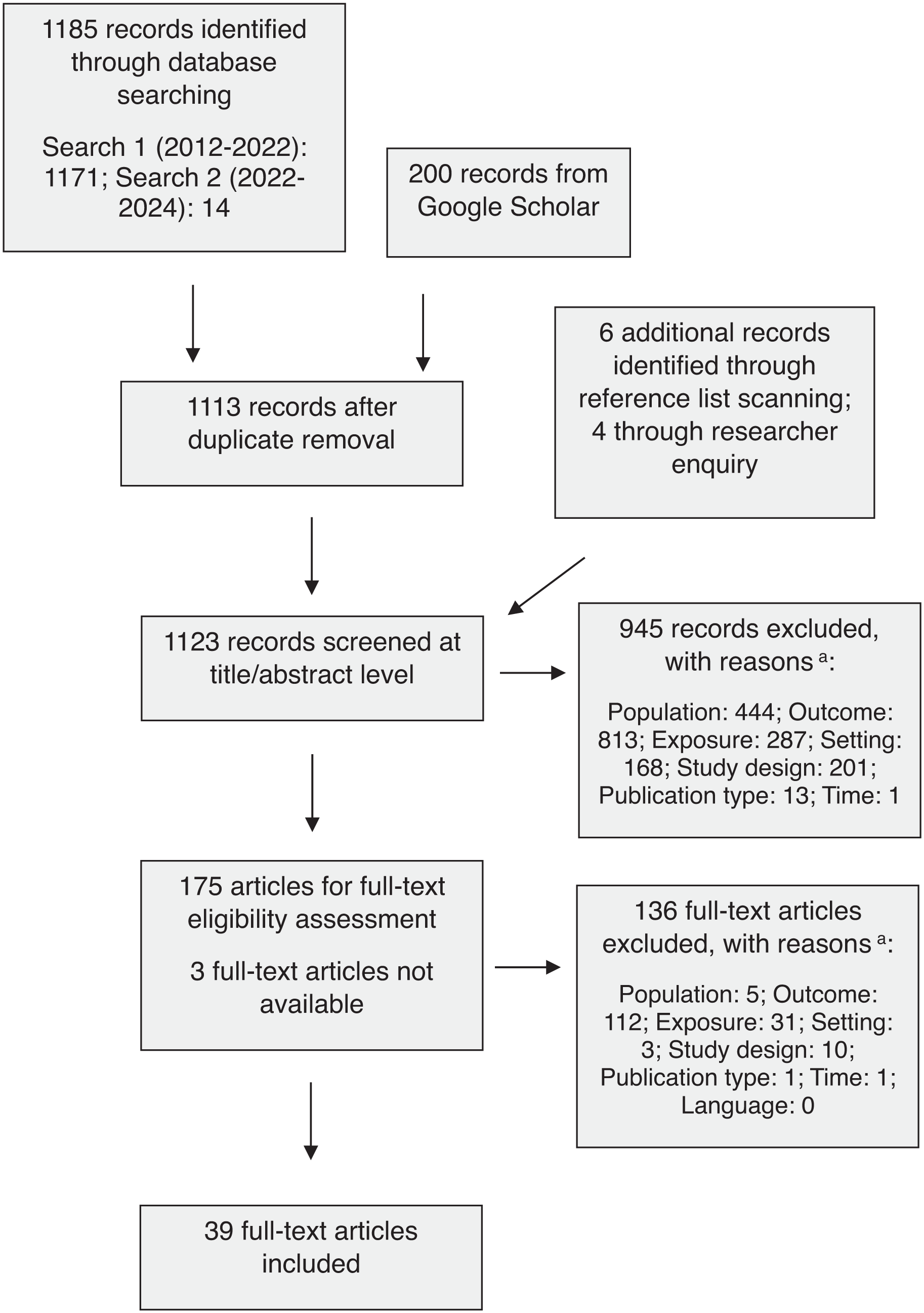
Flowchart.
Results
Study and Population Characteristics
The data extracted from all retrieved studies, including QuADS scores and bibliographic information, are presented in an interactive atlas available at https://osf.io/4wbta. Descriptive data of the sample are presented in Table 3. Almost half of the selected papers were published exclusively in English (48.7%). The remaining articles were published in Spanish (25.6%) or Portuguese (25.6%). Interestingly, two papers published in Portuguese also provided a full-text translation in English.
Selected Paper Characteristics.
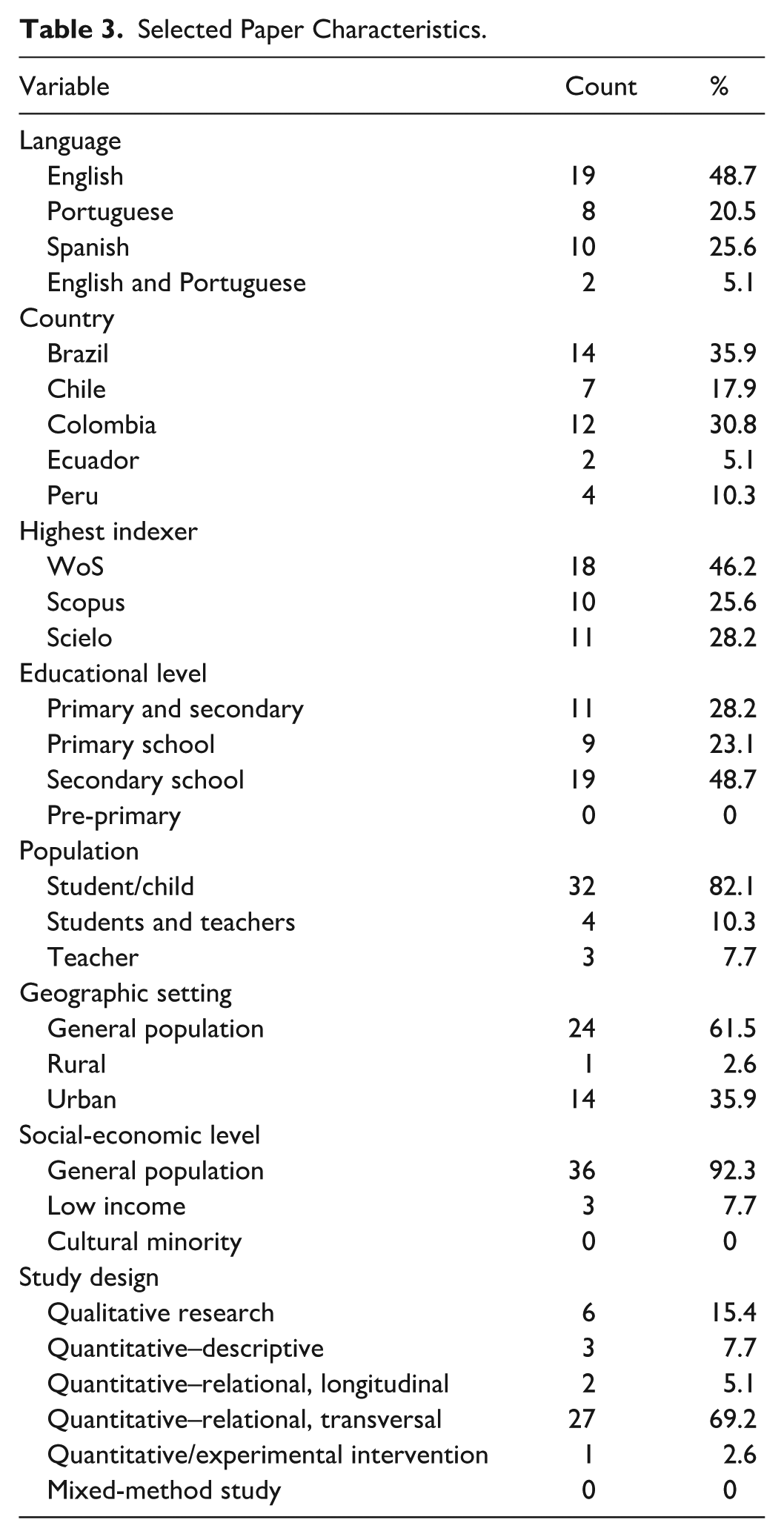
Of the 12 countries considered for our review, only five produced papers complying with all the inclusion criteria. Brazil accounts for 14 of the included studies, followed by Colombia (12), Chile (7), Peru (4), and Ecuador (2).
While most studies focused on how violence exposure affected children, some evaluated its consequences on teachers. Remarkably, pre-primary school populations were not addressed by the selected papers. While three studies specifically focused on low-income populations, none addressed other minorities.
Study Variables
Most studies (76.9%) evaluate the impact of one specific type of violence, while 23.1% study polyvictimization (indicated in our interactive atlas with the value “a combination of types”), including the assessment of two types of violence: war and community violence (three studies), war and family violence (2), school violence and family violence (2), school violence and community violence (2).
Among all studies, a total of 32 different terms were used to label the forms of violence they evaluate. Table 4 presents the terms used by the authors and their frequency in the sample. When coded according to the WHO taxonomy, interpersonal community violence committed by acquaintances is studied most frequently (Table 4). Importantly, the acquaintances involved in the selected studies refer exclusively to the school context (violence committed by peers or teachers).
Violence Types (According to WHO) and Terms Used in the Selected Articles.
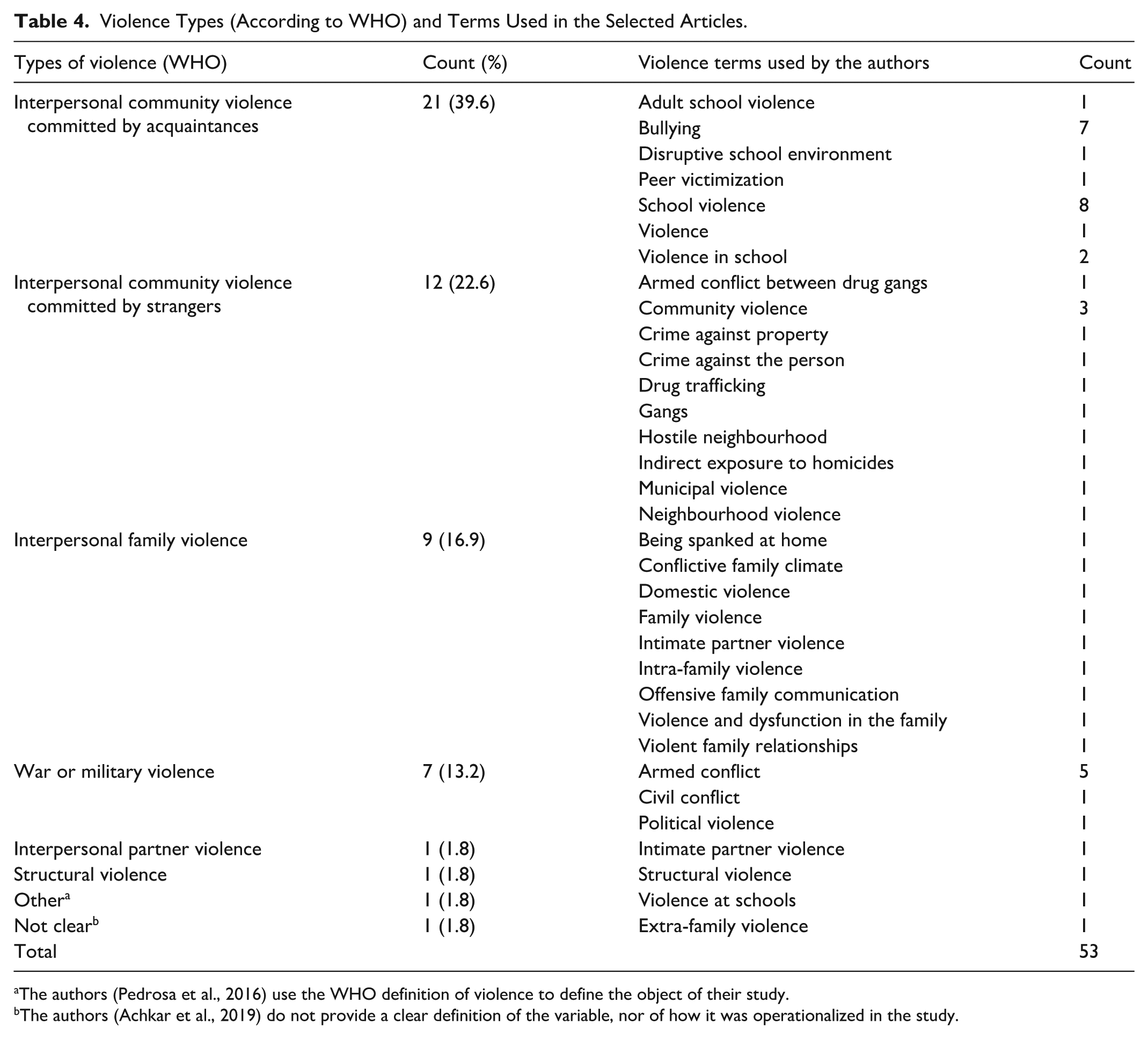
The authors (Pedrosa et al., 2016) use the WHO definition of violence to define the object of their study.
The authors (Achkar et al., 2019) do not provide a clear definition of the variable, nor of how it was operationalized in the study.
Most studies (82.1%) include a single educational outcome variable, 15.4% include two outcomes, and one study evaluates three different educational outcomes. The most frequently measured outcomes are internalizing or externalizing behavior (assessed in 15 studies), achievement scores (9), school climate (9), and social–emotional skills (7). Interestingly, two papers addressed the consequences of violence on teaching practices, a category that was not considered ad hoc. Dropout, enrollment, or promotion was evaluated in two papers. School satisfaction, sense of belonging, and social inclusion were each measured in one paper, as was educational quality.
Twenty-nine studies evaluate the impact of third variables (detailed in the interactive atlas), mainly sex or gender (18 studies), age (11), and aggression (10). Parental education (9) and family or school socioeconomic level (7) are studied simultaneously as mediating variables in 5 studies. The mediating effect of school climate variables is included in four studies.
Study Design and Quality
The large majority of the selected studies (69.2%) use a quantitative cross-sectional design; only two studies (5.1%) are quantitative longitudinal in nature. Six studies (15.4%) use a qualitative design. No mixed studies were included in our selection.
The mean QuADS score in the sample is 22.92, yet total ratings varied greatly (SD = 7.25, range 8.00–44.00). The conceptual underpinning of the research (QuADS item 1) was weak to average (M = 1.85; SD = 0.81), as could be noted in the definition of violence in the selected papers: of the 53 violence variables identified across all studies, definitions were provided only for 30 variables (56.6%).
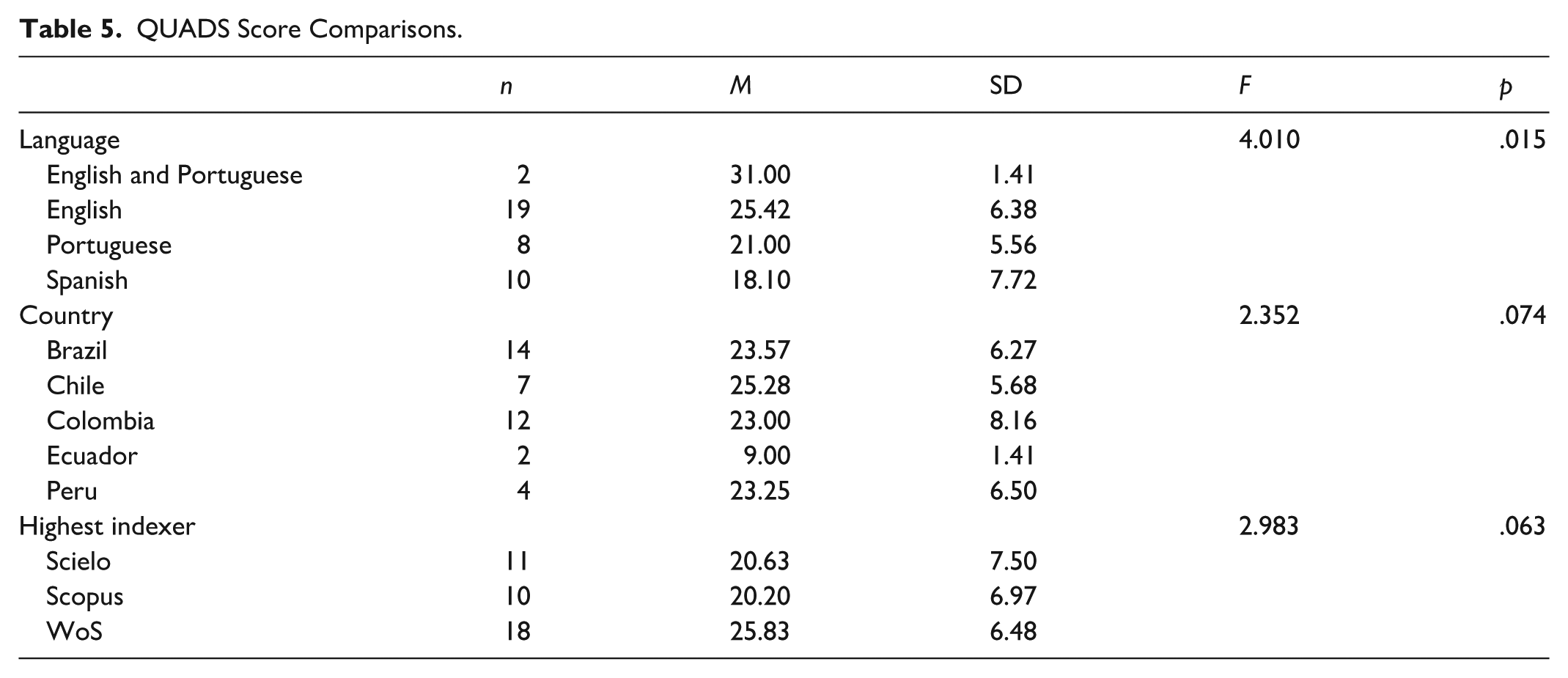
Total QuADS scores according to publishing language, highest indexer and country are provided in Table 5. ANOVA comparisons were only significant for publication language. Post hoc comparisons reveal significantly higher methodological quality of papers published in English compared to those published in Spanish (t = 2.87; pTukey = 0.03).
QUADS Score Comparisons.
Evidence Gaps
Table 6 outlines the studies—and their QuADS scores—available for each pair of violence type and educational outcome addressed in the selected papers.
Evidence and Gap Map With Indication of QuADs Score for Each Included Study.
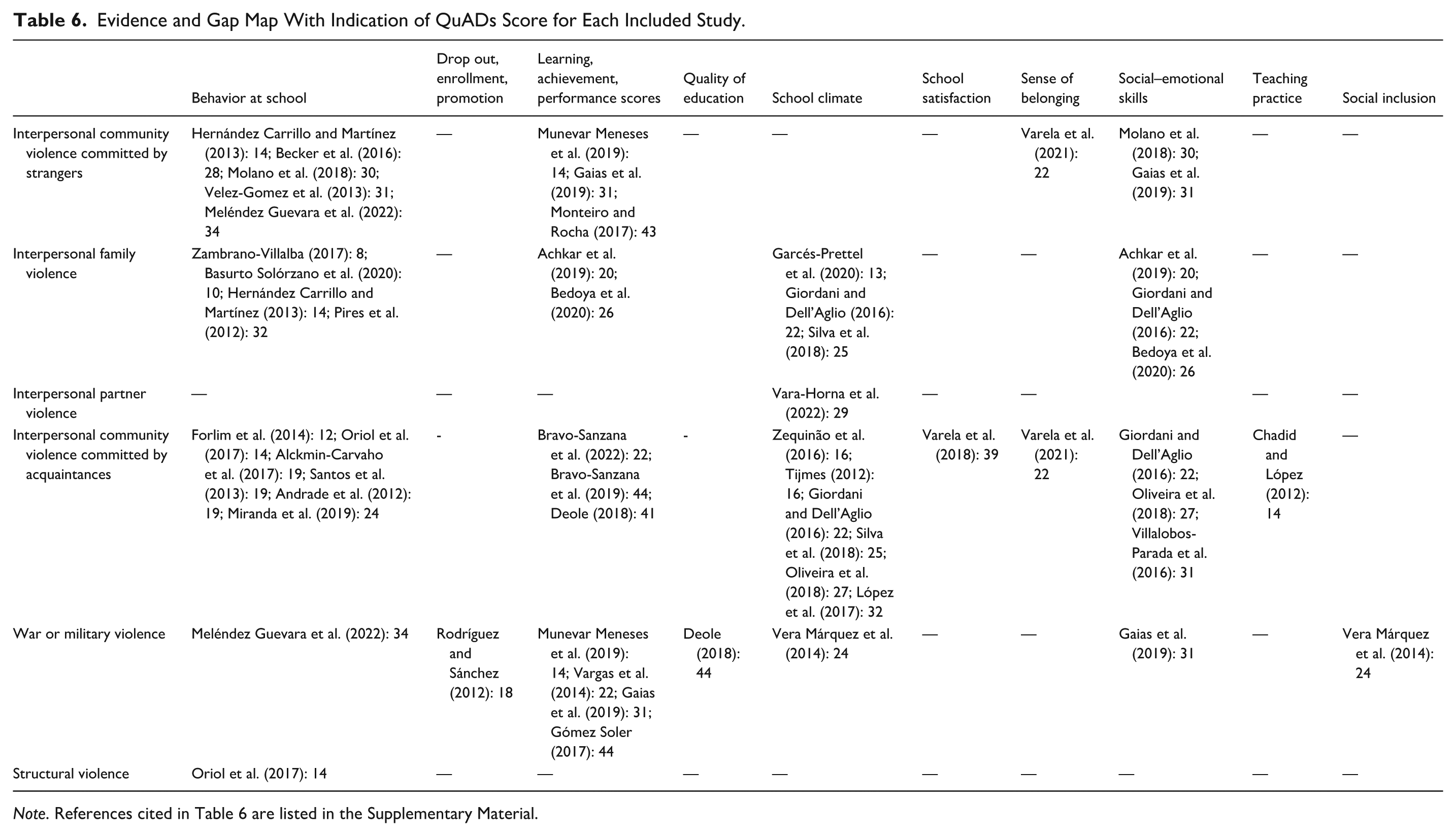
Note. References cited in Table 6 are listed in the Supplementary Material.
Discussion
This paper builds on the observation that South American research is underrepresented in systematic reviews on the educational consequences of violence in children and youth. To make this evidence available, we mapped and characterized eligible studies produced in the region between 2012 and 2024 (first trimester).
Our study provides leads on how the exclusion of non-English literature from systematic reviews hinders the inclusion of South American studies. While 53.8% of the papers in our study were available in English, a significant proportion (46.2%) was written exclusively in Spanish or Portuguese. Additionally, 28.2% of the selected peer-reviewed papers were not indexed in WOS or Scopus, the commonly used bibliographic databases in international review studies (Zhang et al., 2025). These mechanisms explain why only a handful of South American studies (e.g., three in Fry et al., 2018; three in Chávez & Aguilar, 2021) are included in global syntheses on the educational consequences of violence.
Despite South America’s high levels of violence and educational disparities, our evidence mapping highlights a lack of diversity of studies on the educational outcomes of violence in the region. Among the 39 studies included in our systematic review, only five countries—Brazil, Colombia, Chile, Peru, and Ecuador—produced research that met our inclusion criteria, with Brazil and Colombia accounting for 66.7% of all identified studies. This geographic concentration suggests that research production is highly uneven, leaving entire populations unrepresented. This raises concerns about knowledge asymmetries and the funding of research (Lund, 2022; Maternowska & Fry, 2018).
Other gaps appear when focusing on the variables and populations involved in these studies and their methodological characteristics.
Variables Studied
The most studied form of violence is interpersonal violence taking place in schools (38.5%) (e.g., peer violence, bullying, teacher aggression), which makes sense contextually as the outcome variable focused on the educational sphere. The same tendency was observed in the meta-analysis of the international literature performed by Fry et al. (2018), where bullying and peer victimization were the most frequent violence types addressed in the included studies. In contrast, family violence (12.8%) receives less attention in our study selection, despite evidence of its severe impact on child development and widespread occurrence in the region (UNICEF, 2022). Furthermore, the observed quality of the studies on family violence was predominantly low to medium. Effective tracking of family violence inflicted on children typically requires robust and methodologically sound systems in public services, which may not be readily available in some countries (Chioda, 2017).
The empty cells in our evidence and gap map indicate the scarcity of studies that address interpersonal partner violence and structural violence. Considering the high prevalence of partner violence observed in Latin America (Bott et al., 2019; Fry et al., 2021) and the regional relevance of the structural violence construct (Imbusch et al., 2011), prioritizing research about these violence types is paramount.
Polyvictimization is studied in 23.1% of the selected papers. This remarkably high number could reflect the reality of generalized violence in South America (Chioda, 2017). These data indicate that South American studies may provide important leads to better understand this highly understudied phenomenon—the experiencing of multiple forms of violence victimization—important in capturing the cumulative and intersecting nature of violence exposure (Le et al., 2018).
Our broad understanding of educational outcomes allowed us to map evidence beyond typically studied indicators such as grades or standardized test scores (e.g., Chávez & Aguilar, 2021; Nakamoto & Schwartz, 2012; Zhang et al., 2025). Our evidence and gap map confirms that most studies address traditional indicators such as achievement or performance scores. However, a remarkable number of papers have studied behavior (14 papers), social-emotional skills (7 papers), and school climate (11 papers). Despite alarmingly high school dropout rates in South America (ECLAC, 2024), dropout and enrollment are greatly understudied (2 papers).
Analyzing the mediating variables addressed in 29 studies (74.4%) from a socioecological lens, most focus on ontosystem-level variables (e.g., age, gender, or behavior). While four studies included school climate, a meso-level intervening variable, little evidence is available regarding malleable micro-, exo-, and meso-level variables that can help inform educational practices or protective processes in other child ecosystems to prevent the adverse outcomes of violence exposure.
Populations Studied
Looking into the populations addressed by the selected studies, pre-primary education is not represented. From a child development perspective, this omission is concerning, as early childhood is a critical period for cognitive, emotional, and social development. Adversity in the early years can have profound and lasting effects on brain development, stress regulation, and future learning and behavioral outcomes (Bajnath et al., 2020). The absence of research on early childhood outcomes of violence exposure in South America leaves a critical gap in understanding children’s developmental trajectories. It also impedes the design of early interventions to prevent long-term harm.
Despite substantial socioeconomic disparities in academic achievement and the higher exposure rates in socioeconomically vulnerable and minority groups, it is noteworthy that only three studies focus on low-income populations, and none on cultural minorities. While socioeconomic level is a relevant mediating variable to be included in quantitative studies in this context, only 11 studies involve parental educational level or socioeconomic level (either separate or combined) as a proxy for sociocultural vulnerability.
Teacher variables are involved in seven of the selected papers (18%). Despite the central role of teachers in student learning and well-being (UNICEF, 2019), they have been widely overlooked in studies on the educational consequences of violence.
Methodological Characteristics and Challenges
Three methodological challenges can be inferred from our analysis. Firstly, regarding research design, the cross-sectional nature of most studies (69.2%) presents a major limitation, as it prevents causal inferences between violence exposure and educational outcomes. Only two longitudinal studies (5.1%) were identified, restricting our understanding of how violence impacts learning trajectories over time. The complete absence of mixed-method studies implies a missed opportunity for the contextualization and triangulation of statistical findings, among others.
Secondly, publication language in our sample is associated with study quality rather than bibliographic indexing. Papers in our study that are exclusively published in Spanish are significantly lower in quality compared to those available in English. As Lund (2022) adequately points out, non-English speaking scholars from the Global South are more likely to miss out on international collaboration opportunities and resources (e.g., high-quality research training and access to high-quality literature), negatively affecting their general research competence. Publication language, in this sense, might imply structural inequalities in research and publishing (Céspedes, 2021).
Thirdly, in accordance with previous claims regarding the conceptual fragmentation of the study of violence (Kennedy & Ceballo, 2014; Mels et al., 2022), violence terms varied widely in our sample and frequently lacked proper definitions. While this is a difficulty for evidence systematization, the linguistic and conceptual variety in our sample reflects the notion that violence is a phenomenon with heterogeneous and contextualized manifestations.
Study Limitations
While this study provides a comprehensive mapping of research on violence and educational outcomes in South America, some limitations must be acknowledged. Although we did not exclude any languages a priori in our database search, our grey literature search in Google Scholar (in Spanish and Portuguese) may have impeded the inclusion of publications from Suriname, where the official language is Dutch. Furthermore, when extracting the data from the papers written in Spanish and Portuguese, the original terms were translated into English, assisted by Google Translate. Translations from Spanish were revised by the main researcher (fluent in English and Spanish); translations from Portuguese were revised by a knowledgeable research assistant. However, an independent double translation or committee-based approach would have been more appropriate. From the onset of our study, we defined violence as an exposure variable, impeding the inclusion of studies that consider educational vulnerabilities as a trigger for violence exposure. Future studies should understand violence and educational outcomes as a bidirectional issue in order to do justice to the complexity of the relationship (Sharkey, 2018).
Implications for Research Policy and Practice
The methodological, geographic, and population gaps identified in this systematic evidence map have important implications for various stakeholders, including researchers, funding agencies, policymakers, and practitioners working at the intersection of violence prevention and education in South America.
Optimizing Language Gaps in the International Literature
While the PRISMA statement (Page et al., 2021) and other guidelines for review studies explicitly advise against the use of language restrictions, our study shows that a predominant focus on literature published in English limits the inclusion of research performed in South America. As is described by Stern and Kleijnen (2020): “By limiting a review to one language from the outset, we are violating the very essence of what a systematic review is and its purpose in assisting in making informed decisions from the best available evidence” (p. 1819). Current developments in artificial intelligence allow for free access to high-quality translation services. This makes it harder for researchers to cite a lack of resources as a reason to include language and database restrictions in their literature searches. Also, it enables the promotion of bilingual publications, which may enhance the global visibility of locally produced evidence. Promoting multilingual accessibility (e.g., including English translations in Spanish/Portuguese journals) will be key to ensuring that South American evidence is adequately represented in global evidence syntheses on violence and education.
Enhancing Research Quality, Methodological and Geographic Diversity
Prospective research should prioritize longitudinal data collection, which can capture the temporal dynamics and complex mechanisms through which violence exposure affects educational trajectories from early childhood. This may allow for identifying critical periods for intervention. Using mixed-method approaches, data may be further contextualized and triangulated.
International agencies and governments should provide research funding, taking deliberate steps to reduce geographical inequality in evidence production and establish cross-national South–South and South–North research networks. Other structural challenges such as weaker research infrastructure and marginalization of Southern researchers (Lund, 2022; Maternowska & Fry, 2018) should be addressed to enhance geographical diversity in evidence production.
Likewise, international agencies can be conductive in the design and implementation of reliable data collection systems for monitoring child polivictimization of violence, enable cohort studies and long-term follow-up. Facilitating the production of high-quality local data could be considered a valuable strategy for enhancing existing child-protection policies. For example, while INSPIRE provides detailed guidance about how to define and measure core indicators for protecting children against violence, country-level data collection has not yet been concreted (Pan American Health Organization, 2025), constituting an obstacle to the design of evidence-based policies.
Developing Context-Sensitive Conceptual Frameworks
Violence is a phenomenon with heterogeneous and contextualized manifestations. This leads us to question whether existing dominant universal taxonomies and discourses around violence are adequate for capturing the complexities of violence as experienced in South America (Imbusch et al., 2011). For example, the current WHO taxonomy does not provide for possible overlap between general categories. In the case of school violence, one of the most researched domains in our study, some definitions encompass both interpersonal (e.g., between peers, from adults toward students) and collective violence (e.g., social and cultural discrimination). This makes sense from a framework that embraces structural violence as a driver of other forms of violence, whether interpersonal, symbolic, collective, or material (Maternowska & Fry, 2018). Likewise, in the USA, where school violence is often associated with safety threats and school shootings, a specific contextualized framework would benefit knowledge production and its applicability (Bushman et al., 2016). Such context-sensitive frameworks would better serve knowledge production and enhance the applicability of research findings to local contexts.
Addressing Population and Variable Gaps
The near absence of research on pre-primary populations and social and cultural minorities demands deliberate inclusion efforts such as specific funding opportunities and age-appropriate and culturally responsive data collection systems. While several reviews emphasize the need for a socioecological understanding of violence (Maternowska & Fry, 2018; Romano et al., 2015), most studies remain focused on direct consequences of child victimization. Future research should examine the multiple pathways and mediating mechanisms through which violence affects education, including family, school, and community-level factors. The impact of violence exposure on teachers is widely understudied, despite their strong influence on students’ educational outcomes, and critical role in the implementation of child protection policies, making them a priority for further research.
Regarding educational outcomes, despite common focalized practice, our study points out that the time may be right to examine educational outcomes following violence more holistically, allowing to capture several crucial elements for learning simultaneously (UNICEF, 2019). Funding bodies should prioritize studies that explore several educational outcomes, moving beyond traditional metrics like test scores to include social emotional development, peer relationships, and school belonging. Additionally, dropout remains understudied and warrants greater research attention, particularly given its significance in the South American context.
Finally, while we identified research gaps in specific types of violence and age groups, a deeper content analysis—beyond the scope of an evidence map—would be needed to assess theoretical frameworks, identify intervention strategies, and make policy recommendations. We hope our evidence mapping can contribute to these future endeavors.
Critical Findings
A total of 39 studies on the educational outcomes of violence exposure in children and adolescents in South America were included in our study.
Only five countries, from a total of 12, produced evidence published in peer-reviewed manuscripts available in English, Spanish, or Portuguese.
Entire populations remain unrepresented, particularly children in pre-primary education and minority groups.
Almost half of the reviewed studies were published in Spanish or Portuguese, limiting their visibility in English-language reviews.
Only 5.1% of studies used longitudinal methods, limiting causal inferences, and no mixed-method studies were identified, missing opportunities for contextualized insights.
The reviewed research used 32 different terms for types of violence, indicating conceptual fragmentation, and only 56.6% of studies provided clear definitions for the variables analyzed.
Implications for Research, Policy, and Practice
Systematic reviews on violence and education must expand language inclusion criteria to expand geographical coverage.
International collaborations and investments are needed to expand research capacity in underrepresented South American countries.
Educational research and policies should move beyond traditional performance metrics (grades, test scores) to include broader indicators such as school climate, socio-emotional skills, and student well-being to better capture the full educational impact of violence exposure.
South American research literature holds the potential to enrich global knowledge on the educational outcomes of violence as it adds evidence on polyvictimization and context-specific conceptions of violence affecting children and adolescents.
Future studies on the educational consequences of violence in the region should prioritize longitudinal designs to better capture the causal pathways and mixed-method research to enhance a deeper understanding of quantitative evidence.
Supplemental Material
sj-docx-2-tva-10.1177_15248380261433019 – Supplemental material for “The Educational Outcomes of Violence: A Systematic Evidence and Gap Map of Research From South America”
Supplemental material, sj-docx-2-tva-10.1177_15248380261433019 for “The Educational Outcomes of Violence: A Systematic Evidence and Gap Map of Research From South America” by Cindy Mels, David Preston and Agustina González in Trauma, Violence, & Abuse
Supplemental Material
sj-rtf-1-tva-10.1177_15248380261433019 – Supplemental material for “The Educational Outcomes of Violence: A Systematic Evidence and Gap Map of Research From South America”
Supplemental material, sj-rtf-1-tva-10.1177_15248380261433019 for “The Educational Outcomes of Violence: A Systematic Evidence and Gap Map of Research From South America” by Cindy Mels, David Preston and Agustina González in Trauma, Violence, & Abuse
Supplemental Material
sj-xlsx-3-tva-10.1177_15248380261433019 – Supplemental material for “The Educational Outcomes of Violence: A Systematic Evidence and Gap Map of Research From South America”
Supplemental material, sj-xlsx-3-tva-10.1177_15248380261433019 for “The Educational Outcomes of Violence: A Systematic Evidence and Gap Map of Research From South America” by Cindy Mels, David Preston and Agustina González in Trauma, Violence, & Abuse
Footnotes
Acknowledgements
Our appreciation goes out to Alexa Von Hagen for her guidance regarding the study protocol and to the UCU Vicerrectoría de Investigación, which allowed the following students to collaborate in the project: Sabrina Masini, Paulina Berti, Ximena Viera, Thiago Mahia, Daniel Rivas, Melisa Moreno, and Valentina Fernández.

Ethical Considerations
This study is a review of the existing literature and did not involve the collection of new data from human participants; therefore, ethical approval was not required.
Funding
The authors received no financial support for the research, authorship, and/or publication of this article.
Declaration of Conflicting Interests
The authors declared no potential conflicts of interest with respect to the research, authorship, and/or publication of this article.
Data Availability Statement
Data extracted from included studies (beyond the main variables provided in the evidence atlas) can be made available upon request.
Supplemental Material
Supplemental material for this article is available online.
Notes
Author Biographies
References
Supplementary Material
Please find the following supplemental material available below.
For Open Access articles published under a Creative Commons License, all supplemental material carries the same license as the article it is associated with.
For non-Open Access articles published, all supplemental material carries a non-exclusive license, and permission requests for re-use of supplemental material or any part of supplemental material shall be sent directly to the copyright owner as specified in the copyright notice associated with the article.
