






Abstract
Various dimensions of parenting have been associated with youth risk behaviors, such as substance use and dating violence. These associations have spawned many prevention strategies that focus on parenting. However, it is unclear which characteristics of parent–youth relationships, and thus, which parent-focused prevention strategies, may be most influential in youth risk behaviors and, thus, which should be targeted in prevention. Using responses from the YouthStyles 2007 survey (N = 1,357), this study identified three youth-reported parent–youth relationship characteristics: communication about risk behaviors, closeness/respect, and rules/monitoring. The authors examined the associations among these characteristics and youths’ demographics, attitudes supporting controlling dating relationships, and use of alcohol, marijuana, and tobacco. Results suggested risk behavior communication was more frequently reported by girls and was more frequent among older youth. Closeness/respect and rules/monitoring were more frequent among younger youth. Regressions suggested communication about risk behaviors was not a predictor of attitudes supporting controlling dating relationships but was a significant predictor of substance use, closeness/respect and rules/monitoring predicted substance nonuse and attitudes unsupportive of controlling dating relationships. The findings suggest that parental communication alone may not be sufficient to influence youth risk taking, but that parental monitoring and the establishment of respectful, close relationships with children may be important elements of parent-focused health promotion efforts.
Risky behaviors put young people at risk of injury, illness, reduced quality of life, and death. On a 2007 survey of U.S. high school students, 45% reported using alcohol, 20% reported using tobacco, and 20% reported using marijuana in the past 30 days; nearly 10% reported experiencing physical violence by their dating partner in the past year (Centers for Disease Control and Prevention [CDC], 2007). Reports of dating violence victimization have been associated with subsequent health risk behaviors, such as binge drinking and suicide attempts (Black, Noonan, Legg, Eaton, & Breiding, 2006), suggesting that dating violence is associated with the health and well-being of adolescents. For this reason, many health promotion strategies have attempted to harness the influence of parents and other caring adults in the protection of young people. The focus on parents has spawned an impressive array of popular books, websites, scholarly journals, and national media campaigns (e.g., Do you know where your children are?). Despite the interest and investment in parenting, questions remain about the strength of the association between parenting and youth risk behaviors, especially in newer areas such as dating violence. Therefore, it is unclear if and when prevention strategies focused on parenting will have preventive effects.
Research supporting the links between parenting and youth risk behaviors is needed to inform the development or refinement of prevention programs and policies. For example, several national campaigns such as Philip Morris’ Raising Kids Who Don’t Smoke and CDC’s Choose Respect urge parents to “talk to their children” about some risky behavior, but it is unclear that talking in isolation is associated with adolescent risk taking or if other characteristics of parent–youth relationships, such as monitoring, must be present to prevent risk behaviors. Without evidence to support the association between talking and youth behaviors, as well as evidence about the effectiveness of communication as a preventative strategy, the expenditure of resources on such campaigns may fail to translate into public health impact on adolescent health. In the current study, to strengthen the etiological evidence base of parent-focused youth risk prevention strategies, we used a national youth survey to identify characteristics of parent–youth relationships and the associations between these characteristics and youth risk behaviors, such as substance use and youth attitudes supporting the use of control in dating relationships (e.g., being jealous, keeping track of one’s dating partner).
Parent–Youth Characteristics and Youth Risk Behaviors
Multiple dimensions of parenting have been investigated in the youth risk and prevention literatures. Though parenting models may differ in their theoretical underpinnings, some dimensions of parenting, such as monitoring and relationship quality, have garnered support across parenting models and risk behaviors, such as youth substance use and antisocial behavior (Dishion & McMahon, 1998). Other dimensions of parenting, such as parent–youth communication, emerge from public health theories of behavior change (e.g., health belief model), in which knowledge and awareness leads to changes in attitudes and behaviors. Although a number of parenting dimensions and their associations with youth risk behaviors have been examined, to set the stage for our study, we briefly review literature on three broad dimensions of parenting that have been well established in the youth risk behavior literature, capture distinct, albeit related, aspects of parent–youth relationships, and have been translated into prevention strategies.
Monitoring
Parental monitoring and supervision is typically defined as behaviors that include awareness of children’s activities, coupled with rules to establish and enforce acceptable boundaries. In the research linking parenting and adolescent risky behaviors, monitoring appears to have a consistently strong relationship to adolescent outcomes. Parental monitoring has been shown to be inversely related to alcohol use (Barnes, Hoffman, Welte, Farrell, & Dintcheff, 2006; Beck, Boyle, & Boekeloo, 2003; Cottrell et al., 2003), marijuana initiation (Oxford, Harachi, Catalano, & Abbott, 2001), marijuana use (Cottrell et al., 2003), other drug use (Ledoux, Miller, Choquet, & Plant 2002), cigarette use (Ledoux et al., 2002), school truancy (Li, Stanton, & Feigelman, 2000), and risky sexual activity (Rupp & Rosenthal 2007).
Mounting evidence also suggests that monitoring is related to dating violence victimization and perpetration. Howard, Qiu, and Boekeloo (2003) found that monitoring protected against victimization, and Chapple (2003) found that low parental monitoring was significantly associated with dating violence perpetration. Lavoie et al. (2002) found that the combination of perceived low parental monitoring in late childhood coupled with antisocial behavior at age 15 years put boys at risk of becoming involved in dating violence by age 16. Another study found that perceptions of parental monitoring were associated with girls’ but not boys’ dating violence (Chase, Treboux, & O’Leary, 2002).
Closeness
Substantial work suggests that emotional closeness between a parent and child is important. Although the research is varied and nuanced, some consistent effects have been found. First, parental support—the feeling that a parent is helpful, caring, and respectful toward the child—has been associated with fewer adolescent risk behaviors, such as risky sexual behavior (Luster & Small, 1994) and illicit substance use (Stice, Barrera, & Chassin, 1993). Second, perceived parental trust has been shown to be associated with lower tobacco and marijuana use, as well as sexual activity among girls and alcohol use among boys (Borawski, Ievers-Landis, Lovegreen, & Trapl, 2003). Third, parent–child closeness or connectedness has been associated with a lower risk for adolescent pregnancy (Miller, Benson, & Galbraith, 2001), and parent–child attachment deters substance abuse initiation (Oxford et al., 2001). The literature on parent–child closeness and dating violence is less developed but still suggests a negative association between closeness and dating violence; Chase et al. (2002) found that girls who perpetrate dating violence were more likely to perceive their parents as less involved than nonviolent girls. Simons, Lin, and Gordon (1998) found that involvement in dating violence by males was associated with low parental support and involvement.
Communication
The evidence regarding the utility of parental communication about risk behaviors is mixed. Typically, “communication” or “talking” is a broad catch-all category that often fails to capture considerable variation in the content of what is communicated, the frequency and quality of the communication, and the timing of the discussion (e.g., before or after substance use has been initiated). These methodological difficulties may explain why the results are mixed (Miller et al., 2001). For example, many researchers have examined the association between parent–child communication related to tobacco use and risky sexual behavior. In some tobacco studies (e.g., Ennett, Bauman, Foshee, Pemberton, & Hicks, 2001), parental communication appears to have a negative effect on initiation or use, whereas in others it has no effect or a positive effect. A great deal of parent–child communication research has addressed risky adolescent sexual behavior, where results are also mixed. Huebner and Howell (2003) argue that the frequency of parent–teen communication is not associated with adolescent risk taking, whereas Wilson and Donenberg (2004) found that the quality of communication is associated with risk taking. Some research suggests that communication, in combination with skill building, monitoring, and teaching parental values can lead to reduced sexual initiation among youth (Aspy et al., 2006).
Current Study
Parental monitoring, closeness, and in some cases, communication, have been associated with fewer youth risk behaviors. Preliminary evidence suggests parent–youth characteristics may also be associated with adolescent dating relationships; to extend these findings, we used a data-driven approach to identify and examine parent–youth characteristics reported by youth on a national survey. Although several dimensions of parenting are included in the youth risk literature, the current study used data that were not originally intended as cohesive measures of parent–youth relationship characteristics. Therefore, we employed a largely exploratory approach, such that we allowed naturally occurring constructs in the data to emerge, but the interpretation of these constructs was guided by the literature on parenting dimensions as described above. With this approach, we examined the associations among youth reports of their relationships with their parents, youth attitudes supporting controlling dating relationships, and alcohol, marijuana, and tobacco use. We also examined how the characteristics varied by youth and parent demographic characteristics.
Method
Participants
Participants were the 1,357 respondents to the 2007 YouthStyles survey, of whom 693 (51%) were boys and 664 (49%) were girls. Approximately 10% of respondents were from each age between 9 and 17, and 8.5% (n = 115) were 18 years old. A total of 76% (n = 1,032) of respondents had parents who were currently married, 9.6% (n = 130) were divorced, 7.5% (n = 102) were never married, 4.1% (n = 55) were in a domestic partnership, 1.5% (n = 20) were separated, and 1.1% (n = 15) were widowed.
Procedure
The YouthSyles survey is part of Styles 2007, which is composed of three consumer mail panel surveys, ConsumerSytles, YouthStyles, and HealthStyles, administered in two waves. The sampling and data collection for Styles 2007 was conducted by Synovate, Inc. Respondents were recruited to join the mail panel through a four-page recruitment survey. In return for their participation, respondents were given a small incentive and were entered into a sweepstakes. For the initial wave, stratified random sampling was used to generate a list of 20,000 potential respondents. A “households-with-children” supplement (N = 6,000) was used to ensure adequate numbers of potential respondents for the YouthStyles survey during the second wave. In 2007, the response rate for the households with children supplement was 58.1%. In the second wave, 2,566 YouthStyles surveys were sent to half of the mail panel households that returned the ConsumerStyles survey for the initial wave (n = 11,758). Youth and parents used separate postage-paid return envelopes. Responses were received from 1,357 YouthStyles participants, yielding a response rate of 52.8%.
Instruments
Three demographic characteristics from the survey were used, namely, respondent gender, respondent age, and parents’ marital status. Marital status had several response options, resulting in small cell sizes, so we collapsed several response choices into two categories: one that approximates having two parents/adult caregivers in the home (currently married or in a domestic partnership) and one that approximates having one parent in the home (separated, widowed, divorced, or never married).
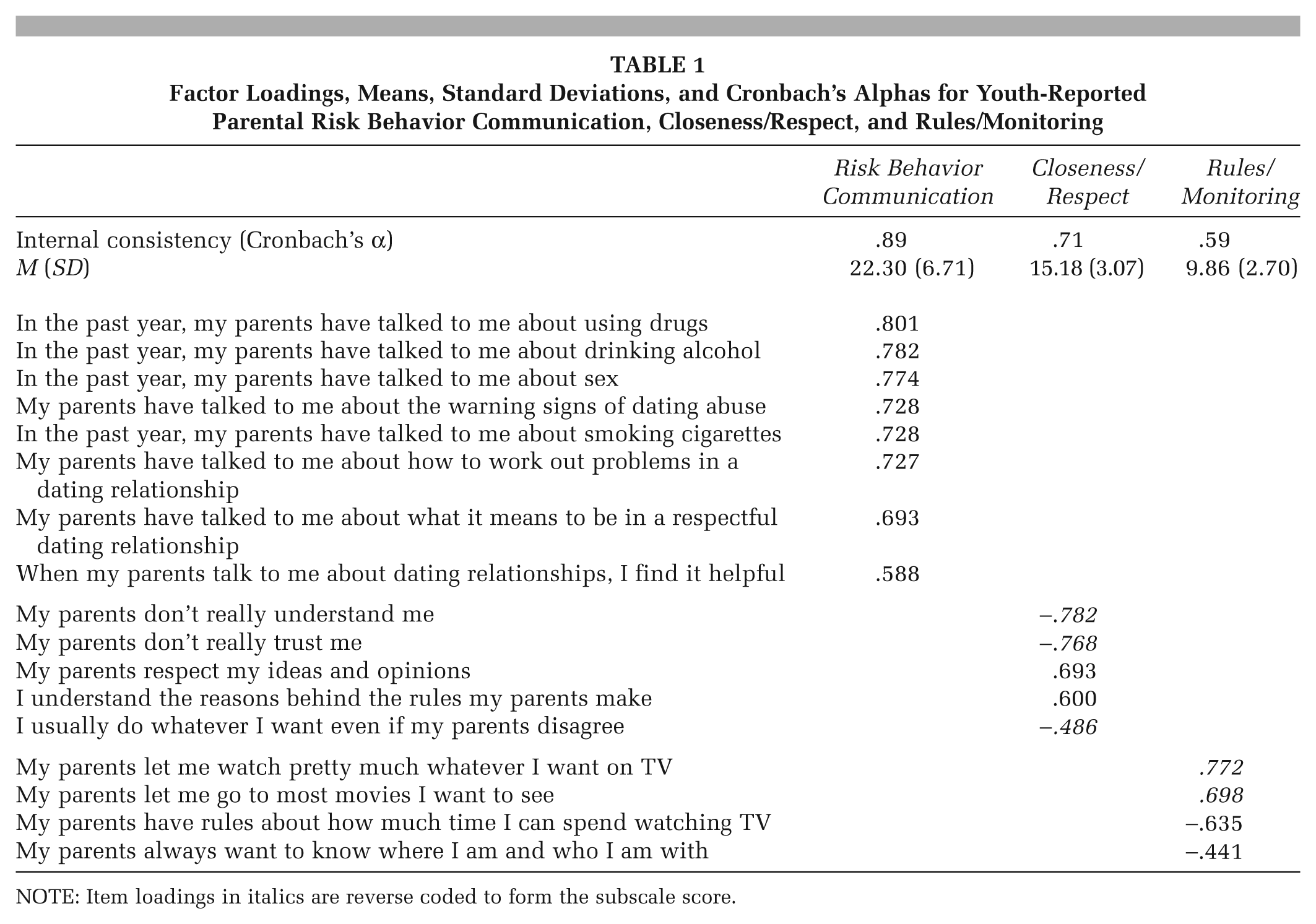
Youth responses to the attitudes and opinions section of YouthStyles were used in the current study. The section is composed of 66 items, of which CDC researchers have access to 44. Using a data-driven approach to develop dimensions of parenting, we selected the 20 items that involved aspects of parenting (described below and in Table 1). Youth responded to these items on a 4-point Likert-type scale, on which 1 = really disagree and 4 = really agree. To assess attitudes supporting controlling dating relationships, we used the following items: “My idea of a good relationship is having a boyfriend/girlfriend who keeps track of me at all times,” “My idea of a good relationship is having a boyfriend/girlfriend who gets jealous when I talk to other boys/girls,” and “My idea of a good relationship is having a boyfriend/girlfriend who spends all of his/her free time with me.” Youth responded to these items on a 4-point Likert-type scale, on which 1 = really disagree and 4 = really agree. For data analysis, dichotomous responses were created from the dating attitude responses, such that really agree and agree were both coded as “agree” and really disagree and disagree were both coded as “disagree.” To assess substance use, we selected items that assessed use of tobacco, alcohol, and marijuana. In response to each item, youth indicated whether they “Never used [the substance],” “Tried [the substance], but did not use in the past month,” or “Used [the substance] in the past month.” Substance use item responses were recoded to create dichotomous categories: “Tried” (created from “Tried [the substance], but did not use in the past month” and “Used [the substance] in the past month”) and “Never Tried” (created from “Never used [the substance]”).
Factor Loadings, Means, Standard Deviations, and Cronbach’s Alphas for Youth-Reported Parental Risk Behavior Communication, Closeness/Respect, and Rules/Monitoring
NOTE: Item loadings in italics are reverse coded to form the subscale score.
Data Analysis
We performed several exploratory principal components factor analyses with varimax rotation on the 20 parent-relevant items to arrive at reasonable and meaningful factors that broadly represented characteristics of parent–youth relationships. We then used Pearson and point biserial correlations to examine the associations between demographic characteristics, youth risk behaviors, and parent–youth relationship characteristics. Finally, binary logistic regressions with exp(β) odds ratios were used to determine which dimensions of parenting and/or demographic variables predicted attitudes supporting controlling dating relationships and substance use.
Results
The initial principal components analysis with varimax rotation for the 20 parent-relevant items produced five factors with eigenvalues greater than one. Several factors only had two or three items, so we limited the number of factors in subsequent analyses to four, three, and two to explore the possibility of a more parsimonious and interpretable solution. The three-factor solution was most parsimonious and interpretable and produced factors that had the most acceptable internal consistency of any solution. However, three items—“I will get a vaccine if my parent/guardian says I should,” “My parents buy me most things I ask for,” “My parents ask for my advice when planning family vacations”—cross-loaded in equal amounts or did not load strongly onto any factor and were excluded from subsequent analyses. The remaining 17 items and the final factor loadings are presented in Table 1. The three factors were labeled as risk behavior communication, closeness/respect, and rules/monitoring based on their constituent items. To create subscales from the factors, we reverse coded five items and summed item responses. Higher subscale scores indicate more communication, closeness/respect, or rules/monitoring. The means, standard deviations, and internal consistency coefficients for each subscale/factor are presented in Table 1.
In terms of the frequencies of participants who agreed with attitudes supporting controlling dating relationships, 18.9% (n = 257) agreed that a good relationship partner “keeps track” of them, 9.1% (n = 124) agreed that a good relationship, the partner is jealous, and 38.0% (n = 515) agreed that relationship partners should spend all of their free time together. Regarding substance use, 32.2% (n = 436) reported ever trying alcohol, 13.8% (n = 187) reported ever trying tobacco, and 10.4% (n = 141) reported ever trying marijuana.
Pearson and Point Biserial Correlations Between Variables
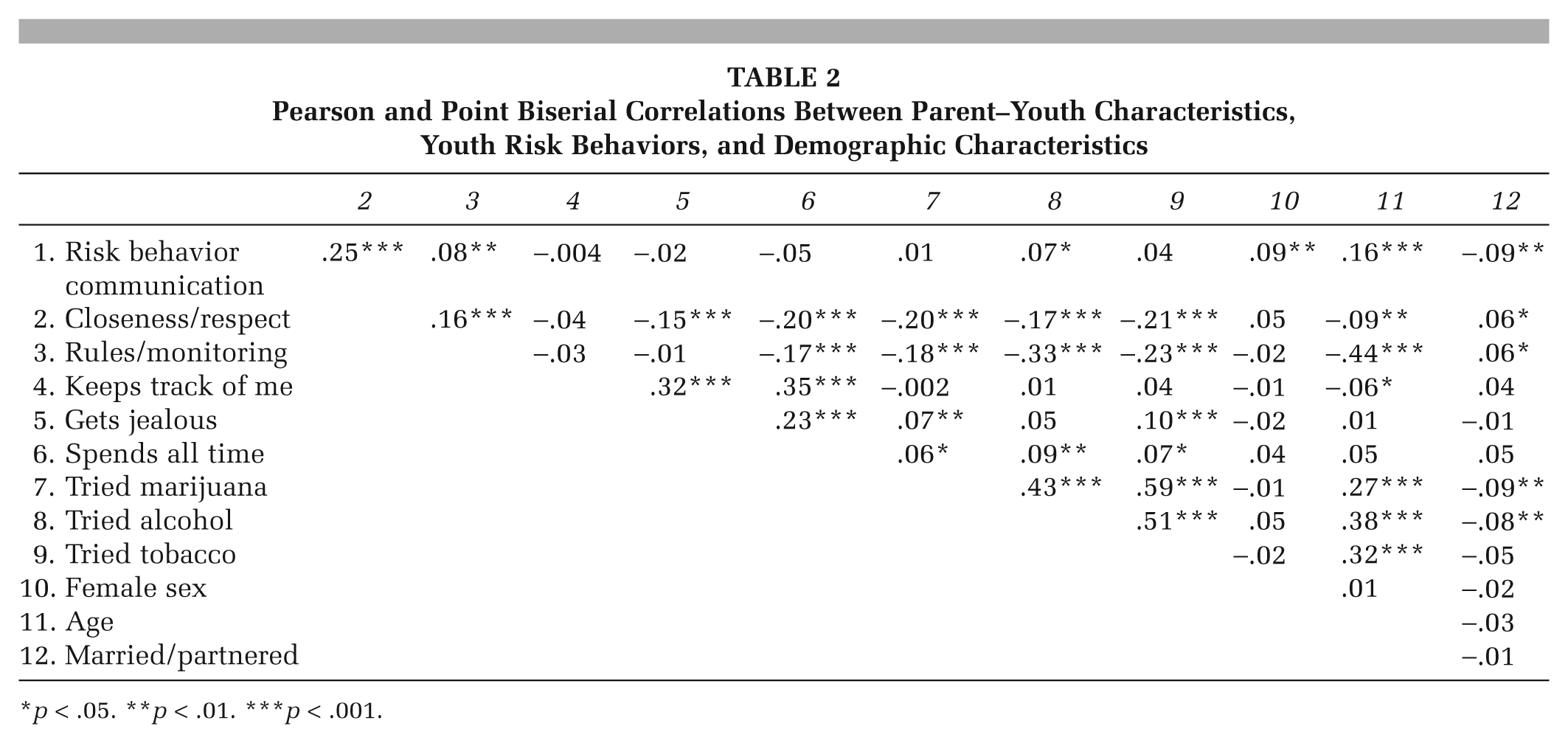
To determine the associations between variables, Pearson (both variables continuous) and point biserial (one variable continuous, one variable dichotomous) correlations were performed for risk behavior communication, closeness/respect, and rules/monitoring, youths’ gender, age, parents’ marital status, attitudes supporting controlling dating relationships, and substance use. The correlations are presented in Table 2. Point biserial correlations function as effect sizes, and, with the exception of age, most effects for demographic variables were small (r < .10).
Pearson and Point Biserial Correlations Between Parent–Youth Characteristics, Youth Risk Behaviors, and Demographic Characteristics
p < .05. **p < .01. ***p < .001.
Prediction of Youth Risk Behaviors
Finally, we performed binary logistic regressions with the dichotomous dating attitude and substance use variables as the dependent variables and the three demographic variables and three youth-reported parent–youth relationship characteristics as the independent variables. The results of the regressions and an explanation of the exp(β) odds ratios are presented in Table 3. The findings related to attitudes supporting controlling dating relationships suggest that younger age and rules/monitoring were the only significant negative predictors of “keeping track,” such that younger youth and those who reported less rules/monitoring were more likely to report the attitude. Closeness/respect negatively predicted “gets jealous,” such that less closeness/respect was associated with more frequent agreement with the attitude. Closeness/respect and rules/monitoring were significant predictors of disagreement with the belief that dating partners spend all of their free time together, whereas youth with married/partnered parents were more likely than those with unmarried parents to report agreement with the belief that dating partners spend all their free time together.
Regressions for Youth-Reported Parental and Demographic Characteristics as Predictors of Dating Attitudes and Substance Use
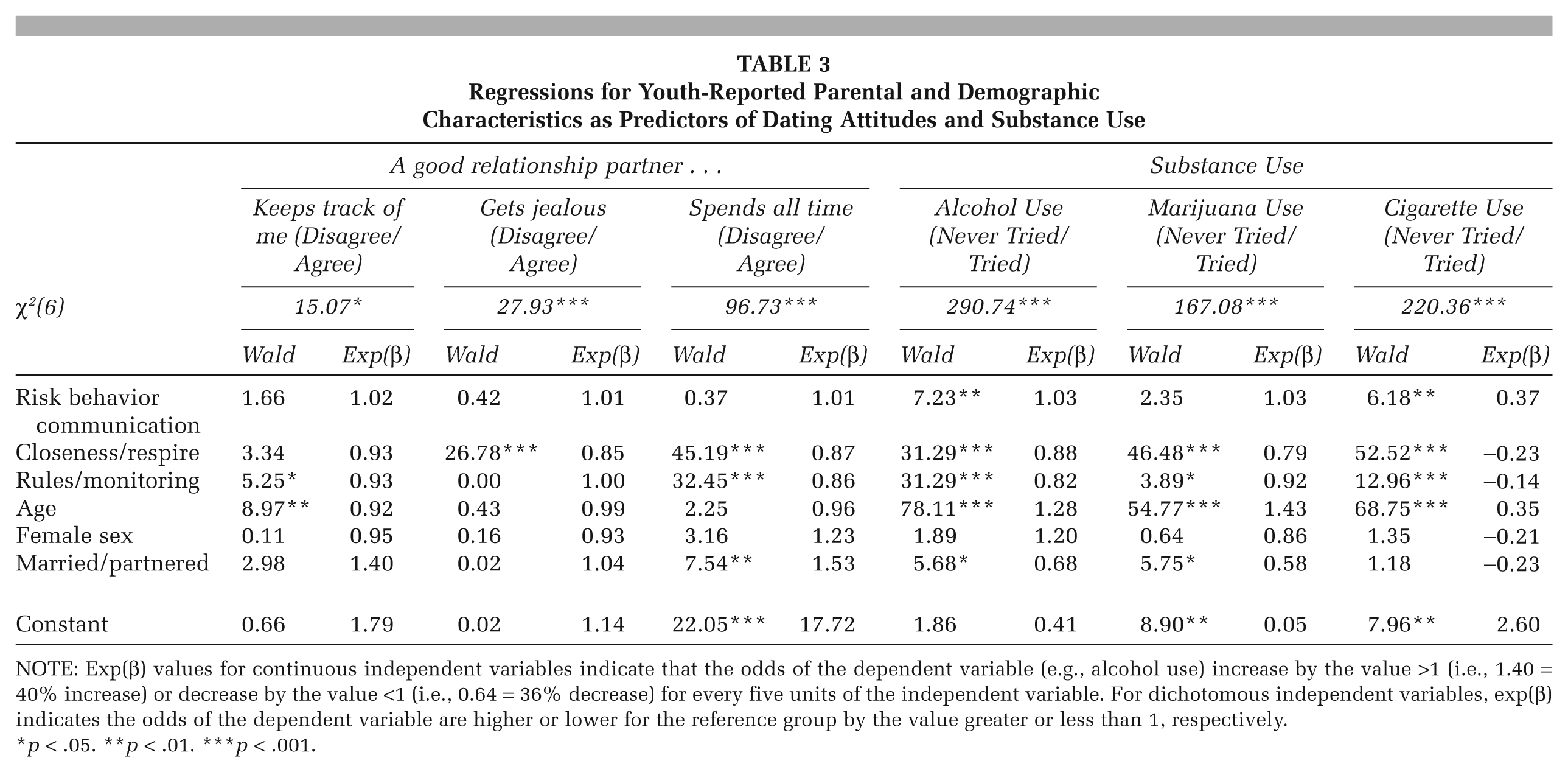
NOTE: Exp(β) values for continuous independent variables indicate that the odds of the dependent variable (e.g., alcohol use) increase by the value >1 (i.e., 1.40 = 40% increase) or decrease by the value <1 (i.e., 0.64 = 36% decrease) for every five units of the independent variable. For dichotomous independent variables, exp(β) indicates the odds of the dependent variable are higher or lower for the reference group by the value greater or less than 1, respectively.
p < .05. **p < .01. ***p < .001.
For alcohol use, regressions suggested risk behavior communication and older age predicted alcohol use, whereas closeness/respect, rules/monitoring, and having married parents predicted alcohol non-use. For marijuana use, closeness/respect, rules/monitoring, and having married parents predicted marijuana nonuse, whereas older age predicted use. For cigarette use, risk behavior communication and older age predicted use, closeness/respect, rules/monitoring, and having married parents predicted nonuse.
Discussion
The current study used exploratory analyses and cross-sectional survey data to examine the associations among youth reports of three parent–youth relationship characteristics and dating attitudes and self-reported substance use. Results found that youth reports of whether or not their parents had talked with them about risk behaviors were not associated with attitudes supporting controlling dating relationships. For alcohol and cigarette use, parents’ risk behavior communication was associated with substance use rather than nonuse. Although the cross-sectional data provides no indication of the temporal ordering of these variables, it is possible that parents talked to youth about substance use after the youth was caught trying the substance or in response to the youth’s affiliation with substance-using friends. We are not suggesting risk behavior communication to youth about substance use increased their likelihood of using, though this is an empirical question in need of further study.
Associations among parent–youth relationship characteristics and demographic variables also had potential implications for the development and implementation of prevention strategies and policies. For example, it is problematic that girls were more likely than boys were to report that their parents talked to them about risk behaviors, including dating violence, as both boys and girls are likely to be perpetrators of teen dating violence (Hickman, Jaycox, & Aronoff, 2004; Sears, Byers, Whelan, & Saint-Pierre, 2006) and boys’ dating violence is more likely to result in injury than girls’ (Molidor, Tolman, & Kober, 2000). It is also problematic that parents were more likely to talk to older youth about risk behaviors, as the age of onset for dating violence and substance abuse may occur in the preteen or early teen years (Burcky, Reuterman, & Kopsky, 1988). In contrast to these practices, evidence-informed prevention strategies would target both boys and girls during developmental phases that precede the onset of violence and substance use.
The consistent negative effects of parental closeness/respect and rules/monitoring on youth risk behavior and attitudes supporting controlling dating relationships stood out in this study. This effect was similar in boys and girls and either closeness/respect and/or rules/monitoring were significant predictors of every form of substance nonuse or disagreement with attitudes supporting controlling dating relationships. These results suggest that the quality of the parent–child relationship, rather than communication about risk behaviors, was associated with healthy behaviors in the current sample. Results also suggest that the associations between youth risk behaviors and parent–youth relationship characteristics varies based on the risk behavior, in that different patterns of results were found for substance use and dating attitudes. Future work may examine whether prevention programs for dating violence also affect substance use, and vice versa, or if different strategies are needed for different risk behaviors. Moreover, prevention programs may need to be developed or refined to include skills that will enhance parents’ ability to monitor youth and develop respectful relationships with them. Existing programs that target communication, in isolation, must be evaluated for effectiveness.
The study was limited by several factors. First, the sample was not nationally representative, although the sampling technique sought to obtain a representative sample. Specifically, the sample’s demographic characteristics suggest more youth than expected were from two-parent homes and rates of substance use were substantially lower than national averages (CDC, 2007). Therefore, the current sample appears to have reported fewer problem behaviors than the population of youth in general. Additionally, the survey did not capture respondent race/ethnicity, which precluded us from examining group differences or health disparities. Our analyses were largely exploratory. Scales and orthogonal factors were created based on the YouthStyles survey questions, rather than validated instruments. Despite this, the factors closely resembled well-studied parenting constructs and two of the three parent–youth relationship characteristics had internal consistency coefficients >.70. The unacceptable alpha for the rules/monitoring factor likely results from the method of scale construction and the selection of items from a survey that was not intended specifically to assess these constructs. To maintain the exploratory, data-driven nature of the study, we did not manipulate the scale further after conducting the factor analyses. However, adding or dropping items may improve the scale’s reliability. Given this limitation, the nature of the factor development, and the cross-sectional and self-reported nature of the data, the factors and items are best described as proxies for the behaviors of interest and do not represent ideal measures of parent–youth relationship characteristics, dating attitudes, or substance use. Because of the low reliability, particular caution may be used when interpreting the results from the rules/monitoring scale. In addition, youths’ agreement with statements about their parents’ behaviors tell us little about the context of the parenting factors and our analyses do not indicate if an interaction is present, such that communication is effective in high-quality relationships. Although our sample size resulted in a well-powered study, these limitations suggest that the results should be viewed as preliminary and in need of replication.
Future work may address these limitations by employing reports from both youth and parents, by measuring attitudes and behaviors at multiple time points, by using validated measures of parenting and youth risk behaviors, and by examining not only the main effects of parent–youth characteristics but also interactions between factors, such as communication and respect. Multivariate models are needed for the development of comprehensive prevention programs and may identify particular contexts (e.g., close parent–child relationships) in which certain preventive strategies (e.g., communication) are most effective.
There is an urgent need for effective prevention for dating violence and substance use; and in a landscape of limited resources, effective prevention strategies must be implemented and disseminated. The current study suggests that enhancing characteristics of parent–youth relationships, such as monitoring, respect, and closeness, rather than simply increasing risk behavior communication, may be important considerations in developing youth risk prevention programs.