






Abstract
A high prevalence of risk behaviors among the rapidly growing Latino youth population in the United States adds urgency to the need to identify effective recruitment and retention strategies for research studies and prevention programs. The objectives of this study are to (a) describe the culturally responsive recruitment and retention strategies used in the Familias Fuertes–Georgia program and (b) discuss the evaluation of the relative importance of these strategies. Familias Fuertes (i.e., Strong Families) is a community-based, primary prevention program for families in Latin America with children between the ages of 10 and 14 years. The main program goal is to reduce high-risk behaviors among adolescents by strengthening family relationships and promoting self-regulation and positive conflict resolution strategies. A pilot feasibility study was conducted to determine the appropriateness of the Familias Fuertes program for Latino families living in the United States. To promote participation, 15 culturally responsive recruitment and retention strategies were developed using a three-step process. These strategies contributed to the successful recruitment and retention of Familias Fuertes–Georgia study participants. Participating parents, the community liaison, and the community leader evaluated the relative importance of the 15 culturally responsive recruitment and retention strategies. Three of the strategies emerged as more important than others: face-to-face recruitment by the community liaison; bilingual, bicultural, and experienced facilitators; and free on-site child care. Further research is needed to develop strategies promoting the participation of male caregivers/fathers.
Keywords
A high prevalence of risk behaviors among the rapidly growing Latino youth population in the United States adds urgency to the need to identify effective, culturally responsive recruitment and retention strategies for research studies and prevention programs. In 2009, we implemented the Familias Fuertes program in Georgia as part of a pilot feasibility study to assess the program’s appropriateness for Latino families living in the southeastern United States. Familias Fuertes is a community-based, primary prevention program for Latino families with children between the ages of 10 and 14 years (Pan American Health Organization [PAHO], 2009). The program’s long-term goal is to reduce high-risk behaviors among adolescents by strengthening family relationships and promoting self-regulation and positive conflict resolution strategies. Trained facilitators deliver the theory-based curriculum over seven weekly 2-hour sessions. During the first hour, parents and youth meet separately. Families then reunite during the second hour to work together and practice new skills. Familias Fuertes uses a mixture of DVDs, discussion, role play, and active games to deliver the curriculum in an interactive, fun way. The sessions are held entirely in Spanish, and the lessons are designed to minimize reading and writing to accommodate a range of literacy levels.
For the Familias Fuertes–Georgia program, we employed a three-step process to develop culturally responsive recruitment and retention strategies. Using these strategies, the recruitment goal of 12 families was met easily and the retention goal of eight families was far exceeded. In light of such successful recruitment and retention, the relative importance of these culturally responsive strategies was evaluated.
The objectives of this study are to (a) describe the culturally responsive recruitment and retention strategies used in the Familias Fuertes–Georgia program and (b) discuss the evaluation of the relative importance of these strategies. The present study is part of a larger project that aims to adapt Familias Fuertes for low-income, Latino families living in the southeastern part of the United States and to evaluate its impact on reducing high-risk behaviors of participating youth.
Background
Latino Youth in the United States
The United States is in the midst of a major demographic transformation expected to result in greater ethnic and racial diversity. Latinos are leading this transformation, comprising the fastest growing ethnic group and the largest minority group in the United States (U.S. Census Bureau, 2006). National population projections from 2008 place the current Latino population at 49.7 million, or 16% of the total U.S. population. The U.S. Census Bureau predicts that the Latino population will rise to 132.8 million, more than 30% of the total population, by 2050. This rise in the Latino population will continue, as evidenced by the youth demographic transformation. Today, Latino youth aged 14 years and younger constitute 23% of the total population in that age group; by 2050, they will constitute nearly 40% (U.S. Census Bureau, 2008).
Unfortunately, many Latino adolescents living in the United States face discrimination and poverty, contributing to high-risk behaviors. Results of the 2007 national Youth Risk Behavior Survey (YRBS) indicate that the prevalence of substance use and suicide-related behaviors is high among Latino adolescents, and it is often higher than any other racial or ethnic group (Centers for Disease Control and Prevention, 2008). In 2007, the status dropout rate (percentage of people aged 16 to 24 years who are not enrolled in high school and do not have a high school credential) was 5.3% for White, 8.4% for Black, and 21.4% for Latino young adults (Cataldi, Laird, & KewalRamani, 2009). The 2005 estimated rate of pregnancy per 1,000 females aged 15 to 19 years in the United States was 44.0 for White, 123.8 for Black, and 128.9 for Latina teens (Ventura, Abma, Mosher, & Henshaw, 2009). In Georgia, the disparity is greater for this same age group: 43.5 for White, 82.7 for Black, and 157.3 for Latina teens (Georgia Division of Public Health, 2010). In summary, these risk behaviors—substance use, depression and suicide, school dropout, and teen pregnancy—jeopardize the health and future of many Latino adolescents.
Family Programs
Substantial evidence exists supporting the effectiveness of family programs in reducing adolescent risk behaviors (Kumpfer & Alvarado, 2003). For example, the Strengthening Families Program for Parents and Youth 10-14 (SFP 10-14; Molgaard, Kumpfer, & Fleming, 1997) has been recognized by many federal agencies for its proven effectiveness in reducing substance use (Foxcroft, Ireland, Lister-Sharp, Lowe, & Breen, 2005; Spoth, Redmond, & Shin, 2001; Spoth, Redmond, Shin, & Azevedo, 2004; Spoth, Scott, Chungyeol, & Cleve, 2006), in reducing aggression and hostility (Spoth, Redmond, & Shin, 2000), and in improving academic success (Spoth, Randall, & Shin, 2008). SFP 10-14 has been adapted for use among many different populations. One such adaptation is Familias Fuertes, completed by the PAHO and intended for implementation in Latin American countries (PAHO, 2009). No information exists about whether this program is appropriate for Latinos living in the United States, prompting the pilot feasibility study of Familias Fuertes in Georgia.
Recruitment and Retention of Latino Families
Many barriers to the recruitment and retention of minority participants in the United States, including Latinos, have been identified: “fear and distrust of the research enterprise, lack of knowledge, lack of transportation, interference with work and/or family responsibilities, subject burden as a result of participation in a clinical study, and financial costs” (National Institutes of Health, 2003, p. 56). However, the notion that ethnic and racial minorities are less willing than nonminorities to participate has been dispelled (Wendler et al., 2005). Many recent studies show that Latinos are very willing to participate once contacted by researchers (Eakin et al., 2007; Fouad et al., 2004; Gorman-Smith et al., 2002). Willingness, however, is not sufficient for participation, necessitating outreach to contact potential minority participants. Unfortunately, this initial contact, although extremely important (Prado, Pantin, Schwartz, Lupei, & Szapocznik, 2006), can also be difficult (Eakin et al., 2007). Thus, culturally responsive recruitment and retention strategies must be employed.
A key element in reaching out to minorities for participation in research is to “understand the study population,” including its cultural norms, customs, and values (National Institutes of Health, 2003, p. 58). In traditional Latino culture, important values and norms often include familismo, strong traditional family values; machismo and marianismo, traditional gender roles; and personalismo and simpatía, dignified yet warm personal interactions (Marín & Marín, 1991). Researchers can incorporate these values into their studies to strengthen recruitment and retention strategies. For example, Miranda, Azocar, Organista, Muñoz, and Lieberman (1996) described how researchers remembered personal details of participants such as the names of their children, satisfied family demands by providing child care, and warmed up their study environment by offering refreshments. Similarly, Marquez, Muhs, Tosomeen, Riggs, and Melton (2003) created an atmosphere that participants “enjoyed and valued” (p. 7) by providing an ethnic meal and social time. Sheppard et al. (2005) selected images and slogans for their study that reflected the traditional values of familismo and simpatía, and incorporated vivid colors and Latino folk art. Gonzalez, Gardner, and Murasko (2007) included family members during the recruitment phase. These examples embody the traditional values of familismo, personalismo, and simpatía while respecting traditional gender roles.
Culturally responsive recruitment and retention strategies require researchers to persist in building trust and in maintaining personal contact with participants. Consequently, increased staff and resources may be necessary (Eakin et al., 2007; Fouad et al., 2004; Keyzer et al., 2005; Marquez et al., 2003). For example, Marquez et al. (2003) reported that recruitment costs for their Latino participants were $280 per person compared with $38 per person for White participants. Increased flexibility with design and implementation may also be necessary for effective recruitment and retention of Latinos (Larkey, Gonzalez, Mar, & Glantz, 2009; Le, Lara, & Perry, 2008; Marquez et al., 2003). For example, Larkey et al. (2009) reported that their promotoras recommended allowing a few noneligible people to participate to avoid breaking friendship circles in the target community.
Method
Development of Culturally Responsive Recruitment and Retention Strategies
Many inherent characteristics of the Familias Fuertes program promote participation, for example, the Spanish-based curriculum that minimizes reading and writing, the relevant subject matter, and its congruence with familismo. However, to ensure adequate recruitment and retention, we developed and implemented culturally responsive strategies to complement these intrinsic pro-participation program features and to address the needs of our specific population. To develop these strategies, we employed a three-step process. First, we reviewed the instructions in the Manual Familias Fuertes-Guía para el Facilitador (i.e., Familias Fuertes Facilitator Manual) provided by PAHO for recruiting and retaining families in Latin America (PAHO, 2009). Table 1 summarizes their suggestions.
Summary of Recruitment and Retention Suggestions From Pan American Health Organization’s (PAHO) Familias Fuertes Facilitator Manual
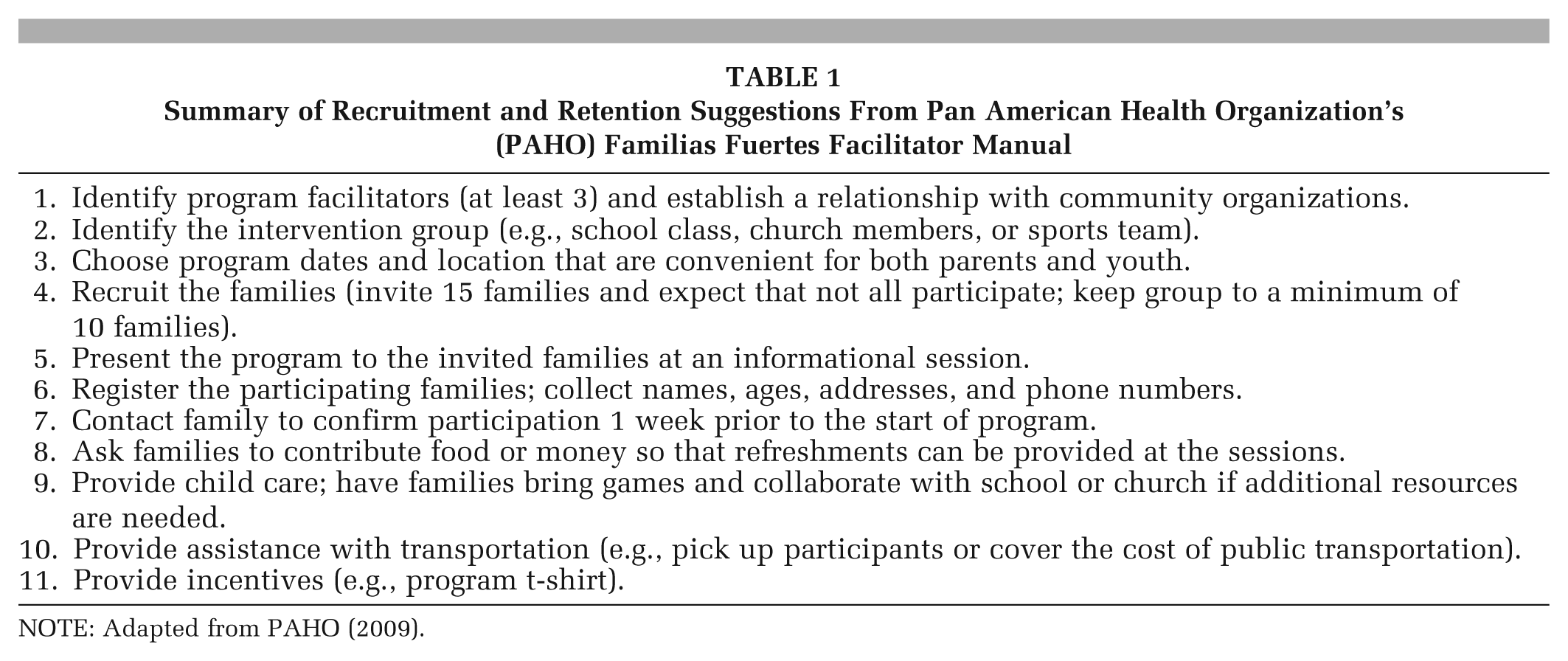
NOTE: Adapted from PAHO (2009).
Second, we conducted a review of the literature from the past 5 years on the recruitment and retention of Latino participants in the United States using MEDLINE with Full Text (search terms related to recruitment, retention, Hispanic, Latino, and research). From this review, we identified five distinct program areas where researchers were incorporating culturally responsive strategies successfully: (a) community involvement (e.g., Larkey et al., 2009), (b) staff selection (e.g., Le et al., 2008), (c) adaptation of program materials (e.g., Gonzalez et al., 2007), (d) personal contact with participants (e.g., Miranda et al., 1996), and (e) logistics (e.g., Marquez et al., 2003). Third, we consulted with the community liaison (a trusted member of the community who participated in the Familias Fuertes training and received a small cash incentive to recruit the families and help facilitate the parent sessions), the community leader (the community “gatekeeper”), the program facilitators, and other researchers to tailor recruitment and retention strategies spanning the five program areas identified in the literature review.
Recruitment for the Familias Fuertes–Georgia program started in late August of 2009. The following inclusion criteria were used: families must have at least one child between 9 and 14 years of age; at least one parent must define himself or herself as Latino; and all participating family members must speak Spanish. A “family” is defined as at least one child in the targeted age range and at least one parent or caregiver, although two parents or caregivers were encouraged to participate. Recruitment visits with potential families, during which the community liaison presented the program and invited the family to participate, lasted approximately 20 minutes and took place in their homes. The principal investigator explained the informed consent and assent processes in Spanish to both the parents and youth at the beginning of the first session.
Evaluation of Culturally Responsive Recruitment and Retention Strategies
As a pilot feasibility study, Familias Fuertes–Georgia was still in the earliest stages of evaluation and limited by resources to a one-group, posttest-only design. To assist in the evaluation of the recruitment and retention strategies, we added relevant Likert-style items and one open-ended question to the parent posttest, a computer-based interview completed by participating parents (N = 13; 12 mothers and 1 father) in November of 2009. Participants could choose to complete the interview in either English or Spanish; all parents chose Spanish. The Likert-style items pertaining to recruitment asked respondents to rate the importance of each of seven different factors (conversation with community liaison, free on-site child care, convenient time and location, program connection to trusted community leader and community-based organization, free dinner, cash incentives, and program brochure) in their initial decision to participate in the program. Response options were as follows: 1 = Not important/No fue importante; 2 = Somewhat important/Algo importante; and 3 = Important/Importante. The Likert-style items pertaining to retention asked respondents to rate the importance of each of five different factors (program facilitators, free on-site child care, convenient time and location, free dinner, and cash incentives) in their continued participation using the same response options. For some Likert-style items, participants were able to respond that they were unaware of a specific factor (4 = Did not know about/No sabía). The open-ended question requested the respondent’s top three motives for either initial or continued program participation. Frequencies of responses for the Likert-style items and themes in the open-ended responses were used to analyze the results. Recruitment and retention strategies were also discussed with the community leader and community liaison to gain a better understanding of results.
Results
Familias Fuertes–Georgia Recruitment and Retention
Our three-step process of reviewing the Familias Fuertes Facilitator Manual, reviewing the literature, and consulting with community members and researchers resulted in the development of 15 culturally sensitive strategies used for the recruitment and retention of Familias Fuertes–Georgia participants. Table 2 details these strategies.
Culturally Responsive Recruitment and Retention Strategies Across Five Program Areas Used in Familias Fuertes—Georgia

The first 12 families invited by the community liaison agreed to participate. Eleven families completed the program with 100% session attendance; one family missed two of the seven sessions because of illness. In total, 15 youth (6 girls, 9 boys; mean age = 10.67 years) and 14 parents (12 mothers, 2 fathers) participated; one father attended only two sessions and therefore was not interviewed. All families lived in the same low-income, predominately Latino community in a semirural area of Georgia. Half of the parents reported an education level of eighth grade or less. All parents were of Mexican origin.
Relative Importance of Culturally Responsive Recruitment and Retention Strategies
Table 3 details parents’ evaluation of the relative importance of selected strategies based on their responses to the Likert-style items. The top three rated factors were the discussion with the community liaison, the program facilitators, and the free on-site child care. In response to the open-ended question, the most frequently reported motives by parents for continued participation in the program were learning valuable material in the sessions (n = 13), participating in session discussions (n = 4), and noticing improvements in family relationships (n = 3). Other responses referred to the convenient location, cash incentives, community liaison, free dinner, child care, and sense of community. The community liaison reported that most families agreed to participate based solely on the program topic and before other benefits—that is, the cash incentives and free dinner—had been mentioned. The community leader, however, believed that the cash incentives and the free dinner, although perhaps not important for recruitment were indeed critical for retention. Both the community liaison and the community leader agreed that child care was absolutely necessary.
Parent Rating of the Importance of Recruitment and Retention Strategies Used in Familias Fuertes–Georgia
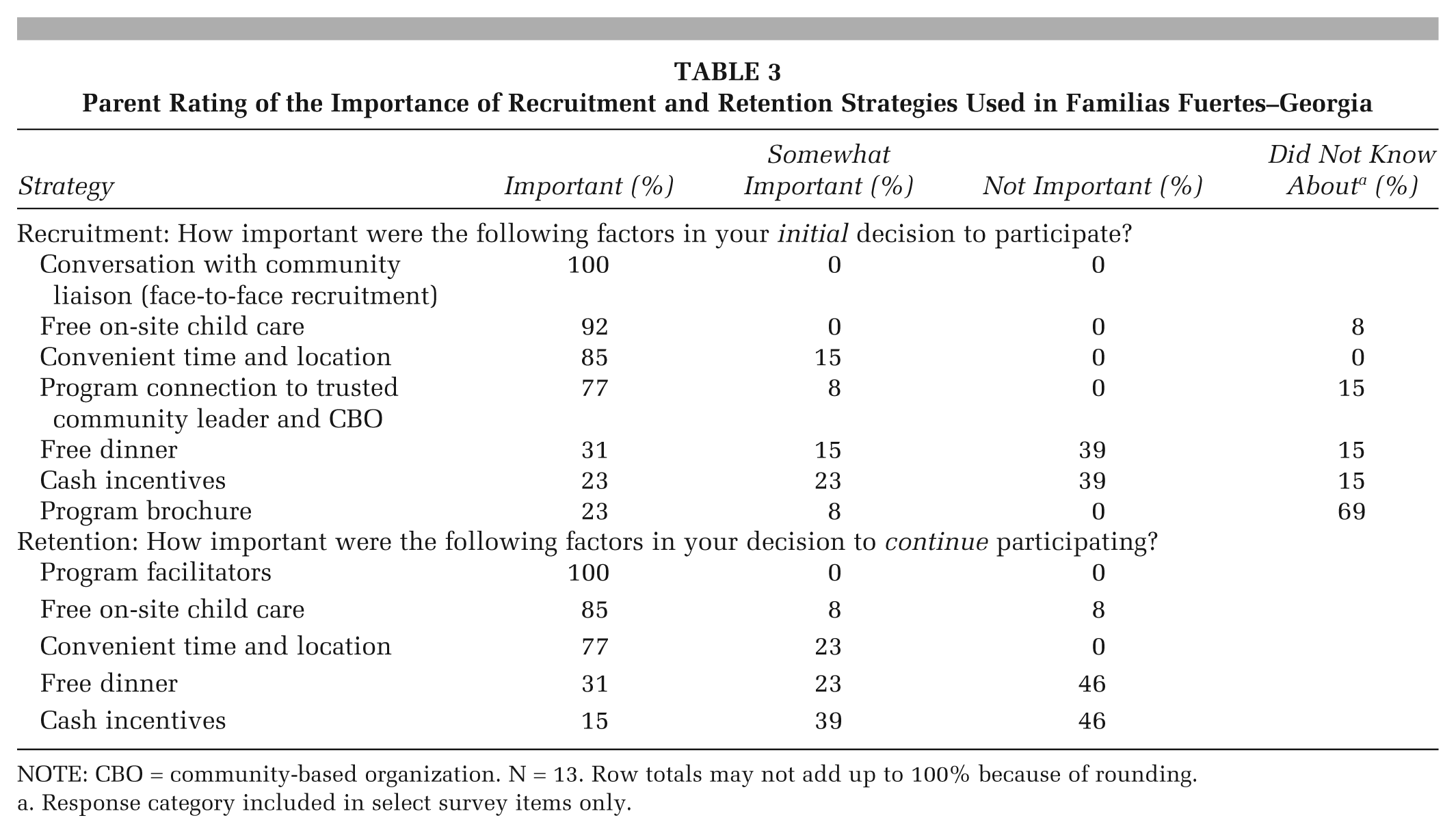
NOTE: CBO = community-based organization. N = 13. Row totals may not add up to 100% because of rounding.
Response category included in select survey items only.
Discussion
Recruitment and retention for the Familias Fuertes–Georgia feasibility study were successful and far exceeded the expectations of program researchers and staff. Even the community liaison and community leader, those most familiar with the participants, were surprised by the degree of success. The importance of inherent pro-participation program characteristics, such as relevance and effectiveness, is manifested clearly in the responses to the open-ended question. For example, parents reported that “learning valuable material in the sessions” was a major motive in their continued program participation. This result reflects the program’s sound curriculum and should be considered an inherent pro-participation program characteristic. However, the level of commitment exhibited by the participants week after week, for seven consecutive weeks, indicates that more than just an excellent curriculum was promoting participation. Reponses to the Likert-style items allow us to consider the other factors—our recruitment and retention strategies—separately from the inherent program characteristics.
Based on our results, 3 of the 15 strategies emerge as more important than others: face-to-face recruitment by the community liaison (Strategy 8); bilingual, bicultural, and experienced facilitators (Strategy 4); and free on-site child care for the younger children of participating families (Strategy 13).
First, all participating parents indicated that their discussion with the community liaison was important in their decision to participate. This finding supports the relative importance of strategies involving personal contact, for example, face-to-face recruitment over more impersonal strategies, for example, mailings or flyers, reported in the literature (Gonzalez et al., 2007; Larson, Yu-hui, Wong-McLoughlin, & Shuang, 2009). Although we classify the face-to-face recruitment used in Familias Fuertes–Georgia as “personal contact with participants,” it actually covers two additional program areas for culturally responsive strategies: community involvement and staff selection. As a community member herself, the community liaison had the insight necessary to frame the program in a tailored, meaningful way for the families during the separate recruitment discussions. She knew how to talk to the participants, and they knew they could trust her.
Second, all participating parents also indicated that the facilitators were important in their decision to stay in the program. Following examples from the literature (e.g., Coatsworth, Duncan, Pantin, & Szapocznik, 2006), we selected bilingual, bicultural, and experienced program facilitators. Each completed a 3-day training workshop required for Familias Fuertes program facilitators. The importance of the facilitators is also reflected in the top motives for continued participation reported in response to the open-ended question. Participants would not have learned as much, enjoyed the discussion, or seen as many improvements in their relationships, had the facilitators not been effective. Furthermore, the community liaison also functioned as a facilitator, lending additional credibility to the program staff.
Third, most participants, the community leader, and the community liaison agreed that the free on-site child care was important for recruitment and retention. Each week, 22 children attended the child care portion of the program. To provide child care, we partnered with a faculty member teaching an undergraduate Recreation and Leisure Studies course in program planning with a service-learning component. Instead of having a few paid providers to satisfy child care needs, we had trained university students (approximately eight per session) dedicated to creating and delivering a quality, active-learning program for the young children. Having a safe and fun child care option on-site that the children actually wanted to attend was crucial for facilitating family participation.
The three strategies receiving the lowest importance rating by parents were the program brochure, the free dinner, and the cash incentives. Interestingly, most participants reported that they did not even know about the program brochure. This lack of awareness clearly indicates that the community liaison felt that the brochure was not the most effective recruitment strategy, corroborating the findings of Gonzalez et al. (2007) and Larson et al. (2009). In perhaps a few cases, the community liaison may have refrained from using the brochure when the potential participant’s literacy level was low. However, it is more likely that she refrained from using the brochures because they lack the personalismo valued by Latino culture. Although the program brochure may not be important to potential participants, this low-cost, tangible source of information is still useful for conveying program details to other stakeholders as it provides a quick description of the program, its benefits, and contact information for researchers and staff.
According to the results, neither the cash incentives nor the free dinner were important factors in the decisions of parents to participate. Indeed, the community liaison reported that most families agreed to participate prior to learning about those added benefits. However, the community leader added insight from her years of experience working in the community. First, she believed that the free dinner provided valuable social time in which a sense of community was allowed to develop among the families. She added that although the families lived in the same neighborhood, many of them did not know each other well. The free dinner removed the pressures of preparing and providing a meal for the family at home and allowed for more personal contact among participants and program staff. The meal also provided a 30-minute buffer for participant arrival, allowing program staff to start each session on time. Second, the community leader believed that, especially given the current state of the economy, the cash incentives were indeed important. It is likely that decorum downplayed the participants’ reported importance of the cash incentives. Interestingly, there is some disagreement in the literature regarding the provision of compensation to promote recruitment and retention. Some studies indicate that financial incentives may help recruitment and retention efforts (Barbeau, Hartman, Quinn, Stoddard, & Krieger, 2007; Gonzalez et al., 2007; Villarruel, Jemmott, Jemmott, & Eakin, 2006), whereas other researchers have had success without providing compensation (Larkey et al., 2009).
This pilot study has a few limitations. One limitation is the small sample size of the study, which limits the generalizability of findings. However, the small group facilitated personal communication between participants and staff, including the principal investigator. Larger studies may have more difficulty fostering this personal contact. A second limitation of the study was the minimal participation of fathers or male caregivers: Only two fathers participated in Familias Fuertes–Georgia, and one of them attended only two sessions. Further research should explore additional recruitment strategies, such as employing a male community liaison responsible for inviting male participants. Male recruiters from the community may be better equipped to frame program messages in meaningful ways to promote participation among fathers and male caregivers.
Conclusion
Ensuring adequate Latino participation in research studies and prevention programs is a critical step toward the reduction of health disparities. Our results, limited by a small sample size and minimal participation by male caregivers, suggest that incorporating culturally responsive strategies across multiple program areas could lead to successful recruitment and retention of Latino families. The 15 culturally responsive recruitment and retention strategies to encourage participation in Familias Fuertes–Georgia correspond to five program areas: community involvement, staff selection, adaptation of materials, personal contact with participants, and logistics. Parents highlighted the importance of face-to-face recruitment by the community liaison; bilingual, bicultural, and experienced facilitators; and free on-site child care for the younger children of participating families.