







Abstract
This article describes two ethical dilemmas encountered by our research team during a project working with undocumented immigrants in Toronto, Canada. This article aims to be transparent about the problems the research team faced, the processes by which we sought to understand these problems, how solutions were found, and how the ethical dilemmas were resolved. Undocumented immigrants are a vulnerable community of individuals residing in a country without legal citizenship, immigration, or refugee status. There are more than half a million undocumented immigrants in Canada. Through an academic–community partnership, a study was conducted to understand the experiences of undocumented immigrants seeking health care in Toronto. The lessons outlined in this article may assist others in overcoming challenges and ethical dilemmas encountered while doing research with vulnerable communities.
Keywords
Introduction
This article describes two ethical dilemmas encountered by our research team during a project that sought to understand the experiences of undocumented immigrants seeking health care in Toronto, Canada. This article aims to be transparent about the problems the research team faced, the processes by which we sought to understand these problems, how solutions were found, and how the ethical dilemmas were resolved.
Conducting research with marginalized and vulnerable people requires constant reflection on all aspects of the research problem. This includes ethical issues that may have not been identified during the institutional research board or research ethics board process. The project also requires adaptability and resilience from all members of the research team. By sharing our experiences, we hope to provide useful insight to other research teams embarking on ethically challenging and sensitive research studies with vulnerable and marginalized populations.
Background
Undocumented immigrants are a vulnerable population, and as such, the research team faced unique challenges engaging them in the research process. The research was conducted using a community-based participatory research (CBPR) process, with a team comprising staff from a community-based organization (CBO) that worked with undocumented immigrants, the principal investigator, three researchers, and a group of nine undocumented immigrants.
Community-Based Participatory Research
All research takes place on a continuum, from studies that are expert/researcher driven on one end to CBPR on the other (Greenwood, Whyte, & Harkavy, 1993). Expert research is characterized by the control of authority and execution by the academic researcher or scientist. By contrast, CBPR is a collaborative process with authority and execution shared between members of the organization under study and the researcher (Greenwood et al., 1993). CBPR has been defined as
a collaborative process that equitably involves all partners in the research process and recognizes the unique strengths that each brings. CBPR begins with a research topic of importance to the community with the aim of combining knowledge and action for social change to improve community health and eliminate health disparities. (Minkler, Blackwell, Thompson, & Tamir, 2003, p. 1210)
Successful CBPR requires the researcher and the marginalized participants to build a trusting relationship (Koch & Kralik, 2006). In the case of our research project, the CBO had a preexisting, strong, trusting relationship with all participants in the study. The researcher was new to the community, and so it was necessary for her to develop a trusting, open relationship with both the CBO and the participants.
Defining the Term Undocumented Immigrant
Citizenship and Immigration Canada considers undocumented immigrants to be residing in Canada illegally, and so these individuals are often under deportation orders from the Canadian Border Services Agency (CBSA). Undocumented immigrants face considerable challenges maintaining their foothold in Canada, with the risk of detainment, deportation from Canada, and potential reprisals awaiting them and their families in their country of origin.
A literature review published by Magalhaes, Carrasco, and Gastaldo (2010) estimates that there are approximately 500,000 “undocumented migrants” in Canada. This number was from 2009 and does not include all undocumented persons. It is therefore not unreasonable to expect that the number of undocumented immigrants in Canada is significantly higher than the one listed above.
Method
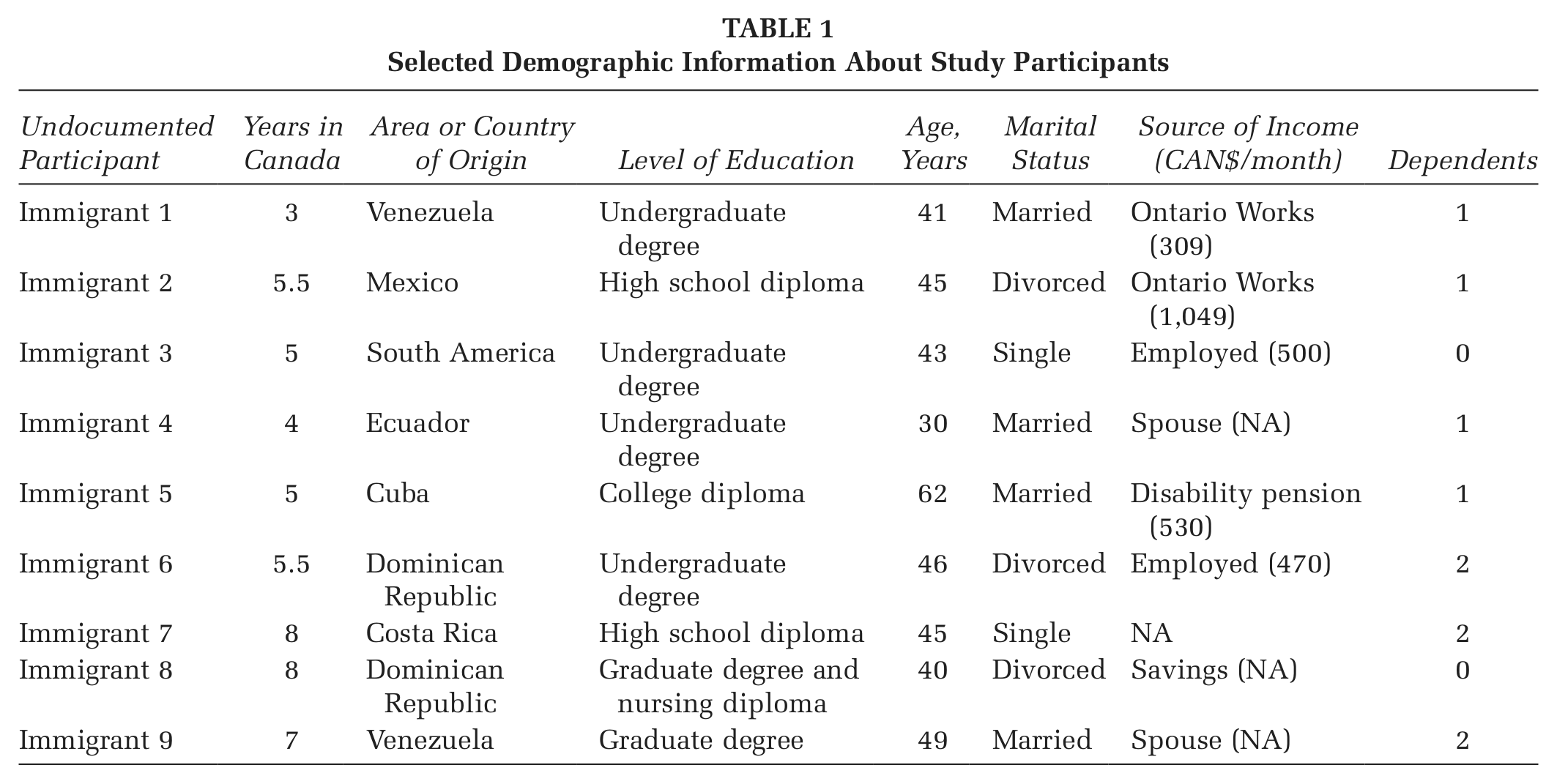
The study received ethical approval from the University of Toronto Research Ethics Board. A total of 21 participants were involved in this study. Women within three immigration categories were recruited: refugee claimants (n = 6), permanent residents (n = 6), and undocumented immigrants (n = 9), outlined in Table 1. The broader research study investigated the experiences of these three groups accessing health care in Toronto, Canada. This article focuses on a subset of the broader study—the undocumented immigrants—as ethical issues did not arise with the refugee claimants or permanent resident participants. The study was conducted at a CBO in downtown Toronto, Canada.
Selected Demographic Information About Study Participants
Data Collection
A qualitative research approach was used to gain an understanding of the experiences participants encountered when seeking health care (Kitto, Chesters, & Grbich, 2008). The design and implementation of semistructured one-on-one interviews were informed by best practices outlined by Kvale and Brinkmann (2009). Interviews ranged in length from 45 minutes to 2 hours. All undocumented immigrants were given the option to create a pseudonym for themselves to help protect their identity. Participants could sign the consent form with their pseudonym or an “x,” depending on their comfort level. A more detailed outline of the methodology has been published elsewhere (Campbell, Klei, Hodges, Fisman, & Kitto, 2012).
Discussion
Emerging Issues in CBPR With Undocumented Immigrants
This article focuses on ethical issues that arose as the data collection process unfolded. Specifically, the article identifies two dilemmas and discusses a critical thinking process the research team used to resolve these ethical dilemmas.
Below we address each of these instances in turn through a series of sections. Section A identifies the ethical dilemma. In Section B, we describe the process by which the research team sought to understand the dilemma. Solutions are discussed in Section C. Then the lessons learned by the research team from each of these situations are jointly outlined in Section D.
Example 1
Section A: Identifying the ethical dilemma
An ethical dilemma arose following the completion of the first set of interviews. Two participants informed their community support worker that they were concerned the researcher was a spy for the CBSA. The participants feared the researcher would report them to the CBSA and they would be deported from Canada.
Whyte (1991) discusses these types of suspicious, fearful responses from marginalized persons who are involved in research projects. He argues that when eople are deprived and disenfranchised because of insurmountable social forces, they will be cautious of outsiders seeking to engage them in intervention research framed as dialogue-centered and participatory. Many of the participants of our study had escaped forceful manipulation at the hands of powerful people, including instances of rape, torture, and death threats.
Section B: Gathering information
A meeting was set up for the researcher and CBO to speak about the problem. During the meeting, several significant points came to light. The two participants who thought the researcher was a spy for the CBSA had not been present during an earlier prestudy orientation session. Since these participants had not met the researcher during the orientation session, they did not have a preestablished relationship with her. This finding reaffirmed the importance of establishing a rapport between the researcher and the participants prior to commencing the interviews.
The main item of concern was that the researcher directly asked them for their immigration status. Being asked direct questions about immigration status was emotionally traumatic for the participants. Undocumented immigrants live life in hiding to avoid being found by the CBSA and returned to their countries of origin. Therefore, direct questions about immigration status activated their acute fear of being discovered and deported.
During the meeting with the researcher and the CBO, all stakeholders agreed that open discussion about immigration status was too frightening for the participants. The research team decided to put the project on hold in order to address the participants’ concerns and reflect on the best way to move forward.
Section C: Solutions
The research team decided to revise the informed consent process. They determined that the community supporter worker, who already had a close preexisting relationship with each participant, would ask the participants for their informed consent to disclose their immigration status to the researcher. With these changes, the participants would have this sensitive topic addressed by a trusted contact and the researcher would no longer need to reference the participant’s immigration status during the interview, unless the participant mentioned it.
Trust is an essential element of this type of research (Koch & Kralik, 2006). Orientation sessions and the consenting process must be sensitive to the lived fears and concerns of all participants, especially vulnerable ones such as undocumented immigrants. The research team adjusted the research protocol to ensure that only participants who had attended the orientation session were invited to participate in the study. Also, efforts were made to increase the level of trust between the researcher and participants. All participants were asked to arrive 30 minutes before their scheduled interviews. During this time, they met with the community support worker and were given a chance to ask questions, voice concerns, and reread the consent materials. Ten minutes before the beginning of the formal interview, the principal investigator joined the meeting. The participant was given the opportunity to ask the researcher questions with the community support worker present. The participant and the researcher would then move into a different room and the researcher would begin the formal interview.
Example 2
Section A: Identifying the ethical dilemma
The second ethical dilemma arose when a female participant told the principal investigator that she was suicidal. Although the community support worker had informed the researcher that some participants had a history of mental health problems, the researcher was not anticipating the participants to be suicidal. The following quote vividly conveys the serious consideration of a participant explaining why she sees suicide as a reasonable option. She initially spoke in the third person, rationalizing the position of suicide for women in her position and later transitioned to describing her own intent to take her life:
Many women come with children and they are healthy when they get here (to Canada) although they experience persecution and kidnapping in their own countries. And many of course were coming from civil war and violent war. And if people come here after experiencing that to be safe, and someone puts drugs in their food to abuse them physically and mentally, how can a person come here and be trusting just to have someone choke them or physically abuse them? So, that is why women give up. They are betrayed by Canada and the people here. That is why they decide to end their life. You don’t need to look so shocked. It is for the best. Maybe you will understand why people give up at some point in your life. You can’t label them as mentally ill, they are not. They have had their spirit broken and there is no point continuing on. They plan out how to end their life . . . So, I am going to kill myself.
Section B: Gathering information
When the participant’s suicidal plans came up in the interview process, the principal investigator was shocked and unprepared to handle the situation. The researcher immediately informed the community support worker who had a preexisting relationship with the participant. The interview was stopped, and the community support worker conducted a counseling session with the individual. The principle investigator also shared this development with her academic mentor, a mental health professional, to seek advice on the situation. The mentor was able to provide counsel.
The research project was put on hold so a strategy could be developed to ensure the participants were made more fully aware that the researcher was not a mental health care professional. A crisis intervention plan was developed to respond to the needs of participants who expressed suicidal ideation, intent to harm themselves, or intent to harm other members of society.
Section C: Solutions
It was resolved that before future interviews would formally commence, the principal investigator would tell the participant that she was not a mental health professional. The participant was informed that if she mentioned harming herself or another person, the researcher would have to notify the community support worker. This effectively transferred the responsibility from the researcher to the community support worker, who had the training to cope with suicidal ideations and mental health problems. It was also determined that since the principal investigator did not have mental health training, it was essential that a mental health professional be available to meet the needs of participants should an occasion arise.
The principal investigator also began to include a 10-minute wind-down conversation into the interview during which no new questions were asked and conversation was transitioned to lighter subject matter or positive experiences with the participant’s health. After the interview was completed, the participant was offered the chance to meet with the community support worker again for 20 to 30 minutes. The participant was then invited to have tea and refreshments in a sitting area, giving her an opportunity to relax before continuing with her day. This decompression time proved to be very positive for the participants.
Section D: Lessons learned
In the course of completing a study, it is common for researchers to encounter unexpected situations, and these situations may give rise to ethical dilemmas. It is advisable that research teams consider that unexpected events may occur and develop a plan for how they will respond to these circumstances.
As not all members of a research team will necessarily be aware of new developments or how to respond to them, it is important to update all members of the team of any new developments. Next, a comprehensive discussion and information-gathering session should be initiated. It should be deliberated whether the new event risks potential harm to the participants, the researchers, or the research study. If there is a chance that any of these may be at risk, then putting ongoing research on hold until a resolution can be found is a judicious course of action and must be considered.
Both examples discussed in this article caused the research project to be put on hold for a period of time. This allowed members of the team to reflect, analyze, synthesize, and evaluate the facts before the group meeting took place. Consequently, the group meeting was calm, thoughtful, and productive. All members of the team listened to each person’s perspective on the issue. Information was synthesized, consensus derived, and a joint decision was made about the best solution. In both examples, the research team in collaboration with the CBO and participants agreed that an appropriate solution was developed and implemented and that the research study could continue. If ethically appropriate solutions cannot be reached, the research study should be terminated and academicians should be transparent about discussing the ethical dilemmas that caused the research study to be terminated. Furthermore, strategies used to address ethical dilemmas should be discussed and published by researchers, thereby enabling the academic communities to benefit from lessons learned.
Conclusion
Community-based participatory research is not an easy road to achieve desirable results. It contains many variables and requires a considerable amount of adaptability, creativity, and resilience from all members of the research team. When working with marginalized people, it is crucial to maintain an ongoing evaluation of the project and reflect on ethical matters that may have an effect on the participants, communities, researchers, and other stakeholders. Constantly reviewing the project and making revisions based on lessons learned can be onerous, but the approach also provides great value to all stakeholders, including the vulnerable participants. This process helps enhance research outcomes as well as the experience of everyone involved.
The process of research projects being vetted by an institutional research board or research ethics board has many objectives, the most important being the protection of research participants. However, it is unrealistic to expect that all possible scenarios of ethical challenges will be identified and outlined by the researcher prior to the commencement of the research project. When working with vulnerable participants, the research team should continually discuss the ethics of the research project and be transparent about all problems. An open discussion about all problems will ensure that no issues are left unaddressed.
Research papers currently provide inadequate transparency and openness about problems that arise during studies. In this article, we make an effort to be transparent about the problems we encountered, the process by which we endeavored to understand those problems, and our solutions. The authors challenge the research community to be more transparent about ethical dilemmas encountered in social science research and to share their experiences completely—problems encountered, strategies, resolutions, successes, and failures—so researchers can learn and develop professionally from the pioneering paths of their predecessors.
Footnotes
Authors’ Note:
We are indebted to the participants and the community-based organization for their strength, resilience, and trust. Thank you to Dr. Brian Hodges for his phenomenal mentorship and guidance and to A. G. Klei, Executive Director of Words Ink., for his superb editing of this article. Ethical approval for this study was obtained from the University of Toronto Research Ethics Board. Ruth Campbell-Page’s research for this study was funded by the Social Science and Humanities Research Award of Canada and by the Richard and Elizabeth Currie Chair in Health Professions Research.