







Abstract
In this commentary, three public health professionals working in diverse career settings share their perspectives on how to get the most out of professional associations. This article demonstrates how you can benefit from active involvement in your membership in professional associations and attending professional conferences. Methods to participate actively in your association include volunteering for one-time opportunities or standing committees, mentoring, and reviewing publications and manuscripts. Being active in professional organizations, such as the Society for Public Health Education, offers personal career development skill-building and opportunities for leadership and mentoring across all career stages. Experiences on how participation in professional organizations helped shape the authors’ careers are shared.
Keywords
Introduction from the Coeditors
Belonging to a professional association is a prerequisite for career development (Cottrell, Girvan, & McKenzie, 2009). However, it is helpful for students and young professionals to go beyond just membership and actively participate in professional associations to build their professional identity and the profession of health promotion (Mata, Latham, & Ransome, 2010). This commentary highlights the benefits of joining professional associations, reasons to get actively involved, and methods to get involved. We hope that public health professionals working in diverse settings and across all career stages will find these strategies useful.
Getting the Most Out of Professional Associations
There are many benefits of joining a professional association, including developing new skills and competencies, connecting with colleagues, and sharing your talents and knowledge with your professional community. Most associations have in-person conferences and/or other professional development activities such as webinars to enhance skills and competencies in the field. At these meetings, you can seek consultation from others, learn more about specific topics, and stay current with best practices, emerging issues, and new initiatives. In addition, many professional associations offer continuing education programs where you can receive CHES/MCHES credits to maintain your credentials. Newsletters or associated journals from associations can also keep you abreast of contemporary topics in health education, job opportunities, and news from the field, among other things.
Associations also offer a variety of ways for you to network to locate and advertise potential jobs in your field. Studies by recruitment and staffing firms consistently find that person-to-person networking and word-of-mouth remains the most common way to find a new job (Right Management, 2013). Broadening your network through professional associations not only increases your potential access to new jobs but also extends your own reach when recruiting new talent. Furthermore, potential employers may view active participation in a professional organization favorably, as an indication of your interest in and dedication to the health promotion field.
Getting active in your professional association also offers the opportunity to learn more about the infrastructure and operations of an organization and connect with professionals from the field. Getting active can also help you build your resume in the area of professional service and research or presentations by presenting your work as posters or presentations or articles in their journals. Membership in an organization can offer the opportunity to connect with others who have a similar mission, goals, and skills. Many organizations also have mentoring opportunities to guide professionals in the field and are a great way to help you meet colleagues who could mentor you throughout your career and help you network at different transitions in your career (e.g., seeking additional degrees, changing jobs).
How to get Involved
You can get active in your professional associations in many ways, including more one-time volunteer opportunities, episodic, or regular in frequency. If you are just recently joining, you may want to start off with the one-time opportunities. Some of these could include attending program, business, and social events at meetings to meet leaders in your field and learn more about the profession; presenting your work at scientific sessions at a national or regional meeting (Society for Public Health Education [SOPHE] chapter); volunteering as a meeting moderator or assisting at conferences with meeting logistics to learn about the organization and its history (usually with discounts off registration); or joining a special section of the association based on your interest/content expertise. More episodic participation could involve volunteering to review abstracts for presentations or posters at a conference or manuscripts from a journal or mentoring another professional. For example, SOPHE has a meeting mentor program where new or young professionals are paired with a seasoned member for the duration of the meeting. Finally, a more intensive level of involvement may be to join a standing working committee of an organization based on interests or skills (e.g., communications, publications). Often, people start with committee membership, but you can later become chair or officers in the association. These opportunities offer beneficial ways to build your leadership and communications skills and also benefit the association.
Attending the conferences of a professional association is also helpful for professional development and for increasing your network. While members may attend conferences without presenting, consider building the presentation section of your resume by submitting an abstract on a project or your work. If the cost of a national meeting is too expensive or difficult to participate in, then you can consider joining an affiliate or local/regional chapter of that association. These often have the same benefits of national meetings but are easier to travel and save your resources. Many associations also offer scholarships for students.
For students, membership in a professional organization is often a first “foot in the door” of the profession in general and for jobs. Getting involved can also help you meet students from other universities and/or programs. Easy methods to get involved are attending student sessions to exchange ideas and experiences with other students at meetings, participate in student sessions or competitions, and join student sections to share experiences. As you get more comfortable with the association, you can ascend to committee work or chair and perhaps leadership roles in the future. Some students and new professionals are apprehensive about getting involved perhaps because they do not know others or are worried they do not have enough experience. It can be useful to remember that everyone who is participating in the organization probably felt the same way at some point. New members are the lifeblood of an organization, and organizations want (and need!) students and young professionals to join and bring fresh ideas and opinions to the work.
As a student, Dr. Escoffery became a member of SOPHE and the American Public Health Association. She started learning about the organizations by attending business meetings. Later, she became a member of committees (e.g., Membership, Awards) and then assumed leadership roles chairing different committees. These experiences helped her become a member of the SOPHE board of trustees to give input into the directions of the association.
Finding Your Professional Home
There is a wide array of professional organizations in health promotion, some with a broad scope (e.g., SOPHE), while others focus more specifically on health issues or priority populations (see Table 1). Some professionals have a difficult time choosing which organization to make their professional “home.” The most important consideration in determining which organization(s) to join is to find one that aligns with your professional identity and training. For example, professionals who work in school health might be most interested in joining the American School Health Association, while those who work in the diabetes education field might get the most use from joining the American Association of Diabetes Educators. Many people maintain membership in more than one organization, as they find they get different types of support from each. Membership in SOPHE and/or the American Public Health Association are a great way to stay connected with the field as a whole and keep abreast of larger issues facing the profession. The Coalition of National Health Education Organizations (http://www.cnheo.org/), a collaboration of health promotion and education organizations, is a useful resource to help identify additional organizations that best match your interest and might want to consider joining.
List of Health Education Associations
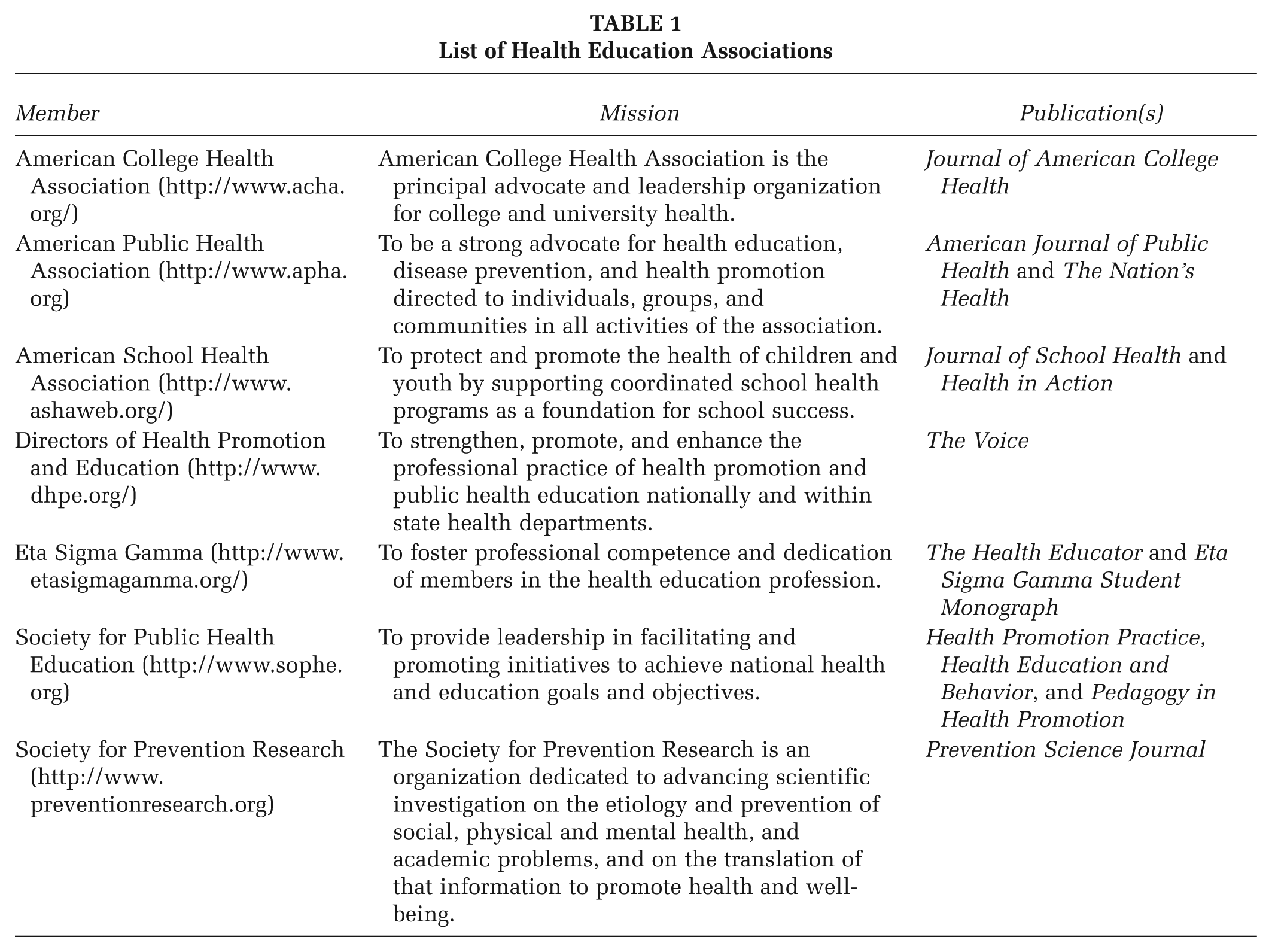
Your professional home may change over the course of your career. For example, during her many years working as a director of health promotion in the health and higher education field, Dr. Kenzig was an active member of the American College Health Association and National Association of Student Personnel Administrators (Student Affairs Administrators in Higher Education). As she transitioned in her career from practitioner to faculty, she began to move her organizational affiliations to other associations like SOPHE and the Society for Prevention Research. She continues to maintain close ties to the many dynamic professionals she worked with in her previous roles and has found that what she gives and gets in those relationships has matured over the years. Although she is no longer as active as she once was in American College Health Association and National Association of Student Personnel Administrators, those early professional connections fostered her ability to be successful in her newer role as full-time faculty and allowed her to effectively transition into different types of positions in other professional associations.
Similarly, while earning an MS in Social Research, Dr. Hyden was encouraged by mentors to join sociology and research-based organizations such as the American Association of Public Opinion Researchers and the Eastern Sociology Society. Those early professional meetings and conferences served as an excellent introduction to the skill building and networking opportunities available to graduate students. While she continues to maintain memberships in both organizations, her primary affiliations shifted while completing doctoral studies in Health Education to include public health oriented organizations such as SOPHE and the Society for Adolescent Health and Medicine. Membership in organizations that are more specifically focused on her areas of research have provided significant opportunities for leadership, dissemination, and professional development during the evolution from graduate student to postdoc to early career investigator.
Involvement in a professional association can be a “win/win” for both the individual and organization as knowledge, resources, experiences, and opportunities are shared among members. Membership and active participation can expand your networks, increase your knowledge, and act as a catalyst for finding and filling job vacancies. For young professionals, active participation often helps them build skills in their discipline and aids in building their resume/curriculum vitae in the dissemination of their work and service to the profession. In return, the organization leverages its resources to provide its members with advocacy, public relations, professional development, and other opportunities.