







Abstract
To realize the promising potential of services delivered via smart phones to help young adults quit smoking at a high level of cost-efficiency, we constructed a texting and mobile media system that was promoted in South Texas via social media advertising and other recruitment channels. During the 6-month service period described here, enrollments were achieved for 798 participants with a mean age of 29.3 years. Seven-month texted follow-up found that 21% (171) of the enrollees reported abstinence at that point. This is consistent with high rates of success found in studies of telephone counseling for young adults and confirms that text and mobile media service specifically designed for young adults provide a feasible and potentially cost-effective approach to promoting cessation.
Introduction and Background
This article describes the translation of research on innovative, affordable, mobile communication technology into practice as a culturally appropriate smoking cessation service for a South Texas marginalized population with low access to cessation services. Mobile devices may have great potential to provide personalized smoking cessation support services, as a Cochrane Review (Whittaker, McRobbie, Bullen, Rodgers, & Gu, 2016) has concluded that short message service (commonly known as SMS or text messaging) can significantly increase odds of successful cessation of smoking, with a mean odds ratio of 1.7. Counseling protocols used in telephone services for smoking cessation that are based on social cognitive theory (McAlister, Perry, & Parcel, 2008), the transtheoretical model (Prochaska, DiClemente, & Norcross, 1992), and motivational interviewing (Miller & Rollnick, 1991) have been shown in randomized trials to significantly increase quitting success (McAlister et al., 2004), particularly among young adults (Rabius, McAlister, Geiger, Huang, & Todd, 2004). These protocols can be adapted for delivery via mobile SMS text messages combined with social media with content tailored to the age, gender, and ethnicity of the quitter (Free et al., 2009; Free et al., 2011; Rodgers et al., 2005). In this way support can be delivered wherever the person is located, without him or her having to attend services. It also provides the anonymity people like, and can be interactive, allowing participants to obtain help when it is most needed. SMS text delivery can also include embedded links to video and other content to provide peer modeling for cessation-related behaviors (Whittaker et al., 2011). Its usefulness can be further increased by adding connections to social media and obtaining user profiles for personalization of messages to gender, marital, and parental status (Bock, Heron, Jennings, Magee, & Morrow, 2013). Young smokers, and particularly lower income young adults for whom mobile devices are a primary point of Internet access, such as Latinos, can be effectively served by SMS cessation service methodology, according to several studies (Free et al., 2009; Free et al., 2011; Rodgers et al., 2005).
In Texas, the Department of State Health Services provides statewide cessation services through its telephone, online, and mobile service management system. However, in 2013 there were only 46 total users (English and Spanish) among young adults in Webb County (Laredo), Maverick County (Eagle Pass), Val Verde County (Del Rio), and Bexar County (San Antonio) areas of South Texas. These data show that the young adult smokers in South Texas are dramatically underserved by cessation services and greatly in need of services appropriate to their language, culture, and media use. This Quitxt project is designed to offer those smoking cessation services through a combination of SMS messaging and mobile media tailored to young adults in South Texas in the San Antonio and Rio Grande Valley media markets.
Method and Applications
Using a case study methodology with prospective data from enrolled participants, this report describes our recruitment and service delivery methods, and the characteristics and 7-month quitting status of smokers enrolled in this new service in South Texas. In October 2015, the Quitxt SMS and mobile media smoking cessation system began recruiting young adults in the San Antonio and Rio Grande Valley market areas via social media advertising (Facebook and Twitter), other mobile media (Pandora Internet Radio), local mass media publicity, and outreach at colleges, university, trade schools, and venues attended by young adults. The social and mobile media ads, which featured couples with different themes (disgust with cigarettes or confidence in quitting success) and styles (cowboy, metro/urban, geek, punk, and graphic novel), asked potential participants who showed interest in quitting smoking to text a code to our system corresponding to the channel of recruitment. This report describes findings from the 6-month service interval of October 2015 to March 2016.
The Quitxt system responds to text codes with a sequence of interactive messaging, beginning with collection of baseline data on demographics, cigarette smoking, e-cigarette use, and binge drinking. After providing baseline data in reply to texted questions, Quitxt participants are prompted to either choose “quit tomorrow” or set a “quit date” within 14 days. Inclusion criteria are current smoking and provision of baseline data. Exclusion criteria are age below 18 and not setting a quit date within 14 days. After the quit date has been set, the service provides daily messages with expanded mobile content including links to nine mobile Web pages with content appropriate for point-of-progress in the cessation process (1) recommendation for use of nicotine replacement but discouraging e-cigarette use, (2) motivating for quitting, (3) obtaining social support, (4) avoiding binge drinking, (5) increasing physical activity, (6) breathing exercises for managing stress, (7) things to do instead of smoking (counterconditioning), (8) avoiding relapse by talking yourself out of smoking, and by (9) predicting, planning, and practicing for difficult situations. Each of these mobile Web pages contained educational tips and information, links to peer modeling videos, and music with lyrics reinforcing the messages on each topic.
Following the protocol elements used in telephone counseling (McAlister et al., 2004), the Quitxt texting system is designed to send prompts, motivational messages, and messages about the nine content areas listed above, sequenced according to the enrollees’ progress from prequitting preparation through initial and longer term cessation. For example, the first day after quitting enrollees receive a text message encouraging them to think about their motivation for quitting (“Make a list with the reasons you are quitting: your family, your health . . . carry it with you and read it when you feel tempted”) with a link to a mobile-friendly Web page with culturally relevant photos and more detailed educational information on the many different reasons for quitting. Or by the end of the day a text message ask enrollees, “Did you make it through the day without smoking? Text Y or N.” Positive replies lead to next steps in the protocol, while negative replies lead to queries about readiness to continue quitting efforts or to set a new quit date. After their quit date, enrollees are also repeatedly encouraged to text “help” if they are having difficulty avoiding cigarettes; when they text “help,” the system texts to ask if the help needed is due to “stress” or “mood,” and depending on their text reply they are then sent either a prompt and link to breathing exercises (for stress) or a message with links to diverting, humorous videos (for mood). When enrollees fail to reply to texted questions at any point in the protocol, the system is designed to repeat the question twice before moving forward with the messaging sequence whether replies are received or not. The messaging system was built and operated by the Software Communication and Navigation Systems Laboratory at the University of Texas at San Antonio. The approximate cost for system operation and maintenance is $5,000 per month, with a total expense of approximately $40,000 for the 8 months of system development and operation reported here. The total costs for SMS messages purchased in bulk to serve the participants in the work reported here was $1,359.
This was not an experimental trial, and no data were collected to control for use of pharmacological or other behavioral interventions, but we did collect data on cessation success. This was assessed with a question texted from the service 222 days (7 months) following the enrollees’ selected quit dates that measured 24-hour point prevalence abstinence (no smoking in the past day). This measure of cessation yields estimates of cessation rates that are very highly correlated with abstinence assessed for longer intervals, and the question can be answered more accurately than questions about smoking in the past week or month (Velicer & Prochaska, 2004). If this were a clinical trial more extensive measures of cessation success would be warranted, but guidelines for research on cessation do not call for biochemical validation of self-reported abstinence in texted or other low-response demand measurement contexts (Benowitz et al., 2002).
Results and Discussion
A total of 798 enrollees were recruited during two media promotion periods covering 7 weeks from October 13, 2015, to January 15, 2016, with 70% (555) texting in response to Facebook advertising, 14% (111) responding to publicity, 9% (70) responding to outreach, and 8% (62) responding to Twitter or Pandora Internet Radio. The most productive recruitment source, positively Facebook advertising with a theme of confidence and the metro/urban style, yielded enrollees at a cost of approximately $120 each.
The mean age of the 798 enrolled Quitxt participants was 29.3 years, and 55% were below the age of 30. More men (57%) than women (43%) enrolled, and 36% identified themselves as Hispanic or Latino. The mean number of cigarettes consumed per day was 11.5. Among 609 enrollees who texted a reply to the question about e-cigarette use, approximately half (302) reported that they were using e-cigarettes to help reduce their cigarette smoking. Among the 601 cases who texted a reply to the question about alcohol use, 64% (385) reported binge drinking (defined as four or more drinks on a single occasion in the past month among women, five or more among men). The mean number of texts sent to and replies received from enrolled participants was 148. The number of Web page views were 420 for nicotine replacement, 345 for motivations for quitting, 184 for enlisting social support, 140 for increasing physical activity, 187 for things to do instead of smoking, 140 for breathing exercises, 217 for binge drinking, and 125 for avoiding relapse, with an average time spent per page of 5.2 minutes.
About one fifth (21.4%) of enrollees (171/798) reported 24-hour point prevalence abstinence from smoking 7 months after their selected quit date. There were no significant differences in abstinence rates between males and females, younger and older enrollees, or Latino/Hispanic enrollees and others. Among those who responded to the question at baseline, enrollees who reported use of e-cigarettes were less likely to report abstinence from smoking at 7 months than those who did not report e-cigarette use: 20% (60/302) versus 36% (111/307; chi-square test, p < .001). Among those who responded to the question at baseline, enrollees who reported binge drinking were less likely to report abstinence from smoking at 7 months than those who did not report binge drinking: 23% (90/385) versus 37% (81/216; chi-square test, p < .001). The numbers and proportions in demographic, e-cigarette and binge drinking groups, with abstinence rates and odds ratios are presented in Table 1.
Enrollee Characteristics and Cessation Rates
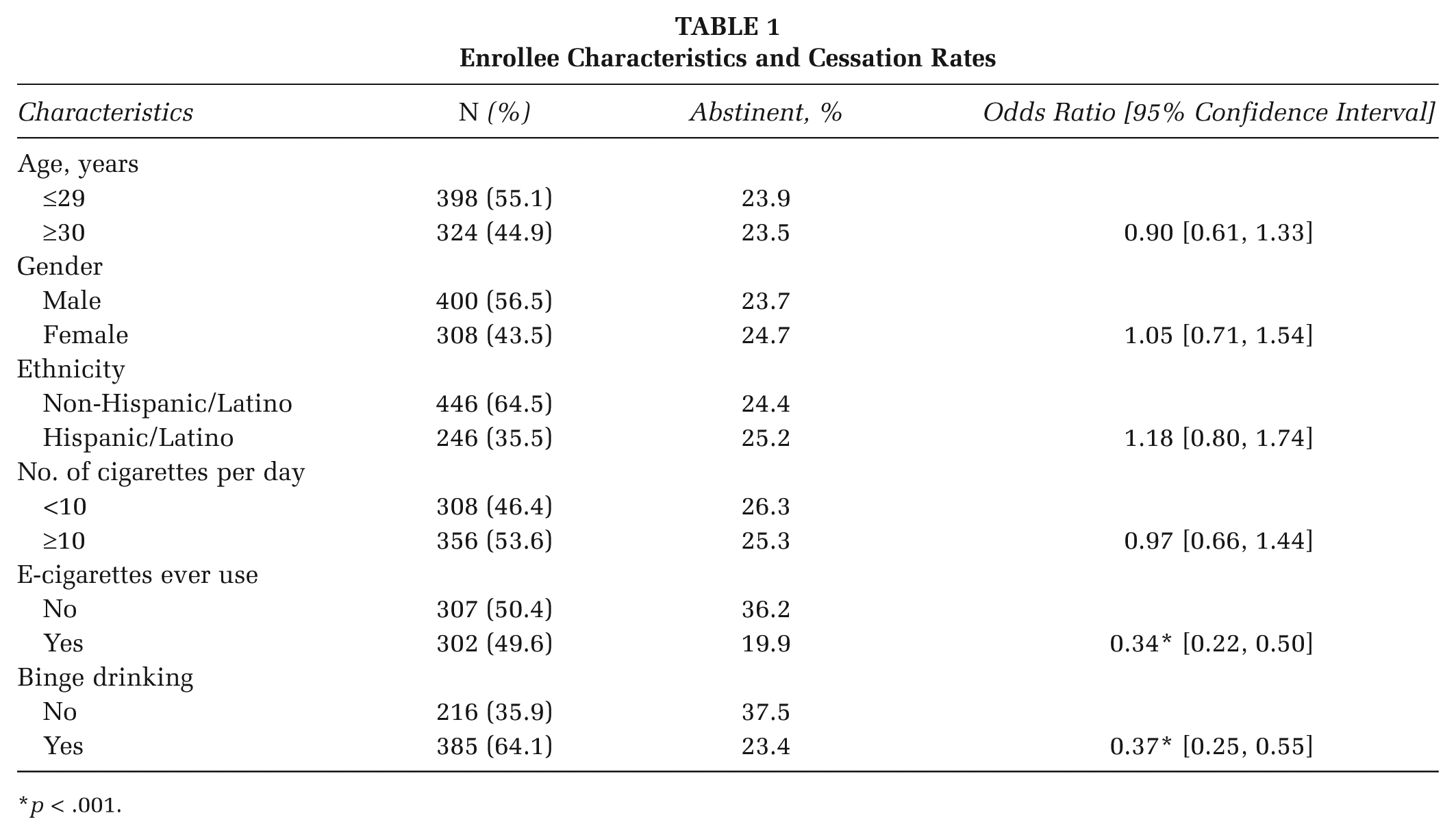
p < .001.
With 8 months of operation costing $40,000 and $1,359 in message expenses, the estimated cost of service provision per enrollee was $52. Not being a randomized clinical trial, this observational study can be used only to make tentative assessments of cost-effectiveness. However, given effects reported in randomized trials of similar services (Whittaker et al., 2016), it is reasonable to conservatively assume that two thirds of those who succeeded in achieving abstinence at the 7-month follow-up may have done so without the service. Thus the net return yielded by the service can be estimated to be a 7% increase in likelihood of quitting. This estimate yields a total service cost for each enrollee reporting abstinence at 7 months follow-up of approximately $740. This compares favorably with the estimated $1,300 per smoker achieving abstinence for 6 months for smoking cessation service delivery via telephone counseling (McAlister et al., 2004). It is also well in line with the estimate of approximately $450 for a similar text service in Great Britain, for which only text messaging costs were reported (Guerriero et al., 2013).
The smoking cessation rate at 7 months follow-up reported here is higher than the rates reported in previous studies of mobile cessation services (Whittaker et al., 2016) but consistent with research on telephone counseling for young adults (Rabius et al., 2004). Measurement of point prevalence of 24-hour abstinence yields cessation rate estimates that are slightly higher than longer reported intervals of abstinence (Velicer & Prochaska, 2004). Furthermore, the enrollees in this service were mostly light smokers, with a mean consumption of only 11.5 cigarettes per day at baseline, which may have contributed to the relatively high cessation rates achieved.
Conclusions
These findings show that texting and mobile media services for smoking cessation can be cost-efficiently delivered to young adults in South Texas, and these services are associated with expected long-term quitting success rates. Although this was not a randomized trial and enrollees’ reports of cessation success are not attributable with certainty to the Quitxt service they received, the net positive return in smoking cessation and cost for this service compared favorably with other cessation services. The greatest costs by far were for enrollee recruitment, which was approximately $120 per enrollment with the most productive Facebook advertisements. Other investigators have reported recruitment costs of approximately $135 per enrollee with their most productive social media recruitment methods (e.g., Graham et al., 2012). We are presently continuing promotion of the Quitxt service in English and testing additional cost-efficient recruitment strategies. We are also preparing to launch and promote a Spanish version of the service and will continue to discourage e-cigarette use among smokers attempting to quit. In future work we plan to add brief text and mobile media content to help enrollees avoid binge drinking, to investigate how that—in combination with quitting smoking—might improve potential service effects.
Footnotes
Acknowledgements
The authors wish to thank Sahak Kaghyan for his contribution to the development of the texting system.
The project is funded by the Cancer Prevention and Research Institute of Texas (Grant ID PP140176).