







Abstract
Health literacy is a priority issue in both medicine and public health, as it refers to the capacity to obtain and understand basic health information and services and to make appropriate health decisions. Health literacy has been associated with a variety of health care and health outcomes such as hospital admissions, use of preventive services, management of chronic conditions, and mortality. There is also evidence of the connection between low health literacy and health disparities. Despite federal and private efforts, improving health literacy has proven to be an enormous challenge. The negative health consequences of low health literacy are being experienced by most minority groups; however, health literacy is particularly relevant to Spanish speakers. Although disparities in health literacy among language minorities have been sufficiently identified and reported, there continue to exist fundamental research gaps. This article discusses health literacy research and practice gaps affecting Spanish speakers and recommends educational opportunities as an effective strategy for improving the health literacy level of Hispanic immigrants.
Introduction
Health literacy, the capacity to make informed health decisions, has been associated with a variety of health care and health outcomes such as hospital admissions, use of preventive services, management of chronic conditions, and mortality (Berkman, Sheridan, Donahue, Halpern, & Crotty, 2011). In the United States, federal agencies such as the Agency for Healthcare Research and Quality, the Centers for Disease Control and Prevention, the Food and Drug Administration, the Office of the Surgeon General, and the National Institutes of Health (NIH) have incorporated health literacy into their focus areas and provided support for both research and resources for best practices in promoting health literacy. This is particularly relevant to health care today, as people are confronted with many challenges when purchasing health insurance. There is a pressing need to educate consumers on insurance options and facilitate informed decisions during open enrollment (Kim, Braun, & Williams, 2013). America’s Health Insurance Plans, the American College of Physicians, the American Medical Association, the Joint Commission on Accreditation, Kaiser Permanente, and Pfizer are examples of organizations that support health literacy and insurance education.
Despite these efforts, improving health literacy has proven to be an enormous challenge, and it continues to be a pressing issue in both health care and public health. The National Action Plan to Improve Health Literacy (U.S. Department of Health and Human Services, 2010) emphasized the need to develop more effective strategies to address low health literacy among diverse populations. Similarly, a developmental objective of Healthy People 2020 is to improve the health literacy of the population in general (Objective HC/HIT-1).
The need to improve health literacy has become even more evident in the past few years, as there is now more evidence of the connection between low health literacy and health disparities. Studies have shown that health disparities are exacerbated by the prevalence and severity of limited health literacy (Paasche-Orlow & Wolf, 2010), and negative health outcomes related to disparities in health literacy continue to be identified and reported among minority groups (Bennett, Chen, Soroui, & White, 2009).
Health disparities may be defined as health differences that are closely related to nonbiologic factors, such as social, economic, and/or environmental disadvantage (U.S. Department of Health and Human Services, 2008). Diverse population groups continue to suffer the negative consequences of pervasive health disparities. These groups experience greater barriers to health and well-being based on individual and social factors related to gender, income, education, disability, geographic location, sexual orientation, race or ethnicity, and other characteristics historically linked to discrimination and exclusion. Reducing and eliminating health disparities has been in the national health agenda for more than two decades. An overarching goal of Healthy People 2000 was to reduce health disparities among Americans. In Healthy People 2010, it was to eliminate, not just reduce, health disparities. In Healthy People 2020, that goal was expanded to “achieve health equity, eliminate disparities, and improve the health of all groups” (U.S. Department of Health and Human Services, 2017).
Although the negative health consequences of low health literacy are being experienced by most minority groups, health literacy is particularly relevant to Spanish speakers. Research has shown that most Hispanic immigrants are at risk of having limited health literacy because they must confront the many barriers of a predominately English-language health care system (Jacobson, Hund, & Soto Mas, 2016; Soto Mas, Jacobson, & Balcázar, 2015; Soto Mas, Jacobson, & Olivárez, 2017). In fact, national data indicate that adults who speak only Spanish before starting school have the lowest average health literacy (Kutner, Greenberg, Jin, & Paulsen 2006). More recent studies with Spanish-speaking adults have also found high prevalence of low health literacy (Garbers, Schmitt, Rappa, & Chiasson, 2010; Sentell & Braun, 2012). This gap must be addressed, especially considering that the U.S. Spanish-speaking population continues to increase. In 2013, 73% of Hispanics aged 5 and older said they speak Spanish at home, which constitutes a record 35.8 million people (Krogstad, Stepler, & Lopez, 2015). The number of Spanish speakers is estimated to reach more than 43 million in 2020 (Ortman & Shin, 2011).
Health Literacy and Hispanics/Spanish Speakers
Despite the fact that disparities in health literacy affecting Spanish speakers and other language minorities have been sufficiently identified and reported, there continue to exist fundamental research gaps related to this issue. For instance, a 2011 health literacy review indicated that in the United States there is a lack of data on the health literacy skills of populations with limited or no English language skills, including Spanish speakers. This research gap may be related to limitations in federal funding, as only a few of the studies supported by the NIH under the “Understanding and Promoting Health Literacy” program, including those funded under the R21, R03, and R01 award mechanisms, involved Hispanic/Spanish-speaking populations (Soto Mas, Ji, Fuentes, & Tinajero, 2015). The NIH program expired in May 2016 and has not been reissued. Furthermore, funding has traditionally supported either the development of measuring tools or clinical-based approaches that address specific diseases and conditions by simplifying written materials (e.g., readability tests) or artificially directing communicative interactions (plain language, teach back, storytelling) (Al Sayah, Majumdar, Williams, Robertson, & Johnson, 2013; Soto Mas, Ji, et al., 2015). For the most part, these approaches have not translated into more literate and healthy communities. Nor have they provided intervention models useful to public health practitioners and educators working with non–English-speaking groups. In the case of Spanish speakers, this must be addressed: Improving the health literacy level of this group is essential. Language obviously affects how we communicate, understand, and respond to health information, which are all essential components of health literacy. It is also important to consider the role that language plays in health literacy assessment (Jacobson et al., 2016).
It is important also to highlight that researchers who have assessed the health literacy level of Hispanics/Spanish speakers have reported conflicting results. Studies in California, New York, and North Carolina found high prevalence of low health literacy among male and female patients (Garbers et al., 2010). To the contrary, a study with primary care patients on the U.S.–Mexico border found that more than 98% had adequate health literacy (Penaranda, Diaz, Noriega, & Shokar, 2012). Other studies with Hispanic college students and Hispanic immigrants on the U.S.–Mexico border also found higher levels of health literacy in these groups than in the general Hispanic population (Mas, Jacobson, & Dong, 2014; Soto Mas et al., 2017). Similarly, researchers have not agreed on the factors that influence health literacy in Hispanics. For instance, a study found that education was a significant predictor of health literacy but age, gender, income, and citizenship status were not (Boyas, 2013). Recent studies have identified English proficiency to be a strong predictor of health literacy among Spanish speakers (Jacobson et al., 2016), and that education and age may have an effect on health literacy in this group (Mas et al., 2014; Soto Mas, Ji, et al., 2015).
The research gaps and discrepancies in study results may be related to inconsistent designs, subpopulations, and instruments used across studies with Hispanics (Jacobson et al., 2016; Koskan, Friedman, & Hilfinger Messias, 2010). However, there are also fundamental conceptual issues in need of further consideration. First, there are many domains within health literacy, from simply the ability to read and write to a comprehensive set of skills that are needed to foster sociocultural and political change (Soto Mas, Jacobson, et al., 2015). Consequently, design methods vary across studies according to the adopted framework. Second, there has been very little debate in the literature on the roles that both primary and secondary language use and proficiency play in health literacy assessment (Jacobson et al., 2016). While health literacy is generally defined as the ability to understand English health information (Kutner et al., 2006), there is no consensus on whether it should be assessed in the primary language of the participant. Although experts recommend that studies with Hispanics control for language proficiency (Koskan et al., 2010; Mas et al., 2014; Soto Mas, Jacobson, et al., 2015; Soto Mas, Ji, et al., 2015), not many health literacy studies with bilinguals collect data on the languages used by participants for different purposes and contexts.
The combination of lack of targeted funding and limitations in research methodologies have made population-level advances in health literacy very difficult, particularly among minority populations. Consequently, there continues to exist a demand for interventions that address the health and literacy needs of Spanish speakers.
Conceptual Models
A comprehensive definition of health literacy implies that interventions must take under consideration not only intrapersonal and interpersonal factors but also social skills. For instance, the U.S. health care system requires a combination of skills to access services, including navigating the system. Based on this comprehensive definition, others proposed a theory-grounded model that combines the main dimensions of health literacy, a logic model illustrating the proximal and distant factors affecting health literacy, and pathways linking health literacy to health outcomes (Sørensen et al., 2012). Paradoxically, the most generally adopted health literacy intervention model in the Unites States has been narrow and intrapersonal, mostly directed toward mitigating low health literacy rather than increasing it. These efforts have not provided intervention models that would effectively improve health literacy at the population level (Soto Mas, Jacobson, et al., 2015).
Comprehensive approaches to health literacy interventions have been proposed in Canada and the European Union. For instance, Canada has developed an intersectorial approach for improving health literacy (Public Health Association of BC, 2012) that is illustrated in Figure 1. Similarly, the European Health Literacy Project proposed that actions to improve health literacy must facilitate enhanced individual life competencies at school, work, the market place, and the political level. This requires collaborative efforts from a variety of stakeholders, such as governments, the private sector, and civil society. The concept is based on the association between health literacy and a variety of factors such as social determinants of health, health behavior and health outcomes, health service use, quality of health systems, as well as capacity building for professionals (Sørensen et al., 2013). In fact, the data generated by the European Health Literacy Project show significant correlations between self-assessed health and sociodemographic or socioeconomic characteristics of respondents such as age, employment status, self-assigned social status, financial deprivation, and education (Sørensen et al., 2015). Although these comprehensive approaches are more complex and difficult to implement, they are also more likely to result in improved health literacy at the population level.
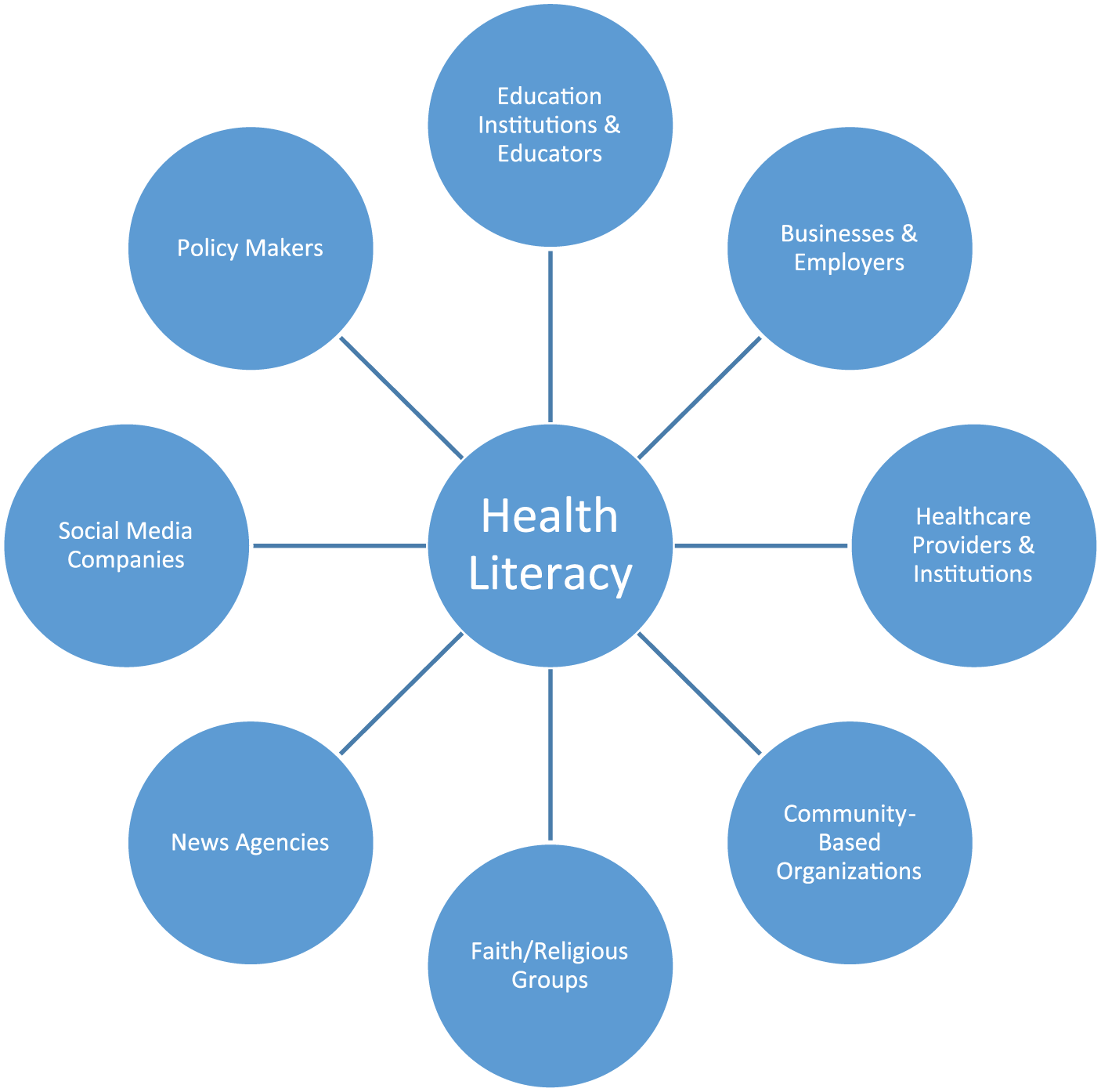
Major Contributors to Health Literacy
Future Directions: Intersection Between Education, Health, and Health Literacy
The essential component of any comprehensive approach to health literacy is education, as it affects both health outcomes and literacy. Education is a key determinant of health, and it has been suggested that general knowledge is more relevant than health-specific knowledge (Cutler & Lleras-Muney, 2010). Education supports and promotes human development, human relationships, and family and community well-being. At the individual level, education reduces the need for health care and the associated economic cost and human suffering impact. Studies have shown that individuals with high educational attainment are less likely than those with low levels of education to have diabetes and heart ailments; they are less likely to be overweight and to smoke cigarettes; and they are more likely to abstain from illegal drugs and excess alcohol (Aranha, Patel, Panaich, & Cardozo, 2015; Ross & Wu, 1995). At the population level, people with more years of education tend to have better health and well-being and live longer. For instance, in 1990, a 25-year-old male college graduate could expect to live another 54 years while a high school dropout of the same age could expect to live 46 years (Richards & Barry, 1998). This continues to be true today. The difference in life expectancy between those with less than a high school education and those with an advanced degree is 10 to 12 years (Montez & Hayward, 2014). Furthermore, it has been suggested that if the life expectancies of those with less than a high school education could be made equal to those with more than a high school education in the United States, there would be an estimated 245,000 fewer deaths per year. This is twice the number of preventable deaths from eliminating homicides, automobile crashes, and diabetes combined (Galea, Tracy, Hoggatt, Dimaggio, & Karpati, 2011).
Similarly, education and literacy are closely related. Although some people with strong literacy skills may have trouble obtaining, understanding, and using health information, research has shown that educational attainment plays a predictably strong role in health literacy. The 2003 National Assessment of Adult Literacy found higher health literacy levels among adults who had taken some graduate classes or completed a graduate degree, compared to those with lower levels of education (Kutner et al., 2006). This finding is consistent with the literature, as there exists evidence of the benefits and feasibility of incorporating health into adult education (Bennett, Kripalani, Weiss, & Coyne, 2003). Other studies indicate that adult education provides an ideal environment to improve health literacy (Diehl, 2007; Golbeck, Ahlers-Schmidt, & Paschal, 2005). Further exploring this interaction, recent studies have reported on collaborative partnerships designed to provide health literacy content through adult education instruction (Chervin, Clift, Woods, Krause, & Lee, 2012), debated the potential benefits of adult education for health literacy and health education (Freedman, Echt, Cooper, Miner, & Parker, 2012), and suggested the unique opportunity to address functional health literacy among low-literate populations through adult education (Freedman, Miner, Echt, Parker, & Cooper, 2011).
Given the evidence of a positive relationship between education and health literacy, we should advocate for their integration. Approaches aimed at improving health at the individual and community levels must include educational interventions. This constitutes an opportunity for improving health literacy levels while contributing to the education of Hispanics. More than half of the 34.5 million foreign-born population 25 years of age in 2013 came from Latin America. Of those, almost 44% did not have a high school diploma (U.S. Census Bureau, 2016). Furthermore, according to a 2009 Pew Research Center study, less than one in three (29%) Hispanic immigrants aged 18 to 25 say they plan to get a bachelor’s degree or more, compared to 60% of native-born young Hispanics (Pew Research Center, 2009). However, although Hispanics in the United States have traditionally experienced high dropout and low college completion rates, most Hispanics value education. The 2009 Pew report found that nearly 9 in 10 (88%) Hispanics agreed that a college degree is important for getting ahead in life, compared to 74% of the overall U.S. population (Pew Research Center, 2009). In addition to interventions to increase high school and college graduation rates, other educational programs that may have a positive impact in the health literacy of Hispanic immigrants are Spanish GED preparation and English as a second language programs. These are generally implemented in both academic and community settings.
The National Action Plan to Improve Health Literacy recommends incorporating age-appropriate health information and curricula, starting with child care/preschool and continuing through the university level, and supporting and expanding local efforts to provide adult education and English language instruction (U.S. Department of Health and Human Services, 2010). An effective implementation of this recommendation is a particularly attractive avenue for improving health literacy among U.S. Hispanic immigrants. For instance, observational studies have shown that adult education programs improve health literacy among Hispanic adults even without including health-specific content, and that Hispanic college students have higher health literacy levels than the general Hispanic population (Mas et al., 2014; Soto Mas et al., 2017). Approaches that have taken advantage of existing community and education systems, such as English as a second language and adult education programs, have also shown to be effective in improving health literacy among Spanish speaking adults (Soto Mas, Cordova, et al., 2015; Soto Mas et al., 2017; Soto Mas, Ji, et al., 2015). Other community systems that may be considered for implementing health literacy interventions for this group include worksites with Spanish-speaking employees (Soto Mas, Cordova, et al., 2015).
Conclusions and Recommendations
Health literacy is a public health imperative and a determinant of health and well-being Strengthening health literacy not only improves health but also builds resilience among individuals and communities in navigating their way to health-sustaining resources and actions. While low health literacy is found across all demographic groups, it disproportionately affects non-White racial and ethnic groups, elderly people, individuals with lower socioeconomic status and education, people with physical and mental disabilities, those with low English proficiency, and nonnative speakers of English.
Health is determined not only by biology, genetics and individual behavior but also by external factors such as society and legislative policies. Literacy level is closely related to socioeconomic status, which is also a major determinant of health. For all Americans, other influences on health include the availability of and access to high-quality education. The United States should reconsider the limited benefits of interventions that are individualized, narrow in scope, clinical based, and disease specific. They do not promote overall literacy and have limited impact at the population level. Effective approaches to health literacy improvement must include, at a minimum, education. There is evidence that increasing educational opportunities is an effective strategy for improving the health literacy level of Hispanics. A more educated Hispanic population will result in a healthier and more economically advanced society. Additional resources should be dedicated to increasing educational opportunities for this population, to supporting health literacy research that looks at health and social outcomes involving Hispanic/Spanish-speaking adults, and to developing and evaluating community-based interventions that use education systems to improve the health literacy of Hispanic groups.