







Abstract
In the Holyoke Food & Fitness Policy Council (HFFPC) case study, the challenges of providing equitable multistakeholder organizing are examined. The importance of housing the work in the community, power sharing, and having community representation in the leadership is made clear. The HFFPC partnership began with vigor, encountered challenges of trust, transparency, aligned goals and values; it dissolved, and reformed. Because it began with shared values of strong communities and healthy people, the partnership continues to evolve, build local leadership, change narratives, and articulate the need for racial equity in their food system, while shifting local systems and policies that frame who has access to healthy food and safe spaces to exercise in a low-income Latino community.
Keywords
Introduction
This article describes the Holyoke Food & Fitness Policy Council (HFFPC), a collaborative model to increase access to healthy food in the primarily Latino community of Holyoke, Massachusetts. A story of a process implementation, it describes how diverse community-based partners worked together to increase systems changes to build a more equitable food system in a low-resourced community. Collective organizing for social change requires a long view. The HFFPC partnership began with vigor and encountered challenges of trust, transparency, aligned goals, and values; it dissolved, and reformed. Because it began with the shared values of strong communities and healthy people, the partnership continues to evolve, build local leadership, change narratives, and articulate the need for racial equity in our food system, while shifting systems and policies that frame who has access to healthy food and safe spaces to exercise in a low-income Latino community. Long-term systems change is not a linear progression: Coalitions build, fall apart, learn, and rebuild. This story provides a framework and guide to the challenges of equitable multistakeholder organizing.
A Partnership Emerges
In 2007, the HFFPC received a multiyear grant from the W.K. Kellogg Foundation (WKKF) to improve health equity by developing a community vision and implementation plan for access to healthy food and safe places to exercise for Holyoke’s Latino, low-income community. In Holyoke, three convening organizations—the Latino community-led urban agriculture and economic development organization, Nuestras Raíces; the Holyoke Health Center; and the Greater Holyoke YMCA—came together in an innovative partnership. Together they established a promising framework that demonstrated a commitment to engaging community residents and youth as decision makers and planners. This was significant for the city of Holyoke, a small Massachusetts former mill city of 40,280, where the majority Latino population struggles with poverty and lack of representation (U.S. Census Bureau, 2016). 1
The HFFPC’s innovative structure prioritized community leadership. A Steering Committee, consisting of four community agencies, four residents, and four youth members, as well as representatives from the city planning office, created new opportunities for low-income, Latino young people and adults from the community to have a voice in management and operation of a significant grant. They designed three committees, acknowledging that community residents needed their own space to build their own voice. The Community Leaders Council met in residents’ homes to discuss and determine priorities. An Agency Alliance convened many organizations working at the nexus of health, food, and fitness in the city. A Youth Leadership Council grew from existing youth groups developing leadership in civic participation, urban agriculture, and health/fitness. A facilitator convened members from each committee together to undergo a planning process and set out a community action plan addressing healthy living with goals for structural change to community food and access, school food and wellness, and the built environment.
The collaborative brought together innovative community-based health programs that were already in motion. The mix of strong partnerships and shared values among community and agencies resulted in significant structural transformations for a healthier and more vibrant Holyoke. For instance, Nuestras Raíces had 100 families gardening throughout the city, a 30-acre incubator farm and training program for predominantly Latino low-income farmers, and a thriving youth leadership program. With the HFFPC, Nuestras Raíces laid the groundwork for increased and coordinated farmers markets and matching coupon programs. The Holyoke Health Center began to develop antihunger strategies, and wellness and nutrition education both through city committees and with hands-on cooking demonstrations in the schools. The YMCA, which in the past had been unaffordable to many low-income residents, developed a youth build-a-bike program and citywide fitness events. HUBS (Holyoke Urban Bike Shop) trained young people with the tools, knowledge, and actual bikes to renovate and keep, and also served as an advocacy channel for young people, who successfully affected the City’s Complete Streets legislation. The Kindergarten Initiative launched a farm-to-school program across the district, advancing nutrition education to young children and families, as well as curriculum and training to teachers about growing, cooking, and eating healthy food. FEEST (Food Empowerment Education & Sustainability Team) gave youth a space to get to know other youth, to learn about food justice while cooking a meal, and to have fun at the same time. A PhotoVoice collaboration with University of Massachusetts Amherst gave youth the opportunity to cultivate action research skills while advocating to the school committee for improved school meals. Community collaborators designated funding and technical assistance for launching their own pilot projects, including the first school salad bar. The Holyoke community witnessed steps toward equity: More young people and community members attended and spoke out at city meetings and saw themselves as citizens who can create social change. Agency engagement grew from 60 to more than 200 during the planning and early implementation stages.
The HFFPC decided to designate the Holyoke Health Center, the largest and most established of the three partners as the fiscal agent for the collaborative, and during the planning years, Nuestras Raíces, a Latino grassroots community-run organization, housed and managed staff. However, the separation of fiscal responsibility and management became unwieldy as the slow payment cycle and institutional requirements of the larger health center challenged basic needs of community residents and partners. As the organizations struggled to agree on financial allocations, questions about transparency emerged. Each organization found itself competing for funding within and beyond the grant. Moreover, the process of involving youth and community members at each step of policy change was unclear and messy. Gatekeeping happened among agencies and community leaders. Mentoring community leaders in new positions was never consistent enough. One organization noted the collaborative’s ability to innovate and act on community priorities but its inability sometimes to sustain and build momentum, due to partner organizations’ lack of capacity, staffing, long-term funding, and general know-how. For example, the community residents voted to install a first salad bar in a high school. The salad bar was monitored by students and faculty but lost institutional support because the HFFPC organizations and the district did not have the farm to school muscle to move it forward.
Growing Pains and Partnership Challenges
In 2013, at the beginning of the implementation phase, it was clear that the structure of a separate fiscal agent and managing organization were at odds. The small grassroots managing organization had real, strained cash flow challenges, and in a small city, the core partners were competing for funding. One partner noted, “There were power dynamics and structural constraints that made this funding very hard” (Sands, Stewart, Bankert, Hillman, & Fries, 2016). A contentious vote was held, and the collaborative decided to move all the HFFPC management from community-led Nuestras Raíces to the fiscal agent, the Holyoke Health Center. Steering Committee and staff members grappled with the decision of maintaining fiscal control in a struggling community organization or having the more established Health Center deploy its resources to bolster the collaborative.
The new Steering Committee reconfigured as the Interim Leadership Team (ILT) with a temporary committee consisting of the City, the three original convening organizations, and a mix of community-based groups representing residents and larger institutions. Working groups were merged into topical groups (food access, active living/complete streets, and school wellness), mixing agency, community, and youth among these strategic areas. Community and youth were no longer at the Steering Committee table making financial decisions for the collaborative, nor did they meet separately as caucuses. Unfortunately, with neither representation in fiscal matters nor a defined ladder for community leadership advancement, resident participation diminished, the collaborative governance became largely White and agency-led, and the voice of the community was lost. The ILT quickly fizzled in attendance to include a slim handful of organizations: the Holyoke YMCA, City of Holyoke, Nuestras Raíces, Holyoke Community College, and Holyoke Health Center. As things fell apart, the ILT ceased contracting a local facilitator, two project directors left within a brief period, and working groups lost momentum.
The HFFPC had hoped having the Health Center at the helm would result in an efficient convener that was open to the community, trusted, and possessing resources and space. However, it became evident that in this case the community health institution was not a community-based organization: It could not place HFFPC and community leadership central to its operations. Its slower, bureaucratic systems, and general lack of community representation in leadership meant that residents did not have equal power in determining the coalition’s agenda and resource allocation. Nuestras Raíces found itself the only Latino-led group at the table in a majority Latino city, struggling to continually represent the low-income Latino community, and soon the only Latina member of the Steering Committee (from Nuestras Raíces) stopped attending meetings. Partners acknowledged just how difficult it was to collaborate with different agendas and to allocate funding equitably. They also noted the human cost of innovation: that people got hurt (Sands et al., 2016). The lack of trust and transparency masked the pervasive issue of structural inequities, race, and equitable representation. The distinct ethnic and income divide between agency staff and residents became more pronounced. Racial inequities and power were not continuously articulated or explored, and thus often manifested in underlying tension about decision making and fund allocation between community members, staff, and agencies.
The group found it did not have a shared language or a shared vision on what successful engagement would look like for community members, which mirrored the structural dynamics that continue to isolate Latinos in Holyoke. People, but particularly Latinos, need jobs and resources in Holyoke. Approximately 28% of Holyoke residents live in poverty (U.S. Census Bureau, 2016). 2 Low-income residents have access to fewer opportunities than their neighbors in the lush Connecticut River Valley, resulting in diminished living wage employment opportunities, lack of access to social networks, affordable housing, public safety, thriving parks and complete streets, and competitive schools. And the spiral continues with higher Latino dropout rates, fewer college attendants, and reduced opportunities to make a living wage.
The majority of people in policy and upper-level management positions in Holyoke are White, while the majority of residents who rely on supports are Latino and people of color. As the representation of the HFFPC Steering Committee and other working committees began to reflect this dynamic of majority White in decision-making roles, the collaborative began to dissolve. Additional challenges arose around building a scaffold to leadership and real jobs for community residents. As the HFFPC became more contentious, it became clear that the collaborative would either have to disband and return funding to the WKKF or that the initiative would need a new structure. In 2015, Nuestras Raíces proposed a leaner initiative, Nuestra Comida, to be both fiscally managed and housed at the community-based organization, and reoriented the work to school food change, scaling up of markets for cultural crops, family health, and youth pathways to jobs and higher education. The name, Nuestra Comida (our food) was chosen to represent a community empowerment model reflected in the theory of change: “By engaging entire families, developing youth, forming effective partnerships, and implementing an equitable culturally based school and community food system, Nuestra Comida builds healthy, respectful, and sustainable communities.”
At the same time, the Partnership in Practice evaluators were funded by the WKKF to conduct in-depth interviews with past staff, partners, and residents, to hold a community dialogue, as part of an effort of community healing, learning, and repositioning for future work and collaboration, and to write about the process. A WKKF technical assistance provider facilitated a community listening session, the evaluators orchestrated asset mapping, and findings were used to create the new Nuestra Comida program. For some partners, this was a moment to rebuild burned bridges, and for others a chance to get on the same page about the good work that had been done, the past struggles, and a path forward.
Nuestra Comida, A New Vision for a Partnership
Nuestra Comida fiscal management and grant convening was centered in the community, with the convener Nuestras Raíces, an organization with majority Latino staff and board. Acknowledging that respectful partnerships were central to the success of the endeavor, Nuestras Raíces gathered a trim group to lead the components of Nuestra Comida: the Paulo Freire Social Justice High School, Holyoke Community College, FoodCorps, with Partnership in Practice as facilitator and evaluators. The collaborative refined innovations from the HFFPC in urban agriculture, youth leadership, community cooking, nutrition, and wellness. With the continued help from the WKKF’s Organizational and Community Change Consultant, Nuestra Comida core partners developed its theory of change and designed a community action plan. The technical assistance provided critical support and direction to the collaborative at this crucial time.
Collaborative Latino Leadership Structure
Latino residents were hired by Nuestras Raíces to staff Nuestra Comida and lead the core committee. An indigenous chef, entrepreneur, and community organizer was hired to lead the Nuestra Comida project. He advocated to FoodCorps to hire its first Holyoke resident parent to teach food justice, cooking, and gardening at the Paulo Freire Social Justice Charter High School and build farm to school programs in the Holyoke Public School District. A resident community organizer mobilized urban gardeners and parents, community taco nights, and a radio show. An agronomist from Puerto Rico was hired to lead the 100 Finqueros training program, which provides bilingual technical assistance in sustainable agriculture and business planning to two cohorts of approximately 50 urban farmers and value-added food venture entrepreneurs over the course of 2 years.
Racial Equity as a Core Value
The collaborative operates with racial equity as its goal and its operational guideline. This means that staff and partners attend trainings to understand systems of racial oppresion and continue these conversations about the influence of privilege and systemic racism on foodways and economic development, both regionally and nationally, as they design and implement collaborative programs. A values-driven process for justice and fairness necessitates trust building, sharing stories and personal experiences, disagreements, and the agreement to hang in together.
The more deliberate foundation of racial equity is a result of organizational readiness, staff and leadership capacity, the current political landscape, technical assistance, and a commitment to practice. The Center for Social Inclusion/Race Forward’s racial equity policy framework informs all conversations with potential partners: “Leading with race because racial inequities are deep and pervasive; racial anxiety is on the rise; race/intersectionality is critical in examining other structural problems; specificity matters” (Villa Lobos, 2017). The Union of Concerned Scientists’ Good Food for All working group provides Nuestra Comida partners with a peer group of national organizers working for racial equity in the food system, and in broader public policy. For Nuestra Comida, The HEAL Network, Soul Fire Farm, Springfield Food Policy Council, and Gardening the Community provide the partnership with thought leaders from allied people of color–led organizations.
Building on Past Foundation of Systematic Change
Adopting this racial equity approach, Nuestra Comida’s strategies amplify systems changes and prototypes from the HFFPC in the areas of partnerships, leadership, and increasing access to healthy cultural food.
Partnerships
Nuestra Comida partnered with outside organizations with additional resources to further systems change. Food Corps provided staffing for farm-to-school, youth leadership, and family nutrition programs to flourish first in the Paulo Freire Social Justice Charter High School and later in six Holyoke Public Schools. Building on the FEEST (Charbonneau, Cheadle, Orbé, Frey & Gaolach, 2014) and The Food Trust’s Kindergarten Initiative (The Food Trust, n.d.; Sands & Shar, 2014) models, Nuestra Comida leaders developed prototype cooking, food justice, and gardening curriculum, with youth learning to cook healthy meals on a budget for their families, and began to model family engagement in these processes. Holyoke Community College designed service learning and community nutrition classes into its budget, increasing opportunities for college students (many from Holyoke) to support residents in learning and adopting healthy recipes. University of Massachusetts, Amherst’s Center for Racial Justice and Urban Affairs provided funding for Holyoke and Springfield youth leaders to design a PhotoVoice project about their food environment. The Smith College Jandon Center for Community Engagement provided year-long interns with their own transportation. Nuestra Comida continues to collaborate with the HUBS program and with the Holyoke Health Center on hunger/nutrition projects and community cooking demonstrations. All partners pitched in to produce the first Holyoke Food Justice Conference in 2017, drawing 300 people to a day of workshops and presentations by national indigenous and people of color food justice leaders.
Community and Youth Leadership Pathways
In addition to developing education programs, Nuestra Comida designed leadership programs for youth and adult residents (Figure 1). With the help of the WKKF’s Organizational and Community Change Consultant and the Health for Oakland’s People and Environment (HOPE) Collaborative’s community engagement model (see Supplemental Appendix 1, available in the online version of this article), Nuestra Comida established a community leadership ladder for youth and parents to become advocates for school food change. During this time, Nuestras Raíces’s Latino staff provided mentorship to young people, while embodying successful professional food systems employment and leadership in the community. Partners developed pipeline programs engaging and educating Holyoke youth who show a passion for farming, cooking, leadership, and food systems from childhood through their college years, and constructed pathways and mentoring for youth interested in good food jobs.
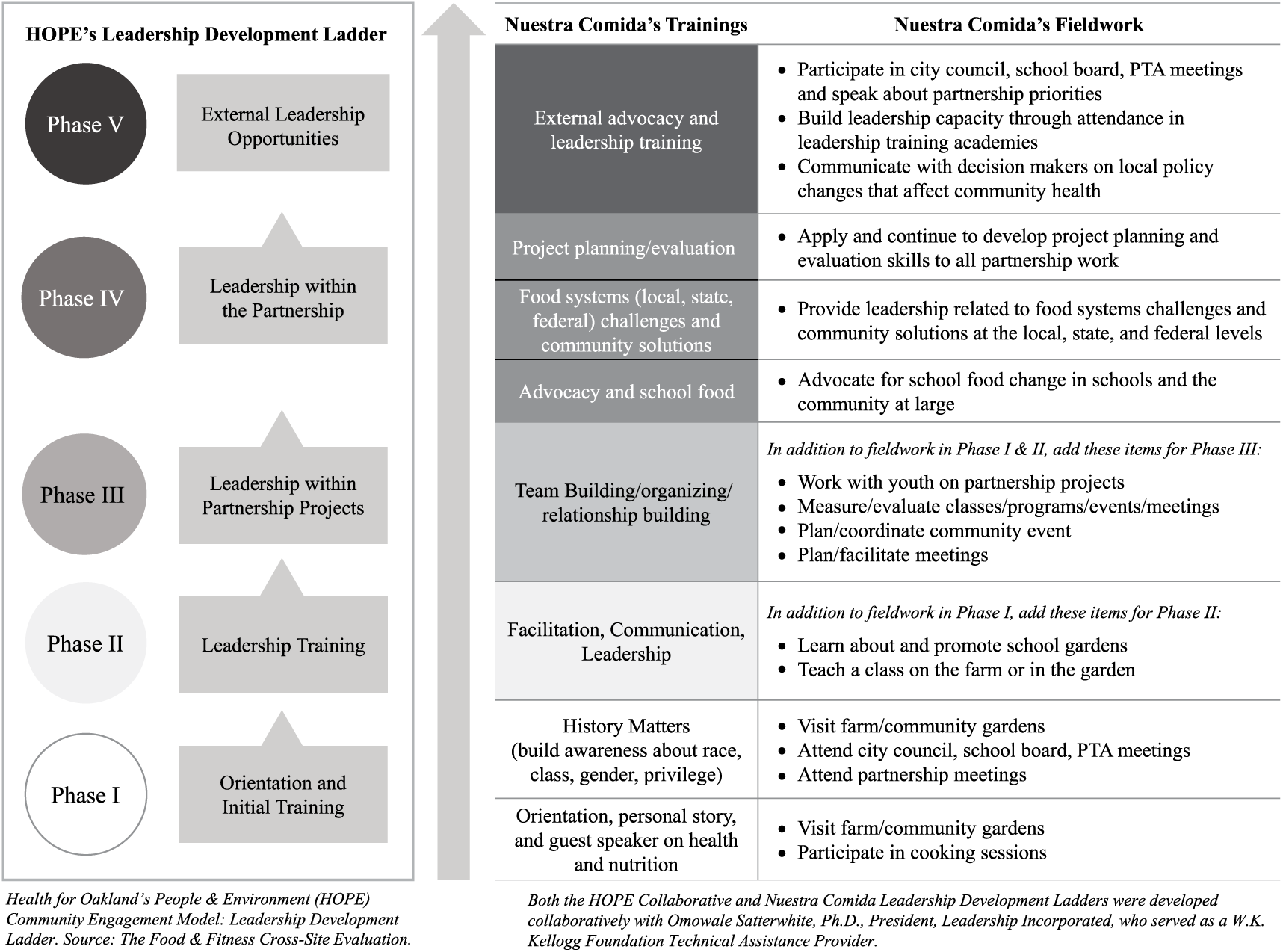
Nuestra Comida’s Leadership Development Training Plan
Increasing Access to Healthy, Fresh, Cultural Foods
Finally, Nuestra Comida continued to build structural change for access to healthy food in the community. Nuestras Raíces designed a new cultural crops marketing program, to increase the seed stock stability of their core crop, Puerto Rican sweet pepper, ají dulce (used for sofrito, and which easily crosses hot peppers). They began a program to train 100 beginning farmers over the span of 2 years, synchronized existing farmers markets, and retrofitted a mobile market to reach people in their neighborhoods with fresh, affordable produce. Together they managed the Healthy Incentives Pilot of the USDA Food Insecurity Nutrition Incentive Program at the farmers markets, increasing fresh food affordability to residents and profits for Puerto Rican farmers.
Constructive Modeling
Nuestra Comida has developed a more collaborative versus competitive dynamic among partners who are not competing for the same grant dollars. Holyoke Community College has modeled dedicating resources to pay staff to develop courses and service learning partnerships. The FoodCorps member position brings in valuable support for farm to school programming, with the leadership of a Holyoke resident. Led by a new generation of Latino activists of color who are working as organizers in the community, the partners demonstrate energy and enthusiasm of early- and mid-career on-the-ground experts. Additionally, Nuestra Comida has engaged more interns from the surrounding colleges and community colleges. Interns are teamed up with staff to administer projects and keep up good communication. Often this means that they show up, do what’s needed to be done, whether taking notes at a meeting, making a flyer or drafting speaker invitation letters for the food justice conference, digging at the farm with youth leaders, cooking for taco nights, developing a community cookbook. Their work is not always linear and requires enthusiasm, flexibility, humility, and listening skills.
Core members have noted that the relationships among the working group partners are very different. One member noted, While HFFPC felt more formal, like a business, with political undertones, with this group, I feel like I have a personal connection with everyone and an unspoken understanding that we all are working towards the same goal. It is a much more collaborative environment. (Nuestra Comida, 2017)
Partners roll up sleeves and jump in as needed to build and strengthen projects. Food is central to meetings—typically some of the attendees cook prior (or during), and the act of gathering around a meal welcomes people.
Looking Forward
The coalition work of the HFFPC and Nuestra Comida relies on grant funding. It is a cyclical process, with grants ending or requiring reapplications every several years. As funding sources shift, some Nuestra Comida Project components continue with other funding, but the collaboration has lost some momentum. Despite this unpredictability, the dedication among many organizations and residents to continue to creatively address structural challenges to food access in Holyoke remains constant.
From the experience of the HFFPC’s initial hard-earned flurry of activity and success to the ebbing of effectiveness when mostly White institution–led and less democratic, we see that for Holyoke food access and health work, Latino community leadership is essential. Successful partnerships with established White-led institutions (surrounding universities, agencies, municipalities) require cultural humility (leading with race, and articulating difference and privilege), setting up agreements initiated by the community, and co-learning and power sharing (Mendez, 2017). While the earlier HFFPC had all these elements, the shift comes from the leadership originating in a community-based organization, run by and for the Latino community. Nuestra Comida partners have set the terms for collaborations with the surrounding universities and partners.
It is a process of working from the center out. Using food as a catalyst, Nuestra Comida sets the table for honest, hard conversations, and creates new models of partnerships with institutions and other organizations.
By establishing an equitable governance structure and collaborative processes, Nuestra Comida has changed a typical Holyoke narrative of top-down service administration to community-led innovative partnerships providing new ladders for residents to give voice, take action, and participate in change making and policy processes. By centering in the community, Nuestra Comida project enabled partners to figure out points of convergence, mutual goals for food resiliency. As the work evolves, partnerships reform, build new bridges, reestablish collaborative processes, and continue to create sustainability for the work.
Supplemental Material
HPP7888849_Supplemental_Appendix_1 – Supplemental material for Phoenix Rising: The Evolution of Holyoke’s Collaborative Organizing for Healthy Food Resilience
Supplemental material, HPP7888849_Supplemental_Appendix_1 for Phoenix Rising: The Evolution of Holyoke’s Collaborative Organizing for Healthy Food Resilience by Laurie Lachance, Theresa Kowalski-Dobson, Catherine Sands, Neftali Duran, Laura Christoph and Carol Stewart in Health Promotion Practice
Footnotes
Notes
Authors’ Note:
Many thanks to all the people who offered their heartfelt stories and analysis over the years to Partnership in Practice. We are deeply grateful to the W.K. Kellogg Foundation for valuing and supporting the work. Neftali Duran is an indigenous chef and community organizer living in Holyoke, MA, USA.
Supplement Note:
This article is part of the Health Promotion Practice supplement, “Community-Driven Efforts to Increase Equity in Communities Through Policy and Systems Change: Outcomes and Lessons Learned From 9 Years of Food & Fitness Community Partnerships.” The supplement describes research and practice outcomes from the Food & Fitness project under the direction of The University of Michigan School of Public Health, with funding from the W.K. Kellogg Foundation. The entire supplement issue is available open access at  .
.
References
Supplementary Material
Please find the following supplemental material available below.
For Open Access articles published under a Creative Commons License, all supplemental material carries the same license as the article it is associated with.
For non-Open Access articles published, all supplemental material carries a non-exclusive license, and permission requests for re-use of supplemental material or any part of supplemental material shall be sent directly to the copyright owner as specified in the copyright notice associated with the article.
