







Abstract
The value of community assessments depends on the researchers’ ability to reach a diverse and representative sample of participants. This process is particularly challenging when assessing the health and well-being of vulnerable populations that are reticent to participate in research because of demographic and sociopolitical factors. One such group is Latinxs (the gender-neutral version of Latinos or Latinas) of mixed immigration status who live in low-income, socially and geographically isolated enclaves in the Southeast. Framed by community-based participatory research and social marketing theories, this study describes practical strategies for health researchers, practitioners, and advocates seeking to engage and build trusting relationship within U.S. Latinx communities. First, identify and leverage points of entry to different segments of the communities of interest by engaging meaningful gatekeepers from different sections of the population and searching for places where potential participants gather. Second, reduce the burden of assessments by using incentives and creating intentional reciprocity. Third, establish critical, long-lasting trust with community members, leaders, and allies by adapting data collection procedures, ensuring confidentiality, engaging bilingual facilitators, and most important, being present with and for the community. Finally, presenting the findings back to the community can increase the ownership of the process.
Community assessments provide the groundwork for developing and implementing effective public health interventions (Centers for Disease Control and Prevention, 2018). For an assessment to result in a reliable overview of a population’s health concerns, however, it is critical to ensure that participant samples represent the larger population (Soriano, 2013). Achieving this representation depends on the researchers’ ability to identify entry points to the different segments of the community and effectively engage community members to participate in the study (Israel et al., 2018). This proposition is particularly challenging when assessing vulnerable populations weary of academic research, fearful of strangers, and with limited access to Internet. This study describes culturally responsive strategies to assess the needs of mixed immigration status Latinxs (the gender-neutral version of Latinos or Latinas) living in low-income and socially isolated enclaves in the Southeast.
The process to find and invite participants to complete an anonymous survey or to attend a focus group was informed by two overarching theoretical frameworks: community-based participatory research (CBPR) and social marketing (Israel et al., 2018; Volpp, Hess, & Saffitz, 2015). CBPR, anchored on equitable, trusting partnerships, has served as a framework for numerous initiatives designed to improve the health and well-being of Latinx communities residing in the Southeastern United States (Calo et al., 2015; Israel et al., 2018; Watson-Johnson et al., 2012). At the base of such interventions, community assessments are conducted in partnership with engaged stakeholders and community members. Social marketing provides a complementary view. Following principles of commercial marketing to sell merchandise, social marketers use “the four Ps” (product, price, place, and promotion) to sell an idea or health behavior and to understand the needs and points of view of the consumers (Volpp et al., 2015). Researchers have used this approach to develop effective health promotion and education campaigns for vulnerable populations (Andrade et al., 2018; Rogers et al., 2017). Because social marketers start where their indicated group is, the outcomes tend to be culturally sensitive.
Assessing the needs of Latinx communities is challenging. Most common barriers are environmental factors (e.g., geographic and social segregation of immigrant communities), population characteristics (e.g., low education levels), and the sensitive nature of some topics (e.g., HIV status; Shedlin, Decena, Mangadu, & Martinez, 2011). Most important, requests to disclose their personal information can increase feelings of vulnerability and fears regarding discrimination (Hernández, Nguyen, Casanova, Suárez-Orozco, & Saetermoe, 2013). The latter is particularly poignant given current “political incivility” toward Latinxs (Sage, Benavides-Vaello, Flores, LaValley, & Martyak, 2018), and state-level “anti-immigrant” policies associated with high perceived discrimination, particularly in some Southeastern states (Almeida, Biello, Pedraza, Wintner, & Viruell-Fuentes, 2016).
Consistent with the present challenges, researchers must establish credibility within communities to support successful assessment efforts (Soriano, 2013). A primary and critical element echoed throughout the CBPR literature is the development and nurturance of trust within a community prior to, during, and following research efforts (Lucero, Wright, & Reese, 2018). Toward that end, researchers and practitioners underscore the need to (a) identify and work alongside indigenous leaders (Israel et al., 2018; Matthew, 2017), (b) engage community members and key stakeholders as active partners in the research effort (Israel et al., 2018), (c) create research tools and materials in Spanish versus using translations (Reidy, Orpinas, & Davis, 2012), and (d) commit the time necessary to support these process-oriented efforts (Matthew, 2017).
Although this scholarship richly contributes to our knowledge of community engagement more generally, significant gaps in knowledge remain with respect to how to engage and build trusting relationship within U.S. Latinx communities. Thus, the purpose of this study is to discuss practical strategies and related challenges to engage socially isolated Latinx community members in a needs assessment.
Method
Setting and Sample
This case study took place in a geographically small county (100,000-150,000 residents) in Georgia that ranks among one of the poorest in the state (U.S. Census Bureau, 2017). According to the census, the proportion of Latinx is 1 in 10, but 1 in 4 students in the local school district self-identified as Latinx. Inclusion criteria for the survey and focus groups were being 18 years or older, self-identifying as Latinx, and residing in the selected county.
Between May 2015 and July 2016, 370 individuals completed the confidential household-level survey (18.5% response rate). Sixty-nine surveys were excluded from final analyses for failure to meet inclusion criteria, participation in one of the pilot surveys, or failure to complete at least 80% of the questions. The final sample consisted of 301 respondents (Table 1). Twenty-six adults (52% response rate) joined one of five 60- to 90-min focus groups between August and October 2016. The university’s institutional review board reviewed all data collection procedures and classified the study as nonresearch, thus, exempt from institutional review board approval.
Demographic Characteristics of the Sample
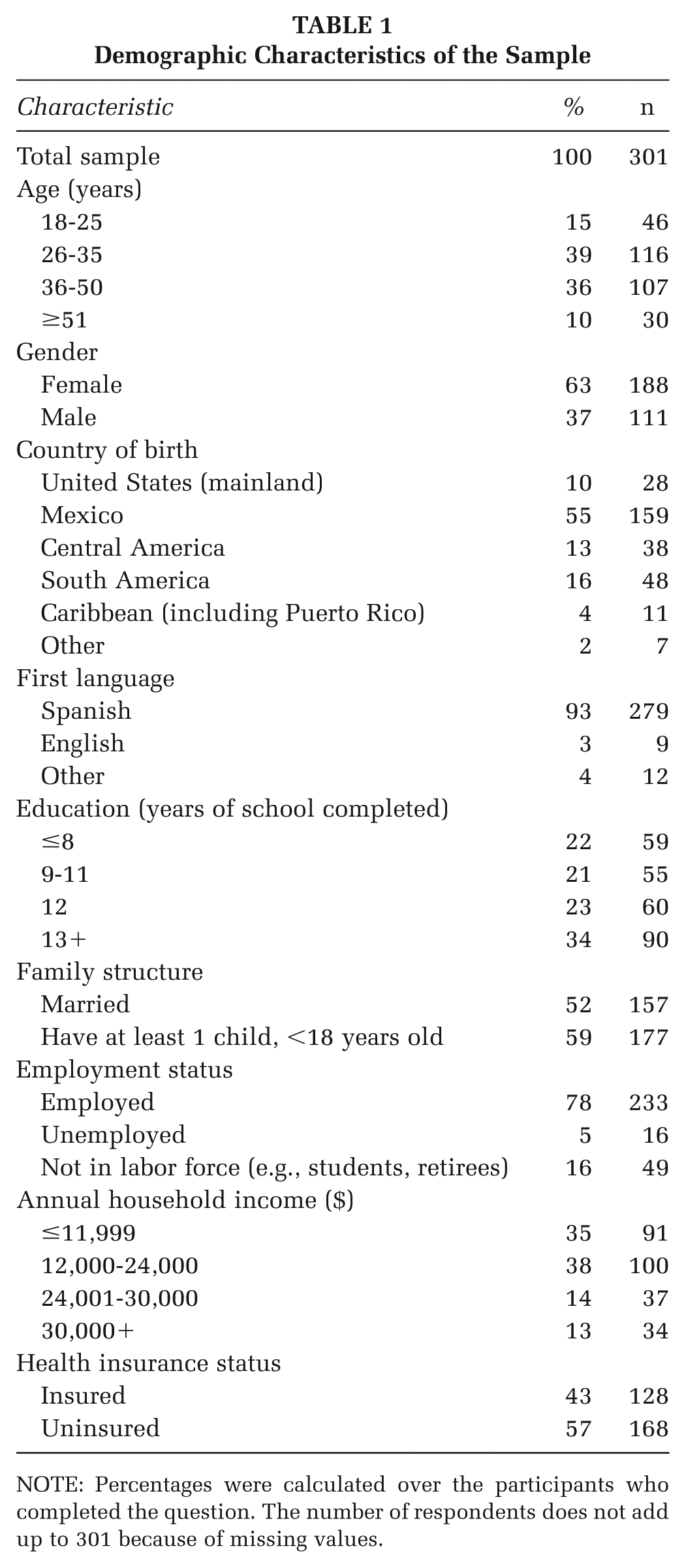
NOTE: Percentages were calculated over the participants who completed the question. The number of respondents does not add up to 301 because of missing values.
Data Collection and Analysis
Survey
A 50-question bilingual household-level survey was developed to assess: access to physical and mental health care, education, employment, government resources, public transportation, immigration and legal status, language services, perceptions of neighborhood safety, community inclusion, and discrimination. Items were adapted from tools used to assess other emerging Latinx communities (Corona, Gonzalez, Cohen, Edwards, & Edmonds, 2009; Fuger, 2014). Two pilot surveys were conducted in April 2015. The survey was available in paper and online. One quarter of surveys were completed online. Between May 2015 and July 2016, trained bilingual and bicultural facilitators (n = 29) surveyed a convenience sample in locations familiar to the community (e.g., libraries, churches, Latinx-owned restaurants), as well as community events such as soccer games. Participants consented by marking an “X” on a bilingual consent form. They had the option to self-administer the survey or have the interviewer read the questions in English or Spanish. To encourage participation, respondents received small incentives like a bilingual resource guide or a coupon to a local restaurant. The response rate to most survey questions was very high, except for items concerning education, immigration status, and income. Descriptive statistics were used to summarize the data using SPSS (Altschuld & White, 2010).
Focus Groups
Five focus groups, conducted in Spanish, were held between August and October 2016 at flea markets, parks, and community centers frequented by the Latinx community. Twenty-six adults were recruited using a combination of convenience, purposive, and snowball sampling methods, and received a $20 gift card as an incentive. The purpose of the groups was to explore in greater detail the following: (a) utilization of existing local health care and social services; (b) perceived access and barriers to those services; (c) perceived impact of immigration status, financial instability, and lack of information about existing services; and (d) sense of community. Focus groups were audiorecorded, transcribed, and thematically analyzed (Braun & Clarke, 2006).
Results
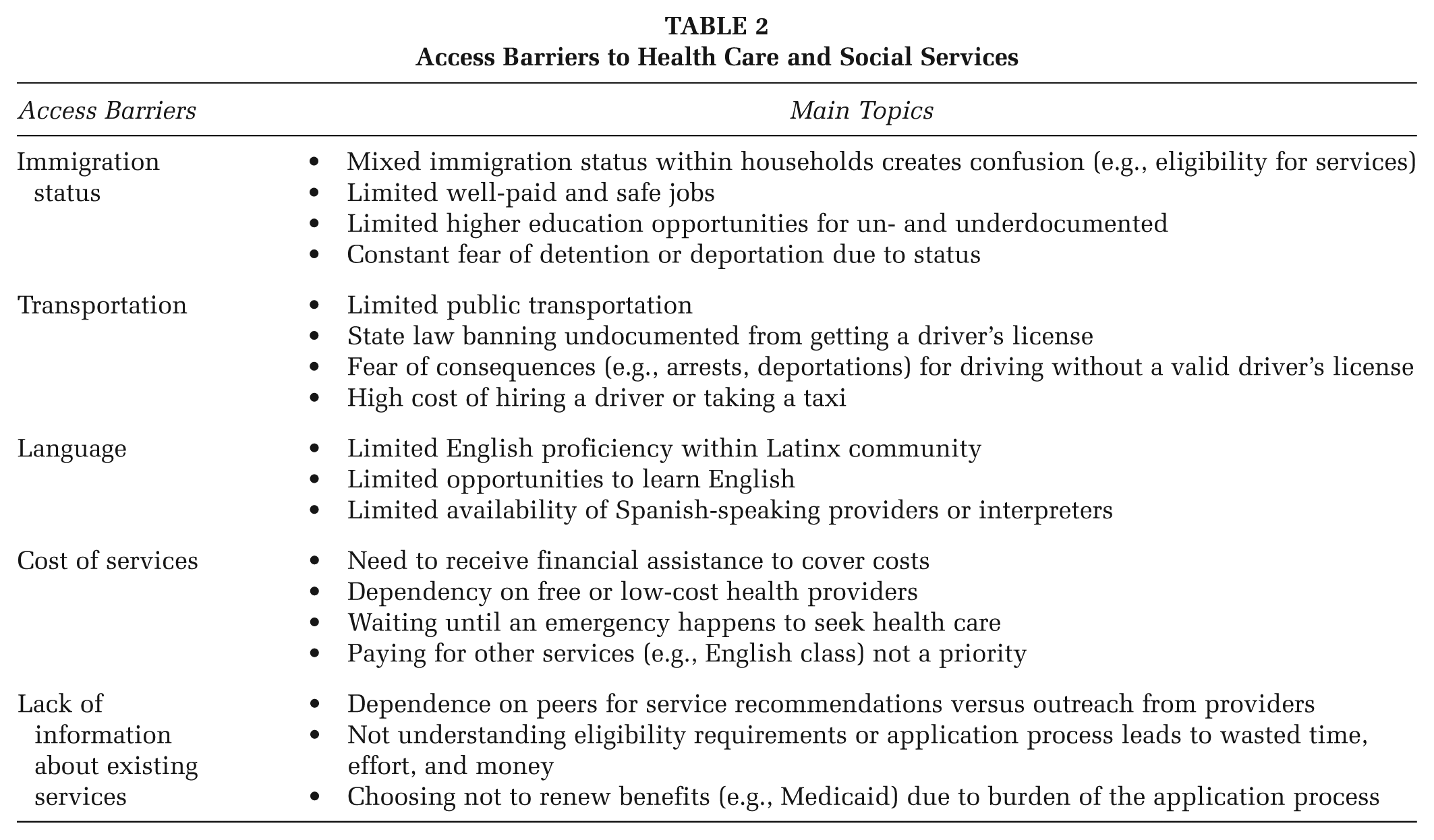
A preliminary analysis of qualitative and quantitative data identified significant, interrelated access barriers to health care and social services, including (a) immigration status, (b) transportation, (c) language, (d) high cost of services, and (e) a lack of information regarding existing services (Table 2). These findings are reflective of similar studies conducted across mixed–immigration status Latinx communities in nonurban areas of the United States (Cristancho, Garces, Peters, & Mueller, 2008; Valenzuela, McDowell, Cencula, Hoyt, & Mitchell, 2013). A more thorough account of research findings is beyond the scope of this article.
Access Barriers to Health Care and Social Services
Lessons Learned
We present lessons learned for conducting a needs assessment within a Latinx community regarding (a) the identification of points of entry, (b) the reduction of assessment burden, and (c) trust-building with community members and stakeholders.
Points of Entry
Leveraging Gatekeepers
The first author, who was new to the area, asked known and respected community allies to provide personal introductions to local leaders and to accompany her to various community engagements (e.g., touring local agencies serving the Latinx community and Latinx-owned businesses, attending open house events, participating in discussions about the impact of recent local immigration raids, and volunteering as an interpreter during parent–teacher conferences in K-12 schools).
Such warm introductions by community “gatekeepers” were crucial in establishing a trusted presence in the community and building rapport. For example, following these efforts, several local businesses agreed to make paper surveys available to their Latinx employees, while local organizations, schools, and churches allowed researchers to recruit participants at relevant gatherings (e.g., at the exit of Spanish-language religious services). The principal of an elementary school also agreed to send paper surveys to the homes of Latinx families. Finally, several entities shared the link to the online survey on relevant mailing lists and social media pages.
Identifying “Places.”
Researchers spent significant time identifying venues frequented by the community, including service providers, minority-owned businesses, parks, churches, social media pages, mailing lists, and regional Spanish-language media (in the absence of local outlets catering to Latinxs). Strategies included (a) requesting recommendations from stakeholders; (b) sifting through local business directories and resource guides; (c) conducting searches online and within social media platforms (e.g., Facebook); (d) perusing bulletin boards in businesses, community centers, and churches; and (e) intentionally driving through the community taking note of potential venues (e.g., small grocery stores not included in business directories).
Asking respected allies and community leaders to accompany researchers to the 75 to 100 locations identified would have represented a heavy burden. Furthermore, as the list of potential entry points grew, it became clear that many were unknown even to said stakeholders. As such, researchers visited many of these locations alone. To gain initial entry, they mentioned the support of key “gatekeepers” for the project and employed trust-building strategies described later in this article.
Reducing Burden of Assessment
Using Incentives
Survey fatigue from multiple university and community studies resulted in reticence among some key stakeholders to support data collection activities in their property. Furthermore, data collectors anecdotally shared that approximately 30% of potential respondents declined participation because they did not want to be part of “yet another” study that would ultimately fail to benefit their community. The intentional use of incentives and reciprocity likely helped improve participation.
To address the challenge of a limited (~$1,500) operating budget for out-of-pocket expenses, researchers leaned on local community partners. For example, researchers invited two Latinx owners of local restaurants, selected specifically for their positive reputation within the population both as employers and as community supporters, to donate low-value coupons for incentives. To avoid exacting additional burdens on the business owners, a research team member worked with them to design and print nearly 300 coupons for a free dessert at their locations. Although their value was less than $5 each, the coupons emblazoned with the restaurant logos afforded priceless credibility to the study. The owners did not track coupon redemption rates but anecdotally shared that it was so low that they would consider a similar strategy in the future.
During the study period, the research team also received a competitive grant from a regional foundation to support qualitative research efforts and dissemination of findings. These funds facilitated the purchase of gift cards ($20 each) to support participation in focus groups.
Creating Intentional Reciprocity
To lay the groundwork for reciprocity between researchers and participants, the introductory narrative explaining the current research highlighted that (a) this was a new, unprecedented effort focused specifically on the local Latinx community (vs. folding it into a larger study), (b) communities should define their own strengths and challenges versus letting service providers do it, (c) service providers eagerly awaited results to inform culturally and linguistically responsive programming (as evidenced in formative conversations with such partners), and (d) the widespread distribution of multidimensional findings might minimize the necessity for future singularly focused surveys emanating from several individual entities.
Facilitating Trust
Adapting Data Collection Procedures
Given the inherent vulnerabilities of low-income, mixed–immigration status communities, it was crucial to design a study that respected ethical standards of human subjects research and was sensitive to this particular population. For example, in addition to translating questions to Spanish, all phrasing was tested during two pilots to ensure it reflected this community’s mostly Mexican dialect of Spanish and literacy levels. Consent forms were similarly written and only required a printed “X” from participants, instead of their full name. Study facilitators were trained to decipher verbal and nonverbal cues signaling discomfort with the study or with specific questions, particularly income and birthplace. For example, uninterested or scared potential participants would say, “Come back later” instead of declining participation outright.
To minimize potential discomfort with certain questions, participants could self-complete the bilingual survey or have a facilitator read the questions aloud and mark their answers. For the same reason—and to navigate personnel constraints and to encourage increased participation among younger adults—researchers distributed a link to the online survey via mailing lists of Latinx organizations and social media.
Ensuring Confidentiality
Researchers emphasized protecting participants’ confidentiality. Specific efforts included not asking for names (focus group participants used pseudonyms) or other potentially identifiable information. If personal information was accidentally shared during conversation, study facilitators informed participants that it would not be written down and that the final focus group transcripts would be edited to remove such details. Online surveys did not collect IP addresses.
Researchers also adopted additional confidentiality measures that addressed the community’s response to the study itself. All self-completed paper surveys were immediately reviewed for any personal information accidentally written; if found, the section with the information was physically cut off and shredded. All confidentiality protocols were reviewed during trainings with data collectors.
Engaging Bilingual and Bicultural Study Facilitators
Given our limited budget and access to the local Latinx community, researchers focused on recruiting volunteers fluent in Spanish who (ideally) self-identified as Latinx. Strategies included announcements in relevant mailing lists (e.g., a listserv focused on topics related to Latin America) and social media groups (e.g., a Facebook page of a local Latinx fraternity), and direct outreach through personal networks.
Forty individuals completed a 2-hr training on research ethics and study procedures. Twenty-nine actively participated in data collection or analysis. The group included students, staff and faculty at a local university and others affiliated with it by one or two degrees of separation (e.g., spouses or friends). More focused efforts to recruit members of the population of interest through gatekeepers may have resulted in a cadre of volunteers more representative of the community.
The survey was designed to last 15 to 20 min, but a considerable number ran closer to 60 min. Reasons were (a) distractions in public spaces where participants were engaged (e.g., greetings by acquaintances) and (b) respondents’ desire to share anecdotes related to the topics at hand (e.g., a recent health crisis exacerbated by lack of insurance). By speaking their language and following the participants’ lead during survey facilitation (even if it meant a longer interaction), interviewers felt that they were able to establish trust relatively quickly.
Being There
Visiting the identified entry points once was often insufficient to build trust with the community and properly promote study participation. Thus, researchers spent considerable personal time (a) attending events organized for and by the local Latinx community (e.g., cultural showcases, jaripeos/bull-riding shows, etc.), (b) volunteering at local Latinx-serving organizations, (c) frequenting local Latinx-owned businesses, (d) attending Spanish-language religious services, and (e) actively participating in Spanish-language Facebook pages (e.g., online “yard sales”). To sustain the trust generated during the research period, researchers have continued to be visible within the community, serving on boards for Latinx-serving nonprofits, participating in public actions organized by community leaders, and accepting invitations to community and family events (e.g., cultural showcases, baby showers, and weddings).
Presenting the Findings
Study results, as well as recommendations on how to address common access barriers, were presented to key decision makers in and around the county in a 58-page report, a double-sided infographic summary sheet, and 15 in-person presentations. To continue engaging community members in a trusting relationship—and to address concerns expressed by local leaders about prior university-led research efforts that failed to share findings with the community—the final report and summary sheet were translated into Spanish and copies were placed at relevant community centers. Researchers also presented the findings to a dozen community leaders and members during standing meetings held by advocacy groups. Poststudy, dialogue with community leaders has continued to highlight positive change emanating from this research and to engage them early in the development of new CBPR initiatives focused on health.
These trust-building strategies were well received in the community, as reflected by a male focus group participant: This [the study] is good. It’s new for me. Nobody had ever come to interview me about this before. But it’s needed. To be aware, as you [the researchers] say: “What do you think? What’s missing?” Well, a lot is missing. But since we had never had a conversation like this before, for me this is a surprise . . . but as to whether there is a need for many services, yes, there is.
Discussion
This study highlights strategies to find and assess members of a Latinx community, within the constraints of a limited operating budget and personnel resources, a lack of trust within the community, and community-wide survey fatigue. Several common challenges in assessing the health and well-being of Latinx communities in low-income enclaves in the Southeast likewise emerged.
Identifying various points of entry to the community, early in and throughout the study, proved crucial to ensuring a large sample. This process was facilitated in large part by gatekeepers’ willingness to introduce researchers to local stakeholders, which increased the credibility of both the researchers and the present study. Taking the time to identify different types of venues relevant to the community (e.g., parks, grocery stores, Facebook pages) also meant that researchers were able to connect with participants in spaces where they already felt safe. The intentionality behind using low-value incentives donated by respected local businesses and highlighting the study’s reciprocity (Corbin & Morse, 2003; Maiter, Simich, Jacobson, & Wise, 2008) in all interactions with participants helped establish trust and mitigate survey fatigue.
To establish trust with the community, it was critical to adapt data collection procedures to ensure that the study was culturally and linguistically responsive and that it protected participants’ confidentiality. Being in the community helped researchers position themselves not just as academics but also as good neighbors and committed social justice allies beyond the scope of this project (Christopher, Watts, McCormick, & Young, 2008; Edwards, 2006). Presenting the study’s findings and ongoing poststudy dialogues with stakeholders in their preferred language(s) has further cemented long-lasting trust (Shoultz et al., 2006). Shared language and cultures helped engender confidence between data collectors and participants; however, engaging community members as researchers (e.g., survey facilitators) may have made this process even more organic (Scharlach & Sanchez, 2011).
Such trust, further strengthened by the researchers’ continued visibility in the community, has also led to exciting possibilities for additional CBPR projects to enhance the health and well-being of this Latinx community (and potentially others) in the Southeast. To date, local government and nonprofit organizations have incorporated findings from the current study into the planning and execution of various efforts that have benefited (or stand to benefit) the local Latinx community: (a) the establishment of a new bus line in August 2017 connecting several predominantly Latinx neighborhoods with public schools, supermarkets, health care and social service providers, and downtown; (b) the opening of a satellite office of a large nonprofit agency offering sliding-scale, bilingual immigration legal aid, and educational and social services; (c) an increase in financial support from private donors and foundations to local Latinx-focused nonprofits that began to incorporate the research findings and suggestions into their donor requests; and (d) the award of a seed research grant to support the efforts of an interdisciplinary research team to implement and evaluate a community health worker (promotora) program to address barriers and support capacity-building within the local Latinx community. Findings may have been more widely used if validated scales had been used during data collection.
Conclusion
By 2060, Latinxs are projected to constitute nearly 30% of the U.S. population (U.S. Census Bureau, 2018). When coupled with research indicating significant and persistent barriers to accessing basic health and social services (Corona et al., 2009; Viruell-Fuentes, Miranda, & Abdulrahim, 2012), which some argue should not be framed as needs but as rights (Androff, 2015), there is cause for alarm.
The current study underscores the value of localized culturally and linguistically responsive methods to engage community members in identifying their needs and participate in developing solutions for the communities in which they work and live. This study first provides practical strategies to identify points of entry to a mostly hidden and fearful population. Second, it positions the use of small incentives and intentional reciprocity as promising strategies to reduce the burden of assessment. Finally, this study highlights the necessary and often critical step of developing trust. Community-based researchers, practitioners, and advocates are thus encouraged to adjust research and program time lines adequately to facilitate the development of authentic community engagement and collaborative partnerships (Matthew, 2017). Given the increased perceived discrimination and anti-immigrant policies (Almeida et al., 2016), community-based researchers and practitioners must be prepared to spend more time on this process than ever before. Understanding the interrelated barriers that vulnerable and oppressed communities face when trying to meet basic human rights is essential to community-based practice and research grounded in social justice. Although clear challenges to conducting mixed-method needs assessments of vulnerable communities exist, promising strategies to address them are available.
Footnotes
Authors’ Note:
The authors acknowledge the 370 individuals who shared a snapshot of their strengths and challenges through their participation in this study, and the community leaders and allies that facilitated these trusting connections. Their decision to participate helped bring much-needed attention to the challenges and needs of their community. We also extend our gratitude to the volunteers, staff, and faculty at The University of Georgia who provided invaluable support and guidance every step of the way. The University of Georgia’s institutional review board reviewed all data collection procedures and classified the study as nonresearch, thus, exempt from institutional review board approval. All authors declare that they have no conflicts of interest, financial or otherwise. This study was supported by The Sapelo Foundation, The University of Georgia’s Office of the Vice President for Research and The Latin American and Caribbean Studies Institute, the U.S. Department of Education Title VI Grant No. P012A140046, and La Vida Yoga/Work for America Foundation. The content is solely the responsibility of the authors and does not necessarily represent the official views of the U.S. Department of Education, and endorsement by the Federal Government should not be assumed.