







Abstract
In the early 2000s, there was a shift in the use of the internet. Individuals on the internet began seeking information from other creators and creating their own content. These online communities allowed individuals to communicate across the globe, gravitating toward people like them or those who shared similar beliefs. Conversations around vaccinations have been particularly polarizing across social media even though scientific literature continually validates their safety and effectiveness. This study will explore whether online public discourse about vaccinations changes before and after major scientific publications, and will measure what is related to social engagement around vaccinations on Twitter. In September 2018, two weeks’ worth of Twitter posts (n = 2,919) discussing vaccinations were collected, coded, and analyzed before and after two major 2014 scientific publications. Linear regression analyses examined variables related to engagement with vaccination-related Tweets pre- and postpublication. Antivaccine-related Tweets decreased by over 25% after scientific publications, while provaccine Tweets increased by 16.6%. Regression models suggest verification status and number of followers were the strongest predictors of Twitter engagement. Findings indicate that scientific publications might affect what people public health information people share online, and how people engage with online content. In a time when false information is easily spread online, this study suggests the need for continual scientific publication on “hot topics,” and urges researchers to partner with influential individuals on social media to disseminate effective, evidence-based, and user-friendly public health information to the public.
Keywords
In the early 2000s a shift in how people used the internet occurred. Users switched away from solely utilizing the internet to obtain information and instead began creating content for others (Scanfeld et al., 2010). This change in platform utilization was coined “Web 2.0” (Robillard et al., 2013) and resulted in the use of social media and other platforms where anyone could share content and exchange information, regardless of geographic distance or education. Individuals on the internet began seeking information from other creators, especially gravitating toward people like them or those who shared similar beliefs (Bollen et al., 2011; Scanfeld et al., 2010; Venkatraman et al., 2015). By doing so, internet users developed virtual peer relationships based on assortative mixing, or having similar qualities or beliefs with other users (Bollen et al., 2011). These groups emerged as new regulatory systems that have the ability to diffuse information quickly across likeminded peers—becoming a primary source for knowledge dissemination.
Based on the diffusion of innovations theory and network theory (Borgatti & Halgin, 2011; Rogers, 2003), we can assume the more connected people are to one another, the quicker ideas diffuse across a network. We can also assume when dense clusters of people are created based on assortative mixing, common beliefs and ideas are held stable within the group, and core beliefs are robust to challenges from outside the network (Granovetter, 1973; Valente, 1995). Web 2.0 (social media specifically; e.g., Twitter, Facebook, YouTube, Reddit) has created a modern arena for information and idea diffusion by connecting people all over the world and by exposing masses of people to new information quickly. However, it has also created environments where ideas are harder to challenge, and the validity of information goes unchecked (Anastasio et al., 1999). Thus, while social media has the potential to diffuse new information widely and quickly, it also provides an environment for ideas to go unchallenged and for like-minded people to propagate false information across their own peers—creating resistance to new ideas. Based on this paradox of having an environment where now information can spread quickly (whether or not it’s scientifically or empirically verified) with pockets of connected people whose ideas are unlikely to shift regardless, the purpose of this study was to determine if recent scientific publications (i.e., empirical evidence supporting new information) alters public discourse on social media. Specifically, we wanted to test whether engagement about vaccinations (a commonly talked about and debated public health topic) on the social media platform Twitter changed after major scientific papers were published about vaccinations.
The Vaccination Debate
Today, there are more parents opting out of vaccinating their children than ever before (Mellerson et al., 2018). Lower vaccination rates have resulted in measles outbreaks (Hopkins Tanne, 2019) and in the resurgence of eradicated diseases, including polio (Verma et al., 2018). These growing disease outbreaks are creating a public health crisis in the United States and worldwide (World Health Organization, 2019). The modern shift in questioning the safety and efficacy of vaccines is largely attributed to beliefs and ideas disseminated and supported online, although most U.S. adults find the benefits of vaccines to outweigh the costs and the medical community to be trusted (Venkatraman et al., 2015; Villa, 2019). A study by Love et al. (2013) analyzed Tweets to understand public discourse on vaccines. They found the majority of Tweets were positively biased toward vaccines and the platform was used for debate and as a communication channel. Another study found antivaccine rhetoric was most likely spread by “bots,” or automated accounts; whereas discord was spread by “trolls,” or individuals who exist only to create conflict (Broniatowski et al., 2018). Either way, antivaccine information is available and spreading through online platforms, despite ample scientific evidence “debunking” antivaccine claims (Evrony & Caplan, 2017).
Because social media analysis allows for decreased bias, free sharing, and the ability to measure communication in real time, vaccine beliefs and behaviors can and should be studied (Barry et al., 2018). With the growing threat of lower vaccination rates on public health, it is important to measure whether empirical evidence has an impact on the collective narrative shared online. Therefore, this study aims to examine what information is being shared about vaccinations on Twitter, how scientific research impacts communication about vaccinations on Twitter, and what predicts social engagement (retweets and likes) on Twitter regarding vaccinations.
Method
To understand the effects of scientific research on public conversations, Twitter posts were analyzed before and after two major scientific publications were released. The first publication was published in Vaccine titled “Vaccines Are Not Associated With Autism: An Evidence-Based Meta-Analysis of Case-Control and Cohort Studies” (Taylor et al., 2014). The other was published in Pediatrics titled “Safety of Vaccines Used for Routine Immunizations of US Children: A Systematic Review” (Maglione et al., 2014).
Data Collection
In September 2018, 2 weeks’ worth of Twitter posts discussing vaccinations were collected before the two major scientific publications were released (May 1-7, 2014) and after (August 1-7, 2014). Tweets for analysis were collected utilizing Twitter’s advanced search function and the hashtags “#vaccines,” “#vaccine,” “#vaccinations,” and “#vaccination.” The hashtags were chosen because they were widely used by Twitter users on both sides of the vaccination debate, and ensured our ability to locate relevant Tweets.
A team of researchers collected the Tweets using the aforementioned hashtags and time periods. Additional inclusion criteria were Tweets had to be (1) in English and (2) related to human vaccines (as opposed to vaccinations for animals and pets) only. There are two different ways to generate and display searched Tweets, by either popularity or time. In order to view all of the Tweets during each time period (before and after publication), the researchers displayed Tweets according to time, rather than popularity. This was achieved by disabling quality filters, which prioritize Tweets based on how much response the Tweet receives and the user’s profile metrics and, as a result, display Tweets based on their popularity. Instead, Tweets were displayed chronologically, no matter how many likes or retweets the Tweet received, and regardless of how many followers the user had.
Codebook
Due to the nature of Twitter, the research team did not have to use a multistep extraction process to arrive at a final sample of Tweets. Twitter has a checkbox for English results only and the option to remove Tweets that contain particular words. In this instance, the research team eliminated Tweets containing “dog,” “cat,” “rabbit,” or “animal.” This allowed for Tweets in the final sample (n = 2,919) to be about humans and fit inclusion criteria. The research team extracted information from all Tweets, including (1) handle (i.e., username) of the person who Tweeted, (2) date of Tweet, (3) URL of Tweet, (4) number of followers, (5) hashtag used, (6) bias to vaccines (i.e., pro, neutral, against), (7) number of retweets, (8) number of likes, and (9) if the user cited another source within the Tweet. Cited sources were broken down into peer-reviewed, other, and none. Peer-reviewed was denoted if the article linked in the Tweet was from a peer-reviewed journal. Those sources fell into the “other” included news articles, blogs, social media (e.g., YouTube), and respectable organizations (e.g., World Health Organization, UNICEF).
There are a multitude of ways to engage on Twitter between users besides only reading and creating content. “Retweets” is when an individual reposts or forwards a Tweet created by another person. This causes all of the “retweeters’” followers to see the post and can exponentially increase the visibility of a single Tweet. “Likes” on Twitter is a way to show appreciation for someone’s Tweet. While it does not distribute the Tweet to others, each individual has a “likes” tab on their Twitter that can be accessed by followers.
Analysis
Using SPSS Version 24, we conducted descriptive statistics measuring Tweets, Tweet bias, whether an account was verified (a special indication from Twitter verifying some’s identity, usually reserved for celebrities who have “fan” created accounts using their identity but also held by organizations concerned that an unofficial source might impersonate them), and sources cited within Tweets. A linear regression analysis was conducted to predict the number of retweets and likes before and after the scientific publications.
Results
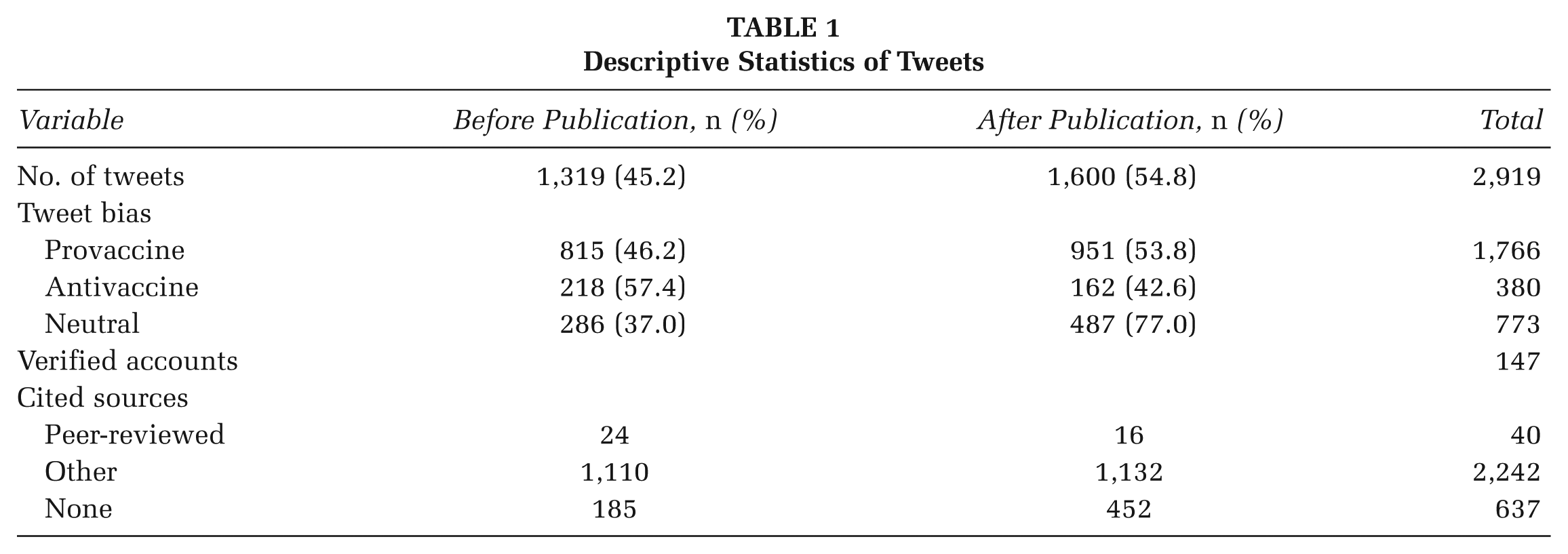
Of the 2,919 Tweets included in our sample, the majority occurred after publication (54.8%) and contained provaccine rhetoric (60.5%) compared to antivaccine (13.0%) or a neutral bias (26.5%). Antivaccine-related Tweets decreased by over 25% from before to after scientific publication, while provaccine Tweets increased by 16.6%. Additionally, few Tweets came from verified accounts (n = 147), and of the Tweets that tagged sources (n = 2,282), the vast majority were not the scientific research articles but sources from media, blogs, governmental agencies, and others. Further descriptive statistics regarding the Tweeting habits can be found in Table 1.
Descriptive Statistics of Tweets
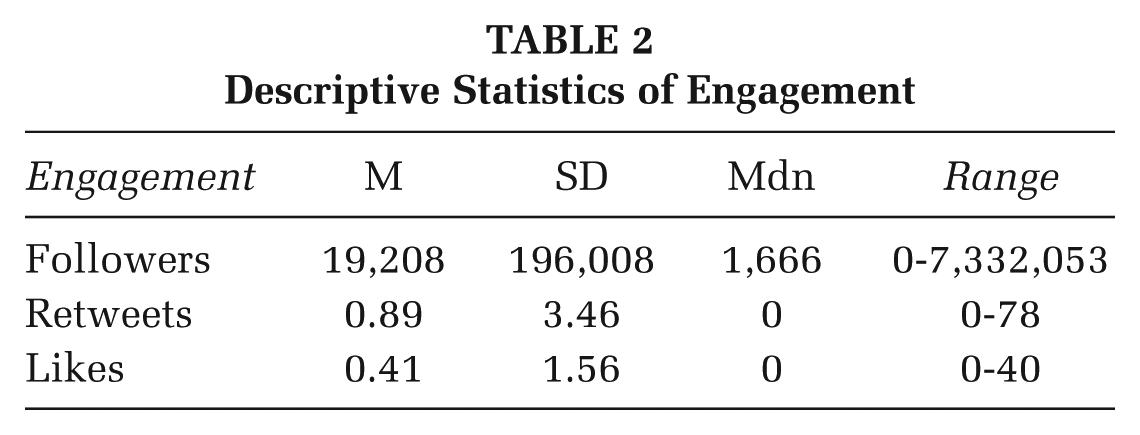
As indicated in Table 2, the average number of followers for the sample of Twitter accounts was 19,208, ranging from 0 to 7,332,053. The average number of retweets received was 0.89, with Tweets receiving anywhere from zero to 78 retweets. The average likes received by a Tweet was 0.41, ranging from zero to 40. The rest of the engagement results can be found in Table 2.
Descriptive Statistics of Engagement
Linear Regression: Likes
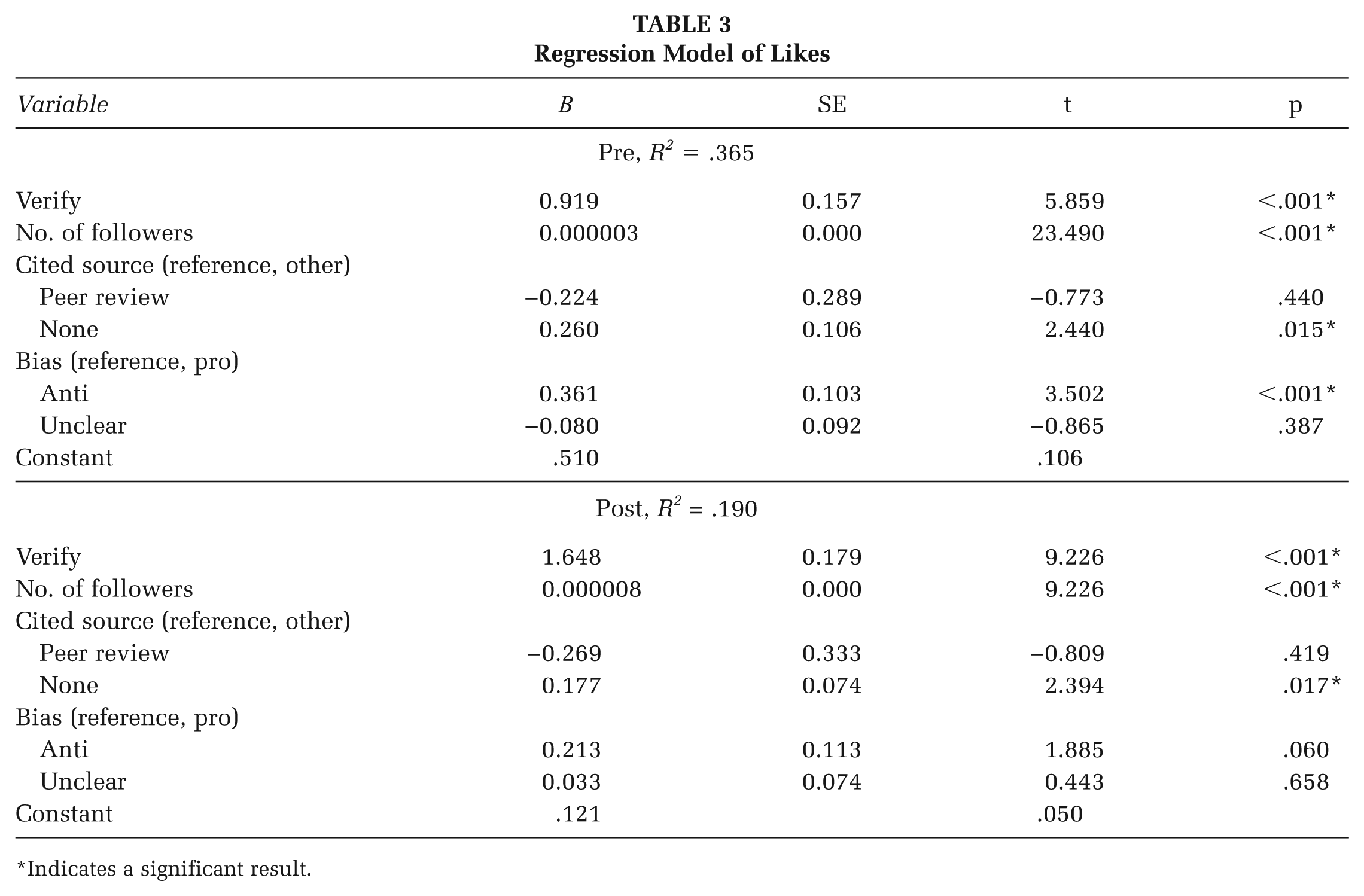
A linear regression analysis was conducted to predict the number of likes on a post based on the individual Tweeting and the content. Verification status, number of followers, type of cited source, and bias were assessed as independent variables in the model to predict number of likes and were subdivided by time period. The regression model statistically significantly explained 36.5% of the variance in likes, F(6) = 125.421, p < .0001, before the scientific publication and explained 19% of the variance after, F(6) = 63.37, p < .0001.
In the prepublication time period, if an individual was verified, they had almost 1 more like then those where were not (Β = 0.919, t = 5.859, p < .001). For every follower an account has, their number of likes increase by 0.0000003 (Β = 0.0000003, t = 23.490, p < .001). If a person did not cite a source, then they had 0.260 more likes when compared to an individual who cited the “other” category (Β = 0.260, t = 2.440, p = .015). Last, if a Tweeter was biased toward antivaccine in the prepublication time period, they had 0.361 more likes than those who had provaccine-related posts (Β = 0.361, t = 3.502, p < .0001).
In the postpublication time period, a verified account had 1.648 more likes than those where were not verified (Β = 1.648, t = 9.226, p < .001). For every follower an account has, their number of likes increased by 0.0000008 (Β = 0.0000008, t = 9.226, p < .001). If a person did not cite a source, then they had 0.170 more likes when compared to an individual who cited the “other” category (Β = 0.170, t = 1.885, p = .017). The label of antivaccination bias was no longer a significant predictor in the postpublication model. See Table 3 for the regression model pertaining to likes.
Regression Model of Likes
Indicates a significant result.
Linear Regression: Retweets
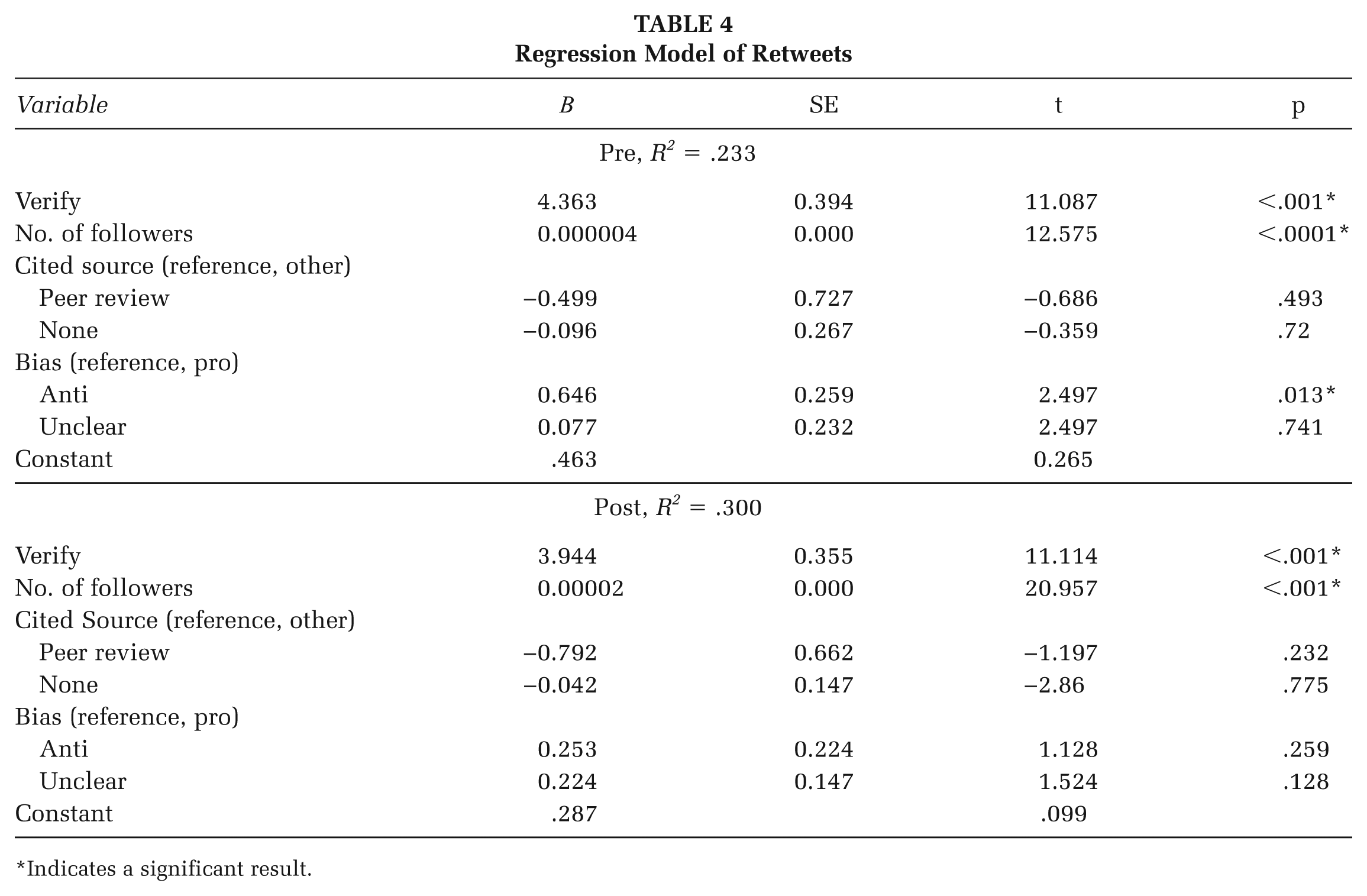
A linear regression analysis was conducted to predict the number of retweets on a post based on the individual Tweeting and the content. Similar to likes, verification status, number of followers, type of cited source, and bias were assessed as independent variables in the model to predict number of retweets and was subdivided by time period. The regression model statistically significantly explained 23.3% of the variance in retweets, F(6) = 67.701, p < .0001, before the scientific publication and explained 30.0% of the variance after, F(6) = 115.193, p < .0001.
For the prepublication time point, if an individual was verified, they had 4.363 more retweets then those where were not (Β = 4.363, t = 11.087, p < .001). For every follower an account has, their number of retweets increased by .000004 (Β = 0.000004, t = 12.575, p < .001). If a Tweet was biased toward antivaccine in the prepublication time period, there were 0.646 more retweets than those who had provaccine-related posts (Β = 0.646, t = 2.497, p = .013).
After the scientific publications, a verified account had almost four more retweets than those where were not verified (Β = 3.944, t = 11.114, p < .001). For every follower an account has, their number of retweets increased by .00002 (Β = 0.00002, t = 20.957, p < .001). Antivaccines posts were no longer more likely to be retweeted after publication as compared to provaccination Tweets. See Table 4 for the retweet regression model.
Regression Model of Retweets
Indicates a significant result.
Discussion
To explore the effect of scientific publication on public discourse of vaccinations, the current study investigated the overall engagement on Twitter and Tweet characteristics as it pertains to vaccination conversation before and after the publication of two major scientific studies. This study suggests public discourse can be influenced by scientific literature in not only what people share but also the way they engage with others.
Content Sharing
A shift in content occurred from before to after publications. There was a 21% increase in Tweets overall after publication. The change suggests merely publishing empirical evidence can increase dialogue around public health issues, even if the majority of the population does not read the primary source. The effectiveness and safety discussion regarding vaccines has long been agreed upon in the scientific literature, but people are still debating it. Based on the finding that new information can increase conversation, it validates the need for continued and new science, even if new studies serve only to confirm already established results. This supports the need for replication studies and continued publication of empirical evidence around public health because it could continue to spur conversation and lead to information spread.
Besides an increase in overall conversation, Tweets supporting vaccinations increased by 17% after publication, and tweets against vaccination decreased by 26% after publication. This indicates not only does scientific publication increase conversation, it could also alter conversation, and affect dialogue about public health. More specifically, the publication of empirical evidence supporting vaccines was followed by more public discourse supporting vaccines, suggesting people’s opinions and comments could be influenced by science. In an era of continued sharing of unverified information (Lowry & Fouse, 2019), it is encouraging there were shifts in public discourse in support of scientific evidence. While previous research parallels our findings that overall vaccine conversations on Twitter are positive, this study indicates public discourse can be altered by the publication of research, even if publications are only systematic literature reviews or meta-analyses (Broniatowski et al., 2018; Love et al., 2013).
Not only did content shift from pre- to postpublication, Tweet engagement (as indicated by likes and retweets) also changed. Before publications, antivaccination Tweets had higher engagement than provaccination Tweets, which could result in antivaccine Tweets being more readily seen and shared on Twitter. After publications, antivaccines had no more engagement than provaccine Tweets. This change in Tweet interaction indicates that scientific publication may serve to eliminate the validation and spread of scientifically unverified information while increasing the spread of correct information. In a time where “fake news” is affecting the political and policy landscape, health literacy has been influenced as well (Kickbusch, 2013; Speed & Mannion, 2017; Waszak et al., 2018). Health literacy is the ability to obtain, synthesize, and make informed health decisions but is founded on individuals having the correct information in the first place. If false information is being spread, then health literacy is jeopardized, creating a less healthy population (U.S. Department of Health and Human Services, n.d.).
There is a concept in network science called “six degrees of separation.” This concept describes the overall connectivity of the human population: Despite there being over 7 billion people in the world, it is possible to link any two people through six social connections (Patterson et al., in press; Watts, 2004). These connections are not inhibited by geographic distance, language, or any other bounds, resulting in ideas and information spreading across the globe in a very short amount of time. This is possible due to having highly connected/central people that serve as a connection point (sometimes called a “hub”) between pairs of people. For example, in a large company, all employees likely do not know one another, but most people know or at least have met the CEO. The CEO serves as a central person in the company who connects other people across the network. Based on the concept that people are easily reachable through their social connections, it would not be difficult for a single Tweet to reach large numbers of people (Muruganandam, 2016). Therefore, it is all the more essential that in a time of false information, sharing correct information that can be seen by others is imperative (Waszak et al., 2018).
Source Sharing
Our study had two primary findings related to source sharing: (1) when people do share information sources in their Tweets, it is unlikely a peer-reviewed scientific article. Instead, the majority of the Tweets cited “other” sources (e.g., blogs, corporations, government entities), and (2) sharing any kind of source (scientific or other) resulted in less engagement with the Tweet. It was not surprising people were more likely to share “other” sources besides peer-reviewed articles. Most antivaccination rhetoric is not supported with empirical evidence, leaving blogs, personal anecdotes, and other sources as their only option for sharing. Additionally, the general public likely does not access primary sources but learns about science through secondary parties (e.g., the Centers for Disease Control and Prevention, media outlets, etc.; Dahlstrom, 2014). Academia and scientific literature can be a siloed field in which research does not have the ability to be directly read by the masses and instead requires others to synthesize and disseminate findings.
We suspect there are a few explanations for why Tweets without sources were shared more often than those that did. Antivaccination users are unlikely to engage with Tweets that have sources supporting vaccines. Thus, we would not expect an antivaccine person to like or retweet a Tweet citing support for vaccines. As stated before, because there is less evidence supporting antivaccination beliefs, there is less opportunity for those users to engage with sourced content. It is possible that no matter what a person believes about vaccines, they could feel a stronger connection with Tweets that feel more personal, rather than those phrased like propaganda or “academese speak” (Dahlstrom, 2014). These overall findings suggest Twitter users seem to be more receptive to the Tweeter’s opinion and actual verbiage, rather than reading source content linked in their Tweet.
Spreading Information by Individuals
The more followers an individual had increased the number of likes and retweets each Tweet received. This indicates influential people were integral into shifting the narrative and public discourse before and after publication. This included not only having more followers but also verifying a user. Network theory would indicate those who are more influential, in this case, have more followers and are deemed verified by Twitter, have more opportunities to disseminate but are also deemed important and credentialed within the social media sphere (Valente, 1995). These influential people act as a hub connecting various people across Twitter. When thinking about the “six degrees of separation,” they are frequently going to be on the paths that connect people. Thus, it is essential these key influencers are spreading accurate and scientifically driven information due to their potential reach across various people. However, considering the majority of reviewed Twitter users were not verified and had fewer than 2,000 followers in this study, identifying key influencers could be an important strategy in disseminating scientifically verified information.
Limitations
While findings show there was a change in discourse from pre- to postpublication, we cannot be certain it was due to published studies. Future research could replicate this study with newer vaccine publications that have hit press since we collected data (i.e., provide new publication here). In doing so, new research could either confirm or challenge patterns in public discourse evidenced in this study. Additionally, we did not account for variables outside of Twitter content that could have affected or explained changes in public discourse beyond the publication of new research. For example, recent disease outbreaks or new policy implementation could alter the dialogue around vaccines no matter what empirical evidence is available. A final limitation is that while there was a change in engagement from pre to postpublication, shifts in mind-sets or adoption of behaviors (i.e., from an antivaccination mindset to a provaccination mindset) are unknown. This study can only conclude what happened with public discourse. To observe attitudinal and behavioral changes, researchers could find individuals who Tweeted before and after publication to see if bias changed or if behavior change is mentioned.
Public Health Implications
The results of this study indicate the need for researchers to partner with influencers to disseminate accurate and true information in a way that is appealing for the masses in order to continue conversation around important public health topics. These individuals could include organizations, bloggers, or others who have a significant presence on social media. Additionally, understanding what kind of Tweets are more likely to have high engagement is essential. Posting tweets that have images are 18% more likely to be clicked through, have 89% more likes, and 150% more retweets (Muruganandam, 2016). The more engagement with a single Tweet ensures that others will be exposed to its message as well. Last, researchers must learn how to present empirical findings in a personal way that does not engage with those spreading false messages, and continues conversation.
