







Abstract
Large-scale population surveillance systems may fall short in capturing localized data specifically from rural communities. A three-tiered engagement approach is implemented by survey administrators that focuses on supporting communities and schools to better understand the health of youth locally and identify the most effective interventions. This community-driven approach to survey administration addresses the locality gap and evolves a statewide youth survey to better meet the needs of the state and local communities, as well as alleviates survey burden in schools through a unified, strategic approach.
Keywords
Introduction
The Youth Risk Behavior Surveillance System (YRBSS) is an essential data resource for youth health outcomes in many states across the country, and nationally (Centers for Disease Control and Prevention, 2018). However, it falls short in capturing localized data, often from rural communities. To address this gap and to evolve the survey to better meet the needs of the state and alleviate survey burden in schools, the state of Colorado took a unique approach of unifying surveillance efforts across governmental and educational agencies with community input and engagement. The purpose of this was to help communities and schools better understand the health of youth locally and identify the most effective interventions.
This effort began in 2011 when the Departments of Health and Environment, Human Services, and Education, known as the Steering Committee, adopted one unified youth health survey, known as the Healthy Kids Colorado Survey (HKCS; Colorado Department of Public Health and Environment [CDPHE], 2019). This unified effort reduced the survey burden on schools, reduced the frequency and quantity of surveying students in schools that were sometimes in competition, and at the same time increased sample size and the ability to provide localized data, especially in rural areas of the state.
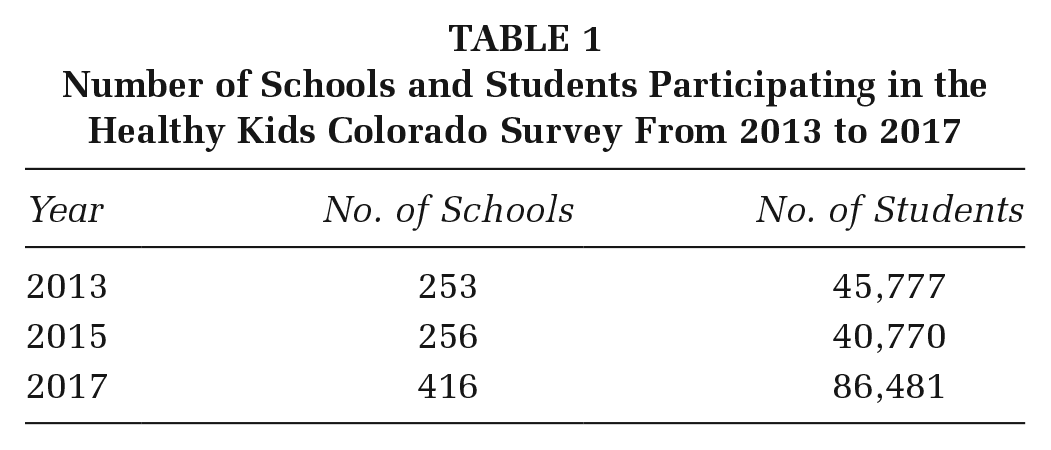
This effort required strategic planning, intentional relationship building, and targeted outreach by survey administrators. Survey administrators included staff at CDPHE and the School of Public Health, University of Colorado. These staff members included faculty, researchers, and community engagement specialists with experience working in the field of youth health. It was not without challenges. In 2015, there was a volatile political climate that threatened the funding by the state legislature and scrutiny from the school board, which delayed the school recruitment by 3 months and reduced participation that year. In response, a more robust outreach strategy was developed for 2017. Table 1 demonstrates the impact of this strategy in increasing the number of participating schools and students. The success of the 2017 survey administration is a reflection of Rothman’s (1996) social change principles to build the capacity of communities and schools to engage in administering the HKCS as well as promoting and using their local HKCS data.
Number of Schools and Students Participating in the Healthy Kids Colorado Survey From 2013 to 2017
Outreach And Engagement Strategies
In preparing for the 2017 HKCS survey administration, the overall goal was to increase community (including parent and student) support for the HKCS by promoting the value of the data, how to interpret the data, and how to use the data to support health interventions or apply for funding. Community support led to active community buy-in for advocating with decision makers (superintendents, principals, and school board members) to administer the survey in local schools.
Based on previous years’ participation, the survey administrators focused their engagement efforts on five regions of the state with consistently low participation. Three strategies emerged as influential approaches in ensuring community support, buy-in, and participation in the 2017 survey.
Strategy 1: Building trust: The primary strategy used to engage communities was intentional relationship and trust building. The survey administrators (a local university contracted by the steering committee) formed local partnerships with local public health agencies, nonprofit organizations, and schools. These strategic relationships directly supported and prepared the local entities to respond to community concerns while having the support of local and state government. The long-term goal was that these local entities will understand the value of HKCS data.
Strategy 2: Local expertise: Trusted relationships with school and local partner agencies allowed for local champions of the survey to emerge. Champions varied from community to community but were often school wellness coordinators, a local public health official or parent of a student, or community partner. These champions gave the HKCS the opportunity to be a community-driven, bottom-up initiative rather than a top-down demand from the state government. This put the survey administrators in the support role of providing financial resources and technical assistance, not as outsiders coming into a community and telling them what to do. The local community was able to make their own decisions and seek support from the state. Furthermore, the survey administrator played the role of matchmaker ensuring that local communities were able to merge resources among various stakeholders for efficiency of data collection efforts.
Strategy 3: Showing up: The survey administrators made intentional efforts to be visible within communities. While this is a resource-heavy strategy, requiring staff time and travel funds, it may be one of the most effective strategies for building trust and understanding local expertise. This included having simple informal face to face conversations with community members, school officials, and local agencies with the purpose of listening to the community to understand current efforts and initiatives around youth health while connecting the dots on how the surveillance data support those efforts. Once a connection was made, ongoing and consistent engagement became remote with virtual contact. Most important, survey administrators emphasized that HKCS participation does not increase local work or resources. In contrast, the HKCS can help communities leverage local partnerships for training, funding, or technical assistance. This includes connecting potential sites to schools that have leveraged their HKCS data for programming grants, like one rural district that used their HKCS data to justify updating their antibullying policy, provided bullying prevention training for district leaders and parents, and supported a student-led campaign against bullying.
Limitations And Considerations
All three of these strategies are interdependent of the other and an important piece of effective community engagement. This framework for sustainable community engagement in HKCS is a resource-heavy initiative requiring both staff time and travel funds. Colorado is a geographically large state with a number of rural schools and communities that have fewer resources and, during the winter months, are challenging to access. Survey administrators had to prioritize specific communities due to these constraints. Additionally, not all schools and communities prioritized youth health initiatives and therefore were not the best investment of time and resources from the survey administration standpoint.
School officials value receiving results for their schools and districts; however, some of them do not have the resources or support in their communities for staff trainings, program development, or opportunities for shared efforts with community partners.
Conclusion
Survey administration comes with a plethora of challenges, including funding limitations, controversial politics, recruitment roadblocks, and navigation of multiple bureaucratic systems including local and state governments. Taking the time to be intentional and strategic around engagement with communities by building trust, relying on local experts, and showing up in communities can substantially improve the overall support, buy-in, and participation in survey administration and other data collection efforts. When a community can utilize data to leverage resources and funds to invest locally, the outcome is improved youth health and well-being.
