







Abstract
Farmers and ranchers (agricultural producers) have higher psychological distress and suicide rates than the general population. Poorer mental health status and outcomes among producers are often attributed to the continuously challenging economic, social, and climate-related changes to agriculture as an occupation and industry. This article describes the development of a training program for agribusiness professionals from the U.S. Department of Agriculture Farm Service Agency (N = 500) who work with producers, as they regularly interact with producers and thus are in a position to readily offer helpful mental health resources. The goal of the program was for agribusiness professionals to build skills and confidence to identify and respond to distressed producers. The educational program was offered primarily online and included a 1-day in-person training to practice skills to communicate with distressed producers and refer them to appropriate mental health resources. Evaluation of the program demonstrated participants experienced gains in knowledge and skills related to identifying and helping distressed producers.
Assessment of Need
Agricultural producers often encounter an array of unique chronic stressors that include uncontrollable weather, volatile financial conditions, and long work hours (Thelin & Donham, 2016), many of which are beyond an individual’s control. Producers have higher levels of psychological distress (Yazd et al., 2019) and a higher suicide rate than the general population (Peterson et al., 2020). Due to issues of access, availability, and stigma in rural communities (Smalley et al., 2010), producers are less likely to regularly encounter mental health professionals. Given these challenges, people who already regularly interact with producers are critical contacts for intervention.
Farm loan and finance professionals have daily contact with producers; however, such professionals have noted a lack of training and limited confidence as barriers to addressing mental health directly with clientele (Rudolphi & Barnes, 2020). Providing training to build knowledge and skills among rural professionals who work with producers can facilitate producers’ access to needed mental health resources.
In this article, we describe a public health educational program about stress and mental health among producers developed for Farm Service Agency (FSA) personnel. FSA, part of the U.S. Department of Agriculture, has an 84-year history of delivering agricultural programs to farmers, ranchers, and agricultural partners, with over 2,000 offices across the United States. While FSA personnel are not mental health providers or specialists, they do interact with producers frequently and have established rapport in communities.
Description of Strategy or Innovation
An interdisciplinary, interagency group of mental health specialists, university faculty, Cooperative Extension educators, and FSA staff created the Farm Stress Training (FST) program. Specific objectives of FST were (a) to increase FSA employees’ knowledge of signs and symptoms of stress, the impact of stress on mental health, stressors specific to farmers, warning signs of suicide, and mental health resources, and (b) to improve FSA employees’ skills and confidence to safely communicate with distressed producers and provide connections to relevant mental health resources. As a pilot program, 500 of FSA’s over 10,000 staff participated in training. Eligible staff were at various levels, including district directors, county executive directors, farm loan managers, farm loan officers, and program technicians.
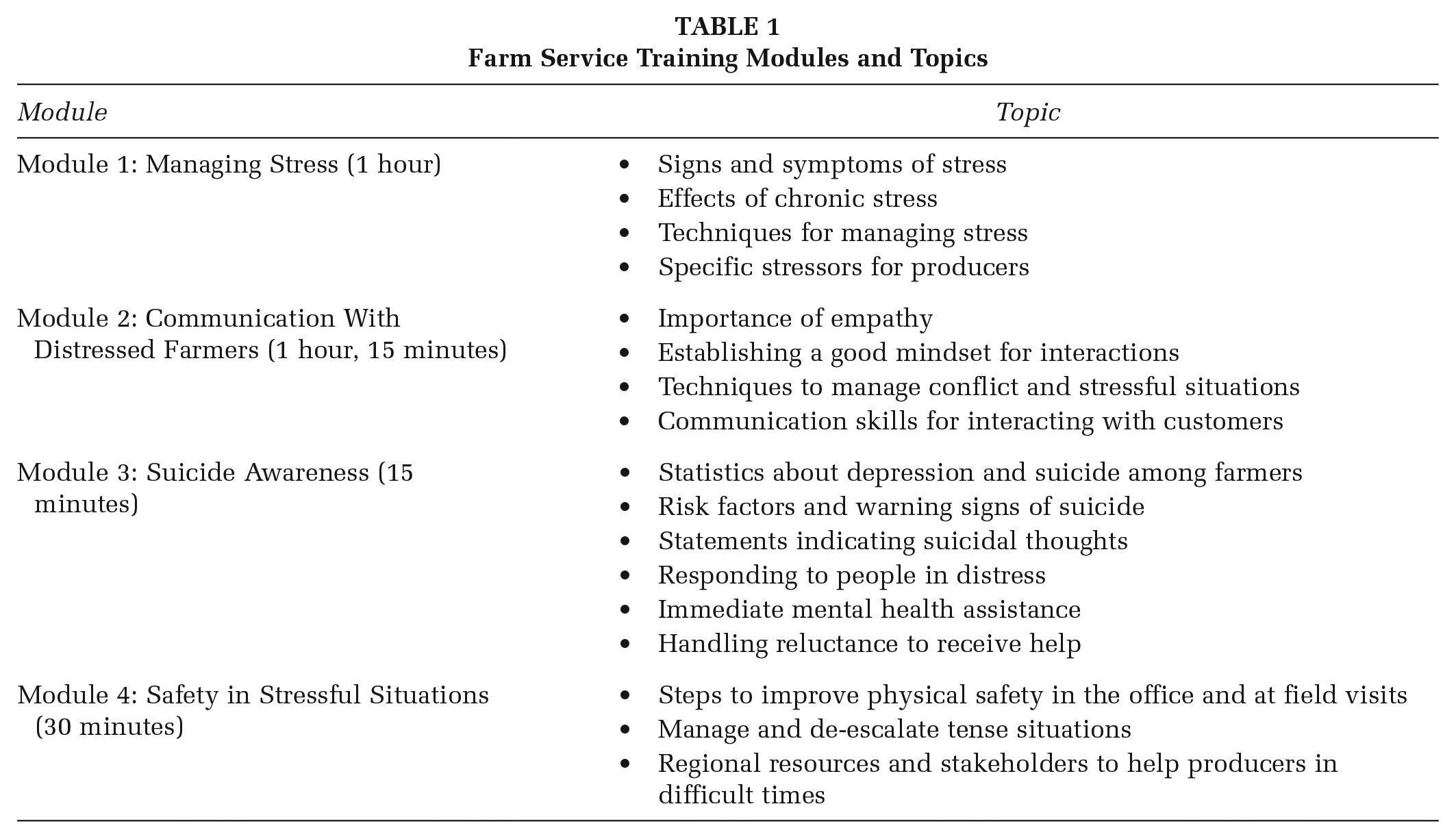
Implementation included three components. The primary educational component was four self-paced modules in U.S. Department of Agriculture’s online platform, AgLearn. FSA personnel learned about various topics including stress, unique stressors for producers, strategies for communicating with distressed producers, warning signs of suicide, skills to refer someone to mental health resources, and issues related to physical safety, including de-escalating anger and aggression (see Table 1). Each online module included recorded PowerPoint lectures and interactive knowledge check quizzes. Supplemental handouts were made available on AgLearn for on-demand download. Participants completed online modules between March 18 and April 5, 2019.
Farm Service Training Modules and Topics
Live discussion groups occurred online using Zoom, both before and after the AgLearn training, to prepare FSA personnel for AgLearn module content and to discuss and process content upon completion. Project team members facilitated each online discussion with approximately 25 FSA staff in each meeting.
FSA personnel were invited to an in-person training that took place in September 2019, to solidify understanding of program content and to enhance skill development. This training focused on role-playing and discussing realistic scenarios of distressed producers and their families. Topics included identifying signs and symptoms of stress, identifying warning signs of suicide, and planning what to do in case of a mental health emergency with a producer.
Intended Outcomes
The intended outcomes of FST were to increase FSA employees’ knowledge of signs and symptoms of stress and suicidality among agricultural producers and to enhance their skills and confidence to communicate with distressed producers and to provide mental health resources (e.g., National Suicide Prevention Lifeline, Substance Abuse and Mental Health Services Administration Treatment Locator, farm stress-specific websites from Cooperative Extension and farming organizations). These intended outcomes are within the context of strengthening the mental health safety net for farmers and ranchers who face uncertainty and stress from dynamic factors beyond their control.
Evaluation Approach
Participants were asked to complete pre- and postsurveys related to the online training to assess changes in knowledge and skills. Analysis of matched cases (n = 371, 76.8%) indicates a significant increase in knowledge scores from pretraining (M = 6.81, SD = 1.19) to posttraining (M = 7.74, SD = 1.06), t(df = 370) = −14.56, p < .001. The greatest improvement occurred within items such as identifying an empathetic response to a distressed client, distinguishing types of coping strategies, and recognizing signs and symptoms of stress.
Challenges and Successes
This program created successes through improving FSA staff knowledge and confidence about producer stress issues. The program is also successful through its use of an online training platform to ensure sustainability over time. One challenge was that while many participants reported the knowledge gained was personally beneficial, some stated they wanted more information about how to handle their own stress and mental health as they felt the impact of workplace issues such as high workloads and staff turnover. Given the demonstrated success of this program, additional farmer-related organizations have requested the training be adapted for their audiences.
Implications for Practice
Evaluation results from FST demonstrate that professionals who work with producers benefit from training to improve behavioral health literacy, enhancing their skills and confidence in identifying stressed producers and providing them with mental health resources. At this time, FSA is determining how best to offer FST to all their staff, and because of the success of FST, similar trainings have been held for American Farm Bureau Federation and National Farmers Union. The online platform enhances the program’s sustainability and accessibility. A wide variety of professionals who work with agricultural producers can strengthen a nonspecialized mental health safety net by enhancing their own behavioral health literacy through this and similar programs. Supporting the mental well-being of agricultural producers helps not only the at-risk individual but also their families and the communities in which they are integrated.
