







Abstract
To limit the spread of coronavirus disease 2019 (COVID-19), the Centers for Disease Control and Prevention issued recommendations that individuals wear face masks in public. Despite these recommendations, the individual decision to adhere and wear a mask may not be a simple decision. In this article, we examine the decision to wear a mask from a social-ecological perspective. Through critical analysis of societal, interpersonal and community, and intrapersonal influences, it is clear that the decision to wear a mask is multifaceted and influenced by constructs including public health recommendations and government mandates, racism and cultural norms, geography, household income, age, and personal attitudes. Understanding the multifactorial influences on mask wearing during COVID-19 is crucial for informing the creation and distribution of inclusive public health messaging regarding mask wearing now in the midst of an unprecedented health crisis, and in future unforeseen public health emergencies.
In light of the coronavirus disease 2019 (COVID-19) pandemic, the Centers for Disease Control and Prevention (CDC) issued a recommendation for individuals to wear face masks to limit viral spread (CDC, 2020a). Although not completely protective, wearing a face mask over the mouth and nose can limit viral transmission (CDC, 2020a), particularly among presymptomatic and asymptomatic infected individuals (Furukawa et al., 2020). Despite this CDC announcement, government policies created on a state-by-state basis have yielded conflicting mandates regarding face mask use across the country. As of October 12, 2020, 33 states have passed mandates requiring employees and customers wear a face mask when entering businesses open to the public (Markowitz, 2020). Violators in the state of Maryland, for example, are subject to a penalty of up to 1 year in prison and a $5,000 fine (Markowitz, 2020). However, the individual decision to wear a mask during COVID-19 is not that clear-cut, as the decision is deeply rooted across one’s social-ecological network. The social-ecological model, a fundamental public health framework, categorically describes the implications of an individual’s social environment, interpersonal relationships and community setting, and personal characteristics on health behavior decision making (CDC, 2020b). In this article, we critically examine mask wearing during COVID-19 from a social-ecological perspective and illustrate the complexities of this precautionary health behavior during the COVID-19 pandemic (Figure 1).
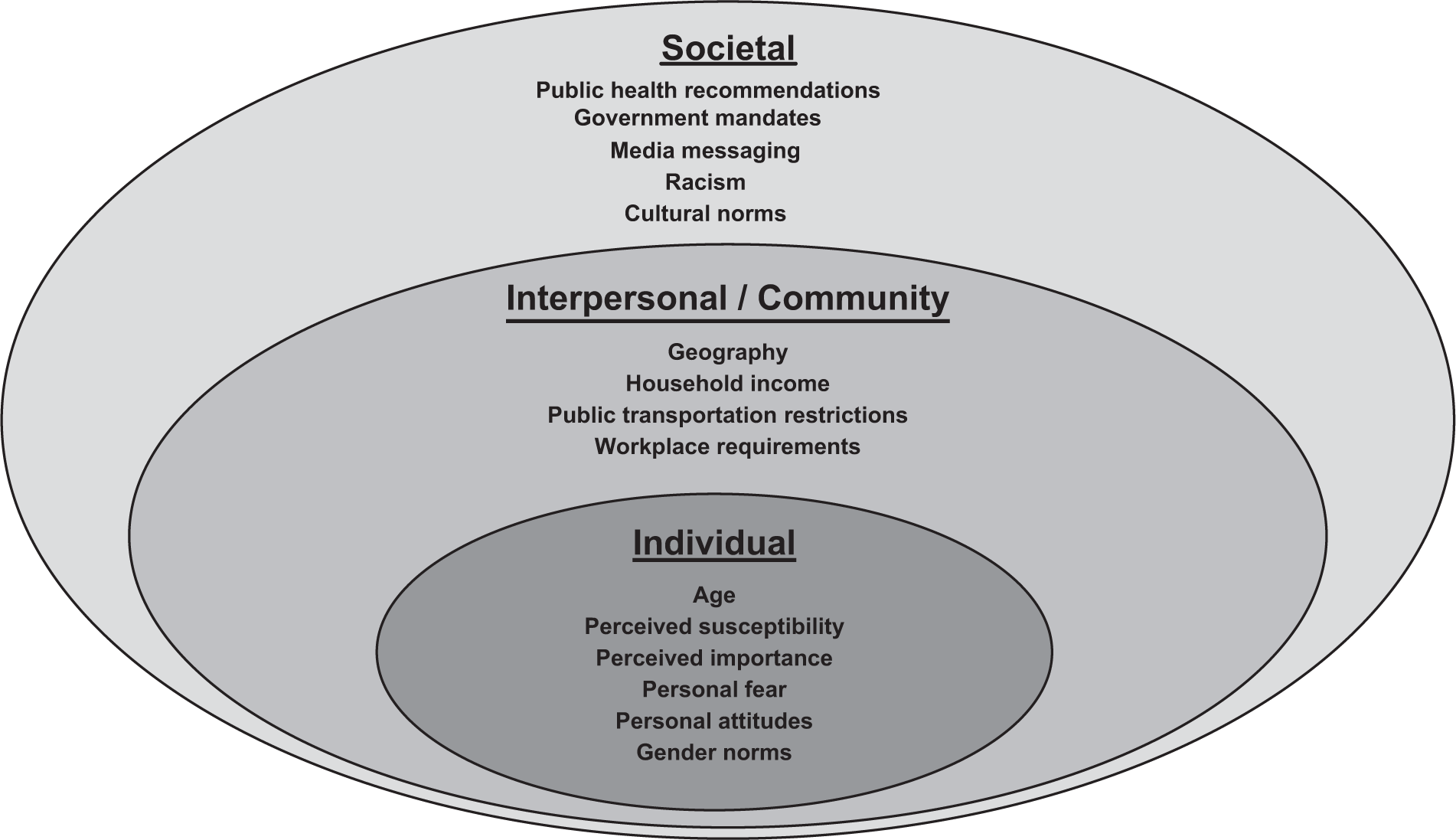
Social-Ecological Model, Applied to Mask Wearing During the Coronavirus Disease 2019
Societal Influences
The outermost ring of the social-ecological model encompasses a societal view on health outcomes and decision making, such as CDC recommendations, government mandates, and access to reliable health care information (CDC, 2020b). Although the CDC recommends that people wear a face mask in public, it is up to individual states to enforce the order. Inconsistencies among state mandates, ordered from the unmasked mouths of politicians, have split public opinion and cooperation on mask wearing. Without uniform leadership and cross-state legislation, mask wearing has become a partisan issue, with influential leaders able to use executive privilege as an excuse for going unmasked and neglecting CDC recommendations (Armus, 2020; Liptak, 2020). Additionally, media outlets have provided conflicting information on proper COVID-19 precautions. Without evidence, some popular news outlets have suggested that masks increase one’s chance of infection and recommend against buying or wearing masks completely; even the World Health Organization omitted recommendations that healthy people wear masks in an early COVID-19 guide (Haelle, 2020). The issue of conflicting information is further exacerbated by the general public’s sparse public health literacy and has contributed to distribution of incorrect messaging and general confusion among the public.
The decision to wear a mask can also be attributed to racism and race relations throughout the country. Members of minority racial groups, particularly Black and Hispanic men, may be resistant to mandates requiring them to wear a mask in public, given racial stigmas and societal inequities that continue to criminalize them based on their appearances (Aviles, 2020). For these individuals, covering their faces with a mask, or worse, a make-shift bandana mask, could intensify already deadly racial profiling situations.
Finally, cultural norms may influence mask wearing. In the United States and western Europe, individualism endorses self-expression and personal preferences (Triandis, 1995), making individuals less likely to abide by mask recommendations to protect others. Meanwhile, many Asian countries foster a sense of collectivism, valuing individuals as parts of a whole (Triandis, 1995). People belonging to a collectivist culture are seemingly more likely to wear masks in public, as their sense of interdependence may motivate them to safeguard those around them.
Interpersonal and Community Influences
The next level of the social-ecological model includes interpersonal influences within one’s immediate environment, such as their community and social networks, that affect their decision to wear a mask (CDC, 2020b). Although more relevant earlier in the pandemic, mask wearing may not be perceived as that important in many rural communities in the United States, as COVID-19 had not yet wreaked the same level of destruction in these areas compared to urban communities (Fisher et al., 2020). It is possible that individuals in rural communities may not even know a single person with the virus (Fisher et al., 2020) and feel that mask mandates are unnecessary, burdensome, or simply an overreaction.
However, the decision to wear a mask could simply be a result of access, fiscally and tangibly. With 11.8% of American households living under the poverty line, it may not be possible to purchase a mask in person or online (Fan et al., 2020). It is a privilege to be able to isolate at home until a mask is delivered, and it is a privilege to be able to safely wash a mask or have multiple masks for everyone in the household. Without access to masks, underprivileged individuals may suffer from further disadvantages. In some cities, masks are required to use public transportation, creating barriers for people commuting to work or accessing essential goods and health care services if they do not have easy access to masks. Additionally, businesses may require their employees to wear masks, potentially limiting one’s job opportunities in an already strained economic climate (Fan et al., 2020).
Intrapersonal Influences
Public compliance regarding mask wearing does not rely solely on one’s social and interpersonal relationships but also on individual characteristics and personal attitudes—the innermost level of the social-ecological model (CDC, 2020b). Early in the pandemic, COVID-19 was labeled as a virus that would disproportionately affect the elderly, resulting in low levels of perceived susceptibility, feelings of naive invincibility, and limited uptake in mask wearing among young and middle-aged adults. Similarly, stigma regarding gender norms may influence mask wearing, as men are less likely to believe the virus will seriously affect them and report feelings of weakness and shame when wearing a mask (Boskovich, 2020).
Others may decide not to wear a mask because they may not understand the importance of doing so, because they may not know how to properly wear a mask, or out of concern of being judged. Fear of being labeled too reactionary toward COVID-19, and a general sense of hyper self-awareness while wearing a mask, may also contribute to one’s decision to leave their mask at home. Yet for some, declining to wear a mask could symbolize their right to exercise their personal liberties as a United States citizen as the refusal to wear a mask in public may suggest one’s support of reopening the country, getting Americans back to work, and a general sense of misguided “patriotism” (Fisher et al., 2020).
Implications for Practice and Future Efforts
Through a social-ecological lens, mask wearing during COVID-19 is influenced by societal structure, community norms, and individual characteristics. However, this analysis is only the beginning. As we continue through this unprecedented pandemic, it is important to acknowledge and comprehend the intricacies of mask wearing across one’s social-ecological network, and to apply these theoretical constructs when conceptualizing and disseminating public health messaging to promote mask wearing and other COVID-19 precautionary measures.
So, where do we go from here? We need to keep working together to develop factual, tailored health communication messaging related to mask wearing and apply theoretical foundations of health behavior to our information guides and marketing campaigns. To promote a singular message—wear a mask—among a diverse American population, future resources should be congruent and take into consideration the social-ecological attributes influencing the intended audience. Depending on the population, these attributes may be social, such as cultural norms that could be influenced by media messaging and role-modeling by socially influential individuals; interpersonal and community, such as geographic and financial barriers to mask access that could be addressed through awareness of free and low-cost mask resources; individual, such as encouragement to reduce fear and anxiety surrounding mask-wearing; or multilevel interventions addressing one or more rings of the social-ecological model. Our messaging should reflect those needs. But most important, we need to openly talk about how mask wearing is much more than donning a mask, piece of fabric, bandana, or scarf around one’s face.
Footnotes

References
Supplementary Material
Please find the following supplemental material available below.
For Open Access articles published under a Creative Commons License, all supplemental material carries the same license as the article it is associated with.
For non-Open Access articles published, all supplemental material carries a non-exclusive license, and permission requests for re-use of supplemental material or any part of supplemental material shall be sent directly to the copyright owner as specified in the copyright notice associated with the article.
