







Abstract
As the use of the photovoice method has proliferated over the past three decades, several literature reviews have been conducted about implementing the method in the context of health promotion research and practice. Challenges emerged from the literature frequently enough to be reported in several reviews. As such, the purpose of this “review of reviews” was to identify and describe the various challenges to implementing photovoice as reported in published literature reviews. Taken together, the sum of the reviews’ critiques about photovoice may be of particular use for developing solutions regarding challenges that limit the utility and outcomes of the method. The literature reviews included in this study were identified using PubMed, CINAHL, Google Scholar, and backward/forward chaining. The final 15 review articles included in the study were analyzed for the challenges of implementing photovoice described in each review. Four major themes emerged from the reviews: (1) inconsistent adherence to the photovoice method, (2) inconsistent evaluation of photovoice outcomes and impacts, (3) implementation challenges with specific populations, and (4) inconsistent reporting and adherence to ethical procedures. For those conducting photovoice projects in the future, the implications of the findings include maximizing participant engagement in the project from start to finish, evaluating photovoice projects for effectiveness in producing community change, and reporting ethical procedures.
In the 1990s, Wang and Burris developed “photovoice” (Wang & Burris, 1994, 1997). The three overarching goals of this new participatory research method were (1) to facilitate participants’ ability to document community strengths and needs, (2) to improve participants’ critical consciousness about the root causes of collective conditions, and (3) to create data and opportunities to advocate for policy change (Wang & Burris, 1997). In 1999, Wang identified photovoice as participatory action research, and described the method as a linear, step-by-step process (Wang, 1999). Overall, the photovoice method consists of involving participants from a community who lack influence, or “voice,” and engages them in using photography to document the needs and/or strengths of their community. Then, in facilitated group discussions, participants critically discuss the meaning of their photographs, resulting in participants’ enhanced critical consciousness of the underlying causes of health issues in their community and potential points of leverage for community-level change that in the end are communicated to policymakers at exhibits (Wang, 1999; Wang & Burris, 1994, 1997).
Health promotion researchers and practitioners have applied the photovoice method with a wide variety of specific populations. A few examples include using photovoice to work with: women from rural China (Wang & Burris, 1997), women of Protestant and Catholic backgrounds from Northern Ireland (Side, 2005), those experiencing homelessness (Seitz & Strack, 2016; Wang et al., 2000), Latino adults with intellectual disabilities (Jurkowski & Paul-Ward, 2007), young people (Evans-Agnew & Eberhardt, 2019; Strack et al., 2004), college students (Goodhart et al., 2006), and older adults (Baker & Wang, 2006).
Given the participatory nature of photovoice and its use within communities, it is often described not only as a form of participatory action research (Wang, 1999) but also as a form of community-based participatory research (CBPR; Hergenrather et al., 2009). In CBPR, “participants” are coresearchers in conducting a study and included in the research process from start to finish. For example, CBPR participants are involved in developing research questions, collecting and analyzing data, and disseminating the study’s findings. The benefits of conducting CBPR are many, including that the data collected are relevant and useful to the community, complex problems are addressed through the direct knowledge and expertise of the community’s own members, and policies to positively influence the community’s health are among the expected outcomes (Israel et al., 1998).
Photovoice projects have resulted in making real changes within communities. Highlights include the following: increased collaboration between people living with HIV/AIDS and public health departments (Rhodes et al., 2008), expanded options for healthy food in schools (Kramer et al., 2010), state-level funding for the continued work of replacing woodstoves (Evans-Agnew & Eberhardt, 2019), the creation of a college mentoring program for male students of underserved populations (Strack et al., 2018), improved parking for people experiencing disability (Newman, 2010), and tobacco policy change at the local level (Strack et al., 2004; Tanjasiri et al., 2011).
Although the positive outcomes of photovoice have been well-documented in the literature, various challenges surrounding the method have also been reported. As the use of photovoice has proliferated over the past three decades (Golden, 2020), several literature reviews have been conducted on published works and have identified common challenges with the method in the context of health promotion practice (Catalani & Minkler, 2010; Hergenrather et al., 2009). Although these reviews did not set out to identify photovoice-related challenges, it is apparent that challenges emerged from the literature frequently enough to be reported in several reviews.
Purpose
The purpose of this study was to identify, describe, and synthesize the various challenges of implementing the photovoice method as reported in published literature reviews.
Method
The literature reviews included in this study were identified by the first author using a relevant list of search terms and databases. During September of 2020, PubMed, the Cumulative Index to Nursing and Allied Health Literature (CINAHL), and Google Scholar were searched using the combination of the terms “photovoice” and “review.” To identify additional articles, the “berry picking” methods of “backward chaining” and “forward chaining” were used (Booth, 2008). Specifically, when an article from a database was selected to be included in the study, its reference pages were searched for additional articles (i.e., backward chaining). Also, studies that cited the included article were searched (i.e., forward chaining) by using Google Scholar (Gusenbauer, 2019; Levay et al., 2016; Martín-Martín et al., 2018).
Articles were included in the review based on the following eligibility criteria: (1) the articles only reviewed photovoice projects (i.e., articles that specifically reviewed individual projects implementing photovoice and not other visual research methods like photo-elicitation), (2) the articles reviewed photovoice projects about health-related topics (i.e., any topic that could possibly be related to or affect people’s health), (3) the articles mentioned one or more challenges about how the photovoice method was implemented, and (4) the articles were published in English language, peer-reviewed journals and not gray literature (e.g., theses, dissertations, presentations). Articles were excluded from the study if they did not meet all the inclusion criteria (Figure 1). The articles were then categorized by the purpose of the review.
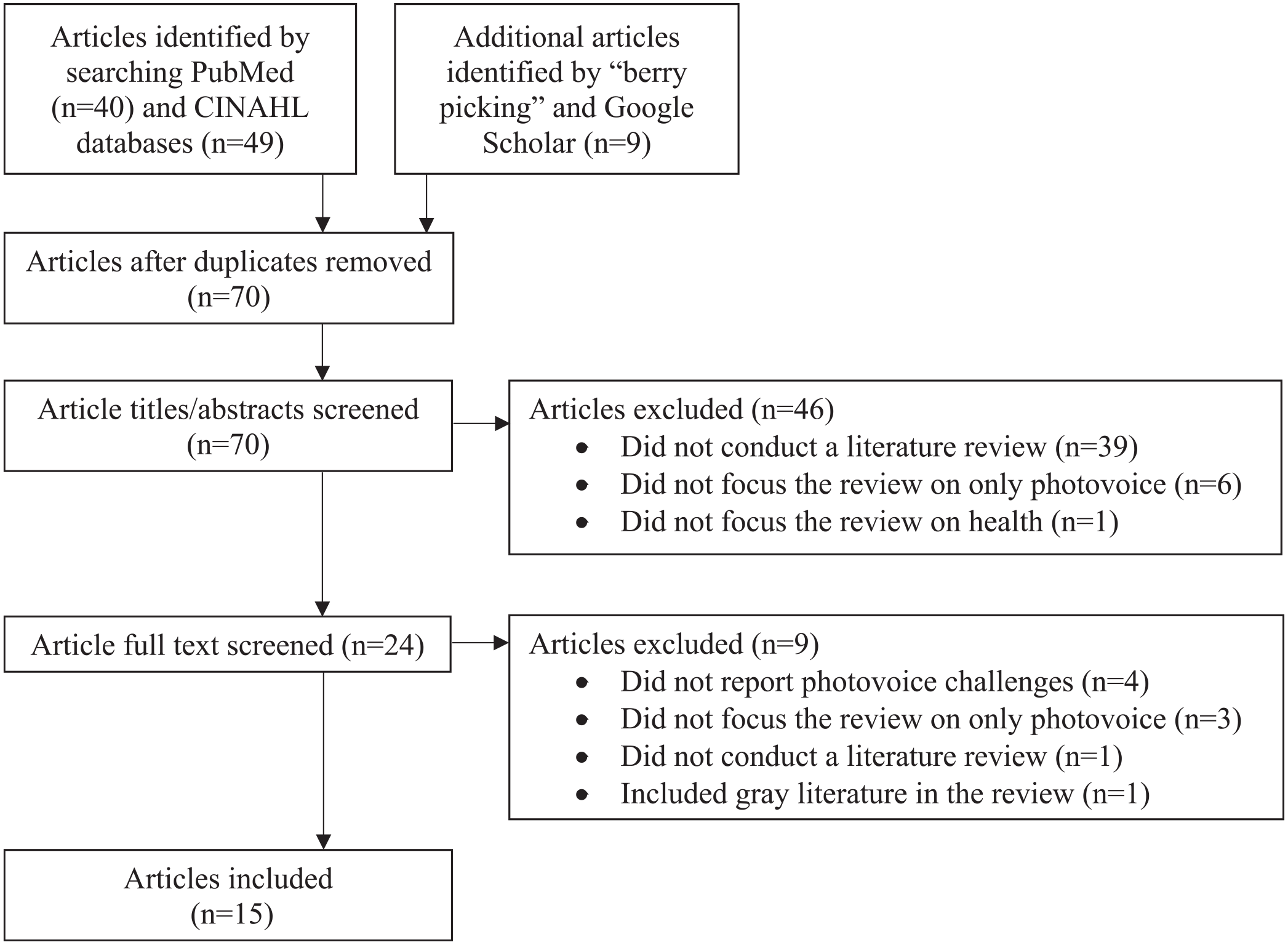
Flow Diagram for Article Inclusion
The final list of review articles included in this study was analyzed using a qualitative approach to conducting a content analysis (Graneheim & Lundman, 2004). First, the lead author gathered all the statements within the review articles that were specific to the challenges of implementing photovoice. These statements were the unit of analysis for the study (Graneheim & Lundman, 2004). Second, both authors independently “immersed” themselves (i.e., read the text several times both during and after gathering the statements; Borkan, 1999) in the statements to understand both the “manifest content” (i.e., the text itself) and the “latent content” (i.e., the underlying meaning of the text; Graneheim & Lundman, 2004). Third, both authors worked independently and as a team (MacQueen et al., 1998) to identify, define, and refine major themes that emerged from the data (i.e., “crystallization”; Borkan, 1999).
Results
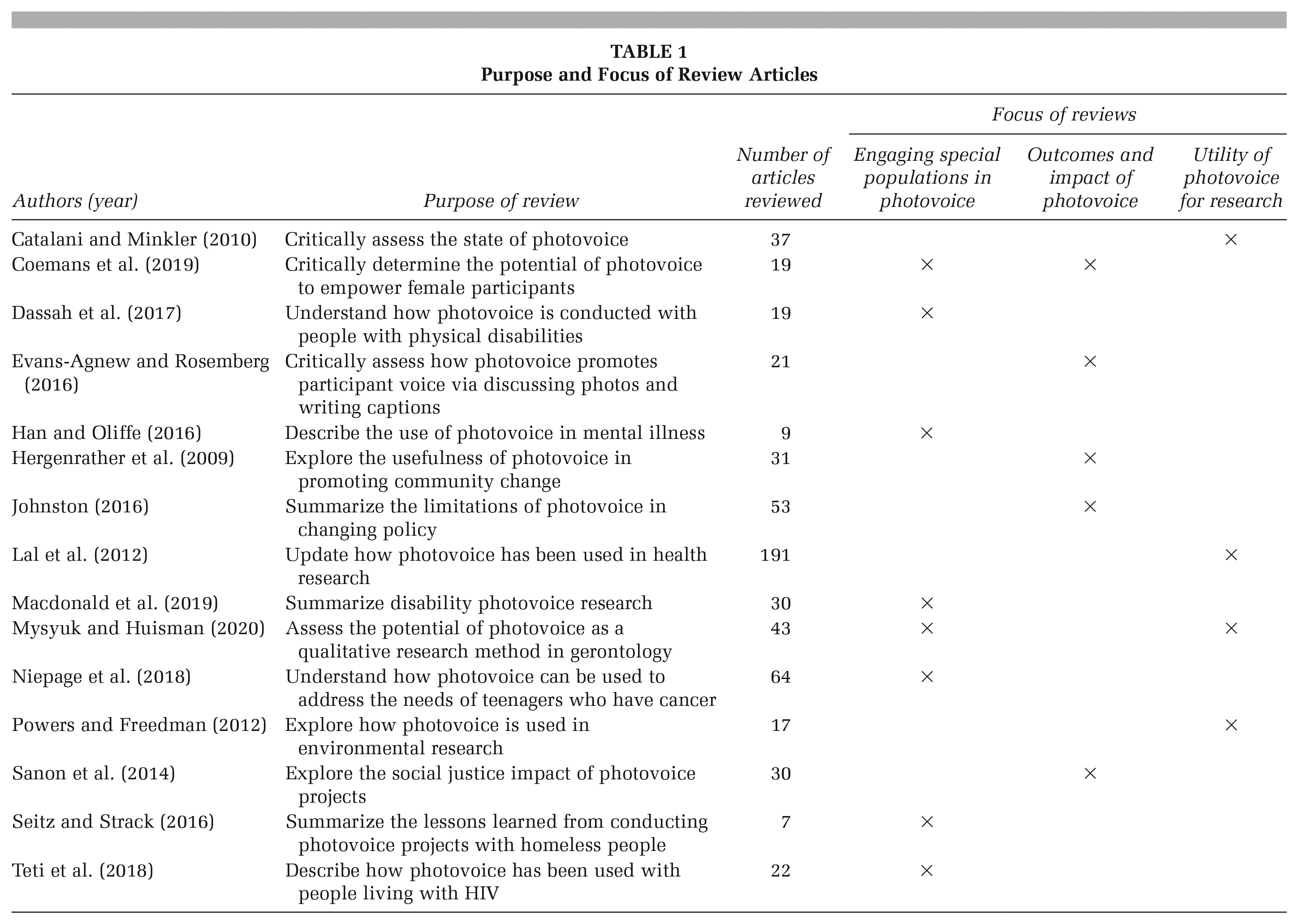
A total of 15 review articles were included in the study (Table 1). Altogether, the 15 reviews examined 593 photovoice articles; however, it is important to note that some photovoice articles were included in multiple reviews and double-counted. The stated purpose of the reviews included engaging specific populations in photovoice projects, investigating the outcomes and impacts of photovoice, and investigating the utility of photovoice for research (Table 1). Four major themes emerged from the analysis: (1) inconsistent adherence to the photovoice method, (2) inconsistent evaluation of photovoice outcomes and impacts, (3) implementation challenges with specific populations, and (4) inconsistent reporting and adherence to ethical procedures
Purpose and Focus of Review Articles
Theme 1: Inconsistent Adherence to the Photovoice Method
Several reviews specified that descriptions of implementing the key steps of the photovoice method were frequently lacking in published articles. The reviews reported instances in which projects did not discuss engaging participants or stakeholders in the research design, did not report communicating the overall purpose of the project to participants during training, or were vague or inconsistent in describing the training of participants about how to use cameras (Catalani & Minkler, 2010; Dassah et al., 2017; Hergenrather et al., 2009; Lal et al., 2012; Teti et al., 2018). Instead of critically discussing photos in a group setting, several photovoice projects opted to use individual interviews with participants (Catalani & Minkler, 2010; Dassah et al., 2017; Lal et al., 2012; Seitz & Strack, 2016). Moreover, there were projects that did not involve participants in: analyzing the photo data (Coemans et al., 2019; Dassah et al., 2017; Evans-Agnew & Rosemberg, 2016; Han & Oliffe, 2016; Mysyuk & Huisman, 2020; Powers & Freedman, 2012; Teti et al., 2018), disseminating the findings by advocating to decision makers through photo exhibits, or contributing to manuscripts for peer-reviewed publication (Catalani & Minkler, 2010; Coemans et al., 2019; Dassah et al., 2017; Han & Oliffe, 2016; Lal et al., 2012; Macdonald et al., 2019; Powers & Freedman, 2012; Seitz & Strack, 2016; Teti et al., 2018).
Theme 2: Inconsistent Evaluation of Photovoice Outcomes and Impacts
The reviews also reported that some photovoice projects did not evaluate the effects of the experience on participants, policy makers, or community conditions. Specifically, three of the reviews critiqued projects for not evaluating the impact of photovoice for enhancing participants’ feelings of empowerment (Catalani & Minkler, 2010; Coemans et al., 2019; Niepage et al., 2018) and several reviews observed that projects did not evaluate the impact of photovoice for changing communities or policies that could improve health (Catalani & Minkler, 2010; Coemans et al., 2019; Hergenrather et al., 2009; Johnston, 2016; Macdonald et al, 2019; Niepage et al, 2018; Powers & Freedman, 2012; Sanon et al., 2014; Seitz & Strack, 2016). This challenge was summarized by Catalani and Minkler (2010) in their review, “. . . the methods used to evaluate photovoice projects tend to be only vaguely described, if they are described at all” (p. 447).
Theme 3: Implementation Challenges With Specific Populations
Some reviews mentioned challenges related to implementing photovoice with specific populations. Participants with physical disabilities had difficulty using cameras or accessing places they wanted to photograph (Dassah et al., 2017; Lal et al., 2012; Mysyuk & Huisman, 2020). In Mysyuk and Huisman’s (2020) review of photovoice projects conducted with older persons, the authors noted that mobility and vision problems of participants, not uncommon in older adults, were sometimes limiting their participation in studies because it was hard for them to take photographs, or it was difficult to reach all places that would be considered meaningful objects for photographs. (p. 1778)
Lal et al. (2012) reported challenges conducting in-depth discussions with children or participants with cognitive disabilities. In addition, Seitz and Strack (2016) observed difficulties engaging people experiencing homelessness (e.g., low attendance in trainings, cameras not returned, lack of transportation for participants).
Theme 4: Inconsistent Reporting and Adherence to Ethical Procedures
Inconsistent reporting of ethical procedures and human subjects protections was also a challenge reported in some of the reviews, as well as inconsistent adherence to well-established ethical guidelines for conducting research. Some photovoice studies either did not obtain, or did not report obtaining, approval from an institutional review board (IRB; Dassah et al., 2017; Han & Oliffe, 2016; Powers & Freedman, 2012). For example, in Powers and Freedman’s (2012) review of environmental-based photovoice projects, the authors noted that “. . . of these articles, only a few reported that they sought and attained approval from traditional research councils for their studies . . .” (p. 93). In addition, some studies did not discuss other ethical issues often associated with photovoice (e.g., shared power between researchers and participants, researchers being careful not to influence participant photos, and obtaining a photo release from those being photographed; Mysyuk & Huisman, 2020; Teti et al., 2018).
Discussion
To the authors’ knowledge, this was the first study to conduct a review of other literature reviews about the photovoice method in the context of health promotion. As interest grows in the potential of photovoice to contribute to advancing health in communities, it is important to step back with a critical eye toward how the method has been used in the past. Although the positive aspects of photovoice are evident in the literature, by synthesizing the challenges of implementing the method as reported by several literature reviews, this study highlights important considerations for improving photovoice projects in the future.
This review of reviews found several aspects of the photovoice method that persist in being inconsistently implemented. In particular, engaging participants throughout a photovoice project is described in reviews as a problem, despite Wang and Burris’ (1997) emphasis on involving participants during each phase of the method. Applying principles of CBPR to photovoice, participants should not simply be a group of people who take photographs as a means of producing qualitative data. Instead, participants should have ownership of a project and should be viewed as coresearchers who have unique expertise and can help with each step following the guidelines of CBPR, including creating research questions, collecting the data, analyzing the data, publishing/presenting findings, and developing advocacy and action plans (Israel et al., 1998; Wallerstein & Duran, 2006, 2008).
The limited and inconsistent evaluation of the effects of photovoice is another persistent concern noted in the reviews. Without robust outcome evaluation, it is difficult to appraise the utility of photovoice for health promotion and community change. Originally, action planning for change was a stated goal of photovoice (Wang & Burris, 1997) and evidence of a culminating action plan indicated that the project was successful. Moreover, evaluation has matured along with photovoice over the past 30 years, and yet the now regular attention to process, outcomes, and impacts in community-based interventions has not consistently transferred to photovoice projects. The literature suggests that opportunities to evaluate the impacts of photovoice on participants, policy makers or other intended audiences, and community conditions are being missed.
There are several possible reasons for the lack of evaluation reported in photovoice articles. If the creation of an action plan or presentation of a public exhibit are considered the project’s primary outcomes, merely reporting that those things happened may be considered adequate. Another explanation could be the difference between the time needed for conducting a project and the time required for substantive policy or community change. Photovoice projects require a considerable amount of time to complete, and may be considered “finished” when the exhibit is done rather when a larger change has occurred (Lofton & Grant, 2021). It is also likely that researchers submit photovoice manuscripts to peer-reviewed journals before the intended policy goals have been achieved. As expressed by Powers and Freedman (2012) in their review, “. . . perhaps researchers published findings too early to report such social changes” (p. 97).
Other reviews noted challenges related to conducting photovoice projects with specific populations. These difficulties were not criticisms of the photovoice method, or how the method was implemented, but more so unique challenges of working with specific populations. The benefit of these issues being documented in the literature is that researchers who are planning to conduct photovoice with the same or similar populations can learn from the challenges that were reported in previous reviews.
A concerning aspect of our study’s findings was the lack of consistency in reporting ethical procedures during implementation of photovoice. Although it is assumed that any study with human participants will include rigorous ethical protections, the process of conducting a photovoice project has specific ethics-related concerns that researchers must proactively address in study design and transparently discuss in publication. These concerns range from the simple but essential requirement of photo release forms through more complex issues such as photograph ownership, exhibit curation, and legal definitions of privacy and defamation (Evans-Agnew et al., 2017; Oakes et al., 2021; Teti, 2019; Wang & Redwood-Jones, 2001). It is possible that researchers address these concerns in their IRB applications, but do not fully describe their processes in published articles because of article length constraints. Regardless, researchers are not consistently reflexive, or transparent, in reporting how their projects valued participant well-being. Open discussion and further development of ethical guidelines specific to photovoice is a necessary next step, particularly in projects involving racially and socially marginalized populations. As others have reported that IRBs themselves often lack the methodological understanding to adequately appraise and anticipate the harm that qualitative studies using methods such as photovoice can inflict (Call-Cummings & Martinez, 2016; Prins, 2010), articulation of best practices could have a wide impact.
Limitations
There are several limitations to this study. First, this study was limited to health-related disciplines, which means the findings cannot be generalized to other areas of study. Second, by only including photovoice projects that were published in the peer-reviewed literature, it is possible that relevant reviews within other published literature (e.g., dissertations, theses, presentations) that may have contributed additional challenges of photovoice that were not recognized in this study. Additionally, reviews of photovoice projects summarized in this study may be unique to projects intended for publication, and not representative of those conducted in communities without an intention to be published. Third, by limiting the study’s search of articles within the databases of PubMed, CINAHL, and Google Scholar, there may have been additional review articles that were not included in the study.
Implications for Practice and Research
The study’s findings have particular value for both health promotion practitioners and researchers. Early in the planning process of a photovoice project, practitioners and researchers should ensure that the project will be implemented according to descriptions of the methodology (Wang, 1999; Wang & Burris, 1997), which include adhering to the step-by-step photovoice process (Wang, 1999) and embedding appropriate ethical procedures in every step (Wang & Redwood-Jones, 2001). Practitioners and researchers should plan to engage community participants in the project from start to finish, ensuring the participants are coworkers or coresearchers who have a real sense of ownership. Also, it is important to plan and dedicate resources to evaluate some combination of the process, outcomes, and impacts of photovoice projects on participants, intended audiences, and real or proxy changes in community conditions. Implementing the basic steps of photovoice, and continuing to develop and transparently share the process, will advance the utility and catalytic potential of this approach to address disparities, inequities, and community change.
