







Abstract
Excessive alcohol consumption is responsible for more than 1,500 deaths annually among college students, of whom more than one in three report having been drunk during the past 30 days. Campus alcohol policies offer a first line of defense against excessive alcohol use but have received little systematic attention in the research literature. The research team previously developed a taxonomy of campus alcohol policies and sanctions, ranked in order of effectiveness, and assessed the accessibility, clarity, and effectiveness of policies at 15 post-secondary educational institutions. Herein we describe the process of reporting those assessments back to the 15 institutions, providing them with recommendations and technical assistance on how to improve their policies, and then re-assessing school alcohol policies for effectiveness and clarity. Conversations with primary points of contact at each school provided further insight into the process of assessing and improving campus alcohol policies. Of the 15 schools assessed, 11 added more effective policies, and four added more effective consequences during the 2 years following receipt of reports on the assessment. Campuses have control over their own policies, and greater attention to them from researchers and practitioners could better maximize their potential for enhancing student health and safety and supporting student success.
Background
Recent estimates indicated that 34.8% of college students report being drunk during the past month, and 32.7% had five or more drinks at a sitting during the past 2 weeks; prior to the COVID-19 pandemic drunkenness had declined since its peak in 2004, while consumption of 5+ drinks declined and then flattened from 2015 to 2019 (Schulenberg et al., 2020). Alcohol-related injuries resulted in approximately 1,519 deaths among college students in 2014, the last year for which estimates are available (Hingson et al., 2017). Heavy episodic drinking among college students is associated with diminished academic performance, cognitive deficits, sexual assault, and unsafe sex (White & Hingson, 2013). In addition to direct consequences, more than half of college students report having been harmed by others’ drinking (Trangenstein et al., 2019). College drinking patterns result from the dynamic interplay of several systems, including government, business forces, and the college environment itself (Apostolopoulos et al., 2018). Environmental interventions, often in the shape of policies that influence the affordability, attractiveness, and availability of alcohol, are among the most effective in reducing college drinking (National Institute on Alcohol Abuse and Alcoholism, 2019).
Campus alcohol policies are a key component of strategies to address excessive drinking (Apostolopoulos et al., 2018), yet little work has been done to conceptualize or study the implementation or outcomes of these policies. To remedy this, we previously assessed campus alcohol policies for their accessibility, clarity, and effectiveness as part of the Maryland Collaborative to Reduce College Drinking and Related Problems (Arria & Jernigan, 2018; Jernigan et al., 2019). A web-based search identified 35 alcohol policy measures and 13 sanctions associated with those measures in use at our member schools. We measured the extent to which information about college alcohol policies was diffused across the schools’ websites, and used the Flesch readability score, an assessment of sentence length and number of syllables in each word, to measure clarity (Flesch, 1948). Effectiveness scores came from assessments by two Delphi panels, one of alcohol policy researchers and one of campus-level practitioners (e.g., vice presidents of student affairs, alcohol and drug prevention professionals). The findings were compiled into an individualized school report that compared school results with aggregate findings from the 15 schools [see Arria & Jernigan, 2018 for a description of the Collaborative and Jernigan et al., 2019 for a description of the reports].
Purpose
This study describes how the report was disseminated to the schools and assesses whether and how it resulted in changes in school alcohol policies.
Methods
Individual School Meetings and Communications
Maryland Collaborative staff sent each school a report on their campus alcohol policies in the summer or fall of 2017, asking for their feedback or questions. These reports included specific recommendations for next steps to make their policies more effective or accessible, taking into account the particular alcohol-related issues at each school. The staff met with the schools’ primary point of contact to share recommendations for the coming year from the campus alcohol policy report. The reports were sent to the schools again in April 2018 to remind schools of the policy recommendations at a time of the school year when schools would be considering policy revisions. Maryland Collaborative staff’s ongoing technical assistance to member schools has included drafting policy language and connecting schools with each other and with other resources to help with policy development and implementation.
Maryland Collaborative staff also assisted administrators with identifying “hot spots” on campus or in the local community that could be affected by policy changes. For instance, persistent alcohol problems at off-campus parties point to a need for the campus to set norms and sanctions regarding conduct at parties/events. Mandated party registration was endorsed as effective by the two Delphi panels (Jernigan et al., 2019), while several research studies have shown that sanctioning social hosts can be effective in reducing alcohol-related problems (Fell et al., 2016; Scherer et al., 2018).
Policy Effectiveness
The original Delphi panel rankings were categorized into: most effective (ME), somewhat effective (SE), ineffective (IE), and not scored (NS), the latter referring to policies considered important for reasons other than to modify college student behavior (Jernigan et al., 2019). During the spring and summer of 2019, two coders independently searched, collected, and coded all alcohol policies listed on the schools’ websites, according to these effectiveness ratings. In the fall of 2019, a third coder reiterated the process and reconciled all differences between the first two coders.
Policy Clarity
Clarity was assessed for the schools’ 2019 policies using the Flesch readability score (Flesch, 1948) by one of the authors.
Qualitative Interviews
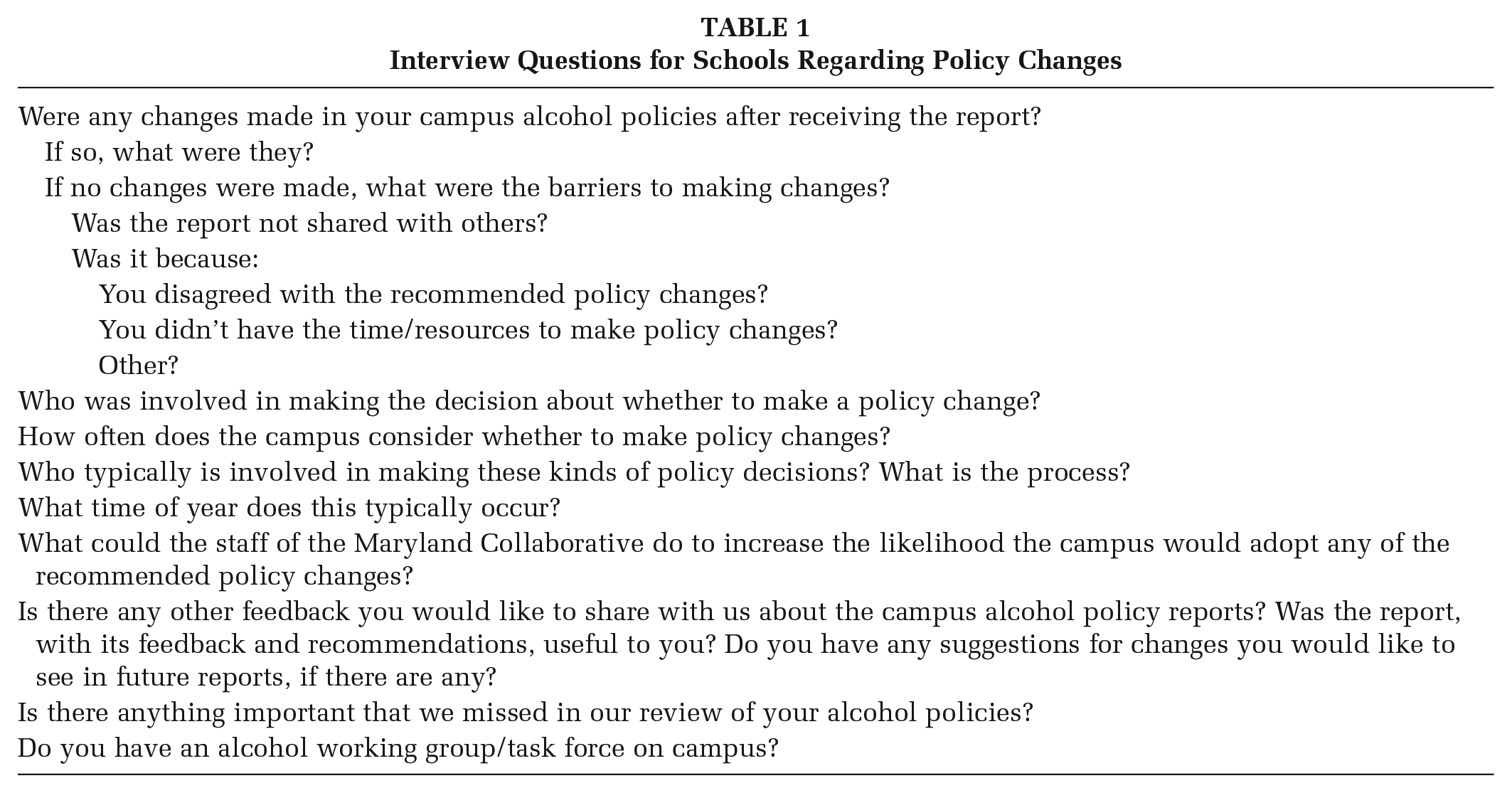
Collaborative staff conducted semi-structured qualitative interviews with the primary point of contact at each school in 2019, to ask verbally about any changes made, find out more about the policy change process on their campus, and explore barriers to policy change. The interview questions are shown in Table 1. The primary points of contact included eight student affairs administrators, six wellness center staff, and one residence life director. The Johns Hopkins Bloomberg School of Public Health Institutional Review Board determined this activity was not human subjects research.
Interview Questions for Schools Regarding Policy Changes
Results
Policy Effectiveness
Collection and coding of the 2019 campus alcohol policies revealed that of the 15 schools, since the 2016 assessment, 11 added policies considered most or somewhat effective, and four added most or somewhat effective consequences. Table 2 indicates that the most commonly adopted policy was a ban on alcohol paraphernalia on campus (five schools), followed by a ban on kegs on campus (three schools), the prohibition of hard alcohol on campus (two schools), prohibition of alcohol at student organization member events (two schools), mandated ID checks at on-campus events with alcohol (two schools), and mandated server training at on-campus events with alcohol (two schools). One school removed a most effective policy, the prohibition of tailgating on campus. The most commonly added consequence was parental notification after a student’s alcohol policy violation (two schools).
Campus Alcohol Policies and Consequences by Effectiveness Rating: Change From 2016 to 2019
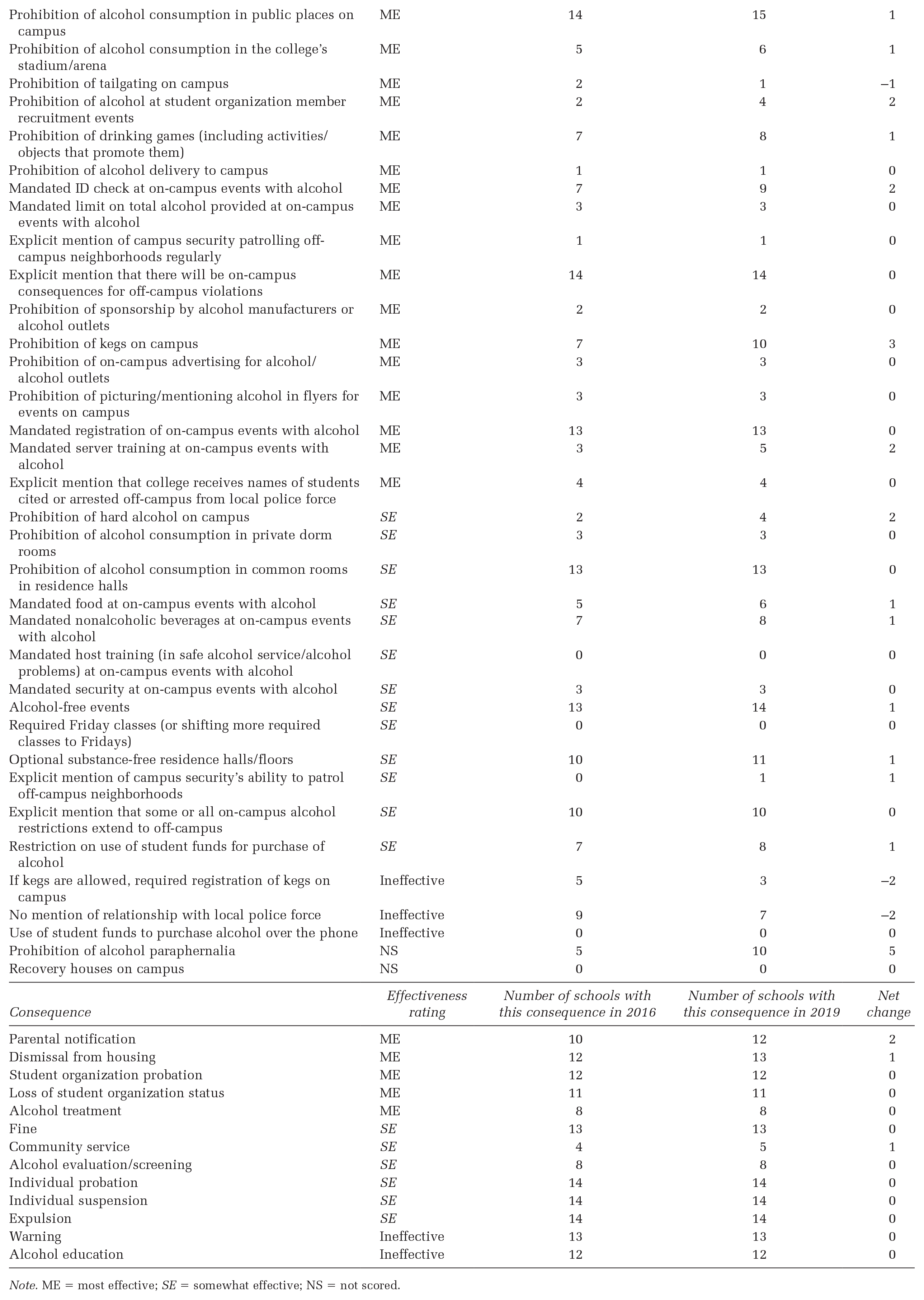
Note. ME = most effective; SE = somewhat effective; NS = not scored.
Policy Clarity
Seven schools improved their Flesch scores slightly; however, seven schools scored lower on readability in 2019 than in 2016, and one had no change (see Figure 1). Only two schools improved sufficiently from the “very difficult to read” to “difficult to read” category, and the readability of one school’s policies moved from “difficult to read” down to “very difficult to read.”
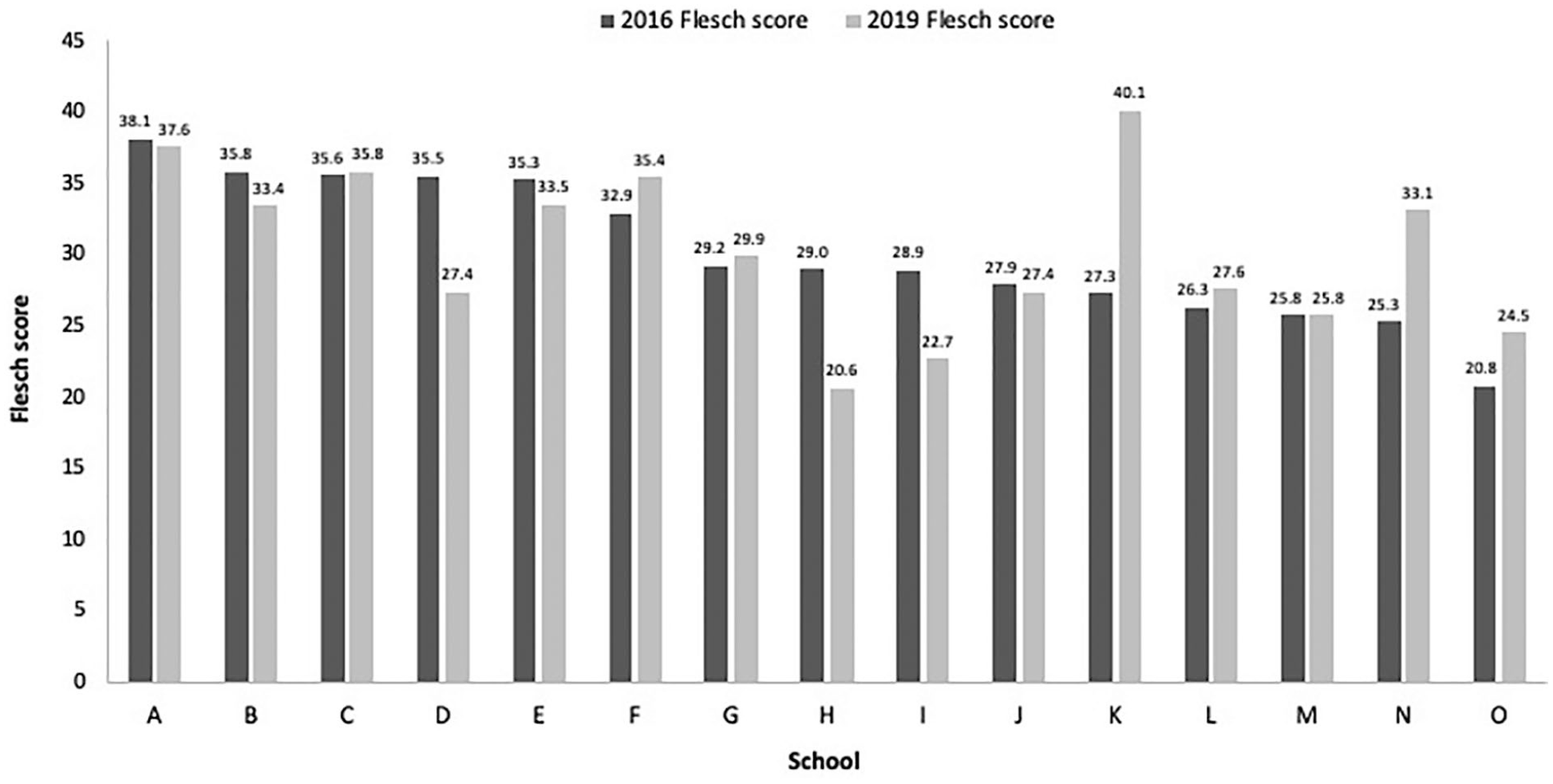
Alcohol Policy Flesch Readability Scores, 2016 and 2019
Communications With School Representatives
Conversations with the primary points of contact at each school showed that changes in campus alcohol policies are ongoing. Almost every school reported reviewing their policies annually. The general “season” for such changes was the spring semester, so that new policies could be in place for the beginning of the new academic year; however, two schools consider policy changes on a rolling basis.
Almost half the schools made no changes to their policies as a result of the campus alcohol policy assessment reports. The most common change involved increasing accessibility of policies on the schools’ websites. Three schools made changes not in response to the policy report per se, but because of technical assistance from the Maryland Collaborative staff. Namely, two schools added a campus social host policy, enabling campus authorities to levy fines on hosts of unruly off-campus parties, while a third initiated a pilot project requiring fraternities and sororities to use a third-party vendor for parties where alcohol was served.
When asked about barriers to changing campus alcohol policies, respondents most frequently mentioned staff shortages and transitions. When staff turnover leaves administrative positions vacant, remaining staff are stretched to cover the workload. In these situations, policy analysis and development are difficult to prioritize. In addition, policy change sometimes requires involvement of multiple individuals, including legal counsel and/or the University Senate. Several schools noted that not all their campus alcohol policies are listed on their websites, rendering web-based evaluation of their policies inaccurate. Several schools disagreed with some of the recommended changes, particularly related to increasing severity of consequences from the first, second, and third offenses. Administrators preferred maintaining flexibility to fit repercussions to the severity of the violation, for example such that a first violation of hosting a large party in a residence hall where underage drinkers were transported to the hospital would merit a stronger sanction than a first violation of being found with alcohol in a student’s room.
Respondents showed interest in the policies of peer institutions across the state, and having examples of both policies from other institutions and model policies implementing the most effective approaches. They also requested assistance regarding policies and prevention strategies for cannabis use and prescription opioid misuse.
Discussion
Environments play key roles in college student drinking, and policies set the parameters for what is acceptable in those environments. Campus alcohol policies can influence student drinking; a recent evaluation of policy changes at one university in New Zealand found that drinking to intoxication dropped substantially during 10 years following policy changes, including strengthening the student code of conduct and banning alcohol advertising on campus (Kypri et al., 2018). While little research in the United States exists regarding effectiveness of and best practices in campus alcohol policies, this project demonstrates that it is possible to assess and score policies, receive feedback, and support policy changes in the direction of higher levels of likely effectiveness.
Most schools assessed in this project improved their policies following receipt of the assessments. Participating schools in the Maryland Collaborative agree to consistently monitor drinking patterns and related harms through a student survey (Arria & Jernigan, 2018). However, the Maryland Collaborative is structured as a public health practice project and not a research project. Further research is needed to more fully explore the effects of policy change on student behavior, as well as the barriers and facilitators of policy change and adoption of more effective policies. The alcohol policy field has made substantial progress in assessing the synergistic effects of combinations of alcohol policies at the state level (Naimi et al., 2014; Xuan et al., 2015). A similar need exists for research related to campus alcohol policy effectiveness singly and in aggregate.
This study is limited by the fact that it utilized a non-representative sample of institutions in a single state in the United States; replication of this project among a more diverse sample of institutions would be a useful next step. Second, it is not possible to determine whether the assessment, scoring, and reporting process led to the policy changes observed. Some policies that appeared to have changed might have been in place previously but were not posted on the school’s website. While they did not necessarily fully attribute changes to the reports or recommendations provided, school contacts appreciated their conciseness, and found them to be a useful tool for considering improvements to their alcohol policies. In practice, the most substantive policy changes came about as a result of Maryland Collaborative staff working closely with campus administrators.
Implications for Policy and Practice
Beyond minimal federal requirements, colleges and universities have considerable control over the policies they set for acceptable behavior on campus, including the norms and standards they promote regarding alcohol use. Campus alcohol policies deserve more attention, from practitioners and researchers, as a “first line of defense” against the considerable negative effects of excessive alcohol use on college students.
Post-secondary educational institutions do not exist in bubbles of their own; indeed, the most effective measures to reduce college drinking, according to the National Institute on Alcohol Abuse and Alcoholism (2019), are better enforcement of minimum alcohol purchase age laws, establishing minimum unit prices for alcohol, and increasing alcohol taxes. Moderately effective strategies include limiting the number and density of alcohol establishments and enacting strong false ID laws. In most states, alcohol taxes have not been raised in decades and have lost much of their real dollar value and prevention capacity (Naimi et al., 2018); engagement by university leadership in state-level efforts to increase these taxes would support and enhance campus prevention policies and programming.
However, the first question state policy makers are likely to ask university leadership is about the policies over which administrators have direct control. Campus alcohol policies can and do change over time, and this project has shown that those changes can lead to alcohol policies that are more likely to be effective in supporting student health, safety, and success.
